


Wyoming is the state where the solar pitch and the solar bill argue with each other in the open. The pitch is true: this is big-sky country at 6,000 feet and higher, with cold clear air, about 250 sunny days a year in Cheyenne, and a kilowatt of panels that makes about 1,601 kilowatt-hours a year — production most of the country would envy. The bill is also true: Wyoming homes pay about 14 cents a kilowatt-hour on average, the 13th cheapest power in the country, and the biggest utility in the state charges 11.515 cents for the energy itself. Strong sun makes a lot of kilowatt-hours. Cheap power makes each one worth very little. That is the whole Wyoming story, and every section of this guide is a working-out of it.
The second thing to understand before any number is the calendar. Wyoming’s net-metering law is generous inside the year and ruthless at the end of it. Through the twelve months, every kilowatt-hour your panels send out becomes a credit worth the full retail price on a later bill. Come January, whatever credits are still sitting there get bought by the utility at its avoided cost — about 1.418 cents a kilowatt-hour on Rocky Mountain Power. A credit you use is worth about ten times a credit you sell. So the sizing question in Wyoming is not how much roof you have. It is how closely the year’s production matches the year’s use, because the gap between the two is where the money leaks out at a tenth of its value.
The third thing is distance. Wyoming is the least populous state in the country, spread across high plains, mountain valleys, and ranch country where the next house can be miles away. The main local installer works out of Lander and Laramie. Most other quotes come from Salt Lake City or Bozeman, Montana, and the drive is built into the price. The wind that makes the state famous — first in the nation for average wind speed — is also the wind the racking has to survive, and in Jackson the design wind speed is 115 miles an hour.
Open with the national picture in our solar panel cost guide, then measure Wyoming’s numbers against it.
Table of Contents
How Much Do Solar Panels Cost in Wyoming in 2026?
Two kinds of evidence describe the Wyoming market in 2026, and they disagree by enough to matter — so this guide prints both, names what each one measures, and anchors on the one built for comparison. EcoGen’s September 2026 Solar Cost Index, which this guide uses as its anchor, prices Wyoming at $3.14 per watt installed and the typical 7.04 kW system at about $22,106 before incentives. That is $0.25 above the national average of $2.89 a watt, about 9% higher, and it sits above every neighbouring state in the Index: Utah at $3.01, Colorado at $3.02, Nebraska at $2.91, South Dakota at $2.85, and Montana at $2.73. Wyoming is the most expensive solar market in its region, and the reason is printed in EcoGen’s own notes: design winds, mountain snow, and a small installer field spread across a very large state.
Quotes gathered from marketplaces form the second evidence stream. EnergySage’s Wyoming page, updated November 2026, prices the average system at $3.73 a watt — but on a much bigger system, 11.32 kW, for about $42,239 before incentives, with a range of $35,903 to $48,575. Its Cheyenne page prices a 9.64 kW system at $3.66 a watt, about $35,275. Those are real quote data from a marketplace, not a modeled index, and the gap between $3.14 and $3.73 is the point: Wyoming quotes spread wide because the jobs spread wide. A roof in Cheyenne and a ranch outside Pinedale are not the same job, and no single per-watt number should be allowed to hide that. Treat the EnergySage figure as the cross-check and the EcoGen figure as the anchor, and never blend the two into a third number that neither source published.
A third snapshot fills out the picture, flagged as a planning estimate. NumeralQ’s Wyoming page, built on EnergySage cost data retrieved October 26, 2026, prices an 8 kW system at $19,850 to $25,950, or $2.48 to $3.24 a watt. That range sits below the EcoGen anchor at its low end and above it at its high end, which is exactly what a planning range should do in a market this spread out. EcoGen’s own marketplace quote ranges, from May 2026 data centred on $3.33 a watt, run higher: 6 kW at $18,000 to $22,000, 8 kW at $24,000 to $29,000, 10 kW at $30,000 to $36,000, and 12 kW at $36,000 to $43,000. The spread between the NumeralQ low end and the EcoGen marketplace high end is the honest width of the Wyoming market. Get three quotes, and you will land somewhere inside it.
One caution about the typical system size first, because every number after this one depends on it. EcoGen’s 7.04 kW is the Berkeley Lab 2025 median for Wyoming single-family installs, drawn from 129 systems — a measured median, not a model. EnergySage’s 11.32 kW is the average size quoted on its marketplace, which skews larger because the homes that seek quotes tend to be the bigger users. Both are real. They describe different populations. This guide uses the 7.04 kW median as typical, because it is the size Wyoming homeowners actually installed, and it prices the bigger sizes separately so a large home can find itself in the table. Wyoming homes use about 817 kilowatt-hours a month, or roughly 9,804 a year — a 12-month EIA average to August 2026, with the average bill running about $114.50 a month. A kilowatt installed here yields about 1,601 kilowatt-hours a year, so a 7.04 kW array produces roughly 11,271 kilowatt-hours — close to 115% of an average home’s annual use. The typical system already makes more than the typical home uses, and that overshoot is where the January sale starts to bite.
Everything the install needs comes out of that per-watt figure: the panels, the inverter or microinverters, the racking, the wiring, the labour, and the cost of permits, inspection, and getting connected. A new roof, a panel upgrade, tree work, wind-rated racking, a battery, and travel to a remote site are all extra, and in Wyoming the wind engineering and the travel can be the biggest extras of all. Every one of those extras belongs on the quote as its own line, and this guide has put a number on each one it could verify. No incentive sits inside the arithmetic either, because there is none to put there for a 2026 owner purchase: no federal credit, no state rebate, no state tax credit, and no sales-tax exemption — the 4% state sales tax plus any local tax applies in full. No incentive trims that number, so a quote showing a lower price is still using a law that ended.
A word of caution before the tables: the lowest quote in Wyoming is not always the cheapest system overall, and in a state with one main local installer the second and third quotes are harder to get and more important for exactly that reason. Dealer fees of 10-30% of the cash price — sometimes more — often sit buried inside the amount a loan quote finances. When you set bidders side by side, the only figure that lines up cleanly is cash price per watt for identical equipment on the same roof. Ask for that figure in writing from at least three installers, and drop any bidder who will not hand it over.
| Source | $ per watt | System | Cash total | Payback |
|---|---|---|---|---|
| EcoGen Index (Sep 2026) | $3.14 | 7.04 kW | ~$22,106 | ~16.0 yrs (RMP, every credit used) |
| EcoGen marketplace quotes (May 2026) | ~$3.33 centred | 8 kW | ~$24,000-$29,000 | Not published |
| NumeralQ planning (Oct 2026) | $2.48-$3.24 | 8 kW | ~$19,850-$25,950 | Not published |
| EnergySage (Nov 2026) | $3.73 | 11.32 kW | ~$42,239 | 18.7 yrs — flagged, modeled |
| EnergySage Cheyenne (Nov 2026) | $3.66 | 9.64 kW | ~$35,275 | 17.6 yrs — flagged, modeled |
| National range (article 4) | $2.25-$3.30 | 8.2 kW | ~$24,600 at $3.00/W | 6-12 yrs |
Treat two rows in that table as footnotes, not headlines. EnergySage’s 18.7-year payback and its $16,824 of 25-year savings are modeled figures built on an 11.32 kW system at $3.73 a watt — a bigger, pricier system than the EcoGen typical — and they are flagged here rather than headlined. They are not wrong, but they are not the EcoGen payback either, and quoting one as the other would mix two different systems. The gap between 16.0 years and 18.7 years is mostly the price per watt and the system size, and any payback that does not name both is not a number you can use.
Solar Panel Cost in Wyoming by System Size
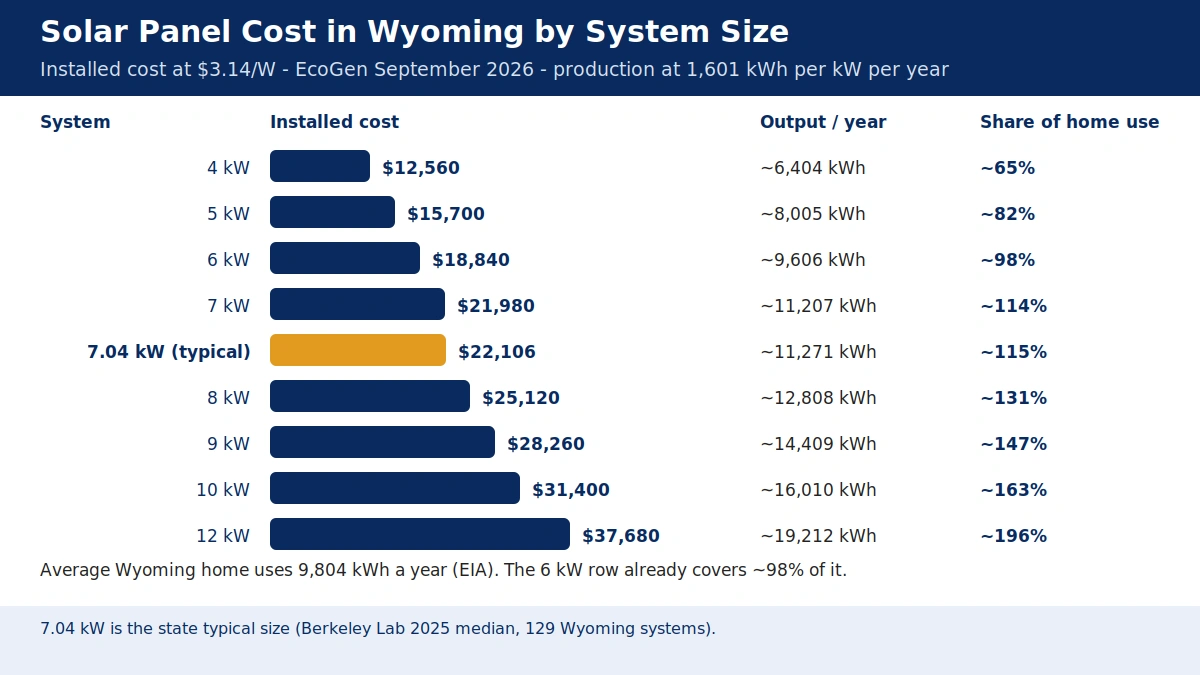
Size is the first decision, and in Wyoming the January sale punishes oversizing more than in almost any other state in this series — not because the surplus is worthless inside the year, but because it is worth almost nothing if it is still sitting there in January. Wyoming’s net-metering law carries your credits through the calendar year at full retail value, which is generous. Then, at the start of the next year, it sells whatever is left at the utility’s avoided cost — about 1.418 cents a kilowatt-hour on Rocky Mountain Power. A kilowatt-hour sent out in July and used in November saves the full retail price. A kilowatt-hour sent out in July and still unused in January earns 1.4 cents. That gap explains why the table below turns unfavourable past 7 kW for most Wyoming homes. The table prices every size from the EcoGen anchor of $3.14 a watt and 1,601 kilowatt-hours of output per installed kilowatt each year. It also lists the share of an average home’s use each size covers, so you can see at a glance where the array stops feeding the house and starts banking credits it may never spend.
| Size | Cost at $3.14/W | Yearly output | Share of avg. WY home use (9,804 kWh/yr) |
|---|---|---|---|
| 4 kW | $12,560 | ~6,404 kWh | ~65% |
| 5 kW | $15,700 | ~8,005 kWh | ~82% |
| 6 kW | $18,840 | ~9,606 kWh | ~98% |
| 7 kW | $21,980 | ~11,207 kWh | ~114% |
| 7.04 kW (state typical) | ~$22,106 | ~11,271 kWh | ~115% |
| 8 kW | $25,120 | ~12,808 kWh | ~131% |
| 9 kW | $28,260 | ~14,409 kWh | ~147% |
| 10 kW | $31,400 | ~16,010 kWh | ~163% |
| 12 kW | $37,680 | ~19,212 kWh | ~196% |
Look twice at two rows in that table. First, the 6 kW row already covers about 98% of average annual use — so even a 6 kW array nearly fills the house’s whole year, and the 7.04 kW typical system already makes about 15% more than the average home uses. Second, the 12 kW row makes nearly twice the average home’s use, which means roughly half its output ends the year as surplus credits, and any credits still unused in January sell for 1.4 cents. The sizing conversation starts with the twelve monthly bills, then the utility’s January price, and only then the roof.
Build the array size from twelve months of electric bills, not from empty roof space — and in Wyoming, size for the whole year, not for summer. Total the kilowatt-hours, divide by roughly 1,601 to find the size that covers them, then stop: if the result is 6 kW, buy 6 kW, because every kilowatt above that line earns the January price in the months it produces most. Add 1-2 kW for a planned EV or a heat pump, more for electric heat or a well pump that runs all summer, less for a shaded or north-facing roof — then check the result against the 25 kW net-metering cap in the state statute. Plan for an EV or a heat pump before you size anything: add the future load to the house first, then size the panels to it, because a load that arrives after the array is built leaves the array too small. Our 6 kW vs 8 kW vs 10 kW guide walks through sizing in full.
Solar Panel Cost by City: Cheyenne, Casper, Jackson & the Rest
Wyoming is a spread-out state with one big solar market in Cheyenne, a second in Casper, a third on cheap hydro in Jackson, and ranch country everywhere else — and the verified city prices run thinner here than in most states in this series, because the installer field is thin and the quote data is thinner. Only two cities carry a verified figure. The rest of this section stays honest about that gap, and leans on what can actually be verified instead: the utility behind the meter, which moves the Wyoming answer more than the install price does.
| City | $ per watt | Avg. system | Cash total | Utility |
|---|---|---|---|---|
| Cheyenne | $3.66 | 9.64 kW | ~$35,275 | Black Hills Energy (Cheyenne Light) |
| Casper | $2.48-$3.24 planning | 8 kW | ~$20,460-$26,740 | Rocky Mountain Power |
| Laramie | No verified figure | 8 kW ~$25,120 | Planning estimate only | Rocky Mountain Power |
| Rock Springs | No verified figure | 8 kW ~$25,120 | Planning estimate only | Rocky Mountain Power |
| Sheridan | No verified figure | 8 kW ~$25,120 | Planning estimate only | Montana-Dakota Utilities |
| Gillette | No verified figure | 8 kW ~$25,120 | Planning estimate only | Black Hills Power (NE WY) |
| Jackson | No verified figure | 8 kW ~$25,120 | Planning estimate only | Lower Valley Energy |
| Cody / Powell / Torrington | No verified figure | 8 kW ~$25,120 | Planning estimate only | Municipal utility — no statutory net metering |
Cheyenne is the biggest market in the state, served by Black Hills Energy through Cheyenne Light, Fuel and Power, and the only city with a figure built on marketplace quote data: EnergySage’s Cheyenne page, updated November 2026, prices a 9.64 kW system at $3.66 a watt, about $35,275, with a range of $29,984 to $40,566. That per-watt figure sits well above the statewide $3.14 anchor, which is exactly what a marketplace average should do when it measures bigger systems in the state’s most expensive city to serve — Cheyenne’s 115 mph design wind speed and its hail country do not come free. Treat the Cheyenne figure as a marketplace average, not a contractor bid, and do not quote either end of its range as the Cheyenne price, because it is not one.
Casper carries the only other verified figure, and it is a planning range rather than a quote average. NumeralQ’s Casper page, built on EnergySage data retrieved October 26, 2026, prices an 8 kW system at $20,460 to $26,740, or $2.48 to $3.24 a watt. Casper sits on Rocky Mountain Power, the state’s largest utility, and its range straddles the statewide anchor — which is what a planning range should do in a market where the installer drives in from somewhere else. The rest of the cities carry a warning label rather than a verified price. No EnergySage city figures were pulled in this pass for Laramie, Rock Springs, Sheridan, Gillette, or Jackson, and this guide does not invent them. The 8 kW planning estimate of about $25,120, built from the statewide $3.14 anchor, is printed so the reader has a number to plan around, and it is labeled a planning estimate.
What can be verified for those cities is the utility, and the utility matters more than the install price does. Sheridan sits on Montana-Dakota Utilities, where the payback runs about 20.5 years and a docket is pending to revise the net-metering tariff. Gillette sits on Black Hills Power’s northeastern Wyoming territory, where a rate case filed in March 2026 seeks about a 32% residential increase — a different territory from Cheyenne Light, with different rates. Jackson sits on Lower Valley Energy at 7.49 cents a kilowatt-hour — the cheapest power of the big utilities, and the longest payback in the state at about 26.2 years, because the power the panels replace is already cheap and hydro-based. Cody, Powell, and Torrington sit on municipal utilities that the state net-metering law does not cover at all, so a homeowner there has no statutory right to net metering and needs the city’s own solar terms in writing before ordering anything. A Jackson system and a Cheyenne system at the same price per watt are two different investments, and the city table should be read utility-first, price-second.
Judge the city table utility first and price second, and compare quotes on price per watt, never on the total. A Casper quote at the low end of its planning range and a Cheyenne quote at the marketplace average are not a close call once the January prices are in: the Casper array banks its credits through the year at Rocky Mountain Power’s retail rate, and the Cheyenne array does the same on Black Hills — but the Cheyenne system costs more per watt to build, and its January sale price is set by a different utility’s avoided cost. The payback section below runs that comparison for each utility.
Wyoming’s Sun: High Elevation, Cold Air & Long Bright Days
Wyoming’s sunshine arrives with a shape that flatters the panels and punishes the bill at the same time: a lot of it, at high altitude, in cold clear air — and a power price so low that each kilowatt-hour it makes is worth very little. A production estimate that is honest has to carry both halves of the story, and the price per kilowatt-hour, not the sunshine, is what decides whether the system pays.
The sun, by the numbers. One kilowatt of panels in Wyoming yields roughly 1,601 kilowatt-hours a year on EcoGen’s PVWatts-based figures — among the strongest solar resources in the northern United States, about 10% above the 50-state planning average. Cross-checks land in the same place: the Home Solar Atlas planning yield gives 1,480 kilowatt-hours per kilowatt per year, Elovane’s PVWatts figure gives about 1,450 for a south-facing system at a 20-degree tilt, and Unbound Solar’s NREL table gives Wyoming 5.2 peak sun hours a day, ranked 10th in the country, against a national average of about 5.0. Take 1,601 as the working annual figure, anchored on EcoGen, and treat the cross-checks as the honest width of the estimate — a site with shade, a north-facing roof, or a low tilt will land nearer the lower figures, and a clear south-facing roof at altitude will land nearer the anchor.
The elevation is the story. Cheyenne sits at about 6,200 feet, Laramie higher still, and much of the state sits above 6,000 feet. At that height the air is thinner, drier, and clearer, and the sun hits harder than it does at sea level — Cheyenne’s own historical marker notes that the sun there is as intense as in desert cities further south, and the city counts about 250 sunny days a year. Thin air also means cold nights and wide temperature swings: Cheyenne’s record runs from minus 34 to 100 degrees Fahrenheit, and the temperature once fell 40 degrees in half an hour. For panels, the cold is a gift and the swing is a warning — the gift is efficiency, the warning is that every seal, wire, and mounting point has to survive freeze-thaw cycles that southern roofs never see.
Cold is a genuine advantage. For each degree Celsius a cell heats beyond 25, it sheds roughly 0.3-0.5% of its efficiency. A Wyoming rooftop in January runs far cooler than 25 degrees, and even a July rooftop in Cheyenne rarely bakes the way a Phoenix roof does — so a system here squeezes more out of each hour of sunshine than the same panels would on a hot southern roof. Cold, clear, high-altitude air is some of the finest solar weather there is, and it explains much of why Wyoming’s per-kilowatt production holds up as well as it does for its latitude. The same physics means the panels need the sun to be up to use it — and in December the days are short, the sun is low, and snow is on the ground.
Snow changes the math in both directions. A tilted array sheds snow, and a steep one sheds it fast — but Wyoming’s snow is not Alaska’s snow. Cheyenne averages about 59 inches a year, and the wind that follows a storm often clears a roof faster than the sun does. Snow on the ground helps too: reflection off snow can boost energy capture in the spring and fall months, when the sun is low and the ground is still white. But snow sitting on the panels means lost production until wind or slope clears it, and a low-slope roof anywhere in the state holds snow longer than a steep one. No Wyoming-specific snow-loss percentage was verified for this guide, so none is stated here — if an installer shows you a production estimate, ask to see the snow-loss assumption inside it, and ask what tilt it assumes.
The roof, and the wind load it carries. A rooftop array in Wyoming sits under wind the racking has to survive for 25 years — the state ranks first in the nation for average wind speed at 12.9 miles an hour, winter winds frequently run 30 to 40 miles an hour with gusts of 50 or 60, and gusts over 80 miles an hour are not unusual in Cheyenne. Jackson sets a design wind speed of 115 miles an hour, and Cheyenne’s published design wind speed is 115 miles an hour too. That is the number the racking engineering answers to, and it means more attachment points, upgraded hardware, and more labour than a calm-state install needs. Ground snow load runs lighter than the mountains suggest on the plains — Cheyenne’s 50-year ground snow load is 18 pounds per square foot — but Jackson sets its ground snow load site by site under the 2024 building codes, and the mountain towns of Jackson, Pinedale, and Star Valley get heavy snow that a Cheyenne racking design would not survive. Confirm the roof’s wind and snow ratings with the county building department before signing, and let that department’s figures govern, not the installer’s guess. A roof with under ten years of life left should be replaced first, because a later reroof means paying to remove and reinstall the whole array. Our roof replacement guide carries the reroof pricing. For solar, standing-seam metal is hard to beat: clamps grip the seams without a single penetration, and snow leaves a metal roof sooner than it leaves asphalt shingles. Panels rated UL 61730 / IEC 61730 remain the specification to ask for, and homeowners insurance remains the cover for storm and hail damage — Cheyenne averages more than eight days with hail a year.
Working with the climate. Nothing exotic is required, but standard equipment still needs tuning to Wyoming conditions. Pick a south-facing orientation where the roof allows it, a tilt near the latitude that still sheds snow, microinverters or optimizers so a shaded or snow-covered string cannot drag the whole array down, and a production estimate built on PVWatts data with the snow assumption out in the open, not hidden. And ask for the wind-load calculation by name: any installer working the I-80 corridor who cannot show ASCE 7 compliance for the county’s design speed has not finished the engineering.
Net Metering in Wyoming: Monthly Credits & the January Sale
People get Wyoming wrong in both directions, and here the correction counts more than almost anywhere else. One common claim is that Wyoming has no net-metering law at all. That is wrong. The other common claim is that Wyoming’s net metering is full retail, forever, with no catch. That is wrong too. What Wyoming has is a statewide statute with a generous year and a hard stop in January — and the difference between those two wrong claims and the real rule is the difference between a system that pays in 16 years and one that never does.
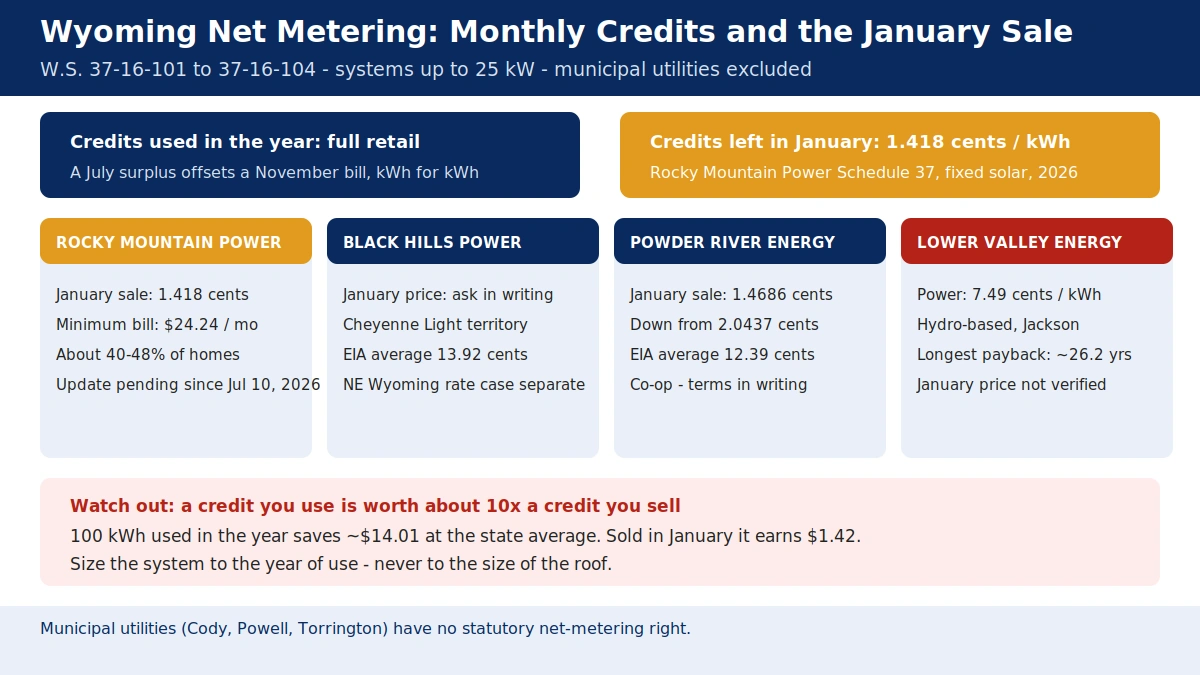
The rule. Wyoming’s net-metering statute, W.S. 37-16-101 through 37-16-104, covers investor-owned utilities, electric cooperatives, and irrigation districts, for systems up to 25 kW. Each billing month, the panels’ output cancels out the house’s consumption one kilowatt-hour at a time, at the full retail rate. Excess kilowatt-hours become a credit on the next bill, one for one. Those credits carry forward through the calendar year, still at full retail value — so a July surplus can offset a November bill in full. At the start of each calendar year, whatever credits are still unused are sold to the utility at its filed avoided cost. The credits do not expire during the year, but they never survive January at retail value. A July surplus settles in July’s value if you use it before the year ends. It settles in January at about 1.4 cents if you do not.
The January settlement is the fact this whole guide turns on, so it is worth stating three ways to make sure it lands. First, there is no banking past the year: the summer surplus cannot be stored on the bill into the next year at retail value. Second, the January price is set by each utility, it changes when the utility files a new avoided-cost schedule, and the utilities do not agree with each other — Rocky Mountain Power pays 1.418 cents, Powder River Energy pays 1.4686 cents, and every other utility sets its own. Third, the rule binds only the utilities the statute names: municipal utilities are left out of the definition of an electrical company, so a household in Cody, Powell, or Torrington has no statutory net-metering right at all, and needs its own city’s solar terms in writing — and the answer may be nothing at all.
Rocky Mountain Power — about 40 to 48% of Wyoming homes, Casper, Laramie, Rock Springs, and much of the south and centre. Rocky Mountain Power is Wyoming’s largest utility, and its January price is the one most Wyoming solar owners will meet. Its Schedule 37 avoided-cost price for unused net-metering credits from a fixed rooftop solar system is 1.418 cents a kilowatt-hour for 2026, effective April 30, 2026 under Docket 20000-687-ET-25. An update has been pending since July 10, 2026, under Docket 20000-714-ET-26, so the price for the January 2027 sale is not settled yet — check whether it was approved before you sign, because a pending rate is not a locked rate. Rocky Mountain Power’s residential energy rate runs 11.515 cents a kilowatt-hour on Schedule 2, effective July 1, 2026, and its EIA 12-month average price runs 15.60 cents — but the fixed monthly charge is never offset by solar credits, so the value of a self-used kilowatt-hour works out to about 12.27 cents once that charge is taken out. The utility also charges a minimum monthly bill of $24.24 — a $23.00 basic charge plus riders — which comes to $291 a year that solar cannot touch. Even a perfectly sized system still pays that.
Black Hills Energy, Cheyenne Light — Cheyenne and the capital region. Cheyenne Light, Fuel and Power is Black Hills Energy’s Wyoming arm in Cheyenne, and its customers net under the same state statute. Its EIA 12-month average price runs 13.92 cents a kilowatt-hour, and the value of a self-used kilowatt-hour works out to about 12.00 cents once the fixed charge is taken out. No Black Hills January avoided-cost figure was verified in this pass, so none is stated here — and that absence is itself the instruction: get the current January price in writing from Black Hills before you sign, because a quote built on Rocky Mountain Power’s 1.418 cents is fiction for a Cheyenne home. Black Hills’ northeastern Wyoming territory, around Gillette, is a separate rate case entirely: the company filed in March 2026 to raise residential rates there by about 32%, after holding base rates unchanged for more than a decade, with new rates anticipated in early 2027 if approved. Do not mix the two territories’ numbers.
Montana-Dakota Utilities — Sheridan and the northeast. Montana-Dakota nets under the same statute through its Rate 58, for systems up to 25 kW, crediting the month’s net kilowatt-hours to the next bill and selling any leftover credits at the start of the year at its Parallel Generation Rate 57 avoided cost. Its EIA 12-month average price runs 13.86 cents, and the value of a self-used kilowatt-hour works out to about 9.59 cents once the fixed charge is taken out. Two warnings travel with this utility. First, Montana-Dakota applied for a 24.36% rate increase the year before, which would shorten payback if approved and lengthen the wait if it is not. Second, the company filed Docket 20004-179-ET-26 to revise its net-metering tariff, and the outcome was still unconfirmed when this guide was written. A Sheridan household should get the current tariff in writing, and ask the utility directly whether a revision is pending, before ordering panels.
Powder River Energy — the northeast co-op. Powder River is the co-op whose January price is actually published and current: 1.4686 cents a kilowatt-hour since January 1, 2026, down from 2.0437 cents the year before. Its EIA 12-month average price runs 12.39 cents, and the value of a self-used kilowatt-hour works out to about 9.94 cents. The drop from 2.04 to 1.47 cents is a useful warning in miniature: the January price is not a constant, it is a filing, and it can fall by more than a quarter in a single year. Size the system so the January price hardly matters, and a filing like that costs you nothing.
Lower Valley Energy — Jackson and the Tetons. Lower Valley is the outlier on the other side. Its power is hydro-based and cheap — an EIA 12-month average of 7.49 cents a kilowatt-hour, the lowest of the big Wyoming utilities — so the power the panels replace is worth barely half the statewide average, and the payback stretches to about 26.2 years on any plausible January price. No Lower Valley January avoided-cost figure was verified in this pass. The Jackson case is the cautionary one: the same panels, the same installer, the same 1,601 kilowatt-hours per kilowatt — and a retail rate so low that the payback runs past the panel warranty. A Jackson homeowner should run the numbers twice, then trust the second run.
The co-ops and the cities write their own rules where the statute does not reach. Seventeen electric cooperatives serve parts of Wyoming, including High West Energy, Carbon Power and Light, Wheatland REA, Bridger Valley Electric, and High Plains Power. Each sets its own net-metering terms inside the statute’s frame, and some add facilities charges for solar customers, so read the tariff before you sign. And the municipal utilities — Cody, Powell, Torrington, and others buying through the Wyoming Municipal Power Agency — sit outside the statute entirely. Before signing, a household on a municipal utility needs its own city’s solar terms in writing.
The flagged conflict. One national site, ConsumerAffairs, claims that Wyoming’s net-metering rules “changed significantly in 2026” and that new solar owners “are likely to be paid less for their excess power”, citing Senate File 111. That claim does not survive the record. Senate File 111, the 2025 net-metering revisions bill, failed its third reading on the Senate floor on February 5, 2025, by 10 votes to 17. House Bill 183, the rancher-backed bill to raise the cap, failed the same session. A plug-in solar bill, House Bill 146, died in committee in February 2026. EcoGen’s October 2026 check states plainly that net metering is unchanged: bills to cut it failed in 2025, and none passed in 2026. Do not let a quote cite the ConsumerAffairs claim for a Wyoming home.
Ranch Solar & the 25 kW Cap: When the House Is Not the Whole Load
Most solar guides in this series size a system to a house. In Wyoming, the house is often not the whole load — and sometimes it is not even the biggest load. A ranch runs a well pump, a shop, a barn, stock tanks, an irrigation pivot, and a house, all on the same meter or across several meters, and the solar arithmetic for that load looks nothing like the arithmetic for a suburban roof in Cheyenne. This section is for the ranch, because the ranch is where Wyoming solar most often gets sized wrong.
The cap is the first fact. Wyoming’s net-metering statute covers systems up to 25 kW. A system bigger than that falls outside net metering and into the PURPA qualifying-facility tariffs — Schedule 37 territory — where the power is bought at avoided cost from the first kilowatt-hour, not credited at retail. For a house, 25 kW is far above any residential size, and the cap never binds. For a ranch with a well pump and a shop, 25 kW can bind fast: a 25 kW array makes about 40,000 kilowatt-hours a year at Wyoming’s production rate, which covers a large ranch house and a modest shop, but not a ranch house plus a big irrigation load. Size past the cap and the economics change completely, because the retail credit disappears and the avoided-cost price takes its place.
The 2025 fight over the cap is the second fact. In the 2025 session, ranchers backed House Bill 183, the net-metering amendments bill, which would have raised the qualifying size from 25 kW to 200 kW — enough for a school, a municipal building, or a working ranch to net-meter its real load. The bill cleared the House, then stalled in the Senate after amendments that would have exposed net-metering customers to new fees, and it failed. Senate File 111, which would have let the Public Service Commission set a different compensation system for new customer-generators, failed its third reading 10 to 17. The cap stays at 25 kW, and the ranchers who backed the bill are still waiting for another session. A ranch buyer should not plan on a higher cap arriving, and should not let an installer promise one.
The ranch load is a good solar load — if it is daytime. Well pumps, stock-tank heaters in the shoulder seasons, shop tools, and irrigation pumps mostly run in daylight, which is exactly when the panels make power. A kilowatt-hour used the moment it is made saves the full retail price, and it never has to survive to January at 1.4 cents. That makes a ranch with a big daytime load a better solar candidate than a town house of the same size, even on the same utility — provided the system stays under the 25 kW cap and the load is metered together with the array. Where the loads sit on separate meters, the array can only offset the meter it is wired to, and the rest of the ranch keeps buying power at retail. Ask the utility, in writing, how multiple meters on one property are treated before you size anything.
The shop, the barn, and the ground mount. A ranch rarely needs to put panels on the house roof at all. A ground mount beside the shop, on a tracker or a fixed rack at a steep tilt, avoids the roof entirely, sheds snow better, and lets the owner clean and service the array without climbing. It also costs more per watt than a roof mount — more steel, more concrete, more trenching — and the wind engineering matters more, because a ground mount in the I-80 wind corridor is a sail. EcoGen’s warning is blunt: sites near Rawlins, Arlington, and Elk Mountain need structural upgrades, and if the total passes $4.00 a watt, payback runs past the useful life of the equipment. Get the ground-mount price as its own line, with the wind engineering shown, and compare it against the roof price on the same spec sheet.
Payback: How Long Until Wyoming Solar Pays for Itself?
Payback is where a Wyoming system either earns its keep or does not, and the answer turns on which utility sends the bill — more sharply than in most states in this series, because the utilities disagree with each other by a factor of three on the price of power. The worked examples below are built on EcoGen’s anchors, so every input can be checked against the source, with EnergySage as the cross-check — and the guide flags each place where the two disagree.
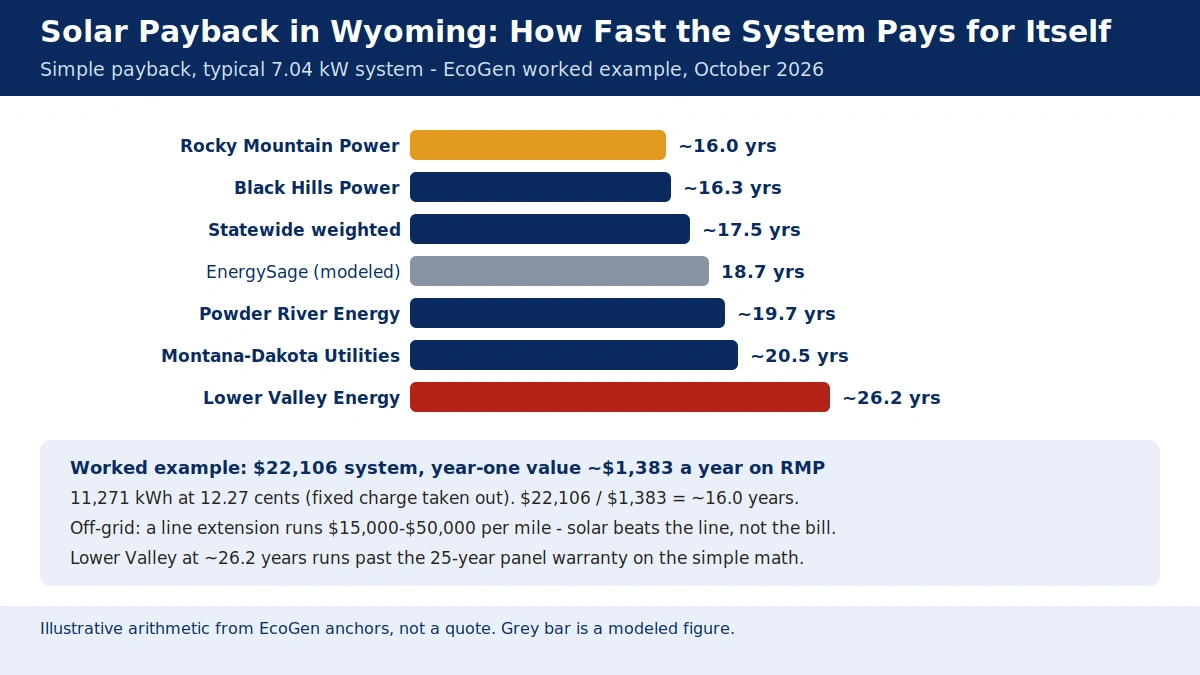
A worked example. Take a typical 7.04 kW system at $3.14 a watt — $22,106 before incentives — as the starting point. Annual output comes to about 11,271 kilowatt-hours at 1,601 per kilowatt. EcoGen publishes the payback figures below before incentives, keeping the arithmetic comparable across utilities — and in Wyoming, before incentives equals after incentives, because none exist. One more input matters before the table: the fixed monthly charge. Rocky Mountain Power’s minimum bill of $24.24 a month, or $291 a year, can never be offset by solar credits, so EcoGen takes it out of the per-kilowatt-hour value before doing the division. That is why the value below is 12.27 cents, not the 15.60-cent EIA average.
Rocky Mountain Power is the benchmark payback. EcoGen’s per-utility worked example for Rocky Mountain Power puts the year-one value at about $1,383 a year: 11,271 kilowatt-hours valued at 12.27 cents each, with every credit used before January. Dividing $22,106 by $1,383 gives a simple payback of about 16.0 years, counting no incentives, no upkeep, no rate rises, and no financing costs. That is inside the 25-year panel warranty, with about nine years of savings after the system has paid for itself. But it leans on two conditions that are easy to miss: every credit gets used before January, and rates do not fall. Let a chunk of credits survive to the January sale at 1.418 cents, and the payback runs longer — EcoGen’s own figures do not model that case, and neither does this guide, because the size of the overshoot decides it. Rising rates shorten it: Rocky Mountain Power’s rates have climbed 3.3% a year since 2019, and the company has filed for an 8.8% increase with a first step proposed from March 15, 2027.
Black Hills Power is a close second. The same 7.04 kW system on Black Hills Power — the Cheyenne Light territory — earns about $1,353 a year at 12.00 cents a kilowatt-hour once the fixed charge is taken out, for a simple payback of about 16.3 years. The difference from Rocky Mountain Power is a few months, not a different investment. What would change it is the rate case in the company’s northeastern territory, which seeks about 32% — but that case covers Gillette, not Cheyenne, and a Cheyenne buyer should not count a Gillette rate rise in a Cheyenne payback.
The co-ops and the small utilities stretch the payback out. Powder River Energy comes in at about 19.7 years — $1,120 a year at 9.94 cents — and Montana-Dakota Utilities at about 20.5 years — $1,081 a year at 9.59 cents. Lower Valley Energy, on cheap hydro at 7.49 cents, comes in at about 26.2 years — $844 a year — which runs past the 25-year panel warranty on the simple arithmetic, before any rate rise is counted. The statewide weighted figure, across Rocky Mountain Power, Lower Valley, Powder River, Montana-Dakota, and Black Hills, sits at about 17.5 years. No EcoGen payback was published for the municipal utilities, so none is stated — a Cody or Powell household has no statutory net metering to build a payback on at all.
| Case | Simple payback | Source |
|---|---|---|
| EcoGen Rocky Mountain Power (7.04 kW) | ~16.0 yrs | EcoGen per-utility figures, Oct 30, 2026 |
| EcoGen Black Hills Power (7.04 kW) | ~16.3 yrs | EcoGen per-utility figures, Oct 30, 2026 |
| EcoGen statewide weighted | ~17.5 yrs | EcoGen per-utility figures, Oct 30, 2026 |
| EnergySage Wyoming (11.32 kW) | 18.7 yrs | EnergySage, Nov 2026 — flagged, modeled |
| EcoGen Powder River Energy (7.04 kW) | ~19.7 yrs | EcoGen per-utility figures, Oct 30, 2026 |
| EcoGen Montana-Dakota (7.04 kW) | ~20.5 yrs | EcoGen per-utility figures, Oct 30, 2026 |
| EcoGen Lower Valley Energy (7.04 kW) | ~26.2 yrs | EcoGen per-utility figures, Oct 30, 2026 |
The flagged conflict. EnergySage reports an 18.7-year payback and $16,824 of 25-year savings for Wyoming. That figure is modeled on an 11.32 kW system at $3.73 a watt — a bigger, pricier system than the EcoGen typical — and it is flagged here rather than headlined. It is not a verified EcoGen payback, and it should not be quoted as one. The gap between 16.0 years and 18.7 years is mostly the price per watt and the system size, and any payback that does not name both is modeling a different system.
What moves the payback most. Sizing is the biggest lever, and in Wyoming it matters more than anywhere else in this series except the states with monthly settlement. A system matched to the year’s use keeps every credit at retail value. A system 30% bigger than the year’s use hands a third of its output to the January sale at 1.4 cents, and the payback stretches by years. Rate escalation is the second lever: Rocky Mountain Power’s rates have grown 3.3% a year since 2019, so 25-year savings grow steadily, and the filed 8.8% increase would shorten the payback if the commission approves it — but no rate rise is counted in the figures above, so any rise is upside, not assumption. Daytime self-use is the third lever: shifting the dishwasher, the laundry, and the EV charger into daylight hours moves kilowatt-hours out of the credit bank and into immediate self-use, which protects them from the January sale entirely. The fourth lever is financing: a solar loan’s dealer fees can add 10-30% to the effective price, so compare bids on cash price per watt rather than on the monthly payment.
Who still comes out ahead. Four kinds of Wyoming household clear it. The Rocky Mountain Power or Black Hills customer who sizes the system to the year’s use and plans to stay in the house well past year 16. The household with a big daytime load — a home office, daytime laundry and dishwashing, an EV charged at midday, a well pump that runs in the sun — that keeps most of its production at full retail value and never lets credits pile up for January. The home that adds a heat pump or an EV to its panels, sizing the array around the new daytime load and keeping it inside the 25 kW cap. And the ranch or remote household that buys mainly to avoid a line extension or to stop running a generator, with savings measured in miles not run and fuel not burned — in that case the payback math is context, not verdict, and the off-grid section below does that arithmetic properly. Walk away when your home sits on Lower Valley’s 7.49-cent power and you are counting on a quick return, when you use under 500 kilowatt-hours a month and the fixed charges eat most of the bill, when you plan to sell within five years, or when the installer projects savings without naming your utility’s January price and its pending filings.
Off-Grid Solar in Wyoming: Ranches, Cabins & the Line-Extension Question
Off the grid, solar stops being a payback story and becomes a distance story — and the distance story is the strongest one in this guide. A grid-tied Cheyenne home is really arguing about whether its panels pay back in 16 years or 19. A ranch ten miles past the end of the line argues about what it costs to bring the line to the ranch, and that argument is usually settled before the panels are even priced.
Beyond the grid, the solar case stops being an argument and becomes a win. A remote property’s power has to arrive somehow, and the utility’s answer is a line extension — a quote that runs, nationally, about $15,000 to $50,000 per mile, before the trenching, the easements, and the monthly minimum bill that follows. Against that, a complete off-grid cabin system runs, nationally, about $3,800 for a weekend cabin, about $14,000 for a year-round cabin, and about $26,400 for a full homestead — figures from national build guides, flagged as national, because no Wyoming-specific off-grid price was verified for this guide. The panels do not need a net-metering statute, a utility, or a January sale price. They need sun, and Wyoming has more of it, per kilowatt, than almost anywhere in the northern United States. Where the line extension costs more than the solar system, the solar system is not the expensive option. It is the cheap one.
What a real remote Wyoming property runs. The loads are different from a town house, and they are friendlier to solar than a town house’s loads. A well pump runs in daylight. A shop runs in daylight. A stock tank heater runs in the cold months, when the panels are at their least productive — which is the load to plan around, not the load to ignore. A cabin’s daily draw is small: lights, a refrigerator, a well pump, communications gear, each on its own line in the load list. Measure the loads before sizing anything — a refrigerator, a pump, and a freezer do not add up to a guess, and a system sized on a guess is a system that runs the generator all winter. Design for two to three days of autonomy — the battery bank’s ability to run the loads with no solar input at all — because that covers the ordinary cloudy stretch without buying a bank big enough for the worst week of the year. A bigger bank than that costs more than the generator it replaces.
The winter truth, stated plainly. No off-grid Wyoming system runs the winter on solar alone without a generator, and any installer who says otherwise is selling a battery bank, not a power system. December gives the panels short days and low sun, snow sits on the array until the wind or a steep tilt clears it, and a system sized to cover December and January with no generator at all would need far more panels and batteries than the same system sized for the other ten months. The economical answer is a hybrid: panels and batteries carry the bright months, and a propane or diesel generator covers the dark core, running a few hours a day to charge the batteries in one go. Running the generator a little in December and January avoids spending a fortune on panels and batteries that would sit unused for the rest of the year. Size the battery for two or three days of cover, not two weeks — a fortnight of storage in December costs more than the generator it replaces.
Batteries in the cold. Off the grid, a battery stops being an accessory and becomes the whole system — and Wyoming’s cold and wind demand a climate plan built around it. Lithium batteries lose usable capacity in deep cold, so the bank belongs in a heated, insulated space: inside the cabin, in a heated shed, or in an insulated room below the frost line. A 13.5 kWh storage add-on runs about $13,500 to $16,200 installed in Wyoming at EcoGen’s $1,000 to $1,200 per kilowatt-hour, and a battery the owner installs in 2026 gets no federal credit either, because section 25D covered storage too and it closed on the same date. On the grid, a battery’s earnings are the spread between the January sale price and the retail rate, and in Wyoming that spread is real but narrow — storing a kilowatt-hour that would otherwise sell for 1.418 cents in January and using it instead of buying at 12.27 cents saves about 11 cents, so a $15,000 battery does not pay as an arbitrage device in any reasonable time. Off-grid, the battery’s earnings are the generator fuel and the line extension it displaces, and the same battery pays far faster. Buy the battery for backup and fuel savings off the grid. On-grid, buy it as backup only, and treat the spend as resilience, not as an investment.
What to ask before an off-grid build. How many kilowatt-hours a day does the property actually use, measured, not guessed — the well pump, the refrigerator, the lights, the shop tools, the communications gear, each on its own line. What the line extension would cost, in writing, from the utility — because that number is the budget the solar system competes against, and without it there is no comparison at all. Ask what tilt the mount allows and whether it changes with the seasons: a summer-fixed tilt wastes spring sun, and a winter-fixed tilt wastes the summer. How the batteries stay warm, and what they do at minus 20 degrees. How the generator starts itself when the batteries run low, and who services it when it will not start. And whether the panels are bifacial, which catch the snow’s reflection from underneath as well as the sun from above — a real gain where the ground stays white for months of the year.
Wyoming Incentives in 2026: What Exists and What Does Not
Once the federal credit vanished, most states still had something left — a state credit, a rebate, an exemption of some kind. Wyoming holds even less than that, and its short list deserves a careful read, because most Wyoming solar advertising omits it — and because both programs that do exist are easy to mistake for something else.
Wyoming offers no state rebate for home solar, and it levies no state income tax to credit against. No check arrives in the mail for a Wyoming rooftop — not from the state, not from any large utility. A state solar tax credit cannot exist here because Wyoming levies no individual income tax at all. There is no state sales-tax exemption because the exemption that once existed was repealed — Wyoming’s renewable-equipment sales-tax exemption ended on June 30, 2012, and the 4% state sales tax plus any local tax applies in full to solar equipment and installation. The only money in a Wyoming solar project is on the electric bill: power used at home at full retail, and credits banked through the year at full retail until January. Everything else in this section is either a program for someone else or a program that pays for something other than panels.
Property tax is the one claimed exemption, and it is unverified — do not count on it. Several websites claim Wyoming exempts solar from property taxes. No statute and no Wyoming Department of Revenue guidance confirms it, and at least one national source contradicts it directly. EcoGen’s October 2026 check calls the exemption unverified and instructs the buyer to verify it with the Department of Revenue before counting on it. That is the position this guide takes too. Ask the county assessor how a solar array is valued before you sign, and get the answer in writing, because a claimed exemption with no statute behind it is a rumour, not a right.
The old state rebate is gone, and there is no renewable portfolio standard. Wyoming’s old state rebate, the Wyoming Business Council’s Residential Renewable Energy Program, is no longer active. Wyoming has no renewable portfolio standard, which means there is no SREC income either — no market that pays a homeowner for the renewable attributes of the power the panels make. A quote that shows an SREC line for a Wyoming home is describing a market that does not exist in this state.
The federal home energy rebates have not launched in Wyoming. The state was allocated about $69.1 million in total — $34,484,390 for HEAR and $34,616,394 for HOMES, per the federal dataset — but Wyoming is not on the federal launched map, and the Wyoming Energy Office’s program, the WEA Home Energy Savings Program, has no launch date. The federal government recommitted about $69 million in June 2026, and the state program page retrieved in September 2026 still said the program was expected to launch in 2025 — a stale date that tells its own story. There is no way for a Wyoming household to apply for HEAR or HOMES money today, and no announced start date. Even after the programs launch, HEAR still will not pay for solar.
Utility efficiency rebates exist, but they are not solar rebates. Rocky Mountain Power’s Wattsmart program offers rebates for heat pumps and heat-pump water heaters in Wyoming — the trade-ally chart runs to August 2026 — and several co-ops offer their own heat-pump rebates in the $500 to $1,700 range, according to secondary sources. Those rebates pay for the heat pump, not for the panels, and they do nothing at all for a solar-only job. Any installer who folds a Wattsmart rebate into a quote for panels on a roof is describing a program that does not work that way. A heat pump paired with new panels is a common move, and the heat-pump half may qualify for a Wattsmart rebate. The solar half never will.
Community solar is not verified here. No Wyoming community-solar program was verified for this guide — no shared array to subscribe to, no bill credit to claim, no price to print. A renter, a condo owner, or a homeowner with a shaded roof has no verified community-solar route in Wyoming today. Do not let a quote cite one.
| Item | Value | Notes |
|---|---|---|
| WY state rebate for panels | $0 — none exists | No state or utility rebate for home solar |
| WY state income-tax credit | None — no state income tax | Nothing to credit against |
| WY state sales-tax exemption | None — repealed Jun 30, 2012 | 4% state sales tax + local tax applies in full |
| Property-tax exemption | Unverified — disputed | No statute or Dept. of Revenue guidance confirms it; verify with assessor |
| Renewable portfolio standard / SRECs | None | No SREC income in Wyoming |
| Old WY Business Council rebate | $0 — no longer active | Residential Renewable Energy Program ended |
| HEAR / HOMES rebates | Not launched | ~$69.1M allocated; no launch date; state page still said “expected 2025” |
| Wattsmart / co-op efficiency rebates | Heat pumps only | Pays for heat pumps and water heaters, never for panels |
| Community solar | None verified | No program found for Wyoming households |
| Net metering (W.S. 37-16-101) | Active and statutory | The real incentive: retail credits through the year |
Federal Help in 2026: A $0 Tax Credit — and the Lease Question
The 2026 federal picture fits in one paragraph — and its shortness is precisely why so much solar advertising still misleads. In Wyoming the paragraph grows a second half that most states never need, because the lease route that rescues other states is thin here too, and the power purchase agreement route is legally uncertain.
Own the system, install it during 2026, and no federal tax credit awaits you. After December 31, 2025, systems placed in service lose the Residential Clean Energy Credit (§25D, 30%) — the One Big Beautiful Bill Act, Public Law 119-21, signed July 4, 2025, took it away. FS-2025-05, the IRS fact sheet, makes the finish date the deciding one: a 2025 deposit is worth nothing when the crew finished the work in January 2026. Section 25C, the efficient-home-improvement credit, ended on that same day too. Any 2026 cash or loan quote still knocking 30% off the price is using a law that no longer exists. Tell the installer to remove it and price the job again. EnergySage’s own Wyoming cost page notes that the federal tax credit for solar buyers expired at the end of 2025, and no number in this guide uses it.
Leases exist, but few sell one — and PPAs are legally uncertain. A company-owned array may still qualify for the commercial clean-electricity credit (§48E, 30%), as long as the system enters service by December 31, 2027 and construction started by July 4, 2026 — IRS Notice 2025-42 sets that cutoff. In states where residential third-party ownership is clearly legal, the credit flows to the homeowner through a lease or a power purchase agreement, with the company handing some of the value back as a lower monthly payment. Wyoming is a thinner market than that. EcoGen found that Intermountain Wind and Solar advertises a prepaid solar lease in Wyoming, and found no company selling a power purchase agreement to Wyoming homes. A power purchase agreement is legally uncertain here: Wyoming does not appear on DSIRE’s list of states that have authorized residential third-party PPAs, and a third party selling power to a homeowner could be classed as a public utility under W.S. 37-1-101. Loans and leases are the safer options. Have a lawyer read any lease or PPA before signing, and treat any “free solar” advertisement in Wyoming as a loan quote until proven otherwise, because a lease is the contract behind free-solar advertising and only one seller here was found advertising one. Lease escalators of 2.9% to 3.9% a year can erase the savings entirely against Wyoming’s low rates, so a lease payment that rises faster than the utility’s rates is a payment that ends up costing more than the bill it replaced.
HEAR money never goes to solar. A household within the income limits may still receive up to $8,000 through the Home Electrification and Appliance Rebates program in 2026 — yet that money covers electrification work, and panels do not count. HEAR pays only for electrification equipment: heat pumps, heat-pump water heaters, electrical panels, and the wiring that goes with insulation work. Solar panels, batteries, EV chargers, and windows are all outside the program’s scope. Only electric-to-electric upgrades qualify under Energy Department Notice 26-2, issued September 1, 2026. Fuel-switching is out. Wyoming’s own HOMES and HEAR programs have not opened, and the state has given no start date at all. Putting a HEAR rebate into the solar price describes a program that bears no resemblance to the real one. HEAR can still be useful to a Wyoming homeowner. Pairing a heat pump with new panels is a common move, and the heat-pump half may qualify once the Wyoming program opens its doors. The solar half never will.
The honest summary is this: in 2026 the federal government contributes nothing to a Wyoming homeowner who buys solar panels outright, and — unlike in states with a clear lease market — it can barely be counted on to contribute indirectly through a lease either, because only one seller was found advertising one and no power purchase agreement seller was found at all. On a cash quote, the price is the price. The only state help is a net-metering statute that banks credits through the year and sells the leftovers in January at about 1.4 cents. For the federal rules behind that zero — and for how a lease stacks up against buying outright when only one Wyoming seller offers one — read our federal tax credits guide and our national solar cost guide.
Permits & Licensing: What Wyoming Requires
Wyoming’s licensing picture is thinner than most states’ in one respect that helps a buyer who knows where to look: there is no Wyoming-specific solar license to hide behind, and no statewide general contractor license at all. It is a short check, and it does not change from one installer to the next in this state.
A licensed electrical contractor must do the electrical work. Wyoming law (W.S. 35-9-120 through 35-9-130) requires that electrical contracting work be done by a business licensed by the Wyoming Department of Fire Prevention and Electrical Safety, and that the business employ a Wyoming-licensed Master Electrician full-time as its Master of Record, or qualifier. A Master Electrician in Wyoming needs eight years, or 16,000 hours, of electrical work experience — four years, or 8,000 hours, of it as a licensed journeyman — plus 576 hours of approved classroom instruction and a pass on the state Master Electrician exam. The contractor license renews every July 1. Ask for the installer’s electrical contractor license number and the name of its Master of Record, verify both in the Department’s online lookup, and check that the names match the contract. A company that waves a general business registration instead of those two documents has handed you the wrong paperwork. EcoGen’s registry read of October 16, 2026 found Creative Energies LLC holding electrical contractor C-16384, active to July 1, 2027, and Big Dog Solar, listed as Big Dog Renewable Energy LLC, holding C-42454, active to July 1, 2027. Neither company publishes its number, so check it under the exact business name on your contract.
Ask installers for NABCEP — a credential worth demanding, though Wyoming law does not require it. This guide verified no Wyoming-specific solar license category, so no state solar credential exists to demand. The North American Board of Certified Energy Practitioners (NABCEP) photovoltaic installer certification remains the leading industry credential, and it is worth asking about — the Town of Jackson’s contractor licensing cites a NABCEP requirement, which is a local rule, not a state one. It counts as a plus, not a license, and it should be weighed as a plus.
Cities run their own contractor licensing. Because Wyoming licenses no general contractors at the state level, the cities built their own programs: Cheyenne, Casper, Laramie, Gillette, Sheridan, and Jackson each run a contractor licensing system of their own, with their own exams, insurance minimums, and fees. Senate File 114, passed in 2024, requires Wyoming municipalities to grant reciprocity to contractor licenses issued by other Wyoming cities and counties — but reciprocity is not the same as a single statewide license, and a company licensed in Casper still has to satisfy Cheyenne’s program to work in Cheyenne. Ask which city licenses the installer holds, and check the one for the city where the roof sits.
The calendar, not the paperwork, limits permits and interconnection — both take time. Three approvals stand between a Wyoming rooftop array and switch-on, in this order: building permit first, electrical permit second, utility interconnection agreement third. Of the three, the interconnection agreement usually takes the longest. No Wyoming-wide permit fee schedule was verified for this guide, so this guide prints no fee figure. The city or county building department sets the fee, and whatever wind and snow figures that department applies are the ones that govern the roof. No Wyoming-specific interconnection timeline was verified either. Per Palmetto (April 2025), the national figure puts residential interconnection at usually 2-4 weeks — cited here as a national figure only. What slows a Wyoming install down is the season and the drive, not the price tag: the crew may be coming from Salt Lake City or Bozeman, and a system ordered in October may wait for spring. Permission to operate in under two weeks is a promise no installer can make — the utility alone decides when it arrives. It is not the installer’s call. And a Montana-Dakota customer should confirm the tariff before signing, because Docket 20004-179-ET-26 seeks to revise it, and the outcome was still unconfirmed when this guide was written.
Wyoming has a solar rights law — and it does not clearly stop an HOA. This is the one place in this guide where two honest sources point in different directions, so both are printed. The Wyoming Solar Rights Act, Title 34, Chapter 22 (§34-22-101 to 106), declares solar rights to be property rights, says no local government shall prohibit the construction or use of solar collectors except for reasons of public health and safety, and sets up a local solar-permit system — Cheyenne’s municipal code, section 15.52, runs one. That Act binds local governments. It does not clearly bind a homeowners association. EnergySage’s June 2026 solar-access survey lists Wyoming among the states without a specific solar-access law that protects a homeowner against HOA restrictions, and a second survey agrees. The safe reading is the narrow one: the Act protects you against the city, not necessarily against the HOA. Before ordering panels, get the architectural-review approval in writing; condo owners face twice the hurdle, since the roof is usually common area and the board’s approval process decides everything. If an installer tells you Wyoming law protects your right to install, ask for the statute number — and if they cannot explain how Title 34, Chapter 22 binds an HOA, believe the HOA’s paperwork instead.
What Pushes Your Wyoming Quote Up or Down
Treat the per-watt anchor as pricing’s starting point, not as the figure any single quote will actually carry. A Wyoming quote can move by thousands of dollars on seven factors, three of which come from this state’s geography and weather rather than from the equipment itself.
Wind-load engineering is the Wyoming factor. EcoGen names it outright as the biggest driver of a Wyoming quote: the racking must meet the county’s ASCE 7 design wind speed — Jackson at 115 miles an hour, Cheyenne at 115 miles an hour — and that means more attachment points, upgraded hardware, and more labour than a calm-state install needs. Sites near Rawlins, Arlington, and Elk Mountain, in the I-80 wind corridor, need structural upgrades on top of that. A quote that does not show the wind-load calculation has not finished the engineering, and a quote that passes $4.00 a watt on wind work alone is a quote whose payback runs past the useful life of the equipment. Ask for the ASCE 7 calculation by name, for your county’s design speed, before you sign.
Mountain snow loads are the second Wyoming factor. Jackson, Pinedale, and Star Valley get heavy mountain snow, and Jackson sets its ground snow load site by site under the 2024 building codes. That racking is heavier and dearer than a Cheyenne or Casper install needs, where the ground snow load runs far lighter. A quote for a mountain roof should show the snow-load engineering as its own line, and a quote that does not show it has hidden it somewhere else. Ask where the snow-load figure came from, and whether the building department agrees with it.
Few installers and long drives are the third Wyoming factor. EcoGen’s October 2026 check compares eight companies that list Wyoming work, with Creative Energies of Lander and Laramie as the main local company. Most other quotes come from Salt Lake City or Bozeman, Montana, and the travel is built into the price. What pulls the other way is lower labour and overhead than in coastal markets — soft costs run lower here — and the strong solar resource itself, which means a smaller system makes the same yearly output. A quote from out of state is not a bad quote by itself. It is a quote whose service crew is hours away, and the workmanship warranty is only as good as the crew that honours it in five years. Ask where the nearest service crew sits.
The roof, and the hail it must survive. Wyoming’s cold winters and hail wear roofs in ways southern ones never see: freeze-thaw cycles chew at flashing and shingles, and Cheyenne averages more than eight days with hail a year. Swap out a roof that has under a decade of life left before the array goes up. A detach-and-reset for a later reroof costs thousands all on its own. Reroof pricing lives in our roof replacement guide. Standing-seam metal — common on Wyoming ranches and shops — is one of the finest roofs solar can sit on: the clamps grip the seams with no penetration at all, and snow slides off metal sooner than it slides off asphalt. Ask the building department to confirm the roof’s wind and snow ratings before the panels go up. After is too late.
Panel tier. Value-tier panels run 10-20% cheaper per watt than top-tier panels. That premium buys two things that matter in Wyoming: better low-light output on cloudy winter days, and slower degradation through a quarter century of cold, bright, high-altitude sun. On a tight roof, paying extra for efficiency earns its keep. On a big unshaded roof or a ground mount, a big array usually favours the cheaper value-tier panels. Premium n-type panels degrade more slowly as well — 0.25-0.5% a year, keeping 91-93% of rated output at year 25, while the fleet median sits near 0.5% a year and about 88% at year 25, per NREL. Where payback already runs long, that gap matters even more: each extra year of strong output is a year the system needs.
Inverter choice. A string inverter costs less to buy. Microinverters or optimizers cost more but generate more on roofs with partial shade — and Wyoming roofs, with their chimneys, dormers, and windbreak trees, carry shade more often than installers admit, and snow that lingers on one part of an array shades it the same way a tree does. A shaded or snow-covered panel cannot drag the rest of the array down when every panel has its own microinverter watching it. Expect a string inverter to last 10-15 years, so budget for one replacement during the system’s life. Microinverters, by contrast, usually last about 25 years. Our inverter replacement guide prices each inverter type across its whole life — but its figures are national, not Wyoming figures.
The electrical panel. Many Wyoming homes still run on 100-amp service — especially older homes in Cheyenne and Casper — and a solar install often forces the question. Nationally, a 200-amp panel upgrade costs $1,500-$4,000, our electrical panel upgrade guide puts it there, and Wyoming buyers get caught out by that add-on more than any other. Before you sign, pin down whether the quote already covers it. Do not leave that question until the electrician is already in your driveway. No Wyoming-specific dollar figure for a panel upgrade was verified for this guide. The national figure is the fallback here, and it carries a national flag. One Wyoming wrinkle: a panel upgrade counts as electrification work, the kind HEAR exists to pay for — once Wyoming’s HEAR program opens, which it has not yet done.
Financing terms. Paying cash delivers the strongest return over the system’s life. On a $0-down loan, dealer fees worth 10-30% of the cash price — sometimes over 50% — hide inside the amount financed. The Consumer Financial Protection Bureau’s August 2024 market spotlight is the source — a national figure, yet Wyoming quotes carry it in just the same way. A lease is the third path, and it is thin here: one seller was found advertising a prepaid lease, and no power purchase agreement seller was found at all, so any lease quote should go past a lawyer before it is compared on its monthly payment. With a payback this long, loan fees and interest can wipe out the gain entirely, so compare cash and financed prices side by side, with the dealer fee shown.
Maintenance and lifespan. Panels go on generating for 25-30 productive years, beyond the warranty, with output tapering. A materials and workmanship warranty on a Wyoming system generally spans a decade to a quarter century. A performance warranty generally spans 25-30 years, guaranteeing 80-92% of rated output at year 25, with the exact figure depending on the tier. Upkeep is light work: an occasional cleaning and a yearly production check, since nothing in the system moves. In Wyoming, wind usually clears a steep array faster than rain does, and a spring rinse does what the dry air does not. All of the lifespan, degradation, and maintenance figures in this section come from national data, not Wyoming data.
Getting Quotes in Wyoming: The Checklist
Wyoming is a hard state to buy solar in — strong sun, cheap power, a January sale that pays 1.4 cents for leftover credits, and one main local installer for the whole state — but only for a homeowner who checks the utility terms before the sales pitch. Take this checklist along to every bidder meeting, and leave nothing unsigned until every item carries a written answer.
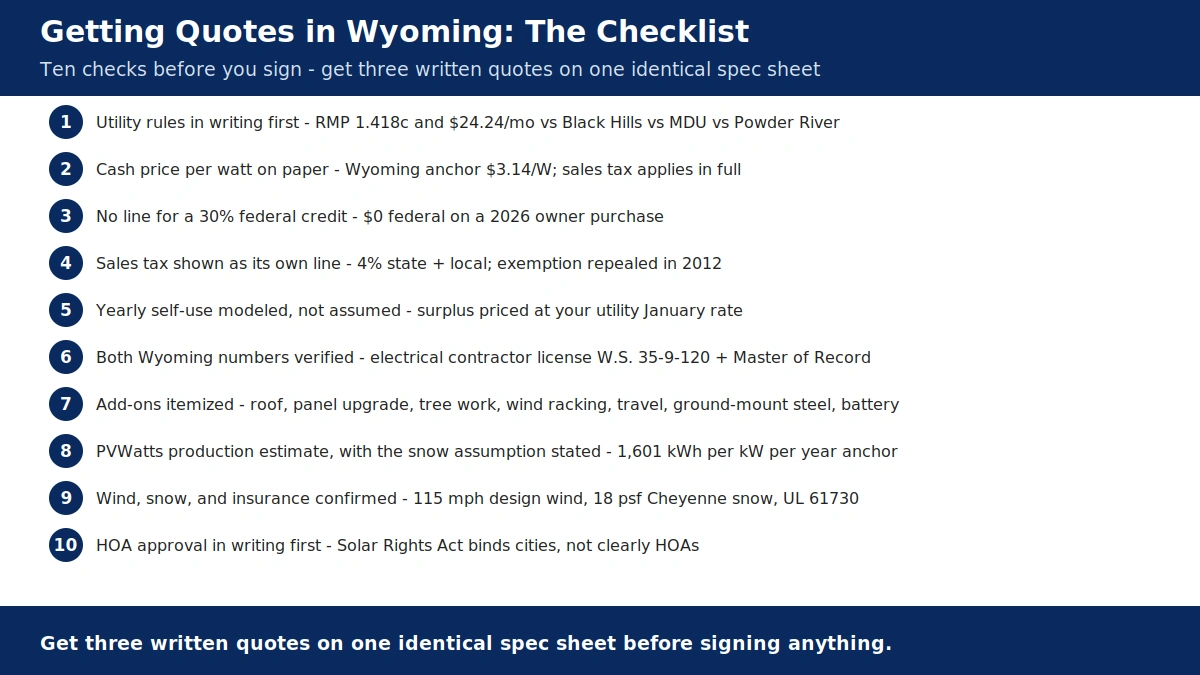
The ten-item quote checklist:
- Your utility’s rules, in writing, first — Rocky Mountain Power’s 1.418-cent January price and $24.24 minimum bill, Black Hills’ January price, Montana-Dakota’s pending tariff revision, Powder River’s 1.4686-cent January price, Lower Valley’s 7.49-cent power, or your municipal utility’s own terms. The January price and the minimum bill decide the payback before anything else — and Lower Valley’s rate is worth about ten years of payback against Rocky Mountain Power’s.
- Cash price per watt on paper — one identical spec sheet, from all three bidders. The Wyoming anchor is $3.14 a watt; a quote far above it calls for an explanation, and a quote far below it calls for a closer look at what was left out — especially the wind engineering and the travel line.
- No line for a 30% federal credit, no line for a state rebate — a 2026 owner purchase gets $0 federal, Wyoming has no state rebate, no state income-tax credit, and no sales-tax exemption, because the exemption was repealed in 2012. Any bidder still printing a 30% credit on a 2026 quote is using a law that ended with 2025. Ask for it to be removed.
- Sales tax shown as its own line — 4% state sales tax plus any local tax applies in full to equipment and installation. A quote that hides the tax has hidden it in the per-watt price, and a quote without a tax line is not a complete quote.
- Yearly self-use modeled, not assumed — the share of production the house consumes the instant it is made, month by month, with surplus priced at your own utility’s January rate. On Rocky Mountain Power, a quote that values all exports at one blended price, or banks credits past January, is wrong.
- Both Wyoming numbers verified — the installer’s electrical contractor license from the Department of Fire Prevention and Electrical Safety (W.S. 35-9-120) and its Master of Record, checked in the state lookup, with names matched to the contract. NABCEP certification is a plus. There is no statewide general contractor license to fall back on.
- Add-ons itemized — roof work, panel upgrade, tree work, wind-rated racking, snow guards, travel, ground-mount steel and trenching, and battery, each with its own price instead of being folded into the per-watt figure.
- Production estimate from PVWatts, snow assumption shown — roughly 1,601 kilowatt-hours per kilowatt a year underpins the estimate, not nameplate watts, and the monthly shape is required rather than a yearly average. Ask for the monthly shape, June against December, and the wind zone the racking is engineered for.
- Wind, snow, and insurance confirmed — the county’s design wind speed named (115 mph in Jackson and Cheyenne), the racking’s uplift rating named, the ground snow load checked with the building department (18 psf in Cheyenne, site-by-site in Jackson), UL 61730 / IEC 61730 panels specified by name, and homeowners insurance confirmed in writing to cover the array, including hail, before signing.
- HOA approval, in writing, first — the Wyoming Solar Rights Act binds local governments, not clearly HOAs, so do not rely on it against an HOA. Get the architectural-review approval before ordering panels, and condo owners should get the board’s approval for the common-area roof as well.
Buy, lease, or wait? Over 25 years, buying wins for homeowners with high daytime use, Rocky Mountain Power or Black Hills territory terms, or a ranch load that runs in the sun — provided the system is sized to the year’s use and stays under the 25 kW cap. Buying means the system is yours, the resale value is yours, and each kilowatt-hour you use yourself keeps its full retail value. Leasing suits homeowners who want no upfront cost and no maintenance — but only one seller was found advertising a lease in Wyoming, so any lease quote should go past a lawyer before it is compared on its monthly payment, and escalators of 2.9% to 3.9% a year can erase the savings against Wyoming’s low rates. Waiting wins for the Lower Valley customer, the municipal-utility customer with no net-metering statute, the household that uses under 500 kilowatt-hours a month, and anyone planning to move before year 16 — because in Wyoming, waiting costs little: the rates rise slowly, the sun is not going anywhere, and the January sale will still be there next year. Off-grid wins for ranches and cabins past the end of the line, where the choice is panels against a line extension quoted by the mile, and the generator runs only in the dark months.
Sources & methodology
Cost anchors (per watt, system size, totals):
- EcoGen Solar Cost Index, September 2026 edition, prices as of Sep 25, 2026: $3.14/W; 7.04 kW typical (Berkeley Lab 2025 median, 129 Wyoming systems); $22,106 total; 1,601 kWh/kW/yr; neighbours UT $3.01, MT $2.73, US $2.89, CO $3.02, SD $2.85, NE $2.91
- EcoGen Wyoming cost page, updated Oct 22, 2026, and per-utility payback file Oct 30, 2026: 7.04 kW makes ~11,271 kWh/yr; RMP year-one value ~$1,383/yr at 12.27 cents; payback ~16.0 yrs RMP, ~16.3 yrs Black Hills, ~19.7 yrs Powder River, ~20.5 yrs MDU, ~26.2 yrs Lower Valley, ~17.5 yrs statewide weighted
- EcoGen marketplace quotes, May 2026, centred on $3.33/W: 6 kW $18,000-$22,000; 8 kW $24,000-$29,000; 10 kW $30,000-$36,000; 12 kW $36,000-$43,000; battery 13.5 kWh at $1,000-$1,200/kWh
- EnergySage Wyoming page, Nov 2026: $3.73/W; 11.32 kW average; $42,239 total; range $35,903-$48,575; payback 18.7 yrs modeled; 25-yr savings $16,824 modeled
- EnergySage Cheyenne page, Nov 2026: $3.66/W; 9.64 kW; $35,275 total; range $29,984-$40,566; payback 17.6 yrs modeled
- NumeralQ Wyoming page (planning estimate, EnergySage data retrieved Oct 26, 2026): 8 kW $19,850-$25,950 ($2.48-$3.24/W); Casper 8 kW $20,460-$26,740
Rates and home use:
- EIA, 12 months Sep 2025-Aug 2026: WY 14.01 cents/kWh (13th lowest of 51), US 18.0 cents; average use 817 kWh/mo (~9,804 kWh/yr); average bill ~$114.50/mo
- EIA final 2025, Form EIA-861 (released Oct 7, 2026): 835 kWh/mo, 13.37 cents, $111.59/mo
- EIA August 2026 alone: 14.43 cents, 821 kWh, $118.52 bill
- Rocky Mountain Power Schedule 2: energy rate 11.515 cents/kWh effective Jul 1, 2026; EIA 12-mo average 15.60 cents; ex-fixed value 12.27 cents; minimum monthly bill $24.24 ($23.00 basic + riders), $291/yr; rate growth 3.3%/yr since 2019; filed for 8.8% increase May 2026 (PSC notice May 18, 2026), first step proposed from Mar 15, 2027
- Black Hills Power (Cheyenne Light): EIA 13.92 cents; ex-fixed 12.00 cents; $1,353/yr; payback ~16.3 yrs (EcoGen Oct 30, 2026)
- Powder River Energy: EIA 12.39 cents; ex-fixed 9.94 cents; $1,120/yr; payback ~19.7 yrs; January price 1.4686 cents/kWh since Jan 1, 2026, down from 2.0437 cents
- Montana-Dakota Utilities: EIA 13.86 cents; ex-fixed 9.59 cents; $1,081/yr; payback ~20.5 yrs; applied for 24.36% increase the year before; Docket 20004-179-ET-26 seeks to revise net-metering tariff
- Lower Valley Energy: EIA 7.49 cents; $844/yr; payback ~26.2 yrs
- Black Hills Energy NE Wyoming (Gillette territory): proposed ~32% residential increase filed Mar 18, 2026, base rates unchanged since 2014, new rates anticipated early 2027 if approved — separate territory from Cheyenne Light
Net metering and buyback:
- Wyoming statute W.S. 37-16-101 to 37-16-104: systems up to 25 kW; monthly netting at retail; credits carry forward within the calendar year; leftover credits sold at the start of the year at the utility’s avoided cost; covers investor-owned utilities, co-ops and irrigation districts; municipal utilities excluded
- RMP Schedule 37: unused net-metering credits, fixed solar, 1.418 cents/kWh for 2026, effective Apr 30, 2026 (Docket 20000-687-ET-25); update pending since Jul 10, 2026 (Docket 20000-714-ET-26)
- MDU Rate 58: 25 kW cap, monthly credit to next bill, January sale at Parallel Generation Rate 57 avoided cost; effective Apr 1, 2026 (Docket 20004-174-ER-25)
- SF0111 (2025) failed 3rd reading Feb 5, 2025 (10-17); HB 183 (2025, cap 25 kW to 200 kW) failed; HB 146 plug-in solar died in committee Feb 2026; EcoGen (Oct 2026): net metering unchanged, no bill passed in 2026
- ConsumerAffairs claim that Wyoming net metering “changed significantly in 2026” is contradicted by LegiScan and EcoGen — flagged, not used
- Total net-metered capacity in Wyoming ~16 MW, ~0.25% of retail sales (Wyoming Outdoor Council SF111 fact sheet)
- 17 electric cooperatives serve parts of Wyoming (EIA 2024), including High West Energy, Carbon Power and Light, Wheatland REA, Bridger Valley Electric, High Plains Power; Lower Valley averaged below 9 cents/kWh in 2024 (EcoGen)
Production and climate:
- EcoGen: 1,601 kWh/kW/yr PVWatts-based; Home Solar Atlas planning yield 1,480; Elovane ~1,450 (NREL PVWatts, south-facing 20-degree tilt); Unbound Solar 5.2 peak sun hours/day (NREL PVWatts/NSRDB), ranked 10th; SunMetricLab ~5.3 peak sun hours
- Cheyenne: elevation ~6,200 ft; ~250 sunny days/yr; ~59 inches snow/yr; average wind ~13 mph, gusts over 80 mph not unusual; record low -34 F, record high 100 F
- Wyoming Climate Atlas (State Climate Office): Wyoming ranks 1st in the US in annual average wind speed, 12.9 mph; winter winds frequently 30-40 mph with gusts 50-60 mph
- Design wind speed 115 mph: Jackson (EcoGen) and Cheyenne (city-published)
- Ground snow load: Cheyenne 18 psf (50-year recurrence, NOAA Engineering Weather Data); Jackson site-by-site under 2024 IRC/IBC
- Heat penalty 0.3-0.5% per degree C above 25 C cell temperature, national figure
- Utility-scale: South Cheyenne Solar Facility, Laramie County, 150 MW, largest in the state; grid-connected PV capacity 146 MW as of 2022 (Wikipedia)
Payback arithmetic:
- The worked examples in the payback section are EcoGen’s per-utility figures of Oct 30, 2026, restated: 7.04 kW x $3.14/W = $22,106; production ~11,271 kWh/yr; RMP year-one value ~$1,383/yr (11,271 kWh at 12.27 cents); $22,106 divided by $1,383 ~ 16.0 yrs; Black Hills ~$1,353/yr, ~16.3 yrs; Powder River ~$1,120/yr, ~19.7 yrs; MDU ~$1,081/yr, ~20.5 yrs; Lower Valley ~$844/yr, ~26.2 yrs; statewide weighted ~17.5 yrs
- EnergySage’s 18.7-year payback and $16,824 25-year savings are flagged as modeled figures on an 11.32 kW / $3.73/W system
Incentives:
- No state rebate, no state income tax, no statewide sales-tax exemption (repealed Jun 30, 2012); 4% state sales tax + local tax applies in full (EcoGen; Wyoming Legislature)
- No renewable portfolio standard, no SRECs; old Wyoming Business Council Residential Renewable Energy Program no longer active
- Property-tax exemption: unverified/disputed — several websites claim one; no statute or Department of Revenue guidance confirms it (EcoGen, Oct 2026); not claimed in the draft
- HEAR/HOMES: DOE dataset: $34,484,390 HEAR + $34,616,394 HOMES allocated to Wyoming (~$69.1M); not launched; WEA Home Energy Savings Program, no launch date; DOE recommitted ~$69M June 2026; state page retrieved Sep 6, 2026 still said “expected to launch in 2025”; not on DOE Feb 2026 launched map
- Wattsmart heat-pump / heat-pump water-heater rebates (Rocky Mountain Power trade-ally chart, Aug 2026); co-op heat-pump rebates $500-$1,700 (secondary sources) — electrification only, never solar
- No Wyoming community-solar program verified
Federal and financing:
- OBBBA P.L. 119-21 and IRS FS-2025-05: §25D and §25C $0 for post-Dec-31-2025 installs, completion date counts
- §48E 30% for third-party-owned systems, in service by Dec 31, 2027, construction begun by Jul 4, 2026 per IRS Notice 2025-42
- Intermountain Wind and Solar advertises a prepaid solar lease in Wyoming (EcoGen); no PPA seller found; DSIRE third-party PPA map does not list Wyoming; third-party power sales could be classed as a public utility under W.S. 37-1-101; lease escalators 2.9-3.9%/yr (EcoGen)
- DOE Notice 26-2, Sep 1, 2026: HEAR electric-to-electric upgrades only, no fuel-switching; solar, batteries, EV chargers, windows outside HEAR
- CFPB Solar Financing Market Issue Spotlight, Aug 2024: dealer fees 10-30%, sometimes over 50%
Off-grid:
- Line extension $15,000-$50,000 per mile (Weltrus, 2026, national figure)
- Off-grid cabin tiers nationally: ~$3,800 weekend cabin, ~$14,000 year-round, ~$26,400 full homestead (OffGridBenchmark, Nov 2026, national figures); design for 2-3 days of autonomy; generator essential in winter (national guides)
- Battery: EcoGen Wyoming 13.5 kWh at $1,000-$1,200/kWh ($13,500-$16,200); national 13.5 kWh add-on ~$15,647 installed (EnergySage, Jul 2026)
HOA and licensing:
- Electrical contractor license W.S. 35-9-120 to 35-9-130: licensed by Dept. of Fire Prevention and Electrical Safety; must employ a Wyoming-licensed Master Electrician full-time as Master of Record; renews every July 1; Master Electrician 8 years / 16,000 hours (4 years / 8,000 as journeyman) + 576 classroom hours + exam
- No statewide general contractor license; cities (Cheyenne, Casper, Laramie, Gillette, Sheridan, Jackson) run their own contractor licensing; Senate File 114 (2024) requires municipal reciprocity
- Installers (EcoGen, Oct 16, 2026 registry read): Creative Energies LLC, electrical contractor C-16384, active to Jul 1, 2027 (Lander + Laramie); Big Dog Solar / Big Dog Renewable Energy LLC, C-42454, active to Jul 1, 2027; neither publishes its number
- No Wyoming-specific solar license category verified; no Wyoming-specific solar license claimed
- Solar Rights Act, Title 34, Chapter 22 (§34-22-101 to 106): solar rights are property rights; no local government shall prohibit solar collectors except for public health/safety; local solar-permit systems (Cheyenne municipal code §15.52)
- CONFLICT: EnergySage (Jun 9, 2026) and PluggedIn list Wyoming among states WITHOUT a specific solar-access law protecting against HOA restrictions — the Act binds local governments, not clearly HOAs; draft states both
Labor and lifespan (national figures):
- BLS OEWS May 2025: electricians national median $30.38/hr (no Wyoming-specific figure pulled)
- Lifespan 25-30 years productive service; NREL median degradation ~0.5%/yr, ~88% of rated output at year 25; premium n-type 0.25-0.5%/yr, 91-93% at year 25 (NREL Jordan et al. 2022)
- Product warranty typically 10-25 years; performance warranty typically 25-30 years, guaranteeing 80-92% of rated output at year 25 depending on tier; string inverter 10-15 years, one replacement expected; microinverters ~25 years
EXCLUDED:
- Any “after 30% credit” prices, including any EnergySage after-incentive column
- Any HEAR-for-solar claim: HEAR does not cover solar, batteries, EV chargers, or windows; electric-to-electric only since DOE Notice 26-2, Sep 1, 2026
- Any state rebate or state tax credit for Wyoming solar: none exists
- ConsumerAffairs’ claim that Wyoming net metering “changed significantly in 2026”: contradicted by LegiScan (SF0111 failed Feb 5, 2025) and EcoGen (Oct 2026)
- A Wyoming property-tax exemption for solar: unverified/disputed, not claimed
- EnergySage’s 18.7-year payback as a verified Wyoming payback: modeled on an 11.32 kW / $3.73/W system, flagged as modeled
- City $/W figures for Laramie, Rock Springs, Sheridan, Gillette, Jackson, Cody, Powell, Torrington: no verified figures pulled except Cheyenne (EnergySage) and Casper (NumeralQ planning)
- Black Hills Energy January avoided-cost figure; Lower Valley January avoided-cost figure; MDU January avoided-cost figure: none verified, none stated
- Wyoming-specific snow-loss percentage: not verified
- Wyoming-specific permit fee schedule, interconnection timeline, battery price (EcoGen $/kWh range used instead), panel-upgrade price, BLS electrician wage (national figures used, flagged as national)
- A Wyoming HOA solar-access statute: the Solar Rights Act binds local governments; whether it binds HOAs is unverified, and the draft says so
- Alaska/Idaho export rates, snow loads, or installer names: none imported
*Disclaimer: The prices here are 2026 Wyoming planning figures. City, utility, roof, and contractor all move the numbers. Line up three written quotes from Wyoming installers before settling on a budget. Read the tax notes here as general background, not as advice about your own return. Run the numbers past a Wyoming tax professional before filing. Program rules change — Rocky Mountain Power, Black Hills Energy, Montana-Dakota Utilities, and Powder River Energy January prices are filed annually — so confirm current terms with your own utility before signing. Rocky Mountain Power’s Schedule 37 update has been pending since July 10, 2026, and Montana-Dakota’s net-metering tariff revision is pending — rate and program figures in this guide are dated to their sources.*
What do solar panels cost in Wyoming in 2026?
Solar panels cost $3.14 a watt installed in Wyoming in 2026 — about $22,106 for the typical 7.04 kW system (EcoGen, September 2026), with marketplace quotes centring on $3.33 a watt and an 8 kW system running $24,000 to $29,000. EnergySage’s marketplace average is higher, at $3.73 a watt on an 11.32 kW system, about $42,239. For a homeowner-owned system installed in 2026, the 30% federal credit is $0, Wyoming has no state rebate and no state income tax to credit against, and the 4% state sales tax applies in full.
Is solar worth it in Wyoming with such cheap electricity?
Slowly, for some homes, and not at all for others. A kilowatt of panels here makes about 1,601 kilowatt-hours a year — strong high-elevation sun — but the power it replaces costs only about 14.01 cents a kilowatt-hour statewide, and Rocky Mountain Power’s energy rate is 11.515 cents. EcoGen puts simple payback at about 16.0 years on Rocky Mountain Power and about 16.3 years on Black Hills Power, but about 26.2 years on Lower Valley Energy in Jackson, where hydro power costs 7.49 cents. The case rests on rates rising: Rocky Mountain Power’s rates have climbed 3.3% a year since 2019, and an 8.8% increase is filed.
Does Wyoming have net metering?
Yes — and the rule is generous inside the year and strict at the end of it. Under Wyoming statute W.S. 37-16-101 through 37-16-104, systems up to 25 kW net against consumption kilowatt-hour for kilowatt-hour within each billing month at the full retail rate, and excess credits carry forward through the calendar year. At the start of each calendar year, whatever credits are left are sold to the utility at its avoided cost: 1.418 cents a kilowatt-hour on Rocky Mountain Power for 2026, and 1.4686 cents at Powder River Energy. Municipal utilities are excluded from the statute, so a Cody or Powell homeowner has no statutory net-metering right.
Why is the January sale so important in Wyoming?
Because a credit you use is worth about ten times a credit you sell. Use 100 kilowatt-hours of credits during the year and they save you about $14.01 at the state average price. Leave the same 100 kilowatt-hours unused and Rocky Mountain Power pays $1.42 for them in January. That is why sizing matters more in Wyoming than in most states: a system matched to the year’s use keeps every credit at retail value, while an oversized system hands a third of its output to the January sale at 1.4 cents.
Can I still get the 30% federal tax credit for solar in Wyoming in 2026?
No, not if you own the system. Homeowner-owned systems that enter service after December 31, 2025 get no Residential Clean Energy Credit (§25D, 30%) — the One Big Beautiful Bill Act (P.L. 119-21) took that credit away. The IRS has been clear: the installation’s finish date decides it. The commercial credit (§48E, 30%) survives for third-party-owned systems in service by December 31, 2027, but only one company was found advertising a lease in Wyoming, and no company was found selling a power purchase agreement. Before you sign anything a Wyoming leasing company puts in front of you, pay a local attorney to read the whole contract first — escalators and buyout terms included.
What is the difference between Rocky Mountain Power and Lower Valley Energy for solar?
Both are Wyoming utilities under the same state net-metering law, but the prices are opposites. Rocky Mountain Power, serving Casper and Laramie at an energy rate of 11.515 cents a kilowatt-hour, pays back in about 16.0 years on a typical system. Lower Valley Energy, serving Jackson on cheap hydro at 7.49 cents a kilowatt-hour, pays back in about 26.2 years — past the 25-year panel warranty on the simple arithmetic. The same panels, the same installer, the same 1,601 kilowatt-hours per kilowatt — and a ten-year difference in payback, decided entirely by the utility on the bill.
Can solar power a ranch or cabin off the grid in Wyoming?
Yes, and off the grid it is often the cheapest option rather than the dearest. A utility line extension runs about $15,000 to $50,000 per mile nationally, while a complete off-grid cabin system runs about $3,800 for a weekend cabin, about $14,000 for a year-round cabin, and about $26,400 for a full homestead, nationally. Wyoming’s strong sun and daytime ranch loads — well pumps, shops, barns — fit solar well, but no off-grid system runs the winter on solar alone: plan on panels and batteries for the bright months and a generator for the dark core, with batteries kept warm and sized for two to three days of autonomy.
Does Wyoming offer any solar incentives in 2026?
Almost none. There is no state rebate, no state income-tax credit, and no sales-tax exemption — the exemption was repealed in 2012, and the 4% state sales tax applies in full. The federal HEAR and HOMES rebates, worth about $69.1 million allocated to Wyoming, have not launched and have no start date, and HEAR would never pay for solar anyway. The claimed property-tax exemption is unverified: no statute or Department of Revenue guidance confirms it, so verify it with your county assessor before counting on it. Net metering is the one real incentive, and it is the whole case.