

Table of Contents
Two weathers write the price of every South Dakota roof, and they take turns. From May through July, supercells rolling off the High Plains drop hail that has totaled whole neighborhoods in a single afternoon, and the state sits in the middle of the Great Plains hail corridor where a golf-ball storm is a routine summer event rather than a freak occurrence. From October through April, the same roof carries snow that piles up by the foot, freezes, thaws, refreezes, and pries at every seam and flashing lap until spring. A roof in South Dakota is not a decoration. It is the one building component that has to survive both seasons at full strength, year after year, and the price of getting it wrong shows up twice: once in the contractor’s invoice, and again in the insurance deductible the next time the sky turns green over Minnehaha County.
That double exposure is the whole guide. Everything else — the cost per square, the city comparison, the permit rules, the financing — matters, but none of it moves the answer as much as the hail and the snow do. A cheap 3-tab roof that looks like a bargain on the quote can cost more than a Class 4 roof within five years if it has to be replaced after one June storm, with a $3,500 to $7,000 wind and hail deductible coming out of the homeowner’s pocket each time. A metal roof that seems extravagant on paper can be the cheapest roof per year of service in a state where asphalt lives fifteen to twenty-two years instead of the thirty the brochure promises. And the regulatory picture is unlike almost any other state in this series: there is no statewide roofing license to check, no statewide building code to fall back on, and no state energy office running a rebate program, because South Dakota is the only state in the country that did not apply for the federal home energy rebates at all.
Start with our roof replacement cost guide for the national numbers, then weigh South Dakota’s figures against them.
What a Roof Replacement Costs in South Dakota in 2026
Two anchors describe the South Dakota market in 2026, and they agree on the shape of the answer even though they measure it differently. SmartRoofingCalculator’s state page, updated November 2, 2026, prices architectural shingles at $400–$580 per square installed with tear-off, which puts a typical 25-square roof at $10,000–$14,500. NumeralQ, pricing October 26, 2026, prices a 2,000 square foot roof at $8,940–$10,840 in Rapid City and $9,150–$11,110 in Sioux Falls. The two anchors overlap comfortably: a 2,000 square foot home usually carries about 20 to 25 squares of roof surface once pitch and waste are counted, and $400–$580 a square across 20 squares is $8,000–$11,600, right where NumeralQ lands.
A third anchor runs higher and a fourth runs lower, and the spread between them is worth understanding rather than averaging away. MyRoofData’s 2026 South Dakota model puts a typical single-family architectural asphalt roof at $11,750–$20,500, about 8 percent below the national average, on per-square installed prices of $414–$690 before tear-off. RoofingEstimatorPros, updated August 26, 2026, puts a typical 2,000 square foot architectural roof at $12,802–$23,054, averaging $17,358, or about $8.68 per square foot installed including tear-off, permits and waste. This Old House’s 2026 Roofing Survey puts the state average at $7,102, with a range of $5,519–$18,270, on asphalt at $4.54 per square foot. The honest reading is that the market is wide because the state is wide: a simple ranch in Sioux Falls with easy access and a competitive bid lands near the low end, while a steep, cut-up roof in a rural county with travel charges and deck work lands near the high end, and the survey average is pulled down by small repair-sized jobs that get counted as replacements.
What the anchors agree on is the direction: South Dakota is cheaper than the national average. SmartRoofingCalculator applies a state factor of 0.890, built from the roofer wage index and the Bureau of Economic Analysis regional price parity of 88.6, and RoofingEstimatorPros applies a 0.92 times multiplier. CostOnce, with prices updated in March 2026, puts the state 16 percent below the national average. The reason is labor, not materials: shingles cost roughly the same in Sioux Falls as they do in Denver, but the people who install them earn less. The Bureau of Labor Statistics, in its May 2025 Occupational Employment and Wage Statistics, puts the median roofer wage in South Dakota at $22.94 an hour, or $47,710 a year, about 14 percent below the national median of $55,440, with most South Dakota roofers earning between $34,550 and $59,200. The state counts only about 440 roofers. That thin bench is the other side of the cheap-labor coin: in the busy weeks after a hailstorm, there are not enough crews to go around, and prices spike while wait times stretch into months.
A square, for anyone pricing a roof for the first time, is 100 square feet of finished roof surface. A 25-square roof is 2,500 square feet of roof surface, which is what a typical 2,000 square foot single-story home carries once the pitch, the overhangs, and the waste factor are added in. Every per-square figure in this guide includes tear-off of one old layer, underlayment, and standard installation, unless the text says otherwise. A second layer to tear off, rotted decking, a steep pitch, or a roof cut up with valleys and dormers all add money on top, and this guide puts a number on each where it arises. One thing no quote in 2026 should contain is a line for a federal tax credit, because there is none to put there for a roof installed in 2026, as the financing section explains.
| Source | Typical job | Price | Dated |
|---|---|---|---|
| SmartRoofingCalculator | 25-square architectural roof | $10,000–$14,500 ($400–$580/sq) | Nov 2, 2026 |
| NumeralQ | 2,000 sq ft roof, Rapid City | $8,940–$10,840 | Oct 26, 2026 |
| NumeralQ | 2,000 sq ft roof, Sioux Falls | $9,150–$11,110 | Oct 26, 2026 |
| MyRoofData | Typical single-family arch roof | $11,750–$20,500 | 2026 model |
| RoofingEstimatorPros | 2,000 sq ft arch roof | $12,802–$23,054 (avg $17,358) | Aug 26, 2026 |
| This Old House survey | State average replacement | $7,102 (range $5,519–$18,270) | 2026 survey |
| CostOnce | 2,000 sq ft home | $8,400–$26,880 ($4–$13/sq ft) | Mar 2026 |
Two entries in that table call for a footnote, not a headline. RoofingEstimatorPros is the high outlier: its $17,358 average sits about 40 percent above the SmartRoofingCalculator midpoint, and it is best read as what a large, complex, or rural job costs rather than what a standard Sioux Falls ranch costs. This Old House is the low anchor: its $7,102 average is a survey figure that mixes small and partial jobs with full replacements, and its $4.54 per square foot for asphalt is a materials-heavy figure that understates the installed price. Neither is wrong. They are measuring different jobs. The headline band of $10,000–$14,500 for a 25-square roof, cross-checked against $8,940–$11,110 for a 2,000 square foot roof in the two verified cities, is the figure a homeowner should carry into the first contractor meeting.
The install itself is fast when the weather cooperates: one to three days for a standard-pitch asphalt roof, according to RoofingEstimatorPros, with metal taking longer. The slow part is everything around the install — getting three quotes in a thin market, waiting out the May-to-July hail season if the old roof can hold a few more weeks, and getting the permit and the inspection scheduled in a city that enforces its code. In the Black Hills, add wildfire season to the calendar: a roof going on during a dry August week is a roof going on while the crew is watching the smoke column over the forest.
Roof Replacement Cost in South Dakota by Material
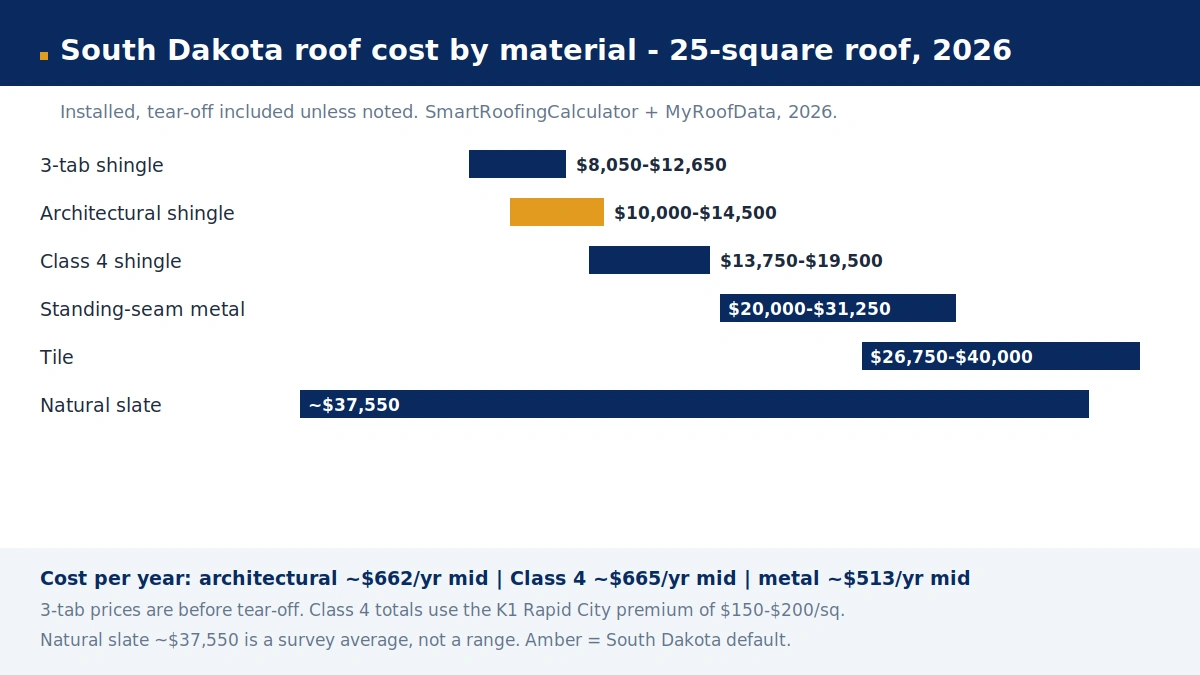
Material is the first decision, and in South Dakota it is a climate decision before it is a budget decision. The cheapest shingle on the shelf is the one most likely to be replaced after the first serious hailstorm, and the most expensive metal on the shelf is the one most likely to still be on the roof when the mortgage is paid off. The table below prices a typical 25-square roof — 2,500 square feet of roof surface — for every material with a verified South Dakota figure, installed, with tear-off of one layer included unless the footnote says otherwise.
| Material | Per square installed | 25-square total | Realistic SD life |
|---|---|---|---|
| 3-tab asphalt shingle | $322–$506 (before tear-off) | $8,050–$12,650 | 10–15 yrs |
| Architectural asphalt shingle | $400–$580 | $10,000–$14,500 | 15–22 yrs |
| Class 4 impact-resistant shingle | $550–$780 | $13,750–$19,500 | 20–30 yrs |
| Standing-seam metal | $800–$1,250 | $20,000–$31,250 | 40–60 yrs |
| Tile (concrete/clay) | $1,070–$1,600 | $26,750–$40,000 | 50+ yrs |
| Natural slate | ~$1,502 (survey avg) | ~$37,550 | 75–150 yrs |
The 3-tab row carries a warning label. MyRoofData’s $322–$506 a square is the installed price before tear-off, so the true job total runs higher once the old layer comes off, and 3-tab is the material with the thinnest margin against South Dakota weather: a single layer of flat shingle with the lowest wind rating in the table and no impact rating worth naming. Many insurers and builders have moved away from it, and in a state that averages about 174 hail events a year, buying 3-tab to save $2,000 on the install is buying the next deductible payment in advance. It still has a place — a rental, a shed roof, a home being sold within a few years — but it should not be the default on a house the owner plans to keep.
Architectural shingles are the default, on roughly three out of four American homes and on most South Dakota roofs as well. They are thicker, dimensional shingles with wind ratings of 110 to 130 miles per hour when installed with the manufacturer’s high-wind nailing pattern, and they carry the $400–$580 a square band that anchors the headline price. The realistic South Dakota life is 15 to 22 years, not the 25 to 30 the brochure prints, because hail bruises the asphalt mat long before the shingle looks worn from the curb, and freeze-thaw cycling works every sealant strip and flashing lap a little looser each winter. A roof that looks sound at year twelve may be one June storm from a full claim.
Class 4 impact-resistant shingles are the material this state was built for, and they get a full section of their own below. The upgrade costs roughly $150–$200 more per square than standard architectural shingles, according to a Rapid City contractor’s 2026 guide, which puts a 25-square Class 4 roof at $13,750–$19,500. The shingles are SBS-modified — rubberized asphalt that stays pliable in freezing weather and absorbs a hailstone strike instead of cracking. They are tested to UL 2218 Class 4, which means surviving a two-inch steel ball dropped from twenty feet. They are not hail-proof: a three-inch stone can still damage them. But the hail that does most of the damage in South Dakota is in the one-and-a-half to two-and-a-half inch band, and that is exactly the band where Class 4 earns its keep.
Standing-seam metal is the long-life answer, at $800–$1,250 a square and $20,000–$31,250 for a 25-square roof. It sheds snow faster than any asphalt, it does not bruise under hail the way a shingle mat does — it may dent cosmetically, which is a different conversation with the insurer — and it lasts 40 to 60 years, which is two or three asphalt roofs. The cost-per-year arithmetic is the surprise in this table: at the midpoints, standing seam costs about $513 a year of service, against about $662 a year for architectural shingles and about $665 a year for Class 4. Metal looks expensive on the quote and cheap on the calendar. It is also the best roof in the Black Hills during wildfire season, because a metal roof does not catch embers the way a dried-out wood shake roof does. For the full metal comparison, see our metal roof cost guide and our metal vs shingles comparison.
Tile and slate are the luxury end, and in South Dakota they are rare for good structural reasons as well as price. Tile runs $1,070–$1,600 a square, or $26,750–$40,000 for 25 squares, and slate runs about $1,502 a square on the This Old House survey average, or about $37,550 for the same roof. Both weigh far more than asphalt, both need a structure verified to carry them plus a snow load, and both last fifty years or more — slate seventy-five to one hundred fifty. Tile’s South Dakota problem is freeze-thaw: a porous tile that soaks up autumn rain and freezes in January can spall, so the product and the installation have to be rated for the climate, not just for the look. Slate’s problem is the installer pool: very few South Dakota crews lay slate, and a slate roof installed by a crew that does not do slate every week is a leak waiting for a thaw. For tile in detail, see our tile roof cost guide.
Cedar shakes deserve a sentence even though no verified South Dakota cedar price was pulled for this guide. Cedar lasts 20 to 30 realistic years in this climate, it is beautiful on a Black Hills cabin, and it is the worst material in the state for wildfire exposure — a dried cedar shake roof in a pine forest during a dry August is kindling nailed to the house. No price is given because none was verified, and a cedar quote from a contractor who does not work in the Hills every week should be checked twice.
One more cost-per-year note, because it changes how the table reads. The cheapest roof per year of service in South Dakota is not the cheapest roof on the quote. At the midpoints, 3-tab costs about $828 a year, architectural about $662, Class 4 about $665, standing seam about $513, tile about $668, and slate about $376. Those figures are NestPriced arithmetic — midpoint total divided by midpoint realistic life — and they ignore the deductibles, which is where Class 4 actually wins. A Class 4 roof that survives two hailstorms without a claim has saved two deductibles, $7,000 at a 1 percent deductible on a $350,000 home, and that saving does not appear in any cost-per-year table. Read the material table and the insurance section together. Neither one alone tells the truth.
Roof Replacement Cost by Roof Size
Size is the second decision, and it is the one most quotes get wrong by measuring the wrong thing. Contractors price roof surface, not living area. A 2,000 square foot single-story ranch has roughly 2,000 square feet of footprint under the roof, plus pitch, plus overhangs, plus waste — usually 20 to 25 squares of roof surface. A 2,000 square foot two-story home has a footprint of about 1,000 square feet, and its roof surface is roughly half the ranch’s, even though both homes are “2,000 square feet” on the listing. Always ask the quote to state the roof surface in squares. A quote that prices the living area has priced the wrong house.
The table below prices architectural shingles at the SmartRoofingCalculator band of $400–$580 a square, tear-off included, for the roof sizes South Dakota homeowners actually have. The 25-square row is the headline row, and the 20-square row is the NumeralQ cross-check: $8,000–$11,600 from the per-square band against $8,940–$11,110 for a 2,000 square foot roof in the two verified cities.
| Roof surface | Typical home | Architectural total | Class 4 total |
|---|---|---|---|
| 15 squares | Small ranch / cabin | $6,000–$8,700 | $8,250–$11,700 |
| 20 squares | 2,000 sq ft ranch | $8,000–$11,600 | $11,000–$15,600 |
| 25 squares | Typical SD home | $10,000–$14,500 | $13,750–$19,500 |
| 30 squares | Large two-story | $12,000–$17,400 | $16,500–$23,400 |
| 35 squares | Large home, complex roof | $14,000–$20,300 | $19,250–$27,300 |
| 40 squares | Very large / steep | $16,000–$23,200 | $22,000–$31,200 |
Three things push a job off this table. Pitch is the first: a steep 10/12 or 12/12 roof costs more per square than a walkable 4/12, because the crew works slower, stages differently, and in some cases ropes in. The per-square bands in this guide assume a standard pitch, and a steep Black Hills chalet roof can run well above them. Complexity is the second: every valley, dormer, skylight, and chimney is a flashing detail that takes time and leaks first if it is rushed. A simple gable roof and a cut-up roof with the same square count are different jobs at different prices. Decking is the third: rotted or delaminated sheathing is found only when the old shingles come off, and it is priced per sheet on the day. Get the per-sheet deck rate in writing before the tear-off starts, so a bad deck is a known number and not a surprise invoice.
Size the budget from the roof, not from the house. Measure the footprint, multiply by the pitch factor — about 1.15 for a 6/12 pitch, about 1.25 for an 8/12 — add 10 percent for waste, and divide by 100 to get squares. Or ask each bidder to show the measurement on the quote, and compare the square counts before comparing the prices. Two quotes $2,000 apart are not $2,000 apart if one of them measured 22 squares and the other measured 26.
Roof Replacement Cost by City: Sioux Falls vs Rapid City vs Aberdeen vs Brookings
South Dakota is a small state with two real roofing markets and a lot of distance between them. Sioux Falls, in the southeast corner, is the biggest city and the most competitive market. Rapid City, in the west at the edge of the Black Hills, is the second market. Everywhere else is a smaller town served by crews that travel, and travel is a line item on the quote. The verified city figures run close together — closer than in most states in this series — which says something honest about the market: labor is cheap everywhere in South Dakota, and the price differences come from the roof and the weather, not from the ZIP code.
| City | 2,000 sq ft roof (arch) | Roofer median wage | Market note |
|---|---|---|---|
| Sioux Falls | $9,150–$11,110 | $23.50/hr | Largest, most competitive market |
| Rapid City | $8,940–$10,840 | $22.36/hr | Black Hills gateway, busiest storm locality |
| Aberdeen | No verified figure pulled | Not published | Northern plains, heavy snow, small crew pool |
| Brookings | No verified figure pulled | Not published | College town, eastern SD climate |
Sioux Falls is the biggest market in the state, served by the most crews, at $9,150–$11,110 for a 2,000 square foot roof, on a roofer median wage of $23.50 an hour — 12 percent below the national median, according to the Bureau of Labor Statistics for May 2025. It is also deep in hail country. A local analysis of storm records counts 232 hail reports in the Sioux Falls metro from 2016 through 2025, including 170 reports of hail an inch or larger and 14 reports of hail two inches or larger, and 3.5-inch hail fell at Renner, just north of the metro, on August 5, 2021, producing significant roof damage. The competition that keeps Sioux Falls prices down is real, but so is the demand: after a June hailstorm, every crew in the metro is booked for weeks, and the homeowner who waits to call is the homeowner who waits to get a roof.
Rapid City runs a touch cheaper on the verified figures, $8,940–$10,840 for the same 2,000 square foot roof, on a roofer median wage of $22.36 an hour — 16 percent below the national median. Do not read that as Rapid City being an easier place to own a roof. It is the busiest severe wind and hail locality in the state, with 30 of the latest 50 storm reports in the Harbilo record, and it sits at the foot of the Black Hills, where snow runs heavier, slopes run steeper, and wildfire smoke is a summer fact of life. The lower price is a labor number, not a risk number. A Rapid City roof faces more hail, more snow, and more wind than a Sioux Falls roof, and the spec should reflect that even when the quote does not.
Aberdeen and Brookings carry a warning label rather than a verified price. No verified city-level roof price was pulled for either town in this pass, and this guide does not invent one. What can be said honestly is the shape of the market: Aberdeen sits on the northern plains with heavy snow and a small contractor pool, Brookings is a college town in eastern South Dakota with a climate much like Sioux Falls, and both are places where the crew may drive an hour or more to reach the job. That drive shows up in the quote as a travel charge, and in the schedule as a crew that cannot come back tomorrow for a small fix. Get three quotes in both towns, and make at least one of them from a company with a permanent shop within an hour’s drive, because warranty service from a crew based two counties away is a promise that gets expensive to keep.
Rank the cities on price per square, never the total. Sioux Falls at $11,110 looks more expensive than Rapid City at $10,840, but the gap is a few hundred dollars on the same size roof, and it disappears entirely once pitch, deck condition, and material are held equal. The real city difference is not price. It is exposure: Rapid City gets more hail reports and more snow, Sioux Falls gets more competition and faster scheduling, and the rural towns get neither the competition nor the fast scheduling, which is why their quotes deserve the closest reading of all.
Why South Dakota Roofs Cost What They Do: Hail, Wind & Snow Load
Four forces set the price of a South Dakota roof, and three of them fall from the sky. Hail is the first and the loudest. Wind is the second and the most persistent. Snow is the third and the heaviest. The fourth is the market itself — a thin bench of about 440 roofers serving a state the size of a small country — and it decides how fast any of the other three gets fixed.
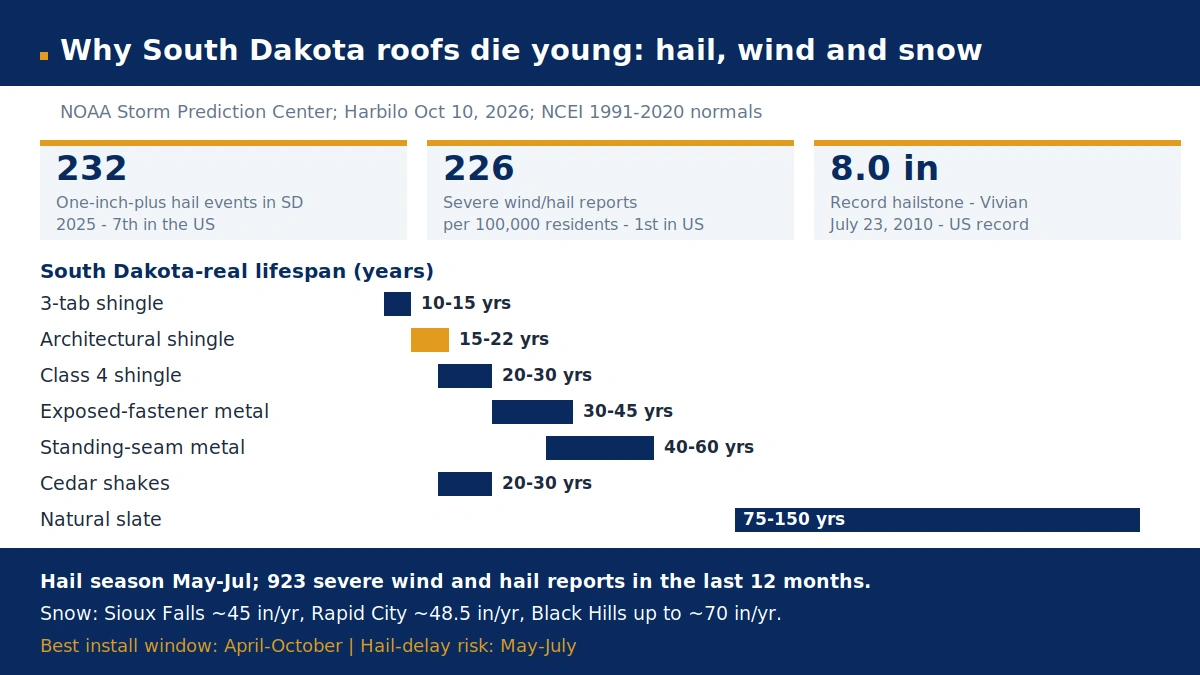
Hail. South Dakota is core Hail Alley, and the numbers leave no room for doubt. The National Oceanic and Atmospheric Administration’s Storm Prediction Center counted 232 hail events of an inch or larger in South Dakota in 2025 alone, the seventh-highest count in the country, out of 5,432 nationwide. Over the longer window, the state averages about 174 hail events a year and 116 thunderstorm-wind events a year, according to NOAA records from 2005 through 2025, and it ranks number one in the nation for hail, thunderstorm wind, flood, and flash flood. Harbilo’s running count of severe wind and hail reports, drawn from the same NOAA data and updated October 10, 2026, stands at 2,001 reports on file for South Dakota, with 923 in the last twelve months and 423 in the last ninety days. July 2025 was the busiest month on record with 526 reports. Adjusted for population, South Dakota leads the nation at 226 reports per 100,000 residents — twelve times the median state. A homeowner here does not ask whether hail will hit the roof. The question is when, and how big.
The size is what matters, because size is what decides whether the roof survives. Hail an inch across — about the size of a quarter — bruises a standard shingle mat. Hail two inches across — golf-ball size — typically ends a standard architectural roof. South Dakota has seen both, often, and it holds the American record for the largest hailstone ever measured: eight inches across and one pound fifteen ounces, dropped on Vivian on July 23, 2010, a stone so large it broke the national records for diameter and weight at the same time. More recently, on May 20, 2025, an outbreak in northern South Dakota produced fourteen tornadoes, hail at least baseball size, damaging winds, and flash flooding in a single day. That is the storm a South Dakota roof is built for, and it is why the Class 4 section of this guide exists.
Wind. Tornadoes get the headlines, but straight-line thunderstorm wind does more roof damage in South Dakota in an average year. The state has logged 1,959 tornadoes all-time, with 14 in 2026 through November 4 — below the ten-year year-to-date normal of about 20 — and 13,345 damaging-wind reports in the same all-time record. A tornado is a total-loss event that no shingle rating can plan for. Straight-line wind is the everyday enemy: a 70-mile-per-hour gust that lifts a poorly nailed shingle tab, breaks the seal, and lets the next rain in under the course above it. The defense is not exotic. It is a six-nail pattern instead of four, a high-wind starter course, and a shingle with a 110 to 130 mile-per-hour wind rating installed the way the manufacturer specifies. Ask for the nailing pattern in writing. It costs almost nothing on the install and it is the difference between a roof that holds in a July thunderstorm and a roof that peels.
Snow load. South Dakota winters are long, cold, and heavy. Sioux Falls averages about 45 inches of snow a year on the 1991–2020 normals, with December the snowiest month at close to ten inches. Rapid City averages about 48.5 inches a year at the airport, on only about 17.4 inches of total precipitation — a dry climate that still buries the roof, because the cold preserves what falls. The Black Hills run much heavier, up to about 70 inches a year in the national forest, and the town of Lead averages close to 200 inches a year. Snow is weight, and weight is structure: a roof that carries a snow load all winter, plus the ice dam that forms at the eave, plus the freeze-thaw cycling that works every joint, is a roof that needs its deck, its underlayment, and its ventilation specified for the load, not just for the look. No statewide snow-load figure exists, because there is no statewide code — the design load is set by the city that adopts the code, and the building department’s figure governs, not the contractor’s guess. The ice dam section below takes this up in detail.
The market. The fourth force is the crew shortage. About 440 roofers work in the whole state, on a median wage of $22.94 an hour. In a quiet month that is enough. In the weeks after a hailstorm, it is not, and the shortage shows up in two ways: prices rise, and wait times stretch. Storm-chaser crews from out of state fill the gap, and some of them do good work, but a crew with no permanent South Dakota shop, no city license where one is required, and no local warranty history is a risk that deserves its own section — which it gets, in the hiring section below. The install season runs roughly April through October. Winter installs are possible — SBS-modified Class 4 shingles stay pliable in freezing weather — but sealant strips bond slowly in the cold, and a January install needs a crew that knows how to hand-seal and when to wait for a warm afternoon.
Ice Dams, Snow Load & Winter: The Cold South Dakota Roof Killers
Hail gets the attention. Winter does the slow damage. An ice dam is the most expensive winter problem on a South Dakota roof, and it is also the most preventable, which is what makes it frustrating: the money spent fixing a dam in February is money that would have been better spent on insulation and ventilation in October.
An ice dam forms the same way every winter. Heat escapes from the living space into the attic, warms the underside of the roof deck, and melts the bottom layer of snow on the upper roof. The meltwater runs down to the eave, where the roof overhangs the warm wall and the deck is cold again, and it refreezes into a ridge of ice. The next melt has nowhere to go. It ponds behind the ridge, backs up under the shingles, and finds its way into the house — through the sheathing, down the wall, and into the ceiling, where it shows up as a brown stain in March and a mold problem in May. A roof can be brand new and still leak from an ice dam, because the leak is not a shingle failure. It is a heat and ventilation failure wearing a roofing disguise.
The defense is three layers deep, and all three belong in the reroof scope, not in a later project. The first layer is the ice and water shield: a self-adhering membrane laid along the eaves, in the valleys, and around penetrations, running from the edge up past the inside face of the exterior wall — at least 24 inches inside the wall line under the International Residential Code. In a state with forty-plus inches of snow a year, the membrane should run further than the minimum on a low-slope roof, and the quote should say how far. The second layer is insulation: a cold attic is the goal, and the attic gets cold when the ceiling is insulated well enough that the roof deck stays near the outdoor temperature. The third layer is ventilation: intake at the soffit and exhaust at the ridge, balanced, so the attic air moves and the deck stays uniform. A reroof is the one moment when all three layers are accessible at once. A contractor who proposes new shingles over a hot, unventilated attic is selling a roof that will dam again by February.
Snow load is the quieter winter risk. A roof in Sioux Falls or Rapid City carries roughly four feet of snow in an average winter, and in a record winter the load is far higher — Sioux Falls has seen close to 100 inches in a single season. The load is not just the snow on the roof today. It is the snow that fell in December, compacted in January, iced over in February, and is still sitting there in March when the next storm adds another foot. Flat and low-slope sections are the danger zones: they hold snow instead of shedding it, and a low-slope porch roof or a flat garage section can carry twice the load of the main slope. Metal sheds snow fastest, which is one more reason it earns its place in this state, and a steep pitch sheds faster than a shallow one. But shedding creates its own problem: snow sliding off a metal roof in a single slab can tear off a gutter or bury a walkway, so snow guards above entries and walkways belong on the quote, not as an afterthought.
The install calendar follows the weather. April through October is the working season, with the best installs in the shoulder months — April and May before hail season peaks, September and October after it ends. May through July carries hail-delay risk: a crew can tear off a roof in the morning and be racing a supercell by the afternoon, and a good contractor watches the forecast the way a farmer does. Winter installs are possible, and SBS-modified shingles make them more practical than they used to be, but sealant strips need warmth to bond, and a crew that installs in January without hand-sealing the tabs is installing a roof that will lift in the first March wind. If the roof has to go on in winter, ask how the crew seals, and ask what happens if the bond does not take.
One more winter note, specific to the Black Hills: wildfire and winter share the same roof. A roof in the Hills has to shed snow in January and resist embers in August, and the materials that do both are metal and Class 4 asphalt. A cedar shake roof in the Hills fails the second test. A flat, debris-collecting valley fails it too. Clean the valleys, clean the gutters, and keep the pine needles off the roof before fire season, because a roof that survives the winter can still be lost to the summer.
Class 4 Impact-Resistant Shingles in South Dakota: What the Upgrade Costs and What It Pays Back
If this guide has one recommendation, it is this: in South Dakota, price the Class 4 upgrade on every asphalt quote, and buy it unless the numbers argue otherwise. No other single decision does as much for a South Dakota roof. The upgrade costs real money, it pays back in two different ways, and the payback is faster here than in almost any other state in this series, because the hail that justifies it falls here more often than anywhere else per resident.
What it is. Class 4 is the highest impact-resistance rating under Underwriters Laboratories standard UL 2218. The test drops a two-inch steel ball from twenty feet onto the shingle — the equivalent of a golf-ball hailstone at terminal velocity — and the shingle passes if it does not crack or fracture. Class 4 shingles are made with SBS-modified asphalt, a rubberized blend that stays pliable in freezing weather and absorbs a strike instead of shattering. The products sold in South Dakota include CertainTeed Landmark IR and NorthGate ClimateFlex, named in a Rapid City contractor’s 2026 guide, alongside GAF and Owens Corning Class 4 lines. Class 4 does not mean hail-proof. A three-inch stone can still damage it. But the hail that does most of the damage in South Dakota falls in the one-and-a-half to two-and-a-half inch band, and that is exactly the band where Class 4 distinguishes itself: a standard architectural shingle typically needs replacement after one of those events, while a Class 4 shingle typically does not.
What it costs. A Rapid City contractor’s 2026 guide puts the upgrade at roughly $150–$200 more per square than standard architectural shingles, or $3,000–$4,000 on a typical 20-square home. Applied to the state headline band, a 25-square Class 4 roof runs $13,750–$19,500, against $10,000–$14,500 for standard architectural. The premium is about 35 percent on the install, and it buys a roof rated to survive the storm that would end the cheaper one.
What it pays back. The payback comes in two streams, and the second one is bigger than the first. The first stream is the insurance discount. Most major carriers in South Dakota offer a Class 4 discount on the wind and hail portion of the premium, but the published ranges disagree and the disagreement is worth stating plainly: a Rapid City contractor’s guide puts it at 15–30 percent of the wind and hail portion; a state-by-state discount table puts South Dakota and Wyoming at 10–18 percent; another industry source puts Minnesota, the Dakotas, and Iowa at 5–15 percent. The discount applies to the wind and hail portion only, never to the whole premium, and the exact figure is set carrier by carrier. Confirm it in writing with your own insurer, with the qualifying product list and the documentation required, before signing anything. Do not let a contractor quote a discount the carrier has not confirmed.
The second stream is the avoided deductible, and in South Dakota it is the stream that matters. A typical South Dakota wind and hail deductible runs 1–2 percent of the insured dwelling value. On a $350,000 home at 1 percent, that is $3,500 out of pocket per hail claim, before the insurer pays anything. If a Class 4 roof survives two or three mid-band hail events without needing replacement — the Rapid City contractor’s own argument — the homeowner avoids paying that deductible two or three times, saving $7,000 to $10,500 against an upgrade that cost $3,000 to $4,000. One avoided claim can pay for the upgrade outright. The premium discount is a bonus. The avoided deductible is the business case.
When it is not worth it. Three cases argue against Class 4. A roof under heavy tree cover, where branches and shade do more damage than hail, and where the impact rating buys little. A home being sold within a few years, where the buyer may not pay for the upgrade in the sale price — though a transferable Class 4 warranty and a documented discount can help the listing. And a home in a pocket with unusually low hail exposure, though in South Dakota those pockets are rare and the exposure maps are county-level, not street-level. For everyone else — the long-term owner, the home in the open plains, the house that has already had one hail claim — Class 4 is the default, not the upgrade.
How to buy it. Name the product on the quote, with the manufacturer and the exact shingle line, and keep the UL 2218 Class 4 marking — printed on the back of the shingle — in the job file. Get the insurer’s discount confirmation and documentation requirements in writing before the install, not after, because some carriers require photos, a certificate, or an inspection. And ask about the warranty: CertainTeed’s SureStart Plus extended warranty, available through certified installers, is the kind of coverage that only applies when the install is done by a credentialed crew, which is one more reason the cheapest bidder is not always the cheapest roof.
Permits & Code: No Statewide Code, City Rules & the Sioux Falls License
South Dakota’s permit and code picture is the most local in this series, because there is almost no state in it. The state has no mandatory statewide building code, and no statewide roofing license, and the rules that govern a roof are the rules of the city or county where the roof sits. A homeowner in Sioux Falls and a homeowner on a ranch outside Pierre live under different regimes, and both need to know which one applies before the first shingle comes off.
The statewide picture is thin on purpose. South Dakota is one of a handful of states with no mandatory statewide building code for residential construction. Each city and county decides whether to adopt and enforce a code at all, and which edition to adopt. Sioux Falls, the state’s largest city, enforces the 2021 International Residential Code with local amendments. Some smaller cities enforce an adopted edition. Some rural areas have no building code enforcement whatsoever, which does not mean anything goes — it means nobody is checking, and the quality of the work rests entirely on the contractor and the homeowner. The design values that matter most — the wind speed and the snow load the roof is built for — are set by the adopting jurisdiction. No South Dakota-specific statewide snow-load figure was verified for this guide, because no statewide table exists to verify. Let the building department’s figure govern, not the installer’s guess.
Sioux Falls is the city with real rules. The City of Sioux Falls requires a building permit for any roof replacement or re-shingling work on a residential home, issued through Building Services at City Center, 231 North Dakota Avenue, and the licensed roofing contractor is required to obtain the permit and schedule the required inspection. Minor repairs — replacing a few shingles, fixing flashing — usually do not require a permit, but any substantial work does. Permit costs run about $100–$400 statewide on one anchor and about $175 on another; the exact fee depends on the valuation of the job. Starting work before the permit is issued doubles the fee in Sioux Falls, which is a penalty worth avoiding by waiting a few days.
Rapid City and the other cities license locally. The statewide licensing guides agree that cities such as Sioux Falls and Rapid City license roofers locally, but no Rapid City-specific exam, bond, or fee figure was verified in this pass, and none is stated here. Check with the Rapid City building department before the job starts, and do the same in Aberdeen, Brookings, and every smaller city — the rule that matters is the one in force on the day the permit is pulled, not the one in a guide written months earlier.
The code details that change the quote. Three code-driven items should appear on every South Dakota bid, and their absence is a red flag. Ice and water shield at the eaves, valleys, and penetrations, run at least 24 inches inside the exterior wall line. Drip edge at the eaves and rakes. And a six-nail high-wind fastening pattern on shingles in the wind-exposed parts of the state. A bid that omits the ice barrier is a bid that will leak in February. A bid that omits the drip edge is a bid that will rot the fascia. A bid that nails four where the manufacturer specifies six is a bid that will lift in July.
Hiring a Roofer in South Dakota: No License, So What Do You Check?
South Dakota has no statewide roofing license, and that fact changes the hiring job completely. In a state with a license, the license is the first filter: it proves the contractor passed an exam, posted a bond, and can lose the credential for bad work. In South Dakota, there is no such filter at the state level, and the homeowner has to build the filter from the pieces that do exist. The pieces are real. They just take more work to check.
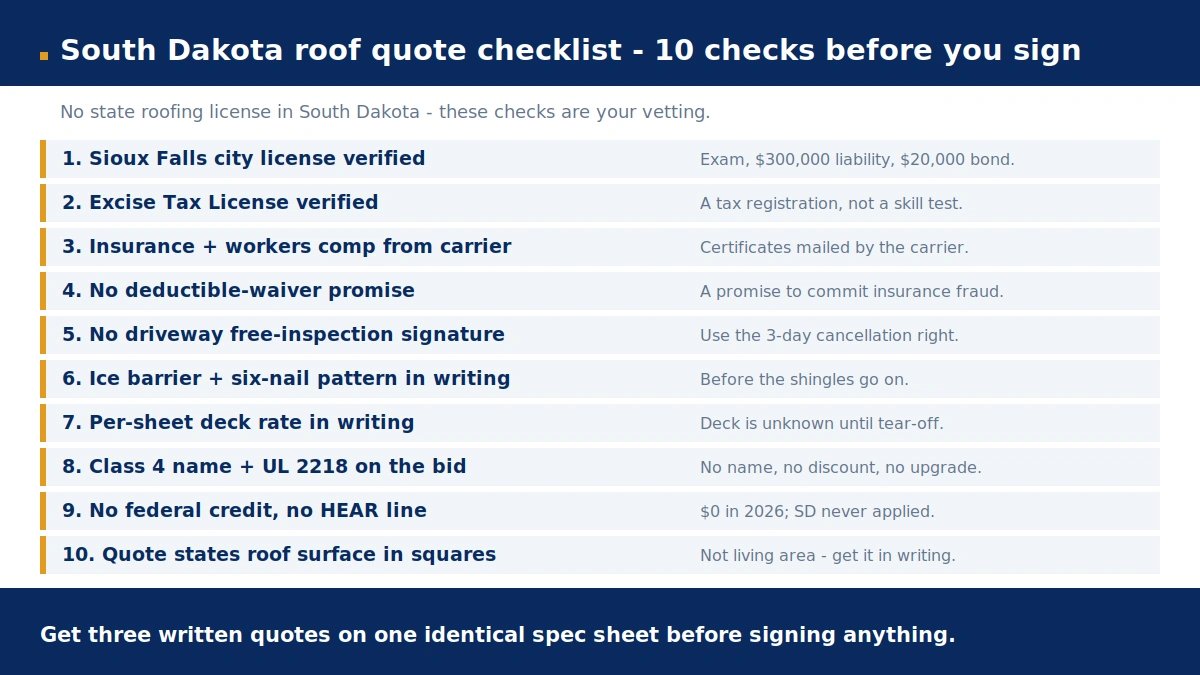
What the state does require. Two things, neither of which tests workmanship. First, every contractor improving real property must hold a Contractor’s Excise Tax License from the Department of Revenue — a free tax registration — and pay the 2 percent contractor excise tax on gross receipts. The excise tax license tells the state where to send the tax bill. It measures nothing about whether the holder can lay a straight course of shingles. Second, only electricians and plumbers are state-licensed trades, so a roofer who waves a state license of any kind is showing the wrong document, unless the job includes electrical work that needs a licensed electrician. Ask for the excise tax license, verify it, and then move on to the checks that actually matter.
What the city requires. In Sioux Falls, the real license is the city’s. Anyone doing residential roofing work must hold a Residential Roofing and Repair Contractor License, which requires passing a city exam, carrying at least $300,000 in general liability insurance, and posting a $20,000 compliance bond with the city. Verify the license by calling Building Services and asking for the company by name — the city publishes who holds its licenses, and a legitimate contractor expects the call. In Rapid City and the other cities, the license is local too, with its own requirements; call the building department and ask what the city requires before the first bidder arrives.
What to verify on every bidder, everywhere in the state. General liability insurance of at least $300,000, with a certificate mailed to you straight from the carrier — not handed to you by the contractor — and a business name that matches the contract exactly. Workers’ compensation coverage if the crew has employees. A permanent South Dakota address and a local phone number that has been in service longer than the last hailstorm. References from jobs done in your own county, at least three, with addresses you can drive past. Manufacturer certification where it matters — CertainTeed ShingleMaster or the equivalent — because the extended warranty only applies when a credentialed crew does the install. And a written quote on one identical spec sheet from all three bidders, so the prices compare the same roof: same material, same underlayment, same ice barrier scope, same nailing pattern, same tear-off, same deck rate, same cleanup.
The storm-chaser warning. South Dakota is storm-chaser territory, and the crews arrive within days of a hail event, knocking on doors in the damaged neighborhoods. Some are legitimate traveling crews. Many are not. Watch for the pattern: a door knock with pressure to sign a free-inspection agreement on the spot, an out-of-state phone number and no permanent local office, no city license where one is required, a promise to waive or absorb your deductible, and a demand for a large payment up front. A deductible waiver is a promise to commit insurance fraud on your behalf, and a contract built on it is a contract you do not want. South Dakota law gives a three-day right of cancellation on door-to-door contracts — the same cooling-off protection other states in this series carry — and it exists for exactly this moment. Use it. Never sign a contingency agreement in the driveway while the adjuster has not yet looked at the roof.
The quote itself. A South Dakota quote should name the manufacturer and the exact shingle line, the underlayment type, the ice and water shield coverage in feet from the eave, the drip edge, the ventilation scope, the nailing pattern, the tear-off depth, the per-sheet deck replacement rate, the disposal, and the cleanup. It should state the roof surface in squares and the total price for that surface, so two quotes can be compared square to square. It should state the warranty — manufacturer and workmanship, separately, in years — and who honors each one. And it should contain no line for a federal tax credit, because there is none in 2026. For the full list of questions, see our questions to ask a roofer guide.
Insurance: Wind/Hail Deductibles, ACV vs RCV & the Class 4 Discount
Insurance is where a South Dakota roof pays for itself — or where the homeowner discovers, too late, that the policy they bought does not pay what they thought it did. The state has some of the most expensive homeowners insurance in the country, the highest hail exposure per resident, and a deductible structure that puts thousands of dollars on the homeowner before the insurer pays anything. Every number in this section should be checked against the homeowner’s own policy, because the policy is the only document that governs the claim.
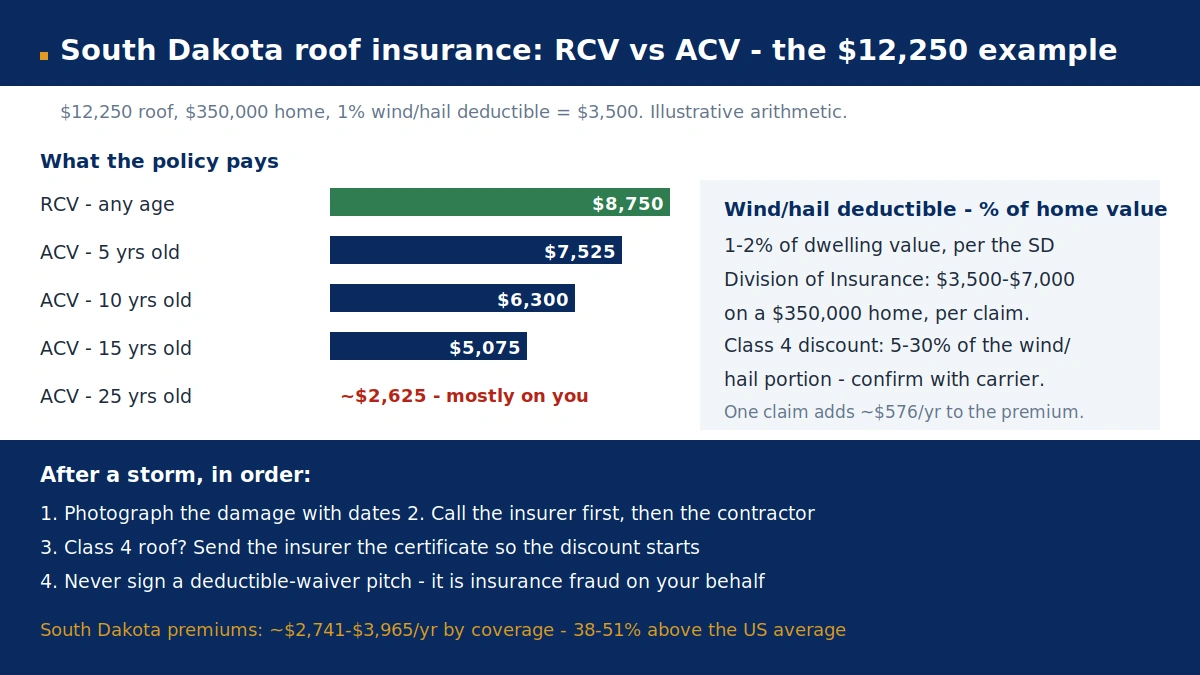
The premium. South Dakota homeowners pay well above the national average, and the studies agree on the direction even though they measure different coverage levels. Insure.com puts the state average at about $3,374 a year. LendingTree’s 2026 rate study, on $400,000 of dwelling coverage, puts it at $3,637 a year, or about $303 a month. Kiplinger’s 2026 state ranking reports roughly $3,965. MoneyGeek puts it at $3,617 a year on $250,000 of dwelling coverage. Insurify, on a $300,000 dwelling policy with a $1,000 deductible, puts it at $2,741 a year. The national average in the same studies runs about $2,628 to $2,772. On the higher-coverage studies, South Dakota runs roughly 38 to 51 percent above the country as a whole, and ranks around tenth to thirteenth most expensive. The driver is not hard to find: hail claims account for about 35 percent of all homeowner claims in South Dakota, according to a local analysis of the state’s claim mix, and the Black Hills region runs the most expensive of all, with wildfire risk stacked on top of hail and wind. One claim raises the premium by roughly $576 a year on the MoneyGeek figures, and two claims by about $1,060 — which is one more reason a Class 4 roof that avoids claims is worth more than its discount.
The deductible. Most South Dakota policies do not have one deductible for everything. They carry a separate wind and hail deductible, typically 1 to 2 percent of the home’s insured dwelling value, according to the South Dakota Division of Insurance. On a home insured for $350,000, that is $3,500 to $7,000 out of pocket before the insurer pays anything on a hail claim — against a standard $1,000 or $2,500 deductible for other perils. That percentage deductible is the single most important number in the policy, and it is the number most homeowners do not know until the adjuster is standing in the driveway. Read the declarations page before the storm, not after it. A 2 percent deductible on a $400,000 home is $8,000, and a roof that costs $12,000 to replace leaves only $4,000 of insurer money on the table — which is why so many South Dakota homeowners end up paying for a large share of their own roof even with a valid claim.
RCV vs ACV. The second most important number is whether the policy pays replacement cost value or actual cash value for the roof. A replacement-cost policy pays what a new roof costs, less the deductible, at any age of the old roof. An actual-cash-value policy pays what the old roof was worth on the day it was damaged — the replacement cost less depreciation — and depreciation on a shingle roof is steep. The table below is NestPriced illustrative arithmetic, not a regulator’s published example: a $12,250 roof on a $350,000 home, a 1 percent wind and hail deductible of $3,500, linear depreciation of 2 percent a year over a 25-year shingle life.
| Roof age | RCV payout | ACV payout |
|---|---|---|
| Any age | $8,750 | — |
| 5 years | — | $7,525 |
| 10 years | — | $6,300 |
| 15 years | — | $5,075 |
| 25 years | — | $2,625 |
The pattern is the warning. At five years, the ACV payout is $1,225 less than replacement cost. At fifteen years, it is $3,675 less. At twenty-five years, the policy pays $2,625 on a $12,250 roof — barely a fifth of the cost — and the homeowner funds the rest. An older roof on an ACV policy is a roof the homeowner is mostly self-insuring, whether they know it or not. Check the policy type before the storm. If it is ACV and the roof is over ten years old, the Class 4 upgrade and the replacement decision both look different, because the insurer will not be paying for much of either.
The claim, step by step. Document the damage before anyone touches it: photos of every slope, every gutter, every dented vent cap, with dates. Call the insurer first, not the contractor — the adjuster inspects, the contractor estimates, and the order matters. Do not sign a contingency or assignment-of-benefits agreement in the driveway. Get the adjuster’s report in writing, with the line items, and compare it to the contractor’s estimate line by line: the adjuster prices the roof, the contractor prices the same roof, and the gap between them is the negotiation. Keep the deductible in cash, because no legitimate contractor can waive it and no insurer will pay it. And keep the paperwork — the Class 4 product name, the UL 2218 marking, the install photos — because the discount on the next policy year depends on proving what is on the roof.
The Class 4 discount, one more time. The discount is real, it is carrier-specific, and it applies to the wind and hail portion of the premium only. The published ranges run from 5–15 percent to 15–30 percent depending on the source, and no named carrier’s South Dakota figure was verified for this guide. Get the figure from your own carrier, in writing, with the qualifying product list and the documentation required, before the install. A discount promised by a contractor is not a discount until the carrier confirms it.
Paying for It: No Federal Credit in 2026, No State Grant & No HEAR Money
The 2026 money story for a South Dakota roof fits in one paragraph, and it is a paragraph with no good news in it — which is exactly why so many roofing quotes still get it wrong. In 2026, the federal government contributes nothing to a South Dakota homeowner who replaces a roof, the state contributes nothing, and the federal rebate programs that help homeowners in other states do not exist in South Dakota at all, because South Dakota never applied for them.
The federal tax credit is $0. The One Big Beautiful Bill Act — Public Law 119-21, signed July 4, 2025 — ended the Residential Clean Energy Credit (§25D, 30 percent) and the Energy Efficient Home Improvement Credit (§25C) for property placed in service after December 31, 2025, per IRS fact sheet FS-2025-05. A roof is not solar equipment and never qualified for §25D in the first place, but the §25C energy-efficiency credit was sometimes claimed for qualifying roofing materials, and that door is closed too. Any 2026 quote that still carries a tax-credit line is priced under a law that no longer exists — ask the contractor to strip it out and quote again. The commercial clean-electricity credit (§48E) belongs to clean-electricity property such as solar, and there is no verified lease or pass-through route that puts federal money into a South Dakota roof. None is claimed here. The whole 2026 federal picture is in our federal energy tax credits guide.
HEAR and HOMES: South Dakota did not apply. The federal home energy rebate programs — HEAR, up to $8,000 for electrification, and HOMES, up to $8,000 for efficiency — were allocated to South Dakota on paper: $34,178,990 for HEAR and $34,309,734 for HOMES. But South Dakota is the only state that did not apply for the funding, according to the Department of Energy dataset and the Bonneville Power Administration’s June 2026 factsheet, and a state-by-state check on October 27, 2026 lists South Dakota as “Not participating” with no programs launched and no launch date. There is no application route, no waiting list, and no money to claim. And even in a state where HEAR had launched, it would never pay for a roof: HEAR funds electrification — heat pumps, heat-pump water heaters, electrical panels, and insulation-related wiring — and never roofing, and since the Energy Department’s Notice 26-2 of September 1, 2026, it pays only for electric-to-electric upgrades. A reroof paired with an insulation upgrade may qualify for the insulation half in a launched state. In South Dakota, there is no launched state program to pair it with.
No state money either. No South Dakota state roof grant, rebate, or tax credit was found in this pass, and no utility roof rebate was found. South Dakota has no state income tax, which is part of the reason there is no state tax-credit mechanism to claim against. What does pay is the insurer, through the Class 4 discount and the avoided deductible, and the energy bill, through the insulation and ventilation work done alongside the reroof. A homeowner who wants help paying for a roof in South Dakota in 2026 should look at a home-equity loan or a contractor financing plan — and should read the annual percentage rate before the monthly payment, because a low monthly payment on a long term with a high rate is the most expensive roof in this guide. For financing in detail, see our how to finance a new roof guide.
Repair vs Replace: The South Dakota Decision Rules
Not every damaged South Dakota roof needs replacing, and not every old roof needs repairing. The decision turns on age, damage, and the deductible — and in this state, on the hail forecast for the next five years, because a repaired roof that takes another storm in June is a repair paid for twice.
Repair when the roof is young and the damage is small. A roof under ten years old with a handful of missing shingles, a flashing leak at a chimney, or a small patch of wind-lifted tabs is a repair job. South Dakota repair figures from NumeralQ, pricing October 26, 2026, put replacing up to ten shingles at $184–$372, flashing repair at $191–$412, finding and fixing a leak at $259–$720, and replacing a 100 square foot section at $459–$910. A Sioux Falls contractor page puts general repair at $150–$1,500, leak repair at $500–$1,500, and inspection at $150–$400. A repair is also the right call when the damage is clearly one storm old and the insurance adjuster agrees the rest of the roof has life in it — take the ACV or RCV payment for the damaged section, fix it properly, and keep the roof.
Replace when the roof is old, the damage is wide, or the math says so. Replace when the roof is past fifteen years on architectural shingles and the hail has bruised more than a quarter of the slopes, because patching a bruised mat is cosmetic work on a roof that will fail at the next storm. Replace when the deck is soft or the sheathing is delaminated, because a repair cannot fix structure. Replace when the ice dams come back every winter despite the insulation and ventilation work, because the dam is telling you the system has failed, not the shingle. Replace when the insurer has paid a claim and the roof is at the age where the next claim will be an ACV claim paying a fifth of the cost — take the replacement money while it is still replacement money. And replace when the repair quote is more than about a third of the replacement quote for a roof with less than five years of life left, because the repair is a down payment on a roof that is coming anyway.
The inspection rhythm. Book an inspection in late fall, once hail season ends, and another in late spring, before it begins. The fall inspection catches the summer’s hail damage while the adjuster’s window is still open and the crew can still work before winter. The spring inspection catches the winter’s ice dam and freeze-thaw damage before the hail season adds a second layer of problems. A roof that looks sound from the curb may be far closer to failure than it seems after several South Dakota summers — the mat bruises from the inside, and the bruise does not show until the shingle cracks. For inspection costs and what an inspection covers, see our roof inspection cost guide and our roof repair cost guide. Gutters take the same hail a roof takes, and they fail first at the seams — see our gutter installation cost guide if the gutters are part of the job.
Sources & methodology
Cost anchors: SmartRoofingCalculator — “Roof Replacement Cost by State (2026)” and South Dakota state page (updated Nov 2, 2026; SD arch $400–$580/sq; 25-square roof $10,000–$14,500; standing-seam metal $800–$1,250/sq; tile $1,070–$1,600/sq; permit ~$175; roofer median wage $23.23/hr; construction laborer $20.90/hr; RPP 88.6; state factor 0.890); NumeralQ — South Dakota roof replacement cost (pricing Oct 26, 2026: Rapid City 2,000 sq ft roof $8,940–$10,840; Sioux Falls $9,150–$11,110; BLS May 2025 roofer median SD $22.94/hr, Rapid City $22.36/hr, Sioux Falls $23.50/hr; billed rates $45–$61/hr at 2.0–2.6x pay); MyRoofData — South Dakota (2026 model: typical arch roof $11,750–$20,500, 8% below national; 3-tab $322–$506/sq, arch $414–$690/sq before tear-off; example 2,338 sq ft, 23.4 squares, $11,800–$20,400); This Old House — South Dakota roof replacement cost (2026 Roofing Survey: avg $7,102, range $5,519–$18,270; asphalt $4.54/sq ft, metal $8.69/sq ft, slate $15.02/sq ft); RoofingEstimatorPros — South Dakota (updated Aug 26, 2026: 2,000 sq ft arch $12,802–$23,054, avg $17,358, $8.68/sq ft, 0.92x multiplier, permit $100–$400, 1–3 day install); CostOnce (prices updated Mar 2026: $4–$13/sq ft; 2,000 sq ft home $8,400–$26,880; 16% below national); Sioux Falls local contractor page (asphalt $4.35–$12.25/sq ft, metal $7–$16/sq ft, ranch $6,500–$11,000, two-story $10,000–$18,000). We computed the 25-square material totals, the size table, the Class 4 totals, and the cost-per-year figures ourselves from the per-square ranges and the lifespans.
Climate + hail + wind + snow: NOAA Storm Prediction Center via Insurance Information Institute / CarCovers (2025: 5,432 one-inch-plus hail events nationwide; South Dakota 232, 7th); Harbilo severe wind and hail reports (NOAA SPC data, updated Oct 10, 2026: 2,001 reports on file; 923 in 12 months; 423 in 90 days; July 2025 busiest month, 526; 226 per 100,000 residents, 1st per capita, 12x median); NOAA 2005–2025 analysis via WiseVoter/KOTA (Oct 26, 2026: SD averages 174 hail events and 116 thunderstorm-wind events a year; number one for hail, thunderstorm wind, flood, flash flood; 4,523 hail episodes in 25 years); NOAA record hailstone (Vivian, July 23, 2010: 8.0 inches, 18.625 inches circumference, 1 lb 15 oz); May 20, 2025 outbreak (KOTA: 14 tornadoes, baseball-size hail, northern SD); Weather.city storm reports (through Nov 4, 2026, preliminary: SD 2026 tornadoes 14 YTD vs 10-year normal 19.9; all-time 1,959 tornadoes, 17,160 hail, 13,345 wind); snowfall 1991–2020 normals, NCEI (Sioux Falls 45.3 in/yr; Rapid City airport 48.5 in/yr, 17.44 in precipitation; Black Hills up to ~70 in/yr; Lead nearly 200 in/yr per Weather Channel); Sioux Falls record seasonal snowfall 94.7–99.7 in (1968–69).
Class 4 + insurance discounts: K1 Roofing, Rapid City — Class 4 guide (2026: upgrade $150–$200/sq; $3,000–$4,000 on a 20-square home; discount 15–30% of wind/hail portion; CertainTeed Landmark IR and NorthGate ClimateFlex named; UL 2218 2-inch steel ball from 20 feet); RoofRepair.co — Class 4 discounts by state (early 2026: SD/Wyoming 10–18%); AmazingFlash (June 9, 2026: MN, Dakotas, Iowa 5–15%; hail-state range 10–28% of dwelling portion).
Insurance: Insure.com (~$3,374/yr); LendingTree 2026 rate study ($3,637/yr on $400,000 dwelling, Quadrant Feb 2026 data); Kiplinger 2026 ranking (~$3,965/yr); MoneyGeek ($3,617/yr on $250,000 dwelling; one claim +$576/yr, two claims +$1,060/yr); Insurify (Nov 1, 2026: $2,741/yr on $300,000 dwelling, $1,000 deductible); national average $2,628–$2,772 in the same studies; South Dakota Division of Insurance (wind/hail deductible typically 1–2% of dwelling value); hail claims ~35% of all homeowner claims in SD (local analysis, Krosch/Huzi, Oct 2026 — single local source, attributed).
Permits + licensing: RoofingLicenseCheck — roofing license by state (checked Oct 22, 2026: SD no state license; excise tax license, 2% tax; Sioux Falls and Rapid City license locally); Simply Business (updated Mar 26, 2025: no statewide general contractor license); ContractorsLiability (Sep 16, 2026: no statewide roofing license); Sioux Falls roofing permits guide (permit required for re-roofing; Residential Roofing and Repair Contractor License: city exam, $300,000 liability, $20,000 bond; Building Services, City Center, 231 North Dakota Avenue; fee doubled if started without permit); PermitsGuide (Mar 2026: no mandatory statewide building code; Sioux Falls 2021 IRC); Hols & Co (excise tax license is a tax registration, not a skill test).
Labor: BLS OEWS May 2025 (SD roofers 47-2181: mean $22.59/hr, median $22.94/hr, median annual $47,710, most earn $34,550–$59,200, rank 36 of 51; Rapid City metro mean $22.62/hr, median $22.36/hr, ~120 roofers; Sioux Falls median $23.50/hr); SmartRoofingCalculator citing BLS May 2024 (~440 roofers statewide, mean $22.10/hr).
HEAR / HOMES + federal: ECW heat pump rebates by state (checked Oct 27, 2026: SD “Not participating”, only state that did not apply; HEAR allocation $34,178,990; HOMES $34,309,734); BPA June 2026 factsheet (same 13 launched jurisdictions; SD did not apply); National Housing Trust DOE tracker (Mar 5, 2026); HeatPumpEconomics (July 25, 2026: Idaho and South Dakota declined funding outright, per tracker); DOE Notice 26-2 (Sep 1, 2026: HEAR electric-to-electric only). Under OBBBA (P.L. 119-21) and IRS FS-2025-05, §25C and §25D no longer apply to installs placed in service after Dec 31, 2025.
Repair costs: NumeralQ — South Dakota roof repair cost (Oct 26, 2026: up to 10 shingles $184–$372; flashing $191–$412; leak $259–$720; 100 sq ft section $459–$910); Sioux Falls local page (repair $150–$1,500; leak $500–$1,500; inspection $150–$400).
How we worked: the 25-square material totals, the size table, the Class 4 totals, the cost-per-year figures, and the RCV/ACV table are our own worked arithmetic from the cited per-square ranges and lifespans, labeled as such. The discount figures quoted here come from published carrier ranges, so treat them as ranges rather than guarantees, and remember they cut the wind and hail slice of the premium, not the whole bill. We flagged the headline-cost disagreement (SRC vs NumeralQ vs MyRoofData vs RoofingEstimatorPros vs This Old House), the Class 4 discount disagreement (15–30% vs 10–18% vs 5–15%), and the city-pricing gap (no verified figures for Aberdeen or Brookings) rather than settling them. No Aberdeen, Brookings, Pierre, or Watertown city-level roof prices were verified, so none are given. No Rapid City-specific permit fee or roofer-license exam/bond figures were verified, so none are given. No South Dakota-specific ground or roof snow-load psf figures by jurisdiction were verified, so none are given. No named carrier’s South Dakota Class 4 discount was verified, so only ranges are given. No South Dakota-specific rural travel-charge percentage was verified, so none is given. The South Dakota lifespans here are contractor-consensus estimates that fit the hail and freeze-thaw climate — realistic figures, not numbers lifted from one published table.
What does a roof replacement cost in South Dakota in 2026?
In 2026, a typical 25-square architectural shingle roof in South Dakota runs $10,000–$14,500 ($400–$580 a square, tear-off included), according to SmartRoofingCalculator, updated November 2, 2026. NumeralQ prices a 2,000 square foot roof at $8,940–$10,840 in Rapid City and $9,150–$11,110 in Sioux Falls. On a 25-square roof: 3-tab shingles $8,050–$12,650 before tear-off, Class 4 shingles $13,750–$19,500, standing-seam metal $20,000–$31,250, and tile $26,750–$40,000. Most asphalt jobs land between $8,500 and $23,000 statewide, with the high end covering steep, complex, or rural roofs.
Is hail really that bad for roofs in South Dakota?
Yes — South Dakota is core Hail Alley, and per resident it is the worst in the country. The state logged 232 hail events of an inch or larger in 2025, seventh in the nation, and averages about 174 hail events a year over the 2005–2025 record. Harbilo’s count of severe wind and hail reports stands at 2,001 on file, with 923 in the last twelve months, and at 226 reports per 100,000 residents South Dakota leads the nation by twelve times the median state. The American record hailstone fell on Vivian in 2010: eight inches across and one pound fifteen ounces. A standard architectural shingle typically fails under golf-ball hail, which is why Class 4 shingles are the default recommendation in this state.
Are Class 4 shingles worth it in South Dakota?
For most South Dakota homeowners, yes. The upgrade costs roughly $150–$200 more per square than standard architectural shingles — $3,000–$4,000 on a typical 20-square home — and it earns an insurance discount of roughly 5–30 percent off the wind and hail portion of the premium, depending on the carrier and the source. The stronger payback is the avoided deductible: at a 1 percent wind and hail deductible on a $350,000 home, each hail claim avoided saves $3,500 out of pocket, so surviving two or three mid-band hail events without a replacement pays for the upgrade. Class 4 also stretches roof life to 20–30 years. Confirm the exact discount, the qualifying product list, and the documentation your carrier needs before signing.
Does my South Dakota roofer need a license?
No — South Dakota has no statewide roofing license and no state exam for roofers or general contractors. What the state requires is a free Contractor’s Excise Tax License and payment of the 2 percent excise tax, which is a tax registration, not a test of skill. The real license is the city’s: Sioux Falls requires a Residential Roofing and Repair Contractor License, earned by passing a city exam, carrying at least $300,000 in liability insurance, and posting a $20,000 bond. Rapid City and other cities license roofers locally too. Verify every bidder’s city license with the building department, and verify insurance and workers’ compensation certificates mailed straight from the carrier.
Is a permit required for a roof replacement in South Dakota?
In the cities that enforce a code, yes. Sioux Falls requires a building permit for any roof replacement or re-shingling, issued through Building Services at City Center, and the licensed contractor must obtain it and schedule the inspection. Permit costs run about $100–$400, and starting work before the permit is issued doubles the fee in Sioux Falls. South Dakota has no mandatory statewide building code — Sioux Falls enforces the 2021 International Residential Code, while some rural areas have no code enforcement at all. Check with the local building department before the job starts.
Can I claim a federal tax credit on a South Dakota roof in 2026?
No — $0. The One Big Beautiful Bill Act ended §25C and §25D for anything placed in service after December 31, 2025, and a roof never qualified for the solar credit in the first place. South Dakota has no state roof grant, rebate, or tax credit to take its place, and it is the only state that never applied for the federal HEAR and HOMES rebates — about $34 million was allocated for each program on paper, but there is no program to apply to. What does pay is the insurer: a Class 4 roof can earn a discount on the wind and hail portion of the premium, and each avoided hail claim saves a $3,500–$7,000 deductible.
How long does a roof last in South Dakota?
Shorter than the brochure promises in mild states, longer for metal and slate. Lifespans that hold up in South Dakota: 3-tab shingles 10–15 years, architectural shingles 15–22 years, Class 4 shingles 20–30 years, exposed-fastener metal 30–45 years, standing-seam metal 40–60 years, cedar shakes 20–30 years, tile 50 years or more, natural slate 75–150 years. The killers are hail that bruises the mat, freeze-thaw cycling that works every seam looser each winter, and ice dams that back water under shingles in January. Book an inspection in late fall, once hail season ends, and another in late spring, before it begins.
What should I watch out for with storm-chaser roofers after a hailstorm?
South Dakota is storm-chaser territory, and the crews arrive within days of a hail event. Watch for a door knock with pressure to sign a free-inspection agreement on the spot, out-of-state phone numbers, no permanent local office, no city license where one is required, a promise to waive or absorb your deductible, and a demand for a large payment up front. A deductible waiver is a promise to commit insurance fraud on your behalf. South Dakota law gives you a three-day right of cancellation on any door-to-door contract — use it. Before signing anything, verify the contractor’s city license with the building department, check the excise tax license, and get the insurance and workers’ compensation certificates mailed to you straight from the carrier.