


Table of Contents
Rhode Island fits in a single day’s drive, and its solar market fits in a single sentence: expensive power, strong state help, and a choice you have to make before you sign anything. The panels cost roughly what they cost everywhere else in the Northeast. The sun is decent, not desert-grade. The power is what sets the state apart — about 28 cents a kilowatt-hour against a national average near 18 — and every kilowatt-hour a panel makes replaces one of those expensive ones. That alone would make the payback short. What makes it shorter still is that Rhode Island, unlike most states, kept paying homeowners after Washington stopped. The state grant knocks $1.65 off every watt, up to $14,500, and the Renewable Energy Growth tariff pays 31.55 cents for every kilowatt-hour the array produces for fifteen years. No other state in this series hands a buyer two doors that generous and then makes the buyer pick only one.
The pick matters more than the price per watt. Take the grant and you keep net metering, with exported power earning 27.553 cents a kilowatt-hour and every kilowatt-hour you use at home wiping out a retail purchase. Take the fixed payment instead and you give up both the grant and net metering, but you get paid for all of your production — including the power your own house eats — at a rate above what you pay for electricity. A household that uses most of its power in daylight does better on the first path. A household with a big empty roof and a small electric bill can do better on the second. A household that signs the wrong one leaves thousands of dollars on the table for fifteen years, and there is no switching later.
There is also a timing problem that no other article in this series has had to carry. The grant comes in rounds, and the last round of 2026 closed on October 16 — three weeks before this guide was written. If you are reading this in November, the grant is not open to you right now. Nobody has published a 2027 round yet. That does not make the grant a fiction: it has run for years, the money comes from the state Commerce agency, and new rounds have followed old ones. But it does mean a quote that subtracts $13,052 today is subtracting money you cannot currently claim, and the honest way to read that quote is as a price with a grant-shaped hole in it until the next round opens.
Start with the national picture in our solar panel cost guide and then weigh Rhode Island’s figures against it.
How Much Do Solar Panels Cost in Rhode Island in 2026?
Two anchors describe the Rhode Island market in 2026, and they land seven cents apart. The November 2026 EnergySage state page, built from live marketplace quotes, puts Rhode Island’s installed average at $2.80 per watt. For the 11.7 kW average system that works out to roughly $32,773 before incentives, and most quotes fall between $27,857 and $37,689. EcoGen’s September 2026 Solar Cost Index lists Rhode Island at $2.87 per watt, with its typical 7.91 kW system coming in at about $22,702 in cash. The 7.91 kW size is a measured median, not a model: Berkeley Lab’s 2025 median for Rhode Island, drawn from 2,480 installed systems across the state. A third snapshot lands higher: SolarPanelCosts, working from Berkeley Lab’s 2024-2025 closed-contract records, puts Rhode Island at $3.75 per watt, with an 8 kW system at $30,000. RenewEstimator’s July 2026 database puts the state at $3.25 per watt, with an 8 kW system at $25,520.
Taken together, the anchors place Rhode Island just below the national average of $2.89 a watt on the EcoGen measure, and tied 27th lowest of all 51 jurisdictions in that index — a middle-of-the-pack price in a state with top-of-the-pack power rates. The neighbors split around it: Massachusetts and New York run roughly $3.18-$3.35 a watt on ElectricChoice’s October 2026 state table, a modeled secondary table rather than a quote average, so the gap is indicative rather than exact. Put the same panels, the same inverter, and the same crew on a Boston roof instead of a Providence one and the same 7.91 kW system costs roughly $2,400 more — and the hardware is not what changes. Rhode Island’s installer field is dense for a state its size, with the whole market inside an hour’s drive, and competition keeps the per-watt number honest.
Nearly all of the gap between the two headline totals comes from system size, not from price per watt — the two sources simply start with different-sized arrays. The 11.7 kW figure is EnergySage’s average of marketplace quotes, and very large systems on very large, heavy-use homes pull it upward. EcoGen’s 7.91 kW is the size the typical Rhode Island home actually had installed. An 11.7 kW system would make about 15,713 kilowatt-hours a year — roughly 239% of what the average Rhode Island home uses — which is why the choice between the grant and the fixed payment matters so much here: on Renewable Energy Growth, every one of those kilowatt-hours earns 31.55 cents whether the house uses it or not, while on net metering the surplus earns the 27.553-cent export credit instead of the retail price.
One per-watt number pays for everything installed — panels, inverter or microinverters, racking, wiring, crew, permits, inspection, and interconnection. A new roof, a panel upgrade, tree work, hurricane-rated racking on a coastal roof, and a battery are all extra, and on the coast the wind detailing a Narragansett Bay roof needs is usually extra too. Every one of those extras gets its own line on the quote, and this guide puts a dollar figure on each as it comes up. Two incentives sit inside the arithmetic, and they are large enough to be easy to overstate: the state grant is worth about $13,052 on the typical system, but only if a round is open when you apply, and the fixed RE Growth payment is worth about $3,352 a year for fifteen years, but only if you give up the grant and net metering to take it. No federal credit is baked into the price either, because for a 2026 owner purchase there is no credit to bake in.
One caution before the tables: in Rhode Island the lowest quote is not always the cheapest system in the end. Any installer’s total is mostly overhead and margin, and loan quotes often hide dealer fees of 10-30% of the cash price — sometimes more — inside what gets financed. When you line bidders up side by side, only one number compares cleanly: the cash price per watt for the same kit on the same roof. Collect that figure on paper from three installers at least, and strike off any bidder that will not produce it. In a state this small, that third quote is easy to get — and there is no excuse for skipping it.
| Source | $ per watt | System | Cash total | Payback |
|---|---|---|---|---|
| EnergySage (Nov 2026) | $2.80 | 11.7 kW | ~$32,773 ($27,857-$37,689) | 9.59 yrs modeled |
| EcoGen Index (Sep 2026) | $2.87 | 7.91 kW | ~$22,702 | ~8.3 yrs before incentives |
| RenewEstimator (Jul 2026) | $3.25 | 8 kW | ~$25,520 | 8.0 yrs modeled |
| SolarPanelCosts (Berkeley Lab 2024-25) | $3.75 | 8 kW | ~$30,000 | 9.7 yrs modeled |
| poweroutage.us (Apr 2026) | $3.95 | 5 kW | ~$20,150 | 10.4 yrs modeled |
| ElectricChoice (Oct 2026) | $3.10 | 7 kW | ~$21,700 | 7.3 yrs modeled |
| National range (article 4) | $2.25-$3.30 | 8.2 kW | ~$24,600 at $3.00/W | 6-12 yrs |
Three rows in that table deserve a footnote rather than a headline. SolarPanelCosts’ $3.75 a watt comes from closed contracts recorded by Berkeley Lab, which run older and higher than live marketplace quotes — useful as a ceiling, not as the market. poweroutage.us’s $3.95 a watt is the highest figure in the table and rests on an older methodology; it is corroboration only. And EnergySage’s 9.59-year payback and $105,520 in 25-year savings are modeled figures whose incentive assumptions are not stated on the page — they are not the same arithmetic as EcoGen’s worked 8.3-year example, and the two should not be averaged together. The GreenWatt-style older benchmarks that other state guides carry were not used here at all.
Solar Panel Cost in Rhode Island by System Size
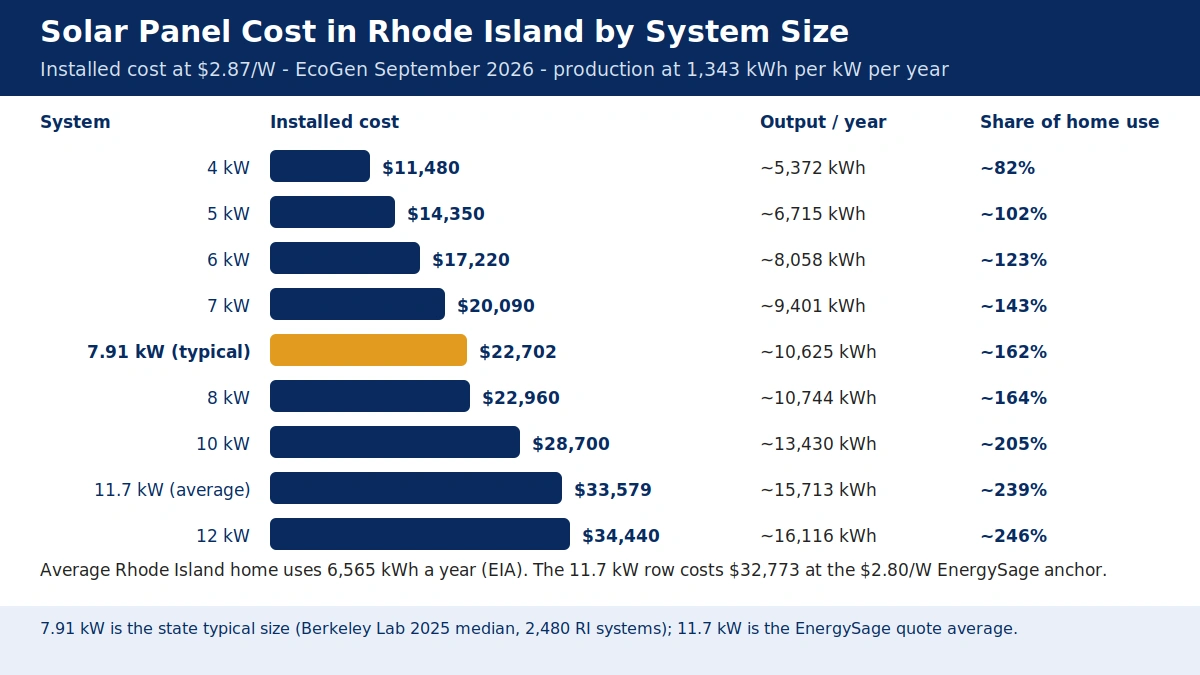
Size is the first decision, and in Rhode Island it is also the decision that picks your incentive path. The average Rhode Island home uses about 6,565 kilowatt-hours a year — a 12-month average derived from EIA billing data — which is far below the national average of roughly 10,500, because so many Rhode Island homes heat with gas or oil and cool a small footprint. Each installed kilowatt here yields about 1,343 kilowatt-hours a year, which puts a 7.91 kW array at about 10,625 kilowatt-hours — roughly 162% of what the average home uses in a year. That is why 7.91 kW counts as the state typical size even though it overshoots the average home by more than half: the typical buyer is not the average home. The typical buyer has an electric vehicle, a heat pump, electric heat, or all-electric everything, plus the oversizing that a quote average rarely talks anyone out of.
Going bigger than the house uses is a different deal in Rhode Island than in a state with weak export rules, because both of Rhode Island’s paths reward size in their own way. On net metering, a kilowatt-hour sent out earns 27.553 cents — close to the retail price, not a token — so oversizing costs little. On Renewable Energy Growth, a kilowatt-hour sent out earns 31.55 cents, more than the retail price, so oversizing pays outright. The table below turns on the EcoGen anchor of $2.87 a watt, with output of 1,343 kilowatt-hours per installed kilowatt each year. The table also shows the share of average home use each size covers, so you can see at a glance where the array stops serving the house and starts earning as a generator.
| Size | Cost at $2.87/W | Yearly output | Share of avg. RI home use (6,565 kWh/yr) |
|---|---|---|---|
| 4 kW | $11,480 | ~5,372 kWh | ~82% |
| 5 kW | $14,350 | ~6,715 kWh | ~102% |
| 6 kW | $17,220 | ~8,058 kWh | ~123% |
| 7 kW | $20,090 | ~9,401 kWh | ~143% |
| 7.91 kW (state typical) | ~$22,702 | ~10,625 kWh | ~162% |
| 8 kW | $22,960 | ~10,744 kWh | ~164% |
| 10 kW | $28,700 | ~13,430 kWh | ~205% |
| 11.7 kW (state avg) | ~$33,579 at $2.87/W ($32,773 at $2.80/W) | ~15,713 kWh | ~239% |
| 12 kW | $34,440 | ~16,116 kWh | ~246% |
Two rows in that table merit a second look. First, the 11.7 kW state-average array generates roughly 239% of an average home’s yearly use — the average buyer is a household with an electric vehicle, a heat pump, or electric heat, plus the oversizing that a quote average rarely talks anyone out of. A gas-heated home with no EV usually needs only 5-6 kW — not 12. Second, the 7.91 kW typical system already covers about 162% of average annual use — so on net metering, the typical system already sells a meaningful slice at 27.553 cents, and on RE Growth the same system earns 31.55 cents on every kilowatt-hour it makes, used at home or not. The sizing conversation starts with the incentive path, then the bills, and only then the roof.
Work out the array size from a full year of electric bills, not from how much roof happens to be empty. Total the kilowatt-hours, divide by roughly 1,343 to find the size that covers them, then adjust: add 1-2 kW for a planned EV, more for a heat pump or electric heat, less for a shaded or north-facing roof — then check the result against the 25 kW threshold that governs the small-solar programs. Planning an EV or a heat pump? Add that load before you size the solar — otherwise the new load arrives after the array was sized for the smaller house. The full treatment of that sizing logic, for the whole country, is in our 6 kW vs 8 kW vs 10 kW guide.
One Rhode Island wrinkle belongs in this section and nowhere else: until June 27, 2025, a home system had to be sized to the household’s past power use to qualify for net metering, which capped how big you could build. Governor McKee signed HB-5580 that day, and the law now bars Rhode Island Energy from denying or delaying a net-metering interconnection because of a customer’s historical consumption. For a system of 25 kW or less, the old sizing test is gone. That is why the 11.7 kW marketplace average can sit so far above average home use without tripping a rule — and why a household planning an EV or a heat pump can size for the future load, not the past one. The 125% figure still appears in older guides; treat it as history, not as the current rule for a small home system.
Solar Panel Cost by City: Providence, Newport, Portsmouth & Westerly
Rhode Island is small enough that the whole state is one solar market, and the verified figures run from $2.73 to $2.87 a watt — the tightest spread in this series. What sets the cities apart is not the install price but the roof and the bill behind it — and on the coast, the wind the racking has to hold against. EnergySage’s city pages for November 2026 show the pattern most clearly, and the pattern is worth reading carefully: Providence, the biggest market in the state, is also the most expensive of the verified cities, and the coastal towns run cheaper even though their roofs face the Atlantic.
| City | $ per watt | Avg. system | Cash total | Payback (modeled) |
|---|---|---|---|---|
| Providence | $2.87 | 10.62 kW | ~$30,443 ($25,877-$35,009) | 10.19 yrs |
| Portsmouth | $2.86 | 10.97 kW | ~$31,333 ($26,633-$36,033) | 10.51 yrs |
| East Greenwich | $2.81 | 12.91 kW | ~$36,270 ($30,830-$41,710) | 9.74 yrs |
| Newport | $2.80 | 8.38 kW | ~$23,505 ($19,979-$27,031) | 8.59 yrs |
| Westerly | $2.76 | 11.12 kW | ~$30,725 ($26,116-$35,334) | 10.51 yrs |
| Chepachet | $2.73 | 18.12 kW | ~$49,510 ($42,084-$56,936) | 12.53 yrs |
Providence is the biggest market in the state, served by Rhode Island Energy, at $2.87 a watt — the highest of the verified cities — with a 10.62 kW average system at about $30,443. That is about 2.5% above the statewide $2.80 a watt — Providence’s quotes run higher even though Providence is where the installers are. A dense installer bench packed into one metro does not always produce cheaper prices, and Providence’s numbers prove it. Portsmouth, across the bay in Newport County, runs $2.86 a watt on a slightly larger 10.97 kW average system at about $31,333. East Greenwich, in Kent County, runs $2.81 a watt on a 12.91 kW average system at about $36,270 — the largest average system of the verified cities, and the one with the biggest 25-year savings figure, $118,701 on EnergySage’s modeled estimate. Newport, on Aquidneck Island, runs $2.80 a watt on the smallest average system of the group, 8.38 kW at about $23,505, with the shortest modeled payback at 8.59 years. Westerly, on the Connecticut line, runs $2.76 a watt on an 11.12 kW average system at about $30,725 — the cheapest of the verified cities.
Chepachet carries a warning label rather than a verified price. It shows $2.73 a watt on an 18.12 kW average system at about $49,510 — a system half again as large as any other city in the table, on a small rural town in Providence County. That is the signature of a thin sample dominated by a few very large installs, not a measured market, and its 12.53-year modeled payback is the longest in the table despite the lowest per-watt price. Treat Chepachet as an outlier, and do not quote it as the state low, because it is not one. No verified EnergySage city figures were pulled in this pass for Warwick, Cranston, Pawtucket, Woonsocket, or North Kingstown, and this guide does not invent them.
Use price per watt to order the cities; the total tells you nothing. East Greenwich’s $36,270 looks alarming next to Newport’s $23,505, but most of the gap is system size — 12.91 kW against 8.38 kW — not price. And use the payback column with care: every payback in this table is EnergySage’s modeled figure, built on assumptions the page does not spell out, and none of them is the worked EcoGen example of about 8.3 years that this guide headlines. The city table tells you what the market charges. The payback section below tells you what the system earns.
One more city-level note: Rhode Island’s housing stock is old and small. Providence triple-deckers, Cape Cods in Warwick and Cranston, and 19th-century colonials in Newport leave installers with steep pitches, dormers, chimneys, and shade from mature street trees — the kind of roofs where a string inverter loses production to a shaded string and microinverters earn their premium. A coastal roof in Newport or Narragansett also carries the wind detailing this guide covers in the climate section. Get three quotes, and make at least one from a company that already works on your side of the bay.
Rhode Island’s Sun: Production, Coastal Weather & Small Roofs
Rhode Island’s sunshine arrives with a climate that flatters the equipment in one way and tests it in another, and a production estimate that is honest has to carry both halves of the story.
The sun. On EcoGen’s PVWatts-based figures, each kilowatt of panels in Rhode Island yields roughly 1,343 kilowatt-hours a year, and a 7.91 kW array yields about 10,625 kilowatt-hours — about 162% of the average home’s yearly use. Cross-checks land close: a PVGIS model gives about 1,332 kilowatt-hours per kilowatt a year, poweroutage.us gives about 1,407, and a second PVGIS-based model gives 1,312. Take 1,312-1,407 as the working range, anchored on EcoGen’s 1,343. Peak sun hours run about 4.3 a day on the annual average in RenewEstimator’s database. June and July produce the most; December produces the least, with barely 9 hours of daylight against more than 15 in June. Rhode Island is not a desert state, and no honest estimate pretends it is — but the panels do not need desert sun when the power they replace costs 29 cents.
Cold works in the panels’ favor. Every degree Celsius a cell heats past 25 degrees costs roughly 0.3-0.5% of its efficiency. In January a Rhode Island rooftop runs far cooler than 25 degrees, so the panels here generate more per hour of winter sunshine than the same panels would on a hot southern roof. Cold, clear, coastal air is good solar weather, and it is a large part of why Rhode Island’s per-kilowatt production holds up against sunnier states. July reverses the effect, when a Providence rooftop bakes — but the long summer days more than make up for it over the year, which is why the annual figure still lands near 1,343 kilowatt-hours per kilowatt.
Rhode Island’s coast draws the line that splits the state in two. A roof in Providence faces a different wind than a roof in Narragansett, and the building code knows it. Rhode Island’s One and Two Family Dwelling Code puts the coast in 110 mph and 120 mph ultimate wind zones, and where the ultimate wind speed reaches 110 mph the construction must follow an engineered standard — the Wood Frame Construction Manual, SSTD 10, ICC-600, or ASCE-7 — rather than the prescriptive path. Appendix AA of the same code carries prescriptive high-wind detailing for those zones, and windows in the 120 mph zone need protection from windborne debris. For a solar array, the check that follows from all of that is the racking’s uplift rating: ask for it by name, in writing, and make sure the number matches the wind zone your address sits in. A ground-mount or flat-roof array on the coast needs the same question asked twice, because tilt is what the wind grabs. Panels rated UL 61730 / IEC 61730 remain the specification to ask for, and homeowners insurance remains the cover for storm damage — confirm in writing that the policy covers the array before signing, because a coastal carrier may price it separately.
Snow is a smaller variable here than in the mountain states. Rhode Island gets nor’easter snow, and a low-slope roof holds it longer than a steep one, but the state’s snowfalls melt off a tilted array within a day or two of most storms, and daytime temperatures often rise above freezing even in midwinter. This guide verified no Rhode Island-specific snow-loss percentage, so none is stated here — if an installer shows you a production estimate, ask to see the snow-loss assumption behind it, and ask what tilt it assumes. On steep coastal roofs, snow guards — which keep sliding snow off walkways and gutters — belong on the quote as a line item, not a footnote.
Rhode Island’s output swings hard with the seasons — summer to winter is a cliff, not a gentle slope. Summer days are long and the panels run hard; winter days are short and the panels run little — and that is exactly when Rhode Island Energy’s winter supply rate jumps to 17.029 cents, up from 11.092 cents in summer. Winter production carries the most value exactly when the house needs the most heat, which is why a battery or a heat pump paired with solar needs Rhode Island arithmetic of its own rather than numbers borrowed from a southern state. This guide has no verified Rhode Island monthly PVWatts table to show, so the seasonal shape is described here in words rather than month by month — if an installer shows you one, ask to see the PVWatts run behind it.
The roof itself, and the space it does not have. Rhode Island’s housing stock is the tightest in this series: small lots, small footprints, steep pitches, dormers, chimneys, and mature trees that shade half the roof by three in the afternoon. If the roof has less than ten years of life left, replace it before the panels go up — taking them off and putting them back for a later reroof costs thousands by itself. What a reroof costs in Rhode Island, and when to do it before the panels go up, is covered in our roof replacement guide. Standing-seam metal is one of the best solar roofs you can have, because clamps grip the seams without a single hole in the roof, and metal sheds snow faster than asphalt. On a small roof, paying extra for high-efficiency panels is worth it, because every square foot has to earn more.
Working with the climate. Nothing exotic is needed. Choose a south-facing orientation where the roof allows it, a tilt steep enough to shed snow and catch the low winter sun, microinverters or optimizers so one shaded string cannot pull the whole array down, and a production estimate built on PVWatts data with the snow assumption stated openly, not buried. On the coast, add one more line to that list: the racking’s uplift rating against the 110 or 120 mph wind zone, named in writing before the deposit is paid.
Net Metering in Rhode Island: The Rules That Decide Your Return
Rhode Island has a statewide net-metering law — and that already puts it ahead of most states in this series — but the law changed in April 2023, and the version that applies to a system installed in 2026 is not the one most solar advertising still describes. Find your interconnection date first. The rest of this section hangs on that date.
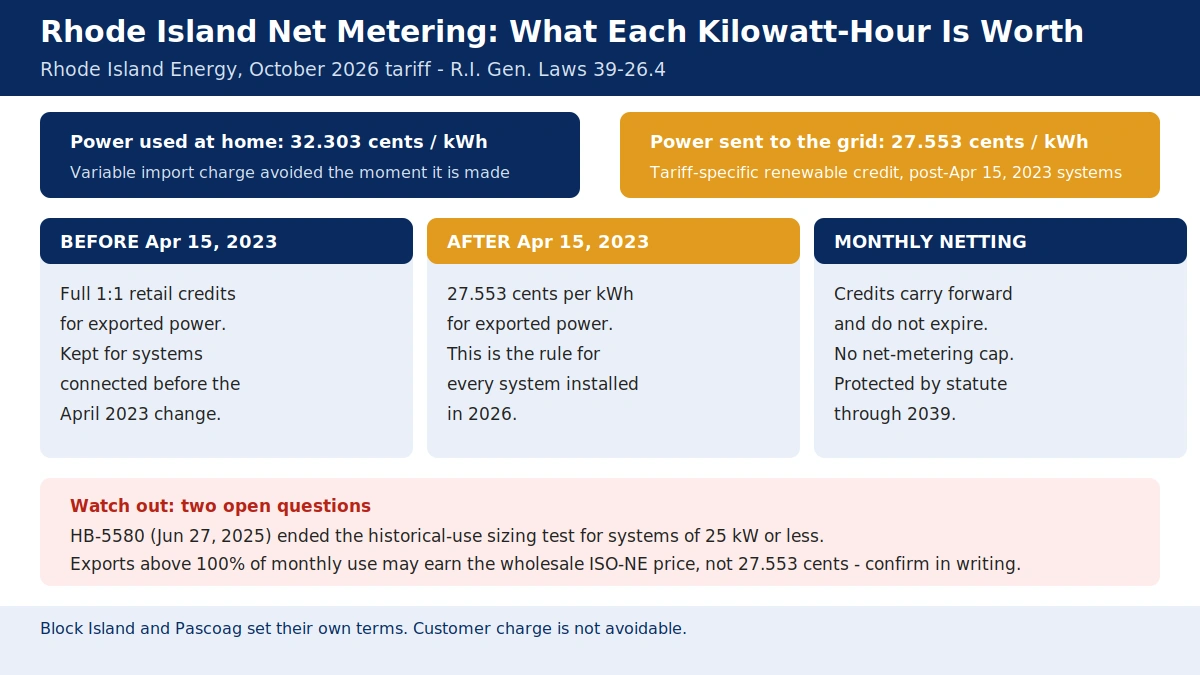
The April 2023 change. On April 15, 2023, Rhode Island cut the export credit for new systems from full retail to a tariff-specific renewable credit. Systems connected before that date keep full one-for-one retail credits. Systems connected after it — which means every system this guide is about — earn the tariff-specific renewable credit instead. Rhode Island Energy’s October 2026 tariff publishes that credit at $0.27553 a kilowatt-hour. Power you use the moment it is made avoids the variable import charge of $0.32303 a kilowatt-hour; the monthly customer charge is not avoidable, and it stays on the bill no matter how much the panels make. The gap between the two numbers is the whole economics of self-use in Rhode Island: a kilowatt-hour eaten at home is worth about 32.3 cents, and a kilowatt-hour sent out is worth about 27.6 cents. Both are high by national standards, and the gap between them is small — which is why oversizing hurts so little here and why a battery earns so little from arbitrage, a point the battery section takes up in full.
How the monthly netting works. Rhode Island Energy reads the retail meter at the start and the end of each billing period, and nets what the house imported against what it exported over the month. If the house imported more than it generated, the bill shows the net use. If it generated more than it used, the bill shows zero kilowatt-hours of usage and the surplus becomes net metering credits, held as a dollar value on the account. Unused credits carry forward and do not expire, and they are not paid out as a check. There is no net-metering cap for Rhode Island Energy customers. The system may be no larger than 10 MW AC per account — a limit no home system will ever approach — and since HB-5580 took effect on June 27, 2025, a home system of 25 kW or less no longer has to be sized to the household’s past power use at all.
One wrinkle the sources do not agree on. The net-metering census published by Electrical Contractors and Wiring on October 27, 2026 classifies Rhode Island as monthly netting with excess at avoided cost — meaning production above 100% of the household’s use in a billing period earns excess credits at the wholesale ISO-New England energy clearing price, not at the 27.553-cent credit. NuWatt’s guide, updated in April 2026, presents the 27.553-cent credit as the rate for exported energy generally. This guide states both, because both are published by named sources in 2026, and the difference matters exactly for the oversized systems Rhode Island sells: if the census reading is right, the kilowatt-hours above your monthly use are worth wholesale, not 27.553 cents. Before you sign, ask Rhode Island Energy in writing how exports above 100% of monthly use are credited on your rate class. Do not let a quote value every exported kilowatt-hour at 27.553 cents until that answer is in hand.
The law protects the program through 2039. Rhode Island’s net-metering statute, R.I. Gen. Laws 39-26.4, carries the program through 2039, so a system installed in 2026 has at least thirteen years of guaranteed net-metering terms — well inside a typical payback period. The protection is in the statute, not in a utility promise, which is a stronger footing than most states offer. The credit rate itself can still move in future rate proceedings; the 27.553-cent figure is the October 2026 tariff, not a lifetime guarantee.
The small utilities set their own terms — the commission has no say over them. Rhode Island Energy serves 98.7% of the state’s residential customers, so this section covers nearly every reader. Block Island Utility District, serving Block Island at an average of about 38.7 cents a kilowatt-hour in 2025, and Pascoag Utility District, serving Burrillville, have terms of their own that were not verified in this pass. Block Island’s rate is the highest in the state by a wide margin, which makes solar there look attractive on paper — but the island’s interconnection, ferry logistics, and installer access are all different from the mainland, and no Block Island solar terms were verified here. Block Island and Pascoag customers should get the solar rate sheet in writing before signing — no PUC order covers those utilities, so the paper is the only protection they have.
Payback: How Long Until Rhode Island Solar Pays for Itself?
Payback is where a Rhode Island system earns its keep, and the answer is short by the standards of this series — shorter than any state covered so far. EcoGen’s anchors underpin the worked examples below, so every input can be checked against them, with EnergySage as the cross-check — and this guide marks each place where the two sources part ways.
A worked example. A typical 7.91 kW system at $2.87 a watt is the starting point, priced at $22,702 before incentives. Yearly production runs to roughly 10,625 kilowatt-hours. The average Rhode Island home uses about 6,565 kilowatt-hours a year, so the typical array makes far more than the house uses — and that surplus is where the two incentive paths split.
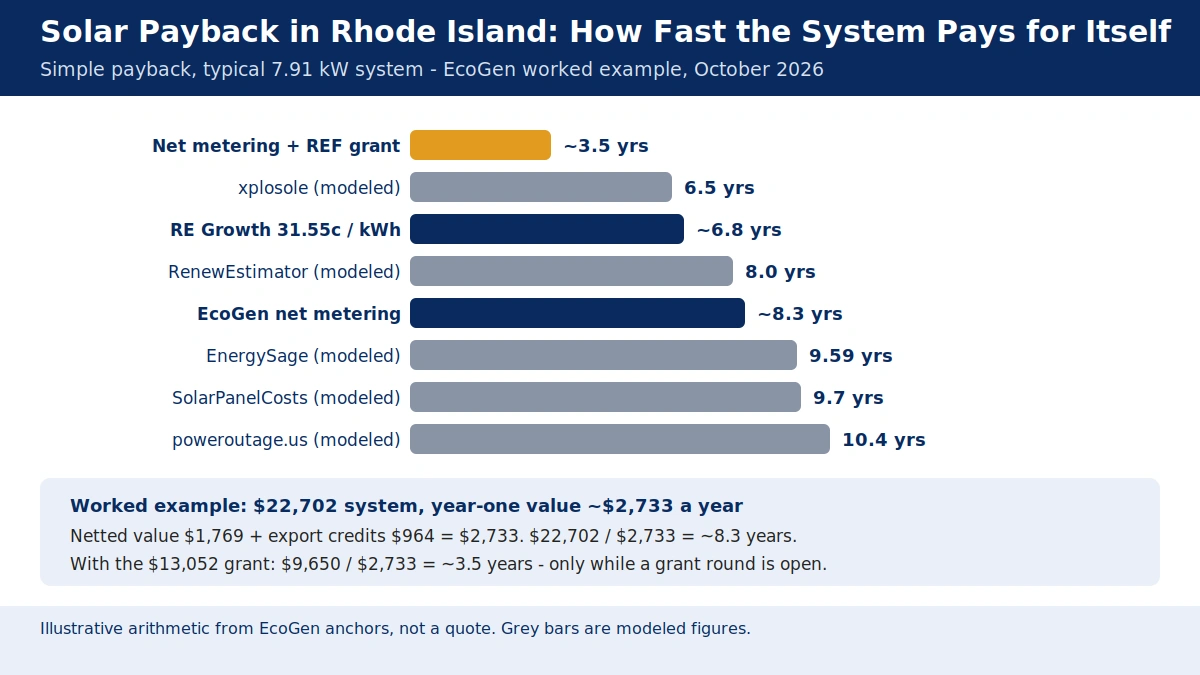
The net-metering path pays back in about 8.3 years. EcoGen’s worked example for Rhode Island Energy territory puts the year-one value at about $2,733 a year. The arithmetic runs in two parts. First, the 6,565 kilowatt-hours the house uses are netted each month against production at the utility’s average home price of 29.26 cents less the $11.25-a-month fixed charges, which leaves 27.2 cents for each kilowatt-hour netted — 6,504 kilowatt-hours at 27.2 cents is $1,769 a year of self-use and netted value. Second, the power left over each month earns the published net metering credit, worth about $964 a year. Simple payback is $22,702 divided by $2,733, about 8.3 years — before incentives, counting no upkeep, no rate rises, and no financing. That is the shortest worked payback in this series, and the reason is the rate: at 29 cents a kilowatt-hour, every panel replaces expensive power.
The grant cuts that to about 3.5 years. The Renewable Energy Fund grant on a 7.91 kW system is $1.65 a watt on 7,910 watts, which comes to about $13,052 — and it comes off the price before installation, taken by the installer. Net cost after the grant is $22,702 minus $13,052, about $9,650. Divide that by the same $2,733 a year of value, and the payback is about 3.5 years. That figure is NestPriced arithmetic from EcoGen’s anchors, labeled as such, and it carries one large condition: the grant has to reach you. The last 2026 round closed on October 16, 2026, and no 2027 round was listed when last checked on October 19. A 3.5-year payback is real money only in a round that is open. Until the next round opens, the honest payback for a new buyer is the 8.3-year figure, with the grant as upside when it returns.
The RE Growth path pays back in about 6.8 years, on different arithmetic. On Renewable Energy Growth, the same 7.91 kW system earns 31.55 cents for every kilowatt-hour it makes, used at home or not: 10,625 kilowatt-hours times 31.55 cents is about $3,352 a year, locked for fifteen years, for about $50,280 in total. Simple payback is $22,702 divided by $3,352, about 6.8 years. That figure is also NestPriced arithmetic, and it needs its framing stated plainly: under RE Growth you still pay your electric bill in full, because there is no net metering on this path. The $3,352 is incremental income against a bill that does not change, so the division is honest as a payback — but the household that takes this path should compare it against the grant path properly. On the grant path the net cost is $9,650 and the value is $2,733 a year. On the RE Growth path the cost is the full $22,702 and the income is $3,352 a year. The grant path wins on payback. The RE Growth path wins on total fifteen-year money, because $3,352 a year for fifteen years is $50,280 against a $22,702 cost, while the grant path’s $2,733 a year is worth about $40,995 over the same fifteen years against a $9,650 cost. Which one wins depends on whether the buyer values a fast payback or the most money over fifteen years — and on whether a grant round is open at all.
The modeled figures cluster around the same answer. EnergySage’s modeled payback for the state is 9.59 years, with $105,520 in 25-year savings. RenewEstimator’s July 2026 database puts the state at 8.0 years. poweroutage.us puts a 5 kW system at 10.4 years. SolarPanelCosts, on Berkeley Lab’s higher $3.75-a-watt contract prices, puts an 8 kW system at 9.7 years. A PVGIS-based model puts the state at 6.5 years. Every one of those is a model with its own assumptions, and none of them is EcoGen’s worked example — but the cluster is tight, and it all points the same way: Rhode Island pays back in roughly 7 to 10 years before the grant, and roughly half that with it.
| Case | Simple payback | Source |
|---|---|---|
| EcoGen net metering (7.91 kW) | ~8.3 yrs before incentives | EcoGen worked example, Oct 2026 |
| EcoGen net metering + REF grant | ~3.5 yrs | NestPriced arithmetic from EcoGen anchors |
| RE Growth (7.91 kW) | ~6.8 yrs | NestPriced arithmetic from EcoGen anchors |
| EnergySage modeled | 9.59 yrs | EnergySage, Nov 2026 — modeled, assumptions unstated |
| RenewEstimator (8 kW) | 8.0 yrs | RenewEstimator, Jul 2026 — modeled |
| poweroutage.us (5 kW) | 10.4 yrs | poweroutage.us, Apr 2026 — modeled |
| SolarPanelCosts (8 kW) | 9.7 yrs | Berkeley Lab 2024-25 contracts — modeled |
| xplosole PVGIS-modeled | 6.5 yrs | xplosole, Oct 2026 — modeled |
What moves the payback most. The incentive path is the biggest lever, and in Rhode Island it matters more than anywhere else in this series. The grant takes about $13,052 off the price; the fixed payment adds about $3,352 a year for fifteen years. No other choice pays as well. Daytime self-use is the second lever: a kilowatt-hour used at home is worth about 32.3 cents against 27.6 cents for one sent out, so shifting the dishwasher, the laundry, and the EV charger into daylight hours is worth roughly 5 cents on every kilowatt-hour moved — real money, but a smaller gap than in states where exports earn 3 cents. Rate escalation is the third lever: Rhode Island rates are high and have risen before — the winter supply rate jumped from 14.770 cents last winter to 17.029 cents this winter, a rise of about 15% in the supply portion alone — and every future rise shortens the payback. Financing comes fourth: a solar loan carrying dealer fees can push the effective price up by 10-30%, so compare quotes on cash price per watt instead of the monthly payment. And the tax exemptions help at the edges: the 7% sales-tax exemption saves about $1,589 on the typical $22,702 system, and the property-tax exemption keeps the added home value out of the assessment every year the system stands.
Who still comes out ahead. Four kinds of Rhode Island household clear it easily. The grant-round buyer, who applies while a round is open and watches the payback fall to about three and a half years. The RE Growth buyer with a big roof and a small bill, who turns the whole array into a fifteen-year income stream at 31.55 cents a kilowatt-hour. A household that is home all day, running a big daytime load — a home office, daytime laundry and dishwashing, an EV charged at midday — keeps most of its production at full retail value under net metering. And the backup-power buyer, who buys mainly for outage protection through nor’easters and hurricane-season shutoffs and treats savings as secondary — for that household the payback math is context, not verdict. Walk away when the roof is heavily shaded and the installer will not show a PVWatts run with the shade in it, when the quote subtracts a grant from a round that is closed, or when the installer prices every export at 31.55 cents on a system that is not enrolled in RE Growth.
Rhode Island Incentives in 2026: A Grant, a Fixed Payment, and Two Tax Exemptions
Once the federal credit is gone, most states still keep something in reserve: a state credit, a rebate, an exemption. Rhode Island keeps more than most states — a grant, a fifteen-year fixed payment, and two tax exemptions — and the grant is large enough that the choice between the two money paths is the most important decision in this guide.
The Renewable Energy Fund grant is the biggest single check in the state. The Renewable Energy Fund, run by Rhode Island Commerce, the state’s economic development agency, pays $1.65 a watt on home solar systems up to 8.8 kW, with a maximum of $14,500 per project. A 5 kW system earns $8,250. The typical 7.91 kW system earns about $13,052. Any system larger than 8.8 kW hits the $14,500 cap. The grant does not arrive as a check to the homeowner — the installer takes it off the price first, so the quote shows the lower number. Add battery storage to the same project and the fund adds a flat $5,000 energy storage adder, bringing the most a project can receive to $19,500. The grant pairs with net metering. It does not pair with Renewable Energy Growth, and the choice between them is made before you sign.
The grant is closed right now, and that has to be said first. The last small-scale round of 2026, round 26-3, closed on October 16, 2026. When EcoGen checked on October 19, Rhode Island Commerce had listed no 2027 round and no 2027 dates. Older guides still show the old grant level of 65 cents a watt up to $5,000 — that figure is stale, from before the 2026 increase, and it is excluded from every number in this guide. The $1.65-a-watt level comes from the Commerce flyer revised April 3, 2026, from EnergySage’s incentives page updated September 9, 2026, and from EcoGen’s October 2026 check. If you are buying in November 2026, do not let a quote subtract $13,052 as though the money were already in hand. Ask the installer which round the grant would come from, and when that round opens. If the answer is vague, the quote is pricing a hope.
Renewable Energy Growth is the fixed-payment path. RE Growth, run by Rhode Island Energy, pays a fixed price for every kilowatt-hour the panels make, used at home or not, locked for the whole term. For the program year that began April 1, 2026, the price is 31.55 cents a kilowatt-hour for fifteen years on systems up to 15 kW, and 28.65 cents a kilowatt-hour for twenty years on systems from 15 to 25 kW. The program takes 3 MW of small solar, first come, first served, until March 31, 2027. Older guides still show 33.85 cents — that was the 2025-2026 price, and it is stale. The fixed payment suits a household that wants income that does not move with electric rates. The utility keeps the renewable energy certificates. And the rule that matters most: RE Growth cannot be combined with the grant or with net metering. A household that enrolls in RE Growth still pays its full electric bill every month, and receives the production payment on top of it.
Rhode Island exempts solar from sales tax and from property tax. Solar equipment is exempt from the state’s 7% sales tax — panels, inverters, racking, and the labor for installation — which saves about $1,589 on the typical $22,702 system, applied automatically at the point of sale. The property-tax exemption is written into state law at R.I. Gen. Laws 44-3-3(48) and (49): renewable energy equipment on residential property is exempt from local taxation, so the value solar adds to the home does not raise the property tax bill. One wrinkle to carry into the battery section: batteries are not on the sales-tax exemption list, according to a Rhode Island installer’s reading of the statute in October 2026 — so a battery bought with the panels may still carry sales tax even when the panels do not.
Rhode Island has no Solar for All program open for households. The state was awarded $49.33 million in April 2024 under the federal Solar for All program, branded EASE — Equitable Access to Solar Energy — aimed at low-income homeowners, renters, and multifamily residents in 61 disadvantaged census tracts holding 97,892 households. The EPA terminated the program on August 7, 2025. On September 18, 2026, a federal judge in Providence, Mary McElroy, vacated that termination, ruling that the EPA lacked authority to cancel grants Congress had already obligated. The EPA said it was reviewing the ruling and considering an appeal, and separate cases remain pending in other courts. As of November 2026, there is no household application route open, and no resident should plan a purchase around it. The ruling reopens a path; it does not reopen a program.
Community solar exists in law, and the rules are still being written. Rhode Island passed its first community solar legislation in 2016, H 8354 A, which set up three kinds of remote generation: community remote net-metering systems, community remote distributed generation systems, and shared solar facilities under RE Growth. All three are administered by the Office of Energy Resources, and all three may be owned by a customer or by a third party. A 2023 law, S 0684 A, expanded third-party ownership for commercial and industrial customers. The final program rules are still pending under PUC Docket 24-10-EL. No general community-solar subscription price was verified for this guide, so treat any such offer as unverified until its terms are in writing. The state’s other low-income solar route, the Affordable Solar Access Pathways lease program, is on pause while the Office of Energy Resources redesigns it, with redesign responses due in May 2026 — no new applications are being taken.
Federal home energy rebates have launched in Rhode Island — and they still never pay for solar. The state was allocated about $31.8 million for HEAR and about $31.9 million for HOMES. HEAR launched on September 17, 2024, the first income-eligible pathway in New England, and its retail pathway pilot opened in May 2026 in eleven municipalities before expanding statewide for low- and moderate-income customers. HOMES launched on September 23, 2026. Since September 1, 2026, under federal Notice 26-2, HEAR pays only for electric-to-electric upgrades — no fuel-switching. HEAR funds heat-pump clothes dryers, electric stoves and induction cooktops, electric wiring, and load service centers — up to $8,000 for an income-qualified household — and never panels, batteries, EV chargers, or windows. HEAR can still matter to a Rhode Island solar buyer. A heat pump paired with new panels is a common combination, and the heat-pump half may qualify while the solar half never will.
| Item | Value | Notes |
|---|---|---|
| REF small-scale grant | $1.65/W, up to $14,500 | ~$13,052 on the typical 7.91 kW system; last 2026 round closed Oct 16, 2026; no 2027 round listed yet |
| REF storage adder | $5,000 flat | Only with a REF solar grant; total up to $19,500 |
| RE Growth (≤15 kW) | 31.55c/kWh for 15 yrs | ~$3,352/yr on the typical system; 3 MW cap to Mar 31, 2027; no grant, no net metering |
| RE Growth (15-25 kW) | 28.65c/kWh for 20 yrs | Larger systems only |
| Sales-tax exemption | 7% exempt | ~$1,589 on the typical system; batteries not on the list |
| Property-tax exemption | Full | R.I. Gen. Laws 44-3-3(48) and (49); added home value not assessed |
| Energy storage rebate (OER) | $250/kWh, up to $8,000 | Income-eligible $500/kWh up to $16,000; $2M fund; see battery section |
| ConnectedSolutions | $225/kW per summer | RI Energy demand response; locked 5 summers |
| Solar for All | $0 — no program open | $49.33M awarded Apr 2024; EPA terminated Aug 2025; court vacated termination Sep 18, 2026; appeal possible |
| HEAR / HOMES rebates | Launched; never for solar | HEAR Sep 17, 2024; HOMES Sep 23, 2026; electric-to-electric only since Sep 1, 2026 |
| Community solar | Law exists; rules pending | 2016 law + 2023 expansion; PUC Docket 24-10-EL; no verified subscription price |
Federal Help in 2026: $0 Tax Credit — and the Lease Route That Still Works
You can tell the 2026 federal story in a single paragraph — which is exactly why so much solar advertising still gets it wrong. In Rhode Island the paragraph has a second half that Idaho does not get, because the lease route that saves other states is alive and selling here.
A homeowner who owns the system and installs it in 2026 gets no federal tax credit whatsoever. Systems placed in service after December 31, 2025 lost the Residential Clean Energy Credit (§25D, 30%) when the One Big Beautiful Bill Act — Public Law 119-21, signed July 4, 2025 — took effect. IRS fact sheet FS-2025-05 makes the completion date the deciding one: a deposit paid in 2025 buys nothing if the crew finished the job in January 2026. The efficient-home-improvements credit, §25C, ended on that date as well. If a 2026 cash or loan quote still takes 30% off, it is priced under a law that no longer exists — have the installer remove it and quote again.
Leases and PPAs are legal and selling in Rhode Island — and the commercial credit is the reason. The commercial clean-electricity credit (§48E, 30%) is still open to a company-owned array — provided the system enters service by December 31, 2027 and construction started by July 4, 2026, the cutoff IRS Notice 2025-42 sets out. Where residential third-party ownership is clearly legal, homeowners get that credit through a lease or a power purchase agreement, with the company passing part of the value along as a lower monthly payment. Rhode Island is such a state. DSIRE’s third-party PPA map cites R.I. Gen. Laws 39-26.4 as the authority, Rhode Island Energy runs a Third Party Ownership disclosure form for net-metering interconnections, and Rhode Island installers list cash, loans, leases, PPAs, and prepaid PPAs side by side. There is one timing trap to carry into the conversation: a lease signed in late 2026 on a system whose construction starts after July 4, 2026 may not meet the construction-start cutoff for §48E at all. Ask the provider to show the §48E treatment in writing, with dates, before comparing the lease payment against a purchase price.
Rhode Island also regulates the people who sell those agreements. The Residential Solar Energy Disclosure and Homeowners Bill of Rights Act — R.I. Gen. Laws chapter 39-26.8, enacted in June 2024 and in effect since March 1, 2025 — requires written disclosures for solar agreements, including leases and PPAs, and gives the buyer a seven-business-day right to cancel. Solar retailers must register with the Department of Business Regulation at $750 a year, carry $500,000 in general liability insurance, and issue ID badges to every customer-facing employee, so a homeowner can tell a registered company from a stranger at the door. That disclosure document is the place to start reading any lease, and the seven-day window is the time to read it in.
HEAR money never pays for solar. In 2026, a household that meets the income test can still receive as much as $8,000 from the Home Electrification and Appliance Rebates program — for electrification work, not for panels. The money under HEAR funds heat-pump clothes dryers, electric stoves and induction cooktops, electric wiring, and load service centers. The program covers none of them: not panels, not batteries, not EV chargers, not windows. Since the Energy Department issued Notice 26-2, the program pays only when an electric appliance is replaced with a more efficient electric one — no fuel-switching. Rhode Island’s HEAR program launched in September 2024 and its HOMES program launched in September 2026, so both halves are open here — which makes the distinction sharper, not softer. Folding a HEAR rebate into the solar price describes a program that works in no such way. HEAR can still matter to a Rhode Island homeowner. A heat pump paired with new panels is a common combination, and the heat-pump half may qualify — the solar half never will.
The honest summary is this: in 2026 the federal government contributes nothing to a Rhode Island homeowner who buys solar panels outright, and — unlike in Idaho — it can still contribute indirectly through a lease or a PPA, because the legal route is clear and providers are selling it. On a cash quote, the price is the price, less the state grant when a round is open. On a lease quote, the price is the monthly payment, and the §48E dates are the question to ask. The federal tax credits guide has the full 2026 federal picture, and lease-versus-buy in detail is covered in the national solar cost guide.
Permits & Licensing: What Rhode Island Requires
Rhode Island’s licensing picture has one feature that helps a buyer who knows where to look: the state has a dedicated renewable-energy license category, and the law names the exact work that only a licensed electrician may touch.
The electrical work needs a state license, and the categories are specific. Rhode Island licenses electricians through the Board of Examiners of Electricians: a Certificate A is the electrical contractor’s license, a Certificate B is the journeyperson’s license, and a Certificate REP is the Renewable Energy Professional certificate under R.I. Gen. Laws § 5-6-8(g). The statute says plainly that all renewable-energy electrical work — installing, connecting, maintaining, servicing, and testing the wires, conduits, and apparatus, mounting the modules to the racks, mounting the inverters, and tying the inverters into the main panel — shall be done by a licensed electrician. Solar sheathing systems of 10 kW or less on a residential structure may be installed by a registered contractor who holds a Certificate REP, but the system must still be connected to the electrical system from the roof edge and energized by a Rhode Island licensed electrician. Ask for the installer’s Certificate A number and verify it with the Board of Examiners of Electricians; the contract company’s name must match. NABCEP certification is the leading industry credential, and some incentive programs require it — it is worth asking about even for a crew working under a full electrical contractor license.
Registration is a separate check from the license. Rhode Island requires contractors to register with the Contractors’ Registration and Licensing Board, under R.I. Gen. Laws § 5-65-1 and following, and the board runs a claim process for homeowners unhappy with a contractor’s work — an administrative alternative to court. Ask for the registration number, check it on the board’s registry, and check that the name matches the contract. And the solar retailer selling the agreement is a third check: since March 1, 2025, the retailer must be registered with the Department of Business Regulation, carry $500,000 in general liability insurance, and badge its customer-facing staff. Three numbers, three registries, ten minutes of checking — and a company that cannot produce all three is a company to walk away from.
Permits and interconnection take time. In Rhode Island, a rooftop system goes through three steps in order — a building permit, an electrical permit, and a utility interconnection agreement — and interconnection is usually the slowest of the three. No Rhode Island-specific permit fee schedule was verified for this guide, so no fee figure is given here. The town or city building department sets the fee, and the wind-zone figure that department applies is the one that governs the roof. No Rhode Island Energy interconnection application fee figure was verified for this guide, so none is stated. No Rhode Island-specific interconnection timeline was verified either; the national figure, per Palmetto (April 2025), puts residential interconnection at usually 2-4 weeks, cited here as a national figure only. In Rhode Island the calendar slows an install down, not the price tag. An installer who promises permission to operate within two weeks is promising something the utility decides, not something the installer controls.
Rhode Island is one of the weakest states in this series on HOA rights — read the statute, not the surveys. Rhode Island has a solar easement statute, R.I. Gen. Laws § 34-40, which lets a property owner grant a written easement to protect a solar system’s sunlight. It has no statewide law barring a homeowners association from restricting solar panels. Multiple 2026 surveys agree on that point: Rhode Island’s protections are limited, and HOAs retain considerable power over installations. Some national lists place Rhode Island among the states with solar access laws; that is wrong against the primary statutes, and it is not used anywhere in this guide. Get architectural-review approval in writing before ordering panels — the easement law protects sunlight, not the paperwork fight — and read the CC&Rs line by line, because in Rhode Island the association’s documents are the whole decision. For condo owners the hurdle is twice as high, because the roof is usually common area and the board’s approval process decides everything. Rhode Island also has a solar disclosure law worth knowing about before signing: the Residential Solar Energy Disclosure and Homeowners Bill of Rights Act (chapter 39-26.8, in effect since March 1, 2025) requires written disclosures for solar agreements, including leases, and gives a seven-business-day right to cancel. Get the disclosure document and read it through before signing anything.
What Pushes Your Rhode Island Quote Up or Down
Treat the per-watt anchor as a starting point, not a quote. Seven factors can move a Rhode Island quote by thousands of dollars, and three of them come from this state’s size, its coast, and its power market.
Labor is expensive in Rhode Island — and that is itself the point. Rhode Island electrician pay runs well above the national median — $35.62 an hour against $30.38 nationally, per BLS May 2025 — with 2,420 electricians employed in the state and a 10th-to-90th percentile range of $20.67-$49.44 an hour. Labor is the largest soft-cost component of an install, and in Rhode Island it inflates the job the way coastal wages do everywhere in the Northeast. What keeps the per-watt number honest anyway is competition: with the whole state inside an hour’s drive, an installer in Providence competes with one in Warwick and one in Fall River, and the buyer can collect three quotes in an afternoon. Check how many installs this crew has finished on your side of the bay, rather than how many years the firm has existed. This pass turned up no Rhode Island-specific BLS figure for solar PV installers — the Bureau publishes state-level solar-installer wages for only 32 states, and Rhode Island was not among them — so the national figure is used here and flagged as national: a median of $53,140 a year, about $26 an hour, with 31,100-31,350 such jobs nationally and BLS projecting 37% growth from 2025 to 2035.
The roof itself, and the space it does not have. Small lots and old houses age Rhode Island roofs differently from southern ones: steep pitches, dormers, chimneys, and shade from mature street trees cut the usable area in half on many homes. If the roof has less than ten years of life left, replace it before the panels go up — taking them off and putting them back for a later reroof costs thousands by itself. What a reroof costs in Rhode Island, and when to do it before the panels go up, is covered in our roof replacement guide. Standing-seam metal — rarer here than in the mountain states, and worth asking about on a reroof — counts among the best solar roofs anywhere, because clamps grip the seams without a single roof penetration. On a coastal roof, the racking’s uplift rating against the 110 or 120 mph wind zone is a line item, not a footnote, and the building department’s wind-zone figure governs, not the installer’s guess.
Panel tier. The premium tier costs 10-20% more per watt than the value tier. In Rhode Island the premium is worth it for two reasons: stronger low-light performance on cloudy winter days and slower degradation across a quarter century of cold, bright sun. On a tight roof, paying extra for efficiency is worth it, because every square foot has to earn more. Where the roof is big and open to the sky, the value tier usually comes out ahead. Premium n-type panels also degrade more slowly — 0.25-0.5% a year, holding 91-93% of rated output at year 25, against the fleet median of about 0.5% a year and about 88% at year 25 per NREL — which matters in a state where the payback is short and every extra year of strong output is a year the system earns at 29 cents a kilowatt-hour.
Inverter choice. The string inverter is the cheaper one to buy. Microinverters or optimizers cost more but generate more on roofs with partial shade — and Rhode Island roofs, with their dormers, chimneys, and mature trees, carry shade more often than installers admit, and snow that lingers on one part of an array shades it the same way a tree does. Microinverters also watch each panel separately, so a single shaded or snow-covered panel cannot pull the whole string down with it. Expect a string inverter to last 10-15 years, so plan on one replacement during the system’s life; microinverters usually carry about 25 years. Each inverter type is priced across its full life in our inverter replacement guide — but that guide is national, and its dollar figures are national rather than Rhode Island-specific.
The electrical panel. Many Rhode Island homes still run on 100-amp service — especially triple-deckers and Capes from the early-to-mid 20th century — and a solar install often forces the question. A 200-amp panel upgrade runs $1,500-$4,000 nationally, according to our electrical panel upgrade guide, and it is the most common surprise add-on in Rhode Island quotes. Find out before signing whether the quote covers it — not after the electrician is already in your driveway. This guide verified no Rhode Island-specific panel-upgrade dollar figure, so the national figure stands in here, flagged as national. One Rhode Island wrinkle: a panel upgrade is electrification work, the kind HEAR is designed to pay for — and Rhode Island’s HEAR program is open, so an income-qualified household should check eligibility before paying for the upgrade out of pocket.
Financing terms. Of all the ways to pay, cash comes out best over the long run. Dealer fees of 10-30% of the cash price, sometimes over 50%, hide inside a $0-down loan’s amount financed — the source is the Consumer Financial Protection Bureau’s August 2024 market spotlight, a national figure, but Rhode Island quotes feel it in exactly the same way. A lease or PPA is the third path in Rhode Island, and it is a real one: the §48E credit survives for company-owned systems, the legal route is clear, and providers are selling leases — but the construction-start cutoff of July 4, 2026 means a lease signed in late 2026 needs its §48E treatment shown in writing. Community solar is the fourth path, and the law exists — but the final program rules are still pending under PUC Docket 24-10-EL, and no general subscription price was verified for this guide.
Maintenance and lifespan. Expect panels to keep producing for 25-30 productive years, past the warranty, at reduced output. Materials-and-workmanship warranties usually last 10-25 years, while performance warranties usually last 25-30 years and promise 80-92% of rated output at year 25, depending on the tier. Upkeep is minimal — an occasional cleaning and a yearly production check — because nothing in the system moves. In Rhode Island, snow usually slides off a tilted array on its own; a low-slope roof holds it longer, and salt air on a coastal roof deserves a rinse in spring, because salt film cuts output the way dust does inland. Every lifespan, degradation, and maintenance figure here is national only — no Rhode Island-specific versions exist — so every number in this paragraph carries a national flag.
Batteries in Rhode Island: Worth It?
A battery is the most consequential add-on in a Rhode Island project. It can add $15,000 or more to the job, and whether that money comes back turns on a question Rhode Island answers differently from its neighbors — because here, unlike almost anywhere else, the state pays for the battery three ways at once.
Battery cost. Expect about $15,647 installed for a 13.5 kWh storage add-on (EnergySage, July 2026, a national figure; no Rhode Island-specific battery price was verified for this guide). Buy a battery in 2026 and there is no federal credit for it either: §25D covered storage too, and that coverage ended on the same date. Our solar battery cost guide has battery model pricing at the national level. One Rhode Island wrinkle national guides skip: a battery bought with the panels may still carry the 7% sales tax even when the panels do not, because batteries are not on the state’s sales-tax exemption list.
Rhode Island pays for batteries, and the stack is unusually deep. The Office of Energy Resources runs the state’s first standalone Energy Storage Rebate: $250 per kilowatt-hour of battery size, up to $8,000 per project for a home battery, and $500 per kilowatt-hour, up to $16,000, for income-eligible households, from a $2,000,000 fund handed out first come, first reserved. On top of that, the Renewable Energy Fund adds a flat $5,000 storage adder to a solar project that receives the REF grant — but only with the grant, and only while a grant round is open. And on top of both, Rhode Island Energy’s ConnectedSolutions demand-response program pays $225 per average kilowatt of battery output each summer, locked for five summers, for letting the utility dispatch the battery on summer peak afternoons. A single 13.5 kWh Powerwall dispatching at about 5 kW earns roughly $1,125 a year from ConnectedSolutions alone. The rebate requires ConnectedSolutions enrollment, so the two are tied together by design. What no one has verified in writing for this guide is whether all three can be stacked on one project — EcoGen flags the stacking question explicitly — so ask the installer to show the combination in writing, with each program named, before counting more than one.
Arbitrage alone does not pay for a battery in Rhode Island — and the reason is the small spread. What a battery earns is the gap between what power sells for and what it costs to buy, on every kilowatt-hour the battery holds and lets go later. In Rhode Island that gap runs roughly 5 cents a kilowatt-hour — the difference between the 27.553-cent export credit and the 32.303-cent variable import charge — narrower than it looks, because both numbers are high. Store 10 kilowatt-hours each day and release them after dark, and the saving comes to roughly $0.50 a day, about $180 a year. That is a return counted in decades against a $15,647 battery, before degradation. The spread between the buy price and the sell price is real, yet on its own it cannot pay for a battery. What pays for it here is the rebate stack and the demand-response payment, not the arbitrage.
Backup is the other real case in Rhode Island. Nor’easters take down lines across the state, hurricane season brings shutoffs and storm outages to the coast, and a January outage is a heating emergency, not an inconvenience. When an outage stretches a day or more along the coast, a battery keeps the refrigerator, the well pump, medical equipment, and a heat source running. That is resilience value rather than a financial return, and it deserves weighing on those terms. A battery that never earns its cost back through arbitrage can still be worth buying for a household that cannot afford to lose heat during a January outage. A generator still gives most households backup for less money. What a battery offers instead is different: quiet, automatic power with nothing to refuel, and no carbon monoxide risk in a garage through a blizzard — plus the ConnectedSolutions payment every summer, which a generator never earns.
The payback verdict. In Rhode Island, arbitrage alone does not pay for a battery, but the rebate stack can. A $15,647 battery less an $8,000 storage rebate less a $5,000 REF adder — where both are available — is a $2,647 battery, and at roughly $1,125 a year from ConnectedSolutions it pays for itself in a little over two years. That arithmetic is NestPriced, labeled as such, and it depends on two programs being open at once, which they may not be. Buy the battery as backup first and as an earner second. Size it for the loads that matter in an outage — heat, refrigeration, water, medical equipment — not for the whole house, check that the rebate fund still has money before you sign, and treat the spend as resilience with a payment attached, not as an investment that stands on arbitrage alone.
Getting Quotes in Rhode Island: The Checklist
Rhode Island is an easy state to buy solar in — expensive power, strong state help, and a dense installer field inside an hour’s drive — but only for a homeowner who picks the incentive path before the sales pitch. Run this checklist against every bidder, and sign nothing until you have an answer in writing for every line.
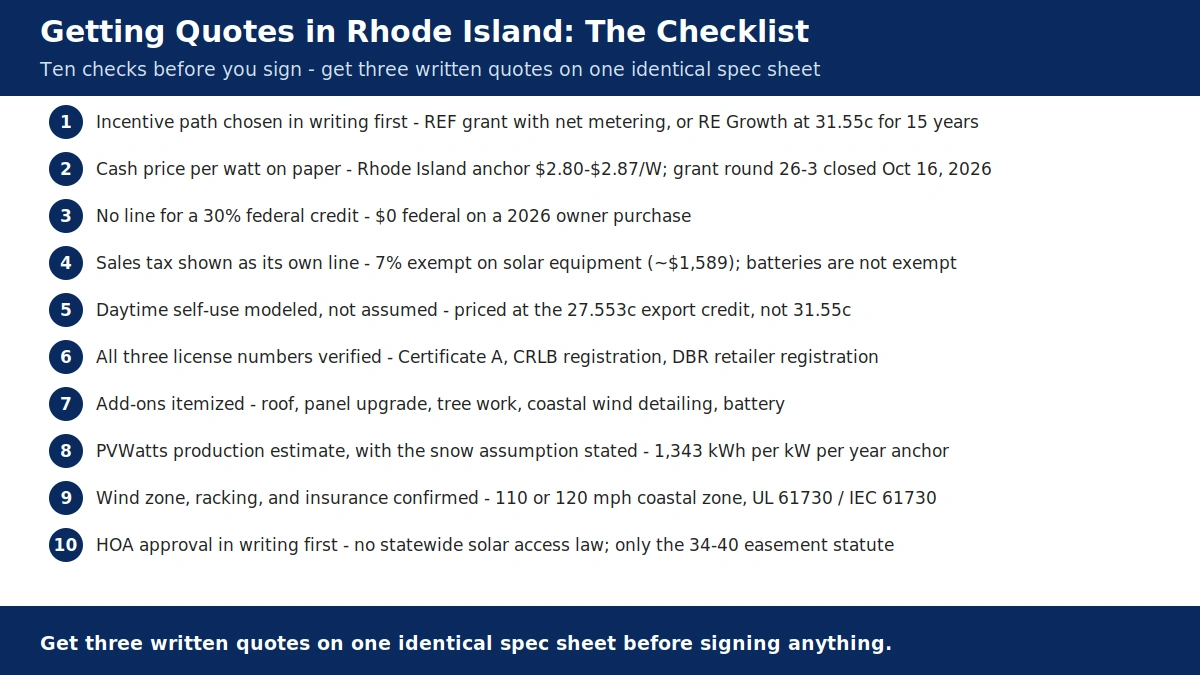
The ten-item quote checklist:
- Your incentive path, chosen in writing first — the REF grant with net metering, or RE Growth at 31.55 cents for fifteen years. The two cannot be combined, and the choice is made before you sign. If the quote subtracts a $13,052 grant, ask which round it comes from — the last 2026 round closed October 16, 2026.
- Cash price per watt, in writing — one identical spec, the same roof, from all three bidders. At $2.80-$2.87 a watt, Rhode Island’s anchor means a quote far above it needs an explanation, and a quote far below it needs a closer look at what was left out.
- No line for a 30% federal credit — a 2026 owner purchase gets $0 federal. A quote still taking 30% off is priced under a dead law. Ask for it to be removed.
- Sales tax shown as its own line — solar equipment is exempt from the 7% state sales tax, about $1,589 on the typical system, and a quote that charges it is wrong. Batteries are not on the exemption list, so a battery line may still carry tax.
- Daytime self-use modeled, not assumed — the share of production the house uses the moment it is made, shown by season and hour, with the export value priced at the 27.553-cent credit, not at 31.55 cents unless the system is enrolled in RE Growth.
- All three license numbers verified — the installer’s Certificate A electrical contractor number, the contractor registration with the Contractors’ Registration and Licensing Board, and the solar retailer’s registration with the Department of Business Regulation, with names matched to the contract. Certificate REP plus NABCEP certification is a plus.
- Add-ons itemized — roof work, panel upgrade, tree work, coastal wind detailing, and battery, each listed on its own line, not folded into the per-watt price.
- PVWatts production estimate, with the snow assumption stated — the estimate should rest on about 1,343 kilowatt-hours per kilowatt a year, not on nameplate wattage, and not on an annual average that hides what the winter takes away.
- Wind zone, racking, and insurance confirmed — the roof’s wind zone checked with the building department (110 or 120 mph on the coast), the racking’s uplift rating named, UL 61730 / IEC 61730 panels specified by name, and homeowners insurance confirmed in writing to cover the array before signing.
- HOA approval, in writing, first — Rhode Island has no statewide law barring an HOA from restricting solar; only a solar easement statute exists, so the association’s documents decide. Approval must come before panels are ordered, and condo owners face a doubled hurdle because the roof is usually common area.
Buy, lease, or community solar? Over 25 years, buying wins for homeowners who can claim the grant while a round is open, or who enroll in RE Growth with a big roof and a small bill. Buy the system and the hardware, the resale value, and every kilowatt-hour of self-use all stay at full retail. Leasing wins for homeowners who want no upfront cost and no maintenance — and in Rhode Island the route is genuinely open, with the §48E credit behind it — but only if the provider shows the construction-start dates in writing, because a system whose construction starts after July 4, 2026 may not qualify. Community solar wins for renters, condo owners, and homes whose roofs are shaded or unsuitable — but the final program rules are still pending under PUC Docket 24-10-EL and no general subscription price was verified for this guide, so treat any such offer as unverified until its terms are in writing.
Sources & methodology
Cost anchors (per watt, system size, totals):
- EnergySage state page, Nov 2026, updated Oct 30: $2.80/W; 11.7 kW average; $32,773 total; $27,857-$37,689 range; 84% offset; payback 9.59 yrs modeled; 25-yr savings $105,520 modeled
- EnergySage city pages, Nov 2026: Providence $2.87/W, 10.62 kW, $30,443; Newport $2.80/W, 8.38 kW, $23,505; Portsmouth $2.86/W, 10.97 kW, $31,333; Westerly $2.76/W, 11.12 kW, $30,725; East Greenwich $2.81/W, 12.91 kW, $36,270; Chepachet $2.73/W, 18.12 kW, $49,510 (flagged outlier)
- EcoGen Solar Cost Index, Sep 2026, prices as of Sep 25 (read Oct 14): $2.87/W; 7.91 kW median size (Berkeley Lab 2025, 2,480 RI systems); $22,702 total; 1,343 kWh/kW/yr; 10,625 kWh/yr; tied 27th lowest of 51; national $2.89/W
- RenewEstimator, data compiled Jul 25, 2026: $3.25/W; 8 kW $25,520; payback 8.0 yrs; rate 29.5c; 4.3 sun hrs
- SolarPanelCosts (Berkeley Lab 2024-2025 closed contracts): $3.75/W; 8 kW $30,000; 1,332 kWh/kW/yr; payback 9.7 yrs at 28.2c
- poweroutage.us, updated Apr 12, 2026: $3.95/W; 5 kW ~$20,150; payback 10.4 yrs; rate 28.40c; bill $161.50/mo at 569 kWh
- ElectricChoice, updated Oct 25, 2026: $3.10/W; 7 kW $21,700; 28.3c; payback 7.3 yrs modeled; MA/NY $3.18-$3.35/W neighbor cross-check
- xplosole (PVGIS-modeled, Oct 2026): 29.22c; 1,312 kWh/kW/yr; 8.2 kW $21,242; year-1 savings $3,132; payback 6.5 yrs modeled
Rates:
- EIA Electric Power Monthly Table 5.6.A, Oct 2026 release: RI 28.18c/kWh Aug 2026; US 18.16c; 7th highest of 51; +55.2% vs US average; 12-mo range Oct 2025 31.2c high, Aug 2026 28.2c low
- EcoGen: RI 12-mo average Sep 2025-Aug 2026 29.44c; RI Energy 12-mo avg home price 29.26c; average home use ~6,565 kWh/yr; fixed charges ~$11.25/mo; netted value 27.2c
- RI Energy Last Resort Service, RIPUC tariff: summer Apr-Sep 2026 11.092c; winter Oct 1, 2026-Mar 31, 2027 17.029c (PUC Sep 24, 2026 open meeting); last winter 14.770c; resets Apr 1 and Oct 1
- Municipal aggregation (Good Energy/NextEra, 8 towns: Barrington, Central Falls, Narragansett, Newport, North Kingstown, Portsmouth, Providence, South Kingstown): winter 2026-27 Standard 16.929c, Basic 16.705c (riratecheck, data checked Oct 17, 2026)
- EIA Form 861, 2025: RI Energy serves 98.7% of RI residential customers; Block Island Utility District avg ~38.7c/kWh
- RI Energy = The Narragansett Electric Company, PPL-owned since May 2022 (ex-National Grid)
- Census Bureau Vintage 2024: RI population 1,112,308 (Jul 1, 2024)
Net metering:
- R.I. Gen. Laws 39-26.4; RI PUC No. 2279 Net Metering Provision; pre-Apr 15, 2023 systems keep full 1:1 retail credits; post-Apr 15, 2023 systems earn the tariff-specific renewable credit, $0.27553/kWh (RI Energy October 2026 tariff, per NuWatt, updated Apr 2026); self-use avoids $0.32303/kWh variable import charge; customer charge not avoidable; credits carry forward, do not expire, not paid out as a check; no net-metering cap for RI Energy customers; 10 MW AC per-account limit
- HB-5580, signed Jun 27, 2025: RI Energy may not deny/delay net metering based on historical consumption; home systems of 25 kW or less no longer have to match past use (EcoGen, Oct 2026)
- Net metering protected through 2039 (NuWatt)
- ECW net-metering census, Oct 27, 2026: RI classified as monthly netting, excess at avoided cost — production above 100% of use earns excess credits at the wholesale ISO-New England energy clearing price; 25 kW threshold for full excess credit (differs from NuWatt’s flat-credit framing; both stated in the draft)
Incentives:
- RI Commerce Renewable Energy Fund, Small-Scale Solar (flyer revised Apr 3, 2026; EnergySage incentives page updated Sep 9, 2026; EcoGen Oct 2026): $1.65/W up to $14,500 per project; systems up to 8.8 kW; typical 7.91 kW = ~$13,052; storage adder $5,000 flat (total up to $19,500); pairs with net metering, not with RE Growth; round 26-3 closed Oct 16, 2026; no 2027 round listed when checked Oct 19, 2026
- RE Growth (RIPUC Docket 25-52-REG; DG Board Nov 2025; program year Apr 1, 2026-Mar 31, 2027): 31.55c/kWh for 15 yrs on systems up to 15 kW; 28.65c/kWh for 20 yrs on 15-25 kW; 3 MW small-solar allocation, first come, first served, until Mar 31, 2027; utility keeps RECs
- Sales tax: 7% exempt on solar equipment (R.I. Gen. Laws 44-18-30; EcoWatch avg saving ~$1,545); batteries NOT on the exemption list (nobscleanenergy, read Oct 28, 2026)
- Property tax: residential renewable energy equipment exempt from local taxation per R.I. Gen. Laws 44-3-3(48) and (49) (H.B. 8354, Jul 2016; OER commercial tangible tax regs)
- OER Energy Storage Rebate (Mar-May 2026 presentations): Tier 1 $250/kWh up to $8,000; income-eligible $500/kWh up to $16,000; $2,000,000 fund, first come, first reserved; requires ConnectedSolutions enrollment; funded by RGGI auction proceeds; 2024 Energy Storage Systems Act (R.I. Gen. Laws 39-26.10) set 90 MW storage goal by 2026
- ConnectedSolutions (RI Energy): $225/kW per summer for battery dispatch, locked for 5 summers; typical 13.5 kWh Powerwall ~$750-$1,200/yr (RI Energy program guide; ProFusion)
- Solar for All: $49.33M awarded to OER Apr 22, 2024 (program branded EASE; 61 disadvantaged census tracts, 97,892 households); EPA terminated Aug 7, 2025; U.S. District Judge Mary McElroy vacated the termination Sep 18, 2026; EPA reviewing/appeal possible; separate cases pending; no household application route open as of Nov 2026
- Community solar: 2016 law H 8354 A (CRNM, CRDG, shared solar under RE Growth; administered by OER); 2023 law S 0684 A expanded third-party ownership for C&I; final rules pending under PUC Docket 24-10-EL (ILSR, updated Oct 2026)
- ASAP (Affordable Solar Access Pathways): on pause, being redesigned; ASAP 2.0 RFI responses due May 7, 2026; no new applications (OER page)
HEAR / HOMES:
- HEAR launched Sep 17, 2024 (income-eligible pathway, first in New England); retail pathway pilot launched May 4/11, 2026 in 11 municipalities, now available statewide for low- and moderate-income customers (OER; OER press release May 11, 2026); allocation HEAR $31,820,030, HOMES $31,943,127 (ECW, Oct 27, 2026); HOMES launched Sep 23, 2026 (referencesource.org, verified Sep 30, 2026)
- DOE Notice 26-2 (May 29, 2026; effective Sep 1, 2026): HEAR electric-to-electric upgrades only, no fuel-switching; HEAR covers heat pump clothes dryers, electric stoves/ranges/ovens/induction cooktops, electric wiring, load service centers; never solar, batteries, EV chargers, or windows
Federal and financing:
- OBBBA P.L. 119-21 and IRS FS-2025-05: §25D and §25C $0 for post-Dec-31-2025 installs, completion date counts
- §48E 30% for third-party-owned systems, in service by Dec 31, 2027, construction begun by Jul 4, 2026 per IRS Notice 2025-42
- DSIRE Third-Party Solar PV PPA Policies, Mar 2026: RI authority cited as R.I. Gen. Laws 39-26.4; RI Energy Third Party Ownership net-metering disclosure form; Evergreen Solar lists cash, loans, leases, PPAs, prepaid PPAs
- Residential Solar Energy Disclosure and Homeowners Bill of Rights Act, R.I. Gen. Laws ch. 39-26.8 / Title 5 ch. 5-93: enacted Jun 10, 2024, effective Mar 1, 2025; retailer registration $750/yr, $500,000 general liability insurance, ID badges; 7-business-day right to cancel (230-RICR-30-45-1)
- CFPB Solar Financing Market Issue Spotlight, Aug 2024: dealer fees 10-30%, sometimes over 50%
Production and climate:
- EcoGen: 1,343 kWh/kW/yr PVWatts-based; 7.91 kW makes ~10,625 kWh/yr
- Cross-checks: PVGIS 1,332 kWh/kW/yr (solarpanelcosts); poweroutage.us 1,407; xplosole 1,312
- RenewEstimator: 4.3 peak sun hrs
- RI One and Two Family Dwelling Code (510-RICR-00-00-2): ultimate wind speeds of 110 mph and above require engineered design (WFCM, SSTD 10, ICC-600, or ASCE-7); 110 mph and 120 mph wind zones; Appendix AA high-wind prescriptive design; Wind Zone 3 (120 mph) windows need windborne-debris protection
- Act on Climate (2021): RI net-zero emissions by 2050
- Heat penalty 0.3-0.5% per degree C above 25 C cell temperature, national figure
Payback arithmetic:
- EcoGen worked example, Oct 2026, restated: 7.91 kW x $2.87/W = $22,702; production ~10,625 kWh/yr; netted value 6,504 kWh at 27.2c = $1,769; leftover power earns net metering credit ~$964; total ~$2,733/yr; $22,702 / $2,733 = ~8.3 yrs; no upkeep, financing, rate rises, or aging counted
- Grant path: $22,702 – $13,052 = $9,650; $9,650 / $2,733 = ~3.5 yrs (NestPriced arithmetic)
- RE Growth path: 10,625 kWh x 31.55c = ~$3,352/yr for 15 yrs (~$50,280 total); $22,702 / $3,352 = ~6.8 yrs (NestPriced arithmetic; bill still payable in full under RE Growth)
- Sales-tax saving ~$1,589 on the typical system is NestPriced arithmetic (7% of $22,702)
- Battery arbitrage illustration (~$0.50/day on 10 kWh stored) is NestPriced arithmetic from the ~5c spread between the 27.553c export credit and the 32.303c import charge
- Battery stack illustration ($15,647 – $8,000 – $5,000 = $2,647; ~$1,125/yr ConnectedSolutions) is NestPriced arithmetic, labeled illustrative, conditional on both programs being open
HOA and licensing:
- R.I. Gen. Laws § 34-40: solar easements only; no statewide solar access law barring HOA restrictions (Palmetto; NuWatt, Mar 2026; CAI 2023)
- R.I. Gen. Laws § 5-6-8(g): Certificate REP (Renewable Energy Professional); all renewable-energy electrical work by a licensed electrician; solar sheathing systems of 10 kW or less may be installed by a registered contractor holding Certificate REP, energized by a licensed electrician
- Contractors’ Registration and Licensing Board, R.I. Gen. Laws § 5-65-1 et seq.
- BLS Occupational Employment and Wage Statistics May 2025: electricians 47-2111 RI, median $35.62/hr, $74,090/yr; mean $35.65/hr; 10th-90th $20.67-$49.44/hr; 2,420 employed; national median $30.38/hr
- Solar PV installers 47-2231: no RI-specific BLS figure found; national median $53,140/yr, ~$26/hr, 31,100-31,350 jobs nationally, BLS projects +37% growth 2025-35
Maintenance, lifespan, warranty (national figures):
- Lifespan 25-30 years productive service; NREL median degradation ~0.5%/yr, ~88% of rated output at year 25; premium n-type 0.25-0.5%/yr, 91-93% at year 25 (NREL Jordan et al. 2022)
- Product warranty typically 10-25 years; performance warranty typically 25-30 years, guaranteeing 80-92% of rated output at year 25 depending on tier; string inverter 10-15 years, one replacement expected; microinverters ~25 years
EXCLUDED:
- Any “after 30% credit” prices — the 30% federal credit is $0 for 2026 owner installs
- REF at $0.65/W up to $5,000 and RE Growth at 33.85c — stale 2025 figures (wisemoneylife; some EnergySage tables still show them)
- Any HEAR-for-solar claim: HEAR does not cover solar, batteries, EV chargers, or windows; electric-to-electric only since DOE Notice 26-2, Sep 1, 2026
- Solar for All as an available household program — terminated Aug 2025, court-revived Sep 18, 2026, appeal possible, no application route open
- A single blended Rhode Island export rate: the draft shows the 27.553c credit and the 32.303c import charge separately, and flags the ECW vs NuWatt disagreement on exports above 100% of monthly use
- Block Island and Pascoag solar terms; RI Energy interconnection application fee; RI-specific permit fee schedule and interconnection timeline; RI-specific battery price (national figure used); RI-specific monthly PVWatts table; RI-specific snow-loss percentage and design snow-load figure; BLS solar-PV-installer wage for RI
- Chepachet $2.73/W / 18.12 kW as a state low — small-sample outlier, flagged
- EnergySage 9.59-yr payback and $105,520 25-yr savings — modeled figures with unstated incentive assumptions; flagged, not merged with EcoGen’s worked example
- Neighbor price comparison (MA $3.18-$3.35/W) — secondary modeled table, flagged
- The claim that Rhode Island has a solar access law barring HOA restrictions — WRONG against the primary statutes (only § 34-40 easements exist); excluded
- Community-solar subscription prices — none verified; PUC Docket 24-10-EL rules pending
*Disclaimer: The prices here are 2026 Rhode Island planning figures. Expect different numbers for a different city, roof, utility territory, or contractor. Get three written quotes from Rhode Island installers before you settle on a budget. The tax notes in this guide are general information only — not advice about your own return. Talk to a Rhode Island tax professional before you file. Program rules change — Rhode Island Energy net metering, the Renewable Energy Fund grant rounds, Renewable Energy Growth enrollment — so confirm current terms with Rhode Island Energy, Rhode Island Commerce, or the Office of Energy Resources before signing. The REF grant’s last 2026 round closed October 16, 2026 and no 2027 round was listed when last checked; RE Growth enrollment closes March 31, 2027 or when its 3 MW fills — rate and program figures in this guide are dated to their sources.*
What do solar panels cost in Rhode Island in 2026?
Solar panels cost $2.80-$2.87 a watt installed in Rhode Island in 2026 — about $22,702 for the typical 7.91 kW system (EcoGen, September 2026), or about $32,773 for the 11.7 kW marketplace average (EnergySage, November 2026). An 8 kW home system typically runs about $22,960 at the EcoGen rate. Providence runs $2.87 a watt, Newport $2.80, and Westerly $2.76. For a homeowner-owned system installed in 2026, the 30% federal credit is $0, but Rhode Island still pays: a state grant of $1.65 a watt, up to $14,500, takes a typical system down to about $9,650 — although the last 2026 grant round closed on October 16, 2026, and no 2027 round was listed when last checked.
How long does it take for solar panels to pay for themselves in Rhode Island?
About 8 years before incentives, and about 3.5 years with the state grant. EcoGen’s worked example for Rhode Island Energy territory puts a 7.91 kW system at $22,702 paying back in about 8.3 years on net metering alone, because the power it replaces costs about 29 cents a kilowatt-hour. With the Renewable Energy Fund grant of about $13,052, the net cost falls to about $9,650 and the payback to about 3.5 years — but only while a grant round is open. The alternative path, Renewable Energy Growth, pays 31.55 cents for every kilowatt-hour the panels make for 15 years, which works out to a simple payback of about 6.8 years on the full price.
Does Rhode Island have net metering?
Yes, under a statewide law — but the rules changed in April 2023, and the version that applies to a system installed in 2026 is not the one most solar advertising still describes. Systems connected before April 15, 2023 keep full one-for-one retail credits. Systems connected after that date earn a tariff-specific renewable credit, published at 27.553 cents a kilowatt-hour in Rhode Island Energy’s October 2026 tariff, while power used at home avoids a variable import charge of 32.303 cents. Net metering is protected by statute through 2039, credits carry forward and do not expire, and there is no net-metering cap for Rhode Island Energy customers. One wrinkle: a 2026 census classifies Rhode Island as monthly netting with excess at avoided cost, so power produced above 100% of monthly use may earn the wholesale ISO-New England price rather than the 27.553-cent credit — ask Rhode Island Energy in writing before you sign.
Should I take the Rhode Island grant or Renewable Energy Growth?
You have to pick one — they cannot be combined, and the choice is made before you sign. Take the grant with net metering if you use most of your power in daylight, want the fastest payback at about 3.5 years, and can apply while a grant round is open. Take Renewable Energy Growth if you have a big roof and a small electric bill, want a fixed payment that does not move with electric rates, and are comfortable paying your full electric bill every month while receiving 31.55 cents for every kilowatt-hour your panels make for 15 years — about $3,352 a year on the typical system. The grant path wins on payback; the fixed-payment path wins on total fifteen-year money. If no grant round is open when you buy, the fixed payment is the only state money on the table.
Can I still get the 30% federal tax credit for solar in Rhode Island in 2026?
No, not if you own the system. Under the One Big Beautiful Bill Act (P.L. 119-21), the Residential Clean Energy Credit (§25D, 30%) no longer applies to a homeowner-owned system placed in service after December 31, 2025 — and the IRS has made clear the finish date of the installation is the date that decides it. Unlike in Idaho, Rhode Island offers a genuine second door: the commercial credit (§48E, 30%) survives for third-party-owned systems placed in service by December 31, 2027, and leases and PPAs are legal and selling in the state. Watch the dates, though — construction must have started by July 4, 2026, so a lease signed in late 2026 needs its §48E treatment shown in writing before you compare the monthly payment against a purchase price.
What is Rhode Island’s solar grant really worth?
About $13,052 on the typical system — $1.65 a watt on 7.91 kW, up to a $14,500 maximum per project — taken off the price by the installer before you pay. Add battery storage to the same project and the fund adds a flat $5,000, for up to $19,500 in total. The grant pairs with net metering but not with Renewable Energy Growth. The catch is timing: the last 2026 round closed on October 16, 2026, and no 2027 round was listed when last checked on October 19, 2026. Older guides still show 65 cents a watt up to $5,000 — that is the stale pre-2026 level. Do not let a quote subtract $13,052 as though the money were already in hand until the installer can name the round it comes from.
Can a Rhode Island HOA block rooftop solar?
Probably, yes — Rhode Island is one of the weakest states in this series on HOA rights. The state has a solar easement statute (R.I. Gen. Laws § 34-40) that lets a property owner protect a system’s sunlight with a written easement, but it has no statewide law barring a homeowners association from restricting solar panels. HOAs retain considerable power over installations, so the association’s own documents decide. Get architectural-review approval in writing before ordering panels, read the CC&Rs line by line, and for condo owners the hurdle is twice as high, because the roof is usually common area. Ignore any national list that places Rhode Island among the states with solar access laws.
Is a battery worth it with solar in Rhode Island?
For backup, yes; for arbitrage, no. A 13.5 kWh battery runs about $15,647 installed, and the spread between buying power at 32.303 cents and selling it at 27.553 cents is only about 5 cents a kilowatt-hour — storing 10 kilowatt-hours a day saves roughly $0.50, about $180 a year, which cannot pay for a battery on its own. What can pay for it is the rebate stack: the Office of Energy Resources pays $250 per kilowatt-hour up to $8,000 ($500 up to $16,000 for income-eligible households), the Renewable Energy Fund adds $5,000 with a solar grant, and Rhode Island Energy’s ConnectedSolutions program pays $225 per average kilowatt each summer, about $1,125 a year for a typical Powerwall. Ask in writing which of the three your project can combine before counting more than one, and size the battery for the loads that matter in an outage — heat, refrigeration, water, medical equipment — not for the whole house.