

Table of Contents
A Maine roof lives a harder life than a roof in just about any other state this series has covered, and the first thing to understand about the price is that the climate is doing the pricing. The same architectural shingles that would sit quietly for 25 years in a mild state spend every Maine winter under snow that can weigh 50 to 90 pounds on every square foot of roof, then get pried at by freeze-thaw cycles that swing across the freezing point again and again, then sit through spring rain on a deck that may have been nailed together before the Second World War. About 22.9% of Maine homes were built before 1940 — 171,959 houses, the seventh-oldest housing stock in the country by one Census count — and the median Maine home went up in 1977. That is the house most Maine roof quotes are written for: an older home, a steep-pitched roof, a deck of planks rather than plywood, and a winter that does not forgive shortcuts.
The second thing to understand is that Maine’s roofing market is thin. The Bureau of Labor Statistics counted about 610 roofers working in the whole state in May 2025. Portland is the only real metro market. North of Bangor, the crew that can do your roof may be driving an hour each way, and there may be only two or three such crews in the county. A thin market means fewer competing bids, longer waits in the busy season, and a price that moves more on crew availability than on material costs. It also means the vetting matters more, because Maine has no statewide license for roofers or general contractors at all — the state Attorney General says so in plain language — and the written contract Maine law requires on any job over $3,000 is the main protection a homeowner has.
The third thing is the choice that defines a Maine reroof more than any other in this series: asphalt or metal. In most states that is a budget question with a clear answer. In Maine it is a climate question with a real argument on both sides. Asphalt costs roughly half as much on the day. Metal sheds snow in slabs, cuts ice dam formation to nearly nothing on many homes, and lasts 40 to 70 years against asphalt’s 20 to 30. Worked out per year of service, the expensive roof is often the cheaper one — and this guide does that arithmetic in the open, so the decision is made on numbers rather than on a salesman’s enthusiasm.
For the national numbers first, see our roof replacement cost guide before weighing Maine’s figures against them.
How Much Does a Roof Replacement Cost in Maine in 2026?
The honest headline for Maine in 2026 is a band, not a number, because four different pricing sources land in four different places and the gap between them is itself useful information. The primary anchor in this guide is SmartRoofingCalculator’s Maine state guide, updated April 24, 2026 with the page updated November 2, 2026: architectural shingles at $430–$620 per roofing square installed with tear-off, which works out to $10,750–$15,500 for a typical 25-square roof — about 2,500 square feet of roof surface on a 2,000-square-foot house once pitch, overhangs and waste are counted. That is the figure the rest of this guide is built on, because it is the most recent Maine-specific per-square band with a stated method: national 2026 per-square bands adjusted by Maine wages (BLS OEWS May 2024) and Maine goods prices (BEA 2024 Regional Price Parities), giving a combined state factor of 0.952.
The cross-checks bracket it on both sides. MyRoofData’s 2026 model puts a typical Maine single-family home with architectural shingles at $13,000–$22,750, about 2% above the national average, on a modeled roof area of 2,338 square feet. OneGoodRoofer, published October 7, 2026, puts a 1,500-to-2,500-square-foot Maine home at $11,200–$17,500 for architectural shingles, on a state index of 1.04 — about 4% above its national baseline. NumeralQ, pricing as of October 26, 2026, is the low anchor: architectural shingles at $4.35–$5.21 per square foot, or $9,250–$11,250 for a 2,000-square-foot roof surface. And HomeCostsByState, working from the 2,217 roof jobs in the Census Bureau’s 2023 American Housing Survey brought to August 2026 dollars with Maine roofer wages from BLS May 2025, puts the Maine typical job at $11,820, with the middle half of jobs between $7,270 and $18,160.
One source runs far above all of them and needs naming: RoofingEstimatorPros, updated August 26, 2026, prices a typical 2,000-square-foot architectural roof in Maine at $15,185–$27,220, averaging $20,534, or about $10.27 per square foot installed. That is roughly double the NumeralQ figure for the same footprint. The gap is a method gap — different assumptions about roof surface, pitch, tear-off layers, and what counts as included — and this guide treats the RoofingEstimatorPros band as the high end of the plausible range rather than the center of it. A Maine homeowner who collects three quotes will most often see totals between the SmartRoofingCalculator band and the MyRoofData band, with the occasional outlier at either end.
Two survey-based figures should be kept out of the headline entirely. This Old House’s 2026 roofing survey puts the Maine average at $6,364, with most projects between $5,081 and $15,554. That number skews toward small and partial jobs — a survey average is not a full-replacement average — and no Maine roofer would quote a full architectural reroof at $6,364. It is flagged here as an outlier and not used as a headline.
So what should a Maine homeowner actually budget? For a typical single-family home with architectural shingles, a sound deck, one layer to tear off, and an average pitch, $11,000–$18,000 is the realistic planning band for most of the state in 2026, with the SmartRoofingCalculator $10,750–$15,500 band as the center and the MyRoofData $13,000–$22,750 band covering the larger, steeper, and more complex roofs. Metal roughly doubles it. A small ranch with a simple gable roof can come in under $10,000 in asphalt. A big coastal home with valleys, dormers, skylights, and a second tear-off layer can pass $25,000 in asphalt and $45,000 in metal without anything going wrong.
The per-square-foot figure is the one to carry into every conversation with a contractor, because it is the only figure that survives a change in roof size. Architectural shingles in Maine run about $4.30–$6.20 per square foot of roof surface installed, on the SmartRoofingCalculator band. Standing-seam metal runs about $8.60–$13.30 per square foot. When two quotes for the same roof differ by $4,000, the per-square-foot number usually shows why: one bidder measured 22 squares and the other measured 26, or one included the ice barrier and the decking allowance and the other left them as extras to be discovered later. Never compare totals. Compare dollars per square, line by line, on the same measured roof.
| Source | Architectural, typical home | $ per sq ft | Basis |
|---|---|---|---|
| SmartRoofingCalculator (Apr/Nov 2026) | $10,750–$15,500 (25 sq) | $4.30–$6.20 | Per-square bands, ME factor 0.952 |
| MyRoofData (2026 model) | $13,000–$22,750 | $5.60–$9.71 | Modeled 2,338 sq ft roof area |
| OneGoodRoofer (Oct 7, 2026) | $11,200–$17,500 (1,500–2,500 sq ft home) | $4.68–$7.28 | State index 1.04 |
| NumeralQ (Oct 26, 2026) | $9,250–$11,250 (2,000 sq ft roof) | $4.35–$5.21 | Planning estimate model |
| HomeCostsByState (AHS 2023, Aug 2026 dollars) | $11,820 typical; $7,270–$18,160 middle half | Not published | Census homeowner-reported jobs |
| RoofingEstimatorPros (Aug 26, 2026) | $15,185–$27,220 (avg $20,534) | $10.27 | High band — flagged |
| This Old House (2026 survey) | $6,364 average | $4.76 | Flagged outlier — small/partial jobs |
What the headline band includes matters as much as the number. A proper Maine quote includes tear-off of the old roof, disposal, ice-and-water shield at the eaves and valleys, synthetic underlayment, drip edge, flashing, ridge vent or equivalent ventilation, and the permit. What it usually does not include is decking replacement beyond a small allowance, a second tear-off layer, skylight replacement, chimney rebuilding, gutter replacement, or snow guards on a metal roof. Every one of those shows up as a line item or a surprise, and the sections below put a number or a warning on each. The cheapest quote in Maine is often the one that left the most out.
Roof Replacement Cost in Maine by Material — Metal vs Asphalt in Freeze-Thaw
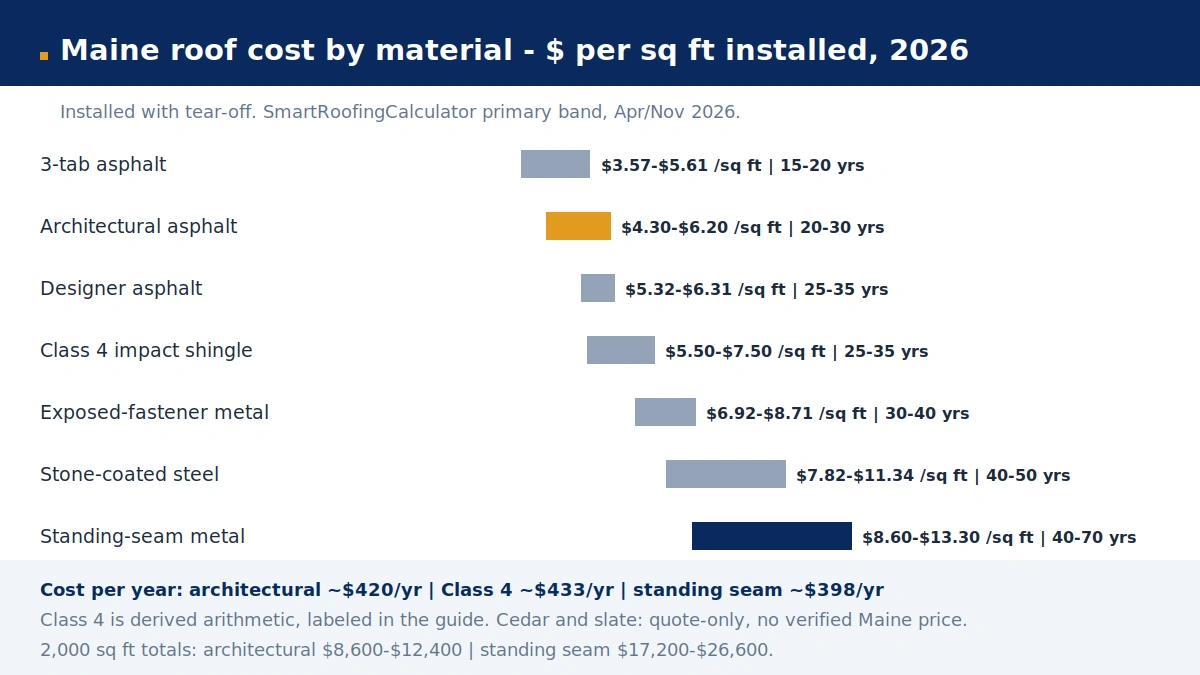
Material is the single biggest decision in a Maine reroof, and it is also the decision where Maine’s climate most changes the national answer. Nationally, architectural asphalt is the default on roughly three out of four homes, and metal is the premium upgrade. In Maine, metal is not a luxury choice — it is the roof that the snow country keeps choosing, and the share of Maine homes going metal is visibly higher than the national share, especially inland and on the coast where the weather is hardest on a roof. The table below prices every material Maine homeowners actually buy, on installed dollars per square foot of roof surface, with the Maine-realistic lifespan in Maine conditions rather than the manufacturer’s laboratory number.
| Material | $/sq ft installed | 2,000 sq ft roof total | Lifespan in Maine |
|---|---|---|---|
| 3-tab asphalt | $3.57–$5.61 | $7,140–$11,220 | 15–20 yrs |
| Architectural asphalt | $4.30–$6.20 | $8,600–$12,400 | 20–30 yrs |
| Designer / luxury asphalt | $5.32–$6.31 | $10,640–$12,620 | 25–35 yrs |
| Class 4 impact shingle | $5.50–$7.50 (derived) | $11,000–$15,000 | 25–35 yrs |
| Exposed-fastener metal (5V/corrugated) | $6.92–$8.71 | $13,840–$17,420 | 30–40 yrs |
| Stone-coated steel | $7.82–$11.34 | $15,640–$22,680 | 40–50 yrs |
| Standing-seam metal | $8.60–$13.30 | $17,200–$26,600 | 40–70 yrs |
| Cedar shakes/shingles | Quote-only (no verified ME $/sq ft) | Quote-only | 20–30 yrs |
| Synthetic slate/shake | Quote-only (national $8–$12/sq ft, flagged) | Quote-only | 40–50 yrs |
| Natural slate | Quote-only (survey $14.57/sq ft, flagged) | Quote-only | 75+ yrs |
| Flat: EPDM / TPO | $5.72–$11.44 | $11,440–$22,880 | 20–30 yrs |
Architectural asphalt is the Maine default for a reason: it is the cheapest roof that does the job properly, at $4.30–$6.20 per square foot on the SmartRoofingCalculator band, with NumeralQ’s $4.35–$5.21 sitting inside it and MyRoofData’s $4.59–$7.65 running higher at the top end. A 25-square roof costs $10,750–$15,500. Architectural shingles are thicker and heavier than 3-tab, carry 110–130 mph wind ratings, and hold up better under the freeze-thaw cycling that works at shingle seals all winter. Expect 20–30 years in Maine, with the shorter end on the coast where salt air and wind work the roof harder, and the longer end inland on a well-ventilated roof. The full national picture for this material is in our roof replacement guide.
3-tab asphalt is the budget option at $3.57–$4.17 per square foot on NumeralQ, up to $5.61 on MyRoofData. It saves roughly $1,500–$2,000 against architectural on a typical roof and gives back most of that saving in lifespan: 15–20 years in Maine, and many insurers and builders have moved away from it. On a Maine roof that already faces the hardest winter in the series, 3-tab is a false economy for most homeowners — the one exception is a roof you plan to replace again soon for other reasons, or a rental where the holding period is short.
Designer and luxury asphalt at $5.32–$6.31 per square foot (NumeralQ) buys thicker shingles, deeper shadow lines, and a heavier look that suits Maine’s older homes and historic districts. Lifespan 25–35 years. It is the right call on a high-value home where the roof is part of the curb appeal, and a poor call on a plain ranch where nobody will see the difference from the street.
Standing-seam metal is the Maine story. At $8.60–$13.30 per square foot on the SmartRoofingCalculator band — $21,500–$33,250 for a typical 25-square roof — it costs roughly double architectural asphalt on the day. Maine Coast Roofing, a Mid-Coast installer working these roofs for nearly two decades, prices a typical Maine standing-seam home at $20,000–$40,000, which brackets the SmartRoofingCalculator band neatly. NumeralQ runs higher at $9.91–$15.12 per square foot and MyRoofData higher still at $9.69–$16.32; the draft uses the SmartRoofingCalculator band as primary and flags the higher bands rather than hiding them. Standing seam means concealed fasteners: vertical panels with raised seams that interlock and fasten with hidden clips, so there are no exposed screws to loosen, leak, or corrode. Lifespan 40–70 years, and Maine Coast Roofing notes there are metal roofs in Maine over 100 years old and still working. For the full national metal picture, see our metal roof cost guide.
Why metal earns its premium in Maine comes down to three things the freeze-thaw climate does to a roof. First, snow. Metal’s smooth surface and the way it conducts temperature mean snow slides off rather than sitting and loading the structure — and a roof that sheds its snow is a roof that is not carrying 50 to 90 pounds per square foot for weeks at a time. Second, ice dams. Heat escaping through the roof melts snow that refreezes at the cold eaves, and metal’s smooth surface plus its heat reflection mean less melting happens and what does melt slides off before it can refreeze into a dam. Maine Coast Roofing reports homes going from annual ice dam problems to virtually none after switching to metal — a contractor’s observation, attributed as such, but consistent with the physics. Third, wind and water. Standing-seam assemblies carry wind ratings of 120–140 mph, and the hidden-fastener system gives wind nothing to get under.
The metal decision has a coastal footnote that matters on the Maine coast more than almost anywhere else in the country: salt air. Aluminum roofing does not rust at all and is the natural coastal choice, though it costs more and dents more easily. Galvalume steel — aluminum-zinc coated — with a PVDF (Kynar 500) topcoat is the inland default and works within 5 miles of salt water. Within one-half mile of salt or brackish water, several Galvalume warranties exclude coverage entirely, and aluminum or copper is the specification to demand. The coastal premium runs about 8–15% over the inland price. A coastal homeowner who buys plain Galvalume steel to save money is buying a roof the warranty may not cover.
Exposed-fastener metal — 5V crimp, corrugated, screw-down panels — runs $6.92–$8.71 per square foot on NumeralQ, or $5.61–$9.69 on MyRoofData’s ribbed band. It is the budget metal: cheaper panels, faster installation, and a 30–40 year life. The trade is the screws themselves. Exposed screws and their washers take the brunt of salt air on the coast, loosen with thermal movement, and need re-tightening and washer replacement over the roof’s life. Maine Coast Roofing’s rule is blunt and worth repeating: standing seam for the house, screw-down for barns, garages, camps, and outbuildings. On a primary home, the saving rarely survives the maintenance.
Stone-coated steel at $7.82–$11.34 per square foot (NumeralQ) looks like shingles, shakes, or tile from the street and performs like steel underneath. Lifespan 40–50 years. It suits historic districts and high-end homes where a standing-seam look would be wrong, but it costs nearly as much as standing seam while shedding snow less cleanly.
Cedar shakes and shingles belong on this table because Maine’s coastal historic homes still wear them — MyRoofData lists cedar shake as a locally common coastal historic system — but no verified Maine per-square-foot price was found in this pass, so none is stated. Cedar in Maine lasts 20–30 years, needs maintenance, and in a freeze-thaw climate with driving rain it is a look you pay for rather than a value you buy. Get a written quote from a crew that has actually installed cedar on the coast, and do not accept a national average as a Maine price.
Natural slate is the same story at the top of the market: This Old House’s survey puts slate at $14.57 per square foot, but that is a survey figure, not a Maine market price, and slate’s 75-plus-year life only matters if the structure can carry its weight — many Maine homes cannot without reinforcement. Quote-only, engineer-checked, and only on homes built for it.
Flat and low-slope roofs — EPDM, TPO, modified bitumen — appear on Maine additions, porches, and the flat sections of older homes. OneGoodRoofer prices flat roofing in Maine at $5.72–$11.44 per square foot installed. Flat roofs in snow country are their own discipline: they hold snow rather than shedding it, they need drains that do not freeze shut, and the membrane choice matters more than the price. The national flat-roof numbers are in our flat roof replacement guide.
The cost-per-year arithmetic is where the metal case is won or lost, and it deserves to be done in the open. Take the midpoints. Architectural asphalt at $10,500 for a 25-square roof lasting 25 years costs about $420 a year. Class 4 at $13,000 lasting 30 years costs about $433 a year. Standing-seam metal at $21,900 lasting 55 years costs about $398 a year. Three-tab at $7,740 lasting 17.5 years costs about $442 a year — the worst value on the table despite being the cheapest roof to buy. These are our own arithmetic from the ranges above, not a published table, and they leave out the disruption of two extra reroofs, the ice dam repairs metal avoids, and the resale value of a roof with 30 years left on it. On a house you plan to keep for decades, metal is the cheapest roof in Maine. On a house you plan to sell in five years, asphalt is the right call, because the next buyer will not pay you back the full metal premium.
Roof Replacement Cost by Roof Size
Roof size moves the total more than any other single factor, and the first trap in Maine quoting is the difference between the size of the house and the size of the roof. A 2,000-square-foot house does not have a 2,000-square-foot roof. Pitch adds surface, overhangs add surface, and waste adds more. SmartRoofingCalculator prices a 2,000-square-foot Maine house at 25 roofing squares — about 2,500 square feet of roof surface — while NumeralQ prices a 2,000-square-foot roof surface directly. MyRoofData models a 2,338-square-foot roof area for its typical Maine home. All three are describing the same kind of house and arriving at different roof sizes, and that is exactly why two quotes for the same house can differ by $4,000 without either contractor doing anything wrong. The table below uses the SmartRoofingCalculator per-square bands and states the roof surface plainly, so the reader can check any quote against it.
| Roof surface | Squares | Architectural ($430–$620/sq) | Standing seam ($860–$1,330/sq) |
|---|---|---|---|
| 1,200 sq ft | ~12 | $5,160–$7,440 | $10,320–$15,960 |
| 1,800 sq ft | ~18 | $7,740–$11,160 | $15,480–$23,940 |
| 2,500 sq ft (typical) | ~25 | $10,750–$15,500 | $21,500–$33,250 |
| 3,000 sq ft | ~30 | $12,900–$18,600 | $25,800–$39,900 |
| 3,500 sq ft | ~35 | $15,050–$21,700 | $30,100–$46,550 |
A small Maine ranch or cape with a simple gable roof — 12 to 15 squares — is the cheapest reroof in the state, and it is also the roof most likely to come in under the headline band. A big two-story colonial with valleys, dormers, and a 35-square roof is the most expensive, and complexity adds more than size alone: every valley is a flashing detail, every dormer is a wall intersection, every skylight is a reflash, and a steep pitch slows the crew and adds safety cost. A 30-square roof with four valleys and two dormers can cost more than a 35-square simple gable, and any quote that prices by the square without walking the roof is guessing.
Pitch deserves its own line because Maine’s older homes are often steeply pitched — and that steepness is both a blessing and a cost. A steep roof sheds snow faster and holds less of it, which is why Maine’s old capes and farmhouses were built that way. It also costs more to work on: slower crew movement, more safety gear, more waste from cutting shingles to fit. A low-slope roof is cheaper to install and worse to own in snow country, because it holds snow longer and gives ice dams more time to form. When a contractor prices a steep Maine roof higher per square than a shallow one, that is not padding — it is the work.
Tear-off is the other size-driven cost, and Maine’s old housing stock makes it bigger than the headline band suggests. The headline prices assume one layer to tear off. Many Maine homes carry two layers — a second roof laid over the first, sometimes decades ago — and the second layer adds roughly $100–$200 per square in removal and disposal on the MyRoofData model, or about $1.15–$1.52 per square foot on the NumeralQ model from the Iowa series. On a 25-square roof that is $2,500–$5,000 before a single new shingle goes on. Worse, a second layer hides the deck. A Maine deck of 100-year-old planks can look fine from the attic and be rotten at the eaves, and the only honest way to price decking is an allowance on the quote with a per-sheet rate for what is actually found. NumeralQ’s Iowa-series decking figure of $55.92–$81.73 per installed 4-by-8 sheet is a national planning figure, not a Maine price, and the draft uses it only as a shape for what the line item looks like. Get the per-sheet rate in writing before the tear-off starts, not after the deck is open and the crew is standing on it.
Roof Replacement Cost by Region: Portland vs Bangor vs Lewiston vs Augusta
Maine is a long state with one metro market and a lot of distance, and the price of a roof follows that geography. Portland, in Cumberland County, is the only city with a verified city-level price in this pass: NumeralQ, pricing October 26, 2026, puts a 2,000-square-foot architectural roof in Portland at $9,340–$11,370, a touch above the state figure of $9,250–$11,250 on the same model. Portland is the biggest market, the most competitive, and also the most expensive on labor and access — coastal spec, tight lots, and crews that can pick their jobs. No verified city-level figures were pulled for Bangor, Lewiston, Augusta, Bar Harbor, or Presque Isle, and this guide does not invent them. The state band applies, and the direction of each city’s pressure is described honestly below.
| City / region | Architectural, typical home | What moves it |
|---|---|---|
| Portland (Cumberland Co.) | $9,340–$11,370 (2,000 sq ft roof, NumeralQ) | Largest market; coastal salt-air spec; highest labor/access costs |
| Bangor (Penobscot Co.) | State band $10,750–$15,500 | Inland; heavier snow, about 66–75 in/yr; expect mid-band |
| Lewiston–Auburn (Androscoggin Co.) | State band $10,750–$15,500 | Oldest housing in the state, avg home age 54 yrs; decking surprises |
| Augusta (Kennebec Co.) | State band $10,750–$15,500 | Central Maine; snow-load zone 60–70 psf |
| Rural / northern Maine | State band, low end on labor, high end on travel | Few bidders; long crew drives; Caribou snow 110–120 in/yr |
Portland’s premium is small on paper and real in practice. The NumeralQ Portland figure sits only about 1% above the state figure, but Portland quotes carry the extras the model does not: coastal material spec, parking and access on tight peninsula lots, and the permit and registration requirements the city adds. Portland also requires contractor registration for building-permit work, which is one more filter that keeps the fly-by-night crews out — and one more reason Portland bids run cleaner. A Portland homeowner should expect the quote to be at the top of the state band once the coastal spec and the extras are in, even if the model’s base number looks low.
Bangor is the inland counterweight. It gets more snow than Portland — about 66 to 75 inches a year against Portland’s 50 to 70 — and its roofs work harder for it. Bangor’s labor market is thinner, with a BLS roofer mean wage of $25.01 an hour and a median of $23.14, both a touch below the state figures, but the thinner market means fewer competing bids and longer waits in the autumn rush. Expect mid-band pricing, with the snow detailing — full ice barrier, snow guards on metal, ventilation — doing more of the work than the base material price.
Lewiston–Auburn is where the housing stock does the pricing. Androscoggin County has the oldest homes in Maine, averaging 54 years, and an old home’s roof is rarely just a roof. Plank decking, skip sheathing, undersized rafters, and two layers of old shingles are the norm rather than the exception, and the decking allowance on a Lewiston quote is the line to read twice. Lewiston–Auburn roofer wages run higher than the state — a mean of $27.16 and a median of $24.69 an hour — which pulls labor cost up even as the market stays small. Budget the top of the band here, and budget a decking contingency on top of it.
Augusta, the state capital in Kennebec County, sits in the 60–70 pounds-per-square-foot snow-load zone and gets the central Maine version of the winter: more snow than the coast, less than the north, and the same freeze-thaw cycling everywhere. Expect mid-band pricing and a code department that knows its snow loads.
Rural and northern Maine is where the market thins to a point. North of Bangor, a roofing crew may drive an hour each way, and there may be only two or three crews in the county who do full replacements. Labor rates can run lower, but travel, material delivery, and the lack of competing bids pull the total back up. Caribou gets 110–120 inches of snow a year, and a roof there is specified for it. The practical advice for rural Maine is the same as for Portland, only more so: start early, get the third quote even if it means waiting, and never let a crew start without the written contract Maine law requires.
One more regional note, and it is the one that surprises newcomers: Maine’s coastal towns and its inland towns are buying different roofs. On the coast, salt air pushes buyers toward aluminum metal or premium architectural shingles with high wind ratings, and historic districts push toward cedar or slate looks. Inland, snow load pushes buyers toward standing-seam metal and steep pitches, and the metal share of the market is visibly higher. A quote that does not name the climate it was written for — coastal or inland, salt or snow — is a quote written for a different house.
Why Maine Roofs Cost What They Do: Snow Load, Ice Dams & Freeze-Thaw
A Maine roof quote is not a materials list with labor added. It is a climate specification with a roof attached, and the climate line items are what separate a Maine price from a national one. Three forces do the work: snow load, ice dams, and freeze-thaw. Each one adds cost in a different place on the quote, and a homeowner who cannot see those lines is a homeowner who cannot tell a complete quote from an incomplete one.
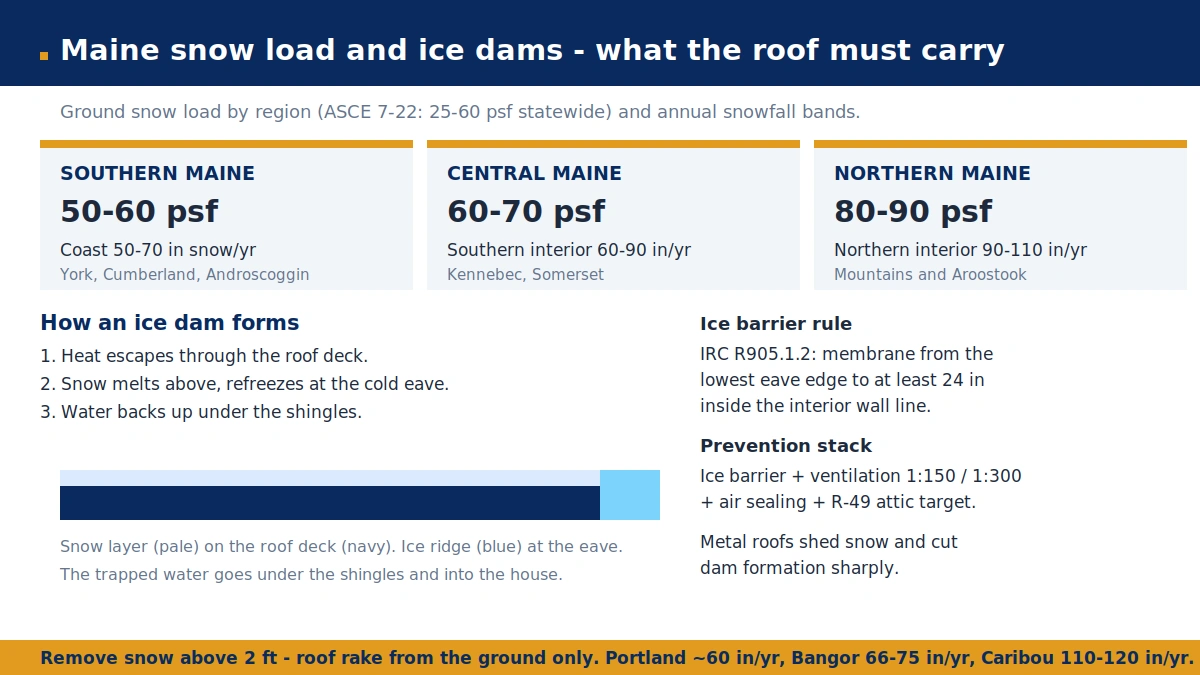
Snow load is the structural fact. Maine’s ground snow loads run from 25 to over 60 pounds per square foot on the ASCE 7-22 hazard maps, and the design loads Maine’s own roofers work to run higher by region: 50–60 pounds per square foot in southern Maine — York, Cumberland, and Androscoggin counties — 60–70 in central Maine around Kennebec and Somerset, and 80–90 in the northern and mountain regions. The Town of Hampden’s ordinance, amended in June 2024, sets its ground snow load at 70 pounds per square foot, with a frost line of 5 feet and a winter design temperature of minus 5 degrees. The state’s own MUBEC snow-load guide, published by the Fire Marshal’s office in November 2025, tells code officials to pull the figure from the ASCE hazard tool for the exact address. Roof snow load — what the structure actually carries — runs roughly 70% of the ground load after exposure, thermal, and slope factors are applied, which still leaves a Maine roof designed to carry roughly 35–50 pounds per square foot of snow before it reaches its limit. What that means on a quote is structure: rafters sized for it, decking that can take it, and fasteners that hold through it. A roof built to a southern snow load would not be a bargain in Maine. It would be a collapse waiting for the wrong winter.
Ice dams are the water fact, and they are the most Maine-specific line on any quote in this series. An ice dam forms when heat escaping through the roof melts snow on the upper roof, the meltwater runs down to the cold eaves, and it refreezes into a ridge of ice that traps the water behind it. The trapped water has nowhere to go but under the shingles and into the house. Maine’s winters are built for this: snow on the roof for months, daytime temperatures that climb above freezing just long enough to melt the top layer, and eaves that stay frozen. The code’s answer is the ice barrier — a self-adhering polymer-modified bitumen membrane that must run from the lowest eave edge to at least 24 inches inside the interior wall line, under IRC R905.1.2, mandatory statewide. It is not optional, it is not an upgrade, and any quote that does not show it as a line item is either hiding it in the base price or leaving it out. The Hampden ordinance confirms it in one word: ice barrier required, yes. Full-roof ice barrier — membrane over the whole deck instead of just the eaves and valleys — costs roughly $0.82–$1.34 per square foot on the NumeralQ model from the Iowa series, a national planning figure, and it is worth discussing on a low-slope roof or a home with a history of dam damage. Ventilation is the other half of the dam defense: a cold roof deck melts less snow, and a roof deck stays cold when air moves freely from eave to ridge and the attic is sealed against heat leaking up from the house. The ventilation ratio the code world uses is 1:150, or 1:300 with a balanced system — and a Maine reroof that does not address ventilation is a reroof that will grow the same ice dams on new shingles.
Freeze-thaw is the slow fact, and it is the one that shortens a Maine roof’s life even when nothing dramatic happens. A Maine winter does not stay cold. It swings across freezing again and again, and every crossing works at the roof: shingle seals flex and relax, sealant cracks, nails work loose, and water that found a hairline gap freezes, expands, and widens it. No verified Maine freeze-thaw cycle count was found for this guide, so none is stated — but the mechanism is not in doubt, and it is why Maine lifespans in the material table run shorter than the manufacturer’s printed numbers. A shingle rated for 30 years in a laboratory in Ohio is a 20-to-25-year shingle on a Maine roof that freezes and thaws all winter. Metal handles the cycling better because it has no granular surface to shed, no sealant strips to fatigue, and seams that are designed to move with temperature. That is the freeze-thaw argument for metal in one paragraph, and it is the argument that convinces the Maine homeowners who have already replaced one asphalt roof early.
Salt air is the fourth force, and it only applies to the coast — but the Maine coast is where a large share of the state’s high-value homes sit. Salt corrodes nearly everything metal, which is why cars rust faster here and hardware needs replacing more often. On a roof it attacks fasteners first, then flashings, then the panels themselves. The specification answer is in the material section: aluminum near the water, Galvalume with a PVDF topcoat a little further back, and a warranty check on the distance exclusion before anything is signed. A coastal quote that specifies standard steel fasteners is a quote that will cost the homeowner twice.
Labor is the last force, and it is the quietest. Maine has about 610 roofers in the whole state, and the BLS May 2025 median wage for a Maine roofer is $24.10 an hour, with a mean of $25.82 — about 10% below the national median of $26.65. That sounds like cheap labor, and it is not. The wage is the floor under the bill, not the bill: the billed rate a contractor charges per worker-hour runs $48–$63 on NumeralQ’s estimate, or $55–$92 on MyRoofData’s crew-rate model, once payroll burden, insurance, overhead, and profit are added. And a thin labor market means the crew you want may be booked for weeks in the season that matters. Maine’s roofing season is short — roughly April through October for the best conditions — and the autumn rush, when every homeowner who spent the summer thinking about it suddenly wants a roof before the snow, is when prices firm up and waits stretch. The cheapest time to buy a Maine roof is often the spring, when crews are hungry and the weather is turning. The most expensive time is the week after the first October storm warning.
Ice Dams, Snow Load & Freeze-Thaw: The Slow Maine Roof Killers
The previous section named the three forces. This one follows them into the house, because the damage they do is slow, quiet, and expensive — and because a homeowner who can recognize the early signs can save thousands by acting before the damage becomes structural.
An ice dam rarely announces itself with drama. It starts as a thick ridge of ice at the eave, a row of large icicles, or a clear patch of roof where the snow has melted while the eaves stay frozen and white. Inside, the first sign is often a brown stain on a ceiling near an exterior wall, or paint bubbling on a top-floor wall in February. By the time water is dripping into a room, the dam has been working for weeks, and the water has been finding its way under shingles, through the underlayment, and into the deck and insulation. The repair bill for a bad dam year is not the cost of removing the ice. It is the cost of the wet insulation, the stained ceilings, the rotted decking at the eaves, and sometimes the mold that follows. Ice dam removal itself runs roughly $400–$1,200 on the national planning bands used in this series — flagged as national, not Maine-measured — but the water damage behind it is what makes a dam a five-figure problem.
The prevention stack is unglamorous and it works. First, the ice barrier at the eaves and valleys, which the code already requires. Second, ventilation: continuous airflow from the eaves to the ridge, so the roof deck stays close to the outside temperature and the snow on it melts evenly rather than from underneath. Third, air sealing and insulation in the attic, so the heat that melts the snow never reaches the roof deck in the first place. The attic insulation target the cold-climate code world uses is R-49 — flagged here as the IRC cold-climate target rather than a Maine-specific verified figure — and the air sealing matters at least as much as the insulation, because a gap around a light fixture or a chimney chase leaks more heat than a thin patch of insulation ever could. A reroof is the one moment when all three are cheap to fix together: the deck is open, the eaves are accessible, and the crew is already there. A homeowner who reroofs without addressing ventilation and air sealing is paying for a new roof on top of the same old problem.
Snow load damage is rarer and more serious. Most Maine roofs do not need snow removal after a typical storm — they were engineered for the load, typically 50–70 pounds per square foot depending on location, and a well-built roof carries it. The danger comes from accumulation without melting: multiple storms in a row, a wet heavy snow on top of a dry one, or an older roof built before modern codes. Maine Coast Roofing’s rule is practical: remove snow when accumulation exceeds 2 feet, when several storms have piled up without a melt, when ice dams are forming, or when there are warning signs of structural stress — a sagging ridge, a door that suddenly sticks, cracking sounds from the attic. And remove it from the ground, with a roof rake, or hire a professional. Climbing onto a snowy Maine roof is how people get hurt, and a metal rake used carelessly is how shingles get torn. Older homes built before the 1970s, or any home with a roof that is aging and possibly weakened, deserve a lower threshold for calling a professional.
Freeze-thaw damage shows up as the roof’s small failures adding up. Granules in the gutters, shingles that have lost their seal and lift in the wind, flashing that has opened at a chimney or a wall, sealant that has cracked around a vent pipe. None of these is a crisis on its own. Together, over a Maine winter, they are how a roof starts leaking in March — not from one big failure, but from a dozen small ones that the freeze-thaw cycle opened one by one. The inspection habit that catches them is simple: walk the house after the snow melts each spring, look at the roof from the ground with binoculars, check the attic for daylight and damp, and pay for a professional inspection every few years. Our roof inspection guide puts a price on that visit. A roof that is inspected in April is a roof that gets fixed in May, in the dry, at a fair price. A roof that is ignored until it leaks in February gets fixed in an emergency, at emergency rates, in the snow.
There is one more slow killer that belongs in this section because Maine’s housing stock makes it common: the deck underneath. A Maine roof is often the second or third roof on a deck of planks that went up a century ago, and plank decking moves with the seasons in a way plywood does not. Gaps open between planks, nails back out, and a shingle nailed into a gap holds nothing. Skip sheathing — planks spaced apart under wood shingles, common on the oldest Maine homes — needs a full new deck before modern shingles can go on at all. None of this shows in the headline price, and all of it is found only when the old roof comes off. The honest way to handle it is a decking allowance on the quote, a per-sheet rate in writing, and a contingency in the budget. The dishonest way is a quote that pretends the deck is fine and discovers otherwise with the house open to the sky.
Class 4 Impact Shingles in Maine: What the Upgrade Costs and What It Pays Back
Class 4 impact-resistant shingles are the hardest sell in Maine in this series, and the reason is the weather itself. In Iowa and Nebraska, Class 4 is a hail story: the shingles resist the hail that hammers the plains, and the insurance discount pays the upgrade back in a few years. In Maine, hail is a low risk — RoofingEstimatorPros rates Maine’s hail risk as low and its storm risk as moderate — and the hail argument barely exists. So the Class 4 question in Maine has to be answered on different grounds: wind, longevity, and the insurance discount, if the carrier offers one at all.
The price first. No standalone Maine per-square-foot figure for Class 4 shingles was verified in this pass, so the figure in this guide is derived arithmetic, labeled as such. Start with the SmartRoofingCalculator architectural base of $4.30–$6.20 per square foot, add the Class 4 premium implied by the Iowa-series method — about $30 per roofing square, or roughly $1.20 per square foot, from Lifelong Insurance Agency in May 2026 — and the designer-asphalt band as a cross-check, and Class 4 in Maine lands at roughly $5.50–$7.50 per square foot, or $11,000–$15,000 for a 2,000-square-foot roof. On a typical 25-square roof, the upgrade over plain architectural runs roughly $1,500–$3,000. That is the number to test against any quote. A contractor who prices Class 4 at double the architectural rate is either pricing a different product or padding the line.
What Class 4 buys in Maine is mostly wind resistance and lifespan. Class 4 shingles are tested to survive a 2-inch steel ball dropped from 20 feet without cracking — the UL 2218 test — and they carry the same 110–130 mph wind ratings as good architectural shingles, often at the top of the range. In Maine’s coastal wind and its freeze-thaw cycling, the thicker, heavier shingle holds its seal longer and resists the granular loss that shortens an asphalt roof’s life. Lifespan in Maine runs 25–35 years against architectural’s 20–30. The cost-per-year arithmetic is nearly a wash: Class 4 at $13,000 over 30 years is about $433 a year, against architectural at $10,500 over 25 years at about $420 a year. Class 4 does not win on cost per year in Maine the way it can in hail country. It wins, if it wins, on the insurance discount and on the extra five years of roof.
The insurance discount is where the Maine answer gets thin. Nationally, published carrier discounts for Class 4 roofs run 5–20% — RoofRepair.co cites 10–20% in its 2026 state table, AmazingFlash cites 5–15% — but those are published national figures, never promises, and no Maine-specific Class 4 discount percentage was verified from a carrier or regulator source for this guide. A Maine homeowner who is told a Class 4 roof will cut their premium by a fixed percentage should ask for it in writing from their own carrier, on their own policy, before signing. The discount, when it exists, applies to the dwelling-coverage portion of the premium and nothing else, so a 15% discount on the roof portion of a policy is a much smaller number than 15% off the whole bill. And in a low-hail state, some Maine carriers may offer little or nothing for Class 4 at all — the underwriting logic is hail-driven, and Maine does not give them hail to price.
So who should buy Class 4 in Maine? Three kinds of homeowner. The coastal homeowner, where wind is the risk and the heavier shingle’s wind performance is the point. The homeowner whose carrier has confirmed a discount in writing, with the payback worked out on their own premium rather than a brochure percentage. And the homeowner who plans to keep the house for 30 years and values the extra five years of roof life and the one fewer reroof. Who should not buy it? The homeowner buying it for hail protection Maine does not need, the homeowner whose carrier offers no discount, and the homeowner who could put the same $1,500–$3,000 into the ice barrier, the ventilation, and the air sealing that actually prevent Maine roof damage. In Maine, the best money after architectural shingles is usually spent under the roof, not on top of it — and a Class 4 quote should always be compared against that alternative before it is signed.
Permits & Code: MUBEC, the Ice Barrier & City Rules
Maine’s building code story starts with a name every Maine homeowner should know: MUBEC, the Maine Uniform Building and Energy Code. It is the statewide minimum standard for construction, based on the International Residential Code and the International Building Code, and any municipality with more than 4,000 residents must enforce it under Maine law (10 M.R.S. sections 9721–9725). Smaller towns may adopt it or not, which is why a roof in a town of 2,000 people can face different paperwork than the same roof in Portland — and why the town office, not the contractor, is the authority on what your job needs.
A full roof replacement generally requires a building permit in most Maine municipalities. The fee depends on the town and the project value, and the sources spread wide: SmartRoofingCalculator puts it near $240, MyRoofData at $50–$250, NumeralQ at $94–$200 across the 47 cities it checked, and RoofingEstimatorPros at $200–$600. The realistic Maine planning range is $50–$600, typically $150–$250, and the permit is usually a small fraction of the job — but it is the fraction that buys the inspection. A permitted roof gets inspected. An unpermitted roof gets a handshake. In a state with no roofer license, the permit inspection is one of the few independent checks that the work meets code, and skipping it to save $200 on a $15,000 roof is the worst trade in this guide.
The code requirements that matter on a Maine reroof are few and specific. The ice barrier is first: self-adhering polymer-modified bitumen membrane from the lowest eave edge to at least 24 inches inside the interior wall line, per IRC R905.1.2, mandatory statewide, confirmed by town ordinances like Hampden’s. Valleys get the same treatment. Shingles are not to be installed below a 2:12 pitch, and low slopes from 2:12 to 4:12 need double underlayment. Ventilation follows the 1:150 or 1:300 ratios. And the snow load for the address comes from the ASCE hazard tool under the state’s November 2025 MUBEC guide — not from the contractor’s memory, and not from a neighboring town’s number. The building department’s figure governs, and a contractor who argues with it is a contractor to replace.
Two layers is the rule that catches the most Maine homeowners by surprise. Most codes, Maine’s included, allow no more than two layers of roofing on a structure, and a roof that already carries two layers must be stripped to the deck before anything new goes on. The practical consequence is the one the size section priced: a second tear-off layer at roughly $100–$200 per square, plus the decking that the second layer was hiding. A contractor who proposes a third layer, or a layover on a roof that already has two, is proposing work the code does not allow.
City rules add their own layer. Portland requires contractor registration for building-permit work, which means the crew pulling the permit must be registered with the city — one more check a homeowner can verify with a phone call. Other cities have their own registration, historic-district, and shoreland rules. Homes in a historic district, or within the shoreland zone near the coast, may face material and appearance restrictions that rule out a standing-seam metal look or require a cedar-style profile. The time to discover that is before the materials are ordered, at the town office, not after the crew has torn the old roof off. And in Maine’s unorganized territories — the townships with no municipal government — permits fall under state review, which takes longer and needs to be started earlier.
One practical note on timing: a Maine permit is not instant, and the roofing season is short. Pull the permit early, in the spring, and let the inspection schedule be the constraint rather than the weather. A crew that offers to start tomorrow without a permit is offering to start a job the town may stop halfway through — with the roof open.
Hiring a Roofer in Maine: No State License — What to Check Instead
Here is the fact that changes everything about hiring a roofer in Maine, and it should be stated without softening: Maine does not require a state-level license for roofing contractors. The Maine Attorney General’s office says it plainly on its Home Construction and Repair page: in Maine, general contractors — and trades such as roofing and framing — are not licensed or regulated. There is no state board, no state exam, no state registration for roofers, and no roofing license to check. The only state-licensed trades are electricians, plumbers, and fuel and HVAC technicians, licensed through the Office of Professional and Occupational Regulation. Roofing is not among them. A contractor who shows a Maine roofing license is showing a document that does not exist.
That absence is not a loophole. It is the system, and it puts the vetting on the homeowner. The substitutes are real, and they work, but only if the homeowner actually runs them. This section is the checklist for doing that, and it is the most important section in this guide for anyone who reads only one.
First, the contract. Maine’s Home Construction Contracts Act — Title 10, Chapter 219-A, section 1487 — requires a written contract for any home construction or repair job costing more than $3,000, and every roof in this guide costs more than that. The contract must be signed by both parties and must include a warranty statement, a down payment capped at one-third of the price, estimated start and completion dates, and a requirement that change orders be in writing. The down-payment cap is the sharpest tooth in the law: a contractor who demands half the money before the first shingle is stripped is asking for something Maine law does not allow, and a homeowner who pays it has given away their leverage. Never pay more than one-third down. Never pay in cash without a receipt. Never sign a contract that leaves the material brand, the underlayment, the ice barrier, the ventilation, and the decking allowance as blanks to be filled in later.
Second, insurance — and this one matters more in Maine than in a licensed state, because there is no licensing board to fall back on. Every roofer under consideration should carry general liability insurance and workers’ compensation, and should put proof in writing before the job starts. If an uninsured worker is hurt on the property, or the home is damaged during the job, the homeowner can end up responsible. Ask for the certificate, check that the dates cover the job, and check that the company name on the certificate matches the company name on the contract. A roofer who cannot produce insurance is a roofer to walk away from, whatever the price.
Third, business registration. All contractors must be registered with the Maine Secretary of State as a legal business entity, and some municipalities add their own registration — Portland, the major metro, requires contractor registration for building-permit work. Check both. A company that is not registered with the state is not a company in the eyes of the law, and a company that cannot pull a permit in Portland is a company that will ask the homeowner to pull it instead — which is a red flag on its own.
Fourth, manufacturer certification. GAF, CertainTeed, and Owens Corning all certify installers, and a certified installer can offer the manufacturer’s extended warranties that an uncertified crew cannot. Certification is not a license, but it is a check: the manufacturer has verified the crew’s training and track record, and the warranty behind the roof is worth more when the manufacturer stands behind the installer as well as the shingle. Ask which certification the crew holds, and verify it with the manufacturer, not with the contractor’s brochure.
Fifth, local references and recent Maine jobs. In a thin market, reputation is the record. Ask for three recent jobs in the same town or county, drive past them, and call the homeowners. Ask how the crew handled the ice barrier, the ventilation, and the decking surprises — the three places a Maine roof is won or lost. Ask whether the final price matched the quote. A roofer with twenty years of Maine work and a list of homeowners willing to say so is worth more than any credential the state does not issue. A roofer with no local references and a quote far below everyone else’s is the oldest story in this trade.
Sixth, the quote itself. A Maine quote worth signing is itemized: tear-off and disposal by the layer, ice-and-water shield by the square foot or the roll, underlayment, drip edge, flashing by the piece, ventilation, the permit fee, and a decking allowance with a per-sheet rate. It names the shingle brand and line, the metal gauge and finish where metal is specified, and the snow-guard plan on a metal roof. It states the warranty — material and workmanship separately, with the years on each — and it states the start and completion dates. Three quotes on one identical spec sheet, compared line by line, is the only comparison that means anything. A lump-sum number with no breakdown is not a quote. It is a guess with a signature line.
One more thing is coming, and Maine homeowners should know about it before it arrives. LD 1226, enacted in 2025, is set to create a statewide residential contractor license for projects over $15,000, with a target effective date of January 1, 2027. One source notes the bill has come closer than most but that as of 2026 no such license has become law. The draft states the 2027 date as a target, not a fact: confirm the status closer to launch, and do not plan a 2026 roof around a 2027 license. For a 2026 roof, the vetting in this section is the whole system. Use it.
Insurance: Wind/Hail Deductibles, ACV vs RCV & the Class 4 Discount
A Maine roof and a Maine insurance policy meet at the worst possible moment — after the damage is done — and the terms of that meeting are set long before, in a policy most homeowners have not read since they bought the house. This section is about reading it before the storm, not after.
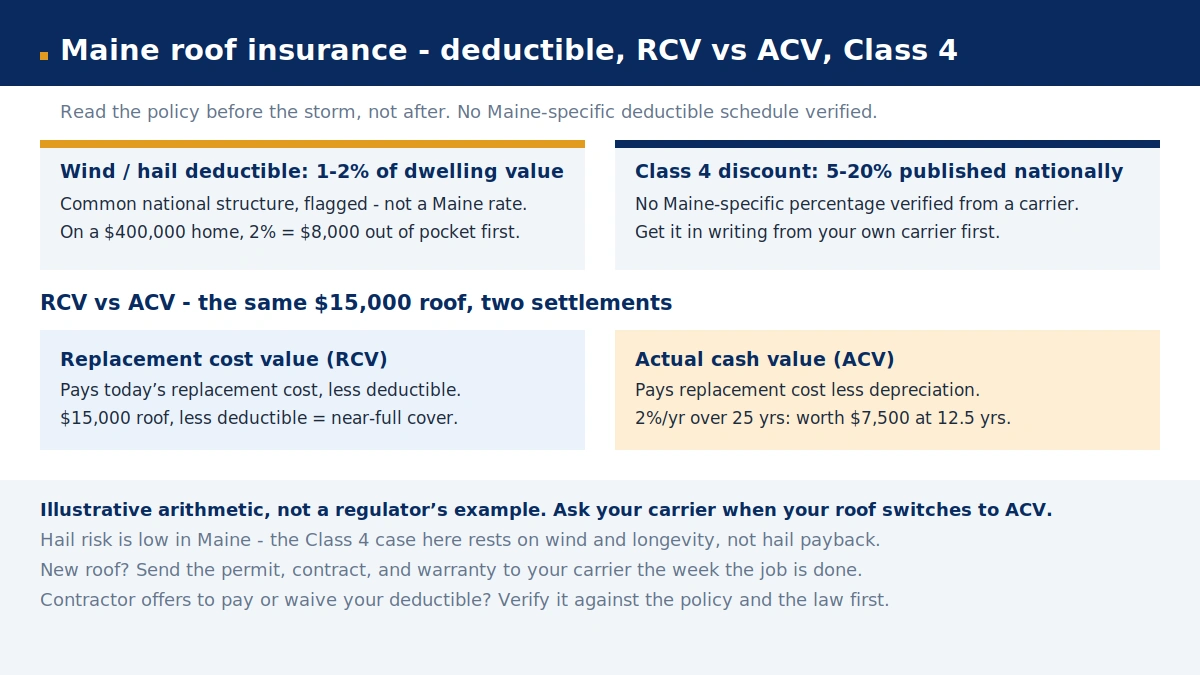
Start with the deductible, because it is the number that decides whether a claim is worth filing at all. Many Maine policies carry a separate wind and hail deductible, commonly 1–2% of the dwelling value on the national framing used in this series — no Maine-specific deductible schedule was verified from a carrier or regulator source for this guide, so the 1–2% figure is presented as the common national structure, not a Maine rate. On a $400,000 home, a 2% wind deductible is $8,000 out of pocket before the carrier pays anything. On a roof that costs $12,000 to replace, that deductible eats two-thirds of the job. A homeowner who does not know their wind deductible does not know whether their roof is insured in any practical sense. Find the number, write it down, and compare it against the cost of the roof before deciding what the policy is for.
Then the settlement method, because it is the number that decides what the carrier actually pays. Replacement cost value, or RCV, pays what it costs to replace the roof at today’s prices, less the deductible. Actual cash value, or ACV, pays the replacement cost less depreciation — and depreciation on a roof is the whole argument. The illustration below is our own arithmetic, not a regulator’s published example: a roof that cost $15,000 to install, depreciated at roughly 2% a year over a 25-year life, is worth $7,500 after twelve and a half years on a straight-line view — and an ACV settlement on that roof, less the deductible, can leave the homeowner paying most of the replacement themselves. Carriers increasingly move older roofs to ACV, or require replacement past 15–20 years, and no Maine-specific carrier rule on roof age was verified for this guide — so the draft states the mechanism and tells the reader to ask their own carrier at what age their roof switches, rather than inventing a Maine rule. The question to ask, in writing, is simple: is my roof covered at replacement cost or actual cash value, and at what age does that change?
The claims process is the third thing to understand before it is needed. Document the damage the day it happens — photographs from the ground, photographs from the attic, the date and the weather. Call the carrier before calling a contractor, and do not sign anything that assigns the claim to a contractor or authorizes work beyond emergency tarping until the adjuster has seen the roof. Get the adjuster’s scope in writing, compare it against the contractor’s scope, and understand that the two scopes will differ — the adjuster prices what the policy covers, the contractor prices what the roof needs, and the gap between them is negotiated, not wished away. A contractor who offers to pay or waive the deductible is offering something to be very careful about: in several states that practice is banned outright, and in Maine it should be treated as a warning sign and checked against the policy and the law before it is accepted. No Maine-specific ruling on deductible waivers was verified for this guide, so the draft flags the practice and tells the reader to verify it rather than stating a Maine rule that was not found.
The Class 4 discount belongs in this section too, and the honest Maine version of it is short: no Maine-specific Class 4 discount percentage was verified from a carrier or regulator source. Published national figures run 5–20% — RoofRepair.co cites 10–20% in its 2026 table, AmazingFlash cites 5–15% — but those are published figures, never promises, and they apply to the dwelling-coverage portion of the premium and nothing else. In a low-hail state, some Maine carriers may offer little or nothing for Class 4, because the underwriting logic is hail-driven and Maine does not give them hail to price. The only discount that counts is the one the homeowner’s own carrier confirms in writing, on their own policy, for their own roof. Get it before signing for the upgrade, not after.
Finally, the roof’s age and the policy’s future. A roof that is past 20 years old is a roof the carrier is watching, and a roof that is past 25 is a roof the carrier may decline to renew at replacement cost at all. A new roof, documented with the permit, the contract, and the material warranty, is the strongest thing a homeowner can show a carrier — and it is worth sending the documentation to the carrier the week the job is done, with a request for the policy to be updated and any new-roof credit applied. The discount for a new roof is real in many policies, and it is the one insurance saving in this guide that does not need a footnote.
Paying for It: No Federal Credit in 2026, HEAR Limits & How Mainers Actually Pay
The money question for a Maine roof in 2026 has a short answer and a longer one, and the short answer should come first because it corrects the assumption most homeowners bring to the conversation: there is no federal help for this roof.
A homeowner-owned roof installed in 2026 earns no federal tax credit whatsoever. The One Big Beautiful Bill Act — Public Law 119-21, signed July 4, 2025 — ended the Residential Clean Energy Credit (§25D, 30%) for systems placed in service after December 31, 2025, and the §25C credit for efficient home improvements closed on the same date, per IRS fact sheet FS-2025-05. A roof is not a solar array and never was a §25D property, so the credit was never available for roofing in the first place — but the point still needs stating plainly, because roofing and solar quotes are often sold together in Maine, and a combined quote that still deducts 30% is priced under a law that no longer exists. Any 2026 quote that shows a federal credit line on a roof, or on a solar array paired with a roof, should be sent back for correction. For the full 2026 federal picture, see our federal tax credits guide.
There is no lease route that rescues a roof either. The commercial clean-electricity credit (§48E, 30%) survives for third-party-owned systems in service by December 31, 2027, and in some states it reaches homeowners through a solar lease or power purchase agreement — but a roof is not §48E-eligible property, and no verified Maine roofing lease route exists. The roof is paid for by the homeowner, in full, with money that comes from somewhere real.
HEAR, the federal Home Electrification and Appliance Rebates program, is the next name homeowners hear, and the Maine version of it needs care. Maine’s HEAR program is partially active — but only for mobile and manufactured homes and for new affordable multifamily construction. Standard single-family homes are not eligible, regardless of income. That is confirmed across five trackers checked between July and November 2026: HomeEnergyBasics (checked August 23, 2026), GridShift (checked November 5, 2026), NuWatt (April 2026), Retrofit Relay (July 15, 2026), and HeatPumpPricing (verified November 4, 2026). A second HEAR phase for moderate-income households is planned, but no launch date has been announced. And even once it launches, HEAR never pays for roofing: it funds electrification — heat pumps, heat-pump water heaters, electrical panels, and insulation-related wiring — and since the Energy Department issued Program Notice 26-2 on May 29, 2026, it pays only for electric-to-electric upgrades, with no fuel-switching. The Mobile Home Initiative, the HEAR channel that is actually open in Maine, offers up to $13,900 for a ducted heat pump in designated towns, with claims due December 31, 2026 — a heat pump rebate, not a roof rebate, and only for the housing types it names. HOMES, the efficiency half of the federal rebates, has not launched in Maine at all; its application is submitted and under Department of Energy review, described as conditionally awarded, with no launch date.
Efficiency Maine, the state program that actually pays Maine homeowners in 2026, pays for heat pumps and weatherization — not roofing. Its heat pump rebates run $1,000–$3,000 per outdoor unit by income tier, with a $500 whole-home bonus for eligible upgrades through December 31, 2026. Its Green Bank Home Energy Loans are the financing tool worth knowing about: up to $25,000, unsecured, at 1-year 0% APR with a $500 origination fee, 5-year 5.99%, 10-year 7.99%, or an income-based 10-year 5.99% capped at $7,500, with rates verified July through October 2026. The boundary matters and this guide states it plainly: the loans pay for heat pumps (not dual fuel), electrical panel upgrades required for a heat pump project, insulation, and air sealing. A roof itself is not an eligible upgrade. But insulation and air sealing done during a reroof — the attic work that prevents the next decade of ice dams — can be financed this way, and a homeowner who pairs the reroof with the attic work can use the Green Bank loan for the attic half while paying for the roof half another way. That pairing is the smartest use of Efficiency Maine money on a Maine reroof, and it is the only one.
So how do Mainers actually pay for a roof? The honest list is short: cash, a home equity loan or line of credit, or contractor financing. Cash is cheapest and rarest on a $15,000 job. A home equity loan or HELOC usually carries the lowest rate available to a homeowner with equity, and it is the route most Maine homeowners with an older home and a good roof’s worth of equity should price first. Contractor financing is the route to read twice: the monthly payment can look small while the APR runs high, and no Maine-specific contractor APR figures were verified for this guide, so none are given — get the APR, the term, and the total of payments in writing, and compare them against the home equity quote before signing. A roof financed at a high APR for ten years can cost half as much again as the roof itself. The payment plan is part of the price, and a homeowner who does not price it is not pricing the roof.
One last money note, and it is about timing. A roof bought in the spring, when crews are hungry and the weather is turning, is often the cheapest roof of the year. A roof bought in the autumn rush, after the first storm warning, is often the most expensive. And a roof bought in an emergency, with the house open to the sky and water coming in, is the most expensive of all — which is why the repair-versus-replace section below exists, and why the inspection habit in the ice-dam section is worth more than any rebate.
Repair vs Replace: The Maine Decision Rules
Every Maine homeowner with an aging roof faces the same question, and it is usually asked at the worst moment — after a leak, in the rain, with a contractor on the phone. The decision rules below are meant to be read before that moment, in the dry, when the answer can be worked out rather than guessed.
Repair it when the roof is under 15 years old, the damage is local, and the deck is sound. A few missing shingles after a windstorm, a flashing failure at a chimney, a vent pipe boot that has cracked — these are repairs, and they run roughly $150–$400 for missing shingles, $250–$650 for a leak repair, and $200–$500 for flashing work on the national planning bands used in this series, flagged as national rather than Maine-measured. A typical call-out runs about $475. If the rest of the roof is in good shape and the attic is dry, a repair is the right call, and the money saved goes toward the replacement fund for the year the roof actually needs it.
Replace it when the roof is past 20 years old and showing its age across the whole surface — granule loss in the gutters, shingles curling or lifting, daylight visible from the attic, or stains on more than one ceiling. Replace it when the deck is suspect, when there are already two layers on the roof, or when the home is being sold and the buyer’s inspector will flag the roof anyway. Replace it when the ice dams come back every year despite the heat cables and the roof rake, because a dam that returns every winter is a roof system failure, not a weather event — and the fix is the ice barrier, the ventilation, and the air sealing that only a reroof delivers properly. And replace it before the leak, not after: a roof replaced on a dry May weekend costs the quote. A roof replaced in a February emergency costs the quote plus the water damage, the emergency rate, and the week of disruption.
The age rule, stated plainly. Under 15 years with local damage: repair. Fifteen to 20 years with spreading wear: get the inspection, price the replacement, and plan the year. Past 20 years with visible wear across the surface: replace, and do it in the season you choose rather than the season the roof chooses for you. Past 25 years: replace now, because the roof is past the point where a repair is an investment and into the point where it is a postponement. These are rules of thumb for Maine’s climate, not a manufacturer’s table — a well-ventilated inland roof can beat them, and a coastal roof can miss them — but they are the right starting point for the conversation with the inspector.
The metal question, one last time. If the roof is being replaced and the house will be kept for decades, price the metal roof alongside the asphalt roof, in cost per year, on the same spec sheet. The numbers from the material section — about $420 a year for architectural asphalt, about $398 a year for standing seam — are the whole argument in two figures. If the house will be sold within five years, take the asphalt and bank the difference. If the house is on the coast, price aluminum. If the house is inland under heavy snow, price standing seam with snow guards. And whichever material is chosen, spend the money under the roof as well as on top of it: the ice barrier, the ventilation, and the air sealing are what keep a Maine roof alive through the winters that are coming.
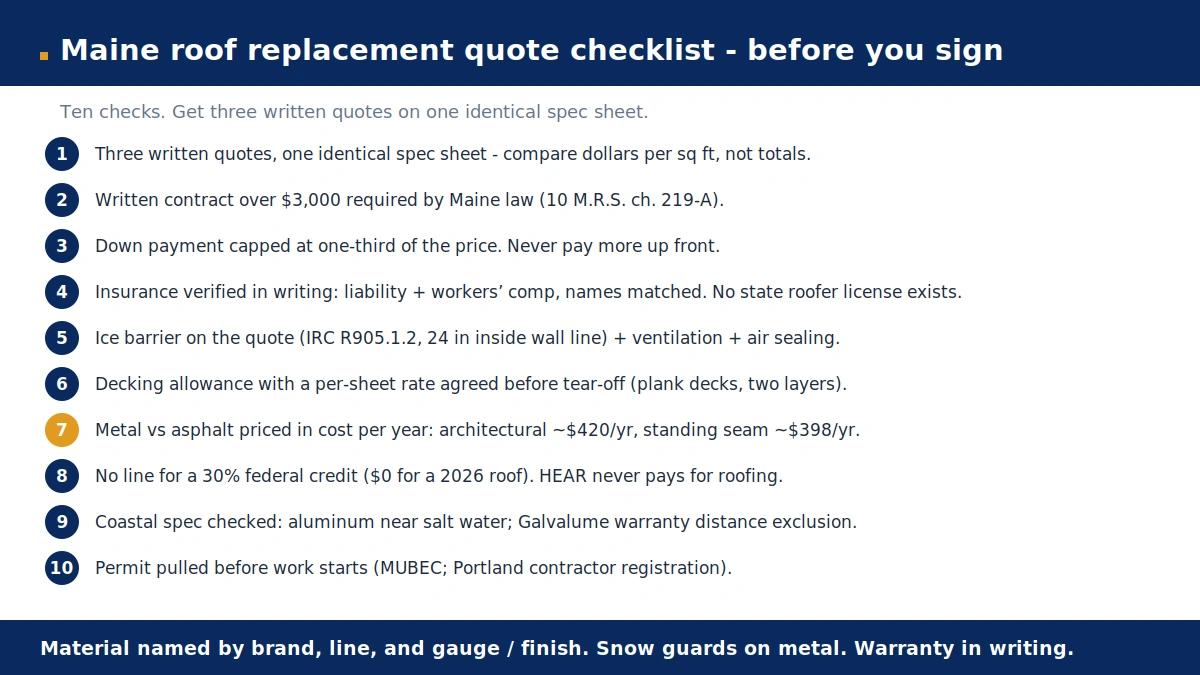
The final check before signing. Three written quotes on one identical spec sheet. The written contract Maine law requires, with the down payment at or below one-third. Insurance verified in writing, with the company name matching the contract. The permit pulled before the work starts. The decking rate agreed before the tear-off. And the material named by brand, line, and — for metal — gauge and finish. A Maine reroof done that way is a roof that will still be working when the next owner asks about it. A Maine reroof done any other way is a story the next owner will tell.
Sources & methodology
Cost anchors: SmartRoofingCalculator — “Maine Roof Replacement Cost: $10,800–$15,500 (2026)” (updated Apr 24, 2026; page updated Nov 2, 2026) — primary Maine anchor: $430–$620/sq architectural, $860–$1,330 metal, $1,140–$1,710 tile, permit ~$240, 25-square roof $10,750–$15,500, roofer median wage $24.03/hr (BLS OEWS May 2024), state factor 0.952, rank 24 of 50; MyRoofData — Maine (2026 model: $13,000–$22,750 typical home; arch $459–$765/sq; 3-tab $357–$561; ribbed metal $561–$969; standing seam $969–$1,632; crews $55–$92/hr; permits $50–$250; 2,338 sq ft roof area); NumeralQ — Maine + Portland (pricing Oct 26, 2026: arch $4.35–$5.21/sq ft; 2,000 sq ft roof $9,250–$11,250; Portland $9,340–$11,370; 3-tab $3.61–$4.17; designer $5.32–$6.31; exposed metal $6.92–$8.71; stone-coated $7.82–$11.34; standing seam $9.91–$15.12; roofer $24.10/hr BLS May 2025, billed $48–$63/hr; permits $94–$200); RoofingEstimatorPros — Maine (updated Aug 26, 2026: 2,000 sq ft arch $15,185–$27,220, avg $20,534, $10.27/sq ft; 3-tab $7.59; standing seam $18.29; multiplier 1.08x, labor 1.10x; permits $200–$600 — flagged high band); OneGoodRoofer — Maine (published Oct 7, 2026: 1,500–2,500 sq ft home arch $11,200–$17,500; metal $23,700–$38,700; per sq arch $468–$728, metal $988–$1,612; index 1.04); This Old House — Maine (2026 survey: avg $6,364 — flagged outlier, not used as a headline); HomeCostsByState (AHS 2023 in Aug 2026 dollars: Maine typical $11,820, middle half $7,270–$18,160; roofer mean $25.82/hr). Every roof-size total, Class 4 total, and cost-per-year figure in this guide is arithmetic we did ourselves, starting from the per-square-foot ranges and lifespans cited above.
Climate + snow + ice: Maine tourism board climate divisions (coastal 50–70 in/yr; southern interior 60–90; northern interior 90–110); US Climate Data Bangor 1991–2020 normals (66 in); WeatherSpark Maine monthly snowfall (Portland, Bangor, Caribou); RoofSquareFootageCalculator Maine guide (ASCE 7-22 ground snow 25–60 psf; 115 mph baseline wind; IRC R905.1.2 ice barrier 24 in inside wall line); A Plus Roofing — snow load science (design loads 50–60 psf southern, 60–70 central, 80–90 northern/mountain); Maine Coast Roofing — should-I-remove-snow (roof snow load about 70% of ground load; 50–70 psf; remove above 2 ft); Maine DPS/FMO MUBEC snow-load guide (Nov 2025: ASCE hazard tool, 7-16 values); Town of Hampden MUBEC ordinance (amended June 2024: ground snow 70 psf, frost 5 ft, winter design temp -5 F, ice barrier required); Maine Coast Roofing — metal roofing on the Maine coast (snow shedding, ice dam reduction, wind 120–140 mph, aluminum vs Galvalume, 40–60 yr life, metal roofs over 100 years old); The Roofing Brief — standing seam cost (Oct 2026: coastal premium 8–15%, Galvalume warranty exclusion within one-half mile of salt water).
Metal: Maine Coast Roofing — screw-down vs standing seam (updated Oct 11, 2026: standing seam $20,000–$40,000 typical Maine home; 24/26 gauge vs 29 gauge screw-down; snow guards above doors/walkways/decks; ice-and-water shield under both); Monastery Roofing — metal roof cost in Maine (metal $7.90–$12.20/sq ft; standing seam $9–$14/sq ft; typical standing seam home about $15,100 — flagged, below the SRC band, single contractor source).
Housing stock: Census ACS 2020–2024 table B25034 via Before Regret (Maine 22.9% pre-1940, 171,959 homes, median year built 1977); B985 / Today’s Homeowner — average Maine home age 45 yrs (Feb 2025: Androscoggin 54, Aroostook 49, Kennebec 48, Cumberland 48, York 42).
Labor: BLS OEWS May 2025, SOC 47-2181 Roofers — Maine employment 610, mean $25.82/hr, median $24.10/hr, 10th $21.58, 90th $30.98; national mean $27.95, median $26.65; Bangor metro mean $25.01, median $23.14, employment 120; Lewiston–Auburn metro mean $27.16, median $24.69, employment 150.
Permits + licensing: Maine AG — Home Construction and Repair (general contractors and trades such as roofing not licensed or regulated; Home Construction Contracts Act, 10 M.R.S. ch. 219-A, written contract over $3,000, down payment capped at one-third; MUBEC enforced by municipalities over 4,000 residents, 10 M.R.S. sections 9721–9725); RoofingLicenseCheck — Maine (checked Oct 22, 2026: no state license); Housecall Pro — Maine GC guide (LD 1226, statewide residential contractor license for projects over $15,000, target Jan 1, 2027); Southern Maine Roofs — permits and regulations (Apr 13, 2026: MUBEC, Portland contractor registration).
Class 4 + insurance: No Maine-specific Class 4 price or discount verified — Class 4 price is derived arithmetic from the SRC base plus the Iowa-series premium (Lifelong Insurance Agency, May 2026, about $30/sq); RoofRepair.co — Class 4 discounts by state (2026: 10–20%, national); AmazingFlash — impact-resistant shingles (June 2026: 5–15%, national); RoofingEstimatorPros — Maine hail risk low, storm risk moderate. The RCV vs ACV illustration is our own arithmetic (2%/yr straight-line depreciation over 25 years), not a regulator’s example.
HEAR / HOMES / Efficiency Maine: HomeEnergyBasics — Maine heat pump rebates (checked Aug 23, 2026: HEAR mobile homes + affordable multifamily only; $35.7M HEAR allocation; second phase no launch date); GridShift (checked Nov 5, 2026: Maine HEAR active only for income-eligible single-family mobile homes and new affordable multifamily); NuWatt — Efficiency Maine income-eligible rebates (Apr 2026: HEAR up to $8,000 for mobile homes/affordable multifamily; $89M allocated — flagged conflict with $35.7M); HeatPumpPricing — HEAR map (verified Nov 4, 2026: Maine Mobile Home Initiative up to $13,900 ducted heat pump rebate, claims due Dec 31, 2026); Retrofit Relay — HEAR/HOMES 2026 (Jul 15, 2026: Maine HEAR active, highly restricted; HOMES not launched); ReferenceSource — home energy rebates tracker (verified Sep 30, 2026: Maine HOMES application submitted, conditionally awarded); Mattra / Efficiency Maine — Home Energy Loans (rates as of Oct 2026: 0%/1-yr with $500 origination, 5.99%/5-yr, 7.99%/10-yr, income-based 5.99%/10-yr max $7,500; eligible upgrades heat pumps, insulation, air sealing — roof not eligible); DOE Program Notice 26-2 (May 29, 2026: HEAR electric-to-electric only, no fuel-switching).
Federal credit: OBBBA (P.L. 119-21); IRS FS-2025-05 — §25C and §25D ended for installs placed in service after Dec 31, 2025; §48E lease pass-through does not apply to roofing.
Repair costs: Iowa-series national planning bands used and labeled as national (missing shingles $150–$400; leak $250–$650; flashing $200–$500; ice dam $400–$1,200; call-out about $475). No Maine-specific repair-price table was verified.
Method notes: the headline-cost conflict (SRC vs NumeralQ vs MyRoofData vs RoofingEstimatorPros), the standing-seam conflict, and the squares-assumption conflict are flagged in the text rather than resolved. No verified city-level figures exist for Bangor, Lewiston, Augusta, Bar Harbor, or Presque Isle, and none are invented. No Maine-specific freeze-thaw cycle count, hail statistics, contractor APR figures, or Class 4 discount percentage was verified, and none is stated. Maine lifespans are realistic figures for Maine’s snow and freeze-thaw climate, not a single published table. The WeatherSpark Portland monthly normals sum lower than the 50–70 in coastal band and the conflict is flagged. The $35.7M vs $89M HEAR allocation conflict is flagged.
What does a roof replacement cost in Maine in 2026?
About $10,750-$15,500 for a typical 25-square architectural shingle roof (SmartRoofingCalculator, updated April 2026), or about $4.30-$6.20 per square foot of roof surface installed with tear-off. Most Maine homeowners should budget $11,000-$18,000 for a typical single-family home once tear-off, ice barrier, and permits are in. Standing-seam metal runs about $21,500-$33,250 for the same roof. Portland runs $9,340-$11,370 for a 2,000-square-foot roof on the NumeralQ model. The federal credit for a 2026 roof is $0.
Is a metal roof worth it in Maine?
Usually yes, if you plan to keep the house for decades. Standing-seam metal costs roughly double architectural asphalt on the day — about $21,500-$33,250 against $10,750-$15,500 for a typical 25-square roof — but it lasts 40-70 years against asphalt’s 20-30, sheds snow in slabs, and cuts ice dam formation sharply. Worked out per year of service, metal costs about $398 a year against about $420 for architectural asphalt. On a house you will sell within five years, asphalt is the better buy, because the next buyer will not repay the full metal premium. On the coast, specify aluminum or Galvalume with a PVDF topcoat — plain steel can fall outside the warranty within one-half mile of salt water.
Why are Maine roofs more expensive than the national average?
Snow load, ice dams, freeze-thaw, and a thin labor market. Coastal Maine gets 50-70 inches of snow a year and the northern interior gets 90-110, ground snow loads run 50-90 pounds per square foot by region, and the code requires an ice barrier at every eave. Freeze-thaw cycling shortens asphalt life to 20-30 years. And Maine has only about 610 roofers statewide, so crews are scarce and the autumn rush is expensive. The sources put Maine about 2-8% above the national average on cost, depending on the model — and the climate detailing on the quote is a larger share of the price than in a mild state.
Does Maine require a license for roofers?
No. Maine does not license roofers or general contractors at the state level — the Attorney General states plainly that general contractors and trades such as roofing and framing are not licensed or regulated. The protection that replaces a license is Maine’s Home Construction Contracts Act: any job over $3,000 needs a written contract, and the down payment is capped at one-third of the price. Check business registration with the Secretary of State, municipal registration where required (Portland requires it for permit work), liability and workers’ compensation insurance in writing, manufacturer certification, and three local references. A statewide residential contractor license for projects over $15,000 is targeted for January 1, 2027 under LD 1226, but that date is a target, not a fact.
Do I need a permit to replace a roof in Maine?
Yes, in most municipalities a full roof replacement requires a building permit, under the Maine Uniform Building and Energy Code (MUBEC). Fees typically run $50-$600, most often $150-$250. The permit buys the inspection, and in a state with no roofer license that inspection is one of the few independent checks the work meets code. Smaller towns may not enforce MUBEC, and unorganized territories fall under state review, so check with the town office where the house sits before the work starts.
What is an ice dam, and how do I stop one on a Maine roof?
An ice dam forms when heat escaping through the roof melts snow on the upper roof, the water runs down to the cold eaves, and it refreezes into a ridge that traps water behind it — and the trapped water goes under the shingles and into the house. The prevention stack is the code-required ice barrier at the eaves and valleys (membrane to at least 24 inches inside the wall line), ventilation that keeps the roof deck cold, and attic air sealing plus insulation so heat never reaches the deck. Metal roofing sheds snow and cuts dam formation sharply. Remove snow when it passes 2 feet, after several storms without a melt, or when dams are forming — from the ground with a roof rake, or by hiring a professional.
Can I get the 30% federal tax credit for a new roof in Maine in 2026?
No. The One Big Beautiful Bill Act (P.L. 119-21) ended the Residential Clean Energy Credit (§25D, 30%) and the §25C credit for systems placed in service after December 31, 2025, per IRS fact sheet FS-2025-05 — and a roof was never a §25D property in the first place. The federal credit for a 2026 roof is $0, and no lease route changes that. HEAR rebates in Maine cover mobile homes and affordable multifamily only, never a standard single-family home, and HEAR never pays for roofing in any case. Efficiency Maine’s Green Bank loans fund heat pumps, insulation, and air sealing — not the roof itself, though insulation and air sealing done during a reroof can be financed that way.
Should I repair or replace my Maine roof?
Repair it when the roof is under 15 years old, the damage is local, and the deck is sound — a few missing shingles or a flashing failure is a repair, roughly $150-$650 on national planning bands. Replace it when the roof is past 20 years old with wear across the whole surface, when the deck is suspect, when two layers are already on the roof, or when ice dams return every winter despite heat cables and raking. Past 25 years, replace now, in the season you choose rather than the season the roof chooses for you. Price metal alongside asphalt in cost per year before deciding — and whichever material you choose, spend the money under the roof too, on the ice barrier, ventilation, and air sealing.