

Table of Contents
| If you want… | Pick in 2026 | Why |
|---|---|---|
| Lowest cost per kWh, fastest payback | Traditional panels | ~$2.80/W vs $5+/W — panels pay back in roughly half the time |
| A new roof AND solar in one project | GAF Timberline Solar ES 2 | It’s the roof; the roof-replacement offset closes most of the gap |
| Maximum power density per shingle | CertainTeed Solstice | 16.1 W/sq ft — best of the shingle class; Apollo II is discontinued |
| Premium look, hurricane-rated | Luma Solar | 80 W/shingle, 200+ mph wind rating — but $4–$8/W and limited dealers |
| Budget BIPV | SunTegra | $4–$6/W, the cheapest shingle — but 13–16% efficiency |
| Tesla Solar Roof | Nothing — it’s discontinued | Tesla exited August 2026; ~3,000 ever installed |
The 2026 Reality Check (Read This First — Most Articles Are Outdated)
If you Googled “solar shingles vs panels cost” last year, you got a tidy comparison: Tesla Solar Roof vs. GAF vs. CertainTeed Apollo II, panels at $3/W “less 30% federal credit.” Almost every word of that framing is now wrong, and the articles still ranking for this keyword are mostly 2024-era zombies that haven’t been updated. Here is what actually changed.
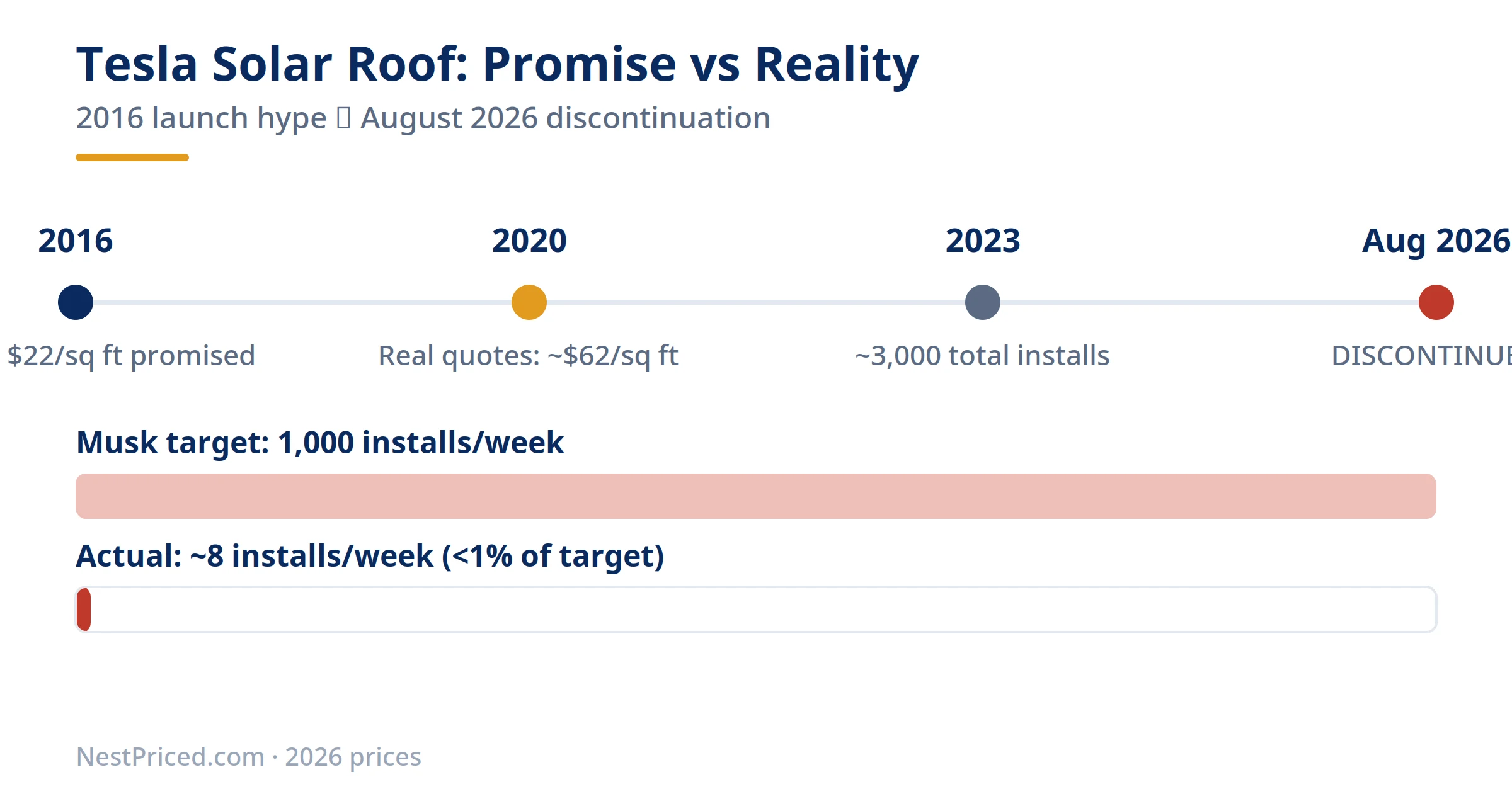
Tesla Solar Roof is dead. Tesla stopped accepting new Solar Roof orders on August 20, 2026 — no press release, just a quiet redirect of the product page to conventional panels. In seven years, roughly 3,000 US homes got a Tesla Solar Roof against Elon Musk’s target of 1,000 installations per week. The miss was over 95%. Internal assessments called the product “not financially viable”: launch marketing promised ~$22 per square foot, but real-world quotes averaged ~$62 per square foot (~$16/W), with typical systems around $106,000 and some exceeding $200,000. If you see any 2026 article presenting the Tesla Solar Roof as a buyable option, close the tab — it’s stale.
The 30% federal credit is gone. The Residential Clean Energy Credit (§25D) ended for property placed in service after December 31, 2025, under the OBBBA (P.L. 119-21). For 2026 homeowner-owned installs — shingles and panels alike — the federal credit is $0. (Leased systems and PPAs can still pass through the commercial §48E credit via the provider, which is why lease quotes may look better than purchase quotes this year.) And no: HEAR rebates do not apply to solar. The Home Electrification rebates (renamed HEEHR in May 2026) cover heat pumps, heat pump water heaters, and electrical upgrades — not solar of any kind. Any article telling you to stack HEAR money onto a solar shingle quote is wrong.
GAF Energy restructured. In December 2025, GAF Energy closed its San Jose facility, laid off 138 California workers, and moved headquarters to Texas. The Timberline Solar product is alive — but availability is genuinely select-market, through GAF-certified contractors only. Some states have thin or no coverage. This matters for the “get 3 quotes” advice below: for shingles, you may struggle to get even two.
CertainTeed’s first generation is dead too. Apollo II — the shingle most older articles recommend — is no longer installed. The current product is Solstice (available now), with Landmark PWR launching November 1, 2026.
So the 2026 shingle market is: GAF Timberline Solar ES 2 (the volume leader), CertainTeed Solstice (the density leader), Luma (the premium play), and SunTegra (the budget play). Tesla is a cautionary tale. Everything below uses this lineup and 2026 pricing with zero federal credit baked in.
Head-to-Head: Solar Shingles vs Solar Panels (2026 Specs)
| Factor | Traditional panels | GAF Timberline Solar ES 2 | CertainTeed Solstice | Luma Solar | SunTegra | Tesla Solar Roof |
|---|---|---|---|---|---|---|
| Status in 2026 | ✅ Widely available | ✅ Available (select markets) | ✅ Available | ✅ Available (limited) | ✅ Available | ❌ Discontinued Aug 2026 |
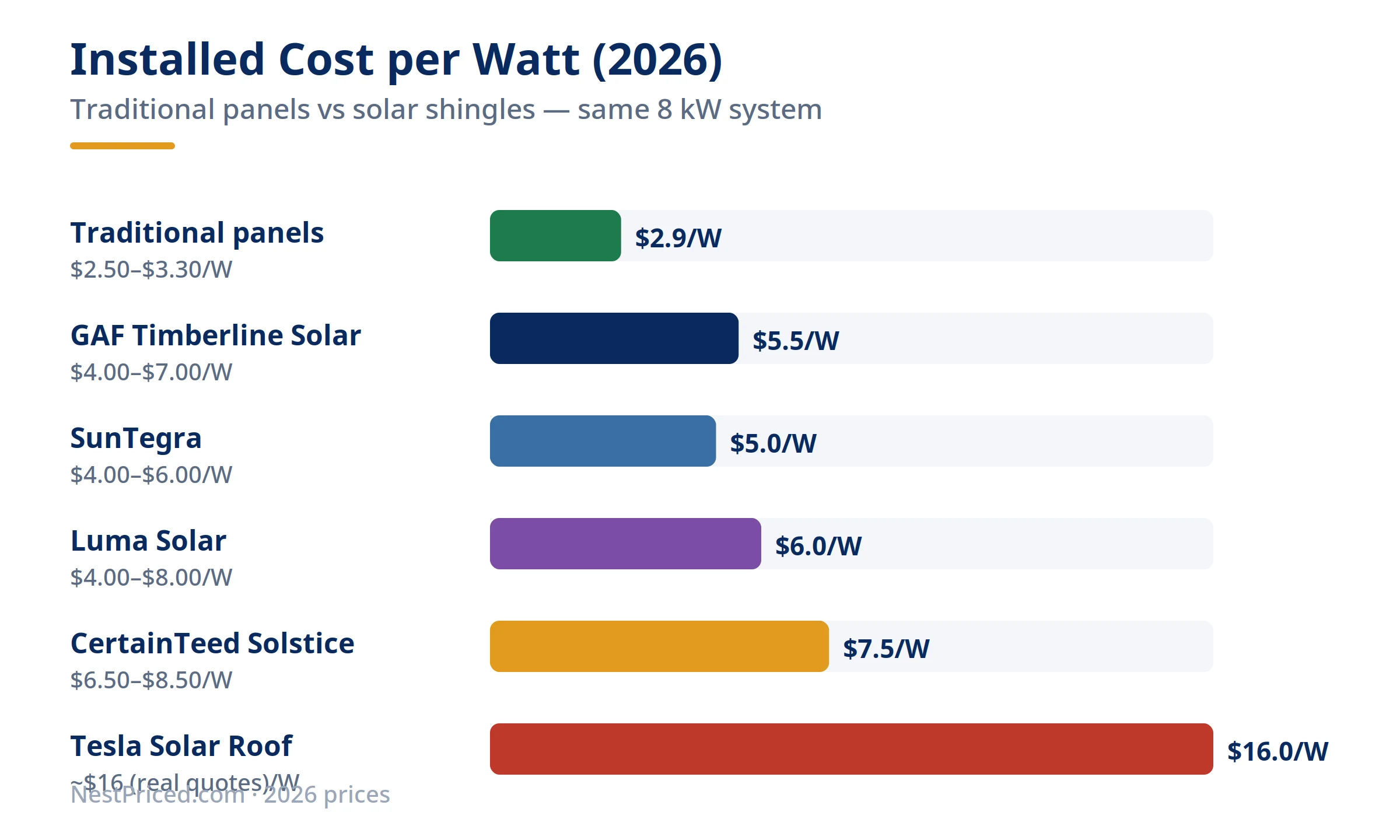
| Cost per watt (installed) | $2.50–$3.30 | $4.00–$7.00 | ~$6.50–$8.50 | $4.00–$8.00 | $4.00–$6.00 | ~$16 (real quotes) |
| 8 kW system cost | $20,000–$26,000 | $36,000–$56,000 | ~$52,000–$68,000 | ~$32,000–$64,000 | ~$32,000–$48,000 | ~$128,000 |
| Unit output | 400–475 W/panel | 57 W/shingle | ~16.1 W/sq ft | 80 W/shingle | 105–114 W/shingle | 71.67 W/tile |
| Efficiency | 20–24% | 22.6% | ~19.5% | up to 22.1% | 13–16% | ~17–20% |
| Power density (roof area) | ~20 W/sq ft | ~17 W/sq ft (active); 40–60% of roof active | 16.1 W/sq ft | High | Low | 7–9 W/sq ft (total roof) |
| Is it also the roof? | ❌ No | ✅ Yes | Partial (integrates) | ✅ Yes | ✅ Yes | ✅ Yes (was) |
| Product warranty | 25–30 yr | 25 yr (narrow — leak defects) | 25 yr | Limited lifetime (roof) | 10 yr | 25 yr |
| Power warranty | 25 yr | 25 yr | 25 yr (≥80%) | 25 yr | 25 yr | 25 yr |
| Install time | 1–3 days | ~2 days (roofing crew) | Days | Days–weeks | Days | Weeks–months (was) |
| Installer choice | Thousands nationwide | GAF-certified only | Credentialed roofers | Limited network | Limited | N/A |
| Aesthetics | Visible racked panels | Looks like asphalt shingles | Low-profile shingle | Premium seamless | Shingle-look | Invisible glass tiles (was) |
| Heat performance | Air gap = cooler | Nailed to deck = hotter | Nailed = hotter | Claims good thermal mgmt | Nailed = hotter | Nailed = hotter |
| Federal credit 2026 | $0 | $0 | $0 | $0 | $0 | $0 |
2026 US national planning ranges for professional installation. Shingle $/W figures bundle the roofing work; panel figures do not include roof replacement — see the three scenarios below for the honest comparison.
Three things in that table deserve unpacking, because they’re where buyers get burned.
First, “efficiency” and “power density” are not the same thing — and density is what your roof cares about. GAF’s 22.6% cell efficiency sounds competitive with panels, and at the cell level it is. But a shingle system only makes 40–60% of your roof active (the rest is plain roofing shingles for ridges, edges, and shaded areas), and each shingle makes 57 watts where a panel makes 400+. Net effect: you need substantially more roof area for the same system size. On a big simple roof, who cares. On a small or cut-up roof, shingles may not fit the system size you need — while panels will.
Second, the heat penalty is real. Rack-mounted panels sit on rails with an air gap underneath; air circulates and carries heat away. Solar shingles are nailed directly to the roof deck — no gap, no airflow, hotter cells. Hotter cells produce less: one 2026 analysis models roughly 14% lower annual output per rated watt for GAF shingles versus rack-mounted panels. Treat that as directional rather than gospel (temperature coefficients vary by product and climate), but the physics is not debatable — shingles run hotter, and heat costs kilowatt-hours. In Phoenix this matters more than in Portland.
Third, warranty fine print differs more than the “25-year” headlines suggest. Panels carry 25–30 year product warranties from manufacturers with decades of solar track records, plus 10–12 year workmanship warranties from the installer. GAF’s 25-year product warranty is narrow — it covers leak defects, essentially — and the inverter/electronics (the parts most likely to fail first) require a paid add-on for extended coverage. Luma’s “limited lifetime” roof warranty sounds best on paper but comes from the smallest company on the list. Which brings us to the Tesla lesson: a warranty is only as good as the company standing behind it in year 18.
The 2026 Solar Shingle Brands, Deep-Dived
GAF Timberline Solar ES 2 — the one most people will actually buy
If you buy solar shingles in 2026, it will probably be these. GAF is North America’s largest roofing manufacturer, and the Timberline Solar ES 2 (Energy Shingle, generation 2) is the only shingle with anything approaching a national footprint — installed by GAF-certified roofing contractors, nailable by regular roofing crews in about two days, and the only solar shingle with Miami-Dade approval (the toughest wind rating in the country). The shingles are assembled in Georgetown, Texas.
The specs that matter: 57 watts per shingle (up 23% from the 46W first generation), 22.6% cell efficiency, roughly 30 shingles per roofing square delivering about 1.7 kW per square, with 40–60% of the total roof typically active. In plain terms: a 2,000 sq ft roof might yield a 6–8 kW system, depending on orientation and complexity.
2026 installed pricing: $4.00–$7.00/W, with most quotes clustering at $4.50–$5.50/W — or $21–$24 per square foot of installed roof. A typical 6–8 kW system runs $30,000–$50,000 including tear-off and the full roof; a 10 kW system lands around $45,000. The full range of real quotes seen in the wild is wild itself: $35,000 to $100,000, driven by roof complexity, market, and how much of the roof is active.
Warranty: 25-year product (narrow — manufacturing and leak defects), 25-year power output warranty. The catch: inverter and electronics coverage beyond the base term requires a paid add-on. Price that add-on into your comparison — the inverter is the component most likely to need replacement in years 12–15 ($1,500–$3,000).
Strengths: biggest installer network of any shingle; installs like a roof (no solar specialty crew needed); Miami-Dade rated; genuine 25-year roofing + power warranties from a company that will probably exist in 2045.
Weaknesses: the December 2025 restructuring means availability is market-dependent — confirm a certified contractor exists near you before you fall in love; the heat penalty (no air gap) trims output per rated watt; the narrow product warranty and paid electronics add-on.
Best for: homeowners who need a roof anyway and want the most mainstream shingle option with the deepest corporate parent.
CertainTeed Solstice — the density leader (Apollo II is dead, don’t buy it)
CertainTeed confuses shoppers because its first-generation shingle, Apollo II, is all over older articles — and it is discontinued. If a contractor quotes you Apollo II in 2026, they’re quoting old stock or an old brochure. The current product is Solstice, with Landmark PWR launching November 2026.
The specs that matter: Solstice posts 16.1 watts per square foot — the best power density of any shingle in independent testing. That matters on smaller roofs where every square foot counts. (Apollo II’s numbers — 63 W/module, $16–$22/sq ft, $6.40–$8.00/W, typical systems $47,500–$67,500 — are included here only so you can recognize a stale quote when you see one.)
2026 installed pricing: roughly $6.50–$8.50/W — the priciest of the mainstream shingles per watt, offset partly by needing fewer square feet of active roof.
Warranty: 25-year power warranty; CertainTeed’s roofing heritage backs 25-year installation/workmanship terms on the Apollo line, and Solstice carries the brand’s standard solar warranty structure. As with GAF, read the electronics coverage separately.
Strengths: best W/sq ft in class; CertainTeed is a 120-year-old building-materials company (Saint-Gobain) — the warranty has a deep balance sheet behind it; integrates with CertainTeed roofing systems.
Weaknesses: highest $/W of the mainstream options; smaller certified installer network than GAF; the Apollo II naming confusion means you must verify which product is on your quote, in writing.
Best for: smaller roofs where density matters most, and buyers who prioritize the manufacturer’s longevity over the lowest bid.
Luma Solar — the premium play
Luma is the boutique option: 80 watts per shingle, up to 22.1% efficiency, a 200+ mph wind rating (the highest in the category), and a limited lifetime roof warranty paired with a 25-year power warranty (≥80%). It’s the shingle for people who want the best-looking, toughest roof and are willing to pay for it.
2026 installed pricing: $4.00–$8.00/W, with full installs typically $41,500–$70,000. The range is wide because Luma is a full custom-roof project, not a commodity — every quote is bespoke.
Strengths: highest per-shingle output; best wind rating; genuinely premium aesthetics (seamless, architectural); lifetime roof warranty headline.
Weaknesses: limited dealer network — in many markets there is exactly one Luma installer, which is another way of saying there is no competitive bidding; premium pricing with premium-project timelines (days to weeks); smallest company of the group, so the Tesla lesson applies most sharply here.
Best for: high-end homes, hurricane zones where the 200 mph rating has insurance value, and buyers who want the statement roof.
SunTegra — the budget shingle
SunTegra occupies the value corner: $4.00–$6.00/W ($15–$18 per square foot of active roof), 105–114 watts per shingle — the highest per-shingle wattage, achieved with larger shingle units. The tradeoff is efficiency: 13–16%, the lowest in the class, meaning more roof area per kilowatt.
Warranty: 25-year power + 10-year product — notably shorter product coverage than the 25-year standard elsewhere. That 10-year number should give you pause on a product meant to be your roof for decades.
Strengths: lowest shingle $/W; integrates with standard roofing; simpler product.
Weaknesses: lowest efficiency (more roof needed); shortest product warranty (10 years); thin installer network; least third-party performance data.
Best for: large simple roofs where area is plentiful and budget is the binding constraint — and buyers comfortable with the shorter warranty.
Tesla Solar Roof — the obituary (know it so you don’t get pitched it)
Worth a section because its ghost still haunts quotes and articles. Real-world pricing ran ~$62/sq ft (~$16/W): a 6 kW system around $96,000, 8 kW around $128,000, with documented quotes from $60,000 past $200,000. Per-tile output was 71.67W, but only 30–60% of the roof was active, yielding a miserable 7–9 watts per square foot of total roof area — the worst density in the category, which is partly why costs exploded (you paid for a whole expensive roof to get a modest system).
If you already own one: Tesla says the 25-year tile and power warranties will be honored and parts supplied. But a flagship Florida installer went insolvent in August 2026, and proprietary tiles have no supply-house spares. Practical advice: document your system thoroughly now (photos, serial numbers, warranty paperwork, installer contact), establish a servicing relationship while the network exists, and budget for the possibility that future repairs mean custom fabrication at custom prices. Do not assume “warranty honored” means “service convenient.”
Solar Shingles vs Panels Cost: What Actually Drives the Price
Whether panels or shingles, five variables move your quote more than brand choice:
1. System size. The $/W figures above are the great equalizer. An 8 kW panel system at $2.80/W is $22,400; the same 8 kW in GAF shingles at $5.00/W is $40,000. But note the asymmetry: shingle $/W includes the roof; panel $/W does not. Always compare (panels + roof) vs. shingles — never panels-alone vs. shingles-alone.
2. Roof complexity. Cut-up roofs with dormers, valleys, and multiple pitches cost more for both — but punish shingles harder, because inactive shingles still cost roofing money while producing nothing. A simple gable roof is the best case for shingles; a Victorian is the worst.
3. Tear-off and decking. Shingle quotes include tear-off of the old roof (typically $1–$3/sq ft of roof area) and any decking replacement. Panel quotes on an existing roof do not. If your decking is rotted, the shingle quote absorbs it; the panel quote gets a change order.
4. Electrical. Both need an inverter, disconnects, and a panel that can take the backfeed. A panel upgrade ($1,500–$4,000 — see our electrical panel upgrade cost guide) hits either option equally. Shingle systems’ electronics are more integrated, which can simplify or complicate the electrical scope — get it itemized.
5. Market and installer competition. Panels: thousands of installers, brutal competition, quotes within 10–15% of each other. Shingles: certified-only networks, sometimes one bidder in a metro. The lack of competition is a real cost — budget 10–20% more where you can’t get three quotes, and treat a single shingle bid with extra skepticism.
The 2026 incentive picture (read before you sign): federal §25D = $0 for owned systems placed in service in 2026. What can still help: state and utility incentives (they vary wildly — South Carolina’s 25% state credit is the standout; check DSIRE for your ZIP), net metering terms (your utility’s buyback rate affects payback more than most hardware choices — some utilities have gutted it), and lease/PPA structures where the provider claims the §48E commercial credit and passes part of it through as a lower rate. Note the tradeoff on leases: lower upfront, but you don’t own the system and the 25-year economics usually favor ownership. And again: HEAR/HEEHR money is for heat pumps and electrical — not solar. Don’t let anyone tell you otherwise.
The Shingle Installer Problem (Why Your Second Quote May Not Exist)
Here’s the practical reality that the $/W tables don’t show: getting a solar shingle quote is hard. Traditional panels have thousands of installers in every metro — you can get three quotes by Thursday. Solar shingles are sold through certified-only networks, and in many markets that means one bidder or none.
GAF’s network is the biggest and still thin. Timberline Solar installs require GAF-certified contractors, and after the December 2025 restructuring (San Jose closure, HQ move to Texas), coverage is openly select-market. Some states have robust coverage; others have a handful of contractors; a few effectively have none — Wisconsin roofers, for example, report GAF shingles as not offered in their market. Before you invest hope in the shingle path, do this 10-minute check: GAF’s contractor locator, plus a direct call asking “are you currently installing Timberline Solar?” — not “are you certified,” which can mean a dormant credential.
CertainTeed, Luma, and SunTegra are thinner still. CertainTeed Solstice goes through credentialed roofers (better than nothing, worse than GAF’s network). Luma works through a small dealer network — in many metros there is literally one Luma installer, which means no competitive bidding and take-it-or-leave-it pricing. SunTegra’s network is similarly sparse.
Why this matters for price: a single bidder doesn’t discount. Our $4–$7/W GAF range assumes at least some competition; single-bidder markets cluster at the top of every range in this article. If you can only get one shingle quote, treat it as a starting bid: get the panel quotes anyway (easy), show the shingle contractor the panel number, and ask them to justify the premium line by line. The honest ones will talk about the roof offset; the others will talk about “curb appeal” until you stop asking about money.
The servicing corollary: the installer who sells you the system is, in practice, the installer who services it. Shingle systems are proprietary — a GAF-certified crew can’t necessarily service a Luma roof, and as IntelligentLiving’s 2026 reporting notes, some installers simply won’t touch systems they didn’t install. Before signing, ask: “If you retire or close, who within 50 miles services this system?” If the answer is a shrug, that’s a cost — an unpriced one — that belongs in your decision.
What to do if no shingle installer exists near you: you have three honest options. One, go with panels (the default for a reason). Two, wait — the shingle market is consolidating, and today’s thin market may be tomorrow’s thinner one; don’t chase a dying distribution model. Three, if you’re building new, ask your builder — production builders with GAF relationships can sometimes access shingle supply that retail shoppers can’t.
The 10-Year Math: Three Scenarios With Real Numbers
This is the section most articles skip, and it’s the one that should drive your decision. All scenarios use 2026 inputs: $0 federal credit, US average residential rate 18.2¢/kWh (~$157/month average bill), an 8 kW system producing ~11,200 kWh/year (~$2,038/year in avoided electricity at average rates), and asphalt roof replacement at $8,500–$14,800 (we use $12,000 as the planning midpoint for a 2,000 sq ft home). No state incentives in the base case — treat those as upside.
Scenario A: Your roof is fine (15+ years of life left)
| 8 kW panels | 8 kW GAF shingles | |
|---|---|---|
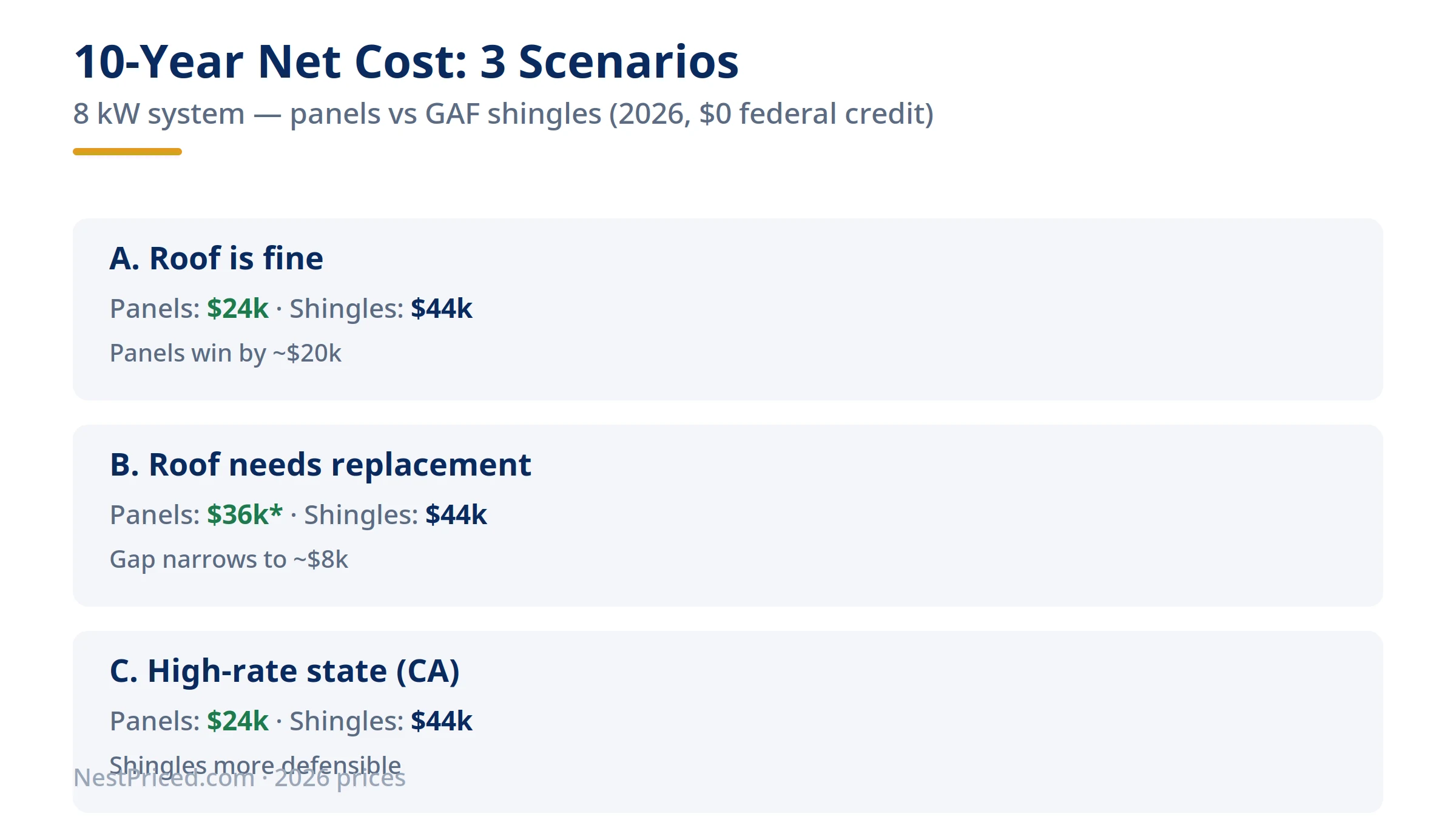
| Upfront cost | $22,400 ($2.80/W) | $40,000 ($5.00/W) |
| 10-yr electricity savings | ~$20,380 | ~$17,500–$18,300 (less ~10–14% heat penalty) |
| 10-yr net position | –$2,020 | –$21,700 |
| Simple payback | ~11 years | ~20+ years |
Winner: panels, by a mile. This is the most common situation — a roof with plenty of life — and it’s not close. The shingle premium buys you nothing here except looks: you’re tearing off a good roof to install an expensive one. If your roof is fine, the shingle conversation should end here. (And never let a salesperson talk you into replacing a healthy roof “for solar” — that’s a $12,000 solution to a problem you don’t have.)
Note the panels haven’t even broken even at year 10 in this scenario — that’s the $0 federal credit talking. With the old 30% credit, this same system would have been ~$15,700 net and paid back in ~8 years. The credit’s death added roughly 3 years to every payback calculation in America. Anyone quoting you pre-2026 payback math is selling you 2024.
Scenario B: Your roof needs replacement anyway (the honest comparison)
This is the scenario the shingle industry is built on — and the one competitors botch by comparing panels-alone to shingles. When the roof is due, the roof cost belongs on both sides of the ledger:
| 8 kW panels + new asphalt roof | 8 kW GAF shingles (roof included) | |
|---|---|---|
| Upfront cost | $22,400 + $12,000 = $34,400 | $40,000 |
| Shingle premium | — | +$5,600 |
| 10-yr electricity savings | ~$20,380 | ~$17,500–$18,300 |
| 10-yr net position | –$14,020 | –$21,700 |
Verdict: the gap narrows to ~$5,600 upfront — and now it’s a judgment call, not a math problem. You’re paying roughly $5k+ for the shingle look, HOA peace, and a single contractor/single warranty. That’s a legitimate purchase! Plenty of people pay $5,000 for kitchen counters they’ll never “pay back.” Just make it with eyes open: the premium buys aesthetics and convenience, not dollars. Frame it to yourself honestly — “I’m spending $5,600 for the roof to look like a roof” — and if that feels worth it, it is.
Two refinements worth pricing: if your roof replacement would have been premium architectural shingles or standing-seam metal rather than basic 3-tab asphalt, the offset grows and the shingle premium shrinks further. Conversely, if you were going to get the cheapest possible roof, the offset shrinks and panels pull ahead again. Get the roofing quote first, then do this math with your real number instead of our $12,000 midpoint.
Scenario C: High-rate state (California ~32.6¢/kWh)
Electricity price is the silent variable that dwarfs hardware choices. At California’s ~32.6¢/kWh, that same 8 kW system saves roughly $3,650/year instead of $2,038:
| 8 kW panels | 8 kW GAF shingles | |
|---|---|---|
| Upfront cost | $22,400 | $40,000 |
| Annual savings | ~$3,650 | ~$3,150 (heat penalty) |
| Simple payback | ~6 years | ~11–13 years |
In high-rate states (California, Hawaii at ~40¢+, New England at ~25–30¢), shingles become genuinely defensible — the payback gap compresses because every kilowatt-hour is worth more. In cheap-power states (Louisiana ~12.7¢, Texas ~14¢), the reverse: panels take ~14 years and shingles may never pay back within the warranty. Know your rate before you know your hardware. Your utility bill matters more than the brand brochure.
The maintenance footnote (years 10–25)
Neither option is maintenance-free. Budget for: inverter replacement around year 12–15 ($1,500–$3,000 for either system — string inverters fail on schedule like clockwork; microinverters last longer but cost more upfront), occasional panel cleaning ($150–$300/visit if you hire it; rain does most of the work), and for shingles, the servicing caveat: shingle-level failures are harder to diagnose and fix than swapping a panel, and some installers simply won’t service systems they didn’t install. Get the service terms in writing before you sign — “who fixes this in year 14, and at what rates?” is the question that separates serious contractors from sales operations.
When Solar Shingles Win
Shingles are the right call when most of these are true:
- Your roof needs replacement anyway. This is the whole ballgame — the $8,500–$14,800 offset is what makes the math competitive. Without it, don’t bother.
- An HOA, historic district, or design review blocks visible panels. Shingles are the great HOA workaround: most associations that restrict racked panels accept a roof that looks like a roof. (Check your state’s solar-access laws too — roughly half the states limit HOA bans on panels, which may solve the problem for $20k less.)
- Your electricity is expensive. California, Hawaii, New England — where every kWh is worth 25–40¢, the payback gap compresses enough that the aesthetic premium starts looking reasonable.
- It’s new construction. On a new build, the marginal cost of a solar roof versus (roof + panels) is smaller than in retrofit, and there’s no tear-off. Some production builders are starting to offer shingle packages — get the line-item breakdown, because “included” is doing a lot of work in those quotes.
- You value one contractor and one warranty. A single roofing contractor, a single 25-year warranty, no finger-pointing between the roofer and the solar installer when a leak appears in year 7. That coordination has real value — just know you’re paying ~$5k+ for it.
When Solar Panels Win
Panels are the right call when any of these are true:
- Your roof has 15+ years left. Never replace a good roof for solar. Full stop.
- ROI is the goal. Roughly half the cost per watt, roughly half the payback period, in every scenario. If this is an investment, it’s not a close decision.
- Your roof is small or complex. Panels deliver ~20 W/sq ft of roof; shingles ~14–17 (and only on 40–60% of the roof). On a cut-up roof, panels may fit an 8 kW system where shingles max out at 5.
- You want competitive bidding. Thousands of panel installers vs. a certified-only shingle network. Three panel quotes take a week; three shingle quotes may be impossible in your market. Competition is a discount.
- You might sell within 10 years. Owned panels appraise reasonably well (buyers understand them; appraisers have comps). A $40,000 shingle roof’s premium over a $22,000 panel system rarely recovers at resale — buyers won’t pay extra for your aesthetic choice. And Tesla’s exit is the cautionary tale: proprietary systems can become orphans, and orphans don’t appraise.
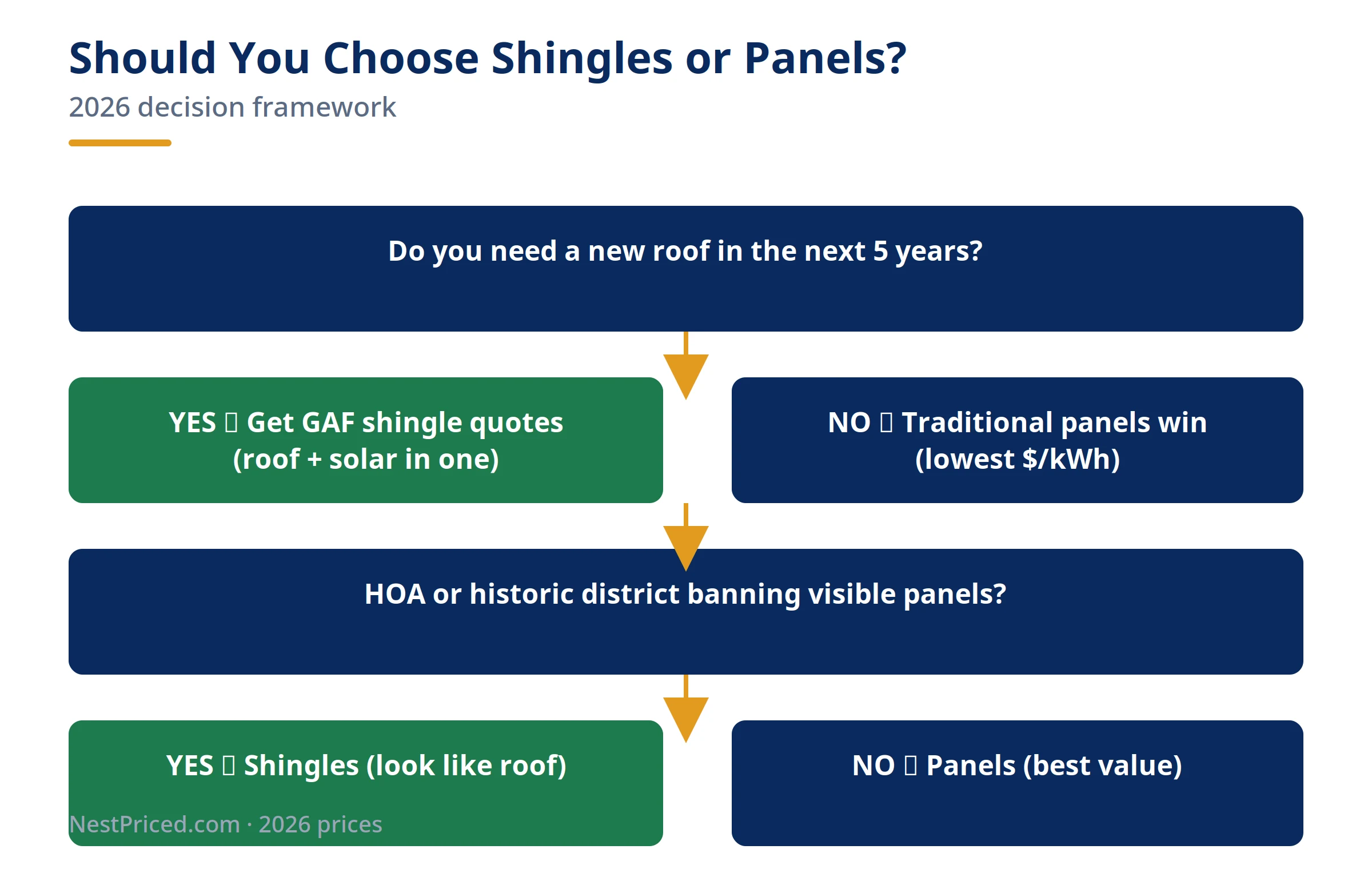
The 2026 Buyer’s Decision Framework
If you’ve read this far, here’s the whole article compressed into the order of operations:
- Check your roof’s age first. 15+ years left → panels, stop here. Due within 5 years → keep reading; the shingle math is now live.
- Check your rate. Pull your actual ¢/kWh from your utility bill (not the national average). Above ~25¢, shingles deserve a real look. Below ~15¢, panels almost certainly win.
- Check HOA/design constraints. If visible panels are genuinely blocked (not just frowned upon), shingles may be your only solar option — price them against no solar, not against panels.
- Get the roofing quote first. Before any solar math, know what a plain roof costs on your house. That number is the offset that makes or breaks the shingle case.
- Get 3 panel quotes (easy) and as many shingle quotes as exist (maybe 1–2). Itemized: $/W, system size, equipment models, electrical scope, warranty terms including electronics.
- Verify the product generation in writing. GAF ES 2 (not gen 1), CertainTeed Solstice (not Apollo II), and if anyone mentions Tesla, walk out.
- Budget incentives at $0 federal. Then check DSIRE for state/utility programs — they’re the only free money left, and they vary from 25% (SC) to nothing.
- Ask the year-14 question. “Who services this system in year 14, and at what rates?” Get it in writing. For shingles, this matters more than the warranty brochure.
How to Compare Quotes (What “Good” Looks Like in 2026)
A shingle quote and a panel quote are different documents — here’s how to read each, and the traps in both.
Every quote, either technology, must itemize: system size in kW (DC), cost per watt, equipment model numbers (panel/shingle model, inverter model), electrical scope (panel upgrade? disconnects? trenching?), permits and interconnection fees, warranty terms (product, power, workmanship — including electronics), and the production estimate in kWh/year with the assumptions behind it. A lump-sum number with none of this is not a quote; it’s a price tag on a mystery box.
Panel-quote traps: the production estimate inflated by 10–15% (ask for PVWatts or Aurora output with your address and your roof’s azimuth/tilt — then sanity-check it yourself); the “25-year warranty” that’s actually 10-year workmanship from an installer who’s been in business for 3 years (the manufacturer covers the panel; the installer covers the labor — weight accordingly); lease/PPA quotes presented as purchases (if there’s an escalator clause, it’s a lease — compare 25-year totals, not month one).
Shingle-quote traps: quoting Apollo II or gen-1 GAF (verify the generation in writing); the $/W that quietly excludes tear-off, then a “roofing supplement” appears later (demand all-in $/W); single-bidder markets with no competitive pressure (get the panel quote anyway — it’s your BATNA, and telling the shingle contractor you have it disciplines the price); the electronics add-on buried or omitted (price the 25-year electronics coverage explicitly — it’s $1,500–$3,000 of future cost hiding in the fine print).
The question that ends confusion: ask each contractor, “If I wanted to spend $5,000 less, what would you change? And what’s the one thing I shouldn’t cheap out on?” The answers reveal where the value lives — and which contractor understands your house versus their sales script.
5 Ways to Save in 2026 (Without the Federal Credit)
- Get 3 panel quotes even if you want shingles. The panel number is your negotiating anchor and your fallback. A shingle contractor who knows you’re comparing against a $22,400 panel system quotes differently than one who thinks shingles are your only option.
- Time the roof, not the sun. If the roof is due in 2–3 years, doing shingles now versus panels-now-plus-roof-later is worth modeling — but don’t accelerate a roof replacement just to chase a shingle quote. The cheapest roof is the one you don’t buy early.
- Mine DSIRE before signing. State and utility incentives are the only free money left, and they range from substantial (South Carolina’s 25% credit, various utility rebates) to zero. A $3,000 utility rebate changes the Scenario B math meaningfully. Check before you sign, not after.
- Price the lease alternative honestly. With §48E alive for commercial, lease/PPA providers can offer $0-down with rates below your utility’s — worth modeling if cash is tight. But compare the 25-year total cost against ownership; leases typically cost more over the full term, and they complicate home sales.
- Don’t pay for density you don’t need. On a big simple roof, SunTegra’s lower efficiency doesn’t matter — area is free. On a small roof, CertainTeed Solstice’s 16.1 W/sq ft earns its premium. Match the product to the roof, not the marketing.
Insurance, Permits, and HOA Paperwork (The Hidden Line Items)
Homeowner’s insurance: tell your insurer about either system — but expect different conversations. Traditional panels are a known quantity: most carriers cover them under dwelling coverage at no or minimal premium change, though you should confirm the replacement cost basis (a $25,000 system needs $25,000 of coverage, not a shrug). Solar shingles are murkier. The Tesla experience is instructive: Tesla Solar Roof owners reported 5–15% premium increases, driven by the eye-watering replacement cost — insurers price the risk of replacing a $100,000+ roof, not a $25,000 panel array. GAF and CertainTeed shingles, priced like premium roofs rather than exotic ones, should land closer to standard asphalt rates — but “should” isn’t a quote. Call your agent before you sign and get the premium impact in writing for your specific product. If one shingle brand triggers a surcharge and another doesn’t, that’s a real annual cost that belongs in the 10-year math.
Permitting: panels typically need an electrical permit and sometimes a structural review (can your roof take the extra 3–5 lbs/sq ft plus wind uplift?). Shingles need a roofing permit plus the electrical — in some jurisdictions that’s two permits, two inspections, two fees. Neither is a dealbreaker, but shingle timelines can stretch where the building department has never seen the product. Ask your contractor: “How many of these have you permitted in this city?” The first one in a jurisdiction is always the slowest.
HOA and design review: this is shingles’ home turf. Most HOAs that restrict visible panels accept a roof that looks like a roof — GAF’s entire value proposition in planned communities. Practical tips: get the HOA’s written solar policy before spending a dollar (verbal “should be fine” is worthless); submit the shingle spec sheet showing the asphalt-shingle appearance; and check your state’s solar-access law first — if your state bars HOAs from banning panels outright, you may not need the shingle premium at all. For historic districts, shingles (or nothing) are often the only option — price accordingly and don’t expect ROI; you’re buying compliance.
Interconnection: the utility doesn’t care what your roof looks like — panels and shingles interconnect identically (same inverters, same net-metering application, same timelines). Where it matters is system size: utilities cap residential systems (often at 110–120% of historical usage), and the shingle density disadvantage means you might hit the roof’s physical limit before the utility’s cap. Size the system to the roof first, then check the cap.
Sources & methodology
Cost figures compiled November 2026 from published 2026 cost guides and contractor-published pricing: SolarSavingsHub/EnergySage panel pricing ($2.50–$3.30/W, Oct 2026), TheGreenWatt state-by-state panel costs, IntelligentLiving solar roof tile comparison (GAF $21–$24/sq ft installed, Oct 2026), TheRoofingBrief ($/W brand comparison), OrganizerTone (GAF $30–$50k for 6–8 kW), Fixr (shingle averages, Luma $4.50/W), EngineerFix (Luma 80W/22.1%/$4–$8/W), PAC Minerals (Solstice 16.1 W/sq ft; CertainTeed $47,500–$67,500), DeyipsTech (brand $/W table), ClimateSort (SunTegra), MyWebAnswers (GAF vs Tesla 10 kW table; ~14% heat-penalty modeling — directional). Tesla discontinuation: Electrek/Reuters via installer network, Engadget (Nov 1, 2026), Wikipedia, Now.Solar (Oct 2026), SolarMelon; ~3,000 installs per Wood Mackenzie; real-quote pricing (~$62/sq ft, ~$106k typical) per SolarReviews via ThePricer. GAF restructuring: Solar Power World (Dec 2025 San Jose closure, 138 layoffs, HQ to Texas); select-market availability per regional roofer reporting (SilverLoon, Oct 2026). CertainTeed generation status: SunVault Roofing (Apollo II discontinued; Solstice current; Landmark PWR launched Nov 1, 2026). Tax status: IRS FS-2025-05, OBBBA P.L. 119-21 (§25D ended for property placed in service after Dec 31, 2025). HEAR/HEEHR scope and caps: RetrofitRelay 2026 guide; 13-jurisdiction launch status per electricalcontractorsandwiring.com (Oct 2026) — heat pumps/appliances/electrical only, not solar. Electricity rates: EIA STEO via Axis Intelligence (18.2¢/kWh US avg, Oct 2026); ChooseEnergy (18.16¢, Nov 2026); state spread via ElectricityCostComparison. Roof replacement: Roomgic ($8,500–$14,800 asphalt), PickARoofer ($11,250 avg), KnowledgeMentors ($14,182 avg). Panel specs: Helios Energy Global (19–22.3 W/sq ft), TheGreenWatt (20 W/sq ft LONGi). Note: several ranking articles still list Tesla Solar Roof as available, recommend Apollo II, or promise the 30% credit — all outdated as of November 2026; figures above reflect the corrected 2026 reality. All figures are 2026 US national planning ranges, not quotes.
Disclaimer: Prices are 2026 US national averages and vary by region, roof complexity, system size, and installer availability — shingle quotes especially vary by market. Always get 3 written, itemized local quotes (as many shingle quotes as your market offers). Tax information is general and not tax advice — confirm with a tax professional. Solar installation involves roofing and electrical work: use licensed contractors and pull permits. This article covers cost information only, not installation instructions.
How much do solar shingles cost per watt in 2026?
Solar shingles cost $4.00–$8.00 per watt installed in 2026. Market leader GAF Timberline Solar ES 2 runs $4.00–$7.00/W (most quotes cluster at $4.50–$5.50/W), or roughly $36,000–$56,000 for an 8 kW system. Traditional solar panels cost $2.50–$3.30/W installed — about $20,000–$26,000 for the same 8 kW.
Is the Tesla Solar Roof still available?
No. Tesla stopped accepting new Solar Roof orders on August 20, 2026. Only about 3,000 were ever installed, and real-world quotes averaged roughly $62 per square foot (about $16/W) — far above the $22 per square foot launch promise.
Is the 30% federal solar tax credit available in 2026?
No. The Residential Clean Energy Credit (Section 25D) ended for property placed in service after December 31, 2025. For 2026 homeowner-owned installs — panels and shingles alike — the federal credit is $0.
Do HEAR rebates apply to solar panels or solar shingles?
No. The Home Electrification rebates (renamed HEEHR in May 2026) cover heat pumps, heat pump water heaters, and electrical upgrades — not solar of any kind.
Which solar shingle brand is best in 2026?
GAF Timberline Solar ES 2 is the volume leader with the largest certified installer network. CertainTeed Solstice leads on power density (16.1 watts per square foot). Luma Solar is the premium pick (80 watts per shingle, 200+ mph wind rating), and SunTegra is the budget option at $4–$6/W. Note that CertainTeed Apollo II and the Tesla Solar Roof are both discontinued.
Are solar shingles cheaper than solar panels?
No — shingles cost roughly 1.5 to 2.5 times more per watt. But if your roof needs replacement anyway, the honest comparison is (panels + roof replacement) versus shingles, and there the gap narrows to roughly $5,000–$6,000.
Why do solar shingles produce less electricity than solar panels?
Heat. Rack-mounted panels have an air gap underneath that keeps cells cooler, while shingles are nailed directly to the roof deck and run hotter. One 2026 analysis models roughly 14% lower annual output per rated watt for shingles versus rack-mounted panels.
When do solar shingles make financial sense?
When most of these are true: your roof needs replacement anyway, an HOA or historic district blocks visible panels, your electricity is expensive (above roughly 25 cents per kWh), or it is new construction.
How long is the payback period for solar shingles versus solar panels in 2026?
At average U.S. electricity rates (18.2 cents per kWh) with no federal credit, panels pay back in about 11 years while shingles take 20+ years when the roof is still good. In high-rate states like California (about 32.6 cents per kWh), panels pay back in about 6 years and shingles in 11–13 years.
Is it hard to find a solar shingle installer in 2026?
Yes. Shingles are sold through certified-only networks — GAF requires GAF-certified contractors with only select-market coverage after its December 2025 restructuring, and the Luma, SunTegra, and CertainTeed networks are even thinner. In many markets you may get only one shingle bid or none, compared with thousands of panel installers.