


Delaware is the smallest state in the country, and its solar market fits inside three counties, three electric utilities, and one state grant office. That smallness is the whole story of buying panels here. There is no maze of county programs to sort through, no sales tax to add to the equipment, and no state income tax credit to claim. What there is, instead, is a single grant worth real money, a single net-metering rule that covers every utility, and a single decision that changes the economics more than the panel brand: which name sits at the top of the electric bill.
The bill name matters because Delaware pays its solar buyers through the utility, not through the tax code. A Delmarva Power customer can claim $0.80 for every watt, up to $10,000. A Delaware Electric Cooperative member claims $0.70 a watt, up to $5,000. A Newark homeowner claims a town grant with its own rates. A Dover homeowner, as of October 2026, claims nothing at all. Two neighbors with identical roofs and identical panels can end up $1,400 apart on an 8 kW system before either one has signed a contract, purely because their wires belong to different companies.
The second decision that matters is the size of the system, and here Delaware law draws a hard line that surprises buyers who come from states with looser rules. A home system may be designed to produce no more than 110 percent of what the home is expected to use, measured against the average of the last two years of bills. Oversizing is not a strategy here. It is a violation of the rule, and the utility will not approve it. The right size is the size that matches the home’s real use, and the payback math in this guide is built on that constraint.
The third thing a Delaware buyer needs to know is that the net-metering rule changed while the ink on most guides was still wet. A law approved in July 2025 says unused bill credits now carry into the next year instead of vanishing at the end of the annual billing period, and utilities have until December 1, 2026 to rebuild their billing to match. Delmarva Power’s own tariff still showed the old forfeiture rule when it was read on October 16, 2026. A buyer who signs in late 2026 is buying into a rule in transition, and the quote should say which version of the rule its savings math assumes.
Delaware also gives solar buyers one advantage that no installer can sell and no other Mid-Atlantic state matches in the same form: the state charges no sales tax on anything, so a $22,000 system costs $22,000, not $22,000 plus tax. Against that sits the loss of the federal credit, which ended for homeowner-owned installs after December 31, 2025, and a short heating season that keeps winter electricity use low. The panels earn their keep in the long, humid summer, when the air conditioning runs and the sun is high, and the payback clock runs on summer kilowatt-hours more than winter ones.
To set these Delaware numbers against the country as a whole, read the national solar panel cost guide. What follows prices Delaware on its own terms: the cross-checked cost band, four cities, the grant rules by utility, the carry-over change, and the coastal weather that decides which hardware survives, with a source and a date on every figure.
Table of Contents
How Much Do Solar Panels Cost in Delaware in 2026?
Four independent 2026 models price Delaware, and they agree inside a 31-cent spread. The band this guide leads with is $2.63–$2.94 per watt installed, before any incentive. At that band, an 8 kW system costs $21,040–$23,520. For payback, this guide uses about $22,280, the middle of the band. Treat the band as a planning range to hold quotes against, not a price any installer has promised, and hold every quote to the same test: the panel model, the inverter type, the year-one production estimate for the actual roof, and the grant status, all in writing.
EnergySage gives the low end. Its Delaware page draws on marketplace quote data, was updated November 6, 2026, and puts the state average at $2.63 per watt with installation included. The average Delaware system quoted through its marketplace is large, 13.02 kW at $34,298, with prices ranging from $29,153 to $39,443, which works out to about $2.24 to $3.03 per watt across that range. Its payback figure for the state is 13.09 years, and its 25-year savings figure is $40,665. EnergySage also puts the national average at $2.60 per watt on its Delaware page, which makes Delaware slightly more expensive than the country as a whole on its measure, a point the other models dispute, as the neighbor comparison below shows.
EcoGen gives the center. In its Solar Cost Index, September 2026 edition, with prices dated September 25, 2026, EcoGen prices Delaware at $2.83 per watt in cash before incentives. That ranks 20th lowest of 51 jurisdictions, against $2.89 for the country. Its typical Delaware system is 10.60 kW, calibrated to the median size Delaware homeowners installed in 2023 on Berkeley Lab data covering 153 systems, at $29,998. A written quote at $2.83 a watt sits in the middle of the Delaware market. It is neither a bargain nor a rip-off. The 153-system calibration is a small sample, and this guide notes it rather than hiding it.
SolarReviews gives the high end. SolarReviews builds its November 2026 cost model from National Renewable Energy Laboratory, Energy Information Administration, and Bureau of Labor Statistics data. It prices Delaware at $2.94 per watt, with a 7.7 kW system at $24,065 before incentives, against $3.03 for the country. The column headed “after tax credit” is out of date. It still knocks off a 30 percent federal credit that no longer exists for a 2026 homeowner install, so leave that column out of the comparison. That stale tax column is a labeling problem, not a math problem: the cost model underneath it is sound. Any quote that still shows a 30 percent federal credit on a 2026 homeowner install is quoting a dead law.
Renewestimator lands inside the band from thinner evidence. Its Delaware page puts the average at $2.97 per watt overall, with the 8 kW figure at $2.91 per watt, or $23,280, and a payback of 10.6 to 10.8 years. Its cost data rests on a three-ZIP sample, so it counts as corroboration only, not as a band-setter. The same site’s 4.5 peak sun hours and 19.4-cent rate line up with the other sources’ inputs, which is why its payback lands where it does.
NumeralQ brackets the band from both sides. Its Delaware planning range runs $2.58–$3.37 per watt, or $20,630–$26,960 for an 8 kW system, built from EnergySage data retrieved October 26, 2026. The low end sits just below the headline band and the high end well above it, which is what a planning range is supposed to do: hold the plausible spread. Nothing in the NumeralQ range contradicts the headline band, and its width is a reminder that roof complexity, equipment tier, and installer margin move the real price more than the state average does.
One 2026 figure lands above the band, and this guide calls it out as an outlier rather than folding it in. A ZIP-code cost site puts Dover at $3.26 per watt, with no method stated. That is above every other 2026 model for Delaware, and a quote at $3.26 a watt for an ordinary roof should have to explain itself: premium equipment, a steep or complex roof, a long wire run, or a battery bundled into the price, stated in writing. The Dover section below carries the same warning.
On EcoGen’s index, the states around Delaware price within a few cents of it. Virginia sits at $2.79, Maryland at $2.80, Delaware at $2.83, Pennsylvania at $2.87, and New Jersey at $2.92 per watt. Delaware is the third cheapest of its five-state neighborhood to install in, and the spread across all five is 13 cents, which means the state line is not where the price is decided. The roof, the equipment, and the installer decide it. Maryland’s numbers live in our Maryland solar panel cost guide, and Virginia’s in our Virginia solar panel cost guide.
What you pay for is a working system, not a pile of parts. The price covers the panels, the inverter hardware, either one string inverter or a microinverter on each panel, the racking and flashing, the wiring with disconnects, permit and inspection fees, the labor, and the visit that switches the system on. Delaware holds one saving the other Mid-Atlantic states do not have: the state charges no general sales tax, so the equipment and the labor carry no tax on top. The surprises for Delaware buyers sit outside the headline price. The work around the system is billed on its own, line by line.
- Roof repairs or a roof replacement before the panels go on, priced on their own
- An electrical panel upgrade, if the existing service cannot take the solar backfeed
- A battery, priced separately and covered in its own section below
- Tree removal or trimming where oaks or pines shade the roof
- Corrosion-resistant racking and hardware on a coastal roof, where the installer specifies it
- The interconnection application fee, which runs $0 for a small Delmarva system and up to $200 for a municipal one, and which the quote should state rather than absorb silently
Ask three installers for written quotes on an identical scope of work. Drop any bidder who will not name the panel model, the inverter type, the year-one production estimate for the actual roof direction, and the grant the savings math assumes, because a Delaware savings estimate that prices the old 30 percent federal credit, or the grant on a leased system, is pricing money that does not exist.
| Source | Price per watt | 8 kW total | Basis |
|---|---|---|---|
| EnergySage (Nov 2026) | $2.63 average | $21,040 (scaled) | Marketplace quote data |
| EcoGen Index (Sept 2026) | $2.83 | $22,640 (scaled) | Cost index, cash, before incentives |
| SolarReviews (Nov 2026) | $2.94 | $23,520 (scaled) | NREL/EIA/BLS cost model |
| Renewestimator (2026) | $2.91 at 8 kW | $23,280 | Three-ZIP sample, weak basis |
| NumeralQ (Oct 2026) | $2.58–$3.37 | $20,630–$26,960 | Planning range, EnergySage data |
Treat the table’s 8 kW column as scaled arithmetic. The three totals in that column were worked out by hand from each source’s per-watt average times 8,000 watts, because no source publishes an 8 kW total, and the table flags each one as a scaled figure. The headline band runs from the EnergySage average at the low end to the SolarReviews average at the high end, $2.63–$2.94 per watt, with EcoGen sitting in the middle. Three different methods landing inside a 31-cent spread is the point that matters. Delaware installs cost about $2.80 a watt at the center, and the band around that center is wide enough for most real quotes.
Solar Panel Cost in Delaware by System Size
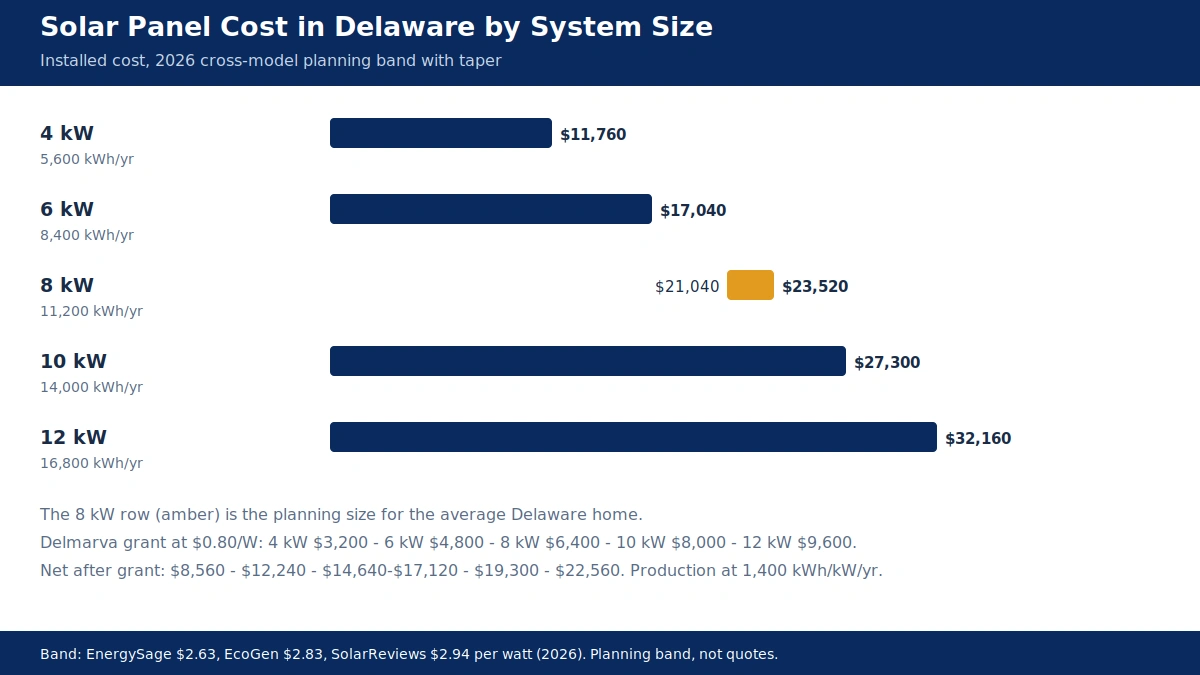
Delaware’s size table has a shape that surprises first-time buyers: the price per watt falls as the system grows, but the grant and the 110 percent sizing rule cap the growth on both ends. The fixed costs of a job, the permit, the interconnection review, the crew’s travel, the inverter, spread across more watts on a bigger system, while the variable costs, panels and labor per watt, stay roughly flat. A 4 kW system therefore costs more per watt than a 12 kW system, and the table below prices that taper openly instead of pretending one rate fits every roof.
The table is NestPriced arithmetic, and it says so on its face. It applies the headline band with a small-size taper: 4 kW at the top of the band, 6 kW just below it, 8 kW across the full band, 10 kW and 12 kW below the midpoint. Production uses the planning figure of 1,400 kilowatt-hours per kilowatt per year from the sun section. The grant column uses the Delmarva Power rate of $0.80 per watt, because Delmarva serves about two-thirds of Delaware homes, and the co-op and town grants are lower, as the incentives section explains. A co-op member should subtract the co-op grant, $0.70 a watt up to $5,000, from the same gross costs instead.
A 4 kW system costs $11,760 at $2.94 a watt and makes about 5,600 kilowatt-hours a year. That is roughly half the average Delaware home’s yearly use, and it is the right size for a small home, a shaded roof, or a buyer who wants to cut the bill without covering it. The Delmarva grant pays $3,200 on this size, bringing the net cost to $8,560. A 6 kW system costs $17,040 at $2.84 a watt and makes about 8,400 kilowatt-hours a year, about three-quarters of the average home’s use, with a $4,800 grant and a $12,240 net cost.
The 8 kW system is the planning size of this guide, and it is the size that matches the average Delaware home. At $21,040–$23,520 it makes about 11,200 kilowatt-hours a year, just above the 10,932 kilowatt-hours the average home used in 2024 and just above the 11,040 kilowatt-hours it used in 2025, on Energy Information Administration figures. The Delmarva grant pays $6,400 on this size, bringing the net cost to $14,640–$17,120. A buyer whose two-year average use is well below 11,200 kilowatt-hours cannot legally build this size anyway, because the 110 percent rule caps the system at 110 percent of expected use, and the net-metering section explains how that cap is measured.
A 10 kW system costs $27,300 at $2.73 a watt and makes about 14,000 kilowatt-hours a year, with an $8,000 grant and a $19,300 net cost. A 12 kW system costs $32,160 at $2.68 a watt and makes about 16,800 kilowatt-hours a year, with a $9,600 grant and a $22,560 net cost. The grant reaches its $10,000 cap at 12.5 kW, so a system larger than that earns no more grant money. EnergySage’s average Delaware system, 13.02 kW at $34,298, sits just past that cap, which means the average system in its marketplace data is larger than the average home needs and earns no extra grant for the extra watts.
The size decision is a use decision before it is a price decision. Pull two years of bills, average the yearly use, and multiply by 1.1. That number, divided by 1,400, is the largest system the utility will approve in kilowatts. A home that used 9,000 kilowatt-hours a year can build about 7 kW. A home that used 13,000 can build about 10 kW. A buyer who sizes from the roof instead of the bills will either be turned back by the utility or left with a system whose extra power earns nothing, because the credit bank only pays for power the home can use.
| System size | Installed cost | Production per year | Delmarva grant | Net after grant |
|---|---|---|---|---|
| 4 kW | $11,760 | 5,600 kWh | $3,200 | $8,560 |
| 6 kW | $17,040 | 8,400 kWh | $4,800 | $12,240 |
| 8 kW | $21,040–$23,520 | 11,200 kWh | $6,400 | $14,640–$17,120 |
| 10 kW | $27,300 | 14,000 kWh | $8,000 | $19,300 |
| 12 kW | $32,160 | 16,800 kWh | $9,600 | $22,560 |
A rough scaling rule follows from the table, and it is labeled here as a rule of thumb, not a quote. Each added 2 kW of capacity adds roughly $4,800–$5,500 at the tapered rates, and about 2,800 kilowatt-hours a year of production. That rule holds for simple roofs at ordinary pitches. It breaks on steep, shaded, or coastal roofs, where the racking, the corrosion hardware, and the shading losses dominate, and it breaks on systems with batteries, where the storage price must be added on its own line.
Solar Panel Cost by City: Wilmington, Dover, Newark, and Rehoboth Beach
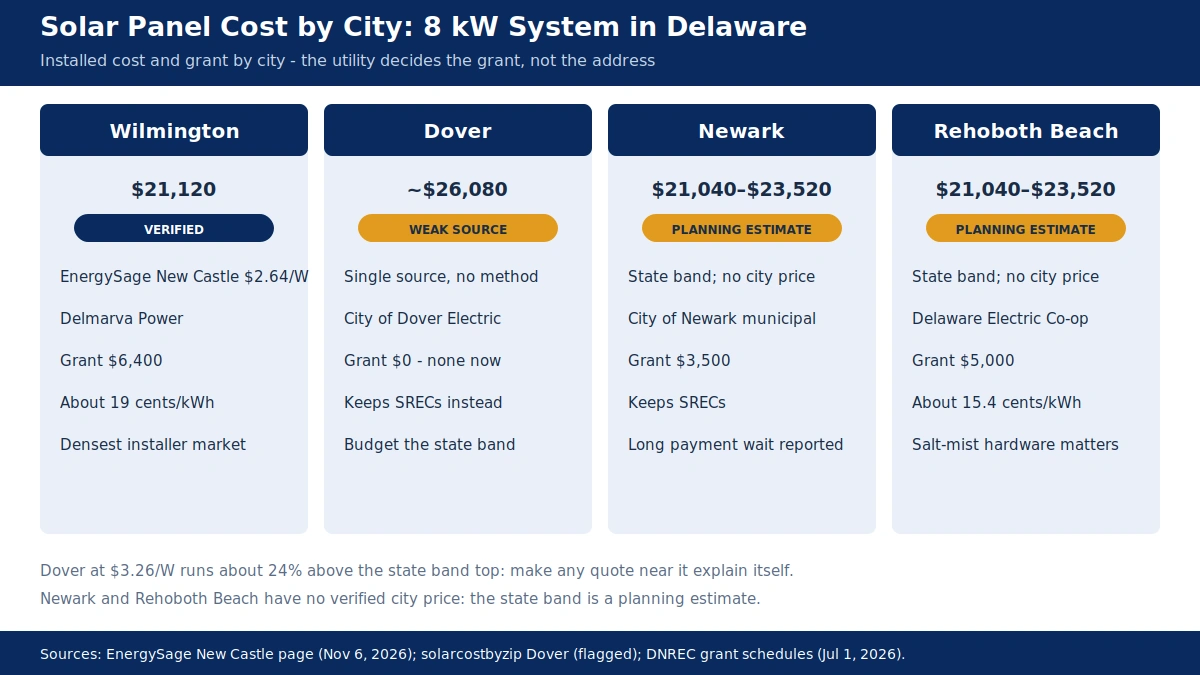
Delaware has three counties and four cities that most buyers search for, and the honest city section is shorter than the search results suggest. Only one city figure in this research comes from a named 2026 source with a stated method, and that figure belongs to New Castle County, not to a single city. The rest of the city prices floating around the internet are single-source estimates with no method, and this guide labels them as such rather than dressing them up as city bands. Printing four identical-looking city bands would mean inventing three of them, so this guide does not do it.
Wilmington carries the strongest city evidence in the state, and it arrives through the county. EnergySage’s New Castle page, updated November 6, 2026, puts the county average at $2.64 per watt, on an average system of 14.7 kW at $38,849, with a payback of 14.33 years and 25-year savings of $37,231. An 8 kW system at the county rate costs $21,120, essentially the bottom of the state band, which fits a dense northern market with many installers competing for the same roofs. Wilmington is Delmarva Power territory, so the $0.80 per watt grant applies, worth $6,400 on an 8 kW system, and the city’s older housing stock means the roof condition check matters more here than the price per watt: a Wilmington row home with a flat or low-slope roof, or a roof near the end of its life, will pay more for the work around the panels than for the panels themselves. A weaker Wilmington figure of $2.95 per watt circulates from a single installer-style page, but that page still promises the expired 30 percent federal credit, so its price is reported here only as a flagged cross-check and is not used.
Dover carries the weakest city figure in the state, and the gap between it and the state band is the warning. A ZIP-code cost site puts Dover at $3.26 per watt, or about $26,080 for an 8 kW system, with no method stated. That is roughly 24 percent above the top of the state band, and no other 2026 model for Delaware runs that high. Dover is also the city where the grant picture changes completely: the City of Dover runs its own municipal electric utility, and as of October 2026 it offers no solar incentive of its own, so a Dover buyer pays the full gross cost and keeps the SRECs instead. The honest statement is that a Dover buyer should budget the state band, $21,040–$23,520 for 8 kW, treat any quote near $26,000 as a price that must explain itself line by line, and confirm the municipal utility’s net-metering terms in writing before signing, because the statewide rule and the town’s version of it are not the same document.
Newark is the small city with the most interesting grant in Delaware. The City of Newark runs its own municipal utility, and its Green Energy Program grant pays $1.00 per watt for the first 5 kW and $0.50 per watt above that, up to $3,500. On an 8 kW system that works out to $5,000 for the first 5 kW plus $1,500 for the remaining 3 kW, capped at $3,500, so the Newark buyer collects $3,500 where a Delmarva buyer collects $6,400. The trade is that Newark recipients keep their SRECs, while Delmarva grant recipients sign theirs over to the state, so the Newark buyer keeps a small yearly income the Delmarva buyer gives up. Newark’s 8 kW cost is the state band as a planning estimate, $21,040–$23,520, because no verified Newark price per watt was found, and the net cost after the town grant runs $17,540–$20,020. The wait for payment can be long, on the program’s own warning, so the buyer should not count the grant as cash on the day the system goes live.
Rehoboth Beach is the beach city where the utility, not the price, is the story. The town sits in Delaware Electric Cooperative territory, so the co-op’s $0.70 per watt grant applies, up to $5,000, worth $5,000 on an 8 kW system at the $0.70 rate, and the co-op’s lower electricity rate, about 15.4 cents against Delmarva’s roughly 19 cents, stretches the payback by years, as the payback section shows. No verified Rehoboth Beach price per watt was found, so the 8 kW cost is the state band as a planning estimate, $21,040–$23,520, with a net cost after the co-op grant of $16,040–$18,520. The coastal hardware matters more in Rehoboth than the price per watt: salt mist, humidity, and storm wind decide which racking and which panel certification the quote must carry, and the weather section prices that choice.
Smaller Delaware communities have no verified bands at all in this research, and the honest guidance is to start from the state band and adjust by utility and by distance from the coast. Middletown, Smyrna, Milford, Seaford, and Lewes all sit in municipal or co-op territory, so their grant is the town or co-op grant, not the Delmarva grant, and their payback follows the co-op’s lower rate. A beach-town quote that runs above the state band is plausible on corrosion hardware and crew travel alone, and the buyer should ask the installer to name which of the two drives the premium rather than accepting a single lump sum.
| City | 8 kW installed cost | Utility | Grant on 8 kW |
|---|---|---|---|
| Wilmington | $21,120 | Delmarva Power | $6,400 |
| Dover | ~$26,080 (weak single source, flagged) | City of Dover Electric (DEMEC) | $0 (no incentive now) |
| Newark | $21,040–$23,520 (state band) | City of Newark (municipal) | $3,500 |
| Rehoboth Beach | $21,040–$23,520 (state band) | Delaware Electric Cooperative | $5,000 |
Delaware Sun, Humidity, and Salt Air: What Panels Actually Produce Here
Delaware is not a desert solar state, and it does not need to be. The state sits at about 39 degrees north latitude, on the Atlantic coastal plain, with long summer days, a humid subtropical climate, and about 4.4 to 4.5 peak sun hours a day. A peak sun hour is an hour of sunshine at full strength, the unit every production estimate is built from, and Delaware’s figure puts it in the middle of the country: less sun than Arizona, more than Maine, and enough that an 8 kW system covers the average home’s yearly use. The planning figure this guide uses is 1,400 kilowatt-hours per kilowatt per year, which is the EcoGen figure of 1,401 rounded, and it sits inside the published range.
The published production range is narrow, and the agreement across models is the reason to trust the planning figure. EcoGen’s Solar Cost Index uses about 1,401 kilowatt-hours per kilowatt per year, giving 14,851 kilowatt-hours a year for its typical 10.60 kW system. Solar Learning Lab modeled Delaware cities with PVGIS version 5.2 in August 2026 and found a range of 1,360.5 to 1,433.8 kilowatt-hours per kilowatt per year across the state’s cities. A national comparison site puts Delaware at 1,330, and a modeled-cost page using 4.4 sun hours lands at about 1,285. The low models assume heavier system losses than the planning figure does, and the high models assume a clean south-facing roof at an ideal tilt. A buyer whose roof faces south at 30 degrees, with no shade, should expect the planning figure or better. A buyer whose roof faces east and west, or sits under oaks, should expect less, and the quote’s year-one production estimate, not this guide’s planning figure, is the number that prices the job.
Wilmington’s sunshine record explains why Delaware production is steady rather than spectacular. The city sees about 55 percent of possible sunshine, one of the lower shares among leading American cities, because the coastal plain breeds cloud cover in every season. The cloud does not kill production: panels still make power on cloudy days, at a reduced rate, and Delaware’s long summer days compensate for the winter gloom. What the cloud does is flatten the difference between a perfect roof and an average one. A south-facing roof in Wilmington and a south-facing roof in Dover make nearly the same power, because the sky, not the address, is the limiting factor.
Humidity is Delaware’s quiet production tax, and it works through the hardware rather than the sky. The state averages about 45.9 inches of precipitation a year, Wilmington takes about 43 to 46 inches depending on the normal period used, and the summers are muggy, with dew points that keep every surface damp through the night. Damp air attacks electrical connections that are not sealed, and it speeds corrosion on any metal that is not protected. The defense is specification, not maintenance: junction boxes and connectors rated for the exposure, sealed conduit, and racking hardware chosen for a humid climate. A quote that names the connector and junction-box ratings is a quote from an installer who has worked in Delaware humidity. A quote that names none of them is a quote to question.
Salt air is the sharper version of the same problem, and it applies to a smaller part of the state. Within about 5 miles of the coast, salt mist in the air settles on panel frames, racking, and wiring, and accelerates corrosion on any metal it touches. The industry standard for this exposure is IEC 61701, the salt-mist corrosion test, and a panel that carries that certification has been tested against salt spray in a way a panel without it has not. The racking matters as much as the panel: stainless steel hardware and anodized aluminum are the coastal norm, and mixing incompatible metals invites galvanic corrosion, the slow eating away that happens when two different metals sit together in salt air. Salt film on the glass also cuts output until it is washed off, so a coastal system needs cleaning more often than an inland one. No Delaware-specific salt-soiling loss percentage was verified in this research, and none is asserted here, but the direction is not in doubt: a Rehoboth Beach system that is never washed makes less power in year five than the same system washed twice a year.
The short heating season shapes when the power is worth the most. Delaware winters are mild, most homes heat with gas or oil rather than electricity, and winter electric use runs low. The air-conditioning season is long, and it lines up with the sun: the panels make their most power in the same months the air conditioner draws its most. That alignment is why Delaware payback works at all despite a middling sun resource. The panels are not fighting the winter dark the way a Maine or Montana system does. They are working the summer peak, when every kilowatt-hour they make is a kilowatt-hour the home does not buy at the full retail rate.
Roof direction and shade decide the last 20 percent of production, and they decide it more than the state average does. A south-facing roof at about 30 degrees of tilt is the reference case every model assumes. An east-west split roof makes less in total but spreads production across the morning and evening, which can match a home that uses power early and late. A north-facing roof makes so much less that most installers will not quote it. Shade is the bigger thief: a single chimney shadow across a string of panels can cut that string’s output far out of proportion to the shaded area, unless the system uses microinverters or power optimizers that let each panel work on its own. The Green Energy Program requires a shade analysis before the grant is approved, which is the state’s way of making sure the grant does not pay for panels that spend the day in shadow.
| Production input | Figure | Source |
|---|---|---|
| Planning production | 1,400 kWh/kW/yr | NestPriced planning figure (EcoGen 1,401) |
| Modeled city range | 1,360.5–1,433.8 kWh/kW/yr | Solar Learning Lab, PVGIS v5.2, Aug 2026 |
| Peak sun hours | 4.4–4.5 per day | sunmetriclab / Renewestimator |
| Wilmington sunshine | About 55% of possible | City climate record |
| Average home use | 10,932 kWh/yr (2024); 11,040 kWh/yr (2025) | EIA |
| 8 kW production | About 11,200 kWh/yr | Planning figure arithmetic |
Net Metering in Delaware: Full Retail Credits and the Carry-Over Change
Delaware’s net-metering rule is short enough to state in one paragraph and important enough to deserve a whole section. The law, section 1014 of Title 26 of the Delaware Code, implemented by section 3012 of the Delaware Administrative Code, requires every electric supplier in the state to offer net metering. A home system up to 25 kW earns a kilowatt-hour credit for every kilowatt-hour it sends out, at full retail value, carried forward month to month on the bill. That is the whole deal, and it is a good one: every extra unit of sunshine cancels a unit bought later, at the same price, for as long as the credit lasts.
The size limit is not the 25 kW cap for most homes. It is the 110 percent rule, and it bites first. A qualifying system must be designed to produce no more than 110 percent of the host customer’s expected aggregate electricity consumption. For an existing home, expected consumption is the average of the previous two 12-month periods of actual use. For new construction, it is the use of comparable units. A home that averaged 10,000 kilowatt-hours a year over the last two years can build a system sized for 11,000 kilowatt-hours a year, which is about 7.9 kW at the planning figure. A home that averaged 12,000 can build about 9.4 kW. The utility checks the math against the bills, and a system that overshoots the cap does not get approved. Buyers who size from the roof instead of the bills learn this at the application stage, when the fix is expensive.
The credit itself is worth the full retail rate, but the law is precise about which parts of the rate count. From January 1, 2024, under Senate Bill 298, the monthly excess kilowatt-hour credit is valued at the sum of the volumetric components of the supply service charges and the distribution service charges, not including the charges for societal-benefits programs. In plain words, the credit covers the energy and the delivery, but not the small rider that funds public-benefits programs. The fixed monthly customer charge, about $14 a month on Delmarva Power, is not offset by credits at all: it is charged before the first kilowatt-hour, and solar cannot touch it. A buyer who expects a $0 bill is expecting something the rule does not promise. The lowest possible Delmarva bill for a solar home is the fixed charge plus taxes and riders, and the quote should say so.
The end of the year is where the rule changed, and the change is the most important Delaware solar news of 2025. Under the old rule, any credits left at the end of the annualized billing period went back to the utility unpaid: the home gave away its summer surplus for nothing. A law approved July 16, 2025 ended that forfeiture. Unused credits now carry into the next year by law, and utilities have until December 1, 2026 to update their billing systems to match. The catch is the transition. Delmarva Power’s own tariff still said leftover credits go back to Delmarva when EcoGen read it on October 16, 2026, and the Lewes Board of Public Works page repeats the same December 1, 2026 deadline. A buyer who signs in November 2026 is buying into a rule whose billing has not fully caught up, and the savings math in the quote must say which version it assumes. Ask the installer, in writing, whether the payback assumes carry-over or forfeiture, and get the utility’s current answer in writing too.
A second change is pending, and its status is genuinely disputed. The state’s aggregate net-metering cap sits at 8 percent, raised from 5 percent in 2022, which is the total share of a utility’s load that net-metered systems may cover. Senate Bill 239 would remove that cap entirely and would also restrict utilities from charging standby fees to residential net-metering customers. One 2026 guide reports the bill as released to the Senate floor and pending. A municipal utility page states that it removes the 8 percent limit as a fact. This guide does not resolve the disagreement, because the two sources cannot both be current, and it treats the bill as pending. The practical meaning for a 2026 buyer is limited either way: Delaware is nowhere near the 8 percent cap today, so the cap does not block a home install, and the bill matters as a watch item, not as a decision input.
Farms have their own corner of the rule. A farm customer may net meter up to 150 kW, raised from 100 kW by Senate Bill 111 in 2023, and a farm that wants a larger system can ask DNREC for a waiver under proposed Regulation 2106, which was open for public comment through October 8, 2026. The waiver requires showing that the farm’s historic consumption, averaged over the previous two 12-month periods, supports the larger system, and the 110 percent cap still applies. The waiver process is a farm matter, not a home matter, and it is noted here only so a buyer with acreage does not mistake the farm cap for the home cap.
The interconnection side of the rule is delegated, not set by the state. Section 3012 sets no application fees, no review levels, and no timelines, and directs each supplier to build its interconnection rules on the Interstate Renewable Energy Council model rules. Delmarva Power’s published schedule runs four levels: Level 1, inverter-based systems of 10 kW or less, with no application fee; Level 2, up to 2 MW, at $50 plus $1 per kilowatt; Level 3 and Level 4 at $100 plus $2 per kilowatt. The Delmarva checklist that publishes those fees is dated August 7, 2015, and its age is disclosed here rather than hidden. A residential customer may not be charged more than $200 toward the cost of a new, replacement, or modified meter. The co-op’s published fee, $125 plus $1 per kilowatt over 100 kW, applies to systems of 100 kW or larger, and no verified residential co-op application fee was found. Lewes charges a $200 interconnection application fee on top of its city business license and building permit. The process runs in two parts everywhere: application and fee first, install and inspection second, and Permission to Operate last. The system stays off until that permission arrives.
Delmarva Power, the Co-op, and the Town Utilities: Who Sets Your Rules
Delaware has three kinds of electric utility, and the kind that serves an address decides the grant, the rate, and the paperwork. The state is small enough that the split can be stated in one table, and the buyer should find their row in it before reading another word of this guide, because every number that follows depends on it.
Delmarva Power is the giant. It is an Exelon company, the state’s only investor-owned electric utility, and it serves about 64 to 66 percent of Delaware homes, roughly 301,950 customers, across New Castle County and parts of Kent and Sussex. Its residential rate is the highest in the state: the Energy Information Administration’s 12-month average for Delmarva runs about 18.98 cents per kilowatt-hour, against a statewide average of 17.98 cents, and its standard-offer supply price rose on June 1, 2026 to 11.11 cents in summer and 11.40 cents in winter, before delivery charges. Delmarva is also the utility with the best solar terms in the state: the highest grant, $0.80 a watt up to $10,000, and the highest retail value for every kilowatt-hour the panels make. A Delmarva home is where solar pays fastest in Delaware, and the payback section puts the number at about 8 years after the grant.
The Delaware Electric Cooperative is the second utility, and it serves the rural south. It covers about 22 to 23 percent of Delaware homes, roughly 104,839 customers, mostly in Kent and Sussex counties, including the beach communities around Rehoboth Beach, Bethany Beach, and Lewes. Its residential rate runs about 15.4 cents per kilowatt-hour, roughly 3.5 cents below Delmarva’s, which is the whole reason co-op solar pays slower: every kilowatt-hour the panels make is worth less. The co-op’s grant is also smaller, $0.70 a watt up to $5,000, and its payback runs about 13 years after the grant against Delmarva’s 8. A co-op member who budgets from Delmarva numbers will be disappointed, and a co-op member who budgets from co-op numbers will not be.
The nine town utilities are the third kind, and they are the most varied. Clayton, Dover, Lewes, Middletown, Milford, New Castle, Newark, Seaford, and Smyrna run their own electric utilities as members of the Delaware Municipal Electric Corporation, and together they serve about 13 percent of Delaware homes, roughly 62,983 customers. Each town sets its own grant and its own interconnection terms inside the statewide net-metering framework. Newark pays $1.00 a watt for the first 5 kW and $0.50 above, up to $3,500, and lets the homeowner keep the SRECs. Dover, as of October 2026, pays nothing. Lewes charges a $200 interconnection application fee and requires a city business license and a building permit on top of the utility application. The town utilities are not modeled in this guide’s payback math, because their rates and grants vary town by town, and a town customer must get the terms in writing from the town itself.
Delaware’s electricity market has one more wrinkle that confuses new buyers. The state deregulated in 1999 under the Electric Utility Restructuring Act, which separated generation from delivery, so a Delmarva Power customer can choose a competitive supplier for the energy while Delmarva keeps delivering it. The default supply, called Standard Offer Service, is what a customer gets if they choose nothing. A solar buyer’s net-metering credits are valued against the supply and delivery charges on the bill, so a customer who switched suppliers should check whether the switch changed the credit value, and should tell the installer which supplier’s rate the savings math assumes. The co-op and the town utilities are not part of the choice market in the same way, and their customers buy from the utility itself.
The Green Energy Program, the fund that pays the grants, is fed by a tiny charge on Delmarva bills: $0.000356 per kilowatt-hour. That charge is why the grant is described as funded, not guaranteed. The program runs on annual appropriations, and its capacity can be exhausted mid-year. The practical advice is the same in every Delaware guide that has checked the fund: apply early in the calendar year, get the approval before the panels go up, and ask the installer about current wait times, because completed grants may be queued for payment until funds are available.
| Utility | Share of homes | Residential rate | Solar grant |
|---|---|---|---|
| Delmarva Power | About 64–66% | About 18.98 cents/kWh (12-mo avg) | $0.80/W, up to $10,000 |
| Delaware Electric Cooperative | About 22–23% | About 15.4 cents/kWh | $0.70/W, up to $5,000 |
| Nine town utilities (DEMEC) | About 13% | Varies by town | Varies by town; Newark $1.00/$0.50/W up to $3,500; Dover $0 |
How Long Until Solar Panels Pay for Themselves in Delaware?
Simple payback is the honest way to price a Delaware system, and it is simple on purpose: the net cost divided by one year of bill savings. No discount rate, no assumed rate increase, no 25-year compounding. The buyer can check every input on their own bill, and the section shows the arithmetic in full so the check is possible. Every figure below is NestPriced arithmetic unless it is labeled as a source’s own figure, and the assumptions are stated before the answer, not after it.
The assumptions are these. The system is 8 kW at the midpoint cost of $22,280. It makes 11,200 kilowatt-hours a year at the planning figure of 1,400 per kilowatt. The home uses all of it, which is the right assumption for a system sized to the 110 percent rule: the panels are sized to the home’s use, so nearly every unit they make replaces a unit the home would have bought. The value of a unit is not the headline state rate of 17.98 cents. It is the per-utility effective value from EcoGen’s payback file of October 30, 2026, which subtracts the fixed monthly charge the credits cannot touch: 17.353 cents at Delmarva Power, and 11.61 cents at the co-op. The grant is the Delmarva $6,400 or the co-op $5,600. The federal credit is $0.
At Delmarva Power, one year of production is worth 11,200 times $0.17353, which is $1,944. The gross payback, before the grant, is $22,280 divided by $1,944, which is 11.5 years. The range across the headline band runs 10.8 years at the low cost of $21,040 to 12.1 years at the high cost of $23,520. The net payback, after the $6,400 grant, is $15,880 divided by $1,944, which is 8.2 years, with a range of 7.5 to 8.8 years across the band. That is the headline answer for two-thirds of Delaware homes: about 8 years with the grant in hand, about 11.5 years without it.
At the co-op, the same system is worth 11,200 times $0.1161, which is $1,300 a year. The gross payback is $22,280 divided by $1,300, which is 17.1 years. The net payback, after the $5,600 co-op grant, is $16,680 divided by $1,300, which is 12.8 years. The co-op buyer waits about four and a half years longer than the Delmarva buyer for the same panels, because the co-op’s power is cheaper and its grant is smaller. That gap is the single largest fact in Delaware solar economics, and it is set by the utility, not by the installer.
The cross-checks land around the same numbers from different methods. EcoGen’s own payback figures, on its typical 10.60 kW system before incentives, run 11.6 years at Delmarva and 17.4 years at the co-op, matching this guide’s gross figures within a few months. EnergySage puts Delaware payback at 13.09 years on its larger 13.02 kW average system, which is longer because a larger system earns no more grant past 12.5 kW and because its marketplace average includes bigger, pricier jobs. Renewestimator puts the 8 kW payback at 10.6 to 10.8 years, a little faster than this guide, because it values every unit at the full 19.4-cent rate without subtracting the fixed charge. The spread across the four methods is about two years, and the honest statement is that a Delmarva 8 kW system pays back in roughly 8 years after the grant and roughly 11 to 13 years before it, while a co-op system pays back in roughly 13 years after the grant and roughly 17 years before it.
The 25-year picture adds the rest of the story. EnergySage models $40,665 in savings over 25 years for the average Delaware system. NestPriced arithmetic at Delmarva runs this way: 25 years of $1,944 a year is $48,600 of gross bill value, minus the $15,880 net-after-grant cost, which leaves about $32,700 before panel degradation of about half a percent a year, before future rate changes, and before the inverter replacement that most systems need once in 25 years. The SRECs, if the buyer keeps them instead of taking the grant, add about $325 a year at $30 a credit, or about $425 a year at the 2025 auction average of $39.39, and the incentives section prices that choice in full. The rate-change direction matters more than any of these adjustments: Delmarva has a base rate increase filing of about 16 to 23 percent pending, and if rates rise, every payback in this section shortens. The filing is not an approved rate, so no shortened payback is claimed here, but the direction is worth knowing.
Three things stretch payback past the numbers above, and each one is a buying mistake, not bad luck. The first is oversizing: a system built past the home’s use makes power the home cannot bank, and under the old forfeiture rule that power was worth nothing at year end. The carry-over law softens this, but the 110 percent cap still forbids it. The second is shade: a system whose year-one production estimate was written for a clear roof and installed under oaks makes less than the quote promised, and the shortfall compounds for 25 years. The third is the loan: Berkeley Lab’s 2025 medians put loan-financed systems at $4.50 a watt against $3.00 a watt for cash purchases, so a buyer who compares monthly payments instead of total cost can pay thousands more for the same panels. The Energize Delaware loan at 3.9 percent is the cheapest money in the state for solar, and even it adds cost: $15,880 borrowed at 3.9 percent over 15 years costs about $117 a month and about $21,000 in total. A loan quote that shows only the monthly payment is hiding the total.
| Payback case (8 kW, NestPriced arithmetic) | Annual value | Gross payback | Net payback after grant |
|---|---|---|---|
| Delmarva Power, midpoint $22,280 | $1,944 | 11.5 years | 8.2 years |
| Delmarva Power, low cost $21,040 | $1,944 | 10.8 years | 7.5 years |
| Delmarva Power, high cost $23,520 | $1,944 | 12.1 years | 8.8 years |
| Delaware Electric Cooperative, midpoint | $1,300 | 17.1 years | 12.8 years |

Should You Add a Battery in Delaware?
Buy a battery in Delaware for the same reason you buy a generator: to keep the lights on when the grid goes down, not to save money on the bill. That sentence is the whole section in short, and the rest of it is the arithmetic that proves it.
The arithmetic starts with what the battery costs. A 13.5 kilowatt-hour battery of the Tesla Powerwall 3 class runs about $13,000–$16,500 installed on national figures, and no Delaware-specific battery price was verified in this research, so the national band is the planning number. Delaware’s Solar + Storage Pilot, effective August 11, 2026, pays $250 per kilowatt-hour of battery, up to $6,000 and no more than half the storage cost, which works out to $3,375 on a 13.5 kilowatt-hour battery. The 2026 homeowner-owned battery earns a $0 federal credit, because the residential credit ended with the rest of section 25D, and a leased battery may pass through the section 48E commercial credit the same way a leased panel system does. The pilot grant has a string attached that the buyer must know before signing: once Delmarva Power offers a program that draws on home batteries, the battery must join it for 10 years. Ask Delmarva whether that program has started, because the answer decides what the battery will be asked to do.
The arithmetic continues with what the battery earns, and the answer is close to nothing on the bill. Delaware’s net-metering rule already gives the home full retail value for every kilowatt-hour it sends out, banked month to month and now carried into the next year by law. A battery’s bill job is to store afternoon sunshine and use it in the evening instead of buying evening power, but the credit bank already does that job for free: the evening unit is canceled by the afternoon credit at the same price. The only bill value a battery can add is the small spread between the supply price and the delivery price, or the fixed charge it cannot touch anyway, and no Delaware-specific arbitrage figure is asserted here because the spread is too small to price honestly from the published rates. The battery earns its keep in outages, when the credit bank is useless because the grid is down and the panels shut off with it.
Whether outages justify $13,000 or more is a household decision, and it turns on three facts the buyer should gather before deciding. The first is how often the home actually loses power, and for how long, which the buyer can read from memory and from Delmarva’s outage history for the neighborhood, not from a state average, because no verified Delaware outage-hours figure was found in this research. The second is what the home needs to keep running: a refrigerator, a sump pump, and a phone charger need a small battery, while a well pump, electric heat, and air conditioning need a large one, and the battery must be sized to the load, not to the roof. The third is the flood line: in a low-lying coastal or bay-front home, the inverter and the battery belong above the expected flood level, and a battery installed at ground level in a flood zone is a battery that will fail exactly when it is needed most.
One more Delaware fact belongs in the battery decision. The state’s short heating season means the winter outage risk that drives battery sales in cold states is smaller here: a Delaware home that loses power in January does not face the frozen-pipe emergency that a Maine home faces. The summer outage risk is the real one, when a nor’easter or a coastal storm takes down lines in August and the air conditioning stops. A battery sized for a summer night, lights, fans, refrigerator, and phones, is a smaller and cheaper battery than one sized for winter heat, and the quote should say which loads it covers and for how many hours.
Solar Incentives, Tax Breaks, and Loans in Delaware in 2026
Delaware’s incentive stack is short, and that shortness is a virtue: a buyer can hold the whole list in one hand and check every item against a primary source. There is one grant per utility, one SREC market, one loan, one low-income program, and one battery pilot. There is no state income tax credit, no sales tax to exempt, and, as of the checks in this research, no open federal home energy rebate in Delaware. The federal credit is gone for 2026 homeowner installs. Everything that follows is the complete list, and a contractor who promises an item that is not on it is promising money that does not exist.
The Green Energy Program grant is the headline, and it belongs to Delmarva Power customers first. The program, run by the Delaware Department of Natural Resources and Environmental Control and funded through a charge on Delmarva bills, pays $0.80 for every watt of a customer-owned home system, up to $10,000, and never more than half the project cost. The project itself must cost $6.00 a watt or less to qualify. On an 8 kW system the grant pays $6,400. On the typical 10.60 kW system it pays $8,480. It reaches its $10,000 cap at 12.5 kW. The rate took effect July 1, 2026, replacing the old $0.70 a watt up to $6,000, and any guide that still quotes the old rate is out of date. Two conditions decide whether the money arrives: the application must be approved before the panels go up, and the system’s SRECs must be signed over to the state’s Sustainable Energy Utility. A buyer who installs first and applies second gets nothing, and a buyer who takes the grant and then tries to sell the SRECs separately is selling something they no longer own.
The co-op’s grant is smaller and simpler. Delaware Electric Cooperative members apply to Solar Grant Delaware, a separate program under the same Green Energy umbrella, which pays $0.70 a watt up to $5,000 per address, first come first served. The cap rose from $2,000 for applications finished on or after July 1, 2026. On an 8 kW system the co-op grant pays $5,600, which is $800 less than the Delmarva grant on the same size. The co-op grant also takes all of the system’s SRECs, and since January 1, 2025, a co-op member whose system is already under an SREC contract cannot get the co-op grant at all. The choice between the grant and the SRECs is the same for co-op members as for Delmarva customers, and the incentives math below prices it both ways.
The town grants are the most varied part of the stack, and the variation is the point. Newark pays $1.00 a watt for the first 5 kW and $0.50 a watt above that, up to $3,500, and its recipients keep their SRECs, which is the one grant in the state that does not take them. The payment wait can be long, on the program’s own warning. Dover, as of October 2026, offers no solar incentive at all, so a Dover buyer pays full price and keeps the SRECs by default. The other municipal utilities run their own versions through the Delaware Municipal Electric Corporation, with one reported schedule of $1.00 a watt for the first 5 kW and $0.50 above, up to $3,500, but that schedule comes from a single source and is flagged here rather than asserted as the rule for every town. A town customer should get the grant terms from the town in writing before the quote is priced, because the town’s grant is the town’s decision.
The SREC market is the alternative to the grant, not an addition to it. A Solar Renewable Energy Credit is a certificate for one megawatt-hour of solar production, and Delaware utilities must buy them to meet the state’s Renewable Portfolio Standard, which calls for 25 percent renewable power by 2025–2026 with a 3.5 percent solar carve-out. SREC Delaware runs an annual procurement: a sealed-bid auction, open for about two weeks a year, that sets the price a winning system is paid for its first ten years of credits, with years 11 through 25 fixed at $10 a credit. The 2025 auction averaged $39.39 for Tier 1, with winning bids from $32.00 to $42.89. SolarReviews puts the typical value at about $30 a credit for the first ten years, and an 8 kW system earns about 10.8 credits a year at 1.35 credits per kilowatt, which works out to about $325 a year at $30, or about $425 a year at the 2025 auction average of $39.39. Over 25 years that is about $4,600 at the lower price and about $5,191 at the auction average. The last bid window ran November 3 to 14, 2025, and no 2026 round was posted when the program was checked on October 19, 2026, so a 2026 buyer cannot count SREC income until a bid wins. The grant-versus-SREC choice is a present-value choice: the Delmarva grant pays $6,400 once, now, while the SRECs pay about $325 to $425 a year for ten years and $108 a year after that, and only if the bid wins. For most Delmarva buyers the grant wins, because $6,400 today beats a decade of small checks that may never start. For a Dover buyer, who gets no grant, the SRECs are the only production incentive on the table, and the auction window is the date to watch.
The battery pilot is new, and it is small. The Solar + Storage Pilot, effective August 11, 2026, pays Delmarva customers $250 per kilowatt-hour of battery storage, up to $6,000 and no more than half the storage cost. A 13.5 kilowatt-hour battery earns $3,375. The pilot’s 10-year must-join condition, described in the battery section, is the price of the money, and the buyer should confirm with Delmarva whether the battery program it refers to has started before counting the grant as certain.
The low-income program is the one Delaware route where solar can cost nothing and the buyer still owns it. DNREC’s Low- to Moderate-Income Solar Pilot installs a system of up to 4 kW at no cost for a low-income homeowner at or below 200 percent of the federal poverty level, and pays 70 percent of a system up to 6 kW for a moderate-income homeowner. It applies in every utility area, it runs through the state’s weatherization agency and DNREC-approved contractors rather than through a sales company, and it was open as of October 5, 2026, when DNREC’s page said grant funding was available and listed approved contractors. No end date or budget is posted, so a qualifying household should apply while the funding is listed as available rather than waiting for a deadline that may never be announced.
The loan is the cheapest borrowed money in the state for solar. Energize Delaware, the state’s Sustainable Energy Utility, lends $5,000 to $50,000 at 3.9 percent for up to 15 years, for a customer-owned system on a single-family home or duplex. A buyer who borrows the $15,880 net-after-grant cost of an 8 kW Delmarva system at 3.9 percent over 15 years pays about $117 a month and about $21,000 in total. That is the honest loan math, and it is why a loan quote must be compared on total cost, not on the monthly payment: Berkeley Lab’s 2025 medians put loan-financed systems at $4.50 a watt against $3.00 a watt for cash purchases, because dealer fees and loan pricing hide in the per-watt rate. A 3.9 percent state loan is the exception to that pattern, not the rule, and a contractor’s own financing at 8 percent or more is a different product entirely.
The federal picture in 2026 is mostly absence. The homeowner-owned install earns a $0 federal credit, because the One Big Beautiful Bill Act ended sections 25C and 25D for property placed in service after December 31, 2025. Delaware’s home energy rebates, the federal HEAR and HOMES programs renamed HEEHR and HER under Department of Energy Program Notices 26-1 and 26-2 of May 29, 2026, are not yet open in Delaware: the official DNREC page said so when it was checked on October 13, 2026 and again on November 9, 2026, its last update was October 2024, and the program is expected to launch once funding is received, with rebates targeted to low-income households at $500 to $8,000 depending on the measure. A solar-only project would not be a HEAR measure in any case, but the panel upgrade, wiring, and insulation around a solar job could qualify once the program opens. No HEAR money belongs in a 2026 Delaware solar quote.
Delaware charges no sales tax on the equipment, because it charges no sales tax on anything, and that is worth stating plainly: the saving is structural, not a solar exemption, and it is worth roughly $1,300 to $1,900 on a typical system compared with a taxed Mid-Atlantic state, though no exact figure is asserted here because the comparison rate varies. The property tax question is the one genuine conflict in this guide. One secondary source claims Delaware law, Title 9 section 9-2308, exempts the added assessed value of a home solar system for 9 years. Three independent 2026 guides found no statewide property tax exemption for home solar at all. This guide adopts neither side and reports the conflict, because a buyer who budgets a 9-year exemption that does not exist will be disappointed, and a buyer who ignores one that does exist will overpay. Ask the county assessor how panels affect the assessment, in writing, before deciding.
One more Delaware protection is worth knowing before the contract is signed. A deed restriction or covenant that effectively prohibits or unreasonably restricts roof-mounted solar is void under section 318 of Title 25 of the Delaware Code. A homeowners association may still set reasonable restrictions on the size, place, and manner of placement, and the buyer should submit the site plan to the association early, but the association cannot ban the panels outright. That protection is the law, not a sales claim, and it belongs in the contract file alongside the grant approval and the utility application.
| Incentive | Who gets it | What it pays | Condition |
|---|---|---|---|
| Green Energy Program grant | Delmarva Power customers who own | $0.80/W, up to $10,000, max 50% of cost | Pre-approval before install; SRECs assigned to the state |
| Solar Grant Delaware | Delaware Electric Cooperative members who own | $0.70/W, up to $5,000 | SRECs assigned; no grant if under an SREC contract since Jan 1, 2025 |
| Newark town grant | City of Newark customers | $1.00/W first 5 kW, $0.50/W above, up to $3,500 | SRECs kept; long payment wait reported |
| Dover town grant | City of Dover customers | $0 | No incentive now (Oct 2026) |
| Solar + Storage Pilot | Delmarva customers | $250/kWh battery, up to $6,000, max 50% of cost | 10-year must-join condition once Delmarva’s battery program starts |
| Low- to Moderate-Income Solar Pilot | Income-qualified homeowners, all utilities | Up to 4 kW free (low-income); 70% of up to 6 kW (moderate-income) | Open as of Oct 5, 2026; apply through DNREC/weatherization agency |
| SREC Delaware auction | Any system owner who does not take a grant | About $32–$43 per SREC years 1–10; $10 years 11–25 | Bid must win in the yearly two-week window |
| Energize Delaware solar loan | Credit-qualified homeowners | $5,000–$50,000 at 3.9%, up to 15 years | Customer-owned system, single-family home or duplex |
| Federal credit, owned 2026 install | Nobody | $0 | Sections 25C/25D ended Dec 31, 2025 |
Lease vs Own in Delaware: The Grant, the SRECs, and the 48E Pass-Through
Delaware lets a company own the panels on a homeowner’s roof, and that permission is written into the state’s net-metering law: a leased or third-party-owned system uses net metering the same way an owned system does. Companies offering leases and power purchase agreements in Delaware include SunnyMac Solar, Trinity Solar, and EMT Solar and Roofing, on EcoGen’s companies page of October 2026, and a lease or PPA is a real product here, not a rumor. The question is not whether the product exists. It is whether the price is fair, and the answer turns on three things the leasing company keeps: the grant, the SRECs, and the federal commercial credit.
The grant is the first thing a lease gives up. The Delmarva Green Energy Program sheet lists “No Incentive” for a leased system, and the co-op grant is for systems the customer owns. On an 8 kW Delmarva system, that is $6,400 the homeowner does not receive and the leasing company does not receive either: the money simply never exists. The SRECs are the second thing. They usually belong to the company by contract, which means the homeowner gives up about $325 to $425 a year for ten years on an 8 kW system, on top of the grant. The federal credit is the third thing, and it is the only one where the company keeps something the homeowner could not have had anyway: the third-party owner can still claim the section 48E commercial clean-electricity credit, which survives for leased systems through about 2027, and the saving is supposed to reach the homeowner as a lower lease or PPA price. The buyer should ask, in writing, how much of the 48E credit is passed through in the price, because a lease that keeps the whole credit and charges the full retail rate is a lease that keeps three incentives and shares none of them.
The lease and PPA prices that circulate for Delaware are illustrative, not market prices, and the two published illustrations disagree with each other by a wide margin. One modeled comparison puts a lease at about $128 a month rising 2.9 percent a year, and a PPA at 13.5 cents per kilowatt-hour rising 2.9 percent a year, both labeled illustrative. A different installer-style page puts a lease at $34 to $59 a month for a 6 kW system, but the same page still promises the expired 30 percent federal credit, so its lease price is not adopted here. Neither figure is a quote, and the guide reports the conflict rather than picking a winner. The test for any real lease or PPA offer is the same in both cases: compare the monthly lease payment, or the PPA price per kilowatt-hour, against the Delmarva retail value of the power, about 17.35 cents a kilowatt-hour after the fixed charge, with the escalator applied over the full 20 to 25 year term. A PPA at 13.5 cents with a 2.9 percent escalator passes 17.35 cents in about nine years, and after that the homeowner pays more per unit than the utility charges. A lease with a 2.5 percent escalator doubles in about 28 years. The escalator is where the lease earns its money, and it is the line most buyers skip.
Owning wins the Delaware math for most buyers who can pay cash or borrow at the state’s 3.9 percent. The owner keeps the $6,400 grant, keeps the choice between the grant and the SRECs, keeps the panels at the end of the term, and keeps the home’s value gain, whatever it is. The lease wins for one buyer only: the buyer who cannot pay upfront, cannot borrow, and cannot use the low-income pilot, and who would otherwise buy every unit from the utility at full retail. For that buyer, a lease with no money down and a first-year price below the retail rate is better than nothing, provided the escalator is capped in writing and the buyout price at year 20 is stated in the contract. The PPA wins for the same buyer when the per-unit price starts well below retail and the escalator is fixed and low. Both lose to ownership the moment the buyer can borrow at 3.9 percent, because the state loan costs about $117 a month on the net-after-grant price and ends after 15 years, while the lease runs for 20 to 25.
The contract terms deserve the same attention as the price. A lease or PPA runs 20 to 25 years, and the home may be sold inside that term. Ask whether the contract transfers to the buyer, whether the buyer must assume it, whether the leasing company charges a transfer fee, and what happens if the buyer refuses. Ask who pays for removal and reinstallation if the roof needs replacing, because the panels must come off and go back on, and that work is billed separately in most contracts. Ask who maintains the system, who monitors it, and what the production guarantee covers, in kilowatt-hours, not in adjectives. A lease that promises “savings” without naming the escalator, the buyout, and the transfer terms is not a price. It is a pitch.
Coastal Storms, Salt, Snow, and Humidity: Delaware Weather and Your Panels
Delaware’s weather is gentle on paper and hard on hardware, and the difference between those two statements is the whole of this section. The state has no desert heat, no mountain snow load, and no hurricane landfall record to match the Gulf Coast. What it has is a damp coastal plain where salt air, humidity, summer storms, and winter nor’easters work on every exposed metal surface for 25 years, and where the panels that survive are the ones whose hardware was specified for that work. A buyer who chooses panels on price per watt alone, and lets the installer choose the racking, is buying the cheapest part of the system twice: once at install, and once at repair.
Snow is the smallest of Delaware’s weather problems, and it is the one buyers ask about first. Wilmington averages 20.2 inches of snow a year on the 1991–2020 normals, Dover 13.2 inches, and Lewes 10.5 inches, and the statewide range runs about 9 to 20 inches. Snow slides or melts off a tilted panel within days in most storms, and the panels make power again as soon as the glass clears. No Delaware snow-loss percentage is published, and none is asserted here, because the loss depends on the storm, the tilt, and the week, not on the state. The practical point is that Delaware’s snow is a delay, not a design load: the roof must carry the snow, which the building code already requires, and the panels must be tilted enough to shed it, which a standard residential pitch already does. A buyer who is quoted snow guards or a steeper tilt for snow reasons alone should ask what problem the hardware solves, because Delaware snow does not justify either.
Humidity is the weather that never makes the news and does the most damage. Delaware averages about 45.9 inches of precipitation a year, Wilmington takes 43 to 46 inches, and the summers are muggy enough that every surface stays damp through the night. Damp air finds unsealed electrical connections and corrodes them from the inside, and it works on racking bolts and flashing that were never meant for a coastal plain. The defense is specification: junction boxes and connectors rated for wet exposure, sealed conduit runs, flashing that sheds water instead of trapping it, and an installer who has worked in Delaware humidity rather than in a dry climate. The quote should name the connector and junction-box ratings. If it names none of them, the buyer is buying a system whose weatherproofing is a promise, not a specification.
Salt air is humidity with teeth, and it applies to the beach towns and the bay shore. Within about 5 miles of the coast, salt mist settles on panel frames, racking, and wiring, and it accelerates corrosion on any metal it touches. The test that matters is IEC 61701, the salt-mist corrosion certification, and a panel that carries it has been proven against salt spray in a way a panel without it has not. The racking matters as much as the panel: stainless steel hardware and anodized aluminum are the coastal norm, and mixing incompatible metals invites galvanic corrosion, the slow eating away that happens when two different metals sit together in salt air and the salt water completes the circuit. Salt film on the glass cuts output until it is washed off, so a coastal system needs washing more often than an inland one, and the buyer should budget for it or learn to do it safely from the ground. No Delaware-specific salt-soiling loss percentage was verified, and none is asserted, but the direction is not in doubt, and the cleaning schedule is part of the system’s real cost on the coast.
Wind is the storm risk, and in Delaware it arrives as a nor’easter more often than as a hurricane. A nor’easter is a coastal storm that spins up off the Atlantic and drives wind, rain, and surf against the Delaware shore for a day or two at a time, and it is the storm that tests a rooftop array’s attachment. The panels themselves are rarely the weak point: most modern panels carry a static wind load rating of 5,400 pascals, about 150 miles per hour, and a hail rating of 1-inch ice at about 50 miles per hour under UL 61730 and IEC 61215, and a National Renewable Energy Laboratory study of a 2017 hailstorm found 1 damaged panel out of 3,168. The attachment is the weak point: the racking, the fastener spacing, the roof deck the fasteners land in, and the condition of the roof underneath. A good design names the design wind speed and the exposure category, tightens the attachment spacing at the roof’s edges and corners where uplift is highest, and keeps panels out of the zones where the wind loads are worst. The buyer should ask to see those calculations on the stamped plan set, because the stamp means a licensed professional is accountable for the numbers. No verified Delaware design wind speed figure was found in this research, and none is stated here, which is itself a reason to ask for the stamped calculations rather than trusting a guide’s number.
Flooding is the risk that belongs to the lowest homes, and it is the one the panels themselves survive best. Panel junction boxes commonly carry an IP67 rating, which means they can sit under a meter of water for half an hour without damage, but the inverter and the battery are a different story. In a low-lying coastal or bay-front home, the inverter and any battery belong above the expected flood level, on a wall or a raised platform, not at ground level in a garage that floods. A battery installed at ground level in a flood zone is a battery that will fail exactly when the storm that flooded the garage also took down the power. No Delaware flood-elevation rule for solar equipment was verified, and none is asserted, so the buyer confirms the placement with the installer and the floodplain map together.
The roof underneath the panels is the last weather decision, and it is the one that costs the most to get wrong. Panels last 25 years or more, and a roof with less than a decade of life left will need replacing while the panels are still working, which means paying to remove the panels, replace the roof, and reinstall the panels. That removal and reinstallation work is priced separately in most contracts, and the solar panel removal and reinstallation cost guide prices it in full. A Delaware roof near the end of its life, in a humid climate that rots decking and lifts shingles, should be replaced before the panels go on, not after. The installer should inspect the roof, state its remaining life in writing, and say whether the quote assumes the roof is sound. A quote that prices panels on a roof nobody inspected is a quote that will grow.
Permits, Licenses, and Installer Rules in Delaware
Delaware’s installer rules are simpler than most states’, and the simplicity is a trap for buyers who mistake it for laxity. The state has no home improvement license, which means there is no single solar license to ask for, and the credential check has three parts instead of one. A buyer who checks only one part has checked nothing.
The first part is the electrician. Delaware licenses electricians as individuals, not as companies, through the Division of Professional Regulation and the Board of Electrical Examiners, under chapter 14 of Title 24 of the Delaware Code. Anyone who performs electrical work on a solar system needs a valid Delaware electrician’s license, and the buyer should ask for the name of the master electrician who will connect the system and check that license with the Division of Professional Regulation before signing. Master and Limited license categories need at least $300,000 in general liability coverage before issuance, and the examination pass mark is 75 percent. One Delaware installer, checked in October 2026, printed a master electrician license on its website that had expired on June 30, 2026, with no Department of Labor contractor registration found under its name. That company is not named here, because the fact is already stale by the time this guide is read, but the lesson is not: check every license number, on the day, against the regulator’s own lookup, and do not accept a number printed on a website as proof that the number is current.
The second part is the business. A person engaging as a Delaware contractor must hold a Division of Revenue contractor business license, whose statutory fee is $75, and the company should also appear in the Department of Labor’s contractor registry. Search both: the Department of Labor registry and the Division of Revenue business license search, and match the name on the contract to the name in both registries. A company whose contract name matches neither registry is a company that has not done the paperwork, and the paperwork is the cheapest part of the job.
The third part is the project approvals, and there are three of them. The town or county reviews the building and electrical permits. A licensed Delaware electrical inspection agency inspects the work. The serving utility reviews the interconnection and grants Permission to Operate. No statewide permit fee schedule was verified in this research, because the fees are local: Lewes charges a $200 interconnection application fee plus a city business license and a building permit, and other towns charge their own amounts. The buyer should get the permit fees from the town or county desk in writing before the quote is finalized, and should confirm who pulls the permits, the installer or the homeowner, because the puller is the party the inspector holds accountable.
The homeowners association is the fourth approval in practice, if not in law. A deed restriction or covenant that effectively prohibits or unreasonably restricts roof-mounted solar is void under section 318 of Title 25, so an association cannot ban the panels outright. It may still set reasonable restrictions on the size, place, and manner of placement, and the buyer should submit the site plan to the association early, before the panels are ordered, so a dispute about placement does not become a dispute about a finished install. The association’s approval, the permit, and the utility’s Permission to Operate are three separate permissions, and none of them substitutes for the others.
The steps from quote to switch-on run in a fixed order, and the order protects the grant as well as the system. The installer inspects the roof, the shading, and the electrical panel, and gives a written proposal. The buyer applies for the Green Energy Program grant and waits for approval, because the grant is void if the panels go up first. The town or county reviews the building and electrical permits, and the utility reviews the interconnection application. The crew installs the system, a licensed electrician connects it, and the inspector checks the work. The utility approves the system, updates the meter if needed, and grants Permission to Operate. The system is switched on only after that last step. A buyer who is asked to pay in full before Permission to Operate is being asked to fund a system the utility has not yet approved, and should refuse.
Getting Solar Quotes in Delaware: Checklist and Decision Rules
Delaware’s solar decision is small enough to fit on one page, and this section is that page. It has two parts: the twelve items every quote must contain, and the eight rules that decide between the quotes once they arrive. A quote that misses an item is not a cheaper quote. It is an incomplete one, and the missing item will be billed later, when the buyer has already signed.
The twelve items are the spec sheet, and every bidder quotes the same sheet. The panel by brand and model, with its IEC 61701 salt-mist certification stated for coastal homes. The inverter type, string or microinverter, by brand and model. The system size in kilowatts, with the 110 percent calculation shown against the home’s two-year average use. The year-one production estimate for the actual roof direction and tilt, with the shading analysis attached. The racking and hardware specification, with stainless or anodized-aluminum hardware named for coastal homes. The roof condition finding, with the remaining roof life stated in writing. The electrical panel finding, with the upgrade priced if one is needed. The permit and inspection fees, with the puller named. The interconnection application fee for the serving utility. The grant the savings math assumes, with the pre-approval status stated. The warranty terms for the panels, the inverter, and the workmanship, each named separately. The payment schedule, with the deposit, the progress payment, and the balance tied to Permission to Operate, not to delivery of the panels.
The eight decision rules are the judgment, and they are stated as rules so the buyer does not have to improvise them. First, compare quotes on the identical spec sheet, line by line, and reject any quote that will not price the sheet. Second, hold every quote against the $2.63–$2.94 per watt band, and make any quote above it explain itself in equipment, roof, or hardware. Third, check the grant math: the Delmarva grant is $0.80 a watt up to $10,000 for owned systems only, the co-op grant is $0.70 a watt up to $5,000, and a leased system earns no grant at all. Fourth, check the credit math: a 2026 owned system earns a $0 federal credit, and any quote that shows 30 percent is quoting a dead law. Fifth, check the net-metering math: ask whether the savings assume the new carry-over rule or the old forfeiture rule, and get the utility’s current answer in writing. Sixth, check the licenses: the master electrician’s license with the Division of Professional Regulation, the company’s Department of Labor registration, and its Division of Revenue business license, all current on the day of signing. Seventh, check the references: three recent installs in the same county, in the same utility territory, and call all three, asking whether the price changed mid-job, whether the grant arrived, and whether the system made what the quote promised in its first year. Eighth, never sign before the grant is approved and never pay in full before Permission to Operate, because the grant and the permission are the two approvals that cannot be bought back after the fact.
The decision rules for the edge cases are shorter. A home that cannot use rooftop solar, because the roof is shaded, rented, or structurally unsuitable, should look at community solar, where Delaware’s Community Energy Facilities Program now guarantees at least 10 percent savings after fees on new projects, or 20 percent for income-qualified subscribers, and where the only offers enrolling today are income-qualified ones. A home whose roof has less than ten years of life should replace the roof first, because removal and reinstallation will cost more than the roof work saved by waiting. A buyer who cannot pay cash should take the Energize Delaware loan at 3.9 percent before any contractor financing, because the state loan is the cheapest money in Delaware for solar and its total cost is stated upfront. A buyer who is offered a lease or PPA should price the escalator over the full term against the retail rate, and should walk away from any contract that will not state the escalator, the buyout, and the transfer terms in writing. And a buyer who is promised a state grant, a federal credit, or a property tax exemption that this guide flags as unverified should ask for the program name, the agency, and the application form, and should expect the promise to evaporate, because in Delaware the money that exists is all on the list in the incentives section, and the money that is not on the list does not exist.
- Spec sheet written first: panel, inverter, size with the 110 percent calculation, production estimate, racking, roof finding, panel finding, permits, interconnection fee, grant, warranties, payment schedule.
- Master electrician license checked with the Division of Professional Regulation, current on the day of signing.
- Company checked in the Department of Labor contractor registry and the Division of Revenue business license search, names matched to the contract.
- Three written quotes on the identical spec sheet, compared line by line.
- Grant pre-approved before the panels go up, with the SREC assignment understood.
- Net-metering terms confirmed in writing: carry-over or forfeiture, and the utility’s current tariff.
- Three same-county references called, asking about price changes, grant arrival, and first-year production.
- Payment schedule tied to Permission to Operate, with the balance held until the system is approved and running.

Sources & methodology
Cost models: EnergySage Delaware solar cost page, updated November 6, 2026 ($2.63/W, 13.02 kW average system $34,298, range $29,153–$39,443, payback 13.09 years, 25-year savings $40,665; New Castle $2.64/W, 14.7 kW average $38,849); EcoGen Solar Cost Index, September 2026 edition, prices as of September 25, 2026 ($2.83/W, typical 10.60 kW $29,998, 1,401 kWh/kW/yr, 14,851 kWh/yr; Delmarva payback 11.6 years, co-op 17.4 years; per-utility effective values 17.353 cents Delmarva, 11.61 cents co-op; grant terms read September 30, 2026; companies page October 2026); SolarReviews November 2026 cost model ($2.94/W, 7.7 kW average $24,065); Renewestimator Delaware page ($2.91/W at 8 kW, $2.97 average, three-ZIP sample); NumeralQ solar cost guide (Delaware $2.58–$3.37/W, 8 kW $20,630–$26,960, EnergySage data retrieved October 26, 2026).
Rates and use: U.S. Energy Information Administration, Electric Power Monthly (Delaware residential 18.70 cents, August 2026; 12 months to August 2026, 17.98 cents; Delmarva 12-month 18.98 cents); EIA Form 861 (2024: 911 kWh/month, $150.87/month, 16.57 cents; 2025 final released October 7, 2026: 920 kWh/month, $157.80/month, 17.15 cents); Delaware Electric Cooperative about 15.4 cents (EIA Form 861 2024 basis); Delmarva standard-offer supply 11.11 cents summer / 11.40 cents winter from June 1, 2026 (Division of the Public Advocate notice, April 6, 2026).
Law and programs: 26 Del. C. §1014 (net metering statute); 26 Del. Admin. C. §3012 (net metering rules, PSC Order No. 10644, January 29, 2025); Senate Bill 298 (2022, excess credit valuation from January 1, 2024); law approved July 16, 2025 (carry-over of unused credits, billing update by December 1, 2026); Senate Bill 239 (8 percent cap removal, pending, status disputed); Senate Bill 111 (2023, farm cap 100 to 150 kW); proposed Regulation 2106 (agricultural waiver, comment through October 8, 2026); Senate Bill 321 (signed August 27, 2026, community solar rules); 25 Del. C. §318 (deed restrictions void); 24 Del. C. ch. 14 (electrician licensing); DNREC Green Energy Program incentives (Delmarva $0.80/W up to $10,000, effective July 1, 2026; co-op $0.70/W up to $5,000; Solar + Storage Pilot $250/kWh up to $6,000, effective August 11, 2026; Low- to Moderate-Income Solar Pilot, open as of October 5, 2026); SREC Delaware procurement (2025 Tier 1 average $39.39, winning bids $32.00–$42.89, last window November 3–14, 2025); SolarReviews Delaware incentives guide (about $30/SREC years 1–10, $10 years 11–25, about $325/yr on 8 kW, about $4,600 over 25 years).
Weather and production: Solar Learning Lab Delaware page (modeled cities 1,360.5–1,433.8 kWh/kW/yr, PVGIS v5.2, August 18, 2026); NOAA 1991–2020 climate normals via currentresults.com (Wilmington 20.2 in snow, Dover 13.2 in, Lewes 10.5 in; statewide precipitation about 45.9 in); National Renewable Energy Laboratory 2017 hail study (1 damaged panel of 3,168).
Methodology: production at the NestPriced planning figure of 1,400 kilowatt-hours per kilowatt per year, the rounded EcoGen figure, inside the published range of about 1,285 to 1,434. Size-table costs are NestPriced planning arithmetic applying the $2.63–$2.94 headline band with a small-size taper. Payback arithmetic is NestPriced arithmetic at EcoGen’s per-utility effective values (17.353 cents Delmarva, 11.61 cents co-op), counting only generation up to yearly use, stated in the payback section. Loan arithmetic is NestPriced arithmetic at 3.9 percent over 15 years. All planning estimates, secondary compilations, outliers, and unresolved conflicts are flagged in the text where they appear. Figures that could not be verified are listed in the QC log and are not asserted in the body.
Disclaimer: Prices, rates, credits, and program rules change, and utility terms, loan windows, and tax filings must be confirmed in writing with the utility, the lender, or the Department of Revenue before signing. This guide states planning estimates and published figures with their sources and dates, and it is not a quote, a tax opinion, or legal advice. Get three written quotes from licensed installers, confirm the roof condition, the utility terms, and the carry-over rule, and confirm insurance coverage before the panels go on.
How much do solar panels cost in Delaware in 2026?
In Delaware in 2026, an 8 kW rooftop system runs $21,040–$23,520 installed, or $2.63–$2.94 a watt. The range comes from checking EnergySage ($2.63), EcoGen ($2.83), and SolarReviews ($2.94) against each other. Delaware has no sales tax, so no sales tax is added to the price. A Delmarva Power customer who gets the state grant approved before installing pays $6,400 less on an 8 kW system, bringing the net cost to $14,640–$17,120.
Does Delaware have net metering in 2026?
Yes, for every electric supplier in the state under section 1014 of Title 26 of the Delaware Code, for home systems up to 25 kW. Extra power earns a kilowatt-hour credit at full retail value, carried forward month to month. The system must be designed for no more than 110 percent of the home’s expected use, measured against the average of the previous two years of bills. A law approved in July 2025 says unused credits now carry into the next year, with utilities given until December 1, 2026 to update their billing, and Delmarva Power’s tariff still showed the old forfeiture rule when it was read on October 16, 2026.
How long is the solar payback in Delaware?
Simple payback runs about 8 years after the Green Energy Program grant at Delmarva Power, or about 11.5 years before it, on NestPriced arithmetic at 17.353 cents a kilowatt-hour for an 8 kW system making 11,200 kilowatt-hours a year. At the Delaware Electric Cooperative, where power is cheaper and the grant is smaller, payback runs about 13 years after the grant and about 17 years before it. EcoGen’s own figures, 11.6 years at Delmarva and 17.4 years at the co-op before incentives, match within a few months, and EnergySage puts the state payback at 13.09 years on its larger average system.
What is the Delaware Green Energy Fund grant worth in 2026?
For Delmarva Power customers it pays $0.80 per watt, up to $10,000 and never more than half the project cost, effective July 1, 2026. On an 8 kW system that is $6,400. The application must be approved before the panels go up, and taking the grant means signing the system’s SRECs over to the state’s Sustainable Energy Utility. Delaware Electric Cooperative members get $0.70 per watt up to $5,000. Newark pays $1.00 per watt for the first 5 kW and $0.50 above, up to $3,500, and lets the homeowner keep the SRECs. Dover offers no solar incentive now. Leased systems get no grant at all.
Is there a federal tax credit for solar panels in Delaware in 2026?
No. A homeowner-owned system placed in service in 2026 earns a $0 federal credit, because the One Big Beautiful Bill Act ended the residential clean energy credit for installs after December 31, 2025. Delaware has no state income tax credit for home solar either. What survives is the Green Energy Program grant, the SREC market, the Energize Delaware loan at 3.9 percent, and the section 48E commercial credit, which a leasing company can claim and pass through as a lower lease or PPA price.
Should I take the grant or keep my SRECs in Delaware?
For most Delmarva Power customers the grant wins. It pays $6,400 once, now, on an 8 kW system. The SRECs pay about $325 a year at $30 a credit, or about $425 a year at the 2025 auction average of $39.39, for the first ten years, and $10 a credit after that, and only if the bid wins in the yearly two-week auction window. No 2026 auction round was posted when the program was checked on October 19, 2026. A Dover buyer, who gets no grant, has no choice to make: the SRECs are the only production incentive on the table, and the auction window is the date to watch.
Will salt air and humidity damage solar panels on the Delaware coast?
Panels certified to the IEC 61701 salt-mist standard are tested for coastal exposure, and stainless steel hardware with anodized aluminum racking is the coastal norm. Salt film on the glass cuts output until it is washed off, so a beach-town system needs cleaning more often than an inland one. Humidity attacks unsealed electrical connections, so junction boxes and connectors must be rated for wet exposure. No Delaware-specific salt-soiling or humidity loss percentage was verified, so none is claimed here. Ask for the salt-mist certification and the hardware specification in writing before signing.
Can I lease solar panels in Delaware?
Yes. Delaware law lets leased and third-party-owned systems use net metering, and companies including SunnyMac Solar, Trinity Solar, and EMT Solar and Roofing offer leases and power purchase agreements in the state. A leased system gets no Green Energy Program grant, and the SRECs usually belong to the company by contract. Compare the lease payment or the PPA price per kilowatt-hour against the Delmarva retail value of about 17.35 cents, with the escalator applied over the full 20 to 25 year term. A PPA at 13.5 cents rising 2.9 percent a year passes the retail rate in about nine years. Owning wins for most buyers who can pay cash or borrow at the state’s 3.9 percent.