


Joplin keeps a date the way other towns keep a founding year. On May 22, 2011, at 5:34 in the afternoon, an EF5 tornado touched down west of the city and spent 38 minutes cutting a path about a mile wide through southern Joplin, killing 158 people outright and 161 in the commonly cited total that counts indirect deaths, injuring about 1,150 more, damaging nearly 8,000 buildings, and leaving $2.8 billion in damage — the costliest single tornado in American history. Fourteen years later, on May 16, 2025, an EF3 tornado 1.8 miles wide cut through St. Louis, killed five people by the city’s count, damaged more than 7,500 buildings in the city’s updated survey, and left $1.6 billion in damage, the largest residential destruction federal surveyors had measured since Joplin itself. Between those two dates sits every roof this guide prices. A Missouri roof is bought against hail that arrives most springs, wind that arrives most springs, heat that cooks asphalt all summer, and ice that works the north of the state all winter — and the price of surviving all four is set less by the shingle than by the nailing pattern, the underlayment, the ventilation, and the crew that shows up the week after the storm.
So this guide is built in the order a Missouri homeowner actually decides. The statewide anchors come first, with every published model laid side by side and the outliers named as outliers. Then each material gets priced against the weather it has to live through, the roof gets measured the way a contractor measures it, and the five cities get compared on verified figures only — Springfield and Columbia carry contractor-ledger numbers because no planning model covers them, and Joplin carries no price figure at all, because none was verified and none is invented here. Then come the forces that set the price: tornado wind and hail first, the northern winter second, and the Class 4 upgrade third, because in this state the upgrade is the closest thing to a financial decision that pays for itself. The last four sections are the ones that protect the money: permits and code in a state with no statewide code, hiring in a state with no statewide license, insurance in a state where the deductible is usually a percentage, and the paying section, where the honest answer is that no rebate of any kind is coming for a Missouri roof in 2026.
The baseline Missouri is measured against sits in our national roof replacement cost guide. Where the roof meets the heating system — insulation and air sealing done while the deck is open, or a heat pump going in under the new roof — our heat pump cost in Missouri guide prices the other half of that job, in a state where the federal rebates for it have not launched either.
Table of Contents
What a Roof Replacement Costs in Missouri in 2026
The job most Missouri homeowners actually buy is a 2,000 square foot roof, and the two planning anchors for it land close enough to trust each other. NumeralQ, pricing October 26, 2026, puts that roof at $9,120–$11,070 statewide in architectural shingles. Measured in squares rather than square feet, SmartRoofingCalculator puts architectural shingles at $450–$650 per square fitted with tear-off — $11,250–$16,250 on a typical 25-square roof. The two figures describe different-sized roofs, and once the units are converted they agree. A 2,000 square foot house usually carries 20 to 25 squares of finished roof surface once pitch, overhangs and waste are counted, and the per-square band run across 20 squares gives $9,000–$13,000 — overlapping NumeralQ’s band across most of its width. Walk into the first contractor meeting with both numbers: $11,250–$16,250 for the 25-square roof, $9,120–$11,070 for the 2,000 square foot roof, and the knowledge that a quote far outside both needs an explanation in pitch, decking or material, not in salesmanship.
One small conflict belongs in the open before the table. SmartRoofingCalculator’s Missouri page carries a title band of $11,300–$16,300 and a quick-answer band of $11,250–$16,250. The $50 difference is rounding at the edges of the same model. This guide uses the quick-answer band throughout, because it matches the per-square arithmetic exactly: 25 times $450 is $11,250, and 25 times $650 is $16,250. Nothing else in the guide depends on the $50.
Around those anchors, the other published models fan out in a pattern that says something useful about how Missouri roofing is sold. MyRoofData’s 2026 model lands higher: $11,750–$20,500 for a typical single-family architectural roof, roughly 8 percent under the national average, from $414–$690 a square before tear-off and crew rates of $48–$82 an hour. RoofingEstimatorPros runs higher still, updated August 26, 2026: $13,100–$23,575 for a 2,000 square foot architectural roof, averaging $17,755, or about $8.88 per square foot with tear-off, permits and waste included — roughly $655–$1,179 per square. That average sits about 29 percent above the SmartRoofingCalculator midpoint, and it reads as the price of a large, steep or complex job rather than a standard two-story. It is flagged as the high outlier in this guide, and its page also tells readers to talk to a licensed Missouri roofer, which is a credential Missouri does not issue — one more reason to read that source with care. At the other end, Angi’s St. Louis figures, updated July 9, 2026, average $8,155, with most roofs between $5,433 and $11,032. Angi averages mix small and partial jobs in with full replacements, which is why its number sits below every planning model. It is the low outlier, not the market.
Between the outliers sit the contractor-ledger numbers, and in Missouri those deserve more weight than usual, because the state’s two big metros run on storm-restoration crews whose ledgers are the market. Gorilla Roofing, a St. Louis contractor, prices a typical 2,000 square foot home at $8,000–$17,000 with architectural shingles and a full tear-off, with most St. Louis homeowners landing between $9,500 and $14,000, at $400–$700 a square. Lane House Roofing, also in St. Louis, updated July 29, 2026, puts the same job at $9,500–$18,000, at $400–$750 a square. Bold Roofing in Branson and Springfield, pricing November 2026, reports an average of $15,301 across the last 118 projects it reviewed, with a typical rate of about $450 a square and a planning range of $10,000–$20,000 for Southwest Missouri. Two app-based sources run near the top of the planning band: Instant Roofer, working from prices contractors enter into its app across 341,800 measured Missouri roofs, puts the state average at $13,185 for asphalt on an average 25.44-square roof, while SquareDash, quoting fixed prices from satellite measurements, puts Columbia at $11,300 and Kansas City, Kansas at $12,000 for a 2,000 square foot home — the Kansas City figure is the Kansas side of the line, and it is flagged as such wherever it appears.
Put the models together and Missouri sits just under the national average on baseline price and far above it on storm exposure. SmartRoofingCalculator applies a state factor of 1.003 and ranks Missouri 37th of 50 from cheapest to most expensive; MyRoofData applies a 0.92 state cost index; RoofingEstimatorPros a 0.94 multiplier. The wage line explains the discount. The Bureau of Labor Statistics, in its May 2025 Occupational Employment and Wage Statistics, puts the median Missouri roofer at $23.35 an hour, with a mean of $27.08 and about 2,050 roofers working statewide — the median sits about 12 percent below the national median of $26.65. One conflict belongs in the open: SmartRoofingCalculator, on a May 2024 BLS vintage, lists the Missouri roofer median at $25.69 an hour with a mean of $28.74. This guide uses the May 2025 number. NumeralQ’s billed-rate estimate — $47–$61 per worker-hour, at 2.0 to 2.6 times the median pay — is the bridge between that wage and the quote: insurance, payroll taxes, overhead and profit sit on top of the wage before the homeowner ever sees a number.
Every price in this guide is written in squares, because that is the unit Missouri crews bid in. Roofers measure in squares: each square covers 100 square feet of finished surface. Finished roof surface runs larger than the footprint under it: pitch, overhangs and cutting waste turn a 2,000-square-foot single-story Missouri house into roughly 2,500 square feet of roof, or 25 squares. Unless a footnote says otherwise, every per-square figure quoted here bundles removal of a single old layer, underlayment, and standard installation. A second layer to tear off, rotted decking, a steep pitch, or a roof broken up by valleys and dormers all cost extra, and in Missouri the extras arrive more often than the quote assumes: about 53 percent of Missouri homes were built before 1980, on Census Bureau American Community Survey 2020–2024 figures quoted by NumeralQ, which means older roofs hide soft decking and extra layers as a matter of routine. And a 2026 quote should show no line for a federal tax credit, because there is no credit left to claim on a roof installed this year — a point the paying section takes up in full.
| Source | Typical job | Price | Dated |
|---|---|---|---|
| SmartRoofingCalculator | 25-square architectural roof | $11,250–$16,250 ($450–$650/sq) | Nov 9, 2026 |
| NumeralQ | 2,000 sq ft roof, statewide | $9,120–$11,070 | Oct 26, 2026 |
| NumeralQ | 2,000 sq ft roof, Kansas City | $9,960–$12,170 | Oct 26, 2026 |
| NumeralQ | 2,000 sq ft roof, St. Louis | $9,990–$12,210 | Oct 26, 2026 |
| MyRoofData | Typical single-family arch roof | $11,750–$20,500 | 2026 model |
| RoofingEstimatorPros | 2,000 sq ft arch roof | $13,100–$23,575 (avg $17,755) | Aug 26, 2026 |
| Gorilla Roofing (St. Louis) | 2,000 sq ft home, most jobs | $9,500–$14,000 | 2026 guide |
| Lane House (St. Louis) | Full arch replacement | $9,500–$18,000 ($400–$750/sq) | Jul 29, 2026 |
| Bold Roofing (Springfield) | Asphalt roof, avg of 118 jobs | $15,301 avg (range $10,000–$20,000) | Nov 2026 |
| Angi | Roof replacement, St. Louis | $8,155 avg (range $5,433–$11,032) | Jul 9, 2026 |
| Instant Roofer | Average asphalt replacement | $13,185 | 2026 snapshot |
| SquareDash | 2,000 sq ft home, Columbia | $11,300 fixed | Apr 2026 |
A standard-pitch asphalt roof goes on in one to three days in good weather; metal takes longer, and a cut-up roof takes longer still. The calendar around the install is what eats the time in Missouri: collecting three quotes, waiting out the March-to-May hail peak if the old roof can hold a few more weeks, and getting the permit and inspection booked where one is needed — or confirming, in Kansas City, that no permit is needed at all. Gorilla Roofing adds a timing warning worth hearing: prices rose 15 to 25 percent between 2024 and 2026, shingle manufacturers raised prices twice in 2026 alone, and steel and aluminum tariffs pushed up flashing, drip edge and metal panels. A quote from two years ago is not a useful comparison in this market, and a quote from last spring is already stale on materials.
Roof Replacement Cost in Missouri by Material
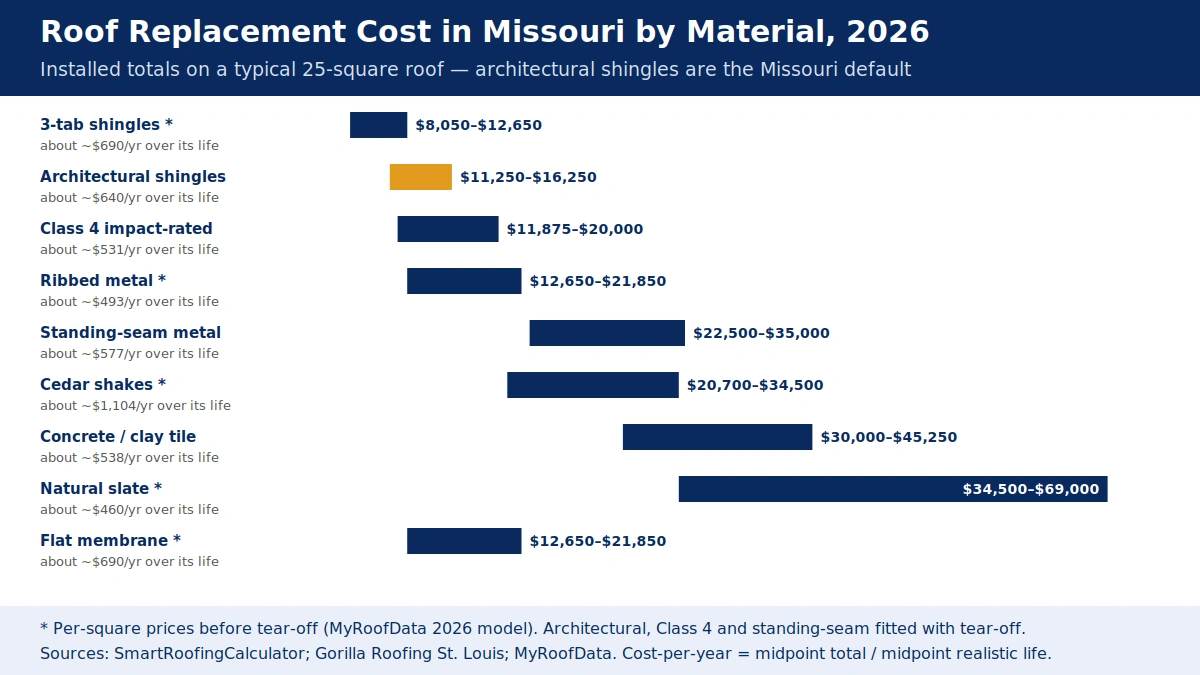
Missouri’s material table has to be read with the hail record open beside it, because the cheapest row and the most expensive row fail in opposite ways. The cheapest shingle on the shelf is the one most likely to bruise under a hailstone it was never built to take, and the most expensive metal on the shelf is the one most likely to still be on the roof when the mortgage is paid off — but metal dents, and a dented standing-seam panel is a panel replacement, not a patch. Material by material, here is what that 25-square Missouri roof costs in 2026, from figures verified for this state. Fitted bands carry tear-off of one layer; before-tear-off bands say so in the row, and the tear-off allowance to add is $100–$200 per square per layer on MyRoofData’s model, or $1.15–$1.52 per square foot to remove an extra layer on NumeralQ’s figures — $2,875–$3,800 on a 2,500 square foot roof for that extra layer alone. Read the lifespan column as Missouri-realistic, not brochure: St. Louis contractor figures put architectural shingles at 18–25 years here against a 25–30 year national range, and the gap is hail, freeze-thaw and summer heat, in that order.
| Material | Installed cost per square | Total for 25 squares | Realistic life in Missouri |
|---|---|---|---|
| 3-tab asphalt shingle | $322–$506 (before tear-off) | $8,050–$12,650 | 12–18 yrs |
| Architectural asphalt shingle | $450–$650 | $11,250–$16,250 | 18–25 yrs |
| Class 4 impact-resistant shingle | $475–$800 | $11,875–$20,000 | 25–35 yrs |
| Ribbed metal (exposed fastener) | $506–$874 (before tear-off) | $12,650–$21,850 | 30–40 yrs |
| Standing-seam metal | $900–$1,400 | $22,500–$35,000 | 40–60 yrs |
| Cedar shakes and shingles | $828–$1,380 (before tear-off) | $20,700–$34,500 | 20–30 yrs |
| Tile (concrete/clay) | $1,200–$1,810 | $30,000–$45,250 | 40–100 yrs |
| Natural slate | $1,380–$2,760 (before tear-off) | $34,500–$69,000 | 75–150 yrs |
| Flat membrane (TPO/EPDM) | $506–$874 (before tear-off) | $12,650–$21,850 | 20–30 yrs |
Read the 3-tab row as a caution sign: for most Missouri houses it is not a serious choice. MyRoofData prices 3-tab at $322–$506 a square installed, before tear-off — and removing the old layer pushes the real total higher. One flat layer, the lowest wind rating in the table, no impact rating worth naming — and Missouri’s hail record is exactly the record that punishes that combination. Insurers and builders have largely moved past 3-tab, and in a state that logged 343 reports of hail two inches or larger in ten years, the $3,200 saved against architectural shingles at the midpoints only pre-pays the next deductible. It still earns its keep in narrow cases — a rental property, a shed, a house headed to market within a few years. On a home the owner plans to keep through a decade of Missouri springs, it should not be the default.
Architectural shingles cover about three quarters of American houses, and Missouri is no exception. With the manufacturer’s high-wind nailing pattern, the thicker dimensional shingle carries a 110-to-130-mile-per-hour wind rating — and its $450–$650-a-square band is the one behind the headline price. Plan on 18 to 25 realistic years from it here, on Lane House’s St. Louis figures, not the 25 to 30 the brochure prints — and note the disagreement in the record, because it matters for budgeting: CoMo Premium Exteriors puts architectural shingles at 20–25 years in Central Missouri, Gorilla Roofing at 25–30 in St. Louis, and MyRoofData at 22–30. The spread is the difference between a roof that takes hail and a roof that does not. Hail bruises the mat, summer heat dries the asphalt binder until the shingle turns brittle, and roughly 60 freeze-thaw crossings a year in St. Louis work every sealant strip and flashing lap a little looser. A roof that looks sound at year twelve can be a single April hailstorm away from a claim, and in Missouri that storm is not a matter of if.
Class 4 gets a section of its own below, as it should: no other single decision does as much for a Missouri asphalt roof. The table prices it from Gorilla Roofing’s St. Louis fitted band, $475–$800 a square, which makes a 25-square Class 4 roof $11,875–$20,000. That band is wide, and the width is honest: the published premium estimates disagree sharply, from 5–10 percent over standard architectural on one Missouri storm-damage guide, to 10–25 percent on an older Missouri pricing page, to 20–40 percent — $2,000–$5,000 on a typical Mid-Missouri roof — from CoMo Premium Exteriors. The rubberized, SBS-modified asphalt keeps its flex through a Missouri freeze, so a hailstone strike bends the shingle instead of splitting it. Behind that rating sits the UL 2218 Class 4 test: a two-inch steel ball dropped from twenty feet, which the shingle must survive with no cracking, splitting or tearing. Class 4 is not hail-proof — the 4.50-inch stone that fell near Weatherby Lake in March 2026 would have damaged anything on a roof. The one to two inch band is where most damaging Missouri hail falls, and Class 4 earns its keep right there, with an insurance discount on top.
Metal is where the per-year math flips the table, and Missouri gives metal two separate arguments. Ribbed panels with exposed fasteners run $506–$874 a square on MyRoofData’s Missouri model before tear-off, or $12,650–$21,850 for a 25-square roof, lasting 30 to 40 years. Standing-seam metal runs $900–$1,400 a square on SmartRoofingCalculator’s Missouri figures, or $22,500–$35,000, lasting 40 to 60 years on Lane House’s St. Louis figures. MyRoofData’s standing-seam band runs a little wider before tear-off, $874–$1,472 a square, or $21,850–$36,800 — the two sources agree once tear-off is accounted for. Metal takes hail differently — no shingle mat to bruise, and no granular surface for heat and freeze-thaw to wear away. Summer heat, the force that dries asphalt out, leaves a metal panel largely alone, and a reflective finish cuts summer heat gain into the bargain. The trade is denting and noise and price: a large stone dents a panel, the dent is visible, and the repair is a panel, not a shingle. Divide by years of service and the ranking reverses. Per year of service at the midpoints: standing seam near $577, architectural shingles near $640, Class 4 near $531, ribbed metal near $493. Metal stings on the quote and looks gentle across the calendar. Standing seam against ribbed metal, with installed prices for each, is covered in our metal roof cost guide. To weigh metal directly against shingles, see our metal-or-shingles comparison for the side-by-side numbers.
Cedar shakes are a niche choice in Missouri: $828–$1,380 a square on MyRoofData’s figures, or $20,700–$34,500 for 25 squares, with 20 to 30 realistic years on Lane House’s St. Louis figures. Cedar looks beautiful on a wooded lot in the Ozarks and needs real maintenance, and Missouri humidity is unkind to it — moisture encourages moss and algae, which hold water against the wood, and the gaps between shakes hold debris through every storm season. In a state where the roof has to take hail in April and humidity all summer, cedar asks for more attention than most owners give it. Check the MyRoofData band against a local quote before budgeting around it, and check whether the insurer will write the roof at all at full replacement cost.
At the luxury end sit tile and slate, kept rare in Missouri by structural demands as much as by price. Tile runs $1,200–$1,810 a square fitted on SmartRoofingCalculator’s figures, or $30,000–$45,250 for 25 squares. MyRoofData splits the tile row before tear-off: concrete tile $920–$1,656 a square, or $23,000–$41,400, lasting 40–75 years; clay tile $1,104–$2,300 a square, or $27,600–$57,500, lasting 50–100 years. Concrete tile weighs 850–1,100 pounds per square, and the structure often needs an engineering check before switching from shingles — a check that matters more in Missouri than in a mild climate, because the frame has to carry the tile plus a snow load in the north and wind uplift everywhere. Tile’s Missouri problem is hail brittleness: a tile that takes a two-inch stone can crack where a Class 4 shingle flexes. Slate runs $1,380–$2,760 a square on MyRoofData’s figures, or $34,500–$69,000, lasting 75–150 years, and slate’s problem is the crew. Few Missouri roofers lay slate regularly, and a slate roof fitted by a crew that rarely touches the material is a leak waiting for the first thaw. Concrete and clay both demand a structural check on a Missouri frame before price is even discussed; our tile roof cost guide walks through that check and the installed costs.
Flat membrane covers the low-slope parts of Missouri houses — porch roofs, additions, mid-century homes — at $506–$874 a square before tear-off on MyRoofData’s figures, or $12,650–$21,850 for 25 squares, lasting 20–30 years. NumeralQ splits the flat row for a 2,000 square foot roof: modified bitumen $9,940–$12,790, EPDM rubber $10,240–$16,130, TPO membrane $12,160–$16,240. A low-slope section holds water and snow rather than shedding them, so the membrane choice and the drainage detailing matter more than the price band suggests, and the flat section is where a Missouri reroof most often hides a second, smaller quote inside the big one.
Read the table by yearly cost, not by the headline total. At the midpoints, 3-tab works out near $690 a year, architectural near $640, Class 4 near $531, ribbed metal near $493, standing seam near $577, cedar near $1,104, tile near $538 on a 40–100 year life, slate near $460, and flat membrane near $690. Those yearly figures come from dividing each midpoint total by the midpoint of the material’s realistic life — our own arithmetic, not a vendor’s. They leave out the deductibles, where Class 4 actually wins, and the hail resistance, where metal actually wins, and the insurance discount, where Class 4 wins again. Decide with the material table open next to the insurance section; the two belong together. Neither one alone tells the truth.
Roof Replacement Cost by Roof Size in Missouri
The listing says 2,000 square feet for both the ranch and the two-story, yet one roof is roughly double the other. A single-story ranch spreads about 2,000 square feet of footprint beneath its roof. Stack the same living space over two floors and the footprint drops near 1,000 square feet, cutting the roof surface roughly in half. Pitch, overhangs and waste usually lift the ranch’s footprint to 20–25 squares of surface, and one Missouri pricing page puts the typical roof surface at about 1.3 times the living-area footprint, higher still on older two-story St. Louis and Kansas City homes with multiple gables. Mistaking living area for roof area is the pricing error Missouri homeowners make most. It is not. Insist that every bid print the square count as its own line, with the pitch and the waste allowance beside it. A quote built on living area is a quote for the wrong house, and in a storm-restoration market it is also the easiest quote to inflate after the fact.
The table below runs on the SmartRoofingCalculator architectural band of $450–$650 a square, tear-off included, with the Class 4 column on the Gorilla St. Louis band of $475–$800 a square. The headline row is the 25-square one. The NumeralQ cross-check sits in the 20-square row: $9,000–$13,000 from the per-square band against $9,120–$11,070 for a 2,000 square foot roof statewide — the two sources overlap across most of the range, and the per-square band runs wider because it covers steeper and more complex roofs than NumeralQ’s typical job.
| Roof size | Typical Missouri home | Architectural shingle total | Class 4 shingle total |
|---|---|---|---|
| 15 squares | Small ranch / cottage | $6,750–$9,750 | $7,125–$12,000 |
| 20 squares | 2,000 sq ft ranch | $9,000–$13,000 | $9,500–$16,000 |
| 25 squares | Typical MO home | $11,250–$16,250 | $11,875–$20,000 |
| 30 squares | Large two-story | $13,500–$19,500 | $14,250–$24,000 |
| 35 squares | Large home, complex roof | $15,750–$22,750 | $16,625–$28,000 |
| 40 squares | Very large / steep | $18,000–$26,000 | $19,000–$32,000 |
Pitch is the first thing that breaks this table’s pricing — before material, before layers, before access. Bold Roofing in Springfield prices the effect plainly: a steep 12/12 roof costs about $110 more per square than a walkable 4/12, roughly 25 percent more, because the crew works slower, stages differently and carries materials differently. After pitch comes complexity. Valleys, dormers, skylights and chimneys each add a flashing detail that eats time and leaks first when rushed — and in Missouri the flashing details are where wind-driven rain gets in, so a cut-up roof is not just a dearer roof, it is a roof with more places to fail. On a cut-up Missouri roof — valleys, dormers, hips — MyRoofData’s estimator tacks roughly 15 percent onto the labor line. Third comes decking. Rotted sheathing only shows itself once the old shingles come off, and NumeralQ prices a replacement sheet of 4×8 OSB decking at $55.85–$81.63 installed in Missouri. Get the per-sheet rate in writing before the tear-off starts, and get the crew to photograph every sheet it replaces. The housing stock makes this more than a formality: with about 53 percent of Missouri homes built before 1980, older roofs hide soft decking and extra layers more often than the quote assumes, and the extra layer alone costs $1.15–$1.52 per square foot to remove.
Let the roof’s own measurements set the budget — the listing’s square footage should not. Take the footprint, multiply by the pitch factor (about 1.15 at 6/12, about 1.25 at 8/12), add 10 percent for cutting waste, then divide by 100 to get squares. Line bids up by square count before looking at price; only matching counts make prices comparable. A bid that is $2,000 cheaper on two fewer squares is not cheaper at all; it is a smaller roof, and the missing squares will show up as a supplement after the tear-off, when the homeowner has no leverage left.
Roof Replacement Cost by City: St. Louis vs Kansas City vs Springfield vs Columbia vs Joplin
St. Louis and Kansas City price within a few dollars of each other on the planning models, and that near-tie is the first thing to understand about Missouri pricing. NumeralQ puts a 2,000 square foot roof at $9,990–$12,210 in St. Louis and $9,960–$12,170 in Kansas City — a $30 gap at the bottom of the band and a $40 gap at the top, which is no gap at all. SmartRoofingCalculator’s city page gives both metros the same 25-square figure, $10,688–$15,438, at $428–$618 a square. The two cities arrive at the same price by different routes: St. Louis roofers earn a median of $28.25 an hour, Kansas City roofers $28.09, both about 5–6 percent above the national median of $26.65, on Bureau of Labor Statistics May 2025 metro figures. What actually separates the two metros is not the wage line but the storm line. FEMA’s National Risk Index rates hail risk Very High in Jackson County, where Kansas City sits, against Relatively Moderate in the city of St. Louis — and the 2026 hail count backs the rating up, with 62 filtered hail reports in the Kansas City metro against 25 in the St. Louis metro through October 13. A Kansas City quote deserves the Class 4 line priced on it as a matter of course. A St. Louis quote deserves it too, but for a different reason: the May 2025 tornado proved the metro is not sheltered from wind.
| City | 2,000 sq ft roof (arch) | 25-square roof (arch) | Roofer median wage | Market note |
|---|---|---|---|---|
| St. Louis | $9,990–$12,210 | $10,688–$15,438 | $28.25/hr | Largest market; May 2025 EF3; permit rule disputed |
| Kansas City | $9,960–$12,170 | $10,688–$15,438 | $28.09/hr | Very High hail risk; reroof permit-exempt |
| Springfield | No verified NumeralQ figure | ~$11,250 at $450/sq (Bold rate) | Not verified | Ozarks; 118-job avg $15,301; 22-sq avg roof |
| Columbia | No verified NumeralQ figure | ~$11,300 (SquareDash 2,000 sq ft) | Not verified | Central MO; arch $5.00–$7.50/sq ft |
| Joplin | No verified figure | No verified figure | Not verified | EF5 history; hurricane-clip rules; no price invented |
St. Louis is the biggest market in the state, served by the most crews, and the contractor-ledger numbers run wider than the planning models. Gorilla Roofing prices most St. Louis jobs at $9,500–$14,000 on a typical 2,000 square foot home, inside a wider $8,000–$17,000 range. Lane House prices the same market at $9,500–$18,000. Instant Roofer’s contractor-entered snapshot puts St. Louis at $13,937 on average — the dearest of its Missouri communities, against $12,394 in St. Joseph — and HomeCostLens puts the St. Louis average at about $10,460 on a typical 2,200 square foot home. Angi’s $8,155 average sits below all of them and is the low outlier for the reasons given above. The city also carries the permit dispute no other Missouri city shares, taken up in the permits section below: one source reads the fee schedule at $175 for a $15,000 job, another says no permit is needed for a like-material re-roof with limited sheathing work. And the city carries the freshest wound in the state. A year after the May 2025 tornado, blue tarps still covered roofs across North St. Louis, and the recovery was uneven by neighborhood. Anyone getting quotes in the tornado path should make at least one of them from a company with a permanent shop in the metro, and should read the storm-chaser section before signing anything a door-knocker hands over.
Kansas City runs a fraction cheaper on the planning models and a great deal more exposed on hail. The NumeralQ figure is $9,960–$12,170 for a 2,000 square foot roof, and SmartRoofingCalculator scales the state baseline down 5 percent for the metro, to $428–$618 a square. Instant Roofer puts Kansas City at $12,658 on average, and HomeCostLens at $10,180. The metro straddles the state line, which makes every rule in this guide a two-state question on the Kansas side: Kansas licenses roofers at state level through the Attorney General’s registration, Missouri does not, and a crew licensed in Kansas has no Missouri credential to show, because none exists. The permit rule is the metro’s genuine advantage: reroofing a one- or two-family home with a light covering needs no building permit in Kansas City, Missouri, under Code Sec. 18-16(b)(1)k, as long as no sheathing or structural work is involved. The hail record is the metro’s genuine cost: 24 hail reports on March 10, 2026 alone, and a 4.50-inch stone near Weatherby Lake the same day. A Kansas City roof spec that does not price Class 4 and impact-rated skylights is a spec written for a different city.
Springfield carries a warning label, not a planning-model price. This research pass found no NumeralQ figure for Springfield, so this guide prints none. What can be said honestly is the shape of the market from contractor ledgers. Bold Roofing, working Branson, Springfield and Southwest Missouri, reports a $10,000–$20,000 range with a $15,301 average across 118 reviewed projects and a typical rate of about $450 a square — which puts a 25-square roof at about $11,250 at that rate, before pitch, layers and decking. Shingle Geek, working from Springfield wholesale costs, puts the average retail price at $10,319 for a typical 22-square roof, with a fair retail range of $9,906–$10,732 for a GAF Timberline HDZ roof on that size. The two ledgers bracket the planning band from below and from the middle, which is consistent with an Ozarks market running a few percent under the two big metros. Springfield sits on the I-44 hail corridor and in the shadow of Joplin, 70 miles to the southwest, and its housing stock runs to the 22-square average roof Shingle Geek measures — smaller than the 25-square planning roof, which is why Springfield totals look lower even when the per-square rate matches the metros. No Springfield roofer median wage was verified in this pass, and none is stated.
Columbia carries the same warning label. Columbia likewise has no NumeralQ figure in this pass, and this guide invents nothing to fill the gap. What can be said honestly is the shape of the market: SquareDash quotes a fixed $11,300 average for a 2,000 square foot Columbia home, and CoMo Premium Exteriors prices Central Missouri architectural shingles at $5.00–$7.50 per square foot installed, or $10,000–$15,000 for a 2,000 square foot roof, with 3-tab at $3.50–$5.50 and premium shingles at $7.50–$12.00 or more. Columbia sits on the I-70 corridor between the two big metros, takes about 16.5 inches of snow a year, and hosts Shelter Insurance’s headquarters — the carrier whose Class 4 discount shows up in more Missouri renewal letters than any other, on the contractor accounts this guide found. The city issues re-roof permits as its own work class — 218 of them between October 2024 and May 2025 — which makes Columbia one of the Missouri cities where the permit is a certainty rather than a question. No Columbia roofer median wage was verified in this pass, and none is stated.
Joplin carries the starkest label of all: no verified price figure, from any source, in this pass. That is not an oversight. Joplin is the city whose name defines Missouri roofing, and it is also the city whose post-2011 building rules make its quotes the hardest to compare with anyone else’s — hurricane clips on every rafter and truss for new single-family construction, and a market rebuilt almost from scratch after the tornado. A Joplin homeowner should treat the statewide bands in this guide as the starting point, get three written quotes from crews with permanent shops in Jasper or Newton County, and read the Joplin code history in the storm section before comparing any of them. Inventing a Joplin figure to complete the table would be worse than leaving the cell empty, because a wrong anchor costs more than no anchor.
Judge cities on price per square, never on the total: a Springfield total of $10,319 on a 22-square roof is not cheaper than a St. Louis total of $11,250 on a 25-square roof, once the square counts are held equal. What actually differs between Missouri cities is exposure — Kansas City takes the worst hail, St. Louis takes the convergence of both storm corridors and the freshest tornado damage, Springfield takes the I-44 track and the Ozarks labor market, Columbia takes the I-70 track and a certain permit, and Joplin takes the strictest post-tornado building rules — which is why the cheapest quote in the wrong city is rarely the cheapest roof.
Why Missouri Roofs Cost What They Do: Tornado Wind, Hail, Heat and Humidity
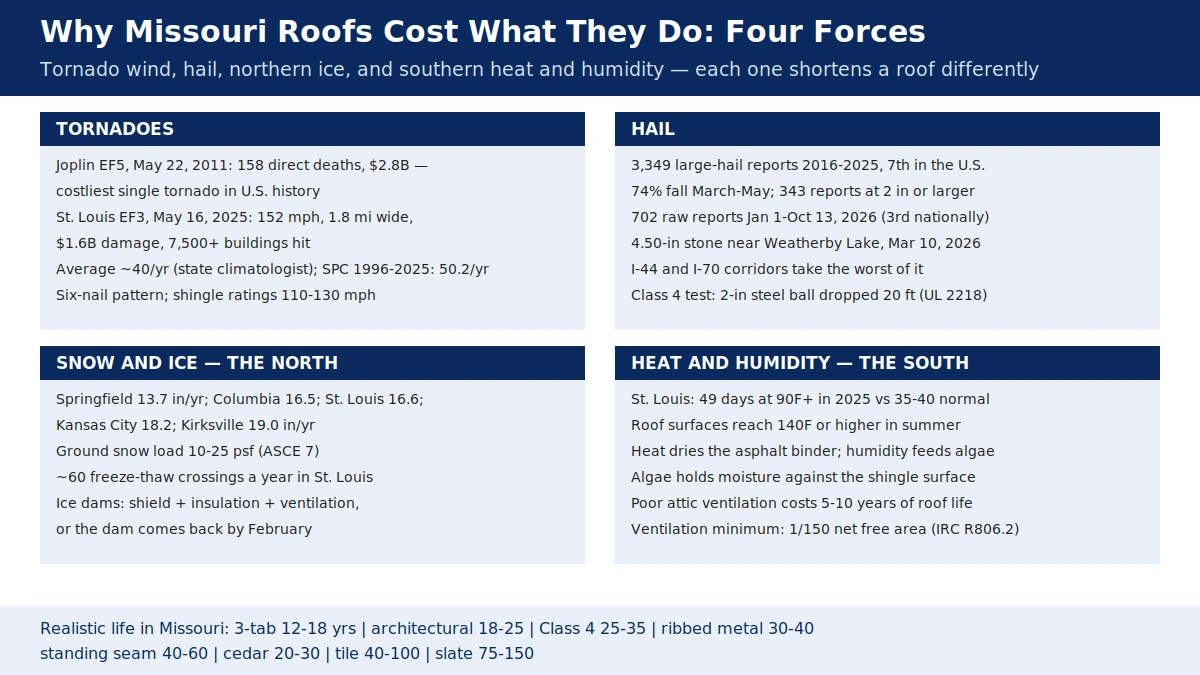
Four forces set what a Missouri roof costs, and the first two arrive with the spring storms. Tornado wind is the most expensive to repair after the fact, because a tornado is a total-loss event for a roof and no shingle rating protects against one. Hail is the most expensive over the life of the roof, because it arrives most years, bruises the mat a little at a time, and decides the deductible arithmetic that dominates the insurance section. Heat and humidity are the slowest forces and the hardest to see from the curb: summer temperatures dry the asphalt binder until the shingle turns brittle, and humidity feeds the algae that holds moisture against the surface. Under every other price sits the labor market. What follows takes them in that order — wind first, because Joplin and St. Louis rewrote the record, hail second, because the numbers are the strongest in the region, and heat, humidity and labor after, because they decide how long whatever survives the storm will last.
The tornado record starts with an argument about the average, and the argument deserves stating plainly, because it shows how counting rules move the number. Missouri’s state climatologist, Zachary Leasor, told KCUR in May 2026 that the state averages about 40 tornadoes a year. The NOAA Storm Prediction Center’s Severe Weather Database, tallied for 1996–2025, averages 50.2 a year, with 2,707 Missouri tornadoes since 1950, 165 of them rated F3 or EF3 or stronger, and 423 deaths. A decade-window tally averages 57.7 a year, and another secondary source gives 45. The windows differ, the reporting got better over time, and the recent years have been busier than the long average. Leasor’s figure is the planning average this guide uses, with the SPC figure printed beside it. Either way, the recent years stand out. By early May 2026 the state had already logged 41 tornadoes — past the annual average with most of the season ahead — all of them rated EF0 or EF1, with winds under 110 miles per hour. The year before had been busier still: 75 tornadoes by early May 2025, on the way to one of the busiest tornado years in Missouri history. And in the Kansas City forecast area — eastern Kansas plus western Missouri, not the state as a whole — the National Weather Service confirmed 37 tornadoes in 2026, a record against the old mark of 33 in 2003 and an average of 11. May is the peak month, and the season runs April through June at its worst, which is why the best Missouri installs land in the shoulder months: September and October after the peak, or April ahead of it if the old roof can hold.
Joplin is the reason Missouri roofing carries a building-code story no other state in this series carries. The tornado that struck on May 22, 2011 was rated EF5, the highest category, with winds over 200 miles per hour and estimated peaks of 225–250. It touched down at 5:34 p.m. west of the city, stayed on the ground 38 minutes, and cut a path 21.62 miles long — some tallies give 22.1 miles — and about a mile wide at its broadest through the southern part of the city. It killed 158 people directly, 161 in the total most sources cite once indirect deaths are counted, injured about 1,150, damaged nearly 8,000 buildings, destroyed more than 4,000 houses — one tally counts 6,954 homes destroyed — and struck one of the city’s two hospitals. The $2.8 billion in damage made it the costliest single tornado in United States history, a record it still holds. The National Institute of Standards and Technology sent a team within two days, and its technical investigation, published in 2014, made 16 recommendations for building and shelter design. Joplin itself moved quickly to adopt more stringent requirements for single-family homes, including hurricane clips on every rafter and truss. The national code followed more slowly: ASCE 7-22 added a tornado-loads chapter, incorporated into the 2024 International Building Code, requiring critical and high-occupancy structures — schools, hospitals, essential facilities — in tornado-prone regions to withstand winds covering about 97 percent of tornadoes, the EF0 to EF2 range. Ordinary houses are not covered by that provision. A Missouri homeowner who wants tornado-level fastening on a house has to ask for it and pay for it; the code does not require it. One finding from the Joplin studies is worth hearing even in its second-hand form, and it is flagged as second-hand here: the American Society of Civil Engineers found that most of the damage in Joplin came from winds of 135 miles per hour or less, because the strongest winds covered only a narrow core. The defense that matters for most Missouri houses is not EF5 engineering. It is six nails instead of four, a high-wind starter course, hurricane clips where the budget allows, and a shingle rated 110 to 130 miles per hour fitted exactly as the manufacturer specifies, written into the quote as the nailing pattern.
St. Louis proved in 2025 that the tornado story is not a southwest-Missouri story. On May 16, 2025, an EF3 tornado with peak winds of 152 miles per hour — one source gives a 136–165 range — and a maximum width of 1.8 miles tracked through Clayton, the Central West End, Fountain Park, Kingsway East and Greater Ville and on into Illinois. The National Weather Service survey put the path at 12.29 miles; the city’s one-year recovery report describes a 23-mile path, a figure that appears to cover the full track including the Illinois leg, and both numbers are printed here rather than one silently chosen. The damage was $1.6 billion. Four people died in the tornado plus one non-tornadic death, five lives by the city’s count. Thirty-eight people were injured. About 5,000 structures appeared in the initial survey; the city’s updated count, from a right-of-way survey, put the figure above 7,500 buildings across 24 neighborhoods. It was the first deadly tornado in St. Louis since 1959, and the largest the region had ever recorded. Federal surveyors called the residential damage the largest-scale they had measured since Joplin. The city secured $371 million in recovery funding from federal, state, local and philanthropic sources, and a year later the recovery was still visibly incomplete, with blue tarps on roofs across North St. Louis. For a homeowner pricing a roof in the metro, the lesson is not the tornado itself — no roof survives an EF3 core — but the market that follows one: crews from out of state, permits and inspections under strain, and insurance settlements that take months to close. The hiring section below is written for that market.
Hail is the force that actually decides most Missouri roofing budgets, because it arrives far more often than a tornado and charges the deductible every time. The NOAA Storm Events Database, as tallied by NumeralQ, logged 3,349 large-hail reports in Missouri from 2016 to 2025 — hail one inch or larger — putting the state seventh nationally, with 74 percent of the reports falling between March and May and 343 of them at two inches or larger. The same decade logged 5,835 thunderstorm-wind reports of 58 miles per hour or higher, tenth nationally, and 596 tornado reports. The 2026 season kept pace. Preliminary Storm Prediction Center data counted 702 raw hail reports statewide from January 1 to October 13, 2026, third in the nation behind Kansas and Texas. The Kansas City metro logged 62 filtered reports, including 24 on March 10 alone — the busiest single day in any of the twelve major roofing markets one industry analysis tracked — with the largest stone at 4.50 inches near Weatherby Lake. The St. Louis metro logged 25, with the largest at 2.50 inches near Highland on August 21. State Farm, the carrier with the largest Missouri book, paid $580 million in Missouri hail claims in 2024, up another 10 percent in 2025 to the second-highest state total in the country, on a secondary summary of the carrier’s data — and the same summary reports major hail events up 182 percent between 2022 and 2024, with two-inch-plus events up 730 percent. Those percentage jumps are flagged here as a secondary summary, not verified against the carrier’s own release, but the direction matches every other count in this section. The one-to-two-inch band delivers most of Missouri’s hail damage, and it is precisely the band Class 4 shingles are built to survive. So the Class 4 case in Missouri stands on three legs at once — the hail record, the wind-driven debris, and the insurance discount — and no single leg carries it alone.
Heat and humidity do their damage slowly, which is why they get underestimated in every Missouri quote conversation. St. Louis recorded 49 days at or above 90 degrees in 2025, against a normal of 35 to 40, on National Weather Service figures quoted by Lane House Roofing. Missouri summers regularly push into the 90s, and roof surfaces run to 140 degrees or higher, on CoMo Premium Exteriors’ Central Missouri account. That heat breaks down the asphalt oils in a shingle over time, making the mat brittle, while ultraviolet radiation fades the color and weakens the fiberglass underneath. South- and west-facing slopes wear fastest, because they catch the direct afternoon sun. Humidity works from the other side: Mid-Missouri’s humid climate encourages algae and moss, especially on shaded sections, and the dark streaks on a roof are not just cosmetic — algae holds moisture against the shingle surface and speeds deterioration. The attic is where the two forces meet. Without proper intake and exhaust ventilation, heat and moisture build up under the deck, cooking the shingles from below and rotting the decking, and Gorilla Roofing’s St. Louis account puts the cost plainly: roofs over poorly ventilated attics routinely lose five to ten years, and most manufacturers will not honor a warranty claim without adequate ventilation. The code minimum is a net free ventilating area of 1/150 of the attic area under IRC section R806.2, and most homes miss on intake rather than exhaust. A reroof is the one job that opens the ventilation question up completely, which is why the ventilation scope belongs on the quote in full, not as an afterthought.
The labor market sets the floor under everything else, and in Missouri the floor is lower than the national average while the metro ceilings run higher. The statewide median roofer earns $23.35 an hour, about 12 percent below the national median. The metro medians run the other way: St. Louis at $28.25, Kansas City at $28.09, both above the national median, with St. Louis mean pay of $31.20 running nearly 12 percent above the national mean. The Central Missouri balance-of-state median, $22.31, is the number that pulls the state figure down, and it is the closest published wage to the Springfield and Columbia labor markets — though it is a balance-of-state figure, not a metro figure, and it is labeled as such. The state’s design wind speed, 115 miles per hour as a baseline in the jurisdictions that publish one, sets the ceiling the nailing pattern has to meet. And the season sets the calendar. March through July is hail season, April through June is tornado season, and the best installs land in September and October, warm enough for the sealant strips to bond and past the worst of the storms.
Ice, Snow and Freeze-Thaw: The Northern Missouri Winter Problem
Missouri’s winter problem runs on a gradient, and the gradient is the point. The south of the state barely freezes; the north freezes, thaws, refreezes, and freezes again, and the roof pays for every crossing. On the 1991–2020 climate normals published by the National Centers for Environmental Information and tabulated by Current Results, Springfield takes 13.7 inches of snow a year, Columbia 16.5, St. Louis 16.6, Kansas City 18.2, Trenton 17.2, and Kirksville 19.0. North of the Missouri River the annual average runs 18 to 24 inches, tapering to 8 to 12 inches in the southernmost counties, and the snowiest place in the state on a 1985–2015 tally is Edina, in Knox County, at about 22 inches a year. Two conflicts belong in the open. One climate site, citing the same NCEI normals, gives Kansas City 12 inches a year against Current Results’ 18.2 — different stations or different methods, and both numbers are printed here rather than one silently chosen. And the National Weather Service figure quoted for St. Louis, a little over 18 inches per winter season, sits just above Current Results’ 16.6. The differences are small, and the shape they describe is not in dispute: Missouri snow is a northern problem that fades south, and no Missouri city takes the snow loads the lake-effect states take. What Missouri takes instead is ice, and ice is the harder problem for a roof.
The ground snow load behind that risk has no statewide number, because Missouri has no statewide code to put one in. Hazard mapping under ASCE 7 puts Missouri ground snow loads at 10 to 25 pounds per square foot, averaging 15 to 25. The one published local table this pass verified, Willard’s adoption of the 2018 International Residential Code, sets the ground snow load at 20 pounds per square foot with a 115 mile per hour design wind speed. A roof in Kirksville or Trenton designs to a different number than a roof in Springfield or Branson, and the building department’s table is the number that governs, not any figure in this guide. On a low-slope porch roof the danger doubles: flat and low-slope areas hold snow rather than shedding it, so a low-slope section can carry far more than the main slope’s load, and the load builds through the season as December’s snow compacts in January, ices in February, and is still there in March when the next storm adds another layer.
Freeze-thaw works on a Missouri roof the way a slow wedge works on a stone, and in this state it gets about 60 chances a year. A hairline gap takes in water in November, freezes wider in January, and opens again in the March thaw. By April the gap is a leak, and the April hailstorm finds it. It works slowly, out of sight from the street, and no shingle brand is immune. Each winter takes a little more out of the sealant strips, the flashing laps, and the shingle’s own granular surface. St. Louis recorded 85 days at or below freezing in 2025, with 25 days that never rose above freezing at all, on National Weather Service figures quoted by Lane House — which means 60 days when the temperature crossed the freezing line in one direction or the other, each crossing a small push at every joint on the roof. A roof can look flawless from the sidewalk while its mat is bruised and near cracking underneath. The damage stays hidden until the shingle finally splits, usually in the first wind event of spring.
Ice dams are the winter failure Missouri homeowners actually call about, and the dam is not a shingle failure. It is an attic failure. Warm air leaking from the rooms below heats the attic and the underside of the deck. Snow higher on the roof melts from underneath while the eave, past the warm wall, stays frozen solid. The meltwater runs down-slope, crosses the warm wall line, and refreezes over the cold deck into a ridge of ice. The next round of meltwater is trapped behind that ridge, pools under the shingles, and finds its way inside — through sheathing, down the wall, into the ceiling below. Often the first clue is a brown stain in March — or something worse. New shingles do not stop a dam leak, because the dam was never a shingle problem. The defense has three layers, and the reroof is the one job that opens up all three at once. Defense one is the membrane itself: self-adhering ice and water shield along the eaves, through the valleys, and around every penetration. The second is attic insulation to the locally adopted code level, with the attic floor air-sealed so the heat cannot escape into the attic in the first place. Third is ventilation balanced from soffit to ridge, holding the deck cold so the snow above it stays frozen. Put new shingles over a hot, airless attic and the next dam arrives by February, whatever brand went on.
Whether the ice-barrier membrane is actually required on a given Missouri roof is a question this guide cannot answer statewide, and it says so plainly. The International Residential Code’s ice-barrier rule, section R905.1.2, applies in jurisdictions where the average January temperature is 25 degrees or below, and Missouri adopts the code locally, city by city and county by county, with different editions in different places. No Missouri statewide ice-barrier requirement was verified in this pass, and no Missouri-specific January-temperature finding was verified either. The practical answer is to ask the local building department whether the rule applies at the property’s address, and to put the membrane in the quote either way on a northern Missouri roof, in valleys, and on any roof that has dammed before. NumeralQ prices a whole-roof ice and water barrier at $0.82–$1.34 per square foot installed in Missouri — $2,050–$3,350 on a 2,500 square foot roof — against the eaves-only coverage most quotes carry. On a roof that has dammed before and will dam again, the whole-roof option is worth pricing, and the quote should state the membrane coverage in feet from the eave rather than leaving it to the crew’s judgment on the day.
Missouri crews do install roofs in winter, under a different set of rules. Winter installation can succeed — SBS-modified shingles made cold-weather work more practical than it used to be — but sealant strips still need warmth to bond, and a January crew that skips hand-sealing fits tabs that lift in the first April wind. Hand-sealing belongs in the written scope of any winter install, spelled out on the quote. Metal sheds snow fastest and steep pitches beat shallow ones, yet a slab of snow sliding off metal can tear a gutter away — so snow guards above entries belong in the original quote, not added afterward. And one last winter note for the north. The wind across open northern Missouri farmland drives snow and rain sideways, and a west-facing slope on an exposed farmhouse takes weather a sheltered suburban roof never sees. Spell out the flashing scope on an exposed rural quote in full, and check a northern roof after the first big January storm, not after the first leak.
Class 4 Impact-Resistant Shingles in Missouri: The Hail-Belt Upgrade
Start with the money, because the money is what settles this question in Missouri. A typical Missouri deductible runs $500 to $2,000 for standard perils on MoneyGeek’s figures. Many policies now carry a separate, higher wind and hail deductible on top of that — a percentage of the dwelling value, usually 1 to 5 percent. At 2 percent on a $300,000 home, the homeowner hands over $6,000 before the insurer contributes a dollar to a wind or hail claim. On a $350,000 home at 2 percent it is $7,000, and at 5 percent it is $17,500. Against that, the Class 4 upgrade on a 25-square roof costs somewhere between a few hundred dollars and $5,000, depending on which published premium estimate is believed — and the disagreement is worth stating, because it is the widest disagreement in this guide. One Missouri storm-damage guide puts the material uplift at roughly 5–10 percent over standard architectural shingles. An older Missouri pricing page puts it at 10–25 percent. CoMo Premium Exteriors, pricing Central Missouri, puts it at 20–40 percent, adding $2,000–$5,000 to a typical Mid-Missouri roof. Gorilla Roofing’s St. Louis bands imply the smallest gap at the bottom — $475 a square for Class 4 against $400 for architectural — and the widest at the top. Survive two hailstorms without a replacement and a Class 4 roof has saved its owner that deductible twice. That is $1,000 to $4,000 at standard deductibles, far more under a percentage wind and hail deductible, against an upgrade that cost a fraction of one deductible at the low estimates and most of one at the high estimate. A single claim the roof rides out can pay for the upgrade by itself at any estimate in the range. The upgrade earns its money through deductibles that never come due.
If one recommendation survives every edit of this guide, it is this: price the Class 4 upgrade on every asphalt quote in Missouri, and accept it unless the arithmetic says otherwise. UL 2218, the Underwriters Laboratories impact-resistance scale, tops out at Class 4. The UL test drops its two-inch steel ball from a height of twenty feet — the equivalent of a golf-ball hailstone falling at terminal velocity. The shingle has to come through the test without cracking, splitting or tearing. What gives Class 4 its flex is SBS-modified asphalt: a rubberized blend that stays pliable in a freeze and takes a strike without cracking. Missouri shelves carry the usual Class 4 lines — GAF Timberline AS II and Armor Shield II, CertainTeed Landmark IR, Owens Corning Duration STORM and Duration FLEX, IKO Nordic, Malarkey Vista, and Atlas StormMaster. No Class 4 shingle is hail-proof: the 4.50-inch stone that fell near Weatherby Lake in March 2026 would have damaged any roof on the market, and the 343 reports of hail two inches or larger in the last decade include stones well past the test’s two-inch ball. Missouri’s costliest hail lands in the one-to-two-inch range — the range where Class 4 earns its keep. Jackson County alone carries a Very High hail-risk rating from FEMA, and the Kansas City metro’s 62 hail reports in the first nine and a half months of 2026 are the reason the upgrade is easiest to justify on the western side of the state.
The price is disputed, and the dispute is honest about itself. This pass verified no Missouri-specific Class 4 premium from a contractor ledger, and this guide invents none. The four published estimates above — 5–10 percent, 10–25 percent, 20–40 percent, and the Gorilla band of $475–$800 a square against $400–$700 for architectural — are all printed, and none of them is the number that matters for a specific house. The quote’s number is. What can be said with confidence is the shape: the premium is smallest as a percentage on a plain, walkable roof and largest on a steep, cut-up roof, because the heavier SBS-modified shingle costs more to carry and lay on a steep pitch. Treat any single premium figure quoted without a roof attached to it as a guess, and get the real premium written on the quote, with the product name and the UL 2218 marking beside it.
The discount exists, varies by carrier, and is worth less than the upgrade itself. Most major carriers writing policies in Missouri offer a Class 4 discount against the wind and hail portion of the premium. Published ranges for that discount disagree with each other, and the disagreement should be stated outright. One Missouri storm-damage guide and a Lee’s Summit contractor both give 10–30 percent off the wind and hail portion, naming Shelter, State Farm, American Family, Allstate, Farmers, USAA and Liberty Mutual. CoMo Premium Exteriors splits the range by carrier: State Farm up to 30 percent in some Missouri markets, Allstate 10–20 percent, American Family 15–25 percent. A state-by-state discount table gives Missouri 10–20 percent, describing it as less aggressive than Texas or Colorado. The discount touches only the wind and hail portion, never the full premium, and its size shifts by carrier and by ZIP code. No carrier has published a figure specific to Missouri in a rate filing this pass could verify. Before signing, get the figure from your own insurer in writing, qualifying product list and paperwork requirements included. Until the carrier confirms it, treat any discount a contractor quotes as made up. One Missouri storm-damage guide puts typical payback at two to four years in a hail-prone ZIP code, on the discount alone. In Missouri, the bigger payback is the deductible that never gets paid, and in Missouri that stream matters most, because the state’s hail record keeps the deductible within reach of every homeowner, every spring.
Three rules close the section. First, put the product on the quote by name — manufacturer and exact shingle line, with the UL 2218 Class 4 marking that is printed on the shingle’s back. Second, file that marking, the install photos, and the final inspection with the job records, because the discount depends on proving what is on the roof at renewal, and some carriers want re-inspection every five years. Third, before work starts, secure the insurer’s discount confirmation and paperwork list in writing. Expect a carrier to want its own evidence — photographs, a certificate, an inspection — because a contractor’s word alone never suffices. And a warranty rule that matters here: only a credentialed crew can trigger the extended warranty — GAF Master Elite, Owens Corning Platinum Preferred, or the equivalent — which is one more reason the cheapest bidder is not always the cheapest roof. Everyone else should treat Class 4 as the default, not the upgrade — the long-term owner, the house that has already had one hail claim, and any house in Jackson County or along the I-44 and I-70 corridors, which is most of the state.
Permits and Code in Missouri: No Statewide Code, Local Rules Only
The most surprising sentence in this section belongs first, because it catches the most homeowners off guard: Missouri has no statewide residential building code at all. The state writes no residential code, mandates no minimum, and enforces nothing. Each city and county decides on its own whether to adopt a building code, which edition, and whether to require permits and inspections — and many rural counties require none of those things. Kansas City, St. Louis city, Springfield and Columbia adopt 2018 editions of the International Residential Code, on a secondary compilation of local adoptions, while St. Louis County and Boone County sit on the 2015 edition. Springfield’s own website confirms its adoption of the 2018 International Building Code and 2018 model codes. That patchwork is the whole system. A rule that is true in Kansas City may be false in Lee’s Summit, fifteen miles away, and false again in unincorporated Jackson County. The building department that covers the property’s address sets the number that governs, not the contractor, not the neighbor, and not any figure in this guide.
Kansas City carries the permit exemption that most changes a quote, and it is written into the city code in plain language. Under Kansas City Code Sec. 18-16(b)(1)k, reroofing — replacement of roof coverings — of one- and two-family residences with a light roof covering needs no building permit. The exemption does not cover replacement of roof sheathing or deck, or structural modifications or alterations, and a separate exemption covers replacement of sheathing under 32 square feet for one- and two-family dwellings. Exempt work must still meet the code; the exemption removes the permit, not the standard. Where a Kansas City permit is needed — deck work over the threshold, structural changes, a heavier covering — the one- and two-family fee schedule runs $58 for the first $2,000 of valuation plus $4.33 for each additional $1,000, which works out to about $114 on a $15,000 job by NestPriced’s arithmetic from the published schedule. Cross the metro line into Lee’s Summit and the rule flips: re-roofing there requires a permit, with a $50 flat fee and a final inspection on issuance. The same roof, the same crew, the same week — a different rule fifteen miles apart. That is Missouri permitting.
St. Louis carries a genuine dispute, and this guide prints both sides of it rather than settling it. NumeralQ, reading the City of St. Louis Building Division fee schedule on October 26, 2026, gives a $25 application fee plus $10 per $1,000 of construction cost on jobs over $3,000, which makes a $15,000 re-roof cost $175 in permit fees. Lane House Roofing, a St. Louis contractor writing in July 2026, states that the City of St. Louis does not require a permit for like-material replacement when 25 percent or less of sheathing is replaced, and that the county has separate rules. Both cannot be the whole rule for every job, and the difference likely turns on the sheathing scope and on whether the job is read as a repair or a replacement. The practical answer is to call the Building Division before the job is priced, get the answer for the specific scope in writing, and put the permit cost and the name of the party pulling it on the quote. Angi’s metal-roof page adds a third data point, a $193 permit fee in St. Louis on a different job value, which is consistent with a valuation-based schedule rather than a flat fee. St. Louis County runs its own rules, and no verified county re-roof fee came out of this pass.
Columbia is the Missouri city where the permit is a certainty. The city issues re-roof permits as its own work class, and 218 of them went out between October 2024 and May 2025, covering $4,571,372 in valuation. The fee carries a small conflict: the city code as read in October 2026 gives $2.25 per $1,000 of value with a $35 minimum, while the city’s 2023 permitting help document gives a 0.0025 multiplier — $2.50 per $1,000 — for alterations and repairs. On a $15,000 job that is $35 against $37.50. The difference is trivial and the conflict is unresolved, and both figures are printed here so the reader is not surprised by either. Springfield, by contrast, carries no verified fee at all. The city has adopted the 2018 model codes, and a secondary permit site claims roof replacement over 25 percent of the roof area needs a permit at typically $150–$300 — but the same site wrongly claims Missouri adopted the 2015 International Building Code statewide, which it did not, so its fee figure is not stated as fact here. Confirm the requirement and the fee with Springfield Building Development Services before budgeting around either. In unincorporated rural counties, the honest answer is often that no permit and no inspection exists to buy, which makes the contractor’s own documentation — photos, nailing pattern, flashing scope — the only record the next buyer or the next insurer will ever see.
Permit fees across the published models vary by an order of magnitude, which is itself worth knowing. SmartRoofingCalculator puts the Missouri permit at about $175, typically $100–$275. MyRoofData puts it at $75–$300 in metro jurisdictions. RoofingEstimatorPros gives $150–$500 for the same permit. NumeralQ, working from the St. Louis schedule, puts it at $175 on a $15,000 job. All four numbers appear in this section, but the only one that governs a particular house is the building department’s. The pattern is what counts: a permit is a small line on a big job, and it is the line that buys protection, since a permitted job is inspected and an inspected job leaves a record. In a state where many counties offer no inspection at all, a homeowner in a permitting city should treat the inspection as a free second opinion and never waive it to save a week.
The code beneath the permit is the locally adopted International Residential Code, and three numbers from it belong on every Missouri quote conversation. The design wind speed runs 115 miles per hour as a baseline in the jurisdictions that publish one, with one engineering source giving a 105–115 range across the state. The ground snow load runs 10 to 25 pounds per square foot on ASCE 7 hazard mapping, with Willard’s published table at 20. The attic ventilation minimum is a net free ventilating area of 1/150 of the attic area under IRC section R806.2. None of those numbers is statewide law, because Missouri has no statewide law to put them in. Each is the number a particular jurisdiction has adopted, and each is the number to ask the local building department to confirm. What the code does not do anywhere in Missouri is require tornado-level fastening on an ordinary house, or require a statewide roofer license, or set a statewide ice-barrier rule. Those three absences shape the next section more than any requirement in the code does.
Hiring a Roofer in Missouri: No State License and the Storm-Chaser Test
The state’s hiring problem can be stated in one sentence: Missouri licenses no roofers, so the homeowner is the inspector, the verifier, and the safety net. There is no state roofing license, no state exam, no state license fee, and no state board for general contracting. The only statewide construction license Missouri issues is the optional electrical contractor license, which has nothing to do with a roof. Anyone can legally call themselves a roofing contractor in Missouri without formal credentials, and in the unincorporated counties there may be no local credential either. What exists instead is a patchwork, and the patchwork is the whole system. Kansas City licenses residential building and trade contractors through Planning and Development, with a qualified supervisor who has passed an approved exam. The City of St. Louis requires a Construction Industry Contractor Graduated Business License, issued through the Office of the License Collector. St. Louis County Public Works registers specialty contractors. Springfield requires registration with Building Development Services. A license in Kansas City is not a license in St. Louis, a registration in one county proves nothing in the next, and none of them proves the business has a permanent local address or local references. One warning from a licensing source that checked Missouri in October 2026 deserves repeating: do not publish the $325 and $167 figures that appear in secondary roundups as Missouri license fees, because they mix Kansas City application, business-license and renewal figures from different years and categories. No verified local fee schedule is stated in this guide. Verify the current fee with the specific city before quoting it, and verify the credential itself with the city or county building department, which is where the lookup lives.
With no state roofer license in Missouri, the homeowner has to assemble the screening process personally. Every bidder gets the same five vetting steps, whether the job sits in Jackson County or the Bootheel. First on the list is general liability insurance. Ask for a certificate mailed to you by the carrier itself, never one handed over by the contractor, and check the business name against the contract. The second is workers’ compensation for the crew, which the bidder must carry whenever it employs anyone, and which matters most on a steep Missouri roof in July. The third is a permanent Missouri address and a local number that has been in service since before the last storm — a shop you can drive to, not a post office box and a mobile number that appeared last week. Fourth: three local references from your own county, with street addresses you can go and see, including at least one roof more than two winters old. Fifth, a manufacturer certification where it counts — GAF, Owens Corning, or CertainTeed credentialed installer status — because only a credentialed crew triggers the extended warranty, and the warranty is worthless if the crew that fitted the roof cannot trigger it. The last step is comparison: three written quotes, one shared spec sheet, and prices that all describe the same roof. And one check that costs nothing: confirm the business is registered with the Missouri Secretary of State, which every legitimate Missouri roofing company must be, and confirm that the name on the registration matches the name on the contract and the insurance certificate. A mismatch on any of the three is a reason to stop.
Two Missouri consumer protections sit behind those five steps, and both are worth knowing by number, because together they are the strongest storm-chaser law in this series. The first is RSMo section 407.725, effective August 28, 2014. It bans a contractor from advertising or promising to pay or rebate any portion of a homeowner’s insurance deductible as an inducement to a sale — and it defines “promise” broadly, to include allowances, discounts, gifts, prizes, bonuses, coupons, credits, referral fees, or anything else of monetary value. A contractor who offers to “make the deductible disappear,” or to absorb it as a discount, an advertising allowance, or a referral bonus, is offering to break Missouri law, and the offer itself is the red flag. The same statute bans the contractor from negotiating the claim on the owner’s behalf — unlicensed public adjusting — on the reading given in Missouri storm-damage guides, and it writes a five-business-day cancellation right into every insurance-funded roofing contract: an insured who signed a written contract to be paid under a property and casualty policy may cancel before midnight on the fifth business day after receiving written notice from the insurer that all or any part of the claim is not a covered loss, by written notice to the contractor at the address in the contract, with payments returned within ten days — ten business days in the statutory notice form, a small discrepancy between the subsection text and the notice form that is flagged here rather than smoothed over. The contract must carry the statutory cancellation notice in the form the statute prescribes. Violations are unfair practices under the Missouri Merchandising Practices Act, Chapter 407, which opens a private action for actual damages, discretionary punitive damages capped at the greater of $500,000 or five times actual damages, and attorney’s fees, under section 407.025. The second protection is the mechanic’s lien rule: on an owner-occupied home of one to four units, only someone with a direct contract with the owner can lien the house unless the owner signed a consent of owner, under RSMo section 429.013, and paying the contractor in full is a complete defense; the contractor must give a bold notice to owner before the first payment, under section 429.012. Do not sign a consent-of-owner form without understanding it. The shingle distributor and any crew the roofer subcontracts are the parties most likely to send a lien notice, which is one more reason the insurance certificate and the business registration must match the contract.
Within days of a hail outbreak or a tornado, storm-chaser crews are knocking on doors across the damaged Missouri neighborhoods. Some are legitimate traveling crews. Many are not. The storm-chaser pattern never varies much from one Missouri town to the next. A knock and a free-inspection agreement pushed across the threshold, an out-of-state number, no office in town, no local registration, a promise to make the deductible disappear, a demand for a large payment before any work starts, and pressure to sign before the adjuster has visited. Watch for a door knock pushing a free-inspection agreement to sign on the spot, especially in the week after a hailstorm on the I-44 or I-70 corridor. The signs cluster together: an out-of-state number, no permanent local office, no local registration, a promise to waive or absorb the deductible, and a demand for a big payment before any work begins. The Missouri Department of Commerce and Insurance takes insurance complaints at (573) 751-4126 or 1-800-726-7390, and the Attorney General’s consumer protection office takes contractor complaints — and a contractor who breaks section 407.725 has handed the homeowner a statute number to quote. In a state with no license to revoke, the only protection is the screening the homeowner does before signing, plus the cancellation right the statute writes into the contract after.
A quote worth signing names the manufacturer, the exact shingle line, and the underlayment type. It also names the ice and water shield coverage in feet from the eave, where the shield applies. The same quote should name the drip edge, the ventilation scope, the nailing pattern, how deep the tear-off goes, the deck rate per sheet, and who handles disposal and cleanup. Every bid should carry a total price tied to its measured surface, so two bids compare square for square. Manufacturer years and workmanship years are separate promises, and the quote should name who honors each. Every bid needs three storm-driven line items. A bid missing any of them is a red flag. Six-nail high-wind fastening where the wind runs hardest in the state; the ice and water shield scope in valleys and at eaves, stated in feet; and the ventilation scope, with intake and exhaust both named. A bid with no nailing pattern means a roof that lifts in the first April wind. And one last check before the work starts: ask for insurance and workers’ compensation certificates mailed straight from the carrier, with the business name matching the contract — and confirm that the local license or registration, where one applies, is current with the city or county that issued it.
Insurance in Missouri: Percentage Deductibles, ACV vs RCV and the Roof-Age Squeeze
A Missouri homeowner’s insurance policy is the part of the roof that either earns its keep or delivers a nasty surprise, and the gap between the two is bigger in Missouri than in most states, because the deductible is usually a percentage and the roof is usually older than the owner thinks. The numbers in this section come from studies that measure the state from different angles, and they disagree on the size of the gap — which is worth stating plainly, because the disagreement is the story. Missouri homeowners insurance averages $3,805 a year for a $400,000 dwelling, per NerdWallet on May 6, 2026 — about 53 percent above the $2,490 national average for the same coverage. MoneyGeek, on its 2026 rates page, prices the same state at $2,939 a year for a $250,000 dwelling, about 15 percent below its own national average. The two studies measure different coverage levels, different carrier mixes, and different methods, and they point in opposite directions against their own national figures. Insurify’s figures, reported in March 2026, sit between them: $2,826 at the end of 2025, projected to $3,035 by the end of 2026. A four-insurer sample-home study prices Missouri at $5,187 a year — the high outlier, built from one sample house and four carriers, and flagged as such. A fifth study prices the state at $2,891 a year at about $300,000 of dwelling coverage. Check every figure in this section against your own policy’s declarations page. Wind and hail make up 41 percent of Missouri claims, on one carrier-data summary, which is why the premium conversation in this state is really a deductible conversation.
A $500-to-$2,000 standard deductible for most perils is what most Missouri policies carry on MoneyGeek’s figures. A separate, higher deductible for wind and hail damage now appears on many policies, and in Missouri it is usually a percentage of the dwelling coverage rather than a flat dollar amount. Most homeowners first hear about the percentage wind and hail deductible from the adjuster standing in the driveway, and by then it is too late to change it. On a $250,000 dwelling, a 2 percent deductible means $5,000 out of pocket before wind or hail coverage pays anything. On a $300,000 dwelling, 2 percent is $6,000. On a $350,000 dwelling, 2 percent is $7,000, and 5 percent is $17,500. MoneyGeek’s deductible table shows what the trade costs on the premium side: at $250,000 of dwelling coverage, a $500 deductible averages $3,152 a year, $1,000 averages $2,939, $1,500 averages $2,787, and $2,000 averages $2,650. Moving from $1,000 to $2,000 saves $290 a year — and costs an extra $1,000 out of pocket on the next claim. If the roof is older and a hail claim is expected, the $1,000 deductible keeps each claim cheaper. If the roof is new and Class 4, the higher deductible is the better bet. Raising the standard deductible does not change a separate percentage wind and hail deductible, which is the number that actually applies to a hail claim. Study the declarations page in calm weather, not in the storm’s aftermath.
The roof-age rule is what makes the call different in Missouri. Carriers save their best rates for roofs in their first decade. From ten to twenty years, standard rates are the norm. Past twenty years, expect surcharges, steeper wind and hail deductibles, or carriers that decline to quote entirely. Some carriers now refuse new business outright on a home whose roof is twenty or older. Replacement cost is not what many carriers pay on an older roof: settlement comes at depreciated actual cash value, or on a roof payment schedule. Gorilla Roofing’s St. Louis account adds a Missouri-specific wrinkle: many Missouri and Illinois insurers change terms at 15 years, switching to actual-cash-value coverage or requiring an inspection at renewal. No Missouri-specific carrier trigger was verified from a carrier filing in this pass, and none is stated as a filing fact — but the 15-year marker is the one St. Louis contractors see in practice, and it is flagged here as a contractor observation. A roof about to cross the carrier’s trigger is a replacement decision as much as a maintenance decision: the policy about to go ACV, the carrier about to decline renewal, and the next hailstorm about to arrive on the worse policy. Confirm the policy type and any roof-age trigger well before storm season. When renewal comes around, documenting a replacement — permits, receipts, photos — matters more than almost anything else a homeowner can do.
Replacement cost value or actual cash value: that settlement basis is the second key number, and in Missouri it is the number that decides whether a hail claim rebuilds the roof or merely contributes to it. A replacement-cost policy pays for the new roof, less the deductible, regardless of how old the damaged roof was. Actual cash value works the other way: it values the roof as it stood when damage struck — new-roof cost minus depreciation — and shingles depreciate fast. The worked example that follows is this guide’s own calculation; no regulator published it. Three inputs drive it: the $13,750 midpoint of Missouri’s architectural band, a flat $2,000 deductible, and depreciation running straight-line at 2 percent a year across a 25-year shingle life.
| Roof age | RCV payout | ACV payout |
|---|---|---|
| 5 years | $11,750 | $10,375 |
| 10 years | $11,750 | $9,000 |
| 15 years | $11,750 | $7,625 |
| 25 years | $11,750 | $4,875 |
The five-year ACV figure lands $1,375 below what replacement cost would pay. By ten years the shortfall reaches $2,750, by fifteen $4,125, and at twenty-five the policy contributes $4,875 toward a $13,750 roof — barely a third of the bill. On an older roof, an ACV policy amounts to self-insurance for most of the cost, whether the homeowner realizes it or not. Check the policy type before the storm. Beyond ten years on ACV, the insurer funds little toward either the Class 4 upgrade or a replacement, which changes both decisions. Past twenty years on an ACV policy, the replacement decision looks different: the insurer covers little of a repair or a replacement, while a new roof resets both the clock and the rating. One more cost belongs in the arithmetic. MoneyGeek’s figures show a single claim raising the Missouri average premium by $468 a year, or 16 percent, to $3,407, and a second claim in five years raising it by $862 to $3,800. A claim is not free money. It is a loan against the next five years of premiums, which is one more reason a Class 4 roof that rides out a storm without a claim is worth more than the discount alone.
A hail or wind claim follows a sequence, and the sequence matters. Start by photographing the damage before anyone touches it — every slope, every gutter, every dented vent cap — and date each photograph. The adjuster inspects first and the contractor estimates second; reverse that order and the estimate is a number with no claim behind it. A contingency or assignment-of-benefits agreement offered in the driveway is one to refuse outright, and a contractor who offers to negotiate the claim on the owner’s behalf is offering to break the rule described in the hiring section. Ask for the adjuster’s written report with its line items, and go through the contractor’s estimate against it, line by line. File the paperwork: Class 4 product name, UL 2218 marking, install photos, final inspection. What is actually on the roof, proved with paperwork, is what next year’s discount turns on. One Missouri storm guide summarizes the insurer’s duties as acknowledging a claim within 10 business days and making a coverage determination within 30 business days of receiving proof of loss, with at least 30 days’ notice of non-renewal — that summary was not verified against the regulation text in this pass, and it is attributed here to that guide rather than stated as regulation. The Department of Commerce and Insurance consumer hotline, (573) 751-4126 or 1-800-726-7390, is the place to test it.
The Class 4 discount is genuine, differs by carrier, and applies only to the wind and hail portion of the premium. Published Missouri ranges run from 10–20 percent to 10–30 percent depending on the source, with carrier splits of up to 30 percent at State Farm, 10–20 percent at Allstate, and 15–25 percent at American Family, on a Central Missouri contractor’s account. Get your own carrier’s figure in writing before the install, together with the qualifying product list and the paperwork it requires. A promised discount stays a promise until the carrier confirms it, and in Missouri the discount is the smaller prize. The deductible that never gets paid is the larger one.
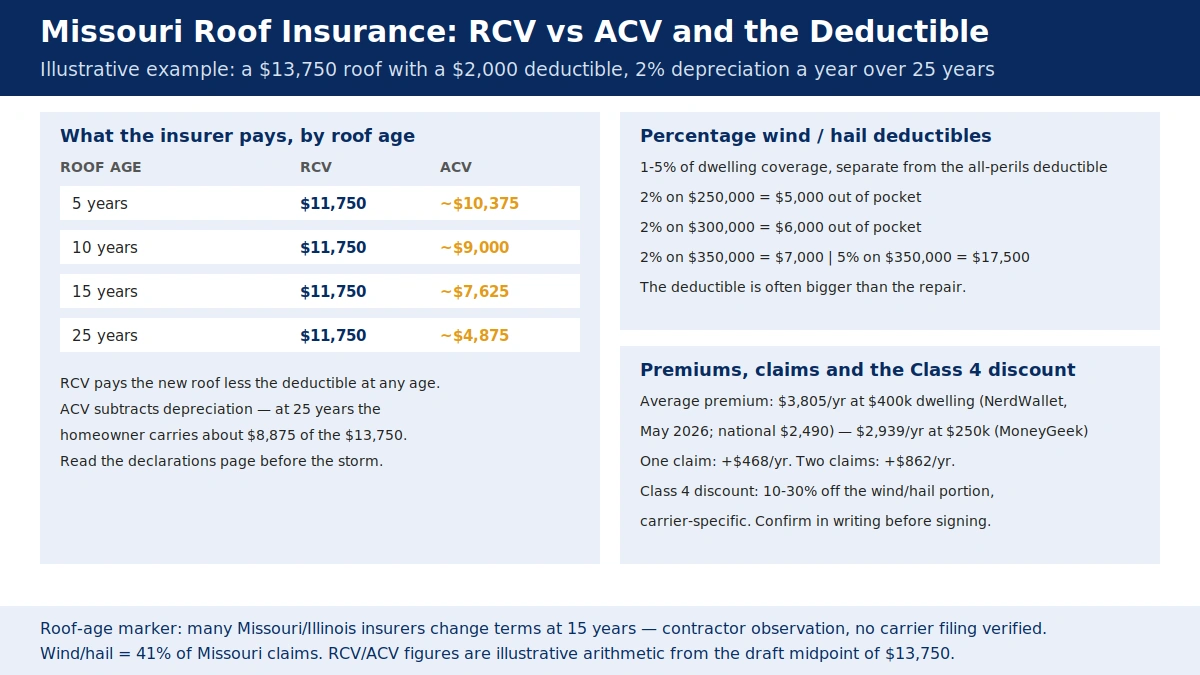
Paying for a Missouri Roof in 2026: No Federal Credit and Rebates That Have Not Launched
Missouri is a state where the federal home-energy rebate programs have not launched at all — and that distinction changes nothing about a roofing quote, which is the point of this section. The Missouri Department of Natural Resources, Division of Energy, submitted its initial funding application to the United States Department of Energy in November 2024, for about $75.4 million in HEAR funding and about $75.7 million in HOMES funding, more than $151 million in total. On August 20, 2026, the department announced it had selected BDO Government Services, working with the Environmental Improvement and Energy Resources Authority, to deliver both programs — and the same announcement said the department was still waiting for federal approval and funding, with more information to come as the programs moved toward launch. On the Energy Department’s February 6, 2026 map, Missouri sits among the jurisdictions where the programs have not launched. A check of the program on October 27, 2026 listed Missouri as “funds awarded: not launched,” with no program running. A status check verified November 4, 2026 put Missouri among the 38 states where the rebate has never launched for homeowners, with rebates possibly not arriving until 2027 or 2028. A Kansas City heating and cooling source writing in late October 2026 confirmed that Missouri’s state-administered rebates are not yet available to claim and no launch date has been announced. When HEAR does pay, it offers up to $8,000 per heat pump to low- and moderate-income households at or below 150 percent of area median income — and under the Energy Department’s Notice 26-2 of May 29, 2026, only electric-to-electric upgrades qualify. HOMES pays up to $4,000 generally, and up to $8,000 for low-income households at or below 80 percent of area median income, on modeled or measured energy savings. But HEAR never pays for a roof. This research pass found no lease or pass-through arrangement steering federal dollars to a Missouri roof, no Missouri state roof grant, rebate or tax credit, and no utility roof rebate. A homeowner who pairs a reroof with a heat pump should price the two jobs separately: the roof comes out of the homeowner’s pocket, and the heat pump may qualify for HEAR — in a future year, under rules Missouri has not yet published. Our heat pump cost in Missouri guide prices the rebate side of that decision, and the waiting side of it.
For 2026 installs both federal credits are gone, and the placed-in-service cutoff is the date that matters. The cutoff falls on the placed-in-service date: after December 31, 2025, neither credit pays a cent. That covers the Residential Clean Energy Credit (§25D, 30 percent) and the Energy Efficient Home Improvement Credit (§25C) alike. Both credits were ended by the One Big Beautiful Bill Act, Public Law 119-21, signed on July 4, 2025, with the cutoff confirmed in IRS Fact Sheet FS-2025-05. The cutoff is a placed-in-service date, not a purchase date: a roof bought in 2025 but installed in 2026 still gets nothing. A roof was never solar equipment in the eyes of the credit. For a roof alone, the solar credit was never available at all. Section 25D covers solar equipment, and roofing never met its definition. Some homeowners did claim §25C for qualifying roofing materials while it lasted. That door is closed too. A tax-credit line on a 2026 quote means the contractor built the price on a law that expired. Have it taken off the quote and the job re-priced clean. A 2026 quote with a federal tax-credit line on it is a quote built on expired law. For 2026 installs, the claimable credit is zero. Any quote subtracting a 30 percent credit for a 2026 owned install is wrong, and a contractor who leaves the line in after being told is a contractor to walk away from.
Section 48E is a commercial clean-electricity credit for solar arrays and similar equipment; it reaches no part of a roof. The §48E pass-through reaches a leased solar array through the lease or power purchase agreement, for equipment in service by December 31, 2027, and it never reaches the roof underneath the array. A homeowner weighing a solar array under the new roof should price the array and the roof as two jobs with two different money stories, because the lease that carries the credit carries no roofing dollars with it. A Missouri homeowner who needs help paying in 2026 has two honest routes: a home-equity loan or a contractor financing plan. The annual percentage rate comes before the monthly payment, and the total interest over the life of the loan comes before either. The money comes from the insurer, in the end, through the only two channels that exist: a Class 4 roof can earn a discount on the wind and hail portion of the premium, and every claim the roof rides out saves a deductible. The insurer is what pays toward a roof, through the Class 4 discount and the avoided deductible, and no rebate program in Missouri pays toward one at all.
Repair or Replace: The Missouri Decision Rules
Early in a roof’s life, with damage confined to one spot, a patch beats a full tear-off. Think of a roof under ten years old that lost a few shingles, sprang a leak at one chimney flashing, or had wind lift several tabs on a single slope. A targeted fix is the right call there, not a whole new roof. The repair prices from NumeralQ, pricing October 26, 2026, set the scale statewide: flashing repair $198–$426, finding and fixing a leak $268–$750, and a chimney reflash $279–$620. In St. Louis the same jobs run $232–$496, $312–$870, and $323–$710, with a skylight leak at $335–$660. In Kansas City they run $231–$494, $310–$870, and $322–$710. A St. Louis contractor’s ledger runs higher, with most repairs at $300–$1,500 and a typical single-issue repair near $500–$700, and chimney work higher still: a reseal at $300–$800, a full reflash at $800–$2,500, and a reflash plus cricket at $1,500–$3,500. The spread between the two sets of numbers is the difference between a price list and a ledger: NumeralQ prices the part, Gorilla prices the job, and a minimum service charge of $150–$300 means a five-minute fix still costs that much. Patching, partial replacement, and the point where repair stops making sense for a Missouri roof are priced on their own terms in our roof repair cost guide. One Missouri pricing page puts the typical repair call-out at $625, which sits inside the ledger range and is a fair number to carry into the first phone call.
Three signals can each point to replacement: age, spread, or arithmetic. Architectural shingles past fifteen years, with wind damage across more than a quarter of the slopes, call for replacement rather than repair. Patching a lifted mat is cosmetic work: the roof fails at the next storm regardless, and in Missouri the next storm is a spring away. A soft deck or delaminated sheathing means replacement too — structure gets replaced, never repaired, and the per-sheet rate agreed before tear-off is what keeps that replacement honest. If ice dams come back every winter despite insulation and ventilation work, the system has failed, not the shingle, and the reroof is the job that fixes the system. The same logic applies to an insurer-paid claim on a roof old enough that the next claim would pay ACV at a third of the cost: take the replacement money while it is still on offer. A roof about to cross the carrier’s fifteen- or twenty-year trigger is a replacement too — the policy about to go ACV, the carrier about to decline renewal, the discount about to vanish. A repair quote above about a third of the replacement quote, on a roof with under five years of life left, is a replacement too, because the repair buys months and the replacement buys decades.
Checking twice a year keeps the repair-or-replace decision out of panic territory. Check in fall for the summer’s wind and hail damage, while the adjuster’s window is still open and the crew can still seal shingles in warm weather. Use spring to catch what winter did — ice-dam and freeze-thaw damage — before tornado season piles a second round of trouble on top. After several Missouri springs, a roof can look sound from the curb while sitting much closer to failure than it appears. The mat bruises from the inside, the granules wash into the gutters a little at a time, and the bruise stays hidden until the shingle splits. A professional inspection after a major hail event — not a door-knocker’s free inspection with an agreement attached, but a paid inspection from a local company with a shop — is the cheapest decision in this whole guide, and our roof inspection cost guide prices what a proper one should include. Gutters belong in the same conversation: NumeralQ prices seamless aluminum gutters at $7.53–$10.90 per linear foot installed in Missouri, and a reroof is the cheapest moment to replace gutters that are already failing, before the new roof’s runoff finds the old gutter’s weak spots. Options and installed prices are in our gutter installation cost guide.
Getting Quotes in Missouri: The Checklist
Work through the ten items below in the order given. Skip an item and the quote you sign is one you never truly read.
- Roof measurements in writing. Square count, pitch, and waste allowance, printed on the bid — never priced from the listing’s living area, and never from a satellite estimate the crew has not verified on the roof.
- Material named by manufacturer and line. GAF, CertainTeed, or Owens Corning, with the exact shingle line and the Class 4 UL 2218 marking where the upgrade is priced, plus the underlayment type beside it.
- Tear-off depth stated. One layer or two, and the per-sheet deck replacement rate agreed before the old shingles come off — NumeralQ’s Missouri planning figure is $55.85–$81.63 a sheet installed, but the rate on the quote is the only number that counts.
- Nailing pattern, ice shield and ventilation in the scope. Six-nail high-wind fastening in the wind-exposed parts of the state, ice and water shield coverage stated in feet from the eave where it applies, and balanced soffit-to-ridge ventilation with intake and exhaust both named.
- Drip edge, flashing and cleanup named. Drip edge at eaves and rakes, flashing scope at every chimney, valley and penetration, and disposal and magnetic nail cleanup included in the total, not added after.
- Certificates for liability and workers’ compensation, mailed straight from the carrier. Business name matching the contract, never a certificate the contractor hands over, and the Secretary of State registration checked against the same name.
- Local license or registration and references checked. The Kansas City contractor license, the St. Louis Graduated Business License, or whatever registration the job’s own city or county requires — Missouri has no state license to check — plus three local references from your own county with street addresses to visit, and a permanent Missouri address and local number in service since before the last storm.
- Three written quotes, all priced against one shared spec sheet. One spec, three bidders, so the prices compare the same roof, and no quote signed on the spot after a storm without the five-business-day cancellation right in the contract.
- No deductible-waiver promise, no federal tax-credit line, no HEAR rebate line. A deductible waiver is illegal for the contractor to offer under RSMo section 407.725, the federal credit is $0 in 2026, and HEAR has not launched in Missouri and never covers roofing.
- The insurer’s Class 4 discount confirmed in writing before signing. Qualifying product list and paperwork included, before the install — a promised discount is not a discount until the carrier confirms it, and the confirmation should name the exact shingle line on the quote.
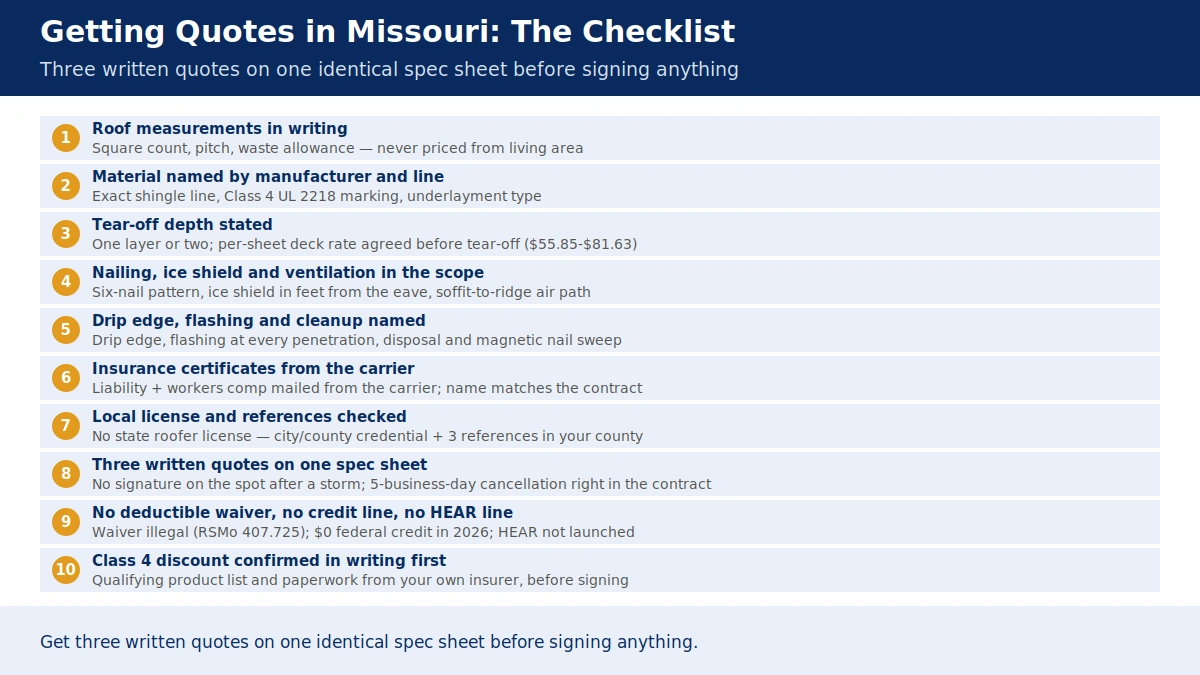
Sources & methodology
Every price in this guide carries its source and its date, and every number this guide worked out itself is labeled as its own arithmetic. The 25-square material totals, the size-table figures, the Class 4 totals, and the cost-per-year figures are NestPriced’s own calculations from the cited per-square ranges and lifespans, worked out by dividing each midpoint total by its midpoint realistic life. The RCV/ACV worked example in the insurance section is our own calculation too, built on a $13,750 roof, a $2,000 flat deductible, and straight-line depreciation of 2 percent a year over a 25-year shingle life. The Kansas City permit arithmetic, the extra-layer removal total, and the whole-roof ice-barrier total are our own arithmetic from the cited rates. The lifespans are realistic figures worked from Missouri contractor accounts and the climate, not numbers lifted from one published table. Where two sources disagree, both are printed and the disagreement is flagged rather than settled silently.
- Headline prices: SmartRoofingCalculator Missouri state page (page dated Apr 24, 2026; index updated Nov 9, 2026): architectural shingles $450–$650/sq fitted with tear-off; 25-square roof $11,250–$16,250 (title band $11,300–$16,300, flagged); standing seam $900–$1,400/sq; tile $1,200–$1,810/sq; permit ~$175 ($100–$275); roofer median $25.69/hr (May 2024 BLS vintage); about 2,050 roofers, mean $28.74/hr (same vintage); state factor 1.003; Missouri ranks 37 of 50 cheapest-to-most-expensive. Kansas City page (Apr 24, 2026): $428–$618/sq, 25-square $10,688–$15,438, local factor 0.95, same figure given for St. Louis.
- NumeralQ Missouri (pricing Oct 26, 2026; state page updated Oct 29, 2026): 2,000 sq ft roof statewide $9,120–$11,070; Kansas City $9,960–$12,170; St. Louis $9,990–$12,210; size table 1,000–3,000 sq ft; material table for a 2,000 sq ft roof (3-tab $7,670–$9,040 through natural slate $30,730–$60,810); add-ons — extra layer $1.15–$1.52/sq ft, deck sheet $55.85–$81.63, whole-roof ice and water barrier $0.82–$1.34/sq ft, gutters $7.53–$10.90/linear ft, chimney/wall flashing $298–$431, skylight reflash $452–$582; about 53% of Missouri homes built before 1980 (Census ACS 2020–2024); NOAA Storm Events 2016–2025 tallies (3,349 large-hail reports, 343 at 2 in+, 596 tornado reports, 5,835 wind reports); FEMA hail risk Very High in Jackson County, Relatively Moderate in St. Louis city; St. Louis permit $175 on a $15,000 job from the city fee schedule; no state roof grant found as of October 2026; RSMo 407.725 text read Nov 6, 2026; lien-law summary via Levelset checked Nov 10, 2026.
- MyRoofData Missouri (2026 model): typical single-family architectural roof $11,750–$20,500, about 8% below the national average; crews $48–$82/hr; state cost index 0.92; tear-off $100–$200/sq/layer; permits $75–$300 in metro jurisdictions; material table per square before tear-off — 3-tab $322–$506, architectural $414–$690, ribbed metal $506–$874, standing seam $874–$1,472, cedar $828–$1,380, concrete tile $920–$1,656, clay tile $1,104–$2,300, natural slate $1,380–$2,760, flat membrane $506–$874; cut-up roof adds about 15% labor.
- RoofingEstimatorPros (updated Aug 26, 2026): 2,000 sq ft architectural roof $13,100–$23,575, average $17,755, about $8.88/sq ft including tear-off, permits and waste; permit range $150–$500; state multiplier 0.94x — flagged as the high outlier, and its “licensed Missouri roofer” wording is wrong against the no-state-license fact.
- Gorilla Roofing, St. Louis (2026 guide): $8,000–$17,000 for a typical 2,000 sq ft home, most jobs $9,500–$14,000; per square — 3-tab $350–$550, architectural $400–$700, Class 4 $475–$800, metal $800–$1,500; per-square build (shingles $95–$140, underlayment/accessories $60–$120, tear-off/disposal $100–$150, labor $150–$350); prices up 15–25% 2024–2026, two 2026 shingle price rises, tariff pressure on flashing and metal; repair guide (Sep 3, 2026): most repairs $300–$1,500, typical $500–$700, chimney reflash $500–$2,500, minimum service charge $150–$300; lifespan guide: poor ventilation costs 5–10 years, insurers change terms at 15 years.
- Lane House Roofing, St. Louis (updated Jul 29, 2026): $9,500–$18,000, $400–$750/sq; lifespans — 3-tab 12–18 yrs, architectural 18–25, standing seam 40–60, cedar 20–30; materials underperform national ranges by 15–25%; 49 days at or above 90°F in 2025 vs 35–40 normal, about 60 freeze-thaw crossings a year, 85 days at or below freezing (NWS St. Louis); ventilation minimum 1/150 under IRC R806.2; City of St. Louis permit claim (no permit for like-material replacement with 25% or less sheathing) — flagged against NumeralQ’s $175 schedule figure.
- Bold Roofing, Branson/Springfield (Nov 2026): $10,000–$20,000 range, $15,301 average across 118 projects, about $450/sq; steep 12/12 about $110/sq more than 4/12; deductible article (Nov 2–4, 2026) on RSMo 407.725.
- Shingle Geek, Springfield (Jun 1, 2026): average retail $10,319 for a 22-square roof; wholesale $7,223; GAF Timberline HDZ fair retail $9,906–$10,732 on 22 squares.
- CoMo Premium Exteriors, Central Missouri (spring 2026): 3-tab $3.50–$5.50/sq ft, architectural $5.00–$7.50/sq ft, premium $7.50–$12.00+/sq ft; lifespans 3-tab 15–20, architectural 20–25, premium 25–30; roof surfaces 140°F or higher; Class 4 premium 20–40% ($2,000–$5,000), carrier discounts State Farm up to 30%, Allstate 10–20%, American Family 15–25%.
- Angi St. Louis (updated Jul 9, 2026): average $8,155, range $5,433–$11,032 — flagged as the low outlier; metal roof page (Jul 20, 2026): average $11,056, about $11/sq ft, full metal replacement average $19,800, permit fee $193.
- Instant Roofer (2026 snapshot; contractor-entered pricing, 341,800 Missouri roofs, 980 contractors): Missouri average $13,185 for asphalt, 25.44 squares, $518/sq; St. Louis $13,937, Kansas City $12,658, St. Joseph $12,394; labor $160–$280/sq — flagged as contractor-entered.
- SquareDash (Apr 2026): Columbia $11,300 fixed for a 2,000 sq ft home; Kansas City, KS $12,000 (Kansas side, flagged).
- HomeCostLens St. Louis (Sep 2026): average ~$10,460 for a 2,200 sq ft home, range $8,560–$17,120; Kansas City $10,180.
- BestRoofingEstimates Missouri (late-2025 page): average $11,400 for a 2,000 sq ft home; architectural $9,200–$17,000; standing seam $18,000–$34,000; Class 4 adds 10–25%; Ozarks/rural 3–8% below metros; roof surface about 1.3x footprint; asphalt life 18–22 years; repair call-out $625 — older page, used as a cross-check only.
- Snowfall, 1991–2020 normals (NCEI via Current Results): Springfield 13.7 in/yr; Columbia 16.5; St. Louis 16.6; Kansas City 18.2; Trenton 17.2; Kirksville 19.0; north of the Missouri River 18–24 in/yr, southernmost counties 8–12; Edina about 22 in/yr (1985–2015). Conflicts: Kansas City 12 in/yr (myPerfectWeather, same normals) vs 18.2; St. Louis a little over 18 in/season (NWS via StudyCountry) vs 16.6 — both printed.
- Ground snow load and wind: ASCE 7 hazard mapping 10–25 psf, averaging 15–25 (RoofSquareFootageCalculator guide); Willard, MO IRC 2018 Table R301.2(1): 20 psf ground snow load, 115 mph wind, climate zone 4A; design wind 105–115 mph range (foundation-engineering source). No statewide figure verified for any of these.
Sources, continued:
- Tornadoes: state climatologist Zachary Leasor (KCUR, May 13, 2026): average about 40/yr; 41 by early May 2026, all EF0/EF1; 75 by early May 2025. NOAA SPC Severe Weather Database via EarthMapped (1950–2025): 2,707 total, 50.2/yr for 1996–2025, 165 F3/EF3+, 423 deaths. TornadoPath: 57.7/yr last decade, most active year 2006 with 143. NWS Kansas City forecast area: 37 tornadoes in 2026, record vs 33 in 2003, average 11 (FOX4KC, Nov 9, 2026).
- Joplin, May 22, 2011: EF5, 5:34 p.m., 38 minutes, path 21.62 miles (22.1 in some tallies), about 1 mile wide, winds over 200 mph (estimated 225–250); 158 direct deaths, 161 total commonly cited; about 1,150 injured; nearly 8,000 buildings damaged, 4,000+ houses destroyed (6,954 homes in one tally); $2.8 billion damage, costliest single tornado in U.S. history (NWS Springfield survey; Wikipedia summary of NWS/NCEI; Missouri Southern State University; NIST/PreventionWeb). NIST technical investigation (2014), 16 recommendations; ASCE 7-22 Chapter 32 tornado loads in the 2024 IBC for Risk Category 3 and 4 structures, covering about 97% of tornadoes; Joplin single-family hurricane-clip requirements (ENR, Oct 2024; SmartSign summary). The “135 mph or less” damage finding is a secondary report, flagged.
- St. Louis, May 16, 2025: EF3, peak 152 mph (136–165 in one source), 1.8 miles wide, path 12.29 miles (NWS survey) vs 23 miles (city recovery report, May 16, 2026); $1.6 billion damage; 4 deaths plus 1 non-tornadic (five lives per the city); 38 injured; about 5,000 structures initially, 7,500+ buildings in the city’s updated count; 24 neighborhoods; first deadly St. Louis tornado since 1959; $371 million recovery funding secured; blue tarps still present a year later (Martin & Sons, 2026).
- Hail: NOAA Storm Events 2016–2025 via NumeralQ (see above); SPC preliminary Jan 1–Oct 13, 2026 via SMA (Oct 14, 2026): Missouri 702 raw reports, third nationally; Kansas City metro 62 filtered reports, 24 on Mar 10, largest 4.50 in near Weatherby Lake; St. Louis metro 25 reports, largest 2.50 in near Highland, Aug 21. State Farm $580M Missouri hail claims in 2024, up 10% in 2025, second nationally; major hail events up 182% and 2-inch-plus events up 730% 2022–2024 (ClimateCosmos secondary summary of State Farm data, flagged). Hail season March–July, I-44/I-70 corridors, top-10 hail-claims state (SDAT Roofing, Apr 2026 — contractor source, labeled).
- Code and licensing: no statewide residential building code and no statewide roofer or general contractor license (RoofingLicenseCheck, checked Oct 22, 2026; HouseCall Pro 2026 guide; PermitFlow Missouri guide; Build-Your-House, May 2026). Local layer: Kansas City contractor licensing (Planning & Development), St. Louis Graduated Business License (License Collector), St. Louis County specialty registration, Springfield registration (Building Development Services). Kansas City reroof exemption: Code Sec. 18-16(b)(1)k (kcmo.gov; NumeralQ, checked Oct 10, 2026). Lee’s Summit re-roof permit $50 (cityofls.net). Columbia re-roof permits 218, Oct 2024–May 2025 (como.gov); fee $2.25/$1,000 ($35 min, Sec. 6-17) vs 0.0025 multiplier (2023 help document) — conflict, both printed. Springfield 2018 IBC/model codes (springfieldmo.gov); Springfield fee unverified. RSMo 407.725 (Revisor of Statutes text; effective Aug 28, 2014; five-business-day cancellation; ten-day vs ten-business-day refund discrepancy flagged); MMPA private action RSMo 407.025 (RoofingStormDamage summary); lien rules RSMo 429.012–429.013 (NumeralQ/Levelset summary).
- Labor (BLS OEWS May 2025): Missouri roofer median $23.35/hr, mean $27.08, 2,050 employed, 10th $18.50, 90th $37.84; national median $26.65, mean $27.95. Metro medians: St. Louis, MO-IL $28.25 (mean $31.20, 1,110 employed); Kansas City, MO-KS $28.09 (mean $28.32, 880 employed); Central Missouri balance of state $22.31. Conflict: SmartRoofingCalculator’s May 2024 vintage lists the Missouri median at $25.69/hr — this guide uses May 2025. NumeralQ billed rate $47–$61/hr.
- Insurance: NerdWallet (May 6, 2026) Missouri $3,805/yr at $400,000 dwelling (national $2,490); MoneyGeek (2026) $2,939/yr at $250,000 dwelling, deductible table $500/$1,000/$1,500/$2,000 → $3,152/$2,939/$2,787/$2,650, one claim +$468/yr, two claims +$862/yr; Insurify via SuperMoney (Mar 2026) $2,826 end-2025, projected $3,035 end-2026; InsuranceQuotes (Sep 30, 2026) $5,187 sample-home average — flagged as the high outlier; BoringRate (Jun 15, 2026) $2,891/yr; Quote.com $255/month, wind/hail 41% of claims. Percentage wind/hail deductibles 1–5% (RoofingStormDamage; TeamZLab); Gorilla: $1,000–$2,500 or 1–2%. Roof-age 15-year marker (Gorilla, contractor observation). DCI hotline (573) 751-4126 / 1-800-726-7390 (SDAT); claim-handling deadlines as summarized by SDAT, not verified against regulation text.
- Class 4 + insurance discounts: UL 2218 Class 4 test (2-inch steel ball from 20 feet); premium estimates 5–10% (RoofingStormDamage), 10–25% (BestRoofingEstimates), 20–40% / $2,000–$5,000 (CoMo), Gorilla bands $475–$800/sq vs $400–$700/sq; discount ranges 10–30% off the wind/hail portion (RoofingStormDamage; Roof Tech Lee’s Summit; CoMo), carrier splits per CoMo, 10–20% (RoofRepair.co table); payback 2–4 years (RoofingStormDamage). No Missouri-specific premium from a contractor ledger and no carrier filing verified.
- Federal help: OBBBA (P.L. 119-21; IRS FS-2025-05) ended §25C/§25D for post-Dec-31-2025 installs — $0 federal credit for a 2026 owned install. HEAR/HOMES not launched in Missouri (Missouri DNR announcement Aug 20, 2026; DOE Feb 6, 2026 map; ECW check Oct 27, 2026; HeatPumpPricing verified Nov 4, 2026; Santa Fe Air Oct 28–29, 2026): allocations about $75.4M HEAR + $75.7M HOMES; application submitted Nov 2024; BDO Government Services selected Aug 2026; federal approval pending; rebates possibly 2027–2028. HEAR up to $8,000 per heat pump at or below 150% AMI, electric-to-electric only since DOE Notice 26-2 (May 29, 2026); HOMES up to $4,000 general, $8,000 low-income at or below 80% AMI. §48E lease pass-through to Dec 31, 2027, solar equipment only. No Missouri state or utility roof rebate found (NumeralQ, Oct 2026).
- Lifespans: the Missouri lifespans here are contractor-consensus estimates fitted to a climate of tornadoes, hail, summer heat, humidity, freeze-thaw and northern ice. Lane House St. Louis figures anchor 3-tab, architectural, standing-seam and cedar; the Class 4 life of 25–35 years is a planning figure between CoMo’s premium range and Gorilla’s Class 4 range; tile, slate and flat-membrane lives follow MyRoofData. The lifespans are realistic figures, not numbers lifted from a single published table.
Prices change, and a quote from last month is not a quote from today. Verify every figure against a current written bid before signing.
EXCLUDED:
- Any “after 30% credit” prices
- Any HEAR-for-roof claim: HEAR never pays for a roof, and Missouri’s HEAR program has not launched at all; electric-to-electric only since DOE Program Notice 26-2, May 29, 2026
- Any HOMES-for-roof claim: roofing is not a covered HOMES measure, and Missouri’s HOMES program has not launched
- Any Missouri state roof grant, rebate or tax credit: none found as of October 2026
- Any Missouri utility roof rebate: none verified
- Any “licensed Missouri roofer” claim: Missouri issues no state roofer license; licensing is city/county only
- Any Kansas City permit fee as a re-roof requirement: reroofing one- and two-family homes with light covering is permit-exempt in Kansas City under Sec. 18-16(b)(1)k, except sheathing and structural work
- Any single St. Louis permit answer: the $175 schedule figure and the no-permit claim are both printed, unresolved
- Any Springfield re-roof permit fee: not verified from the city schedule
- Any Joplin, Springfield (NumeralQ) or Columbia (NumeralQ) city price: none verified, none invented
- Any statewide Missouri ground snow load, design wind speed, ice-barrier requirement or insulation R-value: none verified; local jurisdiction governs
- Any Missouri-specific Class 4 premium per square from a contractor ledger: none verified; four published estimates are printed instead
- Any carrier-published Missouri Class 4 discount from a rate filing: none verified; contractor and guide ranges are printed instead
- Any Missouri-specific roof-age trigger from a carrier filing: none verified; the 15-year marker is a contractor observation
- Any verified full-year 2025 or 2026 Missouri tornado total from NOAA: only the early-May counts and the Kansas City forecast-area record were verified
- The $5,187 InsuranceQuotes premium as the Missouri average: a four-insurer sample-home figure, flagged as the high outlier
- The $325/$167 figures as Missouri license fees: mixed Kansas City figures from different years and categories, per RoofingLicenseCheck
- The claim that Missouri adopted a statewide building code: WRONG — Missouri has no statewide residential building code; adoption is local
- The claim that the 2024 IBC tornado-load rules cover ordinary Missouri houses: WRONG — they cover Risk Category 3 and 4 structures only
- A Missouri-specific monthly snowfall table beyond the annual normals, a county hail-damage dollar total, a Missouri Attorney General post-storm complaint count, or insurer claim-deadline rules verified against regulation text — none verified
*Disclaimer: This guide is general information, not professional advice. Prices are 2026 estimates for Missouri based on the sources cited and will vary with roof size, pitch, condition, material, and contractor. Permits, codes, and licensing rules vary by city and county — Missouri has no statewide building code and no statewide roofer license, so confirm the rules with the local building department that covers the property. Insurance terms, deductibles, and discounts vary by carrier and policy — confirm them with your own insurer before signing. Tax information is general, not tax advice — confirm it with a tax professional. Always obtain multiple written quotes from local contractors before budgeting.*
What does a roof replacement cost in Missouri in 2026?
SmartRoofingCalculator prices a typical 25-square architectural shingle roof at $11,250–$16,250 for 2026, while NumeralQ (pricing October 26, 2026) puts a 2,000 square foot roof at $9,120–$11,070 statewide. On that 25-square roof, 3-tab shingles run $8,050–$12,650 before tear-off, Class 4 impact-rated shingles run $11,875–$20,000 on St. Louis fitted bands, and standing-seam metal runs $22,500–$35,000. Kansas City runs $9,960–$12,170 for a 2,000 square foot roof and St. Louis $9,990–$12,210, while Springfield contractor ledgers average $15,301 across 118 reviewed jobs and Columbia’s fixed-price average sits at $11,300. No verified Joplin figure exists, and this guide invents none. Pitch, decking condition, layers to tear off, and material move any quote off those bands, so get the square count in writing and compare bids on price per square.
How much does a roof cost per square in Missouri?
Architectural shingles run $450–$650 per square fitted with tear-off, per SmartRoofingCalculator, and MyRoofData prices the same material at $414–$690 a square before tear-off. Class 4 impact-rated shingles run $475–$800 a square fitted in St. Louis, per Gorilla Roofing, though published premium estimates disagree widely, from 5–10 percent to 20–40 percent over standard architectural. Standing-seam metal runs $900–$1,400 a square fitted, 3-tab $322–$506 before tear-off, ribbed metal $506–$874 before tear-off, cedar $828–$1,380 before tear-off, tile $1,200–$1,810 fitted, and natural slate $1,380–$2,760 before tear-off. A square is 100 square feet of finished roof surface, and a typical Missouri home carries 20 to 25 squares, so the per-square rate times the measured square count is the only honest way to compare two bids.
Do I need a permit to replace a roof in Missouri?
It depends entirely on the city or county, because Missouri has no statewide building code and no statewide permit rule. In Kansas City, reroofing a one- or two-family home with a light covering needs no building permit under Code Sec. 18-16(b)(1)k, unless sheathing or structural work is involved. In Columbia, a re-roof permit is a standard work class, costing about $35–$38 on a $15,000 job. In St. Louis the answer is genuinely disputed: the fee schedule reads $175 on a $15,000 job, while a local contractor states no permit is needed for a like-material re-roof with limited sheathing work — call the Building Division and get the answer for the specific scope. In Lee’s Summit a re-roof permit costs a flat $50. In many rural counties no permit or inspection exists at all. Minor repairs usually need no permit anywhere, and structural work always does.
Does Missouri license roofers?
No. Missouri licenses no roofers and no general contractors at state level, with no state exam and no state fee. The only statewide construction license is the optional electrical contractor license. Licensing lives with cities and counties: Kansas City licenses residential building and trade contractors, the City of St. Louis requires a Construction Industry Contractor Graduated Business License, St. Louis County registers specialty contractors, and Springfield requires registration with Building Development Services. A credential from one jurisdiction means nothing in the next, and in unincorporated counties there may be no credential at all. Verify the credential with the city or county building department, confirm the business registration with the Missouri Secretary of State, and get insurance certificates mailed straight from the carrier, because in a state with no license to revoke, the homeowner’s own screening is the only protection that exists.
How do I spot a storm chaser after a Missouri hailstorm?
Watch for the door knock in the days after the storm, with a free-inspection agreement pushed across the threshold and pressure to sign before the adjuster visits. The other signs arrive together: an out-of-state phone number, no permanent local office, no local license or registration, a promise to make the insurance deductible disappear, and a demand for a large payment before any work starts. The deductible promise is the clearest tell in Missouri, because RSMo section 407.725 bans a contractor from advertising or promising to pay or rebate any part of a deductible, including through discounts, gifts, coupons or referral fees. A legitimate local crew has a shop you can drive to, a local number in service since before the storm, references in your own county, and no objection to waiting for the adjuster’s report. If the insurer denies any part of the claim, section 407.725 gives the homeowner until midnight on the fifth business day after that written notice to cancel the contract.
How long does a roof last in Missouri?
Hail, summer heat and freeze-thaw shorten shingle life, while metal and slate outlast what their brochures promise. Architectural shingles last 18–25 years in St. Louis on one contractor’s figures, against 20–25 in Central Missouri and 25–30 on another St. Louis account — the spread is the difference between a roof that takes hail and one that does not. Three-tab shingles last 12–18 years, Class 4 shingles 25–35, ribbed metal 30–40, standing-seam metal 40–60, cedar 20–30, concrete tile 40–75, clay tile 50–100, natural slate 75–150, and flat membrane 20–30. Summer heat dries the asphalt binder, humidity feeds algae that holds moisture against the surface, roughly 60 freeze-thaw crossings a year work every joint looser, and a single hailstorm can end a roof a decade early. Poor attic ventilation routinely costs five to ten years. The warranty name on the shingle is not the service life; the storm record is.
Does homeowners insurance cover a roof replacement in Missouri?
The answer turns on the policy type, and the distance between the two types is the costliest surprise in Missouri insurance. With replacement cost value, the insurer covers the new roof’s cost minus the deductible, no matter how old the damaged roof was. Actual cash value pays new-roof cost minus depreciation, and shingle value falls fast. On a $13,750 roof with a $2,000 deductible and 2 percent annual depreciation, replacement cost pays $11,750 at any age, while actual cash value pays $10,375 at five years, $9,000 at ten, $7,625 at fifteen, and $4,875 at twenty-five. Most Missouri policies now carry a separate percentage wind and hail deductible of 1–5 percent of dwelling coverage: 2 percent on a $300,000 home is $6,000 out of pocket before the insurer pays anything. Many carriers change terms at 15 years, and roofs over 20 often face surcharges or refusal. Read the declarations page before the storm, photograph damage before anyone touches it, and get the adjuster’s written report before the contractor estimates.
Can I get a rebate or tax credit for a new roof in Missouri in 2026?
No. Anything placed in service after December 31, 2025 earns zero from either federal credit. Neither the Residential Clean Energy Credit (§25D, 30 percent) nor the Energy Efficient Home Improvement Credit (§25C) applies. The One Big Beautiful Bill Act (Public Law 119-21), signed on July 4, 2025, ended both credits, and roofing never qualified for §25D in any case. Missouri’s federal HEAR and HOMES rebates have not launched at all: the Department of Natural Resources applied in November 2024, selected an administrator in August 2026, and was still awaiting federal approval, with rebates possibly not arriving until 2027 or 2028. Even when they launch, neither program pays for a roof — HEAR pays up to $8,000 per heat pump for income-qualified households, electric-to-electric only, and HOMES pays on whole-home energy savings. No Missouri state roof grant, rebate or tax credit exists, and no utility roof rebate was verified. Any 2026 quote subtracting a 30 percent credit for an owned install is wrong.