


Missouri is the state where the cheapest power in the Midwest meets the most unforgiving billing calendar in the country, and the collision between those two facts is the whole economics of rooftop solar here. The hardware is a bargain by national standards: $2.74 a watt installed, twelfth-lowest of the fifty states and the District of Columbia, fifteen cents under the national average and cheaper than every neighbor except Oklahoma and Kentucky. The sun cooperates too, after a fashion — about 1,399 kilowatt-hours a year from each installed kilowatt, enough for the typical 7.69 kW array to cover roughly six-sevenths of what the average Missouri home draws in a year. What refuses to cooperate is the price of the power those panels displace. Missouri homes paid 13.97 cents a kilowatt-hour on average over the twelve months to August 2026, the twelfth-lowest rate in the country, and the average bill came to about $145 a month. Every kilowatt-hour a panel makes is worth less here than almost anywhere else, and no subsidy arrives to make up the difference.
Then comes the calendar. Missouri law nets solar power one billing month at a time, and it attaches a clock to whatever is left when the month closes. Power your panels send out at noon cancels power you buy that evening, at full retail value, as long as both land inside the same billing month. Power left over when the bill closes is marked down to the utility’s avoided fuel cost — 3.84 cents in summer on Ameren Missouri, 1.90 cents all year on Evergy Missouri Metro — and the resulting credit expires twelve months after it is issued, with no payment for what goes unused. A system sized to the year, the way installers size systems in most states, banks its spring surplus at pennies and watches it lapse before winter demand arrives. A system sized to the month keeps nearly everything it makes at full retail value. The difference between those two designs is not a rounding error; on Ameren Missouri it is the difference between a payback near sixteen years and one that drifts years longer, and it is the reason this guide reads the tariff sheet before it reads the price list.
The state also divides in ways a single statewide number hides. Ameren Missouri serves St. Louis and the east, Evergy serves Kansas City and the west in two separate territories with two different surplus rates, Liberty serves the southwest around Joplin, City Utilities serves Springfield, Columbia Water and Light serves one city with the state’s only rebate, Independence Power and Light serves its own city, and about forty rural cooperatives serve the rest — each setting its own surplus rate, each with its own sizing formula, each with its own answer time. The housing stock divides the same way: brick bungalows and postwar ranches under mature oaks in St. Louis, wide suburban roofs in the Kansas City sprawl, Ozark ranch homes around Springfield with room to spare, and college-town rentals in Columbia where the tenant pays the bill and the landlord owns the roof. A quote that ignores which utility delivers the power and which roof holds the panels is not a quote.
This guide prices Missouri the way the market actually prices it. The headline comes from the EcoGen Solar Cost Index for September 2026, cross-checked against EnergySage’s November 2026 marketplace data, and every city figure comes from EnergySage’s own city pages for St. Louis, Kansas City, Springfield, and Columbia. The net-metering section works through the monthly rule utility by utility, to the cent, including the Ameren rate-plan trap that can quietly disqualify a household from net metering altogether. The incentives section names the one rebate that exists, the sales-tax break that is already inside the quote, and the property-tax exemption that no longer exists no matter how many guides still list it. The countrywide baseline comes from the national guide; the rest of this article tests Missouri against it, working through the utilities and the cities one at a time.
Table of Contents
How Much Do Solar Panels Cost in Missouri in 2026?
Two measures describe the Missouri market in 2026, and they look like they disagree until you see that they describe different houses. EcoGen’s September 2026 Solar Cost Index supplies the anchor used throughout: $2.74 per watt before incentives for a Missouri installation, or $21,071 for the typical 7.69 kW system. That is fifteen cents below the national average of $2.89 a watt, and cheaper than Kansas at $2.87, Illinois at $3.05, and Iowa at $3.07, while Oklahoma at $2.64 and Kentucky at $2.65 undercut it from the south. In 2026, Missouri marketplace quotes landed roughly between $2.12 and $2.87 per watt — the spread implied by EnergySage’s November 2026 range of $29,142 to $39,428 on its 13.74 kW average system. A 6 kW system runs $16,440 at the anchor, an 8 kW system $21,920, a 10 kW system $27,400, and a 12 kW system $32,880, all before any incentive — of which, outside Columbia, there is none.
The marketplace offers a second reading, built from live quotes instead of an index. EnergySage, as of November 2026, puts Missouri at $2.49 a watt — twenty-five cents below the EcoGen anchor — but on a far bigger system: its average Missouri system is 13.74 kW, priced at about $34,285. An October 2026 reading from the same source shows the same $2.49 a watt on a 13.73 kW system, and a September 2026 reading shows $2.50 a watt on a 13.4 kW system at about $33,584, while a March 2026 reading shows $2.53 a watt on a 13.04 kW system. The per-watt price barely moved across the year; the system size did the moving, and it moved in one direction. EnergySage’s marketplace average comes from genuine quotes, but the Missouri shoppers behind those quotes lean toward bigger-than-typical systems — all-electric houses, an EV in the driveway, a heat pump replacing gas heat, a home bought with expansion in mind. The 7.69 kW median comes from Berkeley Lab’s count of 381 Missouri systems actually installed in 2025 — the size Missourians genuinely put on their roofs — and EcoGen takes its typical size from that count. The median is the typical size in this guide, because it is what Missourians actually install. As a cross-check on the per-watt price, EnergySage’s $2.49 sits twenty-five cents below EcoGen’s $2.74 — two independent readings, both beneath the national average.
Two further numbers round out the pricing picture, and each one needs its label read before it carries any weight. The November 2026 SolarReviews figure — $2.68 a watt on a 10.9 kW average system, about $31,032 — is a national model assembled from NREL, EIA, and Bureau of Labor Statistics data, not Missouri quotes, and this guide labels it as exactly that. Its table also prints an after-tax-credit column near $21,722 that assumes the 30% federal credit still exists; for a 2026 install it does not, and that column is excluded from this guide as stale arithmetic. SolarSpecHub’s Missouri page lands higher and wider: $25,200 for an 8 kW system, $3.15 a watt, as a planning estimate rather than a quote-derived anchor. NumeralQ’s planning estimates, built from EnergySage data retrieved October 26, 2026, put a 4 kW system at $10,890 to $14,220 and an 8 kW system at $20,690 to $27,040. Put the anchors together and Missouri sits comfortably under the national average on price, with the quote spread — $2.12 to $2.87 on marketplace data — carrying more information than any one figure.
One caution about the typical size before the tables start: it colors every number that follows, and in Missouri it colors them in the opposite direction from the coastal states. That 7.69 kW figure is a median of systems actually installed, not a modeled number — and it undershoots what the average Missouri household uses in a year. Multiply the 1,399 kilowatt-hour yield by the typical 7.69 kW and the result is roughly 10,758 kilowatt-hours a year — set against the average Missouri home’s roughly 12,468 a year, about 1,039 a month. The typical array therefore covers about 86% of the average home’s yearly consumption. On an average-use home, that is plainly less system than the house needs for full annual coverage — and in Missouri, that is a feature, not a failure, because the monthly netting rule punishes surplus and the utilities cap system size from past use. The sizing section further down works through what that gap means for a home that uses more than average, and why the utilities’ own formulas would not let an average-use home install much more anyway.
One per-watt number has to absorb the whole job in Missouri: modules, inverter or microinverters, racking, wiring, labor, permits, inspection, and the interconnection filing. A new roof, a panel upgrade, tree work, a battery, and any structural letter are all priced separately, outside that number. Nothing in that arithmetic assumes an incentive, because for most Missouri buyers no 2026 program cuts the purchase price at all — the federal credit has ended, no general state rebate exists, no state income-tax credit exists, and the utility rebates expired at the end of 2023. The sales-tax exemption is already inside the quote rather than added on top — the installer buys the equipment free of Missouri sales tax, so a second deduction for it is counting the same money twice. The one exception is Columbia Water and Light’s rebate, and it reaches only that utility’s own customers — the incentives section below prices it separately, so the headline stays honest for everyone else. For most Missouri buyers the number on the quote is the number that sticks — nothing comes off it afterward. A quote that subtracts anything else from it is still doing arithmetic under a law that ended on December 31, 2025, or a rebate program that ended two years before that.
A caution before the tables: the cheapest quote in Missouri is rarely the cheapest system once the job is done, and with cheap power stretching every payback past fourteen years, the install price does most of the work in the math. Dealer fees of 20 to 30% of the cash price are often folded into the amount a $0-down loan finances, since overhead and margin are most of what an installer charges, and Missouri has no lease market to offer a competing $0-down route — a loan is the only way to put panels up without cash here. With quotes from St. Louis, Kansas City, Springfield, and Columbia installers spread across the table, the cash price per watt for the same panels on the same Missouri roof is the one number that lets you judge bidder against bidder. Get the figure in writing from three installers, and treat a refusal to write it down as a reason to walk away. In a state where the billing month decides what a kilowatt-hour is worth, that third quote is also the check that the company you are talking to has read your utility’s tariff sheet — and still answers the phone when a spring storm takes a panel with it.
| Source | $ per watt | System | Cash total | Payback |
|---|---|---|---|---|
| EcoGen Index (Sep 2026) | $2.74 | 7.69 kW | ~$21,071 | ~16.0 yrs weighted statewide |
| EnergySage (Nov 2026) | $2.49 | 13.74 kW avg | ~$34,285 | 17.2 yrs — flagged, modeled |
| EnergySage (Oct 2026) | $2.49 | 13.73 kW avg | ~$34,199 | Not published |
| EnergySage (Sep 2026) | $2.50 | 13.4 kW avg | ~$33,584 | Not published |
| SolarReviews (Nov 2026) | $2.68 | 10.9 kW avg | ~$31,032 | Not published |
| NumeralQ planning (Oct 2026) | $2.59-$3.38 | 8 kW | ~$20,690-$27,040 | |
| EnergySage St. Louis County (Nov 2026) | $2.51 | 12.97 kW avg | ~$32,484 | 16.17 yrs — flagged, modeled |
| EnergySage Kansas City (Nov 2026) | $2.68 | 12.69 kW avg | ~$34,029 | 20.69 yrs — flagged, modeled |
| EnergySage Springfield (Nov 2026) | $2.42 | 12.89 kW avg | ~$31,138 | 18.51 yrs — flagged, modeled |
| EnergySage Columbia (Nov 2026) | $2.36 | 14.03 kW avg | ~$33,177 | 14.87 yrs — flagged, modeled |
| National range (article 4) | $2.25-$3.30 | 8.2 kW | ~$24,600 at $3.00/W | 6-12 yrs |
Trust none of the four city rows until its footnote has been read — each one carries a qualifier that changes what the number means. EnergySage’s payback figures — 16.17 years in St. Louis, 20.69 in Kansas City, 18.51 in Springfield, 14.87 in Columbia — are modeled estimates built on its own marketplace averages, and they run longer than EcoGen’s per-utility figures of 14.5 to 18.0 years in three of the four cities. System size explains the gap: a payback built on a 13.74 kW system for a house using 12,468 kilowatt-hours a year describes a different Missouri than the tariffs do, because the surplus months on an oversized system earn pennies. Neither the SolarReviews $2.68 nor the SolarSpecHub $3.15 comes from Missouri quotes — one is a national model, the other a planning figure — so neither sets the headline. EcoGen’s numbers do the heavy lifting here, with EnergySage’s marketplace figures alongside as the cross-check — never the other way round.
Solar Panel Cost in Missouri by System Size
Sizing comes first, and in Missouri the question works in reverse from the way most installers ask it: the typical system is already smaller than the average home’s appetite, so the issue is not whether the surplus has value but how much of each month the house can keep at full retail. EIA billing data through August 2026 puts average Missouri household use near 1,039 kilowatt-hours a month — roughly 12,468 a year — with a monthly bill near $145 alongside it. A 9 kW array at the 1,399 kilowatt-hour yield makes about 12,591 kilowatt-hours a year, which is essentially the whole of an average home’s yearly use — 101% of it. Put the typical system against the average bill and the coverage lands near 86% — 10,758 kilowatt-hours from a 7.69 kW array versus 12,468 used. Nine kilowatts already covers the average home in full on an annual basis, so this guide calls 9 kW the size for the average home — and 7.69 kW the size for the average buyer, whose use runs below the state average or whose roof runs out of good south-facing space first. Nine kilowatts, on the numbers alone, already equals a full year of household use. The paper is the problem: demand swings unevenly through the year, output does the same, and Missouri settles the account every month instead of once a year.
Oversizing pays off worse here than where export rules are generous — surplus kilowatt-hours earn fuel cost and expire — yet undersizing leaves retail-value power on the table: every kilowatt-hour the house buys back from Ameren at 14.11 cents or from Liberty at 14.82 cents is a kilowatt-hour the panels could have made for the price of the hardware alone. Power sent out in April and drawn back in July still earns full retail value while the netting lasts inside each month — that is the generous half of the deal. A kilowatt-hour that is still sitting in the bank twelve months after it was issued earns nothing at all, which is the part that punishes oversizing. Below the covering size, each added kilowatt feeds the house directly. Above it, each added kilowatt starts banking power the house may never draw down before the clock runs out. Every row in the table is priced at the $2.74 EcoGen anchor, with output figured at 1,399 kilowatt-hours per kilowatt-year. The final column sets each size against average household use, so the point where the array stops serving the house and starts building a banked surplus is easy to spot.
| Size | Cash cost at $2.74/W | Annual output | Share of a typical Missouri home’s use (12,468 kWh/yr) |
|---|---|---|---|
| 4 kW | $10,960 | ~5,596 kWh | ~45% |
| 5 kW | $13,700 | ~6,995 kWh | ~56% |
| 6 kW | $16,440 | ~8,394 kWh | ~67% |
| 7 kW | $19,180 | ~9,793 kWh | ~79% |
| 7.69 kW (state typical) | ~$21,071 | ~10,758 kWh | ~86% |
| 8 kW | $21,920 | ~11,192 kWh | ~90% |
| 9 kW | $24,660 | ~12,591 kWh | ~101% |
| 10 kW | $27,400 | ~13,990 kWh | ~112% |
| 12 kW | $32,880 | ~16,788 kWh | ~135% |
Two rows deserve a closer look. First, even the 9 kW system already covers about 101% of average annual use, so every kilowatt past 9 kW on an average-use home is power the house cannot use itself across the year — it nets at retail inside the surplus months, banks the rest at fuel cost, and whatever is left when the twelve-month clock runs out earns nothing. Second, the sizing rules put a ceiling on the table that the numbers alone do not show: both big utilities cap the system from the home’s own past use, so an average-use home cannot install a 12 kW system at all under either formula. Ameren Missouri divides the most recent twelve billing months of kilowatt-hours by 8,760 hours times a 15.6% capacity factor, which caps the average-use home at about 9.12 kW; Evergy divides the same twelve months by 8,760 times a 14.4% capacity factor, which caps it at about 9.88 kW. The big rows suit homes whose consumption runs well past the average — all-electric heat, a pool, home EV charging, a heat pump in place of gas — and the utility will ask for the usage on paper before it signs off on the size. Columbia’s city utility caps harder still, at 110% of average use over the last three years.
Size from twelve months of electric bills, not from how much roof sits empty — and in Missouri, size from use you can document month by month, because documented monthly use is what both the sizing formula and the netting rule count. Add up twelve months of kilowatt-hours, divide by roughly 1,399 to find the covering size, then look at April, May, and June separately — if a surplus already appears in those months, stop there, because every kilowatt past that line banks power at fuel cost that may expire before winter. Allow 1 to 2 kW more for a planned EV or heat pump, more again for electric heat, less for a shaded or north-facing roof — then test the result against your utility’s sizing formula before signing, because a system the utility will not approve earns nothing at all. A planned EV or heat pump means sizing for the house you will have, not the one you have today — but in Missouri that argument has to be made to the utility with the new load documented, or the formula will hold you to the house you have now. That sizing trade-off gets its own full treatment in our 6 kW vs 8 kW vs 10 kW guide, and the heat-pump half of the load question is priced in our Missouri heat pump guide.

Solar Panel Cost by City: St. Louis, Kansas City, Springfield & Columbia
Missouri is a wide state with four different solar markets inside it, and the city prices show the split before anything else does. Missouri’s city pricing is better documented than most states’: EnergySage keeps a page for each of the big four cities, and the spread between them rewards a careful read. Cheapest to dearest, the per-watt spread is thirty-two cents, yet average system size swings from 12.69 kW in Kansas City up to 14.03 kW in Columbia. Panel pricing varies more from one corner of Missouri to another than it does in the smaller eastern states. System sizes vary widely from city to city as well, and size is what moves the total — every city average here is a system half again as large as the 7.69 kW Missouri typical, which is the first sign that marketplace shoppers are not typical buyers.
| City | $ per watt | Avg. system | Cash total | Utility |
|---|---|---|---|---|
| St. Louis | $2.51 | 12.97 kW | ~$32,484 | Ameren Missouri |
| Kansas City | $2.68 | 12.69 kW | ~$34,029 | Evergy Missouri Metro |
| Springfield | $2.42 | 12.89 kW | ~$31,138 | City Utilities of Springfield |
| Columbia | $2.36 | 14.03 kW | ~$33,177 | Columbia Water & Light |
St. Louis is the biggest city in the state, served by Ameren Missouri, and the second-dearest per watt of the four. St. Louis, per EnergySage’s November 2026 St. Louis County city page, averages $2.51 a watt on a 12.97 kW system — about $32,484 before incentives, a modeled 16.17-year payback, and $23,733 in 25-year savings. That savings figure sits in the middle of the four cities: the St. Louis average system is close to the statewide marketplace average, and its per-watt price sits near the middle of the statewide band. One complication belongs in the open here: EnergySage publishes a second St. Louis page, for the city-county, showing $2.47 a watt on an 11.86 kW system at about $29,260, with a modeled 16.08-year payback and $20,719 in savings. The two pages describe overlapping geographies with different quote pools, and this guide uses the county page in the table rather than averaging two different samples — treat either St. Louis total as the price of the average St. Louis quote, not the price of the typical St. Louis system, and do not quote either end of the $27,611 to $37,357 range as the St. Louis price, because it is not one. The reason the St. Louis total runs high is visible in the housing stock: brick bungalows and postwar ranches under mature oaks, roofs cut up by dormers and chimneys, and shade that makes microinverters or optimizers worth their price on many streets.
Kansas City is the dearest per watt of the four and the smallest average system, which is the same market read two ways. EnergySage puts Kansas City at $2.68 a watt — the highest of the four cities, and only six cents under the EcoGen statewide anchor — but on a 12.69 kW average system, about $34,029, with a modeled payback of 20.69 years and 25-year savings of $9,269. That modeled payback is the longest of the four cities by more than two years, and those savings are the smallest by a wide margin: Kansas City pays the most per watt, builds on Evergy Missouri Metro’s 1.90-cent surplus rate — the lowest of the big utilities — and keeps the least of what its panels make once the surplus months are priced honestly. In Kansas City the same forces behind the statewide average push further still. The metro sprawls across two states and a dozen suburbs, the roofs are wide and the competition is real, yet the quote pool skews toward larger homes with larger appetites, and every additional kilowatt earns the same reward — Evergy Metro’s netted value near 12.22 cents once the customer charge is stripped out. A Kansas City quote at $2.68 a watt is a fair price on a big system in the dearest of the four city markets. It is not a cheap system, and on Evergy Metro’s surplus rate it is the city where oversizing costs the most.
Springfield is the second-cheapest per watt and the city where the utility keeps its cards closest. EnergySage puts Springfield at $2.42 a watt on a 12.89 kW average system, about $31,138, with a modeled payback of 18.51 years and 25-year savings of $14,426. Springfield homes sit in the Ozarks on City Utilities of Springfield, a municipal utility that resets its surplus rate every six months and publishes no current figure this guide could verify — so the modeled 18.51-year payback rests on assumptions about a rate nobody outside the utility has printed. The price itself is the honest part: detached houses with wide roofs, an installer field along the I-44 corridor that competes hard, and the sunniest of the four city skies, a little farther south and a little higher up than the river cities. The Ozarks bring a second cost the table does not show — Springfield sits in the heart of the storm belt that produced the Joplin tornado twenty miles to the west, and the racking, the wind rating, and the insurance confirmation matter more here than the per-watt price does. A low per-watt price on a big system is still a big check, and the modeled 18.51-year payback is the figure in this guide most exposed to a surplus rate that changes twice a year.
Columbia pairs the state’s lowest per-watt price with its largest average system — the city rebate’s fingerprints are all over both numbers. EnergySage puts Columbia at $2.36 a watt on a 14.03 kW average system, about $33,177, with a modeled payback of 14.87 years and 25-year savings of $29,263 — the fastest payback and the biggest savings of the four, and the only city figure in the table that understates its own case, because EnergySage’s numbers exclude local incentives and Columbia is the one city with one. Columbia Water and Light pays $500 per kilowatt, up to $550 with the peak factor, which takes $3,845 off a 7.69 kW system at the base rate and more off the 14.03 kW marketplace average, and it credits a month-end surplus at the customer’s full electric rate instead of at fuel cost. Columbia homes sit in a college town on the Missouri River bluffs, and the price shows it: detached houses with wide roofs, a city utility that wants solar on them, and the same humid sun that St. Louis gets with a little less river haze. The rebate brings a condition the table does not show — the utility must approve the rebate and the net-metering agreement before the panels go up, and the system may run no larger than 110% of three-year average use, which caps most Columbia homes well below the 14.03 kW marketplace average. A Columbia quote at $2.36 a watt, with the rebate approved in advance, is the best deal in Missouri. It is not available anywhere else in the state.
Judge the city table by its utility column first — the price column matters less than which company’s rules the system will live under. Compare quotes on dollars per watt, not on the headline total — the total rewards bigger systems, while the per-watt figure rewards better prices. A Columbia quote at the low end of its range and a Kansas City quote at the statewide anchor are not a close call once the export rules are in: the Columbia array earns its surplus at the full rate and collects a rebate, and the Kansas City array earns its surplus at 1.90 cents and collects nothing. The payback section further down takes each utility’s arithmetic separately, because the four answers barely resemble one another.
One more city-level note: the installer field is deep in both metros and along the I-44 and I-70 corridors, and thin nowhere that matters, which is the one advantage of a state with two big cities and a college town in between. St. Louis, Kansas City, Springfield, and Columbia each have many installers bidding for the same jobs, which is what pulls quotes toward $2.36 in Columbia. What varies is not the competition but the roof and the tariff: a shaded brick bungalow in St. Louis needs optimizers and a shade study, a wide Kansas City ranch needs a sizing argument that survives Evergy’s formula, a Springfield roof needs wind engineering and an insurance letter, and a Columbia roof needs the utility’s approval before a single panel is ordered. Wherever in Missouri the roof sits, get three quotes, and make sure at least one bidder already files interconnection paperwork with your utility — then verify each license number yourself rather than taking the quote’s word for it. Missouri has no statewide contractor license to check against, and the licensing section further down names what to ask for instead.
Missouri’s Sun: Humid Summers, Storm Cloud & Three Different Skies
In Missouri the sun is a river resource: it has to burn through Mississippi humidity in the east, Ozark haze in the south, and the storm track that rolls across the whole state every spring, so the buyer who maps the shade and the storm season hour by hour gets more from it than the buyer who counts only the bright July afternoons. A production estimate worth trusting shows both halves of the story: under monthly netting the seasonal shape decides the return more than the annual total does.
The sun, by the numbers. One kilowatt of Missouri panels is credited with roughly 1,399 kilowatt-hours a year in EcoGen’s PVWatts-based figures, per an October 7, 2026 correction to its earlier number. That is a solid middle-of-the-pack resource for the middle of the country — better than Iowa’s, better than Michigan’s, close to Illinois’s, and a little weaker than Kansas earns just across the state line. Other models disagree by more than the usual margin, and the disagreement is worth stating plainly: one PVWatts-based table puts Missouri at 5.03 peak sun hours a day and 1,433 kilowatt-hours a year per kilowatt, a second puts a south-facing St. Louis roof at 4.8 peak sun hours and 1,220 to 1,370 kilowatt-hours a year, and a third puts the statewide average at 4.3 peak sun hours and about 1,224 kilowatt-hours a year. The gap is the model, the weather file, and the derate assumption, not the weather itself — EcoGen’s figure is the anchor this guide uses, and the lower range is the reason to treat any single production number as an estimate, not a promise. The number that matters more than the annual total is the spring one, and Missouri’s is awkward by design: April, May, and June are the months when output peaks and the air conditioning has not started, which is exactly when the monthly netting rule marks the surplus down to fuel cost.
The humidity is the story in the east. St. Louis sits where the Missouri River meets the Mississippi, and the river bottoms hold haze and cloud that the uplands escape. An older insolation table puts St. Louis at 4.38 average sun hours a day against 4.73 for Columbia, forty miles up the river and a little higher — an old table, used here only for the direction of the difference, not as a production input, because no city-level production figure from a 2026 source could be verified for any Missouri city. Lean on a statewide average for a production estimate and you will overshoot a hazy river-bottom roof and undershoot an open one on the Ozark plateau. An installer who hands you one statewide number is handing you a guess, and in Missouri that guess lands hardest in April, when the haze lifts, the days lengthen, and the surplus starts banking at pennies.
The Ozarks are the story in the south. Springfield and Joplin sit higher and farther south than the river cities, under a sky that clears faster after a storm and stays bright longer into the evening. The same latitude that helps production also feeds the storm track: southwest Missouri is the part of the state where severe weather is a seasonal certainty rather than a possibility, and the spring that makes the most power is the spring that brings the hail. Production and risk arrive together here, and the section on storm country below prices the risk half of that bargain. The northern counties run the other way: colder winters, shorter days, more ice, and a January rooftop that runs cold enough to help the panels and dark enough to limit them.
Heat is a genuine drag. For every degree Celsius a cell runs above 25, it sheds roughly 0.3 to 0.5% of its efficiency — which is why a Missouri rooftop in July, running hot under humid air, converts sunlight less efficiently than the same roof in April. A Springfield rooftop in July almost never enjoys the cool, dry air that makes a high-desert array sing, so an hour of Missouri sunshine in midsummer delivers less than the same hour on a cool spring roof. Winter helps in one specific way: cold, clear air lifts panel efficiency, and that lift offsets a share of what Missouri’s cloud takes away. Daylight sets the hard limit in the other direction: no sun above the horizon, no production, whatever the panel rating says. In December the sun is up for about nine and a half hours, and cloud hides it for much of that window, while the house draws its heaviest load of the year.
Shade is the one factor that charges twice — once in lost output, once in the hardware that works around it. A shaded panel makes less power, and on a string inverter one shaded module throttles every panel wired behind it. That is the case for microinverters or optimizers on a Missouri roof under mature oaks: a dormer, a chimney, and the neighbor’s oak take turns crossing the array as the day moves on, and the oak canopy that shades a St. Louis bungalow in July is the same canopy that drops leaves on the panels in October. A north-facing roof is harder still: it never faces the sun squarely, and no inverter can fix the orientation — and in Columbia, a north-facing array earns no rebate at all. This guide carries no Missouri shade-loss percentage, because no verified figure exists — so ask any installer what shade loss the estimate assumes, and whether the number came from a shade study of your roof or from a statewide average. On a tree-heavy Missouri lot, the shade study is what the estimate is worth.
The roof, and the storms it has to survive. A rooftop array in Missouri sits under a sky that throws hail in the spring, straight-line wind in the summer, and ice in the winter, and the racking and the roof must carry all three together. No Missouri-specific design-wind or snow-load figure is stated here, because none could be verified — so take the roof’s ratings from the local permitting office and treat that office’s numbers as governing, not the installer’s guess. When the roof has fewer than eight to ten years left in it, the replacement comes first and the panels second. Reroofing later means a detach-and-reset that adds a second labor bill to the roofing job — and no Missouri-specific detach-and-reset figure was verified for this guide, so none is stated; get the number in writing from the installer before signing, not after the roofer arrives. When the roof itself is failing, get the replacement priced before anything else — our roof replacement guide carries the numbers — because signing for panels over a dying roof means the array gets bought twice: once to put it up, and again to take it down and reinstall it when the roof underneath gives out. Name UL 61730 / IEC 61730 ratings in the spec for the panels, and ask the insurer to confirm in writing that the policy covers the array against storm damage, because the storm section below shows why that letter matters more in Missouri than in most states.
Putting it together. The equipment itself is ordinary; what matters is arranging it for Missouri’s storms, humidity, and winter cold. Point the array south wherever the roof allows, angle it for the low winter sun, and use microinverters or optimizers so a single shaded or hail-damaged string cannot throttle the rest — then demand a PVWatts estimate that puts its shade assumption and monthly shape on the page, not in the small print. Where the utility nets month by month and expires the bank every twelve months, the kilowatt-hours that pay best are the ones the house consumes the moment they are made, in the month they are made. Tilting west to move production into the evening — when the house is actually drawing power and the air conditioning is running — is a trade worth discussing with the installer, even at the cost of a little total annual output, because an evening kilowatt-hour in Missouri is worth the full retail rate and a spring surplus kilowatt-hour is worth pennies.
Net Metering in Missouri: Full Retail Inside the Month, Fuel Cost After
Missouri’s net-metering law reads like a gift and behaves like a calendar. The Net Metering and Easy Connection Act, RSMo 386.890, requires every electric utility in the state — investor-owned, municipal, and cooperative alike — to offer net metering for systems up to 100 kW, and it has not changed since August 28, 2022. Power your panels send out nets against power you buy, one billing month at a time, at full retail value. Power left over when the month closes is credited at no less than the utility’s avoided fuel cost, carried to the next bill, and expires without payment twelve months after it is issued, or sooner if you close the account or leave net metering. There is no annual true-up that pays the surplus out, no indefinite rollover, and no cash-out. The month is the unit that matters, the year is the clock that kills the bank, and every payback figure in this guide is built on that pair of facts.
The surplus rates are where the utilities part company, and the gap between the highest and the lowest is nearly two to one. Ameren Missouri pays 3.84 cents a kilowatt-hour from June through September and 3.39 cents from October through May, under 7th Revised Sheet No. 171, effective June 1, 2026, at the same rates as the sheet before it. Liberty pays 3.31 cents in summer and 3.30 cents in winter, under Rider NM, effective February 14, 2025. Evergy Missouri West pays 1.98 cents all year, and Evergy Missouri Metro pays 1.90 cents all year, both effective February 21, 2025. The large private utilities restate these rates in odd-numbered years, so new surplus rates arrive in 2027 — and a quote that prices twenty-five years of surplus at today’s rate is pricing a number that changes next year. A guide that tells you Evergy credits exports one-for-one at full price while Ameren pays a low rate has the law backwards: Missouri gives both the same monthly rule, and Evergy’s surplus rate is the lower of the two. What differs is not the rule but the pennies.
| Utility | Territory | Surplus rate, Jun–Sep | Surplus rate, Oct–May | Rate sheet in force since |
|---|---|---|---|---|
| Ameren Missouri | St. Louis, east & central MO | 3.84 cents | 3.39 cents | June 1, 2026 |
| Liberty | Southwest MO, Joplin area | 3.31 cents | 3.30 cents | February 14, 2025 |
| Evergy Missouri West | Western MO, St. Joseph area | 1.98 cents | 1.98 cents | February 21, 2025 |
| Evergy Missouri Metro | Kansas City metro | 1.90 cents | 1.90 cents | February 21, 2025 |
| Columbia Water & Light | Columbia only | Full electric rate | Full electric rate | See Columbia terms |
| City Utilities of Springfield | Springfield | Not verified | Not verified | Resets every 6 months |
| Independence Power & Light | Independence | Not verified | Not verified | Last published 3.55 cents, stale |
| Rural co-ops (~40) | Rest of the state | Set by each | Set by each | Ask in writing |
Two rows in that table carry warnings instead of numbers, and the warnings are the point. City Utilities of Springfield resets its surplus rate every six months, and no current rate could be found on an official page — so this guide prints no Springfield figure rather than printing a stale one. Independence Power and Light’s last published surplus figure, 3.55 cents a kilowatt-hour, applied to the twelve months ending June 2024, based on costs from the year before that, in a schedule effective October 1, 2020 — stale by two years, and flagged here as outdated rather than presented as the current rate. The rural cooperatives each set their own rate, and no co-op rate was verified. If your utility is Springfield, Independence, or a co-op, the surplus rate on your quote is a number your installer must get from the utility in writing, and a quote that prices your surplus at the Ameren or Evergy rate is pricing somebody else’s tariff.
The caps deserve a paragraph of their own, because they are the one part of the law that can close the door entirely. A utility may close net metering to new customers once solar capacity reaches 5% of its prior-year single-hour peak load, and it may refuse new connections for the rest of a year once that year’s approvals reach 1% of peak load. No current fill level for any Missouri utility was verified for this guide, so no fill figure is stated — but the caps are real, they have no end date, and the only way to know how close your utility sits to either limit is to ask it before you sign. The answer times are fixed by the same framework: the utility must answer an application within 30 days for a system of 10 kW or smaller, and within 90 days above that. One wrinkle belongs in the open: Evergy’s own customer-interest document prints those two windows reversed, 30 days above 10 kW and 90 days below. That reading contradicts the statute and the Department of Natural Resources guidance, and this guide treats it as a transposition in Evergy’s document — but if your Evergy application sits past thirty days on a system under 10 kW, the document your installer holds may be the reason for the confusion, and the statute is the document to cite.
Ameren Missouri customers face a trap no other Missouri utility sets, and it sits in the rate plan printed on the bill. Ameren’s Missouri solar FAQ states that net metering is available with the Anytime Saver and Evening/Morning Saver rates but is not available with the Overnight Saver, Smart Saver, or Ultimate Saver rates, and that the account rate is verified during the application process. A customer who switched to a time-of-use plan to charge a car cheaply overnight may have to choose between the plan and net metering — or file a qualifying-facility application instead, which does not allow selling excess generation back to Ameren at all. Two other readings circulate, and both are flagged here rather than hidden: a separate Ameren page line says net-metering customers can choose from all five rate options as of June 1, 2026, but that line sits among Ameren Illinois text about Illinois supply pricing, so it reads as Illinois context rather than a Missouri rule; and EcoGen describes netting happening inside each time period on those plans, which is a third version of the same rule. The Missouri FAQ is the document that governs a Missouri application, and the plan name on the bill is the fact that decides it — verify both with Ameren before signing, in writing, because no installer can wave the rate verification away. Ameren adds, in capital letters on its own page, that a customer whose system produces more than it consumes will not have a zero bill, because regular monthly charges still apply — and that community-solar subscribers must cancel the subscription before switching to net metering.
Evergy customers face a different pair of choices. Evergy offers both net metering and parallel generation, both measured through delivered and received meter readings, and both leave the customer with a bill every month — Evergy says so outright, contrary to what some installers promise. Evergy describes one-for-one netting within the billing cycle, with overgeneration credited at the wholesale rate, and it requires net-metering customers to be in good standing: current on bills, no past-due balance, no pay agreement, no written-off bad debt. A return inspection costs $81 for Missouri customers when a correction is required. Columbia’s city utility plays by friendlier rules that only its own customers can use: a month-end surplus is credited at the customer’s full electric rate and carried forward, when the utility keeps the renewable energy credits, and the system may run to 110% of three-year average use — but any credit left after the March bill is removed without payment, which is Columbia’s own version of the expiry clock, on a March deadline instead of a rolling twelve months.

What all of this means for the size decision is simple to state and hard to internalize: in Missouri, the surplus is not savings waiting to happen. It is power sold at fuel cost, banked for a year, and then deleted. The households that do best here are the ones whose monthly use tracks their monthly output — heavy summer air conditioning, daytime occupancy, loads that can move into daylight — and the ones who size from a twelve-month table of their own bills, priced month by month at their own utility’s rates. The households that do worst are the ones who buy the roof. The payback section below shows what the monthly rule does to the money, utility by utility, and the battery section shows the one purchase that turns the expiry clock from a penalty into a minor inconvenience.
Storm Country: Hail, Tornado Wind & the Insurance Question
No honest Missouri solar guide can treat weather as a footnote, because Missouri weather is the reason the insurance letter matters more than the panel brand. The state averages about forty tornadoes a year, according to Missouri State Climatologist Zachary Leasor — forty-one had already touched down by mid-May 2026, and 2025 had produced seventy-five by early May, one of the busiest years on record. Other counts run lower or higher depending on the period: the long-term NOAA average since 1950 sits near thirty-four a year, while the last decade averages closer to fifty-eight. May is the peak month, carrying about twenty-seven percent of all events. The range across sources is stated here rather than smoothed over, because the exact average matters less than the shape of the risk: spring brings the tornadoes, spring brings the hail, and spring is when the panels make their most power.
The reference point for every Missouri storm conversation is Joplin, on the evening of May 22, 2011. An EF5 tornado with winds over 200 mph — estimates run 225 to 250 mph — cut through the city, killing 161 people on the NIST and City count (158 direct deaths on the National Weather Service tally, the difference being indirect deaths), injuring more than 1,000, damaging 553 business structures and nearly 7,500 residential structures, and causing about $2.8 billion in damage in 2011 dollars — the costliest single tornado in US history and the deadliest since official records began in 1950. No rooftop array is engineered for a direct EF5 hit, and no racking specification in this guide pretends otherwise. The honest question for a Missouri buyer is not whether panels survive a tornado — nothing on the roof survives a direct hit — but whether they survive the hail and straight-line wind that arrive dozens of times a year without making national news, and whether the insurance policy pays when they do not.
Hail is the everyday version of the storm risk, and the testing behind it is more reassuring than the headlines suggest. The baseline certification fires 1-inch ice balls at about 50 mph at the panel — the IEC 61215 hail test, 25 millimeters at 23 meters per second — and every certified module must pass it. Panels rated UL 61730 or IEC 61730 are described as withstanding hailstones from one to three inches at speeds from 16.8 to 88.3 mph, but the top of that range is a test ceiling for the best-rated modules, not a promise attached to every panel on the market, and the draft states it that way deliberately. The field evidence cuts in the buyer’s favor: in the May 2017 Denver hailstorm, with stones up to 2.75 inches, only one of 3,168 panels at the National Renewable Energy Laboratory site was damaged. The counterweight is the scale of Missouri hail itself: the National Oceanic and Atmospheric Administration’s National Severe Storms Laboratory notes that hailstones can reach 100 mph and four inches in diameter, and a stone that size breaks windshields, roofs, and panels alike. No Missouri-specific hail-damage rate for solar arrays was verified for this guide, so none is stated — but the specification to demand is concrete: panels rated UL 61730 / IEC 61730 by name on the quote, with the hail-test result on the data sheet, not a salesman’s assurance that the glass is tough.
Wind is the second everyday risk, and Missouri’s version of it is straight-line wind from severe thunderstorms rather than the rotating wind that makes the news. Leading panel and racking combinations are routinely certified for winds of 140 mph or higher, as a generic industry matter — but no Missouri design-wind figure was verified for this guide, so none is stated, and the number that governs a given roof is the one the local permitting office enforces. The racking specification, the attachment pattern, and any structural letter the jurisdiction requires are the wind questions to settle before signing, and they are local questions: a Springfield roof in the storm belt and a St. Louis roof in the river bottoms do not face the same wind history, and the permitting office knows the difference. Ice adds a third load in the northern counties, where winter storms coat panels and add weight the racking must carry; no Missouri design snow-load figure was verified either, so the same rule applies — the permitting office’s number governs, not the installer’s guess.
Insurance is where the storm risk turns into a paperwork question, and it is the question most Missouri buyers ask last when they should ask it first. No Missouri-specific premium or coverage figure was verified for this guide, so none is stated, and any installer who quotes an insurance cost from memory is guessing. What can be stated is the procedure: get written confirmation from the homeowners insurer, before signing, that the policy covers the array against storm damage — hail, wind, and falling debris — and ask how a claim treats the panels against the roof, whether the array raises the premium, and whether the roof’s age affects coverage at all. Many insurers look hard at roof age before covering an array, and a roof with under eight to ten years of life left can complicate both the insurance and the installation. After a significant hailstorm, inspect the array from a safe location on the ground for visible cracks or discoloration, watch for a drop in output, and call a qualified solar professional for an inspection rather than climbing onto a damaged roof. The panels are the most exposed equipment on the house in exactly the state where the sky throws the most at them; the insurance letter is the cheapest protection in the whole purchase, and it costs nothing but a phone call.
Payback: How Long Until Missouri Solar Pays for Itself?
Missouri payback is long, honestly long, and the length is a feature of cheap power rather than a failure of the hardware. EcoGen’s per-utility figures of October 30, 2026 — simple payback before incentives, on the typical 7.69 kW system at $21,071, producing 10,758 kilowatt-hours a year — run from 14.5 years on Liberty to 18.0 years on Evergy Missouri West, with Ameren Missouri at 15.7 and Evergy Missouri Metro at 16.3. Weighted by home counts across the four big utilities, which serve about 67% of Missouri homes, the statewide figure is about 16.0 years. Those figures count no upkeep, no financing cost, no rate rises, and no panel aging, and they are simple payback — the year the cumulative bill savings equal the purchase price — not a discounted return. An older EcoGen page printing about 14.8 years at Ameren Missouri and a 14.7-to-18.1-year range is superseded by the October 30 figures and excluded here; the supersession is flagged so a reader who finds the older page is not confused by the difference.
The arithmetic behind each utility’s figure is worth following once, because it shows exactly where the monthly rule bites. Ameren Missouri’s EIA twelve-month price to August 2026 was 14.11 cents; strip out the $9.00 monthly customer charge and the netted value is 13.22 cents. Of the 10,758 kilowatt-hours, 92.7% is used at home or netted inside the month at that value, worth about $1,318 a year, and the other 7.3% is left over at month end at a production-weighted 3.58 cents — 3.84 cents in summer, 3.39 cents the rest of the year — worth about $28. The yearly saving is $1,346, and $21,071 divided by $1,346 is 15.7 years. The surplus is a small share of the output and a smaller share of the money, which is why Ameren’s relatively generous surplus rate barely moves the result: the netted value does the work, and the surplus rate is a footnote. Evergy Missouri Metro runs the same math at 13.67 cents less a $12.00 customer charge, leaving 12.22 cents netted, with 1.9% left over at 1.90 cents, for $1,294 a year and 16.3 years. Evergy Missouri West runs it at 12.37 cents less $12.90, leaving 11.08 cents, with 2.1% at 1.98 cents, for $1,172 a year and 18.0 years — the slowest of the four, because its netted value is the lowest. Liberty runs it at 14.82 cents less $13.00, leaving 13.50 cents, with only 0.3% left over at 3.30 cents, for $1,449 a year and 14.5 years — the fastest, because its netted value is the highest and its surplus share the smallest.
| Utility | Netted value | Surplus share & rate | Yearly saving | Simple payback |
|---|---|---|---|---|
| Liberty | 13.50 cents | 0.3% at 3.30 cents | $1,449 | 14.5 yrs |
| Ameren Missouri | 13.22 cents | 7.3% at 3.58 cents | $1,346 | 15.7 yrs |
| Evergy Missouri Metro | 12.22 cents | 1.9% at 1.90 cents | $1,294 | 16.3 yrs |
| Evergy Missouri West | 11.08 cents | 2.1% at 1.98 cents | $1,172 | 18.0 yrs |
| Weighted statewide | — | — | — | ~16.0 yrs |
Three forces push the same way, and the middle one usually decides it. The price is below the national average at $2.74 a watt, and the sun is respectable at about 1,399 kilowatt-hours a year per installed kilowatt — but the power being displaced costs only 13.97 cents on the state average, and cheap power stretches every payback in the country. What saves the case from being worse is the monthly netting itself: because most of what the panels make nets inside the month at full retail value, the surplus markdown touches only a small share of output on a right-sized system. The surplus shares in the table — 0.3% to 7.3% — come from federal data on what each utility’s solar homes actually leave over at month end, and they describe right-sized systems. A system built to fill a roof spills far more, and every surplus kilowatt-hour earns pennies instead of retail, which is why oversizing is the fastest way to turn a sixteen-year payback into a twenty-year one. The twelve-month expiry sharpens the same point: a surplus credit that expires unused is not a small return, it is no return at all.
Rate rises shorten the payback slowly, and Missouri’s recent history gives a measure of how slowly. Rates rose 2.99% a year over the last five years, the twelve-month average price rose 6.1% in the year to August 2026, and the average bill rose about 7.7% over the same span. A payback calculated at today’s rates overstates the wait if rates keep climbing — but it overstates it by a little, not by a lot, and no quote should promise a payback that depends on rate rises that have not happened yet. Panel aging pushes the other way: at the national median degradation rate near 0.5% a year, a system makes about 88% of its rated output in year twenty-five, so the late years of the payback contribute less than the early ones. Financing pushes harder still: a loan at any real interest rate stretches the cash payback by years against the simple figures above, and a $0-down loan with a dealer fee folded in stretches it further. The simple payback is the right starting point for comparing utilities and systems. It is not the number to take to the bank.
EnergySage’s modeled paybacks tell a longer story, and the reason is the system size behind them. Its statewide modeled payback is 17.2 years with $20,940 in 25-year savings, built on a 13.74 kW average system. Its city figures run 16.17 years in St. Louis, 20.69 in Kansas City, 18.51 in Springfield, and 14.87 in Columbia, all flagged as modeled estimates rather than verified paybacks. Kansas City’s 20.69 years is the figure that should give a buyer pause: the dearest per-watt price in the state, the lowest surplus rate, and a system half again as large as the typical install, combining into a payback that eats most of the 25-year warranty term and leaves only $9,269 of modeled 25-year savings. Columbia’s 14.87 years understates its own case, because the model excludes the rebate that takes $3,845 off a typical Columbia system. The honest reading of the two datasets together is a range, not a point: fourteen to eighteen years on a right-sized system at the big utilities, longer on an oversized one, shorter in Columbia after the rebate, and longest of all in Kansas City on a big system at the top of the price band.
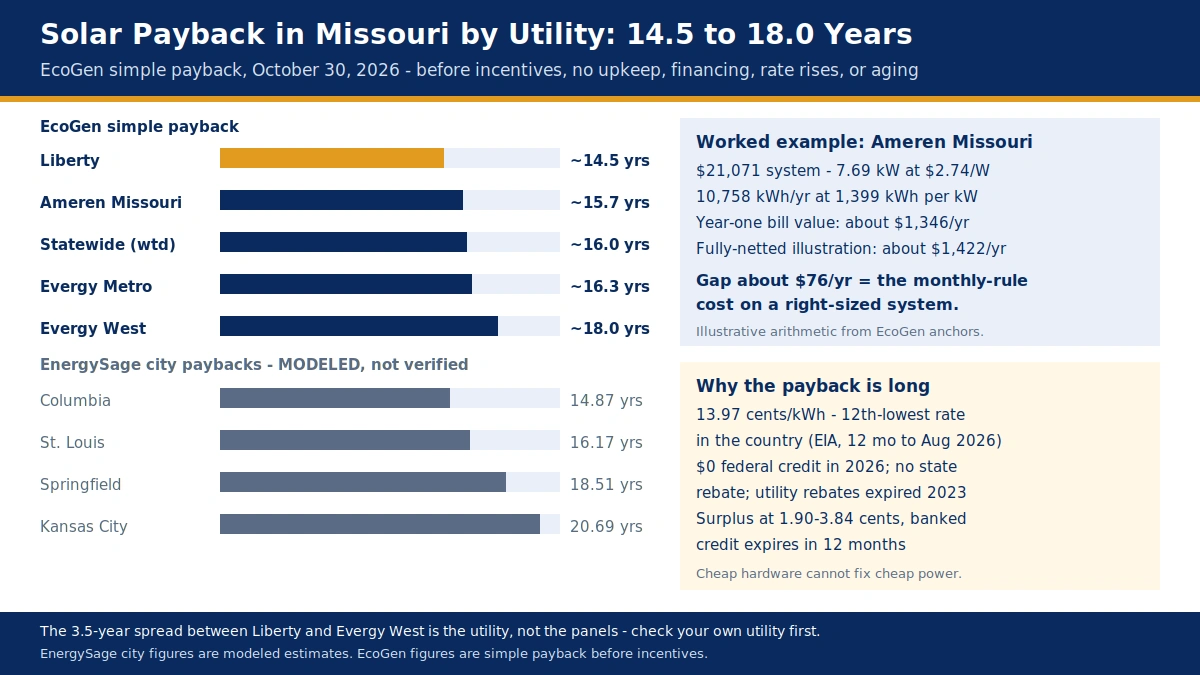
A worked illustration ties the pieces together, labeled as illustration rather than as a quote. Take the typical $21,071 system on Ameren Missouri. If every one of its 10,758 kilowatt-hours netted inside the month at 13.22 cents, the year-one bill value would be about $1,422, for a payback near 14.8 years. EcoGen’s anchored figure is $1,346 a year and 15.7 years, because 7.3% of the output spills into the surplus markdown. The gap between the illustration and the anchor — about $76 a year, about nine months of payback — is the entire cost of the monthly rule on a right-sized Ameren system. On an oversized system the gap is a multiple of that, and on a system whose surplus expires unused it is larger still. That is the whole Missouri payback story in one comparison: the rule costs little when the system fits the month, and it costs years when the system fits the roof. The battery section next shows the purchase that shrinks the gap, and the incentives section shows the one place in the state where a rebate shrinks the price itself.
Batteries in Missouri: An Expiry Hedge and a Storm Backup
A battery in Missouri does two jobs that a battery in a generous net-metering state does not, and both jobs are worth more than the bill savings the battery itself produces. The first job is the expiry hedge: power stored in the evening stays at full retail value instead of becoming a month-end surplus credit at 1.90 to 3.84 cents that expires in twelve months. The second job is storm backup: when a spring storm takes the grid down, a grid-tied array without a battery shuts down with it, by the anti-islanding rule that protects line workers, while a battery-backed system keeps the essentials running. Neither job pays for the battery on its own at Missouri’s power prices. Together, in the state with the shortest credit fuse and the busiest storm track in the Midwest, they make the strongest battery case in the region — and the case still has to be priced honestly, because the battery costs nearly as much as half the array.
The price first, with its labels attached. One Missouri battery guide puts home storage at about $1,093 a kilowatt-hour — roughly $10,930 for a 10 kWh system — and a Tesla Powerwall 3, at 13.5 kWh and 11.5 kW, at $12,000 to $14,500 installed. At $1,093 a kilowatt-hour, a 13.5 kWh battery would run about $14,756, above the top of the Powerwall range, and the two figures are flagged here as in conflict rather than averaged. The same source still claims a 30% federal credit applies to home batteries, which is wrong for a 2026 owned system — the credit ended with everything else on December 31, 2025 — so only its before-incentive prices are used here, and its after-credit arithmetic is excluded as stale. No Missouri-specific installed battery figure from a 2026 marketplace source was verified, and no Missouri battery payback figure was verified either, so this guide states no payback for the battery and no single battery price: the range above is a planning estimate, and the installer’s itemized battery line is the number that governs. The national battery market is priced in our solar battery guide, and the inverter half of the storage decision — string, microinverter, or optimizer — is priced in our inverter replacement guide.
The expiry-hedge arithmetic is simple to state and easy to overclaim, so it gets stated carefully. A kilowatt-hour stored at noon and used at seven in the evening is worth the full netted value — 13.22 cents on Ameren Missouri, 12.22 on Evergy Metro — instead of the surplus rate it would have earned as a month-end leftover. The spread is about ten cents a kilowatt-hour on Ameren and about ten cents on Evergy Metro, and it applies only to the kilowatt-hours that would otherwise have spilled into surplus. On a right-sized system, where the surplus share runs 0.3% to 7.3% of output, the battery rescues a small number of kilowatt-hours at that spread — tens of dollars a year, not hundreds. On an oversized system, where the surplus share is far larger, the battery rescues more — but the cheaper fix for an oversized system is a smaller system, not a battery. The battery earns its keep as an expiry hedge only on a system that is already right-sized and still spills in the spring months, when output peaks before the air conditioning starts. Any quote that prices the battery as if every kilowatt-hour it cycles earns the full spread is pricing a battery twice the size of the surplus it serves.
The storm-backup arithmetic is not arithmetic at all, and that is the point. Missouri’s storm season produces outages measured in hours and sometimes days, and a battery that carries the refrigerator, the well pump or sump pump, the furnace fan, the phones, and a few lights through a night without power is worth what the household says it is worth, not what the tariff sheet says. Size the battery to the essential loads, not to the whole house: a 13.5 kWh battery carries a careful household’s essentials through an evening and a night, and it does not carry whole-house air conditioning through a July afternoon. Cold matters to the sizing too — one planning guide claims a 13.5 kWh nameplate battery delivers only 9 to 10 kWh usable at Missouri winter lows without active thermal management — but that is a single-source planning claim, flagged here rather than stated as fact, and the battery’s own data sheet and the installer’s winter sizing are the documents that govern. No Missouri battery rebate exists, HEAR does not cover batteries, and the federal credit is gone, so the battery is bought at full price for backup value and expiry protection, not for bill savings. In a state where the credit expires in a year and the storms arrive every spring, that is a defensible purchase. It is not a money-saving purchase, and any quote that calls it one has not read the tariff.
Missouri Incentives in 2026: One City Rebate and Two Tax Traps
Missouri’s incentive stack is the shortest in the Midwest, and most of what circulates as Missouri incentive advice is either expired, struck down, or located in a different state. The honest version fits in one paragraph: there is no state rebate, no state income-tax credit, no SREC market, no state battery incentive, and no federal credit for a 2026 owned install. One city utility pays a rebate. One tax break lives inside the installer’s price. One tax break that every outdated guide lists was struck down by the state supreme court in 2022. Everything else in this section is the evidence for those sentences, plus the two programs that have not launched and the one bill that has not passed — because in Missouri, knowing what does not exist saves more money than knowing what does.
Columbia Water and Light runs the only solar rebate found anywhere in the state, and it serves one city. The rebate is $500 per kilowatt of installed capacity, multiplied by a peak factor up to 1.1 for arrays placed to produce more at peak times, so up to $550 per kilowatt. A 5 kW system earns $2,500, or up to $2,750 with the top factor; the typical 7.69 kW system earns $3,845, or up to about $4,230. Arrays that face north earn no rebate at all. The customer must own the system, the rebate and the net-metering agreement must both be approved before installation, the system may run no larger than 110% of average use over the last three years, and the rebate is paid after the final inspection. Columbia also lends up to $15,000 for solar at 1% interest for up to three years, 3% for four to five years, and 5% for six to ten years, with no prepayment penalty — but the home must meet insulation minimums, the panels need a 25-year maker’s warranty, and the inverter needs a 10-year warranty, and the loan too must be approved before the panels go up. A 2022 installer page citing up to $625 per kilowatt for Columbia is stale and excluded. For a Columbia household, the rebate plus the full-rate surplus credit is the best solar deal in Missouri by a clear margin. For the other 99% of the state, it is a reminder that the utility on the bill matters more than the state on the map.
The utility rebates that used to exist are gone, and the date matters because the guides that list them rarely print it. RSMo 393.1670, passed as Senate Bill 564 in 2018, required the investor-owned utilities to pay $0.50 a watt for systems that became operational in the first half of 2019, then $0.25 a watt for systems operational from July 2019 through December 31, 2023, capped at 25 kW for residential systems. The section expired on December 31, 2023, by its own terms. Ameren Missouri, Evergy, and Liberty rebates all ended with systems switched on by that date, and nothing replaced them. An earlier $2-a-watt figure from the original Renewable Energy Standard, RSMo 393.1030, is history from the program’s first years, not a current offer. Any quote, guide, or installer that subtracts a $0.25-a-watt utility rebate from a 2026 Missouri system is working from a program that ended two years ago, and the subtraction should be struck from the quote before anything is signed.
The sales-tax break is real, and it is already in the price. RSMo 144.030.2(46), in force since August 28, 2022, with no end date, exempts a solar company’s purchases of panels, inverters, mounting, cabling, and other system parts from Missouri state and local sales and use tax, when the company builds a system it sells or leases. The Department of Revenue explains the exemption in rule 12 CSR 10-112.020. The saving sits inside the installer’s price; the homeowner files nothing and claims nothing. The exemption does not cover a homeowner who buys the parts and installs the system personally — the rule says so explicitly — which is one more reason the do-it-yourself route costs more in Missouri than the quote comparison suggests. One secondary guide claims no sales-tax exemption exists and the standard 4.225% state tax plus local tax applies to residential solar; that claim is wrong against the statute and the rule, and it is flagged here as such. Whether a battery bought with the system falls inside the exemption was not verified, so this guide states no battery tax figure and tells readers to ask the installer, in writing, whether the battery line carries sales tax.
The property-tax trap is the most expensive piece of outdated advice in Missouri solar, and it deserves to be stated without softening. RSMo 137.100(10) still lists solar energy systems not held for resale as exempt from property tax, and guide after guide still reports the exemption as live. On August 9, 2022, the Missouri Supreme Court held that exemption unconstitutional, in the case noted as Johnson v. Springfield Solar 1, LLC. The State Tax Commission, the agency that guides county assessors, revised its assessor manual in March 2023 to say that an assessor may treat rooftop panels as a fixture of the home, so their value counts toward the home’s value and is not valued separately. There is no property-tax exemption a Missouri homeowner can rely on. A guide that promises $3,000 to $5,000 of twenty-year property-tax savings from the exemption is promising money the court took away four years ago. The practice varies by county assessor, no assessor-by-assessor survey was verified for this guide, and the only reliable answer comes from the reader’s own county assessor, asked before signing — not from a national guide’s incentive table.
Two programs that have not launched, and one bill that has not passed, complete the picture. Missouri’s HEAR and HOMES rebate programs — about $75.37 million for HEAR and about $75.65 million for HOMES, $151 million in total — are administered by the Department of Natural Resources Division of Energy, which submitted its initial application to the federal Department of Energy in November 2024 and is still awaiting federal approval and funding. The department selected BDO Government Services, with the Environmental Improvement and Energy Resources Authority, to deliver both programs in August 2026, and its own program page says details are not finalized, no estimate of availability can be given, and rebates may not be available until 2027 at the earliest and potentially as late as 2028. In any case HEAR does not cover solar, batteries, EV chargers, or windows — it covers electric-to-electric upgrades only, under DOE Program Notice 26-2 dated May 29, 2026 — and HOMES is a whole-home modeled-savings program, not a solar rebate. No HEAR or HOMES money should appear in a Missouri solar quote. Missouri’s Solar for All award, $156 million from the federal Environmental Protection Agency, was terminated on August 7, 2025, before it launched; courts ruled the termination unlawful in September 2026, but no household application route exists. A bill introduced in 2026, HB 3337, would create a state solar income-tax credit starting in 2027 — a proposal, not law, reported by a single source, with no credit amount stated here. Watch it. Do not budget on it.
Federal Help in 2026: No Tax Credit — and No Lease Market Either
The federal story in Missouri has two halves, and the second half is the one most national guides miss. The first half is the same everywhere: the Residential Clean Energy Credit, §25D at 30%, ended for property placed in service after December 31, 2025, under the One Big Beautiful Bill Act, Public Law 119-21, and the IRS has made clear that the installation’s finish date is what decides it. Paying in 2025 for a system finished in 2026 does not qualify. A 2026 owner purchase in Missouri earns a $0 federal credit, and any quote that subtracts 30% from a 2026 owned install is wrong — not optimistic, wrong. The national credit picture, including what remains for other equipment, is laid out in our federal tax credits guide.
The second half is Missouri-specific, and it removes the escape hatch that other states still have. The commercial credit, §48E at 30%, survives for third-party-owned systems placed in service by December 31, 2027, with construction begun by July 4, 2026 under IRS Notice 2025-42 — and in states with a lease market, the leasing company claims it and passes part of the value through as a lower monthly payment. Missouri has no residential lease or PPA market to carry it. The state is one of seventeen with no residential lease or PPA offers at all, on a July 2025 count built from DSIRE data and rechecked in October 2026. Missouri homes held about 302 MW of rooftop solar at the end of 2024, on EIA data, and every panel of it was bought. Sunrun, the largest lease company, did not list Missouri when checked on October 5, 2026. Leasing is not banned — Evergy’s net-metering tariff covers leased systems — but no seller was found offering one. A power purchase agreement sits in a greyer area: DSIRE’s May 2026 map of third-party power purchase agreements marks Missouri’s status unclear or unknown, because a company selling power from panels on a homeowner’s roof may count as a utility under Missouri law, and no rule settles the question. No company offers one here. The §48E pass-through is therefore theoretical in Missouri: the credit exists, the market to deliver it does not, and a national “free solar” advertisement promising a lease in Missouri is advertising a product nobody sells in the state.
What $0-down means in Missouri, then, is a loan — panels the homeowner owns, bought with borrowed money, at the full $21,071 sticker for the typical system plus interest and any dealer fee folded into the financed total. The national pattern of dealer fees at 20 to 30% of the cash price on $0-down loans is stated here as a national pattern, because no Missouri-specific dealer-fee figure was verified, and the protection against it is the same everywhere: the cash price and the financed total side by side, on paper, before signing. No Missouri-specific solar loan rate was verified, so none is stated; Columbia’s city loan, at 1% to 5%, is the only published Missouri solar loan rate in this guide, and it serves one city. A home equity route, a credit-union solar loan, and the installer’s financing all price differently, and the comparison that matters is the total paid over the life of the loan against the cash price — not the monthly payment, which can be stretched thin enough to hide almost any total.
One more federal-adjacent question belongs here, because Missouri’s long payback makes it likelier than in most states: what happens when a house with panels is sold. Net-metering credits do not transfer. Under RSMo 386.890, credits expire when the customer-generator disconnects service or ends the net-metering relationship, and the new owner must file a new interconnection application with the utility. A buyer inherits the panels and the roof, not the bank. Owned panels typically go with the house, but the contract should say so, and a financed system may carry a lender’s security interest recorded against the property. Leased or PPA panels, if any ever appear in Missouri, could not be counted in the appraised value under Fannie Mae guidelines — a moot point today, given the empty lease market, but a live one for any future offer. With paybacks running fourteen to eighteen years, the planned stay in the home is part of the purchase decision in Missouri in a way it is not in states where payback runs six: a household that plans to move in five years buys panels it will not live long enough to pay off, and should weigh that fact before the roof, not after.
Permits & Licensing: What Missouri Requires
Missouri licensing is local all the way down, and the absence of a statewide license to check is itself the fact a buyer has to work around. The state issues no general-contractor license and no separate solar-contractor license. Cities and counties license contractors and electricians, issue building and electrical permits, and conduct inspections, each under its own rules. A company that works in Kansas City, St. Louis, Springfield, and Columbia answers to four different licensing regimes, and a license that covers one address may not cover the next. The question to ask is never whether the company is licensed in Missouri — there is no such license — but which local license covers the address where the panels will go, and whether the name on the license matches the company on the quote.
The one statewide credential is optional, and its optionality is the trap. The Office of Statewide Electrical Contractors, under RSMo 324.900 through 324.925, issues a statewide electrical contractor license that is recognized in lieu of a local electrical contractor license for electrical work and permit eligibility. Qualifying takes an application with a $200 fee, proof of education and experience, an approved NEC-based examination result, and at least $500,000 of liability insurance, with a $100 triennial renewal. A company doing statewide electrical contracting must have a supervisory electrical contractor holding the statewide license, who represents only one company at a time. The statewide license does not eliminate local electrical permits, code enforcement, inspections, or business-license requirements — it replaces the local electrical contractor license, not the local process. The state’s MOPRO Licensee Search, under Electrical Contractor, names the licensee’s employer, and it is the place to check a statewide number. When a recent review found no statewide license under several Missouri installers’ names, that absence proved nothing on its own, because the license is optional and local licenses govern — and this guide says so explicitly, so a buyer does not mistake an empty state search for proof of unlicensed work. Ask for the statewide number or the city or county license that covers the address, check it against the issuing authority, and set aside any bidder who produces neither.
Local requirements vary enough that no single Missouri permit checklist is honest. Kansas City requires a city business license, a Certificate of Qualification held by the trade supervisor, and a contractor license before it issues permits. The contractor-licensing specifics for St. Louis City, St. Louis County, Springfield, and Columbia were not retrieved from those governments for this guide, so none are stated — the buyer’s own city or county building department is the authority, and the installer should name the permits it will pull, the inspections it expects, and the fees it charges for them, before the contract is signed. NABCEP certification is a credential worth asking for — it signals training specific to photovoltaic installation — but it is not a Missouri requirement, and it does not substitute for the local license. Interconnection runs on its own track beside the permits, under the same 30-day and 90-day answer windows the net-metering section sets out, and above 10 kW the large utilities require liability insurance — Liberty’s Rider NM specifies $100,000, while no Ameren or Evergy dollar figure was verified, so none is stated for them. The 10 kW line is therefore a paperwork threshold as well as a size threshold: a system at or under it moves faster and carries fewer insurance demands, which is one more reason the utilities’ sizing formulas, capping the average-use home near 9 kW, are less of a constraint than they first appear.
The HOA question has the clearest answer in Missouri law, and it got clearer in January 2026. RSMo 442.404.3, passed as Senate Bill 820 and effective January 1, 2023, provides that no deed restriction, covenant, or similar binding agreement running with the land may limit or prohibit, or have the effect of limiting or prohibiting, the installation of solar panels or solar collectors on the rooftop of any property or structure. A homeowners association may adopt reasonable rules about placement, but only to the extent that those rules do not prevent installation, impair functioning, restrict use, or adversely affect the cost or efficiency of the device. The protection applies only to rooftops owned, controlled, and maintained by the individual property owner — ground-mounted arrays and common-area roofs sit outside it. On January 23, 2026, the Missouri Supreme Court ruled unanimously in Eikmeier and Love v. Granite Springs Home Owners Association that the statute applies to all covenants, including those created before its effective date, and that the association’s rule barring street-facing panels could not be enforced. The Springfield homeowners’ 2003 covenants banned panels outright; the court held that retrospective application impaired no contract, entered judgment for the homeowners, and settled the question every Missouri HOA had been litigating since 2023. The statute sets no deadline for an association’s review — a single guide’s reading, flagged here — and the same guide reads the law as not applying to condominium associations or residential cooperatives, also flagged as a guide’s reading rather than statute text. Get the architectural-review approval in writing before ordering panels even when the law is on your side, because a lawsuit won in the supreme court is still a lawsuit, and a written approval is a signature.
What Pushes Your Missouri Quote Up or Down
Seven levers move a Missouri quote off the $2.74 anchor, and the tariff sheet controls more of them than the hardware does. The table below names each lever, the direction it pushes, and the Missouri fact behind it — then the paragraphs after it work through the three levers that surprise buyers most.
| Lever | Direction | Missouri fact |
|---|---|---|
| Utility territory | Up or down | Netted value 11.08–13.50 cents; surplus 1.90–3.84 cents |
| System size vs monthly use | Down if right-sized | Surplus earns fuel cost and expires in 12 months |
| Roof condition & age | Up | Replace a dying roof first; detach-and-reset priced separately |
| Shade & orientation | Up | Oaks, dormers, chimneys; north-facing earns no Columbia rebate |
| Panel & inverter tier | Up | Premium modules, microinverters/optimizers on cut-up roofs |
| Storm spec & insurance | Up | UL 61730 / IEC 61730, wind-rated racking, insurer letter |
| Rate plan (Ameren) | Up or disqualifying | TOU plans may bar net metering; verify plan name on the bill |
| Battery | Up | ~$12,000–$14,756 planning range for 13.5 kWh; no incentive |
| Financing | Up | Dealer fee folded into $0-down loans; compare cash vs financed |
The utility territory is the lever no buyer can change and every buyer should price first. The same 7.69 kW system at the same $21,071 earns $1,449 a year on Liberty, $1,346 on Ameren Missouri, $1,294 on Evergy Metro, and $1,172 on Evergy West — a $277 annual spread on identical hardware, worth more than three years of payback from the fastest territory to the slowest. The spread comes from two numbers: the netted value, which runs from 11.08 cents on Evergy West to 13.50 cents on Liberty once the customer charge is stripped out, and the surplus rate, which runs from 1.90 cents to 3.84 cents. A quote that prices the state average rate instead of the utility’s rate misprices the system by hundreds of dollars a year, and a quote that prices the surplus at retail misprices it by more. The utility name sits at the top of the electric bill. The quote should name it too.
The roof is the lever that hides the most money. When fewer than eight to ten years of roof life remain, replace the roof before the panels arrive: a later reroof means a detach-and-reset, a second labor bill no Missouri-specific figure in this guide can price — get that number in writing from the installer, as a line item, before signing. Slate and tile roofs, uncommon in Missouri but present in older St. Louis neighborhoods, need specialty mounting and slower labor. A flat or low-slope roof needs tilt-up or ballasted racking instead of a standard pitched mount. A roof under heavy oak shade needs microinverters or optimizers, which cost more than a string inverter and earn it back on every shaded afternoon. And a roof in the storm belt needs the wind-rated racking and the structural letter the permitting office requires, which cost more than the generic mount and are not optional. None of these costs appears in the $2.74 anchor, because the anchor prices a standard install on a sound, pitched, unshaded roof — and fewer Missouri roofs match that description than installers admit.
The rate plan is the lever that can disqualify the purchase entirely, and it belongs to Ameren Missouri customers alone. A household on the Overnight Saver, Smart Saver, or Ultimate Saver plan may find net metering unavailable, under Ameren’s Missouri FAQ, and the choice between the time-of-use plan and net metering has to be made before the interconnection application goes in — not after the panels are on the roof. The plan name is printed on the bill, the verification happens during the application, and the cost of getting it wrong is a system that cannot sell its excess back to Ameren at all. On Evergy, the parallel question is the billing mechanism: net metering or parallel generation, each with its own treatment of delivered and received power, and the choice should be priced on the household’s own load shape rather than defaulted. Every other lever in the table moves the price by hundreds or low thousands. The rate plan moves it by the whole value of the export rule.
Getting Quotes in Missouri: The Checklist
Take the ten checks in order — the first three decide whether the quote is worth reading further. Ten out of ten means the quote has earned your signature. Miss any of the first three and the quote goes in the reject pile, no matter how tempting the monthly payment looks.
- Your utility’s rules in writing first. Ameren Missouri pays 3.84 cents in summer and 3.39 cents in winter for a month-end surplus, Liberty pays 3.31 and 3.30, Evergy West pays 1.98, and Evergy Metro pays 1.90 — and that gap, plus the netted values from 11.08 to 13.50 cents, is worth more than three years of payback on the same system. Pull your own utility’s tariff sheet before the quotes arrive, then confirm each quote prices the export rate your utility actually pays — not a statewide average that flatters the math. Springfield, Independence, and co-op customers need the surplus rate from the utility itself, in writing, because no current figure is published for those territories.
- Your rate plan verified before anything else (Ameren Missouri). Under Ameren’s Missouri FAQ, the Anytime Saver and Evening/Morning Saver rates qualify for net metering; Overnight Saver, Smart Saver, and Ultimate Saver do not. Find the plan name on the bill, confirm it with Ameren, and get the confirmation in writing — a system installed on the wrong plan cannot sell its excess back at all.
- A twelve-month table, priced month by month. Production each month next to use each month, from your own bills, with the surplus months priced at your utility’s surplus rate and the expiry clock stated plainly. A yearly total hides the April surplus, and the April surplus is where the money leaks. Ask for the table before the contract, not with it.
- Cash price per watt on paper. The anchor is $2.74 a watt, and 2026 marketplace quotes run roughly $2.12 to $2.87. Ask for the cash price beside any financed price: the dealer fee runs 20% to 30% of the system cost on a $0-down loan as a national pattern, and it stays invisible inside the financed amount until both figures sit next to each other. Missouri has no lease market, so the loan comparison is the only $0-down comparison there is.
- No line for a 30% federal credit, no line for a state rebate, no line for a utility rebate. A 2026 owner purchase earns a $0 federal credit, Missouri offers no state rebate and no state income-tax credit, and the utility rebates expired December 31, 2023. The sales-tax exemption is already in the quote. The only rebate in the state is Columbia Water and Light’s $500 per kilowatt, for its own customers, approved before installation. The property-tax exemption was struck down in 2022 — strike any line that claims it.
- The sizing formula applied to your own twelve months. Ameren Missouri divides twelve-month use by 8,760 times 15.6%; Evergy divides by 8,760 times 14.4%; Columbia caps at 110% of three-year average use. Ask the installer to show the arithmetic for your bills, and to show what happens to the approved size if a planned EV or heat pump is documented. A system the utility will not approve earns nothing.
- The local license that covers your address, verified. Missouri has no statewide contractor license and no solar license; the statewide electrical contractor license is optional. Ask for the statewide OSEC number or the city or county license for the address, check it against the issuing authority, and ask whether the crew is NABCEP-certified. A company that cannot produce either number has not done this work under a license that covers your roof.
- Add-ons itemized. Roof work, panel upgrade (no Missouri-specific figure verified — get it itemized and compare it against our panel upgrade guide), tree work, wildlife barrier, wind engineering and structural letter, detach-and-reset for a future reroof, battery. Each add-on belongs on its own priced line — never buried in a footnote where it escapes comparison.
- Production estimate from PVWatts with the shade assumption and the monthly shape shown. Work from the 1,399 kilowatt-hour anchor while remembering that other models span 1,224 to 1,433 — and make the estimate name its model and its assumed shade loss, month by month, April against December, from a shade study of your own roof rather than a statewide average. On a tree-heavy Missouri lot, the shade study is the estimate.
- Storm spec, insurance, and HOA approval in writing first. UL 61730 / IEC 61730 on the panels by name, the racking wind rating from the permitting office’s requirements, written confirmation that the homeowners policy covers the array for storm damage, and architectural-review approval in writing before panels are ordered — RSMo 442.404.3 bars HOA bans on owner-maintained rooftops, and the Missouri Supreme Court confirmed in January 2026 that the bar reaches pre-existing covenants, but a written approval beats a lawsuit.
Three written quotes on one identical spec sheet, from installers already filing interconnection paperwork inside your utility’s territory, before anything is signed — each quote carrying the twelve-month table, the cash price per watt, the surplus rate by name, and the sizing arithmetic for your own bills. In a state where the billing month decides what a kilowatt-hour is worth and the spring storm decides whether the array survives to make it, the cheapest quote is the one that read the tariff sheet, sized to the month, and filed the paperwork on time.
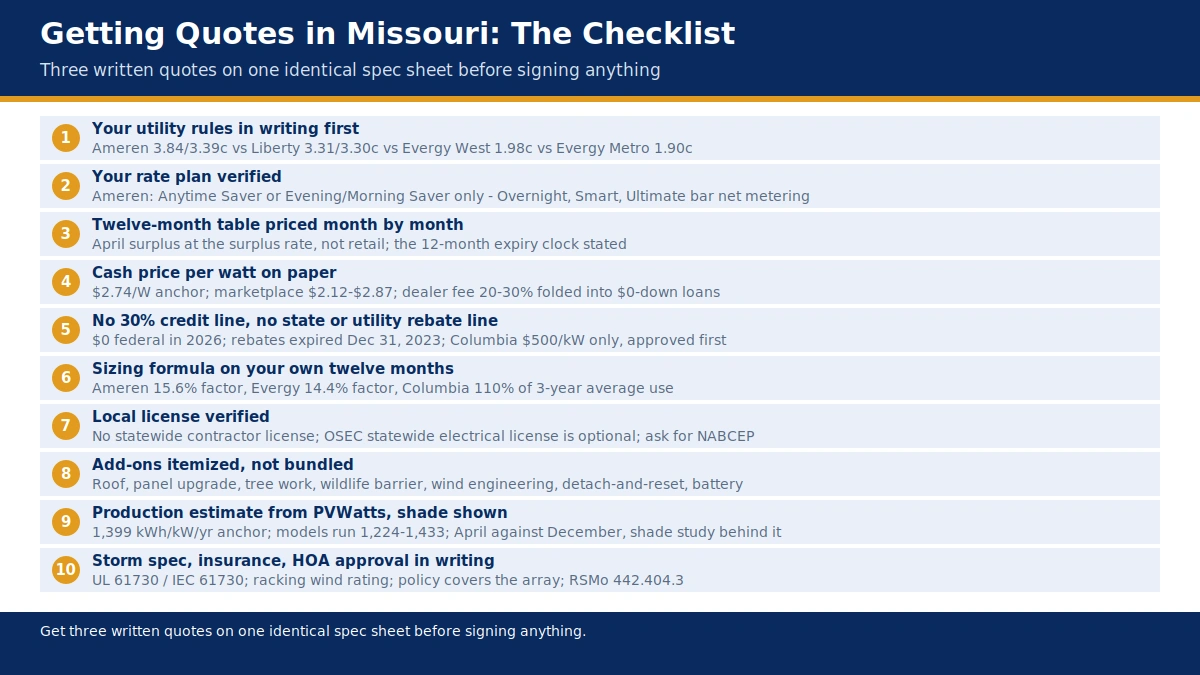
Sources & methodology
Headline price and production:
- EcoGen Solar Cost Index, September 2026 edition: $2.74/W Missouri, 7.69 kW typical system, $21,071, prices as of September 25, 2026; 12th lowest of 51; neighbors Oklahoma $2.64, Kentucky $2.65, Kansas $2.87, Illinois $3.05, Iowa $3.07; national $2.89; 1,399 kWh/kW/yr per October 7, 2026 correction, 10,758 kWh/yr; Berkeley Lab 2025 median 7.69 kW from 381 Missouri systems
- EnergySage Missouri cost data: $2.49/W Nov 2026 (13.74 kW avg, $29,142-$39,428 range, 17.2-yr modeled payback, $20,940 25-yr savings); $2.49/W Oct 2026 (13.73 kW, $29,069-$39,329); $2.50/W Sep 2026 (13.4 kW, $33,584); $2.53/W Mar 2026 (13.04 kW, 14.58-yr modeled payback, $29,125); city pages Nov 2026 — St. Louis County $2.51/W, 12.97 kW, $32,484, 16.17-yr modeled, $23,733; Kansas City $2.68/W, 12.69 kW, $34,029, 20.69-yr modeled, $9,269; Springfield $2.42/W, 12.89 kW, $31,138, 18.51-yr modeled, $14,426; Columbia $2.36/W, 14.03 kW, $33,177, 14.87-yr modeled, $29,263
- St. Louis second page flagged: St. Louis city-county $2.47/W, 11.86 kW, $29,260, 16.08-yr modeled, $20,719 (Nov 2026) — county page used in the table, second page flagged, not averaged
- SolarReviews Nov 2026: $2.68/W, 10.9 kW avg, $31,032 (national model — not headline; after-credit column excluded as stale); $2.93/W second-hand figure flagged as conflicting methodology; NumeralQ planning, EnergySage data retrieved Oct 26, 2026: 4 kW $10,890-$14,220, 8 kW $20,690-$27,040, Kansas City typical job $19,770-$25,840, St. Louis typical job $20,460-$26,740 (job sizes unstated, flagged); SolarSpecHub planning: 8 kW $25,200 ($3.15/W)
- Production conflicts flagged: Green Watt PVWatts v8 5.03 peak sun hours/day, 1,433 kWh/kW/yr; SolarPriceList St. Louis 4.8 peak sun hours, 1,220-1,370 kWh/kW/yr; SolarSpecHub 4.3 peak sun hours, ~1,224 kWh/kW/yr (internally inconsistent 8 kW figure flagged); Unbound Solar 4.6 peak sun hours; SunMetricLab ~4.5; NoOutage older table Columbia 4.73, St. Louis 4.38 (direction only, not a production input); Ameren 15.6% capacity factor implies 1,367 kWh/kW/yr, Evergy 14.4% implies 1,261 (sizing conservatism, not forecasts)
- EIA Electric Power Monthly, 12 months to Aug 2026: Missouri residential 13.97 cents/kWh, ~1,039 kWh/mo, ~$145/mo bill (~12,468 kWh/yr), price +6.1% YoY, bill +~7.7%; Aug 2026 single month 16.02 cents (+4.6% YoY); US 18.0 cents, 875 kWh/mo, ~$158/mo; 5-yr rate rise 2.99%/yr (EcoGen); 2024 annual 1,001 kWh/mo, 12.91 cents, $129.18/mo
Net metering and tariffs:
- RSMo 386.890 Net Metering and Easy Connection Act (100 kW cap, monthly netting, surplus at no less than avoided fuel cost, 12-month expiry, 5% program cap, 1% yearly limit, unchanged since Aug 28, 2022); rules at 20 CSR 4240-20.065; DNR PUB2238 (30-day / 90-day review times, 10 kW line)
- Ameren Missouri 7th Revised Sheet No. 171: 3.84 cents Jun-Sep, 3.39 cents Oct-May, effective Jun 1, 2026; Ameren solar FAQ: net metering with Anytime Saver and Evening/Morning Saver only, not Overnight/Smart/Ultimate Saver, rate verified on application, qualifying-facility alternative sells no excess, no zero bill, community-solar subscribers must cancel; sizing formula 12-mo kWh/(8,760 x 15.6%), example 13,512 kWh to 9.887 kW; review 30 days 10 kW and below, 90 days 11 kW and larger; new construction via living square footage
- Ameren TOU conflict flagged: “all 5 rate options as of June 1, 2026” line sits in Ameren Illinois context; EcoGen within-period netting reading flagged as a third version; Missouri FAQ rule stated as governing
- Evergy Missouri Metro Schedule PG 16th Revised Sheet No. 31A: 1.90 cents all year, effective Feb 21, 2025; Evergy Missouri West Sheet 102.1: 1.98 cents, effective Feb 21, 2025; PSC order Feb 5, 2025, files EE-2025-0210 / EE-2025-0211; Evergy sizing 12-mo kWh/8,760/0.144; good-standing requirement; parallel generation alternative; $81 Missouri return-inspection fee; Evergy 30/90-day reversal in its customer document flagged as a transposition
- Liberty Rider NM: 3.31 cents summer, 3.30 cents winter, effective Feb 14, 2025; $100,000 insurance above 10 kW
- Columbia Water & Light: surplus at full electric rate when utility keeps RECs, carried forward, credit left after March bill removed without payment, 110% of 3-year average use cap, customer must own system (como.gov via EcoGen, read Oct 14, 2026)
- City Utilities of Springfield: rate resets every 6 months, no current rate on an official page — no figure stated; Independence Power & Light: 3.55 cents applied to 12 months ending Jun 2024, schedule effective Oct 1, 2020 — stale, flagged, not current; IPL 100 kW cap, bidirectional metering, 1-year minimum contract term; co-ops (~40) set own rates — none verified
- Stale figures excluded: EnergySage incentives page Ameren 5.39/3.92 cents (updated Jan 6, 2026); SunMetricLab “exports at retail” claim wrong against the statute
Payback arithmetic:
- EcoGen per-utility figures, Oct 30, 2026: Liberty 13.50 cents netted, 0.3% surplus at 3.30 cents, $1,449/yr, 14.5 yrs; Ameren 13.22 cents, 7.3% at 3.58 cents weighted, $1,346/yr, 15.7 yrs; Evergy Metro 12.22 cents, 1.9% at 1.90 cents, $1,294/yr, 16.3 yrs; Evergy West 11.08 cents, 2.1% at 1.98 cents, $1,172/yr, 18.0 yrs; weighted statewide ~16.0 yrs across the four utilities (67% of homes, EIA-861 2024); Ameren ~40% of homes; per-utility EIA prices Ameren 14.11 cents, Metro 13.67, West 12.37, Liberty 14.82; customer charges $9.00 / $12.00 / $12.90 / $13.00; Ameren $9.19 variant flagged
- Older EcoGen page (Ameren ~14.8 yrs, range 14.7-18.1) superseded by Oct 30, 2026 figures — excluded, flagged
- NestPriced illustration (labeled as such): 10,758 kWh fully netted at 13.22 cents = ~$1,422/yr, ~14.8 yrs, vs anchored $1,346/yr and 15.7 yrs — gap ~$76/yr is the monthly-rule cost on a right-sized Ameren system
- EnergySage modeled paybacks flagged as modeled estimates, not verified paybacks
Incentives:
- No state rebate; no state income-tax credit (Form MO-TC 2025 lists none for home solar); no SREC market; no state battery incentive
- RSMo 393.1670 (SB 564): $0.50/W first half 2019, $0.25/W Jul 2019-Dec 31, 2023, residential cap 25 kW, expired Dec 31, 2023; RSMo 393.1030 $2/W figure is history, not a current program
- Columbia Water & Light rebate: $500/kW, peak factor up to 1.1 (up to $550/kW), 5 kW $2,500 (up to $2,750), 7.69 kW $3,845 (up to ~$4,230), north-facing arrays excluded, approval before install, paid after final inspection; solar loans up to $15,000 at 1%/3%/5% by term, no prepayment penalty, insulation minimums, 25-year panel / 10-year inverter warranties (como.gov via EcoGen, ConsumerAffairs Aug 19, 2026); $625/kW 2022 figure stale, excluded
- Sales tax: RSMo 144.030.2(46) since Aug 28, 2022, installer purchases exempt, rule 12 CSR 10-112.020, DIY buyers excluded; SolarPriceList “no exemption” claim wrong against statute and rule, flagged; battery tax treatment unverified, none stated
- Property tax: RSMo 137.100(10) lists the exemption; Missouri Supreme Court held it unconstitutional Aug 9, 2022 (Johnson v. Springfield Solar 1, LLC); State Tax Commission Assessor Manual ch. 7.11 (rev. Mar 8, 2023) — assessor may treat panels as a fixture; guides listing the exemption as live are wrong, flagged
- HEAR/HOMES Missouri: NOT launched; DNR Division of Energy; ~$75.37M + ~$75.65M (~$151M); application to DOE Nov 2024, awaiting approval and funding; BDO Government Services selected Aug 20, 2026 with EIERA; DNR page: not finalized, no estimate, 2027 at earliest and potentially as late as 2028 (ECW Oct 27, 2026; heatpumppricing verified Nov 4, 2026); HEAR electric-to-electric only per DOE Program Notice 26-2, May 29, 2026 — no solar/batteries/EV chargers/windows
- Solar for All: $156M EPA award terminated Aug 7, 2025; courts ruled termination unlawful Sep 2026; no household route (EcoGen rechecked Oct 5, 2026; Missouri EIERA via solarpanelscost)
- HB 3337 (2026): proposal for a state solar income-tax credit from 2027, not law, single source, no amount stated
- Evergy solar subscription: does not lower the bill, adds ~$5-$15/mo per share (Evergy page via EcoGen); Columbia Community Solar exists, no price/savings verified, none stated
Federal and financing:
- OBBBA P.L. 119-21 and IRS FS-2025-05: §25D $0 for post-Dec-31-2025 installs, completion date counts
- §48E 30% for third-party-owned systems, in service by Dec 31, 2027, construction begun by Jul 4, 2026 per IRS Notice 2025-42; Missouri has no residential lease/PPA market to carry it — one of 17 states with no offers (DSIRE-based count Jul 2025, rechecked Oct 5, 2026); ~302 MW Missouri home solar end-2024 (EIA), all bought; Sunrun did not list Missouri (Oct 5, 2026); leasing not banned, Evergy tariff covers leased systems, no seller found; PPA status unclear/unknown on DSIRE May 2026 map, no rule settles whether a power seller counts as a utility; no Missouri PPA escalator figure exists, none stated
- Dealer fees 20-30% on $0-down loans stated as a national pattern; no Missouri-specific figure verified; no Missouri loan rate verified (Columbia 1-5% city loan is the only published Missouri solar loan rate in this guide)
- Home sale: credits do not transfer, new owner files a new interconnection application (RSMo 386.890 via techinspecthome Oct 26, 2026); Fannie Mae leased/PPA appraisal treatment noted as moot given the empty lease market
HOA, licensing, permits:
- RSMo 442.404.3 (SB 820, effective Jan 1, 2023): no deed restriction/covenant may limit or prohibit rooftop solar; reasonable placement rules only if they do not prevent, impair, restrict, or adversely affect cost/efficiency; owner-owned/controlled/maintained rooftops only; ground mounts and common-area roofs outside it
- Eikmeier and Love v. Granite Springs Home Owners Assn, No. SC101152, 2026 WL 202043 (Mo. banc Jan 23, 2026), 727 S.W.3d 432: unanimous, applies to pre-existing covenants, street-facing ban unenforceable, Justice Robin Ransom writing; Greene County, 2003 covenants; Revisor case note confirms
- No HOA decision deadline and condo/co-op exclusion readings: single guide (FS Residential), flagged as a guide’s reading
- No statewide general-contractor license; no separate solar license; licensing local (city/county); OSEC statewide electrical contractor license optional (RSMo 324.900-324.925), $200 application, NEC-based exam, $500,000 liability insurance, $100 triennial renewal, one company per supervisory licensee, local permits/inspections still required; MOPRO Licensee Search names the employer; Kansas City business license + Certificate of Qualification + contractor license (ReadyDocs Oct 2026); St. Louis City/County, Springfield, Columbia specifics not retrieved, none stated; NABCEP a credential to ask for, not a requirement
- Panel upgrade cost and detach-and-reset cost: no Missouri-specific figures verified, none stated; interconnection fees and timelines beyond statutory windows: single secondary source, unverified, none stated
Storm, production and climate:
- Tornado frequency: State Climatologist Zachary Leasor ~40/yr, 41 by mid-May 2026, 75 by early May 2025 (KCUR/KRPS May 13, 2026); NOAA since 1950 ~34/yr; last decade 57.7/yr (TornadoPath/NOAA data); May peak ~27%; range flagged
- Joplin May 22, 2011: EF5, winds over 200 mph (estimates 225-250 mph), 161 fatalities NIST/City count vs 158 direct NWS tally (difference flagged), 1,000+ injuries, ~$2.8B damage (2011 USD), 553 business + nearly 7,500 residential structures damaged, over 3,000 residences heavily damaged/destroyed (NIST)
- Hail: IEC 61215 baseline 1-inch ice balls at ~50 mph (25 mm at 23 m/s); UL 61730 / IEC 61730 described as 1-3 inch at 16.8-88.3 mph (Angi Jul 9, 2026; Peninsula Solar) — top of range is a test ceiling, flagged; NREL Denver May 2017: 1 of 3,168 panels damaged at up to 2.75-inch hail; NOAA NSSL hailstones to 100 mph and 4 inches; no Missouri hail-damage rate verified, none stated
- Wind: 140+ mph racking certification is a generic industry figure (LocalHero); no Missouri design-wind or snow-load figure verified, none stated; no Missouri insurance premium/coverage figure verified, none stated
- Heat penalty 0.3-0.5% per degree C above 25 C cell temperature, national figure
- Lifespan 25-30 years productive service; NREL median degradation ~0.5%/yr, ~88% of rated output at year 25; product warranty typically 10-25 years; performance warranty typically 25-30 years, guaranteeing 80-92% of rated output at year 25 depending on tier; string inverter 10-15 years, one replacement expected; microinverters ~25 years (national figures)
- Battery: SmartEnergyUSA ~$1,093/kWh Missouri (~$10,930 for 10 kWh), Powerwall 3 13.5 kWh $12,000-$14,500 installed — planning estimate, 30% credit claim stale and excluded, $1,093/kWh implies ~$14,756 for 13.5 kWh (conflict flagged); no Missouri marketplace battery figure or battery payback verified, none stated; cold-weather usable-capacity claim single-source planning claim, flagged
EXCLUDED:
- Any “after 30% credit” prices, including SolarReviews’ after-credit column and SmartEnergyUSA’s after-credit battery arithmetic
- Any HEAR-for-solar claim: HEAR does not cover solar, batteries, EV chargers, or windows; electric-to-electric only since DOE Program Notice 26-2, May 29, 2026; Missouri HEAR/HOMES not launched in any case
- Any state rebate or state tax credit for Missouri solar: none exists beyond Columbia’s city rebate
- Any Ameren/Evergy/Liberty utility rebate as an open program: RSMo 393.1670 expired December 31, 2023
- Any Missouri property-tax exemption as a live benefit: struck down by the Missouri Supreme Court on August 9, 2022
- Any claim that Missouri solar equipment pays full sales tax: RSMo 144.030.2(46) exempts installer purchases since August 28, 2022
- Any Missouri lease or PPA offer as available today: no residential seller found; PPA legality unsettled
- Any Springfield, Independence, or co-op surplus rate as a current figure: none verified; the 3.55-cent Independence figure is a stale 2024-period number
- Any Ameren surplus rate of 5.39/3.92 cents: stale, superseded by Sheet 171 (3.84/3.39)
- Any “exports at full retail” description of Missouri surplus: surplus earns avoided fuel cost and expires in 12 months
- Any EcoGen payback older than the October 30, 2026 per-utility figures: superseded
- Any city-level PVWatts production figure for St. Louis, Kansas City, Springfield, or Columbia: none verified
- Any Missouri-specific panel upgrade cost, detach-and-reset cost, interconnection fee, permit fee, design wind speed, snow load, hail-damage rate, insurance premium, dealer fee, or loan rate: none verified, none stated
- Any tornado-proofing claim for rooftop solar: no array is engineered for a direct EF5 hit
- EnergySage’s city paybacks as verified: modeled, EcoGen’s per-utility figures are the anchor
- SolarReviews’ $2.68/W and SolarSpecHub’s $3.15/W as headline prices: national model / planning estimate, not Missouri quotes
- The claim that Evergy credits exports at full retail while Ameren pays a low rate: WRONG against RSMo 386.890; both net monthly, and Evergy’s surplus rate is the lower one
- The claim that an HOA can enforce a pre-existing solar ban in Missouri: WRONG against RSMo 442.404.3 as construed in Eikmeier (January 23, 2026)
- The claim that Missouri has a statewide contractor license to check: WRONG; licensing is local, and the statewide electrical license is optional
*Disclaimer: The prices here are 2026 Missouri planning figures. Your utility, your roof, your shade, your rate plan, and the installer you pick all move the final price, and the monthly netting rule moves it more than any of them — power netted inside the month earns full retail value, power left over earns fuel cost, and banked credit expires twelve months after it is issued. Before settling on a budget, line up three written quotes from installers working in Missouri, on one identical spec sheet, each carrying a twelve-month table priced at your utility’s rates. Treat every tax point in this guide as background reading, not advice about your own filing — have a Missouri tax professional look over your own return before you file it, and ask your county assessor how rooftop panels are valued before counting on any property-tax treatment. Program rules change, and the surplus rates restate in 2027, so confirm current terms with the Department of Natural Resources, the Public Service Commission, and your own utility before signing.*
What do solar panels cost in Missouri in 2026?
A Missouri install in 2026 runs $2.74 a watt on EcoGen’s September 2026 index — about $21,071 for the typical 7.69 kW system — with marketplace quotes through the year generally spanning $2.12 to $2.87 a watt on larger systems. At the EcoGen rate, a 9 kW home system typically runs about $24,660 and covers roughly 101% of an average Missouri home’s annual use; EnergySage, meanwhile, puts the state average at $2.49 a watt on a much larger 13.74 kW system. A homeowner-owned system installed in 2026 earns a $0 federal credit, Missouri offers no state rebate and no state income-tax credit, and the only rebate in the state comes from Columbia’s city utility at $500 per kilowatt. The return rests on monthly netting at full retail value, and the payback runs 14.5 to 18.0 years across the big utilities.
Does Missouri still have net metering in 2026?
Yes, at every electric utility in the state, for systems up to 100 kW, under the Net Metering and Easy Connection Act, RSMo 386.890. Power your panels send out nets against power you buy inside the same billing month at full retail value. Power left over when the month closes is credited at the utility’s avoided fuel cost — 3.84 cents in summer and 3.39 cents in winter on Ameren Missouri, 1.90 cents all year on Evergy Missouri Metro, 1.98 cents on Evergy Missouri West, 3.31 and 3.30 cents on Liberty — and the credit expires without payment twelve months after it is issued. Columbia’s city utility is the exception: it credits a surplus at the customer’s full electric rate, though credit left after the March bill is removed. A utility may close net metering to new customers at 5% of peak load, and no current fill level was verified, so ask your utility before signing.
Why is solar payback so long in Missouri?
Cheap power and a monthly clock, working together. Missouri homes paid 13.97 cents a kilowatt-hour on average over the twelve months to August 2026, the twelfth-lowest rate in the country, so every kilowatt-hour the panels displace is worth less here than almost anywhere else. The hardware is cheap — $2.74 a watt, twelfth-lowest — and the sun is respectable at about 1,399 kilowatt-hours a year per kilowatt, but no subsidy shortens the wait: no federal credit, no state rebate, no state tax credit, and utility rebates that expired at the end of 2023. The monthly netting rule adds the second drag: surplus power earns 1.90 to 3.84 cents instead of retail, and banked credit expires in twelve months. On EcoGen’s per-utility figures the simple payback runs 14.5 years on Liberty, 15.7 on Ameren Missouri, 16.3 on Evergy Metro, and 18.0 on Evergy West, before financing, upkeep, or panel aging.
Is there a Missouri solar rebate or tax credit in 2026?
Only one rebate, in one city, and no tax credit at all. Columbia Water and Light pays $500 per kilowatt, up to $550 with a peak factor, to its own customers who own the system, with approval required before installation and the system capped at 110% of three-year average use. No state rebate exists, Missouri’s 2025 income-tax credit list has no credit for home solar, and the Ameren, Evergy, and Liberty rebates under RSMo 393.1670 expired on December 31, 2023. The sales-tax exemption is real but already inside the quote: installers buy equipment free of Missouri sales tax under RSMo 144.030.2(46), so no second deduction exists. The property-tax exemption that many guides still list was held unconstitutional by the Missouri Supreme Court on August 9, 2022, and assessors may count rooftop panels in the home’s value. A bill that would create a state credit from 2027, HB 3337, is a proposal, not law.
Can my HOA stop me from installing solar panels in Missouri?
No, not on a rooftop you own and maintain — and since January 2026 that answer reaches even covenants written before the law existed. Under RSMo 442.404.3, effective January 1, 2023, no deed restriction or covenant may limit or prohibit rooftop solar panels, and an association may set reasonable placement rules only if they do not prevent installation, impair functioning, restrict use, or adversely affect the cost or efficiency of the system. In Eikmeier v. Granite Springs Home Owners Association, decided January 23, 2026, the Missouri Supreme Court ruled unanimously that the statute applies to all covenants including pre-existing ones, and struck down an association’s rule barring street-facing panels. The protection covers only rooftops owned, controlled, and maintained by the individual owner — ground mounts and common-area roofs sit outside it. Get architectural-review approval in writing before ordering panels anyway, because a written approval beats a lawsuit even when the lawsuit is already won.
Will hail and tornadoes destroy solar panels in Missouri?
Hail usually will not; a direct tornado hit will destroy everything on the roof, panels included, and no honest guide claims otherwise. Certified panels pass a hail test firing 1-inch ice balls at about 50 mph, and panels rated UL 61730 or IEC 61730 are described as withstanding hailstones from one to three inches — though the top of that range is a test ceiling for the best-rated modules, not a promise for every panel. In a 2017 Denver hailstorm with stones up to 2.75 inches, only one of 3,168 panels at the National Renewable Energy Laboratory site was damaged. Missouri averages about forty tornadoes a year, and the Joplin EF5 of May 22, 2011, with winds over 200 mph, killed 161 people and caused about $2.8 billion in damage — no array is engineered for that. The practical protections are the hail rating on the data sheet, wind-rated racking to the permitting office’s requirements, and written confirmation that the homeowners policy covers the array for storm damage.
Is the 30% federal solar tax credit still available in Missouri in 2026?
No. For a system you buy yourself and place in service after December 31, 2025, the Residential Clean Energy Credit (§25D, 30%) is gone — the One Big Beautiful Bill Act, Public Law 119-21, ended it, and the IRS has made clear that the installation’s finish date is what decides it, so paying in 2025 for a system finished in 2026 does not qualify. Missouri also lacks the second door some states have: the commercial credit (§48E, 30%) survives for third-party-owned systems in service by December 31, 2027, but Missouri is one of seventeen states with no residential lease or PPA offers at all, and whether a power purchase agreement is even legal here is unsettled — DSIRE marks the state’s status unclear. Every panel of Missouri’s roughly 302 MW of home solar was bought, not leased. A 2026 Missouri quote that subtracts a 30% credit, or promises a lease, is selling something that does not exist here.
Should I add a battery to a Missouri solar system?
Buy it for backup and for the expiry clock, not for bill savings. A battery stores noon power for evening use at full retail value instead of letting it become a month-end surplus credit at 1.90 to 3.84 cents that expires in twelve months, and it keeps essentials running when a spring storm takes the grid down — a grid-tied array without one shuts down with the grid. A 13.5 kWh battery runs roughly $12,000 to $14,500 installed on planning estimates, with no Missouri rebate, no state battery incentive, and no federal credit for a 2026 owned system. On a right-sized system the surplus share is small, so the battery rescues only tens of dollars a year at the retail-to-surplus spread; on an oversized system the cheaper fix is a smaller system. Size the battery to essential loads — refrigerator, sump or well pump, furnace fan, phones, lights — not to whole-house air conditioning, and get the battery line itemized separately from the array.