


Georgia is the state where the sales pitch and the tariff sheet disagree the loudest. The pitch talks about sunshine, and the sunshine is real: Atlanta gets around 5.1 peak sun hours a day, a kilowatt of panels makes about 1,419 kilowatt-hours a year, and the typical 9.21 kW roof makes more power in a year than the average Georgia home consumes. The tariff sheet talks about what happens to that power after it leaves the roof, and that story is much less generous. Georgia never adopted net metering. There is no monthly settlement where a summer surplus cancels a winter bill, and there is no annual true-up at retail. Georgia Power watches the meter second by second under its RNR-11 tariff: power the house swallows the instant it is made is worth about 15 cents, and power that slips out to the grid is worth 7.22 cents. The co-ops pay less, down to 2.6 cents at Walton EMC, and one of them adds a $10 monthly charge on top. Two houses on the same street, with the same roof and the same quote, can end up with paybacks eight years apart because one of them is on Georgia Power and the other is on a co-op.
The state sits in an odd spot on almost every number that matters. The sun is strong — far stronger than Ohio’s or Pennsylvania’s — and the price is a little below the national average at $2.78 a watt. The power is cheap: about 15.17 cents a kilowatt-hour all-in on the 12-month average to August 2026, against 18.0 cents nationally, which means every kilowatt-hour a panel replaces is worth less than it would be in a high-price state. And the house uses a lot of it: about 1,080 kilowatt-hours a month, the eighth-highest in the country, because Georgia homes cool through long humid summers and many of them heat with electricity too. Cheap power, heavy use, strong sun, and a buy-back rate under half the retail price — that combination is what stretches Georgia payback to sixteen or seventeen years while the panels themselves are among the cheapest in the country.
The national guide above is the countrywide baseline — the sections below test Georgia against it, one utility at a time.
Table of Contents
How Much Do Solar Panels Cost in Georgia in 2026?
The Georgia market in 2026 is described by two kinds of evidence, and they land on the same price per watt once you see what each one is actually measuring. The anchor for this guide is EcoGen’s Solar Cost Index, September 2026 edition: $2.78 per watt for a Georgia install, which puts the typical 9.21 kW system at about $25,604 before any incentive is counted. That is 3.8% below the national average of $2.89 a watt, and cheaper than every state Georgia touches except Florida: North Carolina runs $2.76, South Carolina $2.85, and Alabama $3.44, while Florida undercuts the whole region at $2.46. Mid-2026 Georgia quotes landed between $2.50 and $3.06 per watt, a band the Index price sits comfortably inside. A 6 kW system runs $16,680 at the anchor, an 8 kW system $22,240, a 10 kW system $27,800, and a 12 kW system $33,360 — though the 12 kW row carries a Georgia catch the size section explains, because Georgia Power’s buy-back program stops at 10 kW.
Marketplace data tells the same story from a different angle. EnergySage, as of November 2026, puts Georgia at $2.50 a watt — twenty-eight cents below the EcoGen anchor — but on a much bigger system: its average Georgia system is 13.08 kW, priced at about $32,739, with a range of $27,828 to $37,650. The size gap is the key to reading those two numbers together — they disagree about how big Georgia systems are, not what a watt costs. EnergySage averages the quotes that pass through its marketplace, and Georgia homeowners who go looking for quotes tend to ask for big systems — all-electric houses, a heat pump, an EV, a pool pump running through a humid summer. Berkeley Lab’s installed record tells the real story of size: 351 Georgia systems put in during 2025, with a 9.21 kW median — the size real Georgia homeowners ended up with, rather than the size quote-seekers ask for. For a typical Georgia roof, the installed median is the honest number, so the rest of this guide is built on it. EnergySage still earns its place as the cross-check: $2.50 against EcoGen’s $2.78 is a twenty-eight-cent spread between two independent reads, and both sit under the national average.
Two more numbers fill out the picture, and each one needs its warning label attached before you use it. NumeralQ’s Georgia page, built on EnergySage cost data retrieved October 26, 2026, prices an 8 kW system at $19,280 to $25,210, or $2.41 to $3.15 a watt — a planning estimate, wider than the EcoGen anchor, and labeled as one. EnergySage’s own Georgia guide page carries a second, conflicting export figure — it says Georgia Power pays “about 3.7 cents” for exported power — which contradicts Georgia Power’s own published 7.22 cents and is treated here as stale, not as evidence; the buy-back section below works through why. Put the anchors side by side and Georgia lands a little under the national average on price — and the $2.50-to-$3.06 spread between live quotes tells you more than any single anchor can.
Before the tables, one warning about that typical size, because everything that follows is built on it. The 9.21 kW median is a real installed median, not a model, and it lands almost exactly on the average Georgia home’s annual use: at 1,419 kilowatt-hours per kilowatt, 9.21 kW makes about 13,069 kilowatt-hours a year, and the average Georgia home uses about 1,080 kilowatt-hours a month, or roughly 12,960 a year. On paper, that typical roof covers the whole house and a little more. Year by year, that looks like a perfect match. On a second-by-second basis it is not, because the house does not use power evenly through the day and the panels do not make it evenly either — and Georgia’s buy-back rule settles the difference instant by instant, at 7.22 cents, not at retail. The sizing section digs into why the yearly match hides a daily mismatch.
That per-watt number is the whole job in one figure: panels and inverter or microinverters, racking and wiring, crew labor, permits, inspection, and the interconnection application. A new roof, a panel upgrade, tree work, a battery, and rapid-shutdown gear are all extra, and the interconnection fee — $100 at Georgia Power, $100 at Cobb EMC, $800 for metering at Walton EMC — sits outside the per-watt price too. No incentive is hidden inside that arithmetic, because a Georgia owner buying in 2026 earns none at all — Washington’s credit is gone, the state pays no rebate, and no state tax credit or property-tax exemption exists to claim. The sticker is the final price in Georgia in 2026, so any quote that discounts it is still pricing a law that died on December 31, 2025.
A caution before the tables: the cheapest quote in Georgia is rarely the cheapest system once the job is done, and with a deep installer market around Atlanta the second and third quotes are easy to get — and worth getting. Loan quotes often bury dealer fees of 10-30% of the cash price inside the amount financed, and Georgia caps neither dealer fees nor lease escalators, so the cash price per watt for the same panels on the same Georgia roof is the one number that lets you judge bidder against bidder. Get that per-watt figure in writing from three installers at least, and drop any bidder who refuses to put it on paper. In a state where one long-running Atlanta installer was still advertising the dead 30% federal credit on its website in October 2026, that third quote is also the check that the company you are talking to is selling 2026 solar and not 2024 solar.
| Source | $ per watt | System | Cash total | Payback |
|---|---|---|---|---|
| EcoGen Index (Sep 2026) | $2.78 | 9.21 kW | ~$25,604 | ~16.7 yrs statewide |
| EnergySage (Nov 2026) | $2.50 | 13.08 kW avg | ~$32,739 | 16.98 yrs — flagged, modeled |
| NumeralQ planning (Oct 2026) | $2.41-$3.15 | 8 kW | ~$19,280-$25,210 | Not published |
| EnergySage Atlanta Fulton (Nov 2026) | $2.54 | 12.64 kW avg | ~$32,097 | 15.96 yrs — flagged, modeled |
| EnergySage Savannah (Nov 2026) | $2.49 | 12.92 kW avg | ~$32,185 | 15.29 yrs — flagged, modeled |
| EnergySage Augusta (Nov 2026) | $2.52 | 12.02 kW avg | ~$30,306 | 17.09 yrs — flagged, modeled |
| EnergySage Columbus GA (Nov 2026) | $2.52 | 11.44 kW avg | ~$28,882 | 15.95 yrs — flagged, modeled |
| National range (article 4) | $2.25-$3.30 | 8.2 kW | ~$24,600 at $3.00/W | 6-12 yrs |
Two rows in that table need their footnotes read before you lean on them. EnergySage’s payback figures — 16.98 years statewide, 15.96 in Atlanta, 15.29 in Savannah, 17.09 in Augusta, 15.95 in Columbus — are modeled estimates built on its own marketplace averages, and they sit close to EcoGen’s per-utility figures of 15.9 to 27.0 years, which is reassuring in a way the Ohio comparison was not. The gap that matters here is not between the two sources but between the utilities: EcoGen’s co-op paybacks run to 27 years, and no EnergySage city figure covers a co-op home at all. EnergySage’s Georgia guide page also prints a Georgia Power export credit of “about 3.7 cents” that contradicts the 7.22 cents Georgia Power itself publishes; treat that line as stale and do not let a quote cite it. EcoGen carries the headline numbers in this guide; EnergySage is the second opinion, not the lead.
Solar Panel Cost in Georgia by System Size
Size is the first decision, and in Georgia the buy-back rule punishes oversizing more directly than in most states in this series — not because the surplus is worthless, but because the utility settles it second by second at a fraction of retail and caps the program at 10 kW. Billing data from the EIA, through August 2026, puts the average Georgia home at about 1,080 kilowatt-hours a month — roughly 12,960 a year — on a bill near $164 a month. At roughly 1,419 kilowatt-hours a year for every installed kilowatt, a 9.21 kW array turns out about 13,069 kilowatt-hours, or just over what the average home draws in a year. That near-total coverage is why 9.21 kW is the typical size this guide works with. On paper, the numbers already cover the entire house. Paper is exactly the problem: household demand swings unevenly through the day, and panel output swings unevenly too — and Georgia Power credits only the power the house swallows the instant it is made.
Going bigger than the house uses is a worse deal in Georgia than in a state with full-retail net metering, because the utility nets instant by instant and the surplus earns 7.22 cents or less. A kilowatt-hour sent out at noon earns 7.22 cents on Georgia Power, 2.6 cents on Walton EMC, while a kilowatt-hour used at home saves the full all-in price of about 15.17 cents statewide. With that gap in the numbers, the table below stops looking good past 9 or 10 kW for most Georgia homes. Every row is priced from the $2.78-a-watt EcoGen anchor, with yearly output figured at 1,419 kilowatt-hours for each installed kilowatt. The last column shows how much of an average home’s yearly use each size covers, so you can see at a glance where the array stops feeding the house and starts selling power.
| Size | Cash cost at $2.78/W | Annual output | Share of a typical Georgia home’s use (12,960 kWh/yr) |
|---|---|---|---|
| 4 kW | $11,120 | ~5,676 kWh | ~44% |
| 5 kW | $13,900 | ~7,095 kWh | ~55% |
| 6 kW | $16,680 | ~8,514 kWh | ~66% |
| 7 kW | $19,460 | ~9,933 kWh | ~77% |
| 8 kW | $22,240 | ~11,352 kWh | ~88% |
| 9.21 kW (state typical) | ~$25,604 | ~13,069 kWh | ~101% |
| 10 kW | $27,800 | ~14,190 kWh | ~109% |
| 12 kW | $33,360 | ~17,028 kWh | ~131% |
Two rows deserve a closer look. First, even the typical 9.21 kW system already covers about 101% of average annual use, so it sells a real slice of its output at the buy-back rate in the bright months — and that slice grows with every kilowatt added. Second, the 10 kW cap puts a ceiling on the table that the numbers alone do not show: Georgia Power’s RNR-11 program stops at 10 kW AC, measured at the inverter, and a 12 kW DC array crosses that line. The 12 kW row belongs to homes on a co-op with a higher limit — Walton EMC allows 50 kW — or to homes that accept Georgia Power’s other option, which pays nothing for extra power. An average-use home cannot put a 12 kW system on RNR-11 at all.
Let a full year of electric bills set the array size — empty roof space is the wrong ruler — and in Georgia, read those bills hour by hour for their daytime shape, since instantaneous settlement pays on the daytime pattern, not the annual total. Work from twelve months of bills: add up the kilowatt-hours, divide by roughly 1,419 to find the size that covers them, then check the daytime hours on their own — if the house is empty from nine to five, stop well short of the annual figure, because each kilowatt past the daytime load earns the buy-back rate in the months it makes the most. Add 1-2 kW for a planned EV or a heat pump, more for all-electric heat, less for a shaded or north-facing roof — then check the result against the 10 kW AC cap before you sign, because a system the utility will not put on RNR-11 is a system that earns nothing for its exports. If an EV or a heat pump is on the way, size the solar for the house you are about to have: add the load first, then the panels, or the new load will show up after the array was already built for the smaller house. The same sizing choice, worked through with national numbers, is in our 6 kW vs 8 kW vs 10 kW guide.

Solar Panel Cost by City: Atlanta, Savannah, Augusta & Columbus
Georgia is a spread-out state with one giant solar market — metro Atlanta — a coastal market in Savannah, a second tier in Augusta, Columbus, Macon, and Athens, and a long tail of smaller towns where the installer has to drive further and the quotes spread wider. City-level prices are unusually thick here, because EnergySage runs a page for each of the big four cities — and the pattern repays a close read: per-watt prices sit within five cents of each other, while average system sizes stretch from 11.44 kW in Columbus to 12.92 kW in Savannah. Panel pricing barely moves from one Georgia city to the next. System size is a different story, and it is the size that moves the total.
| City | $ per watt | Avg. system | Cash total | Utility |
|---|---|---|---|---|
| Atlanta | $2.54 | 12.64 kW | ~$32,097 | Georgia Power (mostly) |
| Savannah | $2.49 | 12.92 kW | ~$32,185 | Georgia Power |
| Augusta | $2.52 | 12.02 kW | ~$30,306 | Georgia Power |
| Columbus GA | $2.52 | 11.44 kW | ~$28,882 | Georgia Power |
| Warner Robins | $2.48 | 14.16 kW | ~$35,106 | Georgia Power |
| Athens | $2.57 | 13.13 kW | ~$33,736 | Georgia Power |
| Peachtree City | $2.51 | 13.39 kW | ~$33,582 | Georgia Power |
| Rome | $2.51 | 12.06 kW | ~$30,298 | Georgia Power |
Atlanta is the biggest market in the state, served mostly by Georgia Power, and the only city where the price, the size, and the payback all come from the same source: EnergySage, November 2026, puts Atlanta at $2.54 a watt on a 12.64 kW average system, about $32,097 before incentives, with a modeled payback of 15.96 years and 25-year savings of $23,856. That average system is well over a third bigger than the statewide median of 9.21 kW, and the reason is visible in the housing stock: metro Atlanta is where the new subdivisions are, and new houses come with heat pumps, double garages, and room for an EV charger. Treat the Atlanta total as the price of the average Atlanta quote, not the price of the typical Atlanta system — and do not quote either end of its $27,282 to $36,912 range as the Atlanta price, because it is not one. One more Atlanta wrinkle: the metro is served by more than one utility, and the EnergySage Atlanta page itself appears twice with different figures — the DeKalb County version shows a 13.5 kW average system at $34,258 with a 16.55-year payback. This guide uses the Fulton County figures above and flags the duplicate, because a city split across Georgia Power and four co-ops cannot have one price.
Savannah is the cheapest per watt of the big four and the second-most expensive in total, which is the same fact read two ways. EnergySage puts Savannah at $2.49 a watt — the lowest of the four — but on a 12.92 kW average system, about $32,185, the biggest average system of the four. Savannah homes run big systems for the same reason Atlanta homes do, and then some: the coast gets a little more sun than the Piedmont, the housing stock skews larger, and the same Georgia Power 7.22-cent export credit applies — so the payback, at a modeled 15.29 years, is the fastest of the four cities. A Savannah quote at $2.49 a watt is a good price on a big system. It is not a cheap system. The coastal catch sits in the racking, not the price per watt: near Savannah, the racking has to meet higher ASCE 7 wind-load standards, and that line belongs on the quote where the buyer can see it.
Augusta is the slowest payback of the big four, and the reason is not the price. EnergySage puts Augusta at $2.52 a watt on a 12.02 kW average system, about $30,306, with a modeled payback of 17.09 years and 25-year savings of $17,265 — the lowest savings of the four, because Augusta’s modeled system is big and its savings are thin. A second, weaker source puts Augusta at $2.46 a watt with a 9.4-year payback built on the dead 30% federal credit; that figure is excluded from the table, because a payback computed after a credit that no longer exists is not a payback at all. An Augusta quote has to be read for what it assumes about exports, price-second, and the buy-back section below does that work.
Columbus is the smallest average system of the four and the cheapest total, which is the lake-free version of the same story. EnergySage puts Columbus at $2.52 a watt on an 11.44 kW average system, about $28,882, with a modeled payback of 15.95 years and 25-year savings of $20,932. Columbus sits on Georgia Power like the other three, so the export credit is the same 7.22 cents — the difference is the house, not the utility. A Columbus quote at $2.52 a watt on an 11.44 kW system is the closest thing in the table to the statewide typical system, and it is still more than 2 kW bigger than the 9.21 kW median.
When you scan the city table, sort the rows by which utility serves the home first and only then look at the price column. A low headline total can hide an expensive system, so compare every bid by what each watt costs instead of what the whole job adds up to. An Atlanta quote at the low end of its range and a Savannah quote at the statewide anchor are not a close call once the export credits are in: the Savannah array earns the same 7.22 cents for every surplus kilowatt-hour, and its system is bigger because its homes use more power — but both cities sit on Georgia Power, so the difference between them is the roof and the house, not the tariff. The payback section below runs those numbers for each utility, including the co-ops, where the answer changes completely.
One more note on cities: metro Atlanta has a deep installer field, and everywhere else in the state it thins out. In the metro, a crowded installer field bidding for the same jobs is what pulls quotes toward $2.50. Beyond the metro, installers drive further and bid against fewer rivals, so a small-town quote can land at the top of the band for distance alone. Get three quotes wherever you live, and make at least one from a company that already works in your utility’s territory — and check the license numbers yourself, because EcoGen’s own roster check found a long-running Atlanta installer still advertising the ended 30% credit, and the guide names that in the licensing section below.
Georgia’s Sun: Long Summers, Humid Afternoons & Mild Winters
Georgia’s sunshine arrives with a shape that rewards the buyer who plans around the summer afternoon, not the buyer who falls in love with the annual total. A production estimate worth trusting has to carry both halves of that story, because the daily shape matters more than the yearly total when payback is on the line.
The sun, by the numbers. One kilowatt of panels in Georgia yields roughly 1,419 kilowatt-hours a year on EcoGen’s PVWatts-based figures, at about 5.1 peak sun hours a day in Atlanta. That is well above the national figure and a long way above the cloudy Northeast, and it is one of the strongest resources in the eastern United States — better than South Carolina’s, better than North Carolina’s, and close to Florida’s. The number that matters more than the annual total is the seasonal one, and Atlanta’s own data tells it plainly: a 10 kW system there is modeled at about 43.6 kilowatt-hours a day in July and about 28.1 in December, a gap of more than a third from the brightest month to the darkest, and January is the darkest month of the year at 164 sunshine hours against 288 in May. Work from EcoGen’s 1,419 for the yearly figure, and let the seasonal curve — not the average — govern the design.
The heat is the story in the summer. Atlanta sits in a humid subtropical climate, and the summer that makes the power also takes some of it back. Cell efficiency falls by roughly 0.3-0.5% for every degree Celsius above 25, so a Georgia rooftop in July — dark panels in direct sun, air thick with humidity, afternoon thunderstorms rolling through — runs far hotter than the air temperature suggests, and each hour of that sunshine yields less than the same hour would on a cool spring roof. July is the sunniest month and the hottest month at once, which is why the July-to-December production gap is narrower than the daylight gap alone would predict. The same physics means the panels need the sun to be up to use it — and in December it is up for about ten hours, with the sun low and weak for much of that time.
Of all the variables, the afternoon thunderstorm is the one that pulls the outcome both ways at once. A summer storm cools the panels and washes the dust and pollen off them, and a clean, cool panel in the hour after a storm makes more power than a hot, dusty one did before it. The storm itself is production lost while the cloud sits over the roof, and a July afternoon in Georgia can lose an hour or two of peak production to cloud that was not in any annual average. No Georgia storm-loss percentage appears in this guide, because none was verified — so ask any installer who hands you a production estimate what weather loss went into it and what tilt it was built on. On a Georgia roof, the tilt that catches the low winter sun matters less than the orientation that catches the morning, before the afternoon cloud builds: a south-facing array is the default, but a southeast tilt that moves production into the morning, when the sky is clearer and the house is waking up, is worth raising with the installer even at the cost of a little total annual output.
The roof, and the wind it has to hold. A rooftop array in Georgia sits under a wind load the racking and the roof must carry together, and the load is heaviest where the tropical storms come ashore. No Georgia-specific design wind speed was verified for this guide, so none is stated — confirm the roof’s wind rating with the local building department and let that department’s figure govern, not the installer’s guess. Near the coast, the racking has to meet higher ASCE 7 wind-load standards, and a Savannah quote should show that racking as its own line. If the roof has under fifteen years left in it, replace it before the panels go on — pulling panels off and putting them back for a later reroof runs to low-to-mid four figures on top of the roofing job, and many Georgia insurers want a roof under fifteen to twenty years old before they will cover an array at all. If the roof is near the end of its life, check what a reroof costs in our roof replacement guide before you sign — putting new panels over a dying roof is the expensive mistake this guide exists to prevent. Standing-seam metal is one of the best roofs in Georgia for solar: clamps grip the seams with no penetration at all, and rain washes metal cleaner than it washes asphalt. Specify panels by their UL 61730 / IEC 61730 ratings, and get your homeowners policy’s storm cover for the array confirmed in writing.
Putting it together. The gear itself is ordinary — but it needs to be set up for Georgia conditions. Face the array south where the roof allows, tilt it near the latitude angle, around 34 degrees in Atlanta, fit microinverters or optimizers so one shaded string cannot drag the whole array down, and insist on a PVWatts production estimate whose weather assumption is printed on the page, not buried. Where the utility settles second by second, the kilowatt-hours that pay best are the ones the house uses the instant they are made, in the hour they are made — so a load that runs while the sun is up, a heat-pump water heater, a dishwasher on delay, an EV plugged in at midday, is worth more than a bigger array. Georgia’s trees are the quiet production risk: a live oak over the south roof takes more output than any cloud, and no installer estimate that ignores it is worth the paper it is printed on.
Net Metering in Georgia: There Isn’t Any — Instantaneous Netting & the 7.22-Cent Credit
Georgia is one of the states that people get wrong in both directions, and the correction matters more here than almost anywhere else, because the state never had net metering and the wrong claim can cost a buyer real money. One common claim is that Georgia has net metering like other states. That is wrong. The other common claim is that Georgia Power pays nothing for extra solar power. That is wrong too. What Georgia has is a 2001 law that makes every utility credit the extra power from a home system up to 10 kW, at a rate the utility itself files — and the difference between those two wrong claims and the real rule is the difference between a system that pays in 16 years and one that never does.
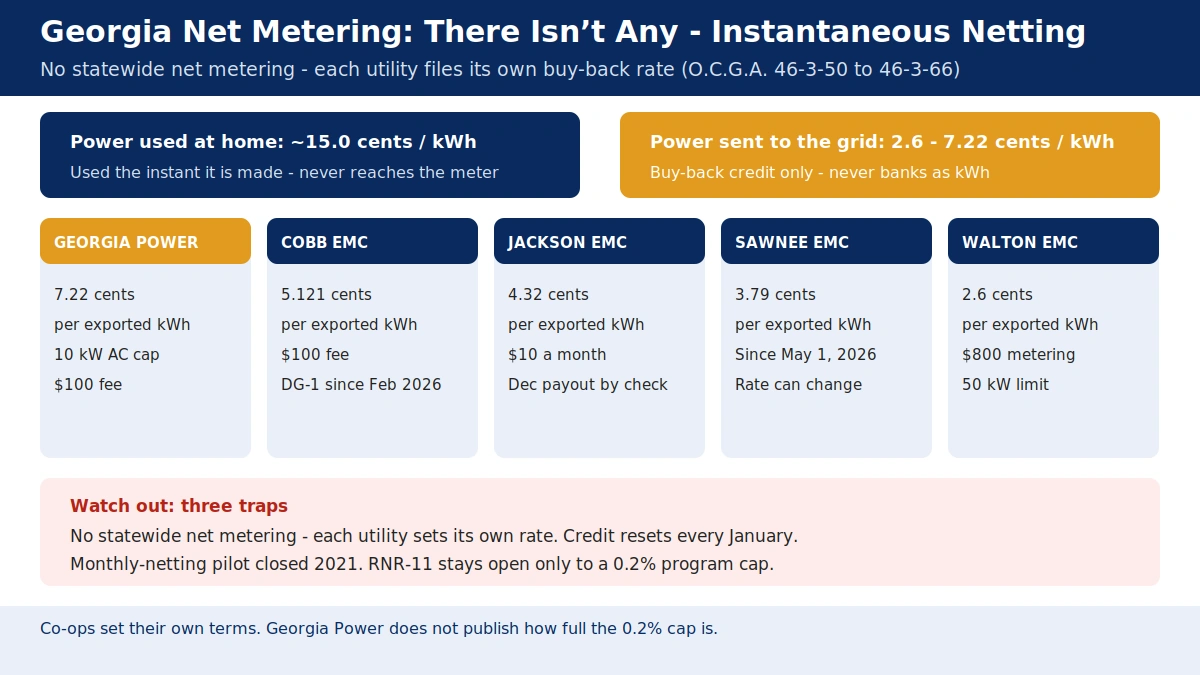
The rule. The Georgia Cogeneration and Distributed Generation Act of 2001, O.C.G.A. 46-3-50 to 46-3-66, says a utility must buy the extra power from a home system of up to 10 kW, at a rate the utility files with the Public Service Commission. The law does not set the rate, and it does not make a utility pay more than its avoided cost — what it would pay to get that power elsewhere. Georgia Power’s version of that rule is tariff RNR-11, and it works by what the utility calls instantaneous netting: the meter compares what the house makes and what it uses second by second, and every kilowatt-hour that leaves the home in that instant counts as exported, even if the house buys the same amount back that evening. There is no monthly netting, no annual banking, and no kilowatt-hour that cancels a kilowatt-hour bought later. The credits are added up each month and taken off the bill, on the line marked “kWh Rec”. The tariff says nothing about carrying unused credit forward or paying it out at year end, and the draft does not invent an answer to that question — ask Georgia Power in writing before you sign.
Everything in this guide turns on that instant-by-instant settlement, so here it is three ways, plainly. First, nothing banks across the day: a noon surplus cannot sit on the meter until evening. Second, the export price is set by each utility, it resets every January at Georgia Power, and the utilities do not agree with each other — Walton EMC pays barely more than a third of what Georgia Power pays for the same kilowatt-hour. Third, the rule binds every utility in the state, but each one files its own rate, so a household on a co-op needs its own co-op’s solar terms in writing — no statewide rate covers those utilities, so the paper is the only protection.
The 10 kW cap. A home system on Georgia Power’s RNR-11 tariff must be no more than 10 kW AC, measured at the inverter. Above that limit, Georgia Power’s other option pays nothing for extra power — the panels still make power the house can use, but every kilowatt-hour that leaves the home earns zero. The cap is the reason the size table above stops being useful past 10 kW for a Georgia Power home. Build past it and the utility will not buy the extra at any price. The co-ops set their own limits: Jackson, Cobb, and Sawnee cap a home system at 10 kW too, while Walton allows 50 kW. And the program itself has a second cap that almost nobody checks: RNR-11 stays open only until solar and other renewable systems reach 0.2% of Georgia Power’s peak demand in the prior year, and Georgia Power does not publish how full it is. Ask whether the program is still open to new systems before you sign, because a closed program is a system that earns nothing for its exports.
Georgia Power — about half of Georgia homes, Atlanta, Savannah, Augusta, Columbus, and most of the state’s cities. Georgia Power is the state’s largest utility, and its export price is the highest of the big utilities. Its credit for exported power is 7.22 cents a kilowatt-hour in 2026: a 3.2188-cent solar avoided-cost rate plus a 4-cent adder the Public Service Commission approved. Its residential all-in price runs about 16.40 cents a kilowatt-hour on the 12-month EIA average, the highest of the big utilities, and the self-use value once the $0.4603-a-day basic service charge is set aside is about 15.0 cents. Since the avoided-cost part resets every January, the 2026 credit is not a promise about 2027: Georgia Power filed a 2027 avoided cost of 3.93 cents on June 26, 2026, which with the adder would make about 7.93 cents — filed, not posted, and not a rate yet when this guide was written. Its interconnection runs through PowerClerk, the utility’s online application tool, with a $100 connection fee billed after the system is tested and the meter is reset, and the agreement is signed by the homeowner, not the installer.
Cobb EMC — northwest metro Atlanta, about 4% of Georgia homes. Cobb pays 5.121 cents a kilowatt-hour for exported power, under Schedule DG-1, in effect since February 1, 2026, for systems connected on or after July 1, 2015. Its all-in residential price runs about 11.4 cents a kilowatt-hour on 2024 EIA figures, which makes the export gap narrower than Georgia Power’s in cents but wider in share: a Cobb kilowatt-hour sent out earns less than half of what a Cobb kilowatt-hour used at home saves. Cobb charges $100 for the meter swap, limits a home system to the rated capacity of the equipment serving the home, and wants its online interconnect agreement started at least 45 days before connecting. Its board can change the rate each year. Cobb’s documents do not say whether extra power is counted moment by moment or over the whole month — ask before you choose a system size, because the answer changes the sizing math completely. A Cobb home with rooftop solar cannot join SolarShare, the co-op’s community solar program.
Jackson EMC — northeast Georgia, about 5% of Georgia homes. Jackson pays 4.32 cents a kilowatt-hour in 2026, its published avoided energy cost, and adds a $10 monthly charge for solar homes — $120 a year, every year, before the first credit is counted. On 2024 EIA figures, a Jackson household’s all-in residential price comes to roughly 11.4 cents a kilowatt-hour. A credit balance carries to the next bill, and each December Jackson clears whatever balance is left and sends a check — the only large Georgia utility that pays out in cash at year end. The catch is the arithmetic: a system that sends out little power can earn less in credits than it pays in charges, and the rider covers systems the member owns, so a leased system needs the co-op’s answer in writing before anyone signs a lease.
Sawnee EMC — north metro Atlanta, about 4% of Georgia homes. Sawnee pays 3.79 cents a kilowatt-hour, the same rate in every month since May 1, 2026, up from 3.48 cents before that. Sawnee’s all-in residential price, again on 2024 EIA figures, sits near 11.5 cents a kilowatt-hour. For systems connected on or after January 2, 2024, Sawnee counts extra power at the moment it leaves the home, like Georgia Power. Owned and leased systems can both take part, which makes Sawnee friendlier to leases than Jackson or Walton. Two warnings travel with the rate: Sawnee can change it at any time, and Sawnee keeps the renewable energy credits for the power it buys — the proof the power was solar belongs to the co-op, not the homeowner. Sawnee’s website blocked the last outside check of the rate, so confirm it with the co-op before you sign.
Walton EMC — east metro Atlanta, about 3% of Georgia homes. Walton pays 2.6 cents a kilowatt-hour, its avoided energy cost for 2026, running through December 31, 2026 — the lowest published credit in the state, barely more than a third of Georgia Power’s. Walton’s homes pay more for power overall: about 13.0 cents a kilowatt-hour all-in, on 2024 EIA figures. Walton charges $800 for the metering equipment and its installation, a one-time cost that lands on top of the system price, and it allows home systems up to 50 kW — the only large Georgia utility where a 12 kW array fits inside the program. A credit balance carries to the next month’s bill. The rate is set one year at a time, so ask for the 2027 rate before you sign, and Walton only has to buy power until member systems reach 0.50% of its peak demand in the prior year.
The co-op in the bill. Georgia’s co-ops together serve about four in ten homes, and each co-op’s board sets its own credit. In all of them the credit runs well under the price homes pay for power: Georgia Power 7.22 cents against about 15.0 cents self-use value, Cobb 5.121 against about 11.4, Jackson 4.32 against about 11.4, Sawnee 3.79 against about 11.5, Walton 2.6 against about 13.0. Look at the name at the top of your electric bill before you sign a solar contract. If it names a co-op, get that co-op’s credit, its monthly charge, and its connection fee in writing, and compare them with the standard figures in this guide — and check the bill again just before the system is switched on, because a co-op board can change its rate with a vote.
SRECs in Georgia: No Market, No Money
Every Georgia solar quote has a line the buyer should read twice, and it is the line about renewable energy credits. A REC certifies that 1,000 kilowatt-hours came from a renewable source, and a typical Georgia roof earns about 13 of them in a year. Where a state runs a strong solar carve-out, 13 credits a year would be real money. In Georgia in 2026, they are nothing — and the reason is simple: there is no market for them at all.
Georgia never built a credit market. The state has no renewable portfolio standard, no solar carve-out, and no SREC market, and no official price for a Georgia solar credit is published anywhere. Without a law that makes anyone buy the credits, nobody has to, and the credits a Georgia rooftop makes have no buyer at any price a homeowner can count on. Sawnee EMC keeps the credits for the power it buys outright. Keep REC income out of your payback math completely. If a quote counts REC money, demand the price, the buyer, and the contract in writing — then watch the payback once that line is struck.
The honest summary is short. Georgia’s certificate market does not exist, because the state never created the demand for one. On paper the credits exist, and the paperwork to hold them is yours to do — but they are worth too little, and too uncertainly, for any honest payback calculation. A quote leaning on REC money is a quote that has run out of genuine incentives. For the same reason, do not let a quote value your exports at the price of a credit in another state — a Georgia credit is not a New Jersey credit, and no Georgia buyer pays New Jersey prices.
Payback: How Long Until Georgia Solar Pays for Itself?
Payback is where a Georgia system either earns its keep or does not, and the answer turns on which utility sends the bill — more sharply than the price per watt suggests, because the utilities disagree with each other by nearly three times on what an exported kilowatt-hour is worth. The worked examples below are built on EcoGen’s anchors, every input traceable, with EnergySage as the second opinion — and every place they part ways is called out.
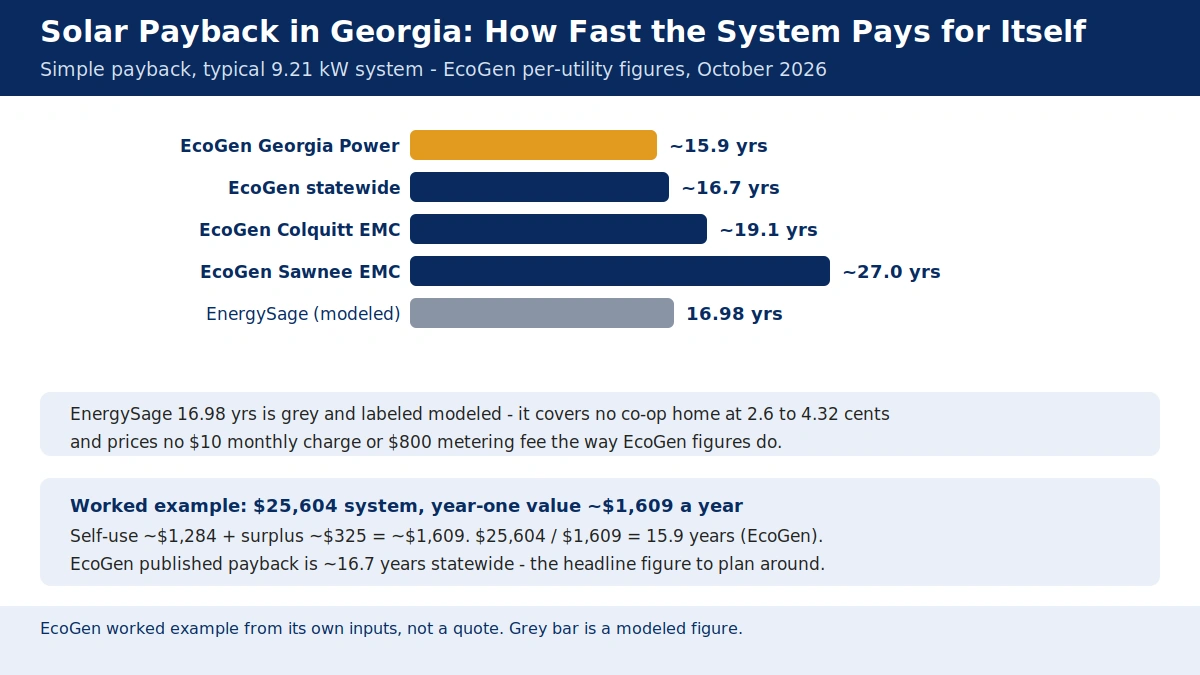
A worked example. Start with the typical 9.21 kW system at $2.78 a watt, $25,604 before any incentive. At 1,419 kilowatt-hours per kilowatt, the yearly output comes to near 13,069 kilowatt-hours. EcoGen’s payback figures below are all quoted before incentives, so the arithmetic stays comparable across utilities. In Georgia the distinction disappears, because there are no incentives here at all — before incentives and after incentives are the same number.
Blended across Georgia Power and the co-ops, EcoGen’s statewide payback lands near 16.7 years. EcoGen weights that figure by where Georgia homes actually sit, across Georgia Power and the co-ops in its figures. Georgia Power, the largest utility at about half of homes, comes in at 15.9 years. The range across the utilities EcoGen models runs 15.9 to 27.0 years, from Georgia Power at the fast end to Sawnee EMC at the slow end. Those are the numbers to plan around. They are slower than the national range of 6 to 12 years in our national guide, and the reason is not the price — Georgia’s $2.78 a watt is below the national average — it is the export rate and the instantaneous settlement. Selling a third of your output for 2.6 to 7.22 cents will never pay back as fast as selling it at retail.
The arithmetic, with its assumptions on the table. EcoGen’s Georgia Power example is published in full, so here it is, step by step. The 13,069 kilowatt-hours the typical system makes split two ways: about 66% is used at home the moment it is made — 8,626 kilowatt-hours at 14.99 cents, the 12-month average Georgia Power price of 16.40 cents less the $0.4603-a-day basic service charge, worth about $1,284 a year — and about 34% is exported — 4,443 kilowatt-hours at 7.22 cents, worth about $325 a year. The year-one value comes to about $1,609 a year, and $25,604 divided by $1,609 is 15.9 years. No upkeep and no future price rises are counted, and no financing or panel aging either. Use EcoGen’s 15.9 years as the headline. Use the arithmetic to see which lever moves it — and to see what happens when the split changes: a household that exports half its output instead of a third keeps only about $1,450 a year and stretches toward 17.7 years, while a household that uses 80% at home pulls the value toward $1,760 a year and the payback toward 14.5 years. Those two numbers are NestPriced illustrations from EcoGen’s own inputs, labeled as such, not quotes.
| Case | Simple payback | Source |
|---|---|---|
| EcoGen statewide (9.21 kW) | ~16.7 yrs | EcoGen, Oct 2026 |
| EcoGen Georgia Power (9.21 kW) | ~15.9 yrs | EcoGen, Oct 2026 |
| EcoGen Colquitt EMC | ~19.1 yrs | EcoGen, Oct 2026 |
| EcoGen Coweta-Fayette EMC | ~23.8 yrs | EcoGen, Oct 2026 |
| EcoGen Flint EMC | ~23.9 yrs | EcoGen, Oct 2026 |
| EcoGen North Georgia EMC | ~26.9 yrs | EcoGen, Oct 2026 |
| EcoGen Sawnee EMC | ~27.0 yrs | EcoGen, Oct 2026 |
| EnergySage statewide (13.08 kW) | 16.98 yrs | EnergySage, Nov 2026 — flagged, modeled |
| EnergySage Atlanta | 15.96 yrs | EnergySage, Nov 2026 — flagged, modeled |
| EnergySage Savannah | 15.29 yrs | EnergySage, Nov 2026 — flagged, modeled |
| EnergySage Augusta | 17.09 yrs | EnergySage, Nov 2026 — flagged, modeled |
| EnergySage Columbus GA | 15.95 yrs | EnergySage, Nov 2026 — flagged, modeled |
The flagged conflict. EnergySage reports a 16.98-year payback statewide, with 15.96 years in Atlanta, 15.29 in Savannah, 17.09 in Augusta, and 15.95 in Columbus, alongside 25-year savings of $20,330 statewide. Those are modeled estimates from EnergySage’s own marketplace averages — a 13.08 kW average system at $2.50 a watt, with savings that assume today’s export credit holds something like its value for 25 years. They sit close to EcoGen’s Georgia Power figure, which is reassuring, but they cover no co-op home at all: no EnergySage city figure prices a Walton EMC household at 2.6 cents, or a Jackson EMC household paying $10 a month before the first credit. Do not present any of them as a verified Georgia payback for a co-op home, and do not let a quote cite one for a Sawnee or Walton household. The gap between 15.9 years and 27.0 years is not a rounding difference — it is the instantaneous settlement, the 10 kW cap, and the 2.6-cent export rate, and any payback that ignores them is modeling a different state.
What moves the payback most. The biggest lever is daytime self-use, and it counts for more in Georgia than it would in a full-retail state. Run the dishwasher, the laundry, and the EV charger in daylight and you move kilowatt-hours from the 2.6-to-7.22-cent export bucket into the 15-cent self-use bucket — no other single change pays as well. The worked example runs on 66% self-use, so pushing that share higher pulls the payback in fast — and a house empty all day pushes it out just as fast. Rate movement is the second lever, and in Georgia it is a live one in both directions: the statewide all-in price rose from 12.5 cents in 2021 to 14.1 cents in 2024, yet the Public Service Commission approved a plan in July 2025 to freeze Georgia Power’s base rates through 2028, and a typical residential customer was set to see about $50 a year less from June 2026 under a fuel settlement. A system bought at today’s prices pays back faster if rates keep climbing, and slower if they do not, and no honest quote can promise which it will be — least of all one that prices 25 years of savings off a single year’s export credit. The third lever is financing: dealer fees on a solar loan can lift the effective price by 10-30%, and Georgia caps neither dealer fees nor lease escalators, so compare quotes on cash price per watt and ignore the monthly payment until then. And no deduction or rebate shortens that payback, because $25,604 is the entire price and payback is simply that price over the yearly value.
Who still comes out ahead. The numbers work for four kinds of Georgia household. The Georgia Power customer who is home in daylight — a home office, laundry and dishes run at midday, an EV plugged in while the sun is up — and so keeps most of its production at full retail value under instantaneous netting. The household that puts panels up alongside a heat pump or an EV, and sizes the array around that new daytime load while keeping it under the 10 kW cap. The household that buys mainly for the rate rises — Georgia’s statewide price climbed about 13% from 2021 to 2024, and a system that looks slow at today’s rates looks different after five more years of the same, if the freeze does not hold. And the Savannah homeowner, where the modeled payback is the fastest of the big cities and the sun is a little stronger than the Piedmont. Say no when the house sits empty all day on Walton EMC, when monthly use runs under 500 kilowatt-hours and fixed charges swallow the savings, or when an installer projects savings without naming your utility’s export rate and its January reset.
Batteries in Georgia: Backup Value, Not Bill Savings
No add-on shows up in Georgia solar quotes more often than a battery — and none is oversold more often. In Georgia it is worth buying for one reason only, and a quote selling it for any other reason is selling a feeling instead of a return.
What a battery costs. No Georgia-specific battery price was verified for this guide — EcoGen’s Georgia pages publish none — so the figures here are national ones, flagged as national. A typical US install lands around $15,647 before incentives for a 10 to 13.5 kWh unit (EnergySage, first-half 2026 data, per our national battery guide), with a Tesla Powerwall 3 at $12,000 to $16,200 installed. That sits on top of the $25,604 for the typical 9.21 kW system, which takes the combined job to about $41,000. Georgia pays no storage rebate and runs no open virtual-power-plant payment to set against a battery, and an owner-installed battery in 2026 earns no federal credit either — §25D covered storage as well, and it closed on the same date. Like the panels, the battery costs what it costs — the full price.
What a battery earns on the bill. A battery on the grid earns the gap between the export rate and the retail rate: it banks a kilowatt-hour that would have sold for 7.22 cents, then spends it after dark in place of a kilowatt-hour bought for about 15.0 cents. That spread runs about 7.77 cents a kilowatt-hour on Georgia Power, and less on every co-op. Store 13.5 kilowatt-hours a day and release them all, and the saving comes to roughly $1.05 a day, or about $383 a year — NestPriced arithmetic from the retail-minus-export spread, stated as an illustration. At that pace, bill savings alone would need more than 40 years to repay a $15,647 battery — longer than the battery itself survives. That spread is real but thin, and thinner in Georgia than in a full-retail net-metering state, because the export rate starts low — leaving the battery less value to win back. On Walton EMC, where the export credit is 2.6 cents, the spread is wider in cents and the battery earns more per stored kilowatt-hour — but the co-op’s $800 metering charge and the same 13.5 kWh of storage still leave the arithmetic far short of the price.
What a battery is actually for. Think of storage as backup and resilience, not as an investment. Georgia’s grid is generally reliable, but summer thunderstorms, tropical storms, and the occasional hurricane remnant do take power out, and a battery sized for the loads that matter in an outage — cooling, refrigeration, water, medical equipment — keeps a house livable through one. Size it to the loads that matter in an outage, not to the whole house, and treat the money as insurance rather than a return. A battery also helps the household that is out all day and home all evening, by shifting midday production into the evening and lifting the self-use share the payback section calls the biggest lever. That benefit is genuine, and it pulls the payback in a little — but it still does not make a $15,647 battery a money-maker, and no honest quote claims it does. Georgia Power’s own solar-plus-battery pilot, approved as part of its 2025 plan, has not opened and has published no payment amounts, so no quote can price a battery payment from the utility into the return. Our solar battery cost guide runs the full battery arithmetic.
Georgia Incentives in 2026: What Exists and What Does Not
With the federal credit gone, most states still hold out something of their own — some kind of state credit, rebate, or exemption. Georgia offers less than that, and the short list below deserves a careful read, because most solar advertising in the state skips it — and because the two real programs are both easy to confuse with something they are not.
For home solar, Georgia pays no state rebate and allows no state income-tax credit. Georgia pays no rebate for rooftop panels — no check from the state, and none from Georgia Power or any of the big EMCs. Georgia Power says so itself: neither it nor the State of Georgia offers rebates for home solar. The old state credit for clean energy property, O.C.G.A. 48-7-29.14, covered only systems switched on by December 31, 2014, and the Department of Revenue’s list of Georgia tax credits carries no solar or clean energy credit today. EcoGen’s check in October 2026 found no rebate for panels or home batteries at Georgia Power, Cobb, Jackson, Sawnee, or Walton EMC. In a Georgia solar project, the only money is on the electric bill itself: power the house uses at full retail, and surplus power at the buy-back rate. The rest of this section is programs built for someone else, a tax you still pay, or a program that has already ended.
Property tax is the gap Georgia does not fill, and you have to ask your county about it. Unlike Ohio, where state law exempts a home system from real property tax, Georgia has no property-tax exemption for solar on the Department of Revenue’s exemption list, and property tax is set by the county. Ask your county tax assessor, in writing, whether panels change your home’s assessed value before you sign — this guide makes no promise of an exemption, because none was verified. A system that adds value to the home may add tax to the bill, and that cost belongs in the payback math before the panels go up, not after.
A sales-tax exemption for home solar is something installers claim — this guide found no such exemption to confirm. Georgia charges 4% state sales tax, and counties and cities add their own on top. No statewide sales-tax exemption for home solar was verified for this guide, and EcoGen’s Georgia pages list none. This guide does not count a sales-tax saving in any figure, and neither should a quote — if an installer shows one, ask for the statute and the ruling, in writing, before you let it into the price, and ask whether the quote includes sales tax on the equipment at all.
Solarize is real but its 2026 status is unverified. Group-purchase campaigns have run in Georgia before: Solarize Atlanta 2.0 launched in June 2021 with Creative Solar USA as the competitively selected installer, and the first Solarize Atlanta campaign in 2018-19 put panels on more than 130 homes and added 890 kW, while Solarize Savannah ran alongside it. Those campaigns cut prices by bulk purchasing — up to 20-25% in the organizers’ own figures — and they are the one Georgia route to a genuinely lower per-watt price. But no live 2026 enrollment window was verified for this guide, and the one undated post praising Solarize Atlanta 2.0 and Solarize Savannah pricing gives no year for its November 30 enrollment deadline. Check solarizeatl.com before you count on a group price, and do not let a quote price a Solarize discount that is not currently open.
Georgia Solar for All is not open to Georgia households. Georgia BRIGHT, the state’s Solar for All program run by the nonprofit lender Capital Good Fund with Atlanta, Savannah, and Decatur, opened a no-cost solar plan in August 2025 and had nearly a thousand families signed up within days. Then the EPA’s termination notices took effect on August 7, 2025, and the program stopped. Federal courts ruled the termination unlawful on September 18 and September 22, 2026, and as of October 5, 2026 Georgia BRIGHT had announced no restart and nothing is open to apply for. The funding sits frozen while the courts decide, and no Georgia household can apply for it today.
Georgia’s home energy rebates are real, paused, and useless for solar anyway. The state was awarded about $109 million each for the HEAR and HOMES programs, run by the Georgia Environmental Finance Authority, and the programs launched in spring 2025 — one of the few states to get them running at all. By August 12, 2026 the authority reported more than $50 million issued to more than 3,500 households, at an average rebate of $12,104. Then HEAR stopped accepting new single-family and multifamily applications at 1:00 PM EST on August 14, 2026, and fuel-switching scopes had already been cut on August 10, 2026 under revised federal guidance. The state said HEAR would reopen in October 2026 with limited funding and narrower measures — wiring and panel work only, paired with an efficiency project — and that multifamily HEAR would not reopen. Whether that reopening actually happened by November 2026 could not be verified for this guide, so it is not stated here as open. The Home Efficiency Rebates program, the whole-home modeled-savings track, remains open at all income levels. Even once those programs settle down, HEAR still puts nothing toward a solar purchase. HEAR money is for electrification only. It covers heat pumps and heat-pump water heaters, electrical panels, and wiring tied to insulation — and nothing else. None of those four — panels, batteries, EV chargers, or windows — is something the program pays for.
| Item | Value | Notes |
|---|---|---|
| GA state rebate for panels | $0 — none exists | No state or utility rebate for home solar |
| GA state income-tax credit | None | Old credit O.C.G.A. 48-7-29.14 ended Dec 31, 2014 |
| Property-tax exemption | None verified | No exemption on Dept of Revenue list; ask the county assessor in writing |
| Sales-tax exemption | None verified | 4% state rate + local add-ons; not counted in any figure |
| Community solar | Subscription, not a saving | Georgia Power $24/mo per 1 kW block (~165 kWh/mo); Cobb SolarShare $19/mo per block (150 kWh) |
| Georgia Power battery payment | Not open | Pilot approved in 2025 plan; no amounts published, not enrolling |
| EMC solar loans | Up to $25,000 at 9.90% APR | Central Georgia EMC + Cobb EMC PowerUp; a loan, not a discount |
| Central Georgia EMC rebate | Gone | Old $450/kW solar rebate no longer offered; 2026 rebates cover heat pumps + water heaters only |
| Solarize Atlanta / Savannah | Status unverified for 2026 | Ran before (Atlanta 2.0 from Jun 2021); no live 2026 window confirmed |
| Solar for All / GA BRIGHT | $0 — paused since Aug 7, 2025 | Courts ruled termination unlawful Sep 2026; no restart announced as of Oct 5, 2026 |
| HEAR / HOMES rebates | HEAR paused Aug 14, 2026 | ~$50M+ issued to 3,500+ homes by Aug 12, 2026; HER open; reopening unverified |
| SRECs | $0 — no market | No RPS, no carve-out, no published price; leave out of payback math |
Federal Help in 2026: No Tax Credit Remains — but Leasing Still Has a Path
The federal picture for 2026 is a short one — a single paragraph covers it, and that brevity is exactly why so much solar advertising still gets it wrong. In Georgia the paragraph grows a second half that most states never need, because the lease route that rescues other states works here, and the buyer who does not know that has one fewer option than they actually have.
For a homeowner-bought system installed in 2026, the federal tax credit comes to $0 — nothing at all. The One Big Beautiful Bill Act (Public Law 119-21), signed on the Fourth of July, 2025, closed the Residential Clean Energy Credit (§25D, 30%) to any system finished after the last day of 2025. Under IRS fact sheet FS-2025-05, the finish date decides everything: a 2025 deposit buys nothing if the crew wrapped up the job in January 2026. The §25C efficient-home-improvement credit ended on that very same day. If a bid dated 2026 still knocks 30% off the price, the installer is pricing off a credit that stopped applying to systems finished after December 31, 2025. Tell the installer to strip that line out and price the job again. Plenty of Georgia cost pages still print an “after tax credit” column. That column still takes off the dead 30% credit, and no number in this guide goes near it.
Georgia law allows leases and PPAs, which leaves the door open for the provider to claim the commercial credit instead. The news is not all bad for leasing companies: a system the company owns can still pick up the 30% commercial clean-electricity credit under §48E, provided construction started by July 4, 2026 and the array enters service by December 31, 2027. Both of those deadlines come from IRS Notice 2025-42. Where the law lets a homeowner host a company-owned array, the credit reaches the household through a lease or a power purchase agreement, with the company folding part of the value into a lower monthly payment. Georgia is such a state: leases and third-party PPAs are both legal here under the Solar Power Free-Market Financing Act of 2015, for home systems up to 10 kW AC, and the utility may not block them — though the utility must be told at least 30 days before the system starts. Palmetto, Sunrun, and other national installers are still taking new Georgia residential contracts in 2026. The catch is the escalator: lease payments commonly rise 1% to 5% a year for decades, and what the provider passes along is whatever the contract promises — never the full 30%. Run the escalator over the full term before you put a lease next to a loan, and get a lawyer to read any lease or PPA before signing — a lease is the contract behind free-solar advertising, and no Georgia program offers free panels. One more Georgia wrinkle: Jackson EMC and Walton EMC credit rules cover systems the member owns, so ask those co-ops before you sign a lease on their territory.
HEAR money never touches solar. When the program is open, income-eligible Georgia households can still draw as much as $8,000 from the Home Electrification and Appliance Rebates program. That money funds electrification work and nothing else — it never pays for panels. HEAR covers electrification gear and nothing more. It pays for heat pumps, heat-pump water heaters, electrical panels, and wiring work tied to insulation. Panels, batteries, EV chargers, and windows — none of the four qualifies. The Energy Department’s revised 2026 guidance confines funding to upgrades that replace one electric system with another. Fuel-switching is out. Georgia’s own HEAR program is paused, with a reopening promised for October 2026 that this guide could not verify, and its HER program stays open. A solar price with a HEAR rebate folded in describes a program that simply does not work that way. A Georgia homeowner can still get real value out of HEAR — just not for the panels themselves. The usual pairing is a heat pump going in alongside the panels, and it is the heat-pump side of that job — not the solar side — that stands a chance of qualifying once Georgia’s program is running steadily again. The solar half never will.
The honest summary: in 2026 Washington contributes nothing to a Georgia homeowner who buys panels outright — yet it can still contribute indirectly through a lease or a PPA, because Georgia’s legal route is clear and providers are actively selling them, which is more than thin-lease states can say. On a cash quote, the price is the price. The only state help is a bill credit that resets every January, a co-op loan at a normal interest rate, and a group-purchase campaign whose 2026 status is unverified. For everything the federal government still offers — and everything it ended — our federal tax credits guide lays out the 2026 rules. Lease-versus-buy is covered in our national solar cost guide.
Permits & Licensing: What Georgia Requires
In one way that rewards a buyer who checks, Georgia asks less of installers than most states do: the state issues no solar-only license for a company to wave at you, and there is no statewide home-improvement credential that can stand in for the electrical one. The check itself is a short one, and it is the same for every installer in Georgia.
The electrical work needs a license, and the license belongs to a person, not a company. Georgia licenses electrical contractors in Class I and Class II under O.C.G.A. §43-14-8, and the license is issued to a person — so ask whose license covers your job, and check that name, not just the company name. The Attorney General’s office says a solar installer should work with a licensed Georgia electrical contractor, and the license can be looked up on the Secretary of State’s licensee search. Ask for the number and check it before you sign — a company that waves a general business license instead of that number has shown you the wrong paper. EcoGen’s check of Georgia installers in October 2026 found Palmetto publishing an active electrical license, EN009061, which names a person rather than the company, and ESD Roofing Solar publishing EN218454, which EcoGen had not checked. A good reputation is not a license, and the roster is the place to look.
NABCEP certification is not something Georgia demands of installers — ask about it anyway, because it is still the credential that counts. For this guide, no Georgia license category for solar installers turned up in verification — so there is simply no state-issued solar credential for a buyer to ask for. The North American Board of Certified Energy Practitioners (NABCEP) photovoltaic installer certification remains the leading industry credential, and it is worth asking about — a Georgia installer that holds it is a real signal in a state with a deep installer bench in Atlanta and thin ones outside it. Treat it as a plus, not a license.
Getting permits and the interconnection agreement sorted takes real calendar time, and how long they take decides when the job can happen. Before anything else, three permissions have to be lined up — building permit first, then the electrical permit, then the utility’s interconnection agreement. Of the three, the interconnection is the one with published Georgia rules: Georgia Power takes applications through PowerClerk, its online application tool, and the agreement is signed by the homeowner; Cobb EMC wants its online interconnect agreement started at least 45 days before connecting; and a leased system must be notified to the utility at least 30 days before it starts. This guide found no statewide schedule of permit fees and no verified Atlanta permit timeline, so it quotes no fee figure and no permit-day count. The fee is set by the city or county building department, and the wind-load figure that department publishes is the one the roof has to meet. If a quote does not list rapid-shutdown gear, ask why — module-level rapid shutdown is standard on a modern home install, and the quote should say so. No installer can promise permission to operate inside two weeks — that timetable belongs to the utility. It is not the installer’s call.
Georgia has no solar-access law, and that is the opposite of what most buyers assume. The only Georgia statute with “solar” in its name is the Solar Easement Act of 1978, O.C.G.A. §§44-9-20 to 44-9-23, and it does nothing for a homeowner facing an HOA: it merely lets neighboring property owners voluntarily grant each other easements for sunlight access, in writing, recorded like any other easement. It says nothing about covenants, architectural review, or associations, and it overrides nothing. A bill that would have barred Georgia HOAs from prohibiting solar installations, HB 483, did not pass. So as of 2026, a Georgia HOA can still restrict solar panels under its covenants, and the recorded declaration — not state law — decides the question. Get the architectural-review approval in writing before any panels are ordered. Condo owners face that hurdle twice over, since the roof is usually common area and the board’s word is final. If an installer tells you Georgia law protects your panels from the HOA, ask them to read the statute — one Atlanta installer’s own website describes a North Carolina court ruling as if it were Georgia law, and it is not.
The cautionary cases are Georgia cases. In 2022 the Georgia Attorney General warned about solar ads promising free solar, no more power bills, or a partnership with Georgia Power or an EMC — and Georgia Power says it has no exclusive partnership with any solar company. The orphan risk is real here too: Pink Energy filed for Chapter 7 bankruptcy, ADT Solar left residential installation in January 2024, and Freedom Forever filed for Chapter 11 in 2026. Treat a door-to-door pitch with caution, look at the Attorney General’s complaint record before signing, and remember the company with the biggest advertising budget is not always the one still answering the phone in five years.
What Pushes Your Georgia Quote Up or Down
Think of the per-watt anchor as the starting point for pricing — any single quote can still land well away from it. A Georgia quote can swing by thousands of dollars on seven factors, three of which come from the state’s geography and climate rather than the equipment.
Heat, humidity, and coastal wind are the Georgia factors. EcoGen names them outright as the reason quotes spread from $2.50 to $3.06 a watt: near Savannah and the coast, racking must meet higher ASCE 7 wind-load standards, which means heavier attachment and a load review on older framing. Summer heat and humidity push installers to mount inverters out of direct sun, which adds little to the line-item cost but belongs on the quote where the buyer can see it. A quote for a Savannah roof should show the wind-rated racking as its own line, and a quote that does not show it has hidden it somewhere else. Ask the installer where the panels will sit, how the racking attaches, and what happens to the schedule when the roof needs work first.
Labor is the quiet factor. No Georgia-specific BLS wage for electricians was pulled for this pass, so no Georgia figure appears here. For context, the national figure is a median of about $30.38 an hour for electricians (BLS, May 2025), and labor is the largest soft-cost piece of any install. What moves a Georgia quote is not the hourly rate but the bench: with a deep installer market in metro Atlanta, the crew’s experience in your utility’s territory matters more than the headline rate. Ask the crew how many installs they have finished in your utility’s territory — that is a different question from years in business.
The roof, and the trees over it. Georgia’s tree canopy is the production risk no other state in this series carries to the same degree: a live oak over the south roof takes more output than any cloud, and a quote that prices a shaded roof like a clear one is pricing a fantasy. If the roof has under fifteen years left, replace it before the array goes on. A detach-and-reset for a later reroof runs to low-to-mid four figures on its own. Our roof replacement guide prices what a reroof adds to the bill — look it up before you budget. Standing-seam metal, common on Georgia homes, takes solar as well as any roof out there: the clamps grip the seams without a single penetration, and rain leaves metal cleaner than asphalt. On a steep Georgia roof, the flashing details matter more than the panel brand, because a summer thunderstorm finds every weak seal. Before the crew shows up, get the building department to confirm the roof can carry the wind loads the array will add. After is too late.
Panel tier. Top-tier panels carry a premium of roughly 10% to 20% per watt over value-tier ones. In Georgia that premium buys two things worth having: stronger low-light performance on cloudy, humid afternoons, and slower degradation across a quarter century of hot, bright sun. Where roof space is tight, the extra money for efficiency is money well spent. On a wide-open roof around central Georgia, a large array usually comes out cheaper with value-tier panels. Premium n-type panels hold their output longer as well, losing 0.25-0.5% a year and keeping 91-93% of rated output at year 25, against a fleet median near 0.5% a year and about 88% at year 25, per NREL. When payback already runs long, that gap counts for more — each extra year of strong output is a year the system depends on.
Inverter choice. A string inverter costs less to buy than microinverters do. Microinverters or optimizers cost more but generate more where roofs carry partial shade — and Georgia roofs, with their oaks, pines, dormers, and chimneys, carry shade more often than installers admit, while a summer storm cloud over one part of an array shades it just like a tree. Each microinverter watches only its own panel, so one shaded panel cannot pull the whole string down with it. Expect a string inverter to last 10-15 years, so budget for replacing it once while the system is still running. Microinverter warranties usually stretch to around 25 years. Our inverter replacement guide prices every inverter type across its whole lifespan, though every dollar figure in it is national, not Georgia-specific.
The electrical panel. Many Georgia homes still run on 100-amp service — especially older homes in Atlanta’s inner-ring suburbs — and a solar install often forces the question. Our electrical panel upgrade guide puts a 200-amp panel upgrade at $1,500-$4,000 nationally — the add-on that catches Georgia buyers by surprise most often. Before you sign, the quote should say plainly whether the panel upgrade is in the price. Get it settled before the electrician pulls into your driveway. No dollar figure for a Georgia panel upgrade was verified for this guide. A national figure stands in instead, clearly marked as national. One Georgia wrinkle: a panel upgrade is electrification work of the kind HEAR exists to pay for — once Georgia’s HEAR program settles down, which it has not.
Financing terms. Nothing beats paying cash over the life of the system — every other way of paying costs more in the end. On a $0-down loan, the amount financed quietly absorbs dealer fees worth 10-30% of the cash price. The Consumer Financial Protection Bureau published that dealer-fee range in its market spotlight of August 2024. It is a national number, yet Georgia quotes carry it in full, and Georgia caps neither dealer fees nor lease escalators. A lease or PPA is the fourth path, and it is a real one here: leases and PPAs are legal in Georgia, the provider claims the §48E credit, and the monthly payment may carry some of that value — but price the escalator, commonly 1% to 5% a year, over the full term before judging the lease on its monthly payment. Community solar is the fifth path, and it is a subscription rather than a saving: Georgia Power charges $24 a month for a block that makes about 165 kilowatt-hours a month on average, and says the program is not meant to save you money.
Upkeep and lifespan. A panel’s productive life runs 25-30 years, past the warranty, and its output fades a little each year. The usual cover for materials and workmanship runs about 10-25 years. A performance warranty typically runs 25-30 years and guarantees 80-92% of rated output at year 25, with the exact percentage set by the panel tier. Upkeep is light: a cleaning now and then, a yearly production check, and no moving parts to wear out. In Georgia, rain does most of the cleaning, but spring pollen and summer dust still coat panels, and a spring rinse does the job rain does not. Every one of those lifespan, degradation, and maintenance figures is a national figure. Georgia-specific versions of those figures do not exist, so each one is flagged as national.
Getting Quotes in Georgia: The Checklist
Georgia is a demanding state to buy solar in — strong sun, cheap power, a buy-back rate under half of retail, a 10 kW cap, and a co-op map where the name at the top of the bill can change the answer by a decade — but only for a homeowner who checks the utility terms before the sales pitch. Take this checklist into every meeting with a bidder. Sign nothing until each item has a written answer.
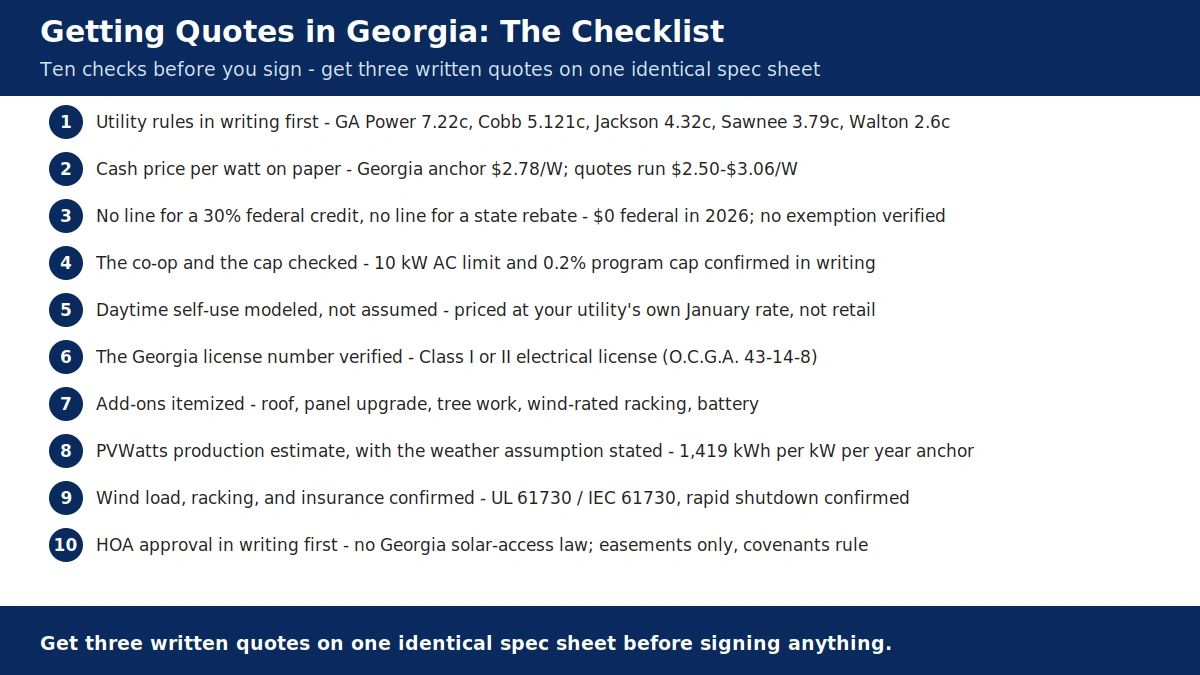
The ten-item quote checklist:
- Your utility’s rules, in writing, first — Georgia Power’s 7.22-cent export credit, Cobb EMC’s 5.121 cents, Jackson EMC’s 4.32 cents plus $10 a month, Sawnee EMC’s 3.79 cents, Walton EMC’s 2.6 cents plus $800 for metering, or your own co-op or city utility’s terms. Export price and instantaneous settlement decide the payback before anything else — and Walton EMC’s credit is worth about eleven years of payback against Georgia Power’s.
- Cash price per watt, in writing — every bidder gets the same spec sheet. The Georgia anchor is $2.78 a watt; a quote far above it calls for an explanation, and a quote far below it calls for a closer look at what was left out — especially the wind-rated racking on a coastal roof.
- Strike any 30% federal credit line and any state rebate line — an owner purchase in 2026 receives $0 from Washington, while Georgia offers neither a state rebate nor a state income-tax credit, and no property-tax exemption or sales-tax exemption was verified. A quote that still carries a 30% credit line is built on a law that has already expired. Ask for it to be removed.
- The co-op and the cap checked — read the name at the top of the bill before you sign, and check the 10 kW AC limit and the 0.2% program cap with your utility in writing, because a system over the limit earns nothing for its exports and a closed program earns nothing at all.
- Model daytime self-use; never assume it — figure out, hour by hour, how much of the production the house consumes the instant it is made, and price the surplus at your own utility’s January rate. A quote that values all exports at one blended price, or banks noon into evening, is wrong.
- The Georgia license number verified — the installer’s Class I or Class II electrical contractor license under O.C.G.A. §43-14-8, checked on the Secretary of State’s roster, with the person’s name matched to the contract. NABCEP certification is a plus. One Atlanta installer was still advertising the dead 30% credit in October 2026 — do not accept a quote that cites it.
- Add-ons itemized — the roof work, the panel upgrade, the tree work, the wind-rated racking, and the battery should each appear as its own priced line, never buried in the per-watt figure.
- A PVWatts production estimate that shows its weather assumption — roughly 1,419 kilowatt-hours per kilowatt each year rather than nameplate watts, laid out as a monthly shape instead of one yearly average. Ask to see the monthly curve itself, with July set beside December.
- Wind load, racking, and insurance confirmed — roof wind-load rating settled with the building department, racking uplift rating named, tilt stated, UL 61730 / IEC 61730 panels specified by name, rapid shutdown confirmed, and homeowners cover for the array confirmed in writing before signing.
- HOA approval, in writing, first — Georgia has no solar-access law: the Solar Easement Act of 1978 only lets neighbours grant each other sunlight easements, and it overrides no covenant. Secure architectural-review approval before ordering panels; condo owners need the board’s approval for the common-area roof too.
Buy, lease, or community solar? Across 25 years, buying comes out ahead for homeowners with high daytime use, Georgia Power terms, or a heat pump or EV to pair with the array. Buying means the system belongs to you, the resale value belongs to you, and every kilowatt-hour you use yourself is still worth its full retail price. Leasing fits homeowners who want no upfront cost and no maintenance — it is genuinely on offer in Georgia, with the provider claiming the §48E credit, so run the 1% to 5% escalator over the full term before judging the deal on its monthly payment. Community solar wins for renters, condo owners, and homes whose roofs are shaded or unsuitable — but in Georgia it is a subscription that the utility itself says is not meant to save you money, so price it as a green choice, not an investment. Off the grid, a cabin past the end of the road is a different question entirely, and this guide does not answer it. A rural Georgia home on a co-op meter should start by getting its own co-op’s terms in writing — nothing else comes first.
Sources & methodology
Cost anchors (per watt, system size, totals):
- EcoGen Solar Cost Index, September 2026 Edition, prices as of Sep 25, 2026: $2.78/W; 9.21 kW typical (Berkeley Lab 2025 median, 351 systems); $25,604 total; 1,419 kWh/kW/yr; ~5.1 peak sun hrs/day; neighbours FL $2.46, NC $2.76, GA $2.78, SC $2.85, US $2.89, AL $3.44; quotes $2.50-$3.06/W
- EcoGen Georgia cost page: 6 kW $15,000-$18,360 ($16,680 at anchor); 8 kW $20,000-$24,480 ($22,240); 10 kW $25,000-$30,600 ($27,800); 12 kW $30,000-$36,720 ($33,360); payback 16.7 yrs statewide, 15.9 yrs Georgia Power, 15.9-27.0 yrs across modeled utilities
- EnergySage Georgia page, Nov 2026: $2.50/W; 13.08 kW average; $32,739 (range $27,828-$37,650); payback 16.98 yrs; 25-yr savings $20,330; 61% offset — modeled, flagged
- EnergySage city pages, Nov 2026: Atlanta Fulton $2.54/W, 12.64 kW, $32,097, payback 15.96 yrs, savings $23,856; Savannah $2.49/W, 12.92 kW, $32,185, payback 15.29 yrs, savings $25,364; Augusta $2.52/W, 12.02 kW, $30,306, payback 17.09 yrs, savings $17,265; Columbus GA $2.52/W, 11.44 kW, $28,882, payback 15.95 yrs, savings $20,932; Warner Robins $2.48/W, 14.16 kW, $35,106, payback 18.45 yrs; Athens $2.57/W, 13.13 kW, $33,736, payback 21.98 yrs; Peachtree City $2.51/W, 13.39 kW, $33,582, payback 16.85 yrs; Rome $2.51/W, 12.06 kW, $30,298, payback 14.37 yrs
- EnergySage Atlanta DeKalb duplicate ($2.54/W, 13.5 kW, $34,258, payback 16.55 yrs) — conflicts with Fulton figures; Fulton used, duplicate flagged
- EnergySage Georgia guide page export figure “about 3.7 cents” for Georgia Power — conflicts with Georgia Power’s own 7.22c; treated as stale, excluded
- NumeralQ Georgia page (planning estimate, EnergySage data retrieved Oct 26, 2026): 8 kW $19,280-$25,210 ($2.41-$3.15/W); 4 kW $10,140-$13,260; production PVGIS 1,446-1,468 kWh/kW/yr by city (Savannah 1,468)
Rates and home use:
- EIA, 12 months to Aug 2026: GA 15.17 cents/kWh (US 18.0 cents); average use 1,080 kWh/mo (~12,960 kWh/yr); average bill ~$164/mo; Aug 2026 alone 15.90 cents, 1,471 kWh, $233.87 bill
- EIA final 2025: 1,077 kWh/mo, 14.74 cents, $158.70/mo; 2024: 1,074 kWh/mo, 14.08 cents, $151.25/mo
- Georgia Power: 12-mo average price 16.40 cents (EIA Sep 2025-Aug 2026); 2024 average homes paid 15.5 cents; R-31 energy rate 8.2116 cents winter, summer 8.7738 cents first 650 kWh, 14.5738 cents next 350, 15.0828 cents over 1,000 kWh; basic service charge $0.4603/day (~$14/mo); self-use value ~15.0 cents once the daily charge is set aside
- EMC 2024 average prices homes paid (EIA Form 861): Cobb ~11.4 cents, Jackson ~11.4 cents, Sawnee ~11.5 cents, Walton ~13.0 cents
- Georgia electricity prices rose 18% from 2020 to 2024 (Palmetto); EIA statewide 12.5 cents (2021) to 14.1 cents (2024); PSC approved a plan to freeze Georgia Power base rates through 2028 (Jul 2025, reported by Pristine Panels — secondary); typical residential customer set to see ~$50/yr less from Jun 2026 under a fuel settlement (ainvest — secondary)
Net metering and export credits:
- O.C.G.A. 46-3-50 to 46-3-66 (Cogeneration and Distributed Generation Act of 2001): every utility must credit extra power from a home system up to 10 kW, at a rate the utility files; no rate set by law, no more than avoided cost required
- Georgia Power tariff RNR-11 (checked Sep 30, 2026): instantaneous netting, second by second; 2026 credit 7.22 cents = 3.2188 cents avoided cost + 4 cents PSC adder; resets every January; 10 kW AC limit; 0.2% program cap; 5,000-customer monthly-netting pilot (RNR-14) closed, filled 2021; $100 connection fee; PowerClerk applications
- 2027 avoided cost filed 3.93 cents on Jun 26, 2026 (PSC Docket 16573) — would make ~7.93 cents with the adder; not posted as of Oct 14, 2026; presented as filed only
- Cobb EMC Schedule DG-1 (effective Feb 1, 2026): 5.121 cents; $100 connection fee; interconnect agreement started at least 45 days before connecting; board can change the rate yearly; rooftop-solar homes cannot join SolarShare
- Jackson EMC Net Metering Rider (PSC Docket 31536, checked Oct 28, 2026): 4.32 cents (2026); $10/month charge; 10 kW limit; balance carries monthly; December balance paid out by check; rider covers member-owned systems
- Sawnee EMC Net Metering Rider NEM-18: 3.79 cents since May 1, 2026 (3.48 cents before); 10 kW AC limit; owned and leased systems can take part; instantaneous counting for systems connected on/after Jan 2, 2024; Sawnee keeps the RECs; rate can change at any time
- Walton EMC: 2.6 cents through Dec 31, 2026; $800 metering cost; 50 kW limit; must own and run the system; Walton only has to buy until member systems reach 0.50% of peak demand
- Co-op export credits run 2.6 to 5.121 cents; co-ops serve about 4 in 10 Georgia homes; Georgia Power serves about half
SRECs:
- No Georgia RPS, no solar carve-out, no SREC market, no official published price; Sawnee EMC keeps the RECs for power it buys; typical system makes ~13 RECs/yr (13,069 kWh / 1,000); REC income excluded from payback math
Payback arithmetic:
- EcoGen published figures (Oct 30, 2026): statewide ~16.7 yrs, Georgia Power ~15.9 yrs, range 15.9-27.0 yrs; Colquitt 19.1, Coweta-Fayette 23.8, Flint 23.9, North Georgia 26.9, Sawnee 27.0; Cobb, Jackson and city utilities have no EcoGen figure yet; Walton has none
- EcoGen Georgia Power worked example: 9.21 kW, $25,604, 13,069 kWh/yr; 66% self-used at 14.99 cents = ~$1,284/yr; 34% exported at 7.22 cents = ~$325/yr; year-one value ~$1,609/yr; $25,604 / $1,609 = 15.9 yrs
- NestPriced illustrations (labeled as such): 50% export share → ~$1,450/yr, ~17.7 yrs; 80% self-use → ~$1,760/yr, ~14.5 yrs
- EnergySage modeled paybacks (16.98 yrs statewide; 15.96 Atlanta; 15.29 Savannah; 17.09 Augusta; 15.95 Columbus) flagged as modeled estimates
Production and climate:
- EcoGen: 1,419 kWh/kW/yr PVWatts-based; Atlanta ~5.1 peak sun hrs/day (Palmetto); NREL insolation map: Atlanta 4.74 hrs/yr avg (5.16 summer, 4.09 winter)
- Atlanta sunshine: ~2,738 hrs/yr (NOAA 1991-2020 normals); May 288 hrs, January 164 hrs; ~217 clear or partly cloudy days
- Palmetto Atlanta model: 10 kW system ~43.6 kWh/day July, ~28.1 December; insolation 2.10 kWh/m2/day December vs 5.76 June (NASA/Gaisma)
- Heat penalty 0.3-0.5% per degree C above 25 C cell temperature, national figure; Atlanta July average high ~30.8 C
- Coastal wind: higher ASCE 7 wind-load standards near Savannah (EcoGen cost page); no Georgia-specific design wind speed verified
- Detach-and-reset for a later reroof: low-to-mid four figures (EcoGen Georgia cost page)
Incentives:
- No state rebate, no state income-tax credit (GA Dept of Revenue tax-credit list; old credit O.C.G.A. 48-7-29.14 ended Dec 31, 2014); no panel or battery rebate at Georgia Power or the four big EMCs (EcoGen check, Oct 2026)
- Property tax: no exemption on the GA Dept of Revenue exemption list; county-set; ask the county assessor in writing (EcoGen incentives page)
- Sales tax: 4% state rate plus county/city add-ons; no home-solar exemption verified; not counted in any figure
- HEAR/HOMES: ~$109M awarded per program; run by GEFA (energyrebates.georgia.gov); launched spring 2025; $50M+ issued to 3,500+ households by Aug 12, 2026 (GEFA milestone; average rebate $12,104); HEAR stopped accepting new applications 1:00 PM EST Aug 14, 2026; fuel-switching cut Aug 10, 2026 under revised DOE guidance (May 29, 2026); reopening promised Oct 2026 with limited funding/measures — unverified as of Nov 11, 2026; HER open at all income levels; HOMES up to $16,000 in Georgia (Retrofit Relay, Jul 2026 — secondary)
- Solar for All / Georgia BRIGHT: EPA terminated all 60 grants Aug 7, 2025; ~1,000 families signed up within days of Aug 2025 opening; courts ruled the termination unlawful Sep 18 and Sep 22, 2026; no restart announced as of Oct 5, 2026 (Capital Good Fund via EcoGen)
- Community solar: Georgia Power $24/mo per 1 kW block (~165 kWh/mo avg), “not meant to save you money”; income-qualified $6/mo for one block via sponsor-funded pilot, enrollment unverified; Cobb EMC SolarShare $19/mo per block credited at 150 kWh
- Georgia Power battery pilot: PSC approved 2025 plan (IRP stipulation Jul 15, 2025) including a solar-plus-battery pilot; Georgia Power has not opened it or published amounts (EcoGen)
- EMC loans: Central Georgia EMC + Cobb EMC PowerUp up to $25,000 at 9.90% APR; Central Georgia EMC old $450/kW solar rebate gone, 2026 rebates cover heat pumps + water heaters only
- Georgia Power HEIP: up to $250 for an eligible solar water heater (Palmetto — secondary, not a PV incentive)
- Solarize: Atlanta 2.0 launched Jun 2021 (Creative Solar USA installer); first Atlanta campaign 2018-19: 130+ installs, 890 kW; Solarize Savannah ran alongside; no live 2026 enrollment window verified
- AG warning: Georgia Attorney General (Carr), Aug 18, 2022, on free-solar ads and false utility partnerships
Federal and financing:
- OBBBA P.L. 119-21 and IRS FS-2025-05: §25D and §25C $0 for post-Dec-31-2025 installs, completion date counts
- §48E 30% for third-party-owned systems, in service by Dec 31, 2027, construction begun by Jul 4, 2026 per IRS Notice 2025-42; leases and PPAs legal in Georgia under the Solar Power Free-Market Financing Act of 2015 (O.C.G.A. 46-3-60 to 46-3-66), home systems up to 10 kW AC; utility must be told at least 30 days before start; escalators commonly 1-5%/yr (CFPB, per EcoGen Georgia page)
- DOE revised 2026 guidance (Program Notices 26-1/26-2): HEAR electric-to-electric upgrades only, no fuel-switching; solar, batteries, EV chargers, windows outside HEAR (notice date conflicts between sources — Sep 1, 2026 per art. 120 vs May 29, 2026 per Retrofit Relay; draft cites the guidance without pinning a date)
- CFPB Solar Financing Market Issue Spotlight, Aug 2024: dealer fees 10-30%, sometimes over 50%; EcoGen Georgia page: 10-30% on $0-down loans; Georgia caps neither dealer fees nor lease escalators
- Battery cost: no Georgia-specific figure verified; national typical ~$15,647 before incentives for 10-13.5 kWh (EnergySage H1 2026, per art. 22); Powerwall 3 $12,000-$16,200 installed (art. 22); battery daily-savings illustration (~$1.05/day on 13.5 kWh stored, ~$383/yr) is NestPriced arithmetic from the 7.77-cent retail-minus-export spread, labeled as an illustration
HOA and licensing:
- No Georgia solar-access law. Solar Easement Act of 1978 (O.C.G.A. §§44-9-20 to 44-9-23): voluntary written easements between neighbours only; says nothing about covenants, HOAs or associations; overrides nothing. HB 483 (would have barred HOAs from prohibiting solar) did not pass. GPOAA (O.C.G.A. §§44-3-220 to 44-3-235) is opt-in.
- No statewide solar license; Class I/II electrical contractor license (O.C.G.A. §43-14-8) issued to a person, not a company; look up via Secretary of State licensee search; NABCEP is the credential to ask for; Palmetto EN009061 active Oct 13, 2026 (person, not company); ESD Roofing Solar publishes EN218454 (not checked by EcoGen); Suncatcher of Atlanta site still advertised the ended 30% credit when read Oct 14, 2026
- Interconnection: Georgia Power via PowerClerk; Cobb EMC online agreement started at least 45 days before connecting; leased systems notified to the utility at least 30 days before start
- Installers (EcoGen, facts read Oct 12-14, 2026): Creative Solar USA (Kennesaw, solar since 2008, cash only, 5-yr workmanship); Hannah Solar (Atlanta, mainly commercial); Palmetto (Charlotte NC HQ, EN009061); Momentum Solar (Norcross); ESD Roofing Solar (Pinellas Park FL HQ, EN218454 published); Suncatcher of Atlanta (Marietta, solar since 1983)
- Orphan risk: Pink Energy Chapter 7; ADT Solar left residential installation Jan 2024; Freedom Forever Chapter 11 in 2026 (EcoGen cost page)
- AG warning Aug 18, 2022 (Carr) on misleading solar offers
- Better Tomorrow Solar’s HOA page describes North Carolina law (2007 Solar Access Law, NCSEA, NC Supreme Court 2022) under an Atlanta heading — misattributed to Georgia; not used
Labor and lifespan (national figures):
- BLS OEWS May 2025: electricians national median $30.38/hr (no Georgia-specific figure pulled)
- Lifespan 25-30 years productive service; NREL median degradation ~0.5%/yr, ~88% of rated output at year 25; premium n-type 0.25-0.5%/yr, 91-93% at year 25 (NREL Jordan et al. 2022)
- Product warranty typically 10-25 years; performance warranty typically 25-30 years, guaranteeing 80-92% of rated output at year 25 depending on tier; string inverter 10-15 years, one replacement expected; microinverters ~25 years
EXCLUDED:
- Any “after 30% credit” prices
- Any HEAR-for-solar claim: HEAR does not cover solar, batteries, EV chargers, or windows; electric-to-electric only under DOE’s revised 2026 guidance
- Any state rebate or state tax credit for Georgia solar: none exists
- Any property-tax exemption for Georgia solar: none verified
- SREC income in payback math: no market, no published price
- Residential sales-tax exemption: no exemption verified
- EnergySage’s “about 3.7 cents” Georgia Power export figure: stale, contradicts Georgia Power’s own 7.22 cents
- EnergySage Atlanta DeKalb duplicate figures: conflicts with Fulton figures; Fulton used
- Solarize 2026 pricing: no live 2026 enrollment window verified
- HEAR reopening as open: unverified as of Nov 11, 2026
- Georgia Power battery pilot payment: unopened, no amounts published
- Atlanta permit fee schedule and permit timeline, Georgia NEC adoption version, Georgia-specific battery price, panel-upgrade price, BLS wage, detach/reset dollar figure, heat-loss percentage, monthly PVWatts table (national figures used, flagged as national)
- Ohio figures: none imported (no ORC 5709.53(B) exemption, no OAC 4901:1-10-28 monthly netting, no 120% sizing rule, no lake-effect snow)
*Disclaimer: The prices here are 2026 Georgia planning figures. Your city, your utility, your roof, and your contractor will each move these figures. Line up three Georgia installers’ quotes in writing first, and only then lock in what you will spend. On tax questions, treat everything in this guide as background reading only — it is not advice tailored to your own return. Before you file, have a tax professional licensed in Georgia look over your own return. Program rules change — Georgia Power’s export credit resets every January, and the co-ops can change theirs with a board vote — so confirm current terms with your own utility before signing.*
What do solar panels cost in Georgia in 2026?
EcoGen’s September 2026 index puts a Georgia install at $2.78 a watt, which works out to roughly $25,604 for the typical 9.21 kW system, while quotes gathered in mid-2026 ranged from $2.50 to $3.06 a watt. A 9.21 kW home system makes about 13,069 kilowatt-hours a year, roughly 101% of what the average Georgia home uses, and EnergySage puts the state average at $2.50 a watt on a bigger 13.08 kW system. A homeowner-owned system installed in 2026 earns a $0 federal credit, Georgia offers no state rebate, no state income-tax credit and no property-tax exemption, and the only money in the project sits on the electric bill.
Does Georgia have net metering?
No — and that is the single most important fact in this guide. Georgia never adopted net metering. Georgia Power settles exports second by second under its RNR-11 tariff: power your home uses the moment it is made saves the full retail price of about 15 cents, and every kilowatt-hour that leaves your home earns 7.22 cents in 2026. The old monthly-netting pilot that paid full retail closed to new customers after filling its 5,000-customer cap in 2021. The co-ops pay less — 5.121 cents at Cobb EMC, 4.32 cents at Jackson EMC, 3.79 cents at Sawnee EMC and 2.6 cents at Walton EMC — and the law that makes them pay anything at all, the 2001 Cogeneration and Distributed Generation Act, lets each utility set its own rate.
How long is solar payback in Georgia?
Longer than the sunshine suggests. EcoGen puts simple payback at about 16.7 years statewide and about 15.9 years on Georgia Power, with the co-ops it models running 19.1 to 27.0 years — Sawnee EMC is the slowest at about 27 years. EnergySage’s modeled figures sit close to EcoGen’s on Georgia Power territory, at 15.96 years in Atlanta and 15.29 in Savannah, but they cover no co-op home. The lever is daytime self-use: EcoGen’s Georgia Power example assumes 66% of output is used at home as it is made, worth about $1,609 a year, and a household that exports half its output instead stretches toward 17.7 years.
What is the 10 kW cap on Georgia Power?
A home system on Georgia Power’s RNR-11 buy-back tariff must be no more than 10 kW AC, measured at the inverter. Past that ceiling, the fallback tariff offers no payment at all for surplus generation — the array keeps covering the home’s own demand, yet any kilowatt-hour exported to the grid brings in nothing. Jackson, Cobb and Sawnee EMCs also cap home systems at 10 kW, while Walton EMC allows 50 kW. There is a second cap almost nobody checks: RNR-11 stays open only until solar systems reach 0.2% of Georgia Power’s peak demand, and Georgia Power does not publish how full it is.
Can my HOA stop me from installing solar panels in Georgia?
Yes, it can — Georgia is one of the states with no solar-access law. The Solar Easement Act of 1978 only lets neighbouring property owners voluntarily grant each other easements for sunlight access; it says nothing about covenants, architectural review or associations, and it overrides nothing. A bill that would have barred HOAs from prohibiting solar, HB 483, did not pass. Get architectural-review approval in writing before you order panels, because the recorded declaration — not state law — decides the question in Georgia.
Is the 30% federal solar tax credit still available to Georgia homeowners in 2026?
No. The One Big Beautiful Bill Act (P.L. 119-21) closed the Residential Clean Energy Credit (§25D, 30%) to homeowner-owned systems placed in service after December 31, 2025 — and what the IRS looks at is the day the installation was finished, which is the date that settles eligibility. Georgia does offer a second door that some states do not: leases and power purchase agreements are legal here under a 2015 state law, and the company that owns the system can still claim the commercial credit (§48E, 30%) for systems in service by December 31, 2027, passing some of the value along as a lower monthly payment — but watch the escalator, commonly 1% to 5% a year, and ask Jackson or Walton EMC first, because their credit rules cover member-owned systems.
Are there any Georgia solar incentives in 2026?
Almost none. Georgia has no state rebate, no state income-tax credit, no SREC market and no verified property-tax or sales-tax exemption for home solar. Georgia Power’s community solar is a $24-a-month subscription the utility says is not meant to save money, and its solar-plus-battery pilot has not opened or published any payment. The two federal rebate programs are no help for panels either: Georgia’s HEAR program paused new applications on August 14, 2026 and never pays for solar panels in any case, and Georgia Solar for All has been paused since August 7, 2025. The honest Georgia incentive list is one line long: your utility’s buy-back credit.
What stretches Georgia solar payback out to roughly 16 years?
Three forces pull in different directions, and the middle one usually comes out on top. The price is below the national average at $2.78 a watt, and the sun is strong at about 1,419 kilowatt-hours a year per installed kilowatt — but the surplus is settled second by second at the buy-back rate instead of banking into the evening at retail, so the bright midday hours earn 7.22 cents or less while the dark evening hours bill in full. What saves the case is the price of the power: 15.17 cents a kilowatt-hour on average, 16.40 cents on Georgia Power, and rising — Georgia’s statewide price climbed about 13% from 2021 to 2024, though base rates are frozen through 2028. On Walton EMC, where the export credit is 2.6 cents, the payback stretches toward the slow end of the range on any plausible rate.