

Pennsylvania does not sell solar on sunshine. It sells it on arithmetic. The state sits in the cloudy middle of the country, with 3.5 to 4.5 peak sun hours a day, and Pittsburgh logs the fewest hours of sunshine of any major American city — 2,021 a year, against 2,498 in Philadelphia. December makes roughly a third of what June makes, and the grey weeks of late autumn can run so long that a new owner starts checking the monitoring app the way other people check the weather. None of that stops the panels from paying. What carries them is the price of the power they replace — about 20.86 cents a kilowatt-hour on the statewide average, and 25.86 cents in the Pittsburgh area — and a net-metering rule that is the most generous in the Northeast: every kilowatt-hour sent out earns a full retail credit, and the credits roll forward month after month until May 31.
That rule is the hinge of this whole guide. In most states, a cloudy winter is a problem because the panels make nothing when the house needs the most. In Pennsylvania, the summer surplus is not sold off cheap in July. It sits on the bill as a credit at full retail value, and the house spends it down through the dark months. The May 31 true-up is the only day the deal gets worse: whatever credit is still sitting there is cashed out at the price to compare, roughly half the retail rate at PECO. Size the system to a year of your own use, and the true-up takes almost nothing. Oversize it, and the true-up takes the surplus at half price.
The second hinge is who sells your power. Pennsylvania lets households choose a competitive electricity supplier, and about a third of them do. That choice quietly rewrites the solar math. Under the state’s rule, a utility credits exported power at the full retail rate only when it also sells you the power. Hand the supply half of the bill to a competitive supplier, and the utility credits your exports at its delivery charge only — 10.236 cents at PECO, 6.175 cents at PPL — and zeroes out whatever delivery credit is left at year end. The same panels, the same roof, the same utility: eleven years of payback one way, sixteen the other. No other fact in this guide moves the answer that far, and it is the fact most Pennsylvania quotes never mention.
The third hinge is geography inside one state. Philadelphia and Pittsburgh are both Pennsylvania, and they are not the same solar market. Philadelphia’s panels make about 1,399 kilowatt-hours per kilowatt a year. Pittsburgh’s make about 1,180, some 11% less, under river-valley cloud that never quite lifts. Erie, downwind of Lake Erie, makes about 1,120. But Pittsburgh’s power costs more — 25.86 cents a kilowatt-hour against PECO’s 20.47 — so the weaker sun is partly repaid by the dearer power. Duquesne Light, which serves Pittsburgh, gives the shortest payback in the state at about 8.8 years. The cloudiest city pays back fastest. That is the Pennsylvania story in one sentence, and the rest of this guide is the evidence for it.
Begin with the national picture in our solar panel cost guide, then set Pennsylvania’s numbers beside it.
Table of Contents
How Much Do Solar Panels Cost in Pennsylvania in 2026?
Two kinds of evidence describe the Pennsylvania market in 2026, and they disagree by more than a rounding error — which is why this guide names both and says which one it builds on. EcoGen’s September 2026 Solar Cost Index — the anchor this guide builds on — prices Pennsylvania at $2.87 per watt installed, with the typical 8.26 kW system near $23,706 before incentives. That is two cents below the national average of $2.89 a watt, and the typical size is not a model: it is the median size Pennsylvania homeowners actually installed in 2025, measured by Berkeley Lab across 1,199 systems. The price is a modeled cash price, not a collected quote, and EcoGen says so plainly — but the size is real, and it is the size this guide uses everywhere that follows.
Marketplace averages make up the other body of evidence. EnergySage’s Pennsylvania page, updated in November 2026, puts the state at $2.60 a watt, with an average system of 12.62 kW at about $32,835 before incentives, ranging from $27,910 to $37,760. Its June-to-July 2026 data, read through GreenEnergyCalc, put the state at $2.55 a watt with an average quoted system of 13.38 kW at about $34,121. Those two EnergySage readings disagree with each other by five cents and with EcoGen by more than twenty-five, and the system sizes disagree by more than four kilowatts. The honest reading is that the marketplace average is pulled up by the big systems EnergySage quotes — 12 to 13 kW, sized for large homes with heat pumps and EVs — while the median home installs 8.26 kW. A quote near $2.87 a watt for an 8 kW system and a quote near $2.60 a watt for a 13 kW system can both be fair at the same time, because bigger systems cost less per watt. Judge your quote against the size it is, not against the state average of a different size.
Two further snapshots round out the picture; both are flagged, not headlined. SolarReviews’ Pennsylvania guide puts the state at $3.16 a watt in 2026, the high end of the range, and MySolarFY’s August 2026 model prices the state at $2.57 to $3.16 a watt, with a typical 6 to 7.8 kW system at $15,400 to $24,600. NumeralQ’s planning estimates, built on EnergySage data retrieved October 26, 2026, put the statewide range at $2.41 to $3.15 a watt, with an 8 kW system at $19,270 to $25,190 and a 12 kW system at $27,410 to $35,830. Taken together, the anchors place Pennsylvania a touch below the national average on price — and the neighbors split around it: New Jersey runs higher, Ohio runs close, Maryland runs higher on the strength of its SREC market. Pennsylvania is not a cheap solar state or an expensive one. It is a middle-priced state with a top-tier billing rule, and the billing rule does more work than the price does.
A warning about the typical system size first, because it shapes every number after it. The 8.26 kW median is a real measured figure, and it is bigger than the medians in most states in this series — because Pennsylvania homes use more electricity than the national average in winter, and because a system sized to a year of use in a cloudy state has to be big enough to make its year’s power in the bright half of the year. The average Pennsylvania home draws about 836 kilowatt-hours a month — roughly 10,032 a year — on EIA billing data for the 12 months to August 2026, with the average bill near $174.53 a month. A Philadelphia kilowatt makes about 1,399 kilowatt-hours a year, so an 8.26 kW array makes about 11,556 — roughly 115% of the average home’s yearly use. The typical system already overshoots the average home, and that overshoot is where the May 31 true-up starts to bite.
The install has to fit inside that per-watt number — hardware, racking, wiring, the crew, and every permit, inspection, and interconnection fee. A new roof, a panel upgrade, tree work, a battery, and the 6% Pennsylvania sales tax are all extra, and the sales tax is the extra most quotes hide: Pennsylvania gives solar no sales-tax exemption, so about $1,422 of tax sits on top of a $23,706 system unless the quote already folds it in. Every one of those extras should appear on the quote as its own line, and this guide puts a number on each one it could pin down. One small offset does exist for PECO customers — a $500 rebate, once per home — but it is a rebate, not a discount, and it arrives after the install, not before. No incentive sits inside the arithmetic, because almost none exists for a 2026 owner purchase: no federal credit, no state rebate, no state tax credit. The price is the price, and a quote that shows anything else is using a law that no longer exists.
A word of caution before the tables: the lowest quote in Pennsylvania is not always the cheapest system overall, and in a state with a crowded installer field the second and third quotes are easier to get and more important for exactly that reason. Loan quotes often bury dealer fees of 10-30% of the cash price — sometimes more — inside the financed total, because overhead and margin are most of what an installer charges. When bidders differ, compare them on one figure alone: what identical equipment on the same roof costs per watt in cash. Collect that number in writing from three installers at least, and walk away from any bidder who will not give it to you. In a state where the biggest national names all operate alongside small local crews, that third quote is also the check that the company you are talking to is registered with the Attorney General — a check the licensing section below shows how to run in two minutes.
| Source | $ per watt | System | Cash total | Payback |
|---|---|---|---|---|
| EcoGen Index (Sep 2026) | $2.87 | 8.26 kW | ~$23,706 | ~10.8 yrs statewide |
| EnergySage (Nov 2026) | $2.60 | 12.62 kW | ~$32,835 | 9.5 yrs — flagged, modeled |
| EnergySage (Jun–Jul 2026) | $2.55 | 13.38 kW | ~$34,121 | Not published |
| NumeralQ planning (Oct 2026) | $2.41-$3.15 | 8 kW | ~$19,270-$25,190 | Not published |
| SolarReviews (2026) | $3.16 | Not stated | Not published | Not published |
| MySolarFY model (Aug 2026) | $2.57-$3.16 | 6-7.8 kW | ~$15,400-$24,600 | ~10-11 yrs — flagged, modeled |
| National range (article 4) | $2.25-$3.30 | 8.2 kW | ~$24,600 at $3.00/W | 6-12 yrs |
The table has two rows that need explaining rather than headlining. EnergySage’s 9.5-year payback and MySolarFY’s 10-to-11-year range are modeled estimates built on their own lower per-watt anchors and larger average systems; they are not verified Pennsylvania paybacks, and the EcoGen per-utility figures in the payback section below are the ones this guide stands behind. The gap between $2.55 and $3.16 a watt is not a rounding difference either — it is system size, equipment tier, and whether the sales tax is inside the number or sitting outside it, and any quote that will not show you which of those three it is should be read twice.
Solar Panel Cost in Pennsylvania by System Size
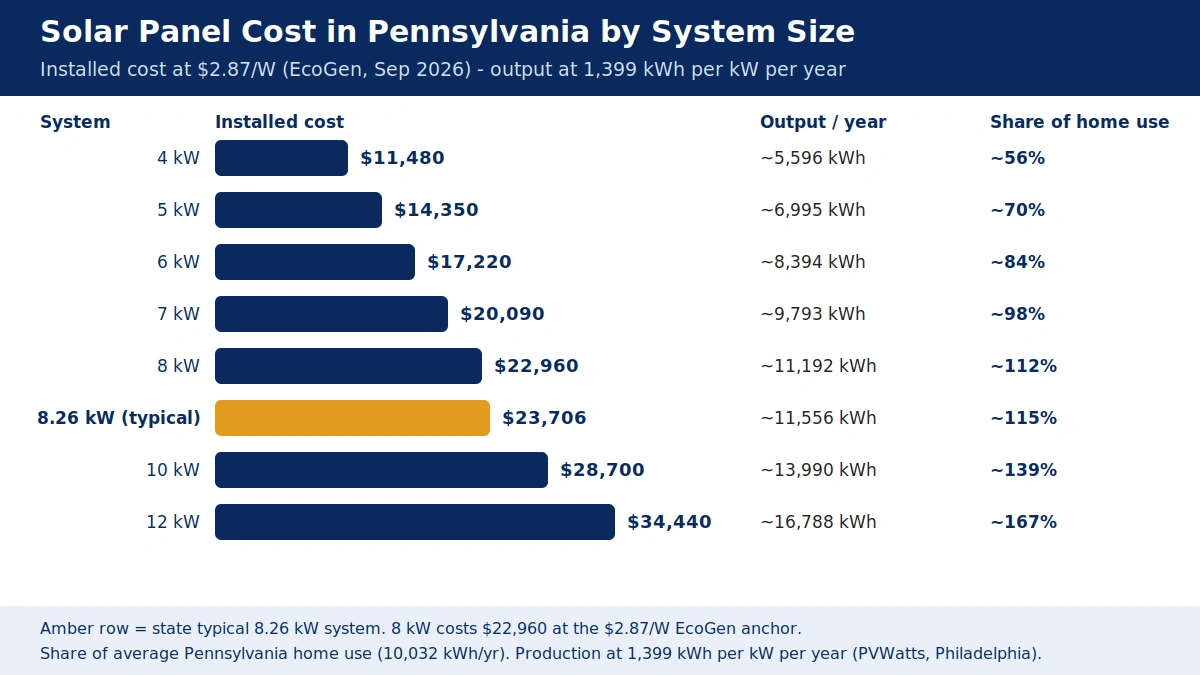
Size is the first decision, and in Pennsylvania the May 31 true-up punishes oversizing more gently than a monthly settlement would — but it still punishes it. EIA billing data for the 12 months to August 2026 puts the average Pennsylvania home near 836 kilowatt-hours a month, or roughly 10,032 a year, with a bill near $174.53 a month. At 1,399 kilowatt-hours per kilowatt each year, an 8.26 kW Philadelphia array makes about 11,556 kilowatt-hours — roughly 115% of the average home’s yearly use. At about 115% of the average home’s use, 8.26 kW is the size this guide treats as typical. On paper, that already covers the whole house. Paper is the problem, though: the house pulls power unevenly across the year, and the panels produce it unevenly as well.
Going bigger than the house uses is a worse deal in Pennsylvania than the headline payback suggests, because the surplus that is still sitting on the bill on May 31 pays out at the price to compare instead of the full retail rate. At PECO that is 11.759 cents against a retail rate near 20 cents — roughly half price. A kilowatt-hour sent out in June earns a full retail credit while it sits on the bill, but only if the house spends it down before May 31. Every size in the table below is priced off the EcoGen anchor of $2.87 a watt, at 1,399 kilowatt-hours of output per installed kilowatt each year — the Philadelphia figure, so a Pittsburgh roof should read its own row about 15% lower on output. The table also shows the share of an average home’s yearly use each size covers, so the point where the array stops feeding the house and starts banking credits is visible at a glance.
| Size | Cost at $2.87/W | Yearly output | Share of avg. PA home use (10,032 kWh/yr) |
|---|---|---|---|
| 4 kW | $11,480 | ~5,596 kWh | ~56% |
| 5 kW | $14,350 | ~6,995 kWh | ~70% |
| 6 kW | $17,220 | ~8,394 kWh | ~84% |
| 7 kW | $20,090 | ~9,793 kWh | ~98% |
| 8 kW | $22,960 | ~11,192 kWh | ~112% |
| 8.26 kW (state typical) | ~$23,706 | ~11,556 kWh | ~115% |
| 10 kW | $28,700 | ~13,990 kWh | ~139% |
| 12 kW | $34,440 | ~16,788 kWh | ~167% |
Two rows of that table are worth a second look. First, the 8.26 kW typical system already covers about 115% of average annual use — so even the typical system banks a meaningful slice of its output as credit through the winter, and the slice grows with every added kilowatt. Second, the 6 kW and 7 kW rows are the honest starting point for a home that uses power mostly in the dark months: a smaller array that the house actually eats, kilowatt-hour for kilowatt-hour, at full retail value, beats a bigger array that leaves credits sitting on the bill until the May 31 payout. The sizing conversation starts with the monthly bills, then the utility’s price to compare, and only then the roof.
Work out the array size from a full year of electric bills, never from the empty roof space you happen to have. In Pennsylvania, that means sizing for the whole year, not for the bright summer months. Total the kilowatt-hours, divide by roughly 1,399 in the east or roughly 1,180 in the west to find the size that covers them, then look at the summer months separately: if June, July, and August already show a surplus at 8 kW, stop there, because every kilowatt above that line earns the price to compare on May 31 instead of the full retail rate all year. For a planned EV or heat pump, add 1-2 kW; add more for electric heat and less for a shaded or north-facing roof — then check the size against the 50 kW net-metering cap and the 110% rule on a PECO lease. If an EV or a heat pump is coming, size the solar for the bigger house now — count the new load first, then the panels — or the load will arrive after the array was built for the smaller house. For the full sizing walk-through, see our 6 kW vs 8 kW vs 10 kW guide.
Solar Panel Cost by City: Philadelphia, Pittsburgh, Harrisburg & the Lehigh Valley
Pennsylvania is a wide state with two big solar markets on opposite ends, a capital city in the middle, and a fast-growing corridor in the east — and the verified city prices run thinner here than the state average suggests, because most city figures are marketplace averages rather than collected quotes. The table below is honest about that: the per-watt figures are EnergySage marketplace data from June to July 2026, the totals are those figures applied to the statewide typical size, and the utility column is the number that matters more.
| City | $ per watt | Avg. system | Cash total | Utility |
|---|---|---|---|---|
| Philadelphia | $2.75 | 11.31 kW | ~$31,109 | PECO |
| Pittsburgh | $2.59 | 7 kW | ~$18,130 | Duquesne Light |
| Lancaster | $2.60 | 8.26 kW | ~$21,476 | PPL |
| Harrisburg | No verified figure | 8.26 kW ~$23,706 | Planning estimate only | PPL |
| Allentown / Bethlehem | No verified figure | 8.26 kW ~$23,706 | Planning estimate only | PPL |
| Williamsport | $2.73 | 8.26 kW ~$22,548 | Planning estimate only | PPL |
| Reading / York | No verified figure | 8.26 kW ~$23,706 | Planning estimate only | Met-Ed |
| Scranton / Wilkes-Barre | No verified figure | 8.26 kW ~$23,706 | Planning estimate only | PPL |
| Erie | No verified figure | 8.26 kW ~$23,706 | Planning estimate only | Penelec |
Philadelphia is the biggest market in the state, served by PECO, and the only city with a figure built on a large quote sample: EnergySage’s June 2026 data shows $2.75 a watt, with an average 11.31 kW system at $31,109 before incentives. That is below the statewide EcoGen anchor at its per-watt level but above it on the total, because Philadelphia homes install bigger systems — rowhouse roofs are small, so the systems that do get built tend to be the ones on the larger suburban homes around the city, and the average is pulled up by them. Treat the Philadelphia figure as a marketplace average, not a contractor bid, and do not quote either end of it as the Philadelphia price, because it is not one.
Pittsburgh is the second market, served by Duquesne Light, and the cheapest per watt of the verified cities at $2.59 — yet the city where the panels make the least power. The 7 kW system shown here is the size EnergySage’s Pittsburgh data points to, at about $18,130 before incentives, and it makes roughly 8,260 kilowatt-hours a year at the city’s 1,180 kWh per kW figure. What is verifiable for Pittsburgh beyond the price is the utility, and the utility is the number that matters more: Duquesne Light’s residential rate runs about 25.86 cents a kilowatt-hour on the EIA 861-M figures for August 2026 — the highest of the big four — and its payback is the shortest in the state at about 8.8 years. A Pittsburgh array and a Philadelphia array at the same price per watt are different investments, so read the city table utility-first and price-second.
Harrisburg, Allentown, Reading, Scranton, and Erie carry a warning label rather than a verified price. This pass pulled no EnergySage city figures for any of them, and this guide will not invent numbers to fill the gap. The 8.26 kW planning estimate near $23,706 at the statewide $2.87 anchor is printed so readers have a number to plan with, labeled as what it is. For those cities, the checkable fact is the utility, and the utility moves the answer more than the price does. Harrisburg and Allentown sit on PPL at about 20.96 cents a kilowatt-hour with an 11.2-year payback. Reading and York sit on Met-Ed at about 20.9 cents with a 10.6-to-10.7-year FirstEnergy payback. Scranton and Wilkes-Barre sit on PPL in the cloudiest corner of the east, where real installer data shows a 10 kW system making 11,200 to 12,400 kilowatt-hours a year. Erie sits on Penelec under lake-effect cloud at about 1,120 kilowatt-hours per kilowatt — the weakest sun in the state — with a 23.1-cent rate that partly repays it.
Read the cities by their utility column first and their price column second, and judge quotes by price per watt, never by the headline total. A Philadelphia quote at $2.75 a watt and a Pittsburgh quote at $2.59 are not a close call once the rates and the sunshine are in: the Pittsburgh array makes less power but replaces dearer power, and its payback is shorter by more than two years. The payback section works that math out utility by utility.
One more city-level note: the installer field is crowded, which is a blessing and a trap at once. EcoGen’s October 2026 registry check names four national companies working Pennsylvania — Green Power Energy (PA128259), Momentum Solar (PA131435, with a Johnstown office), Trinity Solar (PA128551, with a Reading office), and Venture Home (PA168470) — alongside many smaller local crews. A crowded field means three quotes are easy to get, and it means the registration check matters more, not less: any company working a Pennsylvania home must be registered with the Attorney General, and the licensing section below shows how to verify that number before you sign anything.
Pennsylvania’s Sun: Cloudy Winters, Strong Summers & the East-West Split
Pennsylvania’s sunshine arrives with a shape that rewards patience and punishes anyone who sizes a system from a single sunny month. A production estimate that is honest has to carry both halves of the story — the bright summer and the grey winter — and the east-west split inside the state, because a Philadelphia roof and a Pittsburgh roof are not the same roof.
The sun, by the numbers. One kilowatt of panels in Philadelphia yields roughly 1,399 kilowatt-hours a year on EcoGen’s PVWatts-based figures — the number its payback cases are built on. Cross-checks land lower once you leave the southeast corner: pvlib modeling on ERA5 weather data puts Philadelphia at about 1,330, Harrisburg at about 1,290, Allentown at about 1,300, Reading at about 1,310, Pittsburgh at about 1,180, and Erie at about 1,120 kilowatt-hours per kilowatt per year. A separate PVWatts run averaging Harrisburg, Philadelphia, and Pittsburgh lands at about 1,290. The conflict is real and it is stated here rather than smoothed over: EcoGen’s 1,399 is a Philadelphia PVWatts figure, and the statewide truth is a range from about 1,120 in Erie to about 1,399 in Philadelphia. Use the Philadelphia figure for a Philadelphia roof, the Pittsburgh figure for a Pittsburgh roof, and the 1,290 average for a planning estimate anywhere in between. Peak sun hours tell the same story in different units: 3.5 to 4.5 a day statewide, 4.0 to 4.3 in the Scranton and Wilkes-Barre corner, about 4.2 in Pittsburgh.
The cloud is the story. Pittsburgh averages about 2,021 hours of sunshine a year on long-term NOAA averages — the fewest of any major city in the United States — and about 160 sunny days a year against a national average of 205. Philadelphia, by contrast, logs about 2,498 hours. The difference is the river valleys and the lake: Pittsburgh sits where three rivers meet under frontal weather that parks for days, and Erie sits downwind of Lake Erie, where lake-effect cloud shaves the resource further. One modeling source counts only 59 clear days a year in Pittsburgh — a different metric from the National Weather Service’s 160 sunny days, counting only fully clear days rather than days with sun — and the gap between those two numbers is a warning about how loosely the word “sunny” gets used in solar marketing. What matters is not how many days feel sunny. It is how many kilowatt-hours the year adds up to, and in western Pennsylvania that number is about 15% lower than in the southeast.
The seasonal swing is the design problem. A modeled 6 kW Philadelphia system makes about 920 kilowatt-hours in June and about 310 in December — a summer-to-winter ratio of nearly three to one. Real installer data from the Scranton area shows December and January running at about 40% of the June-to-July peak, and a 10 kW system there making 11,200 to 12,400 kilowatt-hours a year. The house needs the most power in exactly the months the panels make the least: winter heating, winter lighting, winter evenings. In a state with monthly settlement that mismatch would be fatal to the economics. In Pennsylvania it is survivable, because the summer surplus banks as a full-retail credit and the house spends it down through the winter. The net-metering section below explains how that banking works, and why the May 31 date matters more than the December cloud does.
Cold is a genuine advantage. A solar cell sheds roughly 0.3-0.5% of its efficiency for each degree Celsius it heats past 25. A Pennsylvania rooftop in January runs far cooler than 25 degrees, and even a July rooftop in Philadelphia rarely bakes the way a Phoenix roof does, so a system here generates more per hour of sunshine than the same panels would on a hot roof in the South. Cold, clear air after a front passes is some of the best solar weather there is, and it is a large part of why Pennsylvania’s per-kilowatt production holds up as well as it does against the latitude. Fresh snow on the ground helps too — reflection off snow bounces extra light onto the panels on cold sunny winter days, a real gain in a state where the ground is white for weeks at a time. The same physics means the panels need the sun to be up to use it — and in December it is up for barely nine hours, often behind cloud anyway.
Snow cuts both ways. A tilted array sheds snow, and a steeper one sheds it faster: a fixed Pennsylvania install typically sits at 30 to 40 degrees from horizontal, near the state’s 40-degree latitude, which is steep enough to let most snow slide off on its own. Snow sitting on the panels is power lost until it slides clear, and a shallow roof anywhere in the commonwealth holds it longer than a steep one. No Pennsylvania-specific snow-loss percentage was verified for this guide, so none is stated here — if an installer shows you a production estimate, ask to see the snow-loss assumption inside it, and ask what tilt it assumes. Snow guards, which keep sliding snow off walkways and gutters, belong on a steep Pennsylvania roof as a priced line, not a footnote.
The roof, and the snow load it carries. A rooftop array in Pennsylvania sits under a snow load the racking and the roof must carry together — ground snow loads run 25 to 35 pounds per square foot on the older IBC figures, and 25 to 60 across the state on the newer ASCE 7-22 mapping, higher in the north and at elevation — so confirm the roof’s snow-load rating and the racking’s uplift rating before signing, and let the building department’s figure govern, not the installer’s guess. When a roof has under ten years of life left, replace it first — taking panels off and reinstalling them for a later reroof costs thousands on its own. Standing-seam metal makes one of the best roofs for solar: clamps grip the seams with no holes at all, and snow leaves metal sooner than asphalt. Name UL 61730 / IEC 61730 when you specify panels, and ask for that rating in the quote. Then get written confirmation that your homeowners policy covers the array against storm damage.
Working with the climate. Nothing exotic is required, but the standard kit needs Pennsylvania settings. Pick a south-facing orientation where the roof allows it, a tilt near the latitude — 30 to 40 degrees, steeper in the north and on lake-effect roofs — microinverters or optimizers so a shaded or snow-covered string cannot drag the whole array down, and a production estimate built on PVWatts data with the snow assumption out in the open, not hidden. On a grid that banks summer credits at full retail until May 31, the most valuable kilowatt-hours are the ones the house eats the moment they are made, in the month they are made — and a west-facing tilt that pushes more production into the evening, when the house is actually using power, is worth discussing with the installer even if it gives up a little total annual output.
Net Metering in Pennsylvania: Full Retail Credits & the May 31 True-Up
Pennsylvania’s net-metering rules get misread in both directions more often than most states’ do, and getting them right changes the answer more here than almost anywhere. One common claim is that Pennsylvania has weak net metering, because the SRECs are cheap and the state offers nothing else. That is wrong. The other common claim is that Pennsylvania’s net metering is simple — that every exported kilowatt-hour is worth the full retail rate forever. That is wrong too. What Pennsylvania has is full retail credit with an annual clock and a half-price payout at the end of it — and the difference between those two wrong claims and the real rule is the difference between a system that pays in nine years and one that pays in sixteen.
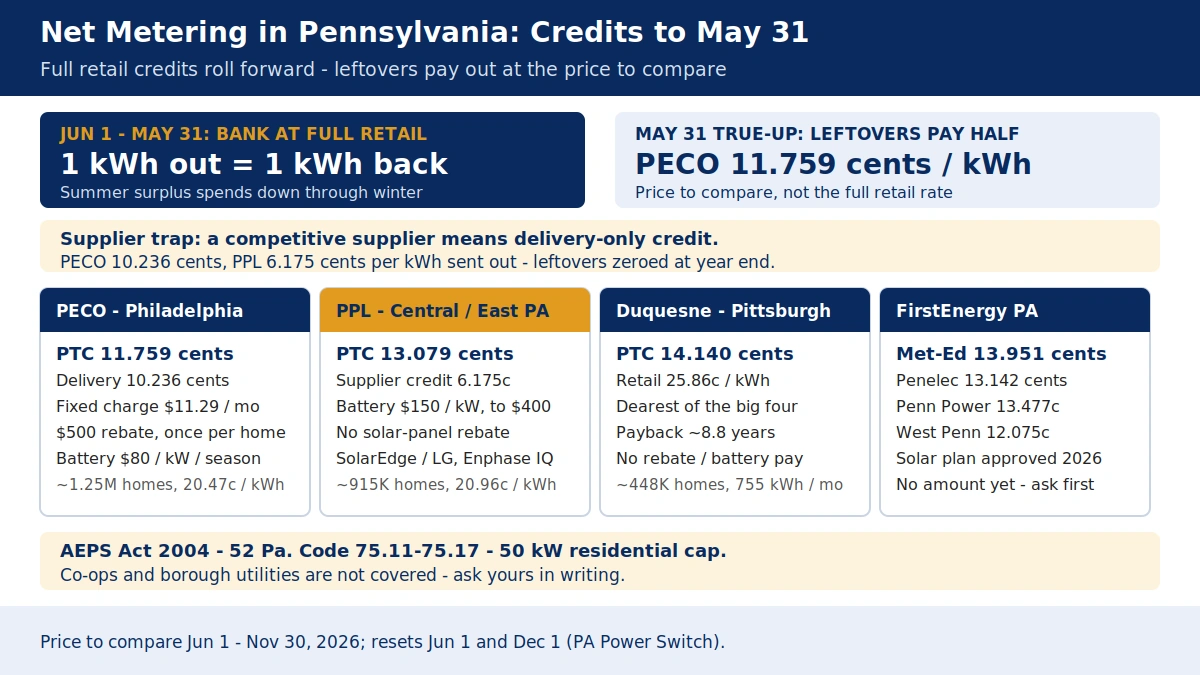
The rule. The Alternative Energy Portfolio Standards Act of 2004 requires net metering, and the Public Utility Commission wrote the details into 52 Pa. Code 75.11 through 75.17, last amended effective November 19, 2016. The cap for a home system sits at 50 kW. Within each billing month, the power the panels make offsets the power the house uses, kilowatt-hour for kilowatt-hour, at the full retail rate — generation, transmission, and distribution all included. Unused credits roll forward month to month at full retail value. The credit year runs June 1 to May 31. On May 31, whatever credit is still sitting on the bill is paid out in dollars at the utility’s price to compare — the price of the power itself, generation plus transmission, without the delivery charge. At PECO that is 11.759 cents a kilowatt-hour for June 1 to November 30, 2026, against a retail rate near 20 cents. The payout resets every June 1 and December 1 with the wholesale auctions.
That yearly settlement is the one fact in this guide that matters most, so it bears saying three ways. First, there is no monthly forfeiture: the summer surplus is not sold off cheap in July, it banks at full retail value and the house spends it down through the winter. Second, the May 31 payout is the only day the deal gets worse — leftover credits pay roughly half price, so a system sized well past the house’s yearly use hands its surplus to the utility at a discount. Third, the rule binds only the investor-owned utilities: rural electric cooperatives and municipal or borough utilities are not required to offer the same terms, so a household on a co-op or a borough system needs to ask its own utility directly, in writing, what it will pay for exported power — and the answer may be very different.
PECO — about 1.25 million homes, Philadelphia and its suburbs. PECO is the largest utility in the southeast, and its numbers are the most completely documented in the state. Its residential price runs about 20.47 cents a kilowatt-hour on the EIA 861-M figures for August 2026, with the average home using about 882 kilowatt-hours a month. Its price to compare for June 1 to November 30, 2026 is 11.759 cents, and its Rate R delivery charge is 10.236 cents with a fixed charge of $11.29 a month, effective July 1, 2026. PECO also pays the only solar rebate in the state — $500, once per home, with the form due within 90 days of in-service status and the program running through May 31, 2031 while funds last. A PECO lease may be sized to no more than 110% of the home’s yearly use.
PPL Electric Utilities — about 915,000 homes, central and eastern Pennsylvania. PPL serves Allentown, Harrisburg, Lancaster, Scranton, and Williamsport, and its residential price runs about 20.96 cents a kilowatt-hour, with the average home using about 852 kilowatt-hours a month — the highest use of the big four, because so many PPL homes heat with electricity. Its price to compare is 13.079 cents, and its Rate RS distribution charge is 6.175 cents a kilowatt-hour from October 1, 2026. PPL lists no rebate for solar panels, but it does pay for batteries: $150 per kilowatt of battery, each season, up to $400 a season, for batteries on its list — SolarEdge with SolarEdge or LG batteries, and Enphase IQ Batteries. PPL’s year-end payout figure is printed on the bill rather than published as a single number, so get it from the bill, not from a quote.
Duquesne Light — about 448,000 homes, Pittsburgh and Allegheny County. Duquesne Light is the smallest of the big four and the dearest: its residential price runs about 25.86 cents a kilowatt-hour, with the average home using about 755 kilowatt-hours a month. Its price to compare is 14.140 cents for June 1 to November 30, 2026. No solar rebate or battery payment was found for Duquesne Light customers — ask in writing, because a program that exists but was not found is different from a program that does not exist, and the quote should not count money that is not there. Duquesne Light’s territory is also where the sun is weakest and the payback is shortest, which is why the payback section puts Pittsburgh first even though its skies are the greyest.
FirstEnergy Pennsylvania — about 1.5 million homes, four companies. Met-Ed (Reading, York, Lebanon, Easton), Penelec (northern and western Pennsylvania, including Erie), Penn Power (northwest), and West Penn Power (southwest) share one parent and one set of rules, with different prices to compare: Met-Ed 13.951 cents, Penelec 13.142 cents, Penn Power 13.477 cents, West Penn Power 12.075 cents. Their residential rates run about 20.9 cents at Met-Ed, 23.1 cents at Penelec, and 21.0 cents at Penn Power on the PUC’s 2025 averages, with the average home using about 930 kilowatt-hours a month at Met-Ed and Penn Power and 725 at Penelec. The regulator approved a plan with a solar measure for homes on March 12, 2026, but no amount and no way to apply exist yet — do not let a quote count a FirstEnergy rebate.
The co-ops and the boroughs write their own rules where the state rule does not reach. The PUC’s net-metering regulations bind the investor-owned utilities. A household served by a rural electric cooperative or a municipal utility needs its own utility’s solar terms in writing — no state rule covers those utilities, so the paper is the only protection. The same caution applies to the small utilities the EcoGen per-utility figures name — UGI, Pike County, Wellsboro, Citizens’ — whose paybacks run from 9.2 to 12.6 years on EcoGen’s figures but whose tariffs were not pulled in this pass.
SRECs in Pennsylvania: Small Money, Real Paperwork
Pennsylvania pays solar owners twice: once on the bill, through net metering, and once in a market, through SRECs. The second payment is the smaller one by a wide margin, and it is the one most quotes either overstate or leave out entirely. It deserves a section of its own, because the gap between what an SREC is worth on paper and what it is worth in a homeowner’s pocket is where the disappointment lives.
How an SREC is made. Every time a system produces 1,000 kilowatt-hours — one megawatt-hour — it mints one Solar Alternative Energy Credit, the formal name Pennsylvania uses for what the rest of the country calls an SREC. The credit is tracked in PJM-EIS GATS, the regional registry, and the system needs a revenue-grade meter and a state certification number before it can mint any. The market exists because the Alternative Energy Portfolio Standards Act requires electricity suppliers to prove that a slice of the power they sell comes from in-state solar. Suppliers buy the credits from system owners, usually through a broker or aggregator such as SRECTrade or Flett Exchange, which takes a 3-to-10% commission.
Why the price is low. The solar carve-out — the slice of retail sales that must come from solar — is 0.5%, the weakest in the region. New Jersey’s fixed-price SREC-II pays $85. Maryland’s market runs far higher. Pennsylvania’s thin demand means the price floats with supply, and supply has been ample: the PUC’s published weighted average for the 2025/2026 reporting year is $28.26 per credit, with sales ranging from $4 to $81, and the solar alternative compliance payment — the fine a supplier pays instead of buying a credit, which caps the price — is $56.52. The weighted average is the number most guides quote, and it overstates what a homeowner selling today actually gets, because it includes long-term contracts struck at higher prices. The spot market tells the truer story: Flett Exchange showed the current 2026 vintage at about $22 in August 2026, inside a roughly $15-to-$25 band, and SunLynk’s August 2026 check put the spot at $19 to $22. Print both numbers, and believe the spot number when you budget.
What it adds up to. A typical 8.26 kW system makes about 11,556 kilowatt-hours a year, so it mints about 11.6 credits a year. At the $28.26 weighted average that is about $327 a year before broker fees. At the $22 spot price it is about $255 a year. Over 25 years, with panels degrading about 0.5% a year, the total runs roughly $6,200 to $9,900 at the NuWatt midpoint — real money, but not the money that decides whether to buy. The net-metering credit on the same system is worth about $2,080 a year at PECO. The SREC is roughly a tenth of the bill savings. Any quote that leans on SRECs to make the payback work is leaning on the wrong leg.
Three rules that catch people out. First, a credit expires: a 2026 vintage SREC can be used for compliance in 2026, 2027, or 2028, and then it is worthless, so credits left unsold are money lost. Second, selling the credit means giving up the right to claim the power was green — the environmental attribute goes to the buyer, which matters to a household that bought solar to cut its own footprint. Third, the market can move: the PRESS Act, pending in the legislature, would raise the solar carve-out from 0.5% to 5.5%, which could push prices far above today’s level — or it could sit in committee for another session, as Pennsylvania solar bills have done for a decade. Do not count on the PRESS Act in a quote. Count the SRECs at the spot price, and treat anything above that as a bonus.
The lease question. Under a lease or a power purchase agreement, the SRECs usually stay with the company that owns the panels, not with the homeowner. That is one of the quiet costs of third-party ownership in Pennsylvania: the $255 to $327 a year goes to the company, and the homeowner’s savings are the bill credit alone. The federal section below prices that trade-off in full.
Payback: How Long Until Pennsylvania Solar Pays for Itself?
Whether a Pennsylvania system earns its keep comes down to payback, and payback comes down to the name on the bill. The utilities here disagree far more sharply than in most states in this series — their power prices differ by a factor of three, and their paybacks by years. EcoGen’s anchors underpin the worked examples below, with EnergySage as the cross-check — and every place the two disagree gets flagged.
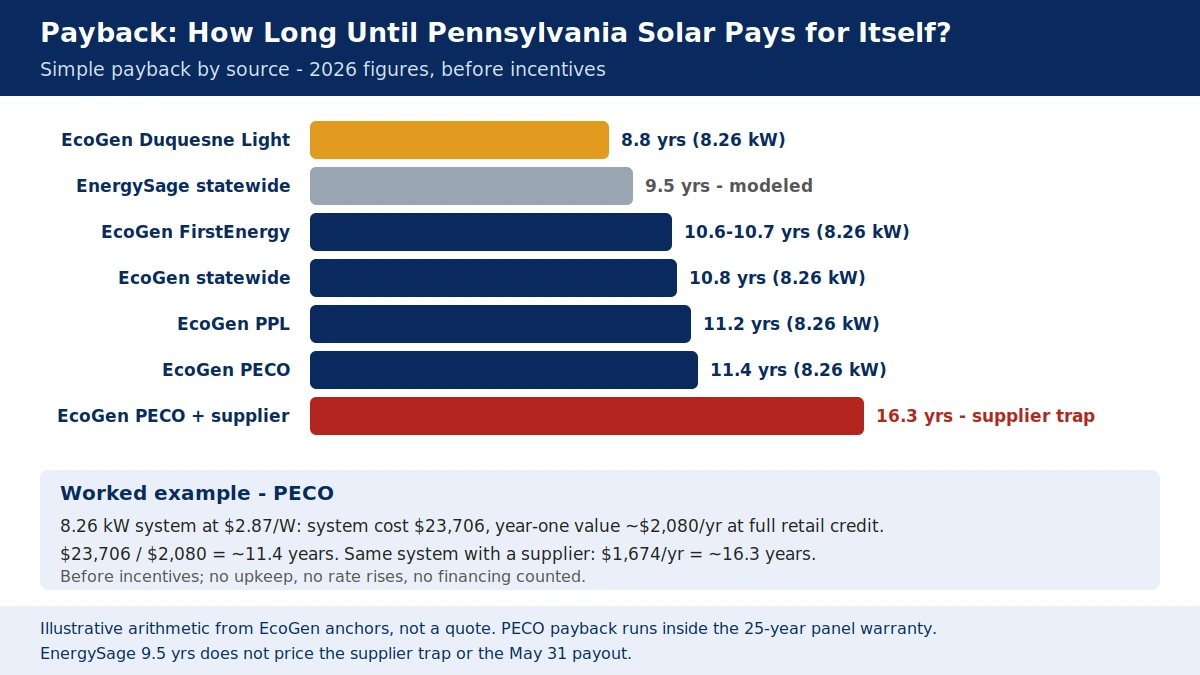
A worked example. Take a typical 8.26 kW system at $2.87 a watt — $23,706 before incentives. Yearly output lands near 11,556 kilowatt-hours at 1,399 per kilowatt. The payback figures below are stated before incentives, as EcoGen publishes them, so the arithmetic stays comparable across utilities — and in Pennsylvania, before incentives is nearly the same as after incentives, because the only incentive is a $500 PECO rebate and a few hundred dollars a year of SRECs.
PECO is the middle payback in the state. EcoGen’s per-utility worked example for PECO territory puts the year-one value at about $2,080 a year, using PECO’s EIA average price of 19.494 cents for September 2025 to August 2026 less its $11.33 in fixed monthly charges — 18.003 cents for each kilowatt-hour. The model assumes about 40% of the solar power is used at home as it is made: 11,556 kilowatt-hours, all of it worth 18.003 cents under full retail net metering, is $2,080 a year. $23,706 divided by $2,080 gives a simple payback near 11.4 years — before incentives, and counting no upkeep, no rate rises, and no financing. That is inside the 25-year panel warranty with room to spare, and it leans on nothing but the net-metering rule and the PECO rate.
Duquesne Light is the shortest payback in the state. EcoGen puts it at about 8.8 years for the same 8.26 kW system — roughly three years faster than PECO — because Pittsburgh power costs 25.86 cents a kilowatt-hour, the dearest of the big four, and even the weaker western sun cannot hold the payback back. This pass pulled no Duquesne worked arithmetic beyond EcoGen’s published figure, so none is re-derived here — the 8.8-year number is EcoGen’s own, dated October 30, 2026. The direction is plain enough without the arithmetic: the dearest power in the state meets the cloudiest sky in the country, and the dear power wins.
FirstEnergy and PPL sit between them. EcoGen puts FirstEnergy Pennsylvania at 10.6 to 10.7 years across Met-Ed, Penelec, Penn Power, and West Penn Power, and PPL at 11.2 years. The smaller utilities EcoGen names run 9.2 years at Pike County, 10.6 at Wellsboro, 10.8 at UGI, and 12.6 at Citizens’. Weighted by customers, Pennsylvania comes to 10.8 years. No EcoGen payback was published for the rural co-ops in this pass, so none is stated — a co-op household should expect its own utility’s terms to govern, and should make the installer show the arithmetic for their own utility rather than borrowing one of these four.
The flagged conflict. EnergySage reports a 9.5-year payback with $72,285 in 25-year savings, and Solar Energy Nerds’ break-even map reports 8.8 years for the state. Both are modeled estimates built on lower per-watt anchors — EnergySage’s $2.60 a watt on a 12.62 kW system — and neither prices the PECO supplier trap or the May 31 payout. Do not present either of them as a verified Pennsylvania payback, and do not let a quote cite one for a home that buys power from a competitive supplier. The gap between 9.5 years and 16.3 years is not a rounding difference — it is the delivery-only credit and the zeroed-out leftovers, and any payback that ignores them is modeling a different household.
What moves the payback most. Daytime self-use is the biggest lever, and in Pennsylvania it matters in a specific way. Under full retail net metering, a kilowatt-hour used at home and a kilowatt-hour banked as a credit are worth the same — until May 31, when the banked one pays out at the price to compare. Shifting the dishwasher, the laundry, and the EV charger into daylight hours moves kilowatt-hours out of the May 31 payout bucket and into the full-retail bucket, and no other change pays as well. EcoGen’s PECO model assumes about 40% self-use, so a home that lifts that share shortens its payback a lot, and a home left empty all summer stretches it just as fast. Rate escalation is a real lever here: Pennsylvania rates rose 9.2% in the year to August 2026, and a system bought at today’s rates pays back faster if rates keep climbing. Financing is the fourth lever, and a costly one: dealer fees on a solar loan can push the real price up 10-30%, so compare quotes on cash price per watt and ignore the monthly payment. And SRECs are the fifth lever, worth roughly $255 to $327 a year on the typical system — enough to shave a year off the payback, not enough to rescue a bad quote.
Who still comes out ahead. Four kinds of Pennsylvania household clear it. The Duquesne Light customer, where the published payback is under nine years and even the weaker sun cannot slow it down. The all-day home with a big daytime load — home offices, daytime laundry and dishwashing, an EV charged at midday in June — that keeps most of its production at full retail value and leaves little for the May 31 payout. Homes that add a heat pump or an EV and size the array for the new daytime load, within the 50 kW cap, also clear it. And the household on a utility’s own default supply, where every exported kilowatt-hour earns the full retail credit — the condition the whole 10.8-year statewide figure depends on. Walk away when your home buys power from a competitive supplier and the quote prices the savings at full retail anyway, when the roof is shaded by the maples and the installer will not model the shade, or when the quote counts a FirstEnergy rebate that does not exist yet.
The Supplier Trap: When Your Power Seller Changes Your Solar Math
Pennsylvania lets households choose who sells them power, and about a third of them do — lured by a fixed rate a cent or two below the utility’s price to compare. That choice is harmless for a home without solar. For a home with solar, it rewrites the economics, and the rewrite is the most expensive fine print in this guide.
How the trap works. Under 52 Pa. Code 75.13, the utility credits exported power at the full retail rate only when it also sells you the power. Hand the supply half of the bill to a competitive supplier, and the utility credits each exported kilowatt-hour at its distribution charge only — 10.236 cents at PECO, 6.175 cents at PPL as of October 2026 — and any unused delivery credits are zeroed out at year end. Any credit for the power itself must be in the supplier contract, and most supplier contracts say nothing about solar at all. The self-used power still saves the full rate. The exported power earns half of it, or a third of it, and the leftovers vanish.
The numbers, side by side. EcoGen ran the same 8.26 kW PECO home both ways. With PECO selling the power: $2,080 a year of value, 11.4 years of payback. With a supplier selling it: 4,622 kilowatt-hours used at home at 20.86 cents, plus 6,934 kilowatt-hours sent out at 10.236 cents, is $1,674 a year — and after $247.80 of upkeep and the $500 PECO rebate, the payback is 16.3 years. Five years of payback, bought with a single phone call to a supplier. At PPL the gap is wider still: the supplier-case credit is 6.175 cents, barely a quarter of the retail rate, and EcoGen did not model that case at all — the number is bad enough without the model.
What to do about it. Three options, in order of sense. First, switch back to the utility’s default supply before the panels go in — the price to compare is the benchmark the supplier has to beat, and a supplier that beats it by a cent on the power you buy costs you far more on the power you sell. Second, if the supplier contract is worth keeping for another reason, get the supplier’s solar terms in writing before signing anything: what it pays for exported power, whether it banks credits, and what happens at year end. Third, size the system to the home’s daytime use rather than its yearly use, so as little power as possible crosses the meter at the delivery-only rate. What you must not do is sign a solar contract that prices the savings at the full retail rate while a supplier sells your power. That quote is not a quote. It is a different household’s arithmetic.
A note on the fixed charge. PECO’s $11.29 monthly fixed charge does not go away with solar, and it should not be counted as savings. EcoGen’s PECO case already nets it out — the 18.003-cent figure is the EIA average less the fixed charges — which is why the worked example is worth $2,080 a year rather than the $2,254 a naive multiplication would give. A quote that multiplies the full retail rate by the full annual output, without netting the fixed charge, overstates the savings by about $174 a year on a PECO home. Check for that line before you believe the payback on the page.
Pennsylvania Incentives in 2026: What Exists and What Does Not
After Congress pulled the federal credit, plenty of states still had a homegrown fallback for their homeowners — a tax credit from the capitol, a utility rebate, a break on sales or property tax. Pennsylvania keeps even less in reserve than that. Read the short list below with care: most solar advertising in the state skips over it entirely, and the two programs that do exist get mistaken for something they are not.
Pennsylvania has no state rebate for home solar, no state solar tax credit, and no tax exemption of either kind. Neither Harrisburg nor any of the big four utilities will mail you a check for putting panels on your roof. There is no state solar tax credit on the Department of Revenue’s list of personal income tax credits. There is no sales-tax exemption: the 6% state sales tax applies to the whole system, plus any local tax where levied, which puts about $1,422 of tax on a $23,706 system unless the quote folds it in. There is no property-tax exemption either: do not count on the added home value escaping taxation — ask the county assessment office in writing how a solar array is valued before you sign, because the exemption some installers imply does not exist in Pennsylvania law.
The $500 PECO rebate is real, and it is small. PECO pays $500, once per home, for a residential solar install, with the form due within 90 days of in-service status and the program running through May 31, 2031 while funds last. It is the only per-home solar rebate in the state. It arrives after the install, not before, and it covers about 2% of a typical system. A quote that treats it as a discount has the timing wrong; a quote that leaves it out entirely has the arithmetic wrong by $500.
The battery payments are real, and they are not solar payments. PPL pays $150 per kilowatt of battery, each season, up to $400 a season, for batteries on its list. PECO pays $80 per kilowatt each season through its Flex & Save program — EcoGen’s example comes to about $480 a year. Both pay for the battery, not for the panels, and both pay per season, which means the money arrives in installments over years, not as a lump sum at install. A battery bought for backup earns these payments as a bonus. A battery bought to earn them will not pay for itself on them.
The FirstEnergy rebate does not exist yet. The regulator approved a plan with a solar measure for homes on March 12, 2026. No amount has been published and no application exists. Do not let a quote count a FirstEnergy rebate, and do not let a salesperson tell you one is coming — coming is not a rebate.
PA Sunshine is dead, and Solar for All never started. The Pennsylvania Sunshine Solar Program, which handed out $100 million in rebates from 2009, ran out of money on November 25, 2013, deployed about $113 million in total, and has accepted no applications since December 31, 2013. Any installer who mentions it is describing a program that ended thirteen years ago. Solar for All is the newer ghost: the EPA awarded the Pennsylvania Energy Development Authority $156 million to put rooftop solar on about 12,500 low- and moderate-income homes, but the program never got off the ground — the legislature never approved accepting the money — and the EPA terminated the national program in August 2025. The state agency says Solar for All is “not operational at this time” and tells homeowners to ignore installers that claim to be its partners. There is no way for a Pennsylvania household to apply for it today, and no household should pay an installer who says otherwise.
Community solar does not exist yet either. Pennsylvania has no community solar law. House Bill 504, the Community Energy Act, passed the House 114 to 89 on May 7, 2025 and was referred to the Senate’s Consumer Protection and Professional Licensure Committee on May 22, 2025, where it sits. It is part of Governor Shapiro’s Lightning Plan, and it has been trying to pass in one form or another for roughly a decade. Until it passes, a renter or a shaded-roof homeowner in Pennsylvania cannot subscribe to a shared array. Solarize Greater Philadelphia offers help instead of money: vetted installers in five counties, a workmanship warranty of at least ten years, and a no-upfront-cost lease for household incomes up to $165,000.
Pennsylvania has no open federal home energy rebates. The state was allocated about $259 million in total — $129,226,380 for HEAR and $129,723,107 for HOMES, per the federal dataset — administered by the Department of Environmental Protection’s Energy Programs Office under the name Penn Energy Savers. But Pennsylvania does not appear on the federal launched map, and the October 27, 2026 check found no launched program. One secondary site claims the HOMES program is open; that claim could not be verified against the federal record, and this guide treats it as unverified rather than as fact. A launch date would change nothing for solar buyers: HEAR’s money stays out of panels even after the programs open. What it funds is electrification work: heat pumps, heat-pump water heaters, electrical panels, and insulation-related wiring. HEAR’s list leaves all four out: panels, batteries, EV chargers, and windows.
| Item | Value | Notes |
|---|---|---|
| PA state rebate for panels | $0 — none exists | No state or utility rebate for home solar, except PECO $500 |
| PA state income-tax credit | None exists | No solar credit on the Dept. of Revenue list |
| PA sales-tax exemption | None — 6% applies | ~$1,422 on the typical $23,706 system |
| PA property-tax exemption | None — do not count on one | Ask the county assessor in writing |
| PECO solar rebate | $500 | Once per home; form within 90 days; term to May 31, 2031 |
| PPL battery pay | $150/kW/season, up to $400 | Named batteries only; no solar-panel rebate |
| PECO battery pay | $80/kW/season | Flex & Save; example ~$480/yr |
| FirstEnergy solar measure | Not open yet | Approved Mar 12, 2026; no amount, no application |
| PA Sunshine | $0 — ended 2013 | $113M deployed; no applications since Dec 31, 2013 |
| Solar for All | $0 — not operational | $156M to PEDA; never launched; EPA ended Aug 2025 |
| Community solar | No law | HB 504 passed House May 7, 2025; in Senate committee |
| HEAR / HOMES rebates | Not launched | ~$259M allocated; Penn Energy Savers; no start date |
| SRECs | ~$255-$327/yr typical | 1 per 1,000 kWh; spot ~$22; weighted avg $28.26 |
Federal Help in 2026: No Credit for Owners — but the Lease Door Is Still Open
The federal picture for 2026 fits in one paragraph — and its shortness is exactly why so much solar advertising still gets it wrong. In Pennsylvania the paragraph grows a second half that most states never need, because the lease route that rescues other states works here — and the choice between owning and leasing is a real one, with real money on both sides.
If you buy the array yourself and the crew finishes it in 2026, the federal government owes you no tax credit at all. For systems placed in service after December 31, 2025, the 30% Residential Clean Energy Credit (§25D) is gone — the One Big Beautiful Bill Act, Public Law 119-21, signed July 4, 2025, repealed it. IRS fact sheet FS-2025-05 ties the credit to the finish date: a deposit paid in 2025 buys nothing if the crew finished the job in January 2026. The same date also ended §25C, the credit for efficient home improvements. Any 2026 cash or loan quote that still knocks 30% off the price is using a law that stopped existing on New Year’s Eve. Hand the quote back and ask for it to be repriced without the credit. EnergySage’s own Pennsylvania pages no longer subtract it. That is the tell: when the marketplace stops showing a credit, the credit is gone.
Leases and PPAs are the second door, and in Pennsylvania it is open. Third-party ownership keeps the door open: a company-owned array can still claim the §48E commercial credit of 30% when the system enters service by December 31, 2027 and construction started by July 4, 2026, the deadline in IRS Notice 2025-42. Where residential third-party ownership is offered, that credit reaches the homeowner through a lease or a power purchase agreement, with the company passing some of the value along as a lower monthly payment. Pennsylvania is such a state: leases and PPAs are sold here by the national companies, and PECO’s own rules contemplate them — a PECO lease may be sized to no more than 110% of the home’s yearly use. Have a lawyer read any lease or PPA before signing, and treat any “free solar” advertisement as a lease quote until proven otherwise, because a lease is the contract behind free-solar advertising. The trade-offs are concrete: the company keeps the SRECs, worth roughly $255 to $327 a year on the typical system; the homeowner keeps the bill credit; and the monthly payment, not the cash price, is the number to compare.
HEAR money never goes to solar. In 2026, a household inside the income limits can still draw up to $8,000 through the Home Electrification and Appliance Rebates program. That money pays for electrification work only — it never buys panels. HEAR pays for electrification hardware only — heat pumps, heat-pump water heaters, electrical panels, and the wiring that goes with insulation. The program’s reach stops short of panels, batteries, EV chargers, and windows. Notice 26-2 from the Energy Department, dated September 1, 2026, limits the program to upgrades that swap one electric system for a more efficient electric one. Fuel-switching is out. Pennsylvania’s own HOMES and HEAR programs remain closed, with no start date announced. A HEAR rebate has no place in the solar price — the program simply does not work that way. HEAR can still be useful to a Pennsylvania homeowner. Pairing a heat pump with new panels is a common move, and the heat-pump half may qualify once Pennsylvania’s program is running. The solar half never will.
The honest summary is this: in 2026 the federal government contributes nothing to a Pennsylvania homeowner who buys solar panels outright, and — unlike in states with no lease market — it can contribute indirectly through a lease or a PPA, because the companies are here and the rules allow it. On a cash quote, the price is the price, less a $500 PECO rebate and a few hundred dollars a year of SRECs. The federal rules in full are in our federal tax credits guide. Lease-versus-buy gets its own full treatment in our national solar cost guide.
Permits & Licensing: What Pennsylvania Requires
Pennsylvania’s licensing picture is thinner than most states’ in one respect that helps a buyer who knows where to look: there is no Pennsylvania solar license to hide behind, and no general contractor license either. The check is a short one, and it is identical for every installer in the commonwealth.
The registration is the license, and it is the Attorney General’s. Pennsylvania issues no statewide general contractor license — the Department of Labor and Industry says so in one sentence. What it has instead is the Home Improvement Consumer Protection Act (HICPA), Act 132 of 2008, 73 P.S. 517.1 et seq., which names solar energy systems expressly as home improvements. Anyone who performs, offers, or agrees to perform home improvements on a private residence must register with the Office of Attorney General, once their home improvement work reaches $5,000 in a year. The registration fee is $100 every two years under the Fiscal Code, though the statute text still reads $50 — both numbers are printed here because both are published, and the $100 figure is the one the Attorney General currently charges. An unregistered contractor cannot enforce the contract in court, no matter how much work has already been done. The contract must include a notice of the three-business-day right to cancel without penalty, and on contracts over $5,000 the deposit is capped at one-third of the price, plus special-order materials listed in the contract. Verify the number at the Attorney General’s contractor search before you sign — and know that registration is not an endorsement: the Attorney General says so itself, and a registration number proves the company filed paperwork, not that it does good work.
There is no state electrician license — the towns hold that power. Electricians in Pennsylvania are licensed at the municipal level, not by the state. Philadelphia licenses electrical contractors. Pittsburgh’s rules are its own. A license that works in one city does not work in another, and HICPA registration does not replace a trade license any more than a trade license replaces the registration. Ask which municipality licenses the electrician on your crew, and ask to see that license as well as the registration number.
Ask for NABCEP certification — an industry credential, not a state requirement. This guide verified no Pennsylvania-specific solar license category, so there is no state solar credential to ask for. The North American Board of Certified Energy Practitioners (NABCEP) photovoltaic installer certification remains the leading industry credential, and it is worth asking about — in a crowded field, it is a real signal, and the companies that hold it say so on their own pages. Treat it as a bonus, not a license, and weigh it that way.
Permits and interconnection take time — and the calendar, not the price tag, is the constraint. Three permissions stand between a Pennsylvania roof and a working array, in this order: a building permit, an electrical permit, and a utility interconnection agreement. Interconnection, of the three permissions, usually drags on longest. This guide found no statewide permit fee schedule to quote, so it prints no fee figure at all. The municipality enforces the Uniform Construction Code — the Pennsylvania Residential Building Code, modeled on the IRC 2018/2021 — and the local building department sets the fee, and whatever snow-load figure that department applies is the one that governs the roof. No Pennsylvania-specific interconnection timeline was verified either. Palmetto’s national figure (April 2025) puts residential interconnection at usually 2-4 weeks — quoted here as a national figure only. What slows a Pennsylvania install is the season, not the price tag: crews work the roofs comfortably for only part of the year, and a system ordered in November may wait for spring. If an installer guarantees permission to operate within two weeks, that guarantee belongs to the utility, not the installer. It is not the installer’s call.
Pennsylvania has no solar-access law — do not assume one exists. This pass found no Pennsylvania statute barring a homeowners association from banning rooftop solar, and this guide claims none exists. Bills have been introduced — SB 826 in 2021, SB 31 in 2023, a House amendment in the 2023–24 session, and a Senate bill introduced April 11, 2025 that would bar associations from prohibiting solar on a detached roof or townhouse unit — and none of them has passed. Win architectural-review approval in writing before you order a single panel; condo owners face a second gate, since the roof is usually common property and the board alone decides. When an installer claims Pennsylvania law protects your right to install, ask which statute — and if they cannot name one, trust the HOA’s paperwork instead. A voluntary solar easement — a negotiated right to sunlight with a neighbor — is a narrower option that does exist, and it is worth asking about where a neighbor’s tree is the problem rather than the HOA.
What Pushes Your Pennsylvania Quote Up or Down
Treat the per-watt anchor as the place pricing starts — no single quote is obliged to land on it. Seven factors can move a Pennsylvania quote by thousands of dollars, and two of them come from this state’s weather and its tax code rather than from the equipment.
The sales tax is the Pennsylvania factor. Pennsylvania gives solar no sales-tax exemption, so 6% lands on the whole system — about $1,422 on a $23,706 job — and some quotes fold it into the per-watt price while others add it at the bottom. Ask which one yours does before you compare two quotes, because a $2.87-a-watt quote with the tax inside it and a $2.70-a-watt quote with the tax outside it are the same price. The second Pennsylvania factor is the shade: Philadelphia rowhouses, Pittsburgh hillsides, and the maples that line so many Pennsylvania streets all cut production, and a shaded roof needs microinverters or optimizers to keep one shaded panel from dragging the string down with it.
Labor is the quiet factor. No Pennsylvania-specific BLS wage for electricians was pulled in this pass, so no Pennsylvania figure is stated here. For context, the national figure: electricians across the country earn a median of about $30.38 an hour (BLS, May 2025), and labor is the biggest soft-cost slice of any install. What moves a Pennsylvania quote is not the hourly rate but the crew’s experience in your utility’s territory: a crew that has done a hundred PECO interconnections knows the paperwork, and a crew on its first Duquesne Light job does not. Ask the crew how many installs they have finished on your utility — time in business answers a different question.
The roof and the weight of snow it must hold. Southern roofs never face what a Pennsylvania winter does to one. Freeze-thaw cycles chew through flashing and shingles, and weeks of snow load a roof with weight it never feels in summer. Ground snow loads run 25 to 35 pounds per square foot on the older figures and 25 to 60 on the newer mapping, higher in the north and at elevation, and the racking has to carry that load with the panels on it. A roof with under a decade left should be replaced before the array goes up. Taking panels off and putting them back for a later reroof costs thousands all by itself. Reroof costs are covered in our roof replacement guide. Standing-seam metal — common on Pennsylvania farmhouses and newer builds — takes solar beautifully: the clamps grip the seams without a single penetration, and snow clears metal sooner than asphalt. Snow guards, which keep sliding snow off walkways and gutters, deserve their own line on a steep Pennsylvania roof. The building department should sign off on the roof’s snow-load rating before installation begins. After is too late.
Panel tier. Premium panels carry a 10-20% price premium over budget panels, per watt. In Pennsylvania, that premium buys two things that matter: stronger output on dim winter days, and slower wear across a quarter century of cold, bright sun after fronts pass. Where roof space is tight — a Philadelphia rowhouse, a small Cape Cod — the extra money for efficiency earns its keep. Where a large array sits on a big, unshaded suburban roof, the cheaper value-tier panels usually make more sense. Premium n-type panels also hold their output longer — fading 0.25-0.5% a year to 91-93% of rated output at year 25, while the fleet median fades near 0.5% a year to about 88%, per NREL. That gap matters more where payback already runs eleven years, because each extra year of strong output is a year the system needs.
Inverter choice. A string inverter costs less to buy. Microinverters or optimizers cost more but generate more on roofs with partial shade — and Pennsylvania roofs, with their maples, dormers, and chimneys, carry shade more often than installers admit, and snow that lingers on one part of an array shades it the same way a tree does. A microinverter watches each panel alone, so one shaded or snow-covered panel cannot drag the whole string down. Expect a string inverter to last roughly 10-15 years, so budget for one swap-out over the life of the array. Microinverters usually carry roughly 25 years of cover. Each inverter type gets priced across its full life in our inverter replacement guide — though every dollar figure there is a national one, not a Pennsylvania figure.
The electrical panel. Many Pennsylvania homes still run on 100-amp service — especially older homes in Philadelphia and Pittsburgh — and a solar install often forces the question. A 200-amp panel upgrade runs $1,500-$4,000 on national figures, per our electrical panel upgrade guide — the add-on that catches Pennsylvania buyers off guard most often. Before you sign, get the installer to confirm in writing that the panel upgrade sits inside that price. Find that out before the electrician’s truck is in your driveway. This guide verified no Pennsylvania-specific dollar figure for a panel upgrade. In its place, this guide uses the national figure and labels it as one. One Pennsylvania wrinkle: a panel upgrade is electrification work, the kind HEAR exists to fund — once Pennsylvania’s HEAR program opens, which it has not.
Financing terms. Paying cash earns the best return over the long run. A $0-down loan can carry dealer fees worth 10-30% of the cash price, sometimes more than half, folded quietly into the amount you finance. The source is the Consumer Financial Protection Bureau’s August 2024 market spotlight — a national figure, but one Pennsylvania quotes feel just the same. A lease or PPA is the fourth path, and it is real here: the company keeps the SRECs and the §48E credit, and the homeowner keeps the bill credit and pays a monthly amount instead of a lump sum. Community solar is the fifth path, and it is not real here yet: HB 504 passed the House in May 2025 and sits in a Senate committee, so a renter or a shaded-roof homeowner has no shared array to join today.
Maintenance and lifespan. Panels keep producing for 25 to 30 useful years, past the warranty, at slowly falling output. Materials and workmanship cover usually spans 10 to 25 years. Performance cover usually runs 25 to 30 years, promising 80-92% of rated output at year 25, by tier. There is almost nothing to maintain: a wash now and then, a yearly look at output, and no moving parts to wear out. In Pennsylvania, snow usually clears a tilted array by itself; a shallow roof keeps it longer, and a spring rinse does the work rain never gets to. Every lifespan, wear, and upkeep figure here comes from national data, not Pennsylvania data. Those figures come from national data only, and this guide marks them as such.
Getting Quotes in Pennsylvania: The Checklist
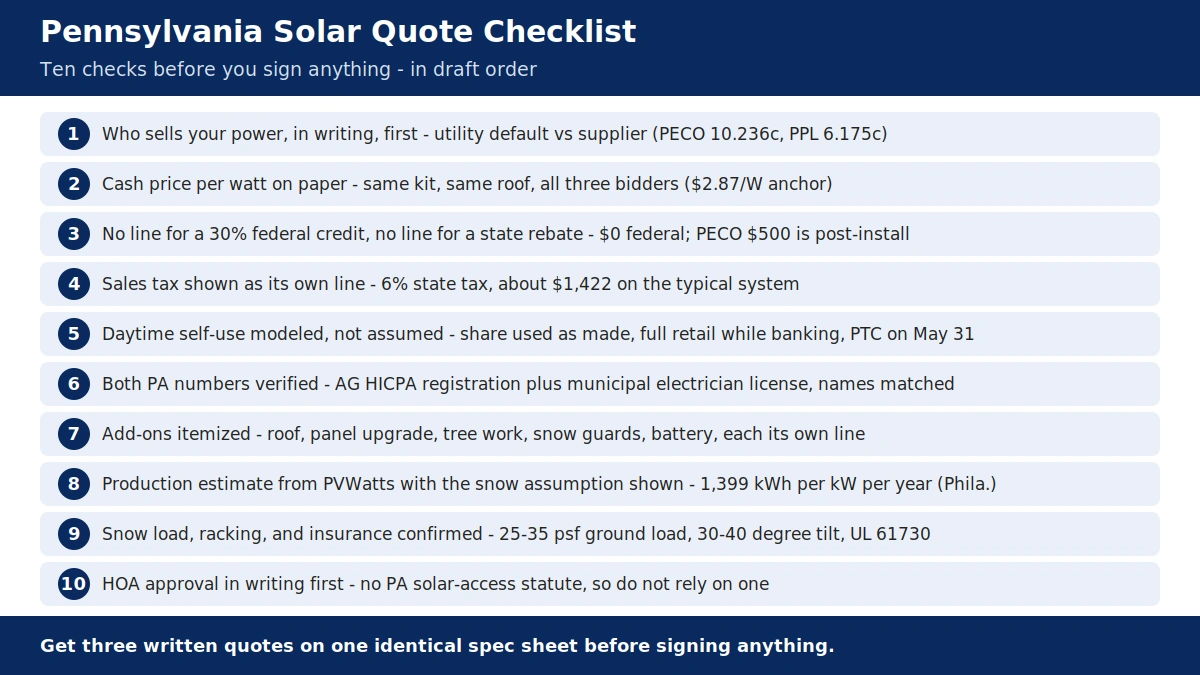
Pennsylvania is a fair state to buy solar in — middle-priced panels, the best net-metering rule in the Northeast, and a crowded installer field — but only for a homeowner who checks who sells the power before the sales pitch. Carry this list into every bidder meeting, and sign nothing until every line has a written answer.
The ten-item quote checklist:
- Who sells your power, in writing, first — your utility’s default supply at the full retail credit, or a competitive supplier at the delivery charge only (PECO 10.236 cents, PPL 6.175 cents), with leftovers zeroed at year end. The supplier question is worth about five years of payback — more than any other line on the quote.
- Cash price per watt, on paper — one identical spec sheet, all three bidders, the number in writing. The Pennsylvania anchor is $2.87 a watt; a quote far above it calls for an explanation, and a quote far below it calls for a closer look at what was left out — especially the 6% sales tax.
- Check the quote carries neither a 30% federal credit nor a state rebate — Washington pays $0 on a 2026 owner purchase, and Harrisburg offers no rebate and no tax credit for solar. The PECO $500 rebate is real but small, and it arrives after the install. Any quote still carrying a 30% credit is priced under a law that has already expired. Ask for it to be removed.
- Sales tax shown as its own line — 6% on the whole system, about $1,422 on the typical system. A quote that hides the tax has hidden it in the per-watt price, and two quotes cannot be compared until both show it.
- Daytime self-use modeled, not assumed — the share of production the house uses the moment it is made, shown month by month, with the surplus priced at the full retail credit while it banks and the price to compare on May 31. On PECO, a quote that values all exports at one blended price, or forgets the May 31 payout, is wrong.
- Both Pennsylvania numbers verified — the installer’s Attorney General HICPA registration number, checked on the state search, and the municipal electrician’s license for the town the work is in, with names matched to the contract. NABCEP certification is a plus. A registration number is not an endorsement of competence.
Add-ons listed separately — roof work, panel upgrade, tree work, snow guards, and battery, each priced on its own instead of folded into the per-watt figure.
- Production estimate from PVWatts, with the snow assumption shown — start from about 1,399 kilowatt-hours per kilowatt a year in Philadelphia and about 1,180 in Pittsburgh, not the nameplate watts, and demand the monthly shape, not a yearly average. Demand the month-by-month shape instead — June beside December, so the seasonal swing is visible.
- Snow load, racking, and insurance confirmed — the roof’s snow-load rating checked with the building department (25 to 35 psf ground load on the older figures, up to 60 in the north), the racking’s uplift rating named, the 30-to-40-degree tilt stated, UL 61730 / IEC 61730 panels specified by name, and homeowners insurance confirmed in writing to cover the array before signing.
HOA approval first, in writing — this guide verified no Pennsylvania solar-access statute, so do not count on one existing. Get the architectural review’s approval before you order panels; condo owners need the board’s sign-off on the shared roof as well.
Buy, lease, or wait? Over 25 years, buying wins for homeowners on their utility’s default supply, with high daytime use, or on Duquesne Light’s dear power. With a purchase, the system is yours, the resale value is yours, the SRECs are yours, and every self-used kilowatt-hour keeps its full retail value. Leasing suits homeowners who want no upfront cost and no maintenance — and in Pennsylvania it is genuinely on offer, with the §48E credit behind it — but the company keeps the SRECs and the monthly payment is the number to compare, not the headline. Waiting wins for renters and shaded-roof homeowners until HB 504 becomes law and community solar exists, and for anyone whose roof has under ten years left in it. Buy the roof first. Then buy the panels.
Sources & methodology
Cost anchors (per watt, system size, totals):
- EcoGen Solar Cost Index, September 2026 edition, prices as of Sep 25, 2026; PA page updated Oct 19, 2026: $2.87/W; 8.26 kW typical (Berkeley Lab median installed in PA in 2025, 1,199 systems); $23,706 total; 1,399 kWh/kW/yr (PVWatts, Philadelphia); $0.02 below US average ($2.89/W); cost-by-size table 6 kW $17,220 / 8,394 kWh, 8.26 kW $23,706 / 11,556 kWh, 10 kW $28,700 / 13,990 kWh, 12 kW $34,440 / 16,788 kWh
- EnergySage Pennsylvania page, Nov 2026: $2.60/W; average system 12.62 kW; ~$32,835 before incentives (range $27,910–$37,760); payback 9.5 yrs; 25-year savings $72,285 — flagged, modeled
- EnergySage Jun–Jul 2026 via GreenEnergyCalc (reviewed Oct 5, 2026): statewide $2.55/W; average quoted system 13.38 kW ~$34,121; Philadelphia $2.75/W (11.31 kW avg, $31,109); Pittsburgh $2.59/W; Lancaster $2.60/W; Williamsport $2.73/W
- NumeralQ Pennsylvania page (planning estimate, EnergySage data retrieved Oct 26, 2026): statewide $2.41–$3.15/W; 4 kW $10,140–$13,250; 5 kW $12,520–$16,360; 8 kW $19,270–$25,190; 12 kW $27,410–$35,830
- SolarReviews Pennsylvania guide, 2026: $3.16/W (via MySolarFY, Aug 2026)
- MySolarFY model, Aug 2026: $2.57–$3.16/W; typical 6–7.8 kW system $15,400–$24,600; payback ~10–11 yrs — flagged, modeled
- Pennsylvania ranks 14th for residential solar, 2,496 MW installed (EnergyScout, reviewed Sep 11, 2026)
Rates and home use:
- EIA, 12 months to Aug 2026: PA 20.86 cents/kWh, US 18.0 cents; average use 836 kWh/mo (~10,032 kWh/yr); average bill ~$174.53/mo; Aug 2026 alone 21.77 cents, 911 kWh, $198.28, +9.2% YoY; 14th-highest rate in the US
- EIA final 2025 (Form EIA-861, released Oct 7, 2026): 839 kWh/mo, 19.29 cents, $161.90/mo
- EIA Form 861-M Aug 2026 by utility: FirstEnergy Pennsylvania 21.33 cents, 928 kWh/mo, $197.89, 1,497,377 customers; PECO 20.47 cents, 882 kWh/mo, $180.44, 1,252,402 customers; PPL 20.96 cents, 852 kWh/mo, $178.66, 914,835 customers; Duquesne Light 25.86 cents, 755 kWh/mo, $195.16, 448,182 customers
- PUC 2025 averages by utility: PECO 708 kWh/mo, $150.34, 21.2 cents; Duquesne Light 599 kWh/mo, $155.75, 26.0 cents; Penelec 725 kWh/mo, $167.24, 23.1 cents; PPL 941 kWh/mo, $186.88, 19.9 cents; Met-Ed 930 kWh/mo, $194.71, 20.9 cents; Penn Power 930 kWh/mo, $195.32, 21.0 cents
- Price to Compare, Jun 1–Nov 30, 2026 (PA Power Switch, Nov 8, 2026): PECO 11.759 cents; PPL 13.079 cents; Duquesne Light 14.140 cents; Met-Ed 13.951 cents; Penelec 13.142 cents; Penn Power 13.477 cents; West Penn Power 12.075 cents; resets Jun 1 and Dec 1
- PECO Rate R (effective Jul 1, 2026): delivery 10.236 cents/kWh; fixed $11.29/mo. PPL Rate RS (Oct 1, 2026): distribution 6.175 cents; generation supply 9.753 cents; transmission 3.326 cents; 1.80% merchant function charge
Net metering:
- Alternative Energy Portfolio Standards Act of 2004 (73 P.S. 1648.1–1648.8); PUC regulations 52 Pa. Code 75.11–75.17, last amended effective Nov 19, 2016: residential systems up to 50 kW; monthly netting at full retail (generation + transmission + distribution); credits roll forward month to month; credit year Jun 1–May 31; year-end leftover paid at the price to compare (75.13(e)); home must use power for something other than running the system (75.13(a)(1))
- Supplier case: utility credits exports at its distribution charge only (PECO 10.236 cents, PPL 6.175 cents, Oct 2026); unused delivery credits zeroed at year end; credit for the power itself must be in the supplier contract
- PECO lease cap 110% of yearly use (EcoGen). Rules bind PUC-regulated investor-owned utilities only; co-ops and municipal/borough utilities not covered
- Utilities may not charge net-metering customers fees other customers do not pay without PUC approval
SRECs / AEPS:
- 1 Solar Alternative Energy Credit per 1,000 kWh; PJM-EIS GATS registry; revenue-grade meter; sold via brokers/aggregators (3–10% commission); vintage life 3 years
- AEPS solar carve-out 0.5% of retail sales — weakest in the region
- PUC Alternative Energy Credit Pricing, 2025/2026 reporting year (posted Oct 1, 2026; xlsx updated Sep 21, 2026): Solar AEC weighted avg $28.26, range $4.00–$81.00; Solar ACP $56.52; Tier I $25.69 (range $5.25–$38.50), ACP $45.00; Tier II $24.81, ACP $45.00; 2024/25 weighted avg was $33.20
- Spot market (Flett Exchange, accessed Aug 2026): 2026 vintage ~$22.00, generally $15–$25; SunLynk Aug 2026: $19–$22 spot
- Typical 8.26 kW system: ~11.6 credits/yr ≈ ~$327/yr at $28.26, ~$255/yr at $22 spot, before broker fees (EcoGen)
- PRESS Act: pending; would raise solar carve-out from 0.5% to 5.5%; not passed as of 2026
Production and climate:
- EcoGen: 1,399 kWh/kW/yr (PVWatts, Philadelphia) — figure in its payback cases
- SolarBenchmark (pvlib modeling, Open-Meteo ERA5, updated Apr 8, 2026): Philadelphia ~1,330; Harrisburg ~1,290; Allentown ~1,300; Reading ~1,310; Pittsburgh ~1,180; Erie ~1,120 kWh/kW/yr
- MySolarFY PVWatts v8 average (Harrisburg, Philadelphia, Pittsburgh): ~1,290 kWh/kW/yr
- Peak sun hours: PA 3.5–4.5/day statewide; NEPA 4.0–4.3; Pittsburgh ~4.2
- Sunshine hours (NOAA long-term averages, via World Atlas Jul 2026 report): Pittsburgh 2,021 hrs/yr — fewest of any major US city; Philadelphia 2,498 hrs/yr; Pittsburgh ~160 sunny days/yr vs US average 205 (National Weather Service)
- Seasonality (SolarBenchmark modeled, 6 kW Philadelphia): June ~920 kWh, January ~340 kWh, December ~310 kWh — ~2.7:1 summer-to-winter ratio; NEPA installer data: Dec–Jan ~40% of Jun–Jul peak; 10 kW NEPA system 11,200–12,400 kWh/yr
- Ground snow loads 25–35 psf (IBC 2003 / USDA state table); ASCE 7-22 range 25–60 psf across the state, higher in the north and at elevation; frost depth 36–42 inches
- Heat penalty 0.3–0.5% per degree C above 25 C cell temperature, national figure
Payback arithmetic:
- The worked examples in the payback section are EcoGen’s per-utility figures of Oct 30, 2026, restated: 8.26 kW x $2.87/W = $23,706; production ~11,556 kWh/yr; PECO year-one value ~$2,080/yr (all 11,556 kWh at 18.003 cents = PECO EIA avg 19.494 cents Sep 2025–Aug 2026 less $11.33/mo fixed charges); $23,706 divided by $2,080 ~ 11.4 yrs; PECO supplier case $1,674/yr (4,622 kWh x 20.86 cents + 6,934 kWh x 10.236 cents), upkeep $30/kW/yr ($247.80), payback = ($23,706 − $500) / ($1,674 − $247.80) ~ 16.3 yrs
- EcoGen per-utility paybacks: Duquesne Light 8.8 yrs; FirstEnergy Pennsylvania 10.6–10.7 yrs; statewide weighted 10.8 yrs; PPL 11.2 yrs; PECO 11.4 yrs; UGI 10.8; Pike County 9.2; Wellsboro 10.6; Citizens’ 12.6
- EnergySage’s 9.5-year payback ($72,285 25-year savings) and Solar Energy Nerds’ 8.8-year break-even figure are flagged as modeled estimates that do not price the supplier trap or the May 31 payout
Incentives:
- No state rebate, no state solar tax credit, no sales-tax exemption (6% applies), no property-tax exemption (EcoGen; SunLynk Aug 2026; NuWatt Apr 2026)
- PECO $500 solar rebate: once per home; form within 90 days of in-service; program term through May 31, 2031, while funds last (EcoGen)
- PPL battery pay: $150/kW/season, up to $400/season; SolarEdge (with SolarEdge or LG batteries) and Enphase IQ Batteries; no solar-panel rebate (EcoGen)
- PECO battery pay: $80/kW/season through Flex & Save; example ~$480/yr (EcoGen)
- FirstEnergy solar measure: regulator approved a plan Mar 12, 2026; no amount, no application yet (EcoGen)
- PA Sunshine Solar Program: $100M allocated (Alternative Energy Investment Act 2008); ran May 18, 2009 to Nov 25, 2013; ~$113M deployed; no applications after Dec 31, 2013 (PA DEP guidelines Rev. 1/2013; CCPA Solar program history)
- Solar for All: EPA awarded PEDA $156M for ~12,500 low- and moderate-income homes; never launched — legislature never approved accepting the money; EPA terminated the $7B national program Aug 2025 (Allegheny Front Aug 2025; EcoGen: state agency says “not operational at this time”)
- Solarize Greater Philadelphia: vetted installers in Bucks, Chester, Delaware, Montgomery and Philadelphia counties; workmanship warranty at least 10 years; no-upfront-cost lease for household incomes up to $165,000 (EcoGen)
- Community solar: no law; HB 504 passed House 114–89 May 7, 2025, referred to Senate Consumer Protection & Professional Licensure May 22, 2025; part of Gov. Shapiro’s Lightning Plan (pv magazine USA May 15, 2025; BillTrack50)
- HEAR/HOMES: DOE Jan 2025 dataset: $129,226,380 HEAR + $129,723,107 HOMES allocated to Pennsylvania; admin PA DEP Energy Programs Office (Penn Energy Savers); not on DOE Feb 6, 2026 launched map; ECW check Oct 27, 2026: not launched; RebateScout’s “HOMES open” claim unverified — flagged as conflict
Federal and financing:
- OBBBA P.L. 119-21 and IRS FS-2025-05: §25D and §25C $0 for post-Dec-31-2025 installs, completion date counts
- §48E 30% for third-party-owned systems, in service by Dec 31, 2027, construction begun by Jul 4, 2026 per IRS Notice 2025-42; leases and PPAs sold in Pennsylvania; PECO lease cap 110% of yearly use
- DOE Notice 26-2, Sep 1, 2026: HEAR electric-to-electric upgrades only, no fuel-switching; solar, batteries, EV chargers, windows outside HEAR
- CFPB Solar Financing Market Issue Spotlight, Aug 2024: dealer fees 10-30%, sometimes over 50%
- HICPA deposit cap: one-third of price on contracts over $5,000, plus special-order materials listed in the contract (EcoGen)
Permits and licensing:
- No statewide general contractor license (PA Dept. of Labor & Industry); HICPA Act 132 of 2008, 73 P.S. 517.1 et seq.: solar energy systems named expressly; registration with the Office of Attorney General required at $5,000 of home improvement work a year; fee $100 every two years (AG, Fiscal Code 72 P.S. § 1603-U) vs $50 in statute text at § 517.5 — both noted; unregistered contractors cannot enforce contracts; 3-business-day cancellation notice; deposit cap one-third over $5,000; registration is not an endorsement of competence (AG)
- No state electrician license — municipal licensing (e.g. Philadelphia); a license in one city does not work in another
- No Pennsylvania-specific solar license category verified; NABCEP is the credential to ask for
- Installers (EcoGen, Oct 9–16, 2026 registry checks): Green Power Energy PA128259 (active Oct 13, 2026); Momentum Solar PA131435 (Johnstown office; active Oct 16, 2026, expires Apr 14, 2027); Trinity Solar PA128551 (Reading office; active Oct 13, 2026); Venture Home PA168470 (active Oct 16, 2026, expires May 7, 2028)
- Permits under the Uniform Construction Code (PA Residential Building Code, IRC 2018/2021); no PA-wide fee schedule verified; national interconnection 2–4 weeks (Palmetto, Apr 2025), flagged national
HOA and solar access:
- Pennsylvania has NO statewide solar access law as of 2026 (NuWatt Apr 2026; Solar United Neighbors Apr 2024; EnergySage Jun 2026)
- Bills introduced but not enacted: SB 826 (2021), SB 31 (2023), HB 1759 amendment (2023–24), Senate bill introduced Apr 11, 2025 (Muth et al., referred to Urban Affairs and Housing) barring associations from prohibiting solar on a detached roof or townhouse unit
Batteries, labor and lifespan (national figures):
- Battery cost: 13.5 kWh add-on ~$15,647 installed (EnergySage, Jul 2026, national figure; no Pennsylvania-specific battery price verified)
- BLS OEWS May 2025: electricians national median $30.38/hr (no Pennsylvania-specific figure pulled)
- Lifespan 25-30 years productive service; NREL median degradation ~0.5%/yr, ~88% of rated output at year 25; premium n-type 0.25-0.5%/yr, 91-93% at year 25 (NREL Jordan et al. 2022)
- Product warranty typically 10-25 years; performance warranty typically 25-30 years, guaranteeing 80-92% of rated output at year 25 depending on tier; string inverter 10-15 years, one replacement expected; microinverters ~25 years
EXCLUDED:
- Any “after 30% credit” prices — §25D is $0 for 2026 owner installs
- Any HEAR-for-solar claim: HEAR does not cover solar, batteries, EV chargers, or windows; electric-to-electric only since DOE Notice 26-2, Sep 1, 2026
- Any state rebate, state tax credit, sales-tax exemption, or property-tax exemption for Pennsylvania solar: none exists
- EnergySage’s 9.5-year payback and Solar Energy Nerds’ 8.8-year break-even figure: modeled estimates that do not price the supplier trap or the May 31 payout
- The claim that Pennsylvania has weak net metering: WRONG against 52 Pa. Code 75.13 — full retail credit with annual banking to May 31
- The claim that the PECO $500 rebate is a discount at install: it is a post-install rebate, form due within 90 days
- PA Sunshine as a 2026 program: ended Nov 25, 2013
- Solar for All as an open program: not operational; EPA terminated Aug 2025
- A FirstEnergy solar rebate: approved in a plan Mar 12, 2026, but no amount and no application exist
- Community solar subscriptions: no law; HB 504 in Senate committee
- PPL and Duquesne Light year-end payout figures: “on your bill” per EcoGen, not stated
- FirstEnergy supplier-credit figures: “ask” per EcoGen, not stated
- City-level verified prices for Harrisburg, Allentown, Scranton, Erie, Reading, York — none pulled, planning estimates labeled as such
- Pennsylvania-specific permit fee schedule, interconnection timeline, battery price, panel-upgrade price, BLS electrician wage (national figures used, flagged as national)
- Pennsylvania-specific monthly PVWatts production table: seasonal shape described from SolarBenchmark modeled figures and NEPA installer data instead
- Pennsylvania-specific snow-loss percentage: not verified
- A Pennsylvania HOA solar-access statute: none verified, none claimed
- Alaska/Oklahoma/Idaho export rates, snow loads, or installer names: none imported
*Disclaimer: The prices here are 2026 Pennsylvania planning figures. City, utility, roof, and contractor each push the final figures in a different direction. Have three Pennsylvania installers price the same job in writing, and build your budget from those three numbers. Treat every tax note in this guide as background information for a Pennsylvania homeowner, never as guidance for your own filing. Check with a Pennsylvania tax professional before you file. Program rules change — price-to-compare values reset every June 1 and December 1, and SREC prices move with the market — so confirm current terms with your own utility before signing. Whether a competitive supplier sells your power changes what every exported kilowatt-hour is worth, so confirm that first, in writing, before you sign anything.*
What do solar panels cost in Pennsylvania in 2026?
In Pennsylvania in 2026, installed solar runs $2.87 a watt — roughly $23,706 for the typical 8.26 kW home system, per EcoGen’s September 2026 index — with an 8 kW planning range of $2.41-$3.15 a watt. An 8 kW home system typically runs about $22,960 at the EcoGen rate, and Philadelphia marketplace averages run $2.75 a watt. For a homeowner-owned system installed in 2026, the 30% federal credit is $0, Pennsylvania has no state rebate and no state tax credit, and the only money beyond the bill is a $500 PECO rebate and SRECs worth roughly $22 each.
Is solar worth it in Pennsylvania with so little sun?
Closer than the cloud suggests, and the answer depends on the utility. A kilowatt of panels here makes about 1,399 kilowatt-hours a year in Philadelphia and about 1,180 in Pittsburgh — the cloudiest big city in the country — but the power it replaces costs about 20.86 cents a kilowatt-hour statewide and 25.86 cents on Duquesne Light, and every exported kilowatt-hour banks at full retail value until May 31. EcoGen puts simple payback at about 8.8 years on Duquesne Light, about 10.8 years statewide, and about 11.4 years at PECO. The one case that breaks is the home that buys power from a competitive supplier: there the payback stretches to about 16.3 years at PECO.
Does Pennsylvania have net metering?
Yes — and it is among the best in the country. Under the Alternative Energy Portfolio Standards Act and Public Utility Commission rules at 52 Pa. Code 75.11 through 75.17, systems up to 50 kW earn a credit at the full retail rate for every kilowatt-hour they send out. The credits roll forward month to month at full retail value through the credit year, which runs June 1 to May 31. Whatever is left on May 31 is paid out at the utility’s price to compare — 11.759 cents at PECO for June through November 2026, roughly half the retail rate. One catch: if a competitive supplier sells your power, the utility credits your exports at its delivery charge only — 10.236 cents at PECO, 6.175 cents at PPL — and zeroes out the leftovers.
What is a Pennsylvania SREC worth?
About $22 on the spot market, or about $28.26 on the state’s weighted average — print both, and believe the spot price when you budget. Your system earns one Solar Alternative Energy Credit for every 1,000 kilowatt-hours it produces, registered through PJM-EIS GATS, and a typical 8.26 kW system mints about 11.6 credits a year, worth roughly $255 at the spot price or $327 at the weighted average, before broker fees. The price is low because Pennsylvania’s solar carve-out is only 0.5% of retail sales, the weakest in the region. Credits expire three years after their vintage year, and selling one means giving up the right to claim the power was green.
Why does who sells my power change my solar payback?
Because Pennsylvania’s net-metering rule credits your exports at the full retail rate only when your utility also sells you the power. Buy from a competitive supplier instead, and the utility credits each exported kilowatt-hour at its delivery charge only — 10.236 cents at PECO, 6.175 cents at PPL — and zeroes out whatever delivery credit is left at year end. EcoGen ran the same 8.26 kW PECO home both ways: 11.4 years of payback with PECO selling the power, 16.3 years with a supplier. Switch back to the utility’s default supply before the panels go in, or get the supplier’s solar terms in writing first.
Is the 30% federal solar credit still available in Pennsylvania in 2026?
No, not if you own the system. No — the One Big Beautiful Bill Act ended the 30% Residential Clean Energy Credit for homeowner-owned systems placed in service after December 31, 2025, so a 2026 Pennsylvania install gets nothing from §25D. What counts is when the crew finishes the work — the IRS ties the credit to the in-service date, not the deposit date. Pennsylvania does offer a second door that some states do not: the commercial credit (§48E, 30%) survives for third-party-owned systems in service by December 31, 2027, and leases and PPAs are sold here — but the company keeps the SRECs, and any lease or PPA should go past a lawyer before you sign it.
What incentives does Pennsylvania actually offer for solar in 2026?
Very little, and the short list is the honest one. There is no state rebate, no state solar tax credit, no sales-tax exemption — the 6% sales tax applies to the whole system — and no property-tax exemption. What exists is a $500 rebate from PECO, once per home, with the form due within 90 days of in-service status; battery payments of $150 per kilowatt per season from PPL and $80 per kilowatt per season from PECO; and SRECs worth roughly $22 each. PA Sunshine ended in 2013, Solar for All never launched and was terminated by the EPA in August 2025, and the FirstEnergy solar measure approved in March 2026 has no amount and no application yet.
Can my HOA stop me from installing solar panels in Pennsylvania?
Yes — Pennsylvania has no statewide solar access law. Unlike about thirty other states, Pennsylvania has passed no law barring a homeowners association from prohibiting rooftop solar, and bills to create one have been introduced in 2021, 2023, and again in April 2025 without passing. Your association can reject the panels on looks alone through its architectural review, and for condo owners the hurdle is doubled, because the roof is usually common area. Get approval in writing before ordering panels, and do not rely on a statute that does not exist.