


Table of Contents
Alaska breaks every rule a solar buyer learns in the Lower 48, and it breaks them in both directions at once. The sun is the weakest in the nation. The power is among the most expensive. The summer days last nineteen hours and the winter days last five and a half. The grid in Anchorage is a co-op, the grid in Fairbanks is a different co-op, Juneau runs on cheap hydro, and a third of the state lives in villages where the grid is a diesel generator and the state pays most of the bill. A single statewide answer for solar in Alaska would be wrong in at least three of those places, so this guide does not offer one. It offers four answers — one per co-op, one per way of life — and the discipline to match your house to the right one before you spend anything.
Start with the two numbers that pull against each other. A kilowatt of panels in Alaska makes about 957 kilowatt-hours a year, according to EcoGen’s PVWatts-based figures from September 2026. That is the lowest production per kilowatt in the United States, and it is not close: the national figure runs roughly 40% higher. But the kilowatt-hour that panel makes replaces power that costs about 26.94 cents on the statewide average, against 18 cents nationally, and in Fairbanks it replaces power at 35 cents. In a village on the Yukon, the power it replaces can cost 80 cents before the state subsidy steps in. Weak sun, expensive power — that tension is the Alaska solar market, and everything in this guide is a working-out of it.
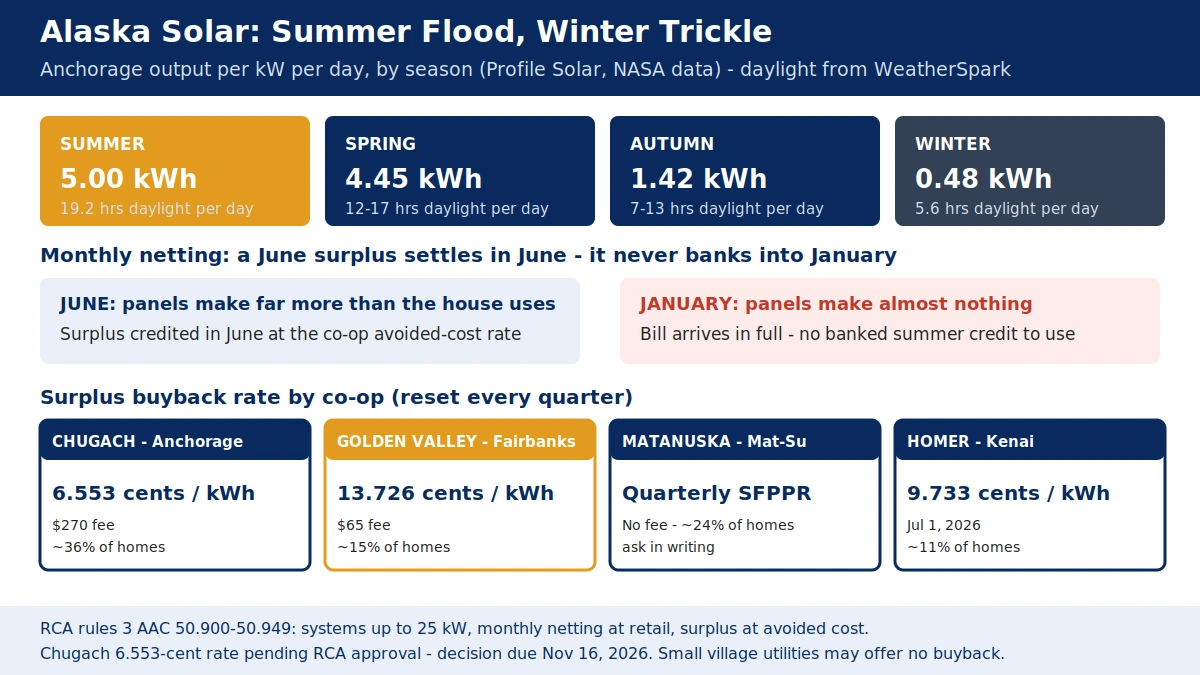
The second tension is time. An Anchorage array makes most of its electricity between March and September, under daylight that stretches toward nineteen hours, and very little in the dark core of winter, when the sun is up for five and a half hours and often hidden behind cloud anyway. The house needs the most power in exactly the months the panels make the least. Alaska’s net-metering rules settle the surplus month by month, at the co-op’s avoided-cost rate, with no annual banking. A June surplus cannot be carried into January at retail value. It settles in June, at 6.6 or 13.7 cents, and January’s bill arrives in full. Size the array for the year and you have bought hardware to sell summer power at wholesale prices. Size it for the month and the numbers start to work.
The third tension is the map. About 79% of Alaska’s electricity load sits on the Railbelt, the single interconnected grid that runs roughly 600 miles from Fairbanks through Anchorage to the Kenai Peninsula, powered mainly by natural gas at 73%, with coal at 15% and hydropower at 12%. The Railbelt is where the co-ops are, where the net-metering rules apply, and where most rooftop solar lives. Outside it sit more than 150 islanded microgrids, most of them diesel, serving about 9% of the state’s load at unsubsidized rates of 55 cents a kilowatt-hour and higher. Juneau, on its own hydro-powered grid, pays 13.2 cents — some of the cheapest power in the state — and solar there is a much harder sell than the same panels in Fairbanks. Your address decides your solar economics more in Alaska than in any other state in this series, and the first job of this guide is to put you on the right part of the map.
Start with the national picture in our solar panel cost guide and hold Alaska’s numbers up against it from there.
How Much Do Solar Panels Cost in Alaska in 2026?
Two kinds of evidence describe the Alaska market in 2026, and they agree within a few cents of each other once you know what each one is measuring. EcoGen’s Solar Cost Index for September 2026 — the anchor this guide builds on — puts Alaska at $3.15 per watt installed, with the typical 7.77 kW system at about $24,476 before incentives. That is the 47th-lowest price of all 51 jurisdictions, and the reason is printed in EcoGen’s own note: remote logistics and a short build season. Shipping panels to Anchorage, trucking them to Fairbanks, flying them to a village — every mile adds cost that a Texas installer never sees, and the crew can only work the roofs for part of the year.
The second kind of evidence is the planning estimate. NumeralQ’s Alaska page, built on EnergySage cost data retrieved October 26, 2026, prices an 8 kW system at $23,400 to $30,560, or $2.92 to $3.82 a watt, and its Anchorage page prices the same 8 kW system at $20,460 to $26,740, or $2.56 to $3.34 a watt. Those are planning outputs, not contractor bids, and the range is the point: Alaska quotes spread wider than Lower 48 quotes because the logistics spread wider. A roof in Anchorage and a roof in Nome are not the same job, and no single per-watt number should be allowed to hide that.
Two more snapshots fill out the picture, both flagged rather than headlined. SolarReviews’ November 2026 cost page puts Alaska at $3.52 a watt, with a 5.1 kW average system at $19,084 — but its “after tax credit” column still subtracts the dead 30% federal credit, so only the gross figure is usable here. RenewEstimator, with data compiled July 25, 2026, puts Alaska at $3.00 a watt and an 8 kW system at $23,520. The GreenWatt’s 2026 table also shows $3.00 a watt, built on older EIA 2024 rates and NREL Q1 2024 benchmarks, useful only as corroboration. Taken together, the anchors place Alaska a little above the national average of $2.89 a watt — about 9% above it — and the neighbors split around it: Oregon runs $2.77 a watt, Washington $2.86, Idaho $2.96, and Hawaii $3.14. Alaska is the most expensive of its region, and the gap is freight, weather, and a thin installer bench, not hardware.
One warning about the typical system size, because it matters for every number that follows. EcoGen’s 7.77 kW is modeled from neighboring states, not measured from Alaska installs — the company says so plainly, because too few Alaska systems exist to measure a local median. It is the best available typical size, and this guide uses it, but it is a model, and real Alaska quotes will cluster around the house, not around the model. Alaska homes also use less electricity than the national average — about 588 kilowatt-hours a month, or roughly 7,056 a year, against 875 nationally — which is why a 7.77 kW array making about 7,436 kilowatt-hours a year already covers roughly 105% of the average home’s annual use. In most states the typical system is sized to the house. In Alaska the typical system is already slightly bigger than the house, and that overshoot is where the export rules start to bite.
That per-watt figure has to pay for everything the install needs — the panels and inverter or microinverters, the racking and wiring, the labor, and the permits, inspection, and interconnection. A new roof, a panel upgrade, tree work, snow guards, a battery, and freight to a remote site are all extra, and in Alaska the freight line can be the biggest extra of all. Each of those extras belongs on the quote as its own line, and wherever this guide could pin a number on one, it has. No incentive sits inside the arithmetic either, because there is none to put there for a 2026 owner purchase: no federal credit, no state rebate, no state tax credit. The price is the price, and any quote that shows it otherwise is priced under a law that no longer exists.
A word of caution before the tables: the lowest quote in Alaska is not always the cheapest system overall, and in a state with two dedicated residential installers the second and third quotes are harder to get and more important for exactly that reason. Dealer fees of 10-30% of the cash price — sometimes more — often sit buried inside the amount a loan quote finances, because overhead and margin make up most of any installer’s total. The only figure that lines up cleanly when you set bidders side by side is cash price per watt for identical equipment on the same roof. Get that figure in writing from at least three installers, and drop any bidder who refuses to hand it over. In a state where one famous name on every national ranking stopped installing in October 2023, that third quote is also the check that the company you are talking to still exists.
| Source | $ per watt | System | Cash total | Payback |
|---|---|---|---|---|
| EcoGen Index (Sep 2026) | $3.15 | 7.77 kW | ~$24,476 | ~16.0 yrs modeled (Chugach + GVEA) |
| NumeralQ planning (Oct 2026) | $2.92-$3.82 | 8 kW | ~$23,400-$30,560 | Not published |
| NumeralQ Anchorage (Oct 2026) | $2.56-$3.34 | 8 kW | ~$20,460-$26,740 | Not published |
| SolarReviews (Nov 2026) | $3.52 | 5.1 kW | ~$19,084 | Not published |
| RenewEstimator (Jul 2026) | $3.00 | 8 kW | ~$23,520 | 9.5 yrs — flagged, modeled |
| GreenWatt (2026) | $3.00 | 5 kW | ~$15,000 | Not published |
| National range (article 4) | $2.25-$3.30 | 8.2 kW | ~$24,600 at $3.00/W | 6-12 yrs |
Two rows in that table deserve a footnote rather than a headline. SolarReviews’ cost page lists the same $3.52 a watt yet still prints an “after tax credit” column — that column subtracts the dead 30% federal credit, so it is stale and has no place in this guide. RenewEstimator’s 9.5-year payback, ConsumerAffairs’ 12.6-year payback, and ElectricChoice’s 6.8-year payback are all modeled estimates that do not price Alaska’s monthly netting and avoided-cost surplus correctly; none of them is a verified Alaska payback, and all three are flagged here rather than headlined. The gap between 6.8 years and 19.4 years is not a rounding difference — it is the export rate and the monthly settlement, and any payback that ignores them is modeling a different state.
Solar Panel Cost in Alaska by System Size
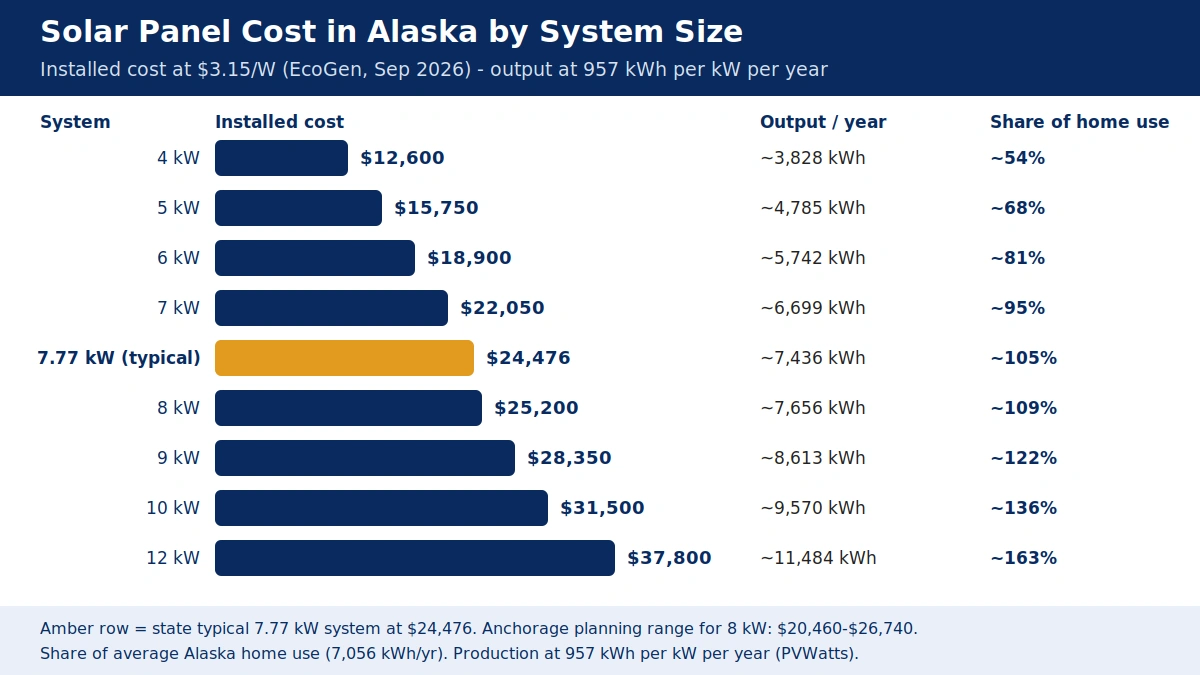
Size is the first decision, and in Alaska the export rules punish oversizing more than in almost any other state in this series — not because the surplus is worthless, but because it settles every month at the co-op’s avoided-cost rate instead of banking into winter at retail. The average Alaska home uses about 588 kilowatt-hours a month, or roughly 7,056 a year — a 12-month average from EIA billing data to August 2026, with the average bill running about $158 a month. Each installed kilowatt here produces about 957 kilowatt-hours a year, so a 7.77 kW array makes about 7,436 kilowatt-hours — roughly 105% of what the average home uses in a year. With the average home covered at about 105%, 7.77 kW is the size this guide treats as typical. It already covers the whole house on paper, and on paper is the problem: the house does not use power evenly across the year, and the panels do not make it evenly either.
Going bigger than the house uses is a worse deal in Alaska than in a state with annual net metering, because the co-op nets month by month. A kilowatt-hour sent out in June earns the avoided-cost rate in June — 6.553 cents at Chugach, 13.726 cents at Golden Valley — while a kilowatt-hour used at home saves the full retail price of 23 to 35 cents. That gap is what makes the table below turn unattractive past 8 kW for most Railbelt homes. Every size in the table is priced off the EcoGen anchor of $3.15 a watt, at 957 kilowatt-hours of output per installed kilowatt each year. It also lists the share of an average home’s use each size covers, so you can see at a glance where the array stops feeding the house and starts selling power instead.
| Size | Cost at $3.15/W | Yearly output | Share of avg. AK home use (7,056 kWh/yr) |
|---|---|---|---|
| 4 kW | $12,600 | ~3,828 kWh | ~54% |
| 5 kW | $15,750 | ~4,785 kWh | ~68% |
| 6 kW | $18,900 | ~5,742 kWh | ~81% |
| 7 kW | $22,050 | ~6,699 kWh | ~95% |
| 7.77 kW (state typical) | ~$24,476 | ~7,436 kWh | ~105% |
| 8 kW | $25,200 | ~7,656 kWh | ~109% |
| 9 kW | $28,350 | ~8,613 kWh | ~122% |
| 10 kW | $31,500 | ~9,570 kWh | ~136% |
| 12 kW | $37,800 | ~11,484 kWh | ~163% |
Give two rows of that table a second look. First, the 7.77 kW typical system already covers about 105% of average annual use — so even the typical system sells a meaningful slice of its output at the avoided-cost rate in the bright months, and the slice grows with every added kilowatt. Second, the 4 kW and 5 kW rows are the honest starting point for a home that uses power mostly in the dark months: a smaller array that the house actually eats, kilowatt-hour for kilowatt-hour, at full retail value, beats a bigger array that sells June power for 6.6 cents. The sizing conversation starts with the monthly bills, then the co-op’s surplus rate, and only then the roof.
Size the array from twelve months of electric bills, not from however much roof is empty — and in Alaska, size it month by month, not year by year. Total the kilowatt-hours, divide by roughly 957 to find the size that covers them, then look at the summer months separately: if June, July, and August already show a surplus at 7 kW, stop there, because every kilowatt above that line earns the avoided-cost rate in the months it produces most. Add 1-2 kW for a planned EV or a heat pump, more for electric heat, less for a shaded or north-facing roof — then check the result against the 25 kW net-metering cap in the RCA rules. If an EV or a heat pump is in your future, size the solar for the bigger house now — add the load first, then the panels — or the new load will show up after the array is already built for the smaller one. See our 6 kW vs 8 kW vs 10 kW guide for the full sizing walk-through.
Solar Panel Cost by City: Anchorage, Fairbanks, Juneau & the Mat-Su
Alaska is a spread-out state with one big solar market in Anchorage, a second in Fairbanks, a third on cheap hydro in Juneau, and a fast-growing one in the Mat-Su Valley — and the verified city prices run thinner here than in any other state in this series, because the installer field is thin and the quote data is thinner. Only one city carries a verified planning figure. The rest of this section is honest about that, and it leans on what is verifiable instead: the utility behind the meter, which in Alaska moves the answer more than the install price does.
| City | $ per watt | Avg. system | Cash total | Utility |
|---|---|---|---|---|
| Anchorage | $2.56-$3.34 | 8 kW | ~$20,460-$26,740 | Chugach Electric |
| Fairbanks | No verified figure | 8 kW ~$25,200 | Planning estimate only | Golden Valley (GVEA) |
| Juneau | No verified figure | 8 kW ~$25,200 | Planning estimate only | AEL&P (hydro) |
| Wasilla / Palmer (Mat-Su) | No verified figure | 8 kW ~$25,200 | Planning estimate only | Matanuska Electric (MEA) |
| Kenai / Homer | No verified figure | 8 kW ~$25,200 | Planning estimate only | Homer Electric |
Anchorage is the biggest market in the state, served by Chugach Electric, and the only city with a figure built on EnergySage data: NumeralQ’s Anchorage page, with data retrieved October 26, 2026, prices an 8 kW system at $20,460 to $26,740, or $2.56 to $3.34 a watt. That range sits below the statewide $3.15 anchor at its low end and above it at its high end, which is exactly what a planning range should do in a logistics-heavy market: it says Anchorage is where the installers, the freight, and the competition all live, and even there the spread is wide. Treat the Anchorage range as a planning estimate, not a contractor bid, and do not quote either end of it as the Anchorage price, because it is not one.
Fairbanks, Juneau, Wasilla, and Kenai carry a warning label rather than a verified price. No EnergySage city figures were pulled in this pass for any of them, and this guide does not invent them. The 8 kW planning estimate of about $25,200 at the statewide $3.15 anchor is shown so the reader has a number to plan around, and it is labeled as what it is. What is verifiable for those cities is the utility, and the utility is the number that matters more. Fairbanks sits on Golden Valley at 35 cents a kilowatt-hour with a 13.726-cent surplus credit — the strongest payback in the state. Juneau sits on AEL&P hydro at 13.2 cents — the weakest payback in the state, because the power the panels replace is already cheap and clean. Wasilla and Palmer sit on Matanuska Electric at 25.2 cents with a quarterly surplus rate that was not posted when this guide was written. Kenai and Homer sit on Homer Electric at 32.3 cents with a 9.733-cent surplus credit. A Fairbanks system and a Juneau system at the same price per watt are not the same investment, and the city table should be read utility-first, price-second.
Rank the cities on the utility column before the price column, and rank quotes on price per watt, never the total. An Anchorage quote at the low end of its range and a Fairbanks quote at the statewide anchor are not a close call once the surplus rates are in: the Fairbanks array earns more than twice as much for every surplus kilowatt-hour, and its retail rate is half again as high. The payback section below does that work for each co-op.
One more city-level note: the installer field is two companies deep. EcoGen’s October 2026 check names Renewable Energy Systems of Alaska — storefronts in Anchorage, Palmer, and Fairbanks, NABCEP-certified designers — and Alaska Solar of Anchorage, a 100% in-house crew with no commissioned sales team. A third name still appears on national ranking lists and should not be trusted there: Arctic Solar Ventures, for years the state’s most-recommended installer, announced in October 2023 that it would end its solar construction work, and its old web address now leads elsewhere. Any list that still recommends it is stale, and any quote that cites it is old. Get three quotes, and make at least one from a company that already works in your co-op’s territory — and check the license numbers yourself, because EcoGen’s own registry check found one of the two surviving installers showing an expired contractor license number, and the guide names that in the licensing section below.
Alaska’s Sun: Midnight Sun, Winter Darkness & Cold
Alaska’s sunshine arrives with a shape no other state in this series has: a flood in summer, a trickle in winter, and a cliff between them. A production estimate that is honest has to carry both halves of the story, and the monthly shape, not the annual total, is what decides whether the system pays.
The sun, by the numbers. One kilowatt of panels in Alaska yields roughly 957 kilowatt-hours a year on EcoGen’s PVWatts-based figures — the weakest solar resource in the country, about 40% below the national figure. Cross-checks land in the same place: Profile Solar’s Anchorage model, built on NASA hourly data, gives about 5.00 kilowatt-hours per kilowatt per day in summer, 4.45 in spring, 1.42 in autumn, and 0.48 in winter. WeatherSpark’s Anchorage table of shortwave solar energy tells the same story in different units: 5.8 kilowatt-hours per square meter per day in June, 0.2 in December — a twenty-nine-fold swing from the brightest month to the darkest. Take 957 as the working annual figure, anchored on EcoGen, and treat the seasonal shape as the thing that governs the design.
The daylight is the story. Anchorage gets about 19.2 hours of daylight in June and 5.6 hours in December — 19 hours and 21 minutes on the summer solstice against 5 hours and 28 minutes on the winter solstice, with the sky never truly going dark in June, civil twilight carrying through the night. Fairbanks, further north, gets nearly 70 consecutive days of near-24-hour daylight around the solstice. Juneau, further south and on the coast, gets about 18 hours in June and nearly seven in December, but its maritime cloud and rain cut the resource the extra daylight would otherwise give. The long summer days are real, and they are the reason Alaska solar works at all: the panels run for nineteen hours a day in June. The short winter days are equally real, and they are the reason no Alaska system should ever be sold on its annual total alone.
Cold is a genuine advantage. A panel cell loses roughly 0.3-0.5% of its efficiency for every degree Celsius it warms past 25. An Alaska rooftop in January runs far cooler than 25 degrees, and even a July rooftop in Anchorage rarely bakes the way a Phoenix roof does, so a system here generates more per hour of sunshine than the same panels would on a hot roof in the South. Cold, clear, high-latitude air is some of the best solar weather there is, and it is a large part of why Alaska’s per-kilowatt production holds up as well as it does against the latitude. The same physics means the panels need the sun to be up to use it — and in December it is barely up at all.
Snow is the variable, and it cuts both ways. A tilted array sheds snow, and a steep one sheds it fast: a fixed Anchorage install needs a tilt of 51 to 56 degrees from horizontal to catch the low-angle sun, far steeper than the 30 to 45 degrees used elsewhere, and that steepness is also what lets snow slide off on its own. Snow on the ground helps too — reflection off snow can boost energy capture by an estimated 15-30% in the spring and fall months, when the sun is low and the ground is still white, according to the engineerfix estimate cited in the sources. But snow on the panels is lost production until it slides, and a low-slope roof anywhere in the state holds snow longer than a steep one. No Alaska-specific snow-loss percentage was verified for this guide, so none is stated here — if an installer shows you a production estimate, ask to see the snow-loss assumption inside it, and ask what tilt it assumes. Snow guards, which stop sliding snow from landing on walkways and gutters, belong on a steep Alaska roof as a line item, not a footnote.
The roof, and the snow load it carries. A rooftop array in Alaska sits under a snow load the racking and the roof must carry together — Anchorage’s minimum design snow load is 40 pounds per square foot, Fairbanks’ is 60, and some areas run higher — so confirm the roof’s snow-load rating and the racking’s uplift rating before signing, and let the building department’s figure govern, not the installer’s guess. If the roof has under ten years left in it, replace it before the panels go on — pulling panels off and putting them back for a later reroof runs into the thousands by itself. For reroof pricing, see our roof replacement guide. Standing-seam metal is one of the finest roofs solar can sit on: the clamps grip the seams with no penetration at all, and snow slides off metal sooner than it slides off asphalt. Panels rated UL 61730 / IEC 61730 remain the specification to ask for, and homeowners insurance remains the cover for storm damage.
Working with the climate. No exotic gear is needed, but the ordinary gear needs Alaska settings. Pick a south-facing orientation where the roof allows it, a tilt steep enough to shed snow and catch the low winter sun — 51 to 56 degrees in Anchorage, steeper still further north — microinverters or optimizers so a shaded or snow-covered string cannot drag the whole array down, and a production estimate built on PVWatts data with the snow assumption out in the open, not hidden. On a co-op that nets month by month, the most valuable kilowatt-hours are the ones the house eats the moment they are made, in the month they are made — and a west-facing tilt that pushes more production into the evening, when the house is actually using power, is worth discussing with the installer even if it gives up a little total annual output.
Net Metering in Alaska: Monthly Netting & the Co-op Buyback Rates
Alaska is one of the states that people get wrong in both directions, and the correction matters more here than almost anywhere else. One common claim is that Alaska has no net-metering law at all. That is wrong. The other common claim is that Alaska has statewide net metering at full retail. That is wrong too. What Alaska has is a statewide rule with a monthly clock and a wholesale price on the surplus — and the difference between those two wrong claims and the real rule is the difference between a system that pays and one that does not.
The rule. The Regulatory Commission of Alaska’s net-metering regulations, 3 AAC 50.900 through 50.949, were adopted in October 2009 and took effect January 15, 2010. They apply to utilities that sell 5 gigawatt-hours a year or more, which covers the four big Railbelt co-ops and AEL&P in Juneau. A residential system may be up to 25 kW. Within each billing month, the power the panels make offsets the power the house uses, kilowatt-hour for kilowatt-hour, at the full retail rate. At the end of the month, whatever is left over — the monthly surplus — is credited in dollars at the utility’s non-firm power rate, roughly what the co-op would pay to make or buy that power itself. The credits do not expire, but they never carry into the next month at retail value. A June surplus settles in June. January starts from zero.
That monthly settlement is the single most important fact in this guide, and it is worth saying three ways so it cannot be missed. First, there is no annual banking: the summer surplus cannot be stored on the bill for winter. Second, the surplus price is set by each co-op, it changes every quarter, and the co-ops do not agree with each other — Golden Valley pays more than twice what Chugach pays. Third, the rule binds only the larger utilities: smaller rural utilities under the Power Cost Equalization program are generally exempt from the net-metering requirement, so a household in a PCE village needs to ask its own utility directly, in writing, what it will pay for exported power — and the answer may be nothing at all.
Chugach Electric — about 36% of Alaska homes, roughly 97,000 customers, Anchorage and the surrounding bowl. Chugach is Alaska’s largest utility, and its surplus price is the lowest of the big four. Its non-firm buyback rate on bills from October 1, 2026 is 6.553 cents a kilowatt-hour, filed with the RCA and pending approval at the time this guide was written, with the regulator’s decision due by November 16, 2026 — check whether it was approved before you sign, because a pending rate is not a locked rate. Chugach’s residential price runs about 23.2 cents a kilowatt-hour on the 12-month EIA average, so a surplus kilowatt-hour earns barely more than a quarter of what a self-used kilowatt-hour saves. Chugach also charges a $270 non-refundable application fee with the net-metering application, in place since June 1, 2026, and it requires its signature on the one-line schematic before the Municipality of Anchorage will green-tag the install. The co-op’s program also carries a cap: 5% of its load, or 10,620 kW, with a March 2026 filing showing about 63% of that already in use. The regulator opened Docket R-24-003 in September 2024 to decide how many solar homes a utility must accept, and its outcome was still unconfirmed when this guide was written. Ask Chugach in writing whether there is still room before you order panels.
Golden Valley Electric (GVEA) — about 15% of Alaska homes, roughly 41,000 customers, Fairbanks and the Interior. Golden Valley is the best deal in the state, and it is not close. Its avoided-cost credit for monthly surplus is 13.726 cents a kilowatt-hour for September 1 through November 30, 2026, reset every quarter, and its residential price runs about 35 cents a kilowatt-hour — the highest on the Railbelt — so a self-used kilowatt-hour saves 35 cents and even a surplus one earns nearly 14. GVEA charges a $65 application fee. Its SNAP program, Sustainable Natural Alternative Power, is a separate, voluntary, donation-funded revenue share for small renewable producers — it is not a standard buyback, its funds are limited, and its terms should be verified before anyone counts on it. GVEA’s territory is also where the cold is hardest and the daylight swing is widest, which is why the payback section below puts Fairbanks first among the co-ops even though its winters are the darkest.
Matanuska Electric (MEA) — about 24% of Alaska homes, roughly 67,000 customers, the Mat-Su Valley. MEA nets month by month under the same RCA rules, credits monthly surplus at its Small Facility Power Purchase Rate, and adjusts that rate quarterly alongside its rate filings. No current MEA surplus figure was posted when this guide was written, so none is stated here — and that absence is itself the instruction: get the current quarter’s rate in writing from MEA before you sign, because a quote built on last quarter’s rate or another co-op’s rate is fiction. MEA charges no application fee, and many small installations incur no interconnection costs beyond the application itself, though an applicant can be charged for engineering, hardware upgrades, and labor where those are needed. Its residential price runs about 25.2 cents a kilowatt-hour.
Homer Electric — about 11% of Alaska homes, roughly 31,000 customers, the Kenai Peninsula. Homer nets month by month under the same rules, for systems from 0.4 kW up to 25 kW, and credits monthly surplus at its Small Facility Power Purchase Rate, which stood at $0.09733 a kilowatt-hour effective July 1, 2026, adjusted quarterly on RCA approval. Its residential price runs about 32.3 cents a kilowatt-hour, so Homer sits between Golden Valley and Chugach on both the price of power and the price of surplus. No Homer application fee figure was verified in this pass, so none is stated.
AEL&P, Juneau — about 15,700 customers on cheap hydro. Juneau’s power comes mostly from hydroelectric dams, and its residential price runs about 13.2 cents a kilowatt-hour — less than half the statewide average, and the cheapest of the big five utilities. Its buyback rate was not verified in this pass. The Juneau case is the cautionary one: the same panels, the same installer, the same 957 kilowatt-hours per kilowatt — and a retail rate so low that the payback stretches far past the other co-ops. Juneau homeowners should run the numbers twice and believe the second run.
The co-ops and the villages write their own rules where the RCA rules do not reach. Utilities that sell less than 5 gigawatt-hours a year are generally exempt from the net-metering requirement, and the 150-plus village microgrids that run on diesel set their own terms or offer none. Before signing, a household outside the Railbelt needs its own utility’s solar terms in writing — no RCA rule covers those utilities, so the paper is the only protection.
The PCE Program: Why Rural Alaska’s Math Is Different
Roughly a third of Alaska lives beyond the Railbelt, in more than 150 communities where the grid is a diesel generator and the power has to be flown or barged in as fuel. The electricity there is the most expensive in the United States — unsubsidized rates of 55 cents a kilowatt-hour on average, with some villages paying 80 cents or more — and the state has run a subsidy for about forty years to keep it affordable. That subsidy is the Power Cost Equalization program, and it changes the solar math in a way no installer from Anchorage will volunteer, because it makes the first kilowatt-hours of solar worth far less than the village rate suggests.
How PCE works. The program pays the difference between a village utility’s actual cost of generation and a base rate set each year by the Regulatory Commission of Alaska. For fiscal year 2026 the base rate is 20.38 cents a kilowatt-hour, set by RCA Order U-25-010(2) on June 18, 2025, and calculated as the weighted average residential rate in Anchorage, Fairbanks, and Juneau during 2024 — Chugach at 21.24 cents, Golden Valley at 30.32 cents, and AEL&P at 12.94 cents. The subsidy covers a residential customer’s first 750 kilowatt-hours a month (and community facilities at 70 kilowatt-hours per resident per month). The state pays the utility, the utility credits the bill, and the customer pays the base rate. About 188 communities and more than 81,000 Alaskans receive it, the program disbursed $46 million in fiscal year 2025, and the PCE Endowment Fund behind it holds more than $1 billion.
What that does to solar. PCE credits apply to the kilowatt-hours a household buys from the utility. When panels cover a kilowatt-hour the house would otherwise have bought, the PCE credit on that kilowatt-hour disappears with it. Inside the first 750 kilowatt-hours a month, then, a solar kilowatt-hour saves the homeowner only the 20.38-cent base rate — not the 65-cent or 80-cent village rate on the unsubsidized bill. The headline village rate is what the power costs to make. The base rate is what the homeowner actually pays for it. Solar displaces the price the homeowner pays, and inside the PCE band that price is 20.38 cents.
Above 750 kilowatt-hours a month, the arithmetic flips. Power past the band is billed at the full unsubsidized rate, so a solar kilowatt-hour that displaces it saves the full 55 or 80 cents. A village household that uses 1,000 kilowatt-hours a month, then, gets two different values from the same array: about 20 cents for the kilowatt-hours inside the band, and the full village rate for the 250 above it. A household that uses 500 kilowatt-hours a month gets only the 20-cent value, and its payback stretches accordingly. That is the honest rural rule, and it is the opposite of the sales pitch: in a PCE village, solar pays best for the household that uses the most power, not the least.
The off-grid version of the same logic. A cabin with no utility at all — no PCE, no grid, no bill — displaces diesel directly, and there the value of a solar kilowatt-hour is the full delivered cost of diesel generation, fuel plus transport plus generator wear, with no subsidy in between. That is why the off-grid section of this guide, not this one, is where rural Alaska solar is most clearly a financial win. A grid-tied village home inside the PCE band is a closer call than the village rate suggests. A cabin that burns diesel by the gallon is not a close call at all — it is a fuel bill, and the panels cut it.
Three things to check before a village install. First, whether your utility is a PCE utility and what its unsubsidized rate actually is — the rate on the bill after the credit is not the rate the power costs. Second, whether your utility offers net metering at all: small PCE utilities are generally exempt from the RCA net-metering rules, and some offer no buyback for surplus power, which means an oversized array earns nothing for its extra kilowatt-hours. Third, how the utility treats a solar home’s PCE eligibility — get it in writing, because a program this old has edge cases, and the edge case is where the money lives.
Payback: How Long Until Alaska Solar Pays for Itself?
Payback is where an Alaska system either earns its keep or does not, and the answer turns on which co-op sends the bill — more sharply than in any other state in this series, because the co-ops disagree with each other by a factor of two on both the price of power and the price of surplus. EcoGen’s anchors are what the worked examples below are built on, so each input can be checked, with NumeralQ as the cross-check — and this guide marks every place the two part ways.
A worked example. Start with a typical 7.77 kW system at $3.15 a watt — $24,476 before incentives. Annual output comes to about 7,436 kilowatt-hours at 957 per kilowatt. The payback figures below are stated before incentives, as EcoGen publishes them, so the arithmetic stays comparable across co-ops — and in Alaska, before incentives is also after incentives, because there are none.
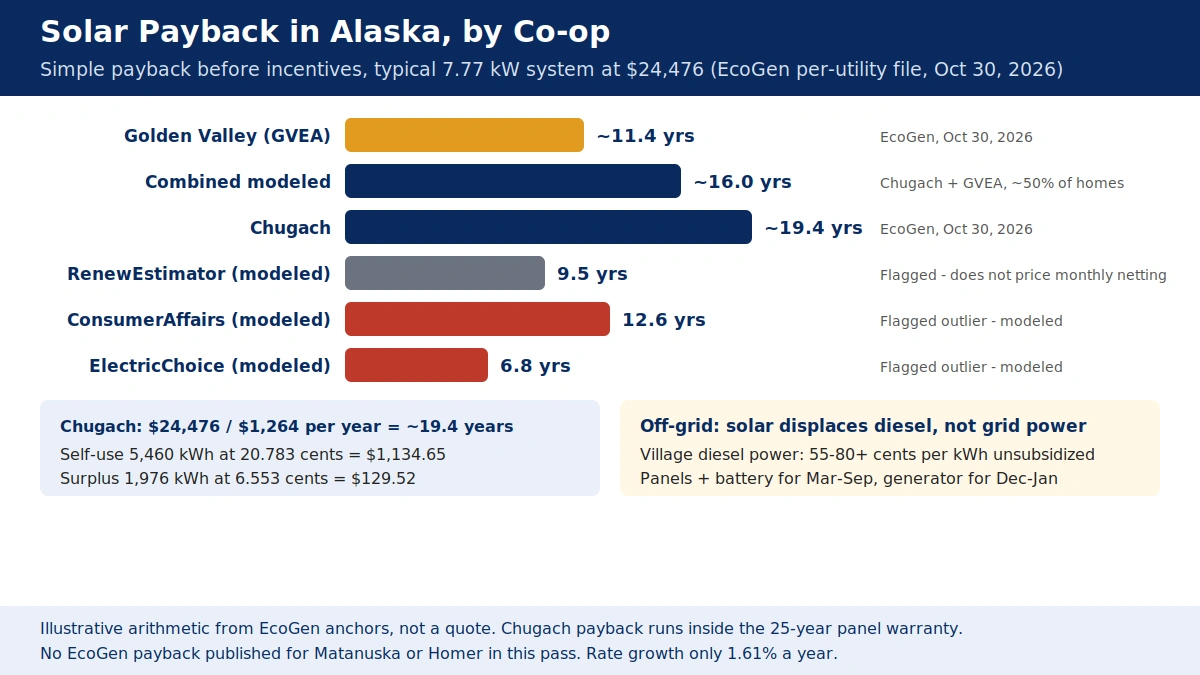
Chugach is the long payback on the Railbelt. EcoGen’s per-utility worked example for Chugach territory puts the year-one value at about $1,264 a year, using Chugach’s 12-month average price less its fixed charge — 20.783 cents for each kilowatt-hour used at home — and its surplus credit of 6.553 cents. The model assumes about 73% of the solar power is used at home as it is made: 7,436 kilowatt-hours, with 5,460 used at home at 20.783 cents, is $1,134.65 a year of self-use value, and 1,976 kilowatt-hours of surplus at 6.553 cents is $129.52 a year of export value. Divide $24,476 by $1,264 and the simple payback is about 19.4 years — before incentives, with no upkeep, no rate rises, and no financing counted. That is inside the 25-year panel warranty, but only just, and it leans on a surplus credit that was still pending RCA approval when this guide was written.
Golden Valley is the short payback in the state, by a wide margin. EcoGen puts it at about 11.4 years for the same 7.77 kW system — roughly eight years faster than Chugach — because Fairbanks power costs 35 cents a kilowatt-hour and even the surplus earns 13.726 cents. The year-one value comes to about $2,149 a year: 6,416 kilowatt-hours used at home at 31.311 cents, plus 1,020 kilowatt-hours of surplus at 13.726 cents. The figure is conditional on GVEA’s quarterly surplus rate holding near its September-to-November level, and on the household using most of its power in the months the panels make it. No GVEA worked arithmetic beyond EcoGen’s published figures was pulled in this pass, so none is re-derived here; the 11.4-year figure is EcoGen’s published number, dated October 30, 2026.
The modeled statewide figure sits between them. EcoGen puts the combined Chugach-and-Golden-Valley payback at about 16.0 years, covering roughly half of Alaska homes. No EcoGen payback was published for Matanuska or Homer in this pass, so none is stated — a Matanuska household at 25.2 cents with an unposted surplus rate, and a Homer household at 32.3 cents with a 9.733-cent surplus credit, should expect something between the Chugach and Golden Valley figures, and should make the installer show the arithmetic for their own co-op rather than borrowing one of these two.
Juneau is the outlier on the other side. No EcoGen payback was published for AEL&P either, and the direction is plain enough without one: at 13.2 cents a kilowatt-hour, the power the panels replace is worth less than half the statewide average, and the payback stretches well past Chugach’s 19.4 years on any plausible surplus rate. Juneau is the one Railbelt city where the honest advice is usually to wait, or to buy for reasons other than money.
| Case | Simple payback | Source |
|---|---|---|
| EcoGen Chugach (7.77 kW) | ~19.4 yrs | EcoGen per-utility figures, Oct 30, 2026 |
| EcoGen combined modeled (Chugach + GVEA) | ~16.0 yrs | EcoGen per-utility figures, Oct 30, 2026 |
| EcoGen Golden Valley (7.77 kW) | ~11.4 yrs | EcoGen per-utility figures, Oct 30, 2026 |
| RenewEstimator (8 kW) | 9.5 yrs | RenewEstimator, Jul 2026 — flagged, modeled |
| ConsumerAffairs modeled | 12.6 yrs | ConsumerAffairs, 2026 — flagged outlier |
| ElectricChoice modeled | 6.8 yrs | ElectricChoice, Oct 2026 — flagged outlier |
The flagged conflict. RenewEstimator reports a 9.5-year payback, ConsumerAffairs reports 12.6 years with $29,737 in 25-year savings, and ElectricChoice reports 6.8 years. All three are modeled estimates that do not price Alaska’s monthly netting and avoided-cost surplus correctly — they assume the surplus is worth something close to retail, or that the year’s production can be banked into the year’s consumption. Do not present any of them as a verified Alaska payback, and do not let a quote cite one for a Chugach or Matanuska home. The gap between 6.8 years and 19.4 years is not a rounding difference — it is the monthly settlement and the 6.553-cent surplus rate, and any payback that ignores them is modeling a different state.
What moves the payback most. Daytime and summertime self-use is the biggest lever, and in Alaska it matters more than anywhere else in this series. Shifting the dishwasher, the laundry, and the EV charger into daylight hours — and into the bright months — moves kilowatt-hours out of the 6.6-cent export bucket and into the 20-to-35-cent self-use bucket, and no other change pays as well. EcoGen’s own Chugach model assumes about 73% self-use, so a household that pushes that share higher shortens its payback materially, and a household that is empty all summer lengthens it just as fast. Rate escalation is a weak lever here: Alaska rates are growing about 1.61% a year per EcoGen, so 25-year savings grow only slowly, and no Railbelt system pays back quickly on flat rates alone. Financing is the fourth lever: dealer fees on a solar loan can lift the effective price by 10-30%, so judge quotes by cash price per watt, not by the monthly payment. And there is no deduction or rebate to shorten the payback at all — the $24,476 is the whole price, and the payback is the whole price divided by the yearly value.
Who still comes out ahead. Four kinds of Alaska household clear it. The Golden Valley customer, where the published payback is about 11 years and even the surplus earns nearly 14 cents. The all-day home with a big daytime and summertime load — home offices, daytime laundry and dishwashing, an EV charged at midday in June — that keeps most of its production at full retail value under monthly netting. The household that pairs panels with a heat pump or an EV, sizing the array to the new daytime load while staying inside the 25 kW cap. And the off-grid or village household that buys mainly to stop burning diesel, with savings measured in fuel not delivered — in that case the payback math is context, not verdict, and the off-grid section below does that arithmetic properly. Walk away when your home sits empty all summer on Chugach, when you live in Juneau and are counting on a quick return, or when the installer projects savings without naming your co-op’s surplus rate and its quarterly reset.
Off-Grid Solar in Alaska: Cabins, Diesel & Winter Batteries
Off the Railbelt, solar stops being a payback story and becomes a fuel story — and the fuel story is the strongest one in this guide. A grid-tied Anchorage home argues about whether its panels pay back in 19 years or 11. A cabin past the end of the road argues about how many gallons of diesel it does not have to fly in, and that argument is settled in the first winter.
Why off-grid solar wins where grid-tied solar argues. A remote cabin’s power comes from a diesel generator, and the diesel has to reach the cabin first — by barge, by plane, by snowmachine, by whatever the season allows — which makes the delivered cost of a generator kilowatt-hour far higher than the fuel price at the pump in Anchorage. National figures put off-grid solar at a levelized cost of roughly $0.20 to $0.50 a kilowatt-hour against $0.35 to $0.60 for a diesel generator, before any remote-delivery premium, and in a village where the unsubsidized cost of grid power runs 55 to 80 cents a kilowatt-hour, the generator’s number is at the top of that range or beyond it. Every kilowatt-hour the panels make in summer is a kilowatt-hour the generator does not have to make, and every gallon not burned is a gallon not flown in. The panels do not need a net-metering rule, a co-op, or a quarterly surplus rate. They need sun, and from March to September Alaska has more of it, per day, than almost anywhere in the country.
What a real Interior cabin runs. The clearest public record of a working system comes from the Victron community forum, where an Interior Alaska cabin owner described a setup south of the Alaska Range: about 4 kW of panels on an adjustable mount that swings from vertical to 90 degrees so snow sheds without sweeping, an 820 amp-hour lead-acid battery bank, and a 48-volt inverter, serving a daily draw of about 2.5 kilowatt-hours — a 22-cubic-foot refrigerator is the biggest load, at about 0.9 kilowatt-hours a day. The longest stretch the owner had seen with near-zero charging was six days. In a long, cold, clear stretch that winter, the generator had not run since late January, and from that time of year forward the panels carried the cabin. A second, smaller setup in the same thread — an unmanned winter cabin on a Victron system with a MultiPlus II, a charge controller, and a battery shunt — draws only 7 watts on standby and keeps the batteries alive through the dark months on a light load. These are not brochures. They are the numbers a cabin actually lives on.
The winter truth, stated plainly. No off-grid Alaska system runs the winter on solar alone, and any installer who says otherwise is selling a battery bank, not a power system. December in the Interior gives the panels almost nothing — Profile Solar’s Anchorage model puts winter output at 0.48 kilowatt-hours per kilowatt per day, and Fairbanks is darker still — and a system sized to cover October through April with little or no generator use would need roughly ten times the array sized for February through November, according to the experienced voices in that same Victron thread. The economical answer is a hybrid: panels and batteries for the eight bright months, and a diesel generator for the dark core, sized to run a few hours a day and charge the batteries in one go. A little generator time in December and January saves a fortune in panels and batteries that would sit idle the rest of the year. Size the battery for two or three days of autonomy, not two weeks — a two-week bank in December is a bank that costs more than the generator it replaces.
Batteries in the cold. A battery is not optional off-grid — it is the system — and in Alaska it needs its own climate plan. Lithium batteries lose usable capacity in deep cold, so the bank belongs in a heated, insulated space: inside the cabin, in a heated shed, or in an insulated root cellar below the frost line, as one Interior owner built it. A garage-mounted battery in Fairbanks needs its temperature rating checked before it is bought, not after it stops holding a charge in January. Installers in the Victron thread recommend a battery bank better than three times the size of the PV array for off-grid work, and they recommend keeping the bank warm over keeping it big. A 13.5 kWh storage add-on runs about $15,647 installed nationally (EnergySage, July 2026; no Alaska-specific battery price was verified for this guide), and a battery the owner installs in 2026 gets no federal credit either, because §25D covered storage too and it closed on the same date. On the grid, a battery’s earnings are the spread between the surplus rate and the retail rate, and in Alaska that spread is real but narrow — storing 10 kilowatt-hours a day on Chugach and releasing it after dark saves roughly a dollar a day, about $365 a year, which does not pay for a $15,647 battery in any reasonable time. Off-grid, the battery’s earnings are the diesel it displaces, and the same battery pays far faster. Buy the battery as backup and fuel savings off-grid. On-grid, buy it as backup only, size it for the loads that matter in an outage — heat, refrigeration, water, medical equipment — and treat the spend as resilience, not as an investment.
Diesel displacement, worked small. Take the Interior cabin above: 2.5 kilowatt-hours a day, about 900 a year. A generator making that power at roughly a third of a liter per kilowatt-hour burns on the order of 300 liters a year, before the fuel flown in to reach it — and the cabin’s panels, at 4 kW making roughly 3,800 kilowatt-hours a year in the bright months, cover the summer load several times over and leave the generator for the dark weeks only. The owner in the thread had not run the generator since late January. That is the diesel displacement math in one sentence: the panels do not replace the generator, they retire it for eight months a year, and the fuel not flown in is the return.
What to ask before an off-grid build. How many kilowatt-hours a day does the cabin actually use, measured, not guessed — the refrigerator, the lights, the well pump, the communications gear, each on its own line. What tilt the mount allows, and whether it adjusts seasonally: a fixed summer tilt wastes the spring sun, and a fixed winter tilt wastes the summer. How the batteries stay warm, and what happens to them at minus 40. How the generator starts itself when the batteries fall low, and who services it when it does not. And whether the panels are bifacial, which catch the snow’s reflection from below as well as the sun from above — a real gain in a place where the ground is white for half the year.
Alaska Incentives in 2026: What Exists and What Does Not
With the federal credit gone, most states still hold something back — a state credit, a rebate, an exemption of some kind. Alaska holds less than that, and the short list is worth reading carefully, because most solar advertising in Alaska skips it — and because the two programs that do exist are both easy to mistake for something they are not.
Alaska has no state rebate for home solar, and no state income tax to credit against. There is no check in the mail for putting panels on an Alaska roof, from the state or from any of the four big co-ops. There is no state solar tax credit because Alaska levies no individual income tax at all. There is no state sales-tax exemption because Alaska levies no statewide sales tax — some boroughs and cities levy their own, so check the local rate before you budget, but the state takes nothing. The only money in an Alaska solar project is on the electric bill: power used at home at full retail, and surplus power at the co-op’s avoided-cost rate. Everything else in this section is either a program for someone else or a program that pays a utility, not a homeowner.
Property tax is the one real exemption, and it is local. State law, AS 29.45.050(b)(1)(E), lets a borough or city exempt a residential renewable energy system from property tax, and the Municipality of Anchorage has adopted such an exemption, according to the secondary source that reports it. Other boroughs may or may not have followed. Never assume the added home value escapes taxation — ask the borough assessor how a solar array is valued before you sign, and get the answer in writing, because the exemption is a local ordinance, not a statewide right.
The $10,000 AHFC rebate is real, and it is not a solar rebate. The Alaska Housing Finance Corporation launched its New Home Construction Rebate in January 2025, and applications are open now on a first-come, first-served basis until the money runs out — a $7 million fund meant for about 650 homes. A homeowner who builds or buys a newly constructed, owner-occupied home that meets 5-Star Plus or higher energy efficiency standards can receive $10,000, provided the foundation was completed and inspected on or after January 2, 2025 and construction is finished within 18 months of application. Solar panels can be part of that efficient new home. But the rebate pays for the home, not for the panels, and it does nothing at all for a retrofit on an existing roof. Any installer who folds $10,000 of AHFC money into a quote for panels on a ten-year-old house is describing a program that does not work that way.
The Renewable Energy Fund is for communities, not rooftops. The Alaska Energy Authority runs the Renewable Energy Fund as competitive grants for renewable energy projects from feasibility through construction — village wind, community hydro, utility-scale solar. It is not a residential program, and a homeowner cannot apply to it. The Authority’s Power Project Fund makes loans to utilities, local governments, and independent power producers for electric power facilities — again, not homeowners. Both programs matter to Alaska’s energy future, and neither puts a dollar on a residential roof.
The net-metering pilot pays utilities, not homeowners. The Alaska Energy Authority’s Net Metering Incentive Payment Pilot holds $750,000 and runs until the money is spent or June 30, 2028, whichever comes first. It pays a regulated Railbelt utility that signs up, which must then use the money to offset its members’ installation costs. No utility had said it joined when this guide was checked in October 2026. Ask your co-op whether it has joined — but do not plan around money that flows to the utility, not to you.
Solar for All is not open to Alaska households. Alaska had two federal Solar for All awards: a state grant led by the Alaska Energy Authority, with AHFC planning rooftop solar for low-income homes, and a tribal grant led by Tanana Chiefs Conference for tribally led community projects. The EPA ended both in August 2025. Federal courts ruled in September 2026 that the termination was unlawful, and as of October 1, 2026 the EPA was still deciding whether to appeal. As of October 5, 2026, the Authority’s own page still showed the program as terminated, and neither grantee showed a way for a household to apply. There is no way for an Alaska household to apply for it today.
Alaska has no open federal home energy rebates. The state was allocated about $74.6 million in total — $37,150,940 for HEAR and $37,293,071 for HOMES, per the federal dataset — but Alaska does not appear on the federal launched map, and AHFC’s consumer notice says plainly that the HOMES and HEAR programs are not yet open, have no announced start date, and will offer no retroactive rebates. The notice also warns against unsolicited calls, messages, and door-to-door promises about the programs. HEAR still will not pay for solar even after the programs launch. Its money goes to electrification: heat pumps, heat-pump water heaters, electrical panels, and the wiring tied to insulation. Panels, batteries, EV chargers, and windows are never covered.
| Item | Value | Notes |
|---|---|---|
| AK state rebate for panels | $0 — none exists | No state or co-op rebate for home solar |
| AK state income-tax credit | None — no state income tax | Nothing to credit against |
| AK state sales-tax exemption | None needed — no statewide sales tax | Some boroughs/cities levy their own; check locally |
| Property-tax exemption | Local option only | AS 29.45.050(b)(1)(E); Anchorage has adopted one; ask your assessor |
| AHFC New Home Construction Rebate | $10,000 | New owner-occupied homes only, 5-Star Plus, foundation on/after Jan 2, 2025; not a retrofit solar rebate |
| AEA Renewable Energy Fund | Community/utility grants | Not residential rooftops |
| AEA Net Metering Pilot | $750,000, to Jun 30, 2028 | Pays utilities that join, not homeowners; none confirmed joined |
| Solar for All | $0 — no program open for AK households | EPA ended both AK awards Aug 2025; court ruling Sep 2026; no application route |
| HEAR / HOMES rebates | Not launched | ~$74.6M allocated; AHFC: not yet open, no start date, no retroactive rebates |
| Chugach community solar | $110/panel/yr | 650 kW shared array, 1–20 panels, small premium over bill credit |
Federal Help in 2026: $0 Tax Credit — and the Lease Route Is Unclear
The federal picture for 2026 is short enough for a single paragraph — and that brevity is exactly why so much solar advertising still gets it wrong. In Alaska the paragraph grows a second half that most states never need, because the lease route that rescues other states has no footing here at all.
Buy the system yourself and install it in 2026, and there is no federal tax credit to claim. For systems placed in service after December 31, 2025, the Residential Clean Energy Credit (§25D, 30%) is gone — the One Big Beautiful Bill Act, Public Law 119-21, signed July 4, 2025, is the law that removed it. FS-2025-05, the IRS fact sheet, makes the finish date the one that matters: a 2025 deposit is worth nothing when the crew completed the work in January 2026. Efficient-home-improvement credit §25C ended the same day as well. A 2026 cash or loan quote that still takes 30% off is built on a law that no longer exists. Tell the installer to take it out and price the job again. SolarReviews’ own Alaska cost page still prints an “after tax credit” column. That column subtracts the dead 30% credit, and no number in this guide uses it.
Leases and PPAs have no footing in Alaska — and no provider was found selling one. A company-owned array can still earn the commercial clean-electricity credit (§48E, 30%), provided the system enters service by December 31, 2027 and construction began by July 4, 2026 — the cutoff IRS Notice 2025-42 lays down. Where residential third-party ownership is clearly legal, that credit reaches the homeowner through a lease or a power purchase agreement, with the company passing some of the value along as a lower monthly payment. Alaska is not such a state. DSIRE’s third-party PPA map (May 2026) does not mark Alaska at all, and EcoGen’s market check of October 5, 2026, found no company selling a lease or a PPA to Alaska homes — Sunrun, the largest national lease company, did not list Alaska. A July 2025 count built on DSIRE data listed Alaska among the states with no residential lease or PPA offerings. Have a lawyer read any lease or PPA before signing, and treat any “free solar” advertisement in Alaska as a loan quote until proven otherwise, because a lease is the contract behind free-solar advertising and no one was found selling one here.
HEAR money never goes to solar. Households that meet the income limits can still get up to $8,000 from the Home Electrification and Appliance Rebates program in 2026 — but that money pays for electrification, not panels. HEAR’s money covers electrification gear only: heat pumps, heat-pump water heaters, electrical panels, and insulation-related wiring work. Panels, batteries, EV chargers, and windows all sit outside what the program covers. The Energy Department’s Notice 26-2, issued September 1, 2026, limits the program to electric-to-electric upgrades. Fuel-switching is out. Alaska’s own HOMES and HEAR programs have not opened at all, and the state has announced no start date. Folding a HEAR rebate into the solar price describes a program that works nothing like that. HEAR can still be useful to an Alaska homeowner. Pairing a heat pump with new panels is a common move, and the heat-pump half may qualify once Alaska’s program opens. The solar half never will.
The honest summary is this: in 2026 the federal government contributes nothing to an Alaska homeowner who buys solar panels outright, and — unlike in states with a clear lease market — it cannot be counted on to contribute indirectly through a lease or a PPA either, because no clear legal route and no verified provider exist for one. On a cash quote, the price is the price. The only state help is a property-tax exemption that depends on the borough, a $10,000 rebate for a new efficient home that does not cover a retrofit, and a pilot that pays utilities. The full 2026 federal picture is in our federal tax credits guide, and lease-versus-buy gets its full treatment in our national solar cost guide.
Permits & Licensing: What Alaska Requires
Alaska’s licensing picture is thinner than most states’ in one respect that helps a buyer who knows where to look: there is no Alaska-specific solar license to hide behind, and no general contractor credential that substitutes for the electrical one. The check is short, and it is the same check for every installer in the state.
The electrical work needs a licensed electrical administrator. Alaska law (AS 08.40) requires that the person responsible for installing electrical wiring — and for certifying that the installation complies with the electrical code — hold an electrical administrator license, and that person must personally inspect the work after installation unless it is simple, highly standardized work done in under 24 man-hours. An electrical administrator may serve only one registered contractor. The contractor itself registers through the Department of Commerce, Community & Economic Development. The electricians on the crew hold Certificates of Fitness issued by the Department of Labor & Workforce Development. Ask for the installer’s electrical administrator license number and the contractor’s registration, verify both on the state registry, and check that the names match the contract. A company that waves a general business license instead of those two documents has shown you the wrong paper.
NABCEP is the credential to ask for, not a state requirement. No Alaska-specific solar license category was verified for this guide, so there is no state solar credential to demand. The North American Board of Certified Energy Practitioners (NABCEP) photovoltaic installer certification remains the leading industry credential, and it is worth asking about — Renewable Energy Systems of Alaska advertises NABCEP-certified designers and installers, which is a real signal in a two-installer market. It is a plus, not a license, and it should be weighed as one.
Permits and interconnection take time, and the calendar is the constraint. An Alaska rooftop system needs three permissions in order: a building permit, an electrical permit, and a utility interconnection agreement. Of the three, interconnection usually takes the longest. This guide verified no Alaska-wide permit fee schedule, so no fee figure is given here. The borough or city building department sets the fee, and whatever snow-load figure that department applies is the one that governs the roof. Chugach charges a $270 net-metering application fee and Golden Valley charges $65; Matanuska charges none; no Homer application fee figure was verified, so none is stated. In Anchorage, Chugach must sign the one-line schematic before the Municipality of Anchorage will green-tag the install — get that signature early, because it sits on the critical path. No Alaska-specific interconnection timeline was verified either. The national figure, per Palmetto (April 2025), puts residential interconnection at usually 2-4 weeks — cited here as a national figure only. What slows an Alaska install down is the season, not the price tag: the crew can only work the roofs for part of the year, and a system ordered in October may wait for spring. An installer who promises permission to operate inside two weeks is promising something the co-op decides. It is not the installer’s call.
Alaska has no verified solar-access law — do not assume one exists. No Alaska statute was found in this pass that bars a homeowners association from prohibiting rooftop solar, and this guide does not claim one. Alaska does allow parties to enter voluntary solar easement contracts, which is a narrower thing: a negotiated right to sunlight, not a statutory one. Get architectural-review approval in writing before ordering panels, and for condo owners the hurdle is doubled, because the roof is usually common area and the board’s approval process is the whole decision. If an installer tells you Alaska law protects your right to install, ask for the statute number — and if they cannot give one, believe the HOA’s paperwork instead.
What Pushes Your Alaska Quote Up or Down
The per-watt anchor is where the pricing starts, not what any one quote will say. Seven factors can move an Alaska quote by thousands of dollars, and three of them come from this state’s geography and climate rather than from the equipment.
Freight and the short season are the Alaska factors. EcoGen names them outright as the reason Alaska runs $3.15 a watt: remote logistics and a short build season. Panels shipped to Anchorage, trucked to Fairbanks, flown to a village — every mile adds cost, and the crew can only work the roofs for part of the year, so the year’s overhead spreads across fewer installs. A quote for a village roof should show freight as its own line, and a quote that does not show it has hidden it somewhere else. Ask where the panels land, how they travel, and what happens to the schedule if the barge is late.
Labor is the quiet factor. No Alaska-specific BLS wage for electricians was pulled in this pass, so no Alaska figure is stated here. The national figure is the context: electricians nationally run a median of about $30.38 an hour (BLS, May 2025), and labor is the largest soft-cost component of an install. What moves an Alaska quote is not the hourly rate but the thin bench: with two dedicated residential installers in the whole state, the crew’s experience in your co-op’s territory matters more than the headline rate. Ask the crew how many installs they have done on your co-op — years in business is not the same question.
The roof, and the snow load it must carry. Alaska’s cold winters and snow loads wear roofs in ways southern ones never see: freeze-thaw cycles chew at flashing and shingles, and a roof that holds snow for weeks carries weight a summer roof never feels. Anchorage’s minimum design snow load is 40 pounds per square foot and Fairbanks’ is 60, and the racking has to carry that load with the panels on it. Replace a roof with under a decade left in it before the array goes up. A detach-and-reset for a later reroof runs into the thousands on its own. For reroof pricing, see our roof replacement guide. Standing-seam metal — common on Alaska homes and cabins — is one of the finest roofs solar can sit on: the clamps grip the seams with no penetration at all, and snow slides off metal sooner than it slides off asphalt. Snow guards, which stop sliding snow from landing on walkways and gutters, are a genuine line item on a steep Alaska roof. Have the building department confirm the roof’s snow-load rating before the panels go up. After is too late.
Panel tier. Top-tier panels carry a 10-20% premium per watt over value-tier panels. In Alaska that premium pays for two things that count: stronger low-light performance on cloudy winter days, and slower degradation across a quarter century of cold, bright sun. Where roof space is tight, the extra money for efficiency earns its keep. On a big unshaded roof in the Mat-Su, a big ground mount usually favors the cheaper value-tier panels. Premium n-type panels also lose output more slowly — 0.25-0.5% a year, holding 91-93% of rated output at year 25, against a fleet median near 0.5% a year and about 88% at year 25 per NREL. That gap counts for more where the payback already runs long, because every extra year of strong output is a year the system needs.
Inverter choice. A string inverter costs less to buy. Microinverters or optimizers cost more but generate more on roofs with partial shade — and Alaska roofs, with their spruce, dormers, and chimneys, carry shade more often than installers admit, and snow that lingers on one part of an array shades it the same way a tree does. Microinverters watch each panel on its own, so one shaded or snow-covered panel cannot pull the whole string down with it. A string inverter typically lasts 10-15 years, so plan on one replacement during the system’s life. Microinverters typically carry about 25 years. Each inverter type gets costed out over its full life in our inverter replacement guide — but that guide is national, and so are its dollar figures, not Alaska’s.
The electrical panel. Many Alaska homes still run on 100-amp service — especially older homes in Anchorage and Fairbanks — and a solar install often forces the question. A 200-amp panel upgrade runs $1,500-$4,000 nationally, according to our electrical panel upgrade guide, and it is the add-on that most often surprises an Alaska buyer. Find out before signing whether the quote covers it. Do not wait until the electrician is already in your driveway. No Alaska-specific panel-upgrade dollar figure was verified for this guide. The national figure is used instead, and it is flagged as national. One Alaska wrinkle: a panel upgrade counts as electrification work, the kind HEAR is built to pay for — once Alaska’s HEAR program opens, which it has not.
Financing terms. Cash payment gives the best long-term return. A $0-down loan carries dealer fees of 10-30% of the cash price, sometimes over 50%, hidden inside the amount financed. The Consumer Financial Protection Bureau’s August 2024 market spotlight is the source — a national figure, but one Alaska quotes feel in exactly the same way. A lease or PPA is the fourth path, and it is thin here. No provider was found actually selling one to Alaska homes, the legal status is unclear, and any lease quote should go past a lawyer before it is compared on its monthly payment at all. Community solar is the fifth path, and it is real here: Chugach’s shared array lets members rent panels for $110 a year each and take the output as a bill credit, which suits renters and shaded roofs — but the credit is paid at the buyback rate, so the subscriber pays a small premium for the privilege, about $14 a year per panel in the South District.
Maintenance and lifespan. Panels keep making power for 25-30 productive years, past the warranty, at falling output. Materials and workmanship warranties usually run 10-25 years. Performance warranties usually run 25-30 years, guaranteeing 80-92% of rated output at year 25, depending on the tier. Upkeep stays light — a cleaning now and then and a yearly production check — because nothing in the system moves. In Alaska, snow usually slides off a steep array on its own; a low-slope roof holds it longer, and a spring rinse does what rain does not. Every lifespan, degradation, and maintenance figure here is national only. No Alaska-specific versions exist, so each one carries a national flag.
Getting Quotes in Alaska: The Checklist
Alaska is a hard state to buy solar in — weak sun, expensive power, a surplus rule that settles every month at wholesale prices, and two installers for the whole state — but only for a homeowner who checks the co-op terms before the sales pitch. Bring this checklist into every bidder meeting, and do not sign until each item has an answer on paper.
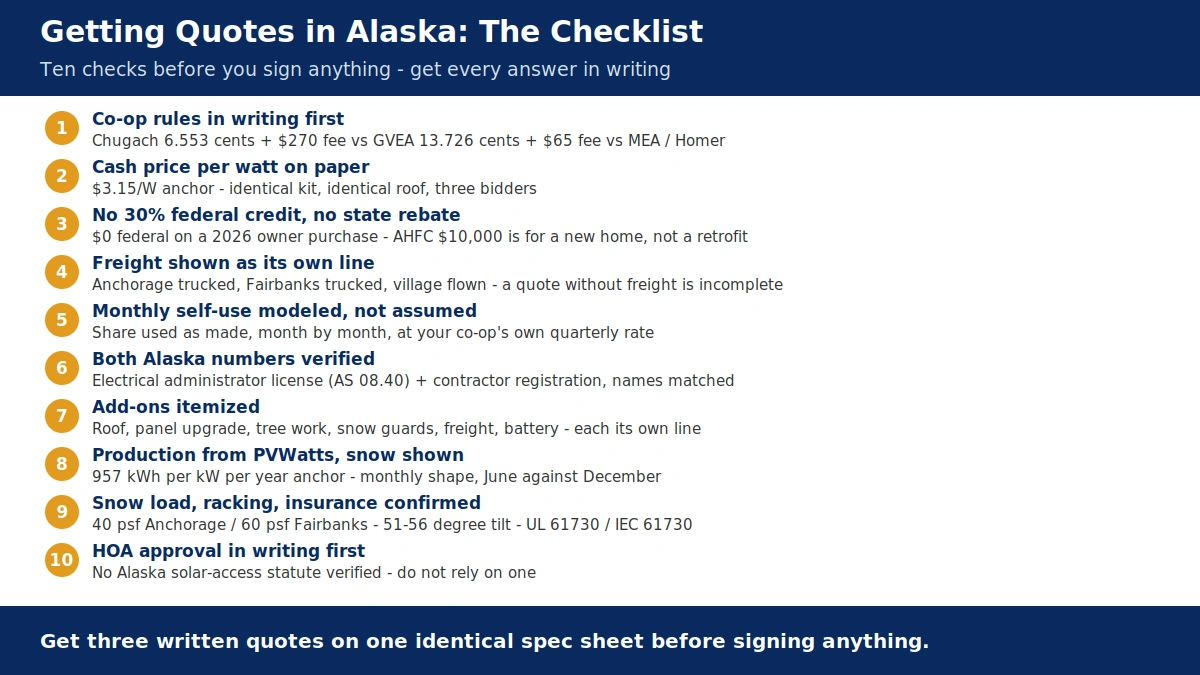
The ten-item quote checklist:
- Your co-op’s rules, in writing, first — Chugach’s 6.553-cent surplus credit and $270 fee, Golden Valley’s 13.726-cent credit and $65 fee, Matanuska’s quarterly SFPPR, Homer’s 9.733-cent SFPPR, or your village utility’s own terms. Surplus price and monthly settlement decide the payback before anything else — and Golden Valley’s credit is worth about eight years of payback against Chugach’s.
- Cash price per watt in writing — get it for one identical spec sheet, from all three bidders. The Alaska anchor is $3.15 a watt; a quote far above it calls for an explanation, and a quote far below it calls for a closer look at what was left out — especially the freight line.
- No line for a 30% federal credit, no line for a state rebate — a 2026 owner purchase gets $0 federal, and Alaska has no state rebate, no state income-tax credit, and no statewide sales tax to exempt. The AHFC $10,000 rebate is for a new efficient home, not a retrofit. If a quote still shows a 30% credit, it is priced under a law that no longer exists. Ask for it to be removed.
- Freight shown as its own line — panels shipped to Anchorage, trucked to Fairbanks, flown to a village. A quote that hides freight has hidden it in the per-watt price, and a village quote without a freight line is not a complete quote.
- Monthly self-use modeled, not assumed — the share of production the house uses the moment it is made, shown month by month, with the surplus priced at your co-op’s own quarterly rate. On Chugach, a quote that values all exports at one blended price, or banks June into January, is wrong.
- Both Alaska numbers verified — the installer’s electrical administrator license (AS 08.40) and contractor registration, checked on the state registry, with names matched to the contract. NABCEP certification is a plus. Arctic Solar Ventures stopped installing in October 2023 — do not accept a quote that cites it.
- Add-ons itemized — roof work, panel upgrade, tree work, snow guards, freight, and battery, each with its own price instead of being folded into the per-watt figure.
- Production estimate from PVWatts, with the snow assumption shown — start from about 957 kilowatt-hours per kilowatt a year, not the nameplate watts, and demand the monthly shape, not a yearly average. Ask for the monthly shape, June against December.
- Snow load, racking, and insurance confirmed — the roof’s snow-load rating checked with the building department (40 psf Anchorage, 60 psf Fairbanks minimums), the racking’s uplift rating named, the 51-56 degree tilt stated, UL 61730 / IEC 61730 panels specified by name, and homeowners insurance confirmed in writing to cover the array before signing.
- HOA approval, in writing, first — no Alaska solar-access statute was verified for this guide, so do not rely on one. Get architectural-review approval before panels are ordered, and for condo owners, board approval for the common-area roof.
Buy, lease, or community solar? Over 25 years, buying wins for homeowners with high daytime and summertime use, Golden Valley territory terms, or a diesel-displacement reason to buy. With a purchase, the system stays yours, the resale value stays yours, and every kilowatt-hour of self-use keeps its full retail value. Leasing suits homeowners who want no upfront cost and no maintenance — but only where a lease is actually on offer. In Alaska no provider was found selling one, so any lease quote should go past a lawyer before it is compared on its monthly payment. Community solar wins for renters, condo owners, and homes whose roofs are shaded or unsuitable — and in Alaska it is genuinely available through Chugach’s shared array at $110 a panel a year, with a small premium over the bill credit it earns. Off-grid wins for cabins past the end of the road, where the choice is panels against diesel by the gallon, and the generator runs only in the dark months.
Sources & methodology
Cost anchors (per watt, system size, totals):
- EcoGen Solar Cost Index, September 2026 edition, prices as of Sep 25, 2026: $3.15/W; 7.77 kW typical modeled from neighboring states (too few Alaska installs for a local median); $24,476 total; 957 kWh/kW/yr; 3.3 peak sun hrs; 47th lowest of 51; neighbors OR $2.77, WA $2.86, US $2.89, ID $2.96, HI $3.14; AK rate growth 1.61%/yr
- EcoGen Alaska cost page, updated Oct 22, 2026, and per-utility payback file Oct 30, 2026: 7.77 kW makes ~7,436 kWh/yr; Chugach payback ~19.4 yrs ($1,264/yr: 5,460 kWh self-use at 20.783 cents = $1,134.65; 1,976 kWh surplus at 6.553 cents = $129.52); GVEA ~11.4 yrs (~$2,149/yr: 6,416 kWh at 31.311 cents + 1,020 kWh at 13.726 cents); combined modeled ~16.0 yrs; surplus shares 26.6% Chugach / 13.7% GVEA as reported to EIA
- NumeralQ Alaska page (planning estimate, EnergySage data retrieved Oct 26, 2026): 8 kW $23,400-$30,560 ($2.92-$3.82/W); 4 kW $12,310-$16,070; 12 kW $33,270-$43,450
- NumeralQ Anchorage page (planning estimate, EnergySage data retrieved Oct 26, 2026): 8 kW $20,460-$26,740 ($2.56-$3.34/W)
- SolarReviews cost page, Nov 2026: $3.52/W; 5.1 kW average; $19,084 total; its “after tax credit” column is stale and excluded
- RenewEstimator, data compiled Jul 25, 2026: $3.00/W; 8 kW $23,520; payback 9.5 yrs; rate 28.2 cents; 3.5 sun hrs — modeled, flagged
- ConsumerAffairs, 2026: $3.14/W; payback 12.6 yrs; 25-yr savings $29,737 — modeled, flagged
- ElectricChoice, updated Oct 25, 2026: $2.80/W; 7 kW $19,600; rate 27.35 cents; payback 6.8 yrs — modeled, flagged
- GreenWatt, 2026: $3.00/W; 5 kW $15,000; rate $0.23 — older EIA 2024/NREL Q1 2024 inputs, corroboration only
Rates and home use:
- EIA, 12 months to Aug 2026: AK 26.9 cents/kWh (EcoGen 26.94 cents), US 18.0 cents; average use 588 kWh/mo (~7,056 kWh/yr); average bill ~$158/mo; +5.0% YoY; Aug 2026 alone 29.41 cents, +5.8% YoY
- EIA final 2025, Form EIA-861 (released Oct 7, 2026): 564 kWh/mo, 26.11 cents, $147.18/mo
- kadoa/EIA utility figures, 12 mo to Aug 2026: Chugach 23.2 cents, 97,029 customers, ~$119/mo; MEA 25.2 cents, 67,217 customers, ~$154/mo; GVEA 35.0 cents, 41,097 customers, ~$211/mo; Homer 32.3 cents, 30,637 customers, ~$168/mo; AEL&P 13.2 cents, 15,721 customers, ~$130/mo
- EcoGen shares of 273,042 AK residential customers (EIA-861 2024): Chugach 36%, MEA 24%, GVEA 15%, Homer 11%
- GVEA effective rate ~32.9 cents/kWh (Alaska Beacon / Gwen Holdmann, Apr 2026); COPA ~12.8 cents/kWh
- Chugach Q4 2026 tariff filing TA 595-8: South District bill at 525 kWh ~$141.01; North District ~$124.13; non-firm purchase rate $0.06412/kWh transmission, $0.06504 primary, $0.06553 secondary
- Railbelt mix: natural gas 73%, coal 15%, hydro 12%; ~79% of state load; 150+ islanded microgrids, ~9% of load (ElectricChoice, Nov 2026)
Net metering and buyback:
- RCA rules 3 AAC 50.900–50.949, adopted Oct 2009, effective Jan 15, 2010: systems up to 25 kW; monthly netting at retail; monthly surplus at the non-firm (avoided-cost) rate; applies to utilities selling 5+ GWh/yr; aggregate limit 1.5% of average retail demand (ECW classification, Oct 27, 2026)
- GVEA avoided-cost credit 13.726 cents/kWh, Sep 1–Nov 30, 2026, reset quarterly (EcoGen, Oct 2026)
- Chugach surplus credit 6.553 cents/kWh on bills from Oct 1, 2026, pending RCA approval, decision due by Nov 16, 2026 (EcoGen; Chugach TA 595-8)
- Homer Electric SFPPR $0.09733/kWh effective Jul 1, 2026, adjusted quarterly (Homer Electric net metering page)
- MEA SFPPR adjusted quarterly; no current figure posted as of Oct 2026 (MEA net metering page)
- Application fees: Chugach $270 non-refundable since Jun 1, 2026 (Chugach renewable generation page); GVEA $65; MEA none (EcoGen, Oct 2026)
- Chugach program cap 5% / 10,620 kW, ~63% in use per Mar 2026 filing; RCA Docket R-24-003 opened Sep 2024, outcome unconfirmed (EcoGen)
- AEA Net Metering Incentive Payment Pilot: $750,000, until funds spent or Jun 30, 2028; pays utilities, not homeowners; no utility confirmed joined (EcoGen, Oct 2026)
PCE:
- FY2026 base rate 20.38 cents/kWh (RCA Order U-25-010(2), Jun 18, 2025, effective Jul 1, 2025; was 19.92 cents); weighted average of Anchorage/Fairbanks/Juneau 2024 rates: Chugach 21.24 cents, GVEA 30.32 cents, AEL&P 12.94 cents
- Residential coverage first 750 kWh/mo; community facilities 70 kWh per resident per month; ~188 communities, 81,000+ customers; $46M disbursed FY2025; PCE Endowment Fund $1B+ (AEA presentation, Mar 10, 2026; ElectricChoice, Nov 2026)
- Rural unsubsidized rates 55 cents/kWh average, some villages 80 cents+/kWh (ElectricChoice, Nov 2026)
- The PCE-band reasoning (solar inside the first 750 kWh/mo saves only the base rate) is NestPriced reasoning from the program structure, stated as such
Production and climate:
- EcoGen: 957 kWh/kW/yr PVWatts-based; 3.3 peak sun hrs/day
- Profile Solar, Anchorage (NASA POWER hourly data): per kW per day — summer 5.00 kWh, spring 4.45, autumn 1.42, winter 0.48
- WeatherSpark, Anchorage: shortwave solar energy Jan 0.3, Jun 5.8, Dec 0.2 kWh/m2/day; daylight Jun 19.2 hrs, Dec 5.6 hrs
- Anchorage solstices: ~19.5 hrs Jun 21, ~5.5 hrs Dec 21; 4,530 hrs daylight in 2026 (Anchoragelist; tutiempo)
- Fairbanks: nearly 70 consecutive days of near-24-hour daylight around the solstice; Juneau ~18 hrs Jun, ~7 hrs Dec (engineerfix)
- Tilt 51–56 degrees Anchorage; snow albedo boost estimated 15–30% spring/fall (engineerfix, cited estimate)
- Design snow loads: Anchorage 40 psf, Fairbanks 60 psf minimum (engineerfix)
- Heat penalty 0.3–0.5% per degree C above 25 C cell temperature, national figure
- Anchorage sunshine: ~1,857 hrs/yr, ~61 mostly-clear days, sun reaches ground ~41% of daylight hours (currentresults, airport data)
Payback arithmetic:
- The worked examples in the payback section are EcoGen’s per-utility figures of Oct 30, 2026, restated: 7.77 kW x $3.15/W = $24,476; production ~7,436 kWh/yr; Chugach year-one value ~$1,264/yr (5,460 kWh at 20.783 cents = $1,134.65; 1,976 kWh at 6.553 cents = $129.52); $24,476 divided by $1,264 ~ 19.4 yrs; GVEA ~$2,149/yr, ~11.4 yrs; combined modeled ~16.0 yrs
- RenewEstimator’s 9.5-year, ConsumerAffairs’ 12.6-year, and ElectricChoice’s 6.8-year paybacks are flagged as modeled estimates that do not price Alaska’s monthly netting and avoided-cost surplus
Incentives:
- No state rebate, no state income tax, no statewide sales tax (EcoGen Alaska incentives page, Oct 2026)
- Property tax: AS 29.45.050(b)(1)(E) lets municipalities exempt residential renewable systems; Municipality of Anchorage has adopted an exemption (SunMetricLab, secondary source — confirm with assessor)
- AHFC New Home Construction Rebate: $10,000, launched Jan 2025, applications open, first-come first-served; $7M fund, ~650 homes; 5-Star Plus; foundation completed and inspected on/after Jan 2, 2025; complete within 18 months (AHFC; Construction Owners)
- AEA Renewable Energy Fund: competitive grants for community/utility-scale projects, not residential; AEA Power Project Fund loans: utilities, local governments, independent power producers, not homeowners (OpenGrants AEA listings)
- Solar for All: EPA ended both AK awards Aug 2025; courts ruled the termination unlawful Sep 2026; EPA weighing appeal as of Oct 1, 2026; AEA page still showed terminated Oct 5, 2026; no household route (EcoGen, Oct 5, 2026)
- HEAR/HOMES: DOE dataset via ECW Oct 27, 2026: $37,150,940 HEAR + $37,293,071 HOMES allocated to Alaska; not on DOE Feb 2026 launched map; AHFC consumer notice (Nov 7, 2026): not yet open, no start date, no retroactive rebates
- Chugach community solar: 650 kW array near Dimond Center, Anchorage; $110/panel/yr (2025 pricing; $9.21/panel/mo first year); 1–20 panels; premium ~$14/yr per panel South District; each panel ~399 kWh first year (Alaska Energy Transparency Project, Mar 2025; EcoGen incentives page)
- CEF program: Chugach Community Energy Facility availability Jan 1, 2027; no facility taking subscribers yet (EcoGen, Oct 2026; RCA notice Jun 2026)
Federal and financing:
- OBBBA P.L. 119-21 and IRS FS-2025-05: §25D and §25C $0 for post-Dec-31-2025 installs, completion date counts
- §48E 30% for third-party-owned systems, in service by Dec 31, 2027, construction begun by Jul 4, 2026 per IRS Notice 2025-42
- DSIRE Third-Party Solar PV PPA Policies, May 2026: Alaska not marked; EcoGen (Oct 5, 2026): no residential lease or PPA provider found; Sunrun did not list Alaska
- DOE Notice 26-2, Sep 1, 2026: HEAR electric-to-electric upgrades only, no fuel-switching; solar, batteries, EV chargers, windows outside HEAR
- CFPB Solar Financing Market Issue Spotlight, Aug 2024: dealer fees 10-30%, sometimes over 50%
Off-grid:
- Victron community, Interior Alaska cabin thread (Feb–Mar 2026): ~4 kW PV, 820 Ah lead-acid bank, ~2.5 kWh/day draw, 22 cu ft fridge ~0.9 kWh/day, longest near-zero charging stretch 6 days, generator unused since late January; adjustable mount vertical to 90 degrees; battery bank better than 3x PV array size; 10x array needed to cover Oct–Apr without a generator
- NovaCalculator (Sep 2026): off-grid solar LCOE $0.20–$0.50/kWh vs diesel generator $0.35–$0.60/kWh, national figures
- Battery cost: 13.5 kWh add-on ~$15,647 installed (EnergySage, Jul 2026, national figure; no Alaska-specific battery price verified)
- GVEA SNAP: voluntary donation-funded revenue share, terms and funds limited — verify before counting on it (solarinsure; GVEA program pages)
HOA and licensing:
- Electrical administrator license AS 08.40: license required, administrator limited to one registered contractor, personal inspection required (Alaska Statutes, akleg.gov)
- Contractor registration via DCCED; Certificates of Fitness via Dept. of Labor & Workforce Development (Next Insurance licensing summary)
- No Alaska-specific solar license category verified; no Alaska solar-access statute verified — neither claimed in the draft
- Installers (EcoGen, Oct 16, 2026 license check): RES of Alaska (founded 2006, Anchorage/Palmer/Fairbanks, NABCEP designers, Enphase Gold; license CONS33921 showed expired Dec 31, 2009 — ask for a current number); Alaska Solar (Anchorage, license 158115 active to Dec 31, 2026, 100% in-house, no commissioned sales); Arctic Solar Ventures stopped installing Oct 2023
Labor and lifespan (national figures):
- BLS OEWS May 2025: electricians national median $30.38/hr (no Alaska-specific figure pulled)
- Lifespan 25-30 years productive service; NREL median degradation ~0.5%/yr, ~88% of rated output at year 25; premium n-type 0.25-0.5%/yr, 91-93% at year 25 (NREL Jordan et al. 2022)
- Product warranty typically 10-25 years; performance warranty typically 25-30 years, guaranteeing 80-92% of rated output at year 25 depending on tier; string inverter 10-15 years, one replacement expected; microinverters ~25 years
EXCLUDED:
- Any “after 30% credit” prices, including SolarReviews’ $13,359 column
- Any HEAR-for-solar claim: HEAR does not cover solar, batteries, EV chargers, or windows; electric-to-electric only since DOE Notice 26-2, Sep 1, 2026
- Any state rebate or state tax credit for Alaska solar: none exists
- RenewEstimator’s 9.5-year, ConsumerAffairs’ 12.6-year, and ElectricChoice’s 6.8-year paybacks: modeled estimates that do not price Alaska’s monthly netting and avoided-cost surplus
- The claim that Alaska has no net-metering rule: WRONG against RCA rules 3 AAC 50.900–50.949 (2010); the correct statement is monthly netting with surplus at avoided cost, no annual banking
- The claim that the AHFC $10,000 rebate pays for retrofit solar: it is a new-home rebate only
- Arctic Solar Ventures as a current installer: stopped installing Oct 2023
- MEA and Homer payback figures: no EcoGen payback published for either co-op in this pass
- AEL&P (Juneau) buyback rate; MEA current SFPPR; Homer application fee; Alaska-specific permit fee schedule, interconnection timeline, battery price, panel-upgrade price, BLS electrician wage (national figures used, flagged as national)
- Alaska-specific monthly PVWatts production table: seasonal shape described from Profile Solar and WeatherSpark instead
- Alaska-specific snow-loss percentage: not verified
- Diesel price per gallon in any village: not stated; generation cost in cents per kWh used instead
- An Alaska HOA solar-access statute: none verified, none claimed
- Idaho/Oklahoma export rates, snow loads, or installer names: none imported
*Disclaimer: The prices here are 2026 Alaska planning figures. The numbers move with the city, the co-op, the roof, and the contractor. Get three written quotes from Alaska installers in hand before you settle on a budget. The tax notes here are general information only — not advice about your own return. Check with an Alaska tax professional before you file. Program rules change — Chugach, Matanuska, Golden Valley, and Homer Electric surplus rates reset every quarter — so confirm current terms with your own co-op before signing. Chugach’s 6.553-cent credit was pending RCA approval when this guide was written, with a decision due by November 16, 2026 — rate and program figures in this guide are dated to their sources.*
What do solar panels cost in Alaska in 2026?
Solar panels cost $3.15 a watt installed in Alaska in 2026 — about $24,476 for the typical 7.77 kW system (EcoGen, September 2026), with a planning range of $2.92-$3.82 a watt on an 8 kW system. An 8 kW home system typically runs about $25,200 at the EcoGen rate, and Anchorage planning estimates run $20,460-$26,740 for the same size. For a homeowner-owned system installed in 2026, the 30% federal credit is $0, Alaska has no state rebate and no state income tax to credit against, and the only money in the project is on the electric bill.
Is solar worth it in Alaska with so little sun?
Closer than the latitude suggests, and the answer depends on the co-op. A kilowatt of panels here makes only about 957 kilowatt-hours a year — the weakest solar resource in the country — but the power it replaces costs about 26.94 cents a kilowatt-hour statewide and 35 cents in Fairbanks, and in a diesel-powered village the unsubsidized cost can pass 80 cents. EcoGen puts simple payback at about 19.4 years at Chugach and about 11.4 years at Golden Valley, and off-grid the panels displace diesel fuel directly. Juneau, on cheap hydro at 13.2 cents, is the one place where the case is genuinely weak.
Does Alaska have net metering?
Yes — and the rule is monthly, not annual. Under Regulatory Commission of Alaska rules 3 AAC 50.900 through 50.949, in force since 2010, systems up to 25 kW net against consumption kilowatt-hour for kilowatt-hour within each billing month at the full retail rate. The month’s surplus is credited in dollars at the co-op’s avoided-cost rate: 13.726 cents at Golden Valley for September through November 2026, 6.553 cents at Chugach from October 1, 2026 (pending approval), 9.733 cents at Homer Electric from July 1, 2026, and a quarterly rate at Matanuska that was not posted when this guide was written. A June surplus settles in June. It never banks into January.
What is the difference between Chugach and Golden Valley for solar?
Both are Railbelt co-ops under the same state rules, but the prices are opposites. Chugach, serving Anchorage at about 23.2 cents a kilowatt-hour, credits surplus power at 6.553 cents and charges a $270 application fee. Golden Valley, serving Fairbanks at about 35 cents a kilowatt-hour, credits surplus at 13.726 cents and charges a $65 fee. That is why the same 7.77 kW system pays back in about 11 years in Fairbanks and about 19 years in Anchorage. Golden Valley’s surplus rate resets every quarter, and Chugach’s 6.553-cent rate was still pending regulator approval when this guide was written, so confirm both in writing before you sign.
Why is solar payback so long in Alaska?
Two forces pull in opposite directions, and the weaker one usually wins on the Railbelt. The sun is the weakest in the country at about 957 kilowatt-hours a year per installed kilowatt, and the surplus is settled month by month at the co-op’s avoided-cost rate instead of banking into winter at retail — so the bright summer months earn 6.6 or 13.7 cents while the dark winter months bill in full. What saves the case is the price of the power: 26.94 cents a kilowatt-hour statewide, 35 cents in Fairbanks, and far more off the grid. In Juneau, where hydro power costs 13.2 cents, the payback stretches past the other co-ops on any plausible rate.
Can I still get the 30% federal tax credit for solar in Alaska in 2026?
No, not if you own the system. The One Big Beautiful Bill Act (P.L. 119-21) ended the Residential Clean Energy Credit (§25D, 30%) for homeowner-owned systems placed in service after December 31, 2025. The IRS has made clear that the finish date of the installation is what decides it. Unlike in states with a clear lease market, Alaska offers no clear second door: the commercial credit (§48E, 30%) survives for third-party-owned systems in service by December 31, 2027, but DSIRE does not mark Alaska on its third-party PPA map, and no company was found selling a lease or PPA to Alaska homes. Get a lawyer to read any lease or PPA before you sign it.
What is the Power Cost Equalization program, and how does it change the solar math?
PCE is the state subsidy that keeps electricity affordable in about 188 rural communities, covering the first 750 kilowatt-hours a month for more than 81,000 Alaskans. For fiscal year 2026 the base rate is 20.38 cents a kilowatt-hour: the state pays the gap between that and the village utility’s actual cost, which can run 55 to 80 cents. The catch for solar is that PCE credits apply to power you buy — so a solar kilowatt-hour inside the first 750 a month saves you only the 20.38-cent base rate, not the village rate. Above 750 a month, solar displaces power at the full unsubsidized rate. In a PCE village, solar pays best for the household that uses the most power, not the least.
Can solar power a cabin off the grid in Alaska through the winter?
Not on solar alone, and no honest installer will say otherwise. An Interior cabin on about 4 kW of panels and a battery bank can run from late January through the bright months without a generator — one owner in the Victron community had not run theirs since late January — but December and January give the panels almost nothing, and a system sized to cover October through April without a generator would need roughly ten times the array sized for the rest of the year. The economical answer is a hybrid: panels and batteries for the eight bright months, a diesel generator for the dark core, batteries kept warm in a heated space, and a mount that tilts steep enough to shed snow on its own.