

Table of Contents
Connecticut is a state where the solar numbers pull in the same direction for once, and the pull is what makes the decision interesting. The sun is modest. The install price sits near the national middle. Then the electric bill arrives, and the other half of the story shows up: power in Connecticut costs about 27.4 cents a kilowatt-hour on the 12-month average, the 7th-highest in the nation, so every kilowatt-hour a panel makes replaces an expensive one. A system here generates less electricity than the same system in Oklahoma and saves far more money doing it.
That does not make solar an automatic buy in Connecticut. It makes the tariff choice the whole decision. Connecticut closed traditional net metering to new customers at the end of 2021, and what replaced it is a two-path program with a 20-year lock and a choice you cannot change later. Pick Buy-All and the utility buys every kilowatt-hour your panels make at 32.89 cents, fixed for two decades, while you buy all your power back at retail. Pick Netting and your exports earn close to the retail rate, minus a charge on all production that jumped eightfold for 2026 enrollees. The math below runs separately for Buy-All and for Netting, and separately for Eversource and for United Illuminating, so jump to your own utility and your own tariff and skip the rest.
For the national baseline before the Connecticut detail, our solar panel cost guide sets out the country-wide numbers this guide builds on.
How Much Do Solar Panels Cost in Connecticut in 2026?
Three solid anchors describe the Connecticut market in 2026, and they agree with each other well enough to price from. EnergySage’s November 2026 state page, built from live marketplace quotes, puts Connecticut at $2.68 per watt installed as the state average. At the 12.09 kW average system size that works out to about $32,354 before incentives, with most quotes falling between $27,501 and $37,207. EnergySage’s payback estimate for that same average system is 9.82 years, alongside $81,594 of expected savings across 25 years.
EcoGen’s September 2026 Solar Cost Index gives the second anchor, built around a much smaller system than EnergySage’s quote average. EcoGen’s number for Connecticut is $2.80 per watt, and its typical 9.52 kW system comes to about $26,656 in cash. That 9.52 kW figure is a measured median from Berkeley Lab’s 2025 data for Connecticut — 13,220 installed systems in the state — not a model. A third snapshot lands in the same place: SolarReviews’ November 2026 cost page puts Connecticut at $2.93 per watt as well, with a 7.0 kW average system at $21,826, and HomeSolarAtlas’ August 2026 benchmark sits at $2.67 per watt on a standardized 10 kW system at $26,700.
Taken together, the anchors sit within about 4-9% of each other on price per watt, and the two freshest marketplace anchors — EnergySage at $2.68 and EcoGen at $2.80 — agree within about 4%. EcoGen ties Connecticut 18th lowest of all 51 jurisdictions in its index, just below the national average of $2.89, and cheaper than every one of its immediate neighbors except none at all: Rhode Island runs $2.87, New York $3.02, and Massachusetts $3.02. Identical panels, an identical inverter, and an identical crew would run roughly $2,000 more on a Massachusetts roof than on a Connecticut one on a typical system — and the reason is labor and permitting, not hardware. Connecticut electrician pay runs well above the national median — $37.28 an hour against $30.38 nationally, per the Bureau of Labor Statistics for May 2025 — and that wage bill is part of why Connecticut never lands at the cheap end of the national table the way Oklahoma does.
Almost the whole gap between the two headline totals is the system size each source assumes, not the price per watt — the per-watt figures sit within a few percent of each other. EnergySage’s 12.09 kW figure is a marketplace-quote average, lifted by very large systems on the heaviest-use homes. Connecticut houses use only about 702 kilowatt-hours a month, and the quote average reflects the heaviest users among them, plus the households sizing up because the Buy-All tariff pays for every kilowatt-hour they make. EcoGen’s 9.52 kW is the size a typical Connecticut home actually had put on its roof. A 12.09 kW system would make about 15,644 kilowatt-hours a year — roughly 186% of what the average Connecticut home uses — which is why the tariff choice matters so much here, and why a system that looks oversized under Netting looks sensible under Buy-All.
That per-watt figure is the whole installed job in one number: the panels, the inverter or microinverters, racking, wiring, the crew’s labor, the permits, the inspection, and the interconnection work itself. A new roof, a panel upgrade, tree work, and a battery are all extra, and out in the heavily treed suburbs the tree work and the shade mitigation are usually extra too. Roof work, a panel upgrade, tree work, and a battery all sit outside that figure, and each one gets its own line — and its own price — in the sections where it comes up. One thing to watch: Connecticut charges no sales tax on solar equipment at all, so a quote that adds 6.35% sales tax overstates the cash price by about $1,693 on the typical system. Get the installer to show the exemption as its own line on the quote.
One caution before the tables: the cheapest quote in Connecticut is not always the cheapest system overall. A large slice of any installer’s total is overhead and margin, and a loan quote can quietly bury dealer fees worth 10-30% of the cash price — sometimes more — in the amount you finance. Across bidders, only one figure compares cleanly: the cash price per watt for the same equipment on the same roof. Ask three installers to put that figure in writing, and cross off any bidder who refuses to show it.
| Source | $ per watt | System | Cash total | Payback |
|---|---|---|---|---|
| EnergySage (Nov 2026) | $2.68 | 12.09 kW | ~$32,354 ($27,501-$37,207) | 9.82 yrs |
| EcoGen Index (Sep 2026) | $2.80 | 9.52 kW | ~$26,656 | ~6.6 yrs (Buy-All, Eversource) |
| SolarReviews (Nov 2026) | $2.93 | 7.0 kW | ~$21,826 | Not published |
| HomeSolarAtlas (Aug 2026) | $2.67 | 10 kW | ~$26,700 | 7.7 yrs |
| RenewEstimator (Jul 2026) | $3.10 | 8 kW | ~$24,320 | 8.0 yrs |
| ConsumerAffairs (2026) | $2.67 | — | ~$31,613 typical install | 6 yrs |
| National range (article 4) | $2.25-$3.30 | 8.2 kW | ~$24,600 at $3.00/W | 6-12 yrs |
Two rows in that table need a footnote, not a headline. SolarReviews’ incentives page shows the same $2.93 per watt, but it still subtracts a $6,547 “tax credit” from its totals — that stale 30% figure is excluded from every number in this guide. ConsumerAffairs prices a typical Connecticut install at $31,613 and reports a 6-year payback with $79,390 in 25-year savings, but that is a modeled estimate at the fast end of the band, so it is flagged here rather than headlined. And one weak single-source site, poweroutage.us, claims $3.65 a watt — far above every other 2026 source, built on older methodology — and none of its figures is used anywhere in this guide.
Solar Panel Cost in Connecticut by System Size
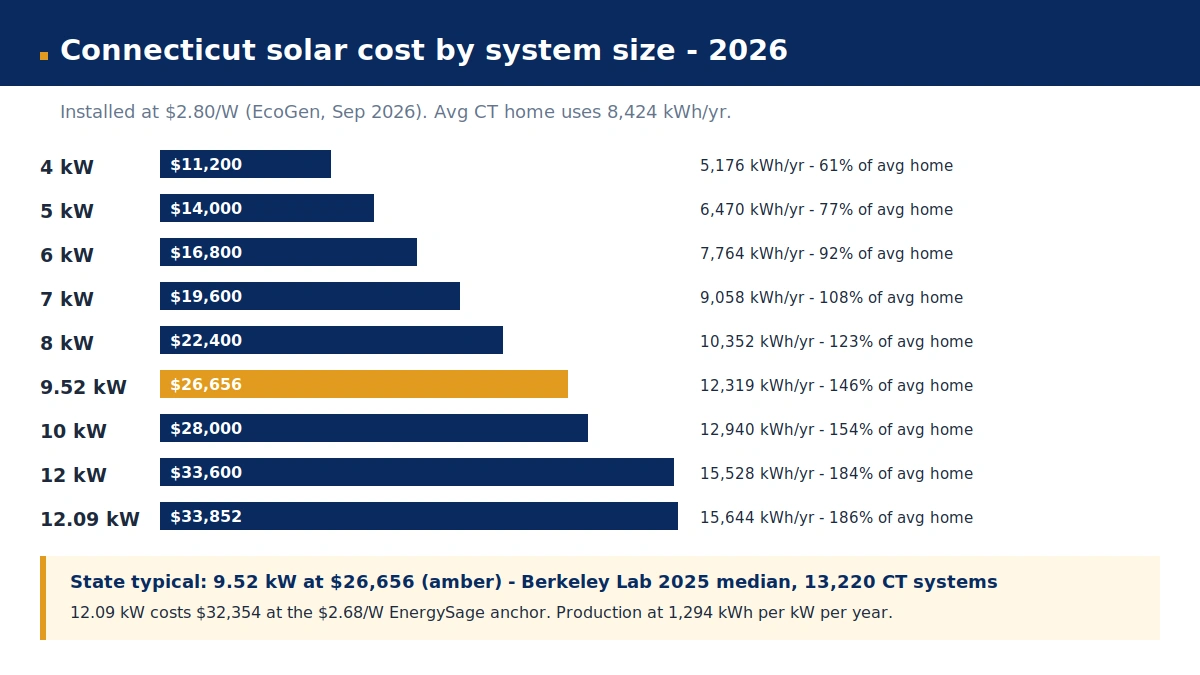
Size is the first decision, and in Connecticut the tariff choice rewards you for getting it right in a way no other state in this series does. The average Connecticut home uses about 702 kilowatt-hours a month, or roughly 8,424 a year — light by national standards, driven by gas heat in most of the state’s housing stock. Each installed kilowatt here generates about 1,294 kilowatt-hours a year, so a 9.52 kW array generates about 12,319 kilowatt-hours — roughly 146% of what the average home uses in a year. That is what makes 9.52 kW the state typical size, and it is also what makes the tariff conversation unavoidable: under Buy-All, every one of those 12,319 kilowatt-hours sells at 32.89 cents whether the house uses it or not, so a big array is a revenue machine. Under Netting, the same array earns the retail rate minus 4.02 cents on exports, and the excess over household use earns less than the power the house consumes directly.
Going bigger than the house uses is a better deal in Connecticut than in a state with plain net metering, because Buy-All pays the same fixed price for the first kilowatt-hour and the ten-thousandth. The constraint is the program cap, not the economics: residential systems in the RRES program may not exceed 25 kW AC, measured by inverter nameplate. The table prices every common size off the EcoGen anchor of $2.80 a watt, with output at 1,294 kilowatt-hours per installed kilowatt per year. The table also shows each size as a share of average home use, so you can see at a glance where the system stops covering the house and starts selling power.
| Size | Cost at $2.80/W | Yearly output | Share of avg. CT home use (8,424 kWh/yr) |
|---|---|---|---|
| 4 kW | $11,200 | ~5,176 kWh | ~61% |
| 5 kW | $14,000 | ~6,470 kWh | ~77% |
| 6 kW | $16,800 | ~7,764 kWh | ~92% |
| 7 kW | $19,600 | ~9,058 kWh | ~108% |
| 8 kW | $22,400 | ~10,352 kWh | ~123% |
| 9.52 kW (state typical) | ~$26,656 | ~12,319 kWh | ~146% |
| 10 kW | $28,000 | ~12,940 kWh | ~154% |
| 12 kW | $33,600 | ~15,528 kWh | ~184% |
| 12.09 kW (state avg) | ~$33,852 at $2.80/W ($32,354 at $2.68/W) | ~15,644 kWh | ~186% |
Two rows in the size table below are worth a second look. First, the 12.09 kW state-average system generates about 186% of what the average home uses. That tells you who buys the average system: households with heat pumps, electric vehicles, electric heat, or all-electric everything, plus the Buy-All buyers who size the array as a revenue asset rather than as a bill offset. Most gas-heated homes with no EV need 6-7 kW, not 12. Second, the 25 kW AC program cap is the ceiling for the whole table — a system larger than that leaves the residential tariff and enters the non-residential program, so the biggest arrays in the state are built under different rules entirely. The sizing conversation has to start with the tariff and the bills, not the roof.
Size the array from twelve months of your own electric bills, not from however much roof happens to be free. Total the kilowatt-hours, divide by roughly 1,294 to find the kilowatt size that covers them, then adjust: add 1-2 kW for a planned EV, add more for a heat pump or electric heat, subtract for a shaded or north-facing roof — and then pick the tariff, because the tariff decides whether the extra kilowatts are worth buying. If you plan to add an EV or a heat pump, add the load first and design the solar second. For the country at large, that sizing logic is walked through in our 6 kW vs 8 kW vs 10 kW guide.
Solar Panel Cost by City: Hartford, New Haven, Bridgeport & Stamford
Connecticut is a small state with one big solar market split across two utilities, and the price spread between its cities is narrow — the four main cities cluster tightly at $2.70-$2.76 a watt. What differs between them is not the install price but the utility behind the meter, and in the southwest corner that gap is the widest in the state. The clearest picture of that spread comes from EnergySage’s city pages for November 2026.
| City | $ per watt | Avg. system | Cash total | Payback | 25-yr savings |
|---|---|---|---|---|---|
| Hartford | $2.74 | 8.3 kW | ~$22,703 ($19,298-$26,108) | 9.79 yrs | $57,591 |
| New Haven | $2.76 | 9.49 kW | ~$26,229 ($22,295-$30,163) | 9.21 yrs | $71,922 |
| Bridgeport | $2.74 | 11.23 kW | ~$30,742 ($26,131-$35,353) | 8.46 yrs | $94,276 |
| Stamford | $2.70 | 13.49 kW | ~$36,462 ($30,993-$41,931) | 10.68 yrs | $80,579 |
| Wethersfield | $2.70 | 8.66 kW | ~$23,376 ($19,870-$26,882) | 9.1 yrs | $64,815 |
| Westport | $2.65 | 12.73 kW | ~$33,710 ($28,654-$38,766) | 13.05 yrs | $50,159 |
| Southport | $2.68 | 13.14 kW | ~$35,194 ($29,915-$40,473) | 9.78 yrs | $86,358 |
| Portland | $2.71 | 12.4 kW | ~$33,569 ($28,534-$38,604) | 9.98 yrs | $78,372 |
| Washington Depot | $2.65 | 12.46 kW | ~$32,972 ($28,026-$37,918) | 11.23 yrs | $78,675 |
| Pomfret Center | $2.73 | 18.01 kW | ~$49,251 ($41,863-$56,639) | 10.36 yrs | $114,573 |
Hartford is the state capital, served by Eversource, at $2.74 a watt — with an 8.3 kW average system at about $22,703, the smallest average system of the four main cities, which tracks with the capital’s smaller housing stock and its gas-heated homes. New Haven, served by United Illuminating, runs $2.76 a watt on a 9.49 kW average system at about $26,229, and its published payback of 9.21 years is the shortest of the four main cities, which tracks with UI’s higher retail rate and its published per-utility payback of about 8.0 years on Netting. Bridgeport, also UI territory, runs $2.74 a watt on an 11.23 kW average system at about $30,742, with the shortest published payback of the four at 8.46 years and the largest 25-year savings at $94,276.
Stamford is the city to read carefully. At $2.70 a watt its install price is the cheapest of the four, but its average system is 13.49 kW — the largest of the four — at about $36,462, and its published payback of 10.68 years is the longest of the four. Stamford sits in Fairfield County, where the housing stock runs large, the roofs run large, and the systems run large with them. Whether the oversized average system is a response to Buy-All economics or simply quote-sample noise is not something the data can settle, and this guide does not over-interpret it — but a Stamford homeowner who sizes to the state average and expects a Bridgeport payback will be disappointed.
Rank the cities on price per watt, and ignore the payback column for that comparison. Westport shows 13.05 years and $50,159 in 25-year savings while Bridgeport, about 30 miles away, shows 8.46 years and $94,276 — at nearly identical prices per watt. Those swings are EnergySage model variance at work: each city page bakes in its own system size, its own rate assumptions, and its own savings model. They are not a real signal that one town is half again as good for solar as the next. For a city-to-city comparison, the price-per-watt column is the one to trust. A payback figure only carries weight when it is built from your own utility’s tariff, and the payback section below builds one for each utility and tariff in turn.
One more city-level note: the top installer named on EcoGen’s Connecticut page in October 2026 is Venture Solar (Venture Home). A deep installer bench is part of why Connecticut prices stay near the national middle despite the high wages — get three quotes, and make at least one of them from a company that has been installing in your utility’s territory for years, because the RRES paperwork differs by utility and an installer who knows your utility’s forms saves weeks.
Connecticut’s Sun: Production, Snow & Winter
Connecticut’s sunshine ranks in the national bottom third, and it arrives with a climate that asks real questions of the equipment. An honest production estimate has to hold both halves of that story at once.
The sun. One kilowatt of panels in Connecticut generates roughly 1,294 kilowatt-hours a year on EcoGen’s PVWatts-based figures (Bridgeport), and a 9.52 kW array generates about 12,319 kilowatt-hours — about 146% of the average home’s yearly use. Cross-checks land close: HomeSolarAtlas’ planning yield gives 1,210 kilowatt-hours per kilowatt a year, Xplosole’s PVGIS modeling gives 1,396 for a south-facing Hartford roof at a 30-degree tilt, and TrueSolarPayback’s 4.0 peak sun hours a day works out to about 1,168 per kilowatt. Use 1,210-1,396 as the range, with EcoGen’s 1,294 as the anchor. Peak sun hours run about 4.0 to 4.4 a day on the annual average, and Connecticut sits at the lower end of viable solar production for the contiguous United States. June produces the most; December produces the least.
The seasonal shape is a steep hill, not a gentle one. Winter days in Connecticut are short, the sun sits low, and snow cover can hold output down for days at a time. Summer days are long and the panels run for hours. No verified Connecticut monthly PVWatts table was pulled for this guide, so the seasonal shape is described here in words rather than as a month-by-month table — if an installer shows you one, ask to see the PVWatts run behind it.
Snow is a temporary tax, not a permanent one. Snow cover cuts output until it slides or melts off, and a tilted panel sheds snow faster than a flat one. Cold air improves panel efficiency, which partly offsets the short winter days, and a dark panel on a sunny day after a storm often clears itself. No Connecticut-specific snow-loss percentage was verified for this guide, so none is stated here. What matters for the economics is the annual figure, not any single snowy week: the 1,294 kilowatt-hours per kilowatt already nets out the winter.
Heat barely trims what the sun gives. What eats panel efficiency is cell temperature — roughly 0.3-0.5% for every degree Celsius the cell runs above 25 degrees. Connecticut summers are milder than the southern states, so the heat derate here is smaller than the one an Oklahoma or Alabama array carries. A production estimate built on nameplate wattage without a temperature derate still overstates summer output, so ask the installer to show the derate inside the production model it hands you — but in Connecticut the derate is a footnote, not a chapter.
Shade is the defining Connecticut risk. Connecticut is one of the most heavily treed states in the country, and mature oaks and maples shade more roofs here than installers admit. A shade report matters more in Connecticut than in an open-plains state, and microinverters or optimizers matter more too: they keep one shaded panel from dragging the whole string down with it. Before you sign, walk the roof with the installer and look at the trees — the ones that shade the roof in June are the ones that decide the output.
The roof itself. Much of Connecticut’s housing stock is old — Colonials, Capes, saltboxes, and Victorians, many of them 50 to 100 years old — and old roofs carry old problems. If under ten years of roof life is left, replace it first — pulling panels off and putting them back for a later reroof runs into the thousands all by itself. Our roof replacement guide carries the reroof numbers. Slate roofs, common on the state’s older and grander homes, make solar expensive and complex: every penetration has to be flashed through stone, and broken slates have to be replaced by a slate specialist. A standing-seam metal roof is one of the best surfaces solar can sit on anywhere, since clamps grip the seams and the roof takes no penetrations at all. Ice dams are the winter roof hazard to ask about: a panel array changes how snow melts on a roof, and the flashing detail at the eaves is worth a conversation with the roofer, not just the solar installer.
Dealing with the climate. No special equipment is needed. Choose a south-facing orientation where the roof allows it, a tilt that sheds snow and summer rain, microinverters or optimizers so a shaded panel cannot drag the whole array down, and a production estimate built on PVWatts data with the temperature derate shown openly, not hidden. The tariff does the rest of the work: under Buy-All, every kilowatt-hour the panels make sells at the same fixed price, summer or winter, so the seasonal shape stops mattering to the money — only the annual total counts.
RRES in Connecticut: Buy-All vs Netting — The Choice That Decides Your Return
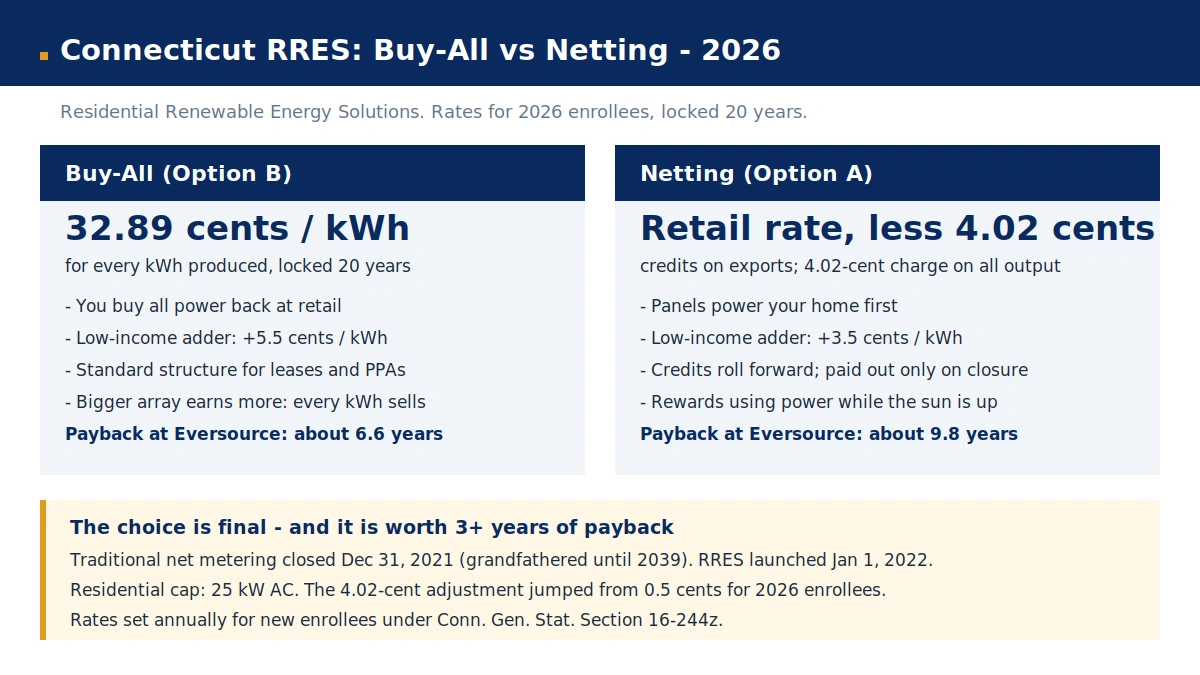
Connecticut does not have traditional net metering for new systems — anyone who says otherwise is describing a program that closed at the end of 2021. What the state offers instead is a two-path tariff with a 20-year lock, and the difference between those two paths is the difference between a 6.6-year payback and a 9.8-year one.
The law. Connecticut’s framework is Conn. Gen. Stat. Section 16-244z, created by Public Act 19-35, with the detail set by Public Utilities Regulatory Authority decisions in Docket 20-07-01 (February 10, 2021) and Docket 21-08-02. The Residential Renewable Energy Solutions program launched on January 1, 2022, replacing both the old net-metering policy and the Connecticut Green Bank’s Residential Solar Investment Program, which closed in 2021 after the state met its 350 MW residential target. Customers who installed before December 31, 2021 keep grandfathered net metering until 2039. That framework binds the two investor-owned utilities — Eversource and United Illuminating — and it does not bind the seven municipal utilities, which set their own terms. That split is the most important thing in this section, and it is why a Wallingford or Norwich homeowner faces a different market from a Hartford one.
How it works. Every new home system picks one of two tariffs at enrollment, and the choice is final. Under both, the homeowner sells the renewable energy certificates the system generates to the utility, and the tariff runs for 20 years. The program stays open until December 31, 2028 or until PURA orders a successor program, with a final order due by December 1, 2027 — and PURA had posted no 2027 RRES rates when checked on October 1, 2026, so a 2026 enrollee locks the 2026 rates and a 2027 enrollee takes whatever PURA sets next. Residential systems are capped at 25 kW AC, measured by inverter nameplate, and co-located battery capacity does not count toward that cap.
Buy-All. The utility buys every kilowatt-hour the system produces — including the power the house consumes itself — at a fixed rate of $0.3289 per kilowatt-hour for 2026 enrollees, locked for 20 years. The homeowner then buys all household electricity back from the utility at the normal retail rate. The rate is set annually for new enrollees, so the 2026 figure is the one a 2026 enrollee keeps. Low-income households at or below 60% of the state median income earn an extra 5.5 cents per kilowatt-hour on Buy-All, and homes in economically distressed municipalities earn an extra 2.75 cents. Buy-All is the standard structure for leases and PPAs, because the fixed 20-year revenue stream is what lets a third-party owner offer a low monthly payment.
Netting. The utility buys all the renewable energy certificates, and gives monetary on-bill credits for energy exported to the grid and not consumed on site, at the retail rate — but 2026 enrollees also pay the Solar Energy Adjustment of $0.0402 per kilowatt-hour on all solar production, a non-bypassable charge that PURA finalized effective January 1, 2026, up from $0.005 per kilowatt-hour — roughly an eightfold increase. Low-income households earn an extra 3.5 cents per kilowatt-hour on Netting. Credits left at year end roll forward and are paid out only when the account is closed. Netting works like conventional net metering, and it rewards the household that uses most of its own power while the sun is up — but the adjustment means the net value of every kilowatt-hour sits a little below the headline retail rate, and older guides that quote Netting at full retail are stale.
Eversource — about 80% of Connecticut homes, roughly 1.25-1.3 million customers, 149 towns. Eversource is the larger of the two investor-owned utilities, covering Hartford, the eastern shoreline, and most of central and northern Connecticut. Its all-in residential rate runs about 26.16 cents a kilowatt-hour (EcoGen, October 26, 2026), and its Standard Service supply rate is 11.58 cents for July through December 2026. RRES rates are identical at Eversource and UI — Buy-All at $0.3289 and Netting at retail minus the $0.0402 adjustment — so what differs between the utilities is the retail rate the homeowner buys back at, not the solar tariff. EcoGen’s per-utility worked examples put Eversource at 6.6 years on Buy-All and 9.8 years on Netting.
United Illuminating — about 340,000 customers, 17 towns, Greater New Haven and Bridgeport. UI is the smaller utility, owned by Avangrid, and its all-in residential rate runs about 31.10 cents a kilowatt-hour (EcoGen, October 26, 2026) — the highest of the two, which is why UI’s Netting payback of about 8.0 years beats Eversource’s 9.8 years despite identical RRES rates. Its Standard Service supply rate is 11.95 cents for July through December 2026. UI customers buy back their power at the highest retail rate in the state, so every kilowatt-hour a UI panel makes is worth more than the same kilowatt-hour on Eversource.
The municipal utilities write their own rules too. Seven town systems run their own utilities — Groton, Bozrah, Norwich, Jewett City, Wallingford, South Norwalk, and the Third Taxing District — and they sit outside RRES entirely. Their customers pay roughly 25-35% less for electricity than Eversource and UI customers, so their solar economics run longer, and no specific municipal solar buyback terms were verified for this guide. The draft says so plainly: municipal-utility customers must get the solar rate sheet in writing before signing, because the RRES rates do not apply to them.
Payback: How Long Until Connecticut Solar Pays for Itself?
Payback is where a Connecticut system either earns its keep or does not. The answer turns on which tariff you picked and which utility sends the bill. The worked examples below are built from the EcoGen anchors, so every input is checkable, with EnergySage as the cross-check — and any disagreement between the two is flagged rather than smoothed over.
The worked example. Start with a typical 9.52 kW system at $2.80 a watt, priced at $26,656 before incentives. It puts out about 12,319 kilowatt-hours a year. The sales-tax exemption saves about $1,693 on that system, so the cash outlay after the exemption is about $24,963 — but the payback figures below are computed on the gross $26,656, the way EcoGen publishes them, so the two can be compared cleanly. From here on, the yearly savings — and with them the payback — turn entirely on the tariff and the utility.
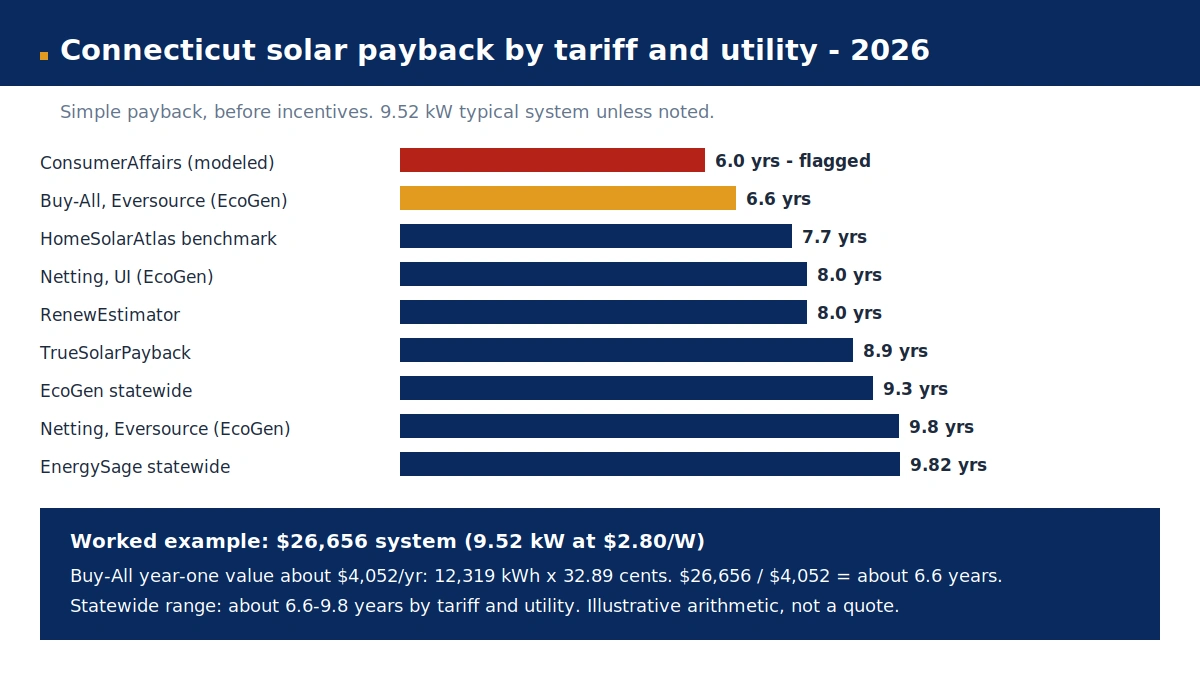
Buy-All at Eversource is the fastest payback in the state. EcoGen’s per-utility worked example for Buy-All at Eversource puts the year-one value at about $4,052 a year — 12,319 kilowatt-hours sold at 32.89 cents each, every one of them, whether the house uses the power or not. Simple payback works out to $26,656 divided by $4,052, about 6.6 years — before incentives, counting no upkeep, no rate rises, and no financing. That figure covers Eversource only, about 80% of Connecticut homes, and it is the fastest payback in this whole series of state guides.
Netting at Eversource is the slowest of the four published cases. The same system on the Netting tariff at Eversource earns about $2,727 a year in EcoGen’s worked example, for a simple payback of about 9.8 years. The gap between Buy-All and Netting at the same utility is more than three years — the largest tariff gap anywhere in this series — and it is the reason the tariff choice has to come before the sizing choice. A household that picks Netting and then sizes the array like a Buy-All buyer has bought the wrong system for its tariff.
Netting at UI sits in between. EcoGen’s worked example for Netting at United Illuminating puts the year-one value at about $3,336 a year, for a simple payback of about 8.0 years. UI’s higher retail rate — about 31.10 cents against Eversource’s roughly 26.16 cents — is what lifts the Netting value, even though the RRES rates are identical at both utilities. No Buy-All worked example for UI was published by EcoGen in this pass, so no UI Buy-All number is stated here; the direction is clear — Buy-All at UI would be at least as fast as Buy-All at Eversource, since the Buy-All rate is the same 32.89 cents at both — but the guide does not invent the figure.
Across both Connecticut utilities, the statewide payback lands in the middle. EcoGen puts statewide simple payback at about 9.3 years, weighted by how many homes each utility serves and computed on Netting. EnergySage puts it at 9.82 years on the 12.09 kW average system, with $81,594 in 25-year savings. HomeSolarAtlas gives a simple benchmark payback of 7.7 years on a 10 kW system, and TrueSolarPayback gives 8.9 years on an 8 kW system — both inside the same 6.6-9.8 year band. For the state as a whole, a defensible line is about 6.6-9.8 years, depending on tariff and utility.
| Case | Simple payback | Source |
|---|---|---|
| EcoGen Buy-All, Eversource (9.52 kW) | ~6.6 yrs | EcoGen, Oct 26, 2026 |
| EcoGen Netting, UI (9.52 kW) | ~8.0 yrs | EcoGen, Oct 26, 2026 |
| EcoGen Netting, Eversource (9.52 kW) | ~9.8 yrs | EcoGen, Oct 26, 2026 |
| EcoGen statewide (Netting-weighted) | ~9.3 yrs | EcoGen, Oct 26, 2026 |
| EnergySage statewide avg (12.09 kW) | 9.82 yrs | EnergySage, Nov 2026 |
| HomeSolarAtlas benchmark (10 kW) | 7.7 yrs | HomeSolarAtlas, Aug 2026 |
| TrueSolarPayback (8 kW) | 8.9 yrs | TrueSolarPayback, Apr 2026 |
| RenewEstimator (8 kW) | 8.0 yrs | RenewEstimator, Jul 2026 |
| ConsumerAffairs modeled | 6 yrs | ConsumerAffairs, 2026 — flagged model |
The flagged conflict. ConsumerAffairs reports a 6-year payback with $79,390 in 25-year savings on a $31,613 typical install. That is a modeled estimate at the fast end of the band, and it sits below even EcoGen’s Buy-All figure. Do not present 6 years as a verified Connecticut payback, and do not let a quote cite it for an Eversource Netting home, where the published figure is 9.8 years.
What moves the payback most. The tariff choice is the biggest lever — more than three years between Buy-All and Netting at the same utility, on the same roof. Size comes second, but only under Buy-All: under Buy-All every extra kilowatt earns 32.89 cents a kilowatt-hour for 20 years, so a bigger array pays back faster in absolute dollars; under Netting, oversizing past household usage pushes the marginal kilowatt-hours into export credits worth less than self-consumed power, and the 4.02-cent adjustment takes a slice of every kilowatt-hour either way. Rate movement is the third lever, and it cut the wrong way in 2026: Connecticut rates fell, with the May 1, 2026 public-benefits cut taking 4.3 cents off Eversource bills and 4.9 cents off UI bills, and the EIA’s August 2026 average down 18.8% year-on-year — so a payback model built on 2025 rates overstates the savings. Eversource’s pending $727 million-a-year rate request, undecided as of October 2026, would push the other way if approved. Fourth is financing: a solar loan carrying dealer fees can add 10-30% to the effective price, so compare cash price per watt, not the monthly payment — or take the Smart-E loan, whose 6.99-7.99% APR is the cheapest solar financing in the state. And the two rate resets a year matter: Standard Service rates reset every January 1 and July 1, so every rate figure in this guide is dated.
Who still comes out ahead. Four kinds of Connecticut household clear that bar. The Buy-All buyer, where the published payback is about 6.6 years and the 20-year rate lock removes the rate risk entirely. The UI customer, where the highest retail rate in the state makes every kilowatt-hour worth the most. The household that adds a heat pump or an EV and sizes the array to the bigger load, staying under the 25 kW cap. And the backup-power buyer, who buys mainly to keep the lights on through nor’easters and ice storms, with savings second — for that household the payback number is background, not the decision. Walk away when your home sits in municipal-utility territory and you are counting on RRES rates, when the installer projects savings from 2025 rates without naming the May 2026 cut, or when the quote still subtracts the dead 30% federal credit.
Connecticut Incentives in 2026: Tax Exemptions, Smart-E Loans & the Battery Program
Connecticut has no state income tax credit for solar and no rebate for panels. What it has instead is a stack of smaller things that add up: two tax exemptions, the cheapest solar loan in the country, a tariff that pays for production, and a battery program that pays for performance. Each one is worth understanding on its own, because no single one of them carries the deal.
Connecticut has no state income tax credit for solar. There is no credit to subtract from a quote, and no state form that lists one. Any quote that subtracts a state credit is simply wrong.
There is a full sales-tax exemption for solar equipment. Connecticut charges a 6.35% sales and use tax on most retail purchases, but solar equipment — panels, inverters, mounting hardware, battery storage, and installation labor — is fully exempt. The installer takes Form CERT-140. On the typical $26,656 system, the exemption saves about $1,693 that would otherwise be added to the bill. Have the installer show the exemption as its own line, and do not let a quote quietly add sales tax that does not apply.
There is a property-tax exemption for the added home value. Under Conn. Gen. Stat. Section 12-81(57), a residential solar electric system is exempt from property tax on the value it adds to the home — a mandatory statewide exemption in place since 2007. The homeowner files a written application with the local assessor by November 1 of the assessment year, or the exemption is waived for that year. EnergySage puts the average annual saving at about 1.63% of the system’s value. Some secondary sources describe the exemption as a local option; the statute-based reading used here is that it is mandatory statewide, and the draft says to confirm with the town assessor either way. Do not assume the added home value escapes tax without filing — the paperwork is the exemption.
No Connecticut utility pays a rebate for panels. Not Eversource, not UI, not any municipal utility. No rebate check arrives when you buy, anywhere in Connecticut. An installer who promises a Connecticut panel rebate is either confused or selling something else. Eversource and UI do run efficiency programs for other measures — insulation, heat pumps, appliances — through Energize CT, but not for solar panels.
The Smart-E Loan is the most important financing tool in the state. The Connecticut Green Bank’s Smart-E Loan runs through a network of participating local lenders: no money down, up to $50,000, terms of 5 to 15 years, at 6.99% to 7.99% APR depending on the term, as of October 1, 2026. It covers owner-occupied homes of one to four units, and it covers solar panels, batteries, and more than 90 other home energy and resiliency upgrades — with up to 25% of the loan allowed to cover non-energy work such as roof repairs done ahead of a solar install. Unlike a lease or PPA, a Smart-E loan keeps the system — and the RRES income — in the homeowner’s name.
The battery program pays for performance, not for panels. Connecticut’s Energy Storage Solutions program, run by the Green Bank with Eversource and UI, pays homeowners who install a battery and let it discharge to the grid during peak events. Since the April 1, 2026 restructuring, the upfront enrollment incentive is $30 per kilowatt-hour for standard residential customers, or $130 per kilowatt-hour for customers on grid-edge circuits — the circuits with the worst outage history — and the performance payments run $300 to $550 per kilowatt a year for years 1 to 5 (standard $300, underserved community $450, income-eligible $550), then up to $130 per kilowatt a year for years 6 to 10. The old ConnectedSolutions program closed to new battery enrollments on December 1, 2023. The battery section below works the numbers.
Connecticut has no Solar for All program open for households. Connecticut won a federal Solar for All grant for Project SunBridge, run by the Department of Energy and Environmental Protection with the Green Bank and the Connecticut Housing Finance Authority, with affordable apartment buildings first in line and planned loans or leases for some single-family homes. It was never a free-panels-for-all program, and its home product never opened before the EPA moved to end the grant on August 7, 2025. In September 2026 federal courts ruled that termination unlawful, and as of October 1, 2026 the EPA was still weighing whether to appeal. DEEP had announced no restart as of October 5, 2026, and there is nothing for a Connecticut household to apply for.
Federal home energy rebates have not launched in Connecticut at all. The Department of Energy and Environmental Protection holds a total allocation of about $49.5 million for HEAR and about $49.7 million for HOMES, and the federal government must approve the state’s plans before any rebate is paid. DEEP told the Energy Efficiency Board in October 2026 that it was updating its planning documents for the Energy Department’s new guidance, that talks with the department can take a few months, and that it hopes funding will be available in early 2027. And even after it launches, HEAR still will not pay for solar. What HEAR pays for is electrification: heat pumps, heat-pump water heaters, electrical panels, and insulation-related wiring — panels, batteries, EV chargers, and windows never qualify.
| Item | Value | Notes |
|---|---|---|
| CT income tax credit | $0 — none exists | No CT income tax credit for home solar |
| CT sales-tax exemption | 6.35% saved — full exemption | Solar equipment and installation labor; Form CERT-140; ~$1,693 on the typical $26,656 system |
| CT property-tax exemption | Added home value exempt | Conn. Gen. Stat. §12-81(57); file with the local assessor by Nov 1 of the assessment year |
| Rebate for panels | $0 — none exists | No CT utility or state program pays one |
| Smart-E Loan | Up to $50,000; 6.99%-7.99% APR; 5-15 yrs | CT Green Bank via local lenders; $0 down; 1-4 unit owner-occupied homes |
| Energy Storage Solutions (battery) | $30/kWh upfront standard ($130/kWh grid-edge) + $300-$550/kW/yr yrs 1-5 | Restructured Apr 1, 2026; 10-year performance payments |
| Solar for All (Project SunBridge) | $0 — paused, nothing to apply for | EPA moved to end the grant Aug 7, 2025; courts ruled the termination unlawful Sep 2026; no restart announced Oct 5, 2026 |
| HEAR / HOMES rebates | Not launched | DEEP; ~$49.5M HEAR + ~$49.7M HOMES; hopes funding available early 2027; HEAR never covers solar |
Federal Help in 2026: $0 Tax Credit — but the §48E Lease Route Is Open
The whole federal story for 2026 fits in one paragraph, and that brevity is exactly why so much solar advertising still gets it wrong. In Connecticut the paragraph has a second half that most states do not get, because the lease route that saves other states is not just legal here but built into the tariff itself.
A homeowner-owned system installed in 2026 earns no federal tax credit at all. The Residential Clean Energy Credit (§25D, 30%) ended for systems placed in service after December 31, 2025, when the One Big Beautiful Bill Act (P.L. 119-21, signed July 4, 2025) took it away. Fact sheet FS-2025-05 from the IRS says the completion date is the one that counts — a deposit paid in 2025 buys nothing when the crew finishes the job in January 2026. The §25C credit for efficient home improvements closed on the same cutoff date. A 2026 quote that still takes 30% off — cash or loan — is priced under a law that no longer exists, so ask the installer to strip it out and quote again. The $6,547 credit still shown on SolarReviews’ own Connecticut incentives page is the stale 30% figure, and it is excluded from every number in this guide.
Leases and PPAs are open in Connecticut — and the tariff is built for them. A company-owned array, rather than one the homeowner buys outright, can still claim the §48E commercial clean-electricity credit at 30% — provided the system enters service by December 31, 2027 and construction began by July 4, 2026, the dates IRS Notice 2025-42 sets out. Under a Connecticut lease, the third-party owner claims the credit and passes part of its value back through a lower monthly payment. The RRES rules say so explicitly: the Buy-All and Netting structures apply to customer-owned and third-party-owned systems alike, and on Buy-All the incentive can be split so that any percentage goes to the customer as an on-bill credit and the rest goes as a direct payment to a third-party Tariff Payment Beneficiary — the company. Buy-All is the standard structure for leases and PPAs in Connecticut, because the fixed 32.89 cents a kilowatt-hour for 20 years gives the system owner a guaranteed revenue stream. That is a genuine Connecticut advantage over states where the lease route is restricted or the export rate is low. Our Massachusetts solar cost guide shows a neighbor with the same New England problems and a different tariff answer.
Two caveats before you sign a lease. First, who signs the tariff decides who gets paid: on a lease or PPA the company is usually the Tariff Payment Beneficiary, so the RRES income flows to the company, not to you — ask whose name goes on that form, and get the answer in writing. Second, no specific national lease or PPA provider’s current Connecticut availability was verified in this pass, so no provider is named here — a lease quote should be compared on its monthly payment and its escalator, not on a headline price, because the homeowner never owns the system. See our federal tax credits guide for the full 2026 federal picture, and our national solar cost guide for a detailed lease-versus-buy walk-through.
Solar is never a HEAR purchase. Income-qualified households can still get up to $8,000 from the Home Electrification and Appliance Rebates program in 2026, but that money funds electrification work, not panels. HEAR covers heat pumps, heat-pump water heaters, electrical panels, and insulation-related wiring work — nothing else in that list is solar. Panels, batteries, EV chargers, and windows all fall outside what HEAR covers. Notice 26-2 from the Energy Department, in force since September 1, 2026, limits the program to electric-to-electric upgrades, with no fuel-switching. Connecticut’s own HOMES and HEAR programs have not launched at all — and DEEP hopes funding will be available in early 2027. A solar price that includes a HEAR rebate is describing a program that does not work that way. HEAR can still matter to a Connecticut homeowner. Pairing a heat pump with new solar panels is a common combination, and the heat-pump half may qualify once Connecticut launches its program — the solar half never will.
The honest summary is this: in 2026 the federal government contributes nothing to a Connecticut homeowner who buys solar panels outright, so the cash price is the cash price, minus the sales-tax exemption. It can still contribute indirectly through a lease or a PPA, because the surviving 30% commercial credit reaches homeowners through a company that owns the system — and Connecticut’s Buy-All tariff is built to carry that deal. On a cash quote, the price is the price, minus the sales-tax exemption. What a lease quote charges is the price minus whatever the third-party owner passes through, and that pass-through figure belongs in writing before anything is signed.
Permits & Licensing: What Connecticut Requires
Connecticut’s licensing picture is more structured than most states’ — there is a solar-only license, a separate electrical license, and a home-improvement registration — and the structure is itself a trap, because the credential that matters most is easy to skip past.
The solar work needs a DCP license. The Department of Consumer Protection licenses the solar trade statewide under Conn. Gen. Stat. Chapter 393, Section 20-330. The classifications are PV-1 Limited Solar Electric Contractor and PV-2 Limited Solar Electric Journeyperson. The PV-2 path runs through a registered apprenticeship — 4,000 hours of on-the-job training plus related classroom instruction — or DCP-approved equivalent experience, plus an exam administered through PSI. The PV-1 contractor route normally requires more than two years as a PV-2 journeyperson, plus its own application and exam. Ask for the installer’s PV-1 number and verify it on the DCP portal; the contract company’s name must match.
The connection to the house needs an E-1 or E-2. Any connection to existing building electrical equipment or the utility meter needs an unlimited electrical license: E-2 Unlimited Electrical Journeyperson, which requires 8,000 hours of on-the-job training and 576 hours of classroom instruction, or E-1 Unlimited Electrical Contractor, which requires two years as an E-2 or six years of equivalent experience, plus an exam. Electrical licenses expire on September 30 each year, with four approved continuing-education credit hours. A solar-only license does not cover the meter connection on its own — ask which license covers which half of the job.
The company needs a Home Improvement Contractor registration too. The company offering the residential installation contract needs a Home Improvement Contractor (HIC) registration under Chapter 400 of the General Statutes, Section 20-418 and following — required once total home-improvement contracts exceed $1,000 in any 12 months, for any single job whose price exceeds $200. It is a registration, not an exam-gated license, so there is no state exam and no experience requirement for it. Ask for the HIC registration as well, and check that it matches the company named on your contract. NABCEP certification is the solar industry’s leading credential for installers. It is worth asking an installer about, even though Connecticut does not require it.
Permits and interconnection take time. The order is fixed in Connecticut: building permit, electrical permit, then the utility interconnection agreement — and interconnection is usually the slowest of the three. Connecticut has a standardized PV permit supplement that aids the local submittal, but the town building department still sets the fee, and no Connecticut-specific permit fee schedule was verified for this guide, so no fee figure appears here. One secondary source reports 2-4 weeks for utility review and 4-8 weeks for interconnection in total — treat that as indicative, not as a utility-published figure, because no Eversource or UI application fee or timeline was verified for this guide. Here the certain bottleneck is time, not money. An installer who promises permission to operate in two weeks is promising something only the utility can grant.
What Pushes Your Connecticut Quote Up or Down
The per-watt anchor is a starting point for pricing, not a quote. Seven things move a Connecticut quote by thousands of dollars, and three of them belong to this state’s labor market, tree cover, and housing stock.
Labor is the reason Connecticut is not cheap — and the reason to check the crew. Connecticut electrician pay runs well above the national median — $37.28 an hour against $30.38 nationally, per BLS May 2025 — and labor is the largest soft-cost component of an install, which is part of why Connecticut lands at $2.80 a watt against a $2.89 national average instead of at the cheap end of the table. Connecticut employs 7,710 electricians, with a 10th-to-90th percentile range of $22.92-$50.13 an hour and a median annual wage of $77,540. A high-wage market pushes prices up, but it also makes the crew’s experience matter more than the headline rate: ask how many installs the crew has done in your utility’s territory, not just how many years the company has existed. No Connecticut-specific BLS figure for solar PV installers was found — so the national figure is used here and flagged as national: a median of $53,140 a year, about $25.55 an hour, with BLS projecting 42.1% growth from 2025 to 2035.
The roof itself. Connecticut’s housing stock is old, and old roofs carry old problems. Colonials, Capes, saltboxes, and Victorians — many of them 50 to 100 years old — dominate the state’s neighborhoods, and a roof that has under ten years of life left should be replaced before the panels go on, because taking panels off and putting them back for a reroof costs thousands on its own. Our roof replacement guide carries the reroof numbers. Slate is the Connecticut special case: it is common on the state’s older and grander homes, and solar on slate is expensive and complex, because every penetration has to be flashed through stone and broken slates need a slate specialist. Standing-seam metal — rarer here than in the South — counts among the best solar roofs anywhere, because clamps grip the seams without a single roof penetration. Before the panels go up, check whether the Smart-E loan can cover the roof work: up to 25% of a Smart-E loan may go to non-energy work such as roof repairs done ahead of a solar install.
Shade and trees. In Connecticut, the tree work is a line item, not a footnote. Mature oaks and maples shade more roofs here than in any open state, and the fix — trimming, removal, microinverters or optimizers — costs more than the cheapest bid allows for. A quote that matches a sunnier state dollar for dollar is probably leaving the shade work out. Ask where it is. If a storm leaves visible damage, have the array inspected before it is re-energized, and tell your homeowner’s insurer the system exists — most policies cover it once declared.
Panel tier. A premium panel costs 10-20% more per watt than a value-tier one. In Connecticut that premium buys two things that matter: better low-light performance on cloudy, overcast afternoons, and better efficiency on a roof where space is tight. On a tight roof, paying extra for efficiency is usually worth it. On a large unshaded roof, cheaper value-tier panels usually win. Premium n-type panels also degrade more slowly — 0.25-0.5% a year, holding 91-93% of rated output at year 25, against the fleet median of about 0.5% a year and about 88% at year 25 per NREL — which matters more in a state where the panels will work through 25 New England winters.
Inverter choice. A string inverter is the cheaper buy upfront. Microinverters or optimizers cost more but generate more on roofs with partial shade — and Connecticut roofs, with their oaks, maples, dormers, and chimneys, carry shade more often than installers admit. Microinverters watch every panel on its own, so one shaded panel cannot drag the rest of the string down. Expect one string-inverter replacement inside the life of the system, since a string inverter typically lasts 10-15 years; microinverters typically carry about 25 years. Our inverter replacement guide costs each type out over its full life — but note that guide is national, and its dollar figures are national, not Connecticut-specific.
The electrical panel. Plenty of Connecticut homes still run on 100-amp service — especially the Colonials and Capes built from the 1940s to the 1970s — and a solar install often forces the question. Our electrical panel upgrade guide puts a 200-amp panel upgrade at $1,500-$4,000 nationally, and it is the most common surprise add-on in Connecticut quotes. Settle whether the quote covers it before signing, not after the electrician is already in your driveway. This guide verified no Connecticut-specific panel-upgrade dollar figure, so it cites the national figure as such.
Financing terms. Cash gives the best long-term return. A $0-down loan can hide dealer fees worth 10-30% of the cash price, sometimes over 50%, inside the amount financed, according to the Consumer Financial Protection Bureau’s August 2024 market spotlight — a national figure, but one that applies to Connecticut quotes exactly the same way. The Smart-E loan is the Connecticut exception to that rule: 6.99-7.99% APR with no dealer-fee structure, up to $50,000, and it keeps the RRES income in the homeowner’s name. A lease or PPA is the third path in Connecticut, and it is mainstream here — see the federal section above — but a lease quote should be compared on its monthly payment and its escalator, not on a headline price, because the homeowner never owns the system. Community solar is the fourth path, and it is real here: the Shared Clean Energy Facility program pays subscribers a bill credit of 2.5 cents a kilowatt-hour, with priority for households at or below 100% of the state median income, and renters qualify.
Maintenance and lifespan. Panels keep producing past the warranty, for 25-30 years of productive service, at reduced output. A product warranty typically runs 10-25 years for materials and workmanship, while a performance warranty typically runs 25-30 years and guarantees 80-92% of rated output at year 25, depending on tier. Maintenance is minimal — occasional cleaning, which matters more under the state’s heavy tree cover, and an annual production check — because there are no moving parts. Snow slides off tilted panels on its own, and leaf litter in fall is the Connecticut-specific cleaning note. No Connecticut-specific lifespan, degradation, or maintenance figures exist, so every figure in that paragraph is national — and flagged as such.
Batteries in Connecticut: Worth It?
A battery is the most consequential add-on in a Connecticut solar project. It can add $15,000 or more to the job, and whether it earns that money back turns on a question Connecticut answers differently from the states around it — because here, the tariff you picked decides what the battery is worth.
Battery cost. A 13.5 kWh storage add-on runs about $15,647 installed — the EnergySage July 2026 national figure, since no Connecticut-specific battery price was verified for this guide. A battery you own and install in 2026 gets no federal credit either — storage was covered by §25D too, and it closed on the same day. Our solar battery cost guide carries national prices for the main battery models.
The battery program stacks on top — and it is the only one that does. Connecticut’s Energy Storage Solutions program pays for batteries in a way no other state in this series does. Since the April 1, 2026 restructuring, a standard residential customer earns a $30 per kilowatt-hour upfront enrollment incentive — $405 on a 13.5 kWh battery — or $130 per kilowatt-hour on a grid-edge circuit, which is $1,755 on the same battery. Then the performance payments run for ten years: $300 per kilowatt a year for years 1 to 5 for a standard customer, $450 for underserved communities, $550 for income-eligible households, then up to $130 per kilowatt a year for years 6 to 10. A 13.5 kWh battery with about 7 kW of discharge capacity earns roughly $2,100 a year in performance payments in years 1 to 5 at the standard rate — real money, paid twice a year by Eversource or UI, and the reason Connecticut batteries pay back faster than batteries in states with no program at all. The grid pays the battery for discharging during peak events, and the homeowner keeps the backup.
Under Buy-All, the battery earns nothing extra from the panels. Every kilowatt-hour the panels make already sells at 32.89 cents, so storing a kilowatt-hour and releasing it later cannot beat the price the utility already pays for it. The battery’s value on a Buy-All system is backup plus the ESS performance payments, not arbitrage. Under Netting, the arbitrage gap is the 4.02-cent adjustment plus the difference between the export credit and the retail rate — real, but small. Storing 10 kilowatt-hours a day and releasing them after dark saves roughly a dollar a day on Netting, which is a decades-long return on a $15,647 battery before the ESS payments are counted. The arbitrage is real, but on its own it is too small to carry the cost. In Connecticut it is the ESS program, not the arbitrage, that makes the battery pencil out.
Backup is the real case in Connecticut. Nor’easters take down lines in winter, ice storms take down lines in January, and hurricanes have reached the Connecticut coast before. In an outage, the battery keeps the refrigerator, the well pump, medical equipment, and a window unit running — sometimes for a day or more in the state’s wooded suburbs. Weigh that as resilience, not as a financial return. A battery that never earns back its cost in arbitrage can still be worth buying for a household that cannot afford to lose heat in January or cooling in July. A generator still covers most houses for less money. What a battery offers instead is different: quiet, automatic power with nothing to refuel and no carbon monoxide risk in a garage during an ice storm.
The payback verdict. In Connecticut, a battery does not pay for itself on arbitrage alone — but unlike in Oklahoma, it does not have to. The ESS performance payments are the largest battery incentive in this series, and on a grid-edge circuit the upfront incentive alone is $1,755. Buy the battery as backup plus ESS income. Size it for the loads that matter in an outage, not for the whole house, and treat the spend as resilience with a program payment attached, not as an investment.
Getting Quotes in Connecticut: The Checklist
Connecticut is a good state to buy solar in — expensive power, a tariff that pays for every kilowatt-hour, and the cheapest solar loan in the country — but only for a homeowner who picks the tariff before the sales pitch. Run every bidder through this checklist, and sign nothing until every line has an answer in writing.
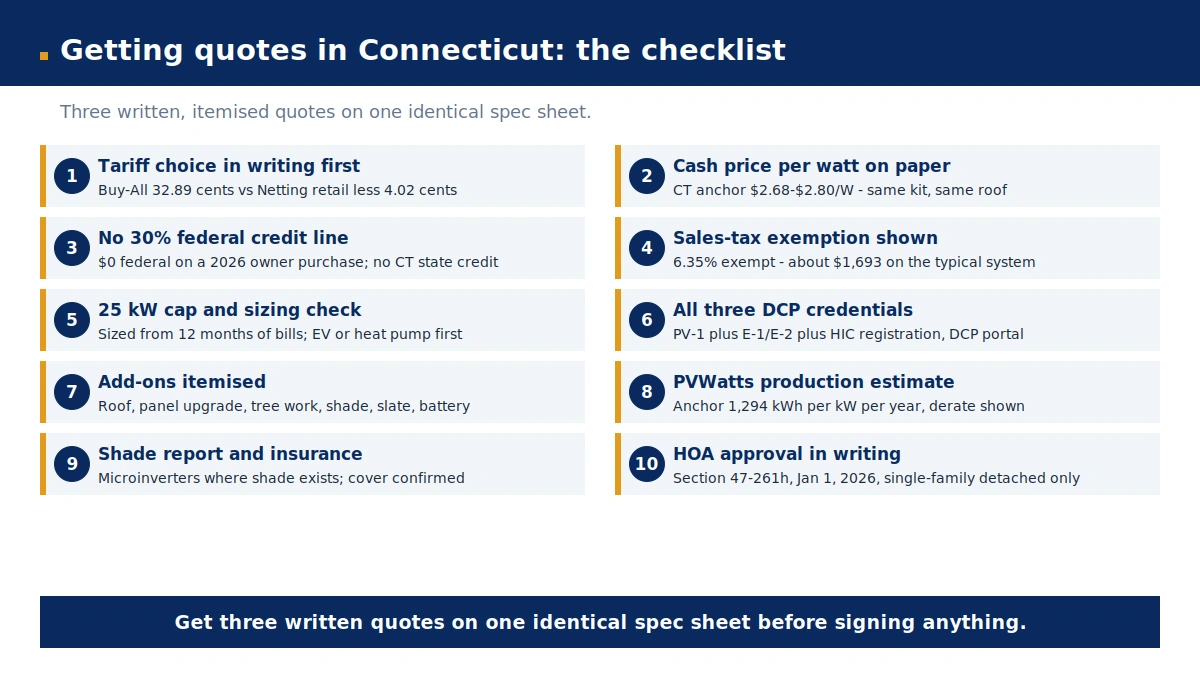
The ten-item quote checklist:
- Your tariff choice, in writing, first — Buy-All at 32.89 cents a kilowatt-hour for 20 years, or Netting at retail minus the 4.02-cent adjustment on all production. The tariff decides the payback before anything else, and the choice is final.
- Cash price per watt, on paper — identical kit, identical roof, three bidders. Anchor the comparison at $2.68-$2.80 a watt for Connecticut; a quote far above that needs an explanation, and one far below it needs a closer look at what was left out.
- No line for a 30% federal credit, no line for a state credit — a 2026 owner purchase gets $0 federal, and Connecticut has no state income tax credit and no panel rebate. If a quote still deducts either one, it is priced under a dead law or an imaginary one — have the deduction removed. Ask for it to be removed.
- Sales-tax exemption shown as its own line — solar equipment is exempt from Connecticut’s 6.35% sales tax, saving about $1,693 on the typical system, and a quote that adds sales tax overstates the cash price.
- The 25 kW cap and the sizing check done on your bills — the system sized from 12 months of your bills, capped at 25 kW AC, with any planned EV or heat pump added as load first. Any quote sized from roof area alone is guessing.
- All three DCP credentials verified — the installer’s PV-1 solar contractor number, the E-1 or E-2 electrical license covering the meter connection, and the company’s Home Improvement Contractor registration, checked on the DCP portal, with names matched to the contract. NABCEP certification is a plus.
- Add-ons itemized — roof work, panel upgrade, tree work, shade mitigation, slate detailing, and battery, each priced on its own line, not buried in the per-watt price.
- PVWatts production estimate, temperature derate shown — anchor about 1,294 kilowatt-hours per kilowatt a year, not nameplate wattage, and no annual average that hides the winter dip.
- Shade report and insurance confirmed — a shade report for a treed Connecticut roof, microinverters or optimizers where shade exists, and homeowners insurance confirmed in writing to cover the array before signing.
- HOA approval, in writing, first — since the new §47-261h solar right took effect January 1, 2026, a single-family detached home in a common interest community has protection, but the board still has 30 days to acknowledge and 60 days to decide, and older associations can opt out by a 75% board vote by January 1, 2028. Get the approval before panels are ordered.
Buy, lease, or community solar? Buying wins over 25 years for homeowners who pick Buy-All, live in UI territory, or have high daytime use. It keeps the system, the resale value, and every kilowatt-hour of tariff income. Leasing wins for homeowners who want no upfront cost and no maintenance, because the §48E route is open in Connecticut and Buy-All is built for it — but only with the escalator, the buyout terms, and the Tariff Payment Beneficiary name read in full, since the RRES income usually flows to the company. For renters, condo owners, and homes with shaded or unsuitable roofs, community solar is the answer. In Connecticut that means the Shared Clean Energy Facility program: it asks for no roof at all, you subscribe to a nearby solar facility, and the bill credits trim your electric bill — a real product here, not a narrow one, with priority for households at or below 100% of the state median income.
Sources & methodology
Cost anchors (per watt, system size, totals):
- EnergySage state page, Nov 2026: $2.68/W; 12.09 kW average; $32,354 total; $27,501-$37,207 range; 9.82-yr payback; $81,594 25-yr savings
- EnergySage city pages, Nov 2026: Hartford $2.74/W, 8.3 kW, $22,703, $19,298-$26,108 range, 9.79 yrs, $57,591; New Haven $2.76/W, 9.49 kW, $26,229, $22,295-$30,163 range, 9.21 yrs, $71,922; Bridgeport $2.74/W, 11.23 kW, $30,742, $26,131-$35,353 range, 8.46 yrs, $94,276 (Oct 2026 page); Stamford $2.70/W, 13.49 kW, $36,462, $30,993-$41,931 range, 10.68 yrs, $80,579; Wethersfield $2.70/W, 8.66 kW, $23,376, 9.1 yrs, $64,815; Westport $2.65/W, 12.73 kW, $33,710, 13.05 yrs, $50,159; Southport $2.68/W, 13.14 kW, $35,194, 9.78 yrs, $86,358; Portland $2.71/W, 12.4 kW, $33,569, 9.98 yrs, $78,372; Washington Depot $2.65/W, 12.46 kW, $32,972, 11.23 yrs, $78,675; Pomfret Center $2.73/W, 18.01 kW, $49,251, 10.36 yrs, $114,573
- EcoGen Solar Cost Index, Sep 2026, prices as of Sep 25: $2.80/W; 9.52 kW typical from the Berkeley Lab 2025 median, 9.54 kW, 13,220 CT systems; $26,656 total; 1,294 kWh/kW/yr; 12,319 kWh/yr; tied 18th lowest of 51; quotes mostly $2.46-$3.14/W; neighbors RI $2.87, NY $3.02, MA $3.02, US $2.89; statewide rate 27.99 cents (EIA 12 mo to Aug 2026); Eversource 26.16 cents; UI 31.10 cents
- EcoGen top installer, Oct 2026: Venture Solar (Venture Home)
- SolarReviews cost page, Nov 2026: $2.93/W; 7.0 kW average; $21,826 total; its $15,278 “after tax credit” column is stale and excluded
- SolarReviews incentives page, Nov 2026: its $6,547 “tax credit” is stale and excluded
- HomeSolarAtlas, updated Aug 27, 2026: $2.67/W benchmark; 10 kW $26,700; planning yield 1,210 kWh/kW/yr; simple benchmark payback 7.7 yrs; first-year energy value $3,487
- RenewEstimator, data compiled Jul 25, 2026: $3.10/W; 8 kW $24,320; payback 8.0 yrs; rate 27.4 cents; 4.4 sun hrs; “Yes” verdict
- ConsumerAffairs, 2026: $2.67/W; $31,613 typical install; payback 6 yrs; 25-yr savings $79,390; modeled, flagged, not headlined
- TheGreenWatt, 2026: $3.10/W; 5 kW $15,500; NREL Q1 2024 benchmarks, EIA 2024 rates, older inputs, corroboration only
- poweroutage.us, updated Apr 12, 2026: $3.65/W; older methodology, excluded as an outlier
- solarcostbyzip.com, Sep 2026: Stamford $4.69/W; single weak source, far above EnergySage $2.70/W for the same city, excluded
Rates:
- EIA Electric Power Monthly Table 5.6.A, Oct 2026 release: CT 24.51 cents/kWh Aug 2026, down 18.8% YoY; US 18.16 cents; Aug bill $204.35 at 834 kWh; 5-yr change +17.8%; 12-mo average to Aug 2026 27.4 cents, ~702 kWh/mo, ~$193/mo bill; Jul 2026 24.16 cents (US 18.31 cents); May 2026 27.37 cents (US 18.44 cents); via Energy Factbook, AMSY, SolarFY, updated Oct-Nov 2026
- CT Office of Consumer Counsel / PURA fact sheet, updated Sep 3, 2026: Standard Service supply Jul-Dec 2026 Eversource 11.58 cents/kWh, UI 11.95 cents/kWh; Jan-Jun 2026 Eversource 12.64 cents, UI 13.70 cents; resets every Jan 1 and Jul 1
- CT OCC newsletter, Jul 2026: May 1, 2026 public-benefits cut, Eversource bills down ~15% overall (4.3 cents/kWh), UI down ~13.8% (4.9 cents/kWh); public-benefits charge from ~4 cents/kWh to a credit of ~1.5 cents (Eversource) / ~1.3 cents (UI)
- AMSY, Oct 19, 2026: Eversource pending request to raise rates by $727M a year, PURA undecided; no Jan 1, 2027 Standard Service rates announced as of Oct 19, 2026
RRES and buyback:
- Conn. Gen. Stat. §16-244z; Public Act 19-35; PURA Docket 20-07-01 (Feb 10, 2021) and Docket 21-08-02: RRES launched Jan 1, 2022, replacing net metering and RSIP; grandfathered net metering until 2039 for pre-Dec-31-2021 systems; program open until Dec 31, 2028 or PURA successor order, final order due Dec 1, 2027; no 2027 rates posted as of Oct 1, 2026 (EcoGen)
- RSIP: created 2011, administered by the CT Green Bank, closed 2021 after the 350 MW residential target was met (NuWatt, Apr 2026; CT portal)
- CT CEQ annual report: through Dec 2022, over 73,500 solar installations, 912 MW total installed PV capacity; 5,998 RRES installations in 2022, 47,133 kW
- UI RRES FAQ, published Jan 1, 2026: 2026 Buy-All $0.3289/kWh, locked 20 years; low-income adder $0.055/kWh Buy-All, $0.035/kWh Netting; economically distressed municipality adder $0.0275/kWh Buy-All; Netting credits at retail rate; RECs sold under both; third-party ownership covered (Q19); residential cap 25 kW AC
- PURA, effective Jan 1, 2026: Solar Energy Adjustment $0.0402/kWh on all production for new RRES Netting enrollees, up from $0.005/kWh (NuWatt, verified Jul 6, 2026 against portal.ct.gov)
- Eversource ~1.25-1.3M customers, ~80% of the state, 149 towns; UI ~340,000 customers, 17 towns (EcoGen; ProFusion)
- Municipal utilities outside RRES: Groton, Bozrah, Norwich, Jewett City, Wallingford, South Norwalk, Third Taxing District (EcoGen); municipal power roughly 25-35% cheaper than Eversource/UI (AskDoss, Mar 2026); no municipal solar buyback terms verified
Incentives:
- EnergySage CT incentives page, updated Oct 1, 2026: Smart-E Loan up to $50,000, 5-15 yrs, 6.99%-7.99% APR; sales-tax exemption 6.35%; property-tax exemption, average annual saving ~1.63% of system value; no state income tax credit; RRES 2026 enrollees pay the 4.02-cent adjustment
- SolarInsure, Sep 16, 2026: sales-tax exemption on equipment and labor; Conn. Gen. Stat. §12-81(57)(A)(i) mandatory statewide property-tax exemption since 2007, application by Nov 1 of the assessment year; Smart-E Loan terms; C-PACE for commercial
- ConsumerAffairs CT incentives page: sales-tax exemption via Form CERT-140; property-tax exemption via local assessor; Smart-E Loan; no broad statewide cash rebate for residential panels
- Energy Storage Solutions: PURA Year Five Decision, Docket 25-08-05, Dec 17, 2025, effective Apr 1, 2026 — upfront $30/kWh standard residential, $130/kWh grid-edge; performance $300-$550/kW/yr yrs 1-5, up to $130/kW/yr yrs 6-10; Active Dispatch only; administered by CT Green Bank, Eversource and UI; ConnectedSolutions closed to new battery enrollments Dec 1, 2023 (Fortress Power; Palmetto Finance; Energy Toolbase)
- Solar for All (Project SunBridge): DEEP + Green Bank + CHFA; EPA moved to end the grant Aug 7, 2025; federal courts ruled the termination unlawful Sep 2026 (Rhode Island Sep 18; DC); DEEP had announced no restart as of Oct 5, 2026; no single-family product ever opened (EcoGen, Oct 5, 2026)
- HEAR / HOMES: DEEP, via GridShift Oct 21, 2026 and InsulationHelper Oct 29, 2026 — not launched; ~$49.5M HEAR (HEEHR) + ~$49.7M HOMES allocated; DOE must approve the initial application and Blueprint; DEEP hopes funding available early 2027; DOE renamed HEAR to HEEHR Jun 1, 2026; Program Notice 26-2 (May 29, 2026) electric-to-electric only
Federal and financing:
- OBBBA P.L. 119-21 and IRS FS-2025-05: §25D and §25C $0 for post-Dec-31-2025 installs, completion date counts
- §48E 30% for third-party-owned systems, in service by Dec 31, 2027, construction begun by Jul 4, 2026 per IRS Notice 2025-42
- RRES FAQ Q19 (portal.ct.gov): Buy-All and Netting apply to customer-owned and third-party-owned (lease/PPA) systems; Tariff Payment Beneficiary assignment; Buy-All split 0-100%
- DOE Notice 26-2, Sep 1, 2026: HEAR electric-to-electric upgrades only, no fuel-switching; solar, batteries, EV chargers, windows outside HEAR
- CFPB Solar Financing Market Issue Spotlight, Aug 2024: dealer fees 10-30%, sometimes over 50%
- Shared Clean Energy Facility: bill credit 2.5 cents/kWh, priority at or below 100% of state median income, renters qualify (EcoGen, Oct 5, 2026)
Production and climate:
- EcoGen: 1,294 kWh/kW/yr PVWatts-based (Bridgeport); 9.52 kW makes ~12,319 kWh/yr
- HomeSolarAtlas: 1,210 kWh/kW/yr planning yield; 10 kW makes 12,100 kWh/yr
- Xplosole PVGIS modeling: 1,396 kWh/kW/yr (Hartford, south-facing, 30-degree tilt, 14% losses, 2005-2023 weather)
- TrueSolarPayback, Apr 29, 2026: 4.0 peak sun hours/day; 8 kW makes 9,344 kWh/yr; rate 32.7 cents; payback 8.9 yrs
- Heat penalty 0.3-0.5% per degree C above 25 C cell temperature, national figure
- Average CT home use ~702 kWh/mo = ~8,424 kWh/yr (EIA, 12 mo to Aug 2026)
Payback arithmetic:
- The worked examples in the payback section are NestPriced arithmetic from EcoGen anchors: 9.52 kW x $2.80/W = $26,656; production ~12,319 kWh/yr; Buy-All Eversource 12,319 x $0.3289 = ~$4,052/yr, $26,656 divided by $4,052 ~ 6.6 yrs; Netting Eversource ~$2,727/yr, ~9.8 yrs; Netting UI ~$3,336/yr, ~8.0 yrs; statewide ~9.3 yrs (Netting-weighted); all worked examples labeled illustrative in the draft
- Sales-tax saving on the typical system: $26,656 x 6.35% = ~$1,693 (NestPriced arithmetic)
- Battery ESS illustration: 13.5 kWh battery, ~7 kW discharge capacity, standard performance $300/kW/yr = ~$2,100/yr in years 1-5 (NestPriced arithmetic from program rates, labeled as an illustration in the section)
- EnergySage’s 9.82-year statewide figure is presented alongside with the system-size difference flagged; ConsumerAffairs’ 6-year payback is flagged as a modeled estimate at the fast end of the band
HOA and licensing:
- Conn. Gen. Stat. §47-261h, Public Act 25-73, effective Jan 1, 2026: provisions prohibiting or unreasonably restricting rooftop solar on single-family detached units unenforceable; board acknowledgment within 30 days, decision within 60 days or deemed approved; board shall not unreasonably withhold approval; scope excludes cooperatives and units sharing common walls; written agreement requires a registered, insured contractor licensed under Chapter 393 with at least $1,000,000 liability cover, workers’ compensation evidence, mechanic’s lien waiver, owner pays all costs including increased master-policy premiums and association attorney’s fees, indemnifies the association, assumes full roof responsibility; associations formed on or before Jan 1, 2026 may opt out by 75% board vote by Jan 1, 2028, notice recorded within 30 days (Homeowners Protection Bureau; APM HOA guide, both reading the 2026 Supplement)
- CONFLICT: PluggedIn Solar (Apr 2026) and older Palmetto pages list Connecticut among states with no solar-access law; NuWatt attributes the protection to “SB 4 (2022), eff. Jan 2023” — outdated/misattributed against the statute-text sources; the §47-261h / Jan 1, 2026 framing is used
- DCP licensing: PV-1 Limited Solar Electric Contractor / PV-2 Limited Solar Electric Journeyperson, Conn. Gen. Stat. Chapter 393 §20-330; PV-2 registered apprenticeship 4,000 on-the-job training hours plus related classroom instruction (classroom hours differ across sources: 288 vs 324 — no classroom figure stated), or DCP-approved equivalent experience, plus PSI exam; PV-1 normally requires more than two years as a PV-2 journeyperson; E-2 8,000 on-the-job training hours and 576 classroom hours; E-1 two years as E-2 or six years equivalent experience; electrical licenses expire Sep 30 annually, four continuing-education credit hours (ContractorLicenseRequirements.com, verified Sep 4, 2026; Harbor Compliance; SimplyWise, Jun 5, 2026)
- Home Improvement Contractor registration, Chapter 400 §20-418 et seq.: required once total home-improvement contracts exceed $1,000 in any 12 months, any single job over $200; registration, not an exam-gated license (SimplyWise, Jun 5, 2026); fee figures differ across secondary sources ($120 + $100 Guaranty Fund vs $220) — no fee figure stated
- Permits: building + electrical permits from the town; CT standardized PV permit supplement; interconnection 2-4 weeks for utility review, 4-8 weeks total per NuWatt Feb 2026 — indicative only, no Eversource/UI fee or timeline verified
Labor:
- BLS Occupational Employment and Wage Statistics May 2025: electricians 47-2111 Connecticut, median $37.28/hr, $77,540/yr; mean $37.21/hr; 10th-90th percentile $22.92-$50.13/hr; 7,710 employed; national median $30.38/hr, $63,190/yr
- Solar PV installers 47-2231: no Connecticut-specific BLS figure found; national median $53,140/yr, ~$25.55/hr, BLS projects +42.1% growth 2025-35, BLS Occupational Outlook Handbook May 2025
Maintenance, lifespan, warranty (national figures):
- Lifespan 25-30 years productive service; NREL median degradation ~0.5%/yr, ~88% of rated output at year 25; premium n-type 0.25-0.5%/yr, 91-93% at year 25, NREL Jordan et al. 2022 fleet analysis
- Product warranty typically 10-25 years; performance warranty typically 25-30 years, guaranteeing 80-92% of rated output at year 25 depending on tier; string inverter 10-15 years, one replacement expected; microinverters ~25 years
EXCLUDED:
- Any “after 30% credit” prices, including SolarReviews’ $15,278 “after tax credit” column and its $6,547 “tax credit” on the incentives page
- Any HEAR-for-solar claim: HEAR does not cover solar, batteries, EV chargers, or windows; electric-to-electric only since DOE Notice 26-2, Sep 1, 2026
- Any state income tax credit or utility rebate for Connecticut solar panels: none exists
- poweroutage.us’s $3.65/W Connecticut average: far above every other 2026 source, older methodology
- ConsumerAffairs’ 6-year payback: modeled estimate, low end of the band, flagged
- TheGreenWatt’s $3.10/W: NREL Q1 2024 benchmarks, EIA 2024 rates, older inputs
- solarcostbyzip.com’s Stamford $4.69/W: single weak source, far above EnergySage $2.70/W for the same city
- The “SB 4 (2022), eff. Jan 2023” HOA claim and the “no solar-access law in Connecticut” survey entries: outdated/misattributed; §47-261h (Public Act 25-73, Jan 1, 2026) used instead
- Municipal-utility solar buyback terms: not verified
- UI Buy-All worked payback: no figure published by EcoGen, not invented (direction stated only)
- Eversource/UI interconnection application fees and timelines; CT-specific permit fee schedule; CT-specific battery price, national ($15,647) figure used instead
- CT-specific monthly PVWatts production table: seasonal shape described qualitatively
- CT snowfall total or snow-loss percentage: not verified
- HIC registration fee: secondary sources differ ($120 + $100 vs $220), not stated
- PV-2 classroom instruction hours: sources differ (288 vs 324), not stated
- No specific national lease/PPA provider’s current Connecticut availability was verified — no provider named
*Disclaimer: The prices here are 2026 Connecticut planning figures. They change by city, roof, utility territory, tariff choice, and contractor. Before locking in a budget, collect three written quotes from local installers. Treat the tax notes in this guide as general information, not as advice for your return. Talk to a Connecticut tax professional before you file. Program rules change — RRES tariffs, the Solar Energy Adjustment, ESS rates, Smart-E terms — so confirm current terms with Eversource, UI, or your own utility before signing. RRES rates are set annually for new enrollees, PURA had posted no 2027 rates as of October 1, 2026, and Eversource’s $727 million-a-year rate request was undecided as of October 2026 — rate figures in this guide are dated to their sources.*
What do solar panels cost in Connecticut in 2026?
Solar panels cost $2.68-$2.80 a watt installed in Connecticut in 2026 — about $26,656 for the typical 9.52 kW system (EcoGen, September 2026), or about $32,354 for the 12.09 kW marketplace average (EnergySage, November 2026). A 10 kW home system typically runs about $28,000 at the EcoGen rate. Hartford runs $2.74 a watt, New Haven $2.76, Bridgeport $2.74, and Stamford $2.70. For a homeowner-owned system installed in 2026, the 30% federal credit is $0, and Connecticut has no state income tax credit and no panel rebate — but solar equipment is exempt from the 6.35% sales tax, saving about $1,693 on the typical system.
How long does it take for solar panels to pay for themselves in Connecticut?
About 6.6 years on Buy-All at Eversource and about 9.8 years on Netting — so roughly 6.6-9.8 years depending on your tariff and your utility. EcoGen’s worked examples put a 9.52 kW system at $26,656 paying back in about 6.6 years on Buy-All at Eversource, where every kilowatt-hour sells at 32.89 cents, and about 9.8 years on Netting at Eversource, where exports earn the retail rate minus a 4.02-cent charge. Netting at United Illuminating is faster, about 8.0 years, because UI’s retail rate is higher. EnergySage’s statewide figure is 9.82 years on the larger marketplace average system.
Does Connecticut have net metering?
Not for new systems. Connecticut closed traditional net metering to new residential customers on December 31, 2021, and replaced it with the Residential Renewable Energy Solutions (RRES) program, which launched January 1, 2022. Customers who installed before the cutoff keep grandfathered net metering until 2039. New systems pick one of two 20-year tariffs: Buy-All, which pays a fixed $0.3289 per kilowatt-hour for every kilowatt-hour produced (2026 enrollees, locked 20 years), or Netting, which credits exported power at the retail rate minus a $0.0402 per kilowatt-hour Solar Energy Adjustment on all production. The choice is final, and the program caps residential systems at 25 kW AC.
What is the difference between Buy-All and Netting in Connecticut?
Buy-All sells every kilowatt-hour your panels make to the utility at a fixed $0.3289 per kilowatt-hour, locked for 20 years, while you buy all your household power back at the normal retail rate — so a bigger array earns more, and the seasonal shape stops mattering to the money. Netting works like conventional net metering: your panels power your home first, and only the power you export earns bill credits at the retail rate, minus a $0.0402 per kilowatt-hour charge on all production for 2026 enrollees. On the same 9.52 kW system at Eversource, Buy-All pays back in about 6.6 years and Netting in about 9.8 years. Buy-All is also the standard structure for leases and PPAs, because the fixed 20-year revenue stream lets a third-party owner offer a lower monthly payment.
What is the difference between Eversource and United Illuminating for solar?
The RRES rates are identical at both utilities — Buy-All at $0.3289 per kilowatt-hour and Netting at retail minus the $0.0402 adjustment — so what differs is the retail rate you buy power back at. Eversource serves about 80% of Connecticut homes, roughly 1.25-1.3 million customers in 149 towns, at an all-in residential rate of about 26.16 cents a kilowatt-hour. United Illuminating serves about 340,000 customers in 17 towns around New Haven and Bridgeport, at about 31.10 cents a kilowatt-hour — the highest of the two, which is why UI’s Netting payback of about 8.0 years beats Eversource’s 9.8 years. The seven municipal utilities — Groton, Bozrah, Norwich, Jewett City, Wallingford, South Norwalk, and the Third Taxing District — sit outside RRES entirely and set their own solar terms.
Can I still get the 30% federal tax credit for solar in Connecticut in 2026?
No — not on a system you own. Under the One Big Beautiful Bill Act (P.L. 119-21), the Residential Clean Energy Credit (§25D, 30%) ended for homeowner-owned systems placed in service after December 31, 2025, and the IRS confirmed that the completion date is the date that counts. But Connecticut keeps the lease door wide open: the commercial credit (§48E, 30%) survives for third-party-owned systems in service by December 31, 2027, and the RRES rules explicitly cover leases and PPAs — Buy-All is the standard lease structure, and the RRES payment can be assigned to the company as Tariff Payment Beneficiary. A lease lets the third-party owner claim the credit and pass part of the value on as a lower monthly payment, though you should check whose name is on the tariff form before signing.
Is snow a problem for solar panels in Connecticut?
Snow is a temporary tax, not a permanent one. Connecticut gets about 1,294 kilowatt-hours a year from every installed kilowatt, and that annual figure already nets out the winter. Snow cover cuts output until it slides or melts off, and a tilted panel sheds snow faster than a flat one, while cold air improves panel efficiency and partly offsets the short winter days. December is the worst month and June the best. The real Connecticut climate risk is shade, not snow: the state is heavily treed, and mature oaks and maples shade more roofs than installers admit, so a shade report and microinverters or optimizers matter more here than in an open state.
Can a Connecticut HOA block rooftop solar?
Since January 1, 2026, usually not for a single-family detached home. Conn. Gen. Stat. §47-261h (Public Act 25-73) makes unenforceable any declaration or bylaw provision that prohibits or unreasonably restricts rooftop solar on a single-family detached unit. The board must acknowledge an application in writing within 30 days and approve, deny or request more information within 60 days, or the application is deemed approved, and the board shall not unreasonably withhold approval. The protection is narrow: it excludes cooperatives and units that share a common wall, so a townhouse sharing a wall is outside it. Approval also comes with a written agreement — a registered, insured contractor licensed under Chapter 393 with at least $1,000,000 of liability cover, and the owner pays every associated cost including increased master-policy premiums and the association’s attorney’s fees, and assumes full responsibility for the roof. Associations formed on or before January 1, 2026 can opt out by a 75% board vote by January 1, 2028. Get the approval in writing before ordering panels.