


Table of Contents
Oregon asks a heat pump buyer to answer three questions that most states never raise. Which side of the Cascades does the house stand on? Which utility sends the electric bill? And what fuel heats the house today? Get those three right and the rest of the decision — system type, size, rebate stack, payback — falls into place. Get any one wrong and the quote, the rebate, or the running-cost maths will be wrong with it.
The Cascades divide is the first split. West of the range, the Willamette Valley and the coast sit in a marine climate where winter design temperatures hover around 22–23F and a standard heat pump carries the house through nearly the whole heating season. East of the range, Bend and Pendleton face design temperatures near 5F, close to 7,000 heating degree days, and real snow — a job for extended-capacity equipment, raised pads, and defrost clearance, not for a bargain standard unit. Medford, in the Rogue Valley, is a third case altogether: mild winters like the Valley, but the hottest summers in Oregon, with a 94–95F design temperature and a 115F record.
The utility split is the second. About 44.6% of Oregon residential customers buy power from Portland General Electric, at roughly 18.8 cents per kilowatt-hour in 2025, well above the 15.5-cent statewide average. Pacific Power serves much of the rest, Eugene has its own municipal utility in EWEB, and Bend sits in Central Electric Cooperative territory. Each of those names carries a different rebate, a different rate, and a different running-cost answer. A Portland-metro buyer and a Bend buyer are not buying the same deal, even when they buy the same machine.
The fuel split is the third, and it decides the rebate stack more than any other fact. Roughly 54% of Oregon homes heat with electricity — mostly resistance heat, baseboards and wall heaters and old electric furnaces — and about 37% heat with piped gas. Energy Trust of Oregon, the body that pays the main residential heat pump incentives in PGE and Pacific Power territory, pays its standard ducted and ductless incentives only when the new heat pump replaces electric heat. A gas-heated home gets $0 from that programme for a standard ducted system. The best-subsidised Oregon heat pump customer is therefore a baseboard-heated home, not a gas-furnace home, and this guide says that plainly wherever it matters.
One more Oregon fact changes the value calculation in a way no price table captures. In June 2021 a heat dome parked over the Pacific Northwest and Portland recorded 108F, 112F, and 116F on three consecutive days, June 26–28. Medford tied its all-time record of 115F, Pelton Dam recorded 119F — the official Oregon state record — and 73 people died of heat in Multnomah County alone. Most of the victims were older, socially isolated, and without central air conditioning. Many older Willamette Valley homes still have no cooling at all. A heat pump in such a home is not a heating upgrade with a cooling bonus. It is the household’s first cooling, and after June 2021 cooling in Oregon is a health feature, not a luxury. That is why the state’s heat pump push is framed as cooling access as much as heating, and why Oregon law now aims for at least 500,000 new heat pumps installed by 2030.
The US-wide baseline behind every Oregon figure below is our national heat pump cost guide.
How Much Does a Heat Pump Cost in Oregon in 2026?
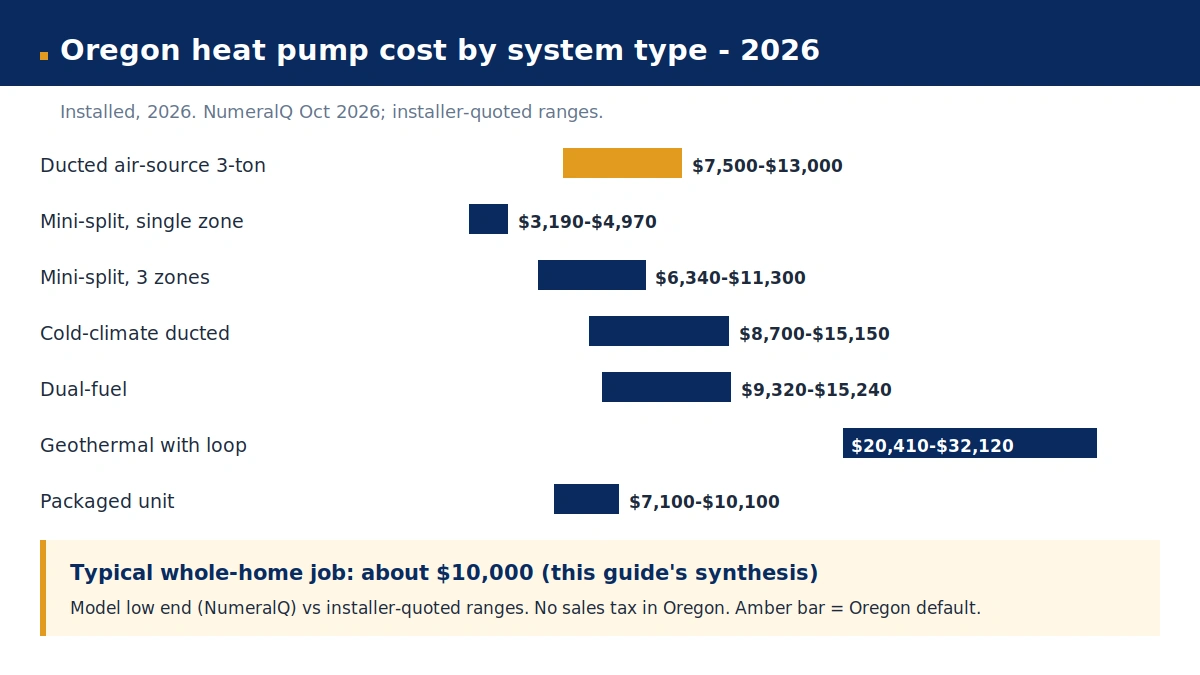
For an Oregon home of 1,500–2,500 square feet, the machine that usually fits is a 3-ton whole-home ducted air-source heat pump. A 2026 fit for that 3-ton job runs $7,500–$13,000, and most settle near $10,000. Plan on that band. That price covers the condenser outside, the air handler inside, refrigerant lines, a dedicated circuit, the permit, and the commissioning visit — a working system, not a box on a pallet. And because Oregon has no general sales tax, a quoted $10,000 costs $10,000. No tax line gets added at the end, which is worth remembering when you compare Oregon figures with guides from states where 5–8% sales tax is buried in the quote or added on top.
The band comes from four anchors that pull in different directions, and the spread between them is itself useful information. NumeralQ’s Oregon estimator — October 26, 2026 pricing, built from Fixr, This Old House, Home Depot prices, and BLS May 2025 wages — puts the 3-ton ducted job at $6,620–$11,060. Such a model counts parts and local wages and almost nothing else — no sales time, no warranty reserve, no surprises hiding inside a real house — so it sits low beside installer charges. TryDun’s August 2026 model pulls the other way, putting Oregon ducted air-source at $8,250–$15,250, well above the NumeralQ model; this guide reports both and notes that TryDun reads high. Between them sit two anchors closer to real bids. Duct Guys, a Portland installer, puts a professionally installed ducted heat pump in the Portland metro at $7,000–$15,000, with a basic replacement at $7,000–$9,000, a mid-range ducted system at $8,000–$12,000, and higher-efficiency equipment at $10,000–$15,000. Modernize’s Oregon marketplace pages put the average installation in the state at $10,500. The headline lands where those views meet: $7,500–$13,000 for the standard whole-home job, with the top end kept for variable-speed equipment, awkward installs, and Portland addresses. The near-$10,000 typical figure is this guide’s own synthesis. No published Oregon statewide installer average was found, and this guide would rather say that than invent one.
A whole-home quote near $5,000 should raise an eyebrow, not excitement. A bid thousands below its rivals usually signals a missing piece — the indoor unit, the wiring, the permit fee, the duct alterations, the start-up visit — or a separate line that appears later. A bid far below the rest should prompt a search for the missing pieces before you sign, not once the crew is on site.
Against the rest of the country, Oregon sits almost exactly on the national average. The national guide’s US-wide band for a ducted heat pump is $7,500–$15,000 in 2026, and NumeralQ puts Oregon at about 1% above the national figure. Oregon labour runs about 3% above the national median — HVAC mechanics and installers in Oregon earn a median $30.26 an hour against $29.33 nationally (BLS, May 2025) — and the panel work costs more here than in most states, yet the absence of sales tax and the mild Valley climate pull the other way. The price of a mistake is higher here too, though in a different way from the humid states: a wrong size gets punished on a 116F afternoon as surely as on a 23F night, and an east-side home fitted with a standard unit instead of a cold-climate one will lean on strip heat all winter.
| System | Typical Oregon installed cost (2026) |
|---|---|
| Ducted air-source heat pump, 3-ton (typical home) | $7,500–$13,000 (typical ~$10,000) |
| Ductless mini-split, single zone | $3,190–$4,970 |
| Ductless mini-split, 3 zones | $6,340–$11,300 |
| Cold-climate ducted heat pump, 3-ton | $8,700–$15,150 |
| Dual-fuel (heat pump + gas furnace) | $9,320–$15,240 |
| Geothermal (ground-source) with loop | $20,410–$32,120 |
| Packaged unit | $7,100–$10,100 |
Sources: NumeralQ Oregon heat pump estimator (Oct 26, 2026); NumeralQ Oregon HVAC replacement page (dual-fuel and packaged models); Duct Guys Portland 2026 guide; Modernize Oregon pages (2026); TryDun (Aug 2026); nestpriced national guide (art. 1).
Heat Pump Cost in Oregon by System Type
Start from the house, not the catalogue. One wall head runs near a third of a full ducted install, and a ground loop runs near triple — yet neither figure means much until the house itself is understood. Ducts or no ducts, gas or no gas, a furnace with years left or one on its last legs, Valley mild or east-side cold: those facts set the system before any price does.
Ducted air-source heat pumps are what most Oregon homes get. One unit works through the ducts already in the house to heat and cool every room, retiring furnace and AC together. NumeralQ’s model puts the 3-ton job at $6,620–$11,060; installer-quoted reality in Portland runs $7,000–$15,000, with the gap mostly margin, warranty, and job conditions. If the ducts are sound and furnace and AC are ageing out together, price this route first. Our ductless vs ducted comparison lays out that trade-off in full.
Ductless mini-splits fit the homes that never had ducts — a finished basement in Portland, an addition in Salem, a bonus room over the garage in Eugene, older bungalows where ducts were never run, and cabins and vacation homes in the Gorge and on the coast. NumeralQ puts one 12,000 BTU head at about $3,190–$4,970 fitted, and three zones for an addition or finished basement at $6,340–$11,300. Five or more heads for a whole home run higher still on national figures, and at that point a ducted system is usually cheaper, if ducts exist or can be added. Each mini-split is a heat pump in its own right: one box cools the bonus room through a July heat wave and warms it through January. Per-zone pricing is in our mini-split installation cost guide.
Cold-climate heat pumps earn their keep in exactly one part of Oregon: east of the Cascades. A cold-climate ducted system costs $8,700–$15,150 (NumeralQ), about $2,000 more than a standard system, for inverter-driven capacity that keeps delivering heat down toward 5F and below. Portland, Salem, and Eugene rarely ask a standard unit to prove itself for long, so the extra money there buys little. Bend, Pendleton, and the high desert are different — design temperatures near 5F, close to 7,000 heating degree days, real snow — and there the premium is the default, not an upgrade. Our cold-climate mini-split guide sets out when that premium pays and when it does not.
Dual-fuel systems pair a heat pump with a gas furnace, and in the Willamette Valley they may be the smartest premium spend in the state — especially for a PGE customer, where the fuel maths at 18.8 cents per kilowatt-hour is the weakest in Oregon. Mild weather lets the heat pump carry the long shoulder seasons; the furnace only steps in on the coldest nights, when the heat pump’s efficiency drops and the strips would otherwise take over. A complete dual-fuel system costs $9,320–$15,240 on NumeralQ’s model, and Duct Guys puts a heat pump plus gas furnace hybrid in Portland at $12,000–$20,000+. The cheapest way in is to fit a heat pump where a dying air conditioner stood, keeping a gas furnace younger than about 10 years. A young furnace with a dying AC makes that route the first one to price. The dual-fuel cost guide sets out the full breakdown.
Geothermal sits apart: $20,410–$32,120 including the ground loop (NumeralQ), and higher on the national guide for larger or more complex loop fields. Nothing you can buy is more efficient or longer-lived — the loop itself runs 25–50+ years on national figures — yet in Oregon the payback sums are stubborn. Electricity is already cheap by national standards, which shrinks the yearly savings that are meant to repay a premium of $10,000 or more over air-source. New builds with land for a horizontal loop, or an owner staying 20+ years, are where geothermal adds up. Almost everyone else gains more from a higher-efficiency air-source unit plus duct sealing. Geothermal numbers in full are in our geothermal heat pump cost guide.
Packaged units — a single outdoor box holding the whole system — cost $7,100–$10,100 on NumeralQ’s Oregon model. They suit homes with no indoor space for an air handler, and some manufactured homes, but they are a niche choice in Oregon compared with the split ducted system above.
Heat Pump Cost by Home Size
Roughly 500–600 square feet per ton is a handy rule of thumb and a poor way to buy a machine. Insulation, glass, ceiling height, shade, duct leakage, and — in Oregon more than most states — which side of the Cascades the house stands on all push the right size up or down, and only a Manual J load calculation settles it. That calculation runs $200–$500 on national figures, usually credited back against the install, and no Oregon-specific price for it was found. Floor area alone, or the nameplate on the old unit, is a guess with your money.
| Home size | Typical system | Ducted air-source installed cost |
|---|---|---|
| 1,000–1,200 sq ft | 1.5–2 ton | $4,470–$8,460 |
| 1,200–1,500 sq ft | 2–2.5 ton | $5,190–$9,760 |
| 1,500–2,000 sq ft | 2.5–3 ton | $5,910–$11,060 |
| 2,000–2,500 sq ft | 3–3.5 ton | $6,620–$12,360 |
| 2,500–3,000 sq ft | 3.5–4 ton | $7,340–$13,660 |
| 3,000+ sq ft | 4–5 ton | $8,060–$16,260 |
Figures: NumeralQ’s Oregon size estimator, October 26, 2026, ducted air-source. Those bands are model outputs — real installer quotes for the same sizes sit toward the top of each band, and Portland quotes higher still. Use the table as a ballpark, not a budget.
Oversizing is the expensive mistake in the Willamette Valley. A unit too big for the house blasts cold air for a few minutes, shuts down before it has pulled any moisture out, and leaves the rooms cool and clammy — the worst outcome in a Valley summer that now includes heat-dome days. Too small, and the unit never rests. It runs around the clock, still calling for strip heat on January nights — the priciest heat an Oregon home can buy. Either error costs more across ten years than a Manual J ever will — so insist on the calculation in writing before equipment is ordered.
East of the Cascades the sizing mistake runs the other way. A Bend or Pendleton home sized to Valley assumptions will be undersized for a 5F design night, and the strip heat will carry the house for weeks rather than hours. That is why the east-side quote should name the design temperature it was sized to, and why a cold-climate unit with extended capacity at 5F belongs on the quote rather than a standard unit with a hopeful note. Ask the installer to show the Manual J design temperature in writing. If the number on it looks like Portland’s 23F and the house stands in Bend, the sizing is wrong.
Two-storey homes need their own warning. One system for two floors leaves one floor unhappy — hot bedrooms upstairs in July, a chilly ground floor in January. Workable fixes are two separate systems, a single ducted system with zoning dampers, or a ducted unit downstairs plus a mini-split head or two upstairs — each pricier than a one-system bid. A bid that prices a two-storey house with one system and never mentions zoning should prompt one question: how will the upstairs feel on a 95F afternoon? Insist on a written answer to that question before signing anything.
Heat Pump Cost by City: Portland, Salem & Eugene
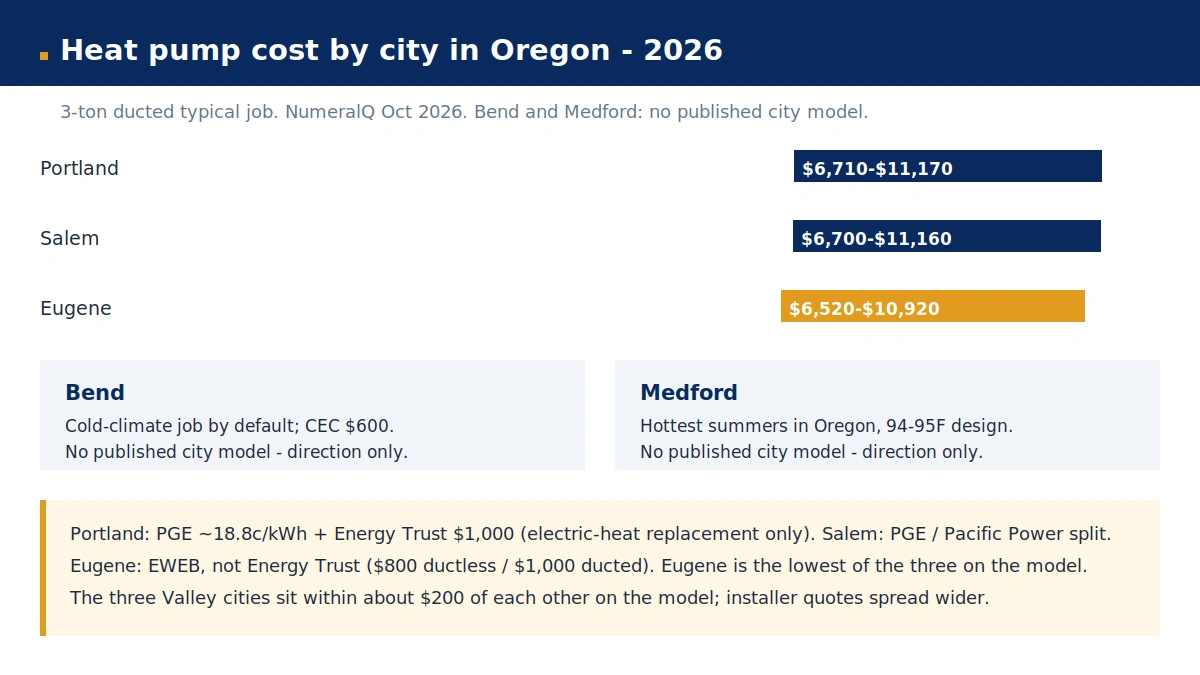
The model prices Oregon’s three Valley cities almost identically for the same 3-ton system — separated by less than two hundred dollars — yet each city reaches that price for different reasons, and installer-quoted reality spreads wider than the model suggests.
| City | 3-ton ducted job, model range | What drives the price |
|---|---|---|
| Portland | $6,710–$11,170 | Largest metro; PGE power at ~18.8c/kWh; older homes, tight lots |
| Salem | $6,700–$11,160 | State capital; PGE/Pacific Power split; similar Valley climate |
| Eugene | $6,520–$10,920 | Lowest of the three on the model; EWEB, not Energy Trust |
Figures: NumeralQ Oregon city pages, October 2026, 3-ton ducted system. No NumeralQ city model exists for Bend or Medford. No band is invented here for them — direction only.
Portland is the biggest and most complicated heat pump market in Oregon. The metro sits in PGE territory, which matters twice over: PGE’s residential rate, about 18.8 cents per kilowatt-hour in 2025, is the highest in the state and weakens the running-cost case exactly where most Oregonians live, and PGE customers are inside Energy Trust territory, so the $1,000 ducted incentive is available to them when they replace electric heat. The housing stock is the other complication: older homes in the inner east side and Sellwood with no ductwork and 100-amp panels, postwar ranches in the suburbs with ducts in unconditioned attics, and new builds in the west hills that price like a different state. A Portland installer guide puts fitted heat pump systems at $7,000–$15,000, with the old-house jobs at the top of that band, and Angi’s Portland page — updated August 4, 2026 — puts the average Portland install at $6,915, with most homeowners paying $4,763–$9,116 and a 3-ton job for a 2,000-square-foot home at $6,915–$9,116. A single-zone mini-split in the Portland area typically runs inside the statewide $3,190–$4,970 band. Portland also requires a Home Energy Score at listing, so a heat pump improves the score a seller shows — relevant at sale time, not at install. And the heat dome is a Portland memory, not an abstraction: 116F on June 28, 2021, and 73 heat deaths in Multnomah County. Cooling capacity on a Portland quote is not a line to trim.
Salem prices a hair below Portland on the model — $6,700–$11,160 against Portland’s $6,710–$11,170 — and the difference is mostly labour and housing age rather than climate. Salem shares Portland’s winter design temperature of 23F and a similar heating load, about 4,754 heating degree days, and it sits in the same mild Valley pattern. What a Salem buyer should check first is the utility name on the bill, because the city straddles service territories and the rebate follows the utility, not the postcode. A PGE customer in Salem is in Energy Trust territory; a Pacific Power customer is too. Either way the standard Energy Trust incentive applies when electric heat is being replaced. Salem’s permit schedule is set by Salem Revised Code 230.020(b)(2)(D) and Table 230-1, and the statewide permit band of $70–$166 covers the usual Salem job.
Eugene is the cheapest of the three on the model at $6,520–$10,920, and it is also the city where the rebate map changes completely. Eugene customers buy power from the Eugene Water and Electric Board, EWEB — a municipal utility that is not in Energy Trust territory. Eugene buyers therefore use EWEB, not Energy Trust, and the amounts differ: EWEB pays a standard $800 ductless or $1,000 ducted, and up to $4,500 ductless or $6,000 ducted for income-qualified owner-occupied homes, with zero-interest loans also available. Those EWEB figures come second-hand via a Palmetto 2026 summary of EWEB programmes, not from eweb.org directly, and an older installer page shows lower amounts — $500 ducted and $850 ductless — that are now outdated. Verify the current amounts on eweb.org before counting the money. Eugene’s climate is a touch warmer in summer than Portland’s, with a design temperature of 22F in winter and 89F in summer, and about 4,726 heating degree days. Eugene adopted a Home Energy Score ordinance on October 28, 2026, becoming the fifth Oregon city to require one at listing.
Bend has no published city price model, and this guide invents none. What can be said with confidence is direction, not dollars. Bend sits east of the Cascades in Zone 5B, with close to 6,926 heating degree days, a heating design temperature around 5F on an installer-marketing page — indicative only, not an IPC or ASHRAE figure — and about 20 inches of snow a year in town. A Bend job is a cold-climate job by default, which means the extended-capacity premium, snow-aware siting, and a raised pad are part of the base price rather than extras. Bend buyers are in Central Electric Cooperative territory, where the current rebate is $600 cash for an ENERGY STAR heat pump system, one per structure, plus a dedicated meter and a discounted electric rate for running the heat pump. An older CEC page lists a $200–$2,500 heat pump rebate plus a $350–$750 duct-sealing rebate; the two pages conflict, the $600 figure is the current rebates page, and this guide quotes $600 and says to confirm the tier with CEC. Bend also requires a Home Energy Score at listing, like Portland. Expect a Bend quote to run above the Valley bands for the same house, because the equipment is dearer and the siting work is heavier — but no published Bend band exists to print, so get three local quotes and compare them against each other, not against a Portland number.
Medford and the Rogue Valley have no published city price model either, and this guide invents none. Stone Heating and Air, a Central Point and Medford installer, quotes only national 2026 ranges — a ducted heat pump roughly $4,500–$14,000 — and explicitly refuses to publish a Medford average, on the grounds that no contractor can tell you where your home lands without looking at it. That refusal is itself useful evidence: there is no published Rogue Valley average to quote. What can be said is that Medford is the summer outlier of Oregon, with a 94–95F design temperature, 562 cooling degree days, and a 115F record tied in the 2021 heat dome. Cooling capacity matters most there, winters are mild at a 23F design temperature, and Medford sits in Pacific Power territory, inside Energy Trust’s area. Expect quotes softer than Portland on labour and heavier on cooling capacity — direction only, no band.
Smaller Oregon cities — Hillsboro, Beaverton, Gresham, Corvallis, Albany, Springfield, Grants Pass, Klamath Falls, Pendleton, Astoria — generally price near the Valley bands or, east of the Cascades, near the Bend direction. Pendleton, with a winter design temperature of 5F and 5,127 heating degree days, is a cold-climate job like Bend. Astoria, on the coast, is mild at a 29F design temperature but brings salt air, which accelerates outdoor-unit corrosion — a coastal install should specify coated coils and more frequent coil cleaning, stated here as installer advice rather than a sourced Oregon fact. Hillsboro, Milwaukie, and Bend already require a Home Energy Score at listing, alongside Portland and now Eugene.
Oregon’s Two Climates: Mild Valley, Cold East
Oregon is split evenly under the 2021 International Energy Conservation Code: Zone 4C across 18 counties and Zone 5B across 18 counties (PNNL-33270, unchanged in the 2024 IECC). Zone 4C is the marine west — the Willamette Valley, the coast, Portland, Salem, and Eugene. Zone 5B is the dry, cool east of the Cascades — Bend, Pendleton, and eastern Oregon. There is no Oregon county in Zone 6 under the 2021 IECC, so no eastern Oregon job should be sold as a Zone 6 job. That correction matters, because a Zone 6 label would imply a colder design case than Oregon actually has — and because a contractor who gets the zone wrong may get the equipment wrong too.
The design temperatures a contractor actually sizes to tell the story in numbers. Portland: winter design 23F, summer 85F, about 4,635 heating degree days and 300 cooling degree days (IPC Appendix D). Salem: winter 23F, summer 88F, about 4,754 heating degree days. Eugene: winter 22F, summer 89F, about 4,726 heating degree days and 239 cooling degree days. Medford: winter 23F, summer 94F, about 5,008 heating degree days and 562 cooling degree days. Pendleton: winter 5F, summer 93F, about 5,127 heating degree days and 656 cooling degree days. Astoria: winter 29F, summer 71F, about 5,186 heating degree days. Burns, in the high desert, logs about 6,957 heating degree days. ASHRAE figures run a touch colder — Portland 22F, Salem 20F, Eugene 21F, Medford 21F, Pendleton 3F, Klamath Falls 4F — but the pattern is the same: the Valley designs to the low 20s, the east designs to single digits.
Through most Valley winters a standard unit needs no help. As the thermometer falls, the unit’s output falls with it. Near 30–35F, most units begin drawing on the electric strips to stay even. In Portland, Salem, and Eugene, that means a modest number of nights. Not weeks at a time. Strip heat is the dearest heat in the house, yet in the Valley it runs on so few nights that the yearly bill barely notices. The east reverses the picture: a standard unit in Bend or Pendleton lives on backup heat for half the winter, which is why the cold-climate premium is the default there and merely optional — sensible mainly east of the Cascades — everywhere else. Bend’s design temperature of about 5F, cited on an installer-marketing page rather than in IPC or ASHRAE tables, is indicative only, but it is consistent with Pendleton’s 5F and Bend’s roughly 6,900 heating degree days, and it points the same way.
Newcomers underestimate the summer, not the winter — and in Oregon the summer now carries a death toll. Portland hit 108F, 112F, and 116F on June 26–28, 2021. Medford tied its all-time record of 115F. Pelton Dam recorded 119F, the official Oregon state record. Seventy-three heat-related deaths were recorded in Multnomah County, and about 500 across Oregon, Washington, Idaho, and British Columbia. Most victims were older, socially isolated, and without central air conditioning. A heat pump’s cooling is a genuine safety feature in the Willamette Valley now, not a luxury — and the 2021 event is why Oregon’s heat pump push is framed as cooling access, not just heating. Medford is the summer outlier: the hottest summers in the state, a 94–95F design temperature, and cooling capacity that should be sized without trimming. Variable-speed equipment earns its keep on the hottest afternoon, not the coldest night, holding its output and running long, gentle cycles where a single-stage unit’s short bursts leave rooms uneven.
Oregon weather touches a heat pump in ways no brochure mentions. Wildfire seasons routinely push smoke into the Willamette Valley and the Rogue Valley; a heat pump with good filtration lets a home cool and filter air with windows closed, though no Oregon-specific quantified figure for that benefit was found, so it stays a qualitative point here. Snow east of the Cascades — about 20 inches a year in Bend, more in the mountains, and about 55 inches in places in eastern Oregon on climate summaries — means a raised pad, defrost clearance, and an outdoor unit kept out of the roof drip line and drifting snow. Columbia Gorge cold-air outbreaks can push Valley temperatures well below design for days, and freezing rain can coat an outdoor unit in ice that cannot defrost properly. A good installer plans for all of this. A cheap one never raises it.
Oregon is a high-adoption state with a statutory goal behind it. House Bill 3409 (2023), now ORS 469.760, aims for at least 500,000 new heat pumps installed by 2030. The Oregon Department of Energy’s 2025 Biennial Heat Pump Report, dated September 15, 2025, puts heat pumps at about 25% of air-conditioning equipment in Oregon as of December 2025, up 7 points since 2023, and its model puts total market share at about 30% — roughly 540,600 residences, multifamily, and commercial buildings — by December 31, 2025. The same report disagrees with itself on the goal: one scenario says Oregon reaches 121,700 new installs by December 31, 2025 and hits the 500,000 goal in June 2033, late; another model says mid-2030. This guide quotes the goal and the roughly 25–30% share, and says ODOE’s own scenarios disagree on whether 2030 is achievable. The state programmes’ output so far is small against the goal: HP3 and the Community Heat Pump Deployment Program together installed 4,638 heat pumps. The gap is the story. About 13% of Oregon homes use a heat pump as their main heat (EIA RECS), against about 54% heating with electricity in some form and 37% with piped gas — Oregon’s main-heat share is lower than some states’ because so many Oregon homes heat with electric resistance, which heat pumps replace.
Heat Pump vs Gas Furnace in Oregon: The Running-Cost Math
Both Oregon fuels sit below the national average, and that is what makes this comparison a genuine argument rather than a foregone conclusion. Oregon residential electricity averages 15.5 cents per kilowatt-hour on the 12-month average to August 2026 (EIA) — 25th lowest in the US, against 18.0 cents nationally. August 2026 alone was 15.92 cents. The average Oregon home’s electric bill runs about $131 a month — $134.77 in August alone, on 847 kilowatt-hours. Residential natural gas runs about $1.61 a therm on the 2025 annual average ($16.71 per thousand cubic feet, EIA Natural Gas Monthly Table 20, October 27, 2026 release; 10.37 therms per thousand cubic feet). Other trailing-average sources agree on the roughly $1.42–$1.67 per therm zone, so this guide uses about $1.60 a therm as the heating-season planning figure and cites the range. Summer monthly gas figures spike — July 2026 at $23.23 per thousand cubic feet, about $2.24 a therm, and August 2026 at $23.65 — because fixed charges spread over tiny summer volumes. Do not use a summer month as the heating price.
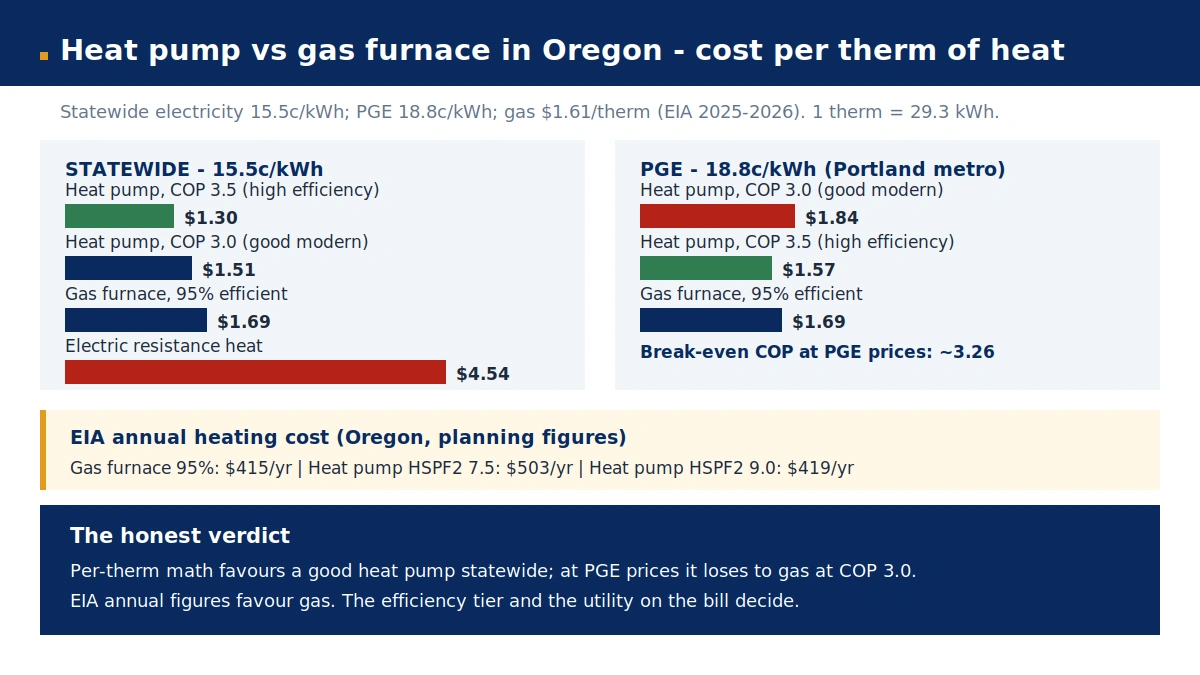
Work it out per therm of heat, where a therm equals 29.3 kilowatt-hours. At the state-average electricity price of 15.5 cents, a good modern heat pump at a seasonal COP of 3.0 delivers that therm for 29.3 x $0.155 / 3.0, or about $1.51. At COP 3.5, a high-efficiency unit delivers it for about $1.30. For a 95%-efficient gas furnace, that therm costs $1.61 / 0.95 — about $1.69. Electric resistance heat, the fuel most Oregon heat pump buyers are actually replacing, delivers it for 29.3 x $0.155, or about $4.54. At COP 3.0 the heat pump beats gas by about 18 cents a therm at the state-average price. On this arithmetic the good heat pump wins.
EIA household heating estimates tell the opposite story, and this guide prints the disagreement rather than hiding it. A 95% gas furnace heats the average Oregon home for about $415 a year; a minimum-efficiency heat pump (HSPF2 7.5, the federal minimum) for about $503 a year; a high-efficiency heat pump (HSPF2 9.0) for about $419 a year. On annual figures, gas wins — even against the high-efficiency heat pump, by $4 a year, and clearly against a minimum-efficiency one. NumeralQ’s own Oregon page says the same thing in plain language: at those prices, a heat pump costs more to run than gas. The two views disagree because a real Oregon winter’s seasonal COP, once cold snaps and strip-heat hours are counted, runs below 3.0, and because Oregon gas is genuinely cheap. An independent model — Blue Ridge Heating and Air, October 13, 2026, using 2024 EIA prices and 2024 heating degree days — also puts Oregon gas ($740 a year) ahead of a heat pump ($910 a year) for a standardised home. Same direction, different absolute numbers, because the home model differs, so cite it as corroboration of direction only. So the verdict stays split — the per-therm sums favour a good heat pump, the EIA yearly figures favour gas, and the tier you choose tips the balance. Printing only one side of that disagreement would be a sales pitch, not a guide.
Now run the same sums at the rate most Portland-metro buyers actually pay, because the statewide average hides a big gap. Portland General Electric, serving about 44.6% of Oregon residential customers, averaged 18.8 cents per kilowatt-hour residential in 2025 (EIA Form 861) — well above the state average — with a $17.00 a month fixed charge plus 11.33 cents per kilowatt-hour in riders on its standard tariff. At 18.8 cents, a heat pump at COP 3.0 delivers a therm for 29.3 x $0.188 / 3.0, or about $1.84 — the heat pump loses to gas at $1.69 outright. The break-even COP at PGE prices is about 3.26. A PGE customer needs a high-efficiency system, COP 3.5 or better, for the fuel maths to work: at COP 3.5 the PGE therm costs about $1.57, a narrow win over gas. Pacific Power customers pay materially less, but no current Pacific Power residential rate was verified from a primary source — an older Palmetto page cites 12.0 cents from 2023 data, which is stale, so this guide quotes no current Pacific Power figure. The practical point stands without it: the fuel-savings case is weakest exactly where most Oregonians live, in PGE territory, and strongest where power is cheapest. A Portland buyer who buys a minimum-efficiency unit on a PGE bill will pay more to run it than the gas furnace it replaced. That is not a reason to keep the furnace. It is a reason to buy the efficient unit, or to buy dual-fuel, or to price the job on its cooling value as well as its heating value.
Two more Oregon situations tilt the sums decisively toward the heat pump. First is a home still on resistance heat — baseboard panels, wall units, or an ageing electric furnace. A heat pump gives the same warmth there for roughly a third of the electricity — about $1.51 a therm against $4.54 at the state-average price — and that is the case where the payback is fastest and the rebate is largest. The other is propane or heating oil, whose fuel costs far more than Oregon power or gas. Judge the heat pump’s $7,500–$13,000 against a furnace and an air conditioner bought together, not against a furnace alone. And remember the other half of the year. A gas furnace sits idle all July, while a heat pump cools for months — and after June 2021, cooling in the Willamette Valley and the Rogue Valley is not a comfort extra. Judge the machine over twelve months, not over one January bill. The full argument is in our heat pump vs furnace comparison, the gas side is priced in our furnace replacement guide, and month-by-month sums live in our running-cost guide.
| Heating system | Cost per therm of heat delivered | EIA estimated annual heating cost (OR) |
|---|---|---|
| Gas furnace, 95% efficient | ~$1.69 | ~$415/yr |
| Heat pump, COP 3.0, statewide 15.5c/kWh | ~$1.51 | — |
| Heat pump, COP 3.5, statewide 15.5c/kWh | ~$1.30 | — |
| Heat pump, COP 3.0, PGE 18.8c/kWh | ~$1.84 | — |
| Heat pump, COP 3.5, PGE 18.8c/kWh | ~$1.57 | — |
| Heat pump, HSPF2 7.5 (federal minimum) | — | ~$503/yr |
| Heat pump, HSPF2 9.0 (high efficiency) | — | ~$419/yr |
| Electric resistance heat, statewide 15.5c/kWh | ~$4.54 | — |
How the table was built: electricity at 15.5 cents per kilowatt-hour statewide and 18.8 cents for PGE, gas at $1.61 a therm (EIA 2025–2026 figures); 1 therm = 29.3 kilowatt-hours. COP here means a planning figure for the whole season, not a laboratory rating. The yearly EIA figures are planning estimates, not forecasts of your bill. They are built from household heating use and current state prices. The two views conflict — the text above explains why. Gas prices also moved in October 2026: NW Natural residential rates rose about 7.3%, roughly $6.30 a month for a typical 54-therm customer, effective October 31, 2026 (OPUC dockets UG 527/528/531; NW Natural serves 700,000+ customers in northwest Oregon), and Cascade Natural Gas residential rates rose about 5.9% effective the same day, a typical 57-therm bill moving from $69.17 to $73.27.
Energy Trust of Oregon & the Other Rebates You Can Collect in 2026
Forget the federal money for a moment. In Oregon in 2026, the live rebate money has one big name in most of the state, and which programme pays you depends entirely on which utility sends your electric bill: Energy Trust of Oregon for Portland General Electric and Pacific Power customers, EWEB in Eugene, and Central Electric Cooperative in Bend and central Oregon. Oregon offers no statewide rebate beyond the state programmes in the next section, and no state tax credit for heat pumps at all — the old Residential Energy Tax Credit expired in 2017 and was never replaced. The utility is the programme — and the amounts are modest, so budget accordingly.
| Programme | What it pays (heat pump) | Key condition |
|---|---|---|
| Energy Trust, ducted heat pump | $1,000 single-family; $3,000 attached/rental/income-qualified | Replaces electric forced-air furnace; HSPF2 7.50+; no gas backup |
| Energy Trust, ductless mini-split | $800 single-family; $1,800 attached/rental/income-qualified | Replaces electric zonal heat; HSPF2 8.10+; inverter-driven |
| Energy Trust, extended-capacity ducted | $1,000 single-family; $2,000 attached/income-qualified | CEE Tier 1 Path A; can replace any heating system; no gas backup |
| Energy Trust, manufactured home | Up to $4,000 ducted; up to $3,500 ductless | Participating trade ally; replacing electric heat |
| Energy Trust, No-Cost Offer (to Dec 31, 2026) | Up to $15,000 ducted; $6,500–$9,600 ductless | At or below 80% AMI; PGE/Pacific Power; electric resistance only |
| EWEB (Eugene only) | $800 ductless / $1,000 ducted; up to $4,500/$6,000 income-qualified | Verify on eweb.org (second-hand figures) |
| Central Electric Cooperative (Bend) | $600 cash + discounted heat-pump rate | ENERGY STAR system; one per structure; confirm tier with CEC |
| Portland PCEF Energy Friendly Homes | No verified 2026 heat-pump dollar amount found | Ask about it; do not budget on a figure |
Sources: Energy Trust of Oregon Information Sheet PI 320I-HP v2026.4 (Sep 9, 2026) and forms v2026.6 (Oct 5, 2026); Energy Trust No-Cost Heat Pump Offer reference guide (updated Oct 2026); EWEB via Palmetto 2026 summary; Central Electric Cooperative current rebates page; Energy Trust 2026 multifamily incentive updates.
Energy Trust of Oregon is the programme most Oregon buyers will actually collect from, and its central rule is the one this guide keeps repeating: the standard incentives pay only when the new heat pump replaces electric heat. A ducted heat pump pays $1,000 for a single-family or manufactured home, and $3,000 for an attached residence such as a duplex or townhome, a rental property, or a Savings Within Reach income-qualified household. Conditions: HSPF2 of 7.50 or better, replacing an electric forced-air furnace as the primary heat, no gas backup, and — for the $3,000 tier — installation by a participating trade ally. A ductless mini-split pays $800 single-family or manufactured home, and $1,800 for an attached residence, a rental, or a Savings Within Reach household. Conditions: inverter-driven, HSPF2 of 8.10 or better, replacing electric zonal heat — baseboard or wall heaters — in the main living space, one incentive per residence. Amounts and rules change annually, and work must be completed through December 31, 2026 on the current forms.
The exception to the electric-heat-only rule is the extended-capacity (cold-climate) ducted heat pump tier: $1,000 single-family, $2,000 attached or income-qualified. Conditions: it must meet CEE Tier 1 Path A — SEER2 of 16 or better, HSPF2 of 8.5 or better, and a COP of 1.75 or better at 5F — it can replace any heating system, including gas, but no gas backup is allowed, and it cannot be combined with other heat pump incentives. That tier is the one route by which a gas-heated home collects Energy Trust money for a heat pump, and it is also the tier that fits Bend and Pendleton anyway. A manufactured-home promotion pays up to $4,000 ducted or $3,500 ductless through a participating trade ally replacing electric heat. A regional promotion in Gilliam, Morrow, Umatilla, and Wallowa counties pays up to $4,000 ducted or $3,500 ductless, according to an AE Heating summary from October 2026 — second-hand, verify on energytrust.org. Multifamily in 2026 pays $1,000–$2,000 per ducted heat pump per unit for stacked properties, and the extended-capacity multifamily incentive was retired in 2026.
The No-Cost Heat Pump Offer is the one route to a near-free system, and it is narrowly targeted. Updated in October 2026 and running through December 31, 2026 or while budget lasts, it covers households at or below 80% of Area Median Income, on PGE or Pacific Power, replacing electric resistance heat: ductless one-to-one at $6,500, ductless two-to-one at $9,600 for a site-built home or $9,000 attached, ducted at $15,000 site-built or $13,000 for a manufactured home, and a heat pump water heater at $4,400. No gas-equipment replacement is allowed. Time-limited and budget-capped — verify availability before quoting it to yourself, because a budget-capped offer can close without warning.
EWEB is Eugene’s programme, and Eugene customers use EWEB, not Energy Trust. The standard amounts are $800 ductless and $1,000 ducted, rising to $4,500 ductless and $6,000 ducted for income-qualified owner-occupied homes, with zero-interest loans also available. Those figures come via Palmetto’s 2026 summary, not from eweb.org directly, and an older installer page shows lower amounts that are now outdated. Verify the current amounts on eweb.org.
Central Electric Cooperative is Bend’s programme. The current rebates page pays $600 cash for an ENERGY STAR heat pump system, one per structure, plus a dedicated meter and a discounted electric rate for operating the heat pump. An older CEC page lists a $200–$2,500 heat pump rebate plus a $350–$750 duct-sealing rebate; the two pages conflict, the $600 figure is the current page, and this guide quotes $600 and says to confirm the tier with CEC.
Check with the local utility and do not invent one. The City of Portland’s Portland Clean Energy Fund launched an Energy Friendly Homes Program offering no- or low-cost efficiency improvements in Portland, but no verified 2026 heat-pump dollar amount was found — mention it only as something to ask about, and do not quote a figure.
Other consumer-owned utilities — Hood River Electric Co-op, Northern Wasco County PUD, and the rest — had no verified 2026 residential heat pump rebate amounts found for this guide. Check with the local utility and do not invent one. The City of Portland’s Portland Clean Energy Fund launched an Energy Friendly Homes Program offering no- or low-cost efficiency improvements in Portland, but no verified 2026 heat-pump dollar amount was found — ask about it, and do not budget on a figure.
Stack the numbers honestly: a $1,000 Energy Trust rebate off a $10,000 job is a 10% discount, real money and not a decision-maker. It is not the five-figure stack some other states’ homeowners collect, and it is not the $8,000 federal rebate that has not launched in Oregon. Count the utility rebate as a windfall, never as the foundation of the budget. In 2026, it is. And remember the fuel rule that governs the whole stack: the best-subsidised Oregon heat pump customer heats with electricity today. A gas-furnace home gets far less — no Energy Trust standard ducted incentive, no HP3 owner-occupied money, and, when it launches, no HEAR money for a gas-to-heat-pump switch under Program Notice 26-2.
Federal Help in 2026: $0 Tax Credit, HP3 Exhausted for Homeowners & HEAR Not Launched
Federal help in Oregon in 2026 is nearly non-existent, so this section is short — and the part that does exist has not arrived, or has already run out for the people most likely to read this guide.
The tax credit is $0. The One Big Beautiful Bill Act (Public Law 119-21, signed July 4, 2025) ended both federal credits once the calendar passed December 31, 2025. Both credits are gone: §25C, the Energy Efficient Home Improvement Credit at 30% up to $2,000 a year for heat pumps, and §25D, the Residential Clean Energy Credit. The IRS confirmed it in FS-2025-05. A heat pump fitted in an Oregon home in 2026 earns no federal tax credit at all. If a 2026 quote still deducts a $2,000 federal credit, it is stale — or the contractor hopes you will not notice. Tell them to strike it. For the statute and the IRS notice, read our federal energy tax credits guide.
Oregon has no state tax credit either. The Oregon Residential Energy Tax Credit ran from 1977 to 2017 — about 600,000 Oregonians received credits over its life — and expired on December 31, 2017, with final applications accepted to June 1, 2018. It was not replaced by any state tax credit. No Oregon state tax credit for heat pumps exists in 2026. Only pre-2018 carryforward credits on old ODOE certificates remain claimable, which is irrelevant to a 2026 buyer. A solar-only side note, to prevent confusion: ORS 307.175 exempts net-metered solar from property tax for tax years beginning on or before July 1, 2029. It does not apply to heat pumps.
HP3 is exhausted for owner-occupied homes. The Oregon Department of Energy’s Heat Pump Purchase Program, HP3, pays $2,000 per home, one per residence, for a system at HSPF2 8.1 or better and SEER2 16 or better, installed by an ODOE-approved contractor, and it cannot stack with federally funded programmes such as HOMES or HEAR. The programme opened on June 17, 2025, and Round 2 funding of $12 million was released on November 3, 2025. As of the ODOE funding table updated November 5, 2026, owner-occupied funding is fully reserved: $0 left, 0 of 2,000 incentives. What is still open is rentals, at $1,910,000 remaining out of 6,000 incentives with 955 left, and new construction, at $6,534,000 remaining out of 4,000 incentives with 3,267 left. The practical consequence is blunt: a typical owner-occupied buyer in 2026 gets $0 from HP3. Only landlords and new builds can still claim it. A contractor who tells an owner-occupier that HP3 will pay $2,000 toward their 2026 job is working from old information.
Oregon’s HEAR rebate remains unlaunched. HEAR, the Home Electrification and Appliance Rebates programme under IRA §50122, is the federal scheme in question. Income-qualified households could collect up to $8,000 toward a heat pump in the federal design, with the biggest rebates under 80% of area median income and eligibility to 150%, paid as a point-of-sale discount. Oregon’s allocation for HEAR and HOMES combined runs to over $113 million — the exact split between the two programmes was not verified from a primary source, so this guide states no split. ODOE opened contractor enrollment on October 12, 2026, announced September 22, 2026, and ODOE Director Janine Benner said then that she was optimistic the US Department of Energy would approve Oregon’s home energy rebate programmes for launch soon. Homeowner rebate applications have no launch date and will open only after US DOE approval. Delivery, once launched, runs through Energy Trust of Oregon in PGE and Pacific Power areas and through Earth Advantage in consumer-owned utility and Idaho Power areas. The planned design calls for HEAR up to 150% of area median income, covering 50–100% of project costs up to $14,000, and HOMES for all incomes, 50–100% up to $10,000, with single-family homes first and multifamily and in-store HEAR coupons to follow in 2027. ODOE’s original spring-2026 launch did not happen. No retroactive rebates will be paid — work completed before launch will not qualify — the same warning as every other state in this series.
The rules changed while Oregon waited. DOE Program Notice 26-2, issued May 29, 2026, removed the fuel-switching allowance from HEAR: from September 1, 2026, once Oregon’s programme opens, rebates cover electric-to-electric replacements only, and a gas-to-heat-pump conversion will not qualify. The sharpest consequence lands on the most common Oregon scenario after baseboard heat: a gas-furnace home considering a heat pump. Even after launch, that household will not collect the HEAR money. Once HEAR opens, its help reaches homes already heating with electricity — resistance heat, old electric furnaces, and ageing heat pumps. Keep the timing trap in mind: work done today, ahead of launch, can never collect the rebate, whenever the programme opens.
The one federal-money route still open in principle is leasing. The One Big Beautiful Bill Act left the §48E clean-electricity investment credit open for systems placed in service by December 31, 2027, and heat-pump leasing and subscription products are marketed in Oregon — Palmetto’s Comfort Plan offers heat pumps in Bend and Eugene with $0 upfront, a monthly subscription, and maintenance and repairs included. But no primary source was found confirming that any specific Oregon lease product passes a §48E credit through to the homeowner, or the exact §48E mechanics for residential heat-pump leases. This guide says leasing exists and is the one federal-money route still open in principle, and it does not promise a specific dollar saving from §48E. Ask the leasing company, in writing, what federal credit value — if any — is passed through to you, and treat a vague answer as no answer.
Two smaller state programmes deserve a sentence each, to prevent confusion. The Community Heat Pump Deployment Program, created by Senate Bill 1536 in 2022, makes grants to regional administrators for low-income households — up to $5,000 off a minimum-efficiency heat pump or $7,000 off a higher-efficiency one, plus up to $4,000 for related upgrades. As of June 30, 2025 it had served 696 owner-occupied homes, with $4,076,215 in incentives, an average install cost of $10,062, and average assistance of $5,857, with 95% or more prioritised households. But no additional funding came in the 2025 legislative session, ODOE staffing for it ended June 30, 2025, and at report time only the North Coast region and the Burns Paiute Tribe were accepting applications. A later AE Heating summary dated October 9, 2026 says the North Central and North Coast regions were open — a slight conflict with the December 2025 report — so availability is region-by-region and shrinking, and this guide says to verify at incentives.oregon.gov. The Oregon Solar + Storage Rebate reopened June 15, 2026, its $1.1 million was fully reserved, and it closed again; it is solar only, not heat pumps, and is mentioned here only to prevent confusion.
Never build an Oregon budget around HEAR, HP3 for an owner-occupied home, or a federal tax credit. Before signing, check ODOE’s home energy rebate programmes page, and treat any future launch as upside rather than plan.
Permits & Licensing: Oregon’s CCB License
Oregon licenses contractors statewide, and the difference works in the homeowner’s favour. Oregon does have statewide contractor licensing through the Construction Contractors Board, the CCB — anyone working for compensation on improvements to real property must hold a CCB license under ORS 701, and heating and air conditioning is explicitly listed as work requiring one. That gives you a genuine state licence number to demand, a genuine state exam behind it, and a genuine state office for complaints.
Getting that license is not trivial, which is the point. The process runs through 16 hours of pre-license training plus the Oregon contractor exam for the Responsible Managing Individual, a determination of endorsement, a surety bond, general liability insurance — $500,000 per occurrence for a Residential General Contractor, $300,000 for a Residential Specialty Contractor, $100,000 for a Residential Limited contractor — workers’ compensation cover if the firm hires employees, and a $400 fee for a two-year license. Applications take 6–8 weeks. Verify any contractor at ccb.oregon.gov before signing. Named examples from this guide’s sources show what a checkable number looks like: Duct Guys, CCB #179150, and Stone Heating and Air, CCB #224159.
A second license sits underneath the CCB one for service and replacement work. The Limited Maintenance Specialty Contractor — HVAC/R, or LHR, runs through the Building Codes Division: a $75 fee, renewed every 3 years on July 1, no exam, but it requires an active CCB license and a full-time signing supervisor, and it covers maintenance, service, repair, and replacement of built-in HVAC equipment. Two further requirements sit underneath both licences. EPA Section 608 certification is required federally for anyone handling refrigerant — no exceptions. And the Oregon Mechanical Specialty Code governs HVAC design and installation statewide.
A mechanical permit is required for a system replacement wherever a building department exists. NumeralQ’s 35-city check puts typical permit fees at $70–$166. The City of Portland Bureau of Development Services charges a heat pump permit fee of $77 plus a site plan. Salem’s permit schedule is set by Salem Revised Code 230.020(b)(2)(D) and Table 230-1. Demand the permit number in writing, with the installer pulling the permit — a contractor who asks you to pull it is handing you the liability. The federal minimum efficiency under DOE rules is 14.3 SEER2 and 7.5 HSPF2 for a split-system heat pump, in force since January 1, 2023.
Refrigerant and sale-time rules round out the section. New home systems run on R-454B or R-32 now. R-410A left new home systems from 2025 under the EPA Technology Transitions rule, which caps global warming potential under 700. Look at the refrigerant on every quote, and refuse a new R-410A system at a 2026 price: yesterday’s equipment at today’s price. And if you plan to sell, note that Portland, Hillsboro, Milwaukie, and Bend already require a Home Energy Score at listing, and Eugene adopted the same ordinance on October 28, 2026, becoming the fifth Oregon city. A heat pump improves the score. That matters at sale time, not at install — but it is one more reason the machine is worth pricing properly.
What Pushes Your Oregon Quote Up or Down
Two quotes for one house can differ by $3,000, and the hardware is almost never why. Everything around the equipment is. The line items below move an Oregon quote, in the order they usually show up.
No other line moves an Oregon quote as far as the ductwork does. Fitting new or extended ductwork costs $4,250–$7,180 per job in Oregon (NumeralQ). Oregon duct runs often sit in vented crawlspaces, basements, or hot attics. Duct leaks there can waste a fifth or more of the conditioned air before it reaches a room. A heat pump price with no duct inspection attached is only half a job priced. Duct sealing repays its cost, yet it is the item a cut-price bid most often omits. Undersized, collapsed, or disconnected ducts in the crawlspace will get blamed on the new heat pump — so have the ducts inspected and priced separately. Central Electric Cooperative’s older programme page paid $350–$750 for duct sealing, which gives a sense of the scale of that companion work.
The electrical panel is the next swing, and in Oregon it swings further than in most states. A heat pump needs a dedicated 240V circuit, and a panel that is full, still 100-amp, or short of spare breaker space means a 200-amp upgrade at $3,080–$4,600 installed in Oregon (NumeralQ) — notably higher than the national $2,180–$3,430 band on NumeralQ’s national page, and higher than the $2,100–$3,330 seen in some neighbouring state guides. Older Portland homes in the inner east side and postwar Salem ranches on 100-amp panels hit this regularly. Electricians in Oregon earn a median $48.71 an hour (BLS, May 2025), billed at $97–$127 an hour once insurance, payroll taxes, overhead, and profit are counted. List the panel on its own line in the quote, so the $4,000 reads as panel rather than profit. That panel work is priced in our electrical panel upgrade guide.
Sizing decides whether the system truly works or merely runs, and only a load calculation sizes it honestly. Load calculations run $200–$500 on national figures, usually credited back against the install. Nothing else sizes a system honestly for a state with a mild Valley winter, a 5F east-side design night, and a heat-dome summer — too big and the house stays clammy, too small and it leans on strip heat. Nameplate figures and floor area alone are guesses, not sizing.
Refrigerant matters in 2026. A new Oregon system in 2026 should run on R-454B or R-32. EPA rules ended R-410A in new home systems in 2025. Confirm the refrigerant on each quote, and say no to a new R-410A system at a 2026 price.
Efficiency tiers are a real choice, not a step on a sales ladder. A variable-speed system holds its output on the coldest nights, dehumidifies properly on the stickiest afternoons, and — for a PGE customer — is the difference between a heat pump that beats gas and one that loses to it, because the break-even COP at PGE prices is about 3.26. Duct Guys puts variable-speed and inverter equipment in Portland at $12,000–$18,000+, against $8,000–$12,000 for a mid-range ducted system. Variable-speed costs real money, and in Oregon it earns that back through shoulder-season efficiency, heat-dome cooling, and — east of the Cascades — cold-weather capacity, not through the SEER2 number in the brochure. Compare the tiers with rebates applied, and weigh the premium on ten years of summers and winters, not on one rating.
East-side siting is an Oregon line item other states do not carry in the same form. For a few hundred dollars you can buy a raised pad, defrost clearance, and sensible siting against snow, drifting, and the roof drip line. That is cheap protection for a $10,000 machine in a state where Bend averages about 20 inches of snow a year in town and eastern Oregon sees about 55 inches in places. On the coast, salt air accelerates outdoor-unit corrosion, so a coastal install should specify coated coils and more frequent coil cleaning — stated as installer advice, not as a sourced Oregon fact. In the Gorge, cold-air outbreaks bring freezing rain and ice to the Portland metro. If the quote leaves siting protection out, ask what it costs as an add-on. Oregon is also Cascadia subduction-zone territory, so outdoor units should be properly anchored — general siting advice here, not a code requirement, because no heat-pump-specific seismic source was found for this guide.
Labour and timing round out the list. Oregon HVAC mechanics and installers earn a median $30.26 an hour (BLS, May 2025), with a mean of $32.90, a 10th percentile of $22.59, and a 90th percentile of $45.44, across 3,980 jobs statewide. Contractors bill $61–$79 per worker-hour once insurance, payroll taxes, overhead, and profit are counted. Metro medians run higher: Portland–Vancouver–Hillsboro at $31.38 an hour ($65,260 a year, 2,580 jobs), Salem at $31.27 ($65,050 a year), Bend at $61,150 a year, Eugene–Springfield at $60,050 a year, and Grants Pass at $23.17 an hour, the lowest in the state. One figure in circulation should not be quoted alongside the billed rate as if it were the same thing: Angi’s Portland page lists HVAC labour at $160 an hour per worker, which conflicts sharply with NumeralQ’s $61–$79 billed-rate estimate. Different metrics — Angi may bundle crew and overhead or quote a different rate basis — so this guide does not present them as the same number. Spring and fall installs run cheaper and faster than peak summer — and a busy installer is a reassuring sign, not a problem. During wildfire smoke season, budget for a good filter and check it after smoke season; a heat pump lets the home stay sealed and filtered, though no quantified Oregon figure for that benefit was found.
Payback: When Does an Oregon Heat Pump Pay for Itself?
What the heat pump replaces decides the payback in Oregon, because cheap electricity and cheap gas make the fuel sums a near-tie rather than a rout — and because the utility on the bill changes the answer. There is no one payback number in Oregon. The answer splits into three cases, and the cases barely resemble each other. Every figure in this section is this guide’s own illustrative arithmetic from the prices in the running-cost section, labelled as such, not a published payback study. No Oregon-specific payback study was found.
Swapping out electric resistance heat: about 3–5 years to payback. It pays back faster than any other case in the state, and it turns up everywhere: all-electric homes, older apartments, and houses with baseboard heat. A heat pump delivers the same heat for about a third of the electricity — about $1.51 a therm against $4.54 at the state-average price — so on a $10,000 system with a $1,000 Energy Trust rebate, or up to $15,000 through the No-Cost Offer for a household at or below 80% of area median income, the yearly savings against resistance heat run into four figures, and the system pays for itself faster than in almost any other state. A home heated by baseboards or an old electric furnace can skip the payback tables and move straight to getting quotes. This is also the case where the rebate stack is largest, the fuel saving is largest, and the HEAR design — when it eventually launches — is aimed. Everything lines up for this household.
Old heat pump or furnace-plus-AC pair replaced: roughly 7–12 years to pay back. Efficiency does the work — a modern variable-speed system against a 15-year-old single-stage one — plus the gain from retiring two ageing machines at once. The utility rebate helps a little. Remember the air conditioner that would otherwise have needed buying. Compare the heat pump with furnace-plus-AC, and the gap narrows fast. For a PGE customer, buy the high-efficiency tier here: at 18.8 cents a kilowatt-hour, a minimum-efficiency unit loses to gas on fuel alone, while a COP 3.5 unit wins narrowly, so the tier choice moves the payback by years.
Working gas furnace out: 8–12 years, possibly longer on fuel alone. No sales pitch will tell you that. At $1.61 a therm against 15.5-cent electricity, a high-efficiency heat pump saves a little on fuel each year on the per-therm arithmetic — and saves nothing at all on the EIA’s annual figures, which put a high-efficiency heat pump at $419 a year against a 95% gas furnace at $415. For a PGE customer the fuel case is worse: at COP 3.0 the heat pump loses to gas outright. The switch needs another reason: a dying air conditioner, a furnace at end of life, a wish for one system instead of two, or the cooling that a furnace never provides — cooling that, after the June 2021 heat dome, is a health feature in the Willamette Valley and the Rogue Valley. Many Oregon homes with gas service and a furnace under ten years old will find dual-fuel is the answer. Gas furnace on the coldest nights, heat pump through the shoulder seasons, and the Energy Trust extended-capacity tier — the one tier that pays a gas-heated home — if the system meets CEE Tier 1 Path A and carries no gas backup.
Two more payback facts. First, the utility rebate only shortens every payback above by a few months — $800–$1,000 off the front is real money on a $10,000 job, but a fraction of what some other states’ homeowners collect, and $0 for a gas-heated home on a standard ducted swap. The No-Cost Offer is the exception: up to $15,000 for a qualifying household changes the payback to near-immediate, which is why its income and electric-heat conditions matter so much. Next, servicing is neither free nor optional. Yearly professional service runs $150–$300 on national figures, and filters need changing every 1–3 months. No Oregon-specific maintenance price was found, so that figure is flagged as national. A neglected heat pump loses efficiency faster than the brochure admits. Looked after properly, a system runs 12–15 years as the planning figure on NumeralQ’s listing, with 15–20 years as the well-maintained case on general guides. Neglect the servicing and the payback sums collapse without anyone noticing. Running costs across the years are in our heat pump maintenance guide and heat pump repair guide; month-by-month sums are in our running-cost guide.
Getting Quotes in Oregon: The Checklist
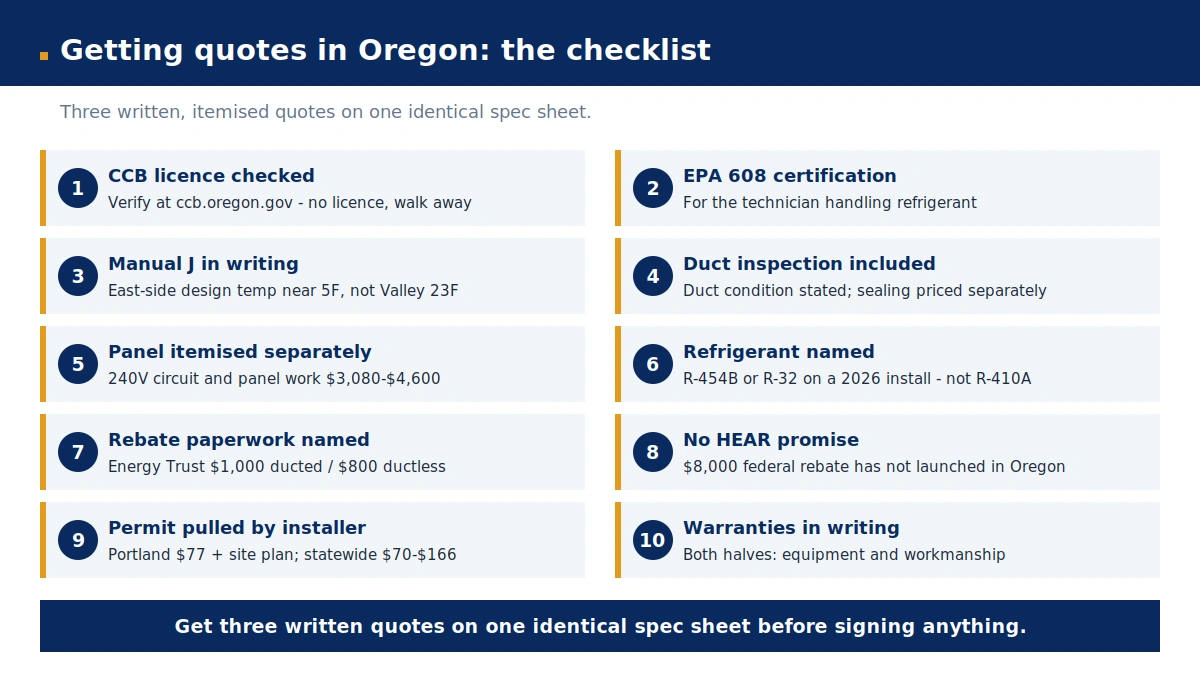
Collect three written, itemised quotes, each built to one identical specification: same tonnage, same efficiency ratings, same duct work, same electrical work, same permit — hold everything fixed except the price. Unless bids line up side by side, line for line, there is no honest comparison — and the cheapest bid usually has the most lines missing. In Oregon, add one more constant to the specification: the utility name and the fuel being replaced, because both change the rebate and the running-cost answer.
- CCB licence checked. Oregon licenses contractors statewide through the Construction Contractors Board — ask for the CCB number and check it at ccb.oregon.gov. No CCB licence is a walk-away. Ask also about the LHR endorsement for service and replacement work.
- EPA 608 held by the person handling the refrigerant on the job. Federal law allows no exceptions.
- Get the Manual J load calculation on paper before anyone orders equipment. Sizing from square footage is a guess. In Bend or Pendleton, the Manual J should show a design temperature near 5F, not a Valley 23F.
- Ducts inspected and priced. State the duct condition in the bid, and list sealing or replacement as a separate line. A bid that says nothing about ducts has left part of the job unpriced.
- Panel shown separately. Put the 240V circuit and any panel work on their own lines, never folded into the headline total. In Oregon that line often runs $3,080–$4,600.
- Refrigerant stated. A 2026 install should name R-454B or R-32 on the quote. R-410A is last year’s equipment.
- Rebate paperwork spelled out. Energy Trust ($1,000 ducted or $800 ductless, electric-heat replacement only) or EWEB in Eugene or Central Electric Cooperative in Bend — with the efficiency threshold, the territory, and the fuel condition checked. Any federal credit line on the bid should read $0 for a 2026 install, and any HP3 line for an owner-occupied home should read $0 too.
- No HEAR promise. A contractor who promises the $8,000 federal HEAR rebate on an Oregon job in 2026 is promising money that has not launched — and work finished before launch can never collect it. Reject the promise, not necessarily the contractor — and remember who made it.
- Permit in the installer’s name, and ask for its number in writing before work starts. Never pull it yourself. Portland’s heat pump permit fee is $77 plus a site plan; the statewide band runs $70–$166.
- Both warranties in writing. Equipment cover usually runs 10 years on parts, with longer compressor cover on premium brands. Contractor workmanship cover, usually 1–10 years, matters even more than the parts cover. Get both before signing.
Oregon-specific red flags: a “federal tax credit” line on a 2026 bid; an HP3 rebate promised to an owner-occupier when the owner-occupied pot is empty; a HEAR rebate promised before ODOE opens the programme; an Energy Trust standard rebate quoted for a gas-furnace home on a standard ducted swap; a TVA or LG&E rebate quoted for an Oregon home at all; a whole-home quote near $5,000 with no duct or electrical lines; a standard unit quoted for a Bend or Pendleton home without the cold-climate premium; and any contractor sizing the system from the old unit’s nameplate without a load calculation. The strongest Oregon installers run two to three weeks out in peak season; a crew able to start tomorrow deserves scepticism, not a signature. For the neighbouring-state comparison, see our Washington heat pump cost guide — Washington is the closest market to Oregon’s, and the contrast in rebates and rates is instructive.
Sources & methodology
Cost anchors: NumeralQ’s “Heat Pump Cost in Oregon (2026)” estimator, priced October 26, 2026 from Fixr, This Old House, Home Depot prices, and BLS May 2025 wages, is the primary Oregon anchor — 3-ton ducted $6,620–$11,060; size table (1.5t $4,470–$7,160 through 5t $9,500–$16,260); type table (cold-climate ducted $8,700–$15,150; single-zone mini-split $3,190–$4,970; 3-head $6,340–$11,300; geothermal $20,410–$32,120); city table (Portland $6,710–$11,170; Salem $6,700–$11,160; Eugene $6,520–$10,920); ductwork $4,250–$7,180; panel $3,080–$4,600; permits $70–$166; HVAC median pay $30.26 an hour, billed $61–$79 an hour; electricians $48.71 an hour, billed $97–$127 an hour; EIA heating-cost table (gas furnace $415 a year; heat pump HSPF2 7.5 $503 a year; HSPF2 9.0 $419 a year); about 13% of Oregon homes heat mainly with heat pumps. NumeralQ’s “HVAC Replacement Cost in Oregon (2026)” gives dual-fuel at $9,320–$15,240 and packaged units at $7,100–$10,100, with city full-system figures (Portland $8,510–$14,330; Salem $8,500–$14,320; Eugene $8,310–$14,070). TryDun’s heat pump cost page (August 2026) puts Oregon ducted air-source at $8,250–$15,250 — reported here and flagged as reading high against the NumeralQ model. Duct Guys, a Portland installer (CCB #179150), puts a professionally installed ducted heat pump in the Portland metro at $7,000–$15,000, with a basic replacement at $7,000–$9,000, mid-range ducted at $8,000–$12,000, higher-efficiency at $10,000–$15,000, variable-speed at $12,000–$18,000+, and a heat pump plus gas furnace hybrid at $12,000–$20,000+. Stone Heating and Air, a Central Point and Medford installer (CCB #224159), published July 9, 2026 and updated October 1, 2026, quotes only national ranges and refuses to publish a Medford average. Modernize’s Oregon pages (2026) average $10,500 statewide, identical on every Oregon city page, so treated here as a statewide template number rather than a city-measured average. Angi’s Portland page (updated August 4, 2026) puts the average Portland install at $6,915, most homeowners $4,763–$9,116. Article 1 (Nestpriced) puts the US baseline at $7,500–$15,000. The headline $7,500–$13,000 band and the near-$10,000 typical job are this guide’s synthesis of the NumeralQ model band, installer ranges, and marketplace averages; no published Oregon statewide installer average was found.
Rates: EIA Electric Power Monthly Table 5.6.A (August 2026, released October 2026), via Where’d My Money Go? (updated October 29, 2026) — Oregon residential electricity 15.5 cents per kilowatt-hour on the 12-month average to August 2026 (August 2026 alone 15.92 cents), 25th lowest in the US against 18.0 cents nationally; average bill about $131 a month ($134.77 in August, 847 kilowatt-hours); monthly range 14.6 cents (February 2026) to 16.3 cents (June 2026). PGE residential averaged 18.8 cents per kilowatt-hour in 2025 (EIA Form 861), serving about 44.6% of Oregon residential customers, with a $17.00 a month fixed charge plus 11.33 cents per kilowatt-hour in riders. No current Pacific Power residential rate was verified from a primary source. EIA Natural Gas Monthly Table 20 (October 27, 2026 release) — Oregon residential gas about $1.61 a therm on the 2025 annual average ($16.71 per thousand cubic feet; 10.37 therms per thousand cubic feet); 2024 annual average $15.38 per thousand cubic feet (about $1.48 a therm). Trailing-average sources range $1.42–$1.67 a therm (ElectricChoice November 2026: $1.42; BallparkLab through April 2026: $1.67; EIA SEDS 2024: $1.46). We worked the per-therm arithmetic out ourselves from those EIA prices at 29.3 kilowatt-hours per therm. It gives $1.51 for a heat pump at COP 3.0 and $1.69 for a gas furnace at 95% at the state-average price, and $1.84 for a heat pump at COP 3.0 at the PGE rate, with a break-even COP of about 3.26 at PGE prices. CONFLICT FLAGGED: the per-therm arithmetic favours a good heat pump at the state-average price, while the EIA annual planning figures show gas marginally cheaper ($415 a year vs $419 a year for a high-efficiency heat pump) — the draft reports both and explains the gap. Blue Ridge Heating and Air (October 13, 2026) corroborates the direction only ($740 a year gas vs $910 a year heat pump, different home model). NW Natural rates rose about 7.3% effective October 31, 2026 (OPUC dockets UG 527/528/531); Cascade Natural Gas rose about 5.9% the same day.
Climate: IECC 2021 zones (PNNL-33270) — Oregon Zone 4C (18 counties) and Zone 5B (18 counties), unchanged in the 2024 IECC, with no Oregon county in Zone 6. IPC Appendix D Table D101 design temperatures (Portland 23F/85F, HDD 4,635 / CDD 300; Salem 23F/88F, HDD 4,754; Eugene 22F/89F, HDD 4,726 / CDD 239; Medford 23F/94F, HDD 5,008 / CDD 562; Pendleton 5F/93F, HDD 5,127 / CDD 656; Astoria 29F/71F, HDD 5,186; Burns HDD 6,957) and ASHRAE 90.1-2013 Table D-1 (Portland 22F/86F; Salem 20F/87F; Eugene 21F/87F; Medford 21F/95F; Pendleton 3F/93F; Bend HDD65 6,926; Klamath Falls 4F/87F). Bend design temperature 5F/92F via a Palmetto marketing page — indicative only. June 2021 heat dome via the Portland NET after-action report and WeatherTogether review (Portland 108F, 112F, 116F June 26–28, 2021; Medford 115F; Pelton Dam 119F state record; 73 deaths in Multnomah County; about 500 across OR/WA/ID/BC). Heating fuel mix: Census ACS 2020–2024 via NumeralQ (electricity about 54%, piped gas about 37%) and EIA RECS (about 13% main-heat heat pumps). HB 3409 (2023), ORS 469.760, 500,000 new heat pumps by 2030; ODOE 2025 Biennial Heat Pump Report (September 15, 2025) — about 25% of air-conditioning equipment, about 30% market share (about 540,600 buildings), with scenarios disagreeing on the 2030 goal (June 2033 vs mid-2030). NEEA via the Clean Energy Transition Institute (about 25% of Northwest single-family homes used some form of heat pump in 2022, up from about 15% in 2017).
Rebates: Energy Trust of Oregon Information Sheet PI 320I-HP v2026.4 (September 9, 2026) and forms v2026.6 (October 5, 2026) — ducted $1,000/$3,000, ductless $800/$1,800, extended-capacity $1,000/$2,000, manufactured-home promotion up to $4,000/$3,500, regional promotion via AE Heating (October 2026, second-hand); No-Cost Heat Pump Offer reference guide (updated October 2026, through December 31, 2026) — up to $15,000 ducted; 2026 multifamily incentive updates. EWEB amounts via Palmetto 2026 summary — second-hand, verify on eweb.org; older JCO page ($500/$850) outdated. Central Electric Cooperative current rebates page ($600 cash plus discounted rate) vs an older CEC page ($200–$2,500 plus $350–$750 duct sealing) — conflict flagged, $600 quoted. No verified 2026 rebate amounts found for Hood River Electric Co-op, Northern Wasco County PUD, or other consumer-owned utilities. Portland PCEF Energy Friendly Homes Program — no verified 2026 heat-pump dollar amount found.
State programmes: ODOE HP3 programme page, funding table updated November 5, 2026 — $2,000 per home, HSPF2 8.1+ and SEER2 16+, owner-occupied $0 left (0 of 2,000), rentals $1,910,000 left (955 of 6,000), new construction $6,534,000 left (3,267 of 4,000); programme opened June 17, 2025, Round 2 $12 million released November 3, 2025. ODOE Community Heat Pump Deployment Program report (December 2025) — up to $5,000/$7,000 plus $4,000 upgrades, 696 homes, $4,076,215, average install $10,062, average assistance $5,857; AE Heating (October 9, 2026) conflicts on open regions — flagged. Oregon Solar + Storage Rebate reopened June 15, 2026, $1.1 million fully reserved, closed again, solar only. RETC history via SunBridge Solar (updated August 16, 2026) and LegalClarity — expired December 31, 2017, not replaced.
Federal: Public Law 119-21 and IRS notice FS-2025-05 ended §25C and §25D after December 31, 2025. HEAR/HOMES Oregon status via ODOE home energy rebate programmes page and contractor-enrollment announcement (September 22, 2026; enrollment opened October 12, 2026); GridShift rebate tracker (October 21, 2026) and HomeEnergyBasics (September 2026) — over $113 million combined, split not verified; HeatPumpPricing HEAR status (verified November 4, 2026); NASEO IRA Home Energy Rebate status (September 30, 2026); BetterHouse state rebate table (September 2026). DOE Program Notice 26-2, dated May 29, 2026, removed fuel-switching from September 1, 2026, leaving HEAR to cover electric-to-electric swaps only. §48E lease route — Palmetto Comfort Plan confirms leasing exists in Bend and Eugene, but no primary source confirms §48E pass-through to a residential lessee. The federal minimum under DOE rules is 14.3 SEER2 / 7.5 HSPF2.
Licensing & permits: Oregon Construction Contractors Board (ORS 701; oregon.gov/ccb) — 16-hour training, exam, bond, insurance ($500,000/$300,000/$100,000 by endorsement), $400 fee for two years, 6–8 weeks. Limited Maintenance Specialty Contractor — HVAC/R (LHR) via the Building Codes Division — $75 fee, renewed every 3 years, no exam, active CCB license required. EPA 608 federal. Oregon Mechanical Specialty Code. NumeralQ’s 35-city check (October 2026) puts permit fees at $70–$166; City of Portland Bureau of Development Services heat pump permit $77 plus a site plan (Angi, August 2026); Salem Revised Code 230.020(b)(2)(D) and Table 230-1.
Method note: where a model estimate and an installer quote disagreed, both figures appear here, with the installer figure given prominence. Where no Oregon-specific figure was verified (for example maintenance $150–$300 a year; lifespan 12–15 years planning figure; Manual J $200–$500), the figure is the national guide’s and is labeled as such. Bend and Medford have no published city price model, so this guide invents no band for them. The payback figures in the payback section are this guide’s own illustrative arithmetic, labelled as such. All prices here are 2026 planning figures, not quotes. Plan the budget only once three written local quotes are in hand.
Disclaimer: these 2026 Oregon planning figures vary by city, home, and contractor. Plan spending only once three written local quotes are in hand. Tax and rebate information here is general guidance, not tax advice. Any incentive should be checked with a tax professional, the Oregon Department of Energy, or your utility first.
What does a heat pump cost in Oregon in 2026?
For a 3-ton whole-home ducted air-source system, expect $7,500–$13,000 installed, with the typical job near $10,000. A single ductless mini-split zone is $3,190–$4,970, three zones are $6,340–$11,300, a cold-climate ducted unit is $8,700–$15,150, a dual-fuel system is $9,320–$15,240, and geothermal is $20,410–$32,120. Portland, Salem, and Eugene come out nearly the same in the model, within about $200 of each other. Bend and Medford have no published city price model, so this guide gives direction only for them. Oregon has no sales tax, so a quoted $10,000 costs $10,000.
What rebates does Energy Trust of Oregon pay for a heat pump in 2026?
Energy Trust pays $1,000 for a ducted heat pump or $800 for a ductless mini-split for a single-family home, rising to $3,000 ducted or $1,800 ductless for an attached residence, a rental, or a Savings Within Reach income-qualified household. The central condition is fuel: the standard incentives pay only when the new heat pump replaces electric heat. A gas-furnace home gets $0 for a standard ducted swap. The exception is the extended-capacity tier, at $1,000 single-family or $2,000 attached or income-qualified, which can replace any heating system but allows no gas backup. The No-Cost Offer, for households at or below 80% of area median income on PGE or Pacific Power replacing electric resistance heat, pays up to $15,000 ducted through December 31, 2026 or while budget lasts. Eugene buyers use EWEB instead, and Bend buyers use Central Electric Cooperative, at $600 cash plus a discounted heat-pump rate.
Is HP3 still paying homeowners in Oregon in 2026?
Not owner-occupiers. The Oregon Department of Energy’s Heat Pump Purchase Program pays $2,000 per home, but its owner-occupied funding is fully reserved: $0 left, 0 of 2,000 incentives, on the funding table updated November 5, 2026. Rentals still have $1,910,000 left, with 955 of 6,000 incentives remaining, and new construction still has $6,534,000 left, with 3,267 of 4,000 remaining. A typical owner-occupied buyer in 2026 therefore gets $0 from HP3. Only landlords and new builds can still claim it, and HP3 cannot stack with federally funded programmes such as HOMES or HEAR.
Has Oregon’s HEAR rebate launched yet?
No. Oregon was allocated over $113 million for HEAR and HOMES combined, and ODOE opened contractor enrollment on October 12, 2026, but homeowner rebate applications have no launch date and will open only after US Department of Energy approval. The planned design calls for HEAR up to 150% of area median income, covering 50–100% of project costs up to $14,000, and HOMES for all incomes up to $10,000, with single-family homes first. Watch two things: rebates are not retroactive, so work finished before launch never collects; and DOE Program Notice 26-2, effective September 1, 2026, limits HEAR to electric-to-electric swaps, so a gas-to-heat-pump conversion collects nothing even after launch. Leave it out of the budget entirely.
Does any federal tax credit apply to an Oregon heat pump in 2026?
No — $0. IRS notice FS-2025-05 confirms it: §25C, worth 30% up to $2,000 a year on a heat pump, and §25D both ended for property placed in service after December 31, 2025 under the One Big Beautiful Bill Act. Oregon has no state tax credit either: the Residential Energy Tax Credit expired on December 31, 2017 and was never replaced. See a $2,000 federal credit subtracted from a 2026 Oregon install? The quote is outdated — tell the contractor to take it off. What is live is utility money: $1,000 ducted or $800 ductless from Energy Trust when electric heat is being replaced, or the EWEB and Central Electric Cooperative amounts in their territories.
Does a heat pump cost more to run than gas in Oregon, or less?
It depends on the utility and the efficiency tier, and this guide prints both sides of the argument. At the statewide electricity price of 15.5 cents per kilowatt-hour, a good heat pump at COP 3.0 heats for about $1.51 a therm, against about $1.69 for a 95% gas furnace — a modest win for the pump. At Portland General Electric’s 18.8 cents, the same heat pump heats for about $1.84 a therm and loses to gas; the break-even COP at PGE prices is about 3.26, so a PGE customer needs a COP 3.5 system, at about $1.57 a therm, for the fuel maths to work. The EIA’s annual planning figures tell the opposite story from the per-therm sums even at the state-average price: $419 a year for a high-efficiency heat pump against $415 for a gas furnace, and $503 for a minimum-efficiency unit. Against electric resistance heat, at about $4.54 a therm, the heat pump wins by a wide margin everywhere in Oregon.
Do I need a cold-climate heat pump in Oregon?
West of the Cascades, usually not. Portland, Salem, and Eugene sit in IECC Zone 4C with winter design temperatures of 22–23F, and a standard unit carries the house through nearly the whole heating season, with strip heat stepping in only on the coldest nights. East of the Cascades, yes. Bend and Pendleton sit in Zone 5B with design temperatures near 5F and close to 7,000 heating degree days in Bend, and a cold-climate ducted system at $8,700–$15,150 is the default there, not an upgrade. Medford is the third case: mild winters at 23F, but the hottest summers in Oregon at a 94–95F design temperature, so cooling capacity matters most there. Oregon has no Zone 6 county under the 2021 IECC.
What permit and licence do I need for an Oregon heat pump?
Oregon licenses contractors statewide through the Construction Contractors Board, the CCB, under ORS 701, and heating and air conditioning is explicitly listed as work requiring a licence. Ask for the CCB number and verify it at ccb.oregon.gov — Duct Guys is CCB #179150 and Stone Heating and Air is CCB #224159, to show what a checkable number looks like. A Limited Maintenance Specialty Contractor — HVAC/R, or LHR, endorsement covers service and replacement work. Refrigerant work calls for an EPA Section 608 certified technician. A mechanical permit is required wherever a building department exists, with typical fees of $70–$166 statewide and a $77 heat pump permit fee plus a site plan in Portland. Insist on the permit number in writing, with the installer pulling the permit.