


Table of Contents
Michigan is the state where the meter has two prices and the brochure has one. Nearly every solar quote in the country is built on the same quiet assumption — that a kilowatt-hour sent to the grid is worth the same as a kilowatt-hour bought from it. In Michigan that assumption has been false since 2019, when DTE closed traditional net metering, and since 2021, when Consumers Energy did the same. The replacement is an inflow/outflow system: what you take in is billed at full retail, what you send out is credited at the supply-only rate, and the gap between the two is where Michigan payback lives or dies. A Detroit homeowner who runs the dishwasher at noon and a Detroit homeowner who runs it at midnight can own identical systems and see paybacks years apart.
That split is the thread through this whole guide. Michigan is not a bad solar state — it gets 4.58 peak sun hours a day, its electricity costs 21.28 cents a kilowatt-hour against a US average near 18 cents, and its rates have climbed 4.16% a year over the last five. But it is a state where the incentives ran out before the sun did. The federal credit is gone, the state never replaced it, the one famous utility rebate is a closed pilot from another decade, and the low-income program Washington funded is paused. What is left is a property-tax rule, a credit-union loan, a $2,000 Lansing rebate, and a bill credit that pays 8.7 cents for power you could have used yourself at 21.28. Every figure below comes from 2026 sources, and every place the sources disagree, the disagreement is printed next to the number.
For the country-wide baseline, start with the national solar panel cost guide.
How much do solar panels cost in Michigan in 2026?
The defensible 2026 Michigan consensus is $2.87–$3.09 per watt installed, before incentives — and in Michigan, “before incentives” does most of the work, because there is almost nothing to subtract. EnergySage’s Michigan state page (November 2026) puts the state average at $2.87/W on an 11.98 kW average system costing $34,323 (range $29,175–$39,471). The EcoGen America Solar Cost Index (September 2026 edition, page updated October 19, 2026) puts Michigan at $3.09/W, with the typical 6.63 kW system costing $20,487. The national benchmark is about $2.60/W (EnergySage, June 30, 2026), and EcoGen’s US average is $2.89/W. Michigan sits above both — 43rd lowest of 51 on EcoGen’s price-per-watt ranking, 6.9% above the US average — and its neighbours are all cheaper: Ohio $2.77, Indiana $2.97, Wisconsin $3.01, Illinois $3.05.
The two anchors measure different things, and the difference matters for how you read them. EnergySage’s 11.98 kW is a marketplace-quote average, pulled upward by large systems on large homes. EcoGen’s 6.63 kW is the median size Michigan homeowners actually installed in 2025 (Berkeley Lab data, 499 systems). A third benchmark lands between them: Home Solar Atlas (updated August 27, 2026) uses $2.90/W as its Michigan marketplace average, with a 10 kW system at $29,000. This guide uses both anchors where they matter and treats the 6.63 kW system as the typical Michigan home, because the average Michigan home uses only 618 kWh a month — about 7,416 kWh a year — and a 12 kW system would make far more power than that home can use.
Michigan homes pay more for electricity than most of the country, which is the only reason the payback works at all at these install prices. The statewide residential average is 21.28 cents per kWh (EIA, 12 months to August 2026, via EcoGen), against a US average near 18 cents. The August 2026 single-month figure was higher still, 22.99 cents. DTE customers pay about 22.0 cents on the 12-month average (23.25 cents in August alone); Consumers Energy customers pay about 21.7 cents (24.38 cents in August). Rates are climbing fast — Michigan is up 8.0% year over year to August 2026, and EcoGen puts the five-year climb at 4.16% a year. Every one of those Michigan increases trims the payback a bit, and none of them is counted in the payback figures below.
The one rule that governs every number in this guide: the gross price is the price. The §25D federal credit ended December 31, 2025, Michigan never had a state solar tax credit, and there is no statewide Michigan rebate for panels in 2026. A quote that shows a “net cost” after a 30% federal subtraction is pricing your system under a law that no longer exists, and a quote that shows a Michigan state credit is inventing a program that never existed. What Michigan does give you is the property-tax rule, the Michigan Saves loan, and — if you are a Lansing BWL customer — a $2,000 rebate. Those are real, and they are itemized in the incentives section below. They do not turn $20,487 into $14,000. Nothing in Michigan does that in 2026.
Solar panel cost by system size in Michigan
2026 installed costs at the EnergySage anchor of $2.87/W, with the EcoGen high end ($3.09/W) alongside. These are before incentives — and since Michigan’s only broad incentive is a property-tax rule that saves nothing on day one, the “before” column is close to what you actually pay. No sales-tax saving is claimed here: no verified Michigan sales-tax exemption for solar equipment was found in this pass, so ask your installer to show sales tax as its own line rather than assuming it away.
| System size | Cost at $2.87/W | Cost at $3.09/W | Production at ~1,320 kWh/kW/yr |
|---|---|---|---|
| 5 kW | $14,350 | $15,450 | ~6,600 kWh/yr |
| 6 kW | $17,220 | $18,540 | ~7,920 kWh/yr |
| 6.63 kW (EcoGen typical) | $19,028 | $20,487 | ~8,752 kWh/yr |
| 8 kW | $22,960 | $24,720 | ~10,560 kWh/yr |
| 10 kW | $28,700 | $30,900 | ~13,200 kWh/yr |
| 11.98 kW (EnergySage average) | $34,383 | $37,018 | ~15,814 kWh/yr |
| 12 kW | $34,440 | $37,080 | ~15,840 kWh/yr |
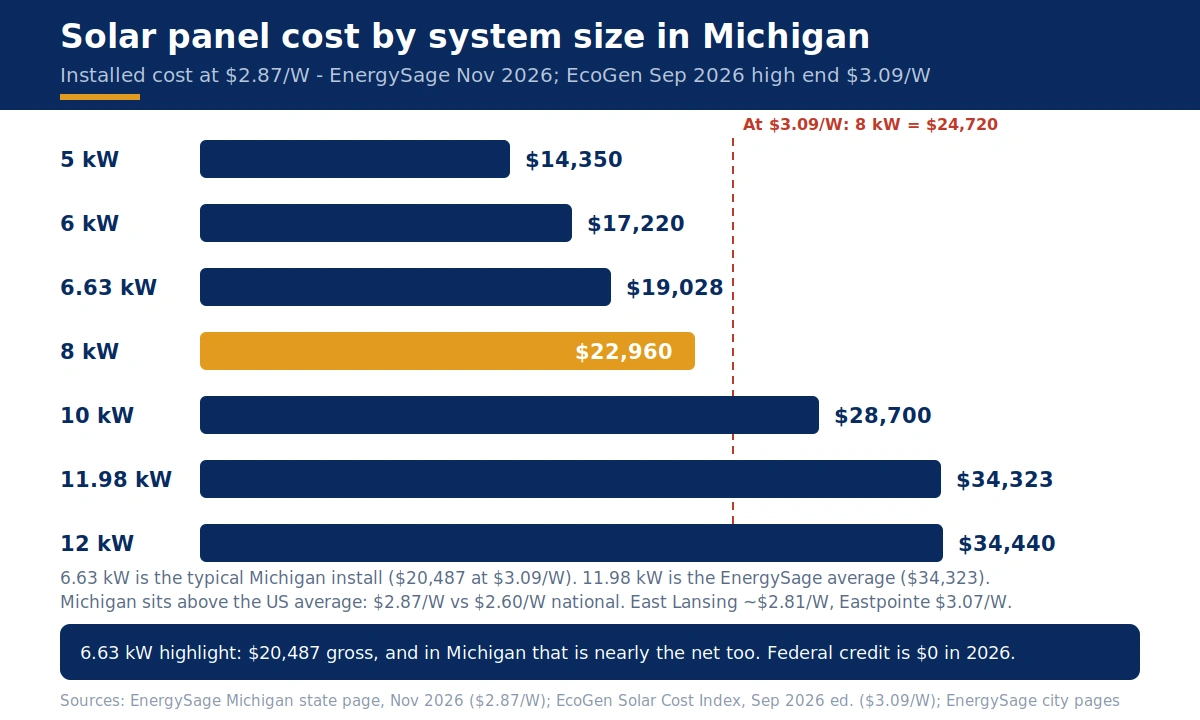
EnergySage’s own 11.98 kW figure is $34,323 (range $29,175–$39,471) — $60 below the straight $2.87/W multiplication, a rounding difference in their published average. The typical Michigan install is much smaller than that average: the 6.63 kW system at $20,487 is the median actually installed, and it is the system this guide uses for its worked math. The reason is the 110% rule in the next sections — a Michigan system may make no more than 110% of the electricity you used in the past 12 months, and the average Michigan home uses only 7,416 kWh a year. An 8 kW system making 10,560 kWh a year already overshoots the average home’s use; a 12 kW system making 15,840 kWh overshoots it by more than double, and every kilowatt-hour past your own use earns the 8.7-cent outflow credit instead of the 21.28-cent retail saving.
City-level figures from EnergySage show a tight cluster with no cheap corner. East Lansing runs about $2.81/W (14.71 kW average system, $41,390) — the lowest of the cities checked. Bay City is $2.86/W (11.64 kW, $33,244) and Southgate $2.88/W (9.67 kW, $27,887). Oak Park is $2.99/W (7.51 kW, $22,431) and Eastpointe $3.07/W (7.94 kW, $24,391) — the highest of the five. No Detroit-proper or Grand Rapids city figure was published on EnergySage’s city pages in this pass, so none is printed here; the metro figures around them are the honest proxy, and the spread across the five published cities is only 26 cents.
The city table hides the real story, and it is the same story as the state table: price per watt is not the deciding number in Michigan. A $2.81/W system in East Lansing and a $3.07/W system in Eastpointe differ by 26 cents a watt. The difference between using a kilowatt-hour yourself (21.28 cents saved) and exporting it (8.7 cents earned) is 12.6 cents on every single kilowatt-hour — and a system makes 8,752 of them a year. Rank Michigan quotes by self-use, not by dollars per watt. The installer who asks what time you run your laundry is doing the math correctly. The installer who never asks is selling you panels, not savings.
What drives your price per watt
Short seasons and snow-rated racking come first. Michigan sits 6.9% above the US average on install price, and EcoGen names three reasons: fewer working months push labor costs up, snow-load engineering adds to materials and design work, and older housing stock raises labor and engineering costs (EcoGen Michigan cost page, October 2026). A roof that has to carry a Great Lakes snow load needs racking rated for the local snow zone, and that engineering is priced into the quote. If an installer cannot name your county’s snow load, they have not finished the engineering.
Roof shape and roof age. Most Michigan roofs are pitched, which is cheaper to mount on than a flat roof, but the state’s housing stock is old — and an old roof with under 5–10 years of life left should be replaced before the panels go on. Taking panels off and putting them back is a real cost, and panel warranties do not cover it. In Michigan the penalty for getting this wrong is sharper than in a warm state: a detach-and-reset bill in February, on a snow-loaded roof, plus a heating season without your panels. No Michigan-specific 2026 detach-and-reset dollar figure was verified, so none is given here — ask for it as a line item if your roof is anywhere near the end of its life.
Equipment tier. Across the country, the hardware — panels, inverter, racking and wiring — makes up roughly 36% of a typical project cost (EnergySage installer survey, via our California guide). Premium panels cost more per watt. In Michigan the equipment question is cloud and cold, not heat: a module that holds its output in diffuse winter light earns more here than one that only wins on a bright June afternoon. Look at the Pmax temperature coefficient on each quote’s datasheet — PERC runs −0.34 to −0.40%/°C, TOPCon −0.28 to −0.35%/°C, HJT −0.24 to −0.28%/°C. Cold weather actually lifts panel voltage — a sharp, sunny March day in Detroit can be strong for every hour the sun is up — but it cannot make up for short winter days, so total winter production still falls well below summer (see the production section below).
Electrical panel upgrade (if needed). Budget $2,500–$4,500 for a panel upgrade if your home needs one (NRG Clean Power, November 2026) — that is a national planning range built from California data, not a price any Michigan installer has verified. One Michigan-relevant wrinkle: the federal HEAR program can pay up to $4,000 for a panel when it supports an eligible appliance on the same application — but HEAR does not pay for solar panels, and no Michigan-specific 2026 HEAR program status was verified, so do not count on a live Michigan HEAR program. Ask your Michigan installer to list the panel upgrade as its own line either way.
Installer overhead. Nationally, roughly 42% of a typical project goes to overhead, sales and margin (EnergySage installer survey). Identical panels can carry very different price tags from different Michigan installers, because so much of the cost is sales, overhead and margin — get three quotes before you believe any one of them. In Michigan, EcoGen’s test is blunt: divide the gross price by the watts, and anything well above $3.09/W needs an itemized engineering reason. Treat $3.60 or more per watt as a warning sign, not a market price.
Installer density. Detroit metro has the most installers and the most quotes, which keeps prices honest. The Upper Peninsula and the rural north have far fewer, longer travel, and shorter seasons — and the quotes show it. If you live outside the Detroit–Grand Rapids–Lansing triangle, get your third quote from an installer who actually serves your county, not from a statewide lead form.
The 30% federal tax credit is gone — what that means for 2026 math
Here is the Michigan version of the story, and it is the shortest in this series — because Michigan has no state credit to soften the blow. The One Big Beautiful Bill Act (OBBBA, P.L. 119-21, signed July 4, 2025) killed the 30% §25D Residential Clean Energy Credit — Section 70506 cuts it off for any expenditure made after December 31, 2025. IRS guidance FS-2025-05 (August 21, 2025) fixes the timing: an expenditure counts as “made” on the day the installation is completed. If the crew finishes in 2026, that credit is gone for a Michigan homeowner.
For a homeowner-owned system installed in Michigan in 2026 — cash or loan — the federal credit is $0. On an 8 kW system at $22,960, the dead credit would have falsely shaved $6,888 off the price. A quote that still shows that 30% subtraction prices your system under a law that no longer exists. And unlike New York, where a 25% state credit worth $5,000 catches part of the fall, Michigan catches none of it: the same 8 kW system costs $22,960 gross and $22,960 net, unless you are a Lansing BWL customer with a $2,000 rebate. The gap between Michigan and New York is not the sun. It is the statehouse.
Two nuances are worth knowing. First, a §25D credit left over from a 2025 install can be carried into 2026 (Form 5695 instructions, 2025) — but that only carries a 2025 credit forward; it creates no credit for 2026 work. Second, one federal path still survives: a lease. The §48E Clean Electricity Investment Credit (30%) lives on only for the business that owns the system — on a residential roof, that means a lease or PPA, with systems placed in service by December 31, 2027. The leasing company claims the credit itself and may hand the savings back as a lower monthly payment; the homeowner never holds a tax credit of their own. Our federal energy tax credits guide covers the full post-OBBBA picture.
The easiest stale-math trap to spot in 2026 is a quote that still takes 30% off. On a $22,960 system, that subtraction is a $6,888 lie — and in Michigan it is often paired with a second lie, a “Michigan state tax credit” that never existed, or a DTE Solar Currents rebate from a pilot that closed years ago. Both are covered in the next section.
Michigan incentives: the thin stack that survives in 2026
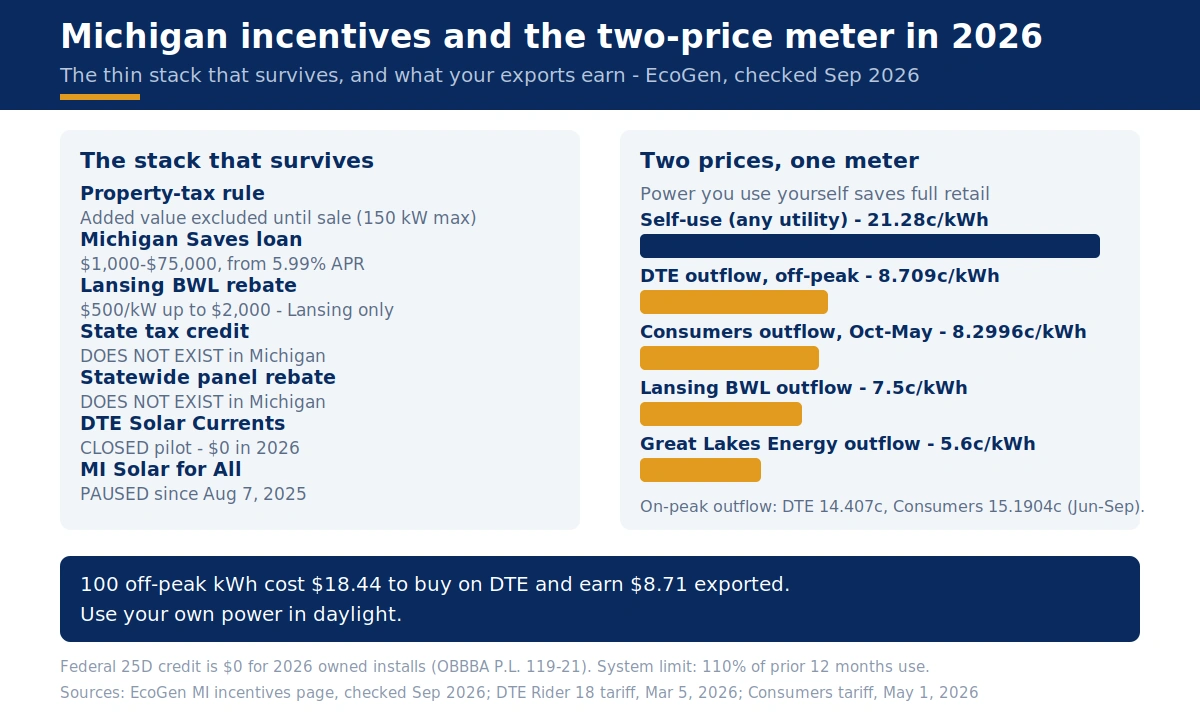
Michigan’s incentive stack is the thinnest in this series, and the honest way to present it is to start with what does not exist. There is no Michigan state tax credit for solar panels — confirmed by EcoGen, This Old House, and ChooseMyPower alike, all in 2026. There is no statewide Michigan rebate for panels. The federal credit is $0. MI Solar for All, the federally funded low-income program, has been paused since the EPA’s termination letter of August 7, 2025, and no homeowner offer ever opened. If a salesperson tells you any of those four things is live, ask for the program page in writing — you will not get one.
What actually exists, item by item:
The property-tax rule — the leg that protects the value. Under MCL 211.27(2)(p), your assessor may not count the value a home solar system adds until the property is sold. The rule has been in force since November 15, 2019 and has no end date. Three conditions apply: the property must be residential, the system must be 150 kW or less, and it may not make more power in a year than the home uses. Owned and leased systems both count, and State Tax Commission guidance includes home batteries. You do not have to apply — you can report the system to your local assessor on Form 865. Watch the fine print: this is a delay, not a permanent exemption. After a sale, the assessor may add the system’s value for the new owner. It saves you nothing on day one, and it saves you real money every year you own the home.
The Michigan Saves loan — financing, not free money. Michigan Saves is a nonprofit that works with Michigan credit unions. It offers fixed-rate loans for solar panels and home batteries: $1,000 to $75,000 at most lenders, up to $100,000 at MSU Federal Credit Union, for up to 180 months, with posted rates from 5.99% (EcoGen, checked September 2026). You need a Michigan Saves authorized contractor, and there is no penalty for paying the loan off early. A loan adds interest — compare the total you will pay, not only the monthly amount. Older guides quote 4.44–7.90% APR with most customers at 5.50%; those figures predate the September 2026 check and are not used here.
The Lansing BWL rebate — the only cash rebate in the state. Lansing Board of Water & Light, the city-owned utility for the Lansing area, pays $500 per kW, up to $2,000 — a 4 kW system reaches the cap, and a typical 6.63 kW system would come to $3,315, so it gets the maximum $2,000. The check goes to you within about four weeks of approval. It is first come, first served while money lasts, you apply after BWL gives written permission to run the system, and the form asks for a purchase invoice, so a leased system may not qualify. On the typical 6.63 kW system, that rebate takes $20,487 to $18,487 — the only “net” number in this guide that is lower than gross by more than a rounding error.
The DTE Solar Currents rebate — the one that is not open. You will still see this name on 2026 pages: $2.40 per watt upfront plus $0.11 per kWh for 20 years. It was real — a DTE pilot launched in 2009, capped at 5 MW of installations. One Michigan solar-history source says it “quickly reached its quota and is currently closed.” EcoGen’s September 2026 Michigan incentives page, the most carefully dated check in this pass, does not list it at all. A lead-generation page still lists it as a live 2026 program. This guide follows the dated check and the closure report: do not count Solar Currents in any 2026 math. If your installer claims it, ask for DTE’s written confirmation of current enrollment before you sign — and if they cannot produce it, the $2.40/W was never yours. On an 8 kW system, that phantom rebate would be $19,200 upfront plus about $1,160 a year in production payments — the largest single lie in Michigan solar quoting, and the easiest to catch.
| Incentive | Value | Who gets it |
|---|---|---|
| Federal §25D credit | $0 in 2026 | — |
| Michigan state tax credit | Does not exist | — |
| Statewide panel rebate | Does not exist | — |
| Property-tax rule (MCL 211.27(2)(p)) | Added value excluded until sale; ≤150 kW | All MI homeowners |
| Michigan Saves loan | $1,000–$75,000, from 5.99%, up to 180 mo | Owners via authorized contractor |
| Lansing BWL rebate | $500/kW up to $2,000 | Lansing BWL customers, while funds last |
| DTE Solar Currents | Closed pilot — $0 in 2026 | — |
| MI Solar for All | Paused since Aug 7, 2025 | — |
| DG outflow credits | 8.7–15.2 cents/kWh (see next section) | DTE / Consumers customers |
Stacking order for 2026: gross contract price, less the Lansing BWL rebate if you are a BWL customer, then nothing — no state credit, no federal credit. The property-tax rule protects you later, the Michigan Saves loan spreads the cost, and the DG outflow credits arrive month by month on the bill. Never add percentages that were never yours: 30% federal plus a phantom state credit plus a closed pilot rebate is not a discount, it is a sales pitch.
No net metering in Michigan: the two-price meter at DTE, Consumers Energy and the co-ops
Michigan does not have traditional net metering for new systems, and has not for years. DTE closed it on May 9, 2019 and Consumers Energy on January 1, 2021. Homes already on it keep those terms for up to 10 years from enrollment, then move to the outflow credit. Everyone else is on the Distributed Generation program, created under 2016 PA 341 and reshaped by 2023 PA 235 — and the program bills your meter at two prices.
Inflow — power you take from the grid — is billed at full retail. Every kilowatt-hour you buy costs the whole rate: supply plus delivery. On DTE’s standard time-of-use rate, 100 off-peak kWh cost about $18.44 to buy, and the delivery charge alone is 9.726 cents per kWh. Outflow — power you send to the grid — earns only the supply part. On DTE that is 8.709 cents per kWh off-peak, 10.319 cents in the busy hours (3–7 pm weekdays) from October to May, and 14.407 cents in the busy hours from June to September. So 100 off-peak kWh sent out earn $8.71 — less than half what the same 100 kWh cost to buy. Unused credits roll forward on your bill, past year end too, with no annual cash-out, and since February 27, 2024 they can pay every charge on the bill except securitization charges. But they never become cash, and they never buy back the delivery charge.
Consumers Energy runs the same two-price design with slightly different cents. From October to May, every exported kWh on the standard RSP rate earns 8.2996 cents. From June to September the rate is time-of-use: 10.397 cents off-peak and 15.1904 cents in the busy hours (2–7 pm weekdays). Consumers’ top-end outflow credit is a touch higher than DTE’s, and its winter base is a touch lower — a wash for most homes, and not a reason to pick a house by its utility. Both tariffs moved in 2026 after rate cases: DTE’s credits changed March 5, 2026, Consumers’ on May 1, 2026, and a small monthly fuel adjustment (the PSCR factor) moves both slightly. A quote that uses last year’s outflow cents is already wrong.
The smaller utilities set their own terms, and they are worse. Lansing BWL credits exports at 7.5 cents per kWh (1.3 cents of that is for renewable energy credits — ask BWL whether you keep that part if you keep your RECs), and BWL’s page does not say whether unused credits carry over, so ask before you size. Great Lakes Energy, a co-op in the western and northern Lower Peninsula, credits 5.6 cents per kWh for 10 years on systems up to 20 kW, with a $100 application fee — or 6.5 cents under Buy-All / Sell-All, where the co-op buys everything you make for 20 years and you buy everything you use at the normal price. Other co-ops and city utilities — Indiana Michigan Power, Upper Peninsula Power, Alpena Power, Xcel — offer the same state program with their own cents per kWh. Do not use a DTE example for a co-op bill.
Two rules cap the whole program. First, a new system may make no more than 110% of the electricity you used in the past 12 months, and no more than 550 kW — the limit PA 235 set in 2023. Oversizing past 110% earns nothing extra on the surplus at DTE, and at Consumers a system above the state size limit drops into the Simple Renewable Program, which pays a flat 6.1 cents per kWh — less than any credit above. Second, the program is first come, first served up to 10% of each utility’s peak load; the regulator’s October 2025 report said no utility had reached it. The interconnection application fee is $50 at DTE and Consumers Energy, filed by your installer before the install, and the utility fits a meter that counts power in both directions before you switch on.
Your utility decides your payback
Here is the table that decides whether solar is a 13-year investment or a 16-year one in Michigan. Same panels, same price, same sun — different bill, different outflow cents, different rebate. The figures below start from EcoGen’s published model (September 2026 Cost Index, page updated October 19, 2026): a typical owned 6.63 kW system at $3.09/W ($20,487 gross), producing 8,752 kWh a year (1,320 kWh per kW), with a 14.9-year simple payback before incentives — the same figure statewide and at DTE, counting no upkeep and no future price rises. The per-utility rows are our illustration of that model on a stated 60% self-use split (60% of production used at home at the 21.28-cent statewide retail rate, 40% exported at each utility’s outflow credit), so you can see exactly where each number comes from. Your own payback moves with your self-use share: use more of your own power in daylight and it shortens; export most of it and it stretches.
| Utility and place | Gross cost (6.63 kW) | Net cost | Year-1 savings (60% self-use) | Simple payback |
|---|---|---|---|---|
| DTE, Detroit / Ann Arbor | $20,487 | $20,487 | ~$1,422 | 14.9 years (EcoGen anchor) |
| Consumers Energy, Grand Rapids / Flint / Kalamazoo | $20,487 | $20,487 | ~$1,467 | ~14.0 years |
| Lansing BWL, Lansing | $20,487 | $18,487 (after $2,000 rebate) | ~$1,380 | ~13.4 years |
| Great Lakes Energy (co-op), western / northern Lower Peninsula | $20,487 | $20,487 | ~$1,313 | ~15.6 years |
| Statewide (EcoGen, weighted across six utilities) | $20,487 | $20,487 | ~$1,375 | 14.9 years |
Read the table as one Michigan with four meters. DTE’s 14.9 years is the anchor because DTE serves about 47% of Michigan homes and EcoGen published the DTE number directly. Consumers Energy, with about 37% of homes, lands a little faster in our illustration — about 14.0 years — because its summer on-peak outflow credit reaches 15.1904 cents, the highest in the state. Lansing is the fastest at about 13.4 years, and the only reason is the $2,000 rebate: the BWL outflow credit itself (7.5 cents) is the lowest of the big three. Great Lakes Energy is the slowest at about 15.6 years, because 5.6 cents is the lowest export credit in the table and there is no rebate to offset it. The spread is three years, not the four-year spread New York shows between Con Edison and National Grid — because Michigan’s utilities differ by cents on the outflow side, not by 15 cents on the retail side.
Two cross-checks keep the model honest. EnergySage (November 2026) puts Michigan payback at 14.6 years with $35,248 over 25 years on its larger 11.98 kW average system — a little faster than EcoGen’s 14.9, because it is a bigger system at a lower $/W with different escalation and discounting assumptions. Both figures are published; the gap comes from methodology, not error, and the methodology section flags it again. The second cross-check is the self-use arithmetic itself: at 100% self-use, the same 6.63 kW system would save 8,752 kWh at 21.28 cents, or about $1,862 a year, and pay back in 11.0 years. At 0% self-use — everything exported at 8.709 cents — it would save about $762 a year and pay back in 26.9 years. No real home sits at either end. But the range shows why the installer who asks about your daytime usage is worth more than the installer who quotes a lower $/W: moving self-use from 40% to 70% is worth more than shaving 20 cents off the price per watt.
Rates are not standing still, and in Michigan they move in only one direction. Michigan rates are up 8.0% year over year to August 2026, and EcoGen puts the five-year climb at 4.16% a year. DTE filed a $237.5 million rate increase in November 2025 (a filing, not an approved rate — say so plainly), and Consumers Energy’s residential rates were reported up as much as 13.3% effective May 2026 (single source — flagged in the methodology section). Each of those Michigan increases pulls the payback a little closer. The paybacks in the table above assume none of those rises — they are the conservative case.
Detroit, Grand Rapids and the Upper Peninsula are three different solar markets inside one state, and the table above only captures two of them. Detroit runs on DTE at about 22.0 cents, with 4.2 peak sun hours and the densest installer base in the state. Grand Rapids runs on Consumers at about 21.7 cents, with similar sun and a slightly better summer outflow credit. The Upper Peninsula runs on Upper Peninsula Power, Upper Michigan Energy Resources and co-ops, with heavier lake-effect snow, a shorter install season, and far fewer installers — and no UP-specific $/W, rate, or outflow figure was verified in this pass, so none is printed here. Treat any quote that applies a Detroit payback to a Marquette roof as a quote built for the wrong house.
Do you need a battery in Michigan in 2026?
In Michigan the battery question is sharper than in a net-metering state, and the answer splits in two. For bill savings, a battery earns its keep here in a way it does not in New York — because Michigan exports are worth so little. Every kilowatt-hour a battery stores and you use later is a kilowatt-hour that would have earned 8.7 cents on export and instead saves 21.28 cents at retail: a 12.6-cent gain on every stored kilowatt-hour, before any outage value. For backup, the case is just as strong: ice storms, lake-effect snow and summer thunderstorms knock Michigan power out regularly, and a battery keeps the heat and the fridge running while the grid is down. The battery does not shorten the solar payback on its own — it adds cost — but in Michigan it is the only add-on that fixes the exact problem the two-price meter creates.
What a battery costs. A home battery runs roughly $1,100–$1,400 per installed kWh (Joule, 2026), which puts a 13.5 kWh Powerwall-class unit around $12,000–$19,000 installed before incentives. Those are national figures — no Michigan-specific battery price was verified in this pass — and there is no Michigan battery rebate to subtract from them. The federal §25D credit for batteries is also $0 for owned installs completed after December 31, 2025, and Michigan has no state battery incentive. Price the battery as its own line with its own payback, not as a bundle buried inside the solar quote.
The Michigan battery trap to know about. DTE gives no credit for power that a battery sends to the grid. A battery that discharges to the grid earns nothing — it only pays when it discharges into your own home. Size the battery to your evening load, not to your roof, and make sure the installer programs it for self-use, not export. A battery set to export on DTE is a $15,000 box that works for free.
The honest battery verdict for Michigan: buy the battery for self-use and for backup, not for payback. On a home that exports most of its production — empty weekdays, nobody home until six — a battery can lift self-use from 40% toward 70% and pull payback back by years. On a home where someone is already home in daylight, running laundry and dishes while the panels produce, the battery adds little and the panels alone are the better investment. Our solar battery cost guide goes deep on battery sizing and brands, and our community solar guide covers the no-roof alternative.
Michigan sun, snow and winter production
Yes, solar panels work in Michigan. No, they do not work the way they work in Arizona — and the guide that pretends otherwise is the one that leaves a Marquette homeowner wondering why December feels so thin.
How much sun Michigan gets. The state averages 4.58 peak sun hours a day (EcoGen) as a planning figure, with Detroit at about 4.2 a day and roughly 178 sunny days a year. Other sources run lower: MichiganStateSolar puts the state at 3.5–4.0 peak sun hours with about 170 sunny days, and Detroit installer pages quote 4.0–4.2. A peak sun hour means one hour of sunlight at 1,000 watts per square meter — a long summer day with 14 hours of daylight still delivers far fewer peak sun hours than that, because morning and evening light is weak. At Michigan’s latitude (about 42° N in Detroit, 46° N in the Upper Peninsula), the fixed tilt that balances the year is about 35–40° — steeper than a typical roof pitch, which is one reason tilt racking earns its keep, and one reason steeper tilt sheds snow better.
What a system actually produces. EcoGen’s payback model uses 1,320 kWh per kW per year — 8,752 kWh a year on the typical 6.63 kW system, 10,560 kWh a year on an 8 kW system. Home Solar Atlas models lower, 1,200 kWh per kW per year (12,000 kWh on a 10 kW system). Detroit installer pages quote 1,100–1,300 kWh per kW per year. This guide uses EcoGen’s 1,320 as the anchor because the payback math is built on it, and flags the lower figures as the conservative end of the range. The difference is methodology — tilt, shading and weather vintage — not a mistake in either number. A single 400 W panel makes roughly 440–530 kWh a year on the EcoGen anchor.
That seasonal swing is what a Michigan system has to be planned around. Michigan’s summer days are long and its winter days are short, and the swing is wider than in New York: a system that makes 45 kWh a day in July can make under 20 kWh a day in December. That is the shape of Michigan solar — a fat summer surplus, drawn down through the dark months. In a net-metering state the swing is a bookkeeping problem, because summer credits pay winter bills at full retail. In Michigan it is a cash problem, because the summer surplus earns 8.7 cents while the winter shortfall costs 21.28 cents to buy back. The two-price meter is what makes the seasonal swing expensive, and it is why self-use and batteries matter more here than anywhere else in this series.
Cold helps, a little. When solar cells run cold their voltage rises, so a bright, freezing March afternoon can squeeze a lot out of every hour of sun. On a panel spec sheet, that effect shows up as the temperature coefficient. Short winter days still win the argument, though — total winter output stays well below summer no matter how cold and clear it gets. The cold-weather bonus is real and you can measure it; it is not big enough to change how you size a system.
Snow. A light dusting usually clears itself off tilted panels within a day or two once the sun warms the dark glass. Heavy snow cover halts production until it melts or slides off. Southeast Michigan gets 40-plus inches of snow a year; the Upper Peninsula gets far more, lake-effect snow off Lake Superior. A few snowy days have a small effect on a full year’s production — the lost days are a rounding error against 1,320 kWh per kW — but a roof that holds snow for weeks is a different problem, and it is a racking and tilt question, not a panel question. Do not climb on an icy roof and do not scrape panels with a shovel — that is dangerous and it scratches the glass. If snow load is what keeps you up at night, ask the installer whether the racking is rated for your county’s snow zone — not whether the panels will survive the winter, because they will.
Orientation. A south-facing array at latitude tilt is the baseline to beat. A southeast- or southwest-facing Michigan array gives up only about 2–5%. An east–west split gives up roughly 10–15% of annual yield but spreads production across the morning and evening, which suits homes whose demand peaks at those hours. A west-facing-only array can give up about 19% against the optimum. In a tree-lined Ann Arbor street or a shaded Grand Rapids lot, the shading study matters more than the compass bearing — get one before you sign, and get it in writing.
HOA rights under the Homeowners’ Energy Policy Act
Michigan has one of the newest and clearest solar-access laws in the country, and it is barely a year old — which is why most Michigan HOAs are still catching up to it.
The law is the Homeowners’ Energy Policy Act, 2024 Public Act 68 (MCL 559.301 et seq.), effective April 1, 2025 (some sources say April 2, 2025 — a one-day variance in the effective-date calculation, flagged in the methodology section; the substance is identical). It says a provision in a homeowners’ association agreement that prohibits, or has the effect of prohibiting, the installation of a solar energy system is invalid and unenforceable as contrary to public policy (MCL 559.307). An HOA may not inquire into your energy usage, impose conditions that impair the operation of your system, or charge excessive application fees.
The written policy rule — and the deadline that already passed. Every Michigan homeowners’ association must adopt a written solar energy policy statement within one year of the Act’s effective date — by April 1, 2026 (April 2 by the other calculation). The policy must reflect the standards the Act sets, contain certain disclosures, and must not conflict with local, state, or federal law. If your association has not adopted one, it is overdue — and under the Act, if an association misses the deadline, or fails to respond to an application within the required time, the owner may proceed with the installation and the association may not fine or otherwise penalize the owner for doing so.
What an HOA can still do. Reasonable standards survive, but the Act draws two hard lines: a standard may not reduce estimated annual energy production by more than 10% or increase installation costs by more than $1,000. The association must approve or deny a written application within 30 days after the policy is adopted (120 days for applications submitted before the policy was adopted). Your application must include your name, the street address, the installer’s name and contact information, an image showing the proposed layout, and a description of the system. The association must facilitate installation on roof faces without specifying the type of technology — solar shingles versus traditional panels is your choice, not theirs.
Where the law does not reach. The Act does not apply to shared roofs or common areas — a roof that serves more than one residence or unit, including contiguous roofs serving adjacent units. For developments with shared roofs, associations can deny applications for solar installations on those roofs. The Act’s plain language also does not clearly cover condominium associations, co-ops, or summer resorts, which are governed by different laws — Michigan has no specific homeowners association act, and the scope question is flagged here rather than settled. It is not legal advice — if your HOA is fighting you, a Michigan real-estate attorney’s letter costs less than a moved array.
Where HOAs bite hardest in Michigan. Suburban subdivisions around Detroit, Grand Rapids and Ann Arbor, where covenants are newest and most detailed — and where, since April 2026, every one of those associations was supposed to have a written solar policy on file. Ask for the policy before you apply. If the association cannot produce one, the Act is on your side — use it early, politely, and in writing.
Payback & 25-year savings math
Pulling the worked model together: the typical owned 6.63 kW system at $20,487 gross — and, outside Lansing, $20,487 net, because there is no federal credit and no state credit — producing 8,752 kWh a year, with year-1 savings of about $1,422 on a 60% self-use split and a simple payback of 14.9 years on EcoGen’s published model (14.4 years on our 60/40 illustration). Simple payback is net cost divided by yearly savings, and it is the honest headline: it assumes no future rate rises, no upkeep, and no degradation. Every rate rise DTE or Consumers Energy announces after you install shortens it.
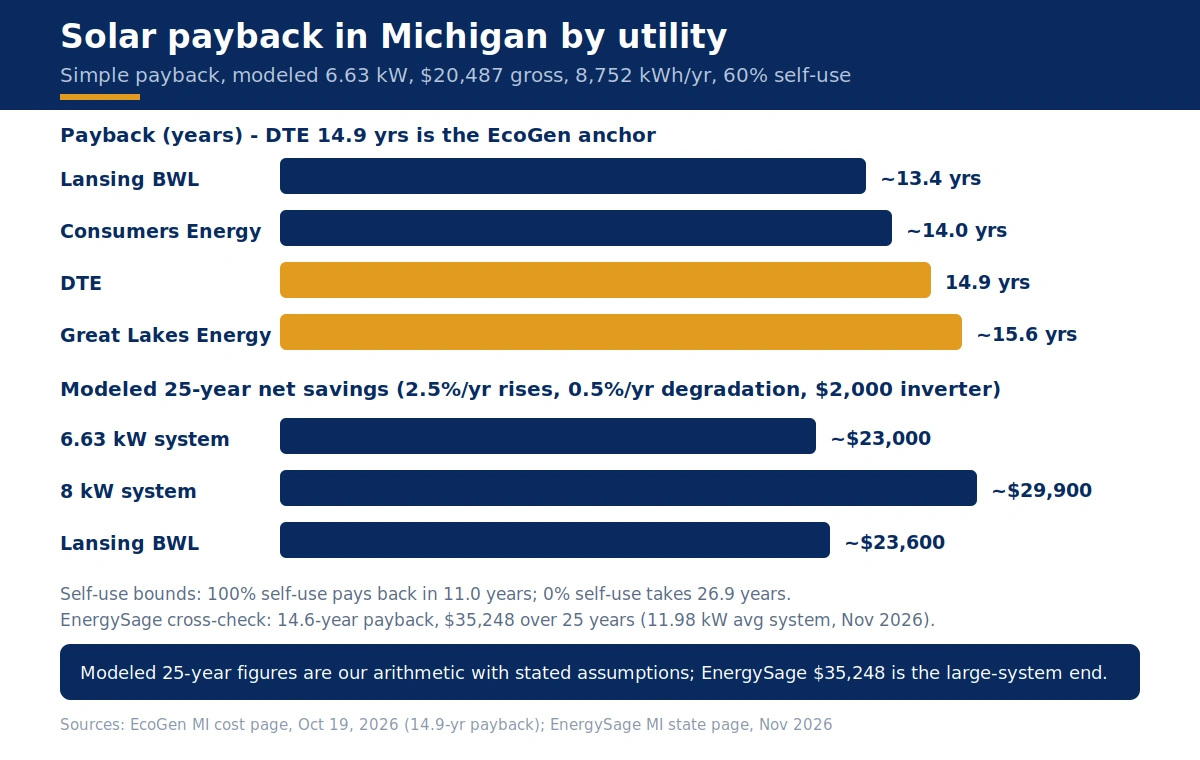
The 25-year picture for Michigan — our model, not a published benchmark. Extending the model with stated assumptions (electricity prices rising 2.5% a year, panels degrading 0.5% a year, one $2,000 inverter replacement in 25 years — a 25-year factor of about 31.98 times year-1 savings) gives: the typical 6.63 kW system ~$23,000 net over 25 years ($1,422 x 31.98 = $45,476, less $20,487 net cost and $2,000 inverter). An 8 kW system at $22,960, saving about $1,716 a year on the same split, gives ~$29,900 net over 25 years ($1,716 x 31.98 = $54,878, less $22,960 and $2,000). A Lansing BWL system at $18,487 net, saving about $1,380 a year, gives ~$23,600 net ($1,380 x 31.98 = $44,132, less $18,487 and $2,000). Those are our arithmetic with stated assumptions, not a published benchmark. EnergySage’s published figure — $35,248 over 25 years on its 11.98 kW average system, with a 14.6-year payback — is higher in dollars because it is a bigger system, and lower per kilowatt because it uses different escalation and discounting assumptions. The gap comes from methodology. Treat the modeled figures as the middle of the range and EnergySage’s as the large-system end; the truth for a given roof sits between them, and it sits closer to the modeled end the more of your own power you use in daylight.
Who should not buy solar in Michigan in 2026. A home with a heavily shaded roof and no unshaded plane; a home whose roof needs replacing within five years and whose owner will not re-roof first; a home where nobody is there in daylight and nothing can be shifted — the system will export most of its production at 8.7 cents and the payback will stretch past two decades; a home on a co-op or city utility with a 5.6-cent export credit and no rebate, where the numbers never close; and a household buying on a $3.60-per-watt quote with no itemized engineering reason. For those homes, the better first step is often community solar — no roof, no panels, bill credits from a local solar farm. Everyone else with a sound roof, average-or-better daytime usage, and a DTE, Consumers Energy or Lansing BWL bill is looking at a 13- to 15-year payback that shortens every time rates rise — which, in Michigan, they do.
How to get quotes in Michigan + red flags
Get three written quotes from installers who serve your county, and compare them on price per watt — not on monthly payment, not on “total savings,” and not on the size of the system. A $20,487 quote for 6.63 kW is $3.09/W. A $19,028 quote for the same 6.63 kW is $2.87/W. The $1,459 difference is the whole negotiation, and it is invisible if you only compare monthly payments. For the national sizing baseline, use our 6 kW, 8 kW and 10 kW system cost guide.
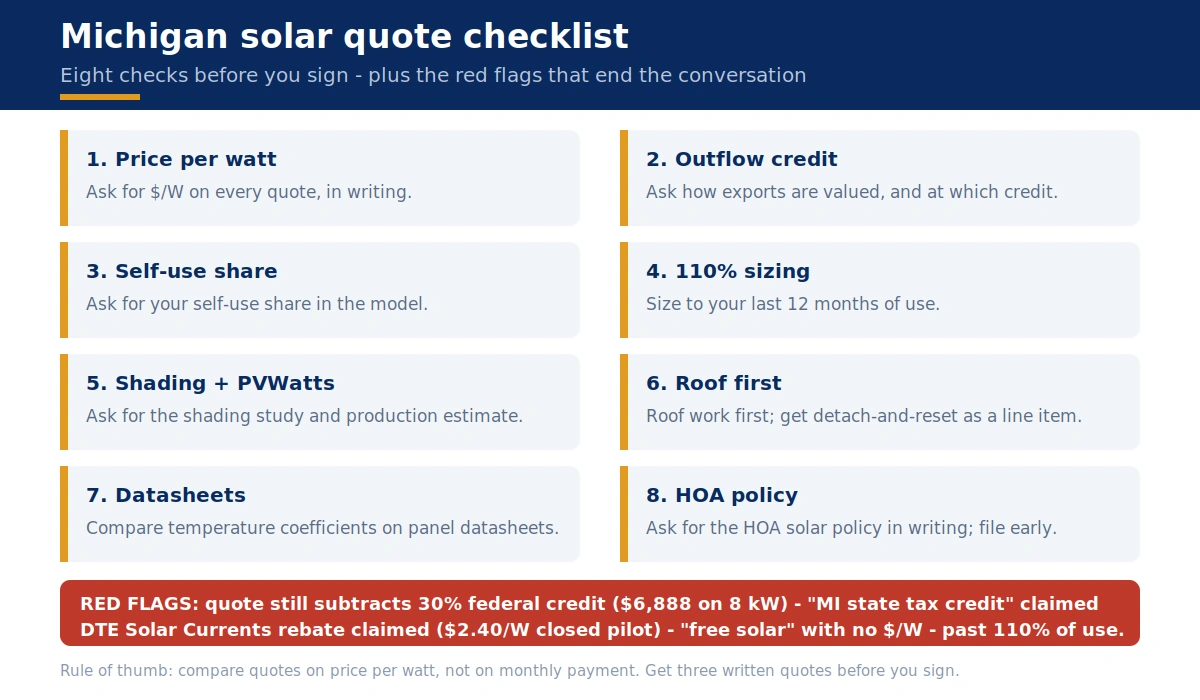
- Get the $/W in writing on every quote. A Michigan installer who will not state a price per watt has already told you everything you need to know. Anything well above $3.09/W needs an itemized engineering reason.
- Ask how the quote values your exports — and at which outflow credit. DTE 8.709 cents off-peak, Consumers 8.2996 cents in winter, Lansing BWL 7.5 cents, Great Lakes Energy 5.6 cents. A quote that values every kWh at the full 21.28-cent retail rate is wrong in Michigan.
- Ask for your self-use share in the model. What fraction of production does the quote assume you use at home? At 100% self-use the 6.63 kW system pays back in 11.0 years; at 0% it takes 26.9. Your number is the only one that matters, and it should be in the quote.
- Ask whether the system is sized to your last 12 months of use. The state limit is 110% of prior-year use. A system past that earns nothing extra on the surplus at DTE and drops to a flat 6.1 cents at Consumers.
- Get a shading study and a PVWatts production estimate for your roof. Michigan production runs from 1,200 to 1,320 kWh per kW per year depending on whose model you believe. Only your roof’s number matters, and it belongs in the quote.
- Find out whether the roof needs work first, and get the detach-and-reset price as a line item if it does. No Michigan-specific 2026 detach-and-reset figure was verified for this guide — which is exactly why you need your installer’s number, not a national average.
- Get the panel and inverter datasheets, and compare their temperature coefficients. Cold helps voltage, but a panel that holds output in diffuse winter light earns more in Michigan than one that only wins in June.
- Ask for the HOA solar policy in writing, and file the application early. Every Michigan HOA was supposed to have a written solar policy by April 1, 2026. If yours cannot produce one, the Homeowners’ Energy Policy Act lets you proceed — but a polite, documented application settles most fights before they start.
Red flags. A quote that still subtracts the 30% federal credit ($6,888 on an 8 kW system — dead law). A quote that shows a “Michigan state tax credit” (never existed). A quote that shows a DTE Solar Currents rebate ($2.40/W — a closed pilot from 2009, capped at 5 MW). A “$0-down, free solar” pitch with no $/W anywhere in the paperwork — $0-down is a loan or a lease with 20–25 years of payments attached, not a free system. A system sized past 110% of your last 12 months of use (the surplus earns the lowest credit in the state). A lease dressed up as a purchase, or a PPA dressed up as net metering — the export rules are different, and the homeowner never holds a tax credit of their own. And any installer who will not put the outflow credit, the self-use share, and the production estimate in writing: those three numbers are the whole economics in Michigan, and an installer who hides them is selling a monthly payment, not a system.
Sources & methodology
Cost anchors: EnergySage Michigan state page (November 2026: $2.87/W, 11.98 kW average system, $34,323, range $29,175–$39,471, 14.6-yr payback, $35,248 25-yr savings; city pages Southgate $2.88/W, Bay City $2.86/W, East Lansing $2.81/W, Oak Park $2.99/W, Eastpointe $3.07/W); EcoGen America Solar Cost Index (September 2026 edition, page updated October 19, 2026: $3.09/W, 6.63 kW typical system $20,487, 4 kW $12,360, 5 kW $15,450, 8 kW $24,720, 10 kW $30,900, neighbours IL $3.05 / WI $3.01 / IN $2.97 / US $2.89 / OH $2.77, 1,320 kWh/kW/yr, 4.58 peak sun hours, 618 kWh/mo avg use, rates +4.16%/yr over 5 yrs); Home Solar Atlas Michigan (updated August 27, 2026: $2.90/W benchmark, 1,200 kWh/kW/yr, 10 kW $29,000); EnergySage national benchmark (June 30, 2026: ~$2.60/W, 12 kW average $31,135). Size table calculated from the $2.87/W anchor at the $3.09/W high end.
Electricity rates: EcoGen Michigan solar pages (October 19, 2026: EIA 12 months to August 2026 — statewide 21.28 cents, DTE delivery 9.726 cents/kWh, 100 off-peak kWh $18.44 to buy); Kadoa Michigan electricity prices (EIA 12 months to August 2026: MI 21.3 cents, DTE 22.0 cents, Consumers 21.7 cents, +8.0% YoY); Energy Factbook Michigan (EIA August 2026: MI 22.99 cents, DTE 23.25 cents, Consumers 24.38 cents, 12-mo avg bill $134.14); ElectricChoice Michigan (November 2026: DTE $237.5M rate-increase filing November 2025 — a filing, not an approved rate); MichiganStateSolar (Consumers residential up to +13.3% effective May 2026 — single source, flagged).
Incentives: EcoGen America Michigan incentives page (checked September 2026: no MI state tax credit, no statewide rebate, property-tax rule MCL 211.27(2)(p), MI Saves $1,000–$75,000 from 5.99%, Lansing BWL $500/kW up to $2,000 + 7.5 cents export, Great Lakes Energy 5.6 cents, DTE credits changed Mar 5, 2026, Consumers credits changed May 1, 2026, DG fee $50, 110%/550 kW limit, 10% program cap, HEPA Apr 2, 2025, MI Solar for All paused — EPA letter Aug 7, 2025); EcoGen free solar panels Michigan (October 2026: net metering closed DTE May 9, 2019 / Consumers Jan 1, 2021, 10-yr grandfather); This Old House Michigan incentives (no MI state tax credit; property-tax exemption; older MI Saves APR range — superseded by EcoGen Sep 2026); ChooseMyPower Michigan solar tax credit (no MI state-level solar tax credit; federal credit ends for property placed in service after Dec 31, 2025); Palmetto Michigan page (DTE Rider 18 outflow $0.08782/$0.10081 per kWh effective Mar 5, 2026; 5% sales/use-tax apportionment note — single source, not used as a saving); OBBBA P.L. 119-21 (signed July 4, 2025), IRS FS-2025-05 (August 21, 2025, FAQ 7); MCL 211.27(2)(p) — cited by statute, no URL guessed.
Distributed generation and export rates: EcoGen Michigan incentives page (September 2026: DTE 8.709 cents off-peak / 10.319 cents Oct–May on-peak / 14.407 cents Jun–Sep on-peak; Consumers 8.2996 cents Oct–May / 10.397 cents summer off-peak / 15.1904 cents summer on-peak; credits roll forward past year end, no cash-out, pay all charges except securitization since Feb 27, 2024; Consumers oversize fallback Simple Renewable Program 6.1 cents flat); PA 341 of 2016 (DG framework), PA 235 of 2023 (110% limit, 550 kW cap) — cited by statute.
Payback model: EcoGen Michigan cost page (October 19, 2026: 6.63 kW, $20,487, 8,752 kWh/yr, 14.9-yr payback statewide and at DTE, before incentives, no upkeep, no price rises); EnergySage (November 2026: 14.6 yrs, $35,248). The per-utility rows and the 25-year modeled figures are our arithmetic with stated assumptions (60% self-use at 21.28 cents retail, 40% exported at each utility’s outflow credit; 2.5%/yr escalation, 0.5%/yr degradation, $2,000 inverter, ~31.98x year-1 savings). The 100% self-use (11.0 yrs) and 0% self-use (26.9 yrs) bounds are the same arithmetic at the extremes.
Production: EcoGen (1,320 kWh/kW/yr, 4.58 peak sun hours); Home Solar Atlas (1,200 kWh/kW/yr); Detroit installer pages (1,100–1,300 kWh/kW/yr, Detroit ~4.2 peak sun hours, ~178 sunny days); MichiganStateSolar (3.5–4.0 peak sun hours, ~170 sunny days, $3.02/W statewide average — not used as anchor); temperature coefficients (PERC −0.34 to −0.40%/°C; TOPCon −0.28 to −0.35%/°C; HJT −0.24 to −0.28%/°C); orientation losses (SE/SW −2–5%, east–west −10–15%, west-facing −19%) — standard planning figures carried from the series.
Battery: Joule (2026: $1,100–$1,400 per installed kWh, national — no MI-specific price verified); EcoGen incentives page (DTE gives no credit for battery-exported power); no Michigan battery incentive found; no Michigan battery attach rate found.
HOA: MI Bar Journal, Homeowners’ Energy Policy Act (2024 PA 68, effective Apr 2, 2025, policy deadline Apr 2, 2026, 10%/$1,000 limits, shared-roof exclusion); MI Condo Law blog (MCL 559.301 et seq., effective Apr 1, 2025, MCL 559.307/559.309, condo/co-op scope question); Szura Delonis HEPA guide (30-day approve/deny, 120 days pre-policy, proceed-if-no-response rule).
Solar Currents conflict: ProFusion Michigan utility programs (lists $2.40/W + $0.11/kWh for 20 years as a 2026 program); SolarMichigan.org (pilot “quickly reached its quota and is currently closed”); EcoGen September 2026 incentives page (does not list it). This guide follows the dated check and the closure report and counts $0 from Solar Currents.
EXCLUDED: any “after 30% credit” net prices; the DTE Solar Currents $2.40/W as a live subtraction (closed pilot — flagged as a live conflict); MI Solar for All as an available program (paused, no homeowner offer ever opened); any Michigan state income tax credit (does not exist); any statewide Michigan panel rebate (does not exist); any Upper Peninsula $/W, rate, or payback figure (none verified); any Detroit-proper or Grand Rapids city $/W (none published on EnergySage city pages in this pass); any Michigan-specific detach-and-reset price (none verified); any Michigan battery attach rate (none found); any Michigan SEIA capacity/homes/jobs figure (none verified); any live Michigan HEAR program claim; any Michigan sales-tax exemption for solar equipment as a saving (none verified — the 5% apportionment note is single-source and not used).
*Disclaimer: Prices are 2026 Michigan planning figures and change by utility territory, county, roof, and installer. Collect 3 written quotes from Michigan installers before you set a budget. Tax notes here are general information, not tax advice — confirm them with a tax professional. Export rates, DG terms and incentive blocks reset on utility and program calendars — DTE’s credits changed March 5, 2026 and Consumers’ on May 1, 2026 — verify the current export credit and incentive status with your utility in writing before signing.*
How much do solar panels cost in Michigan in 2026?
$2.87–$3.09 per watt installed before incentives. A typical 6.63 kW system runs $20,487 gross, and an 8 kW system runs $22,960 at $2.87 per watt. The EnergySage average system (11.98 kW) costs $34,323 before incentives. In Michigan the gross price is nearly the net price, because there is no state tax credit and no statewide rebate to subtract.
Is there still a federal tax credit for solar panels in Michigan in 2026?
No. The 30% §25D Residential Clean Energy Credit stopped applying to homeowner-owned systems installed after December 31, 2025, under the One Big Beautiful Bill Act (P.L. 119-21). For a 2026 cash or loan install, the federal credit is $0 — on an 8 kW system at $22,960, the dead credit would have falsely subtracted $6,888. The one federal path that still survives is a lease or PPA, where the leasing company claims the §48E credit and may hand savings back as a lower monthly payment.
Does Michigan have a state tax credit or rebate for solar panels?
No. Michigan has no state income tax credit for solar panels and no statewide panel rebate. What Michigan does offer is a property-tax rule that keeps the added value of your system out of your assessment until you sell (MCL 211.27(2)(p), systems up to 150 kW), Michigan Saves loans from 5.99%, and a $500-per-kW rebate up to $2,000 for Lansing Board of Water & Light customers only. The DTE Solar Currents rebate ($2.40 per watt) was a pilot that closed years ago and is not open in 2026.
Does Michigan still have net metering?
Not for new systems. DTE closed traditional net metering on May 9, 2019 and Consumers Energy on January 1, 2021; homes already enrolled keep those terms for up to 10 years. New systems are on the Distributed Generation program, which bills at two prices: power you use yourself saves the full retail rate (about 21.28 cents per kWh statewide), while power you send out earns only the supply part — 8.709 cents per kWh off-peak on DTE, 8.2996 cents in winter on Consumers Energy. Unused credits roll forward with no annual cash-out.
How long does it take for solar panels to pay for themselves in Michigan?
About 14.9 years on the typical 6.63 kW system at $20,487, on EcoGen’s 2026 model — 14.6 years on EnergySage’s larger 11.98 kW system. Your own payback depends mostly on how much of your own power you use in daylight: at 100% self-use the same system pays back in 11.0 years, at 0% self-use it takes 26.9 years. Lansing BWL customers pay back fastest at about 13.4 years thanks to the $2,000 rebate; co-op customers on Great Lakes Energy are slowest at about 15.6 years.
Do I need a battery with solar panels in Michigan?
It depends on your daytime use. A battery earns its keep in Michigan in a way it does not in net-metering states: every kilowatt-hour it stores and you use later saves 21.28 cents instead of earning 8.709 cents on export. It also covers outages from ice storms and lake-effect snow. A 13.5 kWh unit runs roughly $12,000–$19,000 installed (national figures), with no Michigan battery rebate and a $0 federal credit in 2026. Note that DTE gives no credit for power a battery sends to the grid — size it for your evening load, not your roof.
Can my HOA stop me from installing solar panels in Michigan?
No — the Homeowners’ Energy Policy Act (2024 Public Act 68, MCL 559.301 et seq., effective April 1, 2025) makes any HOA provision that prohibits, or has the effect of prohibiting, a solar energy system invalid and unenforceable. Every HOA had to adopt a written solar energy policy by April 1, 2026, and any standard it sets may not cut your production by more than 10% or add more than $1,000 to the cost. The association must approve or deny your application within 30 days. The law does not apply to shared roofs or common areas, and it may not cover condo or co-op associations.
Do solar panels work in Michigan winters?
Yes. Michigan averages 4.58 peak sun hours a day, and a typical system produces about 1,320 kWh per kW per year — 8,752 kWh on a 6.63 kW system. Cold weather actually lifts panel voltage, and light snow usually clears off tilted panels within a day or two. The real winter effect is short days: a system that makes 45 kWh a day in July can make under 20 kWh a day in December. Because Michigan exports earn only 8.7 cents while winter power costs 21.28 cents to buy back, the seasonal swing costs more here than in a net-metering state — which is why daytime self-use matters so much.