


Table of Contents
Nevada is the strangest solar bargain in America. It has the cheapest electricity in the country — 12.72¢ per kilowatt-hour, 30% below the US average (EIA, August 2026) — which stretches payback to among the longest in the Southwest. It also has the third-best sun in the country — 6.41 peak sun hours a day (NREL PVWatts v8, 2026) — and an export credit worth 75% of retail, while Arizona pays 1.87–5.55¢ and Texas pays whatever a buyback plan offers that month.
The result: solar in Nevada is a slow-but-steady buy, not a fast one. The panels are cheap, the sun is superb, the export deal is generous — and the power you are replacing is the cheapest in America. This guide covers all of it, with every figure sourced and dated and the federal credit correctly shown as $0.
For the country-wide picture, see the national solar panel cost guide.
How much do solar panels cost in Nevada in 2026?
The defensible 2026 Nevada consensus: $2.36–$2.68 per watt installed, before incentives — and in Nevada, “before incentives” means the same as after them, because there are no incentives to subtract (see the incentives section below). EnergySage’s Nevada state page (updated November 2026) puts the state average at $2.36/W on a 14.18 kW average system costing $33,428 (range $28,414–$38,442). The EcoGen America Solar Cost Index (September 2026 edition) puts Nevada at $2.68/W on the 9.29 kW median system actually installed in 2025, or $24,897.
Those two anchors are not contradicting each other. They measure different things: EnergySage’s 14.18 kW is a marketplace-quote average, EcoGen’s 9.29 kW is the median size homeowners actually installed (Berkeley Lab data). The honest range is $2.36–$2.68/W, and the $2.60/W figure in The Green Watt’s 50-state guide sits inside it. One outlier to ignore: a $3.14/W Nevada average on one aggregator page, well above both EnergySage and EcoGen — it is not used anywhere in this guide.
City-level figures from EnergySage (November 2026) show a clear north-south split. The south is cheaper: Las Vegas $2.38/W (14.61 kW average, $34,719), Henderson $2.31/W (13.99 kW, $32,311, October 2026), North Las Vegas $2.34/W (12.45 kW, $29,171). The north costs more: Reno $2.49/W (11.36 kW, $28,303), Sparks $2.61/W (12.23 kW, $31,889, October 2026). That is a $0.11–$0.30/W north premium — most likely installer density plus smaller average systems up north.
The number-one rule of 2026 Nevada pricing: gross = net. The §25D residential federal credit ended December 31, 2025, and Nevada has no state income tax, so there is no state credit either. Several top-ranking pages still show post-credit prices — treat those as outdated. Every figure in this guide is the price you actually pay on an owned system, with nothing to subtract.
Nevada systems are also unusually large. The state average is 14.18 kW (EnergySage, November 2026) — more than double the ~6 kW US average — because air conditioning drives huge summer loads in the south. Do not size by the national benchmark. Size by your last 12 months of kilowatt-hours. And note the tension: a bigger system exports more power at 75% of retail instead of offsetting full-retail purchases, which is exactly why the average Nevada system pays back slower than a right-sized one (see the payback section).
Solar panel cost by system size in Nevada
2026 installed costs at the EnergySage anchor of $2.36/W, with the high end of the anchor range ($2.68/W) alongside. These are gross and net — there is no federal credit, no state credit, no sales-tax exemption, and no utility rebate to subtract in Nevada in 2026.
| System size | Cost at $2.36/W | Cost at $2.68/W | Best fit |
|---|---|---|---|
| 5 kW | $11,800 | $13,400 | Small home, low daytime use |
| 6 kW | $14,160 | $16,080 | Small-to-mid home |
| 8 kW | $18,880 | $21,440 | Typical home (our worked example) |
| 10 kW | $23,600 | $26,800 | Large home, heavy AC |
| 12 kW | $28,320 | $32,160 | Very large home, pool + EV |
| 14.18 kW (NV average) | $33,428 (range $28,414–$38,442) | — | The average Nevada install |
| 9.29 kW (median installed) | $21,924 | $24,897 | The typical system actually installed in 2025 |
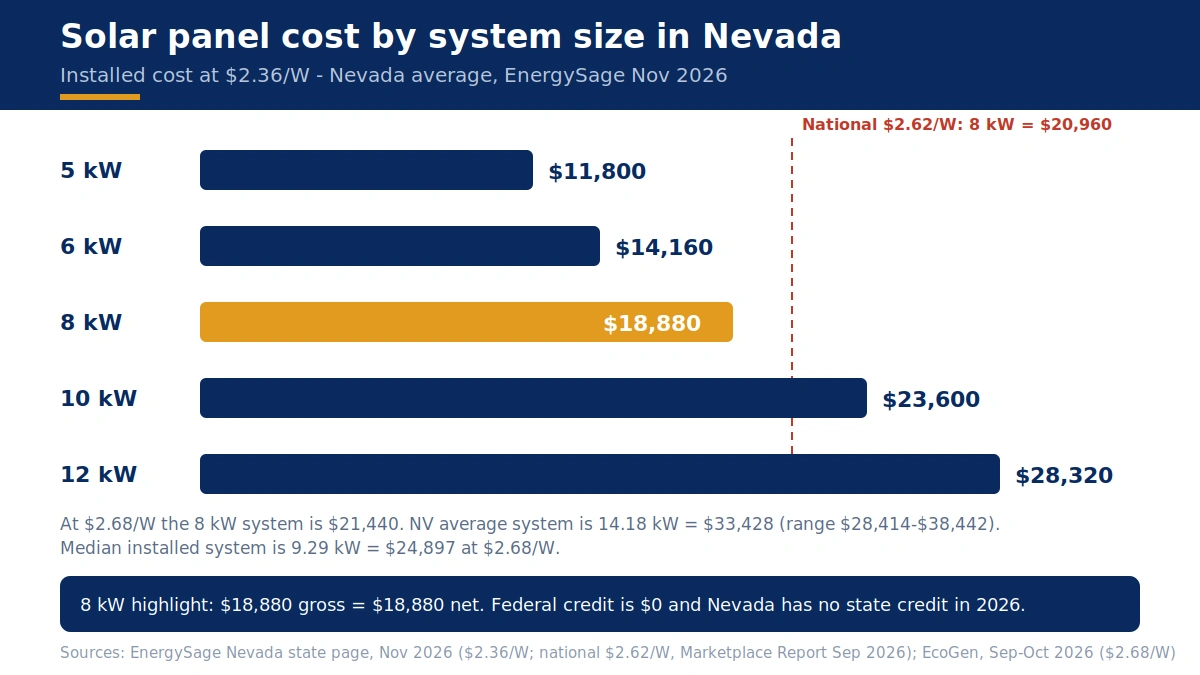
City spot-checks for the average system (EnergySage, November 2026): Las Vegas’s 14.61 kW average runs $34,719; Reno’s 11.36 kW average runs $28,303; Henderson’s 13.99 kW average runs $32,311. The pattern is consistent: Nevada homeowners buy big because the sun is strong, the per-watt price is low, and the AC load is enormous — and the north pays a little more per watt for a little less system.
What drives your price per watt
North vs south — the Nevada split comes first. Reno and Sparks run $0.11–$0.30/W above Las Vegas and Henderson (EnergySage, November 2026). Fewer installers work the north, average systems are smaller there, and crews travel farther — each of those pushes the northern price up. Get quotes from installers who actually work your side of the state — a Las Vegas price is not a Reno price.
Desert heat and equipment tier. Panels, inverter, racking, and wiring make up roughly 36% of a typical project cost nationally (EnergySage installer survey, via our California guide). Higher-grade panels with low temperature coefficients cost more per watt — in the Nevada desert, that extra cost buys real production on 110°F afternoons (see the heat section below).
Electrical panel upgrade (if needed). A national planning range of $2,500–$4,500 (NRG Clean Power, November 2026) is commonly quoted — treat it as a California-sourced national range, not a Nevada-verified figure. Get it itemized on your quote either way.
Permitting and interconnection. No Nevada instant-permitting law was verified in our research, so do not count on one — ask your installer for the interconnection fee as a line item and for the expected timeline. One Nevada protection worth knowing: Nevada law is reported to limit pre-hookup collection to $1,000 or 10% before NV Energy approves hookup (citing NRS 598.982185, single source — verify the statute before relying on it). Never pay most of the price before interconnection is approved.
Installer overhead. Roughly 42% of a typical project nationally is overhead, sales, and margin (EnergySage installer survey). That is why identical equipment quotes can vary widely between installers — and why three quotes are non-negotiable.
The 30% federal tax credit is gone — what that means for 2026 math
Nevada homeowners feel the loss of the federal credit more sharply than homeowners in most states, because there is nothing in Nevada to take its place. Arizona still has a $1,000 state credit; Nevada has no state income tax, so no state credit exists at all. The price on the quote is the price you pay — gross equals net, with no subtraction anywhere in the math.
Congress ended the §25D Residential Clean Energy Credit (30%) in the One Big Beautiful Bill Act (OBBBA, P.L. 119-21, signed July 4, 2025), Section 70506 — it applies to expenditures made after December 31, 2025. The IRS confirmed the timing rule in FS-2025-05 (August 21, 2025): an expenditure counts as “made” when installation is completed. Finish the install after December 31, 2025, and there is no credit.
So for a homeowner-owned system installed in Nevada in 2026 — cash or loan — the federal credit is $0. The gross quoted price is the real out-of-pocket price, with nothing else to subtract in Nevada either. One nuance: an unused §25D credit from a 2025 install can be carried forward to 2026 (Form 5695 instructions, 2025) — but that is a carryforward of a 2025 credit, not a credit for 2026 work.
The one surviving federal path: §48E through a lease or PPA. The Clean Electricity Investment Credit (30%) now survives only for the business that owns the system. On a residential roof, that means a lease or power purchase agreement, with systems placed in service by December 31, 2027 (for construction begun after July 4, 2026). The lessor claims the credit and may pass savings through as a lower monthly payment — you do not get a tax credit yourself. Nevada has its own version of this route: the Nevada BRIGHT prepaid lease, which cuts up to 25% off a solar + battery system and lets you own it after at least 6 years (see the incentives section). Our federal energy tax credits guide covers the full post-OBBBA landscape.
Watch for quotes still subtracting 30% — it remains the most common stale-math trap in 2026 solar pricing, and catching it is the whole point of this guide’s Nevada math.
Nevada incentives: what survives (and what never existed)
Nevada’s incentive picture is the thinnest in the Southwest — and the honest version is shorter than the sales pitch. Here is the whole list.
| Incentive | 2026 status | Value |
|---|---|---|
| Federal §25D residential credit | Expired Dec 31, 2025 — $0 | $0 |
| Nevada state solar tax credit | Does not exist — Nevada has no state income tax, so there is no return for a credit to lower | $0 |
| Property tax exemption | Active | 100% of a qualified solar system excluded from taxable property value — solar adds $0 to taxable value (NRS 701A.200); ask your county assessor to value the home without the system |
| Residential sales-tax exemption | None — no general statewide residential solar sales-tax exemption | $0 |
| NV Energy solar/battery rebate | None in 2026 — the law behind the battery incentive expired December 31, 2025 | $0 |
| §48E (lease/PPA route) | Alive through Dec 31, 2027 — only via third-party ownership | 30% to the lessor, not the homeowner |
| Nevada BRIGHT (prepaid lease) | Active since August 2026 | Up to 25% off a solar + battery system; you own it after at least 6 years (Nevada Clean Energy Fund) |
| RE-UP loan | Active | $3,000–$50,000 at 7.50%–12.00% fixed, 3–8 years; $40 document fee on solar loans (Nevada Clean Energy Fund) |
| Portfolio Energy Credits (PECs) | Active | You earn PECs for the power your system generates; utilities buy them to meet the 50%-renewable-by-2030 standard — no dollar-per-kWh value was verified, so none is given here |
| Expanded Solar Access Program | Closed to new applications October 31, 2026 | At least 1¢/kWh off NV Energy energy charges, no panels; income at or below 80% of area median income; not for homes with rooftop solar |
| Nevada Solar for All | Paused since August 7, 2025 — nothing to apply for | $0 available now |
The property-tax exemption is the one real state benefit — and one page gets it wrong. Under NRS 701A.200, 100% of a qualified solar system is left out of your taxable value. That is confirmed by ConsumerAffairs, EcoGen America (October 2026), and Roi.solar (April 2026). But EnergySage’s own Nevada incentives page (updated January 6, 2026) still says Nevada offers “no sales or property tax exemptions for solar” — stale on property tax. Trust the statute, not the stale page. One process note: sources disagree on whether the exemption is automatic (Roi.solar says no application is required) or needs a word with your county assessor (EcoGen says some counties have a form). The safe advice is to ask your assessor.
Two commercial programs that are NOT homeowner benefits. DSIRE lists a Renewable Energy Sales and Use Tax Abatement (lowers sales/use taxes to 2.6%) and a Large Scale Renewable Energy Property Tax Abatement (55% for 20 years). Both are commercial/large-scale programs. Do not let a salesperson present them as your benefit.
Nevada Solar for All — the full story. The EPA cancelled the $7 billion national Solar for All program on August 7, 2025, freezing Nevada’s $156 million grant (via the Nevada Clean Energy Fund). Two federal courts ruled the EPA termination unlawful on September 18 and September 22, 2026 — but as of October 5, 2026 the fund had posted no restart, and its old program page no longer loads. Anyone selling “Solar for All” in Nevada today is not selling the program.
HEAR rebates (up to $8,000, income-qualified, point-of-sale) are a federal program that survived the OBBBA — but no Nevada-specific 2026 HEAR program status was verified in our research. Check with the Nevada State Office of Energy before counting on one. Verify everything in this section in the DSIRE directory (programs.dsireusa.org, run by NC State University) before signing.
NV Energy net metering: 75% of retail, locked 20 years
Nevada’s net metering has a dramatic history. It was eliminated in 2015 — the move collapsed the state’s rooftop industry overnight — then restored by Assembly Bill 405 (2017) as a tiered successor tariff. New customers enter Tier 4: exports credited at 75% of the retail rate, locked for 20 years at the install location. It is not full 1-for-1 net metering. It is also not the near-zero export pay of Arizona. At roughly 8¢ per kilowatt-hour, it is among the best export deals in the Southwest.
| Tier | Signup period | Export credit | Status |
|---|---|---|---|
| Tier 1 | 2017–2018 | 95% of retail | Closed (tranche filled) |
| Tier 2 | 2018–2019 | 88% of retail | Closed |
| Tier 3 | 2019–2020 | 81% of retail | Closed |
| Tier 4 | 2020–present | 75% of retail | Open — every new signup today |
The tiers are signup-date tranches, not usage bands. If you go solar in Nevada today, you interconnect under Tier 4, and that 75% is locked for 20 years at your home unless the legislature changes it. The rule applies to residential systems up to 25 kW — NV Energy is required by law to offer net metering below that size.
What 75% is worth in cents (October 1, 2026 rates): about 8.35¢ per kilowatt-hour in the south (Nevada Power — Las Vegas, Henderson) and about 8.06¢ in the north (Sierra Pacific — Reno, Sparks), per EcoGen America (October 2026). The 75% applies to the tariff’s “Price of Electricity” definition in the net metering rider, not to the all-in bill rate — which is why the export figures are ~71–75% of the ~11.4–11.5¢ energy rates rather than 75% of the 12.72¢ EIA average. Do not recompute the export credit from the retail rate; use the tariff figures.
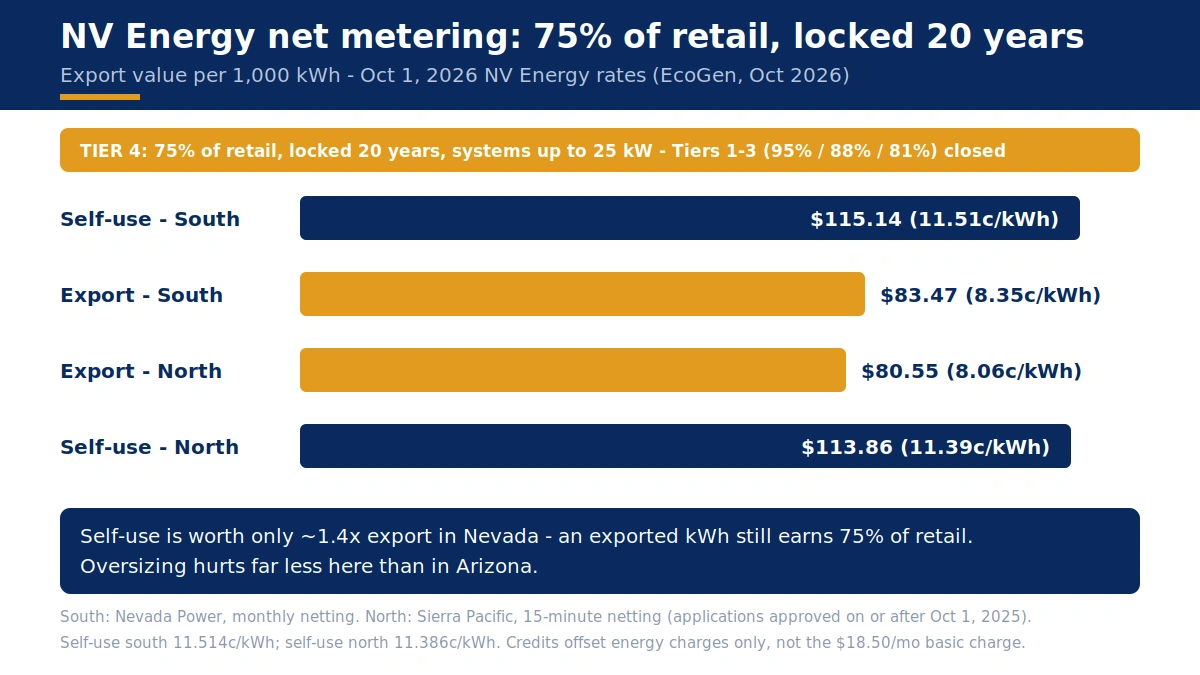
The self-consumption math — the article’s key insight: a self-consumed kilowatt-hour is worth ~11.4–11.5¢; an exported kilowatt-hour is worth ~8.1–8.3¢. Self-use is worth only ~1.4 times the export value. Compare that with Arizona, where self-use is worth ~3 times the export value on APS and ~7 times on SRP, or California’s NEM 3.0, where exports earn roughly 4–8¢ against much higher retail rates. In Nevada, oversizing hurts far less: an exported kilowatt-hour still earns 75% of retail. Credits offset future energy charges only — not the $18.50/month basic service charge — and roll forward to the next monthly bill under the NMR-405 tariff. One secondary source says credits roll over indefinitely with no expiration; that wording is unverified, so this guide does not repeat it as fact.
North vs south: Reno nets every 15 minutes, Las Vegas by the month
NV Energy is two companies with two clocks — and since October 1, 2025, the side of the state you live on changes how fast solar pays back.
| Territory | Netting interval | What it means |
|---|---|---|
| Nevada Power (south — Las Vegas, Henderson, North Las Vegas) | Monthly netting (NMR-405) | Imports and exports are netted across the whole billing month, kilowatt-hour for kilowatt-hour. Only the month’s net excess is credited at 75% of retail. A kilowatt-hour exported at noon can offset a kilowatt-hour imported at 9 PM the same month at full value. |
| Sierra Pacific (north — Reno, Sparks, Carson City) | 15-minute netting (NMR-2025) | For net metering applications approved on or after October 1, 2025: imports vs exports are netted every 15 minutes. Surplus within an interval is sold at 75% immediately instead of offsetting a later import at full value. |
What that means in practice: a Reno home with the same panels and the same usage as a Las Vegas home earns less per exported kilowatt-hour, because midday surplus cannot wait for the evening — it is sold at 8.06¢ at once. In the north, using your own solar in real time matters: run the dishwasher, the laundry, and the EV charger at noon, not at 7 PM. In the south, the monthly clock is forgiving — what matters is the month’s total, not the hour’s.
Court status: EcoGen America (October 2026) reports that court challenges to the 15-minute change were denied in February 2026, “so this is settled, not pending.” That is a single source — treat it as reported, not as settled law, and verify before signing.
Smaller utilities, one line: Overton Power District #5 offers net metering for systems up to 10 kW, and Valley Electric Association offers net billing (not net metering) for systems under 25 kW (EnergySage, January 2026 — single source). If you are not on NV Energy, ask your utility for its tariff in writing.
Statewide context: Nevada’s residential average is 12.72¢/kWh (EIA Electric Power Monthly, Table 5.6.A, August 2026, released October 28, 2026) vs 18.16¢/kWh nationally — 30% below the US average, the lowest of all 51 jurisdictions. On a 12-month average basis the figure is ~13.4¢/kWh, with an average bill of ~$122 a month. The standard NV Energy tariff adds an $18.50/month basic charge before the first kilowatt-hour, plus riders and ~5% tax — about 14.38¢/kWh all-in at 900 kWh. Nevada’s cheap power is the headwind for solar payback; the sun is the tailwind.
The 2027 daily demand charge (and what it means for solar)
Starting January 1, 2027, Nevada Power (southern Nevada) residential bills gain a daily demand charge: $0.14 per kilowatt of your single highest 15-minute grid draw each day, any hour of the day, on top of normal energy charges. The per-kilowatt-hour energy rate drops ~1.675¢/kWh at the same time, so the design is intended to be roughly revenue-neutral for an average home.
| Your daily peak (15-min) | Per day at $0.14/kW | 30-day bill | Typical cause |
|---|---|---|---|
| 3.5 kW (typical home, per NV Energy) | $0.49 | ~$14.70 | Average home |
| 6 kW | $0.84 | $25.20 | AC compressor + dryer together |
| 14 kW | $1.96 | $58.80 | AC + EV charger + pool pump + dryer |
The charge does not care what time your peak happens. 2 PM or 2 AM, it counts the same. It resets every midnight, so you manage a new peak every day — unlike a monthly demand charge, where one bad hour sets the whole month.
History and legal status: the charge was originally scheduled for April 1, 2026, then October 1, 2026, then January 1, 2027 (two delays). The Public Utilities Commission of Nevada approved it in a modified final order on November 20, 2025 (dockets 25-02016 and 25-03006). Two district-court petitions were denied on May 26 and May 28, 2026; the Attorney General said he would appeal. As of October 13, 2026, two appeals sit at the Nevada Supreme Court with no ruling reported (Solar Resource USA, updated October 13, 2026). The January 1, 2027 start date could still change — verify it before you budget around it.
What it means for solar: solar alone does not fix the demand charge. Your panels export at noon and you import at 6–9 PM, so the evening peak — the one that sets the charge — survives solar. A battery (or staggering big loads) does fix it: discharge the battery through the evening peak and your highest 15-minute grid draw falls. NV Energy says the change lowers bills for up to 90% of customers — that is the utility’s claim, not a verified outcome. Northern Nevada gets no daily demand charge; Sierra Pacific customers get 15-minute netting instead.
Do you need a battery in Nevada in 2026?
In Nevada, a battery is a much weaker financial play than in Arizona — and the reason is the 75% export credit. Export 8.06–8.35¢ vs self-use 11.39–11.51¢: a stored kilowatt-hour is worth only ~1.4 times an exported kilowatt-hour (vs ~3–7 times in Arizona). Pure energy arbitrage barely pays.
Where a battery still wins in Nevada: first, northern Nevada — under 15-minute netting, a battery catches midday surplus that would otherwise be sold at 8.06¢ at once and serves it at 11.39¢ in the evening. Second, southern Nevada from January 1, 2027 — a battery shaves the daily demand peak ($0.14/kW/day), which solar alone cannot do. Third, backup power during outages and extreme-heat events, when the grid is most stressed. Those are real reasons. “It pays for itself in energy arbitrage” is not one of them in Nevada.
Cost. No Nevada-specific battery $/kWh benchmark was found, so these are national anchors: a Tesla Powerwall 3 (13.5 kWh) runs ~$15,000 installed with new solar (Solar.com marketplace, September 2026), and EnergySage’s July 2026 battery analysis puts a typical installed 13.5 kWh system at ~$15,647. The installed battery range is $1,100–$2,100 per usable kWh, and a single 10–13.5 kWh system runs $10,000–$16,000 (Solar.com / IntegrateSun, 2026). An 8 kW solar system ($18,880) plus one Powerwall 3 (~$15,000) is roughly $33,880 gross — and in Nevada there is no incentive to subtract from that either.
No upfront solar or battery rebate from NV Energy in 2026, and the law behind the battery incentive expired December 31, 2025. No Nevada virtual power plant payment was verified — do not import Arizona’s VPP figures; they do not apply here.
Our solar battery cost guide has the full national battery pricing depth; do not re-derive battery $/kWh here.
Nevada sun, desert heat, and production
Nevada’s production numbers are among the best in the country. 6.41 peak sun hours per day — #3 in the US (US average 4.98), per NREL PVWatts v8, 2026 NSRDB data. Annual production runs 1,753 kWh/kW/yr (PVWatts v8, Las Vegas) to 1,801 kWh/kW/yr (EcoGen’s model, October 2026). Las Vegas insolation averages 6.41 (7.13 in summer, 5.83 in winter); even Ely, in rural central Nevada, averages 5.98.
The planning figure: ~1,753–1,801 kWh/kW/yr; use ~1,750 as a conservative planning figure and ~14,000 kWh/yr for an 8 kW system. A 9.29 kW median system produces 16,731 kWh a year (EcoGen, October 2026). Las Vegas gets roughly 300 sunny days a year (an older 2023/2024 estimate). Rank cities by utility and netting clock (monthly in the south, 15-minute in the north), not by sun — the sun barely differs, and the billing rules differ a lot.
Heat — panels lose output on the hottest afternoons, but Nevada still wins annually. Panels are rated at 25°C (77°F) cell temperature (standard test conditions). Las Vegas rooftop cells reach 65–75°C (150–170°F) on summer afternoons (Phoenix-measured desert figures, applied here to the same Mojave desert climate — ExploreSolar, February 2026). How much output a panel loses per degree of heat is its temperature coefficient: standard PERC panels run −0.34 to −0.40%/°C, which works out to a 16–21% output loss at 71°C cell temperature; TOPCon (n-type) runs −0.28 to −0.35%/°C (13–16%); HJT runs −0.24 to −0.28%/°C (11–13%). As a rule of thumb, a −0.35%/°C panel loses ~14% of rated power at a given moment on a 104°F afternoon.
The net effect is still strongly positive: annual production of 1,753–1,801 kWh/kW/yr already nets out heat losses (PVWatts models include temperature derating). Production peaks in February–May, when the weather is mild and the skies are clear. Buyer tip: compare the temperature coefficient (Pmax) on each quote’s datasheet — closer to zero is better in the desert; TOPCon/HJT carry a smaller heat penalty than budget PERC. Desert dust needs occasional cleaning, but no Nevada-specific soiling percentage was verified.
HOA rights: Nevada law protects your panels
Nevada has among the strongest HOA solar protections in the US — and two statutes do the work, with a 2025 upgrade that added a deadline clock.
- NRS 111.239 — any covenant, restriction, or condition in a deed, contract, or other legal instrument that prohibits or unreasonably restricts using a solar energy system on the property is void and unenforceable. The statute defines “unreasonable”: a restriction that decreases the system’s efficiency or performance by more than 10% of the amount originally specified (as determined by the Director of the Office of Energy), without allowing an alternative system at substantially comparable cost and efficiency — or a ban on systems using components painted with black solar glazing.
- NRS 116.333–116.334 (SB 440, 2025) — the common-interest-community procedure. An association with qualifying solar rules must approve or deny an initial request within 35 days, with 15 days to review a corrected resubmission. An association without qualifying rules must approve within 15 days and cannot impose conditions. A missed deadline means the request is deemed approved. Two rules — panels turned away from a street, and conduits painted to match — cannot be forced on you if complying costs more than 3% of the installation.
Note the contrast with Arizona: Arizona’s HOA statute has no fixed percentage threshold at all. Nevada has two — 10% on efficiency, 3% on cost. Do not mix the two states’ rules. The SB 440 procedure details rest on secondary sources (greenlancer.com and hopb.co, 2026), not on the statute text itself — verify them before relying on them in a dispute.
Two honest gaps: HOAs may still require an architectural application — submit it, do not skip it. And in condominiums the association commonly owns and maintains the roof, which can limit rooftop solar in practice even where the statute protects the right. Reasonable appearance rules are still enforceable by an HOA — but those rules cannot be used to block your system, cripple its output, or price it out of reach.
Payback & 25-year savings math
Published benchmarks. EnergySage (November 2026) puts Nevada payback at 17.58 years for the 14.18 kW average system, with 25-year savings of $17,553. City pages: Las Vegas 17.83 years ($17,368), Reno 17.96 ($14,413), North Las Vegas 17.68 ($14,356), Sparks 19.33 ($12,745). EcoGen America (October 2026) puts the northern payback at ~16.4 years (range 15.8–17.0) for a 9.29 kW system at $2.68/W. The national cash payback in 2026 is 9–13 years — Nevada sits well above it, because of cheap power and very large systems.
Why published Nevada payback is so long: cheap electricity (12.72¢ vs 18.16¢ US) means each saved kilowatt-hour is worth less, and the average system is very large (14.18 kW), so a bigger share of production is exported at 75% of retail instead of offsetting retail purchases. Smaller systems sized to actual usage pay back faster — that is what our worked model shows.
Worked model: 8 kW system, southern Nevada (Las Vegas, monthly netting). Every line is shown — this model is ours, not EnergySage’s or EcoGen’s, and the assumptions are stated below.
| Line | Math | Result |
|---|---|---|
| Gross installed cost | 8,000 W × $2.36/W | $18,880 |
| Less federal credit | $0 (2026 owned install) | $0 |
| Less state credit / rebate | None exist in Nevada | $0 |
| Net cost | $18,880 | |
| Annual production | 8 kW × 1,753 kWh/kW/yr | ~14,024 kWh/yr |
| Offset at retail (70%, monthly netting) | 9,817 kWh × 11.514¢ (NV Power self-use value) | $1,130/yr |
| Exported at Tier 4 (30%) | 4,207 kWh × 8.347¢ (NV Power Tier 4 credit) | $351/yr |
| Year-1 savings | ~$1,481/yr | |
| Simple payback (net = gross) | $18,880 ÷ $1,481 | ~12.7 years |
| 25-yr gross savings | $1,481/yr escalating ~2.5%/yr (electricity inflation), less ~0.5%/yr panel degradation | ~$47,400 |
| Less inverter replacement (once, ~yr 12–15) | −$2,000 | |
| Less net system cost | −$18,880 | |
| 25-year net savings (modeled) | ~$26,500 |
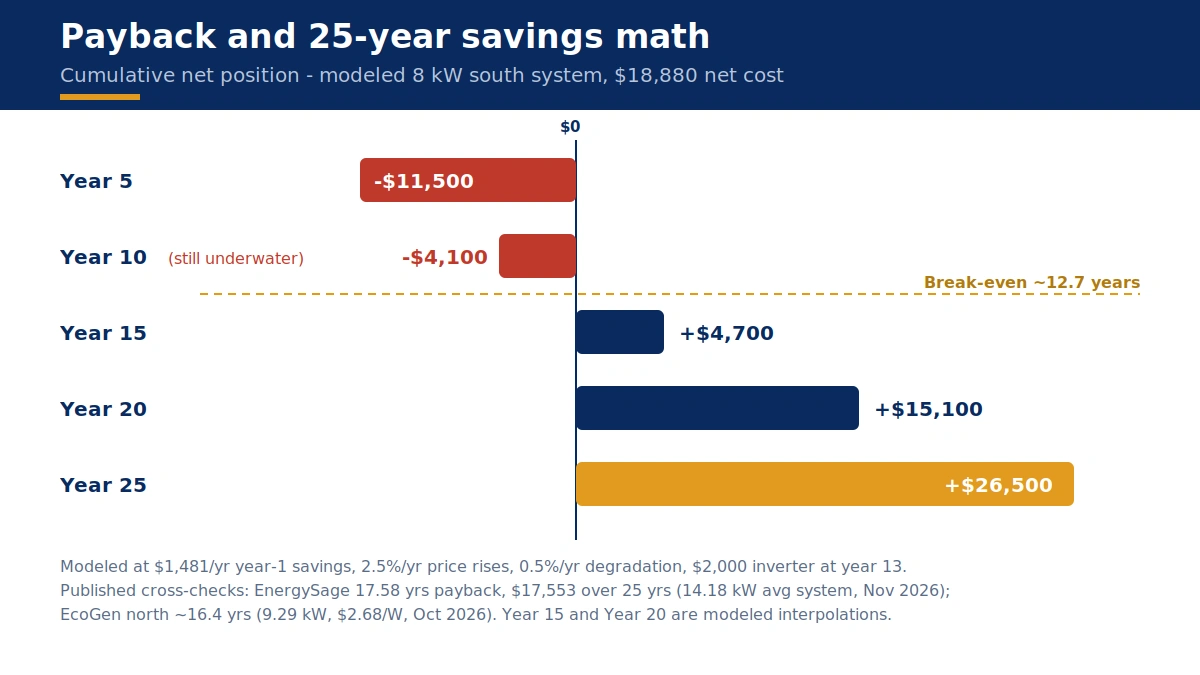
Assumptions, stated plainly: 70% of production offsets retail — monthly netting in the south makes the offset share higher than instantaneous self-consumption, because a noon export offsets a 9 PM import in the same month at full value; 2.5%/yr electricity-price escalation; 0.5%/yr degradation; one inverter replacement ~$2,000; Tier 4 credit locked 20 years at 75% of retail. The payback chart’s Year 15 (+$4,700) and Year 20 (+$15,100) points are modeled interpolations between the 12.7-year break-even and the 25-year net — not published benchmarks.
Northern Nevada version (Reno, 15-minute netting, modeled): the same 8 kW system at Reno’s $2.49/W costs $19,920 gross/net. Self-consumed 60% × 11.386¢ (Sierra Pacific D-1) gives 8,414 kWh = $958/yr; exported 40% × 8.055¢ = 5,610 kWh = $452/yr; year-1 savings ~$1,410/yr; simple payback ~14.1 years. The north pays back slower than the south on the same panels: higher $/W, 15-minute netting, and a slightly lower export credit. No Reno-specific production figure was verified — the statewide 1,753 kWh/kW/yr figure is used for the north model and flagged as such.
Our range: ~13–18 years statewide. South (Las Vegas/Henderson), 8 kW, monthly netting: ~12.7 years modeled. North (Reno/Sparks), 8 kW, 15-minute netting: ~14.1 years modeled. Published benchmarks (larger average systems): 16.4 years (EcoGen north) to 17.6 years (EnergySage statewide). EnergySage’s $17,553 25-year savings is for the 14.18 kW average system; our modeled 8 kW south system nets ~$26,500 over 25 years because it costs far less upfront ($18,880 vs $33,428). The honest headline is the range, not the optimistic end.
Nevada’s scale, for context: 8,254 MWdc installed (September 2026, SEIA/Wood Mackenzie), powering 1,409,963 homes, with 152,462 installations and 6,510 MW projected over the next 5 years — ranking 8th nationally. Residential rooftop alone: 142,497 net-metered installations and 1,108.6 MW of residential PV capacity in 2025 (EIA). The rooftop share keeps growing despite the long payback, because the sun and the 75% export credit are that good.
How to get quotes in Nevada + red flags
Get three or more installer quotes, and run the same questions past each one so the answers compare:
- What’s my $/W before any incentives? The Nevada benchmark is $2.36–$2.68/W. As a rule of thumb, anything above $3.00/W needs a justification (complex roof, premium equipment, northern territory). If the roof itself needs replacing first, see our roof replacement cost guide.
- Does the quote subtract the 30% federal credit? If it does, the math relies on a credit that no longer exists — ask them to take it off.
- Does the quote subtract a Nevada state credit? There is none — Nevada has no state income tax. A “state credit” line is invented.
- Is the savings model using retail rate for all production? If yes, it ignores the 75% export haircut — and in the north, it ignores the 15-minute netting that makes the haircut bite immediately. Ask for offset and export shown as separate lines.
- Does the export rate AND the netting clock on the quote match MY territory? The #1 Nevada-specific trap: a Reno quote modeled as Las Vegas monthly netting, or vice versa. South should show ~8.35¢ with monthly netting; north should show ~8.06¢ with 15-minute netting.
- Is it a lease or PPA? If so, ask where the §48E value goes — the lessor is the one who claims the credit, so the saving should appear in your monthly payment. Compare any private lease against Nevada BRIGHT (up to 25% off, own after 6+ years).
- What’s the panel temperature coefficient, and what’s the inverter warranty? In desert heat, both matter more than the panel brand name. And verify the installer’s license with the Nevada State Contractors Board before signing — do not take their word for it.
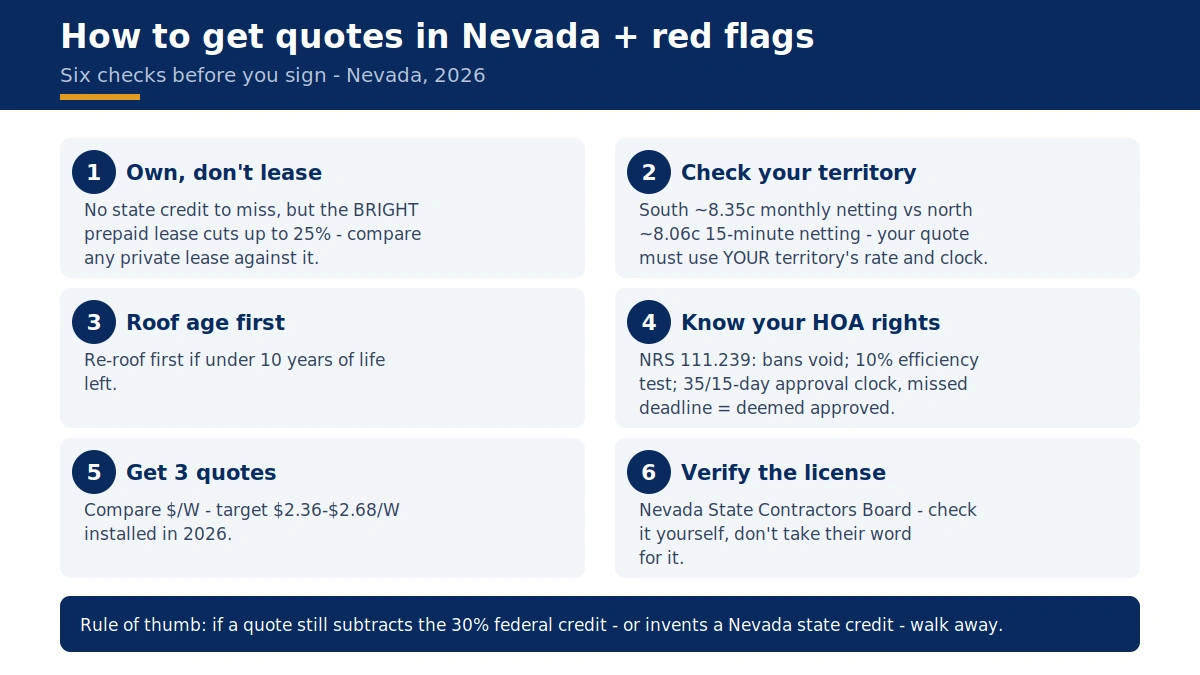
Red flags from the Nevada market. “Free solar” and “government program” claims: there is no program giving away panels, and Nevada Solar for All has been paused since August 7, 2025 — anyone selling it today is not selling the program. Upfront-payment pressure: Nevada law is reported to limit pre-hookup collection to $1,000 or 10% (NRS 598.982185, single source) — never pay most of the price before NV Energy approves interconnection. The demand-charge pitch: from January 2027, a battery genuinely helps in the south by shaving the daily peak — but a salesperson who tells you the demand charge already applies in 2026, or that solar alone eliminates it, is wrong on both counts. Under the FTC Cooling-Off Rule (16 CFR Part 429), a door-to-door sale of $25 or more can be cancelled within 3 days. No Nevada-specific solar fraud case is named here.
Where to complain: the Nevada State Contractors Board (license verification and complaints); the Nevada Attorney General’s consumer protection office; the Public Utilities Commission of Nevada for utility and net-metering disputes. Look up phone numbers on the agencies’ own sites.
Sources & methodology
Cost anchors: EnergySage Nevada state page (November 2026: $2.36/W, 14.18 kW average system, $33,428, range $28,414–$38,442; payback 17.58 years, 25-year savings $17,553); EnergySage city pages (November 2026: Las Vegas $2.38/W 14.61 kW $34,719, payback 17.83, savings $17,368; Reno $2.49/W 11.36 kW $28,303, payback 17.96, savings $14,413; North Las Vegas $2.34/W 12.45 kW $29,171, payback 17.68, savings $14,356; Sparks $2.61/W 12.23 kW $31,889, payback 19.33, savings $12,745; Henderson $2.31/W 13.99 kW $32,311, October 9, 2026); EcoGen America Solar Cost Index, September 2026 edition (Nevada $2.68/W, 9.29 kW median system, $24,897; 1,801 kWh/kW/yr; 16,731 kWh/yr; north payback ~16.4 years, range 15.8–17.0); The Green Watt 50-state guide (2026: Nevada $2.60/W); EnergySage national page (June 30, 2026: ~$2.60/W, 12 kW avg $31,135); EnergySage Marketplace Report 23rd edition (September 2026, H1 2026 data: national median $2.62/W solar-only). Size table calculated from the $2.36/W anchor at $2.68/W high end. The $3.14/W poweroutage.us figure (April 12, 2026) was reviewed and excluded as an outlier.
Electricity rates: EIA Electric Power Monthly Table 5.6.A (August 2026, released October 28, 2026: Nevada residential 12.72¢/kWh, US 18.16¢/kWh, Nevada #1 lowest of 51 jurisdictions, 30.0% below US; avg bill ~$114.48/mo at 900 kWh); EIA 12-month average via kadoa.com (12 months to August 2026: 13.4¢/kWh, avg bill ~$122/mo); EIA Jan–Aug 2026 average via priceofelectricity.com (13.63¢/kWh, +2.1% vs Jan–Aug 2025); EIA Electric Power Annual Table 2.10 (2024 full year: 15.00¢/kWh). NV Energy residential rate schedules (effective July 1, 2026: RS total $0.10560/kWh; TOU $0.11195–$0.11935/kWh; summer on-peak June 1–Sep 30, 6:01–9:00 PM daily; winter Oct–May all hours; EV recharge rider 12:01 AM–8:00 AM). NV Power self-use value 11.514¢/kWh and average price 13.29¢/kWh (Sep 2025–Aug 2026); Sierra Pacific D-1 11.386¢/kWh + $18.50/mo basic charge; $18.50/mo + 0.50¢/kWh riders + ~5% tax = all-in 14.38¢/kWh at 900 kWh (EcoGen, October 1, 2026 rates; priceofelectricity.com).
Net metering: Assembly Bill 405 (2017) tier structure — Tier 1 95%, Tier 2 88%, Tier 3 81%, Tier 4 75% of retail, locked 20 years, systems ≤25 kW (PUCN net metering page, checked October 2026; Solar Resource USA net metering guide; roi.solar, April 22, 2026). Export credits ~8.35¢/kWh south (8.347¢) and ~8.06¢/kWh north (8.055¢), October 1, 2026 (EcoGen America, October 2026). Monthly netting south (NMR-405) vs 15-minute netting north (NMR-2025, applications approved on or after October 1, 2025); court challenges denied February 2026 (EcoGen, October 2026 — single source). Overton Power District #5 (≤10 kW) and Valley Electric Association (net billing <25 kW) per EnergySage incentives page (January 2026 — single source).
Incentives: NRS 701A.200 (property-tax exemption, 100% of qualified system; confirmed by ConsumerAffairs 2026, EcoGen October 2026, Roi.solar April 2026); no state solar tax credit — no state income tax (Roi.solar April 2026; EcoGen October 2026; Icon Power October 2026); no residential sales-tax exemption (EnergySage incentives page, January 6, 2026; Power Done Better, August 2026); no NV Energy solar/battery rebate in 2026, battery-incentive law expired December 31, 2025 (EcoGen, October 2026); Nevada BRIGHT up to 25% off, own after 6+ years, active since August 2026; RE-UP loan $3,000–$50,000 at 7.50%–12.00% fixed, 3–8 years, $40 document fee (Nevada Clean Energy Fund via EcoGen, October 2026); Portfolio Energy Credits (ConsumerAffairs 2026; Icon Power October 2026 — no $ value verified); Expanded Solar Access Program closed October 31, 2026, income ≤80% AMI, not for rooftop-solar homes (EcoGen, October 2026, status checked November 2, 2026); Nevada Solar for All paused since August 7, 2025, courts ruled EPA termination unlawful September 18 + 22, 2026, no restart posted as of October 5, 2026 (NCEF notice; EcoGen, October 2026; wearemainstreet.org, October 27, 2026). OBBBA P.L. 119-21 (signed July 4, 2025), IRS FS-2025-05 (August 21, 2025, FAQ 7). DSIRE directory (programs.dsireusa.org, NC State University) — verify all Nevada items there at publish time; the DSIRE commercial abatements (2.6% sales tax; 55% property tax for 20 years) are not residential benefits.
Demand charge: $0.14/kW/day on the highest 15-minute draw, southern Nevada only, from January 1, 2027; typical home ~$0.49/day (~$15/mo); per-kWh rate drops ~1.675¢/kWh (NV Energy Daily Demand fact sheet; PUCN dockets 25-02016 and 25-03006, modified final order November 20, 2025; district-court denials May 26 + 28, 2026; two appeals pending at the Nevada Supreme Court with no ruling reported as of October 13, 2026 — Solar Resource USA demand-charge guide, updated October 13, 2026; w4news.org, September 2026; The Nevadan, 2026).
Production: NREL PVWatts v8, 2026 NSRDB data via thegreenwatt.com (6.41 peak sun hours/day, #3 US; 1,753 kWh/kW/yr, Las Vegas); EcoGen model (1,801 kWh/kW/yr; 9.29 kW gives 16,731 kWh/yr); solar insolation table (Las Vegas 6.41 avg, 7.13 summer, 5.83 winter; Ely 5.98); ~300 sunny days/yr in Las Vegas (Solar Optimum, 2023, updated January 2024 — older source).
Battery: Powerwall 3 (13.5 kWh) ~$15,000 installed with new solar (Solar.com marketplace, September 2026 — national anchor); EnergySage July 2026 battery analysis ~$15,647 for a typical installed 13.5 kWh system (via thepricer.org, October 2026); installed battery range $1,100–$2,100 per usable kWh; single 10–13.5 kWh system $10,000–$16,000 (Solar.com / IntegrateSun, 2026). No Nevada VPP payment or battery attach rate verified.
Heat/panels: ExploreSolar (February 2026: rooftop cell temps 65–75°C; temperature coefficients PERC −0.34 to −0.40%/°C, TOPCon −0.28 to −0.35%/°C, HJT −0.24 to −0.28%/°C; 16–21% loss at 71°C cell temp — Phoenix-measured, applied to Las Vegas as the same desert climate); MySolarFY (August 2026: ~14% loss at 104°F for a −0.35%/°C panel).
HOA: NRS 111.239 (deed restrictions void; 10% efficiency test; black solar glazing) via FindLaw (current as of January 1, 2025); NRS 116.333–116.334, SB 440 (2025) — 35/15-day clocks, deemed approval, 3% cost test (greenlancer.com, 2026; hopb.co, 2026 — secondary sources, verify at the statute).
Payback model: EnergySage Nevada state page (November 2026: 17.58-year payback, 25-year savings $17,553, 14.18 kW system; city payback figures Las Vegas 17.83, Reno 17.96, North Las Vegas 17.68, Sparks 19.33 years); EcoGen (October 2026: north payback ~16.4 years, 15.8–17.0 range, 9.29 kW at $2.68/W). The 8 kW worked models are our arithmetic with stated assumptions (70% offset south / 60% self-consumption north, 2.5%/yr escalation, 0.5%/yr degradation, $2,000 inverter replacement, Tier 4 locked 20 years).
State scale: SEIA/Wood Mackenzie (September 2026: 8,254 MWdc installed, 1,409,963 homes, 152,462 installations, 6,510 MW projected next 5 years, ranks 8th) — see SEIA Nevada fact sheet. Net-metered residential PV installations 142,497, capacity 1,108.6 MW, 2025 (EIA via electricalcontractorsandwiring.com, October 2026). Cross-check sources: EcoGen America Nevada solar incentives 2026, EcoGen America solar panel cost in Nevada 2026, Solar Resource USA NV Energy net metering guide, Solar Resource USA NV Energy demand charge guide.
EXCLUDED: the $3.14/W poweroutage.us Nevada average (outlier vs EnergySage $2.36/W and EcoGen $2.68/W); the “8 to 12 cents” export range (top end inconsistent with Oct 1, 2026 tariff figures); any claim of a Nevada state solar tax credit (none exists); the DSIRE commercial abatements as residential benefits; Arizona’s VPP figures, battery attach rate (~47%), and HOA rules (no % threshold in AZ — Nevada HAS 10% + 3% tests); any Nevada-specific solar fraud case or AG phone numbers (unverified); the “credits roll over indefinitely” wording (secondary-source only); a summer on-peak ¢/kWh figure for NV Energy TOU plans (unverified).
*Disclaimer: Prices are 2026 Nevada planning figures and change by territory, roof, and installer. Get 3 written local quotes before you set a budget. Tax information here is general background, not tax advice — check with a tax professional. Export rates are October 1, 2026 NV Energy rates — verify the current rate with your utility before signing. The January 1, 2027 daily demand charge is subject to pending Nevada Supreme Court appeals.*
—
How much do solar panels cost in Nevada in 2026?
Solar panels cost $2.36–$2.68 per watt installed in Nevada in 2026 (EnergySage, November 2026; EcoGen, September 2026). An 8 kW system runs about $18,880 gross — and the same net, since Nevada has no federal or state credit to subtract. The Nevada-average 14.18 kW system costs $33,428.
Is there still a federal solar tax credit in Nevada in 2026?
No — $0 for homeowner-owned systems. The §25D residential credit ended for installations completed after December 31, 2025 (OBBBA, P.L. 119-21; IRS FS-2025-05). Nevada has no state credit either, because it has no state income tax. Leased systems may still benefit from the §48E credit through December 31, 2027, and Nevada’s BRIGHT prepaid lease cuts up to 25% off.
Does Nevada have net metering?
Yes — Tier 4 under Assembly Bill 405 (2017). New customers earn credits at 75% of the retail rate for exported power, locked for 20 years. That is about 8.35¢ per kilowatt-hour in the south (Las Vegas, Henderson) and about 8.06¢ in the north (Reno, Sparks) at October 1, 2026 rates. Electricity you use directly is worth the full retail rate of about 11.5¢, so self-use is worth roughly 1.4 times more than exporting.
Why is solar payback so long in Nevada?
Cheap power and big systems. Nevada’s residential rate is 12.72¢/kWh — the cheapest in the US (EIA, August 2026) — so each saved kilowatt-hour is worth less, and the average system is a very large 14.18 kW, so more production is exported at 75% of retail. EnergySage puts statewide payback at 17.58 years. A smaller 8 kW system sized to actual usage pays back in about 12.7 years in the south and about 14.1 years in the north on our modeled figures.
What is the NV Energy demand charge starting in 2027?
A daily charge of $0.14 per kilowatt on your single highest 15-minute grid draw each day, for southern Nevada (Nevada Power) residential customers from January 1, 2027. A typical home peaks near 3.5 kW, or about $0.49 a day (~$15 a month). The per-kWh energy rate drops about 1.675¢ at the same time. Two appeals are pending at the Nevada Supreme Court with no ruling reported as of October 13, 2026, so the start date could still change. Northern Nevada gets no demand charge.
Can my HOA stop me from installing solar panels in Nevada?
No. NRS 111.239 makes any deed restriction that prohibits or unreasonably restricts solar void and unenforceable — a restriction is unreasonable if it cuts efficiency by more than 10%. NRS 116.333–116.334 (SB 440, 2025) adds a deadline clock: an association with qualifying solar rules must decide within 35 days (15 days on resubmission); one without qualifying rules must approve within 15 days, and a missed deadline means the request is deemed approved. Rules that cost more than 3% of the installation cannot be forced on you.
Will solar panels raise my property taxes in Nevada?
No — NRS 701A.200 excludes 100% of a qualified solar system’s value from your property-tax assessment. Ask your county assessor to value the home without the system; some counties have a form for this. Note that one EnergySage incentives page still says Nevada offers no property-tax exemption — that is stale; the statute says otherwise.
Do I need a battery with solar panels in Nevada?
The case is weaker than in Arizona, because exports earn 75% of retail — a stored kilowatt-hour is worth only about 1.4 times an exported one. A battery is worth it mainly in the north (15-minute netting, where it catches midday surplus), in the south from 2027 (shaving the daily demand peak), and for backup power. A Tesla Powerwall 3 (13.5 kWh) runs about $15,000 installed with new solar. There is no NV Energy battery rebate in 2026.
1 thought on “Solar Panel Cost in Nevada 2026”