


Table of Contents
A heat pump and a solar array save money in opposite ways. A heat pump cuts the amount of energy your home needs. Solar cuts the amount of energy you buy from the grid. One shrinks the bill; the other replaces it.
That difference decides everything. Solar wins the long game because panels run for 25–30 years and every kilowatt-hour they make is a kilowatt-hour you never buy. A heat pump wins the short game because it usually replaces two machines — a furnace and an air conditioner — in one box, so the extra cost over a normal replacement is small.
This guide runs both systems through the same home, the same 2026 prices, and the same math — the heat pump vs solar savings 2026 comparison on one set of numbers: upfront cost, annual savings, payback, 10-year and 25-year totals. No 30% federal credit anywhere in the numbers — that credit is gone for 2026 installs, for both technologies. The verdicts at the end are per home type, because “which saves more” has no single answer.
The modeled home used throughout: a 2,000 sq ft home using the US average of ~10,500 kWh of electricity a year (EIA, 2026) at the national average rate of 18.16 cents/kWh (EIA, Aug 2026) — an electric bill of ~$1,900 a year — plus ~$1,200 a year of heating fuel. Total energy spend: ~$3,100 a year. Your numbers will differ; the method will not.
The short answer: which saves more in 2026?
Solar saves more total dollars. A heat pump saves more dollars per dollar of extra spending. Both statements are true at the same time, and which one matters depends on what you are buying.
- If you can only buy one and you plan to stay 15+ years: buy solar. On our modeled home it nets ~$17,000 over 25 years. No heat pump scenario beats that at full cost.
- If your furnace or AC is dying: buy the heat pump first. The premium over a like-for-like furnace-plus-AC replacement is only ~$1,500, and average savings of $370 a year recover it in ~4 years.
- If you heat with cheap natural gas and your HVAC is fine: buy neither yet. A heat pump would take ~80 years to pay back on heating savings alone. Wait until a replacement is due, then choose the heat pump.
- If you heat with oil, propane, or electric resistance: the heat pump is a strong buy — payback of 12–15 years at full cost, ~4 years on the replacement premium.
- If you want the biggest total savings and can fund both: buy both. The combined stack nets ~$8,800 over 25 years and cuts the modeled home’s energy spend from ~$3,100 a year to ~$800 a year — but it needs $32,960 upfront and takes ~14 years to pay back.
The rest of this guide shows the arithmetic behind every one of those verdicts.
Heat pump vs solar at a glance
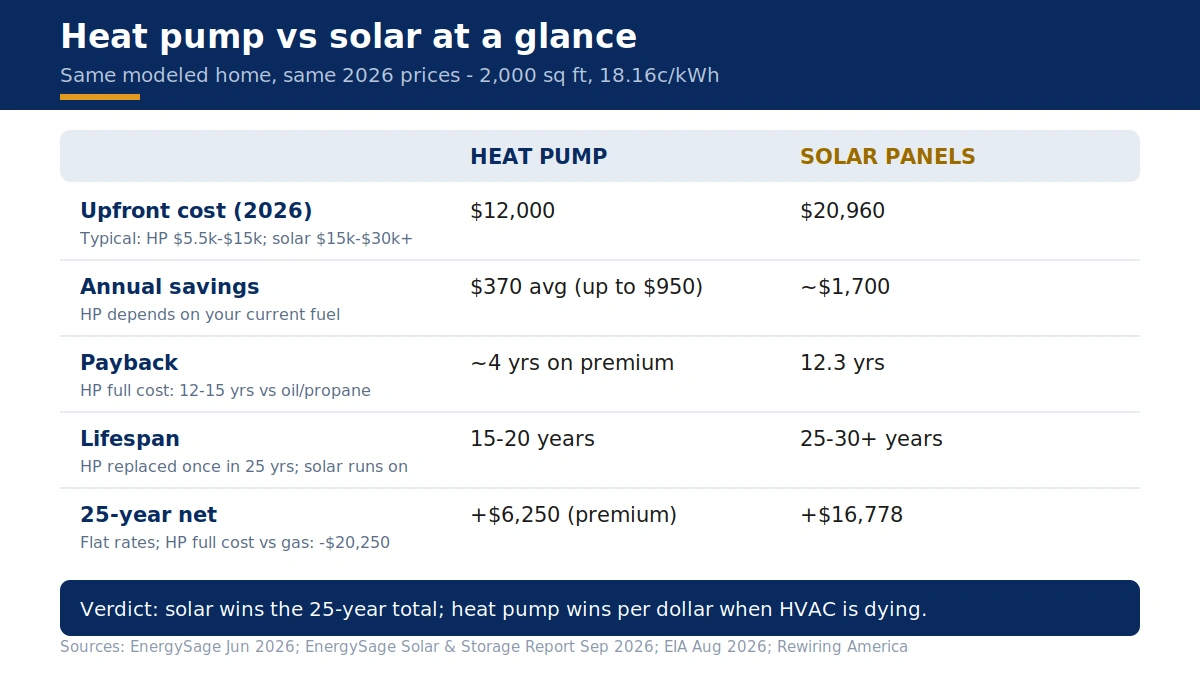
| Heat pump | Solar panels | |
|---|---|---|
| What it does | Heats and cools with electricity, moving heat instead of making it | Generates electricity from sunlight |
| Typical upfront cost, 2026 | $5,500–$15,000 (central case $12,000) | $15,000–$30,000+ (central case $20,960 for 8 kW) |
| What it replaces | Furnace + air conditioner | Grid electricity purchases |
| Annual savings (modeled home) | $150–$950/yr depending on current fuel; $370/yr average | ~$1,700/yr |
| Payback (full cost) | 12–15 yrs vs oil/propane/resistance; ~80 yrs vs cheap gas | ~12.3 yrs |
| Payback (smart framing) | ~4 yrs on the replacement premium | 9–13 yrs national range (cash) |
| Lifespan | 15–20 years (replace once in 25 yrs) | 25–30+ years (one system covers 25 yrs) |
| 25-year net (modeled home) | −$4,000 vs resistance at full cost; +$6,250 on replacement premium | ~+$17,000 |
| Federal credit, 2026 | $0 | $0 |
| Needs | Outdoor unit space, electrical capacity | Usable roof, sun exposure |
| Biggest risk | High electric rates + cheap gas = thin savings | Shaded/old roof, low electric rates, moving soon |
Sources: EnergySage (Jun 2026); EnergySage Solar & Storage Marketplace Report 23rd ed. (Sep 2026); EIA (Aug 2026); Rewiring America (2026); NREL; IRS FS-2025-05. Full citations in Sources & methodology.
What each one costs upfront in 2026
Heat pump: $5,500–$15,000 typical for a whole-home ducted install. EnergySage Marketplace data (Jun 2026) puts the national average at $15,393 before incentives across all system types — ducted $14,529, ductless mini-splits $25,957, hybrid (heat pump + furnace) $14,353. The average sits above our range because it includes multi-zone ductless systems, which run $25,000+. A standard ducted replacement in a home with existing ductwork lands in the $8,000–$15,000 band. Our central case uses $12,000.
What moves the heat pump price: system type (ductless costs far more per home), home size and tonnage, ductwork condition (new ducts add $2,000–$10,000), electrical panel upgrades, and climate — cold-climate units cost more. Our heat pump cost guide breaks it down by type, and the Texas heat pump guide shows how much prices vary by state.
Solar: $15,000–$30,000+ typical for a home system. Solar is priced per watt. EnergySage’s Solar & Storage Marketplace Report, 23rd edition (Sep 30, 2026, covering H1 2026 quotes), reports a median quoted price of $2.62 per watt before incentives for solar-only systems. That gives:
| System size | Cost at $2.62/W | Fits |
|---|---|---|
| 5 kW | $13,100 | Small home, partial offset |
| 6 kW | $15,720 | Average home, good offset |
| 8 kW | $20,960 | Average home, near-full offset (our central case) |
| 10 kW | $26,200 | Large home or EV + heat pump |
| 12 kW | $31,440 | Large home, full electrification |
Higher quotes exist: SEIA/Wood Mackenzie put Q2 2026 turnkey residential solar at $3.36/W, and single-installer quotes (not marketplace-competed) commonly land at $3.00–$3.50/W. At $3.36/W, our 8 kW system would cost $26,880. Price per watt falls as systems get bigger and varies by state — Florida is cheapest at $2.12/W (EnergySage, Sep 2026), Texas runs $2.25–$2.85/W, California averages $2.52/W. Full state pricing is in our solar panel cost guide, with California and Texas deep dives.
The upfront gap is real but smaller than it looks. Solar costs ~$9,000 more than a heat pump in our central cases ($20,960 vs $12,000). But a heat pump usually replaces a furnace and an AC that you would have to buy anyway — a combined replacement runs ~$12,267 (2026 bid analysis, thehomeownerfiles.com). Solar replaces nothing you were already going to buy. That is why the payback math needs two framings, which the next sections use.
What each one saves per year
Heat pump annual savings: $150–$950, depending on what you heat with now
A heat pump does not save a fixed amount. It saves the difference between your old heating cost and its running cost — and that difference is set by your current fuel. Rewiring America estimates (via EnergySage, Jun 2026):
| Current heating | Typical annual savings with a heat pump |
|---|---|
| Natural gas furnace | $100–$200 (we use $150) |
| Electric resistance (baseboards, electric furnace) | ~$800 |
| Propane | ~$850 |
| Heating oil | ~$950 |
| Average US household | ~$370 |
Why the spread is so wide: a heat pump delivers 2–4 units of heat per unit of electricity (COP 2–4), while electric resistance delivers exactly 1 and a gas furnace delivers at most 0.98. Against expensive fuels — oil, propane, resistance electricity — the efficiency gap is worth $800–$950 a year. Against cheap natural gas, the gap nearly vanishes: gas is so cheap per unit of heat that even a 300%-efficient heat pump barely beats a 95%-efficient furnace. The DOE puts it plainly: switching from an older gas or electric furnace can cut heating bills by up to 50%, but “up to” does a lot of work there — the gas case sits at the bottom of that range.
Cooling savings add a little on top: a new heat pump is also a new, high-SEER air conditioner, replacing an old AC that may be 10–15 SEER. We do not count cooling savings in the article math — they are real but small next to heating, and counting them would flatter the heat pump. Our heat pump running cost guide has the month-by-month numbers.
Solar annual savings: ~$1,700 on the modeled home
Solar savings are simpler: every kilowatt-hour your panels produce is a kilowatt-hour you do not buy at 18.16 cents. Our 8 kW system produces about 10,800 kWh a year (8 kW × ~1,350 kWh per kW per year, the standard US production assumption used in 2026 cost analyses). At full retail value that is 10,800 × $0.1816 = $1,961 a year.
We use $1,700 a year instead — a haircut for reality. Not every kilowatt-hour is worth full retail: power exported under net-billing rules (California’s NEM 3.0 and similar) earns far less than retail, and fixed monthly charges cannot be erased by solar at all. The $1,700 figure sits inside the published range: DOE and EnergySage put a typical 6 kW system at ~$1,500 a year, and EnergySage Marketplace data puts rooftop solar annual savings at $1,480–$6,160 depending on state and system size.
The rate you pay is the biggest lever on solar savings. At Hawaii’s 47.18 cents/kWh (EIA, Aug 2026), the same 8 kW system saves roughly $4,400 a year. At Nevada’s 12.72 cents, it saves roughly $1,190. That is why solar payback ranges from 6 years in high-rate, high-incentive states to 18+ years in low-rate states with no incentives (solarpanelsnetwork.com, Sep 2026).
Payback periods, side by side
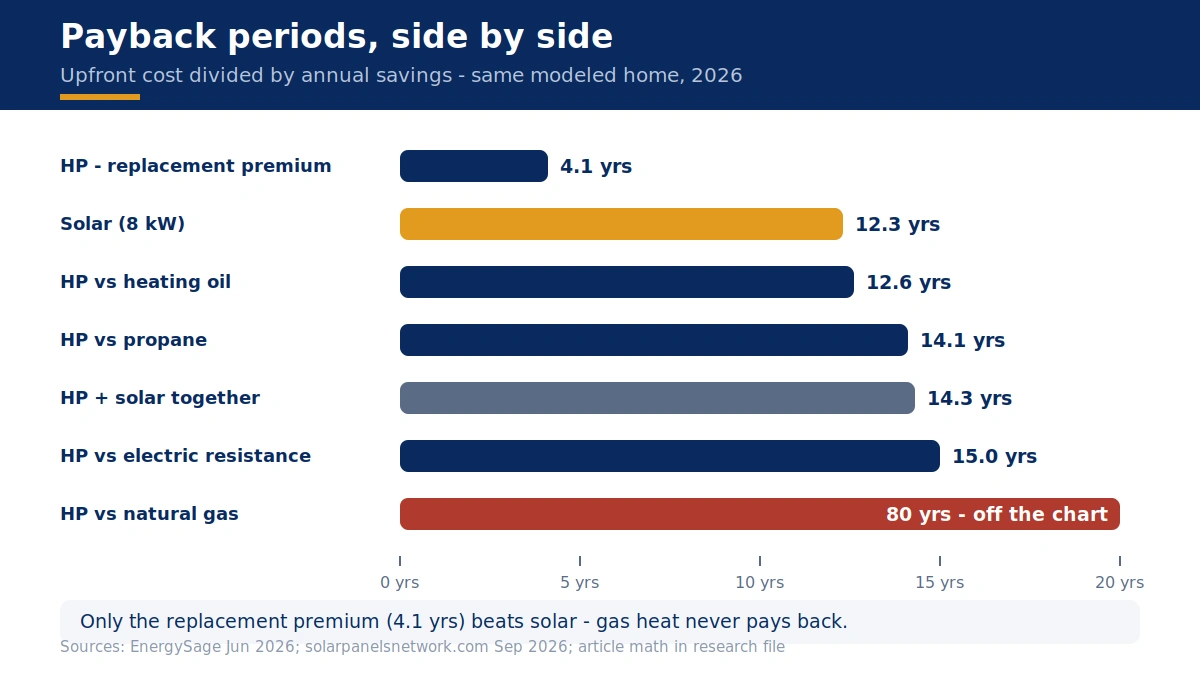
Payback = upfront cost ÷ annual savings. Same formula, same modeled home, both systems.
| Scenario | Cost ÷ annual savings | Payback |
|---|---|---|
| Solar (8 kW) | $20,960 ÷ $1,700 | 12.3 years |
| Heat pump vs electric resistance | $12,000 ÷ $800 | 15.0 years |
| Heat pump vs heating oil | $12,000 ÷ $950 | 12.6 years |
| Heat pump vs propane | $12,000 ÷ $850 | 14.1 years |
| Heat pump vs natural gas | $12,000 ÷ $150 | 80 years |
| Heat pump, average household | $12,000 ÷ $370 | 32.4 years |
| Heat pump, replacement premium | $1,500 ÷ $370 | 4.1 years |
| Heat pump + solar together | $32,960 ÷ $2,300 | 14.3 years |
Read the table in two layers. At full cost, solar and a heat pump against expensive fuels pay back in roughly the same window — 12–15 years. Against cheap gas, the heat pump never pays back: $150 a year of savings cannot repay $12,000 in any reasonable equipment lifetime.
The second layer is the one that changes decisions. Almost nobody buys a heat pump as a pure add-on. They buy it when the furnace or AC dies, and then the honest comparison is not $12,000 — it is the ~$1,500 premium over the furnace-plus-AC replacement they were buying anyway. On that premium, the average $370 a year of savings pays back in ~4 years. EnergySage’s own 2026 scenario analysis reaches the same conclusion: a ~$2,000 premium over a furnace-AC combo, recovered in 2–5 years. If your HVAC is healthy, this framing does not apply to you. If it is dying, it is the only framing that matters.
The combined stack pays back in ~14.3 years — slower than solar alone, because the heat pump’s savings do not fully stack on top of solar’s. Once solar covers most of your electric bill, the electricity a heat pump saves is partly electricity solar would have generated for free. Our combined savings figure of $2,300 a year is deliberately less than the naive $1,700 + $800 = $2,500 sum.
Published benchmarks agree with our math: the 2026 national solar payback for a cash purchase is 9–13 years (solarpanelsnetwork.com, Sep 2026) — our 12.3 years sits inside it — and that range is 2–3 years longer than in 2023–2025, entirely because the 30% federal credit ended.
The 10-year math
Ten years is the first checkpoint that matters for heat pump vs solar savings 2026: it is inside a heat pump’s lifespan and just short of solar’s payback. Flat rates, no electricity-price escalation — the conservative case.
| Cost by year 10 | Savings by year 10 | Net at year 10 | |
|---|---|---|---|
| Solar | $20,960 | $16,660 (10 × $1,700 × 0.98 avg output) | −$4,300 |
| Heat pump vs resistance | $12,000 | $8,000 (10 × $800) | −$4,000 |
| Heat pump vs gas | $12,000 | $1,500 (10 × $150) | −$10,500 |
| Heat pump, average | $12,000 | $3,700 (10 × $370) | −$8,300 |
| Heat pump, replacement premium | $1,500 | $3,700 | +$2,200 |
| Heat pump + solar | $32,960 | $22,540 (10 × $2,300 × 0.98) | −$10,420 |
Nobody is ahead at year 10 at full cost — and that is the honest headline. Solar is $4,300 underwater with ~2 years to break-even. A heat pump against resistance heat is $4,000 underwater with 5 years to go. Against gas it is $10,500 underwater and never recovers. Only the replacement-premium heat pump is ahead at year 10, by $2,200, because it only had $1,500 to repay.
The 10-year view also exposes the combined stack’s weakness: $32,960 upfront is a lot of capital to have underwater at year 10. If you might move within a decade, the stack is the wrong buy — solar alone at least breaks even around year 12, and a heat pump bought on the replacement premium is ahead by year 4.
The 25-year math: solar’s long game
Twenty-five years is where the two technologies diverge completely — because one of them is still on its first system and the other is on its second.
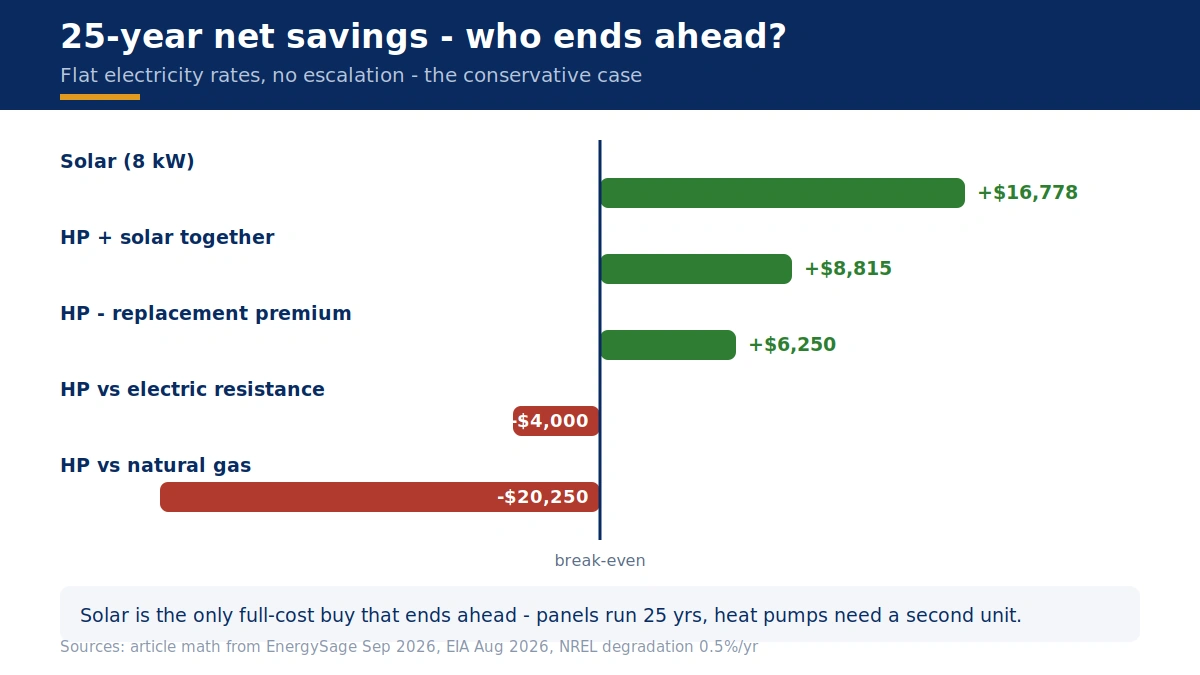
Solar over 25 years: 25 × $1,700 × 0.935 (average output factor with ~0.5% annual degradation) = $39,738 of bill savings. Subtract one inverter replacement, ~$2,000 (string inverters typically last 10–15 years), and the $20,960 upfront cost. Net: +$16,778, about +$17,000. The panels carry a 25-year performance warranty guaranteeing 80–87% of rated output at year 25 (NREL median degradation ~0.5% a year), and many keep producing into years 30–40.
Heat pump over 25 years: a heat pump lasts 15–20 years (DOE uses a 15-year service life in lifecycle calculations), so the modeled home buys two of them: $24,000. Against electric resistance heat, 25 × $800 = $20,000 of savings. Net: −$4,000. Against gas, 25 × $150 = $3,750. Net: −$20,250. On the replacement-premium framing — $1,500 premium × 2 cycles = $3,000 against $370 × 25 = $9,250 of average savings — net: +$6,250.
| 25-year cost | 25-year savings | Net at year 25 | |
|---|---|---|---|
| Solar | $22,960 (system + inverter) | $39,738 | +$16,778 |
| Heat pump vs resistance (full cost) | $24,000 (two units) | $20,000 | −$4,000 |
| Heat pump vs gas (full cost) | $24,000 | $3,750 | −$20,250 |
| Heat pump, replacement premium | $3,000 (two premiums) | $9,250 | +$6,250 |
| Heat pump + solar | $46,960 | $55,775 | +$8,815 |
The combined stack nets ~$8,800 over 25 years — more than the heat pump alone, less than solar alone, because the second heat pump ($12,000) eats much of the stack’s extra savings. The stack’s real prize is not the dollar total: it is the end state. By year 25 the modeled home’s energy spend has fallen from ~$3,100 a year to ~$800 a year, and the home heats, cools, and powers itself from its own roof.
One caveat, stated plainly: all 25-year figures here use flat electricity rates. Rates have risen ~3–5% a year recently (EIA: 18.16 cents in Aug 2026, up 3.4% year over year). With 3% annual rate growth, solar’s lifetime savings rise far above $39,738 — EnergySage’s net 25-year range of $41,000–$155,000 assumes escalation. Our flat-rate math is the conservative floor, not the forecast.
The 2026 tax twist: $0 federal credit for both
This is the single biggest change in the 2026 math, and it hits both technologies equally — which is why older comparisons are now wrong.
The One Big Beautiful Bill Act (OBBBA, P.L. 119-21, signed July 4, 2025) ended §25C (the heat pump credit, 30% up to $2,000) and §25D (the residential solar credit, 30%) for property placed in service after December 31, 2025 (IRS FS-2025-05). For any homeowner-owned system installed in 2026, the federal credit is $0. Not reduced. Not phased down. Zero.
Two consequences. First, every pre-2026 payback figure you find online is 2–3 years too optimistic for solar — the 30% credit used to cut $6,288 off our $20,960 system. Second, any page still showing “after 30% credit” math for a 2026 install is citing dead law. Do not use it.
What is still alive in 2026:
- HEAR rebates (up to $8,000 for a heat pump): the Home Electrification and Appliance Rebates program, run by state energy offices, pays up to $8,000 per heat pump with a $14,000 household cap — but only for households at or below 150% of area median income (below 80% AMI: up to 100% of cost; 80–150% AMI: up to 50%). And since DOE Program Notice 26-2 (effective May 29, 2026), HEAR no longer covers replacing a gas, oil, or propane appliance — only new construction or replacing existing electric equipment. Availability varies by state and some states’ funds are already fully reserved (California’s single-family HEAR money was fully reserved Feb 24, 2026). Check your state energy office before counting on it.
- §48E via lease or PPA (solar, through Dec 31, 2027): the commercial clean-electricity credit survives for leased systems and power purchase agreements — the leasing company claims it, and the homeowner gets lower lease payments, not a tax credit.
- State and utility incentives: these are now the main money on the table. Examples: Austin Energy’s $4,000 solar rebate, New Jersey’s SuSI program (~$960+ a year for 15 years), Mass Save’s $2,650-per-ton heat pump rebate (capped at $8,500 for 2026 whole-home installs). Utility rebates are often open to any income.
Our full credit-by-credit breakdown is in the federal energy tax credits guide.
When a heat pump wins
A heat pump wins — outright, no caveats — in four situations:
1. Your furnace or AC is dying. The replacement-premium math (~4-year payback, +$2,200 at year 10, +$6,250 at year 25) is the best return in this entire guide. You were spending the money anyway. If you are choosing between a heat pump and a straight furnace replacement, the comparison is in our heat pump vs furnace guide.
2. You heat with oil, propane, or electric resistance. Savings of $800–$950 a year repay a $12,000 system in 12–15 years at full cost — right in line with solar — and the heat pump also replaces your AC. In cold climates, a dual-fuel setup (heat pump + gas backup for the coldest days) pays back faster still; see our dual-fuel heat pump guide.
3. You have no usable roof. Renters, condo owners, homes with heavy shading, and roofs due for replacement in under 10 years cannot do solar well. A heat pump needs only an outdoor unit pad and electrical capacity. Solar on a roof that needs replacing first is solar plus a $10,000+ roofing bill.
4. You live in a cold climate with high heating bills. Heating dominates the energy budget in the Northeast and upper Midwest, and that is exactly the load a heat pump attacks. The DOE notes cold-climate homes heating with propane or electricity can save ~$1,500 a year. At that rate, a $12,000 heat pump pays back in 8 years.
A heat pump loses — clearly — when you heat with cheap natural gas and your HVAC is healthy. At $150 a year of savings, the math never closes. It also loses as a pure investment: even in its best case it nets less over 25 years than solar does.
When solar wins
Solar wins — outright — in four situations:
1. You pay high electric rates. At 30+ cents/kWh (California, Hawaii, much of the Northeast), the same 8 kW system saves $3,000–$4,400 a year instead of $1,700, and payback drops to 5–7 years. Rate is the single biggest predictor of solar returns. Our California solar guide covers the highest-rate market in the country.
2. You have a good, young roof with unshaded southern exposure. Solar needs 25 years of roof life under it. A south-facing roof under 10 years old with no shade is the ideal case — and the panels then protect the roof underneath them.
3. You use a lot of electricity during the day. Solar produces midday. Homes with daytime loads — remote work, pool pumps, EV charging at home, electric water heating — capture full retail value for more of their production. Homes empty all day export more power at low export rates, and their savings shrink toward the bottom of the range.
4. You plan to stay 15+ years. Solar’s money is all back-loaded: underwater at year 10, ~$17,000 ahead at year 25. Every year after payback is near-free electricity. If you will move in 5–7 years, you will likely sell before break-even — though solar does add resale value (NREL research: ~$20 of home value per $1 of annual savings).
Solar loses — clearly — with a shaded or aging roof, in low-rate states with no incentives (payback stretches to 18+ years), and for anyone who cannot fund the $20,960 upfront cost. It also loses if your electric bill is already small: a $100-a-month bill caps your possible savings at $1,200 a year, and payback stretches past 17 years. Add a battery and payback stretches further — storage adds $8,000–$15,000 (see our solar battery cost guide) and is a resilience buy, not a savings buy, in most states.
Heat pump + solar together: the electrification stack
Buy both and the math changes character. The heat pump electrifies your heating — moving your biggest fuel bill onto electricity — and solar then generates that electricity on your roof. Together they attack the whole $3,100-a-year energy spend, not just half of it.
The stack, modeled: heat pump $12,000 + solar $20,960 = $32,960 upfront. Combined savings ~$2,300 a year (less than the naive $2,500 sum, because the savings overlap — see the payback section). Payback ~14.3 years. Ten-year net −$10,420. Twenty-five-year net +$8,815, after a second heat pump ($12,000) and one inverter replacement ($2,000).
Is the stack worth it? Compare it to solar alone: the stack costs $12,000 more upfront, saves an extra ~$600 a year, and nets ~$8,000 less over 25 years. On pure dollars, solar alone wins. The stack wins on three things dollars do not capture:
- The end state. The modeled home’s energy spend falls to ~$800 a year — mostly fixed charges. Neither system alone gets there.
- Resilience. A heat pump plus solar plus a battery (add $8,000–$15,000) keeps a home heated, cooled, and powered through an outage. Either system alone cannot do that.
- Sequencing. You do not have to buy both at once. The best sequence for most homes is heat pump first (when the HVAC dies — the ~4-year payback), solar second (when the roof is ready and the budget allows). Each purchase stands on its own math; the stack is the sum, not a gamble.
One warning: size the solar system after the heat pump, not before. A heat pump adds several thousand kWh a year of electric load. A solar array sized to your pre-heat-pump bill will be undersized for the electrified home. Installers who size solar first and add the heat pump later leave savings on the table.
Decision framework: which one for your home
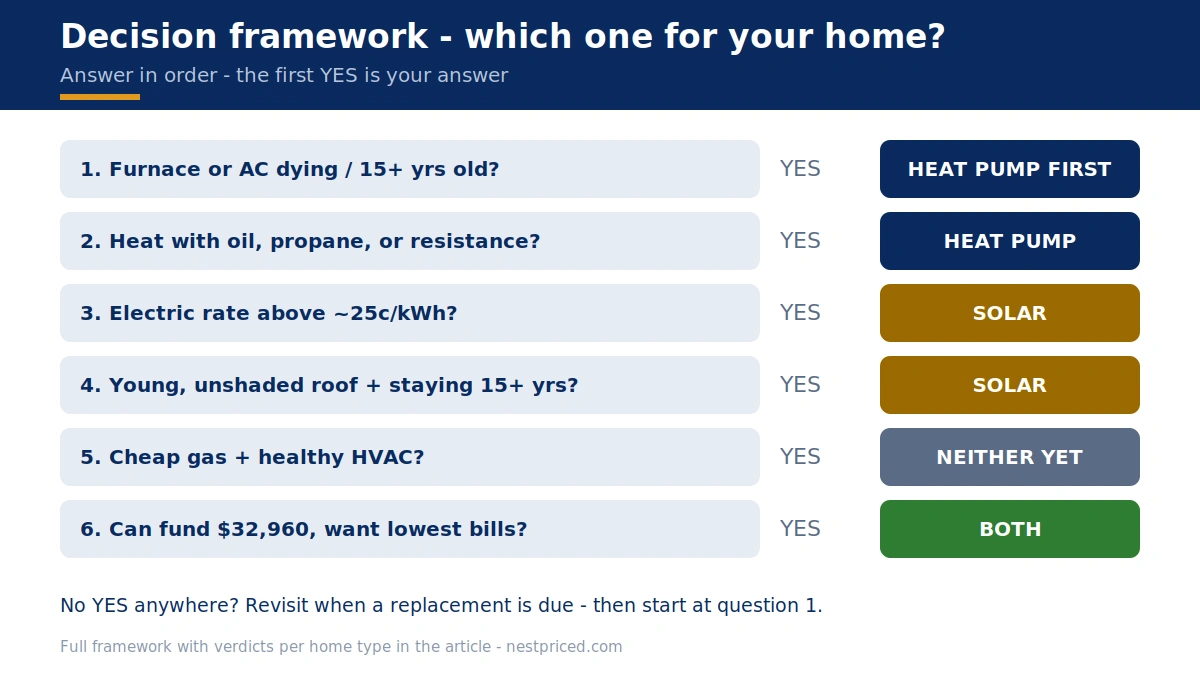
Answer these in order. The first “yes” is your answer.
| # | Question | If yes |
|---|---|---|
| 1 | Is your furnace or AC dying or 15+ years old? | Heat pump first. ~4-year payback on the premium. Solar later if the roof allows. |
| 2 | Do you heat with oil, propane, or electric resistance? | Heat pump. $800–$950/yr savings, 12–15 yr payback at full cost. |
| 3 | Is your electric rate above ~25 cents/kWh? | Solar. Payback drops under 8 years; the highest-return case in this guide. |
| 4 | Do you have a young, unshaded, south-facing roof and plan to stay 15+ years? | Solar. ~$17,000 net over 25 years. |
| 5 | Do you heat with cheap natural gas and your HVAC is fine? | Neither yet. Revisit when a replacement is due — then heat pump. |
| 6 | No usable roof, renter, or moving within 7 years? | Heat pump only (if the HVAC case applies); otherwise neither. |
| 7 | Can you fund $32,960 and want the lowest possible energy spend? | Both, heat pump first, solar second. ~$8,800 net over 25 years, ~$800/yr energy spend. |
The verdicts, one line each:
- Best total return over 25 years: solar (+~$17,000).
- Best return per dollar of extra spending: heat pump on a dying HVAC (~4-year payback).
- Best for cold climates and expensive heating fuel: heat pump.
- Best for high electric rates and good roofs: solar.
- Best end state: both, sequenced heat pump first.
- Worst buy in 2026: a heat pump to replace a healthy gas furnace (~80-year payback), and solar on a shaded or 20-year-old roof.
Get three quotes for whichever you choose — that is the last step in any heat pump vs solar savings 2026 decision. EnergySage’s data shows state averages for heat pumps ranging from ~$8,000 to ~$33,000, and solar from $2.12 to $3.36+ per watt. Your roof, your rates, and your fuel decide the winner. The math above tells you which questions to ask.
Sources & methodology
Modeled home (used for all article math): 2,000 sq ft; ~10,500 kWh/yr electricity use (EIA, 2026); 18.16 cents/kWh national average residential rate (EIA Electric Power Monthly, Aug 2026, published Oct 28, 2026); ~$1,900/yr electric bill + ~$1,200/yr heating fuel = ~$3,100/yr total energy spend. Heat pump central case $12,000 (typical range $5,500–$15,000). Solar central case 8 kW at $2.62/W = $20,960; production ~1,350 kWh/kW/yr = 10,800 kWh/yr; realistic savings $1,700/yr (gross retail value $1,961, haircut for export value and fixed charges). All payback and 25-year figures are recomputed from these inputs in the research file; flat rates, no escalation, unless stated. Heat pump life 15–20 years (two units in 25 years); solar life 25–30+ years; inverter replacement ~$2,000 once.
Pricing: EnergySage Marketplace heat pump data (updated Jun 2026): avg $15,393; ducted $14,529; ductless $25,957; hybrid $14,353. EnergySage Solar & Storage Marketplace Report, 23rd ed. (published Sep 30, 2026; H1 2026 quotes): median $2.62/W solar-only, $2.57/W overall. SEIA / Wood Mackenzie Q2 2026 turnkey residential $3.36/W. SolarReviews (Sep 2026): ~$3.03/W. State $/W: Florida $2.12/W (EnergySage, Sep 2026); Texas $2.25–$2.85/W (NestPriced art. 53); California $2.52/W (NestPriced art. 52).
Savings: Rewiring America via EnergySage (Jun 22, 2026) and SwitchTogether (2026): avg $370/yr; gas $100–$200; resistance ~$800; propane ~$850; oil ~$950. DOE: heating bills cut up to 50% switching from older furnaces; heat pumps cut heating electricity use up to 75% vs older electric heat. NREL (2024): 62–95% of US homes can cut total energy costs with a heat pump. Solar: DOE/EnergySage typical 6 kW ~$1,500/yr; EnergySage Marketplace (Oct 2026): annual savings $1,480–$6,160; 25-year net $41,000–$155,000 (assumes rate escalation). Worked 7 kW example: 9,450 kWh × $0.182 = ~$1,720/yr, 10.7-yr payback (solarenergysupplystores.com, 2026, using EnergySage Jun 2026 data).
Payback benchmarks: Solar cash payback 9–13 years national, 6–9 years best-incentive states, 18+ years low-rate states; +2–3 years vs 2023–2025 after the credit ended (solarpanelsnetwork.com, Sep 2026). Heat pump premium scenario: ~$2,000 premium, 2–5 year recovery (EnergySage, Jun 2026).
Electricity: EIA Aug 2026: 18.16 cents/kWh national avg (+3.4% YoY); Nevada 12.72 cents, Hawaii 47.18 cents. EIA STEO (Oct 6, 2026): 2026 full-year avg 18.2 cents/kWh. EIA: avg home ~10,500 kWh/yr, ~$157–$163/mo bill.
Lifespans: Heat pump 15–20 years (DOE 15-year lifecycle assumption; EnergySage Apr 2025: 10–15 typical, 20–25 well-maintained; HUD 2024 study: 15–20). Solar 25–30+ years; 25-year performance warranty at 80–87% output; NREL median degradation ~0.5%/yr. String inverter 10–15 years (spiritenergy.co.uk, 2026).
Tax/incentives: OBBBA (P.L. 119-21) ended §25C/§25D for property placed in service after Dec 31, 2025 (IRS FS-2025-05) — $0 federal credit for 2026 homeowner-owned installs of both technologies. HEAR/HEEHR: up to $8,000 per heat pump, $14,000 household cap, ≤150% AMI (42 U.S.C. 18795a); DOE Program Notice 26-2 (eff. May 29, 2026) bars fuel-switching; CA single-family HEAR fully reserved Feb 24, 2026 (thehvacbrief.com, Oct 2026; betterhouse.io, Sep 2026). §48E via lease/PPA through Dec 31, 2027. Battery adds $8,000–$15,000 (NestPriced art. 22).
EXCLUDED: pre-2026 “after 30% credit” prices; HomeGuide 6–12 yr solar payback as a headline figure; Angi $4,236–$7,942 as a whole-home heat pump price (equipment-only sample); UK figures; any DIY installation instructions (LOW YMYL).
—
Which saves more money, a heat pump or solar panels?
Solar saves more total dollars over 25 years — about $17,000 net on our modeled home (8 kW system, $20,960 upfront, ~$1,700 a year in savings). A heat pump saves more per dollar of extra spending when your furnace or AC is dying: the ~$1,500 premium over a normal replacement pays back in ~4 years.
How long does it take for a heat pump to pay for itself in 2026?
At full cost ($12,000), 12–15 years if you heat with oil, propane, or electric resistance — but ~80 years against cheap natural gas, which never pays back. If your furnace or AC is dying anyway, only the ~$1,500 premium over a like-for-like replacement counts, and that pays back in ~4 years at average savings of $370 a year.
How long does it take for solar panels to pay for themselves in 2026?
About 12.3 years for a typical 8 kW system costing $20,960 and saving ~$1,700 a year — inside the 2026 national range of 9–13 years for a cash purchase. Payback is 2–3 years longer than in 2023–2025 because the 30% federal tax credit ended. High-rate states see payback under 8 years; low-rate states with no incentives can stretch past 18 years.
Is there a federal tax credit for heat pumps or solar in 2026?
No — $0 for both. The One Big Beautiful Bill Act (P.L. 119-21) ended the §25C heat pump credit and the §25D residential solar credit for property placed in service after December 31, 2025. HEAR rebates up to $8,000 for income-qualified households and state/utility incentives are still alive, and leased solar can still benefit from the §48E credit through December 31, 2027.
Should I get a heat pump or solar panels first?
Heat pump first if your furnace or AC is dying or you heat with oil, propane, or electric resistance — it has the fastest payback (~4 years on the replacement premium). Solar first if your HVAC is healthy, your electric rate is high, and your roof is young and unshaded. If you buy both, install the heat pump first and size the solar system after it, since the heat pump adds 3,000–5,000 kWh a year of electric load.
How much does a heat pump save per year vs a gas furnace?
Only $100–$200 a year (Rewiring America, 2026) — natural gas is so cheap per unit of heat that even a 300%-efficient heat pump barely beats a 95%-efficient furnace. Against electric resistance heat the same heat pump saves ~$800 a year, against propane ~$850, and against heating oil ~$950. The average US household saves ~$370 a year.
How much can solar panels save over 25 years?
On our modeled home (8 kW, $20,960), about $39,738 in bill savings over 25 years, or ~$17,000 net after the system cost and one ~$2,000 inverter replacement. EnergySage’s range for net 25-year savings is $41,000–$155,000, which assumes electricity rates keep rising; our figure uses flat rates and is the conservative floor. Panels degrade ~0.5% a year and still produce ~87% of rated output at year 25.
Is it worth getting both a heat pump and solar panels?
On pure dollars, solar alone nets more over 25 years (~$17,000) than the combined stack (~$8,800), because the second heat pump costs $12,000. The stack wins on the end state: the modeled home’s energy spend falls from ~$3,100 a year to ~$800 a year, and with a battery it keeps heating, cooling, and power through an outage. Best sequence: heat pump first when the HVAC dies, solar second when the roof and budget allow.