


Table of Contents
Texas is America’s solar heavyweight. SEIA’s Texas state fact sheet (September 2026) puts Texas at 55,125 MWdc installed — #2 nationally and #1 in 2025 additions, powering 6.75 million homes with $68.2 billion invested. And Texans buy big: the average Texas residential system runs 12–13 kW, roughly 60% larger than the 6 kW US average (EnergySage, November 2026).
But Texas is also the hardest state to price solar in, because the national rules don’t apply. There’s no federal tax credit to subtract in 2026. There’s no net metering. Your electricity plan is a competitive retail product, and your HOA, your hail risk, and your utility rebate all swing the math. This guide covers all of it — with every figure sourced from 2026 data.
Compare with the national solar panel cost guide for the US baseline.
How much do solar panels cost in Texas in 2026?
The defensible 2026 Texas consensus: $2.25–$2.85 per watt installed, before any local incentives. Texas ties Arizona as the cheapest solar state in America (thegreenwatt.com, 2026).
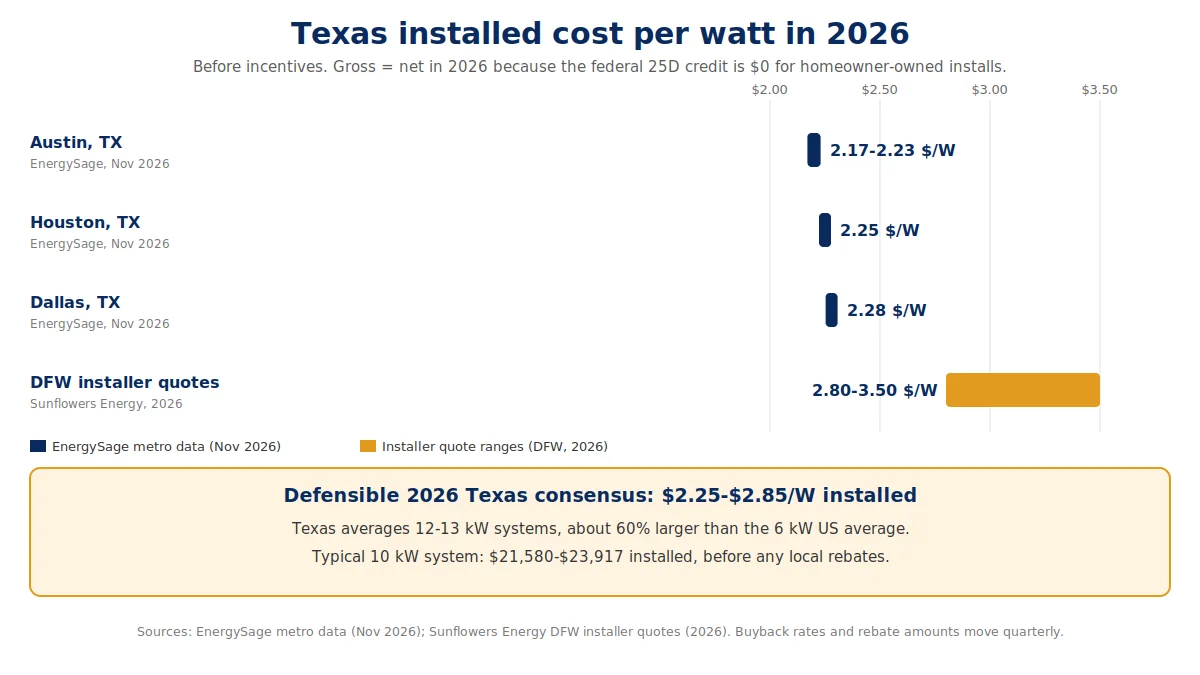
City-level data from EnergySage (all updated November 2026):
- Austin: $2.17–$2.23/W (on ~12 kW systems)
- Houston: $2.25/W (on ~12.85 kW systems)
- Dallas: $2.28/W (on ~12.65 kW systems)
The broader spread: a Dallas Fed–based analysis puts Texas at $2.18–$2.84/W (exspenditure.com, March 2026), typical Texas quotes land at $2.50–$3.20/W (texassolarcostcalculator.com, August 2026), and one dataset averages $3.04/W — the high-end outlier (poweroutage.us, November 2026). Dallas quotes can run higher still: $2.80–$3.50/W, because permitting and Oncor interconnection add cost in the metroplex (Sunflowers Energy installer data, 2026).
The number-one rule of 2026 Texas pricing: gross = net. The §25D residential federal credit ended December 31, 2025. There is no “after 30% credit” column anymore. Several national cost pages still display post-credit math (SolarReviews’ Texas page, solar-estimate.org’s stale 26%/30% tables) — treat those as outdated. Every figure in this guide is the price you actually pay on an owned system.
For sizing math across the country, our 6kW/8kW/10kW system cost guide has the per-size breakdowns.
Texas solar cost by system size: 6, 8, 10, and 12 kW
Texans build bigger systems because they have bigger roofs, bigger homes, bigger AC loads, and cheap per-watt pricing. A 12 kW system is near the Texas average — don’t size by the national 6 kW benchmark.
2026 installed costs, blending EnergySage’s Houston/Dallas/Austin metro data (~$2.25/W), before incentives (which, again, means net for owned systems):
| System size | Approx. installed cost (2026) | Best fit |
|---|---|---|
| 6 kW | $13,000–$14,350 | Small homes, low daytime use |
| 8 kW | $17,265–$19,136 | Mid-size homes |
| 10 kW | $21,580–$23,917 | Large homes, heavy AC |
| 12 kW (near TX average) | $26,000–$28,700 | Typical Texas home |
City spot-checks for a 10 kW system (EnergySage, November 2026): Austin $21,700, Houston $22,484, Dallas $22,790, Huntsville $23,920.
Note what the table shows: costs scale almost linearly with size — a 12 kW system ($26,000–$28,700) runs roughly 50% more than an 8 kW system ($17,265–$19,136) for 50% more capacity. There’s no Texas penalty for sizing to your actual load: big roofs, big AC, and cheap per-watt pricing are a natural fit.
What a Texas solar quote includes
Texas quotes are long. Here’s what you’re actually buying, and what to shop line by line:
Equipment (panels, inverter, racking, wiring). This is roughly half the cost. Panel prices keep falling nationally; inverter choice matters more in Texas because heat is the enemy of electronics — ask about inverter warranties (our solar inverter replacement cost guide covers what a failure costs down the road).
Labor (15–25% of the project). Texas installer labor is cheaper than coastal markets, which is part of why the state’s $/W is the nation’s lowest.
Permitting. City permitting in the Dallas metro runs 3–8 weeks (Sunflowers Energy, 2026). Permits are usually bundled into the installer’s price — ask for the fee as a separate line item so you can compare quotes honestly.
Interconnection. Oncor (DFW, the largest Texas delivery utility) and CenterPoint (Houston) handle grid interconnection. Dallas installers report 4–12 week interconnection timelines. Fees are typically bundled — again, get them itemized.
Sales tax. Disputed territory: some Texas installers claim an equipment sales-tax exemption worth roughly $1,500–$2,000 at 8.25%; the 2026 state-by-state tables list Texas as having no solar sales-tax exemption. We could not verify a 2026 Comptroller ruling — confirm with your installer and a tax professional before counting on it.
Solar + battery cost in Texas: the Oncor deadline
Texas is projected to pass California as America’s largest residential battery market in 2026 (Electrek/SEIA via eos-e.com). The reason is simple: no net metering makes self-consumption valuable, and Texas has the best battery rebates in the country.
The 2026 numbers:
- Texas average installed battery cost: $1,344 per kWh vs. $855/kWh national median (EnergySage, April 2026 via eos-e.com) — Texas batteries are pricier per unit, which makes rebates essential.
- Tesla Powerwall 3 (13.5 kWh) installed in Texas: $11,500–$14,500 for a single unit (EnergySage 2026 via eos-e.com; SmartEnergyUSA 2026).
- 10 kW solar + 1 Powerwall 3 package: ~$35,250 gross installed in Oncor territory, ~$26,250 net after Oncor’s combined rebates (installer-reported, NuWatt, April 2026).
The deadline that matters: November 30, 2026. Oncor’s Take a Load Off Texas program pays $4,500 per battery, up to 2 ($9,000 max) — and the 2026 programs close November 30, 2026 (NuWatt, April 2026; ecogenamerica, October 2026). If you’re reading this in late November, that clock is real. Oncor also offers an installer-reported ~$5,000 solar rebate on paired systems (NuWatt, April 2026 — verify the current figure with your installer, as rebate levels move).
Our solar battery cost guide has the full national battery math; our Tesla Solar Roof cost breakdown covers the Powerwall angle on that discontinued product.
Texas has no net metering: your buyback plan is a cost line item
This is the section no national cost guide explains, and it’s the single biggest cost driver in Texas. Texas has no statewide net-metering mandate. Export value is a competitive retail product — NuWatt’s 16-plan buyback comparison (April 2026) shows how wide the spread is — and choosing the wrong plan can stretch payback by 3–5 years (texaspowercost.com, November 4, 2026).
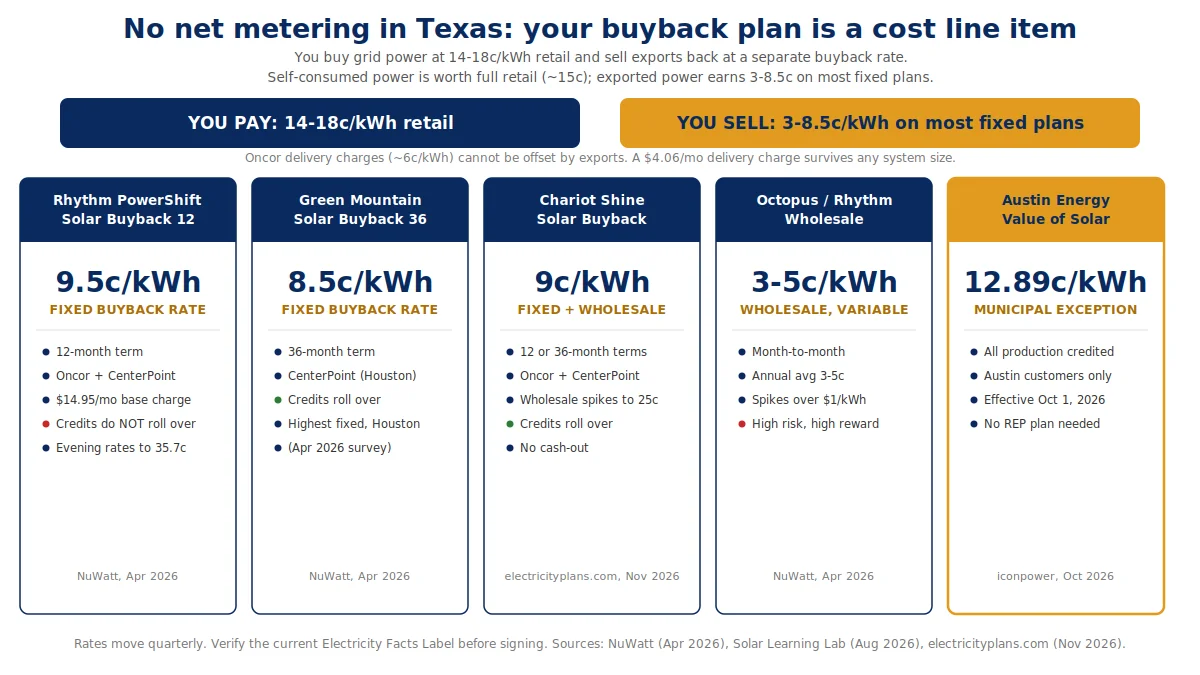
How it works in deregulated ERCOT areas (Houston/CenterPoint, DFW/Oncor): solar is two separate transactions. You buy grid power at retail — 14–18¢/kWh — and sell your exports back at a separate buyback rate, typically 3–8.5¢/kWh on fixed plans (NuWatt, March/April 2026).
Three consequences:
- Self-consumed kWh ≈ full retail value (~15¢). Exported kWh ≈ 3–8.5¢. Every kWh your home uses directly is worth roughly double or triple one you export. A battery multiplies self-consumption — that’s why Texas leads on storage.
- Oncor delivery charges can’t be offset. Roughly 6¢/kWh as of the August 1, 2026 tariff update, plus a fixed $4.06/month delivery charge that survives any system size (Solar Learning Lab, August 18, 2026). No panel array zeroes out an Oncor bill entirely.
- Rollover rules vary by provider. TXU, Green Mountain, Chariot, and Constellation roll credits over (expiring at contract end); Gexa, Rhythm, Pulse Power, and Frontier do not roll over (NuWatt, April 2026).
2026 buyback plan examples (rates move quarterly — verify current Electricity Facts Labels before choosing):
| Plan / Provider | Export rate | Terms |
|---|---|---|
| Rhythm PowerShift Solar Buyback 12 | 9.5¢/kWh fixed (Apr 2026) | 12 mo, Oncor + CenterPoint; $14.95/mo base; credits do NOT roll over |
| Rhythm PowerShift (time-windowed) | 4.1¢ / 18.2¢ evening shoulder / 35.7¢ summer super-peak (Aug 2026) | 12 mo; $14.95/mo base — battery-like behavior |
| Green Mountain Pollution Free Solar Buyback 36 | 8.5¢/kWh fixed (Apr 2026) | 36 mo, CenterPoint — highest fixed in Houston territory at survey date |
| Chariot Shine Solar Buyback | 9¢/kWh fixed + real-time wholesale up to 25¢/kWh (Nov 4, 2026) | 12/36 mo, Oncor + CenterPoint; credits roll over, no expiration, no cash-out |
| Octopus wholesale / Rhythm wholesale | ~3–5¢/kWh average annually (Apr 2026) | Month-to-month; high risk/reward — can spike above $1/kWh in grid stress events |
The municipal exception: Austin Energy. Austin buyers ignore REP buyback plans entirely. Austin Energy has no net metering either — instead it credits all your production through its Value of Solar rate: 12.89¢/kWh, effective October 1, 2026 (up from 9.91¢; set in the city budget, via iconpower October 2026). You pay the normal retail rate for everything your home consumes. It’s a different, arguably better structure.
Texas solar incentives in 2026
The incentive stack in Texas is utility rebates plus exemptions — never credits, because Texas has no state income tax.
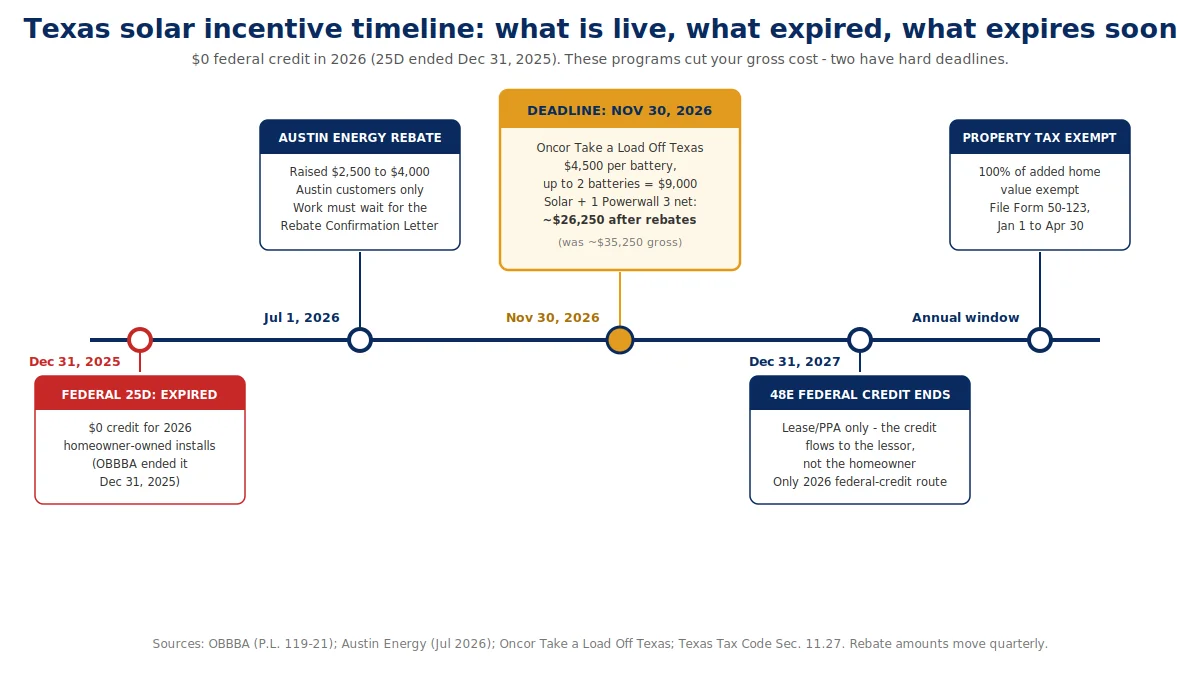
Austin Energy solar rebate: $4,000. Raised from $2,500 to $4,000 on July 1, 2026 (ecogenamerica, October 2026). Austin customers only — and several national pages still show the old $2,500 figure. One procedural note: work must wait for the Rebate Confirmation Letter.
Oncor rebates. $4,500 per battery up to $9,000, plus an installer-reported ~$5,000 solar rebate on paired systems. 2026 programs close November 30, 2026. DFW buyers: this is the single largest incentive available in Texas right now.
Property tax exemption (Tax Code §11.27): 100% of the added home value. Solar typically adds $15,000–$20,000 of appraised value. At Harris County’s ~2.2–2.4% effective rate, that’s $330–$480/year you don’t pay — $8,250–$12,000 over 25 years (hartbeat.solar, April 2026). It is not automatic: you must file Texas Comptroller Form 50-123 with your county appraisal district (filing window January 1–April 30 for the first tax year).
No state income tax → no state tax credit is possible. Say it plainly: Texas’s stack is rebates and exemptions, full stop.
Texas Solar for All: paused. The low-income program has been paused since August 7, 2025 (ecogenamerica, checked October 19, 2026). Nothing is available under it.
Consumer protections (2025–2026): S.B. 1036 (Residential Solar Retailer Regulatory Act) gives you a 5-business-day cancellation right on solar contracts signed on/after September 1, 2025, and requires retailers and salespeople to register with TDLR starting September 1, 2026 (ecogenamerica; iconpower).
The $0 federal tax credit, explained
The §25D Residential Clean Energy Credit ended for property placed in service after December 31, 2025 (OBBBA, P.L. 119-21; IRS FS-2025-05). No phase-down, no partial credit, no exception. Congress has not reinstated it as of November 2026.
The one surviving federal path: §48E through a lease or PPA. The Clean Electricity Investment Credit remains available through December 31, 2027 — but it’s claimed by the system *owner*. So the only way a federal credit touches a 2026 Texas install is if you don’t own the system: in a lease or PPA, the operator claims the credit and passes it through as lower payments.
Our federal energy tax credits 2026 guide covers the full post-OBBBA landscape. And remember the $0 rule applies to every other “after credit” figure you see: if a calculator still shows 2026 savings with a 30% credit subtracted, it’s showing you 2025’s math.
HOA rights in Texas: they can’t ban your panels
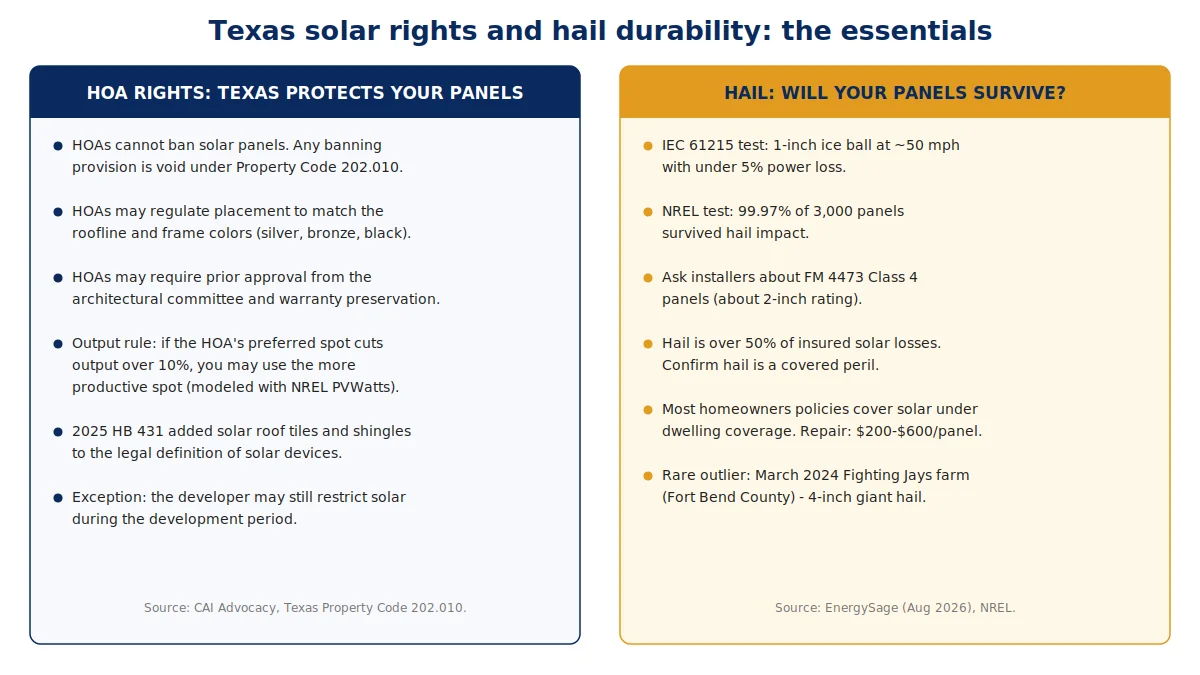
Texas Property Code §202.010 is blunt: HOAs cannot ban solar panels — any provision attempting to ban them is void (CAI’s statute reference). They may regulate, but within limits:
- Roofline/slope conformity and silver, bronze, or black frame colors
- Fenced-yard height limits and prior architectural-review-committee (ARC) approval
- Warranty preservation requirements
- The >10% rule: if the HOA’s preferred placement would cut your system’s output by more than 10% (measured with an NREL modeling tool like PVWatts), you may use the more productive spot
- 2025’s HB 431 added solar roof tiles and shingles to the definition of “solar energy device”
Two honest exceptions: during the developer “development period,” the declarant may still restrict solar — and an HOA can enforce reasonable appearance and placement rules. Get ARC approval before signing a contract, not after.
Texas hail: will solar panels survive?
North-Central Texas is “Hail Alley,” so this is the state’s most-asked solar question. The honest answer: panels are tested for exactly this.
The baseline: IEC 61215. Panels must survive a 1-inch ice ball at ~50 mph with under 5% power loss. In NREL’s 3,000-panel 2017 test, 99.97% survived (EnergySage, August 10, 2026). Ask installers about FM 4473 Class 4 (~2-inch hail) as the stricter benchmark if you live in the metroplex.
The outlier, honestly: the March 2024 Fighting Jays solar farm in Fort Bend County took damage from 4-inch “giant hail” — the extreme tail of Texas weather, and the kind of event no residential panel standard is designed for. Typical hail is not this.
Insurance guidance (no DIY inspection advice — this is cost/shopping info only):
- Most homeowners policies cover solar under dwelling coverage — verify in writing that hail is a covered peril for the panels specifically.
- Hail accounts for over 50% of insured solar losses (EnergySage, August 2026), so the covered-peril question matters more than the deductible.
- Single-panel repair runs ~$200–$600.
Payback and savings math in Texas
The baseline numbers (all 2026):
- Texas residential electricity: ~16.28¢/kWh, typical bill ~$179.28/month for 1,102 kWh (poweroutage.us, November 2026)
- Texas sun: ~1,500 kWh per kW per year (NREL PVWatts) — among the best production ratios in America
- Texas grid context: ERCOT electricity demand is up ~30% since 2020 (installer-reported 2026) — rates have room to rise, which improves solar math every year you own the system
Realistic payback at $0 federal credit:
- 7.6 years pre-incentive on a 5 kW system (poweroutage.us)
- 8.8–11 years in state comparison tables (renewestimator; thegreenwatt)
- 9–13 years realistic in DFW (Sunflowers Energy, 2026)
The range reflects what you control: the buyback plan (3–8.5¢ export vs. 15¢ self-consumption is the single biggest lever), the battery decision, and whether you captured Oncor or Austin Energy rebates. A buyer on a bad buyback plan with no self-consumption sits at the long end; a buyer with a Powerwall on the best plan sits at the short end.
National context for comparison: the US average installed cost runs ~$27,000 (range $4,500–$54,000; Angi, August 2026) — but that’s a national figure, not a Texas one. Texas’s $2.25–$2.85/W beats it comfortably.
How to get solar quotes in Texas
Get three or more installer quotes, and use the same question list every time so the answers compare:
- What’s my $/W before any incentives? The Texas benchmark is $2.25–$2.85/W. Anything above $3.20/W needs a justification (complex roof, premium equipment, difficult permitting).
- What buyback plans is my equipment compatible with? Smart inverters and battery-ready setups keep your options open as plans change quarterly.
- What are the interconnection fees and permit costs, as separate line items? Bundled pricing hides margin.
- What’s the panel hail rating — IEC 61215 minimum, FM 4473 Class 4 preferred?
- For DFW: what’s the Oncor rebate status, and will my project complete before November 30, 2026?
- For Austin: is the $4,000 rebate confirmed, and has work waited for the Rebate Confirmation Letter?
- Is the installer registered with TDLR (required from September 1, 2026), and what’s my cancellation window under S.B. 1036?
Sign nothing until you’ve compared the $/W figures side by side. The cheapest quote is rarely the best one — but the most expensive quote is almost never the best one either.
Sources & methodology
Cost anchors: EnergySage Austin/Houston/Dallas city pages (all updated November 2026: Austin $2.17–$2.23/W ~12 kW; Houston $2.25/W ~12.85 kW; Dallas $2.28/W ~12.65 kW; city 10 kW figures Austin $21,700 / Houston $22,484 / Dallas $22,790 / Huntsville $23,920); exspenditure.com (March 18, 2026: $2.18–$2.84/W, Dallas Fed + ITC analysis); texassolarcostcalculator.com (August 14, 2026: $2.50–$3.20/W); thegreenwatt.com (2026: Texas tied cheapest state at $2.50/W); poweroutage.us (November 2026: $3.04/W higher-end; 16.28¢/kWh, $179.28/mo, 1,102 kWh); Sunflowers Energy DFW installer data (2026: $2.80–$3.50/W, 9–13 yr payback, permitting/interconnection timelines). Battery: EnergySage April 2026 via eos-e.com ($1,344/kWh TX vs $855 national; Powerwall 3 $11,500–$14,500; 10 kW + PW3 ~$35,250 gross / ~$26,250 net after Oncor rebates); Electrek/SEIA via eos-e.com (TX passing CA as largest residential battery market 2026); SmartEnergyUSA 2026. Incentives: ecogenamerica (October 2026: Austin rebate $2,500→$4,000 July 1, 2026; Oncor $4,500/battery up to 2, closes Nov 30, 2026); NuWatt (April 2026: Oncor package rebates; buyback 16-plan comparison); iconpower (October 2026: Austin Value of Solar 12.89¢/kWh from Oct 1, 2026, was 9.91¢); hartbeat.solar (April 2026: §11.27 property-tax exemption, $330–$480/yr, $8,250–$12,000/25 yrs, Form 50-123 Jan–Apr window); legalclarity.org (August 2026: Form 50-123 referenced); n-tech-es.com vs ussolarsupplier.com (2026: sales-tax exemption disputed — presented as unverified). Buyback plans: texaspowercost.com (November 4, 2026: wrong plan = 3–5 yr payback stretch); NuWatt (March/April 2026: 3–8.5¢ export typical; 14–18¢ retail; rollover rules); Solar Learning Lab (August 18, 2026: Oncor ~6¢/kWh delivery, $4.06/mo fixed); electricityplans.com (November 4, 2026: Chariot Shine 9¢ + wholesale up to 25¢); Solar Learning Lab (August 2026: Rhythm time-windowed 4.1¢/18.2¢/35.7¢). Tax: OBBBA P.L. 119-21, IRS FS-2025-05 (standing project rule: §25D $0 for post-Dec-31-2025 installs). Consumer protection: S.B. 1036 (5-business-day cancellation from Sept 1, 2025; TDLR registration from Sept 1, 2026) via ecogenamerica and iconpower. HOA: Texas Property Code §202.010 via CAI Advocacy; HB 431 (2025, solar roof tiles/shingles definition). Hail: EnergySage (August 10, 2026: IEC 61215, NREL 99.97% survival, >50% of insured losses, $200–$600/panel repair); March 2024 Fighting Jays Fort Bend County 4-inch hail (extreme outlier). SEIA Texas state fact sheet (September 2026: 55,125 MWdc, #2 nationally, #1 in 2025 additions, 6,755,088 homes, 12.16% of state electricity, $68.2B investment, 41,301 MW projected 5 yrs, 334,966 installations). Texas Solar for All paused August 7, 2025 (ecogenamerica, checked October 19, 2026). NREL PVWatts (~1,500 kWh/kW/yr). Angi (August 2026: ~$27,000 national avg — national context only). §48E lease/PPA route through Dec 31, 2027 (standing project framing). EXCLUDED: SolarReviews Texas page after-tax-credit cost anchors and $2,500 Austin rebate figure (stale — missed July 1, 2026 raise); solar-estimate.org 26%/30% credit math (pre-OBBBA); texassolarcostcalculator.com “after 30% credit” column (outdated 2026 framing).
—
How much does a 10 kW solar system cost in Texas in 2026?
About $21,600–$23,900 installed before any local rebates (EnergySage metro data, November 2026). City spot-checks: Austin $21,700, Houston $22,484, Dallas $22,790, Huntsville $23,920. Since the federal credit is $0 for 2026 installs, that gross price is the net price for a cash purchase.
Is there a federal tax credit for solar panels in Texas in 2026?
No — $0. The §25D residential credit ended for systems placed in service after December 31, 2025 (OBBBA, P.L. 119-21). The only remaining federal path is §48E through a lease or PPA, where the operator (not you) claims the credit through December 31, 2027.
Does Texas have net metering?
No statewide mandate. In deregulated ERCOT areas, retail providers sell buyback plans where you buy power at 14–18¢/kWh and sell exports back at 3–8.5¢/kWh — two separate transactions. Austin Energy (municipal) credits all production at its 12.89¢/kWh Value of Solar rate instead.
What’s the best solar buyback plan in Texas?
It varies by territory and changes quarterly. 2026 examples: Rhythm PowerShift Solar Buyback 12 (9.5¢/kWh fixed, no credit rollover), Green Mountain Pollution Free Solar Buyback 36 (8.5¢ fixed, 36 months, CenterPoint), and Chariot Shine (9¢ fixed plus wholesale rates, credits roll over). Always compare current Electricity Facts Labels — the wrong plan can add 3–5 years to payback.
Can my HOA stop me from installing solar panels in Texas?
No. Texas Property Code §202.010 voids any HOA provision that bans solar panels. HOAs may regulate placement, appearance (silver/bronze/black frames), and require ARC approval — and if their preferred spot would cut output by more than 10%, you can use the better spot. Get approval before signing a contract.
Will my property taxes go up if I install solar in Texas?
No — the added home value is 100% exempt under Tax Code §11.27. Solar typically adds $15,000–$20,000 of appraised value, which saves roughly $330–$480/year at Harris County rates. You must file Form 50-123 with your county appraisal district (January 1–April 30 window) — it isn’t automatic.
Do solar panels survive Texas hailstorms?
Yes for typical hail. Panels are tested to IEC 61215 (a 1-inch ice ball at ~50 mph), and 99.97% of 3,000 NREL-tested panels survived. Ask about FM 4473 Class 4 (~2-inch hail) as the stricter benchmark, and confirm your homeowners policy covers hail as a peril for the panels — hail drives over half of insured solar losses.
Is the Austin Energy $4,000 solar rebate still available?
Yes — it was raised from $2,500 to $4,000 on July 1, 2026, and is current as of November 2026. It’s Austin Energy customers only, and installation work must wait for the Rebate Confirmation Letter. Austin also credits all solar production at 12.89¢/kWh through its Value of Solar rate (effective October 1, 2026).
2 thoughts on “Solar Panel Cost in Texas 2026”