

Table of Contents
Every cost page you’ll find on this topic shares one problem: most were built when homeowners could subtract 30% from the quote. That math died on December 31, 2025. This guide is the 2026 version — every number below is the gross, out-of-pocket price, with the federal credit correctly set to $0 for homeowner-owned systems. California remains one of America’s best solar states — high rates, strong sun, low installed costs — but the rules changed. Here’s the honest statewide math on solar panel cost in California for 2026.
The 30% federal tax credit is gone — 2026 math starts at $0
Read this first, because it changes every number in this article:
§25D Residential Clean Energy Credit (30%) ended for installations completed after December 31, 2025. The One Big Beautiful Bill Act (OBBBA, P.L. 119-21, signed July 4, 2025) terminated it, and IRS guidance (FS-2025-05, August 2025) confirmed that an expenditure counts as “made” when installation is completed — so a system finished in 2026 gets a $0 federal credit. The gross quoted price is your out-of-pocket price on a cash or loan purchase.
How to spot stale quotes. If an installer’s proposal still subtracts 30% — or a cost page shows an “after tax credit” price like SolarReviews’ November 2026 page still does — that quote is built on dead math. Treat it as a red flag. (Our federal energy tax credits guide has the full 2026 incentive landscape.)
The one surviving federal path: lease or PPA. The §48E Clean Electricity Investment Credit (30%) survives only for the business that owns the system. So a residential roof reaches it only through a lease or power purchase agreement — the operator claims the credit and passes part of it through as lower payments. Discounts of 17–34.6% were observed on PG&E-territory leases in October 2026 (solarbillreview.com). Deadlines are tight: projects whose construction began before December 31, 2025 must be placed in service by December 31, 2029; construction starting after July 4, 2026 must be in service by December 31, 2027. Foreign-entity-of-concern equipment rules apply. More in the lease vs buy section below.
How much do solar panels cost in California in 2026?
The statewide picture, from the most current 2026 data:
- $2.40–$3.25 per watt installed is the working California range (NRG Clean Power, Nov 2026).
- $2.52/W — EnergySage’s November 2026 California average. On the state’s average 8.42 kW system, that’s $21,192 (typical range $18,013–$24,371).
- $2.46/W — EnergySage marketplace quotes in California, June 30, 2026 (vs $2.60/W nationally). Marketplace quotes are the floor, not the middle: LBNL’s 2026 distributed-solar update notes installed-system medians run 25%+ above marketplace quotes.
- $3.14/W — SolarReviews’ November 2026 California figure ($22,600 on an average 7.2 kW install).
- HomeAdvisor’s 2026 California page puts the state at ~$21,000 ($10k–$32k range, ~$3/W) — but that page still cites the 30% credit, so ignore its “after credit” figures.
LBNL’s U.S. Distributed Solar and Storage Data: 2026 Update calls California “a relatively low-cost state for residential PV.” Labor runs about $0.50/W (HomeAdvisor 2026) — higher than most states, but the mature, high-volume installer market keeps total $/W competitive.
One cost-breakdown fact worth knowing: on a typical 6 kW system at $2.80/W ($16,800), roughly 36% is equipment, 22% is installation labor, and 42% is overhead, sales, marketing, and profit (EnergySage installer survey, Oct 2026, via NRG). That’s why three quotes from different installers can differ by 30% on the same roof.
Solar panel cost by system size in California
Your system size is the single biggest driver of total cost. Here’s what the 2026 data shows, all before battery, all with $0 federal credit:
| System size | Installed cost range (2026) | $/W | Source |
|---|---|---|---|
| 6 kW | $14,400–$19,500 | $2.40–$3.25 | NRG Clean Power, Nov 2026 |
| 6 kW (alternate) | $15,000–$21,000 | $2.50–$3.50 | OC Solar, Sep 2026 |
| 8 kW | $20,000–$28,000 | $2.50–$3.50 | Helios Energy (SCE territory), Sep 2026 |
| 8.4 kW (state avg) | $21,192 (range $18,013–$24,371) | $2.52 | EnergySage, Nov 2026 |
| 10 kW | $24,000–$32,500 | $2.40–$3.25 | NRG Clean Power, Nov 2026 |
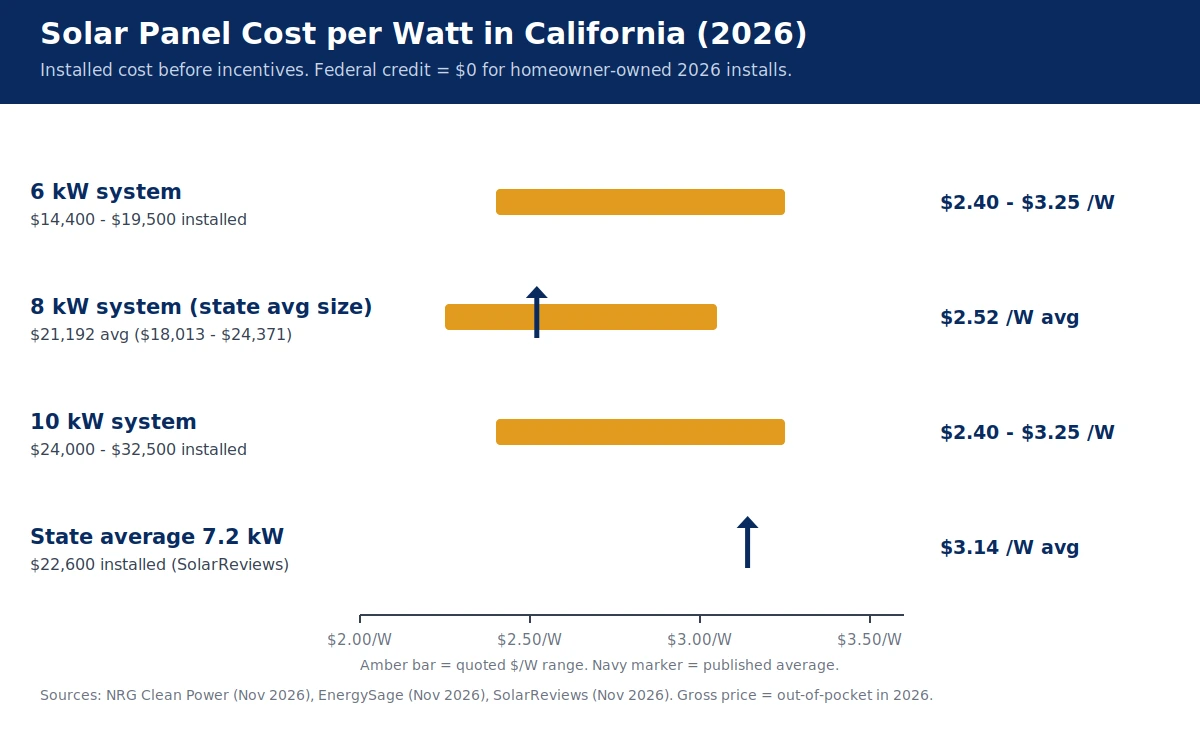
A few notes on reading this table: 6 kW suits smaller homes or lower usage (~500–700 kWh/month) and is the most price-competitive segment. 8–8.4 kW is the California average — the right benchmark for most single-family homes. 10 kW fits larger homes, EV owners, and all-electric households; per-watt pricing drops slightly, but utilities cap residential systems by historical usage, and oversizing earns only 4–8¢ exports under NEM 3.0.
For the full national picture and how California compares state by state, see our solar panel cost guide. For a deeper breakdown of exactly what each size includes, our 6kW/8kW/10kW system cost guide has the 2026 numbers line by line.
Budget add-ons: an electrical panel upgrade, if your panel can’t take the solar feed, runs $2,500–$4,500 (NRG, Nov 2026). Permits and interconnection run roughly 8% of system cost nationally (EnergySage). Get both confirmed in writing — quotes that “forget” them aren’t cheaper, they’re incomplete.
What drives your per-watt price in California
Two identical systems can quote $2.40/W and $3.25/W. Here’s where the difference hides:
Equipment tier. Premium panels (Maxeon, REC, Panasonic) and microinverters (Enphase) push $/W up; value-tier panels and string inverters bring it down. California skews premium — high rates make the extra production worth it — but the tier gap has narrowed.
Roof complexity. Steep pitch, multiple planes, tile roofs (common in SoCal), and long conduit runs add labor hours. If your roof has under 10 years of life left, factor a replacement into the project — solar on a failing roof is the most expensive mistake in this category.
Labor. California solar labor runs about $0.50/W (HomeAdvisor 2026). Bay Area and coastal quotes trend higher than the Inland Empire.
Permitting and interconnection. Some California cities offer same-day permits through SolarAPP+ (San Jose, Fremont, and others) — ask your installer if your city qualifies, because it cuts soft costs. LA’s LADBS plan check is slower and more expensive. Permitting friction is real money in California.
Panel upgrades. That $2,500–$4,500 panel upgrade (above) applies to older 100-amp homes — common in pre-1980 California housing stock. Newer 200-amp panels usually accept solar without modification.
Timeline reality check: contract to permission-to-operate typically runs 6–12 weeks in California; the roof work itself takes 1–3 days (Nabu Energy, Oct 2026). If you’re racing a deadline (see the property-tax section below), sign early — the utility interconnection queue, not the installation, is what eats calendar time.
NEM 3.0 explained: your exports now pay 4–8¢ per kWh
This is the single most important policy to understand before buying solar in California:
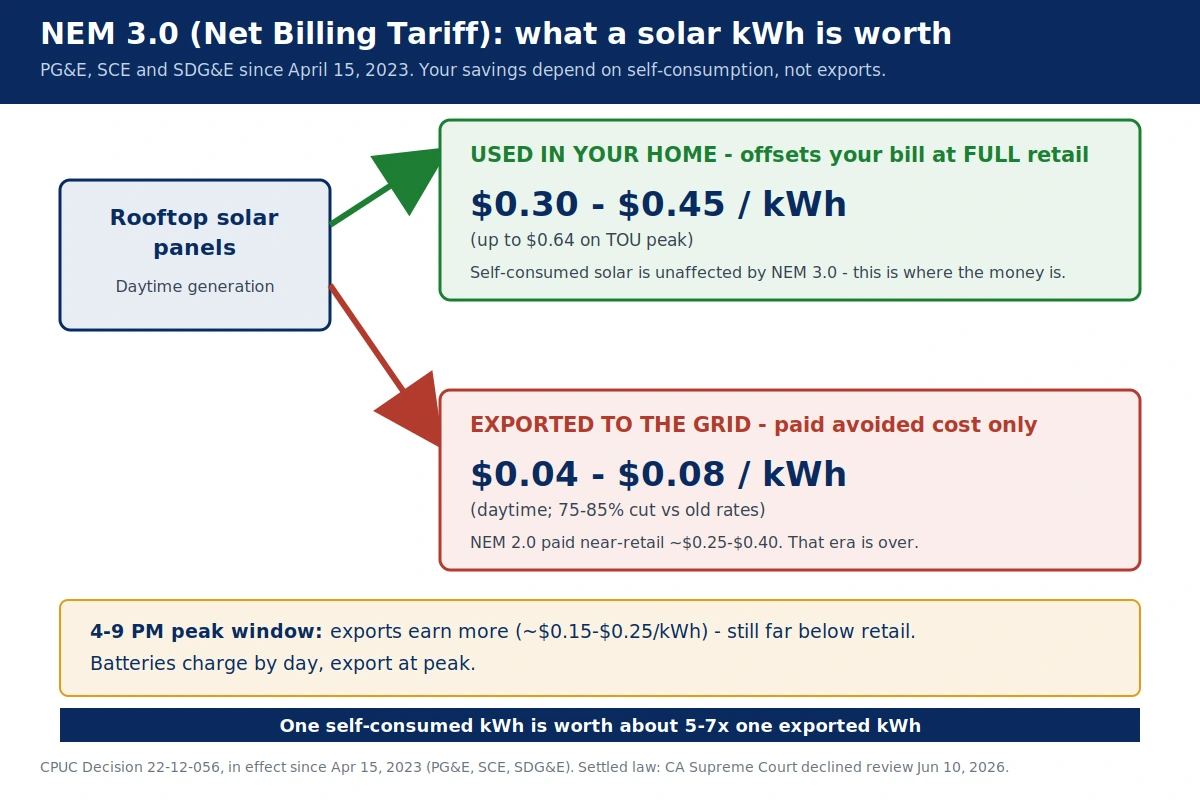
NEM 3.0’s official name is the Net Billing Tariff (CPUC Decision 22-12-056). It has applied to new interconnections at the three big investor-owned utilities — PG&E, SCE, SDG&E — since April 15, 2023. It’s settled law: an appellate court upheld it in March 2026, and the California Supreme Court declined to review it on June 10, 2026 (Helios, Sep 2026).
The headline: export credits collapsed 75–85%. Under NEM 2.0, exports were credited near retail (~$0.25–$0.40/kWh). Under NEM 3.0, daytime exports earn avoided-cost rates of about $0.04–$0.08/kWh (OhmSnap, Apr 2026; ElecGuys, 2026; Helios, Sep 2026).
Self-consumed solar is unaffected. Every kWh your home uses directly still offsets a purchase at the full retail rate — $0.30–$0.64/kWh depending on utility and time-of-use plan. The game is no longer “sell power to the grid”; it’s “use your own power.”
The 4–9 PM exception. Exports during the evening TOU peak earn higher avoided-cost credits — ~$0.06–$0.10/kWh (OhmSnap) to ~$0.15–$0.25/kWh (Helios), depending on month and hour. Higher than daytime, but still far below retail. A battery that stores midday surplus and discharges it in this window captures the best of both.
Payback under NEM 3.0 (2026, $0 federal credit):
| Scenario | Payback |
|---|---|
| Solar only, no battery | 9–13 years (ElecGuys; Helios: 10–13 SCE; NRG: 9–12) |
| Solar + battery (70–80%+ self-consumption) | 6–9 years (Helios; ElecGuys: 7–9) |
| EnergySage blended average | 7.64 years (Nov 2026) |
Not statewide. LADWP — Los Angeles’s municipal utility — is not under NEM 3.0. It still credits exports near retail (about $0.26–$0.31/kWh effective). If you’re in LADWP territory, your economics look closer to the old rules. Details in the regional section below.
Do you need a battery with solar panels in California in 2026?
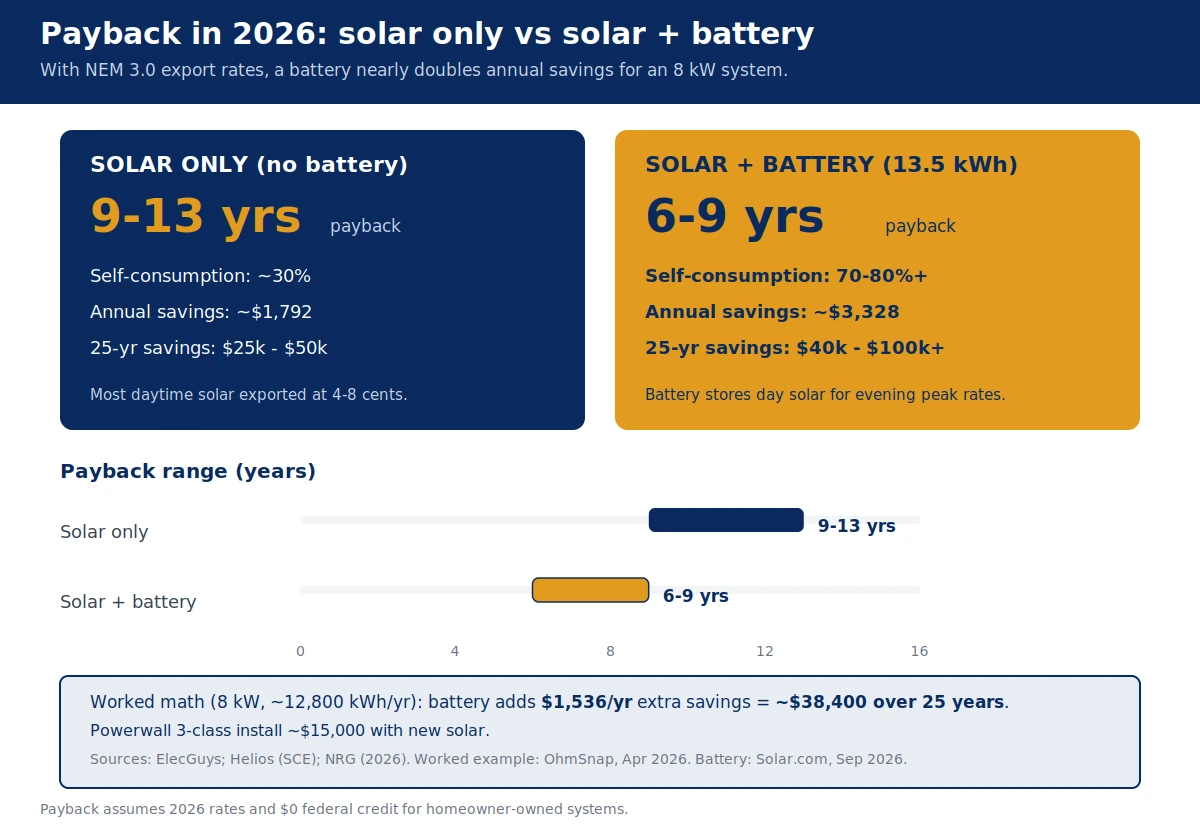
Short answer: under NEM 3.0, a battery is near-mandatory for good economics — not for backup, though backup is a real bonus, but because exports are nearly worthless and self-consumption is where the money is.
The math. Take an 8 kW system producing roughly 12,800 kWh/year:
- Without a battery (~30% self-consumed): 3,840 kWh × $0.35 retail = $1,344/yr, plus 8,960 exported kWh × $0.05 = $448/yr. Total: ≈$1,792/yr.
- With a battery (~70% self-consumed): 8,960 kWh × $0.35 = $3,136, plus $192 in exports. Total: ≈$3,328/yr.
That’s $1,536 more per year — about $38,400 over 25 years (OhmSnap, Apr 2026). The 25-year savings picture: $25,000–$50,000 solar-only vs $40,000–$100,000+ with a battery (ElecGuys, 2026). Monthly savings run $80–$150 solar-only vs ~$150–$300 with a battery.
Battery costs (2026):
- Tesla Powerwall 3 (13.5 kWh), installed with new solar: ~$15,000 median — middle half $13,950–$16,200 (Solar.com marketplace, Sep 2026).
- SCE territory: $14,500–$18,500 installed (Helios Energy, Sep 2026).
- Market range: $1,100–$2,100 per usable kWh installed; a single 10–13.5 kWh system runs $10,000–$16,000 (Solar.com / IntegrateSun, 2026).
- SolarReviews’ California average battery add: $15,600 before incentives (Nov 2026).
- 8 kW solar + battery, all-in: $33,000–$48,000 gross (Helios, Sep 2026; ElecGuys, 2026).
The full battery breakdown — brands, sizing, and whether a second unit pays — is in our solar battery cost guide. The same $0-credit rule applies: the 30% battery credit expired with §25D on December 31, 2025.
California incentives still standing in 2026 (and what’s really gone)
Honest accounting, because most cost pages still list programs that no longer exist:
SGIP: effectively closed. General-market battery budgets stopped accepting applications December 31, 2025 (SB 700 sunset; WattBuild, Jan 2026). The only remaining path is RSSE (Residential Solar & Storage Equity) — $280M paying $1,100/kWh of battery + $3,100/kW of solar — but it’s income-qualified only (≤80% of area median income) and was mostly waitlisted by mid-2026; LADWP’s $32.4M share hit the waitlist October 2, 2026 (Cali Energy). Do not let an installer promise you SGIP in 2026. If you’re income-qualified, check selfgenca.com for waitlist status — but budget as if it doesn’t exist.
Property-tax exclusion: ENDS January 1, 2027 — the urgency angle. Revenue & Taxation Code §73 has excluded active solar systems from property-tax reassessment since 1999. It becomes inoperative January 1, 2027 — confirmed by the CA Board of Equalization (Letter to Assessors 2026/034, Sep 1, 2026). The 2026 extension bill (AB 2389) was held in Assembly Appropriations on May 14, 2026 — it did not pass, and as of September 2026 no extension exists. Systems completed before January 1, 2027 keep the exclusion until a change of ownership; systems completed on or after get assessed — roughly $130–$550/year extra at a typical 1.1% rate (NRG, Sep 2026). The deadline is completion/final inspection, not the contract date — and with 6–12 week install timelines, that means signing well before the holidays. Two caveats: battery storage is not covered by the exclusion, and this is general information, not tax advice — your county assessor makes the final call.
Title 24 solar mandate (new construction). Since January 1, 2020, Title 24, Part 6 has required solar PV on virtually all new single-family and low-rise multifamily homes. The 2025 code cycle took force January 1, 2026, expanding requirements — new homes must now be battery-storage-ready (the wiring and space for a future battery, not the battery itself; a ≥7.5 kWh battery-ready design cuts the required PV size by 25%). If you’re buying new construction, solar is already in your base price; this article is for the retrofit market.
What else survives: net billing under NEM 3.0 (the economics above) and the lease/PPA §48E pass-through discounts. There is no state cash rebate for general-market solar in 2026.
Lease vs buy in California in 2026
With the federal credit at $0 for owned systems, the lease-vs-buy question changed shape in 2026:
Buy (cash or loan). You own the system, keep 100% of the savings, and it adds to home value. Gross cost: $14,400–$32,500 depending on size, plus $14,000–$18,000 with a battery. Federal credit: $0. You carry maintenance — inverters typically need one replacement in 25 years (see our solar inverter replacement cost guide).
Lease or PPA. $0 down, fixed monthly payment or per-kWh rate, operator handles maintenance. Because the operator claims the §48E credit, 2026 leases were seen discounted 17–34.6% in PG&E territory (solarbillreview.com, Oct 2026). It’s the only residential route to any federal solar value through December 31, 2027. Trade-off: you don’t own the system, savings are smaller, and selling means transferring the lease.
Who each suits: buy if you have the capital or cheap financing, plan to stay 7+ years, and want maximum lifetime savings. Lease if you’re cash-constrained, expect to move in under 7 years, or want to capture the last federal value before the §48E window closes.
Solar panel costs by region: PG&E, SCE, SDG&E, LADWP
California isn’t one solar market — it’s four or five, split by utility:
Utility rates (CPUC Public Advocates Office, Q2 2026 residential averages): PG&E $0.337/kWh, SCE $0.344/kWh, SDG&E $0.455/kWh. The EIA’s 2024 statewide average was $0.3197/kWh (up from $0.1915 in 2019), and SolarReviews puts the average California single-family electric bill at $219 (Nov 2026). Rule of thumb: solar “pencils” above ~$200/month bills and pencils well above $300 (solarconnect.solar, 2026).
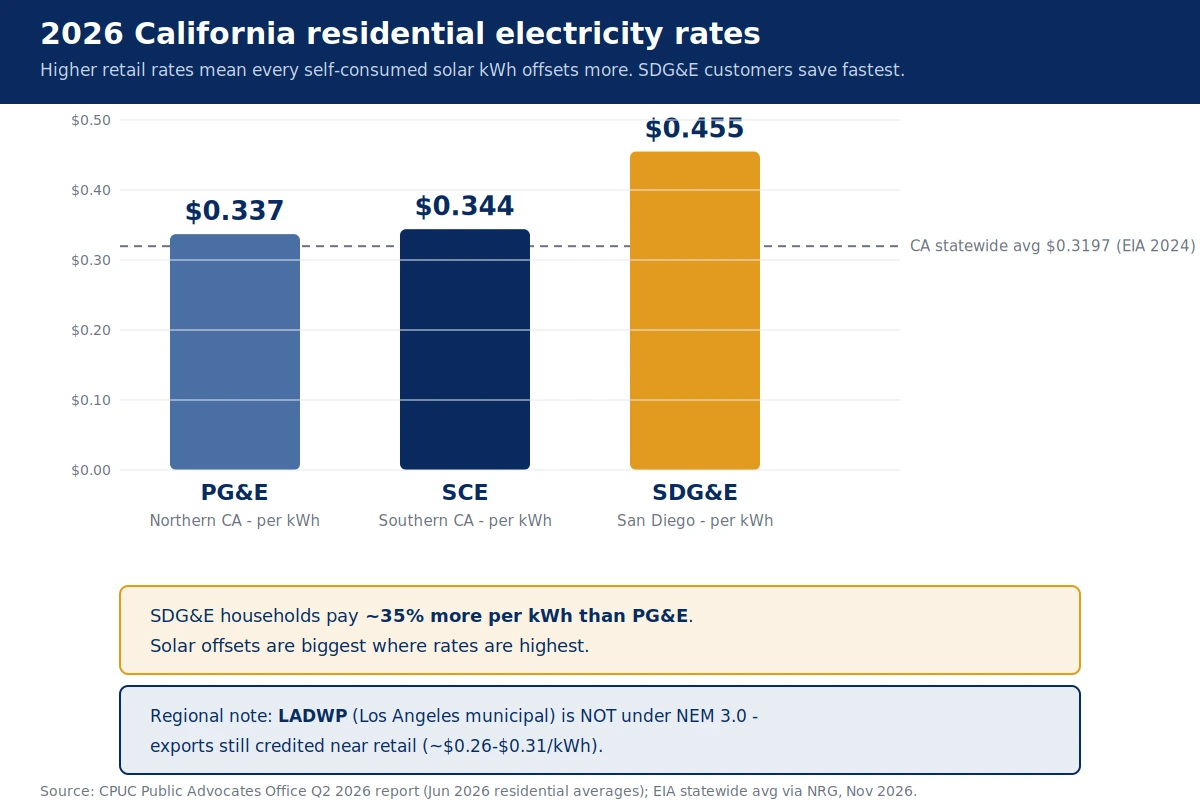
San Diego (SDG&E): the highest rates in the US — $0.455/kWh average. Payback is fastest here despite identical install costs. Solar + battery is the default.
LA Basin — SCE vs LADWP: this is the split that matters. SCE customers are under NEM 3.0 (exports at 4–8¢). LADWP customers are not — the municipal utility still credits exports near retail (~$0.26–$0.31/kWh effective). Same city, materially different economics: an LADWP solar-only system can pay back years faster than an identical SCE system. Confirm your utility before you believe any payback estimate.
Orange County: pricing runs $15,000–$21,000 for 6 kW (OC Solar, Sep 2026) — mid-pack, competitive installer market.
Inland Empire: often the lowest installed $/W in SoCal — simpler roofs, cheaper labor, high cooling loads.
Bay Area (PG&E): higher labor pushes $/W up, but $0.337/kWh rates and frequent PSPS outages make the battery case strongest here — backup value on top of the NEM 3.0 math. SolarAPP+ same-day permitting in San Jose and Fremont helps.
How to get accurate quotes — and red flags to avoid
Get 3+ quotes. The 42% overhead/sales slice of a California install means quotes for the same roof routinely differ by 25–30%. One marketplace quote is not a market price.
Demand $0-credit math. Any quote or payback model that subtracts a 30% federal credit for a 2026 install is wrong — make them redo it. Reject SGIP promises. General-market SGIP closed December 31, 2025; an installer “including SGIP” in 2026 numbers is selling fiction (income-qualified RSSE waitlist excepted).
Size for self-consumption, not the roof. Under NEM 3.0, oversizing earns you 4–8¢ exports. Size to your actual usage plus a battery, not to the maximum panels that fit.
Check the property-tax clock. If your installer can’t commit to completion and final inspection before January 1, 2027, you’re rolling the dice on the §73 exclusion. Get the timeline in writing.
Verify permitting. Ask whether your city supports SolarAPP+ same-day permits — it cuts weeks off the schedule. And if you’re comparing solar to a full solar roof product, our Tesla Solar Roof cost guide has the final 2026 pricing data on that (discontinued) category.
The bottom line: payback and savings in 2026
Is solar still worth it in California with no federal credit and NEM 3.0? For most homeowners with $200+/month bills: yes, with a battery. Typical project: 8 kW at $2.52/W ≈ $21,200 + Powerwall 3 at ~$15,000 = ~$36,000 gross, $0 federal credit. Annual savings with battery: ~$3,300/yr. Payback: 6–9 years with a battery, 9–13 without. 25-year savings: $40,000–$100,000+ with a battery (ElecGuys, 2026).
The buyers who win in 2026 size for self-consumption, add the battery, sign in time to beat the January 2027 property-tax deadline, and ignore every quote still showing 2025’s tax math. California’s rates — the highest in the continental US — do the rest.
Sources & methodology
Cost anchors: NRG Clean Power (Nov 2026 — 6/8/10 kW ranges, panel-upgrade $2,500–$4,500, cost-mix 36/22/42); OC Solar (Sep 2026 — 6 kW $15–21k, marketplace $2.46/W vs US $2.60/W, LBNL 25%+ installed-vs-marketplace gap); EnergySage CA cost page (Nov 2026 — $2.52/W, 8.42 kW avg, $21,192, 7.64-yr blended payback); Helios Energy (Sep 2026 — SCE-territory 8 kW $20–28k, 8 kW+battery $33–48k, Powerwall 3 $14.5–18.5k SCE, NEM 3.0 legal status); SolarReviews (Nov 2026 — 7.2 kW $22,600 @ $3.14/W, $219 avg bill, $15,600 battery add); HomeAdvisor 2026 (state ~$21k, ~$3/W, labor $0.50/W — page still cites 30% credit, excluded for credit math); Nabu Energy (Oct 2026 — 6–12 wk timeline, $25–35k solar+battery planning range); Solar.com marketplace (Sep 2026 — Powerwall 3 ~$15,000 median w/ solar, $13,950–$16,200 middle half, $1,100–$2,100/kWh battery range); IntegrateSun/Joule 2026 (Powerwall 3 $15,300–$16,200); ElecGuys 2026 (payback bands, 25-yr savings $25–50k solar-only / $40–100k+ w/ battery, $80–150 vs $150–300 monthly savings). NEM 3.0: CPUC Decision 22-12-056 (cpuc.ca.gov — Net Billing Tariff, eff. Apr 15, 2023); OhmSnap (Apr 2026 — 75–85% export cut, self-consumption worked example $1,792 vs $3,328/yr); export windows via Helios/OhmSnap as noted. Rates: CPUC Public Advocates Office Q2 2026 (PG&E $0.337, SCE $0.344, SDG&E $0.455); EIA via NRG ($0.3197/kWh 2024, $0.1915 2019, 503 kWh/mo); LADWP near-retail export ~$0.26–$0.31 (via brief installer sources). Tax/credit: OBBBA P.L. 119-21 (signed Jul 4, 2025 — §25D terminated for expenditures after Dec 31, 2025); IRS FS-2025-05 (Aug 21, 2025, FAQ 7 — installation-completion test); §48E lease/PPA route and deadlines via solarfundingusa.com (Aug 2026), greenenergycalc.com (Sep 2026), solarbillreview.com (Oct 2026 — 17–34.6% lease discounts PG&E territory); SEIA (seia.org) for industry context. SGIP: SB 700 sunset — general budgets closed Dec 31, 2025 (WattBuild, Jan 2026); RSSE $280M / $1,100/kWh + $3,100/kW, income-qualified ≤80% AMI (AB 209, 2022; CPUC D. 24-03-071; applications opened Jun 2, 2025); waitlist status mid-2026, LADWP $32.4M waitlisted Oct 2, 2026 (Cali Energy); verify at selfgenca.com. Property tax: RTC §73 inoperative Jan 1, 2027 — CA Board of Equalization LTA 2026/034 (Sep 1, 2026); AB 2389 held in Assembly Appropriations May 14, 2026 (no extension as of Sep 2026); ~$130–$550/yr at 1.1% (NRG, Sep 2026); not tax advice. Title 24: CEC 2025 Building Energy Efficiency Standards, in force Jan 1, 2026 (energy.ca.gov). EXCLUDED: EnergySage’s $125,249 25-yr savings figure (could not confirm the model excludes the expired credit — omitted); HomeAdvisor/SolarReviews “after 30% credit” prices (stale credit framing); any source promising general-market SGIP in 2026.
—
How much do solar panels cost in California in 2026?
$2.40–$3.25 per watt installed (NRG Clean Power, Nov 2026). EnergySage’s November 2026 California average is $2.52/W — $21,192 for the state’s average 8.42 kW system. All prices are gross: the 30% federal credit ended December 31, 2025, so there is nothing to subtract in 2026.
Is there still a federal solar tax credit in California in 2026?
No — $0 for homeowner-owned systems. The §25D Residential Clean Energy Credit ended for installations completed after December 31, 2025 (OBBBA, P.L. 119-21; IRS FS-2025-05). The only surviving federal path is §48E through a lease or PPA, where the system operator claims the credit and passes part of it through as lower payments, through December 31, 2027.
What is NEM 3.0 and how does it affect my savings?
NEM 3.0 (officially the Net Billing Tariff, CPUC Decision 22-12-056, in effect since April 15, 2023) cut export credits 75–85%: daytime exports earn about 4–8¢/kWh vs the 30–45¢/kWh you pay for retail power. Self-consumed solar still offsets the full retail rate, which is why batteries — storing midday power for evening use — are now near-essential.
Do I need a battery with solar panels in California in 2026?
Nearly always yes under NEM 3.0. An 8 kW system producing ~12,800 kWh/year saves roughly $1,792/yr solar-only vs ~$3,328/yr with a battery (70% self-consumption) — a $1,536/yr gap, or ~$38,400 over 25 years (OhmSnap, Apr 2026). A Tesla Powerwall 3 (13.5 kWh) installs for ~$15,000 with new solar (Solar.com marketplace, Sep 2026).
How long until solar pays for itself in California in 2026?
9–13 years solar-only, or 6–9 years with a battery (ElecGuys; Helios; NRG — 2026 figures, no federal credit). EnergySage’s blended average is 7.64 years (Nov 2026). SDG&E territory, with the highest rates in the continental US ($0.455/kWh), pays back fastest.
Does adding solar raise my property taxes in California?
Not if you finish in time. Revenue & Taxation Code §73 excludes active solar from reassessment — but the exclusion becomes inoperative January 1, 2027 (CA Board of Equalization, LTA 2026/034). Systems completed before that date keep it; systems completed after get assessed, roughly $130–$550/year extra. Battery storage isn’t covered. This is general information, not tax advice.
Can I still get the SGIP battery rebate in California in 2026?
Effectively no. General-market SGIP budgets closed December 31, 2025. Only the income-qualified RSSE track remains ($1,100/kWh battery + $3,100/kW solar), and it was mostly waitlisted by mid-2026. Plan your budget as if SGIP doesn’t exist; check selfgenca.com if you’re income-qualified.
Is LADWP under NEM 3.0?
No. LADWP is a municipal utility and is not covered by the CPUC’s Net Billing Tariff — it still credits solar exports near retail (~$0.26–$0.31/kWh effective). If you’re in Los Angeles, confirm whether you’re on LADWP or SCE before believing any payback estimate: the two have materially different economics.