

Whole house repipe cost in 2026 runs $4,000–$15,000 for a standard home, with a national average near $7,500. Angi’s dataset (updated Oct 30, 2026) shows most homeowners spending $1,500–$15,000, with verified professional projects extending $1,250–$22,000. PEX is the price leader — $4,000–$8,000 installed for a standard home — while copper runs $8,000–$16,000+. And there is no federal tax credit for repiping in 2026: plumbing repipes were never §25C/§25D property, and OBBBA ended those credits for 2026 homeowner installs regardless.
Table of Contents
A repipe is the biggest plumbing check most homeowners ever write — bigger than a water heater, bigger than a sewer spot repair. It’s also the one most shrouded in quote-to-quote confusion, because a “repipe” can mean anything from $1,500 in PEX in a ranch with a crawlspace to $30,000+ in copper in a two-story Bay Area slab home. Same word, 20x price spread.
Three facts cut through the noise. First, the pipe material is a minority of your bill: labor is roughly 70% of the total (Angi, Oct 30, 2026), because the work is opening walls, not threading pipe. Second, your foundation type changes the price as much as the material — a slab foundation adds 25–50% to labor vs a crawlspace. Third, a repipe covers pressurized supply lines only: the water main, the sewer lateral, the drains, and the paint are separate line items that surprise people who skim the quote.
This guide prices every material installed, tables cost by home size, decomposes the invoice into labor, permit, and drywall, runs the slab-vs-crawlspace math, lays out the five signs it’s time, does the repair-vs-repipe arithmetic, and explains the polybutylene insurance problem that is quietly forcing repipes across the Sun Belt.
Whole house repipe cost in 2026: the national answer
Start with the anchors. Angi’s 2026 dataset (updated Oct 30, 2026): national average $7,500, most homeowners $1,500–$15,000, verified projects $1,250–$22,000. HomeGuide’s published range (via aggregated cost guides, Aug 2026): $2,000–$15,000 for a whole house, averaging $3,100–$5,500 on an existing 2,000 sq ft home. One-story two-bath repipes with drywall and paint start around $6,500 for up to 12 fixtures (iBuyer.com, updated Nov 2026).
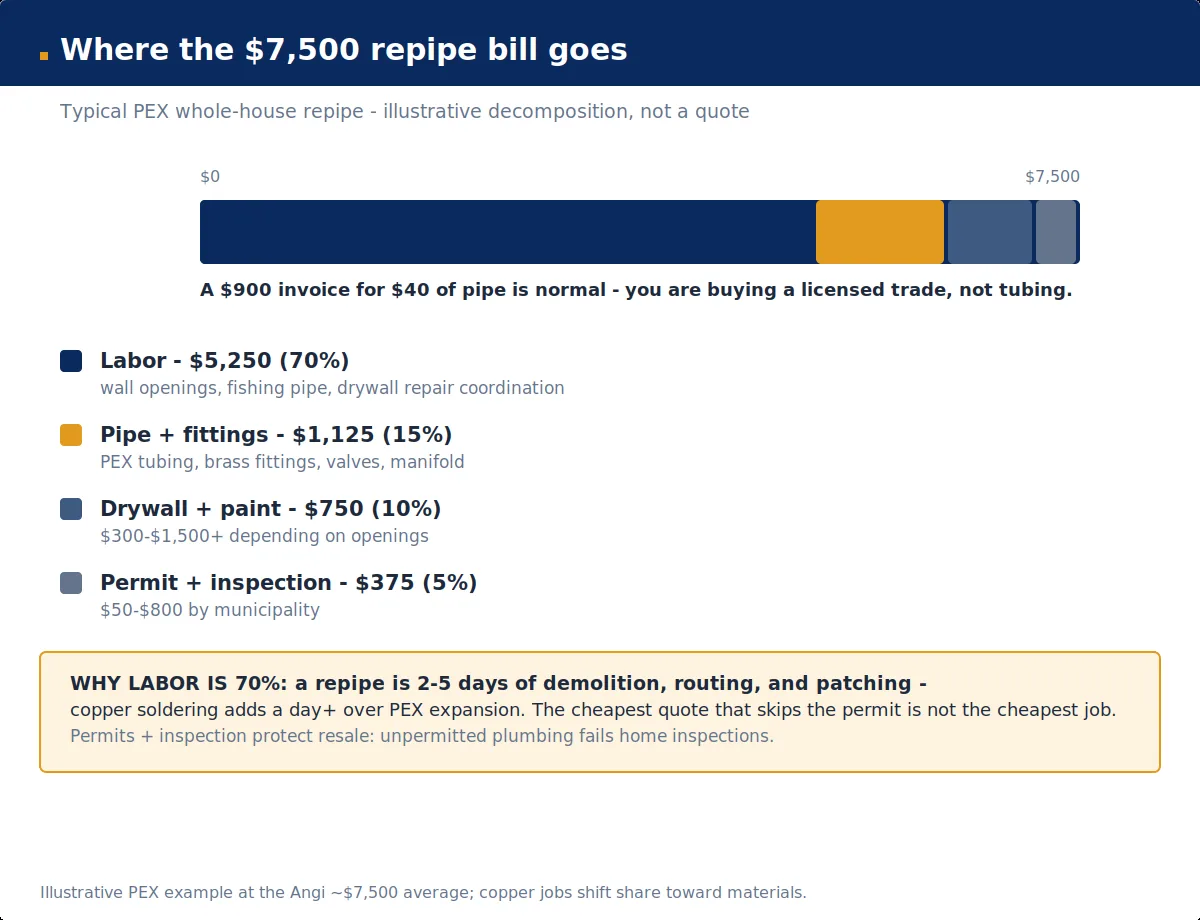
The figure that should reframe every quote you read: labor is about 70% of the total bill — roughly $5,250 of the $7,500 average. A 1,600 sq ft two-bath house with ~300 linear feet of supply line needs only $530–$680 in PEX materials vs $1,140–$1,440 in copper (scopegauge.com, Sep 2026): a $600–$760 material gap on a $7,500 job. The money goes to opening finished walls, fishing pipe through them, closing them back up, and pulling the permit. The pipe is the cheap part.
Two scope notes before the tables. A whole-house repipe replaces pressurized water-supply piping only — it does not include drain/waste/vent piping, new fixtures, the buried service line from the street, or finished paint (repaircostledger.com, Aug 2026). And Angi’s separate “pipe replacement” dataset — $1,246 average across 94,386 verified projects — covers the broad category of small pipe jobs, not whole-house repipes; don’t let a contractor (or a competing article) conflate the two.
Repipe cost by home size
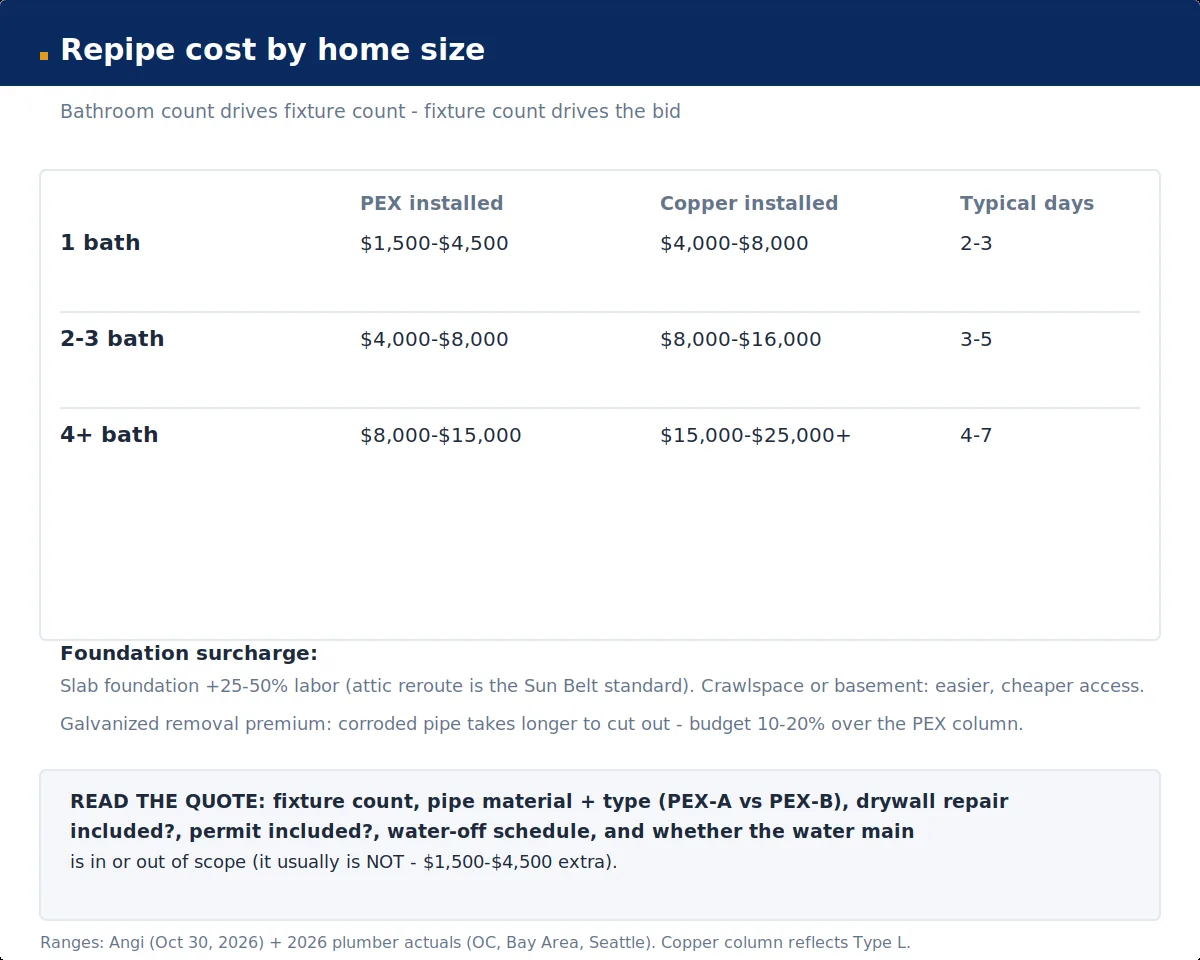
Bathroom count and square footage drive the quote more than any other variable, because every fixture is an access opening. Use this matrix to find your home, then adjust for your foundation (next section) and your market (coastal cities run 30–60% higher).
| Home size | PEX installed | Copper installed | Typical duration |
|---|---|---|---|
| 1-bath home | $4,000–$7,000 | $8,000–$12,000 | 2–3 days |
| 2–3 bath, 1,500–2,000 sq ft | $4,500–$9,000 | $9,000–$20,000 | 3–5 days |
| 4+ bath, 2,500+ sq ft / two-story | $8,000–$14,600 | $16,000–$32,000 | 4–7 days |
Sources: geekpoweredstudios.com (2026); HomeGuide via repaircostledger.com (Aug 2026); serviceagent.ai (~Oct 2026, secondary support); 2026 plumber actuals (labeled below).
Per-square-foot benchmarks: PEX-A installed $3.50–$7.00/sq ft; copper installed $8.00–$14.00/sq ft — copper is 40–60% more than PEX (geekpoweredstudios.com, 2026). Each extra bathroom adds roughly $1,000–$2,500 (iBuyer.com, Nov 2026). Partial repipes exist — $500–$4,000 for a temporary fix (cdcalculators.com), $2,500–$6,000 for a one-bath wing or hot-lines-only (plumbingprosd.com, Jun 2026) — but the catch is real: untouched lines fail next and you pay for drywall twice.
What coastal markets actually pay (2026 actuals, labeled high-cost markets): Orange County, CA — most whole-house PEX repipes landed $13,000–$18,000 (typical ~$15,800), copper ~55% more at $26,000–$32,000 on larger homes, all including permit, inspection, patching, and texture (Olson Superior Plumbing, updated Sep 2026). Bay Area — $10,000–$25,000, most 2–3BR homes $12,000–$18,000 (total-uc.com, May 2026). Seattle/Puget Sound — PEX $8,000–$15,000, copper $15,000–$25,000 (ecoserviceswa.com, verified Jul 2026). San Diego — $4,500–$18,000 plumbing-only, $6,500–$25,000 all-in with drywall and paint (plumbingprosd.com, Jun 2026). Angi’s city averages cluster near the national $7,500: NYC $8,445, Tampa $7,568, Orlando $7,605, Minneapolis $7,860 (May 2026 updates).
PEX vs copper vs CPVC: material costs compared
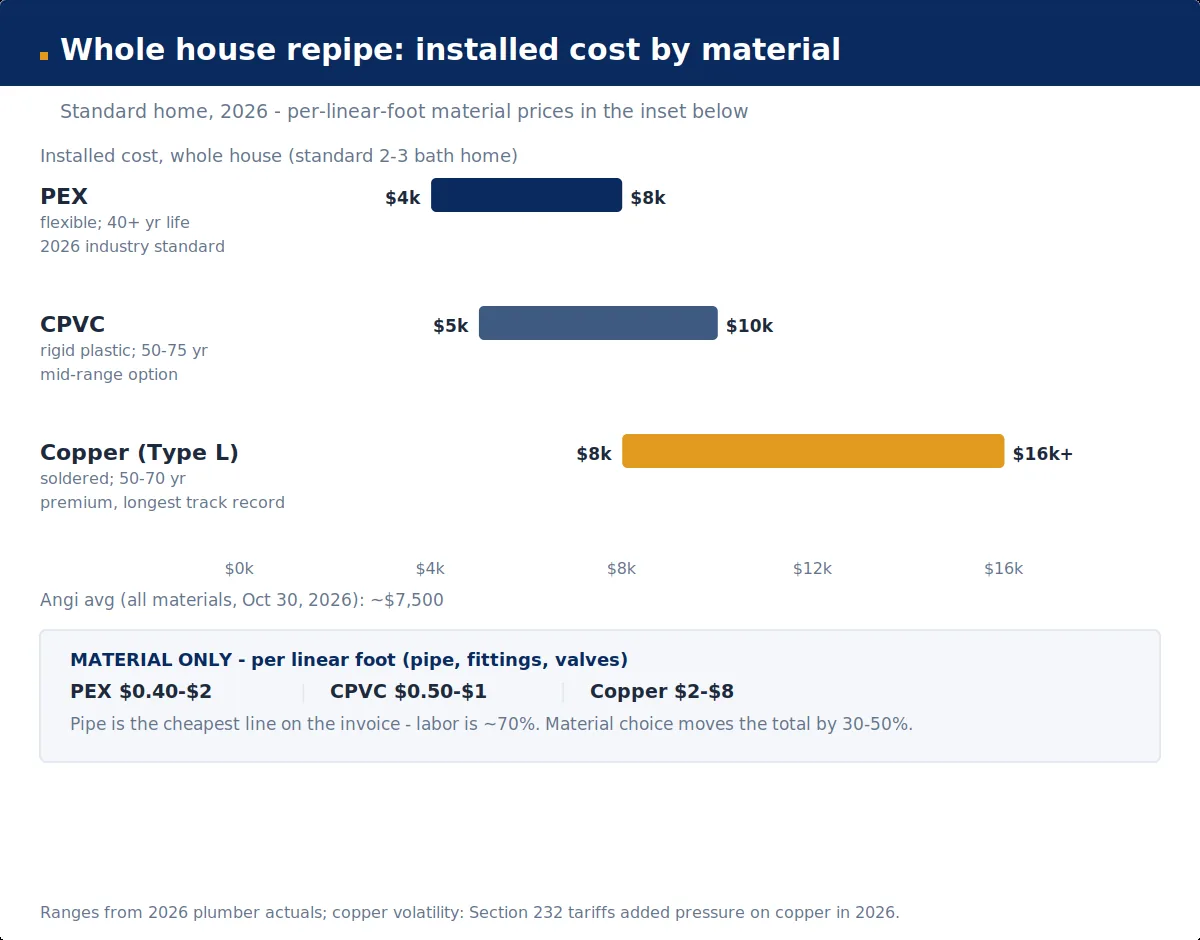
| Material | Per linear foot | Standard home, installed | Lifespan |
|---|---|---|---|
| PEX | $0.40–$2 | $4,000–$8,000 | ~40 years (InterNACHI); 80–100 by Bob Vila’s read |
| CPVC | $0.50–$1 | $5,000–$10,000 | 50–75 years |
| Copper | $2–$8 | $8,000–$16,000+ | 50–70 years (neutral water) |
Sources: Angi (Oct 30, 2026, per-LF data from Aug 2026); cdcalculators.com (~Oct 2026, secondary); 1800plumber.com field data (via thehealthyattitude.com).
PEX is the 2026 industry standard for residential repipes. Flexible, corrosion-proof, freeze-tolerant — and it can be fished through finished walls with fewer openings, which cuts the labor line that dominates the bill. PEX-A (expansion/Engel type, e.g. Uponor) is the dominant spec; PEX-B (crimp/clamp) is the budget tier. One honest caveat: rodents can chew PEX in attics and crawlspaces, and UV degrades it — indoor-only routing, code-compliant in California since 2010.
Copper’s case is durability and resale perception. Copper is bacteria-resistant and carries a premium “done right” signal in many markets. The 2026 problem is price volatility: one publisher reports copper pipe prices spiking ~40% in a single year (thehealthyattitude.com — single-publisher claim, treat as observation not fact), construction input prices ran +12.6% annualized through early 2026, and the April 6, 2026 restructuring of Section 232 steel tariffs to 50% pushed pipe costs broadly higher (total-uc.com, attributing loosely). A copper quote in January can move 15–25% by spring; PEX pricing is more stable (petroleum-linked, but less volatile). In hard-water and chloramine-heavy municipal systems, copper can develop pinhole leaks in 15–20 years — well short of brochure lifespan (907heatingplumbing.com; Olson Superior, Sep 2026).
CPVC sits between: cheaper than copper, rigid like copper but plastic, $5,000–$10,000 installed (cdcalculators.com). It’s losing share to PEX because rigidity means more joints and more wall openings — the labor offset eats the material savings.
What’s included in a repipe quote — and the 3 hidden costs
The three costs most often excluded from base quotes:
- Permit: $50–$800. Most markets land $150–$600 (iBuyer.com); Angi cites $50–$500 by region; scopegauge.com averages $300–$800 for a full residential repipe. Final inspection is usually required before walls close — an unpermitted repipe can fail a future sale inspection. Check your local AHJ; never trust a national flat number.
- Drywall repair and paint: $300–$1,500+ (geekpoweredstudios.com). The buried line from the street is NOT part of a repipe. Adding it runs $1,500–$4,500 in San Diego (plumbingprosd.com) and $800–$2,000 for a standard replacement (Angi, Sep 2026).
Six things to get in writing before you sign (repipesolutionsinc.com, Oct 2026): (1) fixture-by-fixture scope; (2) material + fitting system (e.g., PEX-A expansion vs crimp); (3) a list of every access opening; (4) who patches and paints; (5) permit and inspection included; (6) schedule with water-off days. Budget a 10% contingency on any quote (geekpoweredstudios.com) — raw material costs have stayed elevated since 2025, and walls always hide surprises.
Natural add-ons while the walls are open: a water heater replacement is the classic companion job (you’re already paying for access), and pre-1960s homes often pair a repipe with a full electrical rewire — same walls, one drywall bill instead of two.
Labor: why it’s 70% of your bill
On a $7,500 repipe, roughly $5,250 is labor (Angi, Oct 30, 2026; iBuyer.com puts the labor band at 50–70%). RSMeans 2026 prices journeyman plumber rates at $65–$110/hour in most US markets (via scopegauge.com); licensed plumbers in NYC run $150–$250/hr (Angi, May 2026), $45–$200/hr in Tampa and Orlando.
What the labor buys: cutting access openings behind finished walls, fishing or rerouting pipe, sweating copper joints or expanding PEX-A connections, pressure-testing, coordinating the inspection, and closing the walls back up. Access conditions alone can swing labor hours 30–60% on the same house — open framing vs finished walls is the single biggest lever (scopegauge.com, Sep 2026). Copper costs more in labor than PEX for a second reason: it’s rigid, so every direction change is a soldered joint and every run is a measured stick — PEX’s flexibility cuts both fittings and wall openings. That’s why a PEX repipe finishes 2–3 days faster than copper for the same scope (repipesolutionsinc.com, Oct 2026).
Slab vs crawlspace: how your foundation changes the price
Your foundation is the second-biggest price driver after bathroom count. Crawlspace and raised-foundation homes are the easy case: plumbers work under the house with clean runs — PEX $4,500–$9,000 for 1,500–2,000 sq ft (geekpoweredstudios.com).
Slab foundations — standard in Texas and across the Sun Belt — are the expensive case. You can’t run supply lines through a concrete slab economically, so the 2026 standard method is a reroute: PEX-A run through the attic and walls, abandoning the slab lines in place. No slab penetration, but more linear footage and more drywall work. Slab adds 25–50% to labor (cdcalculators.com): PEX on a slab home runs $7,500–$14,600 (geekpoweredstudios.com). Note the attic routing: those new PEX runs share space with your insulation, and a repipe can disturb it — our attic insulation cost guide covers what re-insulating disturbed bays runs.
One structural advantage of the reroute: the supply lines come out of the slab entirely, so future slab leaks in the old lines stop mattering. For context on the foundation-access side of plumbing work, see our sump pump installation cost guide, which deals with the same slab/crawlspace access geometry from the drainage side.
5 signs it’s time to repipe
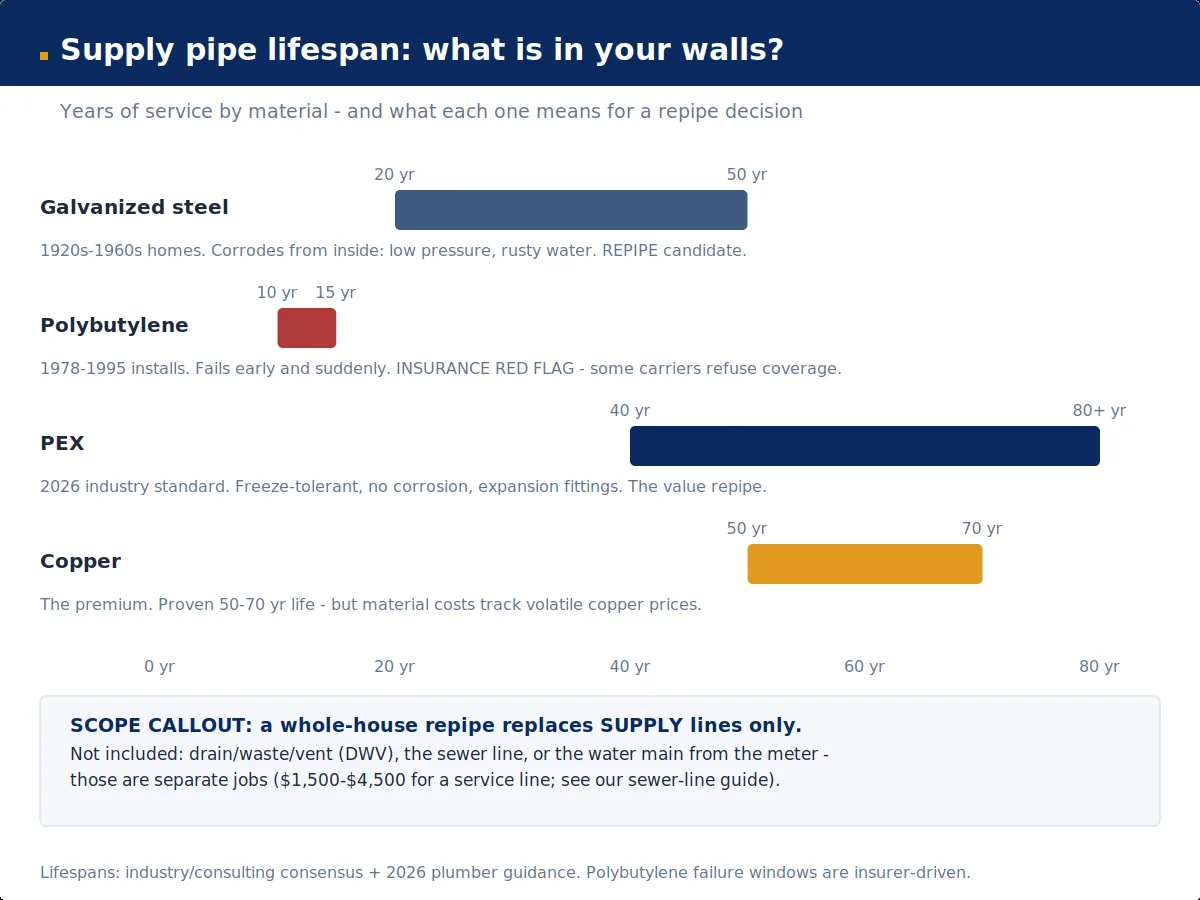
1. Polybutylene (PB) pipes. Installed in ~10 million US structures from 1975–1996 — gray (sometimes blue/silver), stamped “PB2110.” Chlorine and chloramine in municipal water cause micro-fractures and sudden, catastrophic failures. As of May 2026, most homeowners insurance carriers flag polybutylene or refuse coverage outright, and some require replacement as a condition of coverage (ezflowplumbingaz.com; doanplumbing.com, Oct 2026). PB is the single strongest “don’t wait” signal.
2. Original galvanized steel, pre-1960s. Lifespan 20–50 years (InterNACHI). The zinc coating erodes, internal rust and calcium deposits restrict flow, water discolors. If the original galvanized is still in place, plan a repipe even without a major failure (doanplumbing.com, Oct 2026; ezflowplumbingaz.com, Mar 2026).
3. Three leaks in six months. The plumber’s rule of thumb: three or more leaks in half a year means the system is failing systemically, not locally (doanplumbing.com, Oct 2026). Price a full repipe instead of the fourth spot repair.
4. Discolored water or collapsing pressure. Brown/red water after the tap sits, or pressure that has visibly faded over the years, means internal corrosion and mineral restriction — the pipe’s interior is gone even if the exterior looks fine.
5. Lead service-adjacent pipe. Lead supply lines (common pre-1986) aren’t a repipe decision — they’re a health decision. Replace on identification; this is the one scenario where waiting has no defensible upside.
Repair vs repipe: the decision math
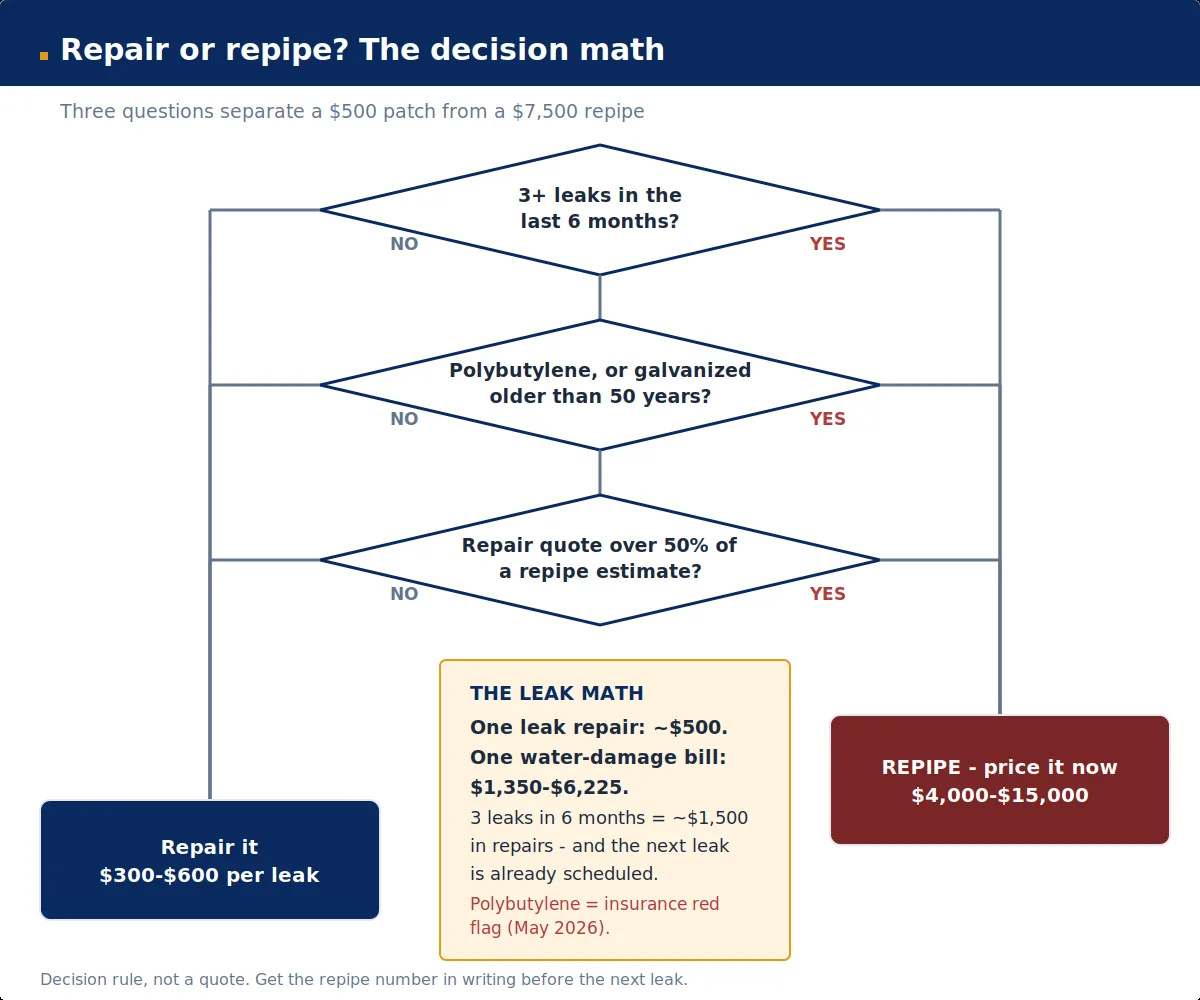
The arithmetic that settles it:
- Average pipe leak repair: ~$500. (Angi, updated Jul 9, 2026.)
- Water damage restoration from a burst: $1,350–$6,225. (Angi’s editorial model — attribute, not verified project data.)
- Full PEX repipe, standard home: $4,000–$8,000.
Three $500 repairs in a year plus one bad burst = $3,000–$7,700 in damage and patchwork — the price of the repipe you should have bought, minus the new-pipe warranty. Repiping can pay for itself by preventing one or two bad pipe bursts.
One honest caveat on value: repiping won’t increase your sale price, per Angi (Jul 9, 2026) — but old pipes with leaks or low pressure can turn buyers away or fail inspection. It’s a deal-preservation expense, not an appreciation play. And remember the scope boundary: the sewer lateral is a separate system and a separate job — a repipe won’t fix drain problems, and a sewer replacement won’t fix supply problems.
How long does a repipe take?
Industry consensus: 2–5 days for most residential repipes. Small homes (1–2 bath): 2–3 days. Medium (2–3 bath): 3–5 days. Large (4+ bath): 4–5 days; complex layouts up to a week+ (repipesolutionsinc.com, Oct 2026; goldenrulephc.com; plumbingoutfitters.com, Jun 2026). PEX runs 2–3 days faster than copper; copper typically takes 4–5 days, 6–7 for large or complex homes. (One San Jose specialist advertises 1–3 days — company marketing; treat as the exception, not the benchmark.)
The livability question matters more than the calendar: water is shut off only during working hours (8–10 hrs/day) and restored each evening — the house remains livable throughout (repipesolutionsinc.com; urbansplatter.com, Aug 2026). The elapsed permit-to-completion timeline is longer: 3–6 weeks in permit-heavy markets, with the permit application alone taking 1–3 weeks in the Bay Area (total-uc.com, May 2026).
How to get an accurate quote
Repipes are quoted, not menu-priced — no two homes are identical. But you can bracket your quote against the regional actuals above, then demand the six in-writing items from the “hidden costs” section. Two final rules:
- Compare scope, not totals. A $6,500 PEX quote without drywall vs an $8,500 PEX quote with full patch-and-paint is the same job at different honesty levels.
- Never let a bid rest on a verbal “we’ll handle the drywall.” The patch-and-paint line is where most repipe disputes start.
And the credit question, one last time for readers arriving from our energy guides: there is no federal tax credit for repiping in 2026. Plumbing repipes were never §25C/§25D property, OBBBA ended those credits for 2026 homeowner installs anyway, and HEAR/HOMES don’t cover repipes either. The full incentive picture — what survived OBBBA and what didn’t — is in our 2026 federal energy tax credits guide.
Sources & methodology
National benchmarks: Angi, “How Much Does It Cost to Repipe a House? [2026 Data]” (updated Oct 30, 2026) and “What Does Pipe Replacement Cost? [2026 Data]” (updated Sep 25, 2026), Angi city pages for NYC, Tampa, Orlando, Minneapolis (May 2026), and “Does Repiping a House Add Value?” (updated Jul 9, 2026). HomeGuide’s published ranges via aggregated 2026 cost guides (repaircostledger.com, ~Aug 2026; aeheatingandcooling.com, Oct 2026). Regional 2026 plumber actuals: Olson Superior Plumbing (Orange County, Sep 2026); total-uc.com (Bay Area, ~May 2026); ecoserviceswa.com (Seattle, verified Jul 2026); plumbingprosd.com (San Diego, ~Jun 2026); estimatorflorida.com (~Aug 2026); iBuyer.com (Nov 2026). Material and labor detail: scopegauge.com (~Sep 2026, incl. RSMeans 2026 labor rates); geekpoweredstudios.com (2026); cdcalculators.com and serviceagent.ai (~Oct 2026, secondary support only). Timeline: repipesolutionsinc.com (~Oct 2026); goldenrulephc.com; plumbingoutfitters.com (Jun 2026); instaservice.com (Mar 2026); urbansplatter.com (Aug 2026); jetpipeplumbing.com. Materials/lifespans: 907heatingplumbing.com; aeheatingandcooling.com (Oct 2026); doanplumbing.com (Oct 2026); ezflowplumbingaz.com (Mar 2026); honorservices.com (Oct 2026, via InterNACHI). Tax-credit status: standing project rule per IRS FS-2025-05 (OBBBA, P.L. 119-21).
How much does it cost to repipe a whole house in 2026?
$1,500–$15,000 nationally, averaging ~$7,500 — from Angi’s Oct 30, 2026 dataset. Most standard homes land $4,000–$8,000 in PEX or $8,000–$16,000+ in copper, with slab foundations and coastal markets running 25–60% higher.
Is PEX or copper cheaper for a whole-house repipe?
PEX, by 30–50% installed: $4,000–$8,000 vs $8,000–$16,000+ for a standard home. PEX-A (expansion type) is the 2026 industry standard — flexible, corrosion-proof, faster to install. Copper’s case is longevity (50–70 years in neutral water) and resale perception, but its 2026 pricing is volatile.
How long does a whole-house repipe take?
2–5 days for most homes; PEX is 2–3 days faster than copper for the same scope. Water is shut off only during working hours and restored each evening, so the house stays livable. Permit-to-completion can stretch 3–6 weeks in permit-heavy markets.
Does a repipe include the water main, sewer line, or drains?
No — a repipe covers pressurized water-supply lines only. The water main/service line ($600–$2,500+ extra), drain/waste/vent piping, new fixtures, and finished paint are separate. The sewer lateral is a completely separate job.
Will repiping increase my home’s value?
Per Angi (Jul 9, 2026), no direct sale-price lift — but old pipes with leaks or low pressure can turn buyers away or fail inspection. Think of it as deal preservation, not appreciation. In polybutylene homes, it’s also an insurance decision: carriers may refuse coverage until the PB is gone.
Is there a federal tax credit for repiping in 2026?
No. Plumbing repipes were never §25C/§25D property, and OBBBA (P.L. 119-21) ended those credits for 2026 homeowner-owned installs regardless. HEAR and HOMES rebates don’t cover repipes either — those are for HVAC, insulation, electrical, and appliances.
Should I repair a leak or repipe the whole house?
Use the 3-leak rule: 3+ leaks in 6 months, polybutylene pipes, or galvanized past 50 years means price a full repipe. At ~$500 per leak repair and $1,350–$6,225 per burst’s water damage (Angi’s editorial model), a $4,000–$8,000 PEX repipe pays for itself after one bad burst plus a couple of spot repairs.