

Table of Contents
Nobody shops for a whole house generator the way they shop for an appliance. The searcher for this keyword is making a $9,000–$16,000 quote-comparison decision — usually right after a storm season, a well pump that needs backup power, or a neighbor’s install they want to price-check. And the quotes they collect are almost impossible to decode, because the generator is a minority of the bill. Two quotes for the “same” 22 kW unit can differ by $5,000, and both can be honest — one just assumed a 50-foot gas trench and a panel reconfiguration that the other didn’t.
Three traps define this market. First, headline averages mislead: widely-cited figures from Forbes Home ($4,000–$25,000, ~$9,000 average) and Angi ($5,156 average) are secondhand citations blending portable units, partial coverage, and small systems — they should not anchor a whole-home budget. Contractor-built 2026 figures converge on $9,500–$15,000 for a 14–22 kW install, and Generac’s own published range is $8,000–$16,000 installed. Second, most ranking pages quote a unit price and stop — but the invoice anatomy (unit vs ATS vs gas vs permits) is where the money actually goes. Third, the sizing advice is usually “buy more kW,” when the real expert move is load management: an 18–22 kW unit with smart shedding can do a 24 kW job for $1,500–$2,500 less in equipment.
This guide prices the generator by size, decomposes a typical $12,500 invoice line by line, settles the sizing math (including the load-management tier nobody explains), compares Generac vs Kohler vs Briggs & Stratton on 2026 model pricing, prices fuel and maintenance honestly, and kills the persistent tax-credit myth. It also frames the 2026 context that matters: 2024 was the worst US outage year since reporting began, and the old 30% battery credit that once made battery backup look cheaper is gone for 2026 installs.
Whole house generator cost by size: the 2026 installed bands
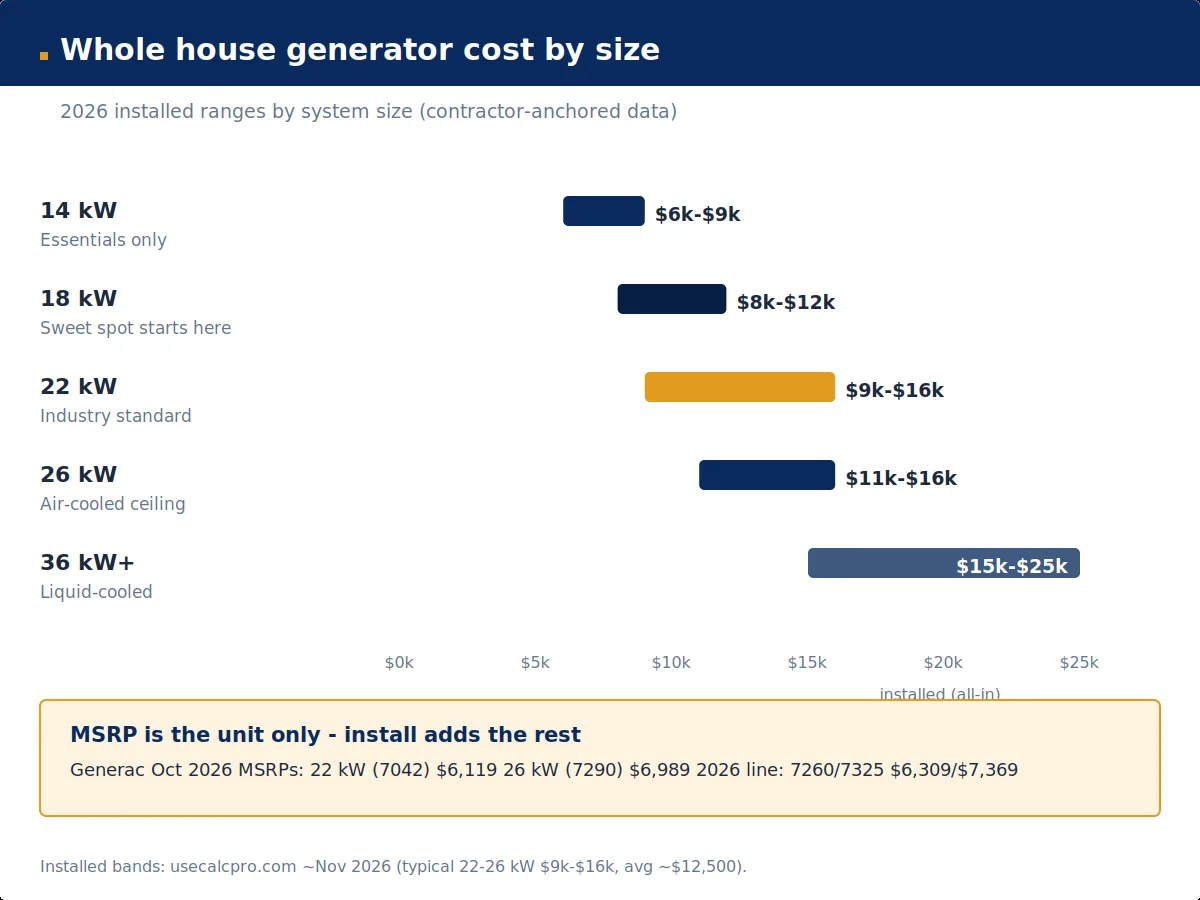
| Size | Typical use | 2026 installed range | Notes |
|---|---|---|---|
| 14 kW | Essentials only (well pump, fridge, lights, furnace fan) | $6,000–$9,000 | Smallest whole-home tier; commonly $8,500–$12,500 depending on site |
| 18 kW | Mid-size home, essentials + one major appliance | $8,000–$12,000 | Air-cooled; the load-management sweet spot starts here |
| 22 kW | Whole-home, the industry standard | $9,000–$16,000 | Generac’s own range: $8,000–$16,000; typical ~$12,500 |
| 26 kW | Large homes, no-compromise whole-home | $11,000–$16,000 | Air-cooled ceiling (≤26 kW) |
| 36 kW+ | Large builds, estates, liquid-cooled | $15,000–$25,000 | Liquid-cooled systems run $25,000–$45,000 installed |
The bands above use contractor-anchored 2026 sources (usecalcpro.com ~Nov 2026, pipelineon.com ~Jun 2026, gendealers.com Aug 2026). A typical suburban 14–22 kW natural-gas install lands at $9,500–$15,000. For 18–22 kW air-cooled, most homeowners pay $10,000–$15,000, with the full spread running $6,000–$18,000 depending on site complexity. Installer-built tiers tell the story more usefully: essentials-only (14 kW) commonly $8,500–$12,500; whole-house with load management (18–22 kW) $11,000–$17,000; no-compromise whole-house (24–26 kW) $15,000–$25,000+ (standbygenpros.com, ~May 2026).
The $9,000-average problem. Widely repeated figures — Forbes Home’s $4,000–$25,000 band (~$9,000 average) and Angi’s $5,156 average — reach us only through secondhand citations (repa.buynewchevy.com), not direct ranking pages, and they blend small/portable units and partial coverage with full whole-home installs. Do not build a whole-home budget on them. The contractor-built bands above are the planning numbers.
Regional reads: PNW contractor pricing for a 22 kW air-cooled with a 200A service-rated ATS, composite pad, gas within 20 ft, and permits runs $11,000–$15,500 (portlandiaelectric.supply, Oct 2026). NYC runs $10,000–$25,000 (homeguide.com, Oct 2026). Expect 2–6 weeks for permit approval in most jurisdictions (fixupfirst.com).
The invoice anatomy: the generator is only ~1/3 of the bill
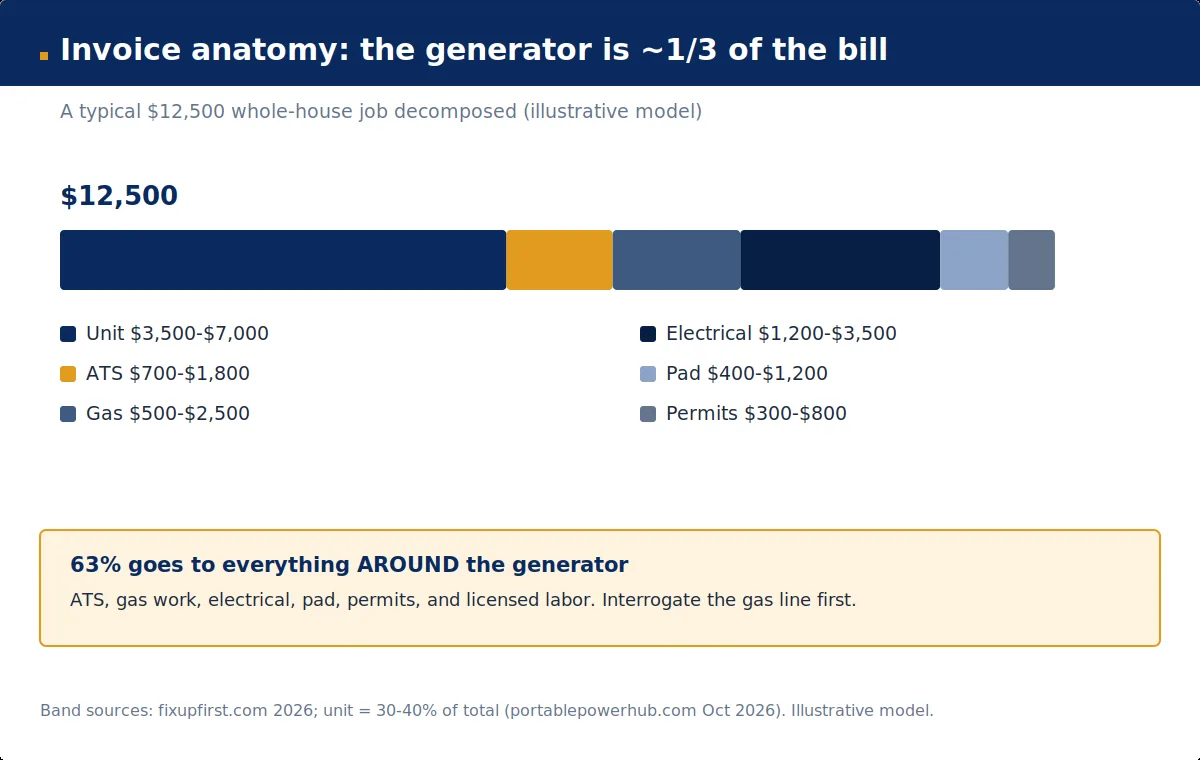
This is the section nobody else writes clearly, and it explains every confusing quote. Roughly 63% of the installed price goes to everything around the generator — transfer switch, materials, electrical, gas piping, pad, permits — with the unit itself at 30–40% of the total (portablepowerhub.com, Oct 2026; thehealthyattitude.com, 2026).
Generator unit: $3,500–$12,000 depending on kW and brand (usecalcpro.com, ~Nov 2026). Generac’s October 2026 MSRPs (unit only): 10 kW $3,649, 22 kW (7042) $6,119, 26 kW (7290) $6,989; with a 200A ATS bundled: 22 kW (7043) $6,979, 28 kW (7329) $9,509. The 2026 model line runs 7260/7325 (22 kW) at $6,309/$7,369 and 7282/7329 (28 kW) at $8,159/$9,509 (thewattguide.com; theday.company, Oct 2026). Kohler 20RCA/26RCA street price sits at $6,000–$7,400 — a ~5–10% equipment premium over Generac, about 5% on the total ticket (portlandiaelectric.supply, Oct 2026; usecalcpro.com).
Automatic transfer switch: $400–$2,000 for the unit (pipelineon.com), $800–$1,800 installed all-in (HomeGuide via pipelineon.com). A 200A service-entrance switch runs $1,500–$2,500 in equipment plus $600–$1,200 in labor (thehealthyattitude.com, 2026). This is non-negotiable hardware: NEC 702 requires an automatic transfer switch on standby installs — backfeed workarounds are not an option, and no legitimate installer quotes without one.
Pad: $200–$500 for a composite base on level pea gravel, or $400–$1,200 for a poured concrete pad on a 22 kW job (usecalcpro.com; pipelineon.com). Generac air-cooled units at 26 kW and below ship with a composite base — no concrete required (Generac Support via legalclarity.org).
Gas line: $500–$2,500 typical (fixupfirst.com); $12–$25 per linear foot (legalclarity.org). A 50-foot 2-inch trench with materials runs $800–$1,500; a new propane tank is $2,500–$5,000; and a home with no existing gas service pays $1,500–$3,000 just to get gas from the street to the pad (thehealthyattitude.com). This is the single biggest quote variable — a unit 20 feet from the meter and a unit 100 feet away are different jobs.
Labor: $1,500–$4,000 for the licensed electrician + gas fitter (4–8 hours) (usecalcpro.com). Total labor scope: $4,000–$5,500 on simple installs, $5,500–$8,000 on complex ones (trenching, panel upgrade, grading) (thehealthyattitude.com).
Permits + inspection: $150–$650 typical (PermitFlow via pipelineon.com). Houston runs $259; Dallas runs up to $1,013 (theday.company, Oct 2026). Nearly every jurisdiction requires both electrical and gas/mechanical permits (legalclarity.org).
A worked example — 22 kW, moderate site: ~$14,670 all-in (thewattguide.com, Oct 2026). And the typical $12,500 job decomposes roughly as: unit $3,500–$7,000 + ATS $700–$1,800 + pad $400–$1,200 + gas $500–$2,500 + electrical $1,200–$3,500 + permits $300–$800 (fixupfirst.com). When a quote comes in high, the gas line and the panel work are the lines to interrogate first.
What size generator do I need? The sizing math
22 kW is the industry standard for whole-home backup (Generac; standbygenpros.com, ~May 2026) — but “standard” is the end of a calculation, not the calculation. Generac’s published guidance: ~1,550 sq ft suits 10–14 kW (up to 18 kW with a heat pump or medical loads); ~2,000 sq ft suits 18–22 kW; 2,500–3,000 sq ft suits 22 kW (via aeheatingandcooling.com, Oct 2026). Square footage is only a starting point: identical floor plans can need generators 8 kW apart depending on what actually runs.
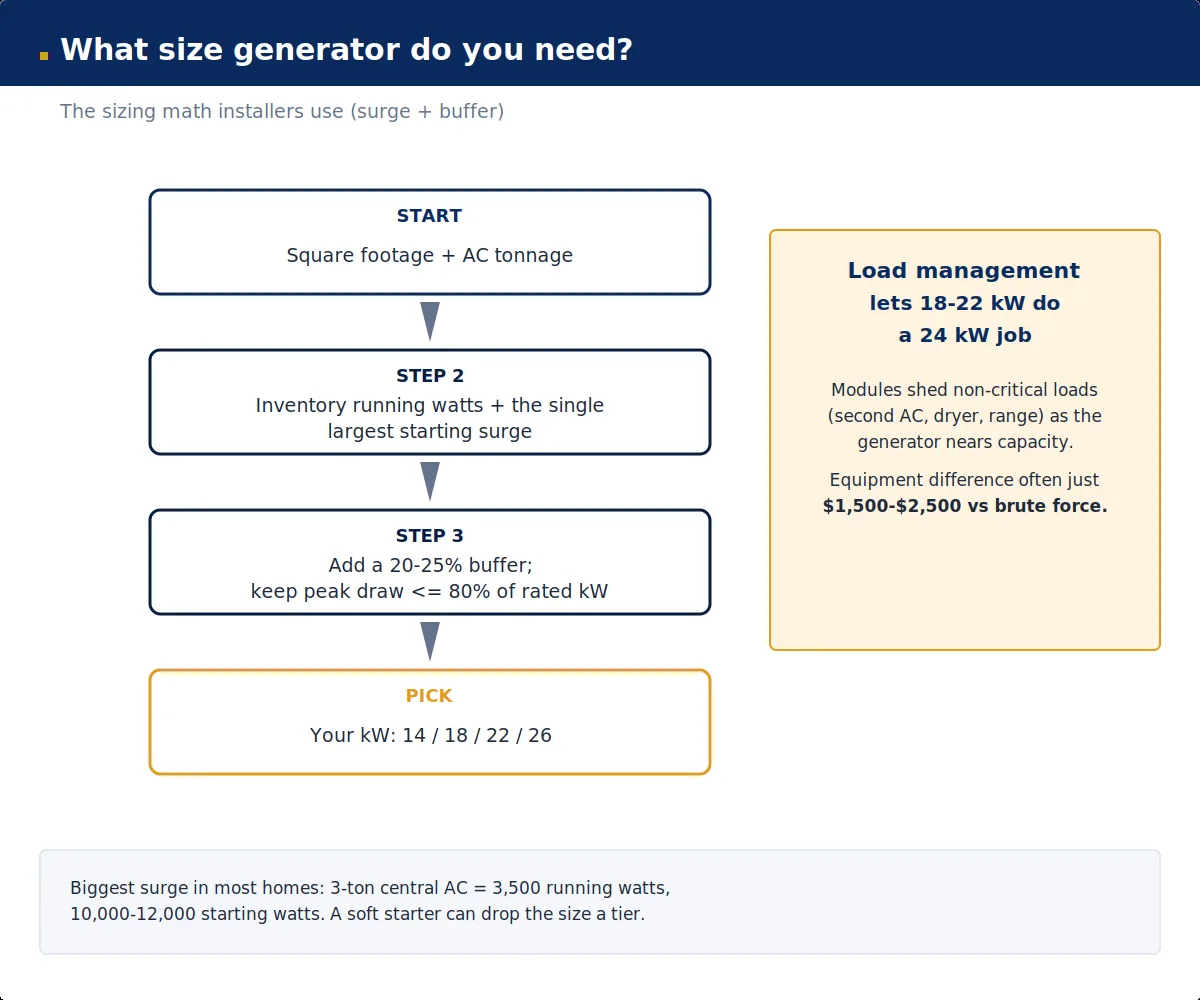
The sizing rule installers use: sum the running watts of everything that must run simultaneously, add the single largest starting surge, then add a 20–25% buffer — and keep peak draw at ≤80% of rated kW (standbygenpros.com). The biggest surge in most homes is the 3-ton central AC: 3,500 running watts but 10,000–12,000 starting watts. A soft starter or load-management module can drop the required size a full tier — which is the whole story of the sweet-spot approach:
The sweet spot (what experienced installers recommend): wire every circuit in, but let load-management modules shed non-critical loads — second AC, electric dryer, range — as the generator nears capacity. Result: an 18–22 kW air-cooled unit does the job a 24–26 kW unit would, with the equipment difference often just $1,500–$2,500 (standbygenpros.com). Buying brute-force kW instead of load management is the most common way homeowners overpay.
Two common adders change the math. A Level 2 EV charger is a worst-case surge item if you insist it runs during an outage — it usually doesn’t need to. And the ATS + panel tie-in sometimes reveals that your panel can’t handle the added load, which is exactly what our electrical panel upgrade guide prices. Above ~25–30 kW you leave air-cooled behind entirely: liquid-cooled systems run $25,000–$45,000 installed, up to 80 kW+ for estates.
Generac vs Kohler vs Briggs & Stratton: whole house generator cost in 2026
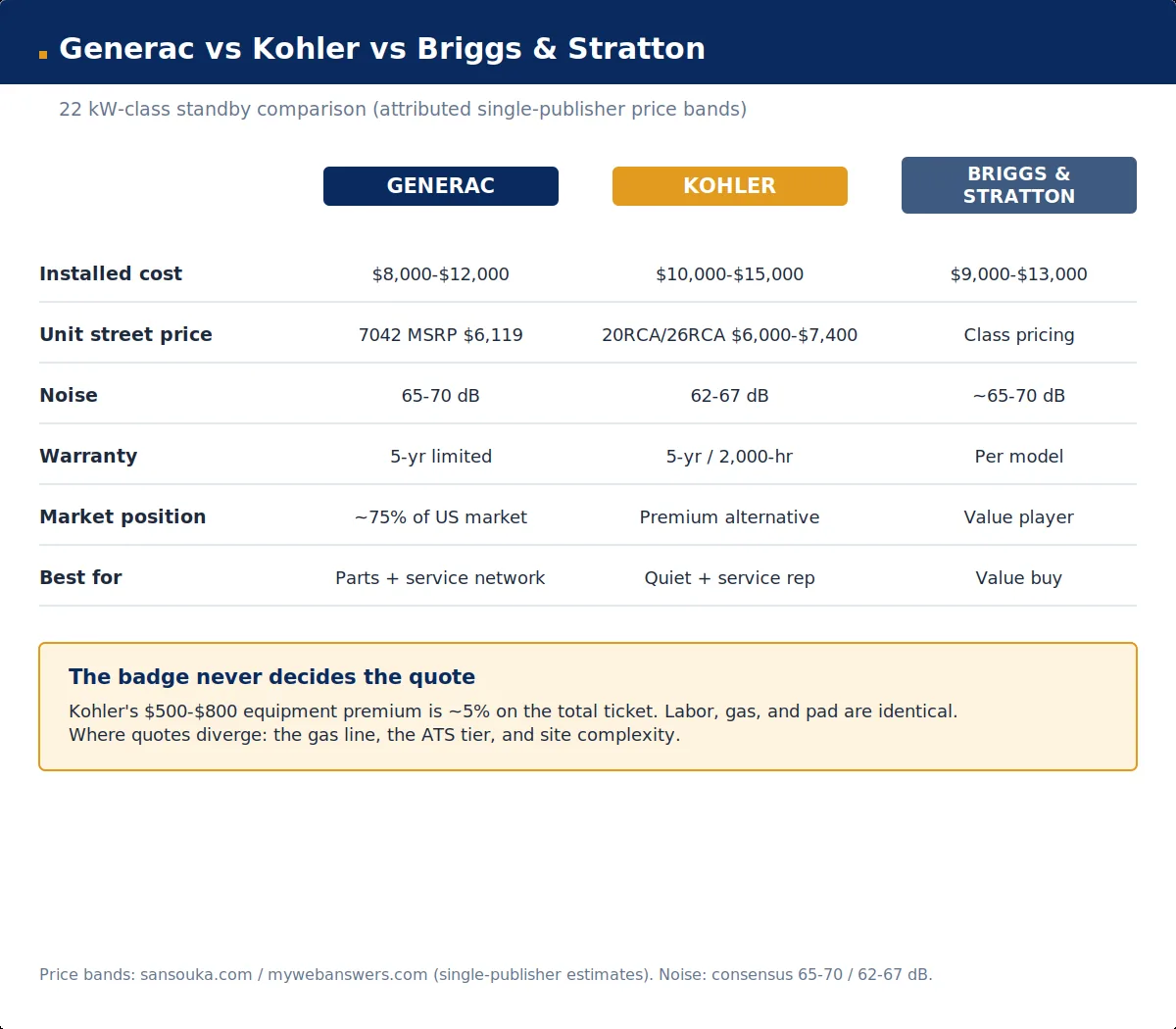
Generac commands roughly 75% of the US residential standby market (mywebanswers.com, 2026) — which means most of the installer expertise, parts availability, and service networks are Generac-shaped. Kohler is the premium alternative; Briggs & Stratton is the value third player. Price bands below are single-publisher estimates (sansouka.com; mywebanswers.com) — attributed, not survey data:
| Brand (22 kW class) | Installed cost band | Noise | Warranty |
|---|---|---|---|
| Generac | $8,000–$12,000 / $10,000–$14,000 (two publishers) | 65–70 dB | 5-yr limited |
| Kohler | $10,000–$15,000 / $12,000–$16,000 (two publishers) | 62–67 dB | 5-yr / 2,000-hr premium |
| Briggs & Stratton | $9,000–$13,000 | ~65–70 dB class | per model |
The honest comparison. A contractor-built 26 kW all-in stack (PNW, Oct 2026) puts Generac at ~$9,600–$16,200 vs Kohler at ~$10,200–$16,900 — with the labor, gas, and pad lines identical (NEC 702 + NFPA 54 don’t change with the badge on the box). Kohler’s $500–$800 equipment premium is about 5% on the total ticket — and it buys measurably quieter operation: Kohler runs ~63–65 dBA at exercise speed vs 67–71 for typical air-cooled rivals (portlandiaelectric.supply). The consensus noise band is 65–70 dB for Generac and 62–67 dB for Kohler (sansouka.com; mywebanswers.com). Note: one outlier source publishes 75–78 dB figures for Generac that contradict every other publisher — use the consensus band; it isn’t repeated here as fact.
What the premium actually buys you: quieter operation and Kohler’s service reputation — not more electricity. Per kW installed, the brands are close. Where quotes diverge, the difference is almost always in the gas line, the ATS tier, and the site complexity — never in the badge alone.
Whole house generator running costs: fuel, maintenance, and the 15-year total
This is where ownership economics actually live. Ignore any page that gives you one blended “$X/day” number — fuel burn is per-model math.
Fuel burn (per-model, not blended): a 22 kW unit at half load burns ~228 cubic feet/hr of natural gas or 2.53 gal/hr of propane — $3.76–$7.84/hr ($90–$188/day) at Texas prices (theday.company, Oct 2026). A 14 kW Guardian at the EIA’s January 2026 residential gas rate ($13.94/MCF) runs $2.72/hr at 50% load, $3.57/hr at full load (thehealthyattitude.com, 2026). Your rate and your fuel decide your number; the formulas above are the template.
Annual dealer maintenance: $200–$500/yr — oil + filter, air filter, spark plugs, battery test, load test (gendealers.com; homeguide.com; consumeraffairs.com). A mechanically comfortable owner can do basic service for $60–$120 in parts (gendealers.com, Aug 2026). The battery — $80–$200 every 2–4 years — is the line item that matters most: a dead battery is the #1 reason generators fail to start when the outage hits (consumeraffairs.com).
The rest of the annual budget: weekly exercise-cycle fuel $30–$120/yr (the 10–15 minute self-test is built in), monitoring subscription $0–$200/yr, repairs amortized $100–$300/yr. Typical all-in ownership cost: $350–$900/yr depending on dealer service vs DIY and monitoring (gendealers.com).
The 15-year total: one publisher’s ownership model puts 15-year total cost of ownership at $17,000–$26,000 — purchase plus maintenance plus fuel, roughly $1,100–$1,750/yr of ownership (gendealers.com, Aug 2026). That’s an attributed model, not established fact — but it frames the decision correctly: the install price is roughly two-thirds of what you’ll spend over the unit’s 15–30 year life (10,000–30,000 hours with proper maintenance; 15–25 years per consumeraffairs.com).
2026 freshness: the outage record and the tax-credit trap
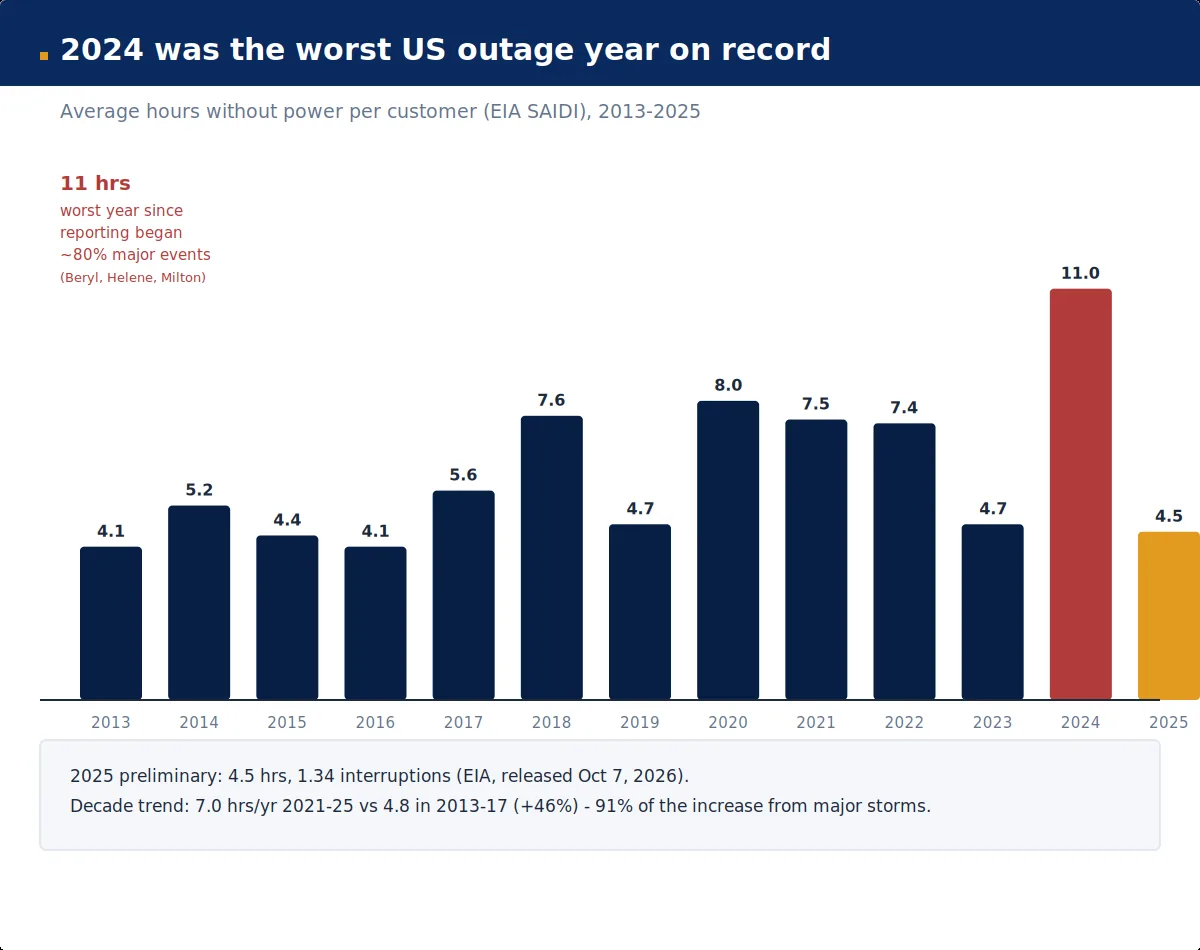
The outage data. 2024 was the worst US outage year since the EIA began reporting in 2013: customers averaged 11 hours without power (SAIDI), roughly 2x the prior-decade average, with ~80% from major events — Beryl, Helene, Milton (Helene alone left 5.9 million customers dark across 10 states) (tdworld.com, Dec 2025; ecmag.com, Jan 2026). Major-event interruptions averaged ~9 hrs/customer vs ~4 hrs/yr in 2014–2023; non-major-event outages stayed at ~2 hrs/yr. South Carolina had the longest 2024 outages: ~53 hours average per customer. The decade trend is unambiguous: outage hours rose 46% — 7.0 hrs/yr in 2021–25 vs 4.8 hrs in 2013–17 — and major storms caused 91% of the increase (theuptimereport.com, Oct 2026). A Talker Research survey for Sunrun (Oct 2026) found 2 in 3 homeowners experienced an outage in 2026, with the biggest disruptions losing heating/cooling (57%), food spoilage (48%), and internet/cell (44%). One caveat: the EIA’s preliminary 2025 data (released Oct 7, 2026) shows 4.5 hours and 1.34 interruptions — the lowest since 2016 — so 2024 is the anomaly, not the new normal.
The tax-credit trap. Pre-2026 pages imply backup power might qualify for a 30% credit. Two facts end this. First: conventional standby generators were NEVER §25D property (legalclarity.org, May 2026; elevatehomeguide.space, Oct 2026; ottri.com, Oct 2026). The credit once covered battery storage — not generators — and sellers who conflated the two created the confusion (buyagenerator.com, Sep 2026). Second: §25D is terminated for expenditures after December 31, 2025 under OBBBA (P.L. 119-21; IRS FS-2025-05) — even the battery credit is gone for 2026 installs. Any page still promising a 2026 credit on backup power is stale. For the full credit-kill list, see our 2026 energy tax credits guide.
Narrower paths that remain: state/utility backup-power rebates (check DSIRE and your utility — never assume), §179 business deductions for business use (legalclarity.org), and a reported-but-unpromised medical-expense angle (IRS Pub 502: backup power with a doctor’s recommendation for medically necessary equipment) — discuss with a tax professional, never counted as a deduction in your budget.
Battery vs whole house generator in 2026 (and the portable alternative)
With the old 30% battery credit gone for 2026 installs, the battery-vs-generator math changed — and it changed against batteries. Our solar battery cost guide prices a 13.5 kWh battery at a ~$15,647 benchmark (EnergySage) with a Powerwall 3 averaging $13,473 — for roughly half a day of essential-load backup. A 22 kW standby at ~$12,500 installed backs the whole house for as long as the gas flows, at $90–$188/day in fuel. The honest framing: a battery buys silence and no fuel; a generator buys duration and whole-home coverage at half the upfront price. Choose the battery if your outages are short and frequent and you value silent, maintenance-free backup; choose the generator if your risk is multi-day storm outages.
The cheaper alternative: a portable generator with a manual transfer switch runs $1,500–$5,000 all-in (fixupfirst.com), and an interlock kit adds $50–$150 plus $400–$800 labor (legalclarity.org). It’s manual start, limited loads, no automatic switchover — standby costs 5–10x more because it buys automation, whole-home coverage, and ~10-second switchover while you’re asleep or away.
– Whole house generator cost in 2026: $9,000–$16,000 installed for a 22–26 kW standby; ~$12,500 typical all-in.
– The generator is only ~1/3 of the bill — the ATS, gas work, electrical, pad, permits, and labor are the other two-thirds; interrogate the gas line first.
– 22 kW is the industry standard, but load management lets an 18–22 kW unit do a 24 kW job — buying brute-force kW is the most common overpay.
– Running costs: $2.72–$7.84/hr fuel by model (about $90–$188/day for a 22 kW), $200–$500/yr dealer maintenance, $350–$900/yr total ownership; 15-year TCO $17,000–$26,000 (one publisher’s model).
– Generac ~75% of the market; Kohler costs ~5% more installed and buys quieter operation — the badge never decides the quote, the site work does.
– No federal tax credit — standby generators were never §25D property, and §25D ended after December 31, 2025.
– 2024 was the worst US outage year since 2013 reporting began (11 hrs average); Talker Research: 2 in 3 homeowners had an outage in 2026.
Sources & methodology
Figures compiled November 2026 from 2026 contractor-anchored cost guides and calculators (usecalcpro.com, pipelineon.com, gendealers.com, fixupfirst.com, standbygenpros.com, thewattguide.com, theday.company, portlandiaelectric.supply, thehealthyattitude.com), EIA outage data via tdworld.com and theuptimereport.com, Generac October 2026 MSRPs, NEC 702 transfer-switch requirements via legalclarity.org, and tax-credit analysis (IRS FS-2025-05 on OBBBA; legalclarity.org, May 2026). The 15-year TCO ($17,000–$26,000) is one publisher’s ownership model (gendealers.com, Aug 2026), not an established figure. Brand price bands from mywebanswers.com and sansouka.com are attributed single-publisher estimates. Forbes Home/Angi figures are secondhand citations via repa.buynewchevy.com and blend portable/partial installs — excluded from headlines per verification. Regional reads (PNW, NYC) are labeled as such; national averages are the planning numbers.
Disclaimer: Prices are 2026 US national averages and vary by home, utility rate, site complexity, and contractor — get 3 written itemized local quotes before buying. Tax information is general and not tax advice — confirm with a tax professional. Standby generator installation is multi-trade licensed work (electrician + gas fitter); no DIY electrical or gas work is described or recommended. Carbon monoxide rules: generators operate outdoors only, on the manufacturer’s clearance specs.
How much does a whole house generator cost in 2026?
$9,000–$16,000 installed for a 22–26 kW standby — the industry-standard whole-home size — with a typical all-in price around $12,500. Essentials-only 14 kW installs run $6,000–$9,000; large no-compromise 24–26 kW systems reach $15,000–$25,000+. Contractor-built bands are the planning numbers — widely repeated figures from Forbes Home ($4,000–$25,000) and Angi ($5,156 average) blend portable and partial installs and reach us only as secondhand citations.
Is Generac or Kohler cheaper?
Generac is roughly 5% cheaper installed — a contractor-built 26 kW all-in stack runs ~$9,600–$16,200 for Generac vs ~$10,200–$16,900 for Kohler, with labor, gas, and pad lines identical (portlandiaelectric.supply, Oct 2026). Kohler’s $500–$800 equipment premium buys quieter operation (62–67 dB vs Generac’s 65–70 dB) and a 5-yr/2,000-hr warranty vs Generac’s 5-yr limited. The badge never decides the quote — the site work does.
What size generator do I need for my house?
22 kW is the industry standard for whole-home backup, but size it by the rule: sum the running watts of everything that must run + your single largest starting surge (a 3-ton central AC pulls 10,000–12,000 watts at startup) + a 20–25% buffer, keeping peak draw at ≤80% of rated kW. Load-management modules can drop you a full tier — an 18–22 kW unit with smart shedding can do the job of a 24 kW brute-force install, often saving $1,500–$2,500 in equipment.
How much does it cost to run a whole house generator?
Fuel is per-model math: a 14 kW Guardian at January 2026 residential gas rates runs $2.72/hr at 50% load ($3.57/hr full load); a 22 kW at half load runs $3.76–$7.84/hr, about $90–$188/day at Texas prices. The weekly 10–15 minute exercise self-test adds $30–$120/yr in fuel. Ignore blended “$X/day” figures — your rate and fuel decide your number.
What is the annual maintenance cost?
$200–$500/yr for annual dealer service (oil, filters, plugs, battery test, load test). A mechanically comfortable owner can do basic service for $60–$120 in parts. Replace the battery ($80–$200) every 2–4 years — a dead battery is the #1 reason generators fail to start during an outage. Typical total ownership: $350–$900/yr depending on dealer service vs DIY and monitoring.
Is there a tax credit for a home generator in 2026?
No. Conventional standby generators were never §25D property — the credit once covered battery storage, never generators — and the residential clean energy credit is terminated for expenditures after December 31, 2025 under OBBBA (P.L. 119-21; IRS FS-2025-05). Narrower paths that remain: state/utility backup-power rebates (check DSIRE + your utility), §179 deductions for business use, and a reported-but-unpromised medical-expense angle — discuss with a tax professional.
How long does a whole house generator last?
15–30 years / 10,000–30,000 hours with proper maintenance (homeguide.com), 15–25 years per consumeraffairs.com. Lifespan is set by maintenance discipline and outage hours, not the badge — the dead battery that fails the first start is the real killer, which is why the $80–$200 battery every 2–4 years is the most important line in the maintenance budget.