


Window replacement cost in 2026 runs $450–$1,500 per window installed for standard sizes — $5,550–$9,650 for a typical 10-window vinyl job (Fairpane, Oct 2026). The real number depends on two forks most guides blur together: frame material (vinyl to wood-clad) and install method (insert vs full-frame). Get those two right and every quote you receive will make sense; ignore them and you’ll get three quotes that differ by 40% with no idea why. Federal tax credit for 2026: $0 — the §25C credit ended Dec 31, 2025.
Table of Contents
Ask ten sites for “window replacement cost” and you’ll get ten answers that barely overlap: $300 to $2,100 per window, depending on who you ask. The pages aren’t lying — they’re measuring different jobs. One is pricing a pocket insert of a vinyl double-hung into a sound frame. Another is pricing a full-frame tear-out with new flashing, trim, and a wood-clad casement. They publish both numbers under the same headline, and the homeowner is left holding quotes that differ by thousands.
This guide fixes that. The structure follows the real decision path: insert vs full-frame first (the single biggest reason published prices disagree 40%+ — one cost calculator states this outright), then frame material, then window style, then the 2026 money (federal $0, HEAR exclusion, HOMES-package nuance, utility rebates), permits, the pre-1978 lead-paint trap, and the sales tactics that eat real money. Windows are a cost guide here — if you want roof numbers alongside, see our roof replacement cost guide; the two projects are the envelope pair homeowners price together.
Why published window replacement costs disagree 40%+: the reconciliation fork
The single biggest reason window prices published online disagree by 40% or more is this: aggregators blend insert and full-frame jobs into one “average.” RemodelCalculators (Jul 2026) states this explicitly. An insert job — a new window slipped into the existing frame, trim untouched — costs roughly half of a full-frame job, where the old window is torn out to the studs, new flashing and insulation go in, and exterior trim is replaced. When a site averages both, the number is wrong for both kinds of customer.
The national benchmarks below are all real 2026 figures. They disagree because they measure different mixes:
| Source (2026) | Per-window range | What it blends |
|---|---|---|
| Angi ($7,347 project, ~$750/window) | $450–$1,500+ | Mixed insert + full-frame |
| HomeAdvisor (avg $850) | $300–$2,100 | Full market range |
| HomeGuide | $450–$1,500 | Standard residential jobs |
| GetWindowCost.com (avg ~$753) | $512–$1,600 | BLS/FRED-based model |
| Woogoro (16-brand survey, avg ~$554) | $300–$1,200 typical | Insert-heavy survey mix |
| Costimated ($8,000 / 10-window project) | $4,500–$14,500 project | Mixed verified projects |
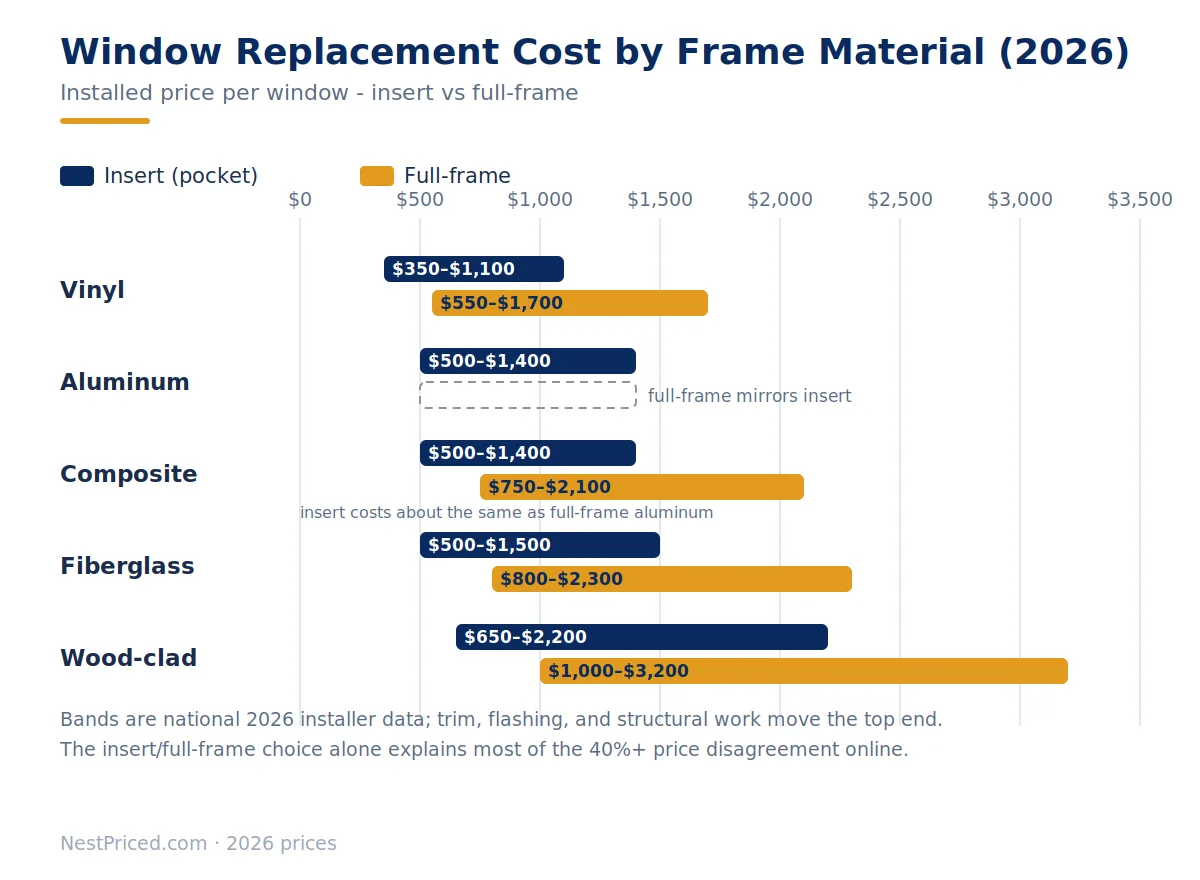
Treat Woogoro’s ~$554 as one survey’s benchmark, not “the” national average — methodology is unspecified. The honest band for a standard vinyl insert in 2026 is roughly $350–$1,100 per window; the same window full-frame runs $550–$1,700, about 1.5–2x (RemodelCalculators, Jul 2026). A 12-window vinyl insert runs $3,150–$11,200; full-frame $4,950–$17,350. That single distinction reconciles nearly every contradictory page you will read.
Insert vs full-frame: the cost fork, with both premium claims kept honest
Two ways to install a replacement window. They differ in labor, scope, and price — and you usually do not get to choose freely; the condition of the old frame chooses for you.
Insert (pocket) installation: the new window goes inside the existing frame. Trim, siding, and interior casing stay. Labor runs $100–$250 per window (Organizertone) to $100–$300 (HomeAdvisor), and a two-person crew installs 4–6 same-size windows a day (EstimationPro 2026). One caveat: the insert slightly reduces glass surface area (Organizertone).
Full-frame installation: the old window comes out to the rough opening. New flashing, insulation, and trim go in. Labor runs $300–$600+ per window (Organizertone) to $150–$800 (HomeAdvisor). This is required when frames are rotted, warped, or water-damaged — insert is not possible then — and when you are changing the window’s size or style (consensus across sources).
On the premium question, two 2026 sources disagree, and the honest answer keeps both: Pella (via SimplyWise, Oct 2026) puts full-frame at 20–30% over insert; Woogoro puts the pocket baseline at $600–$1,000 and full-frame adding 40–100%. The bridge is what each counts — labor-only vs labor plus trim, flashing, and structural repair. The gap widens when the job needs exterior trim work and rot repair, which is Woogoro’s case.
Per material, installed (RemodelCalculators, Jul 2026):
| Frame material | Insert | Full-frame |
|---|---|---|
| Vinyl | $350–$1,100 | $550–$1,700 |
| Composite / Fibrex | $500–$1,400 | $750–$2,100 |
| Fiberglass | $500–$1,500 | $800–$2,300 |
| Wood-clad | $650–$2,200 | $1,000–$3,200 |
Rule of thumb: if a quote is 40% higher than another for the same window count, ask which install method each assumed. That is almost always the whole difference.
Window replacement cost by frame material: vinyl to wood-clad
Material is the second fork. Five materials, one ladder (Woogoro 16-brand survey, Apr 2026, installed, standard double-hung unless noted):
| Material | Installed range | Notes (2026) |
|---|---|---|
| Vinyl | $300–$1,600 | Budget default; unit materials alone $150–$400 (usecalcpro, Nov 2026). Fairpane’s standard vinyl double-hung (36×60): $550–$960, typical $715. |
| Aluminum | $500–$1,400 | Cheaper than wood/fiberglass but conducts heat — a poor insulation choice in cold climates. |
| Composite | $1,000–$3,500 | Mid-premium; Fibrex-type blends strength and low maintenance. |
| Fiberglass | $700–$2,400 | Unit materials $350–$600. Pella (May 2026): $1,100–$2,200 installed. Strong, paintable, low expansion. |
| Wood-clad | $600–$3,500 | Unit materials $300–$700. Pella: $1,100–$2,200+ installed. Interior wood, exterior cladding — but maintenance is the hidden tax. |
On wood, price the maintenance, not just the sticker. One source’s derived math (RemodelCostCalc, Feb 2026 — label as their estimate, not an industry figure): $9,600–$24,000 in maintenance over 35 years for 12 wood windows, working out to roughly $514/year for wood vs $173/year for vinyl ($371/year if you paint the wood yourself). Over a house’s lifetime, cheap wood is expensive.
Regional reads anchor the ranges: Austin/San Antonio 2026 (JP Exteriors) — mid-tier vinyl $700–$1,200, fiberglass $1,200–$1,800, wood $1,800–$3,500+ per window. Orlando (United Renewals, Jul 2026) — $400–$900 standard installed; impact windows $900–$2,500+. Los Angeles (GoldGCP, Oct 2026, 1.14 cost factor) — vinyl $400–$1,350, fiberglass $685–$2,300, wood $910–$3,400.
Window replacement cost by window style: single-hung to bay and bow
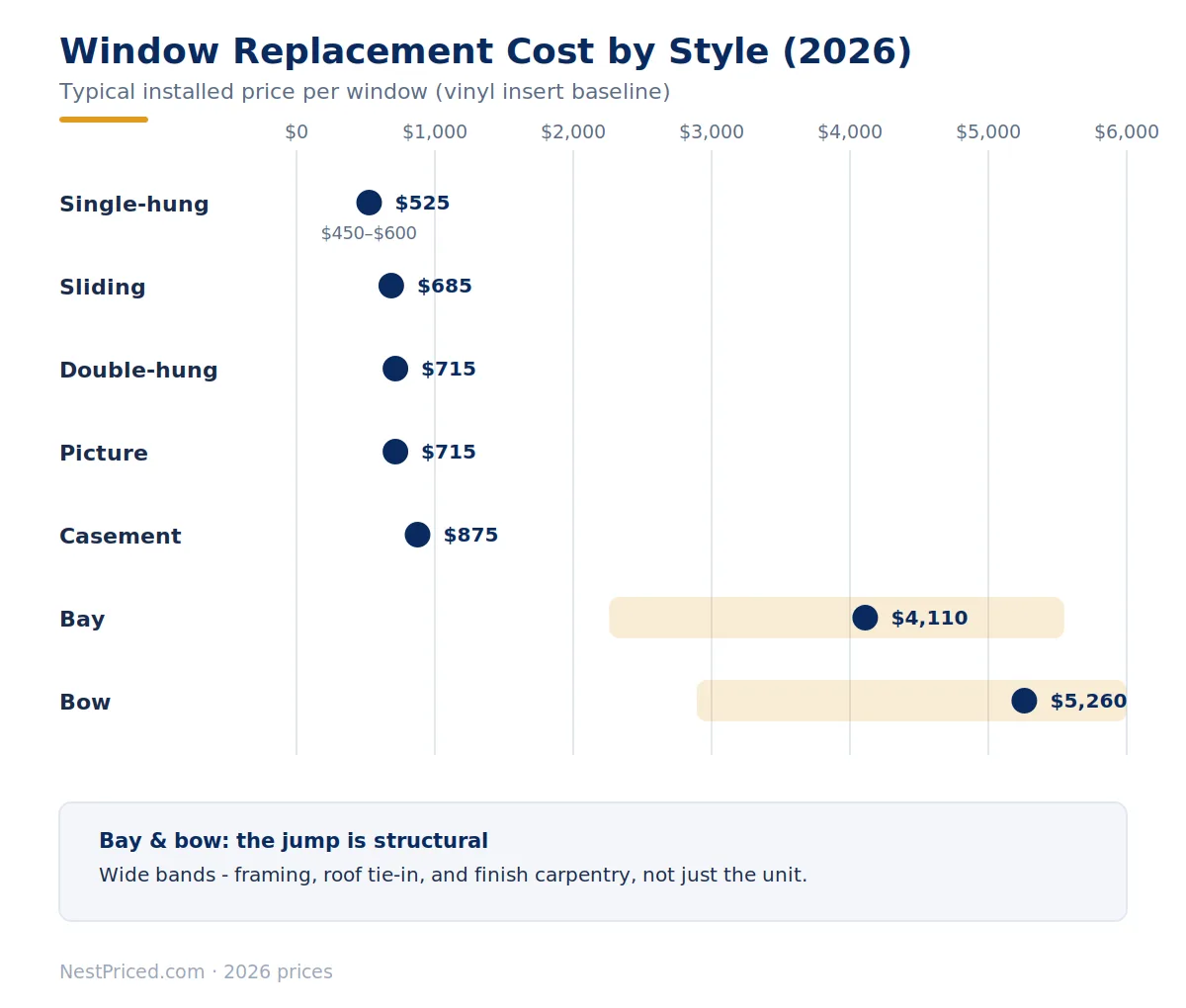
Style is the third price lever. Installed costs for standard 36×60 sizes (Fairpane 2026), with a second band where it matters:
| Style | Typical installed | Range |
|---|---|---|
| Single-hung | — | $200–$450; cheapest style (Fairpane; Angi baseline via EstimatorSuite) |
| Sliding | $685 | $530–$920 |
| Double-hung | $715 | $550–$960 |
| Picture | $715 | $550–$960 |
| Casement | $875 | $680–$1,150 |
| Bay | $4,110 | $3,200–$5,500 |
| Bow | $5,260 | $4,100–$7,050 |
Bay and bow deserve a warning: the band is inherently wide — structural projection work, not just a bigger window. Other 2026 guides give $900–$8,000 (BerksConnect), $1,500–$7,500+ (ARCH), and $2,000–$6,000 bay / $3,000–$8,000+ bow (Baltimore Chronicle). EstimatorSuite’s $1,000–$3,000+ is a vinyl-insert baseline; Fairpane’s $4,110/$5,260 reflects full-frame structural work. Never collapse these to a single number. Custom oversized windows run $2,500–$8,000+ (Magic Window, Jul 2026), and a basement egress window addition is $2,500–$6,000 each (EstimationPro).
Whole-house window replacement cost: what 8–15 windows actually cost
Per-window prices are for budgeting; whole-house prices are what you write a check for. Fairpane’s 2026 whole-house ladders (vinyl, insert):
| Project size | Typical | Range |
|---|---|---|
| 8 windows | $5,720 | $4,450–$7,700 |
| 10 windows | $7,150 | $5,550–$9,650 |
| 12 windows | ~$8,580 | $6,650–$11,600 |
Fairpane adds: minimum charge $90–$240 on jobs under $1,500; $120–$320 extra where permits are required. EstimationPro (Fixr + This Old House 2026, cross-checked invoices) prices by house size: small house (8–10 windows) vinyl $4,800–$8,000, fiberglass $7,200–$15,000, wood $9,600–$20,000; medium (10–14) vinyl $6,000–$11,200, fiberglass $9,000–$21,000, wood $12,000–$28,000.
Step up to a defined 10-opening job with insulated low-E glass, grids, and custom color and the number jumps: Zonda’s 2025 Cost vs Value put vinyl at $22,073 (~$2,207/opening) and wood at $26,781 (2026 retrieval: $23,400 vinyl). Read that per-opening figure correctly — it is the defined job divided by 10, not a survey average of what people pay. Pella’s whole-house bands (Aug 2026): 8–10 windows $6,400–$22,000; 12–15 $9,600–$33,000; 18–25+ $14,400–$55,000.
Context from Furilia 2026: whole-house window work is a $15,000–$25,000 decision for most homeowners, with window prices up 15–25% vs three years ago. Material inflation has plateaued; labor is the live variable — Northeast and California labor runs 30–40% above Midwest/South.
Insert or full-frame: which one your house actually needs
This is the decision section, not the pricing one. Three rules cover nearly every home:
1. Rot, warping, or water damage = full-frame, no choice. Insert requires a sound existing frame. If the old frame is rotted, warped, or water-damaged, the installer must tear out to the rough opening. This is the case where an “insert quote” from a competitor becomes a full-frame invoice at install time — get the frame condition assessed before you sign.
2. Changing size or style = full-frame. Enlarging an opening, switching from double-hung to casement, or adding a bay/bow all require rough-opening work. The insert option exists only for same-size, same-style swaps.
3. Sound frame, same size, budget priority = insert. You keep the trim and casing, the crew is in and out in a day (4–6 windows/day for a two-person crew), and you pay roughly half. The tradeoff: slightly less glass area, and you are not fixing any hidden flashing or insulation problems behind the old frame.
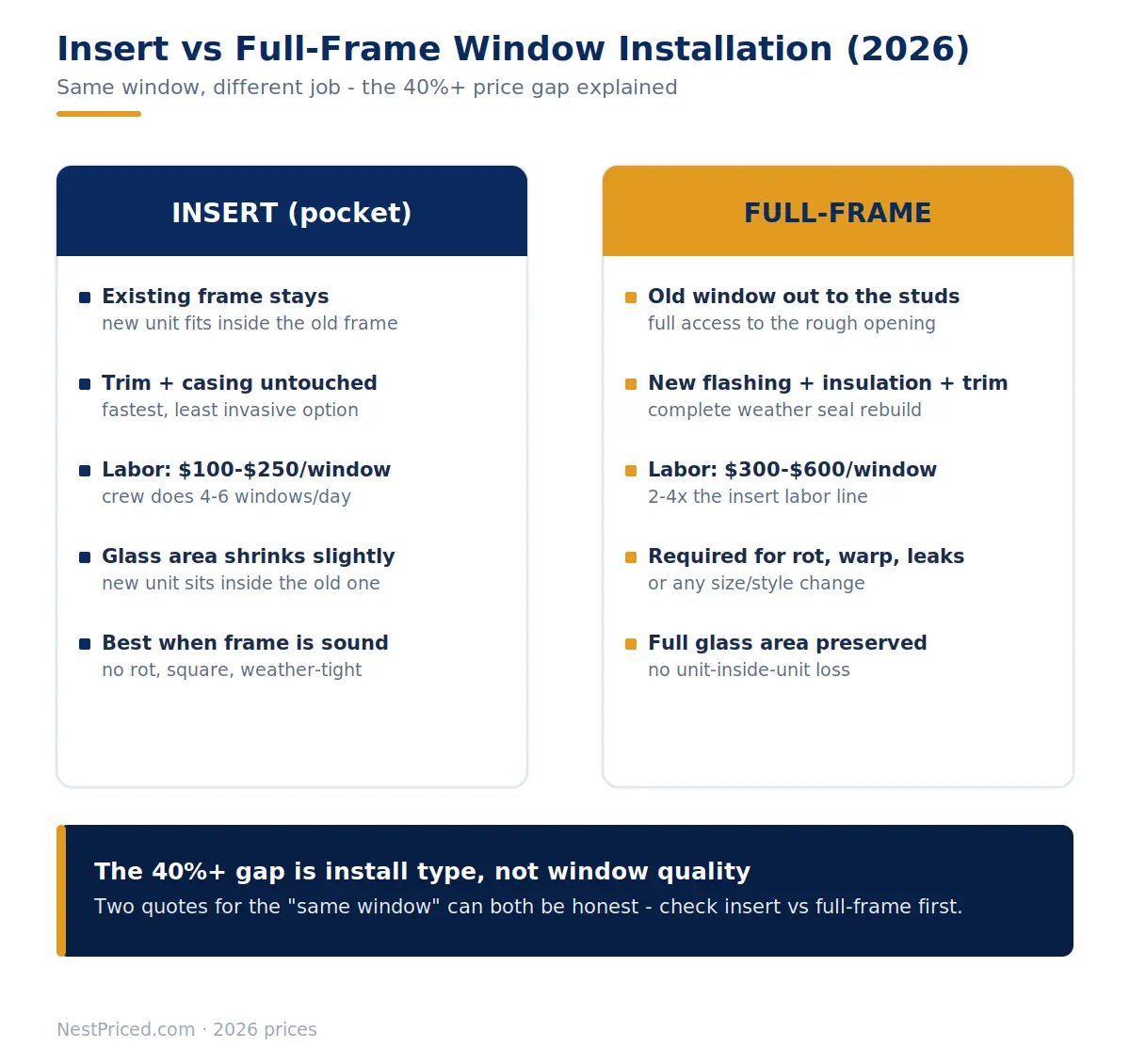
One trap to avoid: the “insert quote” on a rotting frame. If a salesperson quotes insert pricing without probing the frame condition, that quote is fiction. A second contractor who probes the sill with a screwdriver and finds rot is giving you the real number.
Glass, U-factor, and the honest energy-payback math
Windows account for 30–40% of a home’s winter heat loss (DOE, via Flow Right Construction). Upgrading the glass package is where energy money is made — but the payback is longer than sales pitches suggest.
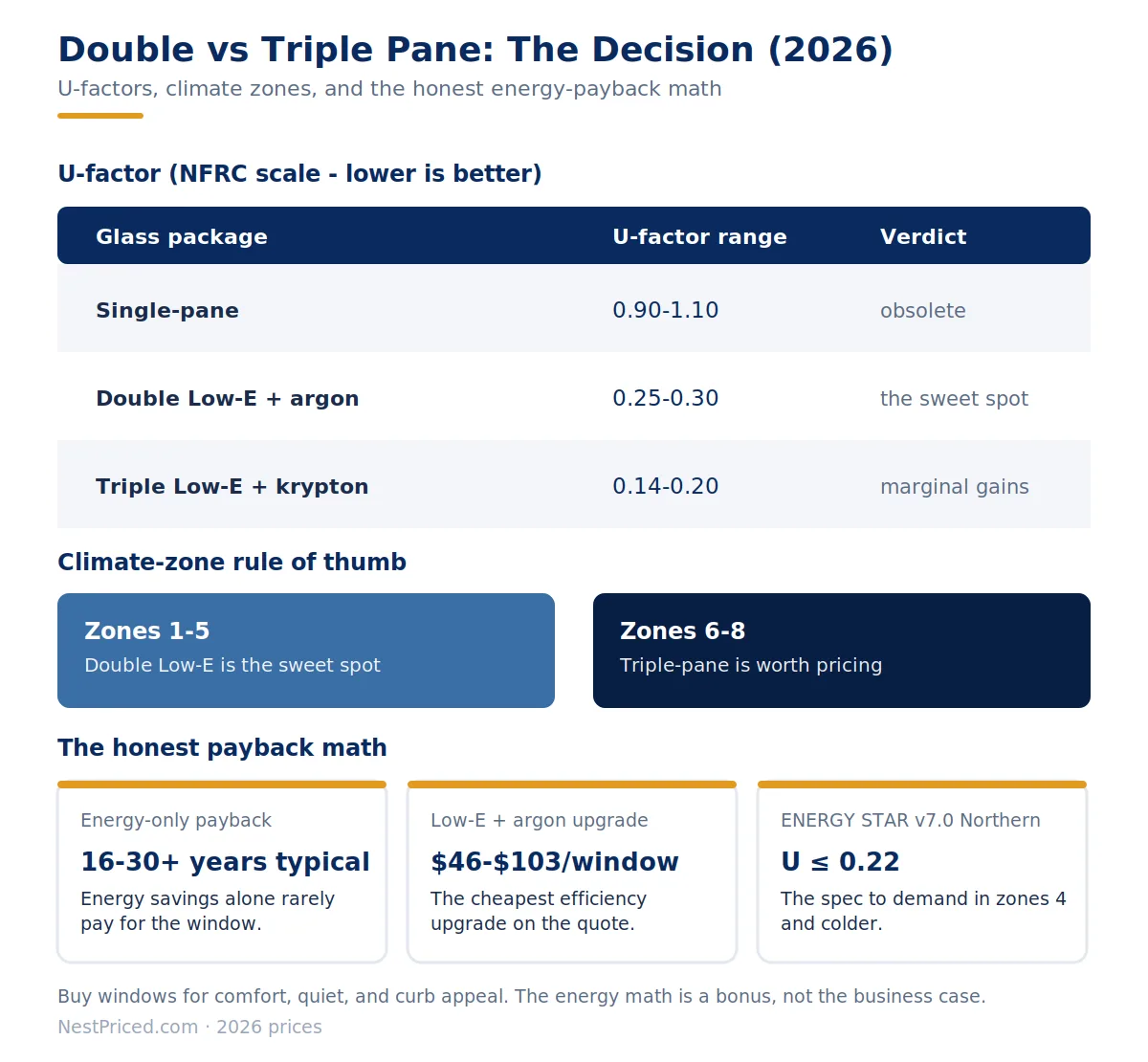
Glass upgrades: Low-E coating runs $50–$125 per window, argon fill $40–$100 ($50–$75 typical), and the combined Low-E + argon package prices at $46–$103/window (NumeralQ estimator, Oct 2026, Home Depot-based). This is the upgrade worth buying in almost every climate.
Triple-pane: the premium is a band, not a number — 15–25% over comparable double-pane (WeatherPro, CA), up to 40–100% ($1,000–$1,500+/window, Knowledgementors), with Angi’s Oct 2026 bands at $500–$2,000 for double-pane and $1,000–$4,000 for triple-pane windows. U-factors (NFRC scale): single-pane 0.90–1.10; double Low-E + argon 0.25–0.30; triple Low-E + krypton 0.14–0.20 (Jouleio).
ENERGY STAR v7.0 (effective Oct 23, 2023): Northern zone requires U ≤ 0.22 and SHGC ≥ 0.17, with equal-performance paths (U 0.23/SHGC 0.35, or U 0.25/SHGC 0.40). “Most Efficient” (Northern) = U ≤ 0.20 (Flow Right Construction, Oct 2026).
The honest payback: going single → double-pane saves $101–$583/year in a typical home (ENERGY STAR, via Jouleio). Energy-only payback typically runs 16–30+ years (Jouleio). Knowledgementors’ California numbers: single → double in cold climates 7–12 years; triple 12–18 years (includes their FAIR Plan discount). One thinly sourced estimate puts triple-pane at 8–15 years in zones 6–8 and 25+ years in zones 1–5 (MyTrendSpot — treat as rough, single-source). The takeaway: buy efficient windows for comfort, quiet, and resale — not because they “pay for themselves” in energy bills. That pitch is marketing math.
2026 incentives: the $0 federal credit, and what actually survives
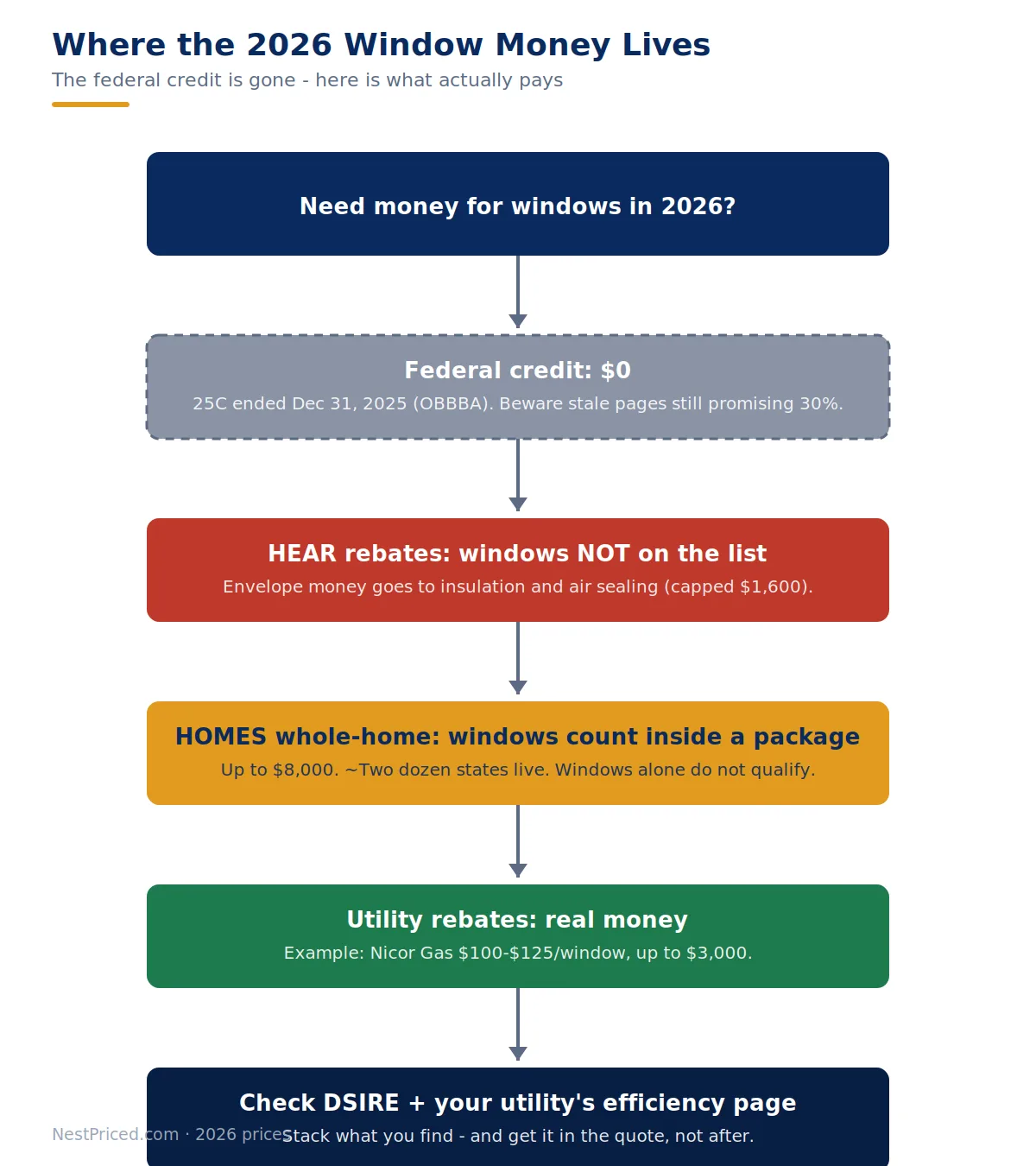
Say it plainly, because stale pages still imply otherwise: there is no federal tax credit for replacement windows in 2026. The §25C Energy Efficient Home Improvement Credit was terminated for property placed in service after Dec 31, 2025 by OBBBA (P.L. 119-21, signed Jul 4, 2025; IRS FS-2025-05). The final-year rules applied only to 2025 installs: 30% of product cost (labor excluded for windows), a $600/year cap for windows and skylights inside a $1,200/year envelope cap, ENERGY STAR Most Efficient required. Install date controls — a Dec 2025 install qualifies; the same job installed Jan 2026 gets $0. For the full credit-kill list, see our 2026 energy tax credits guide.
Two competitor pages are flatly wrong on this today and worth naming as evidence: kwoteadvisor.com still pitches a “30% credit capped at $600” for 2026 installs, and mrremodel.com still lists the 25C credit as live. Both are false post-OBBBA. (Their pricing data is a separate matter and usable as one market read each; their tax claims are not.)
What survives for windows in 2026:
HEAR rebates: not for windows. Income-qualified HEAR envelope money targets insulation, air sealing, and ventilation — capped at $1,600 — and windows are not on the list (Hodges Company, VA page 2026).
HOMES whole-home rebates (up to $8,000, performance-based): windows can count inside a whole-home retrofit package in live states — never as a standalone window rebate. Roughly two dozen states were live mid-2026 (AZ, CA, CO, CT, HI, IL, ME, MD, MA, MI, MN, NV, NH, NJ, NM, NY, OR, PA, RI, VT and others per the Window Monitor). FL and SD declined entirely. VA was allocated ~$188M but not yet launched (Hodges Company).
Utility rebates: the live one to check first. Example: Nicor Gas (IL) pays $100–$125 per ENERGY STAR window, up to $3,000, through approved contractors (SmardBuild, Mar 2026). California homeowners: the FAIR Plan offers up to a 16.4% premium discount for home hardening including multi-pane windows, and the CA Wildfire Mitigation Program covers fire-resistant window upgrades at no cost to qualifying homeowners (Knowledgementors 2026).
The real move: pair windows with the envelope project that still has money. HEAR will pay for your attic insulation and air sealing; HOMES can bundle windows into a whole-home package. The sealed-envelope package — insulation + air sealing + windows — is how you get rebates to touch a window job in 2026. See our attic insulation cost guide for the other half. State-by-state window money = DSIRE plus your utility’s efficiency page.
Permits: usually no, sometimes yes — and the states that always say yes
Like-for-like window replacement is typically exempt under IRC R105.2 in roughly 40 states — same size, same opening, no structural change. You need a permit when you enlarge or cut an opening, and in the states that always require one: FL (all replacements), CA, OR, WA, NJ, and NYC (PermitDeck, Apr 2026).
Costs: $50–$400 per permit (PermitDeck consensus — cut any source claiming higher; one outlier at $200–$500/window is discarded). Whole-house permits run $150–$600; single-window where required $50–$150. Fairpane adds $120–$320 to job estimates where permits apply.
Local wrinkles: Orlando (United Renewals, Jul 2026) — permit required even for same-size swaps, $50–$150 depending on valuation. Los Angeles (GoldGCP, Oct 2026) — same-size change-out uses an LADBS express permit with no plan check, but Title 24 demands NFRC dual glazing with max U 0.30 / SHGC 0.23 in climate zones 6, 8, and 9; valuations over $10k trigger safety-glazing and seismic shutoff retrofits.
The pre-1978 lead-paint trap: $600–$3,000 you didn’t budget
Lead-paint rule: the EPA RRP Rule (40 CFR Part 745) means ANY window replacement in pre-1978 housing always triggers lead-safe requirements — regardless of job size. The contractor must be an EPA Lead-Safe Certified Firm. Penalties run up to $41,093 per violation per day (2026 figure). This is licensed-contractor territory: cost info only, and never hire a non-certified crew for a pre-1978 window job.
The surcharge: $600–$3,000 per project for a certified contractor’s containment and cleanup (Facade Colorizer, 2026). An older NAHB estimate of $60–$170/window is dated (2010-era) — use the 2026 project figure. Roughly three-quarters of pre-1978 US homes still contain lead paint (EPA, via Clarity IAQ, Nov 2026). Lead testing: DIY swabs $25–$50; professional inspection $300–$700 (Facade Colorizer).
If your home was built before 1978 and your quotes look clean, check the line item: a quote without RRP containment is a quote from someone who either doesn’t know the rule or is ignoring it. Both are disqualifying.
Quote traps: the sales tactics that cost real money
Window replacement is one of the highest-pressure sales environments in home services. Angi’s May 22, 2026 guide names the standard playbook:
The “today only” 50% discount. The price is inflated, then “cut in half” if you sign tonight. A legitimate quote is valid for 30+ days (KJM).
The fake manager phone call. The salesperson “calls the manager” for a better price — theater designed to make you feel you’ve won.
The both-spouses-must-be-present rule. This is a pressure structure, not a policy. It exists so nobody goes home and thinks.
The $199 bait-and-switch. A per-window price that excludes removal, disposal, and installation — the actual invoice is triple.
Smart Window Company documents two more: the “model home / neighborhood showcase” discount (the quote was doubled, then “discounted” 40% to close) and the “commercial order volume discount” gimmick. Homepros.blog (Sep 2025) adds seven red flags: vague non-itemized estimates, high-pressure tactics, no license/insurance proof, large upfront cash deposit, no references or portfolio, undisclosed subcontractors, unclear warranty terms.
The defense is cheap: get 2–3 itemized estimates minimum, from companies that survey, leave within 30 minutes, and email an itemized quote (the KJM-reputable-firm pattern). Any quote that expires tonight is a quote you walk away from.
Repair vs replace: the $165–$550 question
Not every bad window needs replacing. Angi (May 2026): window repair runs $165–$550 vs replacement averaging ~$650 — and the rule is simple: repair when the frame is sound. HomeAdvisor puts average repair at $400 vs $850 replacement.
Common glass-only fixes: full IGU (insulated sealed unit) replacement $200–$600/window; Low-E IGU upgrade $350–$800 (NewEnglandMetalRoof — glass-only, not a full window). Fogged glass, a failed seal, a broken sash — these are repair jobs. Rotted frames, failed operation, and water intrusion are replacement jobs. When the repair bill passes half the replacement price on a window older than 15 years, replace.
ROI: what windows return at resale
Zonda’s Cost vs Value: vinyl window replacement recoups 67–72% ($14,270 of value on a ~$21,000 10-window project); wood recoups ~63% ($16,380 on ~$26,000) — via iBuyer, 2025 CVR, with a 2026 retrieval showing vinyl at $23,400 cost / 74%. MrRemodel’s 2025–2026 transaction data: homes with updated windows sell ~8% faster. Industry claims of 13% average bill cuts (ENERGY STAR Most Efficient) and 15–25% heating/cooling reduction are marketing-adjacent — qualify them as industry figures, not independent data.
The honest ROI framing: windows return comfort, noise reduction, and curb appeal first; resale value second; energy savings third. Anyone selling you on energy payback alone is running the MyTrendSpot-rough math.
Key takeaways
– Window replacement cost 2026: $450–$1,500 per window installed; $5,550–$9,650 for a typical 10-window vinyl job.
– Per-window prices are meaningless until you know insert vs full-frame — that single fork explains 40%+ of the disagreement between published numbers.
– Vinyl $300–$1,600; aluminum $500–$1,400; fiberglass $700–$2,400; wood-clad $600–$3,500 installed. Pella puts full-frame at +20–30% over insert; Woogoro at +40–100% — the gap depends on whether trim and flashing count.
– Bay/bow windows are structural work: $3,200–$7,050 installed, and the band is wide for a reason.
– Federal tax credit for 2026: $0. HEAR excludes windows. HOMES can bundle them in live states. Check your utility’s rebate page.
– Pre-1978 homes: EPA RRP always triggers — budget $600–$3,000 for a certified contractor, and walk away from uncertified crews.
– A quote that expires tonight is a sales tactic, not a price. Get three itemized estimates.
Sources & methodology
Cost figures compiled November 2026 from published 2026 cost guides and industry surveys: Angi [2026 Data] (Aug 3, 2026); HomeAdvisor (2026); HomeGuide (Feb 5, 2026); Fairpane (Oct 2026); Pella cost guides (May/Aug 2026); Woogoro 16-brand survey (Apr 2026); Zonda/Remodeling Magazine Cost vs Value (2025, 2026 retrieval); RemodelCalculators (Jul 5, 2026); SimplyWise (Oct 2026); EstimatorSuite; ARCH Exteriors; Costimated (verified Nov 3, 2026); EstimationPro (Fixr + This Old House 2026); NumeralQ (Oct 26, 2026); JP Exteriors (Austin/San Antonio 2026); GoldGCP (Los Angeles 2026); United Renewals (Jul 2026); PermitDeck (Apr 2026); Jouleio; ENERGY STAR v7.0 (eff. Oct 23, 2023); DOE via Flow Right Construction; The Window Monitor; Hodges Company; Lake Washington Windows; SmardBuild (Mar 2026); EPA RRP Rule 40 CFR Part 745; Clarity IAQ (Nov 2026); Facade Colorizer (2026); Angi sales-tricks guide (May 22, 2026); Smart Window Company; Homepros.blog (Sep 2025); IRS FS-2025-05; OBBBA P.L. 119-21. Roof pricing referenced from our article 6; envelope context from our article 24 (attic insulation).
Disclaimer: Prices are 2026 US national averages and vary by region, window type, frame material, install method, and contractor — get 3 written, itemized local quotes. Tax and rebate information is general and not tax advice — confirm with a tax professional. Window installation is licensed-contractor work — this article covers cost information only, never DIY installation instructions. Lead-paint rules are federal (EPA RRP); confirm local enforcement with your municipality.
How much does it cost to replace a window in 2026?
$450–$1,500 per window installed for standard sizes in 2026, with most standard residential jobs landing $650–$850 (ARCH Exteriors 2026). The two forks that decide your number: frame material (vinyl $300–$1,600 installed; wood-clad up to $3,500) and install method — insert $350–$1,100 vs full-frame $550–$1,700 for the same vinyl window (RemodelCalculators, Jul 2026).
What’s the average cost to replace all the windows in a house?
For a typical 10-window vinyl job: $5,550–$9,650 (Fairpane 2026). Costimated’s verified-project average is $8,000 for a 10-window project ($800/window). Stepping up to fiberglass or wood, or to a defined 10-opening job with insulated low-E glass, grids, and custom color, pushes the number to $20,000+ — Zonda’s Cost vs Value prices a defined 10-opening vinyl job at $22,073–$23,400.
Insert vs full-frame: which is cheaper, and when is full-frame required?
Insert is roughly half the price — about $350–$1,100 per vinyl window vs $550–$1,700 full-frame. On the premium, Pella says full-frame adds 20–30% over insert while Woogoro says 40–100% — the gap depends on whether trim, flashing, and structural repair are counted. Full-frame is required when frames are rotted, warped, or water-damaged, and when you’re changing the window’s size or style.
Is there a federal tax credit for replacement windows in 2026?
No — $0. The §25C Energy Efficient Home Improvement Credit ended for property placed in service after Dec 31, 2025 under OBBBA (P.L. 119-21; IRS FS-2025-05). Final-year rules applied only to 2025 installs (30% of product cost, $600/year cap for windows). Pages still pitching a live 2026 window credit are stale — check our 2026 energy tax credits guide for the full list of what survived.
Do windows qualify for HEAR or HOMES rebates in 2026?
HEAR: no — income-qualified HEAR envelope money targets insulation, air sealing, and ventilation (capped $1,600); windows are not on the list. HOMES: windows can count inside a whole-home retrofit package in roughly two dozen live states (up to $8,000 performance-based), but never as a standalone window rebate. Utility rebates are the most likely live money — e.g., Nicor Gas (IL) pays $100–$125 per ENERGY STAR window up to $3,000.
Will new windows pay for themselves in energy savings?
Almost certainly not on energy alone. Single → double-pane saves $101–$583/year in a typical home (ENERGY STAR), but energy-only payback typically runs 16–30+ years (Jouleio) — longer than most windows’ service horizon. Buy efficient windows for comfort, noise reduction, and resale (vinyl recoups 67–72% per Zonda; homes with updated windows sell ~8% faster), not because the utility bill will cover the invoice.
Do I need a permit to replace windows?
Usually no: like-for-like replacement is exempt under IRC R105.2 in roughly 40 states. You need a permit when enlarging or cutting an opening, and always in FL (all replacements), CA, OR, WA, NJ, and NYC. Permits run $50–$400 ($150–$600 for whole-house). If your home was built before 1978, add the EPA RRP lead-safe requirement — always triggered for window replacement, with a $600–$3,000 certified-contractor surcharge.