


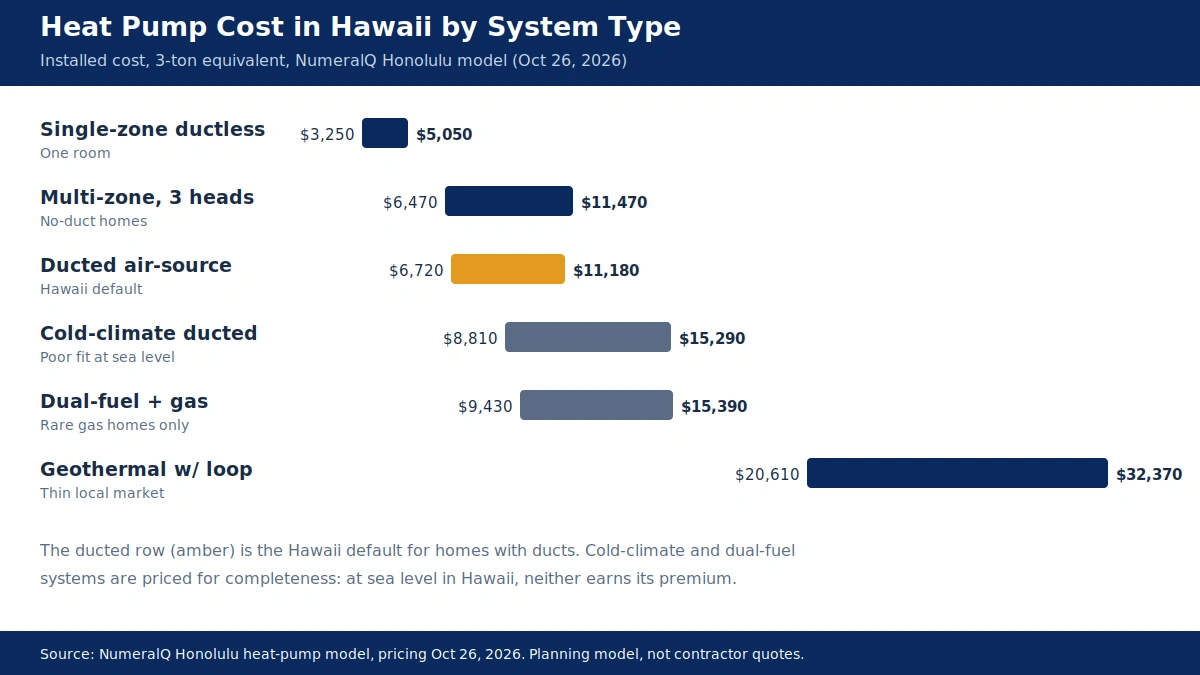
A heat pump costs $6,720–$11,180 installed in Hawaii in 2026 for a typical 3-ton ducted system, based on published cost modeling for Honolulu priced in October 2026. A single-zone ductless mini-split runs $3,250–$5,050, a three-head multi-zone system runs $6,470–$11,470, and a geothermal system with a ground loop runs $20,610–$32,370. Hawaii Energy pays up to $550 per mini-split unit and $1,250 for a qualifying central AC retrofit, while the federal government contributes $0 toward a 2026 homeowner-owned install.
Hawaii turns the usual heat pump story upside down. There is almost no heating load at sea level, so the machine earns its keep by cooling and pulling humidity out of the air, month after month, at the highest electricity rates in the country. A 3-ton system at the federal minimum efficiency costs about $1,748 a year to run in this guide’s planning math, while a high-efficiency system costs about $1,250 a year. That $498 yearly gap is the real buying decision, and this guide prices it island by island.
Honolulu in August sits near 89 degrees in the afternoon and barely cools below 76 at night. The trade winds help when they blow, and they do not always blow. A house with jalousie windows and a good cross-breeze can ride out most days without mechanical cooling, which is why only about 57 percent of Hawaii homes use air conditioning at all. The homes that do cool, though, cool all year, and every kilowatt-hour they burn costs roughly two and a half times the national average.
That combination shapes every number in this guide. A heat pump in Hawaii is first a cooling machine, second a dehumidifier, and only third, on a cool upland night, a heater. The mainland sales pitch about surviving winter does not apply here. What applies is the electricity bill, the salt in the air, the freight barge the equipment rode in on, and whether the house was ever built with ducts in the first place.
This guide prices heat pumps honestly for those conditions. The headline band comes from the only published cost model that prices Hawaii, and it prices one city: Honolulu. No published model prices Hilo, Kailua-Kona, or Kahului, so the city section labels those figures as planning estimates and says exactly how they were built. Every rebate figure was checked against the program’s own application form or contractor page, every running-cost figure shows its inputs, and every figure that could not be verified is flagged in the text rather than smoothed over.
One more Hawaii fact belongs up front. The federal home energy rebate program for Hawaii, called eHale Energy Saver, has not launched. The state energy office says early 2027, and it says plainly that work done before launch will not earn a rebate later. A contractor who prices an eHale rebate into a 2026 quote is pricing money that does not exist yet. The incentives section names what is actually open now, and it is smaller than the mainland headlines suggest.
Table of Contents
How Much Does a Heat Pump Cost in Hawaii in 2026?
In Hawaii in 2026, a 3-ton ducted heat pump, the size that suits most homes between 1,500 and 2,100 square feet, installs for $6,720–$11,180. NumeralQ’s published Honolulu cost model, priced October 26, 2026, is the source of that band, and it bundles the outdoor unit, indoor air handler, refrigerant lines, thermostat, and install labor. It does not cover new ductwork, an electrical panel upgrade, a permit, or the general excise tax treatment on the invoice, and those extras are where Hawaii quotes most often grow past the headline band.
The national heat pump cost band for the same 3-ton system is $6,550–$10,960, so Hawaii sits only about $170 higher at the low end and $220 higher at the high end. That small gap surprises people who expect island prices to run far above mainland prices. Equipment freight is real, and the freight section explains how it reaches your quote, but it is already baked into the modeled band, and Hawaii labor is only modestly above the national middle. Honolulu heating and cooling installers earn a median $31.47 an hour, about 7 percent above the national median, according to Bureau of Labor Statistics data from May 2025, and contractors bill about $63–$82 per worker-hour after insurance, payroll taxes, and overhead.
Three other published sources bracket the Honolulu market, and the honest reading is that they mostly agree at the low end and spread out at the top. BetterHouse, which adjusts a national baseline for local wages, gives a far wider Hawaii range of $4,050–$14,170, with $10,700 as its typical figure. The wide band mixes system types and is less useful for budgeting, but its typical figure sits near the top of NumeralQ’s band, which is where a good variable-speed system with a coated coil lands. A Honolulu contractor guide puts a full central air replacement at $8,000–$15,000, which overlaps NumeralQ’s band and extends higher to include larger and premium jobs. A lead-generation site puts a central heat pump at $6,700–$16,500, with a low end that matches NumeralQ almost exactly and a high end that runs well past it.
| Source | Hawaii 3-ton ducted cost | Basis | Date |
|---|---|---|---|
| NumeralQ Honolulu model | $6,720–$11,180 | Modeled installed cost, Honolulu market | Priced Oct 26, 2026 |
| NumeralQ national model | $6,550–$10,960 | Modeled installed cost, national | Priced Oct 26, 2026 |
| BetterHouse | $4,050–$14,170, typical $10,700 | Aggregator model, wage-adjusted | 2026 |
| Honolulu contractor guide | $8,000–$15,000 | Contractor guide, central air replacement | Nov 2026 |
| HeatingCoolingSource | $6,700–$16,500 | Lead-generation site, wide bracket | 2026 |
One source sits far above the rest and should be named as an outlier rather than averaged in. HVAC Visit, a city-index lead site, puts a Hawaii heat pump at $7,700–$19,850. Its high end runs about $8,700 past NumeralQ’s, its method is thin, and no contractor guide corroborates it. Do not budget from it. If a quote lands near $19,000 for a standard 3-ton ducted system with no ductwork or panel work included, get two more quotes before signing anything.
The width of the band reflects the machines inside it, which differ from each other far more than the price gap suggests. At the low end sits a basic single-stage system that meets the federal minimum efficiency and cools adequately on a mild trade-wind day. At the high end sits a variable-speed inverter system that runs longer at lower speed, pulls far more humidity out of the air, holds a steadier temperature, and costs much less to run at Hawaii rates. Both are called heat pumps. Only the second one is built for a humid Hilo afternoon or a still, muggy week in Ewa Beach when the trades drop out, and the running-cost section prices the gap between them at about $498 a year.
What the band excludes shapes the real budget as much as what it includes. From the same NumeralQ pricing, new or extended ductwork in Honolulu runs $4,370–$7,330 per job, and a 200-amp panel upgrade runs $3,060–$4,570 per job. A plantation-era home with no ducts and a 60-amp or 100-amp panel can easily add $7,000–$12,000 to the headline band before the heat pump itself is priced. Ask for each extra as a separate line on the quote, and ask whether the general excise tax is included in the total or added at the bottom, because the visible pass-through rate of 4.712 percent adds about $422 to a job at the $8,950 midpoint.
Timing works differently in Hawaii than on the mainland. There is no heating season to avoid and no deep winter lull. NumeralQ’s Honolulu data names January and February as the mildest months, when a day without cooling is no hardship, unlike August. A heat pump installed in January is the same machine as one installed in August, but the August install is more likely to be an emergency replacement during a heat wave, with less time to compare bids or wait for a rebate-qualified model to arrive by barge. If your current system is limping through the fall, the cooler months are the time to replace it on your schedule rather than the weather’s.
Heat Pump Cost in Hawaii by System Type
Your choice of system type fixes the price band before any contractor sets foot in the home. A single-zone mini-split that cools one bedroom costs less than a quarter of a geothermal system that would serve the whole house from the ground. The table below uses the published Honolulu rows for every system type, because no published state-level by-type table exists separate from Honolulu. Every price in this section is a full installed cost for a 3-ton equivalent, unless the text says otherwise.
| System type | Hawaii installed cost | Best for |
|---|---|---|
| Single-zone ductless mini-split | $3,250–$5,050 | One room, bedroom, or addition |
| Multi-zone ductless, 3 heads | $6,470–$11,470 | Homes without ducts, room-by-room control |
| Ducted air-source heat pump | $6,720–$11,180 | Homes with good ducts |
| Cold-climate ducted heat pump | $8,810–$15,290 | Almost nobody at sea level in Hawaii |
| Dual-fuel (heat pump plus gas furnace) | $9,430–$15,390 | Rare gas-served homes only |
| Geothermal with ground loop | $20,610–$32,370 | Custom jobs, thin local market |
A single-zone ductless mini-split is the cheapest way into cooled comfort in Hawaii, and it is the right answer for a specific set of homes. It cools and dehumidifies one zone, usually a bedroom or a main living area, through a wall-mounted indoor head connected to a small outdoor unit by a refrigerant line through the wall. The band of $3,250–$5,050 makes it the go-to fix for a Manoa bedroom that stays sticky all night, a Kailua addition that never got ductwork, or a condo where the association allows one outdoor unit on the lanai and nothing more. A second published source, an installer site pricing Hawaii jobs, puts a single zone at $3,000–$5,500 installed and commissioned, which corroborates NumeralQ closely. A Honolulu contractor guide runs higher at $3,500–$7,500, likely reflecting larger capacities and longer line runs, so treat $5,050 as the planning top for a standard room and ask what pushes a quote past it.
Multi-zone ductless takes the same idea to three or more rooms, giving each room its own indoor head and its own control. At $6,470–$11,470, a three-head system overlaps the ducted band, which surprises homeowners who assume ductless always costs less. Ductless is the cheaper route when the alternative is building ductwork from scratch, and the dearer route when good ducts already exist. Multi-zone systems suit the Hawaii home that was built for trade winds rather than ducts: a single-wall plantation house in Kaimuki, a Hilo home with jalousies on every wall, a split-level in Kaneohe where the upstairs bedrooms bake while the downstairs stays cool. Each head cools only its own room, so an empty guest room costs nothing to leave off, which matters at 46 cents a kilowatt-hour. For the zone-by-zone math, see the mini-split installation cost guide, and for homes that could go either way, the ductless vs ducted guide compares both routes side by side.
For a home that already has central air and ductwork, a ducted air-source heat pump is the standard like-for-like replacement. It reuses the ducts, the vents, and often the air handler’s spot, which keeps the job simple and the price inside the headline band. The catch is that the ducts must be in good shape and inside the cooled space or well insulated. Ducts in a hot Hawaii attic leak cooled air into the hottest part of the house, and the industry rule of thumb, cited by ENERGY STAR, is that a typical duct system loses 20 to 30 percent of the air moving through it to leaks, holes, and poor connections. If your ducts run through an unconditioned attic, budget for sealing and insulation on top of the equipment price, and ask the contractor to test for leakage rather than assume the ducts are fine.
A cold-climate ducted system costs about $2,090 more than a standard ducted system at the low end and $4,110 more at the high end in Honolulu, and at sea level in Hawaii that premium buys nothing you need. Cold-climate systems are built to hold heating output at 5 degrees outdoors. Honolulu has zero nights at or below freezing in the climate record, and its coldest month averages a low of 67 degrees. A contractor who quotes a cold-climate system for a Waikiki condo or an Ewa Beach subdivision home is either working from a mainland script or upselling equipment rated for a winter Hawaii does not have. The only Hawaii homes where heating capacity deserves a second look sit above about 2,000 feet in Kula, Waimea, or Volcano village, and even there a standard heat pump performs well in 40-degree to 55-degree night air.
A dual-fuel system combines a heat pump with a gas furnace, switching between the two as the outdoor temperature changes. The Honolulu band of $9,430–$15,390 buys two heating systems for an island where only about 5 percent of homes use piped gas. For almost every Hawaii homeowner, dual-fuel is the wrong purchase twice over: it pays for a furnace that will rarely run, and it pays for gas infrastructure the home may not have. The narrow exception is a home already served by gas that wants furnace backup for upland nights. Everyone else should skip the dual-fuel line on the quote and spend the difference on efficiency or a coated coil.
Geothermal, also called a ground-source heat pump, tops the price list and has the thinnest track record in Hawaii. It buries a loop of pipe and trades heat with the ground, which stays at a steady temperature at depth. The Honolulu band of $20,610–$32,370 comes from the same cost model as the other rows, but no Hawaii residential geothermal installer market of any scale was found during research, and small lots, volcanic rock, and drilling logistics all argue against it as a mainstream option here. Treat geothermal in Hawaii as a custom project that needs a specialist quote and a frank conversation about who services the loop, not as a catalog choice. The ground loop can outlast the indoor equipment by decades on the mainland, and that durability story is real, but it does not overcome a thin local market.
Inside every system type sits one hidden cost: the refrigerant, the fluid that carries heat around the loop. That fluid changed in 2025, when the EPA ended R-410A in new home systems. A Hawaii system bought in 2026 runs on R-454B or R-32, and neither of the new fluids can top off an old R-410A system. Both new fluids are mildly flammable, which adds handling requirements to the install. If a contractor offers to recharge an old system cheaply, ask which refrigerant is in it, whether the system is leaking, and whether the repair makes sense against replacement at Hawaii electricity rates.
Heat Pump Cost in Hawaii by Home Size and Tonnage
Tons are the sizing unit, and one ton means the system moves 12,000 Btu of heat in an hour. Btu is short for British thermal unit, the heat measure used throughout this guide: one Btu warms a pound of water by a single degree Fahrenheit. Ton here has nothing to do with weight: it is a cooling capacity label, and 3 tons sits in the middle of the residential range rather than at the commercial end. In Hawaii the tonnage question is a cooling question, because the system is sized for the hottest humid afternoon, not the coldest night.
NumeralQ’s October 2026 Honolulu pricing by system size is laid out in the table below. No published statewide by-size table exists separate from Honolulu, so Honolulu figures stand in for the state, and they are labeled as Honolulu. Treat the home-size column as a rough planning guide, not a sizing verdict. Two homes of the same square footage can need different sizes because sun exposure, window area, ceiling height, insulation, and air leakage matter as much as floor area, and in Hawaii a west-facing glass wall can add more load than an extra bedroom.
| System size | Honolulu installed cost | Rough home size | Typical Hawaii home |
|---|---|---|---|
| 1.5 ton | $4,550–$7,260 | 600–900 sq ft | Small condo, studio ohana unit |
| 2 ton | $5,270–$8,560 | 900–1,200 sq ft | Starter home, small plantation cottage |
| 2.5 ton | $5,990–$9,870 | 1,200–1,500 sq ft | Older Kaimuki bungalow |
| 3 ton | $6,720–$11,180 | 1,500–2,100 sq ft | Typical subdivision home |
| 3.5 ton | $7,440–$12,480 | 2,100–2,400 sq ft | Two-story Ewa or Kapolei home |
| 4 ton | $8,170–$13,790 | 2,400–3,000 sq ft | Large Mililani home |
| 5 ton | $9,610–$16,400 | 3,000–3,700 sq ft | Large home, high ceilings |
Moving up half a ton adds roughly $720 at the low end and $1,300 at the high end, except for the 4-ton to 5-ton step, which adds $1,440 at the low end and $2,610 at the high end. The 3-ton to 4-ton step alone costs about $1,450 at the low end and $2,610 at the high end, which is why oversizing in Hawaii is an expensive mistake twice over. A system that is too big short-cycles, turning on and off in short bursts that wear out parts, and it never runs long enough to pull humidity out of the air. In a humid climate, an oversized system leaves the air damp while the thermometer looks fine, which feels worse than slightly warm and dry, and it costs more to buy for the privilege.
The correct size comes from a Manual J load calculation, a room-by-room heat gain worksheet that accounts for walls, windows, insulation, air leakage, sun exposure, and the local design conditions. Manual J comes from the Air Conditioning Contractors of America, and it is the standard method for calculating how much heating and cooling a specific home needs. Sizing from square footage alone, or copying the old unit’s size without running the numbers, is guessing, and any contractor who does either is guessing with your money. In Hawaii the guess is especially risky because the load drivers are local: a home under a dark roof with no attic insulation, a lanai converted to living space with single-pane glass, or jalousie windows that never fully seal all add load that a square-footage rule misses.
Three Hawaii sizing wrinkles show up in a good Manual J. First, many older homes have single-wall construction with no wall insulation and generous jalousie windows, which means air leaks in freely and the cooling load runs higher than the floor area suggests. Sealing those leaks changes the load, which is why the load calculation should reflect the house as it will be after any planned window or insulation work, not just as it stands today. Second, west-facing rooms take brutal afternoon sun, and a system sized for the whole-house average will leave the west bedrooms warm at 4 p.m. Zoning or a separate mini-split head for the hot side of the house often solves what a bigger central system cannot.
Third, ceiling height and open floor plans change the volume of air to cool without changing the square footage. A plantation home with 10-foot ceilings and an open living area needs more capacity than a boxy condo of the same footprint, and a vaulted great room with a wall of glass needs more still. A contractor who has already worked on your street will know the local patterns: the panel sizes, the attic access, the condo rules. Ask how many systems they have installed within a few miles of your address, and ask what size those homes needed.
The straight air conditioner comparison belongs in this section because it is the quote most Hawaii homeowners actually compare against. A central air conditioner in Honolulu runs $5,000–$12,500 installed according to a lead-generation cost site, which overlaps the heat pump band heavily. A heat pump and a straight air conditioner cool the same way, with the same outdoor box doing the same work in summer. The heat pump adds a reversing valve that lets the same machine heat on a cool night, for little or no extra installed cost in most quotes. If the heat pump quote and the air conditioner quote are close, the heat pump is the better buy even if you heat only a dozen nights a year, because the heating comes nearly free with the cooling you were buying anyway. The central AC replacement cost guide prices the air-conditioner-only route for a home that wants the comparison in full.
Heat Pump Cost by City: Honolulu, Hilo, Kailua-Kona, and Kahului
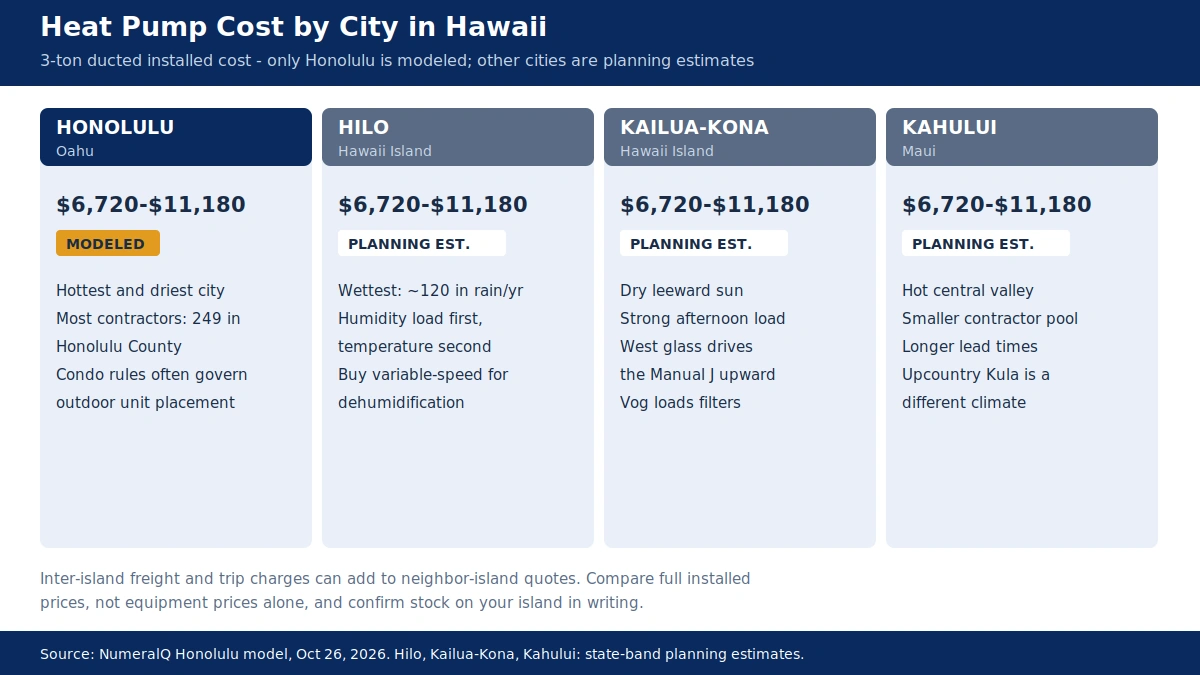
Honolulu is the only Hawaii city with a published cost model. NumeralQ’s Honolulu pricing runs deep, with separate figures for size, system type, add-ons, and labor rates. No published cost model prices Hilo, Kailua-Kona, or Kahului, and this section is honest about that gap. The Honolulu figures below are modeled costs. The Hilo, Kailua-Kona, and Kahului figures are planning estimates built from the Honolulu band, and they are labeled as estimates wherever they appear. Do not treat them as measured city prices, because nobody has measured them.
| City | 3-ton ducted cost | Basis | What moves the price |
|---|---|---|---|
| Honolulu (Oahu) | $6,720–$11,180 | NumeralQ model, Oct 2026 | Reference market, most contractors |
| Hilo (Hawaii Island) | $6,720–$11,180 | State-band planning estimate | Wettest climate, humidity load, inter-island freight |
| Kailua-Kona (Hawaii Island) | $6,720–$11,180 | State-band planning estimate | Dry leeward heat, resort-area labor, inter-island freight |
| Kahului (Maui) | $6,720–$11,180 | State-band planning estimate | Hot central valley, smaller contractor pool, inter-island freight |
Honolulu is this guide’s reference market, so its numbers are the firmest figures quoted here. The city and county had 249 plumbing, heating, and air conditioning contractors in 2023, about 6.7 per 10,000 homes, which is a normal level of competition by national standards. The median Honolulu home is worth $843,400, only 34 percent of housing units are single houses, and the rest are condos, townhouses, and apartments where the association often controls where an outdoor unit can sit. That housing mix matters for quotes: a Honolulu contractor who works mostly in Waikiki and Kakaako condos prices wall brackets, condensate routing, and association paperwork that a subdivision contractor in Mililani never sees. Get bids from contractors who have worked your building type, not just your ZIP code.
Hilo sits on the windward side of Hawaii Island, at the foot of the wettest slopes in the state, and its cooling problem is humidity first and temperature second. Hilo gets about 120 inches of rain a year against about 16 inches at Honolulu airport, summer highs run a few degrees cooler than Honolulu’s, and the air stays damp most of the year. The planning estimate for Hilo uses the Honolulu band of $6,720–$11,180 for a 3-ton ducted system, but the equipment choice inside that band should skew toward variable-speed inverter systems that run long and slow and wring moisture out of the air. A basic single-stage system that short-cycles in Hilo leaves the house cool and damp, which feeds mold in closets and cabinets. Hilo homeowners should also ask about inter-island freight and parts availability, because equipment that is stocked in Honolulu may need a barge leg to Hilo, and a failed board in a humid climate is not a repair you want to wait two weeks for.
Kailua-Kona sits on the dry leeward side of the same island, and its problem is the opposite of Hilo’s: strong sun, low rainfall, and hot afternoons with less cloud cover. Summer highs run 84 to 86 degrees with only about 4 inches of rain across the whole summer, and the town’s resort and vacation-rental stock means many homes sit empty for weeks, then need fast cooling when occupants arrive. The planning estimate for Kailua-Kona also uses the Honolulu band, but Kona homeowners should budget more carefully for sun load: west-facing glass, dark roofs, and unshaded walls all push the Manual J upward, and a system sized from a Hilo rule of thumb will underserve a Kona great room. Vog, the volcanic haze that drifts from Kilauea when the winds turn, is a secondary concern for filtration, and a ducted system’s central filter or a ductless home’s standalone air purifier both help on vog days.
Kahului sits in Maui’s hot central valley, between the West Maui Mountains and Haleakala, and it runs among the hottest towns in the state. Summer highs reach 86 to 88 degrees, rainfall is minimal, and the town’s older neighborhoods mix plantation-era homes with newer subdivisions. The planning estimate for Kahului uses the Honolulu band as well, with two local wrinkles. First, Maui’s contractor pool is smaller than Oahu’s, so lead times can stretch, especially after storm damage or during the summer rush. Second, the drive from Kahului up to Kula or Makawao crosses into a different climate entirely, so a Kahului quote must not be reused for an upcountry home without a fresh load calculation. If you live upcountry, read the heating note in the climate section before accepting a sea-level quote.
Lihue on Kauai deserves a mention even though it is not one of the four priced cities. Kauai is served by its own electric cooperative, KIUC, which runs its own rebate programs and sits outside Hawaii Energy’s territory entirely. A Kauai homeowner gets no Hawaii Energy mini-split rebate and no central AC retrofit rebate, a gap the incentives section covers in full. Kauai’s climate runs wetter than Honolulu’s and cooler than Kahului’s, with about 5.4 inches of summer rain at Lihue airport, and its contractor pool is the smallest of the four main islands. If you live on Kauai, get one bid from a Kauai-based contractor and confirm parts availability in writing, because a Honolulu distributor’s next-day promise means little across the Kaieie Channel.
Travel and access can move a quote on the neighbor islands in ways the Honolulu band does not capture. A home in Puna, on the Hamakua Coast, in Hana, or on Molokai may face a trip charge, a smaller pool of licensed installers, or a longer wait for a model the local distributor does not stock. None of that moves the equipment price, but it can stretch the timeline by days and the labor line by a few hundred dollars. If you live outside the four cities, compare the full installed price including freight and trip charges rather than the equipment price alone, and ask whether the quoted price assumes Honolulu stock or a special order.
Hawaii’s closest mainland comparison is Florida, the other hot and humid state where heat pumps cool far more than they heat. The Florida heat pump cost guide prices the same cooling-first logic at mainland electricity rates, and the contrast shows what Hawaii rates do to the math: the same efficiency upgrade saves roughly twice as many dollars a year in Hawaii as it does in Florida.
Cooling First: What Hawaii Weather Asks of a Heat Pump
A heat pump does not burn fuel to make heat or cold. It moves heat from one place to another, using a refrigerant loop and a compressor, the same basic process as a refrigerator. In summer it pulls heat out of your home and dumps it outside. In winter, on the rare nights a Hawaii home needs heat, it reverses and pulls heat out of the outdoor air and dumps it inside. Moving heat beats making heat: a heat pump can shift two to four units of heat for every unit of electricity it consumes, because the heat is already in the air.
In Hawaii the cooling direction does nearly all the work. Honolulu records about zero heating degree days a year, a measure of how much heating a climate demands, against 5,483 at the median United States weather station. Honolulu also records zero nights at or below freezing in the 1991-2020 climate normals. The coldest month averages a low of 67 degrees. There is no winter for a heat pump to survive here, no defrost cycle to worry about at sea level, and no backup heat strip that will ever earn its keep in a Waikiki condo. A mainland guide’s longest chapter, cold-weather performance, collapses in Hawaii to a single sentence: a standard heat pump covers every night the coast will ever see.
Cooling degree days tell the other half of the story. Honolulu records 4,474 cooling degree days a year in the older state normals, Kahului records 3,883, and Hilo records 3,284, all on a 65-degree base. Those figures come from the 1999 State Data Book normals, so treat them as a relative ordering rather than current measurements: Honolulu demands the most cooling, Kahului sits in the middle, and Hilo demands the least raw cooling but the most dehumidification. Kailua-Kona does not appear in that older table, but a newer NOAA normal (1991-2020, Ke-Ahole airport station) puts Kona at 4,838 cooling degree days on the same 65-degree base. The two vintages are not directly comparable, so treat the Kona figure as a separate datapoint that confirms Kona’s cooling demand is real, not a footnote. The qualitative fact is secure without it: Kona’s dry leeward sun drives a strong afternoon cooling load.
Humidity is the load that temperature numbers hide. A heat pump cools air in two ways at once: it lowers the temperature, which you feel on your skin, and it condenses water out of the air, which you feel as dryness. In a humid climate the second job can account for 30 to 40 percent of the total cooling load, according to a published estimate for the hottest and most humid climate zone, Zone 1A, which covers Hawaii and South Florida. That estimate comes from a single secondary source, so treat the range as indicative rather than measured for your home. The practical point does not depend on the exact share: a system that cools fast and shuts off leaves the humidity behind, and a humid 76-degree room feels stickier than a dry 78-degree room.
That is why variable-speed inverter systems earn their premium in Hawaii in a way they do not in dry climates. An inverter system runs longer at lower speed instead of cycling on and off at full blast. Longer runtimes mean more air passes over the cold coil, more moisture condenses, and the room stays drier between cycles. A single-stage system that blasts cold air for ten minutes and then sits idle for twenty will hold the thermostat number while the humidity climbs back up. In Hilo, where the air rarely dries out, the difference between those two behaviors is the difference between a comfortable house and a house that smells musty by September.
Oversizing makes the humidity problem worse, not better. A system that is too big for the rooms it serves satisfies the thermostat quickly and shuts off before it has wrung much moisture out of the air. The result is the classic Hawaii complaint: the house is cold and damp at the same time, the thermostat says 74, and nobody feels comfortable. The fix is not a lower thermostat setting, which only runs the system harder and costs more at island rates. The fix is the right size, a Manual J that counts the humidity load honestly, and a system that can run long and slow. If a contractor proposes upsizing “to be safe,” ask what the Manual J says and how the larger system will handle humidity on a mild damp day.
The trade winds complicate sizing in a good way. On a breezy day, an open Hawaii home with jalousies and a lanai cools itself for free, and the heat pump idles. On a still Kona-wind day, when the trades drop and the air turns heavy, the same home needs full mechanical cooling. A good load calculation sizes for the still day, not the breezy one, because the still days are when comfort fails. But a good control strategy uses the breezy days: open the house when the trades blow, close up and run the system when they drop, and do not pay 46 cents a kilowatt-hour to cool air that the wind would have moved for free. A smart thermostat with a humidity readout helps here, because it shows when the house is damp even though the temperature looks fine.
The upcountry exception deserves its own paragraph, because it is the one place in Hawaii where heating is real. Kula on Maui sits between about 1,600 and 3,600 feet, and it is the coolest place in the state by average temperature, with an average low near 56 degrees and February lows near 53 degrees. Nights in upper Kula can dip into the 40s or high 30s in winter, and many homes up there have fireplaces or heaters. Waimea on Hawaii Island and Volcano village run similar cool-night patterns. In those pockets, a heat pump’s heating side matters, and it performs well: at 45 to 55 degrees outdoors, a standard heat pump runs at a high coefficient of performance, moving three or more units of heat per unit of electricity, with no defrost drama and no cold-climate rating needed. If you live above about 2,000 feet, ask the contractor to show heating output at 47 degrees outdoors, the standard rating point, and size for the cool nights as well as the warm days.
Salt, vog, and geckos are the local wear factors that a mainland sizing guide never mentions. Salt air corrodes the outdoor coil, which is the subject of its own section later in this guide. Vog brings fine acidic particles that load filters faster on the Big Island’s Kona side when Kilauea is active and the winds turn. Geckos, according to one Oahu contractor, damage circuit boards and wiring often enough to count as a Hawaii failure mode. None of these changes the size of the system, but all of them argue for a coated coil near the coast, a filter plan you will actually follow, and a service company that stocks boards for the brand it sells.
Running Costs at Island Electricity Rates
Running cost is where Hawaii breaks every mainland heat pump comparison. In most states, the debate is whether a heat pump heats cheaper than a gas furnace. In Hawaii, almost nobody heats with gas, almost nobody heats much at all, and the debate is whether a new efficient system cools cheaper than the old system it replaces, at electricity rates no other state approaches. This section shows the math with every input stated, so you can check it against your own utility bills and scale it to your own runtime.
The planning rate is 46.3 cents per kilowatt-hour, the Energy Information Administration average for Hawaii residential customers over January through August 2026, against a national average of 18.2 cents. The August 2026 single-month average ran higher, at 47.18 cents, up 22.5 percent from a year earlier, and June 2026 peaked at 52.72 cents. The 2025 annual average was 40.40 cents. Rates move with fuel costs month to month, because most Hawaii power still comes from imported oil, so the tables below carry sensitivities at the 2025 rate and the June peak alongside the planning rate. Use your own bill’s average rate, total dollars divided by total kilowatt-hours, for the final check, because your tariff tier and riders may differ from the statewide average.
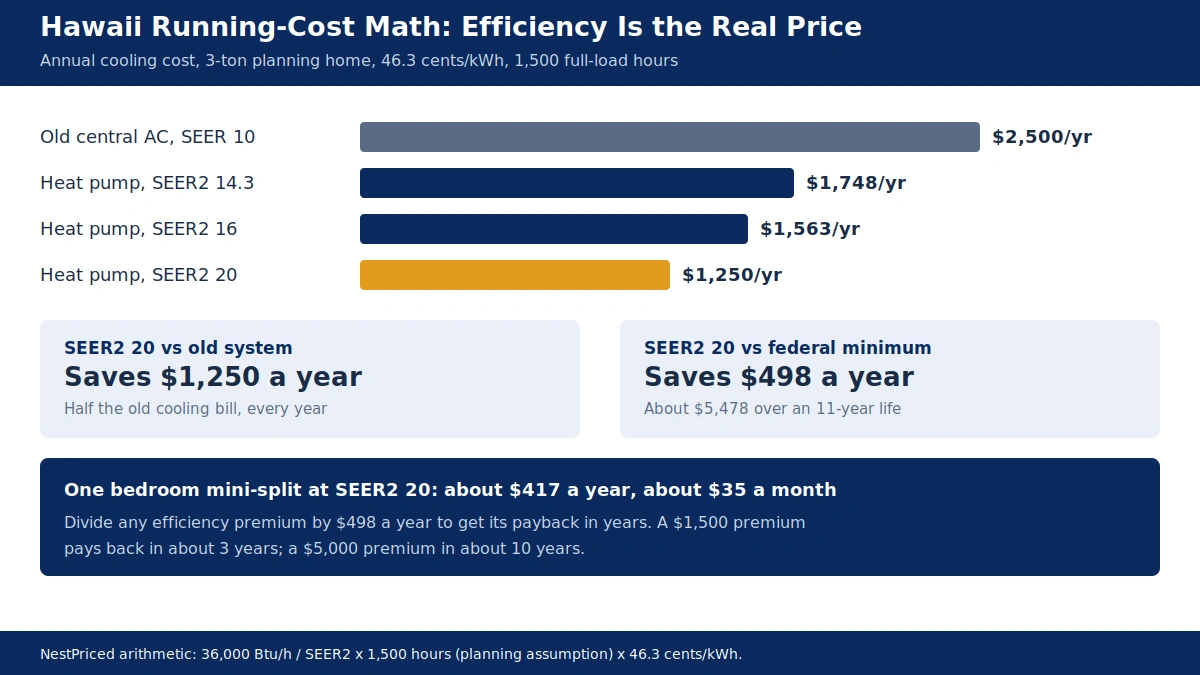
The planning home in this section cools with a 3-ton system, which moves 36,000 Btu per hour at full load. The method converts the efficiency rating into power draw, then multiplies by runtime. A system’s average power draw in kilowatts equals 36,000 divided by its SEER2 rating, divided by 1,000. Annual kilowatt-hours equal that draw times the equivalent full-load hours, the number of hours the system would run at full blast to deliver a year’s cooling. This guide uses 1,500 equivalent full-load hours as a planning assumption for a Honolulu home that cools most of the year. That figure is an assumption, not a measured Hawaii number, and it is disclosed as one. The per-1,000-hour figures are given alongside so you can scale the math to a home that cools less, such as a trade-wind home that runs the system only on still days, or more, such as a west-facing home that runs it all afternoon.
| Cooling system, 3-ton | Power draw | Annual kWh at 1,500 hours | Annual cost at 46.3 cents | Cost per 1,000 hours |
|---|---|---|---|---|
| Old central AC, SEER 10 | 3.600 kW | 5,400 | $2,500 | $1,667 |
| Heat pump, SEER2 14.3 | 2.517 kW | 3,776 | $1,748 | $1,166 |
| Heat pump, SEER2 16 | 2.250 kW | 3,375 | $1,563 | $1,042 |
| Heat pump, SEER2 17.2 | 2.093 kW | 3,140 | $1,454 | $969 |
| Heat pump, SEER2 18 | 2.000 kW | 3,000 | $1,389 | $926 |
| Heat pump, SEER2 20 | 1.800 kW | 2,700 | $1,250 | $834 |
| Heat pump, SEER2 22 | 1.636 kW | 2,455 | $1,136 | $758 |
Read the table from the old-system row outward. A new heat pump at the federal minimum efficiency, SEER2 14.3, costs $1,748 a year to cool the planning home, which saves $752 a year against the old SEER 10 system. A high-efficiency system at SEER2 20 costs $1,250 a year, which saves $1,250 a year against the old system, exactly half the old bill. The jump from the minimum to SEER2 20 saves $498 a year, every year, for the life of the system. Over an 11-year Hawaii working life, that efficiency jump is worth about $5,478 in avoided electricity, before any rate increases, which is more than half the installed cost of the system itself. No other buying decision in this guide moves as much money as the efficiency rating.
The comparison against window units tells a smaller but still useful story. A single 12,000 Btu per hour window unit at an efficiency rating of 11 draws about 1.091 kilowatts, uses 1,636 kilowatt-hours over 1,500 hours, and costs $758 a year at the planning rate. A single-zone mini-split at SEER2 20 draws 0.600 kilowatts, uses 900 kilowatt-hours, and costs $417 a year for the same room. The saving is $341 a year per room, plus quieter operation, better humidity control, and no window blocked by a rattling box. A home cooling three rooms with three window units spends about $2,274 a year on cooling, against about $1,250 a year for a whole-home SEER2 20 system, though the two setups cool different amounts of space and the comparison should be read as indicative rather than exact.
Rate sensitivity cuts both ways, and Hawaii rates have moved enough in one year to show it. At the June 2026 peak rate of 52.72 cents, the SEER2 20 system costs $1,423 a year and the old SEER 10 system costs $2,847 a year, a saving of $1,424 a year. At the 2025 annual average of 40.40 cents, the SEER2 20 system costs $1,091 a year and the old system costs $2,182 a year, a saving of $1,091 a year. The saving grows when rates rise, which means efficiency is also insurance against the next fuel-price spike. A home that buys the minimum-efficiency system to save money up front buys the largest exposure to the next rate increase.
Your tariff matters as much as the statewide average, and this is where the statewide number can mislead. Hawaiian Electric’s standard residential tariff, Schedule R, charges an energy rate that rises with usage: in the August 2026 effective rate summary, Oahu’s first 350 kilowatt-hours a month cost 42.5501 cents each, the next 850 cost 43.9445 cents, and usage above 1,200 cost 46.2141 cents, plus a $13.90 monthly customer charge and a $30.22 minimum charge. Hawaii Island’s first 300 kilowatt-hours cost 46.0841 cents each. The EIA statewide average of 46.3 cents sits above most tariff energy charges because it divides total revenue, including riders and fees, by total kilowatt-hours sold. For running-cost math, the EIA average is the safer planning figure because it captures what you actually pay per unit, not just the energy line. For bill forecasting, pull your last 12 months of bills, divide total dollars by total kilowatt-hours, and use that number.
Time-of-use rates are the one lever that can beat the statewide average, with a warning attached. Hawaiian Electric’s residential time-of-use tariff charges far less for daytime power, 21.7341 cents per kilowatt-hour between 9 a.m. and 5 p.m. in the August 2026 summary, and far more in the evening peak. A home that pre-cools during the day and coasts through the evening peak can save real money, and a home that runs the system hardest at 7 p.m. can lose money on the same tariff. Do not switch to time-of-use on a contractor’s promise. Pull your hourly usage from the utility, model both tariffs, and confirm the peak window before changing plans. The national heat pump running cost guide covers the same fuel comparison for the country as a whole, at mainland rates that make Hawaii’s numbers look like a different sport.
Heating cost barely registers at sea level, and the honest thing is to say so rather than invent a heating comparison. A Honolulu home that runs its heat pump in heating mode a few dozen hours a year spends tens of dollars, not hundreds. Upcountry, the math stays small: a 12,000 Btu per hour head heating at a coefficient of performance of 3.5 draws about 1.0 kilowatt, and four hours a night for 90 cool nights uses about 362 kilowatt-hours, about $168 at the planning rate. That is an illustration with stated inputs, not a measured load, and it shows why heating payback never drives a Hawaii purchase. The cooling bill is the bill. Size for cooling, buy efficiency for cooling, and treat the heating as a bonus that costs almost nothing to include.
Efficiency Ratings That Matter in Hawaii: SEER2 First, Heating Ratings Last
Heat pump efficiency comes with two ratings, and Hawaii buyers should weight the cooling rating far more heavily than the heating rating. SEER2 stands for Seasonal Energy Efficiency Ratio 2, and it rates how efficiently a system cools across a whole season. HSPF2 stands for Heating Seasonal Performance Factor 2, and it rates heating efficiency across a winter season, a number that matters far less in Hawaii than SEER2 does. The 2 in both ratings comes from a 2023 test-procedure update that uses more realistic duct pressures, so the new numbers run lower than the old SEER and HSPF numbers for the same machine. An old quote showing 16 SEER is not describing the same efficiency as a new quote showing 16 SEER2, and mixing the two scales will mislead you. Hawaii Energy’s rebate forms use SEER2 throughout, so insist every quote does too.
Nationwide, a split-system heat pump must meet at least 14.3 SEER2 and 7.5 HSPF2, a standard in force since January 1, 2023. Those two numbers are the legal floor for any new system sold for a Hawaii home. Treat the federal minimum as a floor to stand on, not a target to aim for. At Hawaii rates, the minimum is an expensive place to stop: the running-cost table shows a SEER2 14.3 system costing $498 a year more to run than a SEER2 20 system, every year, for a decade or more. The rebate programs agree with that reading, because every Hawaii Energy tier sits above the minimum. The mini-split rebate starts at SEER2 15.3 and rises at SEER2 17.2, and the central AC retrofit rebate requires SEER2 15.2 or higher. The program will not pay you to install the cheapest legal system, because at island rates that system wastes too much power.
The table below prices the efficiency tiers for the planning home, using the same 1,500-hour method as the running-cost section. Read it as a menu: each tier up costs more to buy and less to run, and the question is whether the buying premium pays back before the system wears out in salt air. No published Hawaii price premium for higher SEER2 tiers was found during research, so this guide does not invent one. Instead, take any premium a contractor quotes, divide it by the annual saving in the table, and you have the premium payback in years. A $1,500 premium for the jump from SEER2 14.3 to SEER2 20 pays back in about 3.0 years at $498 a year. A $4,000 premium for the same jump pays back in about 8.0 years, inside the 11-year planning life but with less margin. Ask for the premium as a separate line, because a quote that bundles it into a single total hides the only comparison that matters.
| Efficiency tier | SEER2 | Annual cooling cost, planning home | Saving vs federal minimum | Who it suits |
|---|---|---|---|---|
| Federal minimum | 14.3 | $1,748 | None | Tight budgets, rarely cooled rooms |
| Rebate entry tier | 15.3 | $1,634 | $114 | Minimum sensible buy |
| High tier | 17.2 | $1,454 | $294 | Most Honolulu and Kahului homes |
| Higher tier | 20 | $1,250 | $498 | Hilo humidity, all-day cooling |
| Top tier | 22 | $1,136 | $612 | Large homes, high runtime |
EER2 deserves a paragraph in Hawaii even though it is a secondary number elsewhere. EER2, short for Energy Efficiency Ratio 2, rates cooling efficiency at one hot outdoor temperature instead of across a season. In a climate where the system runs near full load on hot still afternoons, the hot-day number predicts the worst bills better than the seasonal average does. Two systems with the same SEER2 can differ on EER2, and the one with the higher EER2 will cost less on the hottest days, which are also the days the utility’s peak rates bite hardest. Ask for EER2 alongside SEER2, and weight it more heavily if your home faces west, sits in a hot valley pocket like Kahului or Ewa, or runs the system hardest in the afternoon.
HSPF2, the heating rating, matters least in Hawaii and should be the last number you compare at sea level. A system rated HSPF2 7.5, the federal minimum, heats adequately on every night Honolulu will ever see, because the outdoor air stays near 67 degrees even in the coldest month and the heat pump barely works to move heat from it. The conversion from HSPF2 to seasonal heating efficiency, dividing by 3.412, still works arithmetically, but the seasonal heating load it multiplies is near zero at the coast, so the product is near zero too. Upcountry buyers should weight HSPF2 more, because Kula and Waimea nights in the 40s and 50s ask real heating work of the system, but even there a mid-tier HSPF2 rating suffices. No Hawaii home at any elevation needs a cold-climate heating designation, and a quote that leads with one is selling a mainland solution to a tropical problem.
Two more rating traps catch Hawaii buyers. First, the rated SEER2 assumes a matched indoor and outdoor unit tested together as a system. A contractor who pairs a high-efficiency outdoor unit with a mismatched indoor coil, or who reuses an old air handler with a new outdoor unit, voids the rating in practice even if the brochure number stays on the quote. Ask for the AHRI certificate, the document from the Air-Conditioning, Heating, and Refrigeration Institute that proves the exact combination is rated as a matched system, and check that the model numbers on the certificate match the model numbers on the quote. Second, SEER2 is measured in a test lab with clean coils and correct refrigerant charge. A system installed with a kinked line set, an undercharged loop, or a dirty coil will not deliver its rated efficiency in your home. Commissioning, the startup testing the installer performs after the install, is what closes the gap between the lab number and your bill, and it should be named on the quote as a line item, not assumed.
To compare brands on efficiency and price, use the best heat pump brands cost guide. In Hawaii, brand matters less than three local factors the national guide cannot capture: whether the brand’s distributor stocks parts on your island, whether the local dealer has installed that brand’s inverter line often enough to commission it well, and whether a factory-coated coil option exists for the model you are buying. A top-rated brand with no parts stock on Maui is a worse buy than a mid-rated brand the Kahului dealer services weekly. Ask the dealer how many of the exact model they installed last year and where the nearest parts stock sits.
Ducted or Ductless: Matching the System to a Hawaii Home
Hawaii homes divide cleanly into two groups, and the right heat pump depends on which group yours falls into. A home built with central air already has ducts, and a ducted heat pump drops into that existing system. Homes built for trade winds have no ducts, and a ductless system avoids the cost and disruption of building ductwork from scratch. Most Hawaii homes fall in the second group. One Oahu contractor puts it plainly: most Hawaii homes were built without ducts, so ductless split systems are the most common upgrade it installs. The housing stock in Kaimuki, Manoa, Kalihi, Hilo town, and older Kahului holds plenty of both kinds, and the wrong choice costs thousands.
When good ducts are already in place, the ducted system usually wins. The job goes faster, the indoor unit stays hidden in a closet or attic, and cooled air reaches every room through vents that are already there. The risk is invisible: ducts leak, and ducts in a hot attic leak cooled air into the hottest part of the house. A duct system in an unconditioned attic can lose a fifth or more of the cooled air before it reaches a room, and undersized return ducts can starve the system of airflow and freeze the indoor coil. Have the contractor inspect the ducts before pricing a ducted system, and test older ductwork for leakage when the home is more than 30 years old. Sealing and insulating attic ducts is often the highest-value dollar in the whole project in Hawaii, because every leaked unit of cooled air was bought at 46 cents a kilowatt-hour.
Ductless mini-splits are the right call where ducts do not exist, where the ducts are beyond saving, or where rooms need different temperatures at different times. Each indoor head has its own control, so a bedroom can stay cool all night while the living room stays off, and a rarely used guest room costs nothing to leave uncooled. The indoor heads sit high on a wall or recessed into a ceiling, with refrigerant lines passing through a small wall opening to the outdoor unit. The install is far less disruptive than cutting duct chases through single-wall construction and finished ceilings. For a plantation cottage with jalousie windows and no attic access, ductless is often the only practical option that does not involve opening walls and rebuilding the house around the air system.
The cost crossover is specific. Building new ductwork in Honolulu costs $4,370–$7,330 per job. Three heads, one outdoor unit: $6,470–$11,470 installed. A ducted install runs $6,720–$11,180 before any new ductwork, which is a separate line when the home has no ducts. With no ducts in place, ductless at $6,470–$11,470 undercuts ducted-plus-new-ducts at roughly $11,090–$18,510 by enough that the choice is usually obvious. Where the ducts are good, ducted wins on both price and looks, since no wall heads show in the rooms. Where the ducts are bad, price ducted and ductless each with the duct repair included, and never accept a ducted quote that takes the existing ducts on faith without an inspection.
Condos add a third decision that single-family guides skip. Only 34 percent of Honolulu housing units are single houses, and the rest live under association rules that govern outdoor units, penetrations, condensate drains, and noise. A high-rise condo may allow only a specific outdoor unit location, may ban wall penetrations on certain faces, or may require the condensate drain to tie into a building stack rather than drip onto the lanai below. A townhouse association may limit the number of outdoor units or require screening. Check the association’s alteration rules and get written approval before signing a contract, because a contractor’s install date means nothing if the association stops the work on day one. Ask the contractor how many installs they have completed in your building or complex, and ask for the association contact they worked with.
Some Hawaii homes suit a hybrid better than either pure option. A ducted heat pump can serve the main floor through existing ducts while a single ductless head covers a converted garage, a lanai enclosure, or an ohana unit the ducts never reached. A ductless system can cover the bedrooms that matter most while the living areas stay on trade winds and ceiling fans. Hybrids show up often in Hawaii remodels, letting a homeowner phase the spend, bedrooms first and living area later, with a separate rebate application for each phase where the program allows it. Hawaii Energy’s mini-split rebate is per unit including a condenser, so a phased plan should confirm how each phase qualifies rather than assuming every head earns its own rebate.
Filtration is the hidden difference between ducted and ductless in vog and wildfire smoke country. A ducted system filters all the air through one central filter, and upgrading that filter during vog events or smoke season protects the whole house. A ductless head filters only its own room’s air, through a small washable filter that traps dust but lets fine vog and smoke particles through. If anyone in the home has asthma or smoke sensitivity, the ducted system’s central filtration is a real health advantage during the weeks when Kilauea vog drifts over Kona or wildfire smoke reaches Maui. In a ductless home, budget for a standalone HEPA purifier in the bedroom for vog weeks and smoke events: it costs far less than the filtration gap it closes.
Electrical constraints affect both options in older Hawaii homes. Many pre-1980 homes still have 60-amp or 100-amp panels, and a ducted heat pump with a large indoor blower can need a 200-amp service. A panel upgrade in Honolulu runs $3,060–$4,570 per job. Each ductless head draws less current on its own, so a single-zone system can sometimes run on the existing panel where a ducted system would need an upgrade. The panel answer belongs in the estimate, from looking at the panel and counting free breaker spaces, not as a surprise on install day. If the panel needs upgrading, the electrical panel upgrade cost guide covers what that job involves, and the permits section covers the utility service queue that can follow it.
Salt Air and Shorter Lives: What the Ocean Does to an Outdoor Unit
The ocean is never far away in Hawaii, and the outdoor unit lives in it. Salt-laden air coats the outdoor coil, the finned heat exchanger that dumps heat outside in cooling mode, and the salt film holds moisture against the metal day and night. The fins corrode, the coil thins, refrigerant leaks through pinholes, and the system that cooled well in year three struggles in year eight. High humidity accelerates the process, because the coil rarely dries fully, and year-round runtime means the unit accumulates more operating hours in five Hawaii years than a mainland unit accumulates in eight. Salt air is not a cosmetic issue. It is the main reason Hawaii systems die young.
The planning life for a Hawaii cooling system is about 10 to 12 years. That figure comes from an Oahu contractor, Summit Air Conditioning, which states that most systems in Hawaii last around 10 to 12 years due to salt air, humidity, and heavy year-round use, and that repair usually makes sense only while the system is under 8 years old. A second Oahu contractor’s resale guide is consistent: systems aged 8 to 12 years draw neutral to negative attention from buyers, and systems aged 13 to 15 years or more are commonly flagged on inspection reports as approaching or past typical service life, especially for coastal homes. Mainland guides quote 15 to 20 years for the same equipment. Budget for 11 years in Hawaii, plan the replacement fund from day one, and treat any year past 12 as borrowed time rather than expected life.
Distance from the coast changes the corrosion rate more than any other single factor. National coastal guidance states that homes within a mile of the coast experience faster corrosion than homes further inland, and that unprotected units can show visible corrosion within a few years and fail within 5 to 8 years in severe exposure, while protected units last 10 years or more. In Hawaii, “within a mile of the coast” describes most homes on every island, because the islands are narrow and the population hugs the shore. A home on the beach in Kailua, a condo tower in Waikiki, and a house on the Kona coast all sit in severe exposure. A home in Mililani or upcountry Kula sits further from direct salt spray and should expect a longer coil life, though trade winds carry salt aerosol well inland and no Hawaii home is truly salt-free.
Coated coils are the main defense, and they should be a line item on every coastal quote. Manufacturers offer factory-applied protective coatings for the outdoor coil, using epoxy or phenolic finishes sold under trade names such as GoldFin and WeatherArmor, and some offer all-aluminum coils that resist the galvanic corrosion that attacks copper tube and aluminum fin combinations. Industry claims for coated coils run to 15 to 20 years against 7 to 10 years for uncoated coils in coastal installs, but those claims come from marketing-adjacent sources and have not been verified as measured Hawaii data, so this guide does not present them as fact. What is secure is the direction: a coated coil lasts longer near the ocean than an uncoated one, and the coating is cheapest when applied at the factory. No published Hawaii price premium for a coated coil was found during research, so this guide asserts no dollar figure for it. Ask the contractor to price the coated-coil option as a separate line, with the coating type named, and compare that premium against one or two extra years of system life at $814 a year in capital cost.
Placement and maintenance are the other two defenses, and both cost little. The outdoor unit should sit where it gets airflow but not direct ocean spray, on a raised pad or stand that keeps it above standing water and splash, with the coil facing away from the prevailing wind where the lot allows it. A unit tucked against a wall on the ocean side of the house, where every trade-wind gust drives spray into the fins, will corrode faster than the same unit on the sheltered side. Maintenance advice from Hawaii contractors includes rinsing the outdoor coil with fresh water regularly, using low pressure rather than a pressure washer, which bends the fins. Confirm the rinse schedule with your installer and check whether the warranty requires professional coil cleaning at a set interval, because a warranty that demands documented service will not honor a claim on a unit that was never serviced.
The shorter life changes the lifetime math in ways mainland payback guides miss. A ducted system at the $8,950 midpoint, lasting 11 years, costs about $814 a year in capital alone, before a single kilowatt-hour. A single-zone mini-split at the $4,150 midpoint costs about $377 a year in capital over the same life. A multi-zone system at the $8,970 midpoint costs about $815 a year. Those capital figures belong next to the running costs in any honest comparison, because a system that dies in 11 years must be bought twice in the time a mainland system is bought once. The maintenance and repair guides cover what upkeep runs: the heat pump maintenance cost guide and the heat pump repair cost guide. In Hawaii, budget for at least annual professional service, and treat the $75 Hawaii Energy tune-up rebate, covered in the next section, as a nudge to actually book it.
Warranty terms deserve a closer read in Hawaii than elsewhere, for one reason: the warranty clock and the corrosion clock run at different speeds. A 10-year parts warranty sounds generous until you realize the coil may fail from corrosion in year 9, and corrosion is often excluded or limited in warranty fine print. Ask whether the parts warranty covers coil corrosion, whether the coated-coil option carries a longer coil warranty, and whether the labor warranty covers the coil replacement labor or only the part. The common package is 10-year parts with a one-year labor warranty, and the labor side is what counts when a coil fails in year six. Get both warranties in writing, with the registration confirmation for the parts warranty, and confirm the installing dealer will still be the servicing dealer when the claim arises.
Rebates, Tax Credits, and Financing You Can Actually Collect in 2026
Hawaii’s incentive picture is a mix of modest cooling rebates that are open now, a large federal rebate program that has not launched, no state tax credit for space heat pumps, and a financing program that does not cover home space heat pumps at all. This section covers each source in the order you should check them: Hawaii Energy first, because that is where the open money is, then Kauai’s separate programs, then the unlaunched federal program, then the state tax picture, then the federal situation, which is zero for 2026 installs, and finally financing. Every figure below was checked against the program’s own application form, contractor page, or official program page, and figures that could not be verified against a primary source are flagged as reported.
Hawaii Energy: up to $550 per mini-split unit, through June 2027
Hawaii Energy is the ratepayer-funded efficiency program that serves residential electric customers on Hawaii Island, Lanai, Maui, Molokai, and Oahu who contribute to the Public Benefits Fund. Kauai is not in its territory. Its program year runs July 1, 2026 through June 30, 2027, or while funding lasts, and its rebates are instant rebates paid through participating contractors, which means the discount should appear on the invoice rather than arriving months later as a check. Newly constructed homes do not qualify for the mini-split rebate. The equipment must be new, must meet the efficiency and capacity requirements on the application form, and must be fully operational before the rebate is paid.
The residential VRF mini-split rebate pays by unit size and efficiency tier, with the unit defined as including a condenser. VRF stands for variable refrigerant flow, the industry term for the inverter-driven multi-split technology most mini-splits use. At SEER2 15.3 or higher, the application form pays $400 for a unit of 14,000 to less than 20,000 Btu per hour, and $450 for a unit of 20,000 to less than 30,000 Btu per hour. At SEER2 17.2 or higher, the form pays $450 for 8,000 to less than 20,000 Btu, $500 for 20,000 to less than 30,000 Btu, $550 for 30,000 to less than 45,000 Btu, and $550 for 45,000 to less than 65,000 Btu at SEER2 17.4 or higher. The maximum is $550 per unit. The full form carries additional rows at the lower tier that were not fully legible in the copy reviewed for this guide, so confirm the exact tier for your unit size with the contractor before budgeting. Capacity and efficiency are verified through the AHRI directory, the industry certification listing.
Two details catch applicants out. First, a multi-head system does not earn a separate rebate for every indoor head. The rebate follows the outdoor unit including its condenser, so a three-head system earns one unit rebate, not three. A quote that multiplies $550 by the number of heads is wrong, and the overcount will surface when the contractor files the application. Second, the rebate is an instant rebate through a participating contractor, which means the contractor must be in the program and the equipment must be on the qualifying list at install time. Ask the contractor to show the rebate as a line on the quote and to confirm funding remains available, because the program pays while funding lasts and can change terms without notice. The current application form is on the Hawaii Energy mini-split rebate application.
Hawaii Energy also pays for water heating equipment, and those figures belong here only to prevent confusion. A heat pump water heater, a different machine from a space heat pump, earns a $500 instant in-store rebate for a 40-gallon to 54-gallon unit and $700 for a 55-gallon to 82-gallon unit. A solar water heater earns a rebate too, but published figures conflict across program cycles, ranging from $1,000 to $2,750 in different sources, so this guide asserts no solar water heater figure. If a quote bundles a water heater rebate into a space heat pump price, separate the two machines and the two rebates before signing.
The $1,250 central AC retrofit rebate: confirm heat pump eligibility in writing
Hawaii Energy’s 2026-27 program adds a $1,250 instant rebate for a central air conditioner retrofit, and it is the largest single rebate a ducted-system buyer might collect. The terms, from Hawaii Energy’s residential HVAC contractor page, are specific: the old unit must be rated 13.0 SEER or less, the new indoor and outdoor units must be rated 15.2 SEER2 or higher, the invoice must show both the indoor and outdoor units, and the project must get preapproval from Hawaii Energy before the work proceeds. The preapproval requirement is the trap. A retrofit installed without preapproval does not earn the rebate retroactively, so the paperwork must come first.
Whether a ducted heat pump qualifies as a central AC retrofit is not explicitly confirmed on the contractor page excerpt reviewed for this guide. The rebate is framed as a central air conditioner measure, and a heat pump is a central air conditioner with a reversing valve, so qualification is plausible, but plausible is not confirmed. Do not count the $1,250 in your budget until the contractor or Hawaii Energy confirms in writing that your exact heat pump model qualifies and that preapproval has been granted. The $1,250 appears in the payback section only as a conditional case, labeled as such. A quote that subtracts $1,250 unconditionally, without mentioning preapproval, is assuming an answer it has not received. The contractor page with the retrofit terms is on the Hawaii Energy residential HVAC contractor page.
A $75 tune-up rebate through participating contractors rounds out the cooling offers. It is small money, but it pays for part of the annual service a salt-air system needs, and it is worth claiming every year the program offers it. A window or room air conditioner rebate of up to $45 at participating retailers exists too, and it explicitly does not cover ductless mini-split systems. Neither the tune-up nor the window rebate changes a buying decision, but both reward maintenance that extends system life.
Kauai and KIUC: no space heat pump rebate from any source
Kauai runs its own grid through the Kauai Island Utility Cooperative, KIUC, a member-owned cooperative with about 38,000 meters, and Kauai sits outside Hawaii Energy’s territory entirely. KIUC offers no mini-split rebate and no central AC retrofit rebate. What KIUC does offer is a $500 bill credit for replacing an existing electric water heater, a non-functioning heat pump water heater, or a non-functioning solar water heater with an ENERGY STAR heat pump water heater, plus a $1,500 solar water heater rebate with a zero-interest loan option, a $100 appliance replacement rebate, and a $50 water heater timer credit. Those are water heating and appliance programs, not space cooling programs. A Kauai homeowner buying a space heat pump in 2026 gets no rebate from any open source, unless and until eHale launches. Budget accordingly, and do not let a mainland rebate guide or a Honolulu contractor’s rebate sheet imply otherwise.
eHale Energy Saver: announced, not open, and no retroactive rebates
The eHale Energy Saver program is Hawaii’s version of the federal Home Energy Rebates, the two pathways funded by the Inflation Reduction Act: the High-Efficiency Electric Home Rebate pathway, called HEEHR, and the Home Owner Managing Energy Savings pathway, called HOMES. The Hawaii State Energy Office runs it, and its official page carries a clear status line: currently pending United States Department of Energy approval of launch. The page says the HEEHR and HOMES pathways will be available to Hawaii residents in early 2027. Earlier wording on the same page said late 2026, so the timeline has already slipped once, and the HOMES pathway timing is described as currently unknown, with the office stating it cannot estimate the timeline for program launch.
The amounts in the program design are large, which is exactly why they must be handled carefully. The HEEHR heat pump pathway is designed around up to $8,000 per household, with the published design tiers giving households below 80 percent of area median income up to 100 percent of the eligible project cost and households between 80 and 150 percent of area median income up to 50 percent, for an ENERGY STAR-certified heat pump for space heating and cooling, installed by a program-certified contractor. The contractor certification list does not exist yet, no application exists yet, and the federal program notice of May 2026 narrowed the rules, including barring rebates for replacing a non-electric appliance with an electric one. Treat every eHale dollar figure as announced design, not claimable money.
The rule that matters most is the no-retroactivity rule, stated on the state energy office page in plain language: residents will not receive rebates for measures done before the official launch of the state rebate program. A heat pump installed in 2026 will not earn an eHale rebate in 2027. A homeowner who can wait, whose current system still runs, and whose income falls below 150 percent of area median income faces a genuine choice: install now with only Hawaii Energy money, or wait for a launch date the state cannot yet estimate. There is no right answer for everyone, and this guide does not pretend otherwise. What is certain is that waiting is the only way to preserve eHale eligibility, and installing now forfeits it. The current status is on the eHale Energy Saver program page.
The state tax credit: solar only, nothing for space heat pumps
Hawaii has a generous renewable energy tax credit, and it does not cover your heat pump. The Renewable Energy Technologies Income Tax Credit, in Hawaii Revised Statutes section 235-12.5, pays 35 percent of the actual cost of a solar energy system, capped at $5,000 per system for a single-family home. It covers solar panels, solar water heating, and solar thermal systems. It does not cover air-source space heat pumps, ducted or ductless. No state tax credit or deduction for a space heat pump was found during research. A quote or flyer that subtracts a 35 percent state credit from a heat pump price is confusing a solar credit with a heat pump credit, and the confusion will cost you at tax time.
Two 2026 developments touch the solar credit and matter only if you pair solar with the heat pump. Act 24, signed May 21, 2026, imposes a $40 million annual aggregate cap on the credit beginning in 2027, and an executive order preserves the credit for systems placed in service in 2026. A separate 2026 bill, HB 2608, proposes adding a credit for high-efficiency heat pump water heaters installed alongside a solar system of 1 kilowatt or greater, with the percentage and cap left undetermined in the introduced text. That bill is a proposal, not law, and it covers water heaters, not space heat pumps. The solar panel cost guide for Hawaii prices a rooftop system for a home pairing solar with a heat pump, and the solar credit belongs in that calculation, not this one.
Federal money: $0 for 2026 installs
For a 2026 install in an owner-occupied home, the federal government contributes $0. The One Big Beautiful Bill Act (Public Law 119-21) ended the section 25C home improvement credit and the section 25D clean energy credit for property placed in service after December 31, 2025, and IRS Fact Sheet FS-2025-05 confirmed the cutoff. The Hawaii State Energy Office’s own rebates page confirms the same termination. Any web page, contractor flyer, or quote still promising a 30 percent federal credit or a $2,000 federal credit for a 2026 heat pump install is wrong, and any quote with a line subtracting a federal credit should be sent back for correction before you sign.
Federal law allows a lease route, but the Hawaii market does not currently offer one. Under section 48E, a leasing company can claim a clean electricity investment credit and pass the value to the homeowner, through December 31, 2027. No company was found leasing heat pumps to Hawaii homes, so the route stays theoretical here. Never let a quote count lease savings that no Hawaii company actually offers. The federal energy tax credits guide covers the national picture, and the Hawaii picture is simpler: Hawaii Energy money, nothing from the state tax code for space heat pumps, and nothing from the federal government for 2026 installs.
Financing: GEM$ does not cover a home space heat pump
The Green Energy Money Saver program, called GEM$, is Hawaii’s on-bill financing program, run by the Hawaii Green Infrastructure Authority. It offers fixed-rate financing at 5.5 percent per year for 20 or 25 years, repaid through the electric bill, with the obligation tied to the meter rather than the person, no credit check, and a requirement that the project show an estimated bill saving of at least 10 percent after the program charge. In January 2026 the state released $18 million in new loan capital for the program. On paper it sounds like the answer to a heat pump’s up-front cost. In practice, for a homeowner buying a space heat pump, it is not.
The residential eligible improvements list covers solar panel systems, solar water heaters, heat pump water heaters, and commercial efficiency retrofits. Heating and cooling equipment appears only on the nonprofit, small business, and commercial tenant eligibility list. A homeowner financing a space heat pump through GEM$ would be financing an improvement the residential list does not name. A Hawaiian Electric social media post loosely lists heat pumps among GEM$ uses, but a social post does not override the authority’s eligibility lists, and the lists name water heaters, not space systems. Do not count on GEM$ for a space heat pump unless the Green Infrastructure Authority confirms eligibility in writing for your exact project. What GEM$ can finance alongside a heat pump project is the solar system and the heat pump water heater that pair with it, which is genuinely useful, but it is not heat pump financing.
| Incentive source | Amount | Who qualifies | Status, Nov 2026 |
|---|---|---|---|
| Hawaii Energy, mini-split | $400–$550 per unit | Oahu, Maui, Hawaii Island, Lanai, Molokai | Current, through June 30, 2027 |
| Hawaii Energy, central AC retrofit | $1,250 | Old unit 13.0 SEER or less, preapproval | Current; heat pump eligibility confirm first |
| Hawaii Energy, tune-up | $75 | Participating contractor | Current, reported |
| KIUC, heat pump water heater | $500 | Kauai members, water heating only | Current |
| KIUC, space heat pump | $0 | Kauai members | No program |
| eHale (HEEHR/HOMES) | Up to $8,000 design | Income below 150% AMI, design only | Not launched, early 2027 stated |
| Hawaii state tax credit | $0 for space heat pumps | Solar systems only | Current law |
| Federal credit 25C/25D | $0 | 2026 installs | Ended Dec 31, 2025 |
| GEM$ financing | 5.5% fixed, 20–25 yr | Residential list excludes space heat pumps | Current; confirm eligibility |
Permits, Licensing, and Installation Rules in Hawaii
Hawaii regulates heating and cooling work at the state level for licensing and at the county level for permits, and the split is unusually clear. The state sets the license floor, and no county may add its own contractor licensing on top of it. The four counties, the City and County of Honolulu, Hawaii County, Maui County, and Kauai County, issue building permits and inspect the work. That single split simplifies hiring: one state lookup tells you whether an installer is legal, and one county office handles the permit for your address.
A contractor who installs heat pumps in Hawaii must hold a C-52 Ventilating and Air Conditioning license from the Hawaii Contractors License Board, part of the Department of Commerce and Consumer Affairs. The C-52 classification covers fabricating, assembling, and installing warm-air heating and air cooling systems, complete ventilating and air conditioning systems including piping and non-electrical controls, and heat pumps related to the air conditioning system. A C-40 refrigeration license covers refrigeration work below 50 degrees and is a separate classification. Hawaii issues no individual journeyman HVAC license: the credential is held at the company level through a responsible managing employee with four years of supervisory experience in the preceding ten years, plus business-and-law and trade examinations. Licenses expire September 30 of even-numbered years, and Hawaii requires no continuing education for contractor licenses, which means the credential proves the qualifier passed the exam and met the experience requirement, but it does not prove recent training on inverter systems. Ask how many variable-speed systems the installer has put in during the last year.
A license is required for any project exceeding $1,500 in labor and material and for any project requiring a building, electrical, or plumbing permit, according to the Department of Commerce and Consumer Affairs. Every heat pump install exceeds $1,500, so every heat pump install requires a licensed contractor, and the small discrepancy between the department’s $1,500 statement and a board FAQ figure of $1,000 is moot for this work. Every permit applicant must list the license numbers of the contractor and all specialty contractors, and the county checks those numbers against the board’s list. Anyone who handles refrigerant must also hold EPA Section 608 certification, a federal requirement covering the safe handling of the fluids in the system, and Hawaii law fines licensees per unit serviced for refrigerant violations. Verify the C-52 license on the department’s free online license search before the contractor visits, and match the name on the license to the name on the contract.
Permits are a county matter, and the only verified fee schedule in this guide is Honolulu’s. A building permit is required for HVAC work in Honolulu, filed through the Department of Planning and Permitting’s HNL Build portal with electronic plan review. Under the Revised Ordinances of Honolulu Table 18-A, a job valued between $1,000.01 and $20,000 pays $12 plus $2.20 per $100 or fraction of the total valuation, plus a standard plan review fee of 20 percent of the permit fee. For a job at the $8,950 midpoint, that computes to a $210 permit fee plus a $42 review fee, $252 in total, and for a $10,000 job it computes to $278.40. Those are arithmetic results from the published schedule, excluding other permits and surcharges, and electrical work, including a panel upgrade or a new circuit for the outdoor unit, is typically permitted separately. Whether a standalone mechanical permit fee applies on top of the building permit fee could not be verified, so ask the contractor which permits the job needs, who pulls them, and what each costs, and get the permit numbers before work starts.
Permit fees for Hawaii County, Maui County, and Kauai County were not verified, and this guide does not guess them. A single secondary source puts Hawaii County fees starting around $355 for projects up to $50,000 in value, but one source is not enough to assert a fee, so treat that figure as reported and confirm it with the county. Permit timelines are similarly reported rather than verified for HVAC-only jobs: Honolulu’s median approval time for straightforward residential projects is reported at about 2.5 months after the HNL Build launch and mandatory pre-screening, down from 6 to 12 months before, but a heat pump permit is simpler than a full building permit and may move faster. Ask the contractor for a realistic permit timeline for your county and your scope, in writing, before you plan around an install date.
The residential energy code adds a Hawaii-specific wrinkle that mainland guides never mention. Honolulu’s energy code, an amended version of the 2018 International Energy Conservation Code effective November 2023, offers a Tropical Zone compliance option for homes where 50 percent or less of the dwelling is air conditioned, no heating is installed, and the elevation sits below 2,400 feet. Ductless air conditioning earns a point in the code’s points option, and a home with no air conditioning installed earns points too. The code itself expects partial cooling and no heating at low elevations, which matches how most Hawaii homes actually live. Hawaii has adopted no statewide mechanical code, though the C-52 exam is written to the 2018 International Mechanical Code. The practical point does not depend on the code year: the system should be sized from a Manual J load calculation with equipment selected under Manual S, the companion method that matches equipment capacity to the calculated load. File the Manual J with the quote paperwork so it is there when the next contractor, or the next owner, asks for it. Keep that calculation: it proves the size is right, and any contractor bidding against the first quote will ask for it before pricing the job.
Sales tax does not exist in Hawaii, and the tax that replaces it behaves differently. Hawaii levies a General Excise Tax, a tax on the business calculated on gross receipts, at 4.0 percent for contracting plus a 0.5 percent county surcharge in all four counties, for a combined 4.5 percent. Businesses may visibly pass the tax through to customers, and the maximum visible pass-through rate is 4.712 percent statewide through 2030, because the tax collected from the customer is itself subject to the tax. The tax also pyramids: the contractor pays it on subcontractor invoices, materials, and equipment rentals, and those costs embed in the estimate before the visible line appears at the bottom. On a job at the $8,950 midpoint, the visible pass-through at 4.712 percent is about $422. Ask whether the quote includes the tax or adds it at the bottom, and compare quotes on the same basis, because a quote that buries the tax looks $422 cheaper than an identical quote that shows it.
Timing and access need their own paragraph, because both move the price in Hawaii. A straightforward ducted changeout usually finishes in one to two days. A multi-zone ductless install usually needs two to three days. A panel upgrade adds its own queue: Hawaiian Electric design and field work is required whenever a service is upgraded or modified, and a modeled estimate puts the full panel-and-service sequence at about 26 weeks, though that figure comes from a grid model, not measured utility data, and should be treated as a warning to ask early rather than a promised wait. About 35 percent of Hawaii households would need a panel upgrade for full electrification under the same model. If the system dies in August, ask what temporary cooling the contractor provides while you wait, and get the timeline in writing. A January install avoids the summer rush entirely, which is why January and February are the mildest install months in Honolulu.
Freight is the last installation rule that belongs in a Hawaii quote conversation, because it explains both price and patience. Every heat pump in Hawaii arrived by ship. The Jones Act, Section 27 of the Merchant Marine Act of 1920, requires cargo moving between United States ports to travel on vessels that are United States built, flagged, owned, and mostly crewed, and Hawaii’s supply chain runs almost entirely from West Coast ports under that rule. The Long Beach to Honolulu run covers about 2,560 miles in 5 to 6 days, served principally by Matson and Pasha Hawaii, with fuel surcharges that rise and fall with oil prices. Ships arrive loaded and return far less full, because Hawaii exports little by container volume, so the cargo coming in pays for the ship’s empty trip home. Neighbor-island jobs add a second move, from Honolulu to Hilo, Kahului, or Nawiliwili. No published per-unit freight figure for HVAC equipment was found, so this guide asserts none. The practical advice is simpler: confirm the exact model is in stock on your island, in writing, with a lead time if it is not, before you sign a contract that assumes Honolulu stock.
Payback: When a Heat Pump Pays for Itself in Hawaii
Payback is the number of years of energy savings needed to repay the cost of the heat pump. The comparison matters as much as the heat pump, and in Hawaii the comparison changes the answer from a few years to never, with a third case, first-time cooling, where payback does not apply at all. Four cases follow, all using the same planning numbers as the running-cost section, so every figure stays consistent and checkable. All payback figures are simple payback before maintenance and repair costs, which lengthen every payback slightly, and before rate increases, which shorten them.
Case one: replacing an old central air conditioner. The heat pump costs $8,950 at the midpoint of the Honolulu band, at SEER2 20, and it saves about $1,250 a year against an old SEER 10 system in the planning home. That division gives a 7.2-year simple payback, before any rebate. If the $1,250 central AC retrofit rebate applies to the heat pump, and that eligibility must be confirmed in writing with preapproval, the net cost falls to $7,700 and the payback falls to 6.2 years. A heat pump that lasts 11 years in Hawaii pays for itself well within its life in this case, and the case only strengthens if electricity rates keep rising at anything near the 22.5 percent pace seen between August 2025 and August 2026. This is the strongest payback case in Hawaii, and it is the case most replacement buyers actually face.
Case two: replacing window units with a single-zone mini-split. The mini-split costs $4,150 at the midpoint of the single-zone band, at SEER2 20, and it saves about $341 a year against one window unit in the planning math. The payback stretches to 12.2 years before rebates for the single-zone case. A $450 mini-split rebate, at the SEER2 17.2 tier for a mid-size unit, cuts the net cost to $3,700 and the payback to 10.9 years, just inside the 11-year planning life. The payback is long because one room’s cooling bill is small in absolute dollars, even at island rates. The case for the mini-split here rests on comfort, quiet, humidity control, and the window it frees up, not on savings alone. A home replacing three window units with a three-head system saves roughly three times as much per year, about $1,023, against a system costing $8,970 at the midpoint, for a payback of about 8.8 years before rebates, though the rooms and runtimes must be comparable for that scaling to hold.
Case three: adding cooling where none exists today. About 43 percent of Hawaii homes use no air conditioning, and for those homes a heat pump adds a new annual cost rather than replacing an old one. A whole-home SEER2 20 system adds about $1,250 a year in electricity at the planning rate and runtime. A single-zone mini-split cooling one bedroom adds about $417 a year. Payback does not apply here: with no old cooling bill to shrink, there are no savings to repay the cost. The honest advice is to buy cooling for comfort and health, size it to the rooms that actually need it, buy the highest efficiency the budget allows so the new bill stays small, and consider starting with one bedroom head rather than the whole house. A bedroom head that runs all night at SEER2 20 costs about $35 a month at the planning rate, which is the cheapest comfortable sleep Hawaii electricity rates allow.
Case four: the efficiency premium, priced as a formula rather than a guess. No published Hawaii price premium for a SEER2 20 system over a SEER2 14.3 system was found, so this guide does not invent one. The saving from that jump is $498 a year in the planning math. Divide any premium a contractor quotes by $498, and the result is the premium payback in years. A $1,000 premium pays back in 2.0 years. A $2,000 premium pays back in 4.0 years. A $3,000 premium pays back in 6.0 years. A $5,000 premium pays back in 10.0 years, inside the planning life but with little margin for a shorter-lived coastal unit. Use the formula on every quote that offers two efficiency tiers, and ask the contractor to quote the tiers as separate lines so the premium is visible. The same formula works for the SEER2 17.2 tier, where the saving against the minimum is $294 a year: a $1,000 premium pays back in 3.4 years.
Solar pairing changes the payback picture more than any rebate, and it deserves a paragraph even though solar is a separate purchase. A rooftop solar system in Hawaii produces power worth the full retail rate when the home uses it directly, about 46 cents a kilowatt-hour at the planning rate, while exported power earns far less under Hawaiian Electric’s Smart Export tariff. A heat pump that runs hardest in the sunny afternoon, exactly when the panels produce most, consumes solar power at its highest value and avoids buying grid power at its highest price. The combination is the strongest energy investment most Hawaii homes can make, and the solar panel cost guide for Hawaii prices it, including the 35 percent state solar credit capped at $5,000 and the battery question. Size the solar system after the heat pump decision, not before, because the heat pump’s annual consumption, about 2,700 kilowatt-hours for a SEER2 20 system in the planning math, is a large share of the average Hawaii home’s 6,180 kilowatt-hours a year.
Geothermal payback runs longer than any other option and depends on a market that barely exists in Hawaii. At a $26,490 midpoint, geothermal costs $17,540 more than a ducted air-source system at $8,950. Against an old SEER 10 system, even a very efficient geothermal system saving the full $1,250 a year available from the SEER2 20 comparison would need about 14.0 years to repay the premium, past the air-source planning life and into uncertain territory for the indoor equipment. No Hawaii Energy rebate covers residential geothermal space heating or cooling, no state tax credit covers it, and the federal credit is $0. Geothermal in Hawaii is a custom durability choice for a homeowner with a large lot, a long horizon, and a specialist installer, not a savings investment, and any quote presenting it as one has skipped the arithmetic.
Every payback below leaves out two ownership costs that quietly stretch it, and both are easy to overlook. First, maintenance: a heat pump in salt air needs annual professional service, including coil cleaning and a refrigerant check, and the maintenance guide covers what that runs. Second, repairs: a system that cools year-round runs more hours per year than a mainland system, and coastal corrosion adds failure modes the mainland never sees. No single one of these costs changes the payback ranking, but together they belong in an 11-year ownership budget next to the energy figures. A realistic 11-year budget for the planning home at SEER2 20 is about $8,950 in capital, about $13,750 in electricity at today’s planning rate, and maintenance and repairs on top, against about $27,500 in electricity alone for keeping the old SEER 10 system running, if it survives that long.
Getting Quotes: A Checklist for Hawaii Homeowners
For a job this size, three quotes are the floor, and they only help if they describe the same job. A quote showing only a total cannot be weighed against one that breaks out equipment, labor, ductwork, electrical work, permits, freight, and disposal of the old system. Give every contractor the same spec sheet and require the same line-by-line breakdown, and do not compare a lump-sum bid against an itemized one. The checklist below asks the questions that matter most in Hawaii, in the order worth asking them.
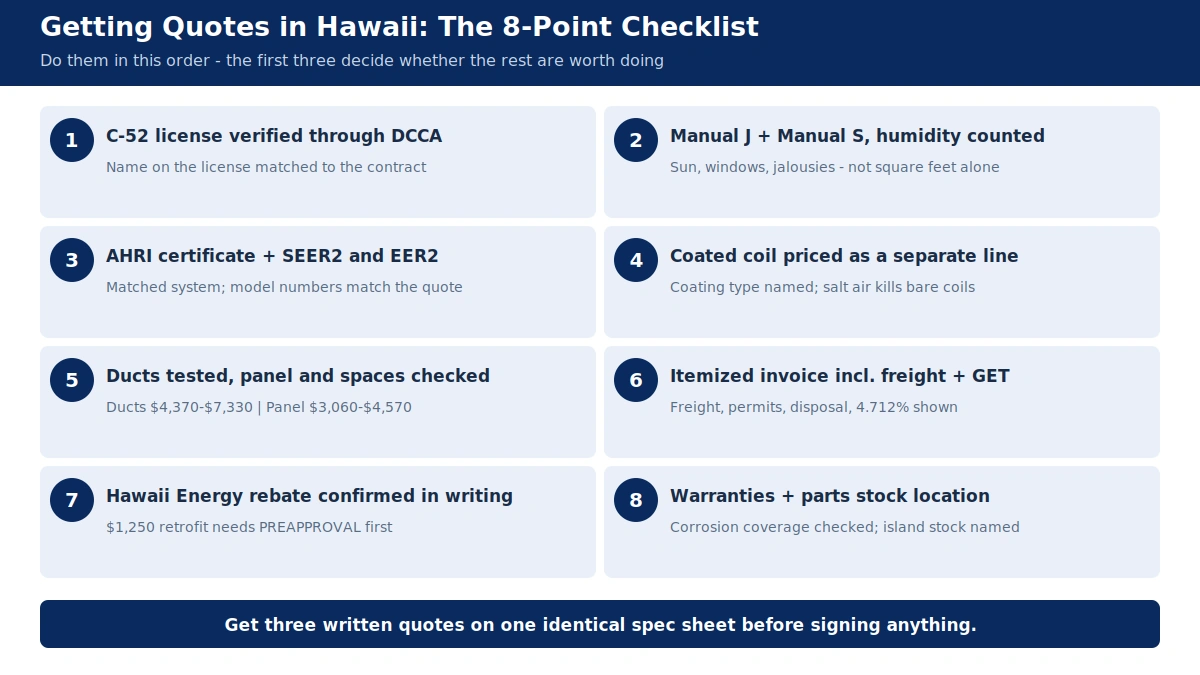
The license check and the load calculation come first, before any talk of brands or prices. Ask for the contractor’s C-52 license number and verify it on the Department of Commerce and Consumer Affairs license search before the site visit. Insist on seeing the Manual J load calculation and the Manual S equipment selection behind the quote, not just a promise that they were done. Ask what design conditions the calculation used, and confirm it accounts for sun exposure, window area, and the humidity load, not just square footage. A contractor who sizes from the existing equipment’s label or from a rule of thumb is not doing the calculation the job requires, and in a humid climate the humidity half of the calculation is the half that decides comfort.
Move to the equipment. Get the exact model numbers for the outdoor unit, the indoor unit or heads, and the controls, plus the AHRI certificate proving the combination is rated as a matched system. Ask for the SEER2 and EER2 ratings, and for the HSPF2 rating only if you live upcountry. Ask whether the outdoor coil carries a factory-applied corrosion coating, what type it is, and what premium it adds as a separate line. Ask whether the refrigerant is R-454B or R-32, and ask what happens to the old system’s refrigerant on removal. In coastal Hawaii, the coating question matters as much as the efficiency question, because a high-efficiency coil that corrodes through in year seven delivers no efficiency at all in year eight.
Ask about everything around the heat pump, not just the box itself. What shape are the ducts in, and will the contractor test them for leakage before quoting? Is duct sealing or repair priced, and is it priced separately? What is the panel size, how many breaker spaces remain, and is an upgrade needed? Who pulls the building and electrical permits, what do they cost, and what is the realistic timeline in your county? Where will the outdoor unit sit, how high above standing water and splash, which way does the coil face relative to the trade winds, and where will the condensate drain go? Who takes the old equipment away, and is removal and disposal part of the quoted price? Each of these questions has caught a Hawaii homeowner with a surprise charge after signing, and the condensate question has flooded more than one lanai.
Ask about money in the right order. Can you break the full installed price into equipment, materials, labor, freight, permits, and disposal, with a line for each? Is the general excise tax included or added at the bottom, and at what rate? Which Hawaii Energy rebate applies to this equipment, what is the amount, who files the paperwork, and has funding been confirmed? If the $1,250 central AC retrofit rebate is claimed, has preapproval been obtained, and has heat pump eligibility been confirmed in writing? Is the contractor a Hawaii Energy participating contractor? Is the equipment in stock on your island, and if not, what is the lead time in writing? What are the payment terms, and what portion is due only after the inspection passes and the system is commissioned?
Ask what warranty and service stand behind the install once the crew leaves. What is the manufacturer’s parts warranty, is it registered to extend it, and does it cover coil corrosion? How long does the contractor’s own labor warranty run, and what exactly does it cover? Who services the system if it fails on a still, humid August night, and what is the emergency response time on your island? Where is the nearest parts stock for this brand, and how long does a board or a fan motor take to arrive if it is not stocked locally? A 10-year parts warranty paired with a one-year labor warranty is the usual package, and the labor side is the one that counts when a control board fails in year three. Put both warranties in the written contract, together with the registration confirmation that activates the parts warranty.
Finally, ask for time. Pressure to sign on the first visit, a discount that dies tonight, or a quote you are not allowed to take home all signal the same thing: the sale matters more than the system. Honolulu’s install market is normally competitive, with 249 contractors in the county, and a second opinion costs you a phone call even on the neighbor islands. Take the best two quotes, compare them line by line, call Hawaii Energy or check the program page to confirm the rebate amount and funding before you sign, and confirm the permit requirements with your county if anything in the quote looks thin. The heat pump will serve your home for about 10 to 12 years in salt air. A week spent comparing quotes is cheap insurance on a decision that lasts a decade or more.
The five decision rules below pull this whole guide into one short list. If you are replacing an old central system, a high-efficiency heat pump pays for itself in about 6 to 7 years and the efficiency rating is the decision that matters most. If you are adding first-time cooling, buy the rooms you actually use, buy efficiency to keep the new bill small, and do not expect payback. If your home has no ducts, go ductless and do not pay to build ducts the house was never designed for. If you live near the coast, buy the coated coil and budget for an 11-year life. And whatever your island, size from a Manual J, verify the C-52 license, itemize the invoice including the excise tax, confirm the rebate and preapproval before you sign, and never let a quote subtract federal money that ended in 2025 or eHale money that has not launched.
Sources & methodology
Cost figures: NumeralQ heat pump cost model for Honolulu and Hawaii state index, pricing as of October 26, 2026, Honolulu page updated November 4, 2026; NumeralQ national heat pump page and Honolulu HVAC replacement page (same pricing date) for national, dual-fuel, and central AC plus furnace rows; BetterHouse heat pump installation cost by state (2026); HomeServicesPros Honolulu HVAC contractor guide (updated November 6, 2026); HeatingCoolingSource Honolulu cost pages (lead-generation site, wide bracket); mini-split-installation.com Hawaii pages (installer lead site, corroboration only); HVAC Visit city index (outlier, named as such); Bureau of Labor Statistics May 2025 wage data via NumeralQ; Census County Business Patterns 2023 and American Community Survey 2020-2024 via NumeralQ.
Energy prices: U.S. Energy Information Administration, Electric Power Monthly Tables 5.6.A and 5.6.B, August 2026 edition (released October 2026); EIA Form 861, Average Monthly Bill, Residential, 2024 Table 5A and 2025 final data (released October 7, 2026); Hawaiian Electric Effective Rate Summary, August 1, 2026 (Schedule R and ARD TOU R tariff sheets); EIA Residential Energy Consumption Survey 2020 (released June 2023) and Census Bureau Local Air Conditioning Estimates 2023 for air conditioning penetration.
Climate: NOAA 1991-2020 climate normals via NumeralQ (Honolulu); NOAA 1991-2020 normals summary for Kailua-Kona Ke-Ahole AP station (4,838 cooling degree days, base 65F); Hawaii State Data Book Table 5.33, 1999 (NOAA normals for Hilo, Kahului, Honolulu, Lihue: cooling degree days, temperatures, humidity); NOAA NCEI daily records analysis for January normals (checked November 12, 2026); howtoliveinhawaii.com summer normals summary (1991-2020); climatestotravel.com for Honolulu and Hilo rainfall; NOAA Kula climate data via secondary sources for upcountry temperatures; Honolulu Energy Conservation Code residential checklist, IECC 2018 with Honolulu amendments (effective November 23, 2023).
Incentives and tax: Hawaii Energy Residential VRF Mini-Split AC Instant Rebate Application, effective July 1, 2026 through June 30, 2027; Hawaii Energy residential HVAC participating contractors page (central AC retrofit terms, preapproval requirement); Hawaii Energy commercial rebate sheet PY26 (updated August 6, 2026) for context only; LokaHI Federal Credit Union summary of Hawaii Energy heat pump water heater rebates (May 2026); Hawaii State Energy Office eHale Energy Saver program page, read November 15, 2026; DOE Program Notice 26-2 (May 29, 2026) via secondary trackers; Hawaii Revised Statutes section 235-12.5 and 2026 legislative testimony on SB 3183 and HB 2608; Act 24 (2026) via secondary summary; One Big Beautiful Bill Act, P.L. 119-21, and IRS Fact Sheet FS-2025-05; Hawaii State Energy Office rebates page confirming the federal termination; Hawaii Green Infrastructure Authority GEM$ presentation (September 2026) and eligibility pages; governor.hawaii.gov GEMS loan capital release (January 2, 2026); DCCA Division of Consumer Advocacy KIUC program summary; KIUC social media post (April 2026) confirming water heater rebate amounts.
Efficiency and standards: U.S. Department of Energy, 10 CFR 430.32 (effective January 1, 2023); AHRI certification directory via Hawaii Energy application requirements; ENERGY STAR duct loss guidance via contractor page; Zone 1A latent load estimate via hvaclaboratory.com (single secondary source, flagged).
Corrosion and lifespan: Summit Air Conditioning (Oahu contractor) repair-or-replace guidance; Oahu Electric and Air resale-value guide (August 2026); HVAC.com salt-resistant air conditioner guidance (March 2025); Craig’s Air Conditioning Hawaii lifespan page (optimistic claims, noted); hvaclaboratory.com coastal coating claims (marketing-adjacent, not presented as measured data).
Licensing, permits, and tax: Hawaii Revised Statutes chapter 444 and Hawaii Administrative Rules section 16-77, Exhibit A (C-52, C-40) via ReadyDocs Hawaii HVAC compliance file (verified October 2026) and secondary compilations with consistent citations; DCCA license threshold statements via getverticalos.com (verified October 14, 2026); Revised Ordinances of Honolulu Table 18-A fee schedule (honolulu.gov document) and PermitOps codified review (October 12, 2026); Hawaii Revised Statutes chapter 237 (General Excise Tax) and DOTAX pass-through guidance via secondary summaries (October-November 2026); Airform open grid model panel estimates via pacificmanufacturingfederation.com (September 2026, modeled, flagged).
Freight: Merchant Marine Act of 1920, Section 27 (Jones Act); Matson and Pasha Hawaii route summaries; Long Beach to Honolulu distance and sailing time via howtoliveinhawaii.com and seawayexport.com.
Methodology: Honolulu cost bands are published modeled estimates, not contractor quotes, and are labeled as such. Hilo, Kailua-Kona, and Kahului city figures are planning estimates built from the Honolulu band, because no published cost model prices those cities. Running-cost, payback, permit-fee, and tax figures are NestPriced arithmetic: the planning home cools with a 3-ton system at 1,500 equivalent full-load hours per year (a stated planning assumption, with per-1,000-hour figures given for scaling), electricity is priced at 46.3 cents per kWh with sensitivities at 40.40 cents and 52.72 cents, and equipment life is planned at 11 years. Inputs are stated in the running-cost section so readers can redo the math. Figures that could not be verified against a primary source are flagged in the text and in this list.
Disclaimer: Cost figures in this guide are planning estimates based on published cost models priced in October 2026, not quotes for your home. Your installed price depends on the equipment chosen, the condition of your ducts and electrical panel, inter-island freight, local permit fees, and the contractor you hire. Rebate amounts and qualifications change, and the figures here were current as of November 2026. Confirm the current amount, funding availability, and preapproval requirements with Hawaii Energy or KIUC before signing a contract, and confirm any tax treatment with a licensed tax professional. This guide does not provide tax, legal, or installation advice.
How much does a heat pump cost in Hawaii in 2026?
A 3-ton ducted heat pump costs $6,720–$11,180 installed in Hawaii in 2026, based on published cost modeling for Honolulu priced in October 2026. A single-zone ductless mini-split costs $3,250–$5,050, a three-head multi-zone system costs $6,470–$11,470, and a geothermal system costs $20,610–$32,370. Ductwork, panel upgrades, permits, and excise tax are extra.
Is a heat pump worth it in Hawaii when heating is barely needed?
Yes, because in Hawaii a heat pump is bought for cooling and humidity control, not heating. It cools the same way a straight air conditioner does, adds heating for cool nights at little or no extra installed cost, and a high-efficiency system saves about $1,250 a year against an old central air conditioner at island electricity rates. The heating side is a bonus, not the reason to buy.
What rebates are available for heat pumps in Hawaii?
Hawaii Energy pays $400–$550 per mini-split unit depending on size and efficiency tier, through June 30, 2027, for customers on Oahu, Maui, Hawaii Island, Lanai, and Molokai. A $1,250 central AC retrofit rebate exists but requires preapproval, and heat pump eligibility must be confirmed in writing first. Kauai customers get no space heat pump rebate from KIUC or Hawaii Energy.
Can I get a federal tax credit for a heat pump installed in 2026?
No. The federal government contributes $0 toward a 2026 homeowner-owned install, because the One Big Beautiful Bill Act ended the section 25C and section 25D credits for property placed in service after December 31, 2025. Hawaii’s eHale rebate program has not launched either, and work done before launch will not earn a rebate later.
How much does a heat pump cost to run in Hawaii?
A 3-ton system costs about $1,748 a year to run at the federal minimum efficiency and about $1,250 a year at SEER2 20, in planning math at 46.3 cents per kilowatt-hour and 1,500 equivalent full-load hours. A single bedroom mini-split at SEER2 20 costs about $417 a year. Your bill depends on your tariff, your runtime, and how much the trade winds cool your home for free.
How long does a heat pump last in Hawaii?
Plan for about 10 to 12 years, shorter than the 15 to 20 years quoted on the mainland, because salt air corrodes the outdoor coil and the system runs year-round. Homes within a mile of the coast corrode fastest. A factory-coated coil, sheltered placement, and annual professional service all extend the working life.
Should I choose a ducted or ductless heat pump in Hawaii?
Choose ducted if the home has ducts in good condition, and ductless if it has no ducts or ducts that are beyond repair. Most Hawaii homes were built without ducts, so ductless mini-splits are the most common upgrade. Building new ductwork costs $4,370–$7,330 in Honolulu, which makes a three-head ductless system cheaper than a ducted system plus new ducts.
Do I need a permit to install a heat pump in Hawaii?
Yes, in most cases, and the permit comes from your county, not the state. In Honolulu, a building permit is filed through the Department of Planning and Permitting, with the fee computed from the job valuation, about $252 for a job at the $8,950 midpoint, plus any separate electrical permit. Your contractor must hold a state C-52 license, which you can verify through the Department of Commerce and Consumer Affairs.