

EV charger installation cost in 2026 runs $650–$2,500 for most Level 2 home installs (national averages cluster around $1,200–$1,800 all-in). The real answer is a fork, not an average: a plug-in charger on an existing outlet can cost $300–$650, while a 48A hardwired unit plus a panel upgrade plus a trench to a detached garage can run $6,000–$10,000+. Your panel capacity and the wire-run distance decide which side of the fork you’re on. The federal 30C credit (30%, up to $1,000) ended for property placed in service after June 30, 2026 — $0 for new installs now.
Table of Contents
The cheap part is the charger. The real money is the install — roughly 25% hardware, 75% labor and materials on a typical job. That split is why single-number “averages” mislead: a $1,700 national average tells you nothing about whether your garage needs a $300 outlet or a $3,000 panel upgrade. This guide prices the four real scenarios, explains the two forks that set your cost (panel capacity, wire-run distance), kills the dead federal credit honestly, and lists the rebates that are actually alive in 2026.
EV charger installation cost: the four scenarios, priced
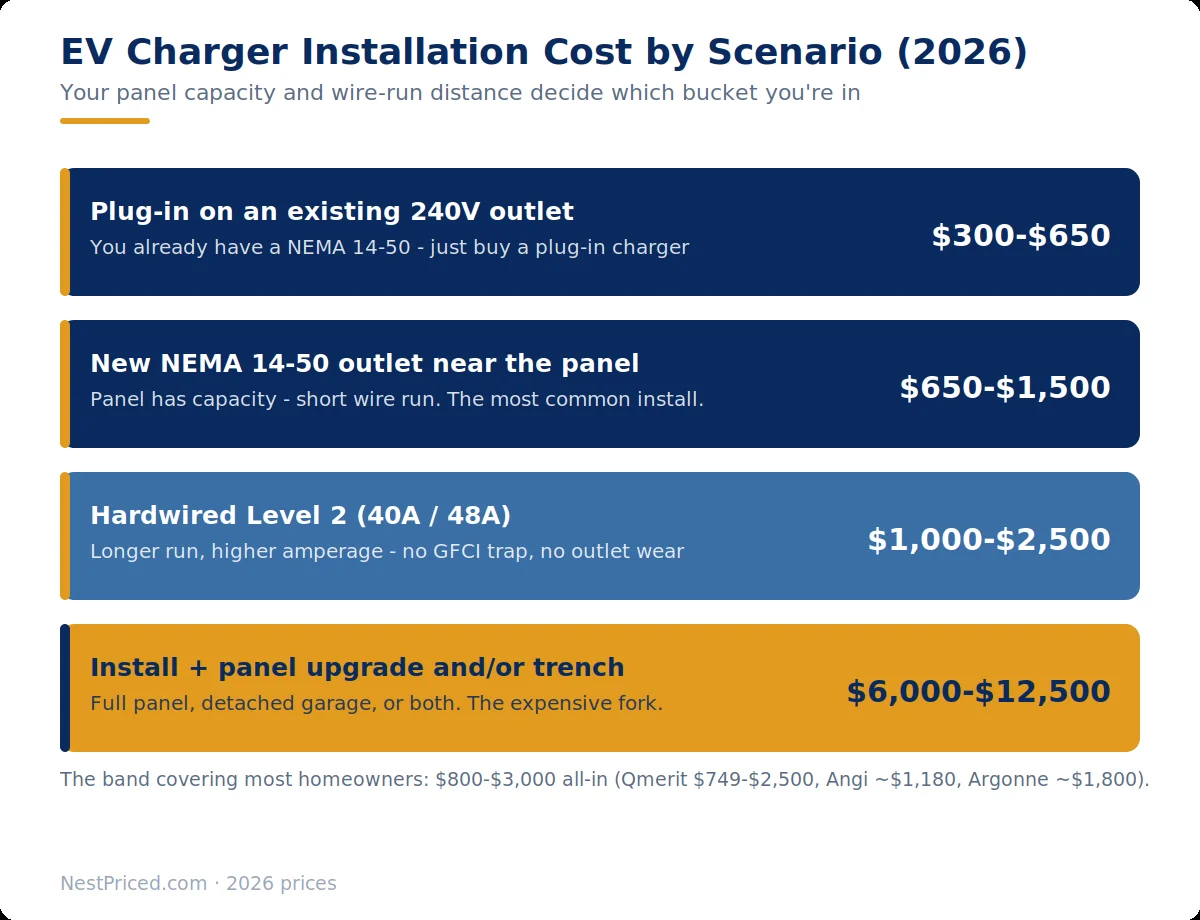
Every home install falls into one of these four buckets. Find yours first, then price it:
| Scenario | Installed cost (2026) | Who this is |
|---|---|---|
| Plug-in on an existing 240V outlet | $300–$650 | You already have a NEMA 14-50 in the garage; you just buy a plug-in charger. |
| New NEMA 14-50 outlet near the panel | $650–$1,500 | Panel has capacity; short wire run. The most common install. |
| Hardwired Level 2 (40A/48A) | $1,000–$2,500 | Longer run, higher amperage, or you want no GFCI trap and no outlet wear. |
| Install + panel upgrade and/or trench | $6,000–$12,500 | Full panel, detached garage, or both. The expensive fork. |
The band that covers most homeowners is $800–$3,000 all-in (Qmerit 2026: $749–$2,500, avg ~$1,700; Angi: ~$1,180 incl. hardware; Argonne National Lab: ~$1,800 incl. equipment). Qmerit’s 2026 state table shows real spread — Wyoming averages $3,585, Nevada $1,387 — so geography moves the needle even within the same scenario.
Hardware: 2026 Level 2 charger prices
Hardware is the smallest line item, but picking the connector now locks you into years of it. Prices below are October 2026 maker-store checks:
| Charger | Price (2026) | Connector | Notes |
|---|---|---|---|
| Tesla Wall Connector | $585 | NACS | 48A, up to 44 mi/hr added; hardwired only |
| Tesla Universal Wall Connector | $660 | NACS + built-in J1772 | 48A, 24-ft cable, 4-yr residential warranty; the mixed-household pick |
| Tesla Mobile Connector | $300 | NACS (14-50 adapter incl.) | Plug-in only — pairs with an existing outlet |
| ChargePoint Home Flex | $549 | NACS or J1772 | Adjustable 16–50A; plug-in and hardwired versions; 23-ft cable |
| Emporia Classic | $449 (J1772) / $479 (NACS) | Both | 48A, 25-ft cable, 3-yr warranty |
| Emporia Pro | $599 | Both | 48A with PowerSmart load management built in |
| Grizzl-E Classic Connect | $350 | J1772 | Cold-climate plug-in pick |
| Grizzl-E Ultimate 48A | $480 | J1772 | Cheapest 48A tracked in 2026 |
| Wallbox Pulsar Plus | ~$649 | NACS or J1772 | Compact 48A |
NACS is the 2026 default. Most major chargers now ship in NACS, J1772, or both. If your household has one Tesla and one non-Tesla, the Universal Wall Connector’s built-in adapter settles the question. Entry 32A units run $200–$350; mid-range 48A Wi-Fi $350–$600; premium $600–$900.
Hardware prices move — the Tesla figures above are the most recent maker-store checks (Oct 2026) and one retailer survey showed lower Tesla numbers. Budget the install, not the exact sticker.
The outlet fork: NEMA 14-50 vs hardwired
This is the first decision that sets your price. A 14-50 outlet installation near the panel runs $300–$1,000; add a plug-in charger ($300–$650) and you’re at $650–$1,500 all-in. But outlets come with three hidden costs the competition never prices:
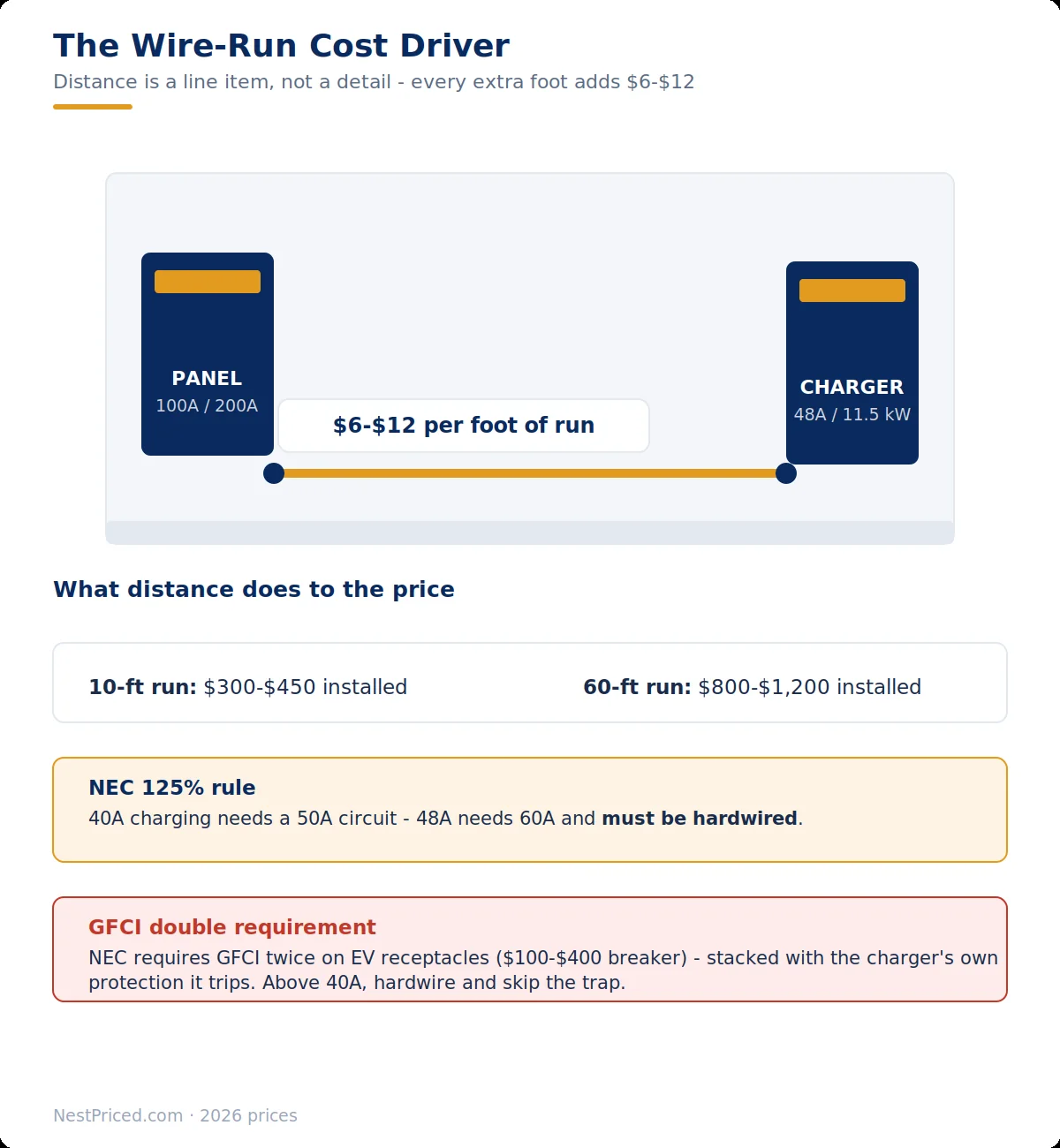
The wire-run rule. Every added foot of run costs about $6–$12 in materials and labor. A 10-ft run runs $300–$450; a 60-ft run $800–$1,200. Distance is a line item, not a detail.
The NEC 125% rule. Circuits must be rated at 125% of continuous draw — 40A of charging needs a 50A circuit, and 48A needs a 60A circuit and must be hardwired. A 50A circuit delivers a maximum of 40A continuous (the 80% continuous-load cap). So the outlet path caps you at 40A charging — about 30 mi/hr added on most vehicles. Want 48A? You’re hardwiring.
The GFCI double requirement — the trap nobody covers. NEC requires GFCI protection on garage 240V receptacles (210.8(A)) and separately on any receptacle installed for EV charging (625.54). That adds $100–$400 for the GFCI breaker, and worse: smart chargers have their own internal ground-fault protection, so stacking a GFCI breaker on top causes widely reported nuisance tripping. This is the honest technical argument for hardwiring above 40A.
Hardwired installs run $500–$1,500 for 40A, $800–$2,500 for 48A (equipment + labor + permit). The outlet path’s only real advantage: you can take the charger when you move.
The panel fork: capacity, upgrades, and the load-management escape hatch
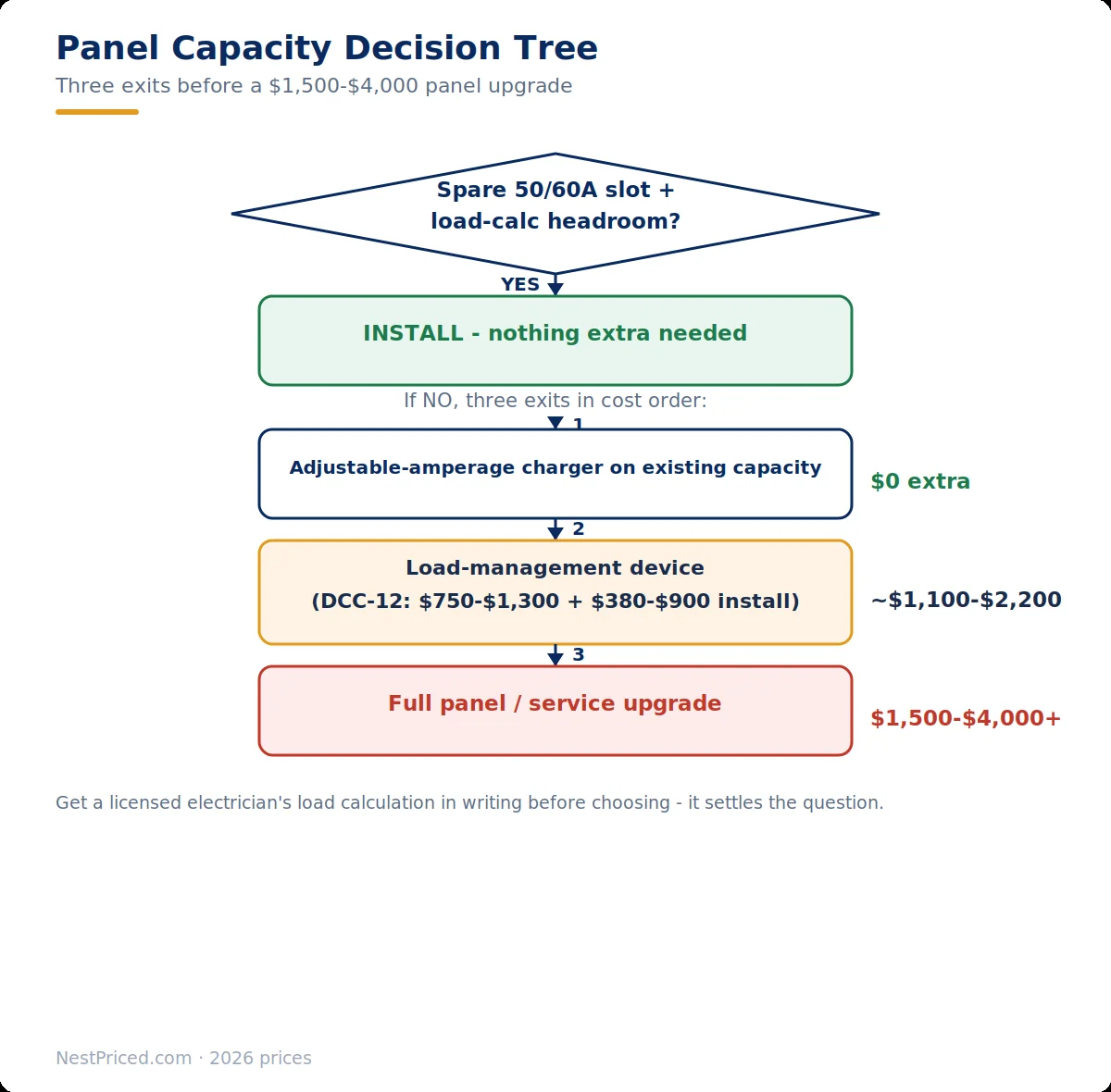
If your panel is full or the load calculation says no, you face three options, in cost order:
1. Adjustable-amperage charger on existing capacity — $0 extra. Chargers like the ChargePoint Home Flex adjust from 16A to 50A. If the load calc allows even 20A of headroom, you charge slower but pay nothing extra.
2. Load-management device — $1,100–$2,200 installed. The escape hatch zero competitors cover. The DCC-12 EV energy management system ($750–$1,300 hardware + $380–$900 professional install) connects a charger to a full panel without a service upgrade — it cuts charger power when total load exceeds 80% of the main breaker. Emporia’s Pro ($599) includes PowerSmart load management in the charger itself. Circuit splitters that share an existing 240V circuit (e.g., your dryer circuit) are a real category here too.
3. Full panel/service upgrade — $1,500–$4,000+. The biggest single cost multiplier in charger installs — it “effectively doubles the bill” on a typical job.
Panel upgrade context: A 100A→200A panel upgrade runs $1,500–$4,000 in 2026 and is the deep subject of our [electrical panel upgrade cost guide](https://nestpriced.com/plumbing-electrical/electrical-panel-upgrade-cost-2026/). Everything above — load management as the cheaper path — assumes you’ve checked whether you actually need one.
Distance and site work: detached garages and trenching
Detached garages are where installs go from hundreds to thousands. A full scenario — 80-ft run, 40-ft trench, sub-panel in the garage — lands at $5,900–$10,300 (projectcostpro, Jul 2026). The trench alone: $5–$20 per linear foot by method (contractor-dug in easy soil; some electricians quote $50–$100/ft), about $75/ft in grass and $110/ft in asphalt or concrete. Budget the underground run at $500–$1,250 per 50 ft, $1,000–$2,500 per 100 ft. Cheaper detached-garage bands ($1,600–$4,500) exist where soil is easy and no sub-panel is needed.
NEC burial depths: 24 inches for direct-burial cable, 18 inches in PVC conduit. Outdoor installs also mean weather-rated equipment and a mounting structure — all of which adds labor.
The tax fact: 30C = $0 after June 30, 2026
Say it plainly because competitor pages still get it wrong: the 30% EV charger federal tax credit is $0 for new installs in 2026. Section 30C (Alternative Fuel Vehicle Refueling Property Credit) was 30% of charger + install cost, up to $1,000 residential per port, in eligible census tracts, claimed on Form 8911. OBBBA (P.L. 119-21) ended it for property placed in service after June 30, 2026 — confirmed by five independent 2026 sources.
Two precise exceptions: chargers placed in service on or before June 30, 2026 can still be claimed on the 2026 return (filed early 2027) — “placed in service” means installed and operational, not contracted. And a Senate bill (S. 5215, Aug 2026) would restore the credit through 2031 and drop the census-tract rule — but as of October 2026 it had only been referred to the Finance Committee with no movement. Budget $0 until that changes.
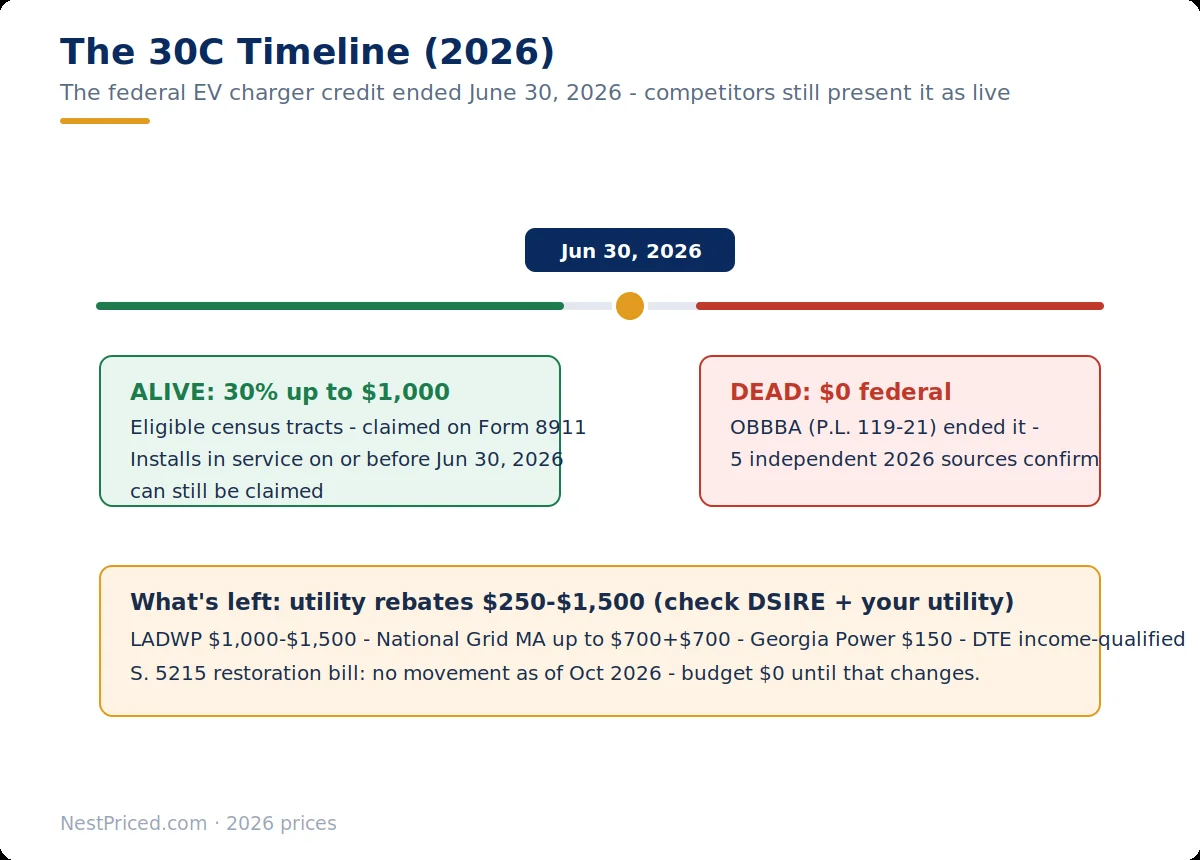
For the full credit-kill list, see our [2026 energy tax credits guide](https://nestpriced.com/solar-energy/federal-energy-tax-credits-2026/). The credit story deserves one more note: multiple cost guides still present 30C as live 2026 guidance (usecalcpro, thegarage.guide — verified stale by crawl, November 2026). Don’t budget it, and don’t let a quote subtract it.
What’s still alive: utility and state rebates in 2026
The federal credit is dead; utility money is real. Qmerit (2026) reports installation rebates of $250–$1,000 or more from numerous utilities, and evchargerlab (2026) puts the band at $250–$1,500. Verified 2026 examples:
- LADWP (Los Angeles): ChargeUp rebates $1,000–$1,500 back, plus a separate $500 Level 2 rebate (licensed electrician + inspection required).
- National Grid MA (2026): up to $700 wiring/circuit rebate (up to $1,400 multi-family) + up to $700 smart-charger rebate; off-peak program enrollment required.
- Georgia Power (2026): $150 per Level 2 wall/pedestal charger, up to 2 per account; installs completed by Dec 31, 2026; mobile connectors excluded.
- Missouri River Energy Services: $500 for ChargePoint Home Flex / $150 for other Level 2; one per EV owned or leased.
- DTE (Michigan): income-qualified home EV charger rebate still available.
Check the ENERGY STAR rebate finder + your utility + DSIRE before budgeting a dollar of it — the same discipline as our other incentive sections. Programs open, pause, and close without notice.
Permits and the insurance question
Budget permits at $50–$400 — Qmerit’s national average is $282; straightforward jurisdictions land $50–$200, LA runs $150–$400. Permits are required in virtually every jurisdiction for a new 240V circuit, and the consequence of skipping is not just a fine: unpermitted electrical work can affect a homeowners insurance claim if the work is ever connected to a loss. Get the permit; it’s the cheapest line item on the invoice.
Does HEAR help with charger installs?
HEAR rebates do not cover EV chargers as a measure — the measure list is insulation, air sealing, ventilation, heat pumps, appliances, and electrical panel/wiring upgrades (DOE Notices 26-1/26-2, May 2026). The panel and wiring enabling work for a charger may qualify under some state programs as an electrification-enabling upgrade — but only ~9 states had launched as of late summer 2026, and charger-driven work is state-variable. Ask your state energy office and cite DSIRE; never budget it as a promise. The insulation-first rule doesn’t gate charger work at all — the charger isn’t a HEAR measure, so the envelope prerequisite is irrelevant to it.
Charging economics: the payback math
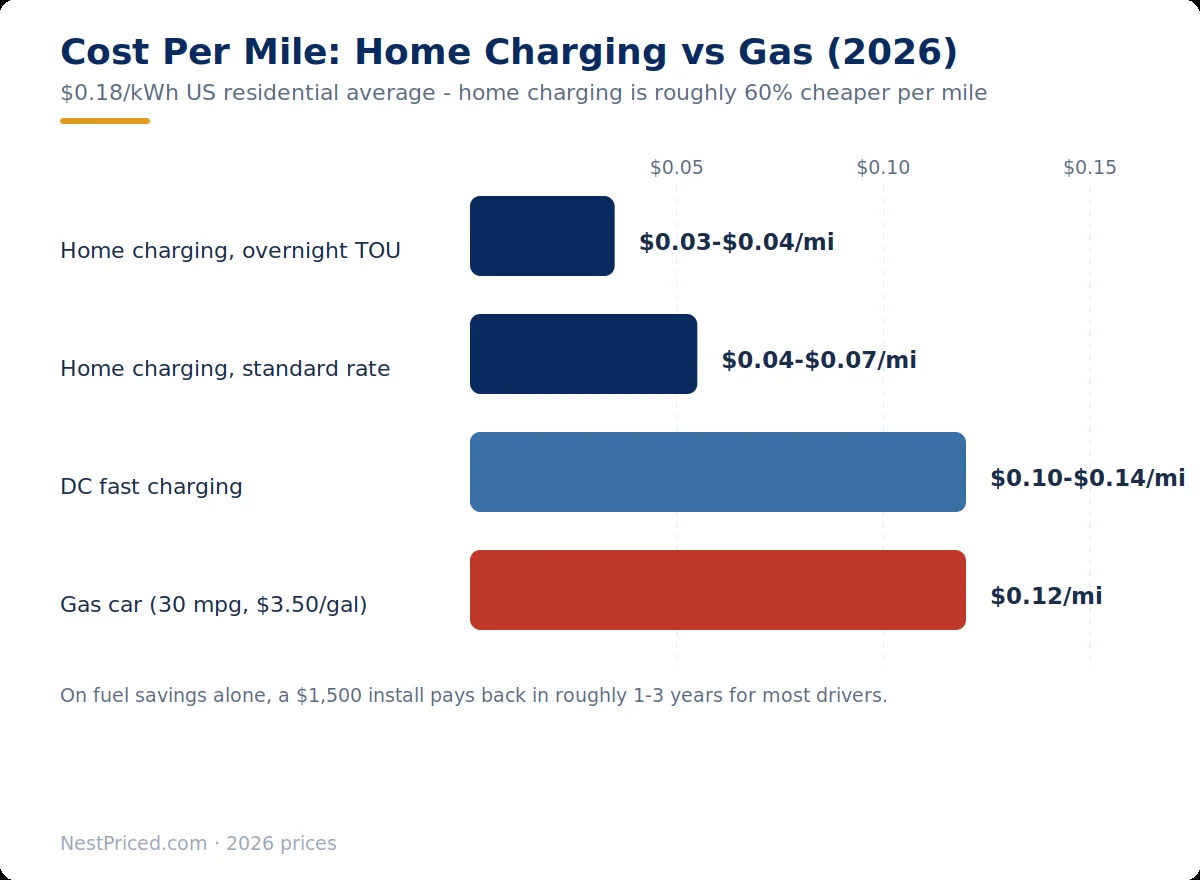
Install cost is only half the story. Home charging runs $0.04–$0.07 per mile at standard residential rates ($0.18/kWh US average, mid-2026), or $0.03–$0.04 per mile on overnight time-of-use rates — roughly $480–$840/year for 12,000 miles, or $360–$480 on TOU. A 30-mpg gas car at $3.50/gal costs about $0.12 per mile, ≈$1,400/year. Home charging is roughly 60% cheaper per mile than gas. About 80% of all EV charging happens at home, so the install payback is real: on the fuel savings alone, a $1,500 install pays back in roughly 1–3 years for most drivers.
Two reality checks: DC fast charging runs $0.30–$0.60+/kWh (≈$0.10–$0.14/mi) — 2–3× home rates, roughly tying an efficient gas car, so road-trippers should discount the math. And solar + charger turns marginal operating cost to near-zero — if you’re already on the solar path, see our [solar panel cost guide](https://nestpriced.com/solar-energy/solar-panel-cost-2026/) and [solar battery cost guide](https://nestpriced.com/solar-energy/solar-battery-cost-2026/); solar-excess charging modes are now standard on several 2026 chargers.
What a good install quote itemizes
A lump sum is not a quote. Demand all eight in writing:
- Charger model + amperage — “ChargePoint Home Flex 50A” not “Level 2 charger”
- Wire run distance and gauge — feet of run, wire size; the $6–$12/ft rule makes this checkable
- GFCI breaker line item — included or hardwired (if omitted on an outlet job, ask why)
- Panel scope — new breaker position, load calculation result, or the load-management device being installed
- Permit fee — listed separately ($50–$400)
- Rebate handling — which utility rebates they’re claiming or filing for you
- Trench/sub-panel scope (if any) — feet of trench, depth, paving restoration
- Warranty terms — workmanship warranty in years and who honors the charger warranty
Get three quotes. The spread on identical specs routinely runs 20–40% — and on a job where the panel fork decides everything, make sure every quote answers the same question: what’s my panel’s actual capacity?
Key takeaways
– Most Level 2 home installs: $650–$2,500; the real answer is a fork (plug-in $300–$650 vs panel-upgrade/trench $6,000–$10,000+).
– Hardware is the cheapest line item — the install is the money (roughly 75% labor + materials).
– NEC 125% rule caps outlet charging at 40A; the GFCI double requirement is the honest argument for hardwiring above 40A.
– Load management (DCC-12 ~$1,100–$2,200 installed) is the escape hatch that can avoid a $1,500–$4,000 panel upgrade.
– 30C = $0 federal for installs after June 30, 2026; utility rebates ($250–$1,500) are the real money left.
– Home charging costs $0.03–$0.07/mi vs $0.12 gas — the install pays back in 1–3 years for most drivers.
Sources & methodology
Cost figures compiled November 2026 from published 2026 cost guides and installer data: Qmerit (2026 installer-network data — $749–$2,500 installs, ~$1,700 avg, $282 permits, state table, utility rebates $250–$1,000+); Angi (~$1,180 incl. hardware, via evchargerlab Sep 2026); Argonne National Laboratory (~$1,800 incl. equipment, via earlybirdelectricians Sep 2026); evchargerlab.com (Sep 2026 — $400–$1,200 near-panel installs, NEC 125% rule, splitter pricing); usecalcpro.com (2026 — $800–$4,000 band, 75/25 hardware/labor split; 30C content verified stale Nov 2026); ev-global.org (Oct 2026 — $1,200–$3,000); carslens.com (Sep 2026 — $800–$2,500); grindguide.online (2026 — $749–$2,500, $75–$200/hr); verdek.com (Oct 2026 — $800–$3,500; 30C ended Jun 30, 2026); projectcostpro.com (Jul 2026 — trench $11.76–$20/ft, detached garage $5,900–$10,300); cheapevcharger.com (Jul 2026 — scenario bands, copper wire pricing); scopegauge.com (2026 — $800–$2,500 residential); thegarage.guide (2026 — 14-50 wire-run rule; 30C content verified stale Nov 2026); ibelectric.com (2026 — 14-50 $300–$1,000, GFCI detail); evseekers.com (2026 — 14-50 $300–$1,000, insurance note); amyelectric.com (Jun 2026, LA — install bands, LADWP rebates); eastsideelectricalwa.com (Oct 2026 — trench budgets, NEC burial depths); metroev.ca (Aug 2026 — trench pricing, CA market); mywebanswers.com (2026 — trench quotes); earlybirdelectricians.com (Sep 2026 — scenario table, Argonne data). Hardware prices: trendytechtribe.com (Oct 28, 2026, maker-store checks — Tesla $585/$660/$300, ChargePoint $549, Grizzl-E $350); emporiaenergy.com (Oct 30, 2026 — $449/$599); evdigest.org (Oct 2026 — Wallbox $649); greenlivingguy.com (Oct 2026 — Grizzl-E Ultimate $480). Load management: monta.com (2026 — DCC-12 $750–$1,300 + $380–$900 install); Emporia (2026 — PowerSmart). Tax: OBBBA P.L. 119-21; IRS Form 8911 instructions; evcharginghelp.com (Oct 2026 — 30C expiry record, S. 5215 status as of Oct 2026); nuwattenergy.com (Apr 2026); blinkcharging.com (Sep 2026); cleanenergycalc.com (Sep 2026); thechargeport.com (2026); goodleap.com (Sep 2026). Rebates: georgiapower.com (2026 terms); nationalgridus.com (MA 2026); Missouri River Energy Services Bright Energy Solutions form (2026). Operating cost: EIA via qmerit.com (Jul 2026 — $0.18/kWh); electvehicles.com (Jul 2026 — 18.05–18.83¢/kWh, TOU 5–9¢); elevatehomeguide.space (2026 — per-mile table); evgascalc.com (2026 — 60% less than gas, 80% home charging); cali-energy.com (Sep 2026 — CA per-mile). Competitor staleness verified by crawl, November 2026 (usecalcpro.com, thegarage.guide).
Disclaimer: Prices are 2026 US national averages and vary by region, panel capacity, wire-run distance, and installer — get 3 written, itemized local quotes. Tax and rebate information is general and not tax advice — confirm with a tax professional and verify program status on DSIRE before budgeting, as programs open, pause, and close without notice. Charger electrical work (panel, wiring, trenching, commissioning) is licensed-electrician territory — this article covers cost information only, never DIY electrical instructions. Permits are required for new 240V circuits in virtually all jurisdictions.
How much does it cost to install a Level 2 EV charger at home in 2026?
Most Level 2 home installs run $650–$2,500 (national averages cluster around $1,200–$1,800 all-in). The real answer is a fork: a plug-in charger on an existing outlet costs $300–$650, while a 48A hardwired unit plus a panel upgrade plus a trench to a detached garage can reach $6,000–$10,000+.
Is the EV charger tax credit still available in 2026?
No — for new installs. Section 30C (30%, up to $1,000) ended for property placed in service after June 30, 2026 under OBBBA (P.L. 119-21). Chargers installed and operational on or before June 30, 2026 can still be claimed on the 2026 return via Form 8911. A Senate restoration bill (S. 5215) had not advanced as of October 2026. Utility rebates of $250–$1,500 remain the real money.
How much does a NEMA 14-50 outlet installation cost?
$300–$1,000 for a straightforward garage job near the panel, plus $300–$650 for a plug-in charger. Budget a $100–$400 GFCI breaker (NEC requires GFCI protection two independent ways on EV receptacles), and know the 40A charging cap on a 50A circuit — the outlet path caps you at about 30 mi/hr added.
How much does it cost to install a Tesla Wall Connector?
The Wall Connector retails at $585 (Oct 2026 maker price); the Universal (NACS + J1772) is $660. Installation runs $500–$1,200 for a straightforward job, up to $2,500 for a 48A hardwired install with a long wire run. Total: roughly $1,100–$3,100 for most homes.
Do I need a panel upgrade to install an EV charger?
Not always. Three options in cost order: (1) an adjustable-amperage charger on existing capacity ($0 extra); (2) a load-management device like the DCC-12 (~$1,100–$2,200 installed) that avoids a service upgrade; (3) a full panel/service upgrade ($1,500–$4,000+). A licensed electrician’s load calculation settles it — get it in writing.
How much does it cost to trench for an EV charger in a detached garage?
Trenching runs $5–$20/ft in easy soil (about $75/ft grass, $110/ft asphalt), and a full detached-garage scenario (80-ft run, 40-ft trench, sub-panel) lands at $5,900–$10,300. Cheaper bands ($1,600–$4,500) exist where soil is easy and no sub-panel is needed.
How much does it cost to charge an EV at home per mile?
$0.04–$0.07 per mile at standard residential rates ($0.18/kWh), or $0.03–$0.04 per mile on overnight time-of-use rates — roughly $480–$840/year for 12,000 miles. A 30-mpg gas car costs about $0.12/mi (~$1,400/yr), so home charging is roughly 60% cheaper per mile.