

Mississippi buys a heat pump for August first and January second, and the order matters more here than in almost any other state. Jackson averages about 85 days a year at 90 degrees or hotter, and the air on those days carries Gulf moisture that makes 91 degrees feel like a wet blanket. A machine that cools fast but leaves the humidity behind has done half the job and charged for all of it.
The winter side of the same machine is almost gentle by comparison. Jackson counts about 32 nights a year at or below freezing and none at zero or colder. Gulfport counts 16 freezing nights. Tupelo, the coldest of the four cities priced in this guide, counts about 54. A standard heat pump carries winters like these without the cold-climate machinery that northern buyers pay thousands extra for, and the quote should say so instead of selling capacity the house will never call on.
The third thing a Mississippi buyer learns is that the rebate follows the electric bill, not the state line. Jackson sits on Entergy Mississippi lines, where a top-tier split heat pump earns up to $1,100. Gulfport and much of Hattiesburg sit on Mississippi Power lines, where the same job earns up to $200 a ton. Tupelo sits in Tennessee Valley Authority country, where the rebate runs $500 to $800 through a TVA-vetted contractor. Hattiesburg splits between a big utility and co-op distributors, so two houses on the same street can qualify for different money.
The fuel map decides the rest. About 58 percent of Mississippi homes heat with electricity and about 31 percent with piped gas, and the split swings hard by city: 72 percent electric in Gulfport against 51 percent in Jackson, where 46 percent of homes still burn piped gas. A heat pump replacing resistance heat or a propane furnace saves real money every winter in this state. A heat pump replacing a gas furnace roughly breaks even on heating and wins on the purchase price, because one machine replaces two.
Start with the countrywide figures before the Mississippi ones. Our national heat pump cost guide holds the baseline, and every number below reads against it.
Table of Contents
How Much Does a Heat Pump Cost in Mississippi in 2026?
Three different kinds of published evidence put numbers on the Mississippi market this year, and each one measures a different job, so the figures disagree and the disagreement needs explaining before any two quotes are set side by side. NumeralQ publishes planning estimates from a cost model built on materials plus local labor, priced October 26, 2026, and pins down the machine, the size, and the scope: ducted air-source, 3 tons, installed. BetterHouse scales a national baseline by each state’s HVAC wage index and lands on a wide band with a typical figure near the top of the NumeralQ range. ElectricMetrics publishes a single $13,000 average for a whole-home install with no size or scope attached.
This guide leads with NumeralQ because that band is the only one naming the machine size, the system type, and the pricing date together, and because it labels itself a planning estimate instead of posing as a record of what Mississippians paid. The midpoint, $8,240, is the number the efficiency and payback sections work from. The BetterHouse typical figure of $9,910 sits inside the NumeralQ band near its top, which is reassuring: two different roads reach the same neighborhood. The ElectricMetrics $13,000 average sits above the whole band, but with no size stated it may describe bigger systems, fuller scopes, or both, so it is recorded here and left out of every band that follows.
A fourth figure, from Dun’s wage-adjusted state table, puts Mississippi at $5,250–$9,700 for a ducted system. Its top end lands about $680 under the NumeralQ top, and its bottom end about $850 under the NumeralQ bottom. The gap is method, not mystery: Dun scales a national ballpark by state wages alone, while NumeralQ prices materials and local labor separately. Neither one is a bid. Both agree on the shape of the market: Mississippi is among the cheapest states in the country to install a heat pump, because the crews earn less here, not because the equipment costs less.
| Source | What it prices | 2026 figure |
|---|---|---|
| NumeralQ (Oct 26, 2026, planning est.) | 3-ton ducted air-source, installed | $6,100–$10,380 |
| NumeralQ national (Oct 26, 2026, planning est.) | 3-ton ducted air-source, installed | $6,550–$10,960 |
| BetterHouse (2026, wage-scaled model) | Ducted whole-home, typical | $3,750–$13,110; typical $9,910 |
| Dun (Aug 2026, wage-adjusted ballpark) | Ducted air-source, installed | $5,250–$9,700 |
| ElectricMetrics (July 2026 data) | Whole-home install, average, no size stated | $13,000 average (noted, not adopted) |
Inside the headline band sit the outdoor unit, the indoor coil or air handler, the refrigerant lineset, the pad or stand, the thermostat, the electrical disconnect and wiring, the labor, the startup and commissioning, and the contractor’s markup. Outside it sit the items that surprise Mississippi buyers: new or extended ductwork at $3,580–$6,540 a job depending on the city, a 200-amp panel upgrade at $1,920–$3,410, a coastal corrosion package with no published Mississippi price, a flood-elevation stand on the Coast, and surge protection for the control board.
Jackson and Gulfport each publish their own add-on figures on their NumeralQ pages, and a proper quote carries each add-on as a separate line rather than burying it in the equipment price. A lump-sum quote that folds them in hides the part of the job that grows after the crew opens the attic.
Mississippi sits about 5 to 7 percent under the national band on the same NumeralQ model, which prices the 3-ton job at $6,550–$10,960 across the country. The reason is pay: Mississippi HVAC technicians earn a median $23.41 an hour, and contractors bill $47–$61 per worker-hour after insurance, payroll taxes, overhead, and profit. Equipment ships on national prices, so the saving is all in the crew. That also means the saving shrinks on a job where the hours go to ductwork, panel work, and flood stands rather than to setting the unit.
One more comparison belongs in this section because it reframes the whole purchase. The same NumeralQ model prices a central air conditioner plus a gas furnace, the pair a heat pump replaces, at $7,870–$13,490 for a 3-ton job in Mississippi. The heat pump band sits below the pair’s band at both ends. A Mississippi buyer is not paying a premium for the heat pump and hoping the bills repay it. The buyer is paying less on day one and then collecting the running-cost savings on top, at least against every fuel except piped gas, where the heating bills roughly tie and the purchase saving carries the case alone.
Heat Pump Cost in Mississippi by System Type and Size
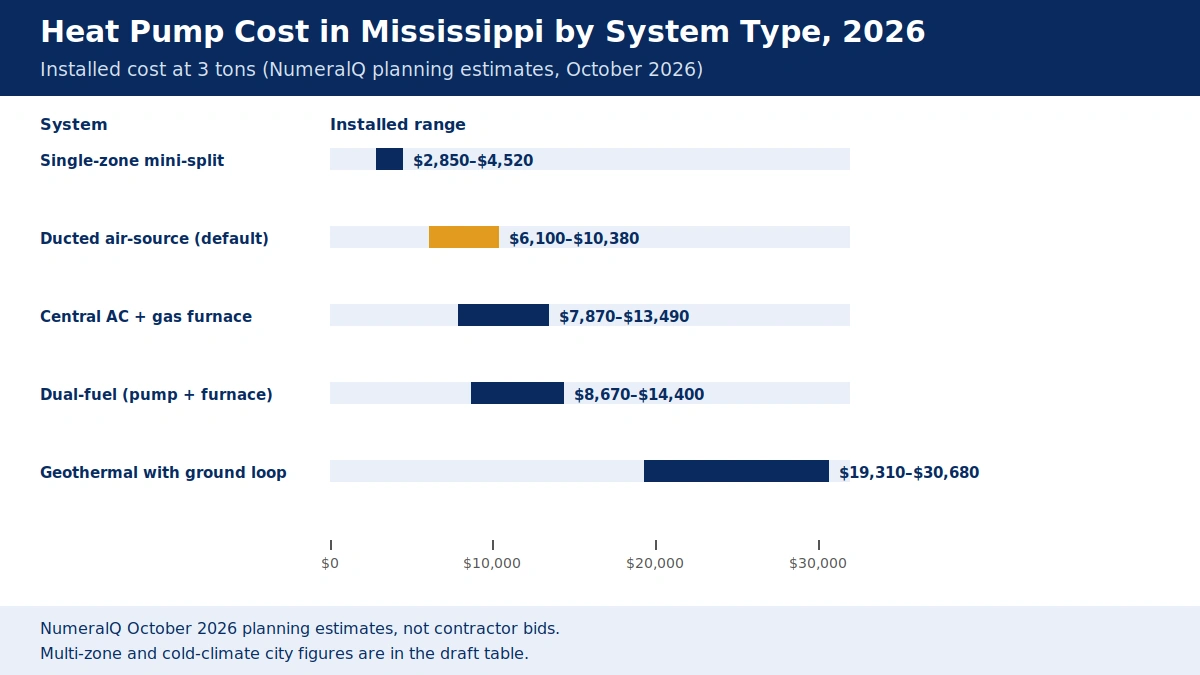
System type is the second-biggest lever on the price after size, and in Mississippi it is also a humidity decision. The table below prices every common system at 3 tons from the NumeralQ state and city pages, with the city rows labeled where the state page publishes no figure. The multi-zone and cold-climate rows come from the Jackson and Gulfport pages because the state page’s by-type table shows only the single-zone mini-split, the ducted system, and geothermal in the text fetched for this guide.
| System (3 tons unless noted) | Mississippi | Jackson | Gulfport |
|---|---|---|---|
| Ductless mini-split, single zone | $2,850–$4,520 | $2,930–$4,630 | $2,840–$4,510 |
| Ductless multi-zone, 3 heads | Not published | $5,800–$10,600 | $5,610–$10,360 |
| Air-source heat pump, ducted | $6,100–$10,380 | $6,230–$10,540 | $6,080–$10,350 |
| Cold-climate heat pump, ducted | Not published | $8,230–$14,540 | $8,060–$14,320 |
| Dual-fuel (heat pump + gas furnace) | $8,670–$14,400 | $8,820–$14,600 | $8,650–$14,370 |
| Central AC + gas furnace (the pair) | $7,870–$13,490 | $8,000–$13,660 | $7,850–$13,470 |
| Geothermal with ground loop | $19,310–$30,680 | $19,570–$31,020 | $19,270–$30,630 |
A ducted air-source heat pump is the Mississippi default, and the default earns its place. One outdoor unit, one indoor air handler or coil, and the existing ductwork carrying both heated and cooled air to every room. At $6,100–$10,380 it undercuts the furnace-plus-AC pair, replaces two aging machines with one new one, and needs no new gas line, no flue, and no combustion venting. The ductwork decides whether the default works: leaky ducts in a hot attic can waste a fifth to nearly a third of the air the new machine moves, which is why the ductwork section below is required reading before the system section is treated as settled.
A single-zone mini-split is the cheapest way into heat pump heating and cooling, and the narrowest. At $2,850–$4,520 it serves one room or one zone: a sunroom off the back of a Fondren bungalow, a garage conversion in Hattiesburg, a bonus room over a Tupelo garage that never held temperature. It needs no ducts at all, which makes it the answer for rooms the ductwork never reached. It is not a whole-home price, and a buyer who compares it against the ducted band without noting the scope difference will feel misled when the second and third zones are priced.
A multi-zone mini-split serves a whole home without ducts, at a price that overlaps the ducted band. Three indoor heads run $5,610–$10,600 depending on the city, and a fourth or fifth head pushes past the ducted midpoint quickly. The system suits homes with no usable ductwork: older houses with ducts too damaged to save, homes on piers where the crawlspace ducts have rotted, additions that outgrew the original system. Each head controls its own room, which helps a house where one side bakes in the afternoon sun while the other stays cool. The per-zone arithmetic, head by head, is worked in full in our mini-split installation cost guide, while homes that could go either way get the head-to-head treatment in our ductless vs ducted guide.
A cold-climate heat pump is the wrong premium for most of Mississippi. At $8,060–$14,540 in the two priced cities, it costs about $2,000–$4,000 more than the standard ducted machine for heating capacity the state rarely needs. Cold-climate machines hold their output far below freezing, which matters in Iowa and means little where the coldest month in Gulfport averages a low of 42 degrees and Jackson counts zero nights at zero. The honest exceptions are narrow: a Tupelo home at the cold end of the state with no backup heat and a buyer who wants the extra margin, or a house where the backup strips would need a panel upgrade the cold-climate machine avoids. For most Mississippi homes, the standard machine plus its backup heat strips covers the winter, and the cold-climate premium buys peace of mind rather than heat.
Dual-fuel pairs the heat pump with a gas furnace and hands the load to whichever machine is cheaper at that hour. At $8,670–$14,400 statewide, it costs about $2,300 more at the midpoint than the heat pump alone. The pairing makes sense where a gas furnace already exists and is young, where piped gas is already in the house and the owner wants furnace heat on the coldest nights, or where the electric panel cannot carry backup strips without an upgrade. It makes little sense as a fresh install in an all-electric Gulfport home, where it adds a gas line, a flue, and a furnace to a house that never needed any of them. The dual-fuel section near the end of this guide prices the switchover logic and the narrow cases where it earns its premium.
Geothermal is the dearest system in the table by a wide margin, and the hardest to justify on Mississippi bills. At $19,310–$30,680 with its ground loop, it costs about three times the air-source midpoint. The ground under Mississippi holds a mild, steady temperature that helps geothermal efficiency, and the indoor unit lasts about 24 to 25 years with a loop rated past 50. But the heating bill it attacks is small: about $371 a year at a seasonal COP of 3.0 on the planning home.
A premium near $16,755 over the air-source machine cannot be recovered from savings that small on any horizon a buyer should plan around. Geothermal in Mississippi is a long-horizon comfort and durability choice, not a savings investment, and any quote presenting it as one has skipped the arithmetic. Our geothermal cost guide prices loop types and the replacement math when the indoor unit eventually ages out.
Size moves the price more than anything else, and the size table below is the one to budget from once the system type is chosen. Every figure is a ducted air-source install from the NumeralQ state model. A ton is 12,000 BTU of cooling per hour, and the tonnage a house needs comes from a Manual J load calculation, not from the square footage alone and never from the size of the unit being replaced.
| Size | Mississippi, ducted, installed | Rough living area (screen only) |
|---|---|---|
| 1.5 tons | $4,020–$6,580 | Small home or apartment, about 800–1,000 sq ft |
| 2 tons | $4,720–$7,840 | About 1,000–1,300 sq ft |
| 2.5 tons | $5,410–$9,110 | About 1,300–1,600 sq ft |
| 3 tons | $6,100–$10,380 | About 1,600–2,000 sq ft |
| 3.5 tons | $6,790–$11,640 | About 2,000–2,300 sq ft |
| 4 tons | $7,490–$12,910 | About 2,300–2,700 sq ft |
| 5 tons | $8,870–$15,440 | About 2,700–3,300 sq ft |
The living-area column is a screen, not a sizing, and the distinction carries real money. Two 2,000 sq ft houses in Jackson can need different machines: one shaded by live oaks with new windows and attic insulation, the other facing west with single-pane glass and ducts in a vented attic. The first may hold temperature on 3 tons.
The second may need 3.5 and still struggle on the hottest afternoons if the ducts leak. A bidder who sizes from square footage alone, or who matches the old unit’s nameplate without measuring, is guessing with the buyer’s money. The residential code requires sizing from a Manual J calculation, and the quote should name the result in tons and show the calculation behind it.
The step from 3 tons to 4 tons adds about $1,390–$2,530 on the state band, and the step from 3 to 5 tons adds about $2,770–$5,060. Those steps are the cost of guessing wrong in the other direction: an oversized machine costs more to buy, cycles on and off in short bursts, and never runs long enough to wring the moisture out of Mississippi air. The sizing section below explains why the bigger machine is often the worse machine in this climate, and why the Manual J result should be believed over the rule of thumb even when it names a smaller unit than the buyer expected.
Heat Pump Cost by City: Jackson, Gulfport, Hattiesburg & Tupelo
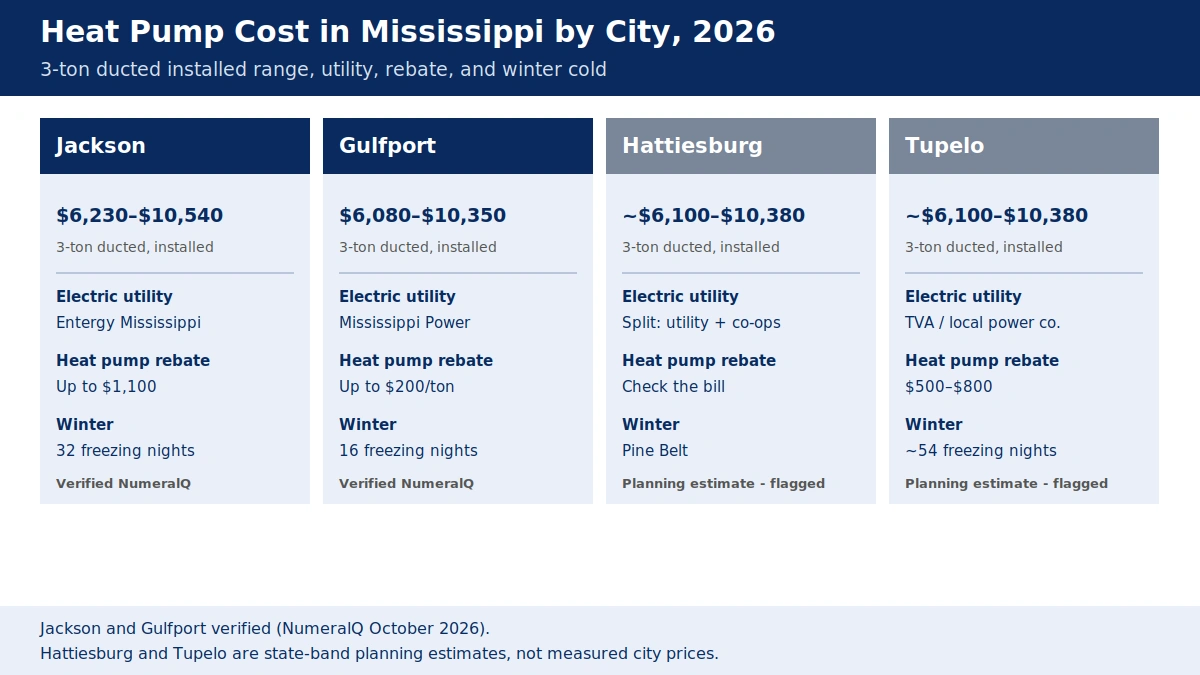
Mississippi has no expensive heat pump market and no cheap one. The two cities with published cost-model pages sit $150–$190 apart at the ends of the 3-ton band, which is the flattest city map a buyer could ask for. What sets the four cities apart is not the equipment price, which ships nationally, but the crew’s pay, the utility on the bill, the heating fuel already in the house, the winter cold, and the storm and flood rules. The table below labels each city’s figure honestly: Jackson and Gulfport carry verified model prices, while Hattiesburg and Tupelo carry planning estimates drawn from the state band.
| City | 3-ton ducted | Basis | Electric utility & rebate | Freezing nights / HDD |
|---|---|---|---|---|
| Jackson | $6,230–$10,540 | NumeralQ verified | Entergy Mississippi, up to $1,100 | 32 nights / 2,123 HDD |
| Gulfport | $6,080–$10,350 | NumeralQ verified | Mississippi Power, up to $200/ton | 16 nights / 1,507 HDD |
| Hattiesburg | ~$6,100–$10,380 | State band, planning estimate | Split: Mississippi Power + co-ops | Not verified; Pine Belt, milder than Tupelo |
| Tupelo | ~$6,100–$10,380 | State band, planning estimate | TVA EnergyRight, $500–$800 | About 54 nights / 2,727 HDD |
Jackson is the capital, the largest market, and the dearest verified figure by a small margin. HVAC technicians in the Jackson metro earn a median $25.03 an hour, 15 percent below the national median, and contractors bill $50–$65 per worker-hour. The housing stock shapes the job more than the labor rate does: 69 percent of Jackson units are single-family houses, only 49 percent of homes are lived in by their owners, and the median home is worth $111,700, so the typical install costs about 7.5 percent of the median home’s value, one of the highest shares among the 147 markets NumeralQ prices. Competition is thin, with 49 plumbing, heating, and air conditioning contractors counted in Hinds County in 2023, or 4.6 per 10,000 homes against a national rate of 7.7, which leaves less room to bargain and makes the three-quote rule harder to fill well.
Jackson is also the most gas-heated city of the four, with 46 percent of homes on piped gas and 51 percent on electric heat. A heat pump in a gas-heated Jackson home more often needs panel work, because the house was wired for a gas furnace and an air conditioner rather than for backup heat strips. The permit goes to the Office of Code Services, and the city adds its own contractor license on top of the state one, both covered in the licensing section. April and October are the mildest months at Hawkins Field by degree days, which makes them the kindest months to be without a system for a day. The federal rebate program has not launched, the federal credit is $0, and the Entergy rebate of up to $1,100 is the only money on the table beyond the purchase saving itself.
Gulfport is the cheapest verified figure and the most electric-heated city, with 72 percent of homes on electric heat and 25 percent on piped gas. HVAC technicians earn a median $23.19 an hour, 21 percent below the national median, and contractors bill $46–$60 per worker-hour, which explains the $150–$190 gap against Jackson. The median home is worth $174,600, so the typical install costs about 4.7 percent of the median home’s value. Owners occupy 55 percent of Gulfport homes, and Harrison County counted 49 plumbing, heating, and air conditioning contractors in 2023, or 5.2 per 10,000 homes, again below the national rate.
Gulfport’s winters barely test a heat pump: 16 freezing nights, a coldest month averaging a low of 42 degrees, and 1,507 heating degree days against 5,483 at the median United States station. The city’s real price drivers sit outside the equipment table: the flood ordinance that can require the outdoor unit a foot above the base flood elevation, the salt air that shortens an unprotected unit’s life, and the wind rules that follow every Gulf storm. March and April are the mildest months at the Gulfport-Biloxi airport station. Mississippi Power’s rebate of up to $200 a ton, up to $600 on a 3-ton system, is the money available, and the city’s mechanical permit and air conditioning inspector add a step Jackson handles differently.
Hattiesburg anchors the Pine Belt in south-central Mississippi, between Jackson and the Coast, and its price is a planning estimate because no published cost model prices the city. The state band stands in, and three local quotes are the real price. The city’s defining feature for a heat pump buyer is its split electric map: Mississippi Power serves much of the city while co-op distributors serve other addresses, and the rebate follows the distributor, not the city limit sign. A Hattiesburg buyer who assumes the Mississippi Power rebate without reading the bill may find the address sits on co-op lines with different money or none at all.
Hattiesburg’s climate sits between Jackson’s and Gulfport’s, with hot humid summers and mild winters, and no verified heating-degree-day figure for the city was found in the research for this guide, so none is asserted here. The permit desk is the city’s Department of Urban Development, Land Development Division, and the rebate question should be settled with the utility or co-op on the bill before any bidder subtracts money from a quote. Hattiesburg homes run from older houses near the universities to newer subdivisions spreading toward Oak Grove and Petal, and the older homes carry the same ductwork risk as the rest of the state, with ducts in hot attics that have had decades to leak.
Tupelo anchors northeast Mississippi in Lee County, in Tennessee Valley Authority country, and its price is also a planning estimate from the state band. Tupelo is the coldest of the four cities by a clear margin: 2,727 heating degree days on the 1991–2020 normals, about 54 freezing nights, and 70 days a year at or above 90 degrees. It is also the wettest-feeling of the four in winter, with 55 inches of annual precipitation spread fairly evenly through the year. The colder winter does not make Tupelo a cold-climate market: zero nights at zero degrees means a standard machine still carries the season, but the backup heat strips will run more hours here than on the Coast, and the quote should say what the backup arrangement is rather than leaving it implied.
Tupelo’s rebate runs through TVA EnergyRight and the local power company: $500 for a heat pump rated 15 to 16.99 SEER2 and $800 at 17 SEER2 or higher, plus $800 for a ductless mini-split and $1,500 for geothermal, all through a Quality Contractor Network installer. The TVA rules also carry a fuel question the buyer must settle before signing, covered in the rebates section. Southaven, the Memphis suburb in DeSoto County, is the city this guide does not price separately: it sits on Entergy Mississippi lines, its winters run close to Tupelo’s, and the state band plus the Entergy rebate schedule is the honest planning figure for an address there. Readers in Southaven should read the Jackson rebate rows and the Tupelo climate rows together.
Mississippi Summers Set the Rules: Humidity, Sizing & Why Bigger Is Worse
A heat pump in Mississippi is an air conditioner that also heats, and the cooling half of the job is the harder half. Jackson’s July and August average highs sit near 91 and 92 degrees, with about 85 days a year reaching 90 or hotter. The heat alone would be manageable. The moisture riding in from the Gulf is what breaks a badly sized system, because a house can sit at 74 degrees on the thermostat and still feel damp, sticky, and uncomfortable when the humidity stays high.
The humidity numbers explain the feeling. Jackson averages about 128 days a year with muggy-or-worse humidity, measured by a dew point above 65 degrees, peaking at about 29 such days in July alone. Relative humidity runs roughly 70 to 84 percent by month. Tupelo’s 55 inches of annual rain and Jackson’s roughly 57 inches keep the ground, the crawlspaces, and the air wet for much of the year.
A cooling system in this state does two jobs at once: it lowers the temperature, which is the sensible load, and it pulls moisture out of the air, which is the latent load. The second job takes time. A system must run long, steady cycles to wring moisture from the air, and that single fact decides the sizing argument.
An oversized heat pump cools the air fast, satisfies the thermostat, and shuts off before it has dehumidified anything. The house hits the set temperature in short bursts, the humidity stays high, the thermostat calls again, and the cycle repeats all afternoon. The buyer paid extra for the bigger machine and got a clammy house, higher bills from the constant starting and stopping, and more wear on the compressor. An undersized machine has the opposite failure: it runs all day on the hottest afternoons and never reaches the set temperature at all. The right size sits between the two failures, and only a load calculation finds it.
That calculation has a name, and the quote should show it. Manual J is the method for working out how much heating and cooling a specific house needs, room by room, accounting for the windows, the insulation, the air leakage, the orientation, and the local weather. Manual S is the method for picking equipment that matches the Manual J result.
The 2021 International Residential Code requires equipment sized by Manual S from Manual J loads, and both NumeralQ city pages repeat the requirement for Mississippi buyers. A bidder who sizes from the square footage alone, or who reads the old unit’s nameplate and orders the same tonnage, has skipped the step the code requires. Ask for the Manual J result in writing, in tons, with the cooling load and the heating load stated separately.
The old unit’s size is a particularly bad guide in Mississippi. Many older systems were sized generously, on rules of thumb from an era when electricity was cheaper and humidity control was an afterthought. A house that gained attic insulation, new windows, or sealed ducts since the old unit went in may need a smaller machine than the one being replaced.
A house that added a sunroom, enclosed a porch, or opened a wall may need a bigger one. The Manual J calculation catches both changes. The nameplate catches neither.
Variable-speed equipment changes the sizing argument in the buyer’s favor, and it is worth understanding before the efficiency section prices it. A single-stage machine runs at full blast or not at all, which is the worst pattern for humidity control. A two-stage machine runs at a lower stage much of the time and steps up only on the hottest hours. A variable-speed machine adjusts its output continuously, running long, gentle cycles that pull moisture steadily while holding the temperature even. In a humid climate, the comfort difference between single-stage and variable-speed is larger than the efficiency rating alone suggests, because the variable-speed machine spends its hours dehumidifying while the single-stage machine spends its hours starting and stopping.
Backup heat deserves a paragraph of its own, because Mississippi buyers hear conflicting advice about it. A heat pump carries electric resistance strips as backup heat for the coldest hours, when the outdoor air holds too little heat for the pump to move economically. In Jackson, with 32 freezing nights and a coldest-month low averaging 38 degrees, the strips run rarely. In Gulfport, with 16 freezing nights, they run more rarely still.
In Tupelo, with about 54 freezing nights, they run more often but still a small share of the season. The strips are expensive heat when they run, at the full resistance price of about $44.55 per million BTU of delivered heat, so the control settings matter: the thermostat should bring the strips on only when the pump genuinely cannot keep up, not at the first cold snap. The quote should name the backup arrangement, the strip size in kilowatts, and the control logic, in writing.
Defrost cycles are the other winter behavior worth knowing before the first cold morning. When outdoor temperatures hover near freezing with damp air, frost builds on the outdoor coil, and the machine briefly reverses to melt it, sometimes blowing cool air indoors for a few minutes. Mississippi’s damp, near-freezing nights produce more defrost cycles than a dry cold climate would, but the total heating load is so small that defrost barely moves the seasonal bill. A buyer who notices the brief cool puffs on a January morning in Jackson is seeing normal operation, not a fault. A buyer whose system blows cool air for long stretches on a mild day has a problem worth a service call, and our heat pump repair cost guide prices the common fixes before that call is made.
Timing the install around Mississippi weather saves discomfort more than money. April and October are the mildest months in Jackson, and March and April the mildest in Gulfport, by heating and cooling degree days at the local weather stations. A day without heating or cooling in those months is a mild inconvenience. A day without cooling in July, after a breakdown, is a miserable one, and emergency scheduling in peak season leaves no room to compare three bids properly. A buyer whose system is aging should plan the replacement for a shoulder month, get the Manual J done while the old machine still runs, and sign from a position of comfort rather than crisis.
Heat Pump vs Gas, Propane & Resistance Heat: The Running-Cost Math
Mississippi is a state where the heat pump beats two fuels by a wide margin and roughly ties the third, and the direction surprises buyers who read national coverage written for colder states. Electricity here is cheap by national standards, gas is not especially cheap, and winters are short and mild. Those three facts together make the heat pump’s case stronger in Mississippi than in Iowa, where cheap gas and brutal winters flip the comparison. The sums below use Mississippi rates, Mississippi winters, and a planning home the reader can rescale to their own house.
The rates first, because every figure that follows hangs on them. Electricity averaged 15.2 cents a kilowatt-hour for Mississippi homes across 2026 so far, on Energy Information Administration figures, against 18.2 cents nationally. The single month of August 2026 came in at 14.43 cents, up 6 percent on the year before, with the average August bill reaching $238.78 on heavy summer use.
The 15.2-cent planning price is the fairer full-season figure, but the spread across Mississippi’s roughly 40 utilities runs from about 12.2 cents to about 18.4 cents, so a buyer on a high-rate co-op or municipal system should rerun these sums at their own bill’s rate. Natural gas averaged $1.63 a therm on the 2025 annual figures, which is the most recent full-year EIA average. Propane cost $3.20 a gallon in the EIA weekly survey for the week of November 9, 2026, up 21 cents on the year before.
The planning home is a 2,000 sq ft Jackson-area house needing about 25 million BTU of delivered heat a year. That figure is a NestPriced planning assumption, stated plainly so the reader can scale it: a smaller or tighter house needs less, a larger or leakier one needs more, and a Tupelo house needs more than a Gulfport house of the same size. It is deliberately far below the 48 million BTU planning home used for Iowa, because Jackson’s 2,123 heating degree days are a fraction of a northern winter. No Mississippi-specific federal survey figure for delivered heat was verified in the research for this guide, so the per-million-BTU table below is the verifiable core of this section, and the annual figures follow from the stated assumption rather than pretending to be measured bills.
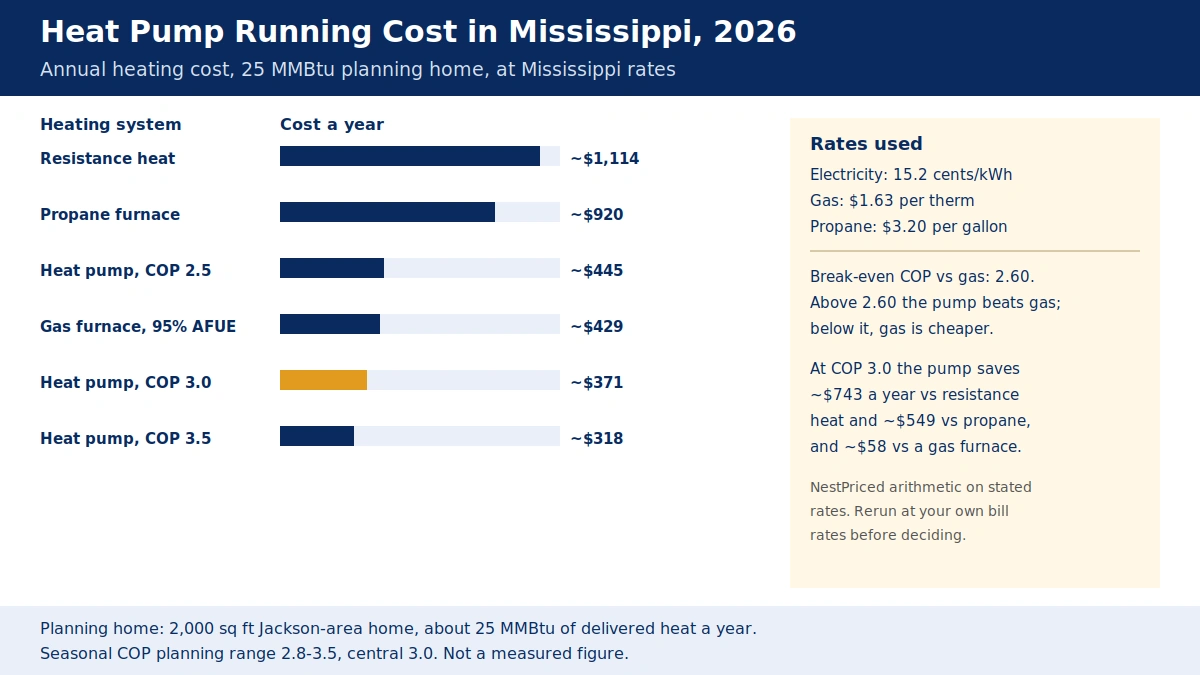
A million BTU is a useful unit because it strips the house out of the comparison. Electric resistance heat, the strips in an electric furnace or the baseboards in an older home, turns each kilowatt-hour into 3,412 BTU and nothing else, so a million BTU of delivered heat costs about $44.55 at 15.2 cents a kilowatt-hour. A heat pump divides that figure by its seasonal COP, the average efficiency across the whole heating season: how many units of heat it moves for each unit of electricity it uses. At a seasonal COP of 2.5, the million BTU costs about $17.82.
At COP 3.0, about $14.85. At COP 3.5, about $12.73. The seasonal COP is the whole argument, and the planning range for Mississippi runs 2.8 to 3.5 with a central figure of 3.0, higher than in cold states because Mississippi winters are warmer and shorter.
Gas at the $1.63-a-therm planning price costs about $17.16 per million BTU of delivered heat through a 95 percent furnace. Gas bills measure heat in therms, and each therm carries 100,000 BTU. AFUE, the annual fuel use efficiency rating, says what share of the fuel’s heat reaches the house, so a 95 percent furnace turns 95 cents of each fuel dollar into heat and loses the rest up the flue. Propane at $3.20 a gallon costs about $36.81 per million BTU through a 95 percent furnace, because a gallon holds 91,500 BTU and the furnace needs about 11.5 gallons to deliver a million BTU after its losses. That propane figure cross-checks against an independent calculation of $36.84 at the same week’s price, which is reassuring.
| Heating option | Cost per MMBtu delivered | Annual cost, planning home (25 MMBtu) |
|---|---|---|
| Electric resistance heat | $44.55 | ~$1,114 |
| Propane furnace, 95% AFUE, $3.20/gal | $36.81 | ~$920 |
| Heat pump, seasonal COP 2.5 | $17.82 | ~$445 |
| Gas furnace, 95% AFUE, $1.63/therm | $17.16 | ~$429 |
| Heat pump, seasonal COP 3.0 | $14.85 | ~$371 |
| Heat pump, seasonal COP 3.5 | $12.73 | ~$318 |
Read the table from the top down and the Mississippi verdict falls out plainly. Against resistance heat, the heat pump at COP 3.0 saves about $743 a year, $1,114 against $371, and that is the saving the 58 percent of Mississippi homes that heat with electricity can actually collect, at least where the electric heat is resistance strips or an aging heat pump rather than a modern one. Against propane, the heat pump saves about $549 a year at COP 3.0, $920 against $371, and the saving grows with every propane price rise. Propane already rose 21 cents a gallon in a year, and a propane-heated home outside the gas mains, common in rural Mississippi, is the second-best heat pump candidate in the state.
Against gas, the story is a tie with a lean in the heat pump’s favor. At COP 3.0 the heat pump costs about $371 a year against about $429 for the gas furnace, a saving of about $58. At COP 2.5 it costs about $445, about $16 more than gas. At COP 3.5 it saves about $111.
The break-even COP against gas sits at about 2.60: run at that seasonal efficiency and the two machines land on the same annual heating bill. A well-installed Mississippi heat pump should clear 2.60 comfortably, but a badly installed one, with leaky ducts in a hot attic and an oversized single-stage machine short-cycling through the winter, can land near it or below it. The install quality decides whether the gas comparison is a small win or a small loss, which is why the ductwork and sizing sections carry as much weight as the equipment choice.
The purchase comparison then settles the gas case in a way the heating bills alone do not. A gas-heated home that needs both a new furnace and a new air conditioner faces the pair’s band of $7,870–$13,490, midpoint $10,680. The heat pump replaces both machines at $6,100–$10,380, midpoint $8,240. The buyer saves about $2,440 on day one, before a single heating bill is counted, and then collects the small annual heating saving on top. A gas-heated home whose furnace is young and whose air conditioner alone has failed faces a different comparison, priced in the decision section, but a home facing a double replacement has no financial reason to buy the pair instead of the pump.
Cooling belongs in this section too, because the heat pump does that job as well and Mississippi’s cooling season dwarfs its heating season. A 3-ton machine running 1,000 hours at full load costs about $383 at 14.3 SEER2, about $342 at 16 SEER2, about $304 at 18 SEER2, and about $274 at 20 SEER2, all at the 15.2-cent planning rate. Those are comparison references, not bills: no house runs 1,000 hours at full load, and a variable-speed machine rarely runs at full load at all.
The point of the reference is the gap between tiers, about $79 a year between the minimum and 18 SEER2 per 1,000 full-load hours, which the efficiency section weighs against the tier premiums. A heat pump and a straight air conditioner of the same efficiency cost the same to run in July, because in July they are the same machine. The saving shows up in January and at purchase, not in the August bill.
Two sensitivities deserve honest treatment before this section closes. The first is the electricity rate: at 18.4 cents, the top of the Mississippi utility spread, resistance heat costs about $53.91 per million BTU, the heat pump at COP 3.0 costs about $17.97, and the break-even COP against gas rises to about 3.14, which a good install still clears but a mediocre one may not. At 12.2 cents, the bottom of the spread, the heat pump wins against gas by a wide margin at any realistic efficiency.
The second sensitivity is the gas price: the $1.63 planning figure is a 2025 annual average, and the 2026 year-to-date figure through the October gas monthly ran higher, at $17.69 per thousand cubic feet. Never build heating math on a summer gas bill: in July almost no gas flows, so the fixed charges pile onto a tiny volume and push the per-thousand-cubic-feet figure near $25 to $35, a number that says nothing about winter heating. Run the sums at the annual average and at your own bill’s rates, and believe the answer that uses your rates.
The same arithmetic at national rates, for readers comparing Mississippi with the rest of the country, sits in our heat pump running cost guide. Readers weighing the pump against a furnace head to head will find that comparison in our heat pump vs furnace guide. For the Mississippi house, the short version is this: the heat pump crushes resistance heat, beats propane by a wide margin, roughly ties gas on heating while undercutting the pair on purchase price, and earns its keep in every fuel case once the air conditioner it replaces is counted. A quote promising more than that has skipped the arithmetic, and a quote promising less has skipped the purchase comparison.
Efficiency Tiers in Plain Words: SEER2, HSPF2 & What Each Step Costs
Efficiency ratings sound like alphabet soup until each letter is translated once, and this section translates them before pricing them. SEER2 stands for Seasonal Energy Efficiency Ratio 2, and it measures how efficiently a machine cools across a whole season: how much cooling it delivers for each unit of electricity. HSPF2 stands for Heating Seasonal Performance Factor 2, and it measures the same idea for heating.
EER2 measures cooling efficiency at one hot condition rather than across a season, which makes it the better guide to a brutal August afternoon. The last rating, COP, answers a narrower question: at one outdoor temperature, in one moment, how many units of heat does the machine shift for each unit of electricity it draws? On every one of these ratings, a higher number means less electricity for the same comfort.
The federal floor is the same everywhere in the country for split heat pumps: 14.3 SEER2 and 7.5 HSPF2, in force since January 1, 2023. No new split heat pump sold in Mississippi may rate below those numbers. That floor is the baseline tier in the table below, and every higher tier is a step above it. The step from the old SEER rating to SEER2 changed the test conditions to match real ductwork more closely, so a 16 SEER machine under the old test rates about 15.2 SEER2 under the new one. A quote showing only the old SEER number is either old stock or old paperwork, and either way the SEER2 and HSPF2 figures should be on the quote in writing, matched to the AHRI certificate for the exact outdoor and indoor combination being installed.
| Efficiency tier | What it usually means | Installed cost, national guides | Premium over base (NumeralQ est.) |
|---|---|---|---|
| 14.3–15.2 SEER2, 7.5 HSPF2 | Federal minimum, single-stage | $5,000–$12,000 | Base |
| 16–17 SEER2, 8–9 HSPF2 | Mid-efficiency, often two-stage | $7,000–$15,000 | +10% to +20% |
| 18–19 SEER2, 9–10 HSPF2 | High-efficiency, variable-speed | $10,000–$18,000 | +25% to +40% |
| 20+ SEER2, 10+ HSPF2 | Top tier, variable-speed | $15,000–$25,000 | +45% to +70% |
The installed-cost column comes from national guides, HomeGuide and Fixr, whose bands run close together and overlap heavily because they price different scopes and different markets. The premium column comes from NumeralQ’s estimate built from the Fixr bands and equipment prices, and it is the more useful column for a Mississippi buyer, because it applies to the Mississippi midpoint directly. On the $8,240 Mississippi midpoint, the 16–17 tier lands at about $9,064–$9,888, the 18–19 tier at about $10,300–$11,536, and the 20-plus tier at about $11,948–$14,008. Those are arithmetic on stated premiums, labeled as such, and the bidder’s quote for a named model replaces every one of them.
The cooling math says the middle tier earns its premium fastest in Mississippi, and the top tier earns its premium slowest. Moving from 14.3 to 16 SEER2 saves about $41 per 1,000 full-load hours on the cooling reference in the last section, and moving from 16 to 18 saves about $38 more. Moving from 18 to 20 saves about $30 more, for the largest price step in the table.
The savings shrink as the rating climbs because each step divides a smaller remaining bill. A buyer who plans to stay in the house for a decade or more, and who values the humidity control that comes with longer, slower runs, has a real case for the 18–19 tier. A buyer planning to move in three years, or buying for a rental, rarely recovers the top tier’s premium from bills alone, and the mid tier is the honest recommendation.
Heating efficiency matters less in Mississippi than cooling efficiency, and the ratings show why. HSPF2 climbs alongside SEER2 in every tier, from 7.5 at the floor to 10 or higher at the top, but the heating bill it attacks is only about $371 a year on the planning home at COP 3.0. Squeezing 10 percent from a $371 bill saves $37 a year. Squeezing 10 percent from a cooling season that produces a $238.78 average August bill saves far more.
Mississippi buyers should weight SEER2 and EER2 more heavily than HSPF2, and should treat a high HSPF2 as a bonus on a machine chosen for its cooling and dehumidification rather than as the reason to buy it. The rebate tiers, covered next, reward both ratings together, which sometimes pushes a buyer toward a higher tier than the bills alone would justify. That push is worth resisting unless the comfort case supports it too.
Two cautions close the section, and both come from how ratings are gamed in quotes. The first is the mismatched combination: the SEER2 and HSPF2 on the brochure describe one specific pairing of outdoor unit and indoor coil or air handler, certified together by AHRI, the industry testing body. Swap the indoor unit for a cheaper one and the certified rating can fall, sometimes below the rebate tier the quote claims.
Ask for the AHRI certificate number for the exact combination on the quote, and check that the ratings on the certificate match the ratings on the quote. The second caution is the rating without the install: a 20 SEER2 machine on leaky ducts in a 140-degree attic delivers a fraction of its rated efficiency to the rooms, while a 16 SEER2 machine on sealed ducts inside the envelope delivers most of its own. Ductwork first, rating second, is the order that gets the buyer the efficiency they paid for.
Ductwork in Older Mississippi Homes: The Hidden Half of the Job
The ductwork decides whether a new heat pump performs like the brochure or like the tired machine it replaced, and in Mississippi the ductwork is often the older, weaker half of the system. Ducts in this state commonly run through vented attics that reach punishing temperatures in July and August, or through crawlspaces that stay damp for much of the year. Both locations punish leaks twice: the conditioned air escapes into spaces that need no conditioning, and the unconditioned air the system pulls back in carries heat and moisture the machine must then remove all over again.
The scale of the loss is well measured, and the figures come from federal sources rather than contractor sales talk. ENERGY STAR says that in a typical house, about 20 to 30 percent of the air moving through the ducts is lost to leaks, holes, and poorly connected ducts, and that leaky ducts can cut heating and cooling efficiency by as much as 20 percent. The Department of Energy puts duct losses at about 30 percent of a cooling system’s energy. Lawrence Berkeley National Laboratory research puts the waste at about 25 percent of the energy used for heating and cooling. Field work backed by the Department of Energy found that sealing ducts saved about 10 percent of heating and cooling energy where ducts ran through a basement, and about 15 to 20 percent where they ran through an attic or crawlspace, which is where Mississippi ducts usually run.
The Mississippi price for fixing the problem depends on whether the ducts need sealing or replacing. New or extended ductwork runs $3,750–$6,540 a job in Jackson and $3,580–$6,310 in Gulfport, on the NumeralQ model, with materials alone at $1,380–$3,450 a job in both cities. Sealing existing ducts costs far less: national guide figures put sealing leaks at $150–$500, reconnecting disconnected ducts at $250–$700, and replacing a damaged section at $400–$1,500, though those are national secondary figures rather than Mississippi prices and should be treated as the shape of the cost rather than a Mississippi quote. A duct leakage test, which pressurizes the ducts with a calibrated fan and measures the escaping air in cubic feet per minute at 25 pascals, gives the buyer a number before and after the work, and the number should be on the quote.
What the crew finds in a Mississippi attic varies by the age and the build of the house. Older homes may carry rigid metal ducts with joints that have opened over decades of heating and cooling cycles, or flexible ducts that have sagged, kinked, or been crushed where someone stored boxes on top of them. Flex duct with a sharp kink chokes airflow to a room as surely as a closed damper, and no new heat pump can fix a room whose duct is pinched flat. Homes on piers, common across south Mississippi, run ducts through crawlspaces where moisture, pests, and the occasional flood have had decades to work on them. A Gulf Coast home that took water in a past storm may carry ducts that look intact from the register and are split open underneath.
The quote should treat the ductwork as a separate scope with its own lines, not as a footnote to the equipment. Ask for the leakage test result, the sealing scope, the insulation state of the ducts, the condition of the flex runs, and the price of each fix separately. Ask whether the ducts sit inside the conditioned envelope or outside it, because ducts inside the envelope lose far less: air that leaks from a duct inside the house still ends up in the house, while air that leaks into a vented attic is gone. A buyer adding attic insulation should price the insulation and the duct sealing together, since the crew is already in the attic and the two jobs share access, and our attic insulation cost guide prices the insulation side of the same visit.
Three rebate lines touch ductwork directly, and they change the sealing arithmetic. Entergy Mississippi pays $100 prescriptive plus $2.50 per cubic foot per minute saved, up to $400, per system, paid to the trade ally and offered at no added cost to the customer. TVA EnergyRight pays a $300 duct sealing rebate through a Quality Contractor Network installer. Mississippi Power offers duct and air sealing incentives through named contractors, with the amount set through the contractor rather than published on the utility page. A sealing job that costs a few hundred dollars and earns a $300 to $400 incentive while cutting bills 15 to 20 percent is the best value in this entire guide, and it should be priced before the efficiency tier is debated, not after.
One warning belongs here because it costs Mississippi buyers real money every year. A new heat pump installed on ducts that leak 25 percent of their air will disappoint its owner in every season: rooms that lag, humidity that never drops, bills that barely move from the old machine’s, and a compressor working harder than it should. The owner blames the machine.
The machine was never the problem. Get the ducts tested, get the result in writing, and get the sealing priced as its own line before the equipment decision is final. The cheapest heat pump on sealed ducts outperforms the dearest heat pump on leaking ones, and the difference shows up on the first August bill.
Rebates & Credits in 2026: Entergy, Mississippi Power, TVA & the $0 Federal Credit
The money available for a 2026 Mississippi heat pump comes from exactly three places: the utility that serves the address, a future federal rebate program that has not launched, and a federal tax credit that no longer exists. This section takes them in reverse order of disappointment, because the fastest way to overpay is to let a quote subtract money that will never arrive.
The federal tax credit is $0. Congress ended both federal credits in the One Big Beautiful Bill Act, Public Law 119-21: the Section 25C energy efficient home improvement credit and the Section 25D residential clean energy credit stop for property placed in service after December 31, 2025, a cutoff the Internal Revenue Service confirmed in Fact Sheet FS-2025-05. A homeowner-owned heat pump installed in Mississippi in 2026 earns no federal tax credit. The federal share of a 2026 Mississippi install is $0: no smaller credit, no postponed credit, no credit of any kind.
Strike any federal credit line on a 2026 quote, including any line showing 30 percent or $2,000, and ask the bidder to reissue the quote clean. Which credits ended, which survived, and what each surviving one is worth now is set out in our federal energy tax credits guide. Several national pages still show prices after a credit that ended, and Mississippi buyers should treat any quote doing the same as a quote that has not been updated since 2025.
The federal rebate programs have not launched in Mississippi either. The Home Energy Rebates program, which covers the electrification rebates formerly called HEAR and now called HEEHR, plus the whole-home HOMES rebates, holds a combined Mississippi allocation of about $104.67 million, split between $52,237,320 for the electrification rebates and $52,437,019 for the whole-home rebates. None of it buys a rebate a homeowner can claim today. The National Association of State Energy Officials reported the program as not launched in September 2026, an October 2026 tracker recorded Mississippi as funds awarded but not launched and absent from both federal launched maps, and a November 9, 2026 check found no status posted and no way to apply, with the Mississippi Development Authority describing a program run with local utilities but posting no application route. No launch date has been published.
If and when the Mississippi program opens, two rules already fixed at the federal level will shape it. The Department of Energy’s Program Notice 26-2, effective May 29, 2026, renamed the electrification rebates and limited them to replacing electric equipment with more efficient electric equipment, plus new construction, with no fuel switching: a gas furnace swapped for a heat pump would not qualify under that notice. Heat pumps are eligible equipment, the cap runs up to $8,000 income-qualified and paid at the point of sale, and HOMES pays up to $8,000 on modeled or measured whole-home savings.
Those are the program’s design figures, not money available in Mississippi in 2026, and no quote should subtract them. The lease route survives in a narrower form: the Section 48E commercial clean-electricity credit runs through December 31, 2027, and a leasing company that owns the equipment may claim it and pass value through in lease pricing. No Mississippi lease price was verified for this guide, so no lease saving is quantified here, and a homeowner-owned purchase gets nothing from Section 48E.
The live money is utility money, and the map has three territories plus the co-ops. The table below shows the maximum a 3-ton ducted heat pump can collect in each territory, before the fine print that follows it. Only one row applies to any given address, and the electric bill names the row.
| Territory | 3-ton ducted heat pump | How it pays | Key condition |
|---|---|---|---|
| Entergy Mississippi | $500–$1,100 by tier | Trade ally files; 4–6 weeks | AHRI-certified; filed within 30 days |
| Mississippi Power | Up to $600 ($200/ton) | Rebate portal after install | At least 14.3 SEER2, AHRI Directory |
| TVA EnergyRight (northeast MS) | $500–$800 by tier | Contractor submits; homeowner claims by code | Quality Contractor Network installer |
| Electric co-ops / municipal | Varies; none verified | Check the distributor | No statewide figure; ask before signing |
Entergy Mississippi pays the most, and its tiers reward efficiency directly. The Residential Heating and Cooling Program, run through Entergy Solutions and authorized by the Mississippi Public Service Commission, pays $500 for a split heat pump rated at least 15.20 SEER2 and 7.8 HSPF2, $750 at 16.15 SEER2 and 8.0 HSPF2, and $1,100 at 18.05 SEER2 and 8.0 HSPF2. Package heat pumps pay the same three dollar figures at lower rating thresholds, starting at 14.30 SEER2. Ductless mini-splits pay per ton: $140 a ton at 16.00 SEER2 and 8 HSPF2, and $165 a ton at 18.00 SEER2 and 8 HSPF2, so a 3-ton ductless system at the higher tier earns $495.
The program also pays duct sealing, tune-ups, and smart thermostats, detailed in the ductwork section and worth stacking where the house qualifies. Funds are limited and first-come, first-served, the participating trade ally must file the application within 30 days of the install, the equipment must carry AHRI certification, and payment takes four to six weeks. The application form itself, read for this guide on the utility’s site, states that incentive levels may change or the program may be suspended without notice, so the tier on the day of the install is the tier that counts, not the tier on the day of the quote. The Entergy Mississippi heating and cooling program form carries the full tier table and terms.
Mississippi Power pays the simplest rebate and the easiest to qualify for. The utility’s rebates page offers up to $200 per ton on a new HVAC system, with a minimum of 14.3 SEER2 per the AHRI Directory, which is the federal floor itself. A 3-ton system earns up to $600, a 4-ton system up to $800, and no efficiency premium is needed to collect it.
Tracker summaries describe a $100 to $200 per ton schedule tiered by efficiency, but the live utility page states only the up-to figure and the floor, so this guide uses the page’s wording and does not assert a tier schedule the utility does not publish. The same page offers $100 on a smart thermostat, $350 on a heat pump water heater, and duct and air sealing incentives through named contractors. The Mississippi Power rebates page is the document to check before signing, because the amounts change and the page is the authority.
TVA EnergyRight pays $500 for a qualifying heat pump rated 15 to 16.99 SEER2 and $800 at 17 SEER2 or higher, plus $800 for a qualifying ductless mini-split, $1,500 for a qualifying geothermal system, $300 for duct sealing, and $50 for a tune-up, all through a Quality Contractor Network installer who submits the claim while the homeowner completes it with an emailed redemption code. The program covers the northeast Mississippi TVA footprint, including Tupelo, Corinth, and Booneville, through the local power company that serves each address. One condition needs care: program summaries describe the rebate as tied to replacing existing electric heat, with a gas-to-electric switch not qualifying, but that condition does not appear in the text of the TVA rebates page read for this guide. A Tupelo buyer switching from gas should confirm the fuel rule with the local power company in writing before counting the rebate, rather than trusting either the summary or the omission. The TVA EnergyRight 2026 rebates page carries the tier table and the contractor process.
The co-op and municipal distributors cover much of rural Mississippi and parts of Hattiesburg, and no per-distributor heat pump rebate amount was verified in the research for this guide. That gap is stated plainly rather than filled with a guess: the buyer on co-op or municipal lines should call the distributor named on the bill, ask for the heat pump rebate schedule in writing, and get the answer before the bidder subtracts anything. Cooperative Energy, headquartered in Hattiesburg, is a generation and transmission co-op serving member distribution co-ops across 55 counties; it is not the retail rebate payer for most addresses, and the member co-op on the bill is the office that answers the question.
One final arithmetic check keeps the rebate tiers honest. The Entergy jump from Tier 1 to Tier 3 pays $600 more, but the equipment jump from about 15.2 to about 18 SEER2 costs roughly $1,500 to $3,000 more on the tier premiums in the efficiency section. The TVA jump from $500 to $800 pays $300 more for a similar equipment step. Buying efficiency for the rebate alone loses money in both territories.
Buy the efficiency tier the house and the comfort case justify, collect the rebate that tier earns, and treat the rebate as a discount on a decision already made rather than as the reason for the decision. The net price after the rebate, on the Mississippi midpoint, runs about $7,140 on Entergy’s top tier, about $7,640 on Mississippi Power’s 3-ton figure, and about $7,440 to $7,740 on TVA’s tiers, all before any ductwork or panel lines. Those net figures are arithmetic on stated rebates, and the bidder’s quote with the rebate tier named replaces them.
Installation, Permits & Licensing: Who May Do the Work in Mississippi
Mississippi licenses the heating and cooling contractor at the state level, and the rule that matters most to a homeowner is the dollar threshold: there is none. State law lists heating, ventilation and air conditioning among the residential subcontract trades that need a Mississippi State Board of Contractors license no matter the dollar amount of the job. A $6,100 heat pump swap needs a licensed contractor just as surely as a $30,000 geothermal install does. The $10,000 remodeler threshold that shows up in some national summaries does not apply to HVAC subcontract work, and a bidder who claims the job is too small to need a license is either mistaken or unlicensed.
The state classifications are Residential HVAC and Residential Mechanical. Residential HVAC covers heating and cooling work and requires the residential HVAC trade exam. Residential Mechanical covers both HVAC and plumbing and requires both trade exams. Either classification also requires the Law and Business Management exam, run open-book through PSI with a 70 percent pass mark.
The residential application costs $50 for one classification, renewal runs $100 a year, and residential licensees complete 2 hours of continuing education a year. Mississippi has no separate state license for the individual technician turning the wrenches; the license sits with the contractor business, and the federal EPA Section 608 certification, required for anyone handling refrigerant, sits with the technician as a separate federal credential. A bidder who shows only an EPA 608 card has shown half the paperwork. The Mississippi HVAC licensing requirements file, verified against official sources in October 2026, carries the full stack with statute citations.
Commercial work plays by a different threshold that rarely touches a house. HVAC contracts of $50,000 or more need a Certificate of Responsibility in the Mechanical major classification or an HVAC specialty under it, at a $400 application cost, with general liability coverage of at least $300,000 per occurrence and $600,000 aggregate. Residential licensees must carry a liability certificate with no minimum amount set by the Board, and must state in the contract, in bold type larger than the rest and just above the buyer’s signature, whether they carry general liability insurance.
That disclosure line is worth reading before signing, because a contractor without liability coverage leaves the homeowner holding the risk if the install damages the house. Workers’ compensation certification is required where the business has five or more employees. Licenses renew annually, and the Board’s consolidated search at search.msboc.us lets any homeowner check a license number, classification, and status before signing.
Enforcement has teeth that buyers rarely hear about until something goes wrong. Undertaking residential work that requires a license without one is a misdemeanor, carrying a fine of $100 to $5,000, 30 to 60 days in county jail, or both, and the Board may cite and stop the work. An unlicensed contractor may not sue to enforce a residential contract, and recovery is limited to documented labor and material expenses proved by clear and convincing evidence, which means the profit and the contract price are gone. Building officials must refuse permits to anyone who would need a residential license and cannot show one, and must report suspected violations to the Board. The license check comes before the price comparison for a plain reason: an unlicensed bidder is not a cheaper bidder, but a bidder outside the system that protects the homeowner.
Two cities add their own licenses on top of the state one, and both matter for the cities priced in this guide. Jackson’s city code makes it unlawful to engage in the business of air conditioning, refrigeration, gas fitting, or appliance installation without a license from the city’s Planning and Development Department, and the master air conditioning and refrigeration license requires five years’ experience, or a trade-school diploma plus one year, three reference letters, and a pass on the National Standard Master Mechanical Exam. Gulfport issues its own air conditioning and heating contractor’s license requiring five years’ experience, manufacturer-approved installer status, and an exam, or a mechanical engineering degree. A bidder working in either city needs the city credential as well as the state one, and the buyer should ask for both numbers.
Permits follow the same local pattern, and the rule changes at the city line. In Jackson, heating and air conditioning work, including furnaces and boilers, requires a permit from the Office of Code Services in the Department of Planning and Development, filed through the city’s OpenGov portal. In Gulfport, anyone installing, altering, repairing, converting, or replacing a mechanical system must first get a permit from the building official, and the city’s air conditioning inspector inspects the work. In Hattiesburg, the permit desk is the Department of Urban Development’s Land Development Division, and in Tupelo it is the city building department.
No permit fee figure for any of the four cities was published or found in the research for this guide, and NumeralQ lists the HVAC permit fee for a $12,000 job as not published in both Jackson and Gulfport, so no fee is asserted here. The permit question belongs on the quote in writing: who pulls it, who pays for it, and who meets the inspector. A bidder who asks the homeowner to pull the permit is often a bidder who cannot pull one, because the license, the insurance, or the city credential is missing.
The last protection on the list works after payment, not before it: lien law decides what happens when someone on the job goes unpaid. Anyone who works on the install or supplies material for it and is not paid may file a mechanic’s lien against the house. On a single-family home in Mississippi, a subcontractor or supplier without a contract with the owner is limited to what the owner still owes the contractor when the pre-lien notice arrives, and earlier payments are a defense. Mississippi has statutory waiver forms, and paying in reliance on a proper waiver dissolves the lien.
Unlicensed contractors cannot lien at all. On a heat pump job, the equipment distributor that sold the condenser and air handler and any electrician brought in for panel work are the parties most likely to send a lien notice. Ask for lien waivers with the final payment, and pay on the contract schedule rather than ahead of it.
No stand-alone Mississippi home-improvement contract or cooling-off statute was located on the official sources read for this guide, so no cancellation period is promised here. The protection a Mississippi buyer actually holds is the license check, the written scope, the insurance disclosure in the contract, the permit record, and the lien waiver at the end. Get all five, and the absence of a cooling-off law matters far less. A bidder who resists any of the five is telling the buyer something important about how the job will go.
The Gulf Coast Problem: Salt Air, Storms, Floods & the Outdoor Unit
The outdoor unit on the Mississippi Gulf Coast lives a harder life than the same unit in Jackson, and the difference shows up in years, not months. Salt air, hurricane wind, storm surge, and standing water each attack the machine from a different direction, and a Coast quote that prices the unit as if it sat in a Jackson backyard has missed the local conditions entirely. This section prices nothing it cannot verify and names every Coast-specific line the quote should carry, because the lines without prices are the ones that become change orders after the storm season.
Salt air is the slow killer. Airborne salt settles on the outdoor coil, the aluminum fins, the wiring, and the electrical connectors, and the salt plus moisture speeds up corrosion far beyond what an inland unit faces. The coil suffers first: as corrosion builds on the thin fins, heat transfer falls, the machine works harder for the same cooling, and refrigerant leaks follow where the metal thins through. Contractor and industry guides put the shape of the loss plainly.
A well-maintained inland central system lasts about 15 to 20 years. A coastal system without special protection lasts about 7 to 12 years in one Gulf Coast contractor’s figures, while other coastal contractors put unprotected coastal life at 5 to 7 years before major decline, and coils near open salt water at 3 to 5 years before real intervention. Distance from open water is the single biggest factor: a unit a mile inland ages differently from one fifty yards from the Gulf, and a canal-front home in Biloxi faces more salt than a house north of Interstate 10 in Gulfport.
The defense is bought at install time, not added later. Coastal packages from the major makers combine factory-coated coils, coated aluminum housings, stainless or coated fasteners, sealed electrical compartments, and reinforced drain pans. Aftermarket coil coatings add a barrier between the metal and the salt air, and a periodic fresh-water rinse to clear accumulated salt still matters with or without a coating.
No Mississippi-specific price premium for a coastal package was verified in the research for this guide, so none is asserted: the package belongs as its own named line on the quote, with the coating or package named, the salt-spray testing stated where the maker publishes it, and the warranty terms checked in writing. Standard manufacturer warranties routinely exclude environmental corrosion, so a Coast buyer should confirm the warranty covers coastal installation explicitly before signing. A quote that names no coating, no package, and no warranty carve-out for a house south of Highway 90 has not been written for the Coast.
Storms are the fast killer, and Mississippi’s storm history needs no exaggeration. Hurricane Katrina came ashore on August 29, 2005, as a Category 3 storm with sustained winds of 125 miles per hour, and its surge ran about 28 feet on the Mississippi Coast, flooding 6 to 12 miles inland. All coastal towns flooded over 90 percent in hours, 238 people died in Mississippi, and every county in the state was declared a disaster area. The three coastal counties, Hancock, Harrison, and Jackson, hold about 400,000 people, and Katrina’s surge was the highest and most extensive in the documented history of the United States.
Biloxi and Gulfport sat underwater under a 20 to 30 foot surge. An outdoor unit in that surge is not a repair job. It is a replacement, and the replacement should sit higher, strapped down, and wired to survive the next one.
The flood rules that followed Katrina shape Coast installs today. Gulfport’s flood ordinance requires heating, air conditioning, electrical, plumbing, and other service equipment in a special flood hazard area to be designed or located to keep out floodwater and placed at least 1 foot above the base flood elevation. Improvements over any 10-year period that together reach 50 percent of the structure’s pre-improvement market value count as a substantial improvement, which brings new-construction standards including elevating the lowest floor.
The residential code’s flood provisions point the same way: in a mapped flood zone, the outdoor unit must be raised to the design flood elevation. Whether the 1-foot rule applies to a like-for-like equipment swap is a question for the floodplain administrator, and the buyer should ask it before the crew arrives, not after the unit is set at grade. The address lookup on the Federal Emergency Management Agency flood map is free, and the bid should state whether it includes the stand, the pad, and the elevation the address requires.
Wind ties the unit down, and the tie-down belongs on the bid as its own line. Anchor straps, a rated pad or stand, and clearances that keep airflow open while shielding the unit from wind-driven debris are standard Coast practice, and the install should match the wind exposure of the address rather than a generic inland detail. Surge protection for the control board is the quieter storm line: a board fried by a surge after a storm is a common post-storm failure, and the protector costs far less than the board and the no-cooling days that follow it. No verified Mississippi price for tie-downs or surge protection was found, so this guide asserts none and says instead that both lines should appear on the quote with prices, rather than appearing as surprises afterward.
Inland Mississippi is not storm-free, and the inland buyer should not skip this section. Katrina’s eye traveled up the entire state, with hurricane-force winds lasting over 17 hours on the Coast and reaching Meridian by evening, and the storm spawned 11 tornadoes in Mississippi. Jackson and Tupelo face tornado and severe thunderstorm risk of their own, and a unit strapped to its pad survives wind that slides an unstrapped unit across a yard.
The Coast premium is real, but the strapping habit should travel inland too. A heat pump’s expected life in Mississippi runs about 10 to 15 years with upkeep on national figures, shorter on the Coast without protection and longer inland with it, and the maintenance visit, about $150 to $300 a year for a professional tune-up, is the cheapest life extension available. Our heat pump maintenance cost guide prices the visit and the plan options.
Dual-Fuel & Geothermal in Mississippi: When Either One Earns Its Price
Dual-fuel and geothermal sit at opposite ends of the Mississippi value argument, and both deserve an honest hearing rather than a sales pitch. Dual-fuel costs a moderate premium and earns it in narrow, nameable cases. Geothermal costs a large premium and earns it almost nowhere on Mississippi bills, though it earns it on durability and comfort for a buyer who plans to stay for decades and values those things above the payback math. This section names the cases for each, with the numbers attached.
Dual-fuel pairs a heat pump with a gas furnace and a control that hands the load to whichever machine heats more cheaply at the current outdoor temperature. On a mild 50-degree Jackson afternoon, the heat pump runs at a high COP and beats gas outright. On a 28-degree Tupelo night, the furnace takes over and the house heats on gas while the pump rests.
The control setting where the handoff happens, the switchover temperature, is set from the equipment capacity tables and the two fuel prices, and it belongs in writing on the quote. At Mississippi prices, with gas at $1.63 a therm and electricity at 15.2 cents, the switchover sits at a milder temperature than it would where electricity is cheap, because the heat pump needs a higher COP to beat gas here. The installer sets it, the buyer checks it, and the setting should be revisited if either fuel price moves sharply.
The dual-fuel premium is moderate and measurable. Statewide, dual-fuel runs $8,670–$14,400 against $6,100–$10,380 for the heat pump alone, a midpoint gap of about $2,295. In Jackson the gap runs about $2,330 at the midpoints, and in Gulfport about $2,295. The premium buys the furnace, the flue and venting, the gas line work where none exists, and the dual-fuel controls. It earns its price in three cases.
The first is the house with a young gas furnace already in place: keep the furnace, add the heat pump, and pay only the pump plus the controls rather than the full dual-fuel band. The second is the house where the electric panel cannot carry backup strips without an upgrade that costs more than the furnace premium, though the panel figures in this guide, $1,920–$3,410, usually undercut the dual-fuel premium, so the comparison should be run on the actual quotes. The third is the owner who simply prefers furnace heat on the coldest nights and is willing to pay for the preference. Preference is a legitimate reason to buy something, as long as it is priced as a preference and not sold as a saving.
Dual-fuel earns nothing in the cases where Mississippi buyers are most often sold it. An all-electric Gulfport home with no gas line gains a gas meter, a flue, and a furnace for a winter that counts 16 freezing nights. A Jackson home whose furnace is already past 15 years gains a new furnace it will replace again before the heat pump ages out. A home on a high-rate electric utility gains less than the headline suggests, because the furnace hours it buys are the hours the pump is least efficient, which are few in this state. Our dual-fuel cost guide prices the national comparison in full, and the Mississippi answer is narrower than the national one: dual-fuel is a keep-the-good-furnace strategy here, not a default.
Geothermal’s case is simpler to state and harder to make. The system runs $19,310–$30,680 with its ground loop statewide, midpoint about $24,995, against the air-source midpoint of $8,240. The premium is about $16,755.
The ground loop lasts past 50 years and the indoor unit about 24 to 25 years, both far longer than an air-source machine, and the system has no outdoor unit for salt air, storms, or floods to attack, which is a genuine Coast advantage. The TVA rebate pays $1,500 toward geothermal in the northeast, the largest single rebate in this guide, and no other Mississippi territory matches it. The federal credit for a homeowner-owned geothermal install in 2026 is $0, the same as for every other system in this guide.
The payback math defeats the premium on Mississippi bills. The heating bill a geothermal system attacks is about $371 a year on the planning home at a seasonal COP of 3.0 for the air-source machine. Even if geothermal cut that bill to zero, which no real system does, the $16,755 premium would take about 45 years to recover. A realistic saving, perhaps $100 to $150 a year against an already-efficient air-source machine in a mild climate, stretches the recovery past the life of the indoor unit.
Geothermal also cools efficiently, and the cooling saving is the larger half of its case in Mississippi, but the cooling reference in the running-cost section shows the same problem: the gaps between efficiency tiers are tens of dollars per 1,000 full-load hours, not hundreds. A buyer who wants geothermal for its durability, its quiet operation, its freedom from outdoor equipment on a flood-prone lot, or its decades-long loop has real reasons. A buyer sold geothermal as a money-saving investment in Mississippi has been sold a story the bills will not confirm.
The comparison that actually decides most Mississippi purchases is neither dual-fuel nor geothermal. It is the heat pump against the furnace-plus-air-conditioner pair, and the heat pump wins it on purchase price at every point of the band, as the first section showed. A buyer replacing a dead furnace and a dead air conditioner together should price the heat pump first and make the pair justify its premium, not the other way around.
A buyer replacing only a dead air conditioner, with a young furnace still running, faces the closest call in this guide: the straight air conditioner costs less than the heat pump, but the heat pump then carries the heating load and the furnace becomes the backup, which is the dual-fuel arrangement at the cost of the pump alone. That buyer should get both quotes, on the same efficiency tier, and compare the difference against the heating saving the pump collects from the day it starts. Our furnace replacement cost guide prices the furnace side of that comparison.
What Pushes Your Mississippi Quote Up or Down
Two quotes for the same house can sit thousands of dollars apart without either bidder cheating, because the scope, the equipment, and the house itself move the price more than the hourly rate does. This section names the levers in order of size, so a buyer comparing bids can tell a scope difference from a price difference. A bid that looks cheap because it left the ductwork out is not cheap. A bid that looks dear because it included the panel upgrade, the flood stand, and the coastal package may be the honest one.
Size is the largest lever, and it was priced in the second section: the step from 3 tons to 5 tons adds about $2,770–$5,060 on the state band. Efficiency tier is the second: the step from the 14.3 SEER2 floor to the 18–19 tier adds about 25 to 40 percent, or roughly $2,060–$3,296 on the Mississippi midpoint. Ductwork is the third: new or extended ducts add $3,580–$6,540 a job in the priced cities, which can exceed the efficiency premium entirely.
The panel upgrade is the fourth: $1,920–$3,410 for a 200-amp service. A house needing all four levers at once, a 5-ton variable-speed machine on new ducts with a panel upgrade, can cost double the headline band without any bidder padding a line. A house needing none of them, a 3-ton swap on sealed ducts with a sound panel, lands near the bottom of the band.
The house itself pushes the quote through access and condition. A unit sited far from the panel needs longer wire runs and a longer lineset. An attic with low clearance slows the duct crew and adds hours. A crawlspace with standing water or limited access adds hours and sometimes a remediation conversation before the HVAC work can start.
A second-story air handler in a tight closet needs more labor than a ground-level closet with room to work. A house on a slab with ducts in the attic differs from a house on piers with ducts underneath, and the crew prices the difference. None of these are negotiable away, and a bidder who has not walked the attic and the crawlspace has not priced the house.
Timing pushes the quote through demand. A July breakdown in Jackson, with the house at 88 degrees and every crew booked, is the worst moment to negotiate, and emergency scheduling narrows the choice to whoever can come soonest. A planned shoulder-month install, in April or October in Jackson and March or April in Gulfport, lets three bidders measure the house properly and compete on the same scope. Storm season pushes the Coast market the same way: after a major storm, crews book out on insurance work, materials tighten, and prices firm up across the region. A Coast buyer replacing an aging unit should do it before hurricane season rather than after the storm that finishes the old machine off.
The rebate tier pushes the quote through the equipment choice, in the direction the rebates section warned about. A bidder steering a buyer from a 16 SEER2 machine to an 18.05 SEER2 machine to collect Entergy’s $1,100 tier instead of the $750 tier is steering toward a $350 rebate gain on a $1,500-plus equipment step. The steering is not dishonest if the comfort case supports the higher tier, and the variable-speed machine’s humidity control often does support it in Mississippi. It is dishonest if the rebate is presented as paying for the upgrade. Run the tier math on the actual quotes, with the rebate subtracted from each tier separately, and buy the tier whose net price the comfort case justifies.
Financing pushes the total cost without changing the quote’s headline at all, and it deserves a line here because heat pump financing is sold hard. Contractor financing, home equity borrowing, and personal loans carry different rates, terms, and fees, and a low monthly payment stretched over 15 or 20 years can cost more in interest than the machine cost to install. The financing decision is separate from the equipment decision, and a bidder who bundles the two, quoting only the monthly payment without the cash price, deserves a second look at both. Get the cash price in writing for the same scope from every bidder, compare the cash prices, and then compare financing separately. The TVA program notes that $0-down financing may be available through the local power company in its territory, which is worth asking about in Tupelo before signing a contractor plan.
Lifespan and maintenance close the value picture. A Mississippi heat pump lasts about 10 to 15 years with upkeep, shorter on the Coast without corrosion protection, and the annual professional tune-up runs about $150 to $300. Over 12 years, maintenance adds about $1,800 to $3,600 to the cost of ownership, and a compressor failure late in life, often $2,000 to $3,500 on national figures, usually ends the machine’s economic life rather than extending it. Those ownership costs belong in the comparison between tiers: a variable-speed machine that runs gently may last longer than a single-stage machine that starts and stops all summer, though no Mississippi-specific lifespan figure by tier was verified for this guide and none is asserted. What is certain is that the maintenance visit, the filter changes, and the coil cleaning the maker specifies are the cheapest years a buyer can add to any machine, and skipping them to save $200 a year is the most expensive saving in homeownership.
Getting Quotes in Mississippi: The Checklist
Do not sign anything until three licensed bidders have priced the same machine, for the same house, on the same written scope. A missing line does not stay missing: it comes back after signing as a change order, priced when the buyer can no longer take that piece of work to another bidder. The list below is the scope sheet. Hand it to each bidder, get each line answered in writing, and compare the answers rather than the bottom lines alone.
- Manual J load calculation in writing, with the cooling load and heating load stated separately, the tonnage it supports, and the Manual S equipment selection matched to it, rather than a size copied from the old unit
- Equipment named exactly: maker, model numbers for the outdoor unit and the indoor unit, SEER2 and HSPF2 ratings from the AHRI certificate for that exact combination, refrigerant type, and single-stage, two-stage, or variable-speed stated plainly
- Ductwork scope priced separately: leakage test result, sealing scope and price, insulation state, flex-run condition, and the price of new or extended ducts if the existing ducts cannot be saved
- Cash price in writing for the same scope ($6,100–$10,380 anchor for a 3-ton ducted system; ~$2,850–$4,520 for a single-zone mini-split; $8,670–$14,400 for dual-fuel; $19,310–$30,680 for geothermal), with financing quoted separately and never instead of the cash price
- No line for a federal tax credit and no line for a HEAR or HOMES rebate on a 2026 job ($0 federal; rebates not launched), with only the utility rebate for the address shown, tier named, and the amount the buyer actually collects stated
- License verified: MSBOC Residential HVAC or Residential Mechanical number checked on the Board lookup, EPA Section 608 certification for the refrigerant technician, and the Jackson or Gulfport city license where the job sits, with every number printed on the contract
- Permit responsibility in writing for the job address, naming who pulls the permit, who pays the fee, and who meets the inspector, with the flood-elevation question answered for Coast addresses before the unit is sited
- Backup heat and controls named: strip size in kilowatts, switchover temperature for dual-fuel, defrost behavior explained, and thermostat model and settings stated
- Coastal and storm lines where they apply: corrosion package or coating named, warranty coverage for coastal installation confirmed, anchor straps and pad or stand priced, flood elevation stated, and surge protection priced
- Contract terms in writing: fixed price, start and finish window, payment schedule with no full payment upfront, lien waiver at final payment, the liability insurance disclosure the law requires, and warranty terms for equipment and labor stated separately
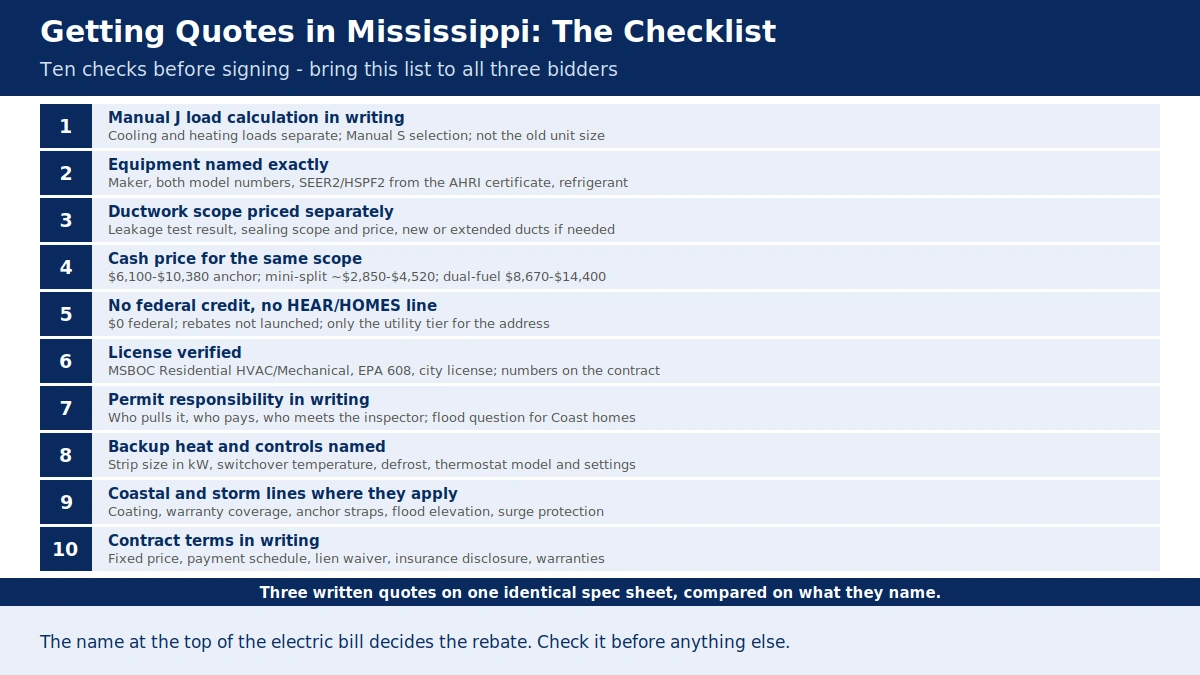
Three written quotes on one identical spec sheet, compared on what they name rather than on the bottom line alone. The strongest quote names the machine, shows the load calculation, itemizes the ducts and the panel, proves the license, puts the rebate tier in writing, and answers the flood and corrosion questions without being asked twice. In a state where August decides comfort and the electric bill decides the rebate, the best quote is also the one written for Mississippi weather and Mississippi utilities rather than for a national average. A heat pump bought that way costs what the planning band says it costs, holds the humidity down through the long summer, carries the mild winter without drama, and leaves the owner with a bill that matches the arithmetic in this guide rather than a story that sounded better in the sales visit.
Sources & methodology Installed costs:
- NumeralQ, Heat Pump Cost in Mississippi (2026), estimator pricing as of Oct 26, 2026 (planning estimates, not contractor bids): 3-ton ducted $6,100-$10,380; by size 1.5 tons $4,020-$6,580, 2 tons $4,720-$7,840, 2.5 tons $5,410-$9,110, 3.5 tons $6,790-$11,640, 4 tons $7,490-$12,910, 5 tons $8,870-$15,440; single-zone mini-split $2,850-$4,520; geothermal $19,310-$30,680; national comparison $6,550-$10,960; labor $23.41/hr median pay, $47-$61/hr billed
- NumeralQ, Heat Pump Cost in Jackson, MS (2026), pricing Oct 26, 2026: 3-ton ducted $6,230-$10,540; by size 1.5 tons $4,130-$6,710 through 5 tons $9,020-$15,630; single-zone $2,930-$4,630; multi-zone 3 heads $5,800-$10,600; cold-climate $8,230-$14,540; geothermal $19,570-$31,020; ductwork $3,750-$6,540/job; panel upgrade $1,920-$3,100/job; HVAC tech pay $25.03/hr, billed $50-$65/hr
- NumeralQ, Heat Pump Cost in Gulfport, MS (2026), pricing Oct 26, 2026: 3-ton ducted $6,080-$10,350; by size 1.5 tons $4,010-$6,560 through 5 tons $8,850-$15,410; single-zone $2,840-$4,510; multi-zone 3 heads $5,610-$10,360; cold-climate $8,060-$14,320; geothermal $19,270-$30,630; ductwork $3,580-$6,310/job; panel upgrade $2,160-$3,410/job; HVAC tech pay $23.19/hr, billed $46-$60/hr; electricians $30.02/hr, billed $60-$78/hr
- NumeralQ, HVAC Replacement Cost in Mississippi (2026), pricing Oct 26, 2026: central AC + gas furnace 3 tons $7,870-$13,490; dual-fuel $8,670-$14,400; Jackson furnace+AC $8,000-$13,660, dual-fuel $8,820-$14,600; Gulfport furnace+AC $7,850-$13,470, dual-fuel $8,650-$14,370
- NumeralQ, Furnace Replacement Cost in Mississippi (2026): 80,000 BTU furnace $4,580-$7,750; electric furnace $2,900-$5,220
- BetterHouse, Heat Pump Installation Cost by State (2026): Mississippi $3,750-$13,110, typical $9,910 (wage-scaled model, BLS wage index 0.82)
- Dun / trydun.com, Heat Pump Cost (updated Aug 2026): Mississippi $5,250-$9,700 (wage-adjusted ballpark)
- ElectricMetrics, Alabama vs Mississippi heat pump cost (July 2026 data, published Aug 10, 2026): Mississippi $13,000 average, rank #6 cheapest; noted, not adopted (no size or scope stated)
Rates and running-cost math:
- EIA via NumeralQ: Mississippi residential electricity 15.2 cents/kWh average for homes in 2026 so far, vs 18.2 cents nationally
- EIA Electric Power Monthly Table 5.6.A, August 2026 (via energyfactbook.com, priceofelectricity.com, chooseenergy.com, updated Oct-Nov 2026): Mississippi 14.43 cents/kWh, up 6.0% year on year; average August bill $238.78 at 1,655 kWh; utility spread about 12.2-18.4 cents (EIA Form 861 based, via costperkwh.com)
- EIA Natural Gas Annual 2025 (released Sept 30, 2026; via petroeyes.com, checked Oct 23, 2026): Mississippi residential $16.65/Mcf, $1.63/therm at state heat content; EIA Natural Gas Monthly Oct 2026 Table 20: 2026 year-to-date $17.69/Mcf
- EIA Weekly Heating Oil and Propane Survey: Mississippi residential propane $3.201/gal, week of Nov 9, 2026 (via nailthemath.com), $3.167 week ending Nov 2, 2026 (via propanepricepergallon.com); propane heat content 91,500 BTU/gal
- Heat content and conversions: 1 kWh = 3,412 BTU; 1 therm = 100,000 BTU; 1 ton = 12,000 BTU/hr; furnace efficiency 95% AFUE for gas and propane
Climate and housing:
- NOAA 1991-2020 normals via NumeralQ Jackson page: Jackson 2,123 heating degree days, about 32 freezing nights, 0 nights at 0F, coldest month low averaging 38F, zone 3A; mildest months April and October (Hawkins Field); FEMA heat-wave risk Relatively High (Hinds County)
- NOAA 1991-2020 normals via NumeralQ Gulfport page: Gulfport 1,507 heating degree days, 16 freezing nights, 0 nights at 0F, coldest month low averaging 42F, zone 2A; mildest months March and April (Gulfport-Biloxi Airport); FEMA coastal flooding Relatively High (Harrison County)
- NWS Memphis, Tupelo annual climate summary (1991-2020 normals, climate record 1930-2025): heating degree days normal 2,727, cooling degree days normal 2,234, 53.9 days with minimum at/below 32F, 70 days with maximum at/above 90F, 0 days at/below 0F
- usclimatedata.com, Tupelo (NOAA 1991-2020 normals): annual high 73F, annual low 51F, precipitation 55.01 inches, snowfall 2 inches
- climate-zone.com, Jackson (NOAA 1991-2020 normals): about 85 days a year at/above 90F, July/August highs near 92F, about 57 inches precipitation; humidity 70-84% by month (NASA POWER modeled estimates)
- WeatherSpark, Mississippi climate analysis: Jackson about 128 days a year with dew point above 65F (muggy or worse), peaking at about 29 in July; modeled estimate, attributed
- Census Bureau, ACS 2020-2024 5-year estimates via NumeralQ: Jackson 51% electric heat, 46% piped gas, median home $111,700, 69% single-family, 49% owner-occupied; Gulfport 72% electric heat, 25% piped gas, median home $174,600, 55% owner-occupied; County Business Patterns 2023: 49 PHAC contractors in Hinds County (4.6 per 10,000 homes), 49 in Harrison County (5.2 per 10,000 homes)
- Census Bureau, ACS 2024 1-year via startbusinessbystate.com (checked Oct 6, 2026): Mississippi 57.8% of homes heat with electricity, 30.5% with utility gas
- Census Vintage 2024 (July 1, 2024): Mississippi population 2,943,045
- 2021 IRC M1401.3 (Manual S sizing from Manual J loads), via NumeralQ city pages; BLS OEWS May 2025 (HVAC technician pay)
Efficiency, ducts, lifespan:
- DOE minimum efficiency since Jan 1, 2023: split heat pump 14.3 SEER2 and 7.5 HSPF2, all regions (via NumeralQ)
- HomeGuide, Heat Pump Cost (2026): installed by SEER2 band (14-15: $6,000-$12,000+; 16-17: $8,000-$15,000+; 18-19: $11,000-$18,000+; 20+: $15,000-$25,000+); Fixr bands via hvaclens.com transcription (Sept 14, 2026)
- NumeralQ tier premiums (from Fixr bands + Home Depot equipment prices): 16-17 SEER2 +10% to +20%; 18-19 +25% to +40%; 20+ +45% to +70%; national cooling-cost reference per 1,000 full-load hours ($404/$361/$321/$289 at the median rate)
- ENERGY STAR duct sealing: 20-30% of duct air lost in a typical house; efficiency cut by as much as 20%; DOE: duct losses about 30% of cooling energy; LBNL: about 25% of heating/cooling energy wasted; DOE/LBNL field savings 10% (basement ducts) and 15-20% (attic/crawlspace ducts), via hvaczonenj.com and hvacbase.org (2026)
- Duct service prices (HomeGuide 2026, national, via secondary summary): sealing $150-$500; reconnecting $250-$700; section replacement $400-$1,500; flagged as national figures
- USA Today, Heat Pump vs Furnace (Sept 8, 2026, ARS cost data Jan 2025-Jan 2026): heat pump lifespan 10-15 years, tune-up $150-$300/year; geothermal indoor unit about 24-25 years, ground loop 50+ years, maintenance $100-$250/year (DOE, via Geothermal Insider)
Rebates, credits, licensing, permits:
- OBBBA P.L. 119-21; IRS FS-2025-05 (§25C/§25D $0 for property placed in service after Dec 31, 2025)
- HEAR/HOMES not launched in Mississippi: NASEO via NumeralQ (Sept 2026); ECW tracker (checked Oct 27, 2026), allocations HEEHR $52,237,320 + HOMES $52,437,019 (DOE May 23, 2024 figures), not on DOE Feb 2026 or BPA June 2026 launched maps; betterpowered.com (checked Nov 9, 2026), no status posted, MDA describes utility-coordinated program with no way to apply; RenewEstimator (July 2026), pending; DOE Program Notice 26-2 (May 29, 2026)
- Entergy Mississippi Residential Heating & Cooling Program application/terms form (©2025, opened Nov 15, 2026): split heat pump tiers $500/$750/$1,100; package tiers $500/$750/$1,100; ductless $140/ton and $165/ton; duct sealing $100 + $2.50/CFM saved ($400 max); tune-up $250/$150; smart thermostat $125 (2 max); heat pump water heater up to $750; 30-day filing, trade ally, AHRI certification, first-come first-served, 4-6 week payment
- Mississippi Power rebates page (opened Nov 15, 2026): HVAC up to $200/ton, minimum 14.3 SEER2 (AHRI Directory); smart thermostat $100; heat pump water heater $350; duct/air sealing via named contractors
- TVA EnergyRight 2026 rebates page (opened Nov 15, 2026): heat pump $500 (15-16.99 SEER2) / $800 (17+ SEER2); ductless $800; geothermal $1,500; duct sealing $300; tune-up $50; Quality Contractor Network required; fuel-switch condition reported by trackers only, flagged
- ReadyDocs Mississippi HVAC compliance file (verified Oct 2026; opened Nov 15, 2026): Miss. Code Ann. § 73-59-3(1)(d) (license at any dollar amount), Residential HVAC/Mechanical classifications, Law & Business Management exam (PSI, 70%), $50 application / $100 renewal, 2 hrs/year CE, commercial $50,000 threshold, liability disclosure (§§ 73-59-11, 31-3-13), enforcement § 73-59-9, permit refusal § 73-59-17, EPA 608 (40 CFR Part 82 Subpart F)
- VerticalOS Mississippi HVAC license requirements (verified Oct 14, 2026): MSBOC authority, classifications, commercial liability $300,000/$600,000, no stand-alone home-improvement contract statute located
- Jackson Code of Ordinances Ch. 26, Art. III (Secs. 26-40, 26-50), checked Oct 10, 2026 (via NumeralQ): city AC/refrigeration license, master requirements, Office of Code Services permit
- Gulfport Code Ch. 3, Art. IV (Secs. 3-146 to 3-153), checked Oct 10, 2026 (via NumeralQ): mechanical permit, AC inspector, city contractor license; Gulfport Code Appendix B, Flood Damage Prevention (Ord. 2929): service equipment 1 foot above base flood elevation in special flood hazard areas, 50% substantial-improvement rule over 10 years
- Mississippi lien law: Miss. Code §§ 85-7-403, 85-7-409, 85-7-413 (via NumeralQ/Levelset, checked Nov 10, 2026)
- Utility territories: utilitywallet.com Mississippi address sampling (July 20, 2026); utilitiesformyhome.com Hattiesburg; findenergy.com Mississippi Power coverage (20 counties, incl. Gulfport, Biloxi, Hattiesburg, Meridian)
Storms and coastal corrosion:
- Hurricane Katrina, Aug 29, 2005: Category 3, 125 mph sustained winds (NOAA NCEI); surge about 28 feet on the Mississippi Coast, flooding 6-12 miles inland, 238 deaths in Mississippi, all counties declared disaster areas (Wikipedia summary of NWS/CDC reporting); CDC MMWR: surge estimated 27 feet at the Hancock County EOC, about 80% of Waveland buildings uninhabitable; NOAA NCEI: 20-30+ foot surge underwater in Biloxi and Gulfport; 11 tornadoes in Mississippi, hurricane-force winds over 17 hours on the Coast
- Coastal HVAC lifespan: Justice Inc. (Sept 2025), coastal 7-12 years unprotected vs 15-20 inland; Wentzel Heating and Air (Oct 2026), coils near open salt water 3-5 years before real intervention; Budget Heating coastal guide (2026), coastal package components and warranty exclusions; all contractor/industry sources, stated qualitatively with ranges attributed
- FEMA National Risk Index county ratings (via NumeralQ); FEMA Flood Map Service Center (msc.fema.gov)
NestPriced arithmetic (labeled in the article, not sourced figures):
- Mississippi midpoint $8,240: ($6,100 + $10,380) / 2; furnace+AC midpoint $10,680: ($7,870 + $13,490) / 2; purchase saving about $2,440
- Cost per MMBtu delivered: resistance $44.55 = 293.07 kWh x $0.152; heat pump = $44.55 / COP; gas $17.16 = 10.526 therms x $1.63 / 0.95; propane $36.81 = (1,052,632 BTU / 91,500 BTU per gal) x $3.20
- Break-even COP vs gas 2.60 = $44.55 / $17.16; vs propane 1.21 = $44.55 / $36.81
- Planning-home annual figures: per-MMBtu cost x 25 MMBtu (resistance ~$1,114; COP 2.5 ~$445; COP 3.0 ~$371; COP 3.5 ~$318; gas ~$429; propane ~$920); savings vs resistance ~$743 and vs propane ~$549 at COP 3.0; vs gas ~$58 saving at COP 3.0, ~$16 more at COP 2.5
- Cooling reference per 1,000 full-load hours: 36,000 BTU/hr / SEER2 x 1,000 hrs x $0.152 (14.3: ~$383; 16: ~$342; 18: ~$304; 20: ~$274)
- SEER tier prices on the midpoint: 16-17 about $9,064-$9,888; 18-19 about $10,300-$11,536; 20+ about $11,948-$14,008
- Dual-fuel midpoint $11,535, premium about $2,295 over the heat pump midpoint; geothermal midpoint $24,995, premium about $16,755
- Net prices after rebates on the midpoint: Entergy top tier about $7,140; Mississippi Power about $7,640; TVA about $7,440-$7,740
- Cold-climate premium (Jackson): midpoint $11,385 vs standard $8,385, about $3,000
- High-rate sensitivity at 18.4 cents: resistance ~$53.91/MMBtu, COP 3.0 ~$17.97, break-even COP vs gas ~3.14
EXCLUDED:
- Any Hattiesburg, Tupelo, or Southaven NumeralQ price (no such pages exist; state-band planning estimates only, flagged)
- Any Mississippi Power per-ton tier schedule (tracker-only; the live page states only up to $200/ton with a 14.3 SEER2 floor)
- Any TVA fuel-switch condition as a verified TVA rule (tracker-only; draft says confirm with the local power company)
- Any co-op rebate amount (none verified) and any Mississippi state tax credit for heat pumps (none found)
- Any HEAR/HOMES money in a 2026 Mississippi quote (not launched; no application route posted) and any quantified §48E lease saving (no Mississippi lease price verified)
- Any federal tax credit for a 2026 install ($0 under OBBBA)
- Any city permit fee (none published or found for Jackson, Gulfport, Hattiesburg, or Tupelo)
- Any statewide share of homes built before 1980 (not verified in this pass) and any Jackson cooling-degree-day normal (annual figures vary by year)
- Any coastal-package premium, tie-down price, or surge-protector price (no verified Mississippi prices)
- Any Mississippi design-temperature figure (not verified; freezing-night counts and coldest-month lows used instead)
- ElectricMetrics $13,000 average as the headline band (no size or scope stated; noted, not adopted)
- Any Mississippi matching or insurance law for HVAC (not researched; not asserted)
- Any cooling-off or cancellation period under Mississippi law (none located; not asserted)
Disclaimer: The prices here are 2026 Mississippi planning figures. What you end up paying moves with the system type, the size, the efficiency tier, the city, the ductwork, the electric panel, the flood zone, and the contractor. Get written quotes from three licensed Mississippi contractors before settling on a budget, and check the license yourself on the Mississippi State Board of Contractors lookup before anyone touches the system. Nothing here is tax advice for your own return. Program rules change, including utility rebate tiers, the HEAR/HOMES launch status, and TVA requirements, so confirm current terms with the utility on your bill, the Mississippi Development Authority, and your local power company before signing. Running-cost figures depend on your own electricity, gas, and propane rates and on how your house actually uses heat and cooling, so rerun the math at your own rates before deciding.
What does a heat pump cost in Mississippi in 2026?
A 3-ton ducted heat pump costs $6,100–$10,380 installed in Mississippi in 2026, on NumeralQ planning estimates priced October 26, 2026. A single-zone mini-split runs $2,850–$4,520, a dual-fuel system runs $8,670–$14,400, and geothermal with its ground loop runs $19,310–$30,680. Jackson publishes $6,230–$10,540 and Gulfport $6,080–$10,350, while Hattiesburg and Tupelo carry planning estimates from the state band because no cost model prices those cities directly.
Which heat pump rebate applies to my Mississippi address?
The rebate follows the electric utility on your bill, not the city you live in. Entergy Mississippi pays $500–$1,100 by efficiency tier for a split heat pump, Mississippi Power pays up to $200 per ton with a 14.3 SEER2 minimum, and TVA EnergyRight pays $500–$800 in northeast Mississippi through a Quality Contractor Network installer. Co-op and municipal addresses vary and no statewide co-op figure was verified, so check with the distributor named on your bill before any bidder subtracts a rebate from a quote.
Is there a federal tax credit for a heat pump installed in Mississippi in 2026?
No. The One Big Beautiful Bill Act ended the Section 25C credit for property placed in service after December 31, 2025, so a homeowner-owned heat pump installed in 2026 earns a $0 federal credit. Mississippi’s federal home energy rebates have also not launched, with no application route posted as of November 2026 checks, so no HEAR or HOMES money belongs in a 2026 quote either. Only the utility rebate for your address is live money today.
Does a heat pump beat a gas furnace on running costs in Mississippi?
Roughly, yes, but by a small margin on heating alone. At 15.2 cents per kWh and $1.63 per therm, the planning home costs about $371 a year to heat with a heat pump at a seasonal COP of 3.0, against about $429 with a 95 percent gas furnace. The heat pump also costs about $2,440 less to buy than the furnace-plus-air-conditioner pair it replaces, and it beats resistance heat by about $743 a year and propane by about $549 a year on the same planning home.
What size heat pump does a Mississippi house need?
The size comes from a Manual J load calculation for the specific house, not from square footage or the old unit’s nameplate, and the residential code requires it. As a rough screen only, a 2,000 sq ft house usually lands near 3 to 3.5 tons, while smaller homes land near 2 to 2.5 tons and larger ones near 4 to 5 tons. An oversized machine short-cycles and leaves humidity behind, which is the worst failure in a humid climate, so believe the calculation even when it names a smaller unit than expected.
Do I need a permit and a licensed contractor for a heat pump in Mississippi?
Yes to both. Mississippi requires a State Board of Contractors Residential HVAC or Residential Mechanical license for residential HVAC work at any dollar amount, plus federal EPA Section 608 certification for the technician handling refrigerant, and Jackson and Gulfport add their own city licenses. Jackson requires a permit from the Office of Code Services and Gulfport requires a mechanical permit with inspection by the city’s air conditioning inspector, so get the permit responsibility in writing for your address before work starts.
How long does a heat pump last on the Mississippi Gulf Coast?
Shorter than inland, unless it is protected. A well-maintained inland system lasts about 15 to 20 years, while coastal contractor guides put unprotected coastal life at about 7 to 12 years, with coils near open salt water failing far sooner. A coastal package with coated coils and sealed electrics, plus regular fresh-water rinsing, pushes life back toward the inland range, and the warranty should confirm coastal coverage in writing. Flood-zone homes should also elevate the outdoor unit at least 1 foot above the base flood elevation under the local flood ordinance.
Is geothermal worth it in Mississippi?
Almost never on the bills alone. Geothermal costs $19,310–$30,680 with its loop, about $16,755 more than the air-source midpoint, while the heating bill it attacks is only about $371 a year on the planning home, so the premium cannot pay back on any horizon worth planning around. It earns its price only for buyers who value its 50-plus-year loop, its 24-to-25-year indoor unit, its quiet operation, and its freedom from outdoor equipment on a flood-prone lot. TVA pays $1,500 toward geothermal in northeast Mississippi, the largest rebate in this guide, and the federal credit for a 2026 owned install is $0.