

Oklahoma does not let a heat pump coast. In July the same machine that heated the house in January has to pull a 94-degree afternoon down to 72 and keep it there while the sun bakes a dark shingle roof, and in January it has to pull heat out of 15-degree air while an ice storm glazes the lines outside. No other state in this series swings that far in both directions in a single year, and the swing is the whole buying decision. A unit sized for the summer alone will lean on backup heat all winter. A unit sized for the winter alone will short-cycle through July and leave the house cool and damp at the same time. The right machine is the one sized for both loads, and the right quote is the one that shows both loads in writing.
The second thing a buyer learns in Oklahoma is that the rebate map is a patchwork with a hole in the middle of it. OG&E serves the biggest metro in the state, and its Oklahoma residential rebates are closed for 2026. PSO serves the second metro and pays the richest live rebate in the state, up to $1,400. The co-ops pay their own schedules, some of them generous on geothermal, and the municipal power authority pays by the ton in 31 small cities. Two neighbors on the same street can face different rebate totals because the city line, not the county line, decides the utility. Read the name at the top of the electric bill before believing any rebate figure in any quote.
The third thing is the fuel split, and it is unusually even here. About 40 percent of Oklahoma homes heat with electricity, and in Oklahoma City 57 percent heat with piped gas. That means the typical Oklahoma buyer is not fleeing a fuel that has failed them. They are weighing two fuels that both work, at prices that are both low by national standards: electricity at 14.82 cents a kilowatt-hour against gas at roughly $1.40 a therm. The heat pump wins that comparison by a whisker on heating, wins it by a mile against resistance heat and propane, and wins it outright once the air conditioner it replaces is counted. But a quote that promises big heating savings against a gas furnace in Oklahoma is a quote that has not done the sums, and this guide does them in the open.
Start with the national figures — our national heat pump cost guide sets the countrywide baseline — then read Oklahoma’s numbers against that baseline.
Table of Contents
How Much Does a Heat Pump Cost in Oklahoma in 2026?
Four kinds of evidence price the Oklahoma market in 2026, and they do not all measure the same job, which is why the numbers disagree and why the disagreement is worth untangling before any quote is compared. NumeralQ, with estimator pricing as of October 26, 2026, publishes planning estimates built from a national cost model adjusted for Oklahoma labor: a 3-ton ducted air-source system at $6,430-$10,800 statewide. Hartzell’s Heat & Air, a central Oklahoma contractor, publishes its own installed ranges by efficiency tier: a standard 14-15 SEER2 single-stage unit at $6,000-$9,000, a mid-efficiency two-stage at $8,000-$12,000, and a high-efficiency variable-speed unit at $10,000-$15,000 and up. HomeCostLens models Tulsa from local labor and material rates at a typical $5,800 for a 2,000-square-foot home, inside a $4,010-$11,600 range. And NumeralQ’s HVAC replacement pages price the furnace-plus-air-conditioner combination the heat pump replaces at $8,260-$14,070 for a 3-ton job. The first is a model, the second is one contractor’s real price list, the third is a model of a model, and the fourth is the comparator that decides whether the heat pump carries a premium at all.
The NumeralQ 3-ton band, $6,430-$10,800, leads this guide because it pins down the machine, the size and the scope — ducted air-source, 3 tons, installed — and because NumeralQ calls it a planning estimate instead of dressing it up as a survey of what Oklahomans actually paid. That band’s midpoint, about $8,615, is the number the payback section works from. The Hartzell ranges sit comfortably inside and around the NumeralQ band, which is the kind of agreement that matters: a real Oklahoma contractor’s standard tier at $6,000-$9,000 lands in the lower half of the planning band, and its high-efficiency tier at $10,000-$15,000 and up explains the top of it. The HomeCostLens typical of $5,800 sits below the band, and its low end of $4,010 is a modeled floor no contractor in this pass quoted for a whole-home ducted install — use it, if at all, as a reminder that a bare swap-out on a healthy house costs less than a full new install, not as a budget for one.
Inside that band: the crew’s labor, the permits, the startup and commissioning, and the hardware itself — outdoor unit, indoor coil or air handler, refrigerant lineset, pad or stand, electrical disconnect and wiring, and thermostat. What it does not buy is the rest of the job, and in Oklahoma the rest of the job is often the expensive part — new or extended ductwork at $4,120-$7,020 a job in Oklahoma City, a 200-amp panel upgrade at $2,130-$3,370, a gas furnace for a dual-fuel setup, a hail guard, tie-downs and surge protection for a unit that will face supercell weather, or a condensate arrangement for a house whose crawlspace floods in a spring storm. NumeralQ lists those two as planning add-ons, and this guide keeps that label on them. The storm items carry no verified Oklahoma price in this pass, and this guide says so rather than inventing one. Expect them as their own lines on the quote; bury them inside the per-ton figure and the buyer only finds the expensive half of the job after signing.
One figure inside that arithmetic is small enough to tilt the decision a particular way in Oklahoma. There is no big rebate to subtract from the sticker for most buyers. The largest single live rebate is PSO’s $1,400 on a top-efficiency replacement, and most buyers who qualify at all collect $600-$1,000. OG&E’s program, which would have paid up to $3,000, is closed for the year. The federal credit is $0. Read every quote gross first. In Oklahoma the net figure sits only a few hundred dollars lower at best and a tax return away at worst, and any quote subtracting a rebate the home cannot collect, or a federal credit that no longer exists, needs rewriting before it can be compared with anything.
A warning before the tables: the cheapest Oklahoma bid rarely stays the cheapest once the system is running, and the dearest bid is not automatically the best machine. The spread between bidders on identical equipment can run several thousand dollars, and in Oklahoma the spread is widest where the house is hardest — a 1950s bungalow in Norman with ducts in a vented attic, a Tulsa split-level with a 100-amp panel, a Lawton ranch on propane with no gas main for miles, a new build outside Edmond where the co-op, not OG&E, sets the rebate. Compare bids on one identical job: the same model, the same house, the same backup-heat arrangement, every line in writing, and only the rebate the home genuinely qualifies for already taken off. Line up three licensed contractors and get each one’s quote in writing. Then strike any bidder who will not name the model number, its SEER2 and HSPF2 ratings, and the Manual J calculation that set the size.
| Source | 3-ton ducted | Single-zone mini-split | Multi-zone (3 heads) | Geothermal |
|---|---|---|---|---|
| NumeralQ (Oct 2026, planning est.) | $6,430-$10,800 | $3,060-$4,800 | ~$6,130-$10,990 (scaled) | $20,000-$31,570 |
| Hartzell central OK (2026, contractor) | $6,000-$9,000 std; $10,000-$15,000+ high-eff. | Not published | Not published | $18,000-$40,000+ |
| HomeCostLens Tulsa (Sept 2026, modeled) | ~$5,800 typical, $4,010-$11,600 | Not published | Not published | Not published |
| NumeralQ HVAC replacement (Oct 2026) | $8,260-$14,070 (furnace + AC) | $3,090-$4,840 (Tulsa) | Not published | Not published |
Two rows of that table need a warning label before anything else is read from them. The HomeCostLens figures are modeled from local rates, not collected from Oklahoma invoices, and their low end describes a narrower job than the whole-home installs this guide prices. Treat the multi-zone statewide band as a scaled figure, not a published one: NumeralQ publishes multi-zone only for Oklahoma City ($6,200-$11,120), and the statewide band here is scaled from it by the statewide-to-OKC 3-ton midpoint ratio. This guide builds on the NumeralQ band, and every size row in the sections that follow carries the planning-estimate label, because that is what each one is.
Heat Pump Cost in Oklahoma by System Type
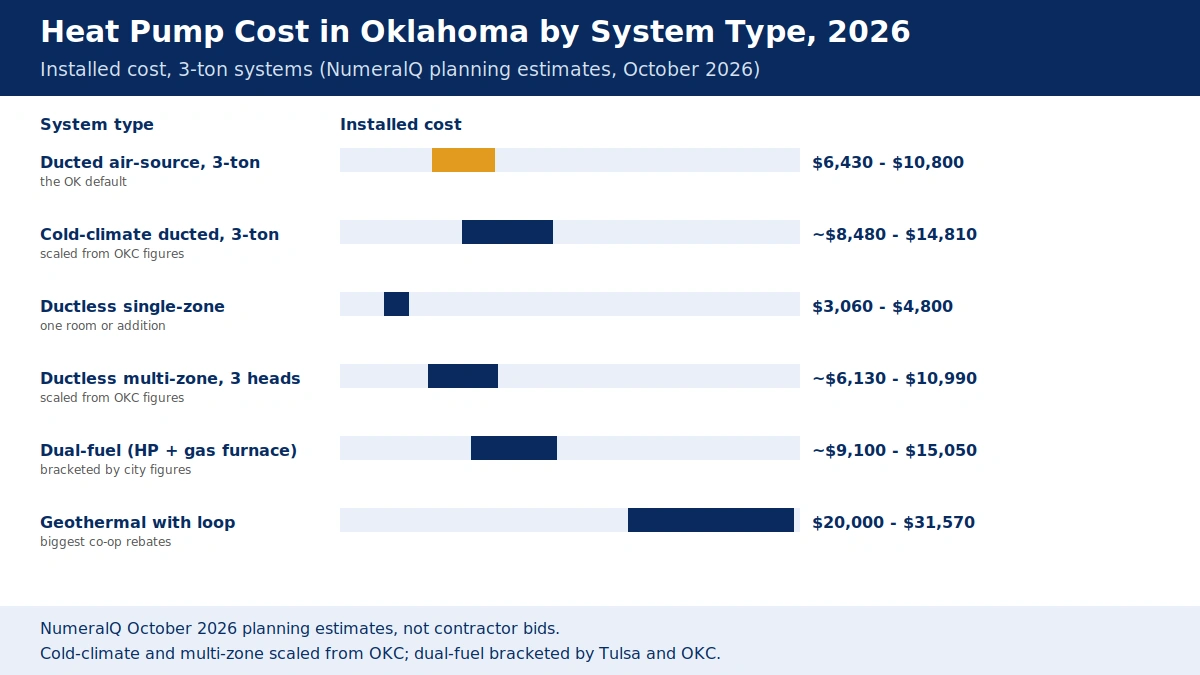
Oklahoma buyers hear “heat pump” and picture one machine, but the phrase covers five of them, priced more than six to one from the cheapest to the dearest — and the house usually picks before the buyer does. An Oklahoma City brick ranch with ducts in the attic, a Tulsa bungalow with no duct chases at all, a Norman split-level on a slab, a Lawton ranch on propane with no gas main for miles, a farmhouse outside Stillwater with the land for a ground loop: each one points at a different machine, and each machine carries a different price, a different rebate, and a different January. The NumeralQ anchors price every machine in that table, and contractor figures join them where they sharpen the picture.
| System type | Installed cost (OK) | Best for in Oklahoma |
|---|---|---|
| Ducted air-source (3-ton) | $6,430-$10,800 | Whole-home heat + cooling with ducts; the default OK buy |
| Ducted cold-climate (3-ton) | ~$8,480-$14,810 (scaled) | Panhandle and northwest OK; rarely needed in the metros |
| Ductless mini-split, single zone | $3,060-$4,800 | One room, addition, or a house with no ducts |
| Ductless multi-zone (3 heads) | ~$6,130-$10,990 (scaled) | Whole-home without ducts; zone-by-zone control |
| Dual-fuel (heat pump + gas furnace) | ~$9,100-$15,050 (bracketed) | Gas-heated home that wants a heat pump for mild weather + AC |
| Geothermal, ground-source with loop | $20,000-$31,570 | Long-term owner, big lot; earns the biggest co-op rebates |
Ducted air-source is the default Oklahoma buy, and it is the default for a two-season reason. Most of Oklahoma sits in a climate where a standard ducted heat pump is the right machine, not a compromise, and the reason runs in both directions: the summer is long and hot enough that the cooling half of the machine earns its keep from May to October, and the winter is mild enough that a standard unit carries most of it without the cold-climate premium. Oklahoma City designs for 15 degrees in winter and cools through a July that averages 94, Tulsa designs for 14 degrees and cools through much the same, and a standard variable-speed unit holds its capacity and efficiency through all of it. It reuses the ducts the house already has, heats and cools from one box, and at $6,430-$10,800 for a 3-ton job it is the cheapest whole-home heating and cooling option in this guide — cheaper, on the planning figures, than buying the furnace-plus-air-conditioner pair it replaces. Our ductless vs ducted guide takes the keep-the-ducts-or-go-ductless decision apart room by room and dollar by dollar, for an Oklahoma house.
Cold-climate is a Panhandle purchase, not a metro one, and most buyers should skip it. The cold-climate premium — about $8,480-$14,810 against $6,430-$10,800 for the standard ducted 3-ton, scaled from the Oklahoma City figures — buys capacity at 5 degrees and below, and in the two big metros that capacity is almost never called on: Oklahoma City counts about 72 freezing nights a year and zero nights at or below zero, and Tulsa’s record runs the same way. A cold-climate unit keeps at least 70 percent of rated capacity at 5 degrees with a COP of at least 1.75, and holds full rated output down to 5 degrees on the best lines — performance a Guymon or Woodward winter, where the wind never stops and the cold pools on the High Plains, might occasionally use, and an Oklahoma City winter will not. An Oklahoma City buyer paying that premium is buying cover for a week of weather that may not arrive in a decade. A buyer in the Panhandle or the northwest counties has a better case. No rebate rule pushes the choice the way it does in some northern states — no Oklahoma utility pays extra for a cold-climate unit — so the call is pure climate rather than paperwork, and across most of the state the climate answers standard.
Ductless mini-splits were built to retrofit exactly Oklahoma’s older housing stock. Mini-splits are how Oklahoma retrofits houses that never had ducts — Tulsa bungalows and Craftsman homes where a duct chase would eat a bedroom, Oklahoma City post-war ranches on baseboards or strip heat, additions and finished attics and converted garages no duct ever reached, and the bonus rooms over garages that bake every July afternoon. Statewide, one zone costs $3,060-$4,800 and conditions a single room or open-plan area, with the outdoor unit on a wall bracket or pad, the indoor head on the wall, and one small hole for the lineset. Three heads at about $6,130-$10,990 condition a whole small home, each zone on its own thermostat, so bedrooms can run cooler overnight while the living room holds steady. Coverage is the limit: a head conditions only its own room, so a four-bedroom colonial with one living-room head still leaves the bedrooms without heat or cooling. Our mini-split installation guide prices the job zone by zone, and PSO pays a $600 mini-split rebate on a 19.1 SEER2 unit, which is the one rebate in the state priced by the machine rather than by the ton.
Dual-fuel is the honest answer for the Oklahoma home that already heats with piped gas. Dual-fuel fits the gas-heated majority of the state: a heat pump and a gas furnace share one house, and a control passes the load to the furnace once the temperature falls below the installer’s switchover setting. The heat pump handles the mild weather, where it beats gas; the furnace handles the cold snaps, where the heat pump’s COP has fallen past the point of winning. The dual-fuel band runs about $9,100-$15,050 for a 3-ton system — heat pump plus furnace plus controls — bracketed by the Tulsa figure of $9,130-$15,000 and the Oklahoma City figure of $9,190-$15,080, and flagged as a bracket rather than a published statewide band. The running-cost section works out the break-even COP at Oklahoma prices — about 2.94 — because that number, not the sticker, decides whether dual-fuel saves money here, and in a state where the planning seasonal COP runs about 2.8 the heat pump owns the mild months and the furnace owns the cold snaps in roughly equal measure. Controls, switchover point, and what the furnace actually does on a cold night are all in our dual-fuel heat pump guide.
Geothermal is the only system in this state whose winter efficiency barely notices the weather — and the only one the co-ops pay serious money for. A ground-source unit draws heat from soil that holds near 60 degrees all year a few feet under an Oklahoma lawn, keeping a COP of 3.0 to 5.0 through a 15-degree Oklahoma City night while an air-source unit labors near 2.5. NumeralQ’s Oklahoma installed range is $20,000-$31,570 with the loop; the Hartzell contractor range runs $18,000-$40,000 and up. The loop decides the price: horizontal trenching where the lot allows it, vertical bores where it does not, and a pond loop where the property has water to spare. Geothermal fits a long-term owner on a big lot who plans to stay 20 years, and Oklahoma has plenty of such lots beyond the two big metros. Anyone likely to move within five years is the exception: the loop stays in the ground, and the payback needs a decade of seasons to arrive. The federal 30 percent credit that once softened the price is $0 for a 2026 homeowner-owned install under the same OBBBA change that ended the air-source credit — but the co-op rebates survive, and they are the largest in this guide: CKenergy pays $2,000 a ton up to $24,000, Cotton Electric pays up to $750 a ton capped at $4,000, and PSO pays $1,400. That rebate picture, and its territory limits, gets a full section below, because it is the single largest incentive in this guide and it applies to exactly one machine in exactly some counties. Our geothermal heat pump guide covers loop types, tight-lot bores, and what the system costs over twenty years.
A last setup is worth a paragraph of its own: a mini-split added to a home that keeps its furnace or its strip heat. Done sensibly, it puts a head or two where the household actually spends its hours: living room, home office, main bedroom. Fit a head or two in the rooms the household lives in, and they handle the mild months while the old system waits for the cold snaps — plus the house gets air conditioning in July. The first zone at $3,060-$4,800 is the cheapest entry to a heat pump in Oklahoma, and in PSO territory it earns a $600 rebate on top. As a whole-home solution it disappoints: one head cannot heat or cool a house, and a house with one head in the living room still has warm bedrooms in July. Whole-home comfort from one head is a promise no bidder should make — the machine behind it is too small for the house.
Heat Pump Cost by Home Size
System type settled, the next decision is size — and Oklahoma’s characteristic mistake runs in both directions at once. In Tulsa, a machine sized too small leans on resistance heat all through the coldest week, at 14.82 cents a kilowatt-hour. Oversized in Oklahoma City, it short-cycles through a humid July, never running long enough to pull the moisture from the air, leaving the house cool and clammy together, and costing thousands extra for capacity the house never calls on. The right size comes from one document only: a Manual J load calculation, room by room, at the design temperature — 15 degrees in Oklahoma City, 14 in Tulsa — and at the summer design condition too, because in Oklahoma the cooling load and the heating load both govern. Floor area alone cannot fix the load figure everything else depends on, and neither can the outgoing unit’s size. Get the Manual J in writing before signing, and make sure it shows the cooling load and the heating load as separate figures.
The table that follows prices ducted air-source systems by tonnage, off the NumeralQ anchors. All seven rows below come from the state page’s by-size table — more complete than most states in this series, where NumeralQ anchors only the 3-ton row and scales the rest. Heat pump capacity is rated in tons, 12,000 BTU an hour to the ton, and in Oklahoma the two loads pull in opposite directions by design: in both metros the cooling load is the larger one on the hottest days, and the heating load is the larger one on the coldest nights, so a machine chosen for one season alone is wrong for the other. Take a 2,000-square-foot Oklahoma City house: it commonly lands on a 3-ton system, where the same house in a cold climate would take 3.5 tons for heating alone. The design temperature sits only about 55 degrees below room temperature, not 85, and the July cooling load does the real work.
| System size | Home size (approx.) | Ducted air-source (OK) |
|---|---|---|
| 1.5 ton | 600-1,000 sq ft | $4,300-$6,940 |
| 2 ton | 1,000-1,400 sq ft | $5,010-$8,220 |
| 2.5 ton | 1,400-1,700 sq ft | $5,720-$9,510 |
| 3 ton | 1,700-2,100 sq ft | $6,430-$10,800 |
| 3.5 ton | 2,100-2,400 sq ft | $7,140-$12,090 |
| 4 ton | 2,100-2,700 sq ft | $7,850-$13,370 |
| 5 ton | 2,700-3,500 sq ft | $9,260-$15,950 |
One October 2026 NumeralQ estimator produced all seven rows, so this table hangs together better than most in this series — planning estimates all the same, not contractor bids, with the home-size column only a rough guide. Each step up a tonnage costs roughly $700-$1,300 at the bottom of the band and $1,200-$1,500 at the top, and the 3-ton row is the size most Oklahoma homes land on. Treat no row as a measured Oklahoma price — none of them is one. What they honestly show is the shape of the decision: oversizing by one ton costs about a thousand dollars to buy, then costs comfort every humid summer after.
Three cautions sit behind that table. To begin with, the home-size column is only a rough guide — rougher in Oklahoma than most places, because the housing stock runs from 1920s Tulsa bungalows with no insulation in the walls to slab-on-grade Oklahoma City ranches to new Edmond subdivisions built tight, and a tight, well-insulated 2,000-square-foot house built in 2020 can need a full ton less than a drafty 2,000-square-foot 1950s ranch with single-pane windows, bare walls and ducts sweating in a vented attic. What really fixes the size is the house itself — its age, its insulation, its glazing, how leaky it is, how high the ceilings run, and above all where the ducts live — not the floor area. Next, both loads govern in Oklahoma, and sizing from the old furnace is sizing for the wrong season: a system chosen for a January in Oklahoma City will be far too big for its July, short-cycling through the humidity, while a system chosen for the summer alone will lean on backup heat through the coldest week. Both loads must be calculated, and the Manual J must show both. Third, the backup heat is sized alongside the heat pump in one conversation, not tacked on after the fact. Strips or a furnace have to cover the full design load on the coldest night, when the heat pump gives the least, and in Oklahoma that night is a 15-degree Oklahoma City ice storm, arriving once or twice a winter and filling the service lines with no-heat calls. A quote pricing the heat pump while leaving backup heat undecided has dropped the part that keeps the house warm on the one night a year it turns genuinely cold.
The 3-ton row merits the closest look: most Oklahoma homes land on it, and the whole guide anchors to it. Brand and efficiency tier decide where a quote lands inside that $6,430-$10,800 band. At the bottom of the band sits the value-tier standard machine, roughly SEER2 15 and HSPF2 7.8 — Hartzell’s standard tier at $6,000-$9,000. At the top sits the premium variable-speed machine, past SEER2 20 and HSPF2 10 — Hartzell’s high-efficiency tier at $10,000-$15,000 and up. Across an Oklahoma City summer of 1,876 cooling degree days, the premium tier repays itself faster than in a cool state — the cooling season runs long, the heat never lets up, and a variable-speed unit running long and slow at part load pulls out moisture a single-stage unit never reaches. Short on cash, the value-tier standard unit still beats resistance heat by a wide margin and cools the house fine. The mistake to avoid is the wrong spend: an oversized single-stage unit for a humid Oklahoma home that needed the smaller machine running longer, or a cold-climate unit for an Oklahoma City home that needed the money in its ducts instead.
Heat Pump Cost by City: Oklahoma City, Tulsa, Norman & Lawton
Oklahoma is a medium-sized state with no expensive HVAC market and no cheap one — the verified figures run from $6,470 to $6,520 at the bottom of the 3-ton band, a $50 spread across the two big cities, which is one of the flattest city maps in this series. Labor barely moves between the cities, so what sets them apart is the rebate territory, the fuel mix, the housing stock, and the storm exposure. NumeralQ’s city figures are the only verified city bands in this pass; the Norman and Lawton figures carry a warning label instead of a verified price, because no NumeralQ city page exists for either one.
| City | 3-ton ducted air-source | Utility | Design temp |
|---|---|---|---|
| Oklahoma City | $6,520-$10,920 (NumeralQ) | OG&E | 15 F |
| Tulsa | $6,470-$10,860 (NumeralQ) | PSO | 14 F |
| Norman | ~$6,430-$10,800 (planning est.) | OG&E | ~15 F (planning est.) |
| Lawton | ~$6,430-$10,800 (planning est.) | PSO | ~14 F (planning est.) |
Oklahoma City is the capital, the largest metro, and the highest verified figure by a few dollars, at $6,520-$10,920 for a 3-ton ducted system. Oklahoma City is also where the rebate story hurts most: OG&E serves the metro, and OG&E’s Oklahoma residential rebates are closed for 2026, so an Oklahoma City buyer collects $0 from the biggest utility in the state this year. The housing stock is post-war ranch and split-level, much of it with ducts in vented attics that bake past 130 degrees in July — ducts that lose a fifth of the cooled air into the attic before it reaches a register, which is why an Oklahoma City quote pricing the machine without inspecting the ducts has skipped the part of the job that decides the July bill. The labor figure underlines the flatness: Oklahoma City HVAC mechanics earn a median $28.91 an hour, and contractors bill $58-$75 a worker-hour. The climate figure underlines the two-season problem: about 72 freezing nights a year, zero nights at or below zero, a July that averages 94 degrees, and a 15-degree design temperature that lets a standard unit do the job easily. The gas comparison is Oklahoma Natural Gas, at the $1.40-a-therm planning price this guide uses.
Tulsa is the second city, the cooler of the two big metros by a degree, and the cheapest verified figure, at $6,470-$10,860 for a 3-ton ducted system. Tulsa is where the rebate picture flips: PSO serves Tulsa, so the rebate is Power Forward’s $600-$1,400 tiered scale, the richest live utility rebate in the state, and the gas comparison is Oklahoma Natural Gas too. The housing stock is older than Oklahoma City’s — 1920s and 1930s bungalows and Craftsman homes, many with no duct chases at all, which is why Tulsa buys more mini-splits than any other Oklahoma metro. Tulsa HVAC mechanics earn a median $28.25 an hour, with 1,620 technicians, and the city’s band sits a few dollars under Oklahoma City’s — a few dollars, not a few hundred, because labor is only part of the price and equipment is priced nationally. Tulsa is also where the tornado record is sharpest in the metro column: Tulsa County’s storm history runs long, and a unit on a low pad in a flood-prone hollow needs the elevation and strapping the inland quote never mentions.
Norman and Lawton carry planning estimates of about $6,430-$10,800 — the state band, applied to each city, because no city-specific price was published in this pass. Treat neither figure as a NumeralQ figure, because neither one is. What is certain is the context. Norman is a college town of about 130,000, home to the University of Oklahoma and the National Weather Center, served by OG&E — so the rebate is $0 from the utility this year, the same as Oklahoma City — with a housing stock of student rentals, post-war ranches and new subdivisions spreading south toward the Canadian River. Lawton is a military town of about 90,000 beside Fort Sill, served by PSO — so the rebate is Power Forward’s $600-$1,400, the same as Tulsa — with a housing stock of mid-century ranches and a drier, windier climate on the edge of the Wichita Mountains. A Norman or Lawton buyer should treat the state band as a starting point and get three local quotes before budgeting anything, because the utility territory and the house variables move the price more than the city average ever could.

Oklahoma’s Two-Season Climate: Blazing Summers, Ice-Storm Winters & Sizing for Both
Oklahoma is the state in this series where the weather refuses to pick a season. July in Oklahoma City averages a high of 94 degrees, and the metro counts roughly 70 days a year at or above 90. January averages a low of 38, and the metro counts about 72 nights a year at or below freezing. The design temperatures tell the same two-sided story: Oklahoma City is designed for 15 degrees in winter and 96 in summer, Tulsa for 14 degrees in winter and 97 in summer. A heat pump in Oklahoma is not a cooling machine that happens to heat, and it is not a heating machine that happens to cool. It is a machine that has to do both jobs at full stretch, six months apart, and the sizing has to respect both.
The degree-day totals put Oklahoma in the middle of the national pack on both sides. Oklahoma City runs about 3,725 heating degree days and 1,876 cooling degree days a year; Tulsa runs about 3,860 heating and 1,949 cooling. Compare that with the Deep South states in this series, where the cooling load swamps the heating load, and with the northern states, where the heating load swamps everything: Oklahoma is the rare state where the two loads are close enough that neither can be ignored. That closeness is what makes the Manual J non-negotiable here. A contractor who sizes from the old furnace is sizing for January. A contractor who sizes from the old air conditioner is sizing for July. Either one alone gets half the house wrong.
The summer half of the problem is heat plus humidity, and the humidity is the part buyers underestimate. Oklahoma summers are not dry desert heat. Gulf moisture rides north across the state all summer, and the wet-bulb temperatures at design — 75 degrees in Oklahoma City, 76 in Tulsa — mean the air holds real water. A right-sized variable-speed unit running long and slow pulls that moisture out of the air; an oversized single-stage unit blasts cold air for ten minutes, shuts off, and leaves the house cool and clammy. The test of a summer install is not the thermostat reading at 3 p.m. It is whether the house feels dry at 9 p.m., and that test is decided at sizing time, not at the thermostat.
The winter half of the problem is cold plus ice, and the ice is the part buyers underestimate. Oklahoma winters are not the steady deep cold of the north. They are sharp cold snaps — a few days in the teens, sometimes a few days in single digits — broken by weeks in the 40s and 50s, and the cold often arrives as freezing rain that glazes everything it touches. An ice storm coats the outdoor unit, loads the power lines, and fills the service lines with no-heat calls, all in the same night. A standard heat pump carries most of an Oklahoma winter without help, because most winter hours sit in the 40s and 50s, where it does its best work. But the cold snaps are when the backup heat earns its keep, and the backup heat has to be sized for the full design load on the coldest night, not for the average night. Skip that sizing step and the house goes cold on the one ice-storm night a year when the heat pump can give the least.
Two calendar facts shape the buying decision. May and October are the mildest months in Oklahoma City by degree days, and they are the easiest months to be without the system on the day of the work — the shoulder-season install, booked before the July rush and before the January cold snaps, is the cheapest and calmest way to buy. And the shoulder seasons are also when the rebate paperwork is easiest: PSO’s Power Forward program runs year-round, but a contractor booked solid in July has no time to chase a rebate form, and a buyer who signs in July discovers the OG&E closure only after the install. Book in May or October, and the paperwork gets done while the crew still has time to do it.
One more climate fact belongs here, because it decides the efficiency tier. The federal minimum in Oklahoma’s region is 14.3 SEER2 for cooling and 7.5 HSPF2 for heating, and a value-tier machine at roughly SEER2 15 and HSPF2 7.8 clears that bar without drama. The premium tier, past SEER2 20 and HSPF2 10, pays for itself faster in Oklahoma than it would in a cool state, because the cooling season is long and the heating season is real — both halves of the year reward efficiency, not just one. On a tight budget, the value-tier standard unit still beats resistance heat by a wide margin and cools the house fine. The error is buying the premium machine and then installing it on leaky ducts in a vented attic, where the efficiency never reaches a register.
Heat Pump vs Gas Furnace in Oklahoma: The Running-Cost Math
Oklahoma is the state in this series where the gas-versus-heat-pump argument is closest to a draw, and the closeness is the story. Both fuels are cheap here. Electricity averages 14.82 cents a kilowatt-hour, 18 percent below the national average, and gas averages about $1.40 a therm on the annual figures. A heat pump that beats gas by hundreds of dollars a year in a high-rate state beats it by single dollars in Oklahoma — and on a cold week it loses. The buyer who understands that before signing will not be disappointed later. The buyer who was promised big heating savings against a gas furnace will be.
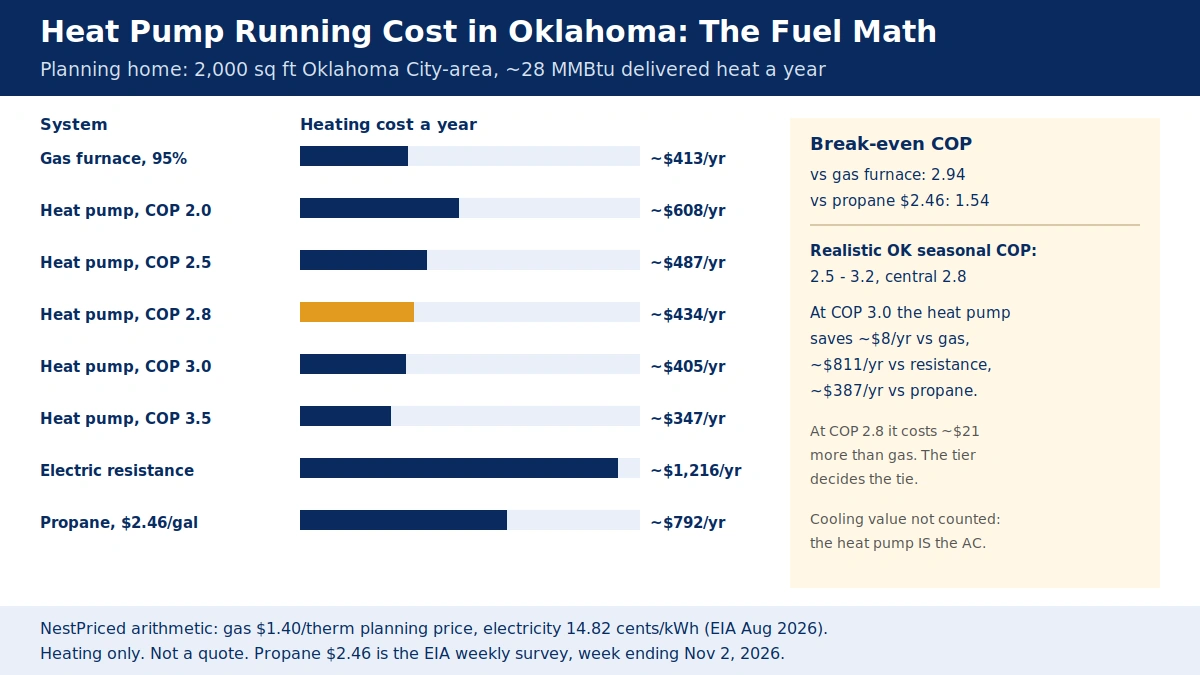
The planning home for the sums below is a 2,000-square-foot Oklahoma City-area house needing about 28 MMBtu of delivered heat a year — NestPriced arithmetic on stated assumptions, not a measured bill. At 14.82 cents a kilowatt-hour, that heat costs $1,216 a year from electric resistance, because resistance turns every kilowatt-hour into 3,412 BTU and nothing more. A heat pump divides that figure by its seasonal COP: at COP 2.0 it costs about $608 a year, at COP 2.5 about $487, at COP 2.8 about $434, at COP 3.0 about $405, and at COP 3.5 about $347. The seasonal COP is the whole argument, and in Oklahoma the planning range runs 2.5 to 3.2 with a central figure of 2.8 — lower than the Deep South states in this series, because Oklahoma winters are colder, and higher than the northern states, because Oklahoma winters are shorter.
Gas at the $1.40-a-therm planning price costs about $413 a year to heat the same house through a 95 percent furnace: 28 MMBtu of delivered heat needs 29.5 MMBtu of gas input, which is about 295 therms. Propane at $2.46 a gallon costs about $792 a year through a 95 percent furnace: the same 29.5 MMBtu needs about 322 gallons. The break-even COP against gas is about 2.94 — the seasonal efficiency at which the heat pump and the gas furnace cost exactly the same to run. The break-even against propane is about 1.54, which any working heat pump clears without trying.
At a seasonal COP of 3.0, the heat pump costs about $405 a year against about $413 for gas — a saving of about $8 a year, which is no saving at all. At COP 3.5 it costs about $347, saving about $66. At COP 2.5 it costs about $487, which is about $74 more than gas. At the central planning COP of 2.8 it costs about $434, about $21 more than gas. Read that plainly: in Oklahoma, a heat pump does not beat a gas furnace on heating. It ties it, within a few dollars either way, and the tie breaks on the COP the house actually achieves. A tight house with a variable-speed unit and ducts inside the envelope will land on the winning side. A leaky house with ducts in a vented attic and a single-stage unit will land on the losing side, and the gas bill will show it.
Against the other two fuels the verdict is not close at all. Against electric resistance heat, the heat pump saves about $811 a year at COP 3.0 — $1,216 against $405 — and that is the saving most Oklahoma buyers actually get, since about 40 percent of the state heats with electricity. Against propane at $2.46 a gallon, it saves about $387 a year — $792 against $405 — and the saving grows with every propane price rise. A propane-heated home outside the gas mains is the best heat-pump candidate in Oklahoma, full stop, and a resistance-heated home is the second best. A gas-heated home buys the heat pump for the air conditioning, not for the heating bill.
One sensitivity belongs in the open, because it cuts against the heat pump. The gas planning price of $1.40 a therm is the EIA 2025 annual average. The EIA monthly winter prices run lower — January 2026 was about $10.78 per thousand cubic feet, February about $10.52, which works out near $1.04 a therm. At $1.04 a therm, the gas furnace costs about $307 a year to heat the planning home, and the break-even COP rises to about 3.96 — a figure no standard heat pump reaches across a whole Oklahoma winter. The annual average is the fairer planning price, because a gas bill carries fixed charges all year, but the winter-month figures are a warning: if gas stays cheap in winter, the heat pump’s heating case against gas gets thinner, not thicker. Do not let a contractor quote the heat pump against a summer gas price. Summer gas figures are unusable for heating math, because fixed charges spread over tiny summer volumes inflate them beyond recognition.
The cooling half of the bill belongs in the same section, because the heat pump is the air conditioner. A 3-ton heat pump cooling an Oklahoma City house through 1,876 cooling degree days at 14.82 cents a kilowatt-hour costs roughly what a same-efficiency straight air conditioner costs — the machine is the same machine in July. The saving against a furnace-plus-air-conditioner setup is not in the July bill. It is in the purchase: one machine instead of two, one install instead of two, one maintenance visit instead of two. That is where the Oklahoma heat pump earns its keep against gas, and the payback section prices it exactly that way.
Our heat pump running cost guide works through the same sums for the national picture, and our heat pump vs furnace guide compares the two machines head to head. For the Oklahoma house, the short version is this: the heat pump crushes resistance heat, beats propane comfortably, ties gas on heating, and wins outright once the air conditioner it replaces is counted. Any quote that says more than that has not done the sums.
Utility Rebates & What You Can Actually Collect in 2026
Oklahoma has no statewide heat pump rebate, and in 2026 that absence matters more than usual, because the biggest utility in the state closed its program. What is left is a patchwork of utility programs, each with its own territory, its own tiers, and its own deadlines — and a buyer who counts money from the wrong utility is a buyer who overpays by the amount of the rebate they never had. Read the name at the top of the electric bill first. Everything below follows from it.
OG&E is the hole in the map. Oklahoma Gas & Electric serves Oklahoma City, Norman, and much of central Oklahoma — the biggest service territory in the state — and its Oklahoma residential rebates are closed for 2026. OG&E’s own rebate page says so, and two independent trackers verified the closure in November 2026: Oklahoma applications are closed, Arkansas applications remain open, and OG&E says its Oklahoma residential rebates return in 2027. The closed program was the generous one: up to $1,500 per qualifying high-efficiency HVAC unit, up to $3,000 for two units, for homes 10 or more years old, a burnout replacement allowed once per 20 years, application within 30 days of install by an Oklahoma-licensed HVAC professional. None of that money is claimable in 2026. A quote that subtracts an OG&E rebate from a 2026 install is a quote that needs rewriting before it is compared. The only honest way to price an OG&E-territory install in 2026 is with $0 of utility rebate, and the only honest thing to say about 2027 is that the program is expected back and its 2027 levels are not published.
PSO Power Forward is the biggest live rebate in the state. Public Service Company of Oklahoma, the AEP company serving Tulsa, Lawton, and much of eastern and northeastern Oklahoma, pays a tiered ENERGY STAR air-source heat pump replacement rebate: $600 at 15.2-17.1 SEER2, $1,000 at 17.2-19 SEER2, and $1,400 at 19.1 SEER2 and above. A ductless mini-split at 19.1 SEER2 earns $600. A geothermal ground-source heat pump earns $1,400. A heat pump water heater earns up to $750. Rebates go through pso-esp.com with proof of purchase, and the program was verified open in late October and early November 2026. The tier structure matters for the buying decision: the jump from the $600 tier to the $1,400 tier is $800, and on a mid-efficiency unit the rebate alone can cover a meaningful share of the step up to a higher-SEER2 machine. Ask the contractor to price the job at two efficiency tiers with the rebate at each tier shown as its own line, because the net price, not the gross price, decides which tier is cheaper.
The co-ops pay their own schedules, and on geothermal some of them pay more than anyone else in the state. Cotton Electric Cooperative, serving southwest Oklahoma, pays $500-$1,000 per air-source unit and up to $750 a ton for geothermal, capped at $4,000 per residence. CKenergy Electric Cooperative, serving ten counties in western Oklahoma, pays $2,000 a ton for geothermal heat pumps, up to $24,000 per member — the largest single rebate in this guide, and the reason a geothermal loop is worth pricing seriously in western Oklahoma. The Oklahoma Municipal Power Authority’s WISE program pays $175-$300 a ton for air-source heat pumps in 31 participating member cities, including Edmond, Altus, and Mangum. Two smaller programs carry a warning label rather than a verified figure: Cimarron Electric is reported at $500 on an air-source unit and $600 on geothermal, from a contractor page rather than the co-op’s own schedule, and Oklahoma Electric Cooperative posts geothermal and heat-pump conversion rebates on a rate sheet dated 2025. Confirm both amounts with the co-op before counting on them.
| Utility / program | Territory | Heat pump rebate (2026) | Status |
|---|---|---|---|
| OG&E HVAC replacement | Oklahoma City, Norman, central OK | Up to $1,500/unit, $3,000 max | CLOSED for 2026; returns 2027 |
| PSO Power Forward | Tulsa, Lawton, eastern OK | $600-$1,400 by SEER2 tier | Open |
| Cotton Electric Co-op | Southwest OK | $500-$1,000 air-source | Open |
| CKenergy Co-op | Western OK, 10 counties | $2,000/ton geothermal, up to $24,000 | Open |
| OMPA WISE | 31 member cities incl. Edmond | $175-$300/ton air-source | Open |
| Cimarron Electric | Northwest OK | $500 air-source / $600 geothermal | Confirm (secondary source) |
No Oklahoma utility pays a rebate for a heat pump water heater except PSO, no gas utility in the state pays a heat pump rebate — Oklahoma Natural Gas offers none — and no program in the state pays more for a cold-climate unit as such. The rebate a home can collect is decided by the electric utility on the bill, and only by that utility: OG&E and PSO and the co-ops cover distinct territories, so a typical Oklahoma homeowner stacks exactly one of them. A contractor who promises a rebate from a utility that does not serve the address is a contractor to walk away from.
One more rule governs every rebate in this section, and it is the rule that costs buyers the most money when it is missed: the application deadline. OG&E’s closed program required the application within 30 days of install. PSO requires proof of purchase through its portal. Co-op programs run on their own calendars and their own funding caps, and several of them operate first-come, first-served. Get the rebate in writing before signing, with the program name, the amount, the efficiency tier it requires, and the deadline printed on the quote — and if the contractor will not put it in writing, price the job as if the rebate does not exist, because for the purposes of the budget it does not.
Federal Help in 2026: $0 Tax Credit, HEAR Not Launched & the Lease Route
The federal picture for a 2026 Oklahoma install is short, and the shortness is the point. The tax credit is gone. The rebates have not launched. The one route still open runs through a lease, and no Oklahoma provider for it was verified in this pass. A quote that shows federal money on a 2026 install is a quote built on 2025 rules, and it needs rewriting before it is compared with anything.
The tax credit ended on December 31, 2025. The One Big Beautiful Bill Act, Public Law 119-21, ended the Section 25C energy efficient home improvement credit and the Section 25D residential clean energy credit for property placed in service after December 31, 2025. The IRS confirmed it in Fact Sheet FS-2025-05. For a homeowner-owned heat pump installed in Oklahoma in 2026 — air-source or geothermal, standard or cold-climate — the federal tax credit is $0. Not reduced, not capped, not delayed: zero. The 30 percent credit that once softened a geothermal install, and the credit of up to $2,000 that once softened an air-source install, are both gone for 2026 work. A 2025 install can still be claimed on a 2025 return through IRS Form 5695. A 2026 install cannot be claimed on any return, and any contractor who says otherwise is either working from an old price sheet or hoping the buyer does not check.
The HEAR and HOMES rebates have not launched in Oklahoma. The federal home energy rebates — HEAR, the electrification rebate worth up to $8,000 for a heat pump, and HOMES, the whole-home efficiency rebate worth up to $8,000 — are funded by the Inflation Reduction Act and run state by state. Oklahoma’s combined allocation is $129,152,880, administered by the Oklahoma Department of Commerce through its State Energy Office. As of November 4, 2026, the programs had not opened to the public, and the state has posted no launch date. The state’s own page once estimated about 18 to 24 months before the programs would be available to the public, a window that ran from winter 2025 into summer 2026, and that window has now closed without a launch. Roughly $129 million is allocated to Oklahoma, and none of it buys a rebate a homeowner can claim today.
Even after launch, HEAR money cannot fund a fuel switch. The Energy Department’s Program Notice 26-2, effective May 29, 2026, renamed HEAR the High-Efficiency Electric Home Rebate and limited it to electric-to-electric upgrades and new construction. It does not pay to replace gas, oil, or propane equipment with electric equipment. That shuts out a gas- or propane-heated Oklahoma home trying to switch to a heat pump — which is most of the state, since 57 percent of Oklahoma City homes heat with piped gas. Only electric-to-electric upgrades and new construction qualify — which in Oklahoma covers the roughly 40 percent of homes that already heat with electricity. A gas-heated home waiting for HEAR to fund its switch is waiting for money that will never come, under rules that were written before the program even opened.
The lease route is the only federal money left for 2026, and it is narrow. Section 48E, the clean electricity investment credit, still supports leased systems placed in service by December 31, 2027, with the credit passing through from the leasing company to the homeowner in the form of a lower payment. That is the one federal route still open for a 2026 install, and it runs through a lease, not through a purchase. No Oklahoma lease or power-purchase provider was verified in this pass, and no lease offer is named in this guide, because an unverified provider is worse than no provider: a lease signed with a company that cannot pass the credit through is a lease that costs more than the purchase it replaced. If a contractor offers a lease, ask for the pass-through in writing, with the Section 48E basis named and the in-service deadline of December 31, 2027 printed on the agreement. Our federal energy tax credits guide carries the full 2026 picture, including what ended and what survived.
Oklahoma adds no state tax credit on top. No Oklahoma state tax credit for heat pumps — air-source or geothermal — was found in this pass, and the state has no sales-tax break for heat pump equipment either. That absence is worth stating plainly, because buyers coming from states with their own credits assume one exists here. In Oklahoma in 2026, the incentive stack is the utility rebate and nothing else, plus the HEAR and HOMES money that has not launched. Price the job on that stack, and the job will not surprise the buyer later.
Permits & Licensing: The CIB Mechanical License & the Local Permit Desk
Oklahoma licenses the trade at the state level and permits the job at the local level, and the buyer has to check both. The state license proves the contractor is allowed to do the work. The local permit proves the work was inspected. A job with one and not the other is a job half done, and the half that is missing is the half that costs money later — at resale, at an insurance claim, or at the first service call after a storm.
The state license comes from the Construction Industries Board. Under the Mechanical Licensing Act, Title 59 Oklahoma Statutes sections 1850.1 through 1850.17, no one may engage in or offer to engage in mechanical work — heating, cooling, refrigeration, ventilation, and natural gas piping — as a journeyman or contractor without a valid CIB license, and no business may act as a mechanical firm unless a licensed contractor is associated with and responsible for its work. Licenses run by category: HVAC limited or unlimited, natural gas piping, process piping, refrigeration, sheet metal, ground source piping, and fueled hearth products. A residential heat pump install needs the HVAC category, and a geothermal loop needs the ground source piping category as well.
The ladder runs apprentice, journeyman, contractor, and each rung is earned. A journeyman mechanical license needs at least three years of verified mechanical trade experience, with approved education substituting for part of it. A contractor license needs at least one additional year beyond the journeyman level, plus a two-part examination through PSI covering trade knowledge and business law, with a 70 percent pass mark on each part. The contractor carries a $5,000 corporate surety bond payable to the Construction Industries Board and at least $50,000 in commercial general liability insurance. Licenses renew annually in the holder’s birth month, and journeymen and contractors complete 6 hours of continuing education every 36 months. An unlimited HVAC/R contractor license needs documented experience with systems over 500,000 BTU per hour of heating input and 25 tons of cooling capacity — a threshold no residential job reaches, which is why the limited license covers nearly every home install in the state.
The permit desk is the local checkpoint, and it is the buyer’s friend. Cities may appoint inspectors, require mechanical permits, charge fees, and require contractors to register locally, and Oklahoma City and Tulsa both do. Oklahoma City requires every contractor to register before pulling a permit, and mechanical contractor registration runs $95 initially and annually per category, on top of the state license. A mechanical permit and an electrical permit come from the city or county where the house sits, and the permit desk is the checkpoint: the work gets inspected, the inspection gets recorded, and the record follows the house. In areas with no local building code, the contractor must notify the CIB before starting work. There is no statewide general contractor license in Oklahoma — general contracting is handled locally — so a contractor who claims a state general license is claiming a credential that does not exist.
Two more checks sit beside the license, and neither is optional. The electrician’s license for electrical work is separate from the mechanical license: the person who wires the disconnect and the panel upgrade needs the matching CIB electrical license. Federal EPA Section 608 certification for refrigerants is separate again: anyone who handles refrigerant needs it, and the new R-454B and R-32 refrigerants in 2026 systems do not change that. Look the CIB license up on the Board’s verification before anyone touches the house, ask for the bond and insurance certificates in writing, and confirm the permit numbers before the crew leaves. A contractor who will not show a license, a bond, and a permit is a contractor to walk away from, however good the price looks.
One Oklahoma rule most buyers never hear about is the lien rule, and it is worth a paragraph. On an owner-occupied Oklahoma home, a subcontractor or supplier who is not paid may file a mechanic’s lien against the house, but only if they send the homeowner a pre-lien notice within 75 days of last supplying work — miss that window and the lien is invalid. The homeowner’s liability is capped at the contract price with the contractor. For a heat pump install, the lien notice, if one ever comes, will most likely come from the equipment distributor or from the electrician the installer brought in for the panel work. Keep a running tally of every payment and every pre-lien notice, pay by the contract schedule and not ahead of it, and the lien rule will never touch the house.
Tornado Belt: Hail, Wind & Keeping the Outdoor Unit on Its Pad
Oklahoma sits in the middle of Tornado Alley, and no honest Oklahoma heat pump guide can pretend otherwise. The state has recorded 4,856 confirmed tornadoes since 1950, the third-highest total in the country, and averages about 71 tornadoes a year over the 1996-2025 record. Hail is the more frequent threat: 30,254 hail events since 1950, against 21,278 damaging-wind events. May is the peak month, carrying about 40 percent of the year’s tornadoes, and most of them are weak — about three in four rate EF0 or EF1 — but 18 reached EF4 or EF5 in the 1996-2025 window, and Moore and El Reno are the names every Oklahoman knows. A heat pump in Oklahoma is not installed in a calm climate with an occasional storm. It is installed in a storm climate with calm spells between the outbreaks, and the install has to be built for the outbreaks.
The outdoor unit is the exposed part, and it needs to be anchored like it. A heat pump’s outdoor unit is a metal box full of a coil, a fan, and a compressor, sitting on a pad in the open air, and in a supercell it faces three threats at once: wind that tries to slide it off the pad, hail that dents the coil fins and bends them shut, and flying debris that punctures the coil outright. The fix is unglamorous and cheap relative to the machine: anchor the unit to its pad with tie-downs or hurricane straps, set the pad on a raised concrete base where the yard floods, fit a hail guard over the coil where the contractor recommends one, and keep the unit clear of trees and fences that shed branches. No Oklahoma-verified price was found in this pass for tie-downs, hail guards, or surge protection, and this guide invents none — ask for each as a separate line on the quote, and treat a contractor who says the unit needs no anchoring in Oklahoma as a contractor who has not thought about May.
Power is the second exposure, and it decides the backup-heat conversation. A heat pump needs electricity, and an Oklahoma ice storm or tornado outbreak can take the power out for hours or days. A gas furnace needs electricity too, for its blower and controls, so the heat pump is not uniquely exposed — but a home that loses power loses heat and cooling either way, and the buyer who has never thought about it should think about it before the first storm season with the new system. A portable generator that can run the heat pump is a bigger machine than a portable generator that can run a furnace blower, because the heat pump’s compressor draws far more on startup, and most portable generators cannot start a 3-ton compressor at all. The honest options are a whole-home standby generator sized for the compressor’s locked-rotor amps, a smaller generator that runs the essentials and not the heat pump, or acceptance that the house will be cold or hot until the lines are back. None of those is a reason to skip the heat pump. All of them are reasons to decide the answer before the storm, not during it.
After the storm, the unit needs checking before it is restarted. Hail dents coil fins and chokes airflow. Debris bends fan blades and blocks the coil. A shifted pad leaves the unit out of level, and an out-of-level unit vibrates, wears its compressor mounts, and fails early. Flood water in the electrical compartment corrodes connections that look fine until they arc. The rule is simple: after any storm that drops hail, throws debris, or moves water through the yard, walk out to the unit, look at the coil fins, the fan, the pad, and the disconnect, and do not restart a unit that has taken a visible hit until a technician has looked at it. A $150 service call after a storm is cheaper than a $3,000 compressor that died because it ran with a bent fan blade for a month.
The state runs one storm-hardening program worth knowing about, even though it does not pay for the heat pump. Strengthen Oklahoma Homes, run by the Oklahoma Insurance Department, pays grants of up to $10,000 for projects that meet the Insurance Institute for Business & Home Safety’s FORTIFIED Home – Roof standard, with the High Wind and Hail Supplement. The final pilot reopened eligible zip codes, and the program is scaling to a full statewide rollout in 2026, with all 77 counties eligible. The grant pays for the roof, not the heat pump — but a FORTIFIED roof is the roof that keeps the hail out of the attic and the wind out of the house, and a buyer replacing a roof and a heat pump in the same year should sequence the two jobs so the roof goes first and the grant is claimed while it is available. Our Oklahoma solar guide covers the same storm exposure from the panel side, for buyers weighing both machines.
What Pushes Your Oklahoma Quote Up or Down
A 3-ton ducted heat pump in Oklahoma runs $6,430-$10,800, and the $4,370 spread inside that band is not noise. It is the house, the machine, and the job, priced line by line. A buyer who knows which lines move the number can read a quote the way a contractor wrote it, and can tell a fair quote from a padded one without needing a second opinion.
The machine itself is the first lever. A value-tier single-stage unit at roughly SEER2 15 and HSPF2 7.8 sits at the bottom of the band. A mid-efficiency two-stage unit at SEER2 16-17 sits in the middle — Hartzell’s mid tier at $8,000-$12,000. A premium variable-speed unit past SEER2 20 and HSPF2 10 sits at the top — Hartzell’s high-efficiency tier at $10,000-$15,000 and up. The step from one tier to the next costs roughly $2,000-$3,000, and the PSO rebate tiers soften it: the jump from the $600 rebate tier to the $1,400 tier is $800 back on a top-efficiency machine. Brand matters less than tier: a perfectly installed mid-range unit beats a poorly installed premium one every time, and the warranty terms matter more than the badge on the box.
The ducts are the second lever, and in Oklahoma they are often the biggest one. New or extended ductwork runs $4,120-$7,020 a job in Oklahoma City, and it is the largest single add-on in the state. Ducts in a vented attic bake past 130 degrees in July and leak a fifth of the cooled air before it reaches a register. Ducts in a vented crawlspace sweat in the summer and flood in a spring storm. Ducts that were sized for a furnace in 1975 are undersized for a heat pump in 2026, because a heat pump moves more air at a lower temperature than a furnace does. A quote that prices the machine without inspecting the ducts has left out the part of the job that decides the July bill, and a quote that includes duct sealing or duct replacement as a separate line is a quote that has actually looked at the house.
The electrical panel is the third lever. A 200-amp panel upgrade runs $2,130-$3,370 a job in Oklahoma City, and it is the add-on most likely to surprise a buyer, because it is invisible until the electrician opens the panel. A heat pump needs a dedicated 240-volt circuit, and a house still on a 100-amp panel — common in Tulsa bungalows and post-war Oklahoma City ranches — has no spare capacity for it. The panel upgrade is not optional, it is not negotiable, and it is not the heat pump contractor’s fault. It is the price of a house built before air conditioning was universal. Our electrical panel upgrade guide prices the job separately, and a heat pump quote that buries the panel work inside the per-ton figure is hiding the most predictable add-on in the book.
The storm items are the fourth lever, and they are the ones with no published price. Tie-downs, a raised pad, a hail guard, and surge protection all cost money, and none of them carries a verified Oklahoma price in this pass. A coastal quote in another state in this series could price a raised stand from a published figure; an Oklahoma quote cannot, because no one has published one. Ask for each as a separate line, and compare the lines across bidders rather than comparing a single lump sum. A bidder who includes storm hardening as separate lines has thought about May. A bidder who does not mention it has not.
The calendar is the fifth lever. May and October are the mildest months in Oklahoma City, and they are the cheapest months to buy, because crews are not booked solid and contractors discount the shoulder season. July is the most expensive month to buy, because every crew in the state is replacing failed air conditioners and the buyer is negotiating from a house with no cooling. January is the second most expensive, because the cold snaps fill the service lines with no-heat calls. A planned replacement in May costs less than an emergency replacement in July, and the difference is not the equipment — it is the calendar.
Sales tax is the sixth lever, and it is the one buyers forget until the invoice. Oklahoma charges 4.5 percent state sales tax, plus city and county tax on top. Combined rates in the two metros are commonly published near 8.625 percent in Oklahoma City and 8.517 percent in Tulsa — verify the figure at purchase, because local rates move — and on an $8,615 midpoint install the tax alone runs about $735-$745. Some quotes show the tax as its own line. Some bury it in the total. Either way it is owed, and a quote that does not mention it is a quote that is $700 short of the real price.
The last lever is the one no quote can price: the installer’s skill. A heat pump lives or dies on the install — the Manual J, the refrigerant charge, the airflow setting, the commissioning. A cheap install with a wrong charge costs more in five years than an expensive install done right, because the compressor is the most expensive part in the box and a wrong charge is what kills it. Three quotes from licensed contractors is the minimum, and the cheapest of the three is not automatically the best. The best is the one that names the model, shows the Manual J, itemizes the add-ons, and puts the rebate in writing.
Payback: When Does an Oklahoma Heat Pump Pay for Itself?
Payback is the question every Oklahoma buyer asks, and it has three different answers, because it depends entirely on what the heat pump replaces. Against resistance heat it pays back in about a decade. Against propane it pays back in about two decades. Against a gas furnace it never pays back on fuel alone — and that is not a failure of the heat pump, because the heat pump was never bought to beat gas on heating. It was bought to replace the air conditioner too, and on that comparison there is no premium to pay back at all.
Against electric resistance heat, about 10.6 years. The midpoint 3-ton ducted install costs about $8,615. At a seasonal COP of 3.0 it saves about $811 a year against resistance heat — $1,216 against $405 — so $8,615 divided by $811 gives about 10.6 years. With PSO’s $1,400 top-tier rebate the net install drops to about $7,215, and the payback drops to about 8.9 years. That is the payback most Oklahoma buyers actually get, since about 40 percent of the state heats with electricity, and it is the payback that makes the heat pump an easy decision for a resistance-heated home. The saving is real, it is large, and it starts the first winter.
Against propane, about 22.3 years. At $2.46 a gallon through a 95 percent furnace, propane costs about $792 a year to heat the planning home, and the heat pump at COP 3.0 costs about $405 — a saving of about $387 a year. Dividing $8,615 by $387 gives about 22.3 years, which is longer than the heat pump will live. That does not make the heat pump a bad buy for a propane home. It makes the fuel saving the wrong frame for the decision. The propane home buys the heat pump for the air conditioning it did not have, for the end of propane deliveries and propane price spikes, and for the comfort of a house that holds its temperature in July. The fuel saving is a bonus, not the payback.
Against a 95 percent gas furnace, never on fuel alone. At COP 3.0 the heat pump saves about $8 a year against gas — $405 against $413 — and $8,615 divided by $8 is over a thousand years. At the central planning COP of 2.8 the heat pump costs about $21 a year more than gas, so there is no payback to calculate. A gas-heated home that buys a heat pump to save on heating has bought the wrong machine for the wrong reason. But compare the heat pump against the furnace-plus-air-conditioner the home would buy anyway, and the picture flips completely: a 3-ton furnace-plus-AC job runs $8,260-$14,070 in Oklahoma, midpoint about $11,165, against the heat pump’s midpoint of $8,615. The heat pump is typically about $2,550 cheaper than the pair it replaces. There is no premium to pay back, because there is no premium. The heat pump is the cheaper whole-home system, and it cools and heats the house besides.
The rebate changes the arithmetic, and the OG&E closure changes it back. In PSO territory the $1,400 top-tier rebate takes the net install to about $7,215, and the payback against resistance heat drops to about 8.9 years. In OG&E territory the rebate is $0 in 2026, and the payback stays at about 10.6 years against resistance heat. The difference is $1,400 of timing: the same machine, the same house, a different utility, a different year. An Oklahoma City buyer who waits for OG&E’s 2027 return is betting $1,400 against a year of resistance-heat bills and a year of an aging system that might fail in July. That is a bet worth doing the sums on, not a bet worth taking on faith.
The long view is the one that matters most, and it is the one the payback tables never show. A heat pump runs year-round, heating and cooling, so it accumulates more runtime hours than a furnace or an air conditioner alone, and it needs the maintenance to match: a yearly professional service, filters changed on schedule, the outdoor coil kept clear of debris and hail damage. A well-maintained heat pump lasts 15-20 years. A neglected one does not, and the payback on a machine that dies at 10 years is a payback that never arrives. The cheapest install is not the one with the lowest sticker. It is the one that is still running in year 15, and that is decided by the installer, the sizing, and the maintenance — in that order.
Getting Quotes in Oklahoma: The Checklist
Do not sign anything until every item on this list is in writing, on one identical spec sheet, from three licensed contractors. A quote that is missing an item is not a cheaper quote. It is an incomplete quote, and the missing item will arrive later as a change order, at a price the buyer no longer has the leverage to negotiate.
- Your rebate in writing first (PSO $600-$1,400 by SEER2 tier; OG&E $0 in 2026, returns 2027; co-op schedules — Cotton Electric $500-$1,000, CKenergy $2,000/ton geothermal, OMPA WISE $175-$300/ton; no HEAR money in 2026)
- Model named with its ratings (SEER2, HSPF2, 5-degree capacity and COP for cold-climate units, refrigerant R-454B or R-32)
- Manual J in writing (Oklahoma City 15 F, Tulsa 14 F, Norman about 15 F, Lawton about 14 F; cooling and heating loads separately)
- Backup heat named and priced (resistance strips or gas furnace, switchover temperature, full design-load coverage)
- Cash price in writing for the same model ($6,430-$10,800 anchor; midpoint about $8,615)
- No line for a federal credit, no line for a HEAR rebate, no line for an OG&E rebate on a 2026 install ($0 federal; HEAR not launched; OG&E closed for 2026)
- Licenses verified (CIB mechanical contractor license, $5,000 bond, $50,000 liability, 6 CE hours every 36 months; electrician’s license for the panel work; EPA 608 for refrigerants; Oklahoma City mechanical registration $95 a year)
- Add-ons itemized (ductwork $4,120-$7,020, panel upgrade $2,130-$3,370, tie-downs, raised pad, hail guard, surge protection; sales tax 4.5% state plus local as its own line)
- Running-cost model by fuel, not by brochure (seasonal COP 2.5-3.2, central 2.8; backup share; your fuel price — gas at $1.40 a therm, propane at $2.46 a gallon, your own electric rate)
- Placement, storm hardening and HOA approval in writing first (leeward wall, anchored to pad, hail guard, clear of flood water and debris; generator plan for outages decided before the storm season)
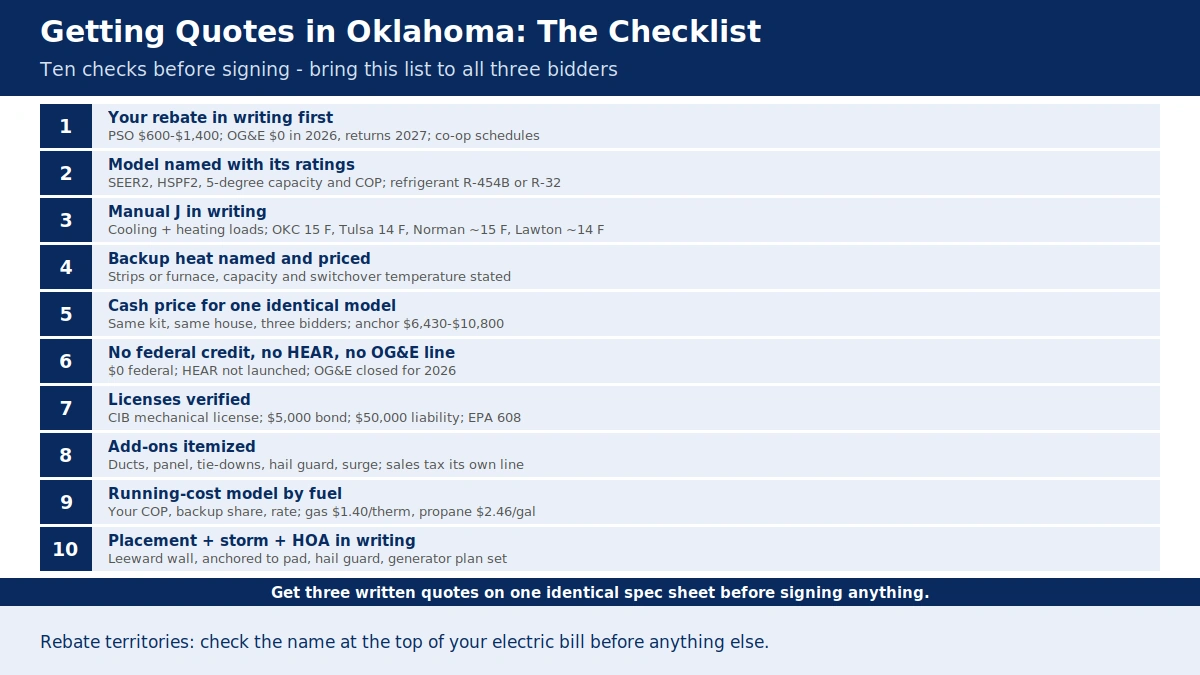
Get three written quotes on one identical spec sheet before signing anything. The cheapest quote is not the best quote. The best quote is the one that names the model, shows the Manual J, itemizes the add-ons, puts the rebate in writing, and proves the license — and in Oklahoma, the best quote is also the one that has thought about May.
Sources & methodology Installed costs:
- NumeralQ, Heat Pump Cost in Oklahoma (2026), estimator pricing as of Oct 26, 2026 (planning estimates, not contractor bids): statewide 3-ton ducted $6,430-$10,800; by size 1.5 ton $4,300-$6,940, 2 ton $5,010-$8,220, 2.5 ton $5,720-$9,510, 3.5 ton $7,140-$12,090, 4 ton $7,850-$13,370, 5 ton $9,260-$15,950; single-zone mini-split $3,060-$4,800; geothermal $20,000-$31,570
- NumeralQ, Heat Pump Cost in Oklahoma City (2026), updated Oct 29, 2026: 3-ton $6,520-$10,920; by size 1.5 ton $4,380-$7,040 to 5 ton $9,380-$16,100; single-zone mini-split $3,120-$4,880; multi-zone 3-head $6,200-$11,120; cold-climate ducted $8,580-$14,990; geothermal $20,200-$31,830; ductwork $4,120-$7,020/job; panel upgrade (200 A) $2,130-$3,370/job; billed $58-$75/worker-hour; HVAC median pay $28.91/hr
- NumeralQ, Heat Pump Cost in Tulsa (2026), updated Oct 3, 2026: 3-ton $6,470-$10,860; single-zone mini-split $3,090-$4,840; dual-fuel $9,130-$15,000
- NumeralQ, HVAC Replacement Cost in Oklahoma City / Tulsa (2026): furnace + AC 3-ton $8,310-$14,070 / $8,260-$14,000; dual-fuel OKC $9,190-$15,080
- Hartzell’s Heat & Air (central Oklahoma contractor), 2026: standard 14-15 SEER2 $6,000-$9,000; mid-efficiency 16-17 SEER2 $8,000-$12,000; high-efficiency 18 SEER2+ $10,000-$15,000+; geothermal $18,000-$40,000+
- HomeCostLens, Tulsa (cost data reviewed Sept 2026, modeled): typical 2,000 sq ft install ~$5,800; range $4,010-$11,600
Electricity, gas, propane:
- EIA Electric Power Monthly, Table 5.6.A, August 2026: Oklahoma residential 14.82 cents/kWh (US 18.16; +2.8% YoY); May 2026 13.38 cents; 2026 YTD average 13.6 cents (NumeralQ OKC page)
- EIA Form 861, 2025: OG&E ~12.5 cents/kWh, ~37.8% of OK residential customers; PSO ~14.2 cents/kWh
- EIA Natural Gas Annual, released Sept 30, 2026: Oklahoma 2025 residential $14.38/Mcf, ~$1.39/therm; monthly Jan 2026 $10.78/Mcf, Feb 2026 $10.52/Mcf
- EIA Weekly Heating Oil and Propane Survey: Oklahoma residential propane $2.461/gal week ending Nov 2, 2026; $2.467/gal week ending Nov 9, 2026
Climate:
- ACCA Manual J design conditions (99%): Oklahoma City winter 15 F, summer 96 F; Tulsa winter 14 F, summer 97 F; older tables disagree (ASHRAE 90.1-2013 99.6%: 9 F both cities; IPC table: 13 F both cities) — flagged
- IPC degree-day table: OKC HDD65 3,725, CDD65 1,876; Tulsa HDD65 3,860, CDD65 1,949; NOAA 1991-2020 normals: OKC HDD 3,615
- NumeralQ OKC page (NOAA normals): ~72 freezing nights a year, 0 nights at or below 0 F; coldest month averages a low of 27 F; mildest months May and October
- DOE federal minimum efficiency, Oklahoma region: 14.3 SEER2 / 7.5 HSPF2; EPA R-410A phaseout in new home systems from 2025 (R-454B / R-32)
Fuel mix and labor:
- ACS 2020-2024 (via NumeralQ): Oklahoma City 57% piped gas, 40% electric heat; statewide electric heat ~40%; OKC median home value $231,300
- BLS OEWS May 2025, SOC 49-9021: Oklahoma HVAC mechanics median $27.67/hr (employment 5,650); Oklahoma City median $28.91/hr (2,120 jobs); Tulsa median $28.25/hr (1,620 jobs); national median $29.33; NumeralQ billed rates statewide $55-$72/worker-hour
Rebates and federal:
- OG&E rebate page (verified Nov 4, 2026 by secondary trackers): Oklahoma residential rebates closed for 2026, return in 2027; closed program $1,500/unit, up to $3,000 for two units, home 10+ years old, once per 20 years, application within 30 days
- PSO Power Forward (verified Oct 25 / Nov 4, 2026): $600 at 15.2-17.1 SEER2, $1,000 at 17.2-19 SEER2, $1,400 at 19.1+ SEER2; ductless mini-split $600; geothermal $1,400; heat pump water heater up to $750
- Cotton Electric Cooperative: $500-$1,000 air-source, geothermal up to $750/ton capped at $4,000; CKenergy: geothermal $2,000/ton up to $24,000; OMPA WISE: $175-$300/ton air-source, 31 member cities incl. Edmond; Cimarron Electric $500/$600 and OEC amounts are secondary/dated — flagged
- HEAR/HOMES: $129,152,880 combined allocation, Oklahoma Department of Commerce State Energy Office; not launched as of Nov 4, 2026 (NASEO tracker); no launch date posted
- OBBBA P.L. 119-21; IRS FS-2025-05 (§25C/§25D $0 after Dec 31, 2025); DOE Program Notice 26-2 (May 29, 2026, no fuel-switching); IRS Notice 2025-42 (§48E lease pass-through, in service by Dec 31, 2027)
Licensing, permits, storms:
- Oklahoma Construction Industries Board, Mechanical Licensing Act 59 O.S. §§1850.1-1850.17; OAC 158:50; $5,000 bond; $50,000 general liability; 6 CE hours / 36 months; annual renewal in birth month; PSI two-part exam, 70% pass; OKC mechanical registration $95 initial and annually
- Lien law: 42 O.S. 142.6 (pre-lien notice within 75 days); 42 O.S. 143 (liability capped at contract price)
- NOAA Storm Prediction Center / Storm Events Database: 4,856 tornadoes 1950-2025 (3rd nationally); ~71/year 1996-2025; 30,254 hail events since 1950; 18 EF4/EF5 1996-2025; May peak ~40%
- Strengthen Oklahoma Homes (Oklahoma Insurance Department): grants up to $10,000, IBHS FORTIFIED Home – Roof (High Wind + Hail Supplement); statewide rollout 2026, all 77 counties
Running-cost and payback arithmetic:
- Planning home 2,000 sq ft OKC-area, 28 MMBtu delivered heat/yr (NestPriced planning assumption) = 8,207 kWh of heat; gas 95% AFUE at $1.40/therm planning price = 294.7 therms = ~$413/yr; heat pump COP 2.0 = 4,103 kWh = ~$608/yr; COP 2.5 = 3,283 kWh = ~$487/yr; COP 2.8 = 2,931 kWh = ~$434/yr; COP 3.0 = 2,736 kWh = ~$405/yr; COP 3.5 = 2,345 kWh = ~$347/yr; resistance = 8,207 kWh = ~$1,216/yr; propane 95% (91,500 BTU/gal) = 322 gal/yr ($2.46 = ~$792/yr); break-even COP vs 95% gas = 2.94, vs propane = 1.54
- Midpoint 3-ton at ~$8,615: vs resistance saves ~$811/yr -> ~10.6 yrs; vs propane saves ~$387/yr -> ~22.3 yrs; vs gas saves ~$8/yr at COP 3.0 (never on fuel alone; at COP 2.8 costs ~$21/yr more than gas); PSO $1,400 rebate -> net ~$7,215 -> vs resistance ~8.9 yrs
- Premium framing: furnace-plus-AC 3-ton midpoint ~$11,165 (OKC $8,310-$14,070; Tulsa $8,260-$14,000) vs ducted heat pump midpoint $8,615 — the heat pump is typically cheaper than the pair it replaces, so the premium is negative
EXCLUDED:
- Any “after 30% credit” or “after $2,000 credit” prices: §25C/§25D are $0 for 2026 installs
- Any HEAR rebate in a 2026 Oklahoma quote: not launched, no launch date, and no fuel-switching even after launch
- Any OG&E rebate in a 2026 Oklahoma quote: closed for 2026, returns 2027, 2027 levels not published
- Norman and Lawton city install prices and design temperatures: planning estimates only, flagged in the draft
- Cold-climate and multi-zone statewide bands: scaled from Oklahoma City figures, flagged in the draft
- Dual-fuel statewide band: bracketed by the Tulsa and Oklahoma City figures, flagged in the draft
- Oklahoma state tax credit for heat pumps: none found; absence not independently verified against the Tax Commission
- Cimarron Electric and OEC rebate amounts: secondary sources / dated rate sheets, flagged
- 2027 OG&E rebate levels: not published; not projected
- Tie-down / hail-guard / surge-protection prices: no Oklahoma-verified prices found
- Any Oklahoma lease/PPA offer: no provider verified, authorization unverified
- Heat-pump seasonal COP 2.5-3.2: planning range, not field-measured for a specific Oklahoma installation
- Summer-month EIA $/Mcf gas figures as heating prices: fixed charges over tiny summer volumes, not usable
- Combined sales-tax figures for OKC/Tulsa (~8.625% / ~8.517%): published figures, not re-verified live
- Billed hourly labor rates beyond NumeralQ’s published ranges: not published elsewhere, omitted
- Heat-pump lifespan figures: national only, flagged as such
Disclaimer: The prices here are 2026 Oklahoma planning figures. What you end up paying moves with the city, the house, the utility territory, the storm exposure, and the contractor. Get written quotes from three licensed Oklahoma installers before settling on a budget, and check the license yourself on the Construction Industries Board’s verification before anyone touches the house. Nothing here is tax advice for your own return — these are general notes only. Program rules change — OG&E, PSO and co-op rebate amounts and deadlines, and the HEAR/HOMES launch status — so confirm current terms with your utility before signing, and note that OG&E’s Oklahoma rebates are closed for 2026. This guide dates its propane price to its source — $2.46 a gallon for the week ending November 2, 2026. A propane-heated home’s payback moves with the propane price, so check the current EIA weekly survey before you decide.
What does a heat pump cost in Oklahoma in 2026?
A typical 3-ton ducted heat pump costs $6,430-$10,800 installed in Oklahoma in 2026 (NumeralQ planning estimates, October 2026), with Oklahoma City at $6,520-$10,920 and Tulsa at $6,470-$10,860. Geothermal with a ground loop is $20,000-$31,570, dual-fuel about $9,100-$15,050, and a cold-climate ducted machine about $8,480-$14,810; one mini-split zone runs $3,060-$4,800. The biggest live rebate is PSO Power Forward at $600-$1,400, OG&E’s Oklahoma rebates are closed for 2026, and the federal tax credit is $0 for a 2026 install.
Do heat pumps work in Oklahoma winters?
Yes — and Oklahoma winters are milder than the cold-climate marketing suggests. Oklahoma City is designed for 15 degrees, Tulsa for 14, and the metros count about 72 freezing nights a year with zero nights at or below zero, so a standard ducted unit carries most of the winter without the cold-climate premium; only the Panhandle and the northwest counties have a real case for one. At five degrees the two machines split: a standard unit keeps 40 to 60 percent of its rated capacity, while a cold-climate machine keeps more than 70 percent and a COP of 1.75 or better. This guide plans on a seasonal COP of 2.5 to 3.2 for Oklahoma, central 2.8, because most of the season sits in the 40s and 50s. Backup heat still counts on the coldest ice-storm nights, yet winter asks far less of the machine here than summer does.
Is a heat pump cheaper to run than a gas furnace in Oklahoma?
Almost exactly the same — and the machine you buy decides which side of the tie you land on. Oklahoma power averages about 14.82 cents a kilowatt-hour, and tying a 95 percent gas furnace at the $1.40-a-therm planning price takes a seasonal COP of about 2.94, while a realistic Oklahoma seasonal COP is 2.5 to 3.2. At COP 3.0 the heat pump heats the planning home for about $405 a year, against about $413 for gas — a saving of about $8. At COP 3.5 it costs about $347, saving about $66. At COP 2.5 the heat pump costs about $74 more than gas, and at the central planning COP of 2.8 it costs about $21 more. Against electric resistance heat the heat pump wins in every corner of the state, saving about $811 a year — and about 40 percent of Oklahoma homes heat with electricity.
What rebates can I get for a heat pump in Oklahoma in 2026?
It depends entirely on your utility, and the biggest utility in the state pays nothing this year. OG&E’s Oklahoma residential rebates are closed for 2026 and return in 2027, so an Oklahoma City or Norman buyer collects $0 from OG&E. PSO Power Forward pays $600-$1,400 for an air-source heat pump replacement in Tulsa, Lawton and eastern Oklahoma, tiered by SEER2, plus $600 for a ductless mini-split and $1,400 for geothermal. Cotton Electric Cooperative pays $500-$1,000 per air-source unit, CKenergy pays $2,000 a ton for geothermal up to $24,000, and the OMPA WISE program pays $175-$300 a ton in 31 member cities including Edmond. Install in 2026 and the federal tax credit is $0 — gone entirely, not trimmed.
Can I get the $8,000 HEAR rebate for a heat pump in Oklahoma?
Not in 2026. Oklahoma’s HEAR and HOMES programs have not launched — roughly $129 million is allocated to the state through the Oklahoma Department of Commerce’s State Energy Office, and none of it buys a rebate you can claim today, with no launch date posted. Program Notice 26-2 from the Energy Department bars HEAR money from paying for a fuel switch, whenever the programs open. A gas- or propane-heated home trying to switch to a heat pump is shut out; only electric-to-electric upgrades and new construction qualify, which in Oklahoma covers the roughly 40 percent of homes that already heat with electricity.
Does Oklahoma give a tax credit for a heat pump?
No state tax credit for heat pumps was found in this pass — no credit for air-source machines, and none for geothermal either. Oklahoma’s incentive stack in 2026 is the utility rebate and nothing else, plus the HEAR and HOMES money that has not launched. The co-op rebates are the closest thing to a state-level incentive: CKenergy pays $2,000 a ton for geothermal up to $24,000, and Cotton Electric pays up to $750 a ton capped at $4,000 — but both are limited to their own co-op territories. Do not claim a state credit on a 2026 Oklahoma return without a tax professional confirming one exists, and do not let a quote subtract a credit the home cannot collect.
What license or permit do I need to install a heat pump in Oklahoma?
You need a mechanical permit and an electrical permit from your city or county, and your contractor needs a state license from the Construction Industries Board: a mechanical contractor license in the HVAC category, limited or unlimited, backed by a $5,000 surety bond and $50,000 in general liability insurance, with 6 hours of continuing education every 36 months. The permit desk is the checkpoint — Oklahoma City and Tulsa both require local contractor registration before a permit is pulled, and Oklahoma City charges $95 a year for mechanical registration. The electrician’s license for electrical work and federal EPA Section 608 certification for refrigerants are separate checks, and there is no statewide general contractor license in Oklahoma. Check the CIB license before anyone touches the house.
When does an Oklahoma heat pump pay for itself?
Against electric resistance heat, about 10.6 years on a saving of about $811 a year — and that is the payback many Oklahoma buyers actually get, since about 40 percent of the state heats with electricity. Against propane at $2.46 a gallon, about 22.3 years, saving about $387 a year. A 95 percent gas furnace is never beaten on fuel savings alone at a seasonal COP of 3.0 — the saving is about $8 a year. But compare the heat pump against the furnace-plus-air-conditioner you would buy anyway, and there is no premium to pay back at all: the heat pump is typically about $2,550 cheaper than the pair it replaces, and it cools the house through a 94-degree July besides.