

Heat pump cost in Alabama in 2026 runs $6,090–$10,360 for a standard 3-ton ducted system installed. Most buyers here never think of it as a heating decision at all. Drive through a Huntsville subdivision in February and the outdoor units hum on the side of three houses out of four, because about 75 percent of Huntsville homes already heat with electricity and the heat pump is the default machine.
Drive through Montgomery and the picture flips. Half the homes heat with electricity and half do not, and the buyer is often trading a gas furnace for the first electric system the house has ever had. That split is the whole story of buying a heat pump in Alabama.
In the north, the purchase is usually a replacement: a dead unit swapped for a better one, or a strip-heat system retired because the winter bills finally broke the household budget. Strip heat means plain electric resistance coils making heat directly, the dearest way to heat a house. In the center and south, the purchase is often a conversion, and conversions carry the rebate, the panel work, and the gas-line question all at once.
The second thing a buyer notices is how little the price moves across the state. Birmingham, Huntsville, Mobile and Montgomery price within about $80 of each other at the bottom of the 3-ton band and within about $100 at the top, because the labor market barely moves either. HVAC mechanics earn a median $23.43 an hour in Birmingham, $24.01 in Huntsville and $23.06 in Mobile, all roughly a fifth below the national median.
No corner of the state is dear enough to justify a high bid, and no corner is cheap enough to chase for a discount. What moves an Alabama quote is the house: ducts in a vented crawlspace under a 1960s ranch in Birmingham, a 100-amp panel in a Montgomery bungalow, a coastal lot in Mobile where the outdoor unit has to sit above the flood line.
The statewide band holds, and the cities are still priced separately below, because the utility territory, Alabama Power, TVA through Huntsville Utilities, or a co-op like Baldwin EMC, decides the rebate, and the rebate is the one part of the price that genuinely changes by address.
Money is where Alabama gets strange, and the strangeness arrives before the buyer has picked a machine. The state will hand you a thousand dollars for switching off gas and going all-electric, and hand you nothing at all if you already heat with electricity and only want a better heat pump, unless the house sits in TVA country, where the rule flips: electric-to-electric replacements earn $500 to $800, and gas conversions earn nothing.
The federal rebates that would make all of this look small are still not open, and no agency has given a date for them. A quote with money knocked off for a federal credit that ended, a HEAR rebate that does not exist yet, or a TVA rebate on a gas conversion rests on money the household will never see. Have it redone before comparing it with anything else.
Start with the national numbers. Our national heat pump cost guide sets the baseline, so weigh Alabama’s figures against them.
Table of Contents
How Much Does a Heat Pump Cost in Alabama in 2026?
Alabama’s 2026 prices come from three different kinds of evidence, and each kind measures something different, which is why the figures disagree, and why the disagreement deserves a sort-out before any quote gets compared. A ton is a unit of cooling power, and 3 tons is the most common whole-home size in Alabama.
NumeralQ’s estimator, priced October 26, 2026, builds planning estimates from a national cost model tuned to Alabama labor: a 3-ton ducted air-source system at $6,090–$10,360 for the state, with city numbers a few dollars either side. BetterHouse works the other way, scaling a national baseline by the wage index: $3,710–$12,980, with a typical job at $9,810.
Alabama contractors publish their own prices. Wingman AC around Lake Martin and Dadeville puts most installs at $5,000–$12,200, averaging about $7,800, and Trane’s published 2026 lineup runs $7,369–$15,608 installed at national averages, with the Alabama market toward the lower end.
None of these counts as a survey of what Alabamians actually paid. One is a model, another is a model stacked on a model, and the last is the lived experience of a few real Alabama firms. The sound approach is to lead with the one that names a specific system size for the whole state, and to keep the others as cross-checks with their limits stated.
The headline figure is the NumeralQ 3-ton band, $6,090–$10,360. It wins the headline because it names the machine, the size and the scope, a ducted air-source system, 3 tons, installed, and because it is presented as a planning estimate instead of being dressed up as a contractor survey. The middle of that band, about $8,225, is the number the payback section works from.
BetterHouse’s typical of $9,810 sits near the top of the NumeralQ band, which is reassuring in the loose sense that two different methods land in the same territory. But that $3,710 floor comes from resizing a national range, not from any price an Alabama contractor quoted in the sources checked, and no buyer should build a budget around it.
The Wingman range is the most concrete evidence in the pile: real installed prices from a real Alabama company, with most jobs landing between five and twelve thousand dollars. But it covers one lake-country market, and its $7,800 average sits below the statewide midpoint because labor around Lake Martin runs cheaper than in Birmingham or Huntsville.
Falling inside the NumeralQ band does not prove a bid is fair. Falling above it does not prove it unfair either. What settles it is always the same trio: which machine, which house, and which add-ons the quote folded in.
A fourth set of numbers sits underneath the rest, and it needs a caution of its own. HVAC Visit’s Alabama pages put a heat pump at $5,800–$16,000 installed, and trydun’s BLS-wage model puts the state at $5,550–$10,200.
The HVAC Visit band is wide enough to cover everything from a bare swap-out to a full system with ducts and a panel, which makes it useless as a budget and useful only as proof that the top of the market is much higher than the headline band. The trydun band tracks the NumeralQ band closely, which is what you would expect from two models fed the same wage data.
Use the wide bands as a reminder that the job, not the machine, sets the final number. Do not let a contractor quote the wide band’s low end for a job that needs ducts, a panel and a stand.
The headline band is the whole install in one number: the thermostat, the wiring and disconnect, the pad or stand, the lineset, the indoor coil or air handler, the outdoor unit, plus the crew’s labor, the permit and the startup. The rest of the job is not in it, and in Alabama the rest of the job is often the dear part.
New or extended ductwork runs $3,590–$6,320 a job, a 200-amp panel upgrade runs $2,030–$3,230, and a dual-fuel setup needs a gas furnace as well. A raised stand or flood elevation on a coastal lot, a corrosion coating for the salt air around Mobile Bay, or a condensate arrangement for a crawlspace that floods in a summer storm can add more.
NumeralQ lists the first two as planning add-ons, and they are treated the same way here. The coastal items carry no verified Alabama price in the sources checked, and no figure is guessed for them.
Those costs appear as their own lines on the quote. Fold them into the per-ton figure and the buyer loses sight of the very part of the job most likely to blindside them later.
One figure sits inside the arithmetic, and in Alabama it is small enough to push the decision in a particular direction. No large rebate waits to be subtracted from the sticker. The largest single utility rebate is Alabama Power’s $1,000 on a gas-to-electric switch, and most buyers collect $500–$800 from TVA or nothing at all.
Start from the gross figure on every bid. In Alabama the net number lands only a few hundred dollars lower, a rebate form away. Any bid that has already subtracted a rebate the home cannot collect, or a federal credit that no longer exists, has to be redone before it can be compared with anything.
One caution before the tables: the cheapest Alabama bid is rarely the cheapest system once it is running. The dearest bid is no guarantee of the best system either. The spread between bidders on identical equipment can run several thousand dollars, and in Alabama the spread is widest where the house is hardest.
Think of a Birmingham cottage with ducts in a vented crawlspace, a 1970s split-level in Huntsville with the air handler in the attic, a Mobile home on piers in a flood zone, or a Montgomery bungalow where the panel is full. To compare fairly, set the identical job side by side from each bidder: one model, one house, one backup-heat arrangement, all in writing, with the rebate the home actually qualifies for already taken off.
Get three bids from licensed contractors at minimum. Any bidder who refuses to name the model number, its SEER2 and HSPF2 ratings, and the Manual J result behind the size is one to walk away from.
SEER2 rates cooling efficiency and HSPF2 rates heating efficiency, and higher is better on both. Manual J is the standard calculation of how much heating and cooling a house needs.
| Source | 3-ton ducted | Single-zone mini-split | Multi-zone (3 heads) | Geothermal |
|---|---|---|---|---|
| NumeralQ (Oct 2026, planning est.) | $6,090-$10,360 | $2,840-$4,510 | $5,640-$10,390 (Birmingham) | $19,280-$30,650 |
| BetterHouse (2026, modeled) | $3,710-$12,980, typ. $9,810 | $2,000-$12,000, typ. $3,250 | Not published | $12,000-$40,000+ |
| Wingman AC, Lake Martin (2026, contractor) | $5,000-$12,200, avg. ~$7,800 | Not published | Not published | $15,000-$30,000 |
| trydun (2026, BLS-wage model) | $5,550-$10,200 | Not published | Not published | Not published |
| HVAC Visit (2026, aggregator) | $5,800-$16,000 | Not published | Not published | Not published |
Read two rows of that table with care before anything else is read from it. The HVAC Visit band covers every job type at once, from a bare replacement to a full install with ducts, and its top end describes a different job than its bottom end. The BetterHouse floor is a modeled number: no contractor in this Alabama pass quoted a whole-home ducted install in the $3,710 region.
The NumeralQ band is the one used for the working figures, and every size row in the sections that follow, where it comes from NumeralQ, is labeled a planning estimate, because that is what it is.
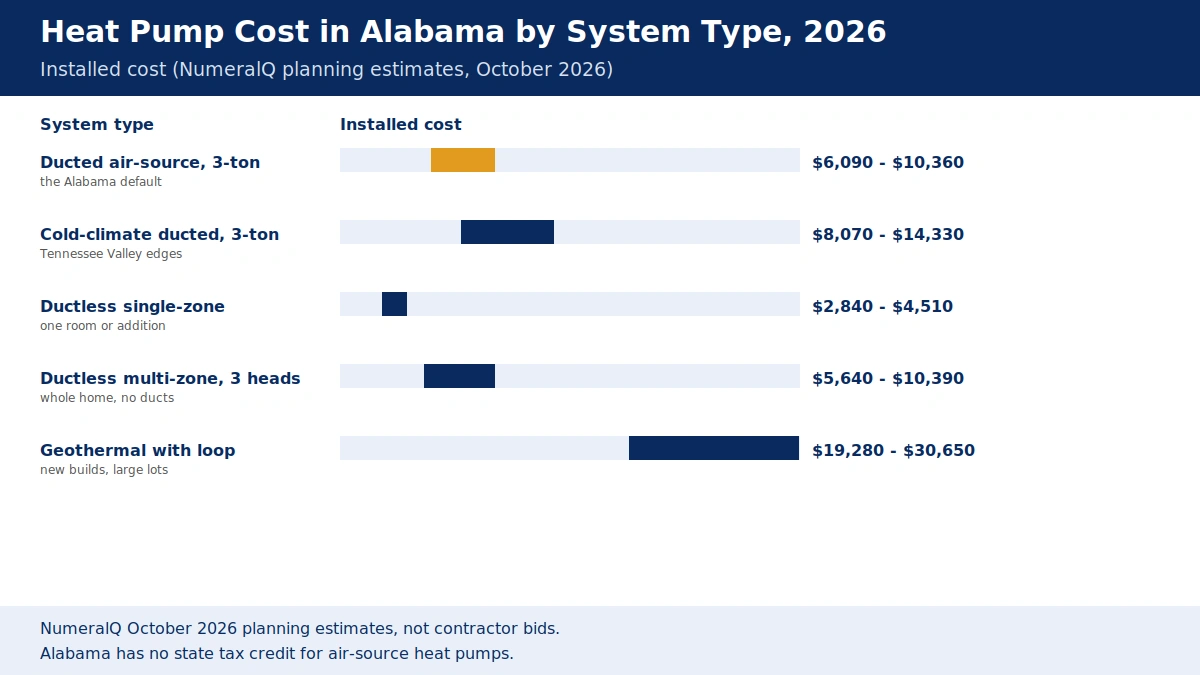
Heat Pump Cost in Alabama by System Type
Say “heat pump” in Alabama and you could mean any of five machines, priced more than six to one from cheapest to dearest, and the house normally makes the choice before the buyer gets a say. A Birmingham brick ranch with ducts in the attic, a Mobile cottage on piers with no duct chases at all, a Huntsville split-level on a slab, a Montgomery bungalow where the old gas furnace finally died, a farmhouse outside Dothan on propane with no gas main for miles: each one points at a different machine.
Each machine carries a different price, a different rebate, and a different summer. Every machine in the table carries a NumeralQ price, with contractor numbers added where they make the picture sharper.
| System type | Installed cost (AL) | Best for in Alabama |
|---|---|---|
| Ducted air-source (3-ton) | $6,090-$10,360 | Whole-home heat + cooling with ducts; the default Alabama buy |
| Ducted cold-climate (3-ton) | $8,070-$14,330 | Huntsville edges and the Tennessee Valley; rarely needed statewide |
| Ductless mini-split, single zone | $2,840-$4,510 | One room, an addition, or a house with no ducts |
| Ductless multi-zone (3 heads) | $5,640-$10,390 | Whole home without ducts; Birmingham figure, statewide similar |
| Geothermal (ground-source) with loop | $19,280-$30,650 | Maximum efficiency, new builds, large lots |
The ducted air-source system is the Alabama default, and the reason is the housing stock. Most Alabama homes already have ducts, and a ducted swap reuses them: the outdoor unit, the indoor coil or air handler, the lineset and the thermostat, with the existing ductwork carrying the air.
At $6,090–$10,360 for a 3-ton system it is also the cheapest whole-home option, and it is the only one Alabama Power’s $1,000 rebate will pay for at the top tier. The rebate requires the heat pump to be the home’s largest HVAC unit, which a ducted whole-home system is by definition.
The catch is the ducts themselves. Alabama’s older homes run ducts through vented crawlspaces and hot attics, where leaks and poor insulation bleed conditioned air into spaces nobody lives in. A ducted swap on leaky ducts buys a new machine and keeps the old losses, which is why the ductwork add-on at $3,590–$6,320 shows up on so many Alabama quotes, and why a contractor who never looks in the crawlspace has not actually quoted the job.
The cold-climate ducted system is the one Alabama buyers most often overbuy. At $8,070–$14,330 it costs roughly a third more than the standard ducted system, and it buys performance the state barely uses: full heating capacity down to 5°F and below, in a state where Birmingham averages zero nights a year at or below 0°F and Mobile averages 15 freezing nights total.
Huntsville is the one market where the conversation is grounded in real cold, with 56 freezing nights a year and a winter design temperature of 16°F. Even there a standard inverter unit with a small strip-heat backup covers the coldest nights for a fraction of the premium.
Buy the cold-climate machine if the house sits on the Tennessee Valley’s coldest ridge and the quote shows the backup-heat hours it eliminates. Buy the standard machine everywhere else and spend the difference on duct sealing.
The ductless mini-split is the machine for the house with no ducts, and Alabama has plenty of them: Mobile cottages on piers, Birmingham bungalows where the ducts were never run, additions and garage conversions, and the sunroom that was never meant to be lived in year-round. A single zone runs $2,840–$4,510 installed, and a three-head multi-zone system runs $5,640–$10,390, the Birmingham figure, with the statewide number tracking it closely.
The mini-split is also the machine TVA likes best in north Alabama, paying $800 for a 17 SEER2 or higher ductless system that replaces existing electric heat.
The trap is the head count. A three-head system at the top of its band costs as much as a ducted whole-home system, and a house that needs five heads has outgrown ductless entirely. Price the ducted option on the same quote before committing to a wall of indoor units.
Geothermal is the dearest machine in Alabama and the hardest to justify on the numbers alone. At $19,280–$30,650 with the ground loop, it costs roughly three times the ducted air-source system, and the premium buys the steadiest efficiency in the state, with ground temperatures that barely move while the August air sits at 94°F.
TVA pays $1,500 toward a geothermal system in its territory, the largest single utility rebate in the state, and the federal residential clean energy credit that once paid 30 percent for geothermal ended with §25D on December 31, 2025, so there is no federal money left for a 2026 install.
Geothermal makes sense on a new build with acreage for a horizontal loop, or on a large home where the air-source machine would need to be oversized for the cooling load. On a standard Alabama lot with a standard Alabama house, the air-source machine wins on payback by a decade.
Two details decide which machine the rebate will actually pay for, and both are easy to get wrong. Alabama Power’s $1,000 requires 20 SEER or 18 SEER2 or higher, which pushes the buyer toward the premium end of the ducted range. A basic 14.3 SEER2 unit does not qualify.
SEER is the older cooling-efficiency rating, and SEER2 is the newer one.
TVA’s $500–$800 tiers start at 15 SEER2, which most mid-range machines clear, but TVA pays only when the new unit replaces existing electric heat. A Montgomery homeowner on gas who wants the Alabama Power $1,000 and a Huntsville homeowner on electric strip heat who wants the TVA $800 are buying the same machine under opposite rules. Without the utility territory named, a quote has not actually priced the rebate.
Heat Pump Cost by Home Size
Size is the single biggest lever on an Alabama quote, and it is the lever the buyer controls least, because the right size comes from the house, not the catalog. The table below prices the NumeralQ bands by tonnage, and the square-footage column is a planning guide only. A tight 2,000-square-foot house in Huntsville needs less machine than a leaky 2,000-square-foot house in Mobile, and the Manual J load calculation is what settles it.
Alabama’s residential code requires equipment sized by ACCA Manual S from Manual J loads, which means a contractor who sizes by the old unit’s nameplate or by square footage alone is sizing by habit, not by code.
| Home size | System size | Installed cost (AL) |
|---|---|---|
| Under 1,200 sq ft | 1.5 tons | $4,010-$6,560 |
| 1,200-1,800 sq ft | 2 tons | $4,700-$7,830 |
| 1,500-2,200 sq ft | 2.5 tons | $5,400-$9,100 |
| 1,800-2,500 sq ft | 3 tons (most common) | $6,090-$10,360 |
| 2,500-3,200 sq ft | 3.5 tons | $6,780-$11,630 |
| 3,200-4,000 sq ft | 4 tons | $7,480-$12,890 |
| 4,000+ sq ft | 5 tons | $8,860-$15,420 |
The jump from 1.5 tons to 5 tons is more than double the money, and most of that jump is equipment: the larger compressor, the larger coil, the larger air handler, and the heavier electrical circuit. Labor barely moves. The crew spends roughly the same day on a 2-ton job as on a 4-ton job, which is why the per-ton price falls as the system grows.
Labor priced per ton pads the small jobs. The Wingman contractor table tells the same story from the field: under 1,200 square feet at $5,000–$7,500, and 2,500 square feet and up at $9,500–$13,000 and beyond, with the middle of the market, the 1,800 to 2,500 square foot home at 3 to 3.5 tons, landing at $7,500–$11,000.
Oversizing is the Alabama-specific trap, and it bites on cooling. A heat pump sized for the coldest January night is oversized for every August afternoon, and an oversized unit in a humid state short-cycles: it cools the air in ten minutes, shuts off before it has pulled the moisture out, and leaves the house cool and clammy at the same time.
Birmingham sits muggy 87 percent of July, and a short-cycling unit in that air is a machine that never finishes its real job. The right size in Alabama is the size that runs long, steady cycles through the afternoon, which is usually the size the Manual J returns, and usually smaller than the size the old unit carried, because the old unit was sized by rule of thumb in 1998.
If two bidders disagree on size by a full ton, one of them did not do the load calculation, and the one who did is the one to trust.
Heat Pump Cost by City: Birmingham, Huntsville, Mobile & Montgomery
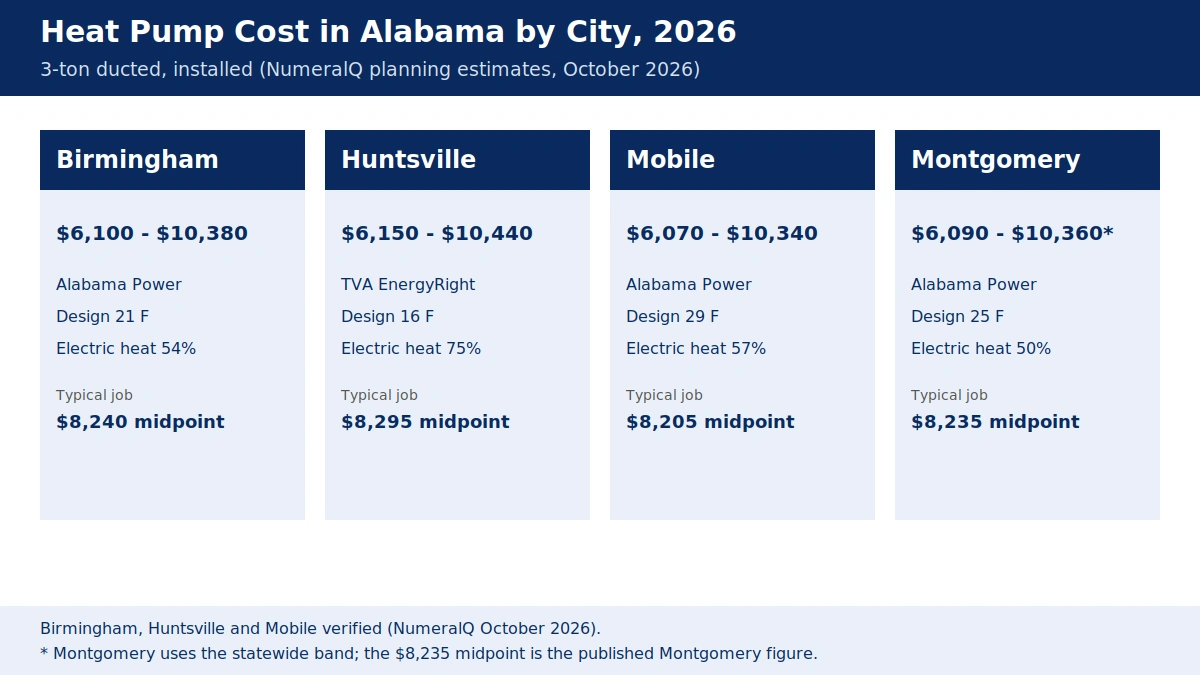
Alabama’s price map is flat enough that the city barely matters for the machine, and sharp enough that the city matters a great deal for everything around it. The four cities below price within about $80 of each other at the bottom of the 3-ton band, because the labor market is nearly uniform: HVAC mechanics earn a median $23.06 to $24.01 an hour across the four metros, all roughly a fifth below the national median.
What changes by city is the rebate, the housing stock, the climate, and the share of the home’s value the job consumes. Birmingham’s typical job costs 5.2 percent of the median home; Huntsville’s costs 2.8 percent. Same machine, twice the bite, because Huntsville homes are worth nearly twice as much.
| City | 3-ton ducted | Typical job | Share of median home | HVAC tech pay | Homes on electric heat |
|---|---|---|---|---|---|
| Birmingham | $6,100-$10,380 | $8,240 | 5.2% ($158,800) | $23.43/hr (−20%) | 54% |
| Huntsville | $6,150-$10,440 | $8,295 | 2.8% ($293,600) | $24.01/hr (−18%) | 75% |
| Mobile | $6,070-$10,340 | $8,205 | 4.2% ($193,300) | $23.06/hr (−21%) | 57% |
| Montgomery | $6,090-$10,360* | $8,235 | 5.1% | −20% | 50% |
No separate city-level Montgomery band for the 3-ton job showed up in the sources checked, so the statewide band stands in, and the typical-job midpoint used is $8,235, the Montgomery figure NumeralQ published.
Birmingham is the replacement market. Fifty-four percent of homes heat with electricity and 43 percent on piped gas, the housing stock runs older and cheaper than anywhere else in this table, and the typical install consumes 5.2 percent of the median home’s $158,800 value, the 12th highest share among the 147 markets NumeralQ prices.
Sixty percent of units are single-family houses and 46 percent of homes are owner-occupied, which means the buyer is often an owner stretching a budget on a house worth less than the machine costs to heat. The rebate here is Alabama Power’s $1,000, and it is the rebate that matters most in the state, but only for the gas-to-electric switch, and only until December 1, 2026.
Birmingham’s 220 plumbing, heating and air conditioning contractors in Jefferson County work out to 7.1 per 10,000 homes, close to the national rate of 7.7, so competition is normal and a quote far above the band is worth questioning. HVAC Visit’s permit record shows Birmingham contractors declaring a median job value of $10,018 across 80 mechanical permit applications in 30 days.
That is a permit record. It shows declared job values, and it is a useful reminder that the typical job with add-ons lands above the headline band.
Huntsville is the heat-pump capital of Alabama, and the numbers say so plainly. Seventy-five percent of homes heat with electricity, the highest share in the state, and only 23 percent sit on piped gas. The typical install is the lightest lift in Alabama relative to home value, 2.8 percent of a $293,600 median home, and the labor market is the strongest in the state, with HVAC mechanics earning $24.01 an hour, 18 percent below the national median rather than 21.
The rebate here is TVA EnergyRight through Huntsville Utilities: $500 at 15–16.99 SEER2, $800 at 17 SEER2 or higher, $800 for a qualifying mini-split, $1,500 for geothermal, but only when the new unit replaces existing electric heat, and only through a Quality Contractor Network installer. Huntsville averages 56 freezing nights a year and a winter design temperature of 16°F, the coldest of the four cities, which makes it the one Alabama market where the cold-climate conversation rests on real winter cold rather than salesmanship. Madison County holds 124 contractors, 6.9 per 10,000 homes.
Mobile is the coastal market, and the coast changes the job more than the price. The 3-ton band is the lowest of the four cities at $6,070–$10,340, because Mobile’s HVAC mechanics earn the least in the state at $23.06 an hour, 21 percent below the national median.
But the machine that goes into a Mobile home costs more to protect: salt air corrodes the outdoor coil faster, the lot may sit in a mapped flood zone where the unit must be raised to the design flood elevation under the residential code, and FEMA’s National Risk Index rates coastal flooding risk in Mobile County as Relatively High.
Mobile averages only 15 freezing nights a year and a winter design temperature of 29°F, the mildest winter in this table, and the summer design wet bulb of 79°F is the highest, which is the number that says the humidity load here is the worst in the state. Fifty-seven percent of homes heat with electricity and 41 percent on piped gas, and the rebate is Alabama Power’s $1,000 for the gas-to-electric switch.
Baldwin EMC, the co-op across the bay, pays up to $400 a ton for dual-fuel or ductless mini-split systems replacing an electric furnace. Mobile County holds 135 contractors, 7.2 per 10,000 homes.
Montgomery is the conversion market. Half the homes heat with electricity and half do not, which means half of Montgomery’s heat-pump buyers are trading a gas furnace for their first electric system, the exact switch Alabama Power’s $1,000 rebate was written for, and the exact switch that needs the panel work, the gas-line capping, and the 90-day application window handled correctly.
The typical job midpoint is $8,235, or 5.1 percent of the median home, nearly as heavy a bite as Birmingham. Montgomery’s winter design temperature of 25°F sits between Birmingham’s 21°F and Mobile’s 29°F, and its summer design dry bulb of 95°F is second only to Huntsville’s 96°F. The labor market matches Birmingham at 20 percent below the national median.
One pattern holds across all four cities and is worth stating plainly: the city does not set the price, the house does. A Birmingham quote and a Huntsville quote for the same machine on the same house differ by tens of dollars, not thousands.
What differs by thousands is the add-on list, ducts, panel, elevation, corrosion protection, and the rebate the utility territory allows. Price the city table, then price the house.
Alabama’s Cooling-First Climate: Humidity, Design Temps & Sizing for July
Alabama buys heat pumps for July, not January, and every number in this section proves it. Heating degree days count how much heating the weather demands over a year, and cooling degree days count the cooling demand.
Birmingham logs 2,533 heating degree days a year against a national median station’s 5,483, and Mobile logs 1,404. The heating load in the state’s warmest city is a quarter of the national middle.
The cooling load runs the other way: Birmingham’s 1996–2025 normals show 1,905 cooling degree days against 1,850 heating degree days, and the 2026 running total had already reached 2,260 cooling degree days by October, 356 above normal. The machine spends more of its life removing heat and moisture than adding heat, and it should be bought, sized and judged on that basis.
| City | Heating degree days | Winter design (97.5%) | Summer design dry bulb | Summer design wet bulb | Freezing nights/yr |
|---|---|---|---|---|---|
| Birmingham | 2,533 | 21°F | 94°F | 77°F | 47 |
| Huntsville | 2,831 | 16°F | 96°F | 77°F | 56 |
| Mobile | 1,404 | 29°F | 93°F | 79°F | 15 |
| Montgomery | 2,291 | 25°F | 95°F | 79°F | – |
The winter column is the one that surprises northern buyers: not one of Alabama’s four cities averages a single night a year at or below 0°F. Birmingham’s coldest month averages a low of 35°F, Huntsville’s 33°F, Mobile’s 42°F. A standard heat pump carries most winter nights in this state without calling on backup heat at all, and the strip heat that does exist in Alabama homes runs for hours a year, not weeks.
The design temperatures tell the same story from the other direction. The 97.5 percent winter design temperature, the cold the system is sized to beat, is 21°F in Birmingham and 29°F in Mobile, which is warmer than a mild October night in Minneapolis. Any contractor who sells an Alabama buyer a cold-climate machine on the strength of winter performance alone is selling insurance against a winter that does not happen here.
The summer column is where the money is. The 2.5 percent summer design dry bulb, the heat the system is sized to beat, runs 93°F to 96°F across the four cities, and the wet bulb runs 77°F to 79°F. The wet bulb is the number that matters in Alabama, because it measures the moisture in the air, and moisture is the load that breaks a badly sized system.
Birmingham sits muggy 87 percent of July. A system sized only for the dry bulb cools the air and leaves the humidity behind, and a house at 72°F and 65 percent relative humidity feels worse than a house at 76°F and 45 percent. The right Alabama system is the one that runs long, steady cycles through the afternoon, pulling moisture out hour after hour, which is the variable-speed inverter machine, sized by Manual J, not the single-stage unit sized by rule of thumb.
Sizing for July has a second consequence that Alabama buyers discover the hard way: the ductwork. Alabama’s older homes run ducts through vented crawlspaces and unconditioned attics, where summer attic temperatures clear 130°F and duct leakage dumps cooled air into spaces nobody lives in.
A new heat pump on leaky ducts is a new engine in a car with flat tires. The machine works harder, the house stays damp, and the electric bill does not fall the way the quote promised. Duct sealing and insulation belong in the same conversation as the machine, and the $3,590–$6,320 ductwork add-on is often the best money in the whole job.
The install calendar follows the climate. In Birmingham and Huntsville, heating and cooling run least in April and October, the two mildest months by NOAA degree days, the easiest time to be without the system for a day, and the time to plan the work rather than after a breakdown in July. In Mobile the mildest months are March and April.
A July breakdown is the worst time to buy in Alabama: the crew is booked, the house is unlivable without cooling, and the buyer signs the first quote that promises a unit tomorrow. The cheapest heat pump in Alabama is the one bought in April, on three quotes, with the Manual J in hand.
Heat Pump vs Gas Furnace in Alabama: The Running-Cost Math
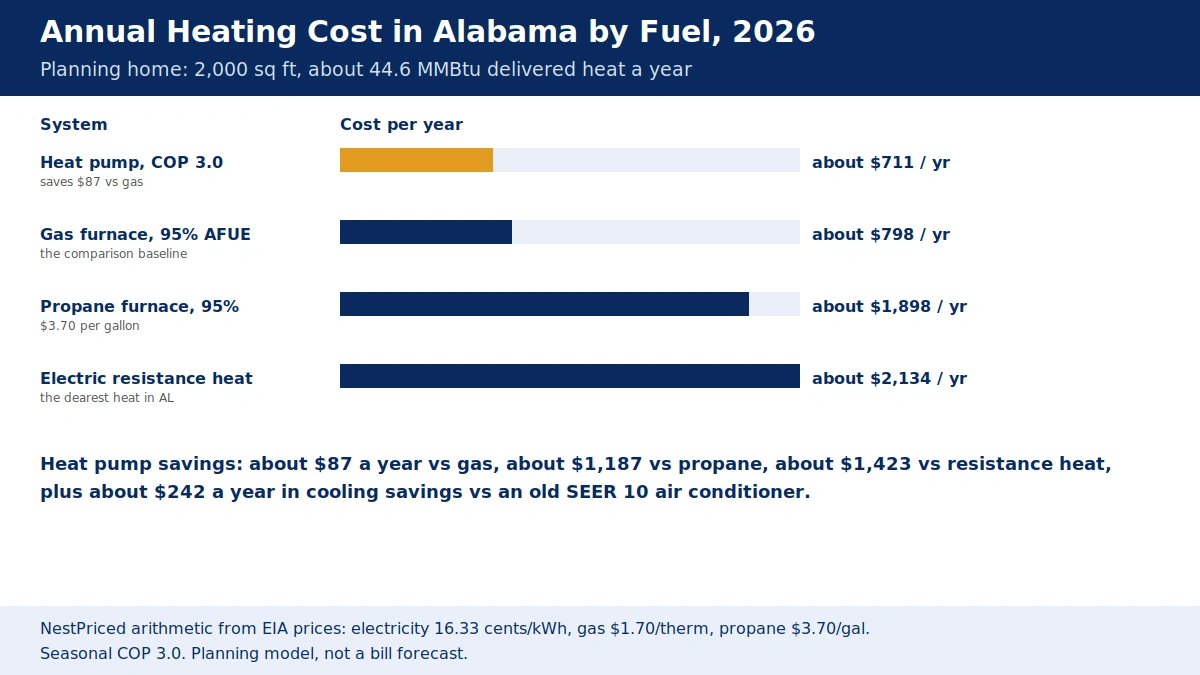
The running-cost question in Alabama is how little a heat pump beats a gas furnace, and whether that little is worth the premium. Alabama’s electricity is cheap by national standards and its gas is not, which narrows the gap from both sides at once.
The math below is a planning model, built on published prices and a stated method. Treat it as a guide. It will not match any single bill.
The method: a typical 2,000-square-foot home, design heat loss of about 36,000 BTU per hour at Birmingham’s 21°F winter design temperature, and Birmingham’s 2,533 heating degree days. A BTU is a unit of heat.
Annual delivered heat comes to about 44.6 million BTU. Every fuel in the table delivers that same 44.6 million BTU, so the comparison is on equal terms.
| System | Fuel price | Annual heating cost |
|---|---|---|
| Heat pump, seasonal COP 3.0 | 16.33¢/kWh (EIA, Aug 2026) | ~$711 |
| 95% AFUE gas furnace | $1.70/therm (EIA, 2025 annual) | ~$798 |
| Electric resistance heat | 16.33¢/kWh | ~$2,134 |
| 95% propane furnace | $3.70/gal (EIA SHOPP, Nov 2026) | ~$1,898 |
COP measures how many units of heat the machine moves for each unit of power it uses, and AFUE is the furnace efficiency rating, the share of fuel heat that reaches the house. Against a 95 percent gas furnace, the heat pump saves about $87 a year on heating, real money, but not the kind of money that pays back an $8,225 machine.
Against electric resistance heat, the heat pump saves about $1,423 a year, because resistance heat turns every kilowatt-hour into exactly one kilowatt-hour of heat while the heat pump turns one into three. Against a propane furnace at $3.70 a gallon, the heat pump saves about $1,187 a year, because Alabama propane is the dearest heat in the state, $3.70 a gallon against a national average of $2.83, and the 2025–26 season average of $3.45 was no bargain either.
The verdict follows the house: if the house heats with gas today, the heat pump is a comfort and cooling upgrade that roughly breaks even on heating; if the house heats with resistance strips or propane, the heat pump is a money machine.
The cooling side of the ledger is where the Alabama heat pump earns its keep, and it is the side the heating math leaves out. A 3-ton system at SEER2 15.2, running roughly 1,200 full-load cooling hours a year, a planning assumption for the Alabama cooling season, not a published figure, uses about 2,842 kilowatt-hours for cooling, or about $464 a year at 16.33 cents.
The old SEER 10 unit it replaces uses about 4,320 kilowatt-hours, or about $706 a year. That is about $242 a year in cooling savings on top of the heating savings, and it is the number that matters most in a state where the cooling season runs from May into October.
Add the heating and cooling together and the heat pump saves about $329 a year against gas, about $1,665 a year against resistance heat, and about $1,429 a year against propane. Those are the figures the payback section builds on.
Three caveats apply to this math.
- The electricity price is a statewide average, not a tariff: Alabama Power’s standard residential tariff runs about 16.74 cents all-in at 900 kilowatt-hours once the $16 monthly fixed charge is spread across usage, and TVA territory rates differ again.
- The gas price is the 2025 annual average of $1.70 a therm; the monthly EIA figures run much higher in summer, when fixed charges spread across tiny volumes, and July 2026 showed $2.43 a therm. A buyer who prices gas off a summer bill will overstate the heat pump’s advantage.
- The seasonal COP of 3.0 is a planning figure for a modern inverter system in Alabama’s mild winters; a single-stage unit on a cold Huntsville night runs lower, and a variable-speed unit on a mild Mobile winter runs higher.
The math is a compass, not a contract, and any contractor who promises an exact dollar saving has promised something no model can deliver.
Dual-fuel is a genuinely close call in Alabama, one of the few states where that is true. A dual-fuel system pairs a heat pump with a gas furnace, and the heat pump carries the load until the outdoor temperature falls to the point where gas is cheaper, the economic balance point. In Alabama that balance point sits low, because gas at $1.70 a therm is cheap heat and the heat pump at 16.33 cents is only slightly cheaper.
The dual-fuel setup costs more upfront, since the furnace is an extra machine, and it only pays if the house already has the gas line, the furnace and the venting in place. For a Montgomery home with a gas furnace that still has life in it, dual-fuel is a reasonable way to add cooling and cut the heating bill at the same time. For a Huntsville home on electric strip heat, dual-fuel means buying a gas connection the house has never had, and the numbers do not survive it.
Our dual-fuel guide prices the setup in detail, and our heat pump vs furnace comparison works the national math.
Alabama buyers also ask how a heat pump compares with the straight air conditioner plus furnace it replaces. A heat pump is an air conditioner that runs backward in winter, and in Alabama the cooling half of the machine is identical to the air conditioner it replaces. The buyer who needs cooling anyway, which in Alabama is every buyer, pays the heat pump premium only on the heating side, and the heating side is where the $87 to $1,423 a year in savings lives.
The buyer who needs a furnace and an air conditioner anyway should price the heat pump against the pair, not against the furnace alone, and the pair is where the heat pump usually wins.
Utility Rebates & What You Can Actually Collect in 2026
Alabama’s rebate map is a patchwork, and the patchwork has a trap in it: the two biggest programs in the state pay for opposite things. Alabama Power pays to switch off gas. TVA pays to stay electric.
A buyer who applies to the wrong program collects nothing, and a contractor who promises both has not read either program’s rules.
The table below is the whole map, checked against program pages and utility sources in October and November 2026.
| Program | Amount | Who qualifies | Status |
|---|---|---|---|
| Alabama Power – high-efficiency heat pump | $1,000 | Gas furnace to all-electric heat pump, 20 SEER / 18 SEER2+, owner, apply within 90 days | Active – ends Dec 1, 2026 |
| Alabama Power – hybrid heat-pump water heater | $600 | Gas water heater to hybrid electric | Active |
| Alabama Power – smart thermostat | Up to $200 | Alabama Power residential customers | Active |
| TVA EnergyRight – ducted heat pump | $500 (15–16.99 SEER2) / $800 (17+ SEER2) | Replaces existing electric heat, QCN contractor | Active (north Alabama) |
| TVA EnergyRight – ductless mini-split | $800 (17+ SEER2) | Replaces existing electric heat, QCN contractor | Active (north Alabama) |
| TVA EnergyRight – geothermal | $1,500 | QCN contractor | Active (north Alabama) |
| TVA EnergyRight – duct work | $300 | Full duct system brought to TVA standards | Active (north Alabama) |
| Baldwin EMC – heat pump | Up to $400/ton | Dual-fuel or ductless mini-split replacing an electric furnace | Active (coastal co-op) |
Alabama Power’s $1,000 is the largest single rebate in the state, and it is also the most time-sensitive. It pays when a homeowner switches from a gas furnace to an all-electric heat pump rated 20 SEER or 18 SEER2 or higher, the heat pump must be the home’s largest HVAC unit, the applicant must own the home and complete a W-9, the application must be filed within 90 days of purchase, and the unit is subject to Alabama Power onsite inspection.
The program is voluntary, limited to Alabama Power customers, and it ends on December 1, 2026. That deadline is the single most important date here: a buyer who installs on December 2 collects nothing from Alabama Power, and a buyer who installs on November 30 and files on March 1 has missed the 90-day window and collects nothing either.
The efficiency floor matters too. 18 SEER2 is a premium machine, not a basic one, and the cheapest quote on the table almost certainly does not qualify. Price the qualifying machine first, then subtract the thousand.
TVA EnergyRight covers the Tennessee Valley, Huntsville Utilities and the other TVA local power companies in north Alabama, and its rules run the other way. TVA pays $500 for a ducted heat pump at 15–16.99 SEER2 and $800 at 17 SEER2 or higher, $800 for a qualifying ductless mini-split, $1,500 for geothermal, and $300 for duct work brought to TVA standards.
But the work must be completed by a member of TVA’s Quality Contractor Network, and the new unit must replace an existing electric heat source, an old heat pump, an electric furnace, or electric resistance baseboard. Gas-to-electric conversions are explicitly excluded.
A Huntsville homeowner on strip heat who installs a 17 SEER2 ducted system through a QCN contractor collects $800. A Huntsville homeowner on gas who does the same install collects nothing from TVA, and if that homeowner’s gas furnace is the reason for the switch, the Alabama Power $1,000 does not apply either, because Huntsville Utilities is not Alabama Power. Know the utility on the bill before counting any rebate.
The smaller programs fill the gaps. Baldwin EMC, the co-op serving the coastal counties around Mobile Bay, pays up to $400 a ton for dual-fuel or ductless mini-split heat pumps replacing an electric furnace, real money on a 3-ton system, up to $1,200, and the only rebate in the state that pays for dual-fuel.
Alabama Power’s $600 hybrid water heater rebate and up to $200 smart thermostat rebate stack with the heat pump rebate for a household doing the whole electrification at once, though neither pays for the heat pump itself. And Huntsville Utilities runs a Home Energy Inspection program and Project Share for low-income or disabled customers. That help is assistance with bills and inspections, separate from any heat-pump rebate, and worth asking about for a household that qualifies.
What Alabama does not have is a statewide heat-pump rebate. There is no state program paying for air-source machines, and no state tax credit for them either. Unlike South Carolina, where geothermal alone earns a 25 percent state tax credit, Alabama’s tax code pays nothing for the machine most buyers actually buy.
The federal HEAR and HOMES rebates, which would pay up to $8,000, have not launched in Alabama, and the next section explains why. The total for most Alabama buyers in 2026 is one utility rebate, $500 to $1,000. Any larger subtraction rests on money that does not exist.
Federal Help in 2026: $0 Tax Credit, HEAR Not Launched & the Lease Route
The federal picture for a 2026 Alabama install is short, and it is short because the money is gone. The Energy Efficient Home Improvement Credit, §25C, paid 30 percent of a qualifying heat pump installation, up to $2,000 a year, for years. The One Big Beautiful Bill Act, P.L. 119-21, ended §25C and §25D for property placed in service after December 31, 2025.
A heat pump installed in Alabama in 2026 earns $0 in federal tax credit. The same act ended the residential clean energy credit that once paid 30 percent for geothermal, so the geothermal buyer loses the federal money too. Our federal credits guide works through the full picture, but the Alabama summary fits in one sentence: there is no federal credit left for a 2026 install.
That sentence bears repeating, because Alabama contractors are still getting it wrong in print. Two Alabama contractor guides found in this research pass, one from a Lake Martin HVAC company, one from a Birmingham-area firm, still present the §25C 30 percent credit, up to $2,000, as live in 2026. One of them lists it in a rebate table alongside the Alabama Power $1,000 as though both were collectible today.
They are not. A 2026 Alabama quote with $2,000 of federal credit subtracted rests on money the IRS will not pay, and a buyer who signs on that arithmetic discovers the gap on the tax return, a year after the machine is in.
Ask every bidder, in writing, whether the quote assumes any federal credit. The answer for 2026 is no.
The second federal bucket is the Home Energy Rebates, HEAR and HOMES, the IRA-funded programs that would pay up to $8,000 for a heat pump for an income-qualified household, and up to $8,000 for a whole-home efficiency retrofit. In Alabama these programs are run by the Alabama Department of Economic and Community Affairs, ADECA, and as of October 12, 2026, ADECA is still developing the program, with no application period and no date set.
The National Association of State Energy Officials lists Alabama’s federal heat pump rebate program as not launched. A contractor guide from September 2026 describes ADECA as “actively rolling out” the programs, which is true in the sense that the agency is working on them and false in every sense that matters to a buyer: there is no portal, no application, no timeline, and no household in Alabama can collect a dollar from HEAR or HOMES today.
Two more federal details matter for the small number of Alabama buyers they touch. First, DOE Program Notice 26-2, effective May 29, 2026, limits HEAR equipment rebates to replacing existing electric equipment, with no fuel-switching.
When Alabama’s program does eventually launch, a household switching off gas will not be able to use HEAR for the heat pump, which is the opposite of Alabama Power’s rule. The two programs, when both exist, will pay for opposite conversions, and the buyer who plans around both will collect one at most.
Second, the §48E lease pass-through survives for systems placed in service by December 31, 2027: a homeowner who leases a heat pump system through a provider that claims the commercial clean-energy credit can see part of that credit passed through in the lease pricing. The route is narrow, it turns on how the lessor is set up, and the sources checked named no Alabama lessor offering it.
But it is the only federal money still attached to a 2026 or 2027 heat pump in any form, and a buyer offered a lease should ask whether §48E is in the price.
The practical summary for an Alabama buyer in 2026: budget on the gross price, collect the one utility rebate the house qualifies for, and treat every federal dollar as zero until a program actually opens. A buyer who waits for HEAR to launch before replacing a dead system waits in a house with no heat, and a HEAR-based quote is $8,000 wrong before the machine goes in.
Permits & Licensing: No Dollar Threshold & the Recovery Fund
Alabama licenses HVAC contractors harder than most states, and the licensing rule is the buyer’s best protection, if the buyer uses it. The Alabama Board of Heating, Air Conditioning & Refrigeration Contractors, HACR, certifies every contractor who performs heating, air conditioning and refrigeration work in the state, and the rule has no dollar threshold.
Under Code of Alabama § 34-31-24, no one may advertise, solicit, bid, pull permits or perform the work of a certified contractor unless the person in responsible charge holds a board certification. There is no small-job exemption, no handyman carve-out, and no county license that substitutes. A heat pump install of any size, at any price, requires a certified contractor.
Getting that certification takes real work, which is the point. The applicant must document 3,000 hours of work experience under a licensed contractor within the past five years, or graduate from an approved two-year HVAC curriculum, or complete two years as a registered apprentice, and even apprentices must register with the board before they start work.
The exam costs $175, is open-book and multiple-choice, covers trade knowledge and business law, and requires a 70 percent score to pass. An active certificate costs $220 a year, requires a $20,000 performance bond naming the board as obligee, and requires four hours of approved continuing education every year, with renewal by December 31.
The board holds reciprocity with South Carolina, Tennessee, Mississippi, Louisiana and West Virginia. And any technician who handles refrigerant must hold EPA Section 608 certification on top of the state certificate. Local governments may collect privilege and business-license fees, but under § 34-31-28(d) they may not require any further local testing of a certified contractor, and the local official who issues a business license to an HVAC company must first see the board certificate.
The permit is separate from the license, and Alabama’s cities enforce it unevenly. Huntsville City Code Sec. 7-61(a) requires a permit for the installation, replacement or alteration of electrical, gas, mechanical or plumbing systems, with narrow exemptions for portable equipment and minor repairs that do not alter the system’s approval or safety.
Mobile went further: City Code Sec. 28-52 amended the 2021 International Residential Code to remove the permit exemptions for electrical, gas, mechanical and plumbing work, so a heat-pump install in Mobile requires a permit as a matter of city law. The sources checked listed no Birmingham fee schedule in a form that names a price. The fee exists, and the number could not be verified, so no number is printed here.
The quote should name who pulls the permit and who pays for the inspection, and a contractor who suggests skipping the permit is a contractor to walk away from: an unpermitted install can void the equipment warranty, complicate a home sale, and leave the buyer with no inspection record if the work fails.
Alabama gives the buyer two financial backstops that most states do not, and both are worth knowing before signing. The Homeowners’ Recovery Fund, under Ala. Code 34-14A-15, pays up to $30,000 per transaction after a court judgment against a licensed residential home builder who cannot pay, a limit raised from $20,000 on March 17, 2025.
A fund claim depends on the paper trail, so the buyer keeps the signed contract, every receipt, and the contractor’s license or registration number from the first day. The second backstop is the lien law, and it cuts both ways: under Ala. Code 35-11-210, a subcontractor or supplier who never dealt with the homeowner can usually lien the home only for what is still owed to the contractor, unless the supplier warned the homeowner in writing before delivering material.
Under 35-11-227, the homeowner who receives a notice of an unpaid claim may object in writing before the material is used, and may hold back payment. If a lien notice shows up on a heat pump job, it will most likely come from the equipment distributor or the electrician who did the panel work. Pay the contractor on the schedule in the contract, keep the receipts, and a lien notice is a problem to answer in writing, not a surprise to discover at closing.
The verification step is simple and takes five minutes. Ask for the contractor’s HACR certificate number, check it against the board, confirm the $20,000 bond is current, and confirm the permit is in the quote.
A certified contractor expects the question. An uncertified one resents it, and the resentment is the answer.
Gulf Storms & Flooding: Elevation, Tie-Downs & Surge Protection
The heat pump that survives an Alabama summer has to survive an Alabama storm season too, and the storm risk is not evenly spread across the state. Mobile County carries a Relatively High coastal flooding risk on FEMA’s National Risk Index, and Jefferson County carries a Relatively High heat-wave risk. Two different hazards, two different failure modes, and a quote silent on both has not actually priced the job.
The flood rule is the one with a code citation behind it. In a mapped flood zone, the outdoor unit must be raised to the design flood elevation under the residential code, IRC R322, and Mobile’s own code history makes the point: the city removed the permit exemptions for mechanical work, which means the elevation question gets asked at the permit desk, before the unit goes on the ground.
Most inland buyers never see a raised stand as a line item, and the sources checked held no Alabama price for one that could be verified, so no number is printed. But the cost of the stand is small next to the cost of a unit that floods. A compressor that sits in salt water during a storm surge is a compressor that gets replaced, and the replacement is not a warranty claim.
Before signing, look up the address on FEMA’s flood map, ask whether the bid includes the stand, and get the elevation in writing.
The wind rule is quieter but just as real. The Gulf Coast sits in a wind-borne debris region under IRC R301.2.1.2, and the outdoor unit on a Mobile or Baldwin County home needs tie-downs or strapping rated for the design wind speed, a line item that costs little and prevents the unit from becoming debris in the first place.
The corrosion question is the slow version of the same risk: salt air eats the outdoor coil faster on the coast than inland, and a corrosion coating or a coastal-rated coil is a legitimate upcharge on a Mobile quote that would be padding on a Huntsville one. Ask what the coastal package includes, and ask how long the coil warranty runs in a salt-air environment. The answer tells you whether the contractor has actually worked on the coast.
The heat-wave risk runs the other way, and Birmingham is where it bites. Jefferson County’s Relatively High heat-wave rating means the design temperature is not a theoretical number: the system will be asked to hold the house at 94°F outside and humid, for days at a time, and a unit sized by guesswork tends to short-cycle the rest of the summer.
The residential code requires sizing from a Manual J load calculation, and the heat-wave county is exactly where that requirement earns its keep. A system that holds the house on the hottest day and still dehumidifies on a mild one was sized by calculation.
The surge question is the one buyers forget until the lights go out. A heat pump needs electricity, and an Alabama summer storm takes the power with it. A whole-home generator is a separate purchase and a separate guide, but the surge protector on the outdoor unit is part of this job: a $150 to $300 line item, roughly, that protects a $10,000 machine from the voltage spike when the power comes back.
It is the cheapest insurance in the whole quote, and it is the line item most often left off. Ask for it by name.
Elevation, tie-downs, corrosion protection and surge protection decide whether a machine survives its first hurricane season.
What Pushes Your Alabama Quote Up or Down
A 3-ton ducted heat pump in Alabama costs $6,090–$10,360, and the $4,270 spread between the bottom and the top of that band comes from a dozen decisions, and most of them are made by the house before the contractor arrives. The list below is the whole spread, in the order it usually shows up on a quote.
Ductwork is the biggest single mover. New or extended ductwork runs $3,590–$6,320 a job statewide, and on an Alabama home with ducts in a vented crawlspace or a hot attic it is the line that turns a $8,000 quote into a $13,000 one. Most Alabama homes have ducts, so the question is whether they leak, whether they are insulated, and whether they are sized for the new machine.
A duct blaster test or a visual inspection of the crawlspace answers it in an hour. A contractor who quotes the machine without looking at the ducts has quoted half the job.
The electrical panel is the second mover. A 200-amp panel upgrade runs $2,030–$3,230 in Birmingham, $2,070–$3,290 in Huntsville, and $2,150–$3,390 in Mobile, and it shows up whenever the house still runs a 100-amp panel, common in Birmingham’s older stock and in Montgomery’s bungalows, or whenever the panel is full. The heat pump needs a dedicated 240-volt circuit, and the panel that cannot give it one needs replacing before the machine goes in.
Our panel upgrade guide prices the job in detail. The panel question is also the question that decides the rebate in a conversion: a gas-to-electric switch that needs a panel upgrade costs $2,000 more than the machine alone, and the $1,000 Alabama Power rebate covers half of it.
Efficiency tier moves the machine price directly. The basic 14.3 SEER2 unit that meets the federal minimum is the cheapest machine on the table, and it is also the machine that qualifies for nothing: Alabama Power’s $1,000 requires 18 SEER2, TVA’s $800 requires 17 SEER2, and TVA’s $500 requires 15 SEER2. The premium for the qualifying tier runs roughly $1,000 to $2,500 over the base machine, and the rebate covers part of it, but only part.
The buyer who buys the base machine saves the premium and loses the rebate, and the buyer who buys the premium machine pays the premium and collects the rebate. Price both paths on the same quote and compare them directly.
The refrigerant is a 2026 decision in its own right. EPA rules phased out R-410A in new home systems starting in 2025, so a new Alabama heat pump in 2026 should use R-454B or R-32.
R-410A on a 2026 quote means old stock, and old stock at a discount is a machine whose refrigerant gets dearer every year it runs. Ask which refrigerant each quote uses, and ask what the lineset flush costs if the old lines are reused.
The backup heat arrangement moves the price and the bill. A standard Alabama install carries a small strip-heat backup for the handful of nights the heat pump cannot carry alone. A larger strip package costs more upfront and much more to run if the thermostat calls on it often, which happens when the system is undersized or the balance point is set wrong.
A dual-fuel setup with a gas furnace costs more again, and it only pays where the gas infrastructure already exists. The quote should name the backup heat, its capacity, and the temperature at which it engages.
The house itself moves the labor. A unit on a roof in a Mobile condo, a unit on piers in a flood zone, an air handler in a Huntsville attic in August, a lineset run through a finished Birmingham basement, each one adds hours, and the billed rate runs $46–$62 per worker-hour depending on the city. The labor share of an Alabama install is smaller than in the Northeast, because Alabama’s HVAC mechanics earn about a fifth below the national median, but the hours are the hours, and a hard house is a hard house in any state.
The season moves the price too. A July breakdown is the worst time to buy, for the reasons in the climate section above: booked crews, a house with no cooling, and a rushed signature on the first offer.
An April or October install, planned on three quotes with the Manual J in hand, is the cheapest heat pump in Alabama. Same machine, same crew, a calmer calendar and a buyer who can walk away.
Payback: When Does an Alabama Heat Pump Pay for Itself?
Payback in Alabama depends on what the house heats with today, and the answer ranges from five years to never. The math below uses the statewide 3-ton midpoint of $8,225, the running-cost figures from the comparison section, about $329 a year saved against gas, about $1,665 a year against resistance heat, about $1,429 a year against propane, heating and cooling combined, and the one utility rebate the house qualifies for.
It is a planning model. Treat the years as estimates, and note that it assumes the machine runs at a seasonal COP of 3.0 and the prices here hold.
| Replacing | Annual saving | Net cost after rebate | Simple payback |
|---|---|---|---|
| Electric resistance heat | ~$1,665/yr | $7,425 (after TVA $800) | ~4.5 years |
| Propane furnace | ~$1,429/yr | $7,225 (after Alabama Power $1,000) | ~5.1 years |
| 95% gas furnace | ~$329/yr | $7,225 (after Alabama Power $1,000) | ~22 years |
Against resistance heat, the heat pump pays for itself in about four and a half years, the fastest payback of any heating switch in Alabama, and the reason Huntsville’s strip-heat homes are the best heat-pump candidates in the state. Against propane, the payback runs about five years, and it runs faster every time the propane dealer raises the price: at $3.70 a gallon the math already favors the heat pump, and the 2025–26 season average of $3.45 was the floor, not the ceiling.
Against a 95 percent gas furnace, the payback runs about 22 years, longer than the machine’s life, which means the heat pump bought to replace a working gas furnace never pays for itself on energy savings alone. It pays in cooling, in comfort, in the single system that replaces two, and in the house that no longer burns gas, but it does not pay in dollars, and the buyer who is told otherwise has been sold a story.
Three things shorten the payback, and one thing lengthens it.
- The rebate shortens it by $500 to $1,000, which is why the Alabama Power deadline of December 1, 2026 matters: a gas-to-electric switch installed on November 30 pays back years faster than the same switch installed on December 2.
- The cooling savings shorten it, because the $242 a year in cooling savings is real money in a state where the cooling season runs six months.
- A dead system shortens it most of all, because the comparison is no longer heat pump against gas furnace. It is heat pump against a new gas furnace plus a new air conditioner, and the pair costs more than the heat pump alone.
- The add-on list lengthens it: ducts at $3,590–$6,320 and a panel at $2,030–$3,230 can double the net cost, and a $14,000 job against gas never pays back at all. Price the add-ons before promising the payback.
Use this section as a filter. It sorts houses into buy-now, wait, and buy-for-comfort. If the house heats with resistance strips or propane, buy the heat pump and do not wait, since every winter on the old system costs more than the interest on the new one.
If the house heats with gas and the furnace still runs, wait for the furnace to die, and when it does, price the heat pump against the furnace-plus-air-conditioner pair. If the house heats with gas and the buyer wants the heat pump anyway for cooling, comfort or the $1,000 rebate, buy it before December 1, 2026, and buy it knowing the payback is measured in comfort rather than dollars.
Getting Quotes in Alabama: The Checklist
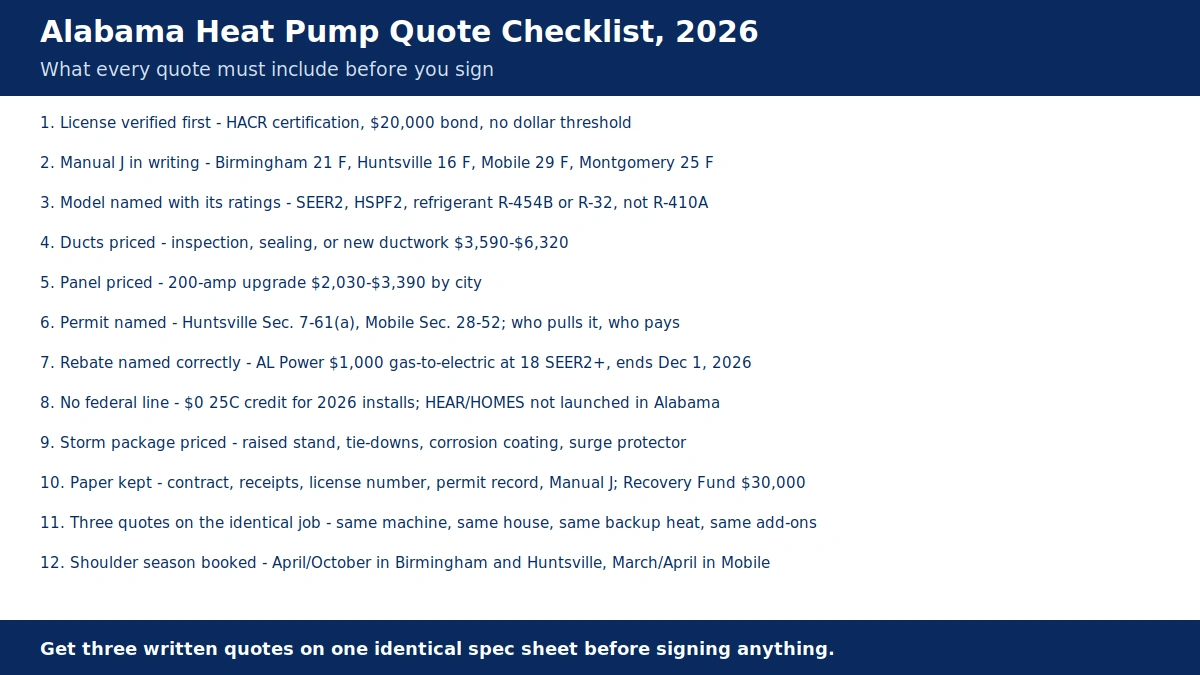
Three quotes, from three certified contractors, on the identical job, in writing. That is the whole discipline, and everything below is the detail that makes it work.
- Check the license first. Ask for the HACR certificate number and verify it with the Alabama Board of Heating, Air Conditioning & Refrigeration Contractors. Confirm the $20,000 performance bond is current and the certificate is active, not inactive. A legitimate Alabama contractor hands the number over without a second thought.
- Demand the Manual J. The residential code requires equipment sized by ACCA Manual S from Manual J loads. Ask for the load calculation in writing, and walk away from any bidder who sizes by the old unit’s nameplate or by square footage alone.
- Name the machine. Every quote must list the equipment model number, the capacity in tons, the SEER2 and HSPF2 ratings, the refrigerant, R-454B or R-32, not R-410A, and the backup heat arrangement with its capacity and balance point.
- Price the ducts. Ask whether the quote includes duct inspection, duct sealing, or new ductwork, and at what price. The $3,590–$6,320 ductwork add-on is the line that most often arrives as a surprise.
- Price the panel. Ask whether the house needs a 200-amp panel upgrade, at $2,030–$3,390 depending on the city, and whether the quote includes the dedicated 240-volt circuit.
- Name the permit. Ask who pulls the mechanical permit and who pays for the inspection. Huntsville requires the permit under city code, Mobile took away the exemptions, and the sources checked show no Birmingham fee schedule, yet the permit is required everywhere.
- Name the rebate, correctly. Write down which program the house qualifies for, Alabama Power’s $1,000 for a gas-to-electric switch at 18 SEER2 or higher, or TVA’s $500–$800 for an electric-to-electric replacement through a Quality Contractor Network installer, and confirm the application deadline. Alabama Power’s program ends December 1, 2026, and its applications are due within 90 days of purchase.
- Subtract nothing federal. The §25C credit is $0 for a 2026 install, and HEAR and HOMES have not launched in Alabama. Strike either subtraction from any quote before comparing it.
- Price the storm package. On the coast, ask about the raised stand, the tie-downs, the corrosion coating and the surge protector, and get the flood elevation in writing if the address sits in a mapped flood zone.
- Keep the paper. The contract, every receipt, the contractor’s license number, the permit record and the Manual J, the Homeowners’ Recovery Fund pays up to $30,000 per transaction after a court judgment, and only against a paper trail. Keep it from the first day.
- Compare the identical job. Line up the three quotes on the same machine, the same house, the same backup heat and the same add-ons, with the rebate the home actually qualifies for already deducted. The cheapest quote on a different job proves nothing about price.
- Book the shoulder season. April and October in Birmingham and Huntsville, March and April in Mobile, the mildest months, the calmest calendars, and the buyer who can walk away from a bad quote.
The Alabama heat pump is a cooling machine that happens to heat, bought in a state where the summer is the test and the winter is the afterthought. Buy it for July, size it by Manual J, pay for it on the gross price, collect the one rebate the house qualifies for, and do it before the Alabama Power deadline if the house is switching off gas. The machine will do the rest.
How much does a heat pump cost in Alabama in 2026?
A 3-ton ducted air-source heat pump costs $6,090–$10,360 installed in Alabama in 2026, per NumeralQ planning estimates from October 2026. A single-zone ductless mini-split runs $2,840–$4,510, a cold-climate ducted system $8,070–$14,330, and geothermal with a ground loop $19,280–$30,650. The statewide midpoint for the 3-ton ducted system is about $8,225, and Birmingham, Huntsville, Mobile and Montgomery all price within about $100 of each other at the top of the band.
Does Alabama Power really pay $1,000 for a heat pump?
Yes, Alabama Power pays $1,000 when a homeowner switches from a gas furnace to an all-electric heat pump rated 20 SEER or 18 SEER2 or higher. The heat pump must be the home’s largest HVAC unit, the application must be filed within 90 days of purchase, and the program is limited to Alabama Power customers. It ends on December 1, 2026, it does not pay for replacing an existing electric system, and it does not pay for a machine below 18 SEER2.
Is there a federal tax credit for a heat pump installed in Alabama in 2026?
No, a 2026 install earns $0 in federal tax credit. The §25C Energy Efficient Home Improvement Credit, which paid 30 percent up to $2,000 for a qualifying heat pump, ended for property placed in service after December 31, 2025 under the One Big Beautiful Bill Act, P.L. 119-21. Some Alabama contractor guides still list the credit as live, and they are wrong, so do not let a quote subtract it.
Have Alabama’s HEAR and HOMES rebates launched?
No, the Alabama Department of Economic and Community Affairs, ADECA, is still developing the Home Energy Rebates programs, and as of October 2026 there is no application period and no launch date. The National Association of State Energy Officials lists Alabama’s federal heat pump rebate program as not launched. When the programs do launch, DOE Program Notice 26-2 limits HEAR heat pump rebates to replacing existing electric equipment, so a gas-to-electric switch will not qualify.
Does a heat pump beat a gas furnace on running costs in Alabama?
Barely, on heating alone: at 16.33 cents a kilowatt-hour for electricity and $1.70 a therm for gas, a heat pump at a seasonal COP of 3.0 costs about $711 a year to heat a typical 2,000-square-foot home, against about $798 for a 95 percent gas furnace, a saving of about $87 a year. Against electric resistance heat the heat pump saves about $1,423 a year, and against propane at $3.70 a gallon it saves about $1,187 a year. Add about $242 a year in cooling savings against an old SEER 10 air conditioner, and the heat pump’s real advantage in Alabama lies in the cooling season.
Do I need a permit to install a heat pump in Alabama?
Yes, a mechanical permit is required for a heat pump installation or replacement. Huntsville City Code Sec. 7-61(a) requires a permit for the installation, replacement or alteration of mechanical systems, and Mobile City Code Sec. 28-52 removed the permit exemptions for mechanical work under the city’s 2021 IRC amendment. The quote should name who pulls the permit and who pays for the inspection, and an unpermitted install can void the equipment warranty and complicate a home sale.
What license must an Alabama HVAC contractor hold?
A statewide certification from the Alabama Board of Heating, Air Conditioning & Refrigeration Contractors, required at any job size with no dollar threshold under Code of Alabama § 34-31-24. The contractor must document 3,000 hours of experience or graduate from an approved curriculum, pass an exam, hold a $20,000 performance bond, pay a $220 annual active fee, and complete four hours of continuing education a year. Ask for the certificate number and verify it before signing.
Will a heat pump work in an Alabama winter?
Yes, easily: Birmingham averages 47 freezing nights a year and zero nights at or below 0°F, Mobile averages 15 freezing nights, and the winter design temperature runs 16°F in Huntsville to 29°F in Mobile. A standard heat pump carries most winter nights without backup heat. The harder question is the summer: Birmingham sits muggy 87 percent of July, so the system must be sized by Manual J to run long, steady cycles that pull moisture out, since short cycles cool the air and leave the house clammy.