


Table of Contents
Florida is the strangest solar market in America. It has the cheapest installed prices in the country, the eighth-best sun, and the most generous net metering rule of any large state — and at the same time it has the strictest hurricane wind code, the most complicated roof-insurance rules, and a municipal utility that just walked away from 1-for-1 netting. A solar quote in Tampa and a solar quote in Jacksonville can show nearly the same price per watt and produce paybacks six years apart. The difference is never the panels. It is the utility on the bill, the wind zone under the roof, and the age of the shingles above the rafters. Every number below comes from 2026 sources, and the federal credit is shown as the $0 it now is.
For the US-wide baseline, see the national solar panel cost guide.
How much do solar panels cost in Florida in 2026?
The defensible 2026 Florida consensus: $2.12–$2.46 per watt installed, before any incentives — and for a solar-only purchase in Florida, there is nothing left to subtract. EnergySage’s Florida state page (updated November 2026) puts the state average at $2.12/W on a 14.49 kW average system costing $30,713 (range $26,106–$35,320). The EcoGen America Solar Cost Index (September 2026 edition, page updated October 19, 2026) puts Florida at $2.46/W, with a typical 11.09 kW system costing $27,281 and most installs landing between $2.10 and $2.70/W. The national benchmark is about $2.60/W (EnergySage, June 30, 2026, 12 kW average $31,135; median quoted solar-only price $2.62/W, Marketplace Report 23rd edition, September 2026). Florida is the cheapest state on both measures — the lowest of 51 jurisdictions in the EcoGen index, and the cheapest on the EnergySage marketplace.
The two anchors are not in conflict. They measure different things. EnergySage’s 14.49 kW is a marketplace-quote average, skewed upward by large systems. EcoGen’s 11.09 kW is the typical size actually installed in Florida in 2025 (Berkeley Lab data, 4,704 systems). Both are real, and this guide uses both where they matter. Some model-based guides quote higher — $2.60/W (The Green Watt, citing EnergySage), $2.61/W (SolarReviews, model-based, not marketplace quotes) and $2.71/W (Story of Solar) — but those are models, not marketplace data, and they are not used as anchors here.
Florida homes are big electricity users, which is why Florida systems are so large. The state residential rate is 14.99 cents per kWh (EIA Electric Power Monthly, Table 5.6.A, August 2026, released October 28, 2026) against a US average of 18.16 cents — 15th lowest of 51 jurisdictions, 17.5% below the national average — but the average August bill was $217.28 at 1,449 kWh, because air conditioning and pool pumps push usage far above the US norm. On a 12-month average basis the rate is about 15.4 cents/kWh with an average bill near $169 a month. Note the distinction: 14.99 cents is a single-month average, not an annual average. Do not mix them. The 14.99-cent rate is low; the 1,449 kWh of August usage is what makes the bill high — and what makes a 14.49 kW average system normal in Florida rather than oversized.
The one rule that governs every number in this guide: the quote is the price. The §25D residential federal credit ended December 31, 2025, Florida has no state income tax and therefore no state solar tax credit, and no Florida utility offers a direct residential panel rebate in 2026. Several top-ranking pages still show “after 30% credit” prices. Those are now wrong for 2026. Every figure in this guide is the price you actually pay on an owned system.
Solar panel cost by system size in Florida
2026 installed costs at the EnergySage anchor of $2.12/W, with the EcoGen high end ($2.46/W) alongside. These are before incentives — and for a solar-only purchase in Florida, there is no incentive to subtract. The sales-tax exemption means no 6–7.5% tax is added on top of these figures. They are the price as quoted, not a pre-tax subtotal.
| System size | Cost at $2.12/W | Cost at $2.46/W | Best fit |
|---|---|---|---|
| 5 kW | $10,600 | $12,300 | Small home, low daytime use |
| 6 kW | $12,720 | $14,760 | Small-to-mid home |
| 8 kW | $16,960 | $19,680 | Typical home (our worked example) |
| 10 kW | $21,200 | $24,600 | Large home, heavy AC, EV |
| 11.09 kW (EcoGen typical) | $23,511 | $27,281 | The typical Florida install |
| 12 kW | $25,440 | $29,520 | Very large home, pool + EV |
| 14.49 kW (EnergySage average) | $30,713 (range $26,106–$35,320) | — | The average EnergySage quote |
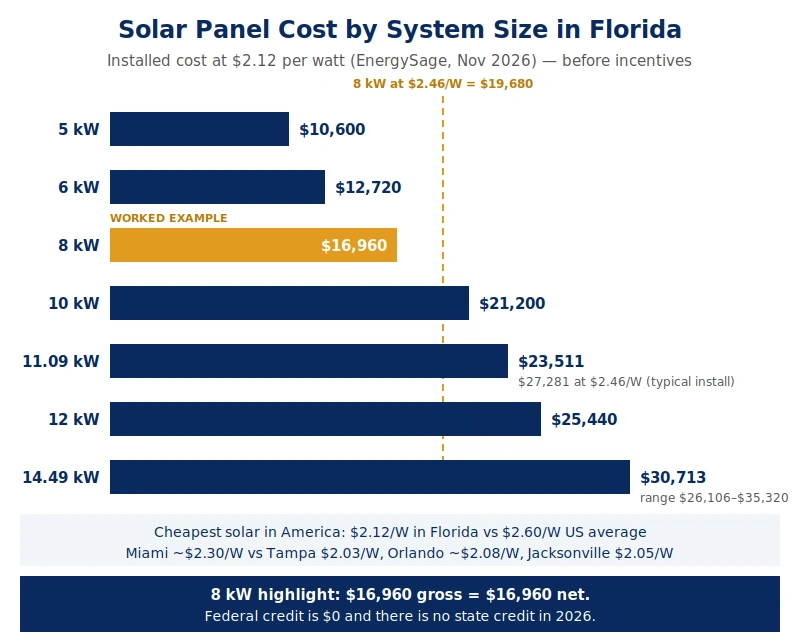
City-level figures from EnergySage show a tight cluster with one expensive outlier. Miami runs about $2.30/W (September 4, 2026: 15.75 kW average, $36,247) — the most expensive big market in the state, and the hurricane wind code is a large part of why (see the wind-code section below). Tampa is $2.03/W (November 2026: 15.05 kW average, $30,471, range $25,900–$35,042), Orlando about $2.08/W (September 4, 2026: 14.27 kW average, $29,649) and Jacksonville $2.05/W (November 2026: 12.95 kW average, $26,486, range $22,513–$30,459). Tampa, Orlando and Jacksonville sit within five cents of each other. Miami sits about 25 cents above them.
That city table hides the real story, and it is the story of this whole guide. Jacksonville’s price per watt is nearly identical to Tampa’s — $2.05 against $2.03 — yet EnergySage puts Jacksonville’s payback at 14.1 years against Tampa’s 8.2 years, with 25-year savings of only $26,613 against Tampa’s $78,468. Jacksonville is JEA territory, where exports earn the 4.326-cent fuel rate instead of retail. Rank Florida cities by utility, not by dollars per watt. The export-value gap (about 3.5 times) dwarfs the price gap (about 25 cents).
One more number to handle honestly: EnergySage’s statewide 25-year savings figure moved between updates — $64,627 in the September 4, 2026 version against $58,382 in the November 2026 version for the same statewide page. This guide uses the November figure. The change is unexplained, and it is flagged again in the methodology section.
What drives your price per watt
Miami and the hurricane zone come first. South Florida is the High-Velocity Hurricane Zone, and hurricane-rated racking costs more than standard racking — one supplier notes it “adds some cost” without a figure, and a single secondary source claims HVHZ products carry a 30–60% premium over standard-zone products. No Florida-specific dollar adder for hurricane-rated racking was verified, so none is given here. What is verified is the price pattern: Miami at about $2.30/W against $2.03–$2.08/W in Tampa, Orlando and Jacksonville. If a Miami quote looks cheap, ask whether the racking carries Florida Product Approval or a Miami-Dade Notice of Acceptance — unapproved hardware is the hurricane-season failure mode, and it is the first thing a corner-cutting quote drops.
Equipment tier. Panels, inverter, racking and wiring are roughly 36% of a typical project cost nationally (EnergySage installer survey, via our California guide). Premium panels cost more per watt. In Florida the equipment question is heat, not just brand: a module rated at 25°C sits 25–35°C hotter on a Florida roof, costing roughly a 10–15% production penalty at peak heat (Orlando guide, single secondary source — flagged, not a measured Florida figure). Compare the Pmax temperature coefficient on each quote’s datasheet: PERC −0.34 to −0.40%/°C, TOPCon −0.28 to −0.35%/°C, HJT −0.24 to −0.28%/°C. A panel that holds its output in August humidity is worth more in Florida than a panel that only wins on a cool spring morning.
Electrical panel upgrade (if needed). Budget $2,500–$4,500 for a panel upgrade if your home needs one (NRG Clean Power, November 2026) — that is a national planning range built from California data, not a price any Florida installer has verified. One Florida-relevant wrinkle: the federal HEAR program can pay up to $4,000 for a panel when it supports an eligible appliance on the same application — but HEAR does not pay for solar panels, and no Florida-specific 2026 HEAR program status was verified, so do not count on a live Florida HEAR program. Get the panel upgrade itemized on your quote either way.
Permitting — Florida actually fixed this. HB 683 (ch. 2025-140, effective July 1, 2025) put a 5-business-day clock on single-trade permits (solar and battery included) using a licensed private provider, for 1–2 family homes. Software plan review and virtual inspections are allowed, and local governments may no longer demand contracts or cost breakdowns with the permit application (EnergySage, July 9, 2025; EcoGen laws page, October 2026). HB 803 (ch. 2026-63) tightened it further: the building official may only check a private provider’s forms for completeness, and missing items must be flagged within 5 business days or the permit is approved by law and issued the next business day (§553.791(8)). A universal residential permit application is planned from 2027 (Insurance Journal/Bloomberg, July 28, 2026) — planned, not in force. If your installer blames slow permits, ask whether they used a private provider. The law is on your side now.
Installer overhead. Roughly 42% of a typical project nationally is overhead, sales and margin (EnergySage installer survey). Identical panels can carry very different price tags from different Florida installers, because so much of the cost is sales, overhead and margin — get three quotes before you believe any one of them. In Florida, verify the installer’s license under Chapter 489, F.S. (certified solar contractor, electrical contractor, or roofing contractor as applicable) at the DBPR before signing anything.
Roof age. If your roof needs replacing within 5–10 years, re-roof first — removing and reinstalling panels is a real cost that panel warranties do not cover. One older installer account put detach-and-reset at $10,000–$20,000 for a tile roof (ActiveRain, installer-quoted) — flagged here as an older anecdote, not a 2026 benchmark. In Florida the penalty for getting this wrong is sharper than in other states: a detach-and-reset bill plus an insurance fight, not just the reset bill. Our Florida roof replacement cost guide covers the roofing side, including the hurricane code.
The 30% federal tax credit is gone — what that means for 2026 math
Here is the Florida version of the story, and it is shorter than the national version because Florida has nothing to soften the blow. The §25D Residential Clean Energy Credit (30%) died with the One Big Beautiful Bill Act (OBBBA, P.L. 119-21, signed July 4, 2025): Section 70506 ends it for any expenditure made after December 31, 2025. The IRS spelled out the timing in FS-2025-05 (August 21, 2025) — an expenditure counts as “made” on the day installation is completed. Finish the install in 2026 and the credit is gone.
For a homeowner-owned system installed in Florida in 2026 — cash or loan — the federal credit is $0. And unlike Arizona, which still has a $1,000 state credit to take the edge off, Florida has no state credit at all, because Florida has no state income tax for a credit to reduce. Gross quoted price is the real out-of-pocket price, minus nothing. On an 8 kW system at $16,960, the dead credit would have falsely shaved $5,088 off the price. Any quote that still shows that subtraction is using dead law.
Two nuances are worth knowing. First, an unused §25D credit from a 2025 install can be carried forward to 2026 (Form 5695 instructions, 2025) — but that is a carryforward of a 2025 credit, not a credit for 2026 work. Second, the one surviving federal path is a lease. The §48E Clean Electricity Investment Credit (30%) survives only for the business that owns the system — on a residential roof, that means a lease, with systems placed in service by December 31, 2027. The leasing company claims that credit and may hand the savings back as a cheaper monthly payment; the homeowner never sees a tax credit of their own. Florida’s net metering rule covers leased systems — but it does not cover PPAs, where you buy power from a company that owns the panels on your roof. A PPA customer gets no 1-for-1 credit at all. The full post-OBBBA picture is in our federal energy tax credits guide.
The easiest stale-math trap to spot in 2026 is a quote that still subtracts 30%. On a $16,960 system, that subtraction is a $5,088 lie.
Florida incentives: two tax exemptions, one battery rebate, no panel rebate
Florida’s incentive stack is honest but thin: two tax exemptions that work by not charging tax, one municipal battery rebate with a catch, and nothing else for panels. The table below lists what exists — and what does not.
| Incentive | 2026 status | Value |
|---|---|---|
| Federal §25D residential credit | Expired Dec 31, 2025 — $0 | $0 |
| Florida state solar tax credit | Does not exist — Florida has no personal income tax, so there is no return for a credit to lower | $0 |
| Sales-tax exemption | Active, no end date | 0% sales tax on solar equipment — no 6% state tax, no county surtax (0.5–1.5%) — under §212.08(7)(hh); made permanent in 2005; equipment must be certified by the Florida Solar Energy Center; covers panels, inverters, racking, batteries and related components. Worth ~$1,500–$2,500 on a typical system |
| Property-tax exemption | Active | 100% of the added value a solar system brings is exempt from property-tax assessment under §193.624, for systems installed since January 1, 2013; covers panels + qualifying battery storage. Nothing to file — automatic in most counties |
| Utility rebate for panels | None statewide — FPL, Duke and TECO offer no direct residential solar rebate in 2026 | $0 |
| OUC battery rebate | Active (“open when we checked,” EcoGen, October 2026) | $150/kWh of battery nameplate capacity, up to $2,000; solar PV up to 20 kW; apply within 6 months of purchase; one rebate per service address; bill credit |
| §48E (lease route) | Alive through Dec 31, 2027 — only via third-party ownership | 30% to the lessor, not the homeowner |
| PACE financing | Active in many counties | 100% financing, repaid on the property-tax bill for up to 20 years (10–20 yr terms); transfers to the next owner on sale; 3 business days to cancel |
| SELF loan | Active | Nonprofit lender: 8.25–8.75% fixed for 7 years, plus a 2% fee |
| FPL SolarTogether (community solar, renters) | Active | Pay $6.76/kW/mo for a credit starting at ~3.6 cents/kWh, rising 1.5%/yr — at first you pay more than you get back |
| Duke Clean Energy Connection (community solar) | Active | $8.35/kW/mo for a 4.037 cents/kWh credit for the first 36 months, then +1.5%/yr |
| Florida Solar for All | Not open — waitlist only | $156M to a 3-nonprofit coalition (Solar and Energy Loan Fund, Solar United Neighbors, The Nature Conservancy in Florida). EPA terminated all Solar for All grants August 7, 2025; two federal courts ruled the termination unlawful September 18 + September 22, 2026; EPA was weighing an appeal as of October 1, 2026; coalition site showed only a waitlist sign-up, no open application, as of October 5, 2026 |
| HEAR rebates | Federal program, up to $8,000, income-qualified, point-of-sale — no Florida-specific 2026 HEAR program status was verified | Up to $8,000 (if available) — check the Florida Department of Agriculture and Consumer Services / Energy Office; do not assume a live Florida program. HEAR does not pay for solar panels |
| SRECs | None — Florida operates no statewide SREC market | $0 |
The OUC battery rebate — read the catch before you count the $2,000. Accepting it forfeits the TruNet full retail export rate — exports are then credited at the community solar farm rate for 5 years (to June 30, 2030), then at the retail fuel rate. For a grandfathered OUC customer, that trade can cost more than the $2,000 rebate is worth. The rebate is real money; the forfeiture is real money too. State both, or state neither.
Worked incentive example — 8 kW solar at the $2.12/W anchor: gross $16,960 — sales tax $0 (exempt, saving ~$1,020–$1,270 against a taxed purchase at 6–7.5% — present that as “tax not charged,” not as a rebate) — property tax $0 added — federal $0 — net $16,960. With an OUC battery, the only subtraction in the state is the $2,000 OUC battery rebate, and it costs the TruNet retail export rate. That is the whole Florida incentive story in one line: the exemptions keep money from being added, and nothing is ever subtracted.
The canonical directory for verifying all of this is DSIRE (programs.dsireusa.org), run by NC State University. Verify every Florida item there at publish time.
Net metering: 1-for-1 at FPL, Duke & TECO — and the OUC break
Florida still has full retail 1-for-1 net metering at the four investor-owned utilities — the best export deal of any large solar state in 2026. It is governed by Florida PSC Rule 25-6.065, in force unchanged since April 7, 2008. The legislature tried to phase it down in HB 741 (2022) — 75% of a kilowatt-hour from 2024, 60% in 2026, 50% in 2027–2028, then avoided cost from 2029 — and Governor DeSantis vetoed it on April 27, 2022. No change passed in 2025 or 2026 at the investor-owned utilities (EcoGen laws page, October 19, 2026; Sunstorm net metering guide, checked October 8, 2026). Older pages still cite the vetoed HB 741 phase-down as if it were law. It was vetoed. The 2008 rule stands.
But Orlando broke away on November 1, 2026 — and OUC is the warning that the 1-for-1 era is not guaranteed forever.
How Rule 25-6.065 works (FPL, Duke, TECO, FPU)
- 1-for-1, kWh for kWh: every exported kWh offsets a kWh you buy later, at full retail value, netted monthly. There is no export haircut — self-use and export are worth the same, which is why oversizing hurts least in Florida and why a battery earns nothing on bill arbitrage at the big four.
- Credits roll forward up to 12 months. Once a year, leftover kWh are paid out at the utility’s avoided cost (its COG-1 tariff), not at retail. FPL credits it on the bill after the last billing cycle of the year (December) and does not publish the COG-1 rate in advance. Duke pays early the next year at a wholesale rate. Practical rule: size to your last 12 months of use — power beyond your yearly use earns little.
- $30 minimum bill at FPL and Duke (FPL RS-1 tariff sheet, October 2026). Your bill never reaches $0. TECO and FPU have no $30 minimum.
- Tier 1 / Tier 2 size line: systems up to 10 kW AC are Tier 1 — no application fee, no liability insurance. The typical 11.09 kW DC Florida system counts as 9.43 kW AC (Rule 25-6.065 counts inverter systems at DC x 0.85), so it stays Tier 1. Above 10 kW AC (11.76 kW DC of panels) you need liability insurance of up to $1 million and the utility may charge an application fee.
- Covers owned or leased systems — NOT PPAs. The rule does not cover buying power from a company that owns the panels on your roof.
- System cap: the rule covers systems up to 2 MW.
Export credit by utility
| Utility | Export credit for extra power (2026) | Notes |
|---|---|---|
| FPL | 1-for-1, kWh for kWh (Rule 25-6.065) | $30 minimum bill; December payout at COG-1 (unpublished rate) |
| Duke Energy Florida | 1-for-1, kWh for kWh | $30 minimum bill; payout early next year at wholesale rate |
| Tampa Electric | 1-for-1, kWh for kWh | No $30 minimum; a battery can connect but is not net metered (EcoGen wording — meaning unclear, flagged) |
| Florida Public Utilities | 1-for-1, kWh for kWh | Same state rule as the three above |
| OUC (Orlando) — new customers | 5.467 cents/kWh from November 1, 2026 | Applies to customers whose complete interconnection application + any required payment reached OUC on or after July 1, 2025; full retail through October 31, 2026; OUC retired its kWh solar bank November 1, 2026; rate dated October 1, 2025; OUC can reset it |
| OUC — grandfathered | Full retail (~11.55 cents/kWh) through June 30, 2045 | Applications + payment by June 30, 2025; a new owner after a sale moves to the lower credit. The June 30, 2045 end date is EcoGen’s reading; another source describes grandfathering at 1:1 retail for 20 years — both point the same way (long grandfathering), but the exact end date differs |
| JEA (Jacksonville) | 4.326 cents/kWh, its fuel rate, from October 1, 2026 | Each exported kWh earns the fuel rate, far below the ~14.8 cents you pay |
| Gainesville Regional Utilities | That month’s fuel rate | Credit moves with a monthly fuel charge (single source) |
| Lakeland Electric | 1-for-1, kWh for kWh | No payment for leftover credits; $6.08/kW net demand charge (RSD, eff. October 1, 2026) (single source) |
| City of Tallahassee Utilities | 1-for-1, kWh for kWh | Credits expire each year and are never paid in cash (single source) |
| Florida Keys Electric Co-op | Dollar credit at your bill’s per-kWh charges | May limit exports if you make more than you use in a year (single source) |
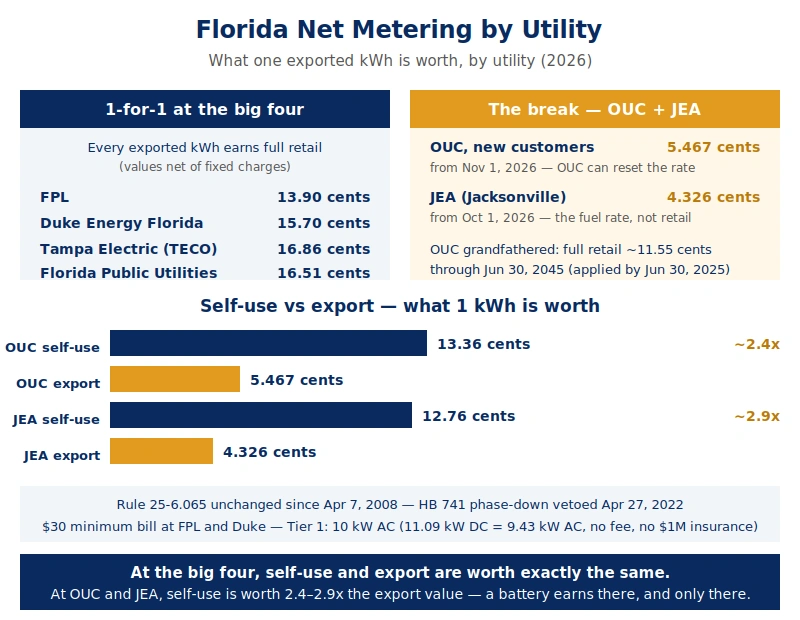
The self-consumption math — the article’s key insight: at FPL, Duke, TECO and FPU, a self-consumed kWh and an exported kWh are worth exactly the same — the full retail rate (about 13.90 cents at FPL, about 15.70 cents at Duke, about 16.86 cents at TECO, net of fixed charges). There is no export penalty at all, so the battery-arbitrage case is zero and the sizing question is only “do not oversize past annual use, because the December payout is wholesale.” At OUC (new) and JEA, the math flips: self-use is worth about 2.4 times the export value at OUC (13.36 cents against 5.467 cents) and about 2.9 times at JEA (12.76 cents against 4.326 cents) — there, and only there, a battery that moves midday solar to the evening earns real money. This is the Florida split: same state, same sun, two different solar economies.
Two figures in this section need a warning label. Tesla’s incentives page lists FPL net metering exports credited at full retail at about 10.8 cents/kWh — that figure is inconsistent with FPL’s October 2026 RS-1 tariff (12.258/14.258 cents) and EcoGen’s 13.90-cent net-of-base value, so it is not used here. And one source says OUC went to roughly 4.6 cents/kWh effective July 1, 2025 — that appears to be an earlier or different OUC rate vintage. This guide uses EcoGen’s 5.467 cents from November 1, 2026 (rate dated October 1, 2025, read October 14, 2026), and OUC can reset the rate, so verify it at ouc.com before you sign.
Your utility decides your payback
Before the payback math, here is what a solar kilowatt-hour is actually worth on each Florida bill — because the export value, not the panel price, is what decides your return.
| Utility | Territory / customers | 2026 residential rate |
|---|---|---|
| Florida Power & Light (FPL) | East coast + South FL + Panhandle; ~5.4M residential customers | EIA Aug 2026: 14.90 cents/kWh, avg bill $217.92 at 1,463 kWh. RS-1 tariff (Oct 2026): base charge $10.52/mo; energy up to 1,000 kWh 12.258 cents/kWh, over 1,000 kWh 14.258 cents/kWh; $30 minimum bill. Value net of base charge: 13.90 cents/kWh |
| Duke Energy Florida | Central FL incl. St. Petersburg, Clearwater, Ocala, parts of Orlando; ~1.85M residential customers | EIA Aug 2026: 15.18 cents/kWh, avg bill $201.06 at 1,325 kWh. 12-mo avg 17.1 cents/kWh. Customer charge $14.27–$14.35/mo; FPSC Mar 20, 2026: $155.92 per 1,000 kWh. Value net of fixed charge: 15.70 cents/kWh |
| Tampa Electric (TECO) | Tampa Bay area; ~780k residential customers | TECO’s own rates page: $156.43 per 1,000 kWh (15.64 cents/kWh) after the August 2026 storm-charge end; $154.18 from January 2027 (−1.4%). EIA Aug 2026: 16.4 cents; 12-mo avg 18.1 cents/kWh. Value net of fixed charge: 16.86 cents/kWh |
| Florida Public Utilities (FPU) | Northwest FL pockets | FPSC Mar 2026: $165.17 per 1,000 kWh. Value net of fixed charge: 16.51 cents/kWh |
| Orlando Utilities Commission (OUC) | Orlando + parts of St. Cloud; ~255k homes | Avg 2025: 13.2 cents/kWh. Customer charge $18.50/mo. Value net of charge: 13.36 cents/kWh. OUC also introduced DemandLevel pricing in early 2026 (single secondary source — flagged) |
| JEA (Jacksonville) | Jacksonville metro; ~500k customers | ~14.8 cents/kWh. Tariff eff. October 1, 2026: basic monthly charge $21.00; energy tier 1 (up to 1,000 kWh) 7.815 cents/kWh, tier 2 9.705 cents/kWh. Value net of $21 charge: 12.76 cents/kWh |
Two small flags on this table. EcoGen computes FPL’s 13.90-cent net-of-base value using a $10.22/mo base charge, while the October 2026 FPL tariff sheet shows $10.52/mo — a $0.30 discrepancy that is immaterial to the model, but this guide uses the tariff sheet’s $10.52. And Duke’s component rates (tier-1 energy 7.558 cents, fuel about 6.01 cents) come from secondary tariff summaries, not from a Duke tariff sheet read in this research — the EcoGen 15.70-cent net-of-fixed value and the EIA 15.18-cent August 2026 figure are the solid anchors.
Storm surcharges are why 2026 rates moved. FPL customers paid an interim $12.02 per 1,000 kWh through all of 2025 for Debby, Helene and Milton (finalized at $1.125B in July 2026, with a one-month base-rate reduction to return the over-recovery). TECO paid $19.95 per 1,000 kWh from March 2025 to July 2026 (ended August 1, 2026, one month early). Duke paid $32.40 per 1,000 kWh from March 2025 to February 2026. TECO’s August 2026 bill drop (−11.6%) is the storm charge ending, not a base-rate cut.
FPL’s 2026–2029 rate plan is the tailwind for solar economics. The PSC approved a four-year settlement on November 20, 2025 (Docket 20250011-EI): base-rate increases of $945M in 2026 and $705M in 2027, plus solar and battery cost recovery in 2028–2029; a 1,000 kWh bill of $134.14 rising to $136.64 in January 2026, projected $143.05 in January 2027, $146.24 in January 2028, $148.15 in December 2029; cumulative about $6.9B. The Office of Public Counsel and consumer groups opposed it and were expected to challenge it at the Florida Supreme Court (November 2025 reporting) — but whether a challenge was actually filed, and its status as of November 2026, was not verified, so this guide does not state it as settled. What is settled is the direction: FPL rates are locked in to rise through 2029, so every kilowatt-hour you make yourself gains value each year.
The Jacksonville paradox, stated plainly: Jacksonville and Tampa pay nearly the same price per watt ($2.05 against $2.03) and nearly the same retail rate, yet EnergySage puts Jacksonville’s payback at 14.1 years and Tampa’s at 8.2 years. The difference is entirely the export rule — JEA’s 4.326-cent fuel rate against TECO’s 1-for-1 retail. A Jacksonville quote that values every kilowatt-hour at retail is not a quote. It is a fantasy. Look beyond Florida and the contrast sharpens: California’s NEM 3.0 pays roughly 4–8 cents per exported kilowatt-hour against much higher retail rates, Texas offers no net metering at all — buyback plans pay 3–8.5 cents — and Arizona’s export split runs 1.87 to 5.554 cents by utility. Florida’s big four are the exception in America; OUC and JEA are the reminder that the exception is not statewide.
Do you need a battery in Florida in 2026?
Florida is the strongest battery state in America for backup power and the weakest for bill arbitrage — and the two facts come from the same rule. At FPL, Duke, TECO and FPU, a battery earns $0 on bill arbitrage: exports already earn full retail 1-for-1, so a stored kilowatt-hour is worth exactly the same as an exported kilowatt-hour. There is no time-of-use spread to capture and no export haircut to avoid. A battery bought for bill savings at the big four is a battery bought for nothing.
At OUC (new customers) and JEA, the battery does earn. Self-use is worth 13.36 cents against a 5.467-cent export at OUC (about 2.4 times) and 12.76 cents against a 4.326-cent export at JEA (about 2.9 times). A battery that moves midday surplus to the evening converts a 5.467-cent export into a 13.36-cent avoided purchase. North Carolina’s battery case is the closest parallel — Duke’s 4.53-cent exports against 22-cent on-peak rates — but Florida’s big four are the opposite: no spread at all.
The real Florida battery case is hurricanes. Florida has among the longest average outage durations in the US, driven by severe weather. A multi-day outage after a storm is the scenario: panels refill the battery daily while a generator runs until its fuel runs out. One Florida homeowner’s two Powerwall+ units (27 kWh) refilled about 40 kWh even on a heavily overcast day. The cost of losing power for 3–5 days — spoiled food, hotel, generator fuel — “can easily run $1,000–$2,000 per event” (installer-published — flagged). No Florida virtual-power-plant performance pay was verified. Other states do pay for VPP participation — North Carolina’s Duke Battery Control pays $6.50/kW/mo and Arizona’s APS pays $110/kW/yr — but no Florida figure exists to quote. No FPL residential battery rebate exists. The only Florida battery rebate is OUC’s $150/kWh, with the TruNet forfeiture catch.
Cost. A Tesla Powerwall 3 (13.5 kWh) runs about $12,900 installed in Florida (solartechelec Florida guide, 2026); $11,500 (DC) / $15,500 (AC) per Lunex (early 2026); the national range is $13,000–$16,500, and EnergySage’s July 2026 battery analysis puts a typical installed 13.5 kWh system at about $15,647. An Enphase IQ Battery 5P (5 kWh) runs $5,500–$9,000 installed; an Enphase IQ Battery 10 (10.1 kWh) about $11,000; an Enphase IQ 10C from $15,500 (Lunex, early 2026 — the spread reflects different vintages and configurations). Florida battery cost averages about $1,030/kWh installed (single source — flagged); the national installed range is $1,100–$2,100 per usable kWh, and a single 10–13.5 kWh system runs $10,000–$16,000. Florida-wide, batteries run $3,000–$18,000+ depending on capacity, brand and complexity.
An 8 kW solar system ($16,960) plus one Powerwall 3 (about $12,900–$15,000) is roughly $29,900–$31,960 gross. OUC customers subtract up to $2,000 (with the TruNet trade-off); everyone else subtracts $0.
Sizing reality. Most Florida homes use 30–35 kWh a day. One 10–14 kWh battery stores less than half a day. Whole-home multi-day hurricane backup needs two or more units (18–27 kWh, $18,000–$30,000 nationally). A single battery covers essential loads — fridge, lights, fans, phones, medical equipment — not central AC running continuously. Two Powerwall+ units (27 kWh) cost one homeowner $18,700 in July 2023 before the then-live 30% credit — a buyer today pays the full price, with no credit. A home standby generator typically costs $8,000–$16,000 installed — cheaper than batteries, but fuel-limited in a multi-day outage and useless for daily solar value.
One more honest number: Tesla rates Powerwall+ round-trip efficiency at 90%, but one Florida owner’s measured lifetime figure was 81.0% (5,499.2 kWh charged, 4,454.0 kWh discharged through October 23, 2026). At 100% reserve (storm-ready), idle top-ups cost about $26 a year; daily cycling at lower reserve wastes about 690–1,450 kWh a year (about $85–$180 at FPL rates). That is single-homeowner data — flagged — but it is the only measured Florida figure available, and it cuts against the brochure numbers.
Our solar battery cost guide has the full national battery pricing depth; battery dollars per kWh are not re-derived here.
Hurricanes, wind code & your roof
This is the section no national solar page explains, and in Florida it is the section that decides whether your system survives its first hurricane season.
Wind code — the strictest in the nation
The Florida Building Code, 8th Edition (effective December 31, 2023) runs on ASCE 7-22. The 9th Edition takes effect December 31, 2026 — and the permit date governs, so projects permitted before that date use the 8th Edition. Peninsula design wind speeds are unchanged in the 9th Edition; speeds rose only in the western Panhandle.
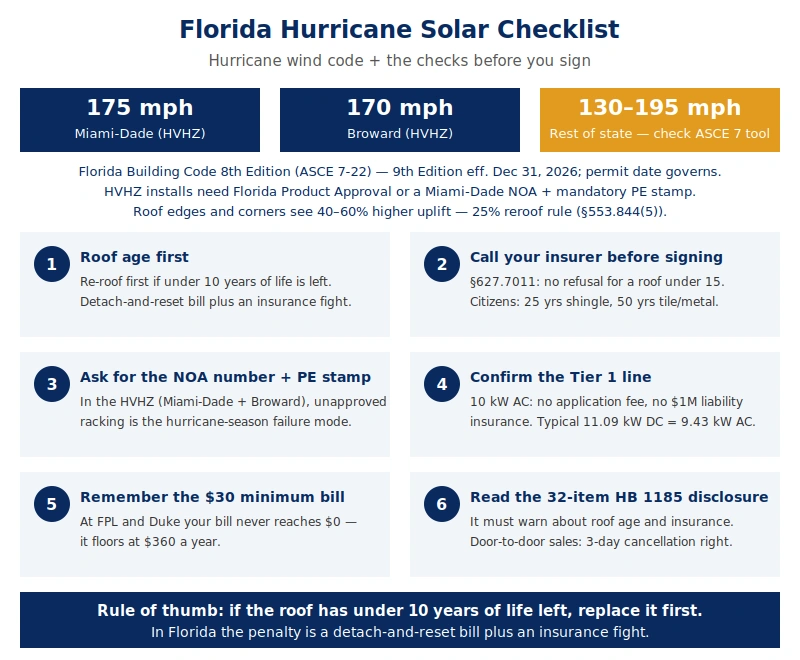
The High-Velocity Hurricane Zone (HVHZ) is Miami-Dade and Broward counties. Design wind speeds reach 175 mph (Miami-Dade) and 170 mph (Broward) for Risk Category II structures. HVHZ installs require Florida Product Approval or a Miami-Dade Notice of Acceptance (NOA) and a mandatory PE stamp on structural and electrical designs. Outside the HVHZ, design wind speeds run 130–195 mph by location — a broad range, so check the ASCE 7 Hazard Tool for your address rather than trusting a statewide number. Standard panels are typically rated to 2,400 Pa (about 140 mph) while Florida hurricane-zone practice demands about 3,300 Pa — a single secondary source, flagged, so do not treat 3,300 Pa as code. Roof edges and corners see 40–60% higher uplift than center sections.
HB 911 (2026 session) would have required 160-mph impact-resistant envelopes for multistory residential, homes within 5 miles of tidal waters, and HVHZ construction. It died in committee on March 13, 2026. It never became law.
The 25% reroof rule (§553.844(5)) also matters: for homes built before March 2009 with no prior roof replacement, damage over 25% of the roof surface requires a full replacement to current code; roofs built or repaired to the 2007 Florida Building Code or later need only the repaired part brought to code.
Roof age + insurance — check BEFORE you sign
§627.7011(5), F.S.: an insurer may not refuse to issue or renew a policy solely because the roof is under 15 years old. At 15+ years, the homeowner may get an inspection by an authorized inspector; if it shows 5+ years of useful life remaining, the insurer may not refuse or non-renew solely for roof age. The law does not stop an insurer declining for roof condition, pricing an older roof higher, or using approved roof endorsements.
Citizens Property Insurance (the state-created insurer) uses later thresholds: 25 years for shingle and soft roofs, 50 years for tile, metal, slate and concrete — beyond that, proof of replacement or 5+ years of remaining life.
Individual insurers are stricter than the statute. Edison Insurance (March 13, 2026) requires shingle and metal roofs up to 10 years, flat roofs up to 5 years, and calls clay and cement tile roofs ineligible for solar-panel coverage; the system must be installed after 2016 by a licensed solar contractor, with post-installation inspection and an approved permit; Coverage A must be updated to the panels’ replacement value and the home insured to 100% of replacement cost. Those are one insurer’s published rules — not industry-wide. The point is not Edison’s terms. The point is: call your insurer before you sign a solar contract.
Solar sales disclosure — HB 1185 (ch. 2023-130, effective July 1, 2023): the seller’s written disclosure form (now 32 items) must include the DBPR consumer phone number, a warning about your roof’s age, and a warning that solar may change your insurance premium. Door-to-door sales come with a 3-day right to cancel under the FTC Cooling-Off Rule (16 CFR Part 429, sales of $25 or more).
Practical rule — sharper here than in other states: if the roof has under 10 years of life left, replace it first. In Florida the penalty for getting this wrong is a detach-and-reset bill plus an insurance fight, not just the reset bill. See our Florida roof replacement cost guide and the national roof replacement cost guide before you decide.
HOA rights: Florida law protects your panels
Florida’s HOA solar law is older than most states’ — and it has a remedy most states do not: fee-shifting.
Fla. Stat. §163.04 (“Energy devices based on renewable resources”) has been on the books since 1980, with its current text stable since 2008 (amendments through ch. 2008-227).
- §163.04(1): no local government ordinance may prohibit or have the effect of prohibiting solar collectors, clotheslines, or other renewable-energy devices. Cities and counties cannot zone solar out.
- §163.04(2): a deed restriction, covenant, declaration, or similar binding agreement “may not prohibit or have the effect of prohibiting” solar collectors from being installed on buildings on the covered lots. A property owner “may not be denied permission” to install solar collectors by any entity with power to approve, forbid, control or direct alteration of property — an HOA architectural review committee cannot deny a solar application.
- The ONE power an HOA keeps: it “may determine the specific location where solar collectors may be installed on the roof within an orientation to the south or within 45° east or west of due south if such determination does not impair the effective operation of the solar collectors.” An HOA can steer panels within that band. It cannot push them somewhere that cuts output, and it cannot refuse on aesthetic grounds alone.
- §163.04(3): in any litigation under the section, the prevailing party gets costs and reasonable attorney’s fees — the fee-shifting remedy that makes the right enforceable for an ordinary homeowner.
- §163.04(4): the section does not apply to patio railings in condominiums, cooperatives, or apartments.
Two practice notes. HOAs may still require an architectural application — submit it, do not skip it. And in a condominium, the roof is usually association property, so the board’s control of the roof can block a rooftop array in practice even though the statute protects the right itself.
Florida has no percentage efficiency or cost test in its HOA statute. Contrast Nevada, which applies 10% efficiency and 3% cost tests, and North Carolina, which has a front-facing exception. Florida’s test is the 45° band plus “does not impair effective operation.” Do not mix the states’ rules. Arizona’s §33-1816 also bars bans, but Florida’s law is older (1980) and adds the fee-shifting remedy and the explicit 45° placement band.
Payback & 25-year savings math
Published benchmarks. EnergySage (November 2026) puts Florida payback at 10.2 years for the 14.49 kW average system, with 25-year savings of $58,382. City pages: Tampa 8.2 years ($78,468), Jacksonville 14.1 years ($26,613). EcoGen (October 2026) puts statewide payback at about 11.1 years simple payback before incentives for its 11.09 kW, $2.46/W model — per utility: FPL 11.4 years ($2,396/yr), Duke 10.1 years ($2,707/yr), TECO 9.4 years ($2,907/yr), FPU 9.6 years ($2,848/yr), OUC new 15.0 years ($1,816/yr), JEA 15.1 years ($1,805/yr). A GreenEnergyCalc model (10 kW, $2.15/W, October 4, 2026) gives about 10–12 years and 25-year net savings of $23,400–$43,500 depending on rate escalation. The national cash payback in 2026 is 9–13 years — Florida sits at or below the national range at the big four, and above it at OUC and JEA.
Our range: about 8–13 years statewide — TECO at the fast end, OUC and JEA at the slow end. The published benchmarks model larger systems at higher dollars per watt; our model below is a right-sized 8 kW system at the $2.12/W anchor — the optimistic end of the range.
Worked model: 8 kW system, FPL territory. Every line of the Florida model is shown below, with the assumptions stated alongside it — this is our own arithmetic, not EnergySage’s or EcoGen’s.
| Line | Math | Result |
|---|---|---|
| Gross installed cost | 8,000 W x $2.12/W | $16,960 |
| Less federal credit | $0 (2026 owned install) | $0 |
| Less state credit / rebate | None exist in Florida | $0 |
| Less sales tax | $0 charged (exempt under §212.08(7)(hh)) | $0 |
| Net cost | $16,960 | |
| Annual production | 8 kW x 1,555 kWh/kW/yr | ~12,440 kWh/yr |
| Value of production (1-for-1, all kWh at retail) | 12,440 kWh x 13.90 cents (FPL value net of base charge) | ~$1,729/yr |
| Year-1 savings | ~$1,729/yr | |
| Simple payback (net = gross) | $16,960 / $1,729 | ~9.8 years |
| 25-yr gross savings | $1,729/yr escalating ~2.5%/yr (electricity inflation), less ~0.5%/yr panel degradation | ~$55,400 |
| Less inverter replacement (once, ~yr 12–15) | −$2,000 | |
| Less net system cost | −$16,960 | |
| 25-year net savings (modeled) | ~$36,400 |
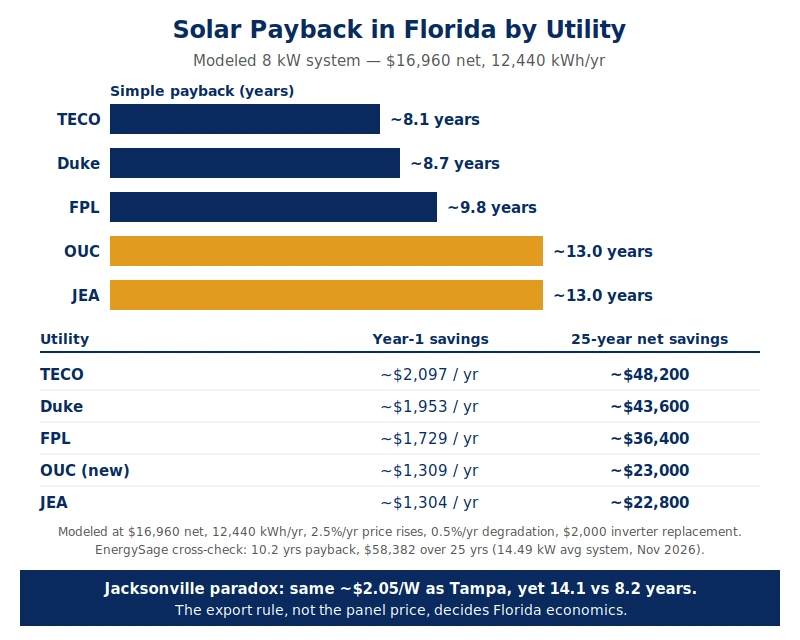
Assumptions, stated plainly: the home uses at least as much as the system produces annually (so no surplus is settled at the wholesale COG-1 rate); 1-for-1 net metering at FPL; 13.90 cents/kWh value net of the $10.52/mo base charge; 2.5%/yr electricity-price escalation; 0.5%/yr degradation; one inverter replacement about $2,000; no battery. Production uses EcoGen’s 1,555 kWh/kW/yr; NREL PVWatts v8 models 1,455 kWh/kW/yr — roughly 6% lower, a methodology gap, not an error. The $30/mo minimum bill caps savings: the bill floors at $360 a year, so a home using under about 13,000 kWh a year saves slightly less than the model — EcoGen’s 11.09 kW FPL model takes 12.5 years when the $30 minimum applies every month, against 11.4 years simple. Our 8 kW model is the optimistic end for a right-sized system. Lower-use homes pay back slower — expect that to be true for your home if your annual use is well below 12,440 kWh.
Same 8 kW system, other utilities (modeled, same assumptions):
- Duke Energy Florida: 12,440 kWh x 15.70 cents = ~$1,953/yr — payback ~8.7 years; 25-yr net ~$43,600.
- Tampa Electric: 12,440 kWh x 16.86 cents = ~$2,097/yr — payback ~8.1 years; 25-yr net ~$48,200.
- OUC (new customers, 5.467-cent export): self-consumed 64% x 13.36 cents = 7,962 kWh, about $1,064/yr; exported 36% x 5.467 cents = 4,478 kWh, about $245/yr; year-1 savings ~$1,309/yr; payback ~13.0 years; 25-yr net ~$23,000. The 64%/36% split is EcoGen’s OUC model assumption.
- JEA: self-consumed 73% x 12.76 cents = 9,081 kWh, about $1,159/yr; exported 27% x 4.326 cents = 3,359 kWh, about $145/yr; year-1 savings ~$1,304/yr; payback ~13.0 years; 25-yr net ~$22,800. The 73%/27% split is EcoGen’s JEA model assumption.
With a battery + OUC rebate (OUC only): 8 kW + 13.5 kWh battery is about $16,960 + ~$13,000 = ~$29,960 gross, minus the $2,000 OUC rebate = ~$27,960 net — but the rebate forfeits the TruNet retail export rate, so the export value in the model above no longer applies; the battery’s job is to push self-consumption toward about 85–90%. No single payback figure is given for this case. The trade-off is the story, not a number.
Annual savings for a typical 8 kW system: FPL ~$1,729/yr. Duke ~$1,953/yr. TECO ~$2,097/yr. OUC (new) ~$1,309/yr. JEA ~$1,304/yr.
An 8 kW system producing about 12,440 kWh a year against a typical Florida home’s about 13,000–17,000 kWh a year covers roughly 75–95% of annual use — but fixed charges ($10.52/mo FPL base, $30/mo FPL and Duke minimum bill, $18.50/mo OUC, $21/mo JEA) survive any system size.
Florida’s scale, for context: 22,550 MWdc installed (SEIA/Wood Mackenzie, September 2026), powering 2,703,713 homes across 298,287 installations, with 12,850 MW projected over the next 5 years (ranks 6th) — 3rd nationally. Florida is a solar giant. The rooftop market is where the fine print decides everything.
How to get quotes in Florida + red flags
Get three or more installer quotes, and use the same question list every time so the answers compare:
- What is my $/W before any incentives? The Florida benchmark is $2.12–$2.46/W. Anything above $3.50/W needs a justification (premium equipment, complex HVHZ wind engineering, difficult roof).
- Is the 30% federal credit still in this quote? A quote that subtracts it is running on dead law. Ask them to remove it — that is $5,088 on a $16,960 system.
- Which utility sends my bill, and is the savings model built for that utility? If the model uses retail value for all production on an OUC or JEA home, it ignores the 5.467-cent or 4.326-cent export reality. Ask for self-consumption and export shown as separate lines, on YOUR utility.
- Is it a lease or a loan — and if a lease, how does the §48E value reach me? The lessor claims the credit; the discount should show in the monthly payment. If anyone offers a per-kWh PPA, walk away: PPAs are not covered by Florida’s net metering rule, so a PPA customer gets no 1-for-1 credit.
- What is my roof’s age, and has my insurer given written OK? A quote that never asks your roof’s age or your insurer’s name has not read HB 1185’s disclosure form. Get the insurer’s written OK before signing.
- In Miami-Dade or Broward, what is the Florida Product Approval or Miami-Dade NOA number for the racking, and is there a PE stamp? Unapproved hardware is the hurricane-season failure mode.
- What is the installer’s Chapter 489 license number? Verify it at the DBPR and check complaint history before you sign.
Red flags from real Florida patterns. Any pitch built on “free solar” or a “government program” is selling a fiction: no program hands out panels. Florida Solar for All is waitlist-only, with no open application as of October 5, 2026 — anyone selling it today is not selling the program. Zero-down means a loan, a lease, or PACE — not $0 overall. Quotes still subtracting the dead 30% federal credit are the number-one stale-math trap in 2026. Savings modeled at retail for all production on OUC or JEA homes are the number-one Florida-specific trap. Oversizing past annual use wastes money at the big four (the surplus is settled once a year at the wholesale COG-1 rate, not retail) and at Lakeland and Tallahassee leftovers are never paid at all — size to your last 12 months of bills. An OUC battery-rebate pitch without the TruNet warning can cost a grandfathered customer more than the $2,000 rebate is worth. Lease and PPA pitches need the escalator clauses, transfer terms, and what-happens-on-sale read in full. A sale made at your door can be cancelled within 3 days under the FTC Cooling-Off Rule (16 CFR Part 429), for sales of $25 or more.
Where to complain: the Florida DBPR (license verification + complaints); the Florida Attorney General consumer protection division (deceptive sales practices); the Florida PSC (utility and net-metering disputes); the Florida Office of Insurance Regulation (insurer issues). No complaint phone numbers are published here — none were verified in this research.
Sources & methodology
Cost anchors: EnergySage Florida state page (November 2026: $2.12/W, 14.49 kW average system, $30,713, range $26,106–$35,320; Tampa $2.03/W, 15.05 kW, $30,471, 8.2-yr payback, $78,468; Jacksonville $2.05/W, 12.95 kW, $26,486, 14.1-yr payback, $26,613; statewide 10.2-yr payback, $58,382 25-yr savings; September 4, 2026 version: $2.12/W, 14.53 kW, $30,833, $64,627 25-yr savings, Miami ~$2.30/W, 15.75 kW, $36,247, Orlando ~$2.08/W, 14.27 kW, $29,649); EcoGen America Solar Cost Index (September 2026 edition, page updated October 19, 2026: $2.46/W, 11.09 kW typical system $27,281, most installs $2.10–$2.70/W, 8–10 kW $17,000–$27,000, 1,555 kWh/kW/yr, 11.09 kW produces 17,245 kWh/yr, per-utility payback FPL 11.4 / Duke 10.1 / TECO 9.4 / FPU 9.6 / OUC new 15.0 / JEA 15.1 years, statewide ~11.1 years); EnergySage national benchmark (June 30, 2026: ~$2.60/W, 12 kW average $31,135); EnergySage Marketplace Report 23rd edition (September 2026: median quoted solar-only price $2.62/W, US). Size table calculated from the $2.12/W anchor at the $2.46/W high end.
Electricity rates: EIA Electric Power Monthly Table 5.6.A (August 2026, released October 28, 2026: Florida residential 14.99 cents/kWh, US 18.16 cents/kWh, FL 15th lowest of 51, 17.5% below US average; avg bill $217.28 in August at 1,449 kWh; FPL 14.90 cents, avg bill $217.92 at 1,463 kWh; Duke 15.18 cents, avg bill $201.06 at 1,325 kWh); EIA 12-month average (15.4 cents/kWh, avg bill ~$169/mo); EIA Jan–Aug 2026 average (15.31 cents/kWh); FPL RS-1 tariff sheet (October 2026: base charge $10.52/mo; energy up to 1,000 kWh 12.258 cents/kWh, over 1,000 kWh 14.258 cents/kWh; $30 minimum bill); TECO rates page ($156.43 per 1,000 kWh after August 2026 storm-charge end; $154.18 from January 2027); FPSC March 2026 (Duke $155.92, TECO $176.89, FPU $165.17 per 1,000 kWh); FMEA Jan–Sep 2026 all-in at 1,000 kWh (Duke 16.16 cents, TECO 17.81 cents); JEA tariff filing via FPSC (eff. October 1, 2026: basic monthly charge $21.00; tier 1 up to 1,000 kWh 7.815 cents/kWh, tier 2 9.705 cents/kWh). Storm surcharges: FPL $12.02 per 1,000 kWh through 2025 ($1.125B finalized July 2026); TECO $19.95 per 1,000 kWh March 2025–July 2026 (ended August 1, 2026); Duke $32.40 per 1,000 kWh March 2025–February 2026. FPL 2026–2029 rate plan: PSC approved November 20, 2025 (Docket 20250011-EI), +$945M (2026) / +$705M (2027), 1,000 kWh bill $134.14 to $136.64 (Jan 2026), projected $143.05 (Jan 2027), $146.24 (Jan 2028), $148.15 (Dec 2029), cumulative ~$6.9B.
Net metering and export rates: Florida PSC Rule 25-6.065 (in force since April 7, 2008); HB 741 vetoed April 27, 2022; EcoGen America Florida solar page (October 2026: OUC 5.467 cents/kWh from November 1, 2026, grandfathered full retail ~11.55 cents through June 30, 2045; JEA 4.326 cents/kWh from October 1, 2026; Tier 1 up to 10 kW AC, 11.09 kW DC = 9.43 kW AC, above 10 kW AC up to $1M liability insurance; 2 MW system cap; owned/leased covered, PPAs not; Gainesville fuel-rate credit; Lakeland 1-for-1 + $6.08/kW net demand charge eff. October 1, 2026; Tallahassee credits expire yearly, never paid in cash; Florida Keys dollar credit; EcoGen values net of fixed charges FPL 13.90 / Duke 15.70 / TECO 16.86 / FPU 16.51 / OUC 13.36 / JEA 12.76 cents/kWh); Sunstorm Energy Florida net metering guide (checked October 8, 2026). Excluded: Tesla’s ~10.8-cent FPL export figure (inconsistent with the October 2026 RS-1 tariff); ProFusion’s ~4.6-cent OUC figure (earlier rate vintage).
Incentives: EcoGen America Florida solar incentives page (October 2026: sales-tax exemption §212.08(7)(hh), ~$1,500–$2,500; property-tax exemption §193.624, 100% of added value, nothing to file; OUC battery rebate $150/kWh up to $2,000 with TruNet forfeiture; no utility panel rebate; PACE up to 20 years; SELF loan 8.25–8.75% fixed 7 years + 2% fee; FPL SolarTogether $6.76/kW/mo, ~3.6 cents/kWh; Duke Clean Energy Connection $8.35/kW/mo, 4.037 cents/kWh; Solar for All waitlist-only as of October 5, 2026); OUC battery rebate page; DSIRE (programs.dsireusa.org, NC State University) — verify all Florida items there at publish time; OBBBA P.L. 119-21 (signed July 4, 2025), IRS FS-2025-05 (August 21, 2025, FAQ 7).
Production: NREL PVWatts v8, 2026 NSRDB data, via thegreenwatt.com (2026: 5.48 peak sun hours/day, #8 in the US, US avg 4.98; best month May 6.6; PVWatts 1,455 kWh/kW/yr); EcoGen (September 2026: 1,555 kWh/kW/yr); city insolation table (Miami 5.62, Tampa 5.67, Gainesville 5.27, Apalachicola 5.49); temperature coefficients (ExploreSolar, February 2026, via art. 62: PERC −0.34 to −0.40%/°C; TOPCon −0.28 to −0.35%/°C; HJT −0.24 to −0.28%/°C); heat penalty 10–15% at peak heat (Orlando guide — single secondary source).
Battery: solartechelec Florida guide (2026: Powerwall 3 ~$12,900 installed; Enphase 5P $5,500–$9,000; Enphase IQ 10 ~$11,000; Florida-wide $3,000–$18,000+; homes use 30–35 kWh/day); Lunex Power (early 2026: Powerwall 3 $11,500 DC / $15,500 AC; Enphase IQ 10C from $15,500); a1solarstore (2026: national $13,000–$16,500; Florida average ~$1,030/kWh); EnergySage July 2026 battery analysis (~$15,647 for a typical installed 13.5 kWh system); Solar.com / IntegrateSun (2026: single 10–13.5 kWh system $10,000–$16,000); floridasolarlife.com (October 2026: two Powerwall+ units 27 kWh, $18,700 July 2023; ~40 kWh refilled on an overcast day; measured round-trip efficiency 81.0%; ~$26/yr idle top-ups at 100% reserve; ~690–1,450 kWh/yr wasted on daily cycling); Generac via floridasolarlife.com (standby generator $8,000–$16,000 installed); Advance Solar (2026: outage cost $1,000–$2,000 per event — installer-published).
Wind code, roof and insurance: Florida Building Code 8th Edition (eff. December 31, 2023, ASCE 7-22); 9th Edition eff. December 31, 2026 (Jimerson Firm, 2026; Urban Building Concepts, 2026); HVHZ 175 mph Miami-Dade / 170 mph Broward (PermitPlace, 2026); Florida Product Approval / Miami-Dade NOA + mandatory PE stamp (Energyscape, 2026; WindLoad.solutions, 2026); 25% reroof rule §553.844(5) (PermitPlace, 2026; reroofreport.com, October 2026); HB 911 died in committee March 13, 2026 (Jimerson Firm, 2026); §627.7011(5) 15-year rule and Citizens 25/50-year thresholds (reroofreport.com, reviewed October 12, 2026; Citizens FAQ, updated March 17, 2026); Edison Insurance roof rules (March 13, 2026 — single insurer); HB 1185 (ch. 2023-130, eff. July 1, 2023: 32-item disclosure form); EcoGen America Florida solar laws page (October 2026: HB 683, HB 803, §163.04, HB 1185, Chapter 489 licensing); HB 683 (ch. 2025-140, eff. July 1, 2025) and HB 803 (ch. 2026-63) permitting; universal permit application planned from 2027 (Insurance Journal/Bloomberg, July 28, 2026).
HOA: Fla. Stat. §163.04 (since 1980, current text stable since 2008; Goldin Solar, 2026; apmhoa.com, 2026; pmlawfla.com, 2026).
Payback model: EnergySage Florida state page (November 2026: 10.2-year payback, $58,382 25-year savings, 14.49 kW system; Tampa 8.2 / $78,468; Jacksonville 14.1 / $26,613); EcoGen (October 2026: ~11.1-year statewide simple payback; per-utility FPL 11.4 / Duke 10.1 / TECO 9.4 / FPU 9.6 / OUC new 15.0 / JEA 15.1 years); GreenEnergyCalc (October 4, 2026: 10 kW, $2.15/W, ~10–12 years, 25-yr net $23,400–$43,500). The 8 kW worked model is our arithmetic with stated assumptions (1,555 kWh/kW/yr, 2.5%/yr escalation, 0.5%/yr degradation, $2,000 inverter replacement, 13.90 / 15.70 / 16.86 cents utility values, 64%/36% OUC and 73%/27% JEA self-consumption splits from EcoGen).
State scale: SEIA Florida Solar and Storage fact sheet (September 2026: 22,550 MWdc installed, powers 2,703,713 homes, 298,287 installations, 12,850 MW projected next 5 years, ranks 6th, 3rd nationally).
EXCLUDED: the Tesla ~10.8-cent FPL export figure; the ProFusion ~4.6-cent OUC figure (use 5.467 cents from November 1, 2026); the vetoed HB 741 phase-down as law; any “after 30% credit” net prices; the OUC battery rebate without the TruNet forfeiture catch; any Florida state tax credit or statewide panel rebate claim; other states’ VPP figures (NC $6.50/kW/mo, AZ $110/kW/yr) or HOA percentage tests (NV 10%/3%); HB 911 as law (died in committee); the $10,000–$20,000 detach-and-reset figure as a 2026 benchmark (older anecdote); any Florida-specific hurricane-racking dollar adder (none verified); any Florida-specific soiling percentage (none verified); any Florida battery attach rate (none found); any Florida-specific solar-sales fraud case or AG complaint phone numbers (none verified).
*Disclaimer: Prices are 2026 Florida planning figures and change by utility territory, wind zone, roof, and installer. Always get 3 written local quotes before budgeting. Tax information is general, not tax advice — confirm with a tax professional. Export rates and net metering rules reset on utility calendars — OUC’s 5.467-cent export credit took effect November 1, 2026 and OUC can reset it — verify the current export credit with your utility in writing before signing.*
—
How much do solar panels cost in Florida in 2026?
Solar panels cost $2.12–$2.46 per watt installed in Florida in 2026 (EnergySage, November 2026; EcoGen Solar Cost Index, September 2026) — the cheapest solar in America. An 8 kW system runs about $16,960 gross — and $16,960 net, since there is no federal credit and no state credit to subtract. The Florida-average 14.49 kW system costs $30,713.
Is there still a federal solar tax credit in Florida in 2026?
No — $0 for homeowner-owned systems. Congress ended the §25D residential credit for installations completed after December 31, 2025 (OBBBA, P.L. 119-21; IRS FS-2025-05). Florida has no state solar tax credit either — it has no state income tax for a credit to reduce. A leased system can still pass through the §48E credit, which runs through December 31, 2027.
Does Florida still have net metering in 2026?
Yes — full retail 1-for-1 net metering at FPL, Duke Energy Florida, Tampa Electric and Florida Public Utilities under PSC Rule 25-6.065 (unchanged since 2008; the HB 741 phase-down was vetoed April 27, 2022). But Orlando’s OUC cut new customers to 5.467 cents per kilowatt-hour from November 1, 2026, and Jacksonville’s JEA pays 4.326 cents per kilowatt-hour from October 1, 2026.
How much is the Florida sales tax exemption worth?
0% sales tax on solar equipment under §212.08(7)(hh) saves about $1,500–$2,500 on a typical system — the tax is simply not charged, not refunded. The property-tax exemption under §193.624 adds $0 to your tax bill, since 100% of the added value is exempt and there is nothing to file.
Do I need a battery with solar panels in Florida?
For backup, yes — hurricanes. For bill savings, no at FPL, Duke and TECO, where exports already earn full retail 1-for-1, so a battery earns $0 on arbitrage. At OUC and JEA, yes — exports earn only 5.467 and 4.326 cents against about 13 cents for self-use. A Tesla Powerwall 3 (13.5 kWh) runs about $12,900 installed in Florida.
Can my HOA stop me from installing solar panels in Florida?
No — Fla. Stat. §163.04 voids bans on solar collectors, and an HOA architectural committee cannot deny a solar application. The one power an HOA keeps is choosing the roof spot within an orientation to the south or within 45 degrees east or west of due south, and only if that placement does not impair the panels’ effective operation. In litigation, the prevailing party recovers costs and reasonable attorney’s fees.
Will solar panels raise my property taxes in Florida?
No — §193.624 exempts 100% of the added value a solar system brings from property-tax assessment, for systems installed since January 1, 2013, including qualifying battery storage. There is nothing to file; the exemption is automatic in most counties.
Why does solar pay back slower in Jacksonville than Tampa?
Same price per watt — about $2.05 in Jacksonville against $2.03 in Tampa — but Jacksonville is JEA territory, where exports earn the 4.326-cent fuel rate, while Tampa Electric still credits exports 1-for-1 at full retail. EnergySage puts Jacksonville’s payback at 14.1 years against Tampa’s 8.2 years, with 25-year savings of $26,613 against $78,468. The export rule, not the panel price, decides Florida economics.