

Table of Contents
North Carolina is a state of three climates wearing one name. Charlotte and Raleigh sit in the humid Piedmont, where January nights average just above freezing and July afternoons run into the low 90s. Wilmington and the Coastal Plain are warmer still, with the shortest heating season in the state and salt air eating at outdoor equipment. Asheville and Boone climb into real mountain winters, with January lows averaging below 30°F and about 10 inches of snow a year. One heat pump price cannot cover all three — and this guide does not pretend it does. Every figure below is 2026 North Carolina data, with the federal credit correctly shown as $0 and the state’s rebate map drawn utility by utility.
Compare with the national heat pump cost guide for the US baseline, our Georgia heat pump cost guide for the closest Southern comparison, and our North Carolina solar panel cost guide for the same Duke Energy territory, rates, and merger timeline.
How much does a heat pump cost in North Carolina in 2026?
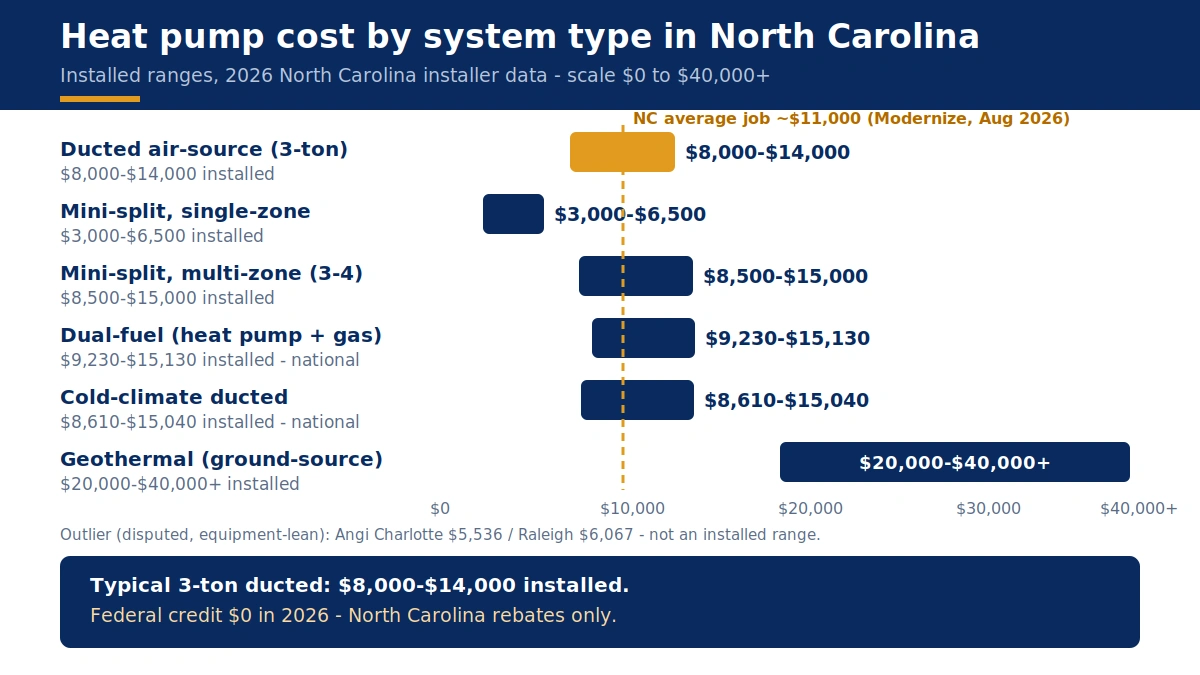
The number this guide stands behind for 2026 North Carolina: $8,000–$14,000 installed for a typical whole-home ducted air-source heat pump (3-ton). That range is built from North Carolina installer quotes, not national averages. Modernize’s North Carolina page (published August 4, 2026; updated August 21, 2026) puts the statewide average at ~$11,000 installed, with most homeowners paying $7,500–$16,000. Its Durham city page puts the average a little lower, at $10,200 — so this guide presents the average as ~$10,200–$11,000 and headlines the $8,000–$14,000 range, not a point average. EnergySage (via ratemyhvacquote, October 29, 2026) cites a North Carolina state average of $9,757 for whole-home heat pump quotes before incentives, which sits comfortably inside the same band.
The installer quotes behind the range tell the same story from different metros. Boer Brothers HVAC (Triangle installer) quotes a new heat pump at $6,000–$12,000 installed. Mitchell HVAC (Durham, Trane dealer, updated October 22, 2026) quotes Trane heat pump installations at $8,000–$15,000. Horne Heating & Air (Charlotte, in business since 1983) quotes $13,000–$16,000, averaging $14,500 — a premium installer sitting at the top of the Charlotte band, not the typical price. Andersen Heating & Cooling (Charlotte) quotes full system replacements at $8,500–$22,000, from a Comfort tier at $8,500 up to an Ultimate tier at $16,000–$22,000. A typical 2,000 sq ft North Carolina home runs ~$7,000–$13,000 for a new central AC or heat pump (northcarolinabusinessesnearme, October 22, 2026). A BLS labor-adjusted model (TryDun, updated August 2026) puts North Carolina ducted air-source at $5,850–$10,800.
Two numbers you will see elsewhere need handling with care. Angi’s Charlotte page (updated August 4, 2026) reports an average heat pump cost of $5,536 (range $3,926–$7,496), and its Raleigh page reports $6,067 (range $4,571–$7,629). Those figures conflict sharply with every North Carolina installer quote we found — $8,000–$16,000 for a complete installed system. Angi’s numbers appear to reflect equipment-only or partial-scope pricing: its own Charlotte page lists air-source equipment at $4,100–$7,200 and labor at only $500–$3,000, and its Raleigh page lists an air-source “average unit cost” of $1,500–$4,500. Do not budget on $5,536 or $6,067. When a quote lands near those Angi figures, ask which pieces are missing — ductwork, the air handler, the panel, the permit, or the install labor itself. The same pattern showed up in our Georgia guide, where Angi’s Atlanta average was also far below every installer quote.
The pricing rule that defines 2026: the quoted price is the real price, minus North Carolina rebates only. The §25C credit — 30% of the cost, up to $2,000 a year for a heat pump — stopped applying to any system placed in service after December 31, 2025. Plenty of top-ranking pages still display heat pump prices net of a tax credit. Treat those as outdated. Every price in this guide is the price you actually pay, less only the Duke and Energy Saver NC rebates listed in the incentives section.
Heat pump cost by system type in North Carolina
| System type | North Carolina installed range | Best for |
|---|---|---|
| Ducted air-source heat pump (whole home) | $8,000–$14,000 (typical 3-ton; high-end variable-speed to ~$16,000–$22,000) | Most NC homes with existing ducts |
| Ductless mini-split, single zone | $3,000–$6,500 (Modernize NC: $5,610 typical) | One room, addition, garage |
| Ductless mini-split, multi-zone (3–4 zones) | $8,500–$15,000 (Modernize NC 3-zone: $12,240) | Whole home without ducts |
| Dual-fuel (heat pump + gas furnace) | $9,230–$15,130 at 3 tons (NumeralQ national, 2026 — no NC-specific figure verified) | High Country / homes with cheap gas + cold snaps |
| Cold-climate ducted heat pump | $8,610–$15,040 at 3 tons (NumeralQ national, 2026) | Asheville / Boone |
| Geothermal (ground-source) | $20,000–$40,000+ (national; Modernize NC: $28,560 — no precise NC average verified) | Maximum efficiency; propane-heated mountain homes; coastal sandy soil helps loop cost |
Ducted air-source is the default North Carolina system. When the ducts you already have are sound, start with a quote for this system. Modernize’s North Carolina figures split the tier clearly: a standard air-source system at $8,160 against a high-efficiency system at $12,240. The high-efficiency tier means a variable-speed (inverter) system, and in North Carolina that upgrade earns its keep: its longer, slower run cycles strip far more humidity from the air (more in the climate section). It is the one efficiency upgrade that is worth more in a humid state than in a dry one.
Mini-splits are the answer for homes without ducts. One zone at $3,000–$6,500 handles a single room, an addition, or a converted garage. A whole-home 3–4 zone setup runs $8,500–$15,000, and once you are spending that much, a ducted system usually wins on value wherever ducts already exist or go in cheaply. Our mini-split installation cost guide breaks down per-zone pricing in detail, and our cold-climate mini-split guide covers the inverter models that matter in Asheville and Boone.
Geothermal is the finest system money buys — and the toughest to justify on payback in the Piedmont. At $20,000–$40,000+ installed, with a seasonal COP near 3.8 that never drops with the air temperature, it is superb engineering. But with winters this mild, the efficiency premium over a good air-source system is smaller than it would be up north, so payback stretches long. Two North Carolina exceptions are real: mountain homes heating with expensive propane, where payback can be genuinely fast, and the coast, where sandy soil makes loop installation notably cheaper (Modernize, August 2026). The 30% federal geothermal credit is gone too — a $30,000 system that would have cost $21,000 after the credit in 2025 costs the full $30,000 in 2026.
Cost by metro area (Modernize NC, published August 4, 2026; updated August 21, 2026):
| Metro / Area | Ducted air-source | Mini-split, single zone | Mini-split, multi-zone (3–4 heads) |
|---|---|---|---|
| Charlotte | $8,500–$14,000 | $3,200–$6,500 | $9,000–$15,000 |
| Raleigh-Durham (Triangle) | $8,000–$13,500 | $3,000–$6,200 | $8,500–$14,500 |
| Greensboro / Winston-Salem (Triad) | $7,500–$13,000 | $2,900–$6,000 | $8,200–$14,000 |
| Asheville | $9,000–$15,000 | $3,500–$7,000 | $9,500–$16,000 |
| Boone / High Country | $9,500–$16,000 | $3,700–$7,300 | $10,000–$17,000 |
| Wilmington / Coastal Plain | $8,000–$13,500 | $3,000–$6,200 | $8,500–$14,500 |
The pattern is clean: the mountains cost the most (cold-climate equipment plus harder installs), the Triad costs the least, and Charlotte and Raleigh sit in the middle. Horne’s $13,000–$16,000 Charlotte range sits at the top of Modernize’s Charlotte band — a premium installer, not the typical Charlotte price.
Heat pump cost by size in North Carolina
No single published North Carolina tonnage table exists, so the table below is built from the North Carolina installer ranges above (3-ton anchor: $8,000–$14,000) and the national tonnage pattern in NumeralQ (3-ton ducted $6,550–$10,960 nationally). Treat it as planning ranges, not quotes.
| Tonnage | Home size served | North Carolina installed range (planning) |
|---|---|---|
| 2 ton | 1,000–1,200 sq ft | $6,500–$10,000 |
| 2.5 ton | 1,200–1,500 sq ft | $7,500–$12,000 |
| 3 ton | 1,500–1,800 sq ft | $8,000–$14,000 |
| 4 ton | 1,800–2,200 sq ft | $10,000–$16,000 |
| 5 ton | 2,200–3,000 sq ft | $12,000–$18,000 |
The average Charlotte home is just under 1,700 sq ft and needs about a 3-ton heat pump (Angi Charlotte, August 2026). Per-ton installed cost nationally runs $2,500–$3,800 per ton (Costimated, November 2026, via our Arizona guide) — and the per-ton rate falls as tonnage rises. Higher SEER2/HSPF2 ratings push each band upward.
Square footage alone never sizes a system. The “one ton per 500–600 square feet” rule is a rough starting guess, never a sizing method. Right-sizing takes a Manual J load calculation ($200–$500, often credited toward the install), which weighs insulation, windows, ceiling height, and — the part that matters most here — the humidity load. An oversized system is not a safety margin. Here it is the sizing mistake installers see most, and it leaves the house clammy (see the climate section below).
What drives your price up or down in North Carolina
Ductwork. Have good ducts? A ducted swap is straightforward. Need new ducts? Add $5,000–$10,000 (national planning range, art. 1); Angi Charlotte lists duct installation at $3,000–$7,500 (August 2026). Ducts leaking into a hot attic are also the house’s quietest energy waste — ask for duct sealing as its own line item.
Electrical panel. A heat pump runs on its own dedicated 240V circuit. If your panel is full or still 100-amp, budget $1,500–$4,000 for a 200-amp upgrade. One North Carolina-specific offset: Energy Saver NC (HEAR) can pay up to $4,000 for a panel when it supports an eligible appliance on the same application — but not as a standalone panel rebate. The electrical panel upgrade cost guide walks through the options and the price bands.
Efficiency tier. The Southeast legal floor for a split-system heat pump is 14.3 SEER2 / 7.5 HSPF2. A mid-tier 15–17 SEER2 / 8.5+ HSPF2 system is the sweet spot for most North Carolina homes — and the Duke rebate tiers effectively push buyers to 15.2 SEER2 minimum anyway. An 18+ SEER2 variable-speed system costs more, and its payback concentrates in heavy-AC homes and on time-of-use plans. Cold-climate (inverter-driven) models cost 15–30% more than standard — worth pricing in Asheville and Boone, overkill in the Piedmont and on the coast.
Labor market. North Carolina HVAC labor runs $77–$163 an hour (Modernize, 2026). The same equipment costs noticeably more in Charlotte and the Triangle than in smaller markets, and quotes for identical systems can swing widely between contractors — which is why three quotes are non-negotiable.
Permits and tax. A Charlotte permit averages ~$79.61 (Angi, August 2026; the fee is $59.70 plus $12.19 per $1,000 over $3,000 for jobs over $7,000). Raleigh requires a permit and plan review. Check whether quotes include sales tax: Raleigh applies 7.25% to heat pump purchases (Angi, August 2026), and rates vary by county (state base 4.75% plus local).
Mountains and coast. Boone and the High Country carry a mountain premium — colder design conditions, harder installs, longer cold seasons. On the coast, salt air shortens outdoor-unit life, so ask about coated or corrosion-resistant coils (Modernize, August 2026), and hurricane exposure matters for outdoor-unit anchoring. Sandy coastal soil, on the other hand, makes geothermal loop installation notably cheaper.
Refrigerant transition. New 2026 systems use R-454B or R-32; R-410A was phased out of new equipment on January 1, 2025. New systems carry a modest cost increase over old R-410A equipment (Andersen Charlotte, 2026). A “new” R-410A system quoted in 2026 is old stock — ask which refrigerant the quote uses.
A North Carolina heat pump lasts 12–15 years with annual maintenance (northcarolinabusinessesnearme, October 22, 2026; NumeralQ, 2026) — year-round use shortens life against an AC-only unit, and coastal salt air shortens it further.
North Carolina’s climate: why heat pumps work here — and the humidity catch
North Carolina is humid subtropical (Cfa) across the state, with a mountain twist. The 1991–2020 NOAA normals tell the story in numbers:
| Metric | Charlotte (Piedmont) | Raleigh (Triangle) | Asheville (Mountains) | Wilmington (Coast) |
|---|---|---|---|---|
| Annual mean temperature | ~61°F (Jan 43°F / Jul 80°F) | ~61°F (Jan ~42°F / Jul ~79°F) | ~56°F (Jan 38.7°F / Jul 75.1°F) | ~64°F (Jan ~46°F / Jul ~80°F) |
| Heating degree-days (base 65°F) | 3,181 | 3,393 | 3,838 | Not verified — do not state |
| Winter design temp (99.6%) | 22°F | 20°F | Not verified — do not state | Not verified — do not state |
| Summer design temp (0.4%) | 93°F | 92°F | Not verified — do not state | Not verified — do not state |
| Annual precipitation | ~43.6 in | ~46.0 in | 49.6 in | ~55 in |
| Days at or above 90°F / year | ~55 | ~50 (not verified) | ~10 (not verified) | ~45 (not verified) |
Heating degree-days come from ICC Appendix D (Charlotte 3,181; Raleigh 3,393; Greensboro 3,805) and NOAA 1991–2020 (Asheville 3,838). Asheville’s cooling degree-days are 1,048 (NOAA 1991–2020) — the only verified cooling degree-day figure in the state. No verified Charlotte or Raleigh cooling degree-day figure was found, so none is stated here.
The key insight: North Carolina’s load is heating-tilted on paper but cooling-dominated on the bill. Charlotte accumulates 3,181 heating degree-days against a smaller cooling load, and Asheville 3,838 against just 1,048 — yet summers are long, hot, and humid, so the cooling side of the heat pump earns its keep May through September. Winters are mild enough that a standard heat pump runs at a COP above 3.0 most of the season (ohmsnap zone 3–4 analysis, March 2026 — Charlotte sits in the same zone 3–4 band as Atlanta and Nashville). A heat pump is the only single system that serves both loads, which is why it is the default HVAC choice across the Piedmont and the coast.
Regional variation inside the state matters more than the state average. In the Piedmont (Charlotte, Raleigh-Durham, Greensboro/Winston-Salem), January nights average ~32–34°F and standard (non-cold-climate) equipment is the right default. On the Coastal Plain (Wilmington, Outer Banks), winters are the warmest in the state and the heating season is the shortest — heat pumps are the clear default, with salt-air coil protection and hurricane anchoring as the real concerns. In the Mountains (Asheville, Boone / High Country), it is genuinely colder: Asheville’s January mean is 38.7°F with lows averaging 28.6°F and ~10 inches of snow a year, and Boone sits higher still with real snow, harder freezes, and a longer cold season. Standard heat pumps still work there, but backup heat runs more often, and cold-climate/inverter models and dual-fuel are worth pricing. Propane is common in the mountains and expensive against electricity, so a heat pump or geothermal can pay back fast against propane (Modernize, August 2026).
Humidity is the sizing story, not winter cold. Charlotte’s July dew point averages ~67°F, and summer humidity runs high — monthly-average relative humidity near 68% in July, with much higher morning readings. Indoor comfort needs relative humidity held near 30–50%; above ~60% sustained, mold risk rises (general building-science guidance — no North Carolina-specific mold statistic was verified).
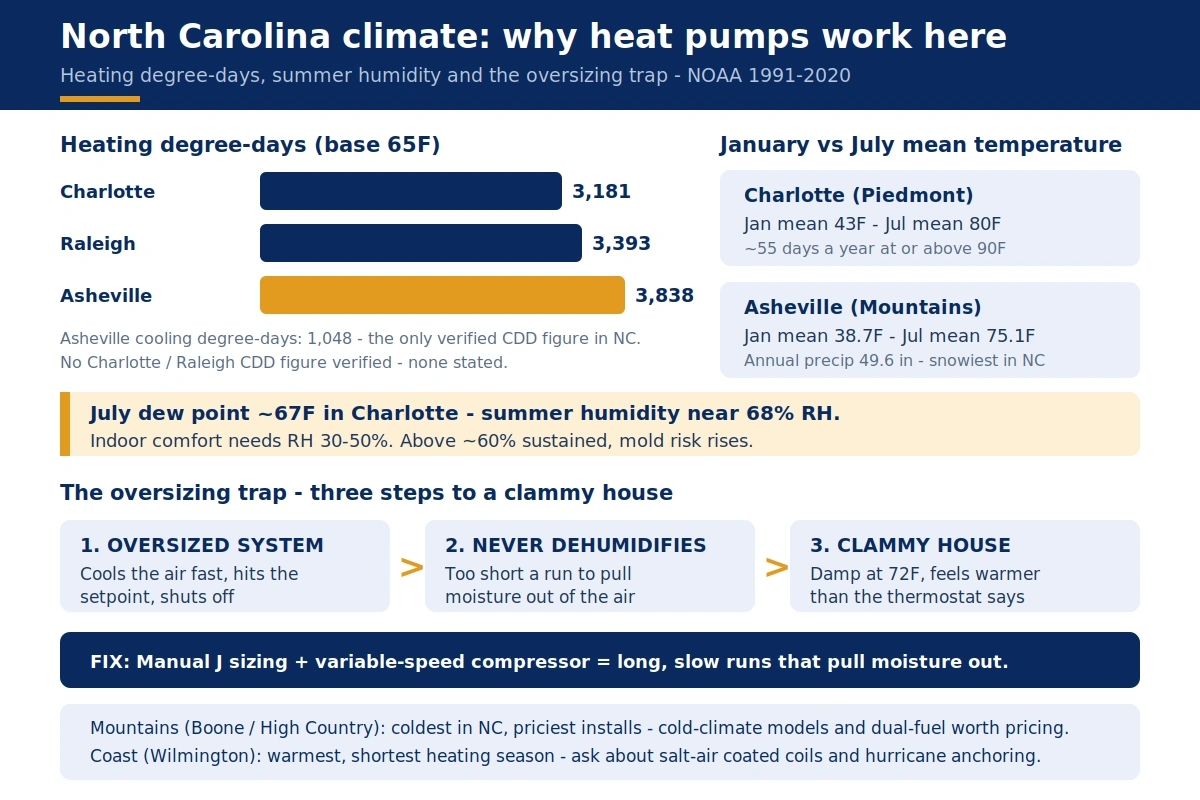
That is where oversizing bites. An oversized heat pump blasts the air cold, hits the thermostat setpoint, and switches off — before it has run long enough to wring moisture out of the air. The house ends up clammy at 72°F, feeling warmer than the thermostat claims. Modernize’s North Carolina page (August 2026) states it explicitly for this state: “An oversized unit cools your home fast but shuts off before it’s pulled enough moisture out of the air, leaving your home feeling damp even at the right temperature.” The fix is threefold: a Manual J load calculation instead of a square-footage rule; a variable-speed/inverter compressor that runs long and slow, dehumidifying while it cools; and, in the most humid homes, a whole-home dehumidifier quoted as a separate line item. No verified North Carolina dehumidifier cost was found, so no figure is given here — ask for it as a quoted option.
Variable-speed is worth more in North Carolina than in dry states because it dehumidifies while it cools. That is the honest upsell case for the $12,240 high-efficiency tier (Modernize) over the $8,160 standard tier.
Efficiency ratings that matter in North Carolina. Under the DOE’s 2023 standards, a split-system heat pump sold in the Southeast must hit at least 14.3 SEER2 for cooling and 7.5 HSPF2 for heating. SEER2 has been the test standard since 2023, so SEER2 figures and old SEER figures are not directly comparable. (Angi Charlotte’s “minimum SEER rating in Charlotte is 15” is the old-SEER framing; use 14.3 SEER2 / 7.5 HSPF2 as the verified 2026 minimums.) ENERGY STAR split-system minimums are 15.2 SEER2 / 7.8 HSPF2. To convert HSPF2 to a seasonal COP, divide by 3.412: the 7.5 HSPF2 minimum is a seasonal COP of about 2.2, and a standard North Carolina heat pump at COP ~3.0 in winter is the working assumption. For most North Carolina homes, 15–17 SEER2 with 8.5+ HSPF2 is the sweet spot. Florida runs the same humidity playbook with an even shorter heating season — see Florida’s heat pump climate.
The federal tax credit is $0 in 2026 — what that means
Here is the fact that changes every 2026 heat pump quote in North Carolina. The §25C Energy Efficient Home Improvement Credit paid 30%, up to $2,000 a year, for heat pumps — until the One Big Beautiful Bill Act (OBBBA, P.L. 119-21, signed July 4, 2025) cut it off for any property placed in service after December 31, 2025. The IRS confirmed the rule in FS-2025-05 (August 21, 2025). For any heat pump installed in North Carolina in 2026, the federal credit is $0.
One exception to keep straight: a system installed in 2025 still goes on the 2025 return (IRS Form 5695). That is a claim for 2025 work, not a credit for 2026 work — paying for the equipment in 2025 changes nothing if the install finished in 2026.
Geothermal’s 30% §25D credit ended on the same date, under the same law — confirmed by jouleio (2026) and AirProHQ (October 2026). And there is no lease workaround for heat pumps. No lease workaround exists for heat pumps either: the surviving §48E credit is for clean-electricity generation, so it reaches leased solar panels but never a heat pump. No salesperson should pitch you a heat pump lease on the promise of a federal credit passing through. The full post-OBBBA picture is in our federal energy tax credits guide.
Watch for quotes still subtracting a $2,000 federal credit. It is the most common stale-math trap in 2026 heat pump pricing, and it is live in North Carolina right now: hvac.com’s North Carolina heat pump page (published June 2, 2025) still says “you might qualify for federal tax credits under the Inflation Reduction Act, up to $2,000,” and Mitchell HVAC of Durham (updated October 22, 2026) still says “federal tax credits and rebates can cover a significant amount of equipment and installation costs.” Both are wrong for 2026 installs. Ask any contractor still showing a credit line to remove it before you sign.
North Carolina rebates that are still alive in 2026
North Carolina’s rebate map is the best in the humid Southeast — and the reason is a single program that stayed open while its neighbor closed. Here is the whole picture in one dated table.
| Program | 2026 status | Value |
|---|---|---|
| Federal §25C credit | Expired Dec 31, 2025 — $0 | $0 |
| Federal §25D geothermal credit | Expired Dec 31, 2025 — $0 | $0 |
| Duke Energy Smart $aver (Home Energy Improvement Program) | Open — both Duke Energy Carolinas and Duke Energy Progress, similarly structured | Strip heat to heat pump $600 (15.2 SEER2 and 7.5 HSPF2) or $1,000 tier 2 (16 SEER2 and 7.5 HSPF2); existing heat pump to new heat pump $500 (15.2 SEER2 and 7.5 HSPF2); existing AC to new AC $300 |
| Energy Saver NC — HEAR (NC DEQ) | Open in all 100 counties, with limits (see detail below) | Up to $8,000 for a heat pump; up to 100% of cost at/below 80% AMI, up to 50% at 80–150% AMI; $14,000/dwelling HEAR cap; plus up to $4,000 panel, $2,500 wiring, $1,750 heat pump water heater on the same application |
| Energy Saver NC — HOMES (NC DEQ) | Open — performance-based (modeled energy savings) | Up to $16,000/dwelling cap |
| Blue Ridge Energy (mountain co-op) | Listed in co-op rebate materials — verify at publish time (old form) | High-efficiency heat pump or mini-split (16 SEER+) $150; geothermal (19 SEER+) $250 |
| NC electric co-ops (general) | Varies by co-op | Heat pump up to $400 + heat pump water heater $300–$350 (secondary aggregator data — verify with your co-op) |
| NC state tax credit for heat pumps | None verified — do not claim one exists | — |
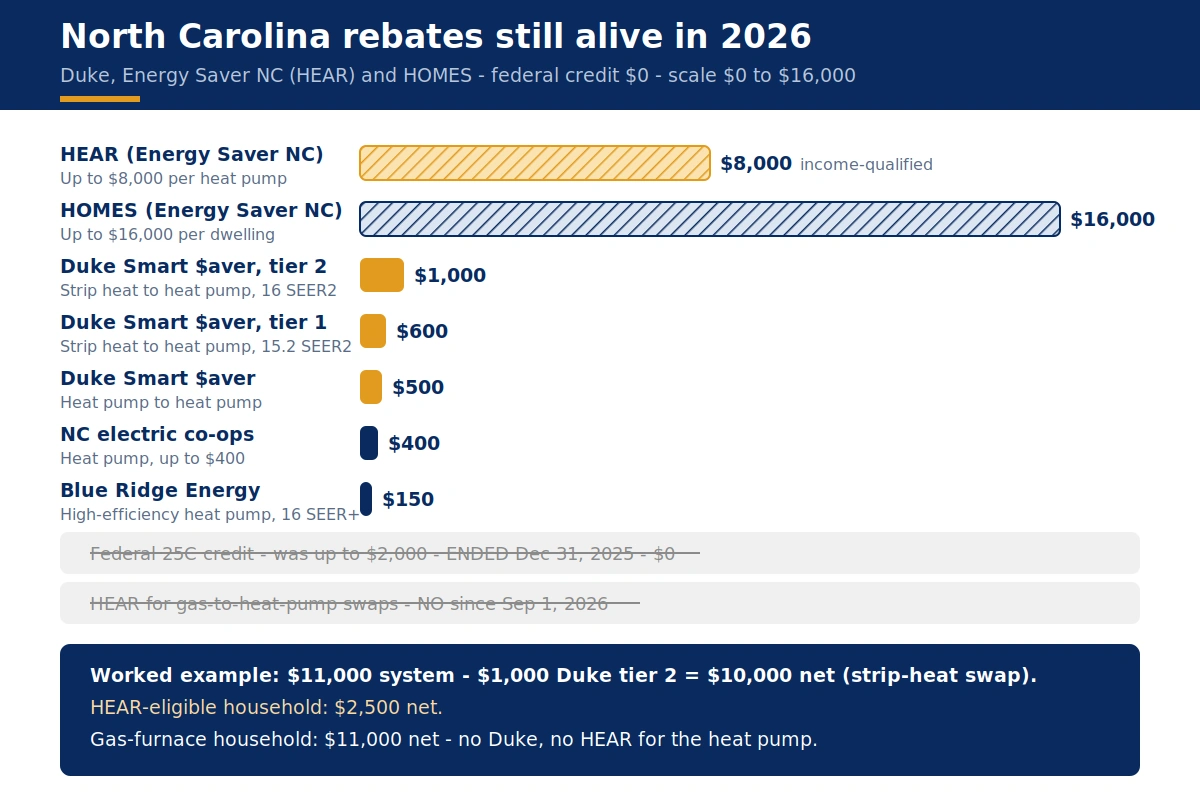
Duke Smart $aver is the rebate most Duke customers can actually get — with prerequisites that trip people up. The rebate is submitted by a Smart $aver participating contractor (find one through Duke’s Find It Duke tool) — the homeowner does not file it. A free Home Energy Check within 24 months of installation, with a qualifying recommendation, is a prerequisite for most Duke rebates. Schedule it before signing a contract. The tiers reward the swap that saves the most energy: replacing electric strip heat pays $600–$1,000, while replacing an existing heat pump pays only $500. And gas-to-heat-pump conversions get no Duke rebate — every Duke conversion line starts from an existing heat pump or from electric resistance heat. That is the gap HEAR used to fill before September 1, 2026.
Two Duke figures conflict across secondary sources, and both are flagged here rather than settled. Modernize (August 2026) says Duke pays “$350 to $700”; Boer Brothers says Duke Smart $aver is “$350 to $2,500”; homeenergybasics says “Duke Energy adds $500–$1,000.” The $500/$600/$1,000 tier figures come from Duke’s own Home Energy Improvement Program document (©2025) and are corroborated by legalclarity and tempcontrolservice — those are the ones this guide headlines. The $2,500 figure likely bundles multiple measures. The application window conflicts too: 60 days (window-rebate page, October 2026) against 12 months from installation (Duke HEI program document). Confirm both with your participating contractor. One contradiction to ignore entirely: OhmSnap’s Duke Energy Progress page says DEP offers “no utility-specific heat pump rebate” — but the same page still cites the dead 25C 30% credit, so it is stale. Duke Smart $aver covers both DEC and DEP.
The HEAR story is the most important North Carolina rebate fact of 2026. Energy Saver NC (HEAR) is open in all 100 counties — North Carolina is one of only a handful of states where the federal heat pump rebate actually works (heatpumppricing.com, verified November 4, 2026). It launched January 16, 2025 and expanded county by county. Unlike Georgia, North Carolina’s HEAR program did not pause — Georgia closed HEAR to new applications in August 2026 while North Carolina stayed open with new rules. That contrast is worth remembering when a contractor tells you the program is gone.
What changed on September 1, 2026: DOE Program Notice 26-2 (May 29, 2026) rewrote the rules so that HEAR no longer pays for fuel-switching — a heat pump replacing gas, propane, or oil heat does not qualify. What changed at the same time, and what most pages miss: electric-to-electric upgrades are now allowed, including replacing an existing heat pump. A homeowner who wants to keep the gas furnace can also participate by replacing the AC portion with a heat pump while the furnace stays — the rebate covers the heat pump addition, not removing the gas heat.
One conflict to flag honestly: as of late September 2026, Energy Saver NC’s own HEAR eligibility page and Program Requirements PDF still carried the original footnotes (“Existing Heat Pump will not be eligible for replacement” / “Rebates are available only when upgrading from a non-electric appliance”). The Program Changes notice is the current rule (Boer Brothers, September 2026; Holt HVAC, October 29, 2026). Verify current eligibility at energysavernc.org and use a registered program contractor before counting on the money. Applications that reached rebate reservation status before September 1, 2026 keep their original terms.
Income limits: at or below 80% AMI means up to 100% of project cost (capped at $8,000 for the heat pump); 80–150% AMI means up to 50% of cost (same $8,000 cap). Above 150% AMI means not eligible. Panel and wiring rebates ($4,000 panel / $2,500 wiring) must support an eligible appliance on the same application — no standalone panel rebate. NC DEQ lists both $2,500 and $2,000 for wiring; this guide uses $2,500 with the discrepancy flagged. HEAR and Duke rebates can be stacked for the same product, provided the combined amount does not exceed the purchase price.
Worked rebate examples — 3-ton ducted heat pump, $11,000 installed, Duke customer:
- Replacing electric strip heat with a 16 SEER2 unit: $11,000 minus $1,000 Duke tier 2 = $10,000 net.
- Replacing an existing heat pump: $11,000 minus $500 Duke = $10,500 net.
- HEAR-eligible household at or below 80% AMI replacing electric heat: $11,000 minus $8,000 HEAR minus $500 Duke = $2,500 net (stacked, under the purchase price).
- Gas-furnace household: $11,000 gross, $11,000 net — no Duke rebate, no HEAR rebate for the heat pump since September 1, 2026. HEAR can still cover the heat pump water heater, panel, and insulation on the same application.
North Carolina electricity rates and what a heat pump costs to run
North Carolina’s residential electricity averages 14.95 cents per kilowatt-hour (EIA Electric Power Monthly, Table 5.6.A, August 2026, released October 28, 2026) — about 18% below the US average of 18.16 cents, and the 14th lowest of 51 jurisdictions. The average August bill was $195.84 on 1,310 kWh. The January–July 2026 average was 14.94 cents. Rates rose 2.4–2.5% year over year (August 2025 was 14.59–14.60 cents). A typical North Carolina home uses about 1,015 kWh a month — about 12,180 kWh a year (ecogenamerica, October 2026, via our North Carolina solar guide). Cheap power is the headwind for heat pump payback against gas — and the reason the running-cost comparison in this section is nearly tied against a new furnace.
Duke is two utilities in North Carolina, with different rates. Duke Energy Carolinas (DEC) covers the western half, including Charlotte, Greensboro, Winston-Salem, and Durham; its standard residential rate (Schedule RS, effective January 1, 2026) is a flat 12.2603 cents per kWh before riders, plus a $14.00 monthly customer charge. Duke Energy Progress (DEP) covers the eastern half, including Raleigh, Wilmington, and Asheville, at about 15.5 cents per kWh residential in 2026. The two merge on January 1, 2027 (NCUC approval May 1, 2026; FERC January 30, 2026; South Carolina commission April 30, 2026) — but nothing changes for customers on that date itself; the two rate sets integrate over time through future rate cases. Duke also filed for 2027 rate increases in late 2025, still pending at the NCUC — proposals, not approved rates. Do not let a sales pitch use the merger or a pending increase as urgency.
Time-of-use plans change the math — and the plan to pick is not the obvious one. Duke’s Flex Savings Option (FSO) is the no-demand-charge time-of-use plan a heat pump household can actually use. Rates below are 2026 rates, last verified April 2026:
| Period | When | Duke Energy Carolinas (Charlotte) | Duke Energy Progress (Raleigh) |
|---|---|---|---|
| Discount | 1–6 am (summer); 1–3 am and 11 am–4 pm (winter) | 7.05¢/kWh | 6.88¢/kWh |
| Off-peak | All other hours | 9.74¢/kWh | 9.50¢/kWh |
| On-peak | 6–9 pm weekdays (summer); 6–9 am weekdays (winter) | 21.34¢/kWh | 20.80¢/kWh |
| Critical peak | Up to 20 designated days/yr, notified a day ahead | 44.26¢/kWh | 43.18¢/kWh |
Weekends and designated holidays are always off-peak. There is no demand charge under FSO. Contrast that with Duke’s Residential Time-of-Use (RT / R-TOUD) rate, which adds an on-peak billing demand charge (highest 30-minute draw during on-peak hours) plus a max billing demand charge, with a one-year minimum commitment — a heat pump plus dryer plus oven running together on a cold winter morning can set an expensive demand hour. RT is usually the wrong choice for a heat pump household unless the home also has solar and a battery. Do not confuse FSO with the solar Rider RSC rates in our North Carolina solar guide (different schedule, different numbers). Pending Duke rate cases may change time-of-use rates from January 2027 — flag that as pending, not fact.
What does it cost to run? Two good sources disagree — and both are right, because they compare different baselines. Boer Brothers HVAC (Triangle installer, 2026, at 14.94¢/kWh and $17.89/MCF gas) prices heat by the therm delivered: heat pump at COP 3.0 $1.46; new 95% AFUE gas furnace $1.82; 20-year-old 80% furnace $2.16; heat pump in cold weather at COP 2.0 $2.19; cold-climate heat pump at 5°F, COP 1.75, $2.50; electric strip heat at COP 1.0 $4.38. The crossover COP is ~2.4 against a new 95% furnace and ~2.0 against an old 80% furnace. Thepowerbill.com (EIA data, 2026) heats an average North Carolina home (22.3 MMBtu a year, EIA RECS 2020) for $421 a year with a heat pump at HSPF2 7.8 against $402 a year with a 95% gas furnace — $19 apart (4.7%), “too close to call.” Its break-even electricity price is 14.1¢/kWh; North Carolina pays 14.74¢ (June 2026), so the furnace wins above that line. A heat pump needs HSPF2 8.2 to match the furnace. A third source (searchright.io, 2026) puts the break-even at 14.84¢/kWh for federal-minimum tiers and 17.05¢/kWh for ENERGY STAR tiers — and North Carolina’s price sits either side of the line depending on the month.
The truth for North Carolina in 2026, baseline by baseline:
- Against electric strip heat (common in older North Carolina homes, especially rural ones): the heat pump wins big — $4.38 against $1.46 per therm. The heating bill falls by roughly two-thirds.
- Against an old 80% gas furnace: the heat pump wins moderately — $2.16 against $1.46 per therm, about $156 a year on the average North Carolina heating load.
- Against a new 95% gas furnace: essentially tied on heating — about $80 a year apart on the full heating load by Boer’s math, $19 a year by thepowerbill’s. Running cost will not decide this one; upfront cost and the AC-replacement value will.
- The modeled zone 3–4 saving of $600–$800 a year (ohmsnap, March 2026: gas furnace $1,200–$1,800 a year against heat pump $600–$1,000 a year) assumes older or average gas equipment and $0.13/kWh electricity. Do not publish it as a headline without naming that baseline.
One more honest note: your electric bill will rise in winter when a heat pump replaces a gas furnace. The heating load moves onto the electric account while the gas bill falls by about the same amount. The household total is what matters, not one bill. On Duke’s FSO plan, winter on-peak is 6–9 am weekdays (21.34¢ DEC / 20.80¢ DEP) — exactly when a heat pump works hardest on a cold morning. A variable-speed unit that pre-heats during discount hours (7.05¢ / 6.88¢) softens this.
Heat pump vs furnace in North Carolina: the honest comparison
This is the comparison most articles get wrong. A heat pump replaces both heating and cooling. The fair comparison is a furnace plus an air conditioner, never a furnace by itself.
| Option | Installed (NC) | Notes |
|---|---|---|
| Heat pump (complete system) | $8,000–$14,000 (typical 3-ton) | Heats AND cools — one system |
| Gas furnace alone | ~$4,500–$10,000 (national, art. 1 — no NC-specific figure verified) | Needs a separate AC |
| Outdoor AC alone | ~$5,500–$12,500 (Costimated via art. 61 — national) | Needs a separate furnace |
| Furnace + AC combined | ~$10,000–$22,500 (national components) | The true comparison — roughly a wash with the heat pump upfront, or the heat pump cheaper |
Upfront, it is roughly a wash in North Carolina. The heat pump then wins on running costs against old equipment and ties against new gas equipment. North Carolina-specific furnace and AC component prices were not verified — present the combined $10,000–$22,500 as a national-components estimate, flagged.
When does the furnace win in North Carolina? Two cases. First, the High Country, where winters are colder, backup heat runs more often, and the heat pump’s efficiency edge narrows — especially if the home already has cheap natural gas. Second, homes where natural gas is very cheap and electricity is on the high side. Run the numbers with the crossover rule from Boer Brothers: a heat pump needs a COP of about 2.4 to beat a new 95% furnace at North Carolina prices, and it holds a COP above 3.0 most of the winter in the Piedmont — but not on the coldest mountain mornings. Our full heat pump vs furnace cost comparison works through the 10-year math in detail, and our heat pump running cost guide covers the formulas.
When does the heat pump win? Against electric strip heat, decisively. Against an old 80% furnace plus an old AC, comfortably — the avoided second system does most of the work. And when the AC needs replacing anyway: a heat pump is one install instead of two, and the cooling-efficiency gain is real money in a state with ~55 days a year at or above 90°F in Charlotte. One more point for the heat pump in this state: with no combustion it cannot produce carbon monoxide — worth weighing for any family replacing an old gas furnace.
Dual-fuel and geothermal: when they make sense in North Carolina
Dual-fuel pairs a heat pump with a gas furnace. The heat pump carries the mild weather; the furnace cuts in below a switchover point, usually somewhere around 35–40°F. Installed cost runs $9,230–$15,130 at 3 tons (NumeralQ, national, 2026 — no North Carolina-specific dual-fuel installed price was verified). Across most of the state the furnace in a dual-fuel setup almost never fires, so the second system mostly buys insurance for a few cold nights a year. The exceptions are Boone and the High Country, where the furnace earns its keep, and homes sitting on very cheap natural gas. One HEAR wrinkle: under the September 2026 rules, adding a heat pump alongside an existing furnace is an eligible project (the rebate covers the heat pump; it does not pay to remove the furnace) — but a gas-heated home cannot use HEAR to fund a heat pump that replaces the furnace. Our dual-fuel heat pump cost guide covers the technology in depth.
Geothermal (ground-source) is the efficiency champion: a seasonal COP near 3.8 (jouleio, 2026), no drop-off with air temperature, and a ground loop that lasts 25+ years. It is also $20,000–$40,000+ installed — NumeralQ’s 3-ton range is $20,260–$31,920, Modernize North Carolina puts it at $28,560, and hard drilling can push it past $50,000 (AirProHQ, October 2026). In this mild climate the efficiency premium over air-source is smaller than in cold states, so payback runs long. Honest framing: geothermal is the finest system money buys and the hardest to justify on payback alone in the Piedmont. It makes sense for mountain homes heating with expensive propane — where payback can be genuinely fast — and on the coast, where sandy soil makes loop installation notably cheaper. Blue Ridge Energy’s geothermal rebate is only $250 (old form — verify before counting on it), and Duke pays no geothermal-specific rebate that was verified. Our geothermal heat pump cost guide has the full depth.
Cold-climate mini-splits are a mountain-only question in North Carolina. Inverter-driven cold-climate models still heat at −15°F, and they cost 15–30% more than standard models. That capability buys nothing in Charlotte, Raleigh, or Wilmington — but in Asheville and Boone it is worth getting a quote for. Our cold-climate mini-split guide covers the technology in full; the point here is simply not to assume the whole state needs it.
Payback math: when a North Carolina heat pump pays for itself
Worked example: 3-ton ducted air-source, $11,000 installed (Modernize North Carolina statewide average, August 2026). Heating load: the average North Carolina home uses 22.3 MMBtu a year of space heating, or 223 therms (EIA RECS 2020, via thepowerbill.com). Per-therm costs from Boer Brothers (Triangle, 2026, at 14.94¢/kWh and $17.89/MCF gas): strip heat $4.38, heat pump at COP 3.0 $1.46, old 80% furnace $2.16, new 95% furnace $1.82.
| Line | Math | Result |
|---|---|---|
| Installed cost | Modernize NC average | $11,000 |
| Less Duke Smart $aver (strip-heat replacement, tier 1) | $600 | −$600 |
| Net cost (typical, strip-heat swap) | $10,400 | |
| Annual heating saving vs electric strip heat | 223 therms × ($4.38 − $1.46) | ~$651/yr |
| Simple payback, strip-heat replacement | $10,400 ÷ $651 | ~16 years |
| Annual heating saving vs old 80% gas furnace | 223 therms × ($2.16 − $1.46) | ~$156/yr |
| Simple payback vs old gas furnace (heating only) | $10,400 ÷ $156 | ~67 years (heating alone — see framing below) |
| Annual heating saving vs new 95% gas furnace | 223 therms × ($1.82 − $1.46) | ~$80/yr |
| HEAR-eligible net cost (below 80% AMI, electric heat) | $11,000 − $8,000 HEAR − $500 Duke | $2,500 |
| Simple payback, HEAR-eligible, strip-heat swap | $2,500 ÷ $651 | ~4 years |
| 15-year net position, strip-heat swap, typical | $651 × 15 − $10,400 | −$635 (about break-even at ~16 yrs) |
| 15-year net position, HEAR-eligible | $651 × 15 − $2,500 | +$7,265 |
Assumptions, stated plainly: $11,000 installed (Modernize North Carolina average); Duke $600 tier-1 strip-heat rebate; savings are heating-only (cooling-efficiency savings against an old AC are real but not modeled — a new heat pump also replaces the AC, which is part of the value); no electricity-price escalation modeled; maintenance excluded (roughly similar for a heat pump against a furnace plus AC); no HOMES stacking in the base case (HOMES is modeled per home). This payback model is our own arithmetic, not a published North Carolina benchmark — none was found. The honest headline: payback turns entirely on what the heat pump replaces.
Payback by scenario:
- Replacing electric strip heat / electric furnace (common in older North Carolina homes): fastest payback — heating electricity falls by roughly two-thirds at COP 3.0 (~16 years typical; ~4 years HEAR-eligible). This is the largest North Carolina segment and the one Duke’s $600–$1,000 tiers reward.
- Replacing an old gas furnace + old AC: heating savings alone (~$156 a year) never pay back the system — the economic case is the avoided second system (one install instead of furnace plus AC) plus comfort and the cooling-efficiency gain.
- Replacing a new 95% gas furnace: heating savings are ~$80 a year — do not buy a heat pump for heating savings alone in this scenario; buy it when the AC also needs replacing.
- Like-for-like heat pump replacement: longest payback — savings come only from efficiency gains (14.3 to 17 SEER2, 7.5 to 9 HSPF2), roughly 15–25% on HVAC energy. Duke pays only $500 here.
- Asheville / Boone: colder winters, more backup-heat hours — payback stretches for standard equipment; cold-climate models and dual-fuel deserve quotes. Propane-heated mountain homes are the exception — payback can be fast.
- Coastal North Carolina: shortest heating season — payback is driven more by cooling efficiency than heating savings; salt air shortens equipment life, which cuts into lifetime value.
A heat pump lasts 12–15 years in North Carolina. A payback near 16 years on a system that lasts 12–15 years is a fair deal for a strip-heat swap, not a windfall — and the comfort and humidity-control gains count as return too, even though the payback table never shows them. For a HEAR-eligible household, the same system pays back in ~4 years.
How to get quotes in North Carolina + red flags
Collect three or more installer quotes, asking every contractor the same questions so the answers line up:
- What is my cost before any rebates? The North Carolina benchmark is $8,000–$14,000 for a typical 3-ton ducted system, with a ~$10,200–$11,000 average. A quote far above $18,000 should come with a reason spelled out — complex ductwork, premium variable-speed equipment, panel work.
- Did you do a Manual J load calculation? Sizing from square footage alone makes the quote a guess, and an oversized guess here means a clammy house.
- Is a $2,000 federal credit subtracted anywhere on the quote? That credit no longer exists for 2026 installs — ask the contractor to take the line off and re-total the quote.
- Is HEAR in this quote — and for what kind of swap? Since September 1, 2026, HEAR does not pay to replace gas, propane, or oil heat. Any quote counting an $8,000 HEAR rebate on a gas-furnace replacement is counting money that no longer applies to that job. Electric-to-electric swaps and add-alongside-furnace projects are still eligible — verify at energysavernc.org.
- Which rebate applies to MY utility? Duke Smart $aver pays $500–$1,000 with a Home Energy Check and a participating contractor. Blue Ridge Energy pays $150 for a high-efficiency heat pump (verify — old form). Co-ops pay up to $400. A quote using another utility’s rebate is the wrong quote.
- What are this unit’s SEER2 and HSPF2 ratings, and how long is the warranty on each part? In North Carolina, 15–17 SEER2 with 8.5+ HSPF2 is the sweet spot. Ask specifically about the compressor warranty — longer coverage usually signals better equipment.
- Is the installer licensed, and is the permit included? North Carolina HVAC contractors are licensed by the NC State Board of Examiners of Plumbing, Heating & Fire Sprinkler Contractors; residential heat pump work needs an H-3 classification (forced-air heating/cooling, 15 tons or less). Verify at public.nclicensing.org or call (919) 875-3612. Also confirm EPA Section 608 certification for anyone opening a refrigerant circuit.
- Did you check my HOA rules? No North Carolina statute protects heat pumps from HOA rules the way G.S. 22B-20 protects solar — that law is solar-only and does not extend to heat pumps. An HOA can regulate outdoor-unit placement, screening, and appearance. Check architectural guidelines before install; this guide states no legal position.
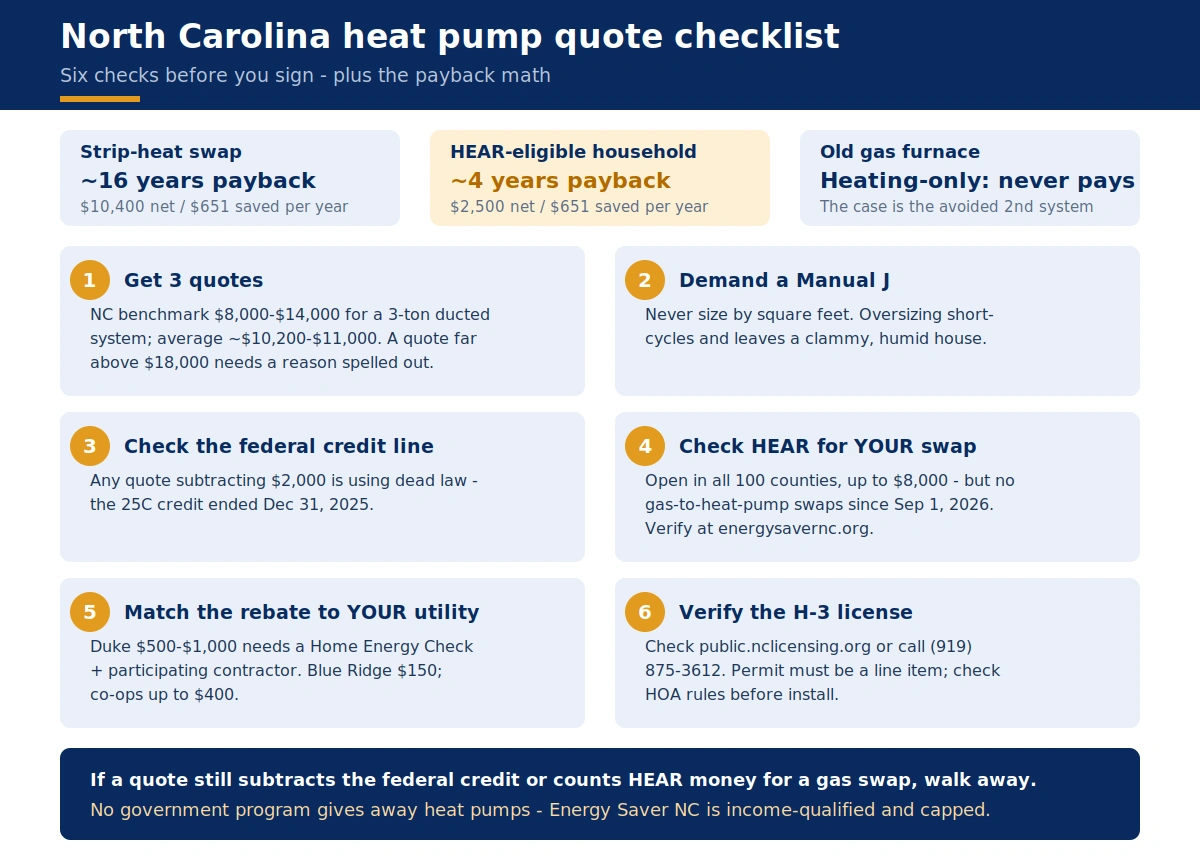
Red flags. A quote far below the $8,000–$14,000 installer range with no explanation of what is excluded — check it against the Angi $5,536 / $6,067 trap. A contractor who sizes from square footage and never runs a Manual J load calculation. Any “free heat pump” or “government program” door-to-door pitch — no government program gives away heat pumps; Energy Saver NC is income-qualified and capped, not free equipment for everyone. A furnace-only quote offered as the heat pump alternative, with the air conditioner it still needs left out of the total. A Duke rebate assumed without the prerequisites — the Home Energy Check must be done within 24 months before installation, and the work must be done by a Smart $aver participating contractor. A “new” R-410A system in 2026 — new equipment manufactured after January 1, 2025 uses R-454B or R-32. And any “sign now to lock in the credit” pressure — with the credit gone, that deadline is invented. Under the FTC Cooling-Off Rule (16 CFR Part 429), door-to-door sales of $25 or more carry a 3-day right to cancel.
Sources & methodology
Cost anchors: Modernize North Carolina market data (published August 4, 2026; updated August 21, 2026: statewide average ~$11,000, most homeowners $7,500–$16,000; Durham city page average $10,200; labor $77–$163/hr; standard air-source $8,160; high-efficiency $12,240; single-zone mini-split $5,610; multi-zone 3-zone $12,240; geothermal $28,560; metro table Charlotte/Raleigh-Durham/Triad/Asheville/Boone/Wilmington); Boer Brothers HVAC Triangle (2026: $6,000–$12,000 new heat pump; per-therm costs; crossover COP ~2.4); Mitchell HVAC Durham (updated October 22, 2026: Trane $8,000–$15,000 — and the stale federal-credit implication, cited as a trap example); Horne Heating & Air Charlotte (2026: $13,000–$16,000, avg $14,500 — premium installer, high end); Andersen Heating & Cooling Charlotte (2026: full system $8,500–$22,000; Comfort $8,500, Comfort Plus $11,000–$15,000, Ultimate $16,000–$22,000; R-454B/R-32 transition; 14.3 SEER2 Southeast minimum); northcarolinabusinessesnearme.com (October 22, 2026: ~$7,000–$13,000 for a new central AC or heat pump in a typical 2,000 sq ft NC home; lifespan 12–15 years); hvac.com NC heat pump page (published June 2, 2025: 3-ton + air handler $10,000–$13,000 incl. labor — cost cross-check only, stale on the federal credit); TryDun (updated August 2026: NC ducted air-source $5,850–$10,800, BLS labor-adjusted model); EnergySage NC average $9,757 (via ratemyhvacquote.com, October 29, 2026 — cited second-hand); Angi Charlotte page (updated August 4, 2026: avg $5,536, range $3,926–$7,496 — disputed as equipment/partial-scope pricing) and Angi Raleigh page (updated August 4, 2026: avg $6,067, range $4,571–$7,629 — same dispute); art. 1 national heat pump guide (November 2026: ducted $7,500–$15,000; mini-split single $3,000–$8,000, multi-zone $8,000–$15,000; geothermal $25,000–$40,000+; ductwork $5,000–$10,000; panel upgrade $1,500–$4,000; Manual J $200–$500); NumeralQ (2026: 3-ton ducted $6,550–$10,960; cold-climate 3-ton $8,610–$15,040; dual-fuel 3-ton $9,230–$15,130; geothermal 3-ton $20,260–$31,920; permits $70–$166 across 35 cities; lifespan 12–15 years); Costimated (November 2026, via art. 61: $2,500–$3,800/ton installed nationally; outdoor AC alone ~$5,500–$12,500). Tonnage table built from the 3-ton North Carolina anchor plus the national tonnage pattern (research brief §1d).
Climate: NOAA 1991–2020 normals — Charlotte Jan mean 43°F / Jul mean 80°F, annual mean ~61°F, precip ~43.6 in, ~55 days at or above 90°F a year; Raleigh annual mean ~61°F, Jan ~42°F / Jul ~79°F; Asheville Jan mean 38.7°F / Jul mean 75.1°F, annual mean ~56°F, precip 49.6 in, snowfall ~10.3 in a year (via Asheville Chamber EDC climate sheet); Wilmington annual mean ~64°F, Jan ~46°F / Jul ~80°F, precip ~55 in; ICC Appendix D — HDD Charlotte 3,181, Raleigh 3,393, Greensboro 3,805; winter design Charlotte 22°F / Raleigh 20°F; summer design Charlotte 93°F / Raleigh 92°F; Asheville CDD 1,048 (NOAA 1991–2020); Charlotte July dew point ~67°F (myforecast.com historical climate); July monthly-average relative humidity near 68% (climate-zone.com, 1991–2020); ohmsnap zone 3–4 analysis (March 2026: COP above 3.0 most of the winter in Charlotte’s climate band).
Electricity rates: EIA Electric Power Monthly Table 5.6.A (August 2026, released October 28, 2026: North Carolina residential 14.95¢/kWh, US 18.16¢/kWh, 14th lowest of 51; avg bill $195.84 in August at 1,310 kWh; Aug 2025 14.59–14.60¢, +2.4–2.5% year over year); EIA via Boer Brothers (January–July 2026 average 14.94¢/kWh); EIA via thepowerbill.com (June 2026: 14.74¢/kWh); typical NC home usage ~1,015 kWh/month, ~12,180 kWh/year (ecogenamerica, October 2026, via art. 64); DEC Schedule RS 12.2603¢/kWh plus $14.00/mo customer charge (effective January 1, 2026, NCUC Docket E-7 Subs 1276/1325); DEP ~15.5¢/kWh residential 2026 (ohmsnap, verified February 15, 2026); Duke merger filed August 14, 2025, approvals FERC January 30, 2026 / PSCSC April 30, 2026 / NCUC May 1, 2026, target effective January 1, 2027 (via art. 64); Duke FSO time-of-use rates (evsolarnc.com, verified April 2026: DEC discount 7.05¢ / off-peak 9.74¢ / on-peak 21.34¢ / critical peak 44.26¢; DEP 6.88¢ / 9.50¢ / 20.80¢ / 43.18¢; on-peak 6–9 pm summer, 6–9 am winter; up to 20 critical-peak days a year).
Efficiency standards: DOE 2023 minimums, Southeast region — split-system heat pumps 14.3 SEER2 / 7.5 HSPF2 (verified via Andersen Charlotte, 2026, and NumeralQ, 2026); ENERGY STAR split-system minimums 15.2 SEER2 / 7.8 HSPF2 (via legalclarity.org, 2026); HSPF2 ÷ 3.412 = seasonal COP; SEER2 replaced SEER in 2023.
Incentives: OBBBA P.L. 119-21 (signed July 4, 2025), IRS FS-2025-05 (August 21, 2025) — §25C $0 for 2026 installs (was 30% up to $2,000/yr for heat pumps); §25D geothermal 30% also ended December 31, 2025 (jouleio, 2026; AirProHQ, October 2026); Duke Energy Smart $aver / Home Energy Improvement Program document (©2025, via whitesprings.org): strip heat to heat pump $600 (15.2 SEER2 and 7.5 HSPF2) / $1,000 tier 2 (16 SEER2 and 7.5 HSPF2), existing heat pump to new heat pump $500, existing AC to new AC $300, Home Energy Check within 24 months, participating contractor required, apply within 12 months of installation (conflicts with the 60-day figure — see QC log); legalclarity.org (2026) and tempcontrolservice.com (July 2026) corroborating the Duke tiers; Modernize (August 2026: “$350 to $700” — conflicting secondary summary); Boer Brothers (2026: “$350 to $2,500” — conflicting secondary summary, likely bundles multiple measures); homeenergybasics (“Duke adds $500–$1,000” — conflicting secondary summary); Energy Saver NC — HEAR (NC DEQ): open in all 100 counties, launched January 16, 2025, up to $8,000 per heat pump, up to 100% of cost at/below 80% AMI, up to 50% at 80–150% AMI, $14,000/dwelling cap, plus up to $4,000 panel / $2,500 wiring / $1,750 heat pump water heater on the same application; DOE Program Notice 26-2 (May 29, 2026): no fuel-switching since September 1, 2026, electric-to-electric upgrades now allowed including existing-heat-pump replacement (Boer Brothers, September 2026; Holt HVAC, October 29, 2026 — against NC DEQ page footnotes as of late September 2026 still saying existing heat pumps are not eligible; verify at energysavernc.org); heatpumppricing.com (verified November 4, 2026: NC open with limits); gridshiftmedia (October 21, 2026); parkshvac.com (2026: HEAR/Duke stacking, panel/wiring must support an eligible appliance); startbusinessbystate.com (checked October 6, 2026: NC “fully open”); HOMES open, up to $16,000/dwelling cap (NC DEQ; parkshvac.com, 2026; homeenergybasics.com, 2026); Blue Ridge Energy rebate trifold PDF (undated; purchases after May 1, 2016: high-efficiency heat pump/mini-split 16 SEER+ $150, geothermal 19 SEER+ $250 — verify, old form); NC co-op heat pump up to $400 plus heat pump water heater $300–$350 (homeupgradecheck.com, May 2026 data — secondary aggregator, verify with the reader’s co-op). DSIRE directory (programs.dsireusa.org, NC State University) — check every North Carolina item there before publishing. No North Carolina state heat pump tax credit was verified.
Running costs: Boer Brothers HVAC (Triangle, 2026: cost per therm of heat — heat pump COP 3.0 $1.46, new 95% furnace $1.82, old 80% furnace $2.16, strip heat $4.38, cold-weather COP 2.0 $2.19, cold-climate at 5°F COP 1.75 $2.50; electricity 14.94¢/kWh January–July 2026 average, gas $17.89/MCF January 2026; crossover COP ~2.4 vs new furnace, ~2.0 vs old furnace); thepowerbill.com (2026, EIA data: average NC home 22.3 MMBtu/year heating load, EIA RECS 2020; heat pump HSPF2 7.8 $421/year vs 95% furnace $402/year, $19 apart; break-even electricity price 14.1¢/kWh); searchright.io (2026: break-even 14.84¢/kWh federal-minimum tiers, 17.05¢/kWh ENERGY STAR tiers; NC electricity 14.13¢/kWh 2024 full-year vs 15.16¢/kWh July 2026 latest month); ohmsnap (March 2026: zone 3–4 gas furnace $1,200–$1,800/year vs heat pump $600–$1,000/year, saving ~$600–$800/year, at $0.13/kWh and $1.20/therm — older/average-furnace baseline, flagged in the article); jouleio (2026: heat pump HSPF2 8.0, COP ~2.3 seasonal, ~$785/year heating at 18.05¢/kWh national average; geothermal COP ~3.8, ~$475/year).
Payback model: our arithmetic with stated assumptions ($11,000 install; $600 Duke tier 1; Boer per-therm costs; 22.3 MMBtu heating load; heating-only savings; no cooling savings modeled; no HOMES stacking). No published North Carolina heat pump payback benchmark was found. Lifespan 12–15 years (northcarolinabusinessesnearme, October 22, 2026; NumeralQ, 2026).
Red flags / consumer protection: FTC Cooling-Off Rule (16 CFR Part 429 — 3-day right to cancel door-to-door sales of $25+); NC HVAC licensing — NC State Board of Examiners of Plumbing, Heating & Fire Sprinkler Contractors, H-3 classification (forced-air heating/cooling, 15 tons or less), verify at public.nclicensing.org or (919) 875-3612 (ashevillepros.com, 2026; contractorrecords.com, 2026); EPA Section 608 certification for refrigerant work; HOA guidance is general (no NC heat pump HOA statute verified — G.S. 22B-20 protects solar only, per art. 64).
EXCLUDED: Angi’s $5,536 Charlotte / $6,067 Raleigh averages as headline figures (conflict with every NC installer quote; likely equipment/partial-scope pricing); OhmSnap’s DEP “no rebate” claim (stale — still cites the dead 25C credit); any “after 30% credit” or “after $2,000 credit” prices for 2026; any Charlotte/Raleigh cooling degree-day figure (unverified — only Asheville CDD 1,048 stated); any Wilmington HDD/CDD or design-temperature figure (unverified); any North Carolina-specific dual-fuel or geothermal installed average (national ranges used, labeled); any North Carolina-specific whole-home dehumidifier cost (unverified — no figure invented); the Blue Ridge geothermal form’s $1,600/ton figure (much older form — not used); any North Carolina state heat pump tax credit (none verified); the $350–$700 / $350–$2,500 Duke figures as settled fact (flagged conflicts); the 60-day vs 12-month Duke application window as settled fact (flagged); any 2027 Duke rate increase as fact (pending rate case only); any relaunched Georgia HEAR amount (unpublished — Georgia contrast only).
*Disclaimer: Prices are 2026 North Carolina planning figures; they change with utility territory, home, and installer. Always get 3 written local quotes before budgeting. Tax notes here are general information, not tax advice — check with a tax professional. Rebate programs change fast: HEAR eligibility (especially the existing-heat-pump question), Duke Smart $aver tiers, and FSO rates must be verified at energysavernc.org and duke-energy.com before signing.*
—
How much does a heat pump cost in North Carolina in 2026?
$8,000–$14,000 installed for a typical whole-home ducted system (3-ton), with the statewide average job at about $11,000 (Modernize, August 2026). Single-zone mini-splits cost $3,000–$6,500, multi-zone systems $8,500–$15,000, and geothermal $20,000–$40,000+. The federal credit is $0 for 2026 installs.
Is there a federal tax credit for heat pumps in North Carolina in 2026?
No — $0. The §25C credit — 30%, up to $2,000 a year for heat pumps — stopped for property placed in service after December 31, 2025 (OBBBA, P.L. 119-21; IRS FS-2025-05). Geothermal’s §25D credit ended on the same date. A 2025 install can still be claimed on the 2025 return, but a 2026 install gets nothing. Heat pumps have no lease workaround — the §48E pass-through covers leased solar, not heat pumps.
What rebates are available for heat pumps in North Carolina in 2026?
Duke Energy’s Smart $aver program pays $500 for replacing an existing heat pump and $600–$1,000 for replacing electric strip heat (tiered by SEER2). Energy Saver NC (HEAR) pays up to $8,000 per heat pump for income-qualified households (up to 150% of area median income), and the HOMES program caps at $16,000 per dwelling. Blue Ridge Energy pays $150 for a high-efficiency heat pump, and other co-ops pay up to $400. North Carolina has no state heat pump tax credit.
Is North Carolina’s HEAR rebate still open?
Yes — Energy Saver NC (HEAR) is open in all 100 counties, paying up to $8,000 per heat pump for households at or below 150% of area median income. But since September 1, 2026, it no longer pays to replace gas, propane, or oil heat (DOE Program Notice 26-2). Electric-to-electric replacements — including replacing an existing heat pump — are now allowed under the Program Changes notice, though Energy Saver NC’s own page footnotes still carried the old rule as of late September 2026, so verify current eligibility at energysavernc.org before counting on the money. Unlike Georgia, North Carolina’s HEAR program did not pause.
Do heat pumps work well in North Carolina’s humid climate?
Yes — North Carolina is strong heat pump country. A standard system runs at a COP above 3.0 most of the winter, and Charlotte’s January mean is 43°F. The risk is oversizing: an oversized system short-cycles and never runs long enough to pull moisture out, leaving a clammy house in July dew points near 67°F. Get a Manual J load calculation and weigh a variable-speed system for its dehumidification.
Heat pump vs gas furnace in North Carolina — which is cheaper to run?
Nearly tied against a new 95% gas furnace: $421 a year for a heat pump (HSPF2 7.8) against $402 a year for the furnace on the average North Carolina heating load — $19 apart (thepowerbill.com, EIA data). The heat pump wins big against electric strip heat (about $651 a year in heating savings) and moderately against an old 80% furnace (about $156 a year). Upfront, a heat pump at $8,000–$14,000 is roughly a wash against a furnace plus a separate air conditioner at about $10,000–$22,500.
What size heat pump do I need in North Carolina?
The average Charlotte home (just under 1,700 sq ft) needs about a 3-ton system. Never size from square footage alone — a Manual J load calculation ($200–$500, often credited toward the install) weighs insulation, windows, ceiling height, and the humidity load. Oversizing is the most common North Carolina sizing mistake.
How long does a heat pump last in North Carolina?
12–15 years with annual maintenance. Homes near the coast should ask about coated coils, because salt air shortens outdoor-unit life. At a modeled payback of about 16 years for a strip-heat replacement — about 4 years for a HEAR-eligible household — a heat pump pays for itself inside or near its service life in the scenarios where it wins.