

Table of Contents
A standard mini-split is a fair-weather heater. It is rated at 47°F, and by 17°F it has already lost 30–50% of its heating capacity. In Minneapolis, Bangor, or Burlington, that is not a rounding error — it is the difference between a warm house and a backup heater running all January.
A cold-climate mini-split is built differently: a larger inverter compressor, vapor injection, a heated base pan, and smarter defrost. It is the equipment the DOE tested at -15°F in its Cold Climate Heat Pump Challenge, and it is the only mini-split worth pricing if your winter design temperature is near or below 0°F.
This guide answers the cold climate mini split cost 2026 question with the actual numbers — cost per zone, the cold-climate premium, COP and capacity at 5°F, -5°F and -15°F, the brands that pass the NEEP test, sizing rules, and the rebates that still pay now that the federal tax credit is $0.
National baseline for standard systems (everything except the cold-climate premium): mini-split installation cost.
How much does a cold climate mini split cost in 2026?
Start with the standard baseline, then the cold-climate premium. US installed pricing, 2026 sources:
| System | Standard mini-split (HomeGuide / Angi, 2026) | Cold-climate mini-split (2026) |
|---|---|---|
| Single zone (1 head) | $2,500–$6,000 | $4,000–$9,000 |
| Two zones | $4,500–$8,000 | $7,000–$13,000 |
| Three zones | $6,500–$11,000 | $9,000–$16,000 |
| Four to five zones (whole-home) | $8,000–$16,500 | $12,000–$25,000 |
Sources: standard ranges — HomeGuide (research published Oct 8, 2025, cited Nov 2026) and Angi (updated Oct 17, 2026; national average ductless install $7,500, most projects $4,350–$12,250). Cold-climate single-zone and whole-home ranges — MassHVAC (updated Sep 19, 2026): single-zone $4,000–$9,000, multi-zone $12,000–$25,000; PickHVAC brand pricing; whole-home oil-to-heat-pump conversion in Central MA ~$22,000–$23,000 before incentives (Lela Homelife, Oct 23, 2026). The two- and three-zone cold-climate figures are planning ranges interpolated between the sourced single-zone and whole-home figures.
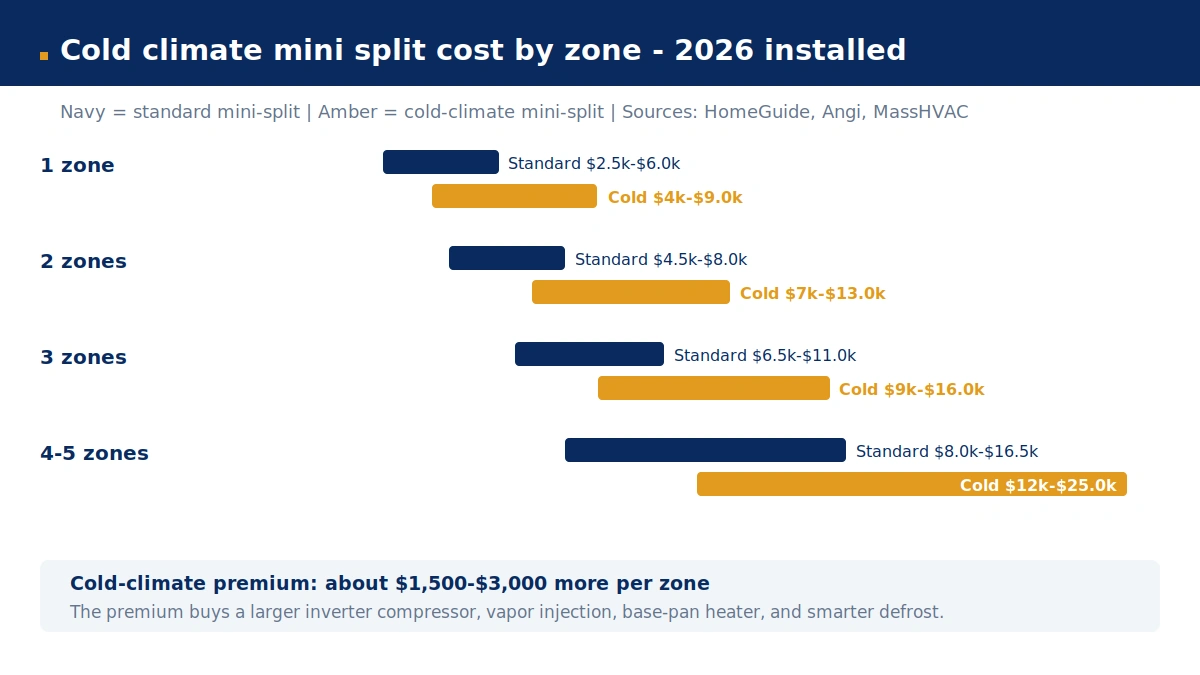
The premium is roughly $1,500–$3,000 per zone over a standard system. What it pays for: a larger variable-speed inverter compressor with vapor (flash) injection, a factory base-pan heater, a heavier outdoor unit built for snow and wind, a snow stand or wall bracket, and a wind baffle. Labor is the same crew and the same day — the equipment is what costs more.
Cold climate mini split cost by system size
The per-zone price falls as zones are added, because one outdoor unit, one electrical circuit, and one crew visit are shared. But cold-climate multi-zone systems still cost more than standard ones at every size — the outdoor unit has to carry the whole heating load on the coldest night.
| Zones | Typical home | Cold-climate installed cost (2026) | Standard installed cost (2026) |
|---|---|---|---|
| 1 zone | Bedroom, office, garage, addition | $4,000–$9,000 | $2,500–$6,000 |
| 2 zones | Two bedrooms or one floor | $7,000–$13,000 | $4,500–$8,000 |
| 3 zones | Small home or main floor | $9,000–$16,000 | $6,500–$11,000 |
| 4–5 zones | Whole home, ~1,800 sq ft | $12,000–$25,000 | $8,000–$16,500 |
Single-zone installed prices by brand (PickHVAC, 2026): Fujitsu XLTH $5,000–$8,500; Daikin Aurora $4,500–$7,500; LG LGRED $4,500–$7,500; Mitsubishi Hyper-Heat H2i equipment $4,000–$7,000 before installation (ohmsnap.com, Apr 2026).
What moves a quote inside — or outside — these ranges:
- Electrical work. A new 240V circuit is included in most single-zone quotes; a panel upgrade is a separate line item. Ask whether the quote includes it.
- Line-set length and routing. Long runs through finished walls, or an outdoor unit far from the heads, add refrigerant line, condensate routing, and labor.
- Indoor head style. Wall-mounted heads are cheapest; ceiling cassettes and floor-mounted units cost more per head.
- Permits. Angi (Apr 2026) puts mini-split permits at $250–$400 where required.
- Snow and wind exposure. A wall bracket, snow stand, or wind baffle is cheap hardware, but it has to be on the quote — not discovered in January.
Full breakdown of standard-system pricing: heat pump cost.
What makes a mini split “cold climate”?
“Hyper-heat,” “XLTH,” and “Aurora” are brand names, not ratings. The rating that matters is on the NEEP list.
The NEEP Cold-Climate Air Source Heat Pump (ccASHP) Specification v4.0 (effective January 2023; v5.0 pending) requires a verified COP of at least 1.75 at 5°F, with published capacity and efficiency at 47°F, 17°F, and 5°F. The ENERGY STAR Cold Climate label requires the same COP ≥ 1.75 at 5°F plus at least 70% of rated heating capacity at 5°F. The NEEP list holds 100+ models (ohmsnap.com, Apr 2026). The NEEP cold-climate specification is the reference installers and rebate programs use.
The practical test, from the DOE Cold Climate Heat Pump Challenge: a cold-climate unit keeps heating at -15°F and holds 70% or more of its capacity at 5°F, delivering 200–350% efficiency (COP 2.0–3.5) where a standard heat pump has shut off. The challenge field-tested systems at 23 sites across 10 US states and 2 Canadian provinces (energy.gov, updated May 14, 2026).
Three things to check before you sign — all of them are on paper, not in a sales pitch:
- The exact matched system is on the NEEP ccASHP list. Not the brand, not the product family — the specific outdoor + indoor combination, with its AHRI certificate.
- Rated heating capacity at 5°F. The quote should state the BTU/h the system delivers at 5°F, not just its nameplate tonnage (measured at 47°F).
- Capacity at your local design temperature. Chicago’s 99% design temperature is 5°F; Minneapolis–St. Paul is -8°F (99.6%: -13°F) (ASHRAE, via heatpumpeconomics.com, 2026). The system must cover your home’s heat loss at that temperature, or the backup plan must be explicit.
A standard mini-split loses 30–50% of its rated heating capacity by 17°F (hometsair.com, 2026). A true cold-climate unit holds 100% of rated capacity to 5°F and keeps operating — at reduced capacity — to -13°F or lower.
Low-temperature performance: COP and capacity at 5°F, -5°F, and -15°F
COP is heat delivered per unit of electricity. A COP of 2.0 means the unit delivers twice as much heat as the electricity it consumes; electric resistance heat is COP 1.0. Both COP and capacity fall as it gets colder — the question is how fast.
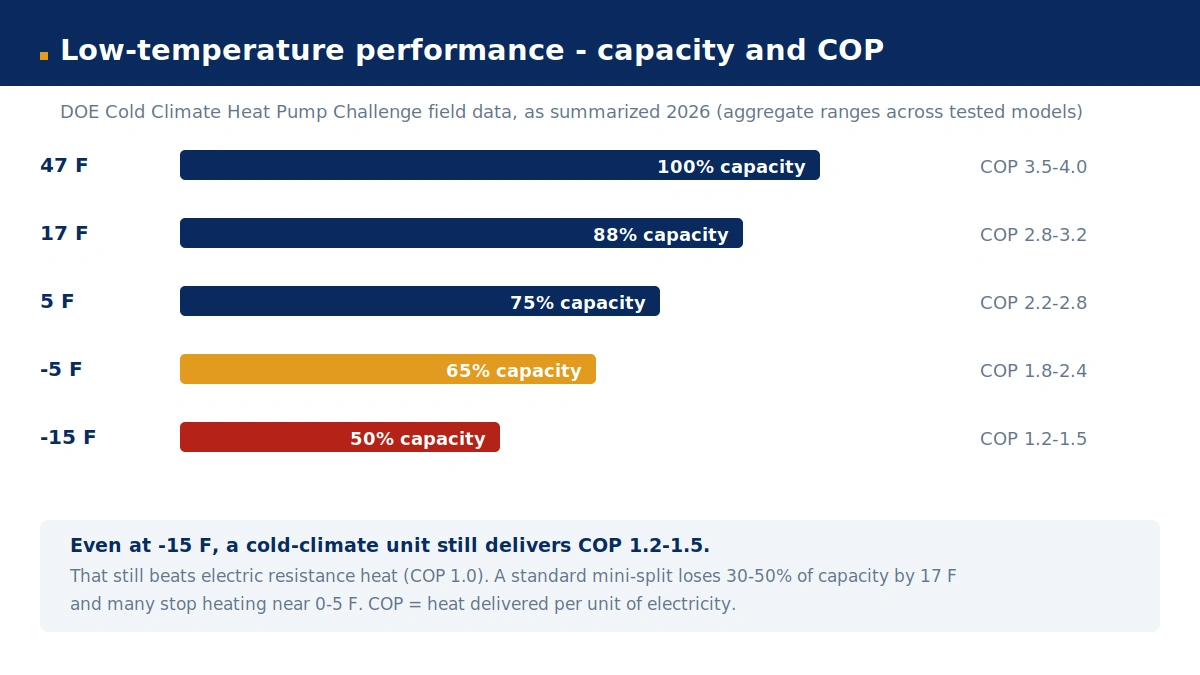
DOE Cold Climate Heat Pump Challenge field data, as summarized in 2026 (a1solarstore.com, citing DOE):
| Outdoor temperature | Heating capacity retained | Typical COP |
|---|---|---|
| 47°F | 100% | 3.5–4.0 |
| 17°F | 85–90% | 2.8–3.2 |
| 5°F | 70–80% | 2.2–2.8 |
| -5°F | 60–70% | 1.8–2.4 |
| -15°F | ~50% | 1.2–1.5 |
These are challenge-aggregate ranges across tested models, not one unit’s spec sheet. Even at -15°F, a cold-climate heat pump still delivers a COP of 1.2–1.5 — 120–150% efficient, still beating electric resistance heat (ohmsnap.com, Apr 2026).
Mitsubishi’s own Hyper-Heat catalog numbers show the same curve for a single model family (NuWatt, 2026 — catalog planning values, not an AHRI certificate): a 1.5-ton H2i runs COP 4.0 at 47°F, 2.8 at 17°F, 2.2 at 5°F, and 1.8 at -5°F, with capacity retention of 70% at 5°F and 60% at -5°F. The larger MSZ-FE18NA holds 100% of rated capacity at 5°F and 73% at -13°F (Mitsubishi catalog, via manuals.plus).
The takeaway for sizing: never size from the nameplate. A “3-ton” unit rated at 47°F may deliver only ~2.1 tons of heat at 5°F. The number that matters is the capacity at your design temperature — and that is exactly what the NEEP list publishes. (At -15°F, manufacturers publish a minimum operating temperature rather than a rated capacity; the ~50% figure in the table is an extrapolation of the -5°F trend, not a published rating.)
Best cold climate mini split brands in 2026
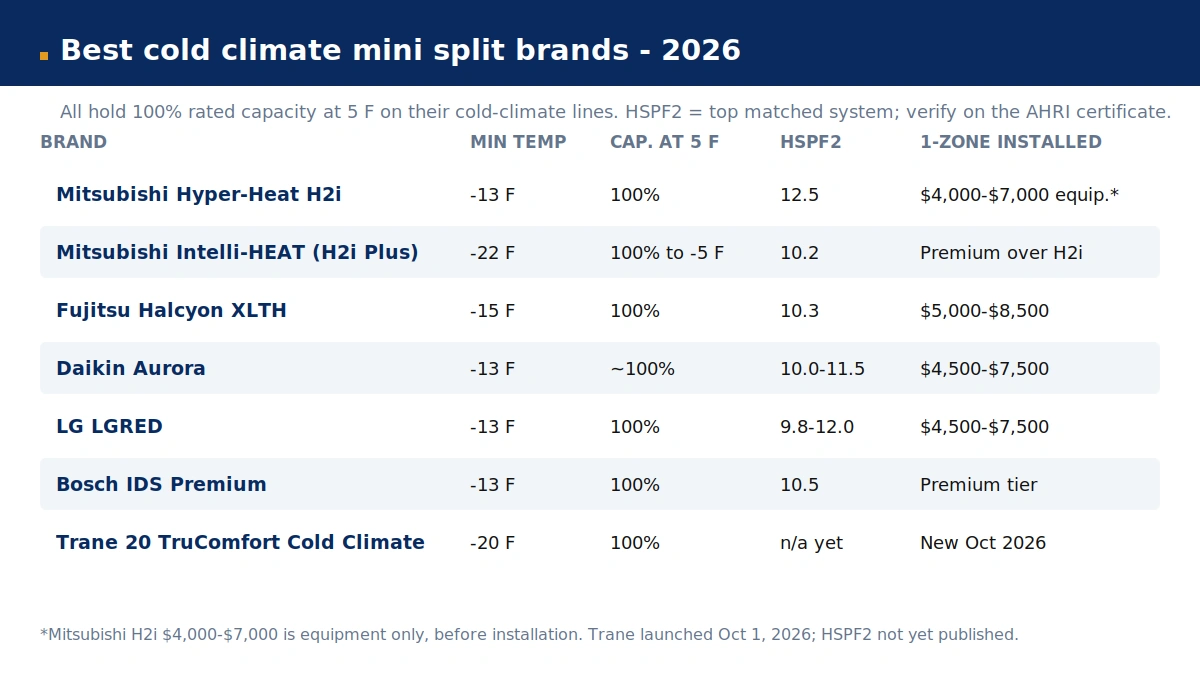
All six brands below hold 100% of rated heating capacity at 5°F on their cold-climate lines. The differences are minimum operating temperature, seasonal efficiency, and price — not whether they work in the cold.
| Brand / line | Min. operating temp | Capacity at 5°F | HSPF2 | Single-zone installed (2026) |
|---|---|---|---|---|
| Mitsubishi Hyper-Heat H2i | -13°F | 100% | up to 12.5 | $4,000–$7,000 equipment* |
| Mitsubishi Intelli-HEAT (H2i Plus) | -22°F | 100% (to -5°F) | ~10.2 | Premium over H2i |
| Fujitsu Halcyon XLTH | -15°F | 100% | 10.3 | $5,000–$8,500 |
| Daikin Aurora | -13°F | ~100% (select sizes) | 10.0–11.5 | $4,500–$7,500 |
| LG LGRED° | -13°F | 100% | 9.8–12.0 | $4,500–$7,500 |
| Bosch IDS Premium | -13°F | 100% | 10.5 | Premium tier |
| Trane 20 TruComfort Cold Climate | -20°F | 100% | Not published yet | New Oct 2026 |
*Equipment only, before installation (ohmsnap.com, Apr 2026). Installed prices: PickHVAC, 2026. HSPF2 figures are top-matched-system values; your installed system’s numbers depend on the indoor unit pairing — check the AHRI certificate on the quote.
Mitsubishi Hyper-Heat H2i defined cold-climate ductless in North America: 100% capacity at 5°F, operation to -13°F, via a flash-injection compressor. The newer Intelli-HEAT (H2i Plus) pushes the 100%-capacity floor to -5°F and keeps running to -22°F (Mitsubishi brochure, via heatpumpeconomics.com, 2026).
Fujitsu Halcyon XLTH (“Extra Low Temperature Heating”) matches Intelli-HEAT at -15°F and ships with a factory base-pan heater — the most complete cold-weather hardware package out of the box.
Daikin Aurora is the value pick in this group: same -13°F floor and ~100% capacity at 5°F as Mitsubishi, at the lowest installed price band. LG LGRED° (“LG Red Heat Technology”) is the cold-climate variant of LG’s ductless platform, with the same 100%-at-5°F, -13°F profile and strong app controls.
Bosch IDS Premium tops the 2026 ranking group on seasonal efficiency (HSPF2 10.5) with the same 100%-at-5°F, -13°F cold performance (hometsair.com, 2026).
Trane 20 TruComfort Cold Climate (launched October 1, 2026) is the newest entry: 100% capacity at 5°F, operation to -20°F, validated in nearly 18,000 hours of field testing in Minnesota, Montana, New York, Pennsylvania, Wisconsin, and Texas at temperatures down to -21°F (Trane Technologies, Oct 1, 2026).
The honest ranking rule: installation quality outweighs brand. A perfectly installed mid-tier cold-climate unit beats a sloppy premium install every winter. Verify the NEEP listing and the AHRI certificate for the exact matched system, whatever brand you choose.
Brand-by-brand installed pricing: best heat pump brands cost.
Sizing a mini split for a cold climate
Cold-climate sizing is different from standard sizing. A standard heat pump is sized to the cooling load; a cold-climate heat pump is sized to the heating load — but to no more than 1.25 times the cooling load, so it is not oversized for summer (hvacbase.org, 2026).
The rule of thumb (starting point only): cold climates (Zones 6–8) need 30–35 BTU per square foot of heating output; moderate climates (Zones 4–5) 25–30; warm climates (Zones 1–3) 20–25 (solartechonline.com). A 2,000 sq ft home in Zone 6–7 pencils out at roughly 60,000–70,000 BTU/h by this rule — about 5–6 tons of heating. Two identical floor plans can land a full ton apart once insulation, windows, air leakage, and ceiling height are counted.
The real method is an ACCA Manual J load calculation (plus Manual S for equipment selection). Manual J accuracy is within 10–15%, versus 25–50% variance for square-footage rules (solartechonline.com). A Manual J + Manual S audit typically costs $100–$300 (hvac-boss.com) — the cheapest insurance on a $12,000–$25,000 system.
Three sizing checks that belong on every cold-climate quote:
- Capacity at design temperature, not nameplate. The quote should show BTU/h delivered at your local 99% design temperature (5°F in Chicago, -8°F in Minneapolis). If it only shows the 47°F rating, it is not a cold-climate quote.
- The balance point. The outdoor temperature where the heat pump’s falling capacity meets the house’s rising heat loss. Above it, the heat pump heats alone. Below it, backup heat covers the gap. A small amount of backup for the few coldest hours of the year is normal — and often cheaper than oversizing the heat pump to cover them without help (calculatevolume.org, 2026).
- Insulation first. Air sealing and insulation shrink the load before equipment is sized. In Massachusetts, Mass Save covers 75–100% of insulation and air sealing (Lela Homelife, Oct 23, 2026) — and a smaller load means a smaller, cheaper system. Our attic insulation cost guide has the numbers.
Oversizing costs $1,000–$3,000 more upfront and raises annual operating costs 10–25% (solartechonline.com). Undersizing means the backup heat runs all winter. Manual J is how you avoid both.
Cold-weather hardware: base-pan heaters, wind baffles, and defrost
The cold-climate premium is mostly hardware that keeps the outdoor unit alive through a northern winter. Four items to confirm on the quote:
Base-pan heater. Every defrost cycle melts frost off the outdoor coil, and that water drains into the base pan — where it can refreeze into ice that damages the fan blades. A base-pan heater keeps the pan clear. Fujitsu’s XLTH ships with one factory-installed, kicking on below 36°F (ACHR, 2025, via SupplyHouse, Oct 22, 2026). On other brands it may be built in or an accessory — verify it is on the quote, not assumed.
Wind baffle. A shield that blocks wind-driven snow and wind chill on the outdoor coil. It matters most on exposed, windy sites and on units facing prevailing winter winds. Cheap hardware; real defrost benefit.
Snow stand or wall bracket. The outdoor unit must sit above the snowline. Daikin recommends raising the unit 2–4 inches above the expected snowline (ACHR, 2025, via SupplyHouse, Oct 22, 2026); in deep-snow regions a taller stand or wall mount keeps the unit clear of drifts. A unit buried in a snowdrift cannot defrost and cannot breathe.
Smarter defrost. Cold-climate designs cut down on defrost-cycle frequency through larger coils and pan heaters (SupplyHouse, Oct 22, 2026). Each defrost briefly reverses the cycle and pauses heating, so fewer cycles mean steadier indoor temperatures and better seasonal efficiency. This is a design difference, not a setting — it is why the cold-climate model costs more.
None of this is a DIY project. Sizing, electrical work, refrigerant lines, and mounting are licensed-installer work; this article covers cost and shopping decisions only.
Cold climate mini split vs furnace and dual-fuel
The comparison that matters is running cost — and it splits cleanly by what you burn today.
Maine, October 2026 prices (localenergyme.com, Oct 2026; Governor’s Energy Office survey, Oct 19, 2026): heating oil $6.04/gal, propane $3.52/gal, electricity 23.72 cents/kWh. Cost per million BTU of heat delivered:
| Heat source | Cost per million BTU (Oct 2026, Maine) |
|---|---|
| Cold-climate heat pump (seasonal COP 2.5) | ~$28 |
| Propane boiler, 95% efficient | ~$40 |
| Oil boiler, 85% efficient | ~$49 |
| Electric baseboard (COP 1.0) | ~$70 |
For an 800-gallon-oil home (about 98 million BTU of heat per winter): oil costs ~$4,830/year, propane ~$3,970/year, and a cold-climate heat pump ~$2,720/year — a saving of roughly $1,250–$2,100 a year. In Upstate NY and Vermont, a Mitsubishi Hyper-Heat system in a 1,800–2,200 sq ft home runs ~$900–$1,600 per heating season versus ~$2,000–$3,500+ for oil or propane (scoophvac.com, Oct 2026). A Minnesota field study of 7 monitored homes found owners saved 30–56%, and homes keeping propane as backup burned ~60% less of it (Center for Energy and Environment, via ecoticias.com, Nov 2026).
The honest exception: cheap piped natural gas. Maine’s energy office priced piped gas at $13.37–$24.95 per million BTU on March 2, 2026, versus $30.60–$32.30 for a heat pump — the heat pump loses (Maine DOER, via ecoticias.com, Nov 2026). Harvard researchers (Energy Policy, Dec 10, 2025) found that for natural-gas households in northern regions, heat-pump adoption would “significantly raise annual heating bills.” If you have cheap piped gas, the right answer is usually dual-fuel: a cold-climate heat pump for most of the season, with the existing gas furnace taking over on the coldest nights. Our dual-fuel heat pump cost guide prices that setup, and the heat pump vs furnace cost comparison covers the full 10-year math.
On the coldest nights the heat pump’s COP falls to ~1.5–2.0, pushing its cost to ~$35–$46 per million BTU — about the same as oil or propane then (localenergyme.com, Oct 2026). The savings come from the other 90% of the season, when the COP is 2.5–3.5.
What does a cold climate mini split cost to run?
Seasonal running cost depends on your electricity rate, your home’s insulation, and how cold your winter gets. Two 2026 benchmarks:
- Maine example (above): ~$2,720/year for a home that used 800 gallons of oil — at 23.72 cents/kWh and a seasonal COP of 2.5 (localenergyme.com, Oct 2026).
- Upstate NY / Vermont: $900–$1,600 per October–April season for a well-insulated 1,800–2,200 sq ft home at $0.16–$0.22/kWh; drafty older homes run $1,600–$2,400 (scoophvac.com, Oct 2026).
Massachusetts adds a rate break: National Grid’s heat-pump rate runs November 1 through April 30 and cuts the base delivery charge from about 6.8 cents to about 2.5 cents per kWh (Lela Homelife, Oct 23, 2026). Check whether your utility has a winter heat-pump rate — it changes the payback math directly.
The DOE’s own estimate: cold-climate heat pumps can save an average US family up to $500 a year on utility bills (energy.gov, updated May 14, 2026). Against oil at $6+/gallon or propane at $3.50+/gallon, real-world savings run much higher — $800–$2,000+ a year in the Northeast (scoophvac.com, Oct 2026). Against cheap piped gas, expect the heat pump to cost more to run, and size the decision around dual-fuel instead.
Payback sketch (planning math, not a quote): a $15,000 whole-home cold-climate system, minus $8,500 in Mass Save rebates, nets $6,500. At $1,500/year saved versus oil, that pays back in roughly 4–5 years. Without rebates, the same system pays back in roughly 10 years. Your electricity rate and your current fuel are the two numbers that decide it.
Rebates in 2026: HEAR, state, and utility programs
The federal tax credit is $0 in 2026. Section 25C/25D ended for property placed in service after December 31, 2025 (OBBBA, P.L. 119-21; IRS FS-2025-05). Do not let any quote show “after 30% credit” math for a 2026 install. The money that still pays is state and utility rebates — plus HEAR, where it has actually launched.
HEAR (federal Home Electrification and Appliance Rebates): up to $8,000 per heat pump for households at or below 150% of area median income, with a $14,000 household cap. But as of November 4, 2026, HEAR is fully open in only 2 states, open with restrictions in 7, closed in 3, and has never launched in 38 (HEAR 50-state status, verified Nov 4, 2026). And DOE Program Notice 26-2 (May 29, 2026) ended HEAR funding for replacing gas, oil, or propane equipment — the heat pump must now replace electric equipment or be added alongside an existing system.
HEAR status in the cold-climate states (November 2026):
| State | HEAR status (Nov 2026) |
|---|---|
| Maine | Single-family NOT offered — mobile homes + affordable multifamily only (up to $8,000) |
| New Hampshire | Not launched; projects started before launch will not qualify |
| Vermont | $29.2M program never launched; state advises not to plan on HEAR funds |
| Minnesota | Not launched, no estimated launch date (Oct 12, 2026) |
| Wisconsin | Open — up to $8,000 (Focus on Energy, ≤150% AMI) |
| Indiana | Open — up to $8,000 |
| New York | Routed through NYSERDA EmPower+; no standalone $8,000 heat-pump rebate |
State and utility rebates — the programs that actually pay in 2026:
| Program | 2026 rebate |
|---|---|
| Efficiency Maine | $1,000/unit standard; $2,000/unit moderate (≤150% AMI); $3,000/unit low-income (≤80% AMI); max 3 units = up to $9,000; +$500 whole-home bonus thru Dec 2026 |
| Mass Save (MA) | Whole-home $2,650/ton up to $8,500 (installs by Dec 31, 2026; drops to $2,350/ton, $7,500 cap Jan 1, 2027); partial-home $1,125/ton; income-based up to $16,000; low-GWP refrigerant required, R-410A excluded |
| NHSaves (NH) | $250/ton standard (up to 5 tons); $2,000/ton replacing electric resistance heat; +$650/outdoor unit NE Heat Pump Accelerator |
| Efficiency Vermont / Burlington Electric | Up to $2,200 (Efficiency VT); up to $7,950 income-qualified ducted (Burlington Electric) |
| NYS Clean Heat (NY) | $5,000–$6,000 per single-family full-load project, by utility (not Con Edison) |
| Xcel Energy (CO) | $2,250/ton for cold-climate systems replacing gas heat |
Sources: NuWatt (updated Apr 2026) and ProFusion for Efficiency Maine ($529M Triennial Plan VI; 200,000+ heat pumps installed in Maine, most per capita); SumZero and Lela Homelife (Oct 23, 2026) for Mass Save; caronheatcool.com (updated Sep 18, 2026) and leblanchvac.com for NHSaves; homeenergybasics.com (2026) for VT/NY/CO; GridShift (Oct 21, 2026) for NYS Clean Heat.
The biggest stack in the country is in Maine: a low-income mobile-home household can combine $9,000 from Efficiency Maine with $8,000 from HEAR for $17,000 total (NuWatt, Apr 2026). In Massachusetts, a whole-home install by December 31, 2026 captures the $8,500 tier before it drops to $7,500 — plus a 0% HEAT Loan up to $25,000.
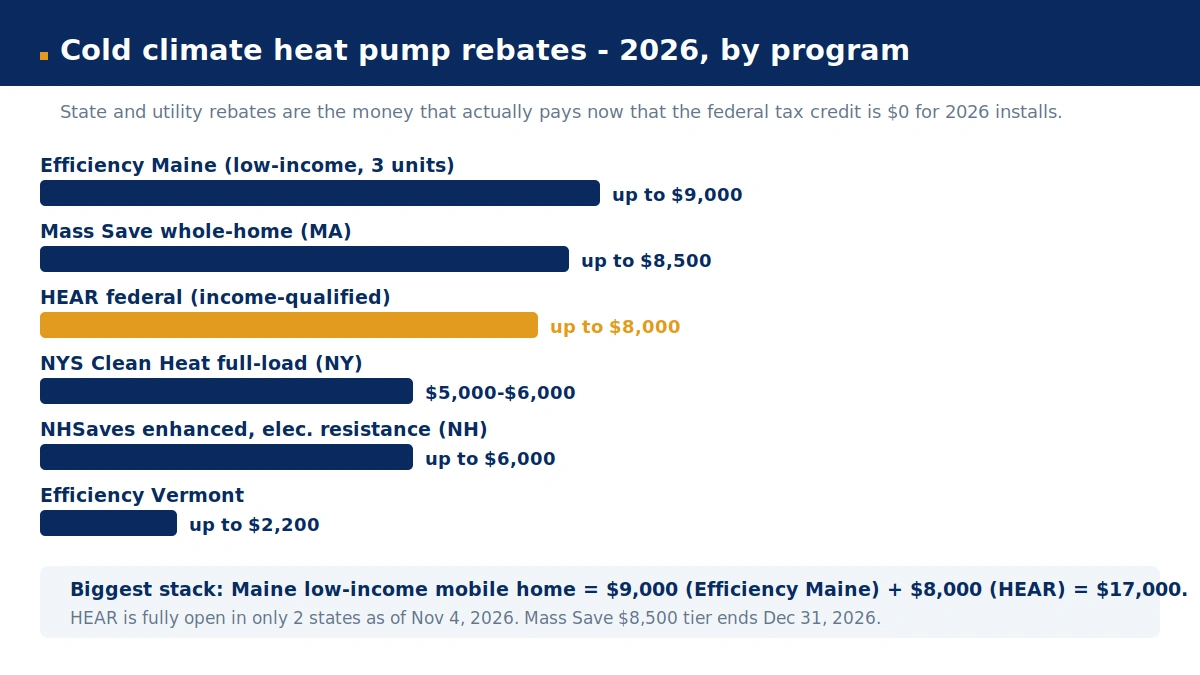
Full tax-credit picture (including the §48E lease route that survives through 2027): federal energy tax credits 2026.
How to get accurate quotes in a cold climate
Cold-climate quotes vary more than standard ones, because the sizing and the hardware matter more. Get three or more, and make them comparable:
- Demand the NEEP listing and AHRI certificate for the exact matched system on the quote. A brand name is not a rating.
- Ask for capacity at your design temperature in writing — BTU/h at 5°F (or your local 99% design temp), not just nameplate tonnage.
- Ask for a Manual J. If the contractor sizes from square footage alone, get another bid. The audit costs $100–$300 and protects a five-figure purchase.
- Get the cold-weather package itemized: base-pan heater, wind baffle, snow stand or wall bracket, and the defrost strategy. If it is not on the quote, it is not in the price.
- Ask what the backup plan is. Electric strips, the existing furnace in dual-fuel, or nothing — each has a different cost on the coldest nights, and it should be an explicit decision, not a January surprise.
- Check the rebate paperwork before signing. Mass Save requires a certified installer-network contractor; NHSaves requires the unit to be on its qualified product list; Efficiency Maine rebates run through a registered vendor at point of purchase. The wrong installer can void the rebate.
- Confirm the timeline against rebate deadlines. Mass Save’s $8,500 tier ends December 31, 2026. Maine’s $500 whole-home bonus ends December 2026. A January install can be worth $1,000+ less than a December one.
Is a cold climate mini split worth it?
It depends on what you heat with today — more than on the equipment.
Yes, clearly, if you heat with oil, propane, or electric baseboard. At October 2026 Maine prices, a heat pump delivers heat at ~$28 per million BTU versus ~$40 for propane and ~$49 for oil (localenergyme.com, Oct 2026). Savings of $1,000–$2,000+ a year are realistic, and the rebates — up to $9,000 in Maine, $8,500 in Massachusetts — cut the payback to a few years. Maine’s 200,000+ installed heat pumps are the proof: no state has adopted them faster.
Maybe, if you heat with cheap piped natural gas. The heat pump will likely cost more to run than the furnace. The case then rests on cooling (the mini-split replaces a window AC too), on dual-fuel, or on future gas prices — not on heating savings. Get the dual-fuel quote before deciding.
Yes, if you are building or replacing a dead system anyway. The incremental cost of cold-climate over standard is $1,500–$3,000 per zone — small against a whole-home job, and it buys the only system that holds full capacity at 5°F and keeps heating at -15°F.
The one mistake to avoid: buying a standard mini-split for a cold-climate house because the quote was cheaper. It will cost less in November and far more every January after — in backup heat, in comfort, and in a second installation to fix the first one.
Sources & methodology
Costs: HomeGuide (research Oct 8, 2025, cited Nov 2026) and Angi (updated Oct 17, 2026; avg $7,500, most $4,350–$12,250; permits $250–$400, Apr 2026); RemodelCalculators (updated Oct 21, 2026); MassHVAC (updated Sep 19, 2026); PickHVAC brand pricing 2026; Lela Homelife (Oct 23, 2026) Central MA conversion $22,000–$23,000. Standards: NEEP ccASHP Spec v4.0 (eff. Jan 2023), ENERGY STAR Cold Climate criteria, NEEP list 100+ models; DOE Cold Climate Heat Pump Challenge (energy.gov, updated May 14, 2026; 23 field sites). Performance: DOE challenge field data (a1solarstore.com, 2026); Mitsubishi H2i/H2i Plus brochure (via heatpumpeconomics.com, 2026); NuWatt H2i catalog table (2026); MSZ-FE18NA 73% at -13°F (Mitsubishi catalog via manuals.plus); Fujitsu XLTH / Daikin Aurora / LG LGRED / Bosch IDS Premium (hometsair.com 2026; pickhvac.com); Trane 20 TruComfort launch (Trane Technologies, Oct 1, 2026). Sizing: ACCA Manual J/S; BTU/sq ft rules and 1.25x cooling-load cap (solartechonline.com; hvacbase.org, 2026); ASHRAE design temps (Chicago 5°F, Minneapolis -8°F); Manual J audit $100–$300 (hvac-boss.com). Hardware: base-pan heater below 36°F, snowline +2–4 in (ACHR 2025 via SupplyHouse, Oct 22, 2026); defrost (SupplyHouse, Oct 22, 2026). Running costs: Maine Oct 2026 prices + $/MMBtu math (localenergyme.com, Oct 2026; Governor’s Energy Office Oct 19, 2026); Upstate NY/VT season costs (scoophvac.com, Oct 2026); MN CEE 30–56% savings; Harvard Energy Policy Dec 10, 2025 + Maine DOER Mar 2, 2026 (gas caveat); DOE $500/yr (energy.gov). Rebates: HEAR status verified Nov 4, 2026 (heatpumppricing.com); DOE Program Notice 26-2 (May 29, 2026); Efficiency Maine tiers + $17,000 stack (NuWatt, Apr 2026); Mass Save 2026 tiers + Jan 2027 step-down (SumZero; Lela Homelife Oct 23, 2026; GridShift Oct 21, 2026); NHSaves (caronheatcool.com, updated Sep 18, 2026); VT/NY/CO (homeenergybasics.com 2026). Tax: OBBBA P.L. 119-21 / IRS FS-2025-05 — $0 federal credit for 2026 installs. EXCLUDED: Canadian CAD prices; pre-OBBBA 30% credit framing; unverified accessory prices; Fujitsu COP 5.33 (mild-condition rating, not low-temp).
—
How much does a cold climate mini split cost in 2026?
A single-zone cold-climate mini-split costs $4,000–$9,000 installed; a two-zone system $7,000–$13,000; three zones $9,000–$16,000; and a whole-home 4–5 zone system $12,000–$25,000 (MassHVAC, Sep 2026). That is roughly $1,500–$3,000 more per zone than a standard mini-split.
What is the difference between a cold climate mini split and a standard one?
A cold-climate unit holds 100% of its rated heating capacity at 5°F and keeps operating to -13°F or -15°F. A standard mini-split loses 30–50% of its capacity by 17°F and many stop heating near 0–5°F. The difference is a larger inverter compressor with vapor injection, a base-pan heater, and smarter defrost — verified by the NEEP cold-climate list (COP of at least 1.75 at 5°F).
Do mini splits work at -15°F?
Yes — cold-climate models do. The DOE’s Cold Climate Heat Pump Challenge field-tested systems at 23 sites that operated at -15°F. At that temperature a cold-climate unit still delivers a COP of 1.2–1.5 (120–150% efficient) at roughly half its rated capacity. A standard mini-split will have shut off long before -15°F.
Which cold climate mini split brand is best in 2026?
Mitsubishi Hyper-Heat H2i is the most proven (100% capacity at 5°F, operates to -13°F; H2i Plus to -22°F). Fujitsu XLTH matches it at -15°F with a factory base-pan heater. Daikin Aurora is the value pick at the same -13°F floor. LG LGRED and Bosch IDS Premium (highest HSPF2 at 10.5) round out the top group. New in October 2026: Trane’s 20 TruComfort Cold Climate, rated to -20°F. Verify the exact matched system on the NEEP list and its AHRI certificate — brand alone is not a rating.
How do I size a mini split for a cold climate?
Get an ACCA Manual J load calculation ($100–$300) — square-footage rules (30–35 BTU/sq ft in Zones 6–8) are a starting point only. Size to the heating load, but no more than 1.25x the cooling load. The quote must state the system’s BTU/h capacity at your local design temperature (5°F in Chicago, -8°F in Minneapolis), not just its 47°F nameplate rating.
Is there a federal tax credit for a cold climate mini split in 2026?
No — $0. The §25C/§25D credits ended for property placed in service after December 31, 2025 (OBBBA, P.L. 119-21). The money that still pays is state and utility rebates: up to $9,000 in Maine, $8,500 through Mass Save, and up to $8,000 in federal HEAR rebates where that program has actually launched — which, as of November 2026, is only a handful of states.
How much can I save with a cold climate mini split vs oil or propane?
At October 2026 Maine prices, a heat pump delivers heat at about $28 per million BTU versus about $40 for propane and about $49 for oil. A home burning 800 gallons of oil a year spends about $4,830 on oil versus about $2,720 on a heat pump. Against cheap piped natural gas, though, the heat pump usually costs more to run — dual-fuel is the better answer for gas homes.
Do I need a base-pan heater and wind baffle?
In a cold climate, yes — confirm both on the quote. The base-pan heater stops defrost water from refreezing into ice that can damage the outdoor unit’s fan; Fujitsu’s XLTH includes one factory-installed. A wind baffle blocks wind-driven snow on the coil, and the outdoor unit should sit 2–4 inches above the expected snowline (more in deep-snow regions).
1 thought on “Mini-Split Cost in Cold Climates: 2026 Cold-Climate Guide”