

Table of Contents
Florida is one of the best states in the country to buy a heat pump — and one of the trickiest. The climate is perfect for heat pump technology: short, mild winters mean the system rarely works hard for heating, while long cooling seasons mean efficiency pays for itself every month. But Florida buyers face traps competitors don’t warn about: salespeople still quoting the dead federal tax credit, oversized systems that cool your house while feeding mold, and hurricane-code anchoring that must be in your quote.
This guide is built on 2026 Florida contractor quotes, utility rebate schedules verified this year, and the actual building code your inspector will enforce. Every number below is sourced — see “Sources & methodology” at the end.
How much does a heat pump cost in Florida in 2026?
The short version: most Florida homeowners pay $6,500–$13,000 installed for a standard central ducted air-source heat pump at 16–18 SEER2 (Florida Cool, Boca Raton, updated October 2026). A like-for-like changeout in South Florida at code-minimum efficiency can run as low as $6,500–$10,500; step up to a 4–5 ton variable-speed system and the range climbs to $11,000–$17,000.
Three more data points sharpen the picture:
- Angi’s city averages: Orlando averages $4,926 (range $3,748–$6,186, updated August 2026); Tampa averages $5,065 (range $4,093–$6,368). These reflect simpler replacements, not premium equipment.
- NumeralQ’s 2026 model: the typical Florida job lands at $6,390–$10,760, about 2% below the national average — roughly $6,550–$10,960 for a 3-ton ducted air-source system installed.
- North Florida planning ranges (Southern Air, ~October 2026): $17,000–$23,000 for homes of 1,500–2,500 sq ft and $22,500–$28,000 for 2,500–5,500 sq ft — these reflect larger homes and premium equipment tiers.
Nationally, Angi’s October 2026 data (4,719 verified projects) puts the average at $6,087, with a range of $4,236–$7,942. Florida sits near the national middle — neither the cheapest nor the priciest state to install.
City spread matters. Miami-Dade runs about 7% above the Florida baseline; Jacksonville roughly 3% below (BuildPriced 2026 Q1–Q2 quote dataset). A quote that’s “too high” in Tampa may be normal in Miami.
Expect to pay 5–8% more than last year. Prices rose across 2026 as new equipment moved to A2L refrigerants (R-454B/R-32) under the R-410A phase-out, and labor shortages kept contractor costs elevated (hammerio 2026 guide). Quotes from 2025 are not a negotiating baseline — the equipment literally changed.
Florida heat pump cost by system type
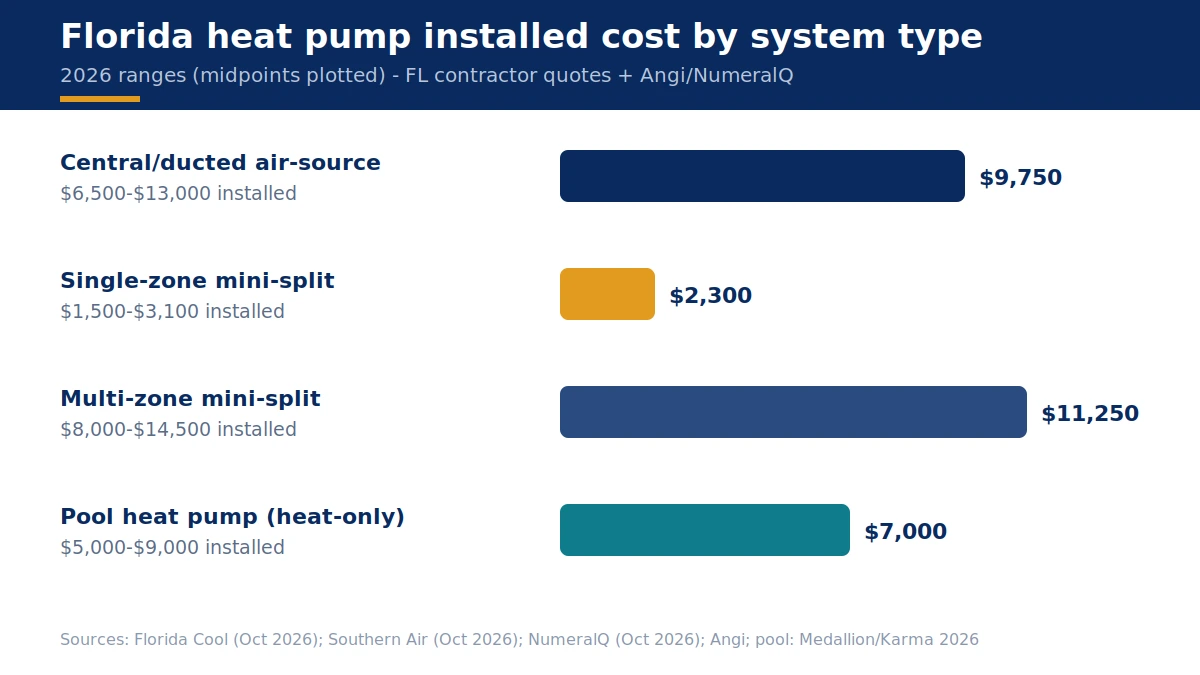
Central ducted air-source heat pump: $6,500–$13,000. The workhorse for most Florida homes with existing ductwork. See our national heat pump cost guide for how Florida compares to the US average.
Ductless mini-split: $1,200–$5,500 per single zone. Typical 12k BTU single-zone installs land at $1,500–$3,100 (Southern Air). Multi-zone systems scale fast: two zones $4,000–$9,000, three zones $6,500–$11,000, and 4–5 zones $8,000–$14,500+. Tampa contractors list single-zone installs starting around $2,999, with multi-zone projects from $9,237 up to $30,371 (swflductlesspros, November 2026). Our mini-split installation cost guide breaks the zone math down further.
Pool heat pump: $5,000–$9,000 installed (heat-only). Florida’s year-round pool culture makes this a real line item — heat/cool combo units run $6,500–$11,000, and large or combo systems reach $10,000–$20,000+. (Unit-only prices start around $2,500.) We devote a full section to pool heat pumps below.
Geothermal: $20,000–$50,000+. Rarely installed in Florida — the shallow water table complicates loop fields, and the economics don’t beat air-source in a warm climate. Not worth pricing in detail here.
Expected lifespans: 12–15 years for ducted air-source systems, 15–20 for mini-splits (NumeralQ 2026). Near the coast, salt air shortens that without corrosion protection — more on that below.
Cost by size: the tonnage table
Florida contractors price roughly by the ton:
| Tonnage (typical home) | Base tier ($1,900–$2,600/ton) | Variable-speed ($2,600–$3,400/ton) |
|---|---|---|
| 1.5 ton (~1,000 sq ft) | $2,850–$3,900 | $3,900–$5,100 |
| 2 ton (~1,200 sq ft) | $3,800–$5,200 | $5,200–$6,800 |
| 3 ton (~1,800 sq ft) | $5,700–$7,800 | $7,800–$10,200 |
| 4 ton (~2,400 sq ft) | $7,600–$10,400 | $10,400–$13,600 |
| 5 ton (~3,000+ sq ft) | $9,500–$13,000 | $13,000–$17,000 |
The per-ton rates come from Florida contractor quote math (Florida Cool, 2026); national turnkey pricing runs $2,500–$3,800/ton (costimated, November 2026).
One critical warning, especially in Florida: bigger is not better. An oversized heat pump short-cycles — it cools the air quickly and shuts off before removing moisture. In a state where summer outdoor humidity runs 70–95%, that means a cool house that breeds mold. A proper Manual J load calculation — not square-footage rules of thumb — is what determines the right size. Any contractor who sizes your system “by the square foot” without running Manual J should be replaced.
The $0 federal tax credit: 2026’s hard tax reality
Lead with the correction, because competitors are still wrong. The §25C Energy Efficient Home Improvement Credit and §25D Residential Clean Energy Credit were repealed by OBBBA (P.L. 119-21; IRS FS-2025-05). They ended for property placed in service after December 31, 2025. For a homeowner-owned heat pump installed in 2026, the federal credit is $0.
This matters because stale pricing is everywhere. BuildPriced’s 2026 Florida page still claims heat pumps of 17+ SEER2 “qualify for the $2,000 federal 25C credit” — that is wrong. Multiple 2026 sources still publish “after the 25C credit” pricing. NumeralQ explicitly warns about this. If a contractor or a website subtracts $2,000 from your quote for a federal credit in 2026, they are either working from outdated material or hoping you are.
What about the HEAR rebates? Florida’s share of the Home Electrification and Appliance Rebates (HEAR/HEEHR) program — income-limited to households under 150% of area median income — would cover up to $8,000 per household for heat pumps (up to $14,000 total) — but as of October 2026, the program has not launched in Florida. Florida has $346 million in IRA funding allocated ($172.7M HEEHR + $173.3M HOMES), pending DOE approval, with the first phase still pending. Residents can register for launch alerts through FDACS — but you cannot apply today. Any page that treats the $8,000 as available is misleading you.
One more 2026 change worth knowing: DOE Program Notice 26-2 (May 29, 2026) removed fuel-switching payments from HEAR — the program no longer pays to replace gas, oil, or propane equipment when it launches (gridshiftmedia.com). That narrows who the rebate will serve.
Bottom line for 2026 budgeting: plan on $0 federal support, and treat utility rebates (next section) as the only real discounts available today.
Florida utility rebates that still work in 2026
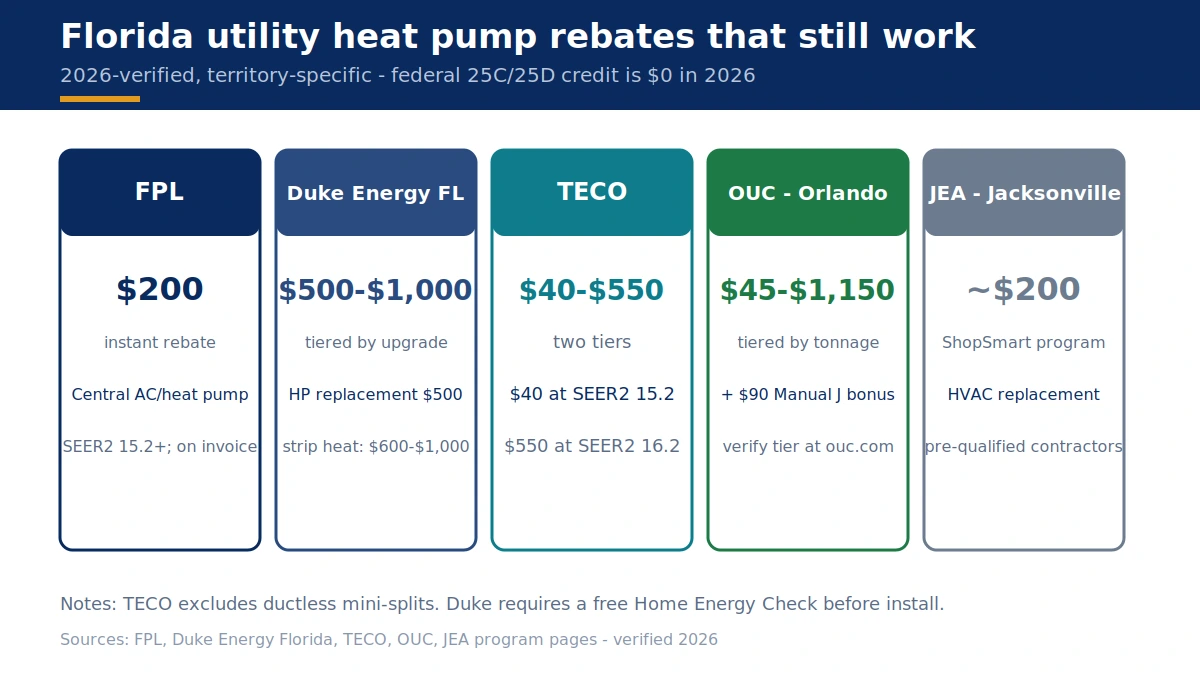
This is where the real 2026 money lives — it’s entirely territory-specific, so check which utility serves your address first:
| Utility | Heat pump rebate (2026) | Fine print |
|---|---|---|
| FPL | $200 instant rebate | Central AC or heat pump, SEER2 ≥ 15.2, through a Participating Independent Contractor; applied as an invoice credit |
| Duke Energy Florida | $500–$1,000 | Existing heat pump → new heat pump: $500; strip heat → heat pump: $600; strip heat → higher-efficiency heat pump (≥16.0 SEER2): $1,000. Requires a free Home Energy Check; replacement-only (no new construction) |
| TECO (Tampa Electric) | $40 (SEER2 ≥ 15.2) / $550 (SEER2 ≥ 16.2) | Ducted systems only — ductless mini-splits are excluded; apply within 90 days of installation |
| OUC (Orlando) | $45–$1,150, tiered by tonnage and SEER2 | Older tier documents show up to $1,630 — verify current tiers at ouc.com; includes a $90 bonus for proper Manual J sizing |
| JEA (Jacksonville) | ~$200 HVAC replacement (ShopSmart) | Through pre-qualified contractors; heat-pump water heater up to $350 |
Notes worth your attention:
- Duke’s $1,000 tier is the best heat-pump rebate in Florida — but it requires replacing electric strip heat with a ≥16.0 SEER2 heat pump, plus a free Home Energy Check *before* you commit.
- TECO’s mini-split exclusion surprises buyers — in Tampa Electric territory, budget $0 from TECO on a ductless install.
- JEA’s heat-pump water heater rebate (up to $350) pairs with this topic — see our heat pump water heater cost guide for those numbers.
A $750–$1,400 Daikin instant rebate expired July 31, 2026. Manufacturer promos are seasonal — ask your contractor what’s currently live.
One clarification on My Safe Florida Home. Florida’s hurricane-hardening program (free wind mitigation inspection, grants up to $10,000, $405M+ reappropriated for 2026–27) covers windows, doors, roofs, and shutters. It does not fund heat pumps. Don’t plan your HVAC budget around it.
Humidity and mold: why your system choice matters in Florida
This is the Florida-specific buying decision most cost guides ignore: you’re not just buying heating and cooling — you’re buying moisture control.
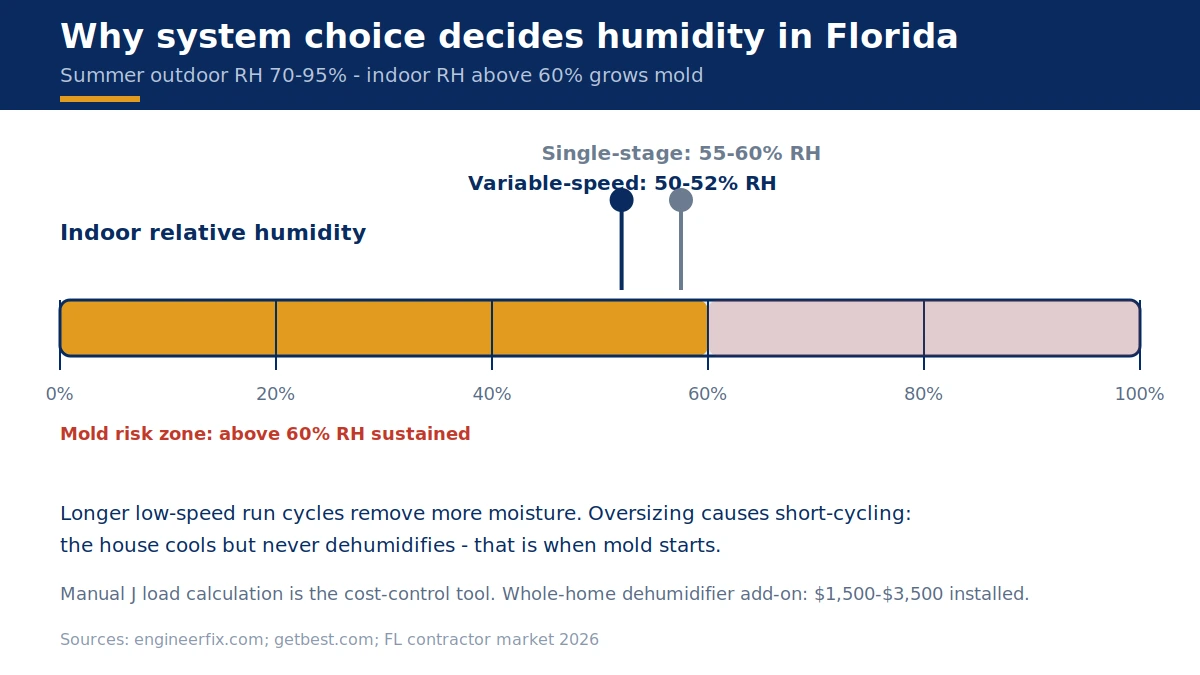
Florida’s summer outdoor relative humidity runs 70–95%. Sustained indoor humidity above 60% feeds mold, dust mites, and that stale smell returning Florida renters know well. The compressor tier you choose directly controls your indoor humidity:
- Single-stage heat pumps cool hard, shut off, and leave indoor humidity at 55–60% — uncomfortably close to mold territory.
- Variable-speed heat pumps run long, low-speed cycles that squeeze out moisture continuously, holding indoor humidity at 50–52% (engineerfix.com) — the comfort sweet spot.
That’s the real justification for the variable-speed price premium ($2,600–$3,400/ton vs $1,900–$2,600/ton): it’s a dehumidification purchase, not a comfort luxury. If a contractor tries to sell you a whole-home dehumidifier add-on (~$1,500–$3,500 installed), ask whether a variable-speed heat pump properly sized would make the add-on unnecessary. Often it does.
Three rules for Florida heat pump sizing and humidity:
- Demand a Manual J load calculation. Oversizing is the enemy — a short-cycling 5-ton unit cools without dehumidifying. Right-sizing is the cheapest moisture control you’ll ever buy.
- Ask about latent vs sensible capacity. A good contractor will talk about the system’s moisture-removal (latent) performance, not just its cooling (sensible) tons.
- Check your thermostat. Modern Florida installations should include humidity-sensing controls that can overcool slightly to wring out moisture — confirm it’s in the quote.
Hurricane code: anchoring, permits, and the inspector
Florida’s building code treats your outdoor unit as a wind-load object, not just an appliance. What that means for your quote:
Anchoring is required. The Florida Building Code (8th Edition (2023) governs all 2026 permits; the 9th Edition takes effect December 31, 2026 — Miami-Dade: applications after 4 PM on December 30, 2026 fall under it). Under FBC-Mechanical §301.13/301.15 and FBC-Residential M1307.2/M1307.3, wind-exposed mechanical equipment must be fastened and anchored to resist wind pressures — typically with hurricane straps at the upper and lower thirds of the unit’s vertical dimensions, anchored to a concrete pad (no wood sleepers for roof-mounted units). Engineered tie-downs in Miami-Dade are rated for design winds up to ~175–186 mph.
Your contractor handles this — but confirm it’s in the quote. Wind anchoring is a modest cost, and it’s a permit/inspection line item. A quote without pad anchoring is a quote that will fail inspection.
Permit costs are small but real:
- Orlando: ~$108 for a ~$4,926 project
- Tampa: ~$124 per HVAC permit
- Statewide range: $70–$166 across 35 Florida cities (NumeralQ)
Mechanical permits are required statewide, and Florida requires licensed contractors — there is no DIY-permit shortcut for HVAC.
Coastal homes: salt-air corrosion protection
If you live within a mile or two of the coast, salt air is a quiet cost driver. Unprotected coils degrade — fin corrosion is a genuine Florida failure mode — and coastal replacement cycles run shorter than the inland 12–15 years.
What to specify in your quote:
- Factory anti-corrosion coil coatings (epoxy or polyurethane) — a modest equipment premium that protects the investment.
- Coastal-model units with stainless-steel fasteners and cabinets rated for salt exposure.
- Ask the contractor what the unit’s coastal warranty coverage looks like — some manufacturers limit corrosion coverage inland of a specified distance.
It’s a few hundred dollars on a $10,000 job, and it buys back years of equipment life.
Cost drivers that raise your quote
Beyond equipment and tonnage, these Florida-specific line items move the number:
- Ductwork: New ductwork runs $3,000–$7,500 per 300 linear feet (Angi Tampa, 2026). Florida homes with ducts in unconditioned attics often need duct sealing or replacement — insist on duct leakage testing before signing.
- Electrical panel upgrades: Older panels may need work to support a modern heat pump’s electrical load. Budget accordingly if your panel is original to a 1970s–1990s home.
- Attic air-handler placement: Florida air handlers often sit in 90°F+ attics, forcing the system to work harder — location and duct design affect both efficiency quotes and long-term operating costs.
- A2L refrigerant transition: New 2026 equipment ships with R-454B or R-32 refrigerants under the R-410A phase-out. The transition contributes to this year’s 5–8% price increase — and means refrigerant costs differ from what older cost guides cite.
- Refrigerant line-set routing and concrete pad replacement can each add line items on complex replacements.
Get quotes itemized — equipment, labor, ductwork, electrical, permits, anchoring — and compare line by line. And if a quote omits hurricane anchoring or the permit fee, it’s not complete.
Financing: Florida PACE explained
Florida’s PACE (Property Assessed Clean Energy) program is the state’s most distinctive HVAC financing path — and most cost guides skip it entirely.
How it works: PACE finances 100% of eligible HVAC/heat pump upgrades with no money down, repaid as an annual assessment on your property tax bill over 5–30 years (typically 15–20). Eligibility is based on home equity (10%+), not your FICO score. The assessment attaches to the property, not the borrower — it transfers to the buyer if you sell. Financing is typically capped at 10–20% of property value, at fixed rates around 6.5–8.5% APR.
The main administrator: Ygrene Energy Fund, active in 50+ Florida counties (including Miami-Dade, Broward, Palm Beach, Orange, and Hillsborough). Ygrene has financed $2B+ for 40,000+ Florida homeowners since 2014.
PACE is not a loan, not a grant, and not a county program — the county only authorizes the provider. Common alternatives: GoodLeap and Synchrony HVAC financing (credit-based), and Duke Energy Florida’s EnergyWise Home program, which pays up to $141/year in bill credits (credits, not financing).
Is PACE right for you? The no-credit-check, 100%-financed structure suits homeowners with equity but tight cash flow. The trade-off: the assessment sits on your property tax bill and takes priority over your mortgage — which some lenders and future buyers scrutinize. Compare the total cost against a bank home-equity loan before committing.
Pool heat pumps in Florida: the real numbers
Florida’s year-round pool culture makes pool heat pumps a genuinely Florida line item — and most HVAC cost guides don’t price them at all.
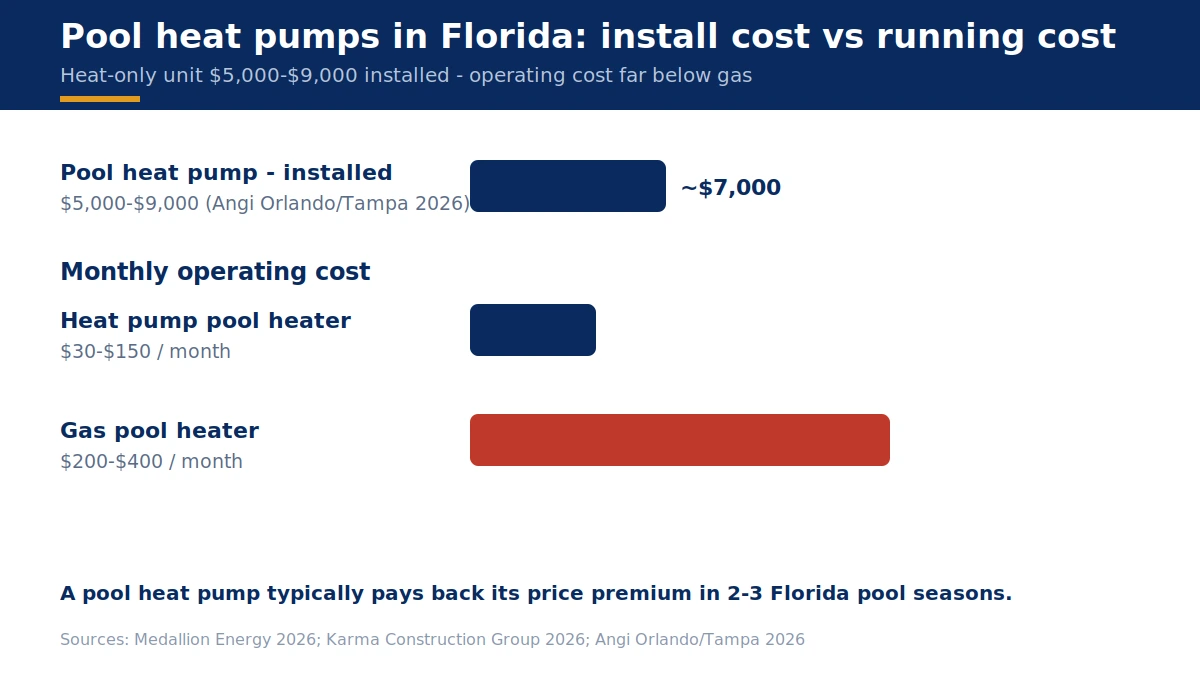
Installed costs:
| Pool heat pump type | Installed cost (Florida, 2026) |
|---|---|
| Heat-only | $5,000–$9,000 |
| Heat/cool combo | $6,500–$11,000 |
| Large or combo systems | $10,000–$20,000+ |
| Unit-only (equipment, before install) | From ~$2,500 |
City data backs the bands: Orlando $2,883–$8,648, Tampa $3,500–$15,000 (Angi, 2026).
The operating math is the selling point. A pool heat pump costs roughly $30–$150/month to run in Florida, versus $200–$400/month for a gas pool heater (Medallion Energy / Karma Construction Group, 2026). For year-round Florida swimming, the payback math beats gas quickly — and unlike the gas bill, the heat pump keeps working efficiently in Florida’s mild shoulder seasons.
A few buying notes:
- Size pool heat pumps by pool volume and desired temperature rise, not by guesswork — undersized units run constantly and never quite warm the pool.
- A heat/cool unit doubles as pool cooling in brutal August heat.
- Check your electric panel capacity before sizing up; pool heat pumps draw serious amperage.
Operating costs: what a Florida heat pump costs to run
Installed price is only half the story. Florida’s long cooling season means efficiency compounds — a higher-SEER2 unit pays back month after month.
- FPL’s typical 1,000-kWh residential bill in 2026: $136.64/month (up ~2%; floridahomeservicesnews.com, October 2026). Heating and cooling is typically the largest share of that.
- Heat pumps deliver 2–3x the heating energy they consume in electricity (heat-pump physics, via DOE) — which is why strip-heat replacement with a heat pump is Duke Energy’s $1,000 rebate tier.
- A well-sized variable-speed unit in a Florida home typically runs lower summer bills than the single-stage system it replaced, while holding indoor humidity 3–8 points lower.
To keep operating costs down over the system’s life, budget for routine care — see our heat pump maintenance cost guide for the annual numbers, and our heat pump repair cost guide for what out-of-warranty failures cost.
Florida heat pump buying checklist
- Get 3+ itemized quotes — equipment, labor, ductwork, electrical, permits, anchoring. Compare line by line.
- Insist on a Manual J load calculation. Reject square-footage rules of thumb, especially in Florida’s humidity.
- Confirm hurricane anchoring is in the quote (straps, pad anchors) — it’s a code and inspection item.
- Check your utility rebate before signing — FPL $200, Duke up to $1,000, TECO up to $550, OUC tiered, JEA ~$200. Duke requires a Home Energy Check first; TECO needs the application within 90 days.
- Plan on $0 federal credit for 2026 — and don’t let anyone subtract $2,000 from your math.
- Choose variable-speed for humidity control, not just comfort — it’s the Florida dehumidification decision.
- Specify coastal corrosion protection if you’re near salt air.
- Verify contractor licensing — Florida requires licensed HVAC contractors; permits are pulled statewide.
For the full heat pump vs. furnace comparison (relevant in North Florida, where winters bite), see our heat pump vs furnace cost guide. If your project is a broader system replacement, our HVAC replacement cost guide covers the whole stack, and our central AC replacement cost guide covers the cooling-only path. Shopping brands? Our best heat pump brands cost guide compares equipment tiers.
Sources & methodology
Cost anchors: Florida Cool (Boca Raton contractor, updated 2026-10-27) — central ducted $6,500–$13,000, South FL changeout $6,500–$10,500, 4–5 ton variable-speed $11,000–$17,000, $1,900–$2,600/ton base / $2,600–$3,400/ton variable-speed; Southern Air (North FL, ~Oct 2026) — whole-home $17,000–$23,000 / $22,500–$28,000, single-zone mini-split $5,400–$8,500; Angi (national, 4,719 projects, updated 2026-10-28) — $6,087 avg; Angi Orlando (2026-08-04) — $4,926 avg, permit ~$108; Angi Tampa (2026-08-04) — $5,065 avg, ductwork $3,000–$7,500/300 ft, permit ~$124; Thumbtack (2026) — $1,430–$7,778 range, ~$3,414 typical; NumeralQ (2026) — FL $6,390–$10,760, 3-ton ducted $6,550–$10,960, permits $70–$166, lifespans 12–15/15–20 yrs; jouleio (2026) — mini-split/central/geothermal national bands; BuildPriced (2026 Q1–Q2) — Miami-Dade +7%, Jacksonville −3% multiplier; hammerio (2026) — +5–8% price trend, R-410A → A2L transition; costimated (2026-11-03) — $2,500–$3,800/ton national; thehomeownerfiles.com/costimated — Fixr $8,350 avg, national $9,400 range $6,000–$14,800. Mini-splits: Southern Air, swflductlesspros (Nov 2026), callhometherapist — single-zone $1,200–$5,500 (typical $1,500–$3,100), two-zone $4,000–$9,000, three-zone $6,500–$11,000, 4–5 zone $8,000–$14,500+; Tampa single-zone from $2,999, multi-zone $9,237–$30,371. Pool heat pumps: Karma Construction Group (2026), Medallion Energy (2026) — heat-only $5,000–$9,000, heat/cool $6,500–$11,000, large/combo $10,000–$20,000+, unit-only from $2,500, operating $30–$150/mo vs gas $200–$400/mo; Angi Orlando/Tampa (2026) — Orlando $2,883–$8,648, Tampa $3,500–$15,000. Dehumidifier add-on ~$1,500–$3,500 (FL contractor market: getbest, completeenvirosolutions, 2026). Tax: §25C/§25D repeal via OBBBA P.L. 119-21, IRS FS-2025-05 (standing project rule); stale-credit warnings confirmed by numeralq, hammerio, gridshiftmedia, rmihvacr (2026); BuildPriced 25C claim flagged stale. HEAR: homeenergybasics.com (2026-07-20), americanphc.com (2026-07-03), gridshiftmedia.com (2026-10-21), electricalcontractorsandwiring.com (2026-10-27) — $8,000 cap, not launched, $346M allocation; DOE Program Notice 26-2 (May 29, 2026) — no fuel-switching payments. Rebates: FPL $200 instant (SEER2 ≥ 15.2, Participating Independent Contractor); Duke Energy Florida $500–$1,000 (Home Energy Check required, replacement-only); TECO $40/$550 (SEER2 ≥ 15.2/16.2, ducted only, 90-day application); OUC $45–$1,150 tiered + $90 Manual J bonus (verify current tiers at ouc.com); JEA ShopSmart ~$200 HVAC / up to $350 heat-pump water heater. Daikin $750–$1,400 expired July 31, 2026 (americanphc.com). PACE: F.S. 163.08; Ygrene Energy Fund — 50+ FL counties, $2B+ for 40,000+ homeowners since 2014, 6.5–8.5% APR; Duke EnergyWise Home up to $141/yr. MSFH: mysafeflhome.com — up to $10,000 grants, $405M+ reappropriated 2026–27, does not fund HVAC. Code: Florida Building Code 8th Edition (2023) in effect; 9th Edition effective Dec 31, 2026; FBC-Mechanical §301.13/301.15, FBC-Residential M1307.2/M1307.3 — strapping upper/lower thirds, no wood sleepers; floridabuilding.org product approvals (e.g. FL #47496.1). Humidity: FL summer RH 70–95%, mold above 60% sustained (getbest.com); variable-speed 50–52% vs single-stage 55–60% indoor RH (engineerfix.com). Operating: FPL 1,000-kWh bill $136.64/mo (floridahomeservicesnews.com, Oct 2026). External authorities: U.S. DOE Energy Saver — Heat Pump Systems; ENERGY STAR certified air-source heat pumps; Florida Building Commission — Florida Building Code Online; My Safe Florida Home (referenced only for the non-HVAC clarification).
—
What is the average heat pump cost in Florida in 2026?
Most Florida homeowners pay $6,500–$13,000 installed for a standard central ducted heat pump at 16–18 SEER2 (Florida Cool, October 2026). Angi’s city averages run lower for simple replacements: $4,926 in Orlando and $5,065 in Tampa (August 2026). NumeralQ’s model puts the typical Florida 3-ton job at $6,550–$10,960.
Is there a federal tax credit for heat pumps in Florida in 2026?
No — $0. The §25C Energy Efficient Home Improvement Credit ended for property placed in service after December 31, 2025, when OBBBA (P.L. 119-21) repealed it. Ignore any website or quote that subtracts $2,000 for the federal credit in 2026 — that math is dead. Florida’s HEAR rebate (up to $8,000 for heat pumps) is real but has not launched as of October 2026.
What heat pump rebates do FPL, Duke, and TECO offer in 2026?
FPL offers a $200 instant rebate (SEER2 ≥ 15.2) applied as an invoice credit. Duke Energy Florida pays $500 for a heat-pump replacement, $600 for strip-heat to heat-pump conversion, and $1,000 for strip-heat to ≥16.0 SEER2 heat pump — but requires a free Home Energy Check and replacements only. TECO pays $40 (SEER2 ≥ 15.2) or $550 (SEER2 ≥ 16.2) for ducted systems only, applied for within 90 days of installation. OUC ($45–$1,150 tiered) and JEA (~$200) cover Orlando and Jacksonville.
Is Florida’s $8,000 heat pump rebate available yet?
Not as of October 2026. Florida’s HEAR/HEEHR program (Florida Energy Saver, run by FDACS; income-limited to households under 150% of area median income) has $346 million in federal funding allocated but is still pending DOE approval — the first phase has not launched. Residents can register for launch alerts, but you cannot apply today. Note the 2026 DOE rule change: HEAR will no longer pay to replace gas, oil, or propane equipment (Program Notice 26-2).
Do heat pumps work well in Florida’s humidity?
Yes — variable-speed heat pumps are genuinely excellent dehumidifiers. They hold indoor humidity at 50–52% versus 55–60% for single-stage systems, because long low-speed cycles keep removing moisture. The critical rule is right-sizing: an oversized heat pump short-cycles, cools the air without dehumidifying, and creates the mold risk buyers fear. Always get a Manual J load calculation.
Does Florida require hurricane straps on heat pump outdoor units?
Yes. The Florida Building Code requires wind-exposed mechanical equipment to be fastened and anchored against wind pressures — typically hurricane straps at the upper and lower thirds of the unit, anchored to a concrete pad (wood sleepers are not permitted for roof-mounted units). Your contractor handles this, but confirm it’s itemized in the quote — it’s a permit/inspection requirement, not an optional add-on.
How much does a pool heat pump cost in Florida?
Heat-only pool heat pumps install for $5,000–$9,000 in Florida (2026). Heat/cool combo units run $6,500–$11,000, and large or combo systems reach $10,000–$20,000+. Equipment-only prices start around $2,500. Operating costs run roughly $30–$150/month versus $200–$400/month for a gas pool heater — the payback math favors heat pumps for year-round Florida swimming.
What is PACE financing for a heat pump in Florida?
Florida PACE (Property Assessed Clean Energy, F.S. 163.08) finances 100% of eligible HVAC upgrades with no money down, repaid as an annual assessment on your property tax bill over 5–30 years (typically 15–20). Approval is based on home equity (10%+), not your credit score. The assessment attaches to the property and transfers if you sell. The main administrator is Ygrene Energy Fund (50+ Florida counties, ~6.5–8.5% APR). It’s not a loan or a grant — compare total costs against a home-equity loan before committing.