

Table of Contents
Recessed lights are priced per light. Almost every quote you get will be a per-fixture number, and almost every one will be dominated by labor. A $25 fixture can sit next to a $200 labor charge on the same invoice — which is why two identical-looking quotes can differ by hundreds of dollars once ceiling access, wiring, and patching enter the picture.
This guide builds the full per-light picture from the 2026 data: HomeAdvisor’s $100–$300 per fixture band, Angi’s $1,800 average project (Sep 24, 2026), Fixr’s $176–$328 per light, and what installers actually publish. No DIY electrical instructions here — this is a cost guide, so you can budget the job and read a quote line by line.
The 2026 per-light price, in one table
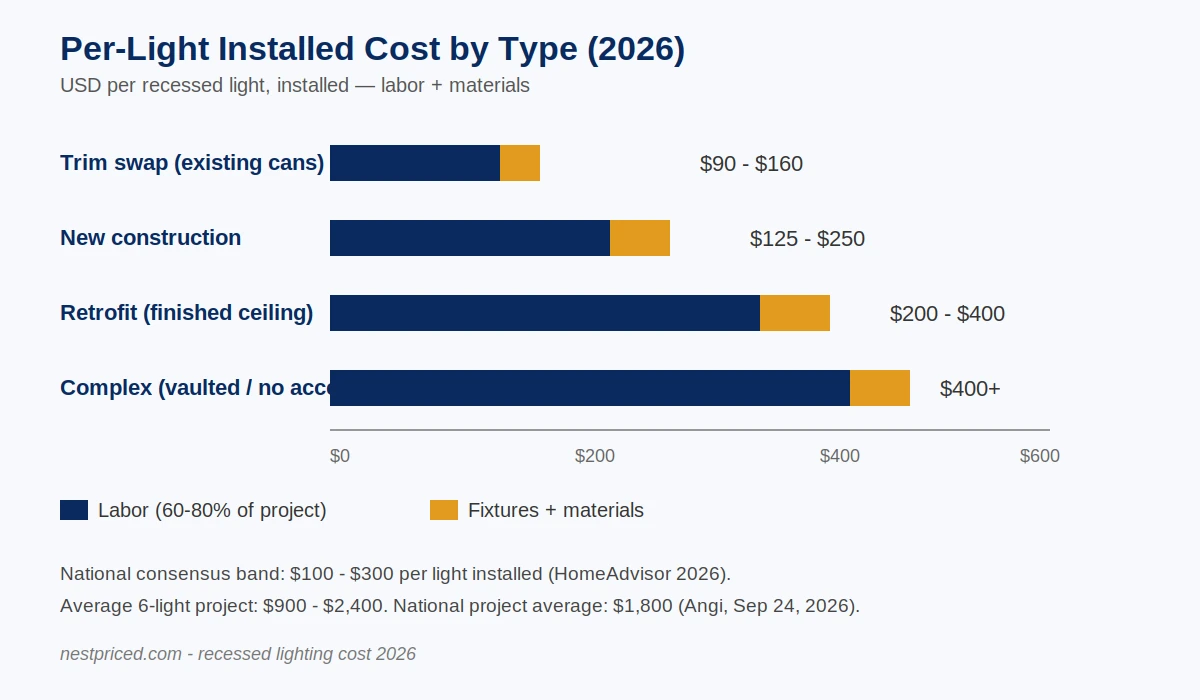
The national consensus across the four big 2026 sources:
| Installation type | Per light installed (2026) | Source |
|---|---|---|
| Straight can swap (new trim, existing housing) | $90–$160 | Pasadena installer pricing, 2026 |
| New construction (open ceiling) | $125–$250 | cansandfans 2026 |
| Retrofit into finished ceiling | $200–$400 | cansandfans 2026 |
| Complex (vaulted, no access, smart) | $400+ | cansandfans 2026 |
The four sources agree on the center of gravity: $100–$300 per light is the standard band (HomeAdvisor), with Fixr landing at $176–$328 per light and a national project average of $1,467 for six lights (range $1,056–$1,968).
Fixr’s own component math explains the anatomy of the number: roughly $75/can + $75 in wiring on new construction, plus a ~$50 fixture-and-trim package, totals ~$200 per can — $1,200 for a six-light room. Retrofitting into an existing ceiling pushes the same six lights to about $1,350 in Fixr’s older figures — the 2026 data has moved those retrofit numbers higher ($900–$2,400 per room).
Two numbers to anchor on: Angi’s $1,800 average standard project (Sep 24, 2026) and Homewyse’s $380–$529 per light (May 2026, Unit Cost Method — the high-end anchor because it bundles every line item per fixture).
Labor vs fixture: where your money actually goes
Labor is the larger share of every recessed lighting job. Multiple sources put the split at 60–80% labor, 20–40% materials — recessed lighting is an installation product, not a fixture product.
Electrician rates (2026 consensus):
- Standard range: $50–$150 per hour (cansandfans 2026: $75–$150; national average ~$100/hr)
- Per-fixture flat pricing: $60–$150 per light (Angi) to $100–$200 per light (installer consensus)
- Remodel labor specifically: $100–$300 per fixture (cansandfans)
Fixture costs (the smaller line):
- Basic LED fixtures: $15–$30 each; mid-range LED: $30–$50 (xhlux 2026)
- Smart fixtures: $50–$200+ each
- LED retrofit kits (screw into existing cans): $10–$25 each
- Canless/wafer LED: $15–$50 each (fixture only)
So a typical $250 per-light retrofit quote decomposes roughly as: $35 fixture, $160 labor (electrician, wire-fishing, cut-in, connections), $35–$55 trim, permit share, and drywall patching. See our [electrician cost per hour guide](https://nestpriced.com/plumbing-electrical/electrician-cost-per-hour-2026/) for the full 2026 rate map — the hourly number in your market is the single biggest driver of the per-light figure.
One pricing dynamic to know: the first 3–4 lights absorb the setup. Travel, panel access, circuit evaluation, and switch work are one-time costs. A Pasadena installer (2026) notes the per-fixture cost drops meaningfully after the first three or four lights — one light might cost $400–$500 alone, while eight in one visit can land at $200–$300 each (amicolight 2026).
New construction vs retrofit: the access question that sets your price
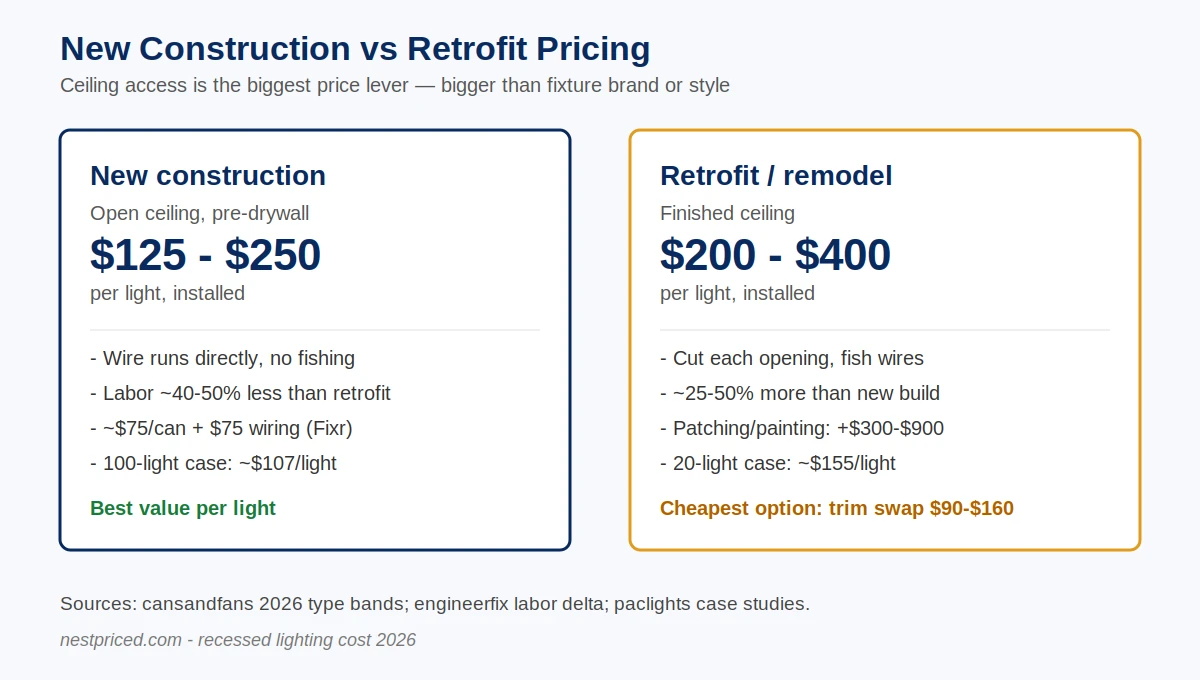
This is the single biggest price lever — bigger than brand, size, or style. When the ceiling is open, the electrician runs wire directly and quickly. When it’s finished, every foot of wire has to be fished through cavities, joists, ducts, and insulation.
New construction (open ceiling): $125–$250 per light. Electricians charge roughly $75 per can plus $75 in wiring (Fixr), and labor per fixture runs 40–50% less than retrofit (engineerfix). One commercial case study: 100 LED can lights at ~$107 per fixture all-in (paclights).
Retrofit (existing finished ceiling): $200–$400 per light. Expect about 25–50% more than new construction (cansandfans 2026). The electrician cuts each opening, navigates around plumbing/HVAC/ducts, fishes wire, and patches. A residential case study: 20 LED can lights in an existing ceiling at ~$155 per fixture (paclights). Complex retrofits — no attic access, plaster-and-lath, routing around blocking — run $400+ per light, with drywall patching and painting adding another $300–$900 to the project if the quote doesn’t include it (engineerfix).
The cheapest install: the straight swap. If you already have cans, swapping the trim for an LED retrofit kit runs $90–$160 per light (Pasadena 2026) — or $80–$200 with labor (indochinalight, updated Aug 2026). No new openings, no wire-fishing. This is the budget path to LED recessed lighting.
Canless LEDs ($175–$400 installed per light, amicolight 2026) deserve a mention: the slim profile installs from below with a small cutout, often at the lower end of retrofit pricing because there’s no housing to mount.
Cost per light by can size: 4″, 5″, 6″
The housing diameter matters less for price than most shoppers expect. The material spread between sizes is roughly $5–$15 per fixture — the labor to cut and wire them is identical. What the sizes are *for* differs:
- 4-inch: task and accent lighting — kitchen islands, artwork, hallways. Fixture $15–$40; installed same labor as 6″.
- 5-inch: the fading middle child — adequate general lighting but losing shelf space to 4″ and 6″ lines.
- 6-inch: the general-lighting standard — living rooms, basements, whole-room washes. Fixture $15–$45; the most competitively priced housings because of volume.
Practical note: your electrician needs more 4″ lights to wash the same room (smaller aperture, narrower beam), which can erase any fixture savings. A room that needs six 6″ lights might need eight 4″ lights — price the *room*, not the fixture.
Specialty housings: vaulted/sloped-ceiling cans run $30–$120 each (fixture only); airtight IC cans add a small premium. These are fixture-line items, not labor drivers.
How many lights does a room need? (The estimator)
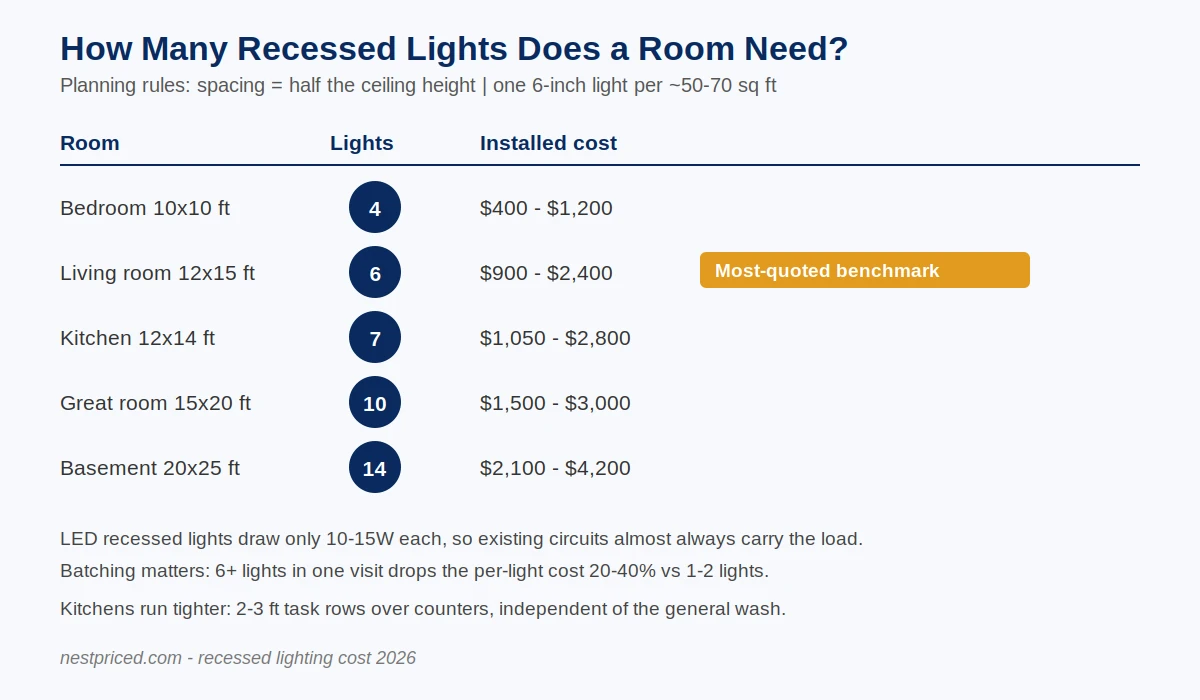
Three planning rules electricians use to lay out a room:
- Spacing = half the ceiling height. On an 8-ft ceiling, space lights ~4 feet apart; on a 9-ft ceiling, ~4.5 feet. Keep them at least ~3 feet from walls.
- One 6″ light per ~50–70 sq ft for general illumination (not task lighting).
- Kitchen task lighting runs tighter — 2–3 ft rows over counters and islands, independent of the general wash.
| Room | Size | Lights (8-ft ceiling) | Installed cost (2026) |
|---|---|---|---|
| Bedroom | 10×10 (100 sq ft) | 4 | $400–$1,200 |
| Living room | 12×15 (180 sq ft) | 6 | $900–$2,400 |
| Kitchen | 12×14 (168 sq ft) | 6–8 (task + general) | $1,200–$3,200 |
| Great room | 15×20 (300 sq ft) | 8–12 | $1,600–$4,800 |
| Basement | 20×25 (500 sq ft) | 12–16 | $2,400–$6,400 |
The 6-light project cost ($900–$2,400, remodelingexpense June 2026) is the most-quoted benchmark in the 2026 data — and Thumbtack’s project data corroborates the curve: 2–4 lights: $406; 5–10: $948; 11+: $2,030 (Thumbtack 2026).
One caveat the estimator assumes: the existing circuit can carry the load. LED recessed lights draw only 10–15W each — a 6-light LED room draws under 100W total, so existing circuits almost always suffice. That’s also the energy case: LEDs replacing 65W incandescent cans cut per-light draw by ~80%.
IC-rated vs non-IC: a $5–$10 per light decision with real consequences
IC-rated (Insulation Contact) housings are thermally shielded so insulation can touch them directly. Non-IC housings need a 3-inch clearance from insulation on all sides — in an insulated ceiling that clearance creates thermal gaps (heat loss in winter) and can be a code problem if the installer skirts it.
The price difference is small: IC adds roughly $5–$10 per fixture (grandmabetty33 2026). Housings overall: IC-rated $12–$80 each; non-IC $7–$60-ish new-construction (HomeServe). For a 6-light room, choosing IC over non-IC adds about $30–$60 total — trivial next to the $900–$2,400 project.
The real cost isn’t the fixture premium — it’s what happens when the wrong housing is specified. If your ceiling is insulated (attic above), IC-rated is the correct spec; asking for it in the quote costs nearly nothing and avoids insulation clearance work that would. LED fixtures make this easier: integrated LED/IC cans run cooler and the combined units are the current standard.
What moves your quote up or down
Beyond access, these are the line items that push a quote toward the $100 end or the $400 end of the per-light band:
Up:
- New circuit + dimmer: $350–$900 one-time (Pasadena 2026) — if the room needs its own circuit. A standalone dimmer install runs $100–$200.
- Panel upgrade: $1,200–$3,000 full service upgrade (grandmabetty33) — rare for LEDs (10–15W each), but pre-1980s homes with loaded panels should get the load evaluated. See our [electrical panel upgrade cost guide](https://nestpriced.com/plumbing-electrical/electrical-panel-upgrade-cost-2026/).
- High ceilings: an advertised $135/light can move to $180+/light above ~10 ft (scaffolding, access time).
- Plaster-and-lath or no attic access: $250–$375 per light (Pasadena 2026); routing around joists/ducts adds ~$150–$200 per fixture.
- Smart fixtures: $50–$200+ per fixture in materials; integration/programming time on top.
- Permits: $150–$250 (Angi) — some jurisdictions require them whenever new wiring is added.
Down:
- Existing circuit capacity: LEDs at 10–15W each rarely need electrical service changes.
- Batch the lights: 6+ lights in one visit drops per-light cost 20–40% vs 1–2 lights.
- Straight trim swaps ($90–$160/light) instead of new openings.
- Rural/mid-cost markets: urban labor runs 20–30% above the national average (amicolight 2026).
Regional variation: the same 6 lights, different zip codes
Labor is local, so the per-light band shifts with your market. Labeled 2026 examples:
- San Jose CA (Emelco, advertised): $135/light; from $180/light with high ceilings.
- West Palm Beach FL (Nassif, retrofit): $150–$300/light; complete room $1,200–$2,800 (6–8 lights, new circuit, dimmer).
- Prescott Valley AZ (Assurance, licensed ROC, Oct 2026): $200–$400/light new; $150–$250/light LED retrofit kits.
- Pasadena CA (handymanconnection, 2026): $180–$280/light with open attic access; $250–$375/light plaster-and-lath.
- Los Angeles metro (alwaysreliableelectric, Sep/Oct 2026): $100–$300/light; 6–8 light room $900–$2,400; permit $150–$300 — tracks the national bands.
These are installer-published examples, not national figures. The national frame (Angi $1,800 project avg; HomeAdvisor $100–$300/light) is the benchmark; use the regional examples only to see where your market sits.
When to hire an electrician (informational)
Recessed lighting installation involves new wiring, ceiling cut-ins, and circuit evaluation — HomeAdvisor (2026) advises against DIY and notes improper installation can create safety and insurance problems. Permit requirements vary by jurisdiction; most require a permit when new circuits or new wiring runs are added, even if the fixtures themselves are swapped.
When you’re comparing electricians, the quote should itemize: number of lights, fixture type (housing + trim, IC-rated or not), labor per fixture or per project, circuit/switch work, drywall patching and painting (or a clear exclusion), permit fees, and minimum service charges. One Thumbtack pro’s structure is illustrative: $65–$85 per light where lighting exists, plus $100–$125 per room where there’s no existing electrical source — the “no source” premium is exactly the cost of running a new home run from the panel.
If the house needs panel work before lighting, price that first — our [electrical panel upgrade guide](https://nestpriced.com/plumbing-electrical/electrical-panel-upgrade-cost-2026/) and [house rewiring guide](https://nestpriced.com/plumbing-electrical/house-rewiring-cost-2026/) cover the bigger electrical projects that recessed lighting sometimes uncovers.
Getting a fair quote: 3 red flags
1. One flat price with no fixture spec. “12 lights, $2,400” tells you nothing. The quote should name the housing (new-construction vs remodel vs canless), the trim, whether it’s IC-rated, and the bulb/fixture wattage. A $25 fixture and a $90 fixture get the same labor — you deserve to know which you’re buying.
2. No mention of drywall patching or painting. Retrofit means cut-ins. If the quote is silent on patching, budget $300–$900 for patch-and-paint after (engineerfix) — or get the electrician to include it. The cheapest per-light number often excludes it.
3. No circuit evaluation. The quote should say whether the existing circuit carries the new load or a new circuit is needed ($350–$900 with dimmer). A quote that adds six lights without checking the circuit is an unscoped quote.
The fair-quote playbook: three quotes from licensed electricians, identical scope (light count, fixture type, IC rating, switch/dimmer work, patching), and check that at least one includes the permit line. The national numbers — $1,800 average project (Angi), $900–$2,400 for six lights — are your calibration; a quote wildly outside them should come with a named reason (vaulted ceilings, plaster, panel work).
Sources & methodology
National benchmarks: HomeAdvisor recessed lighting guide (2026: $100–$300/fixture; DIY not recommended). Angi recessed lighting cost guide (updated Sep 24, 2026: $1,800 avg project, $1,900–$2,500 typical; $60–$150/fixture labor; $50–$120/hr electricians; $150–$250 permits). Fixr recessed lighting installation (national $176–$328/light; $1,467 avg for 6 lights, range $1,056–$1,968; ~$75/can + $75 wiring new construction; ~$200/can all-in, ~$225 retrofit; last updated ~2024 — date-flagged, used as secondary). Thumbtack 2026 lighting installation guide (recessed $175–$225; project totals 2–4: $406, 5–10: $948, 11+: $2,030; Rancho Cucamonga pro $65–$85/light + $100–$125/room without source). Homewyse (May 2026, Unit Cost Method: $380–$529/light — high-end anchor, bundles everything per fixture). Type tables: cansandfans 2026 (new construction $125–$250, retrofit $200–$400, complex $400+; electricians $75–$150/hr). remodelingexpense (updated Jun 24, 2026: $150–$600/light; 6 lights $900–$3,600). Tax-credit status: standing project rule per IRS FS-2025-05 (OBBBA, P.L. 119-21) — $0 federal credit for recessed lighting in 2026.
How much does recessed lighting installation cost per light in 2026?
$100–$300 per light installed for a standard retrofit (HomeAdvisor), with Fixr landing at $176–$328 per light and a national project average of $1,467 for six lights. New construction runs $125–$250 per light; retrofits into finished ceilings run $200–$400.
What is the average cost to install 6 recessed lights?
$900–$2,400 installed (remodelingexpense, June 2026). Angi’s September 2026 data puts the average standard project at $1,800. Per-light cost drops after the first 3–4 lights because setup, wiring, and switch work are one-time costs.
Is it cheaper to install recessed lighting in new construction or as a retrofit?
New construction: $125–$250 per light, with labor per fixture 40–50% lower because the ceiling is open. Retrofit: $200–$400 per light, plus possible drywall patching and painting ($300–$900 if not in the quote). The cheapest path is swapping existing cans for LED retrofit kits ($90–$160 per light).
How much does labor cost to install recessed lights?
Electricians charge $50–$150 per hour (2026 consensus, ~$100 national average), or $60–$200 per fixture on flat pricing. Labor is 60–80% of the project cost — a $250 per-light quote is typically ~$160–$200 labor and ~$50–$90 fixtures and materials.
How many recessed lights do I need for a room?
The standard rules: space lights at half the ceiling height (4 ft apart on 8-ft ceilings), and allow one 6″ light per ~50–70 sq ft. That means 4 lights for a 10×10 bedroom, 6 for a 12×15 living room, and 8–12 for a 15×20 great room.
Should I get IC-rated or non-IC recessed lights?
IC-rated housings (safe for insulation contact) cost only $5–$10 more per fixture — about $30–$60 extra for a 6-light room. If your ceiling is insulated, IC-rated is the correct spec; non-IC housings need a 3-inch clearance from insulation that creates heat-loss gaps.
How much does it cost to add recessed lighting to an existing ceiling with no wiring?
Budget $200–$400 per light for the retrofit, plus $350–$900 for a new circuit and dimmer if the room needs one. One Thumbtack pro charges $65–$85 per light where lighting exists, plus $100–$125 per room without an existing electrical source. Drywall patching and painting can add $300–$900 if not in the quote.