

Table of Contents
“Ceiling fan installation” is not one job — it’s three different jobs that happen to share a name, and quoting sites mix them into one number. A swap that takes an hour and a new-location install that takes half a day get averaged together into the same $253, which is why two neighbors can pay $175 and $800 and both be right. Know your scenario before you read the numbers, and the numbers will make sense.
This guide is the homeowner-first synthesis the top-10 SERP doesn’t have: Angi’s 9,729-project consumer dataset, Homewyse’s unit-cost materials/labor split, Thumbtack’s city-level data, Angi’s five 2026 city pages, and the fan-rated box safety decoder from NEC 314.27(C) — the line item that surprises more homeowners than anything else on the invoice.
Ceiling fan installation cost in 2026: the national answer
Start with the anchors. Angi (updated September 25, 2026): national average $253 across 9,729 verified projects, with most homeowners paying $146–$360 and a low end of $50 (straightforward swap) to a high end of $300 (high-end models or more involved installations). HomeAdvisor’s automation-updated page, reviewed by Editor Ryan Noonan, mirrors the same dataset: $253 average, $146–$360 typical. Thumbtack (2026): a $146–$351 national range, most people paying around $225, with a low of $79 and a high of $675. This Old House’s 2026 guide lands on ~$250 average with a $100–$600+ range. Four sources, one story: budget $150–$350 and you’ll cover the middle of the market.
Angi’s installer-side numbers confirm the spread: its “who to hire” buying guide (July 9, 2026) puts professional installation at $144–$353, with ceiling fan repair averaging $88–$197. Its March 2026 Q&A guide: replacing an existing ceiling fan runs $100–$500; a new installation with no existing wiring can reach $2,000. repairreality (published February 14, 2026) frames the same split as an all-in mid-range budget of $200–$400. The consistent message: the fan and the wiring matter more than the fan’s brand.
The labor rate underneath is the same pool as every other residential electrical job. Angi: electricians charge $50–$130/hr for ceiling fan installation, and warns that handypersons or general contractors “may not be equipped to handle complex wiring.” HomeAdvisor: handypeople $50–$150/hr, electricians $150 for the first hour then $50–$130 each additional hour. Thumbtack: $75–$95/hr national average for ceiling fan electrician work, with an Atlanta pro quoting a flat $175 for a basic install (fan not included). If you want the full anatomy of what electricians charge and why, our electrician hourly rate guide breaks down the service-call structure these fan quotes sit inside.
The three install scenarios: what your job actually is
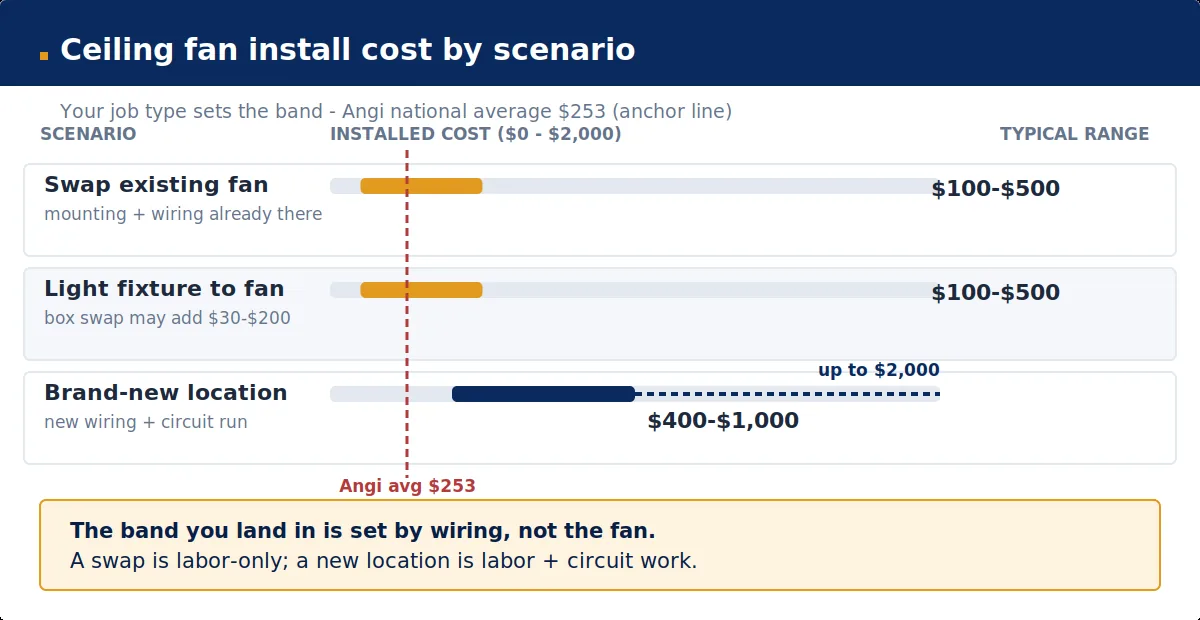
Everything in this guide flows from this framework. Get the scenario right and the price stops being a mystery.
Scenario A — Swap an existing fan ($100–$500 all-in). The box, wiring, and switch are already there from the old fan. Swap labor alone runs $50–$200 (engineerfix), $75–$150 (repairreality), or $100–$200 in under 2 hours (learn.updateblast.com, editorial — directional). Angi’s March 2026 Q&A: $100–$500 all-in. A San Jose contractor quotes swap labor at $100–$300 with work starting at $165 (truservice.co, 2026). Angi’s city pages show how cheap this gets: simple swap-outs run as low as $85 in Dallas and Austin (June 2026). This is the fastest, cheapest, lowest-risk job on the list — and the one every “average” figure leans on.
Scenario B — Replace a light fixture with a fan, existing box ($100–$500 all-in). The ceiling box and wiring exist, but they were built for a light, not a fan — which brings in the box question (next section, and the #1 cost surprise). Labor for this step-up runs $100–$200 (repairreality), and if the box needs upgrading to a fan-rated brace, add $30–$200 (eastsideelectricalwa, October 2026, citing NEC 2023) or $50–$150 (fixupfirst.com, thin source — directional). thespruce prices reinforcement plus a fan-rated box at $75–$250. HomeAdvisor’s basic-install band of $100–$500 (replace simple light with fan plus brace, existing wiring and switches) maps exactly to this scenario.
Scenario C — Brand-new location, new wiring ($400–$1,000 typical; up to $2,000). Open walls, run wires, install boxes, junction-box connections, switches. Angi’s no-wiring guide (May 2, 2026): ~$2,000 all-in, with the electrician at ~$150 for the first hour, then $50–$100 each additional hour. repairreality: new-install-with-new-wiring labor $200–$500, with wiring adding $150–$300. HomeAdvisor: complex installations up to $2,000 (new wiring, boxes, switches, limited access); adding a fan to a pergola or gazebo with wiring needed runs $500–$1,500+ for circuit, switch, and boxes. homeguide (January 25, 2026): new install with new wiring $400–$1,000; new wiring alone $200–$400+. Thumbtack: new circuit $130–$290, new ceiling-fan wiring $6–$8 per foot. If the job is really about getting wire where none exists, the wiring half of the bill belongs in our house rewiring cost guide — same trades, same per-foot economics.
The two-hour rule: homegrail (January 9, 2026 — note its content is 2021-vintage with a 2026 refresh stamp, so treat its bands as soft) puts a typical install at ~2 hours whether it’s a replacement or new work. Labor quotes cluster accordingly: Homewyse’s January 2026 fair-cost estimate books 3.1 labor hours for a full loaded project.
Fan unit vs labor: where the money goes
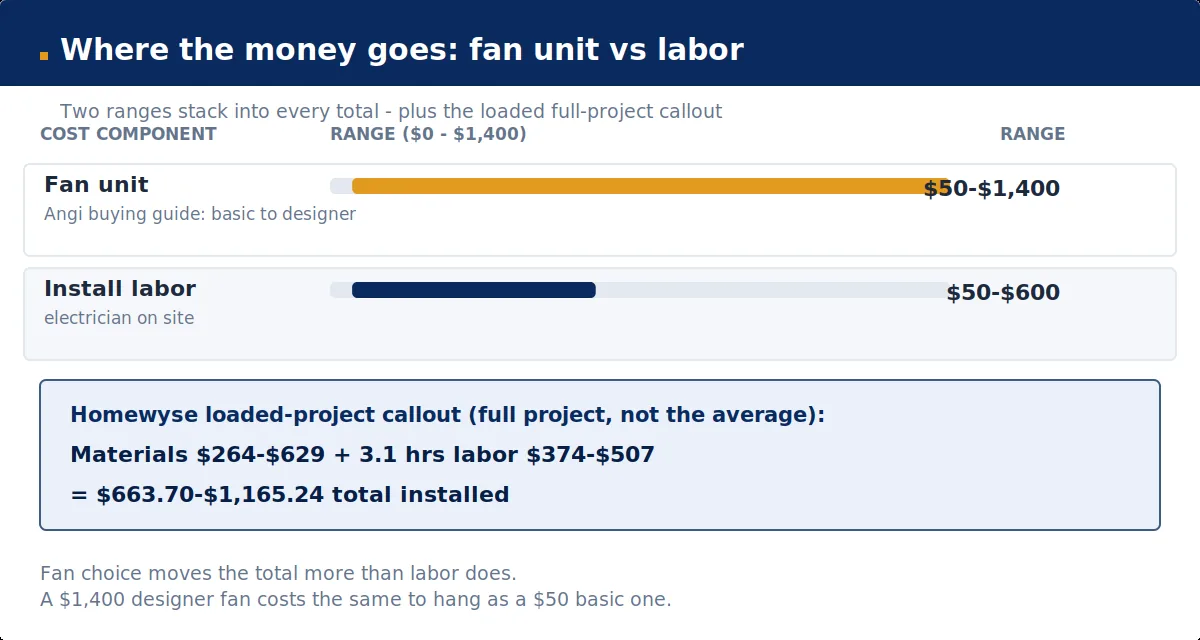
The invoice splits into two buckets that behave very differently: the fan you buy, and the labor someone sells you.
The fan: $50–$1,400. Angi’s buying guide (July 9, 2026) puts fan units at $50–$1,400 with professional installation labor at $50–$600 depending on fan choice and complexity. By retailer tier (learn.updateblast.com, editorial — directional): Home Depot/Lowe’s basics $80–$250, Hunter/Casablanca mid-range $200–$600, Minka-Aire/Big Ass Fans $500–$1,500+. Thumbtack’s 2026 ladder goes wider: basic pull-chain $20–$90, better models with remote $200–$600, high-end $700–$12,000. homeguide: units $50–$500+. repairreality: basic $50–$150, mid-range $150–$350, premium $300–$800.
The labor: $50–$600, usually $100–$300. homeguide: $100–$300 for a replacement, $500+ for complex jobs. This Old House: $50–$200 labor, with simple installs at $100–$300 total and complex at $300–$600+. fixupfirst.com (thin — directional): $75–$200 labor at an existing fan-rated box. homeyou’s customer-reported figures (September 2026) show the loaded-labor end: Central Falls, RI — fan unit $162–$270 plus labor $280–$408 for a total of $466–$704; Rice Lake, WI — total $435–$657. Present those totals, not derived hourly rates: the hour math includes job prep and travel. But notice the pattern — small-market totals running well above Angi’s national average, the inverse of what most readers expect.
Why Homewyse looks so much higher. Homewyse’s January 2026 fair-cost estimate — materials $263.80–$628.51 plus 3.1 hours of labor at $373.53–$506.72, published as a $663.70–$1,165.24 full-project total (a 52-inch 5-blade fan with light kit and remote) — is a loaded full-project estimate: retail materials, mounting hardware, job prep, and cleanup. Angi’s $253 is closer to a labor-plus-basic-fan consumer number. Don’t read Homewyse as “the average install costs $900” — read it as the what-if-you-bought-mid-range-materials-at-retail-and-paid-full-loaded-labor ceiling. GC supervision adds another 13–22%. Both numbers are true; they measure different shopping carts.
Small add-ons that belong in the quote: a ceiling light kit runs $25–$300 (average light kit $35, per Thumbtack); adding a wall switch is $50–$200 extra (homeguide); a remote control kit is $15–$30 (This Old House); an extended downrod is $10–$75 (homeguide). Specialty mounting hardware — angled-ceiling adapters, extra-long downrods — adds $10–$50 (Angi).
Cost by fan type
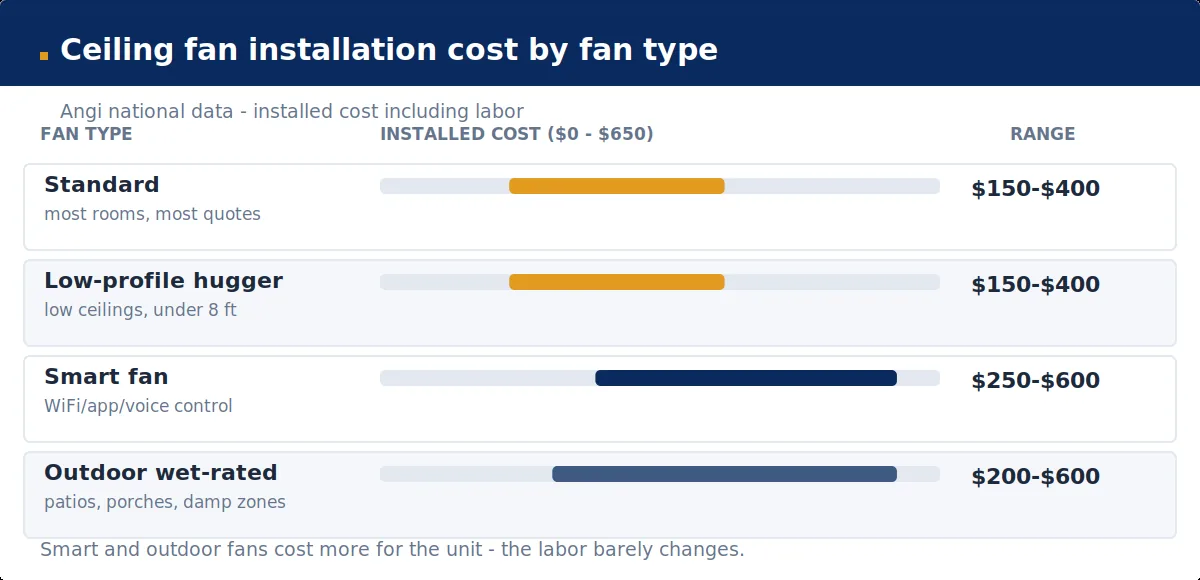
Angi’s national cost-by-type table is the cleanest reference in the category:
| Fan type | Installed cost | Notes |
|---|---|---|
| Standard (basic, indoor, 3–5 blades) | $150–$400 | The default; covers most bedrooms and living rooms |
| Low-profile / hugger | $150–$400 | For ceilings under 8 ft; fan unit $50–$350 (homeguide), $50–$300 (TOH) |
| Smart (Wi-Fi, app, voice) | $250–$600 | Fan unit $120–$1,000 (TOH); labor roughly equal to standard (below) |
| Outdoor / wet-rated | $200–$600 | Porches, patios; fan unit $150–$1,200 wet-rated (TOH) |
The smart-fan labor reality. A smart/Wi-Fi fan installs on the same wiring as a standard fan, so the labor is roughly equal — the premium is in the fan unit ($250–$600 vs $150–$400 for standard, per Angi). Two things to know: smart fans need constant power at the fan for the receiver, and Wi-Fi setup takes 5–10 minutes via app (findingdulcinea, 2026). The budget alternative: universal retrofit controllers like Bond Home or Treo add app and voice control to a standard fan for $50–$150 (findingdulcinea). A smart fan + thermostat combo installed runs $400–$900 (learn.updateblast, editorial — directional). Smart fans typically carry 2–5 year warranties (findingdulcinea). If “not comfortable with electrical work,” findingdulcinea suggests budgeting $150–$300 for professional installation.
Outdoor fans: damp vs wet is the decision. Damp-rated fans suit covered porches, kitchens, and baths — fan units $125–$1,100 (TOH), installed $400–$850 per fan (remodelingexpense, June 25, 2026). Wet-rated fans handle direct rain exposure — units $150–$1,200 (TOH), installed $550–$1,200 (remodelingexpense), which also prices a wet-rated fan upgrade at $150–$700 per fan over an existing mount. Overall outdoor ceiling fan installs: $400–$1,500 per fan (remodelingexpense). Angi’s local Phoenix page puts outdoor/wet-rated at $210–$620. Weather-sealed boxes and rust-resistant hardware are required outdoors — not optional extras.
The running cost is trivial. homeguide: $2–$5/month at 8–12 hours a day. DC-motor fans are up to 70% more energy-efficient than older AC-motor fans (learn.updateblast, editorial — directional). At $2–$5 a month, the fan pays for itself in air-conditioning offset long before anyone models the exact payback.
Blade span and ceiling height move the number. Angi: 29–36 inch spans run $50–$300 (fan only); oversized fans (60 inches+) often require reinforced mounting or a second installer. Vaulted ceilings and outdoor installations take more time, and ceiling height plus fan type drive the labor line. engineerfix: ceilings over 10 ft add $75–$300 for tall ladders or scaffolding. One Santee, CA pro quotes $175–$200 for ceilings under 15 ft and $250 over 15 ft (Thumbtack, 2026) — the high-ceiling premium in a single quote.
The fan-rated box: the line item that matters
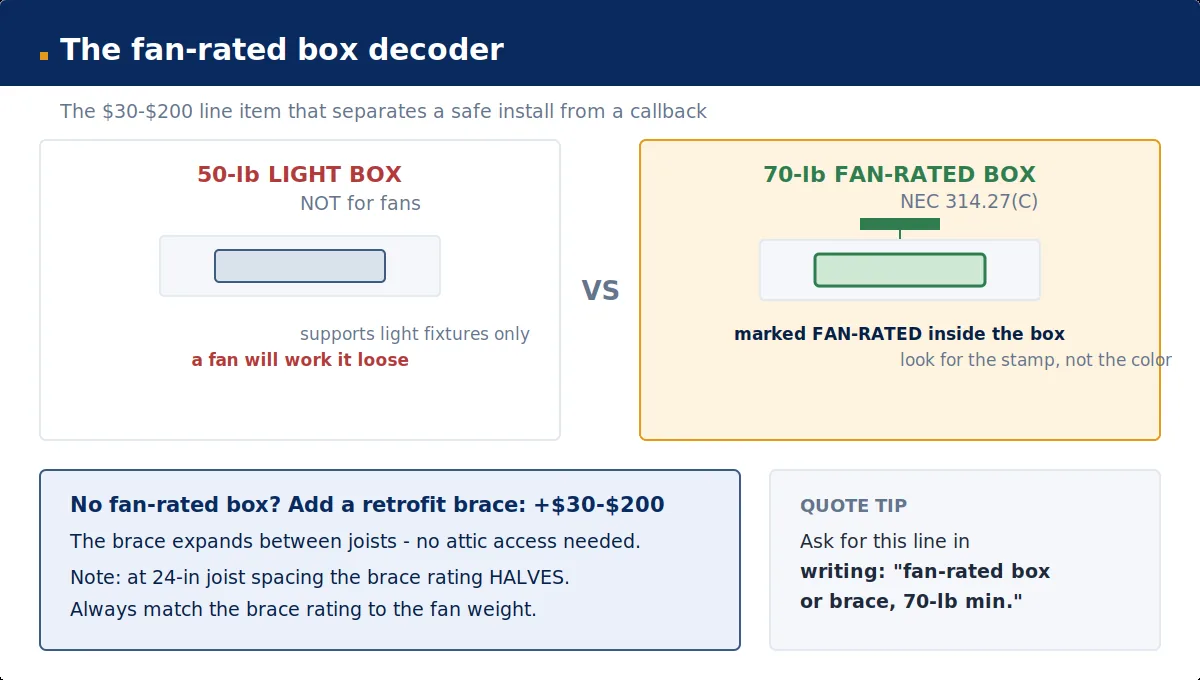
This is the section that saves you the most money and the most risk. A standard light box is built to hold a 2-pound fixture; a ceiling fan spins a 20–50 pound load with vibration, in two directions, for a decade. The code knows the difference.
The rules, from NEC 314.27(C) (via eastsideelectricalwa, October 2026, citing NEC 2023): a standard light box must support at least 50 lbs; a ceiling-fan box must be listed for fan support, marked inside the box, and never carry a fan over 70 lbs (NFPA 70 §314.27(C)). A fan box rated over 35 lbs must be marked with its maximum weight. Brace ratings halve at 24-inch joist spacing vs 16-inch — a brace rated 70 lbs on 16-inch centers is a 35-lb brace on 24-inch centers.
The cost of getting it right. Adding a fan-rated box or brace runs +$30–$200 (eastsideelectricalwa). A Vancouver, WA contractor prices typical installs at $200–$500 per fan when an existing box is in place, notes new locations cost more, and checks the box before every install — swapping non-fan-rated boxes as standard practice (newmanelectricwa, October 2026). remodelingexpense prices fan-rated box installation at $150–$500. A San Jose contractor confirms the ceiling box is fan-rated before hanging every fan (truservice.co).
The red flag. Installers who quote without checking the box are the ones to worry about. Three separate contractor sources — eastsideelectricalwa, newmanelectricwa, and truservice — all describe box verification as a standard pre-install step. If your quote doesn’t mention the box or brace at all, that’s not a simpler job — it’s an unverified one. A quote far below $100 for a swap is the classic tell: at that price, the safety steps got skipped.
One related note for scenario C: a new dedicated 120V circuit for a fan location runs roughly $500–$1,300 in one contractor’s market (eastsideelectricalwa, Greater Seattle — present as a Pacific Northwest example, not a national figure). That kind of work lives in panel-upgrade territory — panel capacity and dedicated circuits are the same trade, same permit logic.
What it costs by region
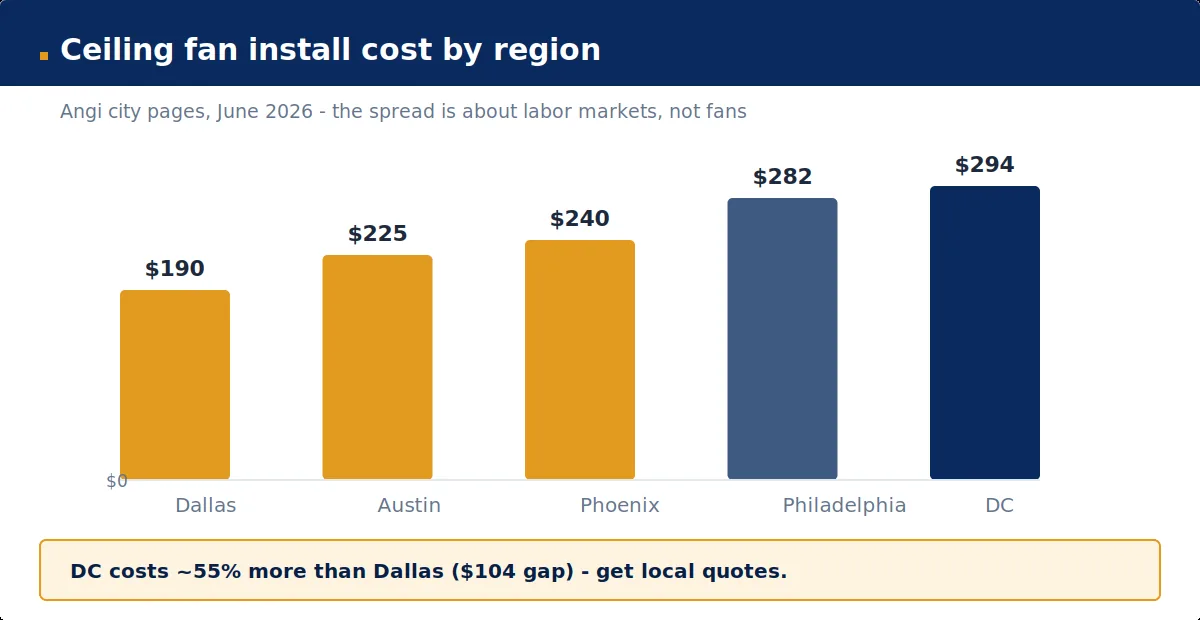
Angi’s five June 2026 city pages give the cleanest regional spread in the category — same methodology, same month, directly comparable:
| City | Average | Range | Notables |
|---|---|---|---|
| Washington, DC | $294 | $174–$432 | Standard $165–$440; smart $275–$655; compact 29–36 in $55–$330 |
| Philadelphia, PA | $282 | $162–$403 | Standard $155–$415; smart $260–$620 |
| Phoenix, AZ | $240 | $137–$350 | Outdoor/wet-rated $210–$620 locally |
| Austin, TX | $225 | $130–$326 | Complex new-wiring jobs reach $600; swaps from $85 |
| Dallas, TX | $190 | $126–$256 | Swaps from $85; standard $155–$415; smart $260–$620 |
The gap from cheapest to priciest: $104, or about 55% — Dallas at $190 vs DC at $294. That’s a bigger regional swing than most readers expect for a one-visit job, and it’s the argument for getting three local quotes instead of trusting a national average. The Austin page shows the scenario split in local form: complex jobs with new wiring or reinforcement reach $600 while simple swap-outs start at $85 — a 7× spread inside one metro.
Two flags on interpretation. First, these are Angi’s consumer-aggregated figures, so the per-city ranges ($126–$256 in Dallas, $174–$432 in DC) matter more than the headline average. Second, homeyou’s customer-reported small-market totals (Central Falls, RI $466–$704; Rice Lake, WI $435–$657, September 2026) run above the national average — proof that “small market = cheap” isn’t a rule. Your three local quotes are the only number that counts.
What’s NOT in the quote
Homewyse, HomeAdvisor, and the junk-removal side of the internet all agree: the quote rarely covers everything. Budget for the exclusions:
- Permits and inspections: $20–$100 permit fees depending on municipality; final inspection $25–$75 (Angi). engineerfix puts the permit band at $20–$150. New wiring triggers these; a straight swap usually doesn’t.
- Sales tax on materials. The fan is a retail purchase; labor-only quotes exclude it.
- Drywall repair after wiring runs. Scenario C opens walls. Most electricians patch roughly or not at all — confirm in writing or budget the patch separately.
- GC markup: 13–22% on the full project if a general contractor supervises (Homewyse).
- Junk removal of the old fan: $50–$90 for a single-item pickup (getwecycle); goloadup quotes ceiling fan pickup from $75 (curbside $70, same-day +$10) — and notes their loaders do NOT unwire fixtures, so it must be detached first. Angi’s removal guide (March 6, 2026): pro ceiling-fan removal $100–$500 depending on type and count.
- Dedicated-circuit work when the new location needs its own run — the $500–$1,300 Seattle example above, a separate line item from the fan install.
How to get a fair quote: 5 red flags
1. No box or brace verification. The #1 cost surprise is also the #1 safety step. If the quote never mentions checking whether the box is fan-rated, the installer isn’t pricing the real job.
2. A handyperson offered for a new-wiring job. Handyperson rates ($50–$150/hr) are fine for a straight swap — Angi’s own guidance says they “may not be equipped to handle complex wiring.” New circuits, new boxes, and panel connections are licensed-electrician work.
3. A lump-sum quote with no line items. Fan, labor, wiring, permit — if they’re not separated, you can’t compare quotes. HomeAdvisor prices a fan with light at $100–$300 and a wall switch at $100–$200 as separate lines; your quote should read the same way.
4. “No permit needed” in a jurisdiction that requires one. New wiring, new boxes, and new circuits trigger permits in most municipalities ($20–$100). An installer who waves that off is planning to skip the inspection.
5. No written scope or warranty — or a price far below $100 for a swap. A quote without a workmanship warranty is a price, not a repair. And at under $100 for a swap, the safety steps — box check, brace verification, balance test — got skipped. Smart fans carry 2–5 year manufacturer warranties (findingdulcinea); the installer’s labor warranty should be in writing alongside it.
The fair-quote playbook: identify your scenario (A, B, or C), get three quotes with identical scope, confirm the box line item, confirm permit responsibility in writing, and check the license number against your state’s board for any wiring work. The cheapest lump sum on an unscoped quote is the most expensive invoice you’ll ever sign.
Sources & methodology
Consumer benchmarks: Angi, “How Much Does It Cost to Install a Ceiling Fan? [2026 Data]” (updated Sep 25, 2026; 9,729 verified projects; $253 average, $146–$360 typical); Angi buying guide (Jul 9, 2026: fan unit $50–$1,400, labor $50–$600; who-to-hire install range $144–$353); Angi Q&A (Mar 19, 2026: replacement $100–$500, new install to $2,000); Angi no-wiring guide (May 2, 2026: ~$2,000); Angi removal guide (Mar 6, 2026); Angi city pages (Jun 12, 2026: DC $294, Dallas $190, Phoenix $240, Philadelphia $282; Jun 11: Austin $225). HomeAdvisor (automation-updated, reviewed by Editor Ryan Noonan: mirrors Angi dataset). Thumbtack (2026: $146–$351, ~$225, $75–$95/hr, Atlanta $175 flat, new circuit $130–$290, wiring $6–$8/ft, Santee CA high-ceiling quote). repairreality.com (Feb 14, 2026: $150–$350 pro install, scenario labor bands, $200–$400 mid-range budget). homeguide.com (updated Jan 25, 2026: units, labor bands, running cost $2–$5/mo). This Old House (2026 guide: ~$250 avg, type and rating bands). Homewyse (January 2026 fair-cost estimate: $663.70–$1,165.24 loaded full-project, materials $263.80–$628.51 + 3.1 hrs labor $373.53–$506.72; outdoor $368.27–$520.00; GC markup 13–22%). Contractor sources: eastsideelectricalwa.com (Oct 22, 2026, NEC 2023/NFPA 70 §314.27(C), box/brace pricing $30–$200, Seattle circuit $500–$1,300 presented as a regional example); newmanelectricwa.com (Oct 2026: $200–$500/fan existing box); truservice.co (San Jose 2026: swap $100–$300). Customer-reported: homeyou (Sep 18, 2026 Central Falls RI $466–$704; Sep 8, 2026 Rice Lake WI $435–$657 — totals presented, hourly math not derived). Directional/thin sources: homegrail.com (Jan 9, 2026 — 2021-vintage content, bands treated as soft); engineerfix.com (labor bands, ceiling-height adder); fixupfirst.com (thin, box add-on); learn.updateblast.com (editorial, retailer tiers, DC-motor claim); findingdulcinea.com (2026: retrofit controllers $50–$150, setup, warranties); getwecycle.com / goloadup.com (removal pricing). EXCLUDED per research flags: all AU/CA/IN figures (service.com.au, connexelectrical, hipages, statewidesparkies, dlgelectrical, aimlocal, buildman.ca, thequoteyard, electricalottawa.ca, ojcommerce, smarthousegears); Bob Vila (Aug 2023 — stale). Tax-credit status: standing project rule per IRS FS-2025-05 (OBBBA, P.L. 119-21).
How much does it cost to install a ceiling fan in 2026?
$253 on average nationally, with most homeowners paying $146–$360 — from Angi’s September 25, 2026 dataset of 9,729 verified projects. Thumbtack (2026) lands close at $146–$351 with most people around $225.
How much does it cost to replace an existing ceiling fan?
$100–$500 all-in, per Angi’s March 2026 Q&A. Swap labor alone runs $50–$200 (engineerfix) or $75–$150 (repairreality), and Angi’s Dallas and Austin city pages show simple swap-outs from $85.
How much does it cost to install a ceiling fan with no existing wiring?
$400–$1,000 typical, up to $2,000 with panel or drywall work (Angi’s May 2026 no-wiring guide; HomeAdvisor). The wiring itself — new circuit $130–$290, wiring $6–$8 per foot (Thumbtack) — is the bulk of the bill, priced like any other rewiring work.
Do I need an electrician to install a ceiling fan?
For new wiring or circuit modifications, yes — HomeAdvisor’s rule is explicit: “You need an electrician to install a ceiling fan if new wiring or circuit modifications are required.” A simple swap can be a handyperson job ($50–$150/hr), but complex wiring belongs to a licensed electrician ($50–$130/hr, per Angi).
Do I need a special electrical box for a ceiling fan?
Yes — a ceiling-fan box must be listed for fan support, marked inside the box, and never carry a fan over 70 lbs, per NEC 314.27(C) (NFPA 70). A standard light box (50-lb rating) can’t legally hold a fan. Adding a fan-rated box or brace runs $30–$200 (eastsideelectricalwa, citing NEC 2023).
How much does an outdoor ceiling fan cost installed?
$400–$1,500 per fan installed (remodelingexpense, June 2026). Damp-rated (covered porches): $400–$850. Wet-rated (direct rain exposure): $550–$1,200. Homewyse’s January 2026 estimate for an outdoor fan is $368.27–$520.00.
Are smart ceiling fans more expensive to install?
The fan is — $250–$600 vs $150–$400 for standard (Angi) — but the labor is roughly the same, since a smart fan installs on the same wiring as a standard fan. The budget alternative: a $50–$150 universal retrofit controller (Bond Home, Treo) adds app and voice control to a standard fan.