


Table of Contents
Drain cleaning costs $95–$825 in 2026, with a national average of $246. Angi’s 2026 dataset (updated Oct 30, 2026; 33,589 verified projects) puts most homeowners between $147 and $352 for a standard visit. The method is the biggest lever on your bill: hand snaking $95–$175, machine augering $250–$375, hydro jetting $350–$825. And there is no federal tax credit for drain cleaning in 2026 — plumbing was never §25C/§25D property.
A clogged drain is one of the most common service calls a plumber runs — and one of the most confusing to price. The same symptom, “the kitchen sink won’t drain,” can cost $95 or $825 depending on three things: where the blockage sits, which method clears it, and what time of day you call. The industry’s own numbers agree on the band — a June 2026 study of 22,000+ residential service calls lands at $95–$825, matching Angi, Thumbtack data, and industry pricing guides almost exactly.
This guide walks the full ladder: what each method costs and when it’s the honest answer, prices by fixture and by line length, the camera-inspection $280-vs-$995 split that confuses everyone, emergency pricing, and the five-year math that settles the DIY-vs-pro question. All prices are professional service prices — this is licensed-plumber work, not a DIY guide.
Drain cleaning cost in 2026: the national answer
Start with the anchors. Angi’s 2026 dataset (updated Oct 30, 2026): national average $246, most homeowners paying $147–$352, from 33,589 verified projects. A Paul Bunyan Plumbing & Drains research study (June 2026), built from 22,000+ residential service calls cross-referenced with national platform benchmarks and BLS wage data, puts most residential calls at $95–$825. Chicago-based Four Seasons (2026) lands at $242 national average; industry pricing data compiled for 2026 shows ~$225–$241 for a standard visit.
The three biggest drivers of any quote, per that June 2026 study: blockage location, cleaning method, and regional labor rates. A single accessible bathroom sink is a different job than a root-choked main sewer line — different equipment, different crew time, sometimes a camera inspection first. Everything that follows is a decomposition of those three drivers.
Industry context: the US septic, drain, and sewer cleaning industry reached $8.7 billion in 2026, up 4.6% in a single year (IBISWorld via industry pricing data). It’s a big, fragmented market — which is why prices vary and why knowing the method ladder protects you from upsell pressure.
The method ladder: snaking vs hydro jetting
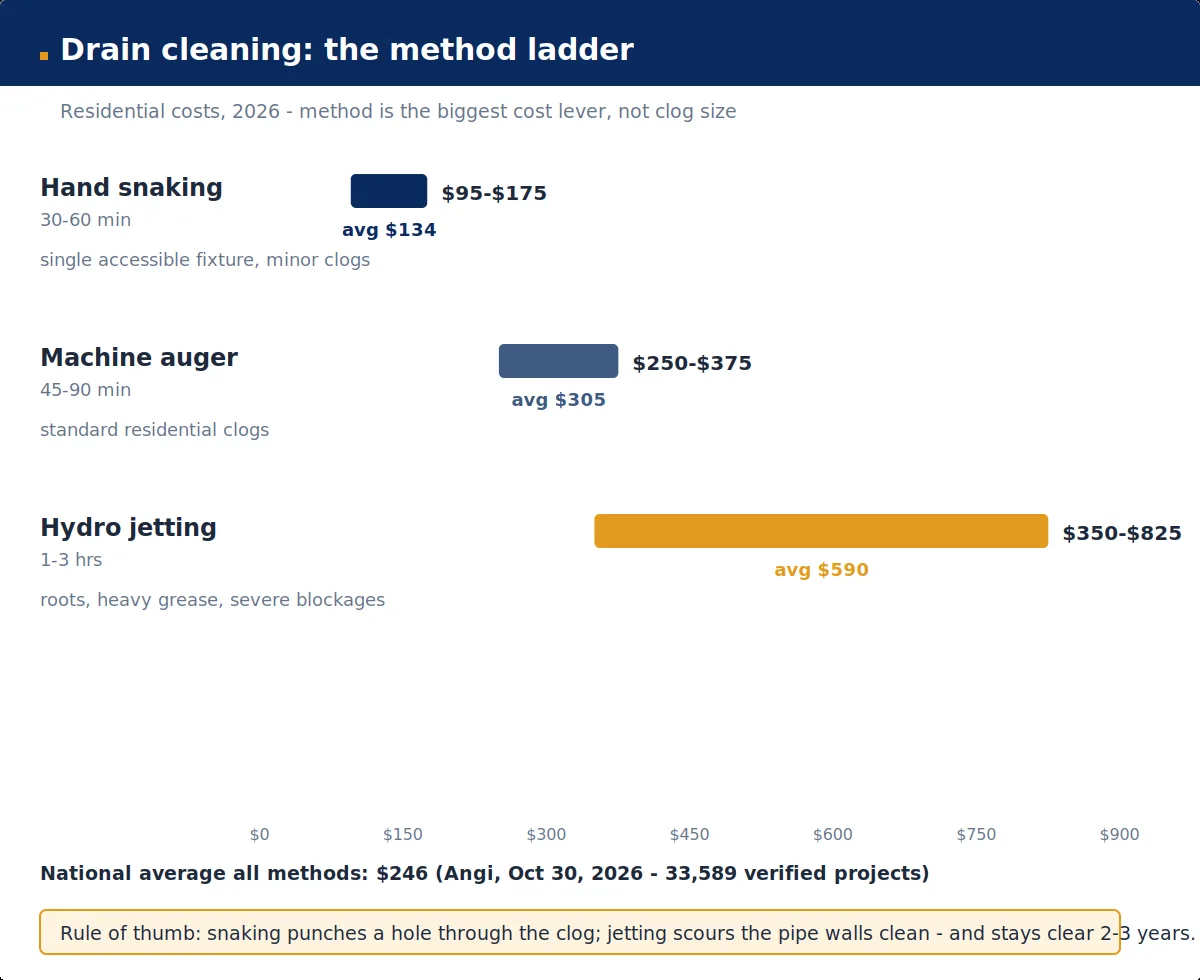
This is the section that matters most, because the method chosen explains more of the price spread than anything else.
| Method | Cost | Avg | Duration | Best for |
|---|---|---|---|---|
| Hand snaking | $95–$175 | ~$134 | 30–60 min | Minor clogs, single accessible fixture |
| Machine auger / power snake | $250–$375 | ~$305 | 45–90 min | Standard residential clogs |
| Hydro jetting | $350–$825 | ~$475–$590 | 1–3 hrs | Severe blockages, roots, heavy grease |
Sources: 2026 industry consensus (directional from content farms, cross-checked against Angi and plumber data); Angi hydro jetting page (updated Oct 23, 2026: avg $475, most pay $350–$600, complex blockages up to $2,000).
Hand snaking is a flexible cable with a cutting head, worked by hand or a small drill — the quick fix for a hair or soap clog in one fixture. Machine augering is the powered version: a motor-driven cable that reaches deeper and chews through tougher obstructions. Paul Bunyan’s own 2026 figures put augering at $150–$275 — below the broader consensus of $250–$375 — so treat their low end as their data, not the national band.
Hydro jetting is a different animal: a high-pressure water stream (no cable, no blade) that scours the entire pipe interior. As a Seattle plumber (ecoServicesWA, Jul 2026) puts it: snaking punches a hole through the clog; jetting scours the pipe walls clean, so it lasts far longer. For a soft one-time clog, snaking is the honest, cheaper answer.
The ladder also explains why phone quotes are unreliable. A shop can’t know which rung your clog needs until a tech sees the line — which is why “how much to unclog a drain” gets answered with a band, not a number, and why the shops that quote a flat $99 over the phone are pricing the cheapest rung and upselling on arrival. The honest answer to “what will it cost” is always “it depends on the method,” and now you know the method ladder they’re working from.
Drain cleaning cost by fixture
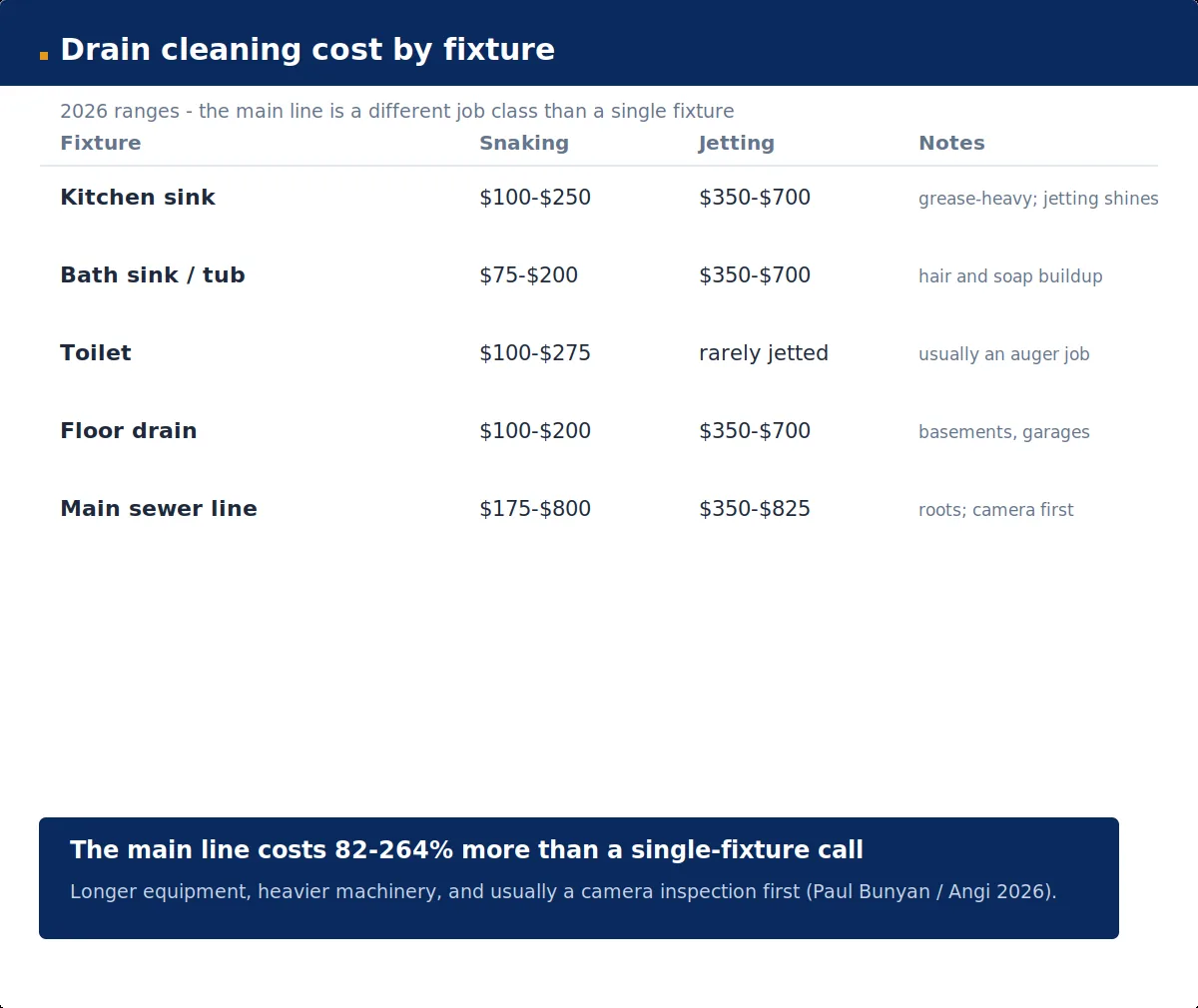
Location drives the quote because it dictates equipment and access:
| Fixture | Typical range |
|---|---|
| Kitchen sink | $100–$250 |
| Bathroom sink / tub | $75–$200 |
| Toilet | $100–$275 |
| Floor drain | $100–$200 |
| Single fixture (overall) | $80–$150 low; $150–$300 typical; $300–$600+ high |
| Main sewer line | $175–$800 typical (Angi snaking from $99); multiple-fixture/main-line $175–$600 (HomeGuide’s published ranges via 2026 cost guides) |
Sources: bestreplyai (2026, fixture-level); roomgic (2026); Four Seasons (2026); Angi (Oct 30, 2026).
The main line costs 82–264% more than a single-fixture call (Paul Bunyan, citing Angi 2026 and C&C Air’s 30,000+ verified calls) — longer equipment, heavier machinery, and often a camera inspection first. Angi’s national average for main sewer line cleaning is ~$380. One caution from Angi’s NYC page (Aug 4, 2026): it shows wide bands like kitchen $150–$500 and bathroom up to $10,000 — those high ends reflect repairs, not cleaning. Use only labeled cleaning figures.
Hydro jetting cost, deep-dive
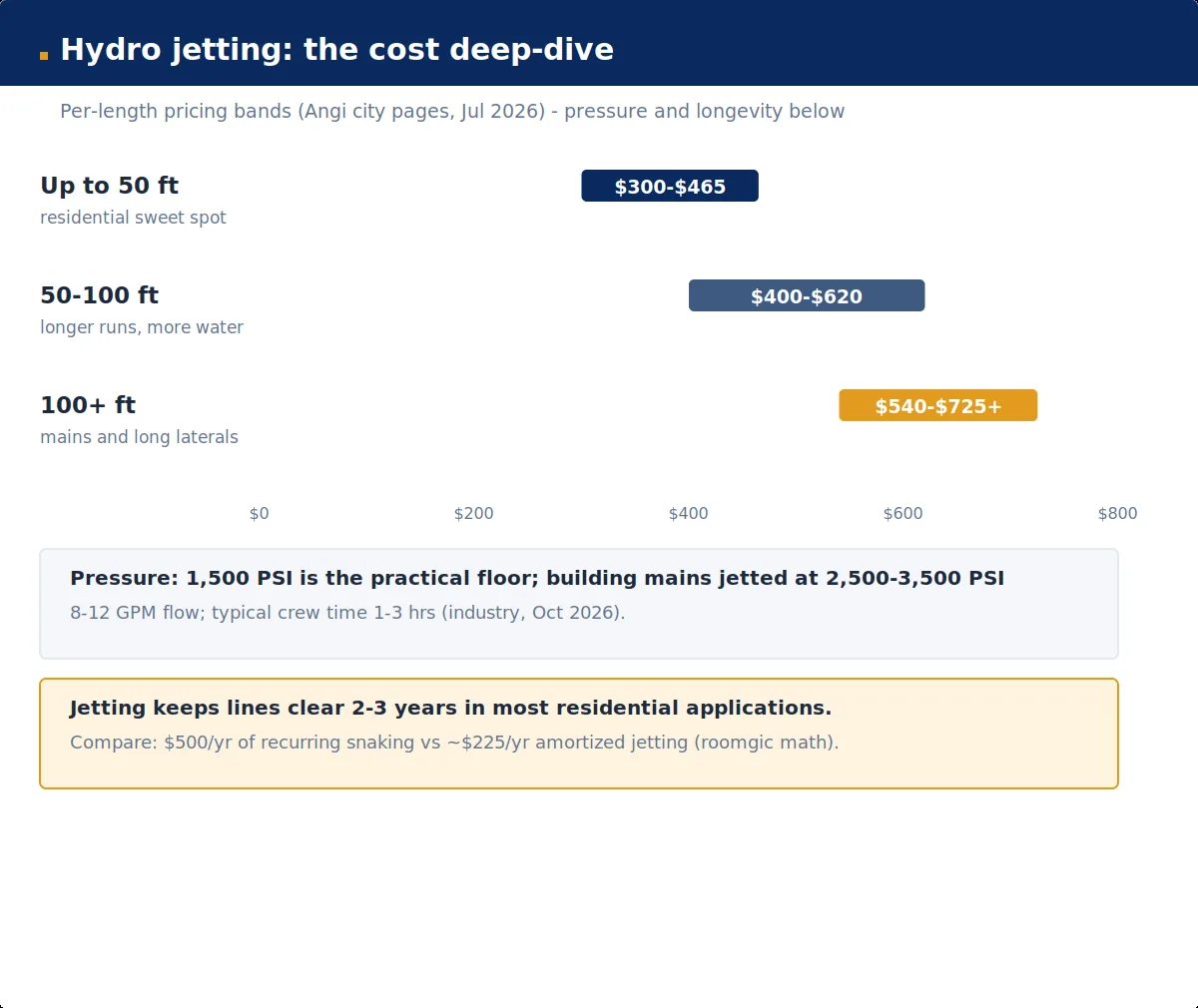
Jetting deserves its own section because it’s where the biggest money — and the biggest upsell pressure — lives.
Per-length pricing (Angi city pages, Jul 9, 2026): up to 50 ft, $300–$465; 50–100 ft, $400–$620; 100+ ft, $540–$725+. Per-linear-foot: roughly $3–$9.75/LF in Austin (Angi), with $150–$250 per 100 ft typical for residential runs. Angi’s city hydro jetting averages (updated Jul 9, 2026) sit in a remarkably tight national band: Austin $466, Phoenix $491, Houston $468, Tampa $479, Detroit $476, Denver $503 — typical ranges $343–$635.
The physics: 1,500 PSI is the practical floor for real cleaning; 3–4″ building mains are jetted at 2,500–3,500 PSI and 8–12 GPM; a typical crew spends 1–3 hours on the job (industry source, Oct 2026). Equipment vendors (HotJet USA, Jul 2026) quote residential $350–$800 per job, tough residential mainlines with roots or heavy grease $600–$1,200, commercial/restaurant work $800–$2,500.
How long it lasts: a thorough jetting typically keeps clogs away for 2–3 years (HomeGuide’s published guidance via a Colorado plumber, Oct 2026; contractor guidance corroborates). That longevity is the economic argument: two snaking visits a year at $250 each is $500/yr of recurring problems, versus one $450 jetting holding two years — $225/yr.
The limit: jetting does NOT repair structural defects. If the pipe is cracked, offset, or collapsed, cleaning restores flow but not the line — and a camera inspection after jetting is common practice (Colorado plumber, Oct 2026). When the camera shows structural damage, the job stops being cleaning and becomes replacement — our sewer line replacement cost guide covers trenchless repair at $150–$250 per linear foot (average $5,800–$10,000, up to 50-year longevity). Context: a 60-foot sewer replacement runs 10–20x the cost of a jetting visit — which is exactly why a camera inspection before big money is worth it.
Camera inspection: the $280-vs-$995 split explained
This is the article’s honesty hook, because both numbers are true and neither is a scam.
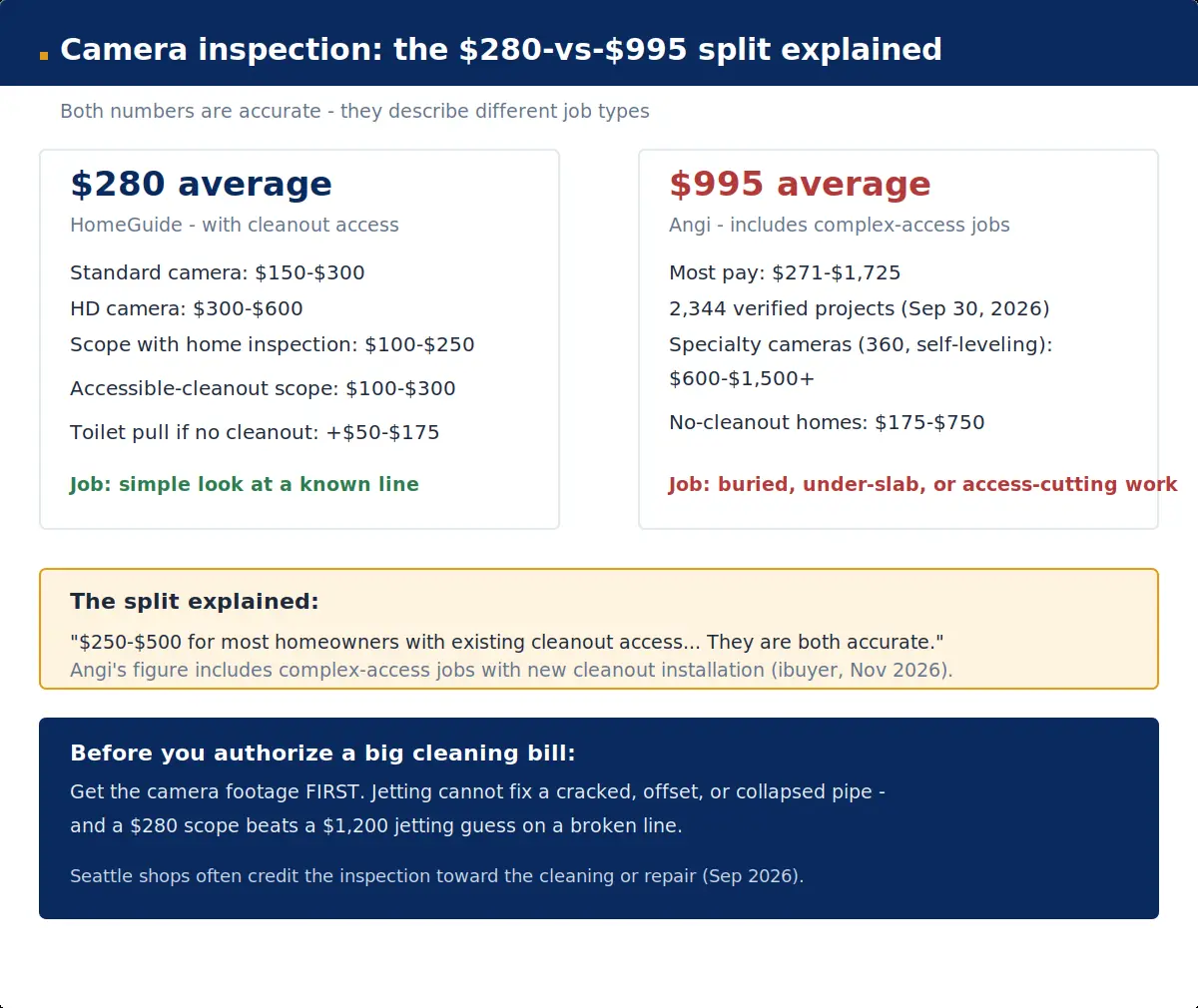
HomeGuide’s published range: $125–$500, averaging $280 (via 2026 cost guides, Mar and Sep 2026). Angi’s 2026 refresh (updated Sep 30, 2026): average $995, most paying $271–$1,725, from 2,344 verified projects. As a Nov 2026 analysis explains: both are accurate — they describe different job types. The typical $250–$500 figure is a scope through an existing cleanout; Angi’s ~$995 average includes complex-access jobs and new cleanout installation.
The access story:
– Existing cleanout access: $100–$300 (scope), $150–$300 standard camera, $250–$500 typical.
– No cleanout: toilet pull adds $50–$175; a home without cleanout runs $175–$750.
– HD / specialty cameras (self-leveling, 360°): $300–$600, up to $1,500 (Angi, Sep 30, 2026).
– Seattle actuals (Ready Rooter, Sep 2026): basic $200–$400; difficult access $375–$750; full-service HD with report $250–$500 — often credited toward the cleaning or repair if you proceed.
Two practical notes: a sewer scope added to a home inspection runs $100–$250 (Sep 2026), and some shops bundle — one Idaho plumber includes a basic camera inspection with a $59 service call.
And HotJet USA notes contractors net roughly 90% margin on a ~$750 jetting job — context for why upsell pressure exists. Get the camera footage before authorizing jetting, not after.
Emergency and after-hours pricing
When water is rising, you don’t negotiate — so know the math before you need it.
Emergency drain service (2026): $150–$400/hr plus a trip fee, with after-hours multipliers of 1.5x–3x (Angi/industry data via 2026 guides). The multiplier ladder: weeknights ~1.5x; late nights (9pm–6am) ~2x; Saturdays ~1.5x; Sundays and holidays 2x–3x. Some shops charge a flat $100–$200 weekend surcharge instead. Trip and emergency fees: Angi $100–$300; Forbes Home’s published data $100–$350, averaging $225.
Emergency drain clearing totals: $200–$600+; single drain $250–$500+; main line $400–$1,200+; a sewer backup with water damage $1,500–$5,000+. Angi’s emergency plumber data (2026): $100–$500/hr, averaging ~$170; holidays up to $600/hr versus standard daytime $45–$200/hr. Chicago actuals (Four Seasons, 2026): emergency $250–$750 versus standard drain cleaning $262–$349.
The practical takeaway: if the drain is slow but not backing up, waiting for business hours can cut the bill in half or more. If sewage is actively backing into the house, don’t wait — the water damage number ($1,500–$5,000+) dwarfs any after-hours multiplier. That’s the real emergency-pricing decision: not the hourly rate, but the cost of waiting.
DIY vs professional: the five-year math
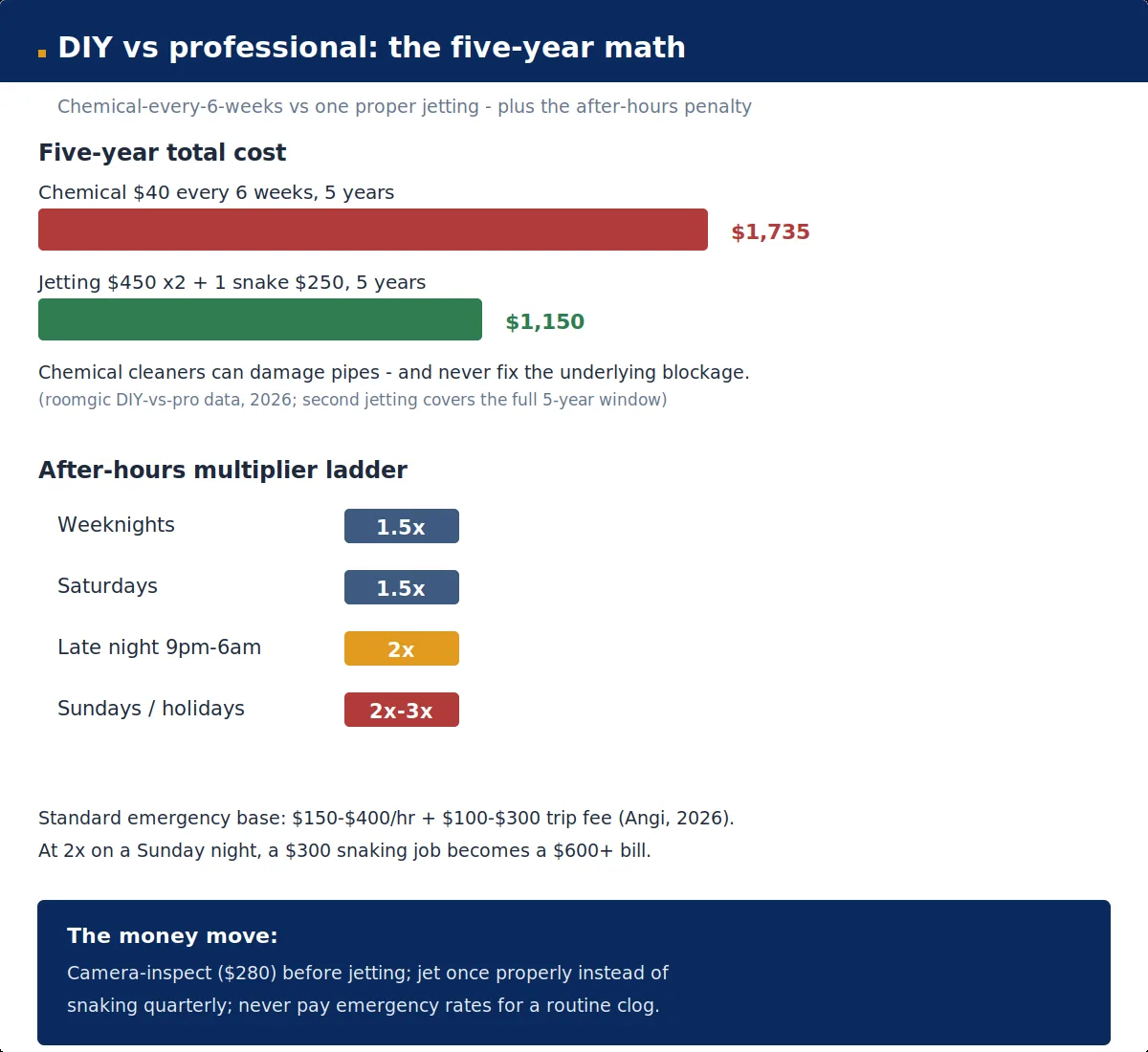
The honest math favors professionals more often than the sticker price suggests. DIY drain products run $30–$50 per incident. Recurring $40 every six weeks comes to $347/yr — $1,735 over five years — versus $400–$600 for a hydro jetting that resolves the issue for 12–24 months. The chemical route also carries a real cost beyond money: chemical drain cleaners can damage pipes (factual warning from 2026 industry guidance), particularly older metal and PVC lines.
This article contains zero DIY plumbing instructions by design — drain work beyond a plunger is licensed-plumber territory, and the pricing math above is exactly why. For the drainage-adjacent side of the house, our sump pump installation cost guide covers the basement side of water management, and our whole-house repipe guide explains the supply-vs-drain distinction: repipes cover pressurized supply lines only; drains are a separate system.
What drives your quote
Four variables, in order of impact:
- Blockage location. Main line vs single fixture is the 82–264% swing. Inside the house vs the buried lateral is the next tier. A kitchen sink clog 15 feet from the cleanout is a 45-minute job; a root intrusion 80 feet out in the yard is a half-day with a jetter and a camera.
- Cleaning method. The $95–$825 ladder — hand snake to jetting — is the single biggest lever. Most honest plumbers start with the cheapest method that fits the symptom and escalate only if the camera or the cable says so.
- Regional labor rates. Rural simple drains $95–$220; suburbs $100–$290; high-cost urban $150–$400 simple, $450–$1,200 for jetting. NYC averages $646 (Angi, Aug 4, 2026) — labeled as a high-cost metro, not the national picture. Seattle runs $250–$750 typical (ecoServicesWA, Jul 2026); Chicago $95–$900 with standard calls averaging $262–$349 (Four Seasons, 2026).
- Access and timing. Cleanout access vs toilet pull; weekday vs 2am Sunday. A missing cleanout doesn’t just add the $50–$175 toilet pull — it adds diagnostic uncertainty, because the plumber can’t see what they’re dealing with until the camera goes in.
One more cost driver people underestimate: repeat-visit economics. A shop that prices snaking at $150 knows many of those jobs come back. That isn’t necessarily dishonest — some clogs genuinely recur — but it’s why the quote conversation should always include “what happens if this doesn’t hold,” and why the jetting-vs-snaking math in this guide matters before you authorize anything.
The house rewiring cost guide is a useful parallel read on how licensed-trade quotes are structured — same access-and-labor logic, different trade.
When cleaning isn’t enough
Cleaning restores flow; it doesn’t restore pipe. The signs the job has moved past cleaning: recurring clogs in the same line within months, a camera showing cracks, offsets, root intrusion at joints, or a collapsed section. At that point the economics flip — repeated $400–$600 cleanings against a line that will keep failing.
There’s also the damage math to consider. A sewer backup that reaches finished space doesn’t just cost a cleaning visit — water damage restoration from a burst runs $1,350–$6,225 (Angi’s editorial model), and a sewer backup with water damage can total $1,500–$5,000+ on the emergency side. One bad backup can exceed the cost of the camera inspection and preventive jetting that would have caught the failing line. The cheapest cleaning is the one that happens before the backup.
That’s the replacement decision, and it’s a different price universe: trenchless sewer repair $150–$250/LF, averaging $5,800–$10,000 with up to 50-year longevity (2026 industry data). The full treatment — dig vs bursting vs CIPP, the responsibility boundary at the tap, the $30–$50/yr service-line endorsement — is in our sewer line replacement cost guide.
How to get a fair quote
Four rules that protect you in a fragmented $8.7B market:
- Get the camera footage before authorizing jetting. A $280 scope can save you from an unnecessary $600 jetting — or prove the jetting is the right call. Ask to see the footage yourself; a reputable tech will show you the screen.
- Compare method, not totals. A $250 snaking quote and a $600 jetting quote are different jobs. Make sure both plumbers are pricing the same method for the same line. If one shop recommends jetting and another recommends snaking for the same clog, the camera footage is the tiebreaker.
- Get access and extras in writing. Cleanout vs toilet pull, camera fee, trip fee, after-hours multiplier — all before work starts. The written scope is where most drain-service disputes start, and where they’re prevented.
- Ask what the jetting includes. Some shops bundle a post-cleaning camera check; some charge separately. Some include a 30- or 90-day re-clog warranty; most don’t unless asked. The warranty question costs nothing to ask and tells you a lot about the shop.
And when you get two or three quotes — which you should for anything over $500 — compare the written scopes line by line, not the bottom-line numbers. The cheapest quote with the thinnest scope is usually the most expensive job you’ll ever buy twice.
One last note for readers arriving from our energy guides: there is no federal tax credit for drain cleaning in 2026 — plumbing was never §25C/§25D property, and OBBBA ended those credits for homeowner installs anyway. The full incentive picture is in our 2026 federal energy tax credits guide.
Sources & methodology
National benchmarks: Angi, “How Much Does Drain Cleaning Cost? [2026 Data]” (updated Oct 30, 2026; 33,589 verified projects), “How Much Does Hydro Jetting Cost? [2026 Data]” (updated Oct 23, 2026), “How Much Does a Sewer Camera Inspection Cost? [2026 Data]” (updated Sep 30, 2026; 2,344 projects), Angi city hydro jetting pages (updated Jul 9, 2026) and Angi NYC drain cleaning page (Aug 4, 2026). Research study: Paul Bunyan Plumbing & Drains (June 2026; 22,000+ service calls). Local 2026 plumber actuals: ecoServicesWA (Seattle, Jul 2026); Four Seasons (Chicago, 2026); Ready Rooter (Seattle, Sep 2026); Drainline Services (Parker CO, Oct 2026); Elkhorn Plumbing (Idaho). Industry data: IBISWorld (via industry pricing data, 2026); HotJet USA (equipment vendor, Jul 2026); industry pressure/crew-time guidance (Oct 2026). HomeGuide’s published ranges via 2026 cost guides (aggregators, secondhand — attributed as such). AI-spam farm numbers (roomgic, familylifespace, bestreplyai) used directionally only, cross-checked against Angi and plumber data. Toronto CA$ figures excluded. Tax-credit status: standing project rule per IRS FS-2025-05 (OBBBA, P.L. 119-21).
How much does drain cleaning cost in 2026?
$95–$825 for most residential calls, with a national average of $246 — from Angi’s Oct 30, 2026 dataset of 33,589 verified projects. Most homeowners pay $147–$352 for a standard visit. The method chosen (hand snake vs machine auger vs hydro jetting) is the biggest cost lever.
How much does hydro jetting cost?
$350–$825 for residential work, averaging $475 (Angi, Oct 23, 2026) to ~$590 (industry consensus). Most homeowners pay $350–$600; complex blockages with roots or heavy grease reach $1,200–$2,000. Per-length pricing: up to 50 ft runs $300–$465, 50–100 ft $400–$620, 100+ ft $540–$725+.
Is hydro jetting worth it vs snaking?
For recurring or severe blockages, yes. Snaking punches a hole through the clog; jetting scours the pipe walls clean, and a thorough jetting typically keeps lines clear for 2–3 years. The math: two $250 snaking visits a year ($500/yr of recurring problems) versus one $450 jetting holding two years ($225/yr). For a soft one-time clog, snaking is the honest, cheaper answer.
How much does a sewer camera inspection cost?
$125–$500, averaging $280, for a scope through an existing cleanout (HomeGuide’s published ranges via 2026 cost guides). Angi’s 2026 refresh averages $995 from 2,344 projects — but that figure includes complex-access jobs and new cleanout installation. Both numbers are accurate; they describe different job types. Never let anyone average the two.
Why do camera inspection prices differ so much?
Access. A scope through an existing cleanout runs $100–$300; a home without cleanout access needs a toilet pull ($50–$175 extra) and runs $175–$750; HD or specialty cameras add $300–$1,500. Some shops credit the inspection toward the cleaning or repair if you proceed.
How much extra does emergency drain cleaning cost?
After-hours multipliers of 1.5x–3x: weeknights ~1.5x, late nights ~2x, Sundays and holidays up to 3x. Emergency drain service runs $150–$400/hr plus a $100–$300 trip fee. Emergency clearing totals: $200–$600+ for a single drain, $400–$1,200+ for a main line.
Can chemical drain cleaners damage pipes?
Yes. Industry guidance confirms chemical drain cleaners can damage pipes — particularly older metal and PVC lines. Beyond the damage risk, the five-year math is poor: $40 every six weeks is $1,735 over five years, versus $400–$600 for a professional hydro jetting that resolves the issue for 12–24 months.