

Sump pump installation cost in 2026 runs $800–$2,000 installed, with a national average near $1,200. Angi (updated Aug 9, 2026) puts professional installation at $800–$3,000, averaging ~$1,100; This Old House’s 2026 guide averages ~$1,400 on a $500–$4,000 range; Modernize (updated Aug 12, 2026) lands at $200–$4,000 with most homeowners near $1,200. Replacing a pump in an existing pit is a different, cheaper job — Angi’s Oct 17, 2026 dataset prices it at $309–$755, averaging $531 across 5,044 verified projects. And there is no federal tax credit for sump pumps in 2026 — this is a plumbing purchase, not energy equipment.
Table of Contents
A sump pump is the cheapest catastrophic-loss prevention in a basement. It sits in a pit, waits for groundwater, and ejects it through a discharge line before the floor gets wet. The pump itself is rarely the expensive part. The excavation, the discharge routing, the electrical work, and the backup system are where a $200 box turns into a $2,000 invoice.
Three traps define this market. First, replacement quotes and new-install quotes look similar but aren’t — a $531 average replacement (Angi, Oct 17, 2026) and a $1,200 average new install are two different jobs, and many cost guides mix them. Second, the battery backup is where the math gets murky: batteries last 3–5 years and cost $150–$300 to replace, so the “backup” has a running cost nobody quotes upfront. Third, the outage question is the real one — the storm that floods you is the same storm that kills the power, which is why the battery-vs-water-powered decision matters more than the pump brand.
This guide prices every pump type installed, decomposes the invoice into pit vs pump vs circuit, settles the battery-vs-water-powered backup question, prices repair vs replacement, and does the flood math against what your homeowners insurance will actually pay — which is usually nothing.
Sump pump installation cost in 2026: the ladder
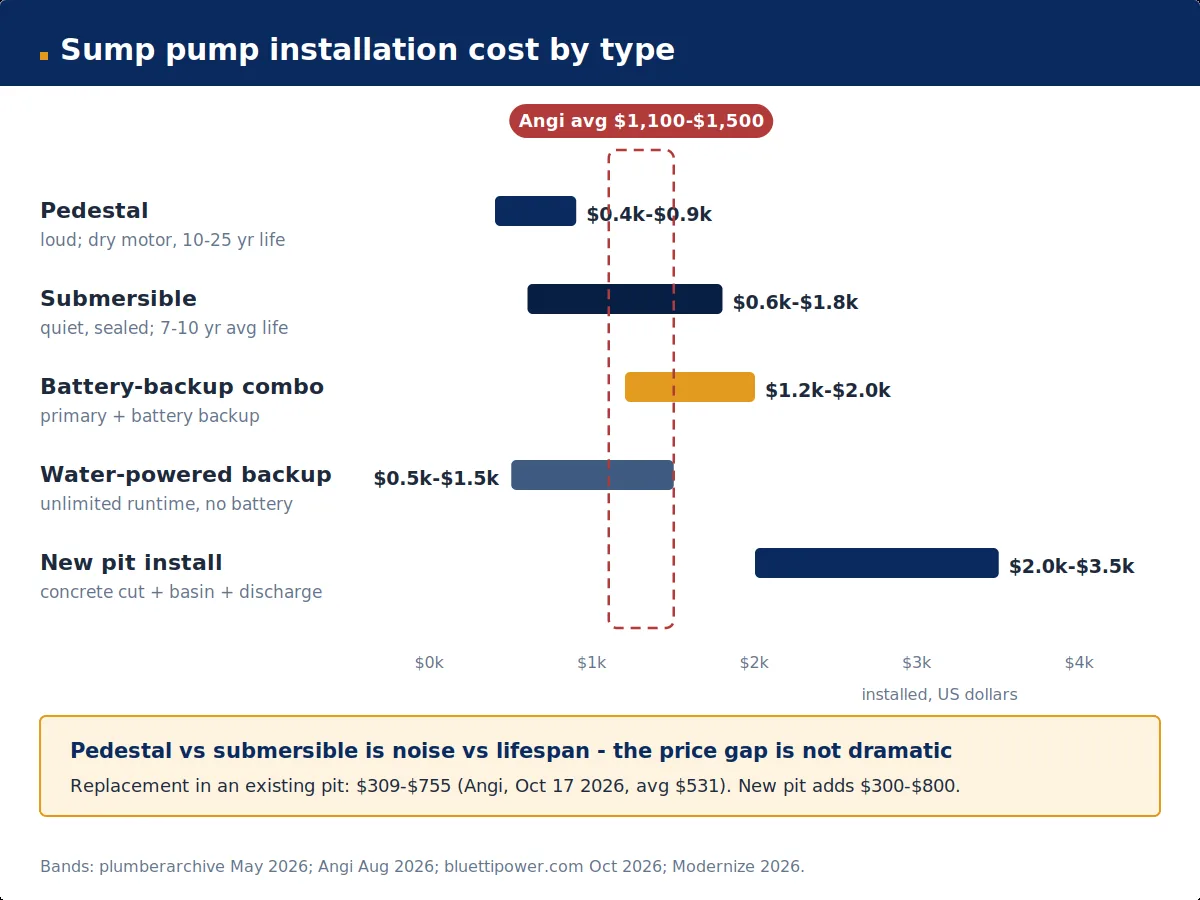
The ladder runs from the cheapest pump swap to a full new-pit install with backup. Where you land depends on two things: whether a pit already exists, and whether you add backup power.
| Scenario | 2026 installed range | What it is |
|---|---|---|
| Pedestal pump + professional install | $400–$900 | Motor sits above the pit, easier service; loudest option |
| Submersible pump + professional install | $600–$1,800 | Motor sits in the pit; quieter, handles debris better |
| Replacement in an existing pit | $309–$755 (avg $531) | Unit swap only — pit, discharge, and wiring already exist |
| Battery backup add-on (added to a primary) | $300–$700 | Secondary DC pump + battery + charger |
| Submersible + battery backup together | $1,200–$2,000 | The standard “never floods” package |
| Water-powered backup installed | $500–$1,500 | Uses municipal water pressure; unlimited outage runtime |
| New pit excavation + install | $2,000–$3,500 | Concrete cut, basin set, discharge line — no existing pit |
The national anchors agree within a few hundred dollars: Angi $800–$3,000 (avg ~$1,100, Aug 9, 2026); nearbyhunt.com $800–$3,000 (avg $1,100–$1,400); This Old House ~$1,400 on a $500–$4,000 range; Modernize $200–$4,000 (most ~$1,200, Aug 12, 2026). The wide ranges come from the pit question — a replacement in an existing pit and a new install are priced by different mechanisms, and sources that blend them produce the $200–$4,000 sprawl.
Pedestal vs submersible: the cost trade. Pedestal pumps are the cheapest to buy and install: $400–$900 installed (plumberarchive, May 2026), with unit prices from $60–$170 (Angi) to $100–$400 (HomeGuide). The motor sits above the pit — louder, but the dry motor is why pedestals live 10–15 years, up to 20–25 years by Angi’s read. Submersible pumps run $600–$1,800 installed, with units from $100–$400 (Angi) to $90–$1,000 (Modernize). They cost more and live shorter — 5–15 years, averaging 7–10 (HomeGuide, Oct 2026) — but they sit sealed under the lid, run quieter, and handle debris and higher inflow. The price gap is real but not dramatic; the decision is noise vs lifespan, not budget.
The HP sizing ladder. A 1/3 HP pump is standard residential. A 1/2 HP unit suits higher inflow or flood-prone homes — Basement Watchdog’s 1/2 HP units run $200–$300 (basementcalculator), and Kansas City retail in 2026 prices a standard 1/3 HP swap at $985 vs an upgraded 1/2 HP swap at $1,292 (callbrightside.com, Sep 2026 — Kansas City market, labeled local). Bigger HP buys gallons-per-hour, not quality: the Wayne WBPS50 smart system moves up to 5,100 GPH with a 25 ft lift, while the Basement Watchdog Big Combo does 4,400 GPH at 0 ft and 3,540 at 10 ft on the primary, plus 2,890/2,150 on the backup.
Sump pump installation cost, decomposed: where the money actually goes
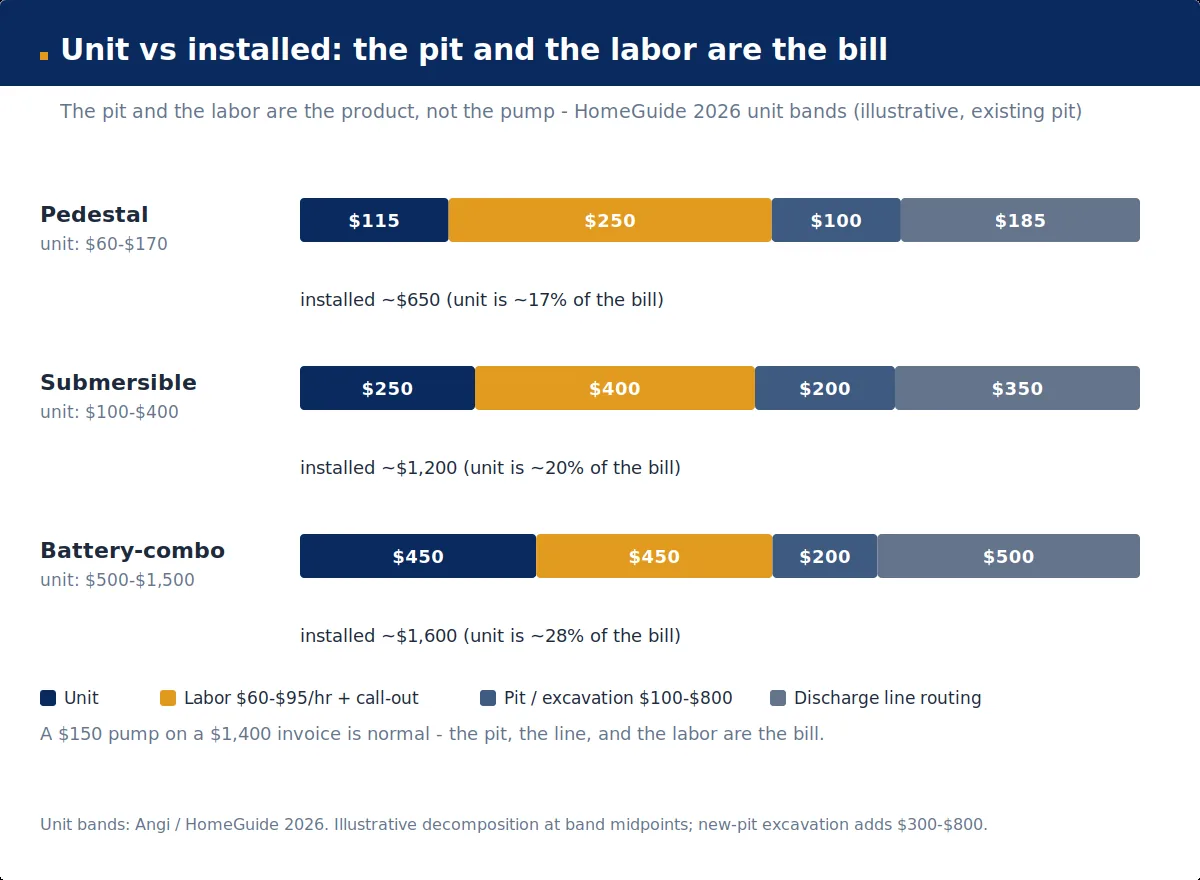
The single most misunderstood line on a sump pump quote is the pump price. HomeGuide 2026 unit-only bands: pedestal $60–$170; submersible $100–$400. Then the installer adds the rest. A $150 pump on a $1,400 invoice is normal — the pit, the line, and the labor are the product, not the pump.
The pit is the cost driver. Excavating a new pit — cutting the concrete slab, setting the basin, routing the discharge line — adds $300–$800 on top of a pump install (plumberarchive, May 2026). That’s the swing between a $531 average replacement and a $1,200+ new install. basementcalculator’s Sep 30, 2026 breakdown shows the math precisely: a new install with a 20 ft discharge line runs $2,630 pro vs $890 DIY; add backup and a new outlet and it becomes $3,780 pro vs $1,690 DIY; a replacement in an existing pit is $660 pro vs $310 DIY. Salt Lake County plumbers price new sump pit installs at $1,450–$2,850 in 2026 (valleyplumbing.com — Salt Lake County market, labeled local), and Kansas City retail puts a full new-pit install with a 1/2 HP pump at $5,200 (callbrightside.com, Sep 2026 — Kansas City market, labeled local). Same job, different markets, very different labor rates.
The electrical line. A sump pump must sit on a GFCI-protected outlet — 2023 NEC requires it for the appliance and for any outlet in a basement or crawl space. Many pros also recommend a dedicated circuit, so a space heater or freezer on a shared line can’t trip the breaker and stop the pump mid-storm. Angi (updated Oct 30, 2026) prices a new dedicated circuit at $570–$1,000. If the pit location has no outlet at all, that electrical line item is real money — and it’s licensed-electrician work, not a plumber’s add-on. When the quote already needs electrical work plus panel space, see our electrical panel upgrade cost guide for the panel-side numbers.
Labor math. Plumbing labor for sump work runs $60–$95/hr plus a $75–$150 call-out minimum (plumberarchive); Angi’s range is $45–$200/hr (Oct 2026). This Old House puts total labor at $300–$4,000 depending on whether a basin already exists — that single variable explains the entire national range.
Sump pump installation cost with battery backup: the outage question
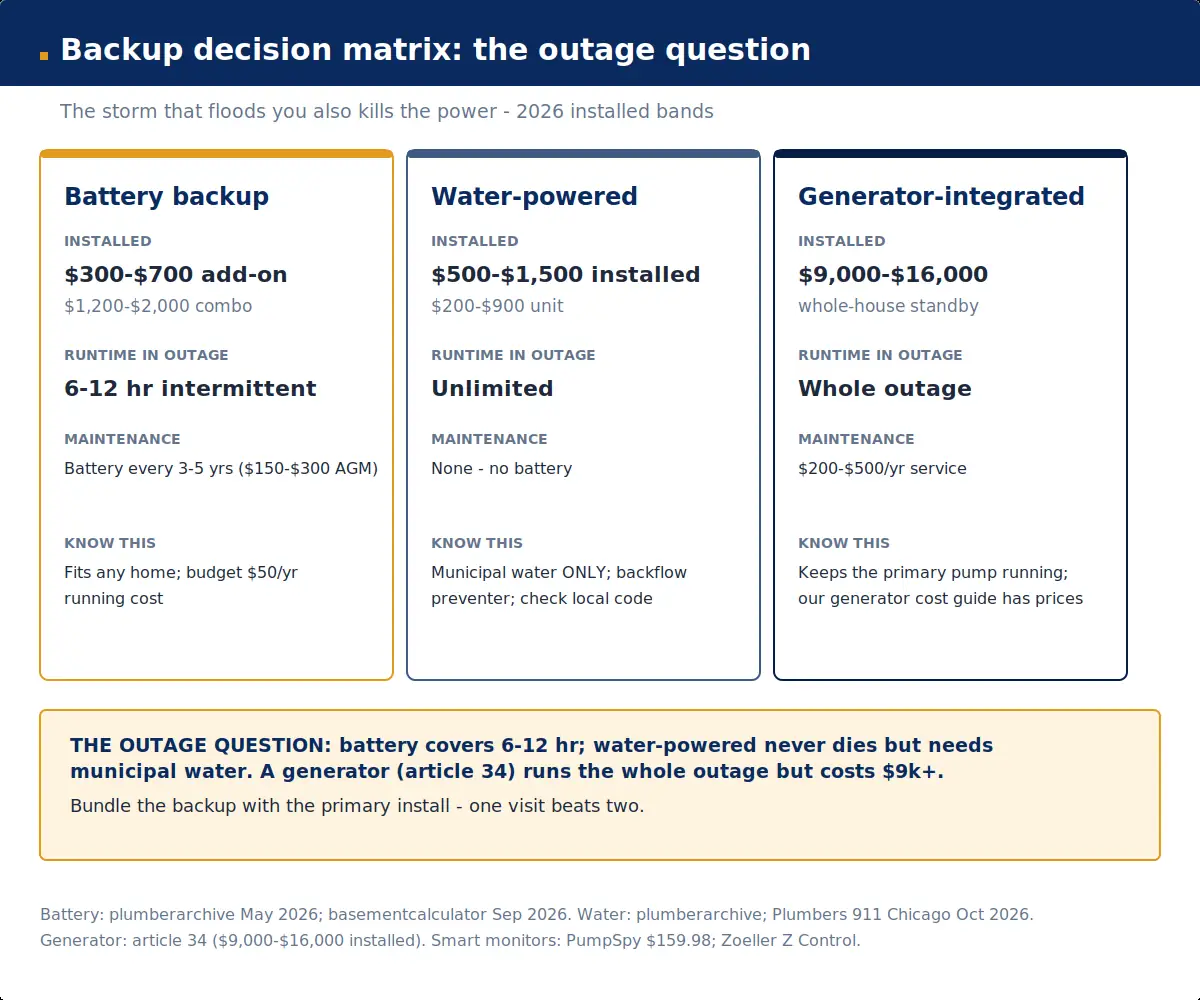
The pump that floods your basement fails in exactly one scenario: the power dies during a storm while the pit keeps filling. That is why the backup decision matters more than the primary pump brand. Three backup architectures exist, and they cost and behave very differently.
Battery backup: $300–$700 added to a primary; $1,200–$2,000 for the full combo. A battery backup add-on alongside an existing primary runs $300–$700 (plumberarchive) to $400–$700 (basementcalculator); a full battery backup system installed lands at $600–$2,000+ (HomeGuide). Plumbers 911 Chicago (Oct 2026, labeled local) prices a battery-backup system at $800–$1,500 installed and a combination primary + battery package at $1,500–$2,500. As a standalone add to an existing pit: $600–$1,500 professionally, pushed to $1,500–$2,500+ when the job needs pit modifications, discharge changes, or new electrical work (bluettipower.com, Oct 2026). Angi’s 2026 battery-backup data (via bluettipower) puts professional backup installs at $600–$1,200, with many complete jobs at $640–$2,000.
The hidden cost of battery backup is the battery itself: an AGM deep-cycle replacement every 3–5 years at $150–$300 (basementcalculator), and the battery is almost never included in the pump’s unit price. Budget $50/yr as the running cost of the backup. Runtime on a full charge is roughly 6–12 hours of intermittent pumping depending on inflow — enough for most outages, not all of them.
Water-powered backup: $500–$1,500 installed, unlimited runtime. A water-powered backup pump uses municipal water pressure to eject pit water — roughly 1–2 gallons of municipal water per gallon pumped. Installed cost: $500–$1,500 (plumberarchive), or $600–$1,200 (Plumbers 911 Chicago, Oct 2026 — labeled local); unit-only $200–$900 (Modernize) / $250–$400 (basementcalculator). Advantages: unlimited runtime during outages, no battery to replace. Hard constraints: it does NOT work on well systems, it needs a backflow preventer, and you must verify local code acceptance before assuming it’s legal in your municipality. A Chicago read prices primary + water-powered backup at $2,100–$3,700 (plumbers911chicago, Oct 2026 — labeled local).
The decision framework. Battery backup wins for: homes with reliable municipal power that goes out for hours, not days; owners willing to replace a battery every 3–5 years; anyone on a well. Water-powered wins for: homes with municipal water, long outages, or owners who want a backup with zero maintenance. The premium option — a whole-house generator powering the primary pump — is priced in our whole house generator cost guide; it turns the backup question into a whole-home answer at $9,000–$16,000.
2026 retail anchors for the smart-battery corner: Basement Watchdog CITS-50 Big Combo CONNECT (primary + battery system) $469 — Wi-Fi module sold separately; Zoeller 508-0014 Aquanot Fit 12V battery backup $677.06 with built-in Wi-Fi and Zoeller Z Control Cloud; Wayne WBPS50 1/2 HP smart sump $999 — battery NOT included, includes Wi-Fi radio, app alerts, and primary + backup pumps (smarthomeexplorer.com, Oct 2026).
Sump pump installation cost of repair vs replacement: the 7-year and 50% rules
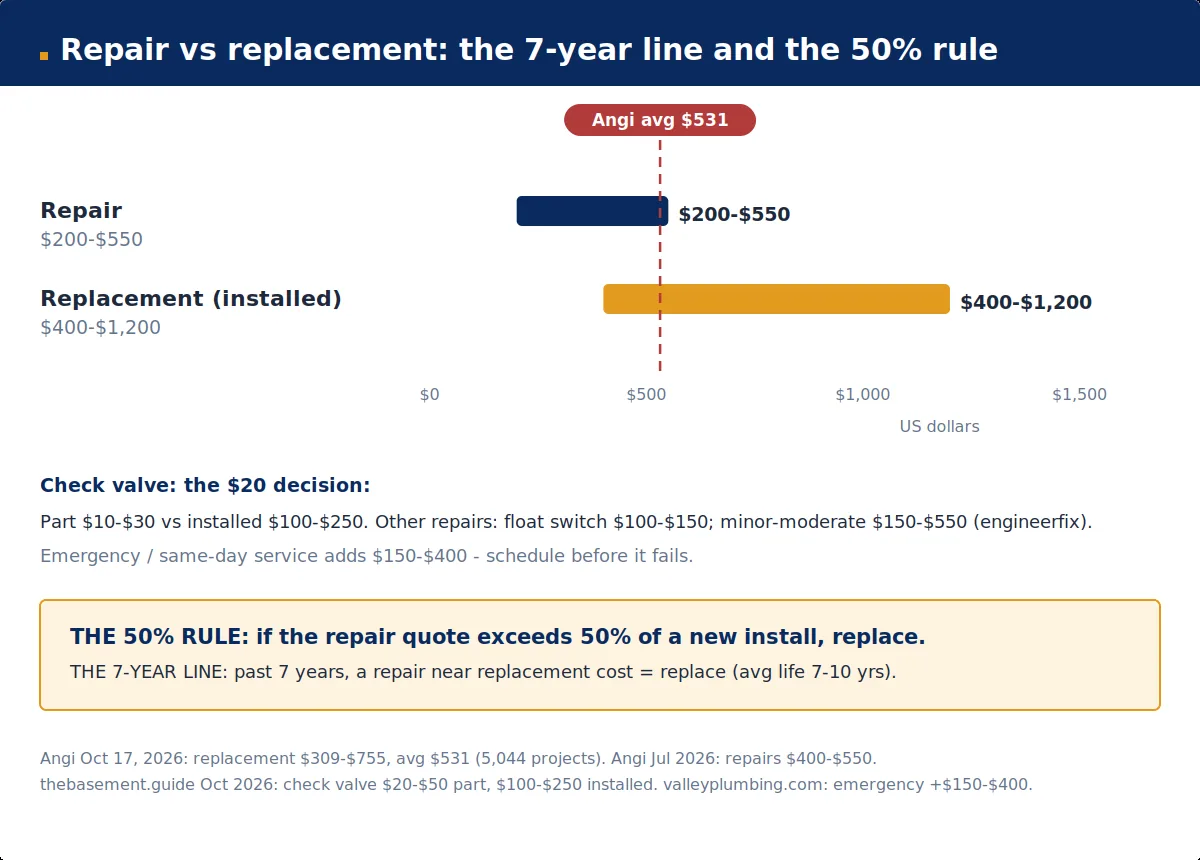
Professional sump pump repairs run $400–$550 (Angi, Jul 15, 2026). Common repairs land at $100–$350 installed (thebasement.guide, Oct 2026) or $150–$550 minor-to-moderate (engineerfix.com). HomeGuide’s repair page lists $200–$870 averaging $540 — but that page was last updated Feb 2026, so treat it as range confirmation only; the Angi Jul 2026 and thebasement.guide Oct 2026 numbers are the fresh anchors.
The two line items that make up most repair calls: the check valve and the float switch. A check valve is a $10–$30 part (HomeGuide) — but professional replacement costs $100–$250 (thebasement.guide), $75–$200 (Kansas City), or $125–$200 (engineerfix) because it’s an hour of plumber time. A float switch replacement runs $100–$150 professionally (engineerfix), $75–$125 (Kansas City), or $100–$250 (Lakewood CO). The part-to-labor ratio is the story: the parts are cheap, the visit is not.
The two rules that decide the repair call:
- The 50% rule: if the repair costs more than half the price of a new pump and the unit is past 7 years old, replace it (Kansas City plumber; thebasement.guide; Lakewood CO).
- The 7–10 year line: average pump lifespan is 7–10 years (HomeGuide, Oct 2026). Submersibles run 5–15; pedestals run 10–15 by HomeGuide’s read, up to 20–25 by Angi’s because the motor stays dry. Many homeowners proactively replace every 8 years (Angi, Jul 2026). Federal flood-readiness guidance (via a Kansas City plumber): test yearly, and replace if the unit is over 10 years old, if it never runs, or if it cycles on and off during rain.
Replacement math in one line: Angi’s Oct 17, 2026 dataset — $309–$755, average $531, from 5,044 verified projects. If the repair quote is $300 on a 9-year-old submersible, replacement is the smarter spend. HomeGuide’s guidance agrees: replacement in an existing pit is $400–$700, and it recommends a new install ($600–$2,500) when repair costs approach replacement prices. Emergency/same-day replacement adds $150–$400 (valleyplumbing.com — Salt Lake County, labeled local), so the replacement call is cheaper when it isn’t an emergency.
Sump pump installation cost vs the flood bill: $1,200 now vs $13,954 later
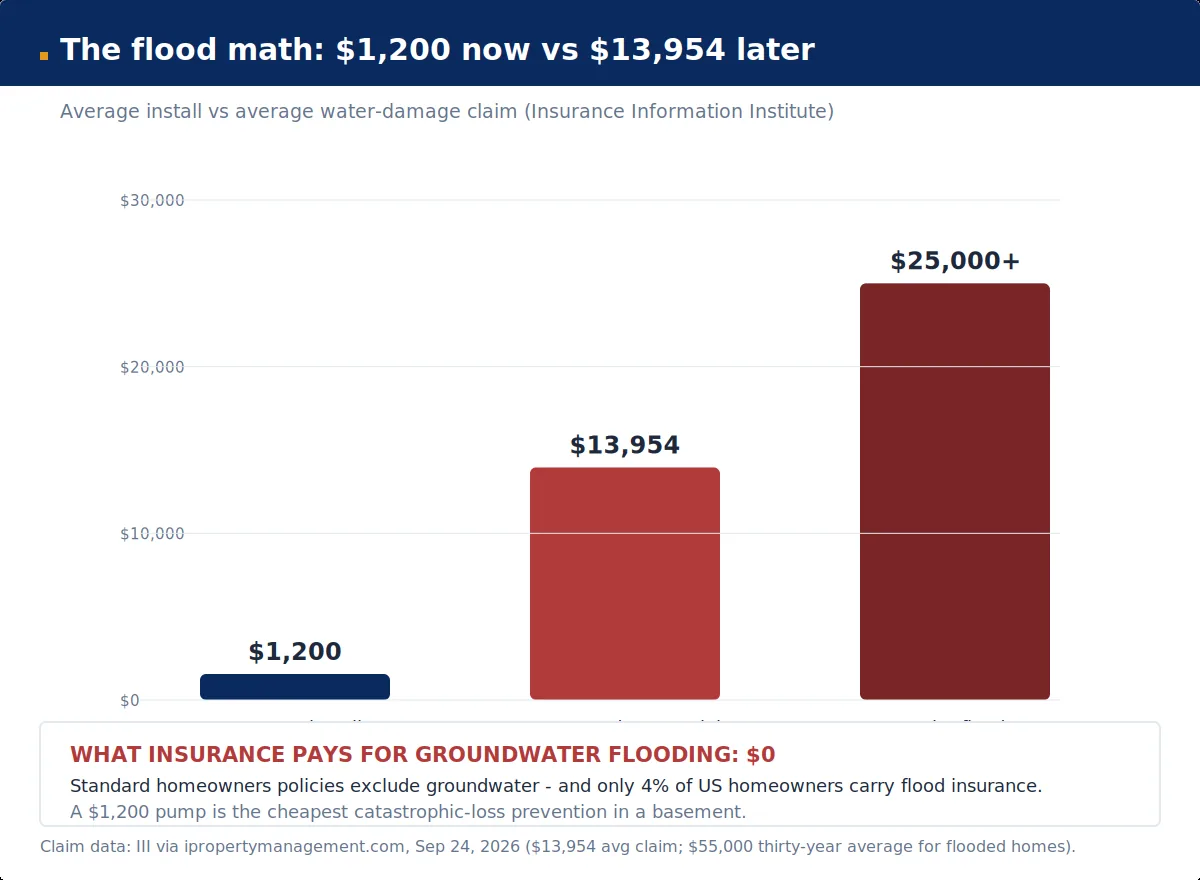
Here is the math that makes sump pumps a financial product, not a plumbing purchase. The average homeowners insurance claim for water damage is $13,954 — yet only 4% of American homeowners carry flood insurance (ipropertymanagement.com, updated Sep 24, 2026, citing the Insurance Information Institute). A ~$1,200 sump pump install protects against a $13,954 average claim and a $25,000+ major flooding bill. The ratio is roughly 11-to-1 on the average alone.
And the coverage gap is wider than most homeowners realize: standard homeowners insurance does NOT cover groundwater seepage or rising flood water. A failed sump pump during a storm — the exact failure mode you’re insuring against — is the case your standard policy excludes. Separate flood insurance (NFIP) is required, and it typically carries a 30-day waiting period. Over a 30-year period, a home with a history of flooding averages $55,000 in flood damage (ipropertymanagement.com, citing III).
The adjacent insurance angle worth checking: our sewer line replacement cost guide covers the $30–$50/yr service-line endorsement and the distinct sewer-backup endorsement — a failed pump and a backed-up sewer are two different water events, and they need two different endorsements.
The ways to save (legitimate ones): schedule a replacement before it fails — emergency/same-day service adds $150–$400; replace when the repair-vs-replace rules say so rather than after a failure; bundle the backup with the primary install (a combo at $1,200–$2,000 is cheaper than primary-now-plus-backup-later at two labor visits); and when the discharge routing is already being dug for other work — a sewer lateral replacement is the classic pairing — ask for a combined quote. Maintenance is $100–$250/yr (HomeGuide): clear the check valve, test the float, pour water in the pit to confirm it pumps. Cheap insurance for the $1,200 asset.
Sump pump installation cost in 2026: Wi-Fi alarms and smart monitoring
The 2026 trend nobody owns nationally is connected monitoring. The cheapest entry is an alarm, not a pump: basic sump pump alarms run $20–$40; Wi-Fi/smart alarms with app alerts run $100–$300 (clogheroes.com, updated Oct 1, 2026). The PumpSpy Wi-Fi Smart Outlet 2.0 — monitoring plus app alerts — was $159.98 on Amazon US in Oct 2026 ($139 low / $199.99 high, per pricehistory.app).
The premium tier is smart pump systems, which combine pump + backup + Wi-Fi + app: the Zoeller 508-0014 Aquanot Fit ($677.06 with built-in Wi-Fi and Z Control Cloud) and the Wayne WBPS50 ($999, Wi-Fi radio and app alerts, battery not included) are the 2026 anchors. Combination primary+battery units run $500–$1,500 (Modernize).
When the smart premium pays. For an owner-occupied home with a visible pit, a $20–$40 basic alarm covers the “did it die?” question. The $100–$300 Wi-Fi premium is worth it for vacation and second homes — the case where a failure runs unnoticed for weeks and the $13,954 average claim is the baseline. That is the whole smart category: remote notification for a machine whose job is to prevent damage while nobody is watching.
Key takeaways
– Sump pump installation cost 2026: $800–$2,000 (national average ~$1,200); replacement in an existing pit is a separate job at $309–$755, averaging $531 (Angi, Oct 17, 2026, 5,044 verified projects).
– The pit and the labor are the product: new-pit excavation adds $300–$800; the dedicated GFCI circuit adds $570–$1,000 (Angi, Oct 30, 2026) when the pit location has no outlet.
– Battery backup vs water-powered is the real decision: battery $300–$700 add-on (plus $150–$300 every 3–5 years for the battery, 6–12 hr runtime); water-powered $500–$1,500 installed, unlimited runtime, no wells, verify local code.
– The 50% rule + the 7-year line: repair past half the price of a new pump on a unit over 7 years old means replace; proactively replace every 8–10 years.
– $1,200 now vs $13,954 later: standard homeowners insurance does NOT cover groundwater or rising flood water — 4% of Americans carry flood insurance; the sump pump is the coverage.
– No federal tax credit exists for sump pumps in 2026 — HEAR covers heat pumps, appliances, electrical, and insulation, not sump pumps.
Sources & methodology
Cost figures compiled November 2026 from 2026 published cost guides and contractor data: angi.com (Aug 9, 2026 — $800–$3,000 install, avg ~$1,100; Aug 4, 2026 — $1,500 avg install; Oct 17, 2026 — $309–$755 replacement, avg $531, 5,044 verified projects; Jul 15, 2026 — $400–$550 repairs; Oct 30, 2026 — dedicated circuit $570–$1,000); thisoldhouse.com (2026 guide — avg ~$1,400, range $500–$4,000); modernize.com (updated Aug 12, 2026 — $200–$4,000, most ~$1,200); thepricer.org (Oct 16, 2026 — HomeAdvisor Jun 2026 replacement $645–$2,120, avg ~$1,362; HomeGuide battery backup $600–$2,000+); homeguide.com (existing-pit replacement $400–$700; new install $600–$2,500; repair $200–$870 — page updated Feb 2026, used for range confirmation only); thebasement.guide (updated Oct 2026 — standard submersible replacement $650–$1,200; common repairs $100–$350; check valve $20–$50 part, $100–$250 installed); nearbyhunt.com (2026 guide — $800–$3,000 install, avg $1,100–$1,400; replacement $300–$700); plumberarchive.com (May 2026 — pedestal $400–$900 installed; submersible $600–$1,800; battery backup add-on $300–$700; pit excavation +$300–$800; labor $60–$95/hr + $75–$150 call-out); basementcalculator.com (updated Sep 30, 2026 — install with 20 ft discharge $2,630 pro / $890 DIY; with backup + new outlet $3,780 pro / $1,690 DIY; replacement $660 pro / $310 DIY; battery replacement $150–$300 every 3–5 years; Watchdog 1/2 HP $200–$300); plumbers911chicago.com (Oct 2026, Chicago market — water-powered backup $600–$1,200; battery system $800–$1,500; combo $1,500–$2,500; primary + water-powered $2,100–$3,700); bluettipower.com (Oct 2026 — standalone battery backup $600–$1,500; pushed to $1,500–$2,500+ with pit/discharge/electrical mods); smarthomeexplorer.com (Oct 2026 — Basement Watchdog CITS-50 $469; Zoeller Aquanot Fit $677.06; Wayne WBPS50 $999); clogheroes.com (updated Oct 1, 2026 — basic alarms $20–$40; Wi-Fi alarms $100–$300); pricehistory.app (PumpSpy Wi-Fi Smart Outlet 2.0 $159.98, Oct 2026); homerdiy.com (Wi-Fi premium for vacation/second homes); callbrightside.com (Sep 2026, Kansas City market — 1/3 HP swap $985; 1/2 HP swap $1,292; new pit + 1/2 HP $5,200); valleyplumbing.com (2026, Salt Lake County market — new pit install $1,450–$2,850; emergency add-on $150–$400); engineerfix.com (minor-to-moderate repairs $150–$550; float switch $100–$150; check valve $125–$200); ipropertymanagement.com (updated Sep 24, 2026, citing Insurance Information Institute — $13,954 avg water-damage claim; 4% carry flood insurance; $55,000 thirty-year average for flooded homes). Thin/AI-fluff domains (jobsnear.in, elevatehomeguide variants, lokerkesehatan, seputarwarganet, dryhome.the-dark-triad.com, bozuktus.com) and all Canadian sources were excluded from citations per standing rules. No pit-size code claims are stated (F1: omitted without a fresh code search). Tax: IRS FS-2025-05, OBBBA P.L. 119-21 — no federal credit exists for sump pumps in 2026. Skylight-adjacent pricing referenced from our article 9 (electrical), article 33 (sewer), article 34 (generator).
Disclaimer: Prices are 2026 US national averages and vary by region, home, and contractor — get 3 written, itemized local quotes. Tax information is general and not tax advice — confirm with a tax professional. Sump pump installation is licensed plumbing-contractor work: pit excavation, discharge routing, and GFCI/dedicated-circuit electrical work. This article covers cost and decision information only, never installation instructions.
How much does it cost to install a sump pump in 2026?
$800–$2,000 installed, with a national average near $1,200. Angi (Aug 9, 2026) puts professional installation at $800–$3,000 averaging ~$1,100; This Old House averages ~$1,400; Modernize (Aug 12, 2026) lands at $200–$4,000 with most homeowners near $1,200. The pit question drives the range — a new pit excavation adds $300–$800 over a pump-in-existing-pit job.
How much does it cost to replace a sump pump?
$309–$755, averaging $531 — from Angi’s Oct 17, 2026 dataset of 5,044 verified projects. Replacement in an existing pit is a unit swap: the pit, discharge line, and wiring already exist. Nearbyhunt.com (2026) prices it at $300–$700; HomeGuide at $400–$700. If the repair quote approaches these numbers on a unit past 7 years old, replace.
Pedestal vs submersible sump pump — which costs more?
Submersible, by a few hundred dollars installed: pedestal $400–$900 vs submersible $600–$1,800 (plumberarchive, May 2026). Unit-only the gap is smaller — pedestal $60–$170 (Angi) vs submersible $100–$400 (Angi). The real trade is noise vs lifespan: pedestals are louder but the dry motor lives 10–25 years; submersibles run quiet but average 7–10 years (HomeGuide, Oct 2026).
How much does a battery backup sump pump cost?
$300–$700 added alongside an existing primary (plumberarchive) or $400–$700 (basementcalculator); $1,200–$2,000 for submersible + battery backup installed together; $1,500–$2,500 for a combination primary + battery package (Plumbers 911 Chicago, Oct 2026, labeled local). The running cost nobody quotes: the AGM battery needs replacement every 3–5 years at $150–$300, and it’s almost never included in the unit price. Runtime is roughly 6–12 hours of intermittent pumping per charge.
Does homeowners insurance cover a flooded basement from a failed sump pump?
Almost always no. Standard homeowners insurance does not cover groundwater seepage or rising flood water — the exact failure mode of a dead sump pump during a storm. Separate flood insurance (NFIP) is required and typically carries a 30-day waiting period. Meanwhile the average water-damage claim is $13,954, and only 4% of American homeowners carry flood insurance (Insurance Information Institute via ipropertymanagement.com, Sep 2026). A ~$1,200 sump pump install is the actual coverage.
How long do sump pumps last — repair or replace?
7–10 years on average (HomeGuide, Oct 2026): submersibles 5–15 years, pedestals 10–15 years by HomeGuide’s read (up to 20–25 by Angi’s, since the motor stays dry). Use the 50% rule — if the repair costs more than half a new pump and the unit is past 7 years old, replace. Many homeowners proactively replace every 8 years (Angi, Jul 2026); federal guidance says test yearly and replace at 10+ years, if it never runs, or if it cycles on and off during rain.
How much extra is a battery backup or water-powered backup?
Battery backup: $300–$700 as an add-on, $600–$2,000+ for a full installed system (HomeGuide). Water-powered backup: $500–$1,500 installed (plumberarchive), unlimited runtime but no well systems, requires a backflow preventer, and needs local code acceptance. Battery gives 6–12 hours per charge with a 3–5 year battery cycle; water-powered runs indefinitely on municipal pressure. The premium option — a whole-house generator — is priced in our generator guide.