


A Virginia heat pump buyer starts from a position no buyer in the northern half of this series enjoys. The state is warm enough that the machine rarely has to prove itself in deep cold, and cheap enough in power that the proving costs little when it does. Richmond is designed for 14 degrees, Norfolk for 20, Roanoke for 12 — temperatures a standard heat pump handles without drama — and the state average for residential electricity is 17.64 cents a kilowatt-hour, below the national average and barely more than half what a Massachusetts buyer pays. The same machine that struggles to tie a gas furnace in Boston comes within $83 a year of tying one in Richmond, and beats everything else in the house by hundreds. That is the headline, and it is real.
The second fact is that Virginia is not one market. It is four, and the price of the same 3-ton system moves by thousands between them. Northern Virginia pays Washington wages — HVAC mechanics in the Washington-Arlington-Alexandria metro earn a median $34.58 an hour, against $28.43 in Richmond — and a Northern Virginia contractor’s own price list runs $8,499-$21,650 for a heat pump system, against a statewide planning band that starts at $6,510. Hampton Roads pays for salt air, wind, and a housing stock built for the coast. Richmond sits in the middle on price and in the middle on climate. And the mountains west of Roanoke ask for a cold-climate machine, backup heat, and a contractor who has worked a January at altitude. A statewide average hides all of that, so this guide prices the cities separately and says which figure is measured and which is only a planning estimate.
The third fact decides the rebate before the buyer does. Virginia’s utilities do not run one program. Dominion Energy, which serves most of the state, lists no rebate for a central heat pump. Appalachian Power, in the southwest, pays a few hundred dollars for a mini-split or a standard air-source unit. Washington Gas, in Northern Virginia only, pays the most in the state — up to $2,600 for a dual-fuel job — and only for a heat pump paired with a gas furnace that replaces an existing air conditioner. Where you live in Virginia decides what you collect, and in most of the state the honest answer is: not much. The federal money that would change that has not arrived either, and this guide says so plainly rather than letting a quote imply otherwise.
The national numbers come first in our national heat pump cost guide — then weigh Virginia’s figures against them.
Table of Contents
How Much Does a Heat Pump Cost in Virginia in 2026?
Two Virginia sources anchor the 2026 market, and they measure different things — which is why they disagree, and why the disagreement is worth understanding before any quote is compared. NumeralQ, updated through October 2026, publishes planning estimates built from cost-guide data: a 3-ton ducted air-source system at $6,510-$10,900 statewide, with city figures within a few dollars of that band. SwiftPro, a Northern Virginia contractor, publishes its own installed price list, checked October 2026: a heat pump system with the outdoor unit and air handler together at $8,499-$21,650. The first is a modeled estimate for the whole state. The second is what one real company in the most expensive corner of the state actually charges. Neither is wrong. The gap between them is the gap between a value-tier job in Roanoke and a premium variable-speed job in Fairfax, and a buyer who treats either number as the price of every Virginia heat pump will be misled in both directions.
This guide headlines the NumeralQ 3-ton band, $6,510-$10,900, because it is the only figure tied to a specific system size statewide, and because it is labeled as a planning estimate rather than dressed up as a contractor survey. The SwiftPro band sits above it for a reason that shows up in the wage data: Northern Virginia labor runs about 18 percent above the national median, and premium equipment sits at the top of any contractor’s price book. A quote inside the NumeralQ band is not automatically cheap, and a quote inside the SwiftPro band is not automatically expensive. The question is always which machine, which house, and which city.
A third dataset sits below both and needs a warning of its own. BetterHouse models Virginia ducted systems at $3,920-$13,730, typical $10,370, by scaling a national baseline with the state’s BLS wage index. That typical figure, $10,370, lands near the top of the NumeralQ band — consistent, in the loose sense that two different methods point at the same territory — but the low end of its range, $3,920, is a modeled floor, not a price anyone in Virginia is likely to be quoted for a whole-home install. Use the BetterHouse typical as a cross-check on the midpoint. Do not budget on its low end.
The quoted price is the complete installation: labor, permits, and startup, plus the outdoor unit, indoor coil or air handler, refrigerant lineset, pad or wall bracket, electrical disconnect and wiring, and thermostat. What it does not buy is the rest of the job — a gas furnace for a dual-fuel setup, a panel upgrade, ductwork repairs or replacement, a condensate pump for a coastal crawlspace, or hurricane strapping on an exposed coastal unit. They arrive as separate lines on the quote. This guide prices each one where a price could be verified, and flags the ones where it could not.
One number sits inside the arithmetic, and in Virginia it is small enough to change the decision in the opposite direction from Massachusetts. There is no big state rebate to subtract. The largest single rebate in Virginia is Washington Gas’s dual-fuel payment, and it reaches only Northern Virginia gas customers who pair the heat pump with a furnace. Appalachian Power pays $250 for a standard air-source unit and $300-$400 for a mini-split. Dominion pays nothing for a central heat pump. Judge every quote on the gross figure, because in most of Virginia there is no net figure worth the name — and a quote that subtracts a rebate your home cannot collect is a quote that needs to be rewritten before it is compared.
A warning before the tables: the cheapest Virginia quote is rarely the cheapest system once it is running, and the most expensive is not automatically the best. The spread between bidders on identical equipment can run several thousand dollars, and in Virginia the spread is widest in Northern Virginia, where the deepest installer bench and the highest wages sit side by side. To compare bidders fairly, line up the same job from each: one model, one house, one backup-heat arrangement, all in writing, with the rebate your home actually qualifies for already deducted. Three quotes from DPOR-licensed contractors is the minimum, and any bidder who will not name the model number, its 5-degree capacity and COP, and its SEER2 and HSPF2 ratings is a bidder to walk away from.
| Source | 3-ton ducted | Single-zone mini-split | Multi-zone (3 heads) | Geothermal |
|---|---|---|---|---|
| NumeralQ (Oct 2026, planning est.) | $6,510-$10,900 | $3,120-$4,870 | $6,180-$11,100 | $20,170-$31,790 |
| SwiftPro NoVA (Oct 2026, price list) | $8,499-$21,650 (system) | $7,000-$10,000 | Not published | Not published |
| BetterHouse (2026, modeled) | $3,920-$13,730, typ. $10,370 | $2,000-$12,000, typ. $3,250 | Not published | $12,000-$40,000+ |
| AVS Fairfax (2026, contractor) | $4,068-$7,160 avg $5,613 | $2,000-$14,500 (range) | Not published | $6,000-$20,000 |
Read two rows of that table with a warning attached first. The SwiftPro and AVS figures are contractor price lists from the same Northern Virginia market, and they disagree by thousands — $8,499-$21,650 against an average of $5,613 — because SwiftPro prices a full system with air handler and backup strips at premium tiers while AVS reports an average across replacement jobs of every size and tier. The overlap, roughly $8,500, is where a competitive Northern Virginia quote for a standard 3-ton system should start. And the BetterHouse low end is a modeled floor, not a market price: no Virginia contractor in this pass quoted a whole-home ducted install near $3,920. The NumeralQ band is the one this guide builds on, and every size row derived from it is labeled a planning estimate.
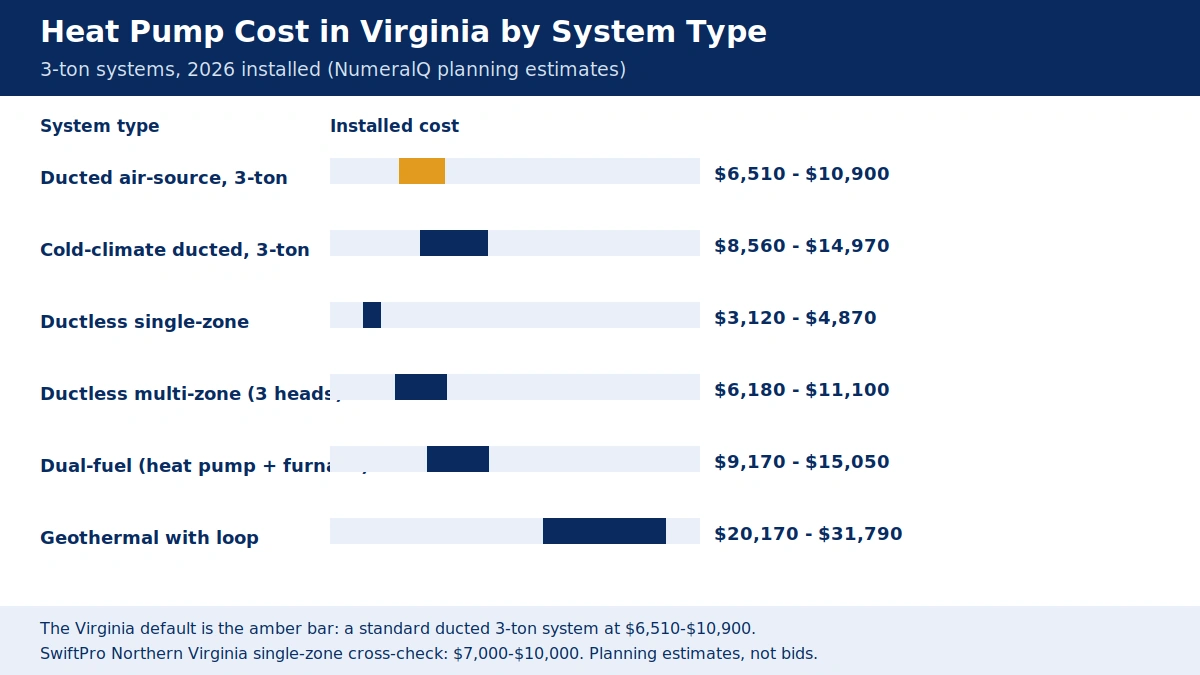
Heat Pump Cost in Virginia by System Type
In Virginia the words “heat pump” can mean five machines at very different prices — more than six to one from the cheapest to the dearest. Which one fits depends on the house and on which of Virginia’s four climates it sits in, and here the house usually decides: a Richmond brick ranch with ducts, a 1920s Norfolk bungalow on baseboards, an Arlington townhouse with no outdoor space to spare, a Roanoke farmhouse on propane at the edge of the gas mains. The table prices each machine from the NumeralQ anchors, with the Northern Virginia contractor figures where they sharpen the picture.
| System type | Installed cost (VA) | Best for in Virginia |
|---|---|---|
| Ducted air-source (3-ton) | $6,510-$10,900 | Whole-home primary heat with ducts; the default VA buy |
| Ducted cold-climate (3-ton) | $8,560-$14,970 | Mountain and western VA; coldest sites, backup-light homes |
| Ductless mini-split, single zone | $3,120-$4,870 | One room, addition, or a house with no ducts |
| Ductless multi-zone (3 heads) | $6,180-$11,100 | Whole-home without ducts; zone-by-zone control |
| Dual-fuel (heat pump + gas furnace) | $9,170-$15,050 | Gas-heated home that wants a heat pump for shoulder seasons + AC |
| Geothermal, ground-source with loop | $20,170-$31,790 | Long-term owner, big lot; steadiest winter COP |
Ducted air-source is the default Virginia buy. Most of Virginia is warm enough that a standard ducted heat pump is the right machine, not a compromise. Richmond designs for 14 degrees and Norfolk for 20, and a standard variable-speed unit holds its capacity and efficiency through those temperatures without the cold-climate premium. It reuses the existing ductwork, heats and cools from a single system, and at $6,510-$10,900 for a 3-ton job it is the cheapest whole-home heating and cooling system in this guide — cheaper, on the planning figures, than the furnace-plus-air-conditioner it replaces. Whether a Virginia house keeps its ducts or goes ductless is a decision our ductless vs ducted guide works through in full, room by room and dollar by dollar.
Cold-climate is a mountain purchase, not a statewide one. The cold-climate premium — $8,560-$14,970 against $6,510-$10,900 for the standard ducted 3-ton — buys capacity at 5 degrees and below, and in coastal and central Virginia that capacity is rarely called on. In Roanoke, designed for 12 degrees with 4,360 heating degree days, and in the Blue Ridge and Allegheny counties above it, the premium earns its keep: a cold-climate unit keeps at least 70 percent of rated capacity at 5 degrees with a COP of at least 1.75, and holds full rated output down to 5 degrees on the best lines. A Richmond buyer who pays the premium is buying insurance for a week of weather that may not come. A Blacksburg buyer who skips it is buying a January of resistance heat. The line between the two is roughly the Blue Ridge — east of it, standard; west of it, cold-climate. The rebate rules do not force the choice here the way they do in Massachusetts: no Virginia utility pays more for a cold-climate unit, so the decision is pure climate, not paperwork.
Virginia’s older housing stock is exactly what ductless mini-splits were built to retrofit. Mini-splits are how Virginia retrofits houses that never had ducts — Norfolk and Richmond bungalows on boiler heat or baseboards, Arlington townhouses where the duct chase would eat a bedroom, additions and finished attics no duct ever reached. A single zone costs $3,120-$4,870 statewide and heats and cools one room or open-plan area: outdoor unit on a wall bracket, indoor head on the wall, one small hole for the lineset. Three heads at $6,180-$11,100 cover a whole small home, each zone on its own thermostat, so bedrooms can sit at 62 degrees overnight while the living room holds 70. Coverage is the limit: a head warms only its own room, so a four-bedroom colonial with one living-room head still needs heat in the bedrooms. In Northern Virginia the same single zone costs more — SwiftPro lists $7,000-$10,000 — because the labor and the premium brands dominate there. Our mini-split installation guide prices the job zone by zone.
Dual-fuel is the honest answer for the one Virginia home in three that heats with piped gas. Dual-fuel fits the gas-heated third of the state: the heat pump and a gas furnace share the house, and a control hands the load to the furnace below a switchover temperature the installer sets. The heat pump owns the mild weather, because it beats gas there; the furnace owns the deep cold, because the heat pump’s COP has fallen past the point where it wins. NumeralQ puts the dual-fuel band at $9,170-$15,050 for a 3-ton system — the heat pump plus the furnace plus controls, a modeled figure, flagged as such. In Northern Virginia the configuration also carries the state’s largest rebate: Washington Gas pays up to $2,600 when the heat pump is installed with a new 95 percent furnace, or $2,000 with an existing 90 percent furnace, provided the heat pump replaces an existing central air conditioner. The running-cost section works out the switchover point at Virginia prices — about 38 degrees on Dominion power, about 16 degrees on NOVEC — because that number, not the sticker, decides whether dual-fuel saves money here. Our dual-fuel heat pump guide walks through the setup itself.
Geothermal is the only system in this state whose winter efficiency barely notices the weather — and the only one whose 2026 math lost a third of its value overnight. A ground-source unit draws heat from earth that holds near 55 degrees all year a few feet beneath a Virginia lawn, keeping a COP of 3.0 to 5.0 through a 12-degree Roanoke night while an air-source unit works at 2.0. NumeralQ puts the Virginia installed range at $20,170-$31,790 with the loop; the national Carrier and EnergySage range runs $15,000-$40,000 and more. The loop is the swing: horizontal trenching where the lot allows, vertical bores where it does not, and a pond loop where the property has half an acre of water ten feet deep within 200 feet of the house. The buyer who fits geothermal is a long-term owner on a big lot staying 20 years, and Virginia has plenty of those lots west of Richmond. The buyer who does not is anyone likely to move in five, because the loop stays in the ground and the payback needs a decade of winters. The 30 percent federal credit that once softened the price is $0 for a 2026 homeowner-owned install under the same OBBBA change that ended the air-source credit, so the 2026 geothermal case stands on operating savings alone — and in Virginia, where a standard air-source unit already runs cheap, those savings are thinner than in a cold state. Our geothermal heat pump guide covers loop types, tight-lot bores, and the 20-year math with no credit.
One more setup deserves a paragraph: a cold-climate mini-split added to a home that keeps its furnace or boiler. Put one or two heads in the rooms people actually live in — living room, home office, main bedroom. They carry the shoulder seasons and the mild winter days, the old system handles the deep cold, and the house gains air conditioning in July. The first zone at $3,120-$4,870 is the cheapest entry to a heat pump in Virginia, and in Appalachian Power territory it earns a $300-$400 mini-split rebate on top. As a whole-home solution it will disappoint: one head cannot heat a house. A quote that claims otherwise is selling a smaller system than the house needs.
Heat Pump Cost by Home Size
After system type comes size, and Virginia gets it wrong in both directions more often than most states — for the opposite reason from the north. Too small in Roanoke, and the machine leans on resistance heat for the coldest weeks at 17.64 cents a kilowatt-hour. Too big in Virginia Beach, and it short-cycles through a humid July, never running long enough to wring the moisture out of the air, and costs thousands extra for capacity the house never calls on. The right size comes from one document only: a Manual J load calculation, room by room, at the design temperature — 14 degrees in Richmond, 20 in Norfolk, 12 in Roanoke. Floor area alone, or the size of the furnace being removed, only guesses at the number everything else depends on. Insist on the Manual J in writing before signing.
The table below prices ducted air-source systems by tonnage from the $6,510-$10,900 3-ton anchor. Heat pump capacity is rated in tons, 12,000 BTU an hour to the ton, and in Virginia the two loads pull in opposite directions: in Richmond and Norfolk the cooling load is the larger one, in Roanoke the heating load is. A 2,000-square-foot Richmond house commonly needs a 3-ton system, where the same house in a cold climate would take 3.5 tons for the heating load alone — because the design temperature sits only about 55 degrees below room temperature, not 85.
| System size | Home size (approx.) | Ducted air-source (VA) |
|---|---|---|
| 1.5 ton | 600-1,000 sq ft | $4,500-$7,500 (planning est.) |
| 2 ton | 1,000-1,400 sq ft | $5,200-$8,700 (planning est.) |
| 2.5 ton | 1,400-1,700 sq ft | $5,800-$9,800 (planning est.) |
| 3 ton | 1,700-2,100 sq ft | $6,510-$10,900 |
| 3.5 ton | 2,100-2,400 sq ft | $7,200-$12,000 (planning est.) |
| 4 ton | 2,100-2,700 sq ft | $7,800-$13,000 (planning est.) |
| 5 ton | 2,700-3,500 sq ft | $9,000-$15,000 (planning est.) |
All rows but the 3-ton one are labeled as planning estimates. No Virginia source in this pass published heat pump prices by size; the other rows are planning estimates scaled from the 3-ton anchor, and they are labeled as such. Do not cite them as measured Virginia prices — they are not. What they show honestly is the shape of the decision: at every size, moving up one tonnage costs roughly $600-$1,500, and the 3-ton row is the only one with a measured anchor behind it.
Three cautions sit behind that table. To begin with, the home-size column is only a rough guide — rougher in Virginia than most places: a tight, well-insulated 2,000-square-foot house built in 2020 can need a full ton less than a drafty 2,000-square-foot 1920s bungalow with single-pane windows and bare walls. Age, insulation, glazing, air leakage, and ceiling height move the answer more than floor area does — and Virginia’s housing stock runs from colonial-era brick in Richmond to post-war ranches in the suburbs to mountain cabins, so the drafty end of the range is a common case. Next, the governing load changes by region. In Richmond and Norfolk the cooling load governs: a system chosen for a January in Virginia Beach will be far too big for its July, short-cycling through the humidity. In Roanoke and the mountains the heating load governs, and a system chosen for the summer will be far too small for January. Sizing from the old air conditioner’s tonnage is sizing for the wrong season in the west, and sizing from the old furnace is sizing for the wrong season in the east. Lastly, size the backup heat together with the heat pump, not after the fact. Strips or a furnace must cover the full design load on the coldest night, when the heat pump gives the least. A quote that prices the heat pump and leaves backup heat to be decided later has left out the part that keeps pipes from freezing on a 12-degree Roanoke night.
The 3-ton row deserves the closest look: it is the only row with a measured anchor behind it, and the size most Virginia homes land on. Inside that $6,510-$10,900 band, brand and efficiency tier decide where a quote lands. The bottom of the band is a value-tier standard unit, around SEER2 15 and HSPF2 7.8. The top is a premium variable-speed unit, above SEER2 20 and HSPF2 10. Across a Richmond winter at 3,963 heating degree days, the premium tier pays for itself more slowly than it would in Worcester — the season is shorter and milder — so the value tier is a defensible buy in coastal Virginia in a way it is not in New England. Short on cash, the value-tier standard unit still beats resistance heat by a wide margin; the error is buying a standard unit for a mountain home that needed a cold-climate one, or buying an oversized unit for a humid coastal home that needed the smaller machine running longer.
Heat Pump Cost by City: Richmond, Virginia Beach, Norfolk, Arlington & Roanoke
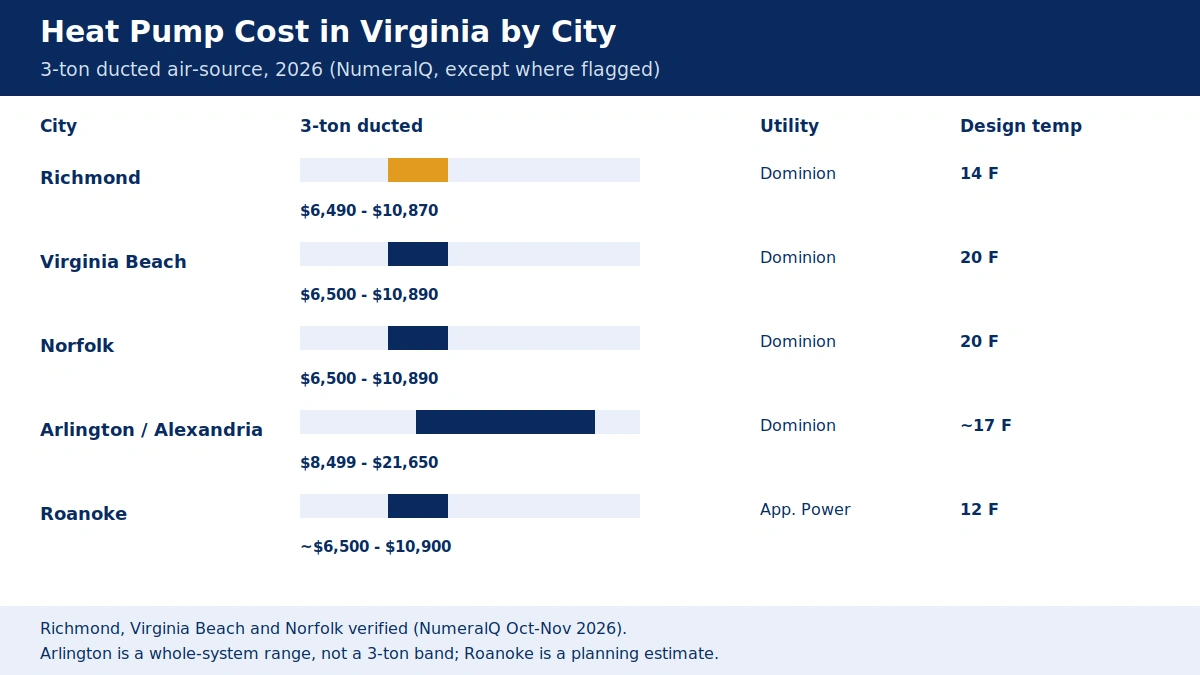
Virginia is a medium-sized state with one very expensive HVAC market — Northern Virginia — and several cheaper ones a short drive away, and the verified figures run from $6,490 to $21,650 for the same job. What sets the cities apart is labor more than equipment: the rebate is different in every territory, the electricity price is nearly identical statewide, and the design temperature differs by only a few degrees between Richmond and Roanoke. NumeralQ’s city figures are the only verified city bands in this pass; the Arlington and Roanoke figures carry a warning label rather than a verified price.
| City | 3-ton ducted air-source | Utility | Design temp |
|---|---|---|---|
| Richmond | $6,490-$10,870 (NumeralQ) | Dominion Energy | 14 F |
| Virginia Beach | $6,500-$10,890 (NumeralQ) | Dominion Energy | 20 F |
| Norfolk | $6,500-$10,890 (NumeralQ) | Dominion Energy | 20 F |
| Arlington / Alexandria | $8,499-$21,650 (SwiftPro NoVA system range) | Dominion Energy | ~17 F (planning est.) |
| Roanoke | ~$6,500-$10,900 (planning est.) | Appalachian Power | 12 F |
Richmond is the capital, the middle of the state on price and on climate, at $6,490-$10,870 for a 3-ton ducted system. Richmond is also where the housing stock fights the installer in a specifically Virginian way: brick ranches and 1920s bungalows with ducts that were sized for a furnace, Fan District rowhouses with no room for an outdoor unit except the alley, and a 14-degree design temperature that lets a standard unit do the job. A Richmond buyer pays the middle price for the install and runs the system on Dominion power at the state-average rate. That is not a reason to skip the heat pump in Richmond — it is the city where the case is cleanest, because the machine is cheap, the power is cheap, and the winter is mild.
Virginia Beach and Norfolk, the two big Hampton Roads cities, price within dollars of Richmond at $6,500-$10,890, and the similarity is the story: the same Dominion territory, the same labor market, the same mild coastal design temperature of 20 degrees. What differs is the coast itself. Salt air corrodes an outdoor unit faster than inland air does, so a coastal unit wants a corrosion-resistant coating and a rinse schedule the inland quote never mentions. Wind off the Atlantic drives rain sideways into the coil, and a unit on the windward wall, below a roof valley that sheds water, or beside a driveway the storm surge reaches will spend its life fighting the weather. Hurricane strapping and a raised pad that keeps the unit clear of standing water cost a few hundred dollars on the quote — and in Hampton Roads they are the difference between a unit that survives a tropical storm and one that does not. The labor figure underlines the similarity: Virginia Beach-Norfolk HVAC mechanics earn a median $28.59 an hour, within cents of Richmond’s $28.43.
Arlington and Alexandria, across the river from Washington, carry the highest figures in the state — and the figure itself needs a careful read. SwiftPro’s Northern Virginia price list runs $8,499-$21,650 for a heat pump system, but that is a whole-system range across sizes and tiers, not a 3-ton band, so it reads high against the other cities’ 3-ton figures and should be used as a market check, not a 3-ton price. What is certain is the labor behind it: the Washington-Arlington-Alexandria metro pays HVAC mechanics a median $34.58 an hour, about 18 percent above the national median and 22 percent above Richmond’s, with 8,730 technicians, the largest pool in the region. Townhouses with no yard for an outdoor unit, strict county permitting, and some of the oldest housing in the state push the install to the top of any band. The offset is the rebate: Northern Virginia is the only part of Virginia where Washington Gas pays up to $2,600 for a dual-fuel job, and the only part where a heat pump buyer collects real money from a utility.
Roanoke, in the southwest on Appalachian Power, carries a planning estimate of about $6,500-$10,900 — the state band, applied to the city, because no Roanoke-specific price was published in this pass. Roanoke is the coldest of the five cities, designed for 12 degrees with 4,360 heating degree days, and its housing stock of older mill-town homes and mountain cabins is the classic Virginia mini-split market. The rebate picture flips here too: Appalachian Power pays $250 for a standard air-source unit and $300-$400 for a mini-split, small money next to Washington Gas, but money Dominion customers do not get at all. Do not quote the Roanoke figure as a NumeralQ figure, because it is not.
Judge cities by price per ton, never by the total, and check the rebate before comparing prices. Arlington’s $21,650 top end next to Richmond’s $6,490 bottom end looks like a chasm, but most of it is the range itself — the same 3-ton job can land anywhere inside either city’s band with brand and ductwork. The rebate gap is the real one: a Northern Virginia dual-fuel buyer collects up to $2,600 that a Richmond buyer cannot, and a Roanoke buyer collects $250-$400 that a Virginia Beach buyer cannot. The payback section below works through the fuel-by-fuel numbers.
Virginia’s Two Climates: Design Temps, HDD & What Humidity Does to a Heat Pump
Virginia holds two climates inside one state line, and the heat pump that suits one can be the wrong machine for the other. The east is humid subtropical — hot, damp summers, mild winters, cooling load bigger than heating load. The west is mountain country — colder winters, a heating load that governs sizing, and nights that ask for a cold-climate unit and backup heat. The state sits in IECC climate zone 4 for most of its area, zone 5 in the Blue Ridge and Allegheny hills, which puts it two zones warmer than Massachusetts and one zone warmer than Maryland. That middle-warm position is what makes the standard heat pump the right machine for most of Virginia, and the cold-climate unit a regional purchase rather than a statewide requirement.
The design temperatures. Manual J sizing starts with the 99.6 percent winter design temperature — the outdoor temperature the weather stays above for 99.6 percent of a typical winter’s hours, and the number the whole calculation rests on. Richmond’s is 14 degrees, Norfolk’s 20 degrees, Roanoke’s 12 degrees, Lynchburg’s 12 degrees. These are routine winter conditions, not records — Richmond still logs 3,963 heating degree days a year, Norfolk 3,495, Roanoke 4,360, Fredericksburg 4,554. For scale, the Massachusetts guide in this series designs around 9 degrees in Boston and the Maryland guide around 13; Virginia sits warmer than both, nearer North Carolina. A Richmond January averages a high near 47 and a low near 30, so the heat pump spends most of its season in the 30s and 40s — exactly where a standard unit does its best work, and where a cold-climate premium buys the least.
What a mild Virginia winter does to a heat pump. An air-source machine draws heat from the outdoor air, and the colder that air, the less heat there is to draw. Capacity and efficiency fall together — but in Virginia they fall a short distance. Start from a familiar rating: 36,000 BTU an hour at 47 degrees, the standard 3-ton unit. At 20 degrees, a Norfolk design temperature, that same machine still delivers most of its rated capacity at a COP near 2.5. At 5 degrees it keeps 40 to 60 percent of rated capacity while its COP falls toward 1.0 — but a Norfolk winter almost never sees 5 degrees, and a Richmond winter sees it for hours, not weeks. Department of Energy field tests show what the vapor-injection hardware buys: at 5 degrees a cold-climate unit still delivers 70 to 80 percent of its rated capacity, with a COP between 2.2 and 2.8. In Virginia, with a 14-degree design temperature in Richmond and most of the season above 30, a standard unit seldom reaches its worst-case numbers — which is why this guide plans on a seasonal COP of 2.5 to 3.0 for Virginia, a planning range, rather than the harsher figure a New England winter would force. Even the best air-source unit fades below zero, and on a Roanoke January’s coldest nights it cannot heat the house alone. Backup heat is not a footnote in the mountains. It is half the system there, and a small footnote on the coast.
Humidity is the Virginia line item, and it cuts both ways. Below freezing, the outdoor coil ices up: moisture in the air freezes onto it, and the unit must reverse itself now and then to melt the frost away, blowing cold air indoors for a few minutes while it does. Coastal air off the Atlantic and the Chesapeake keeps Virginia winters damp, so a Virginia Beach heat pump defrosts more often than a Roanoke unit in dry mountain air. The meltwater has to go somewhere, and an outdoor unit sitting at grade in a Norfolk yard will grow an ice mound beneath itself until the coil is blocked. Lifting the unit on a wall bracket or raised stand, with a pad that drains away from the house, adds a few hundred dollars to the quote — and it is what separates a unit that defrosts cleanly from one that ices itself into a February service call. The same humidity is the machine’s best feature in July: a heat pump wrings moisture out of the air as it cools, and Richmond logs about 20 muggy days in July and 17 in August. A house that has never had cooling feels the difference the first humid week.
Cooling is the bigger half of the value in the east. July is the bigger half of the value east of the Blue Ridge. Richmond logs 4,223 cooling degree days against 3,963 heating degree days, and Norfolk 4,478 against 3,495 — the cooling load is the larger load in both cities, the reverse of every northern state in this series. The same machine cools the house too, and a Richmond July in the high 80s with humidity to match is where that second job earns its keep. For a Virginia home that has never had cooling, that July comfort is worth more than the heating sums alone suggest. Size the system for the load that governs where the house sits: cooling in Richmond and Norfolk, heating in Roanoke and the mountains. A machine chosen for the wrong season is the wrong machine in both.
Salt, wind, and the tropical storm. A tropical storm can push surge water across a Virginia Beach yard and drive rain sideways into drifts against a Norfolk wall, and an outdoor unit on the windward side, below a roof valley that sheds water, or beside a driveway the storm floods will spend the storm starved for air. Choose the leeward wall, beneath an eave that throws water clear of the unit, with open space on every side for airflow and for a technician to reach it in a storm. On exposed coastal sites, a wind baffle — a plain shield on the intake side — keeps driven rain out of the coil, and hurricane strapping keeps the unit on its pad. The catalog never mentions any of it. The September service bill does.
Start with the house, not the machine. What matters most is the house, not the machine. Air from a heat pump leaves the register at 90 to 110 degrees; a gas furnace sends out 120 to 140. In a tight, well-insulated house, the difference is not felt at all. A drafty 1920s bungalow with single-pane windows, bare walls, and a vented crawlspace notices it every evening: the rooms feel as if the heat pump is always a step behind. The cheapest capacity a Virginia homeowner can buy is air sealing and insulation — every BTU kept inside is one the heat pump need not make at 14 degrees, and one the backup heat need not make either. Book the energy assessment and the insulation quote before the heat pump quote. When the house needs both, do the envelope first and size the heat pump second: a tightened house may need a full ton less. A smaller machine costs less to buy and less to run, so spending on the envelope first is the one place in this purchase where paying early means paying less twice over.
Heat Pump vs Gas Furnace in Virginia: The Running-Cost Math
Every number in this guide comes back to this section, and it is also where Virginia differs most sharply from the northern states in this series — because here the heat pump nearly ties the gas furnace, and the tie is decided by the efficiency of the machine you buy, not by the price of the fuel. All the figures below are NestPriced arithmetic built from published prices. Every assumption is printed in the open, so the sums can be redone with any utility’s rate and any house.
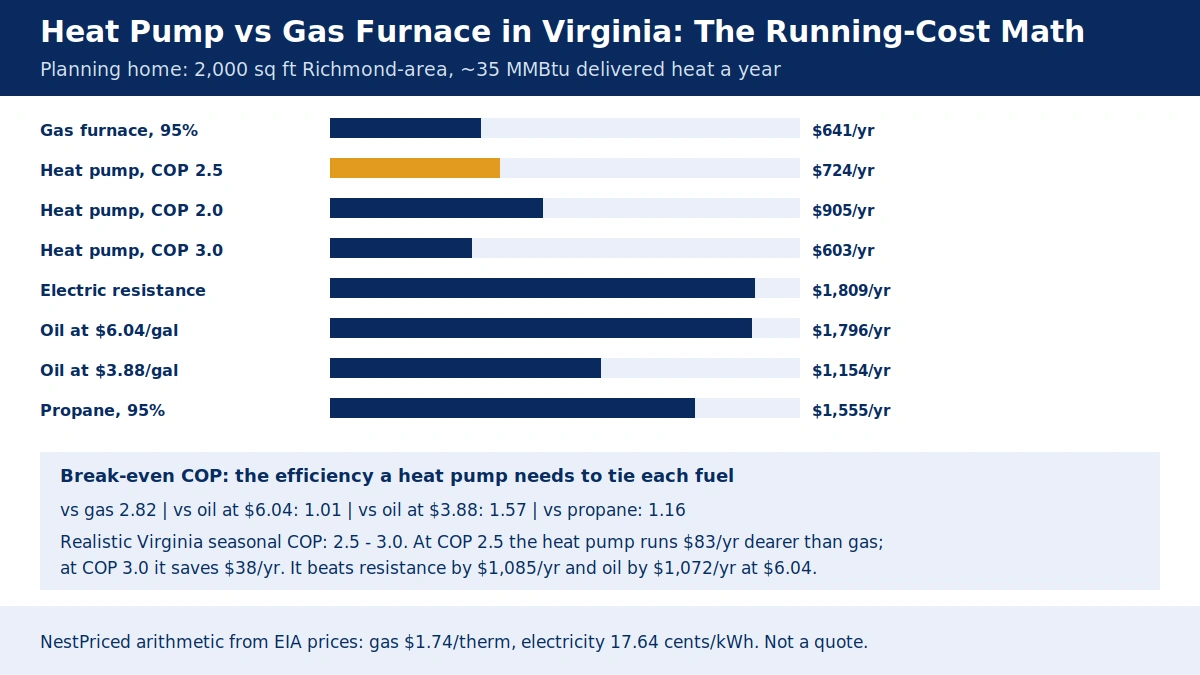
The planning home. Start with a 2,000-square-foot Richmond-area home needing about 35 million BTU of delivered heat a year — a planning assumption built from Richmond’s 3,963 heating degree days, scaled from the 50 million BTU Boston planning home in this series. Thirty-five million BTU equals 10,258 kilowatt-hours of heat. The rest of this section splits that heat by each machine’s efficiency and multiplies by its fuel’s price.
The gas furnace. Start with the furnace: at 95 percent AFUE, 35 million BTU of heat from the registers needs about 36.8 million BTU of gas in — 368 therms. At Virginia’s residential gas price of about $1.74 a therm (EIA, 12-month average to July 2026), the fuel bill lands near $641 a year. That gas price is the first surprise in this guide after the electricity price: Virginia homes pay about $17.99 per thousand cubic feet, against $15.34 nationally in the Massachusetts comparison — gas is not cheap in Virginia, but electricity is cheaper still, relative to the north. A second check: Virginia Natural Gas’s own November 2026 tariff bills $1.88 per hundred cubic feet on its residential schedule, and Washington Gas’s marginal winter price is about $1.41 a therm — the state average of $1.74 sits between them, and the shape of the answer does not turn on which one is used. Gas is affordable in Virginia. Electricity is nearly as affordable, and that is what makes the race close.
The heat pump. A heat pump at a seasonal COP of 2.5 — a realistic Virginia seasonal figure, between the 2.2 to 2.8 it manages at 5 degrees and the higher numbers it holds through a mild Richmond winter — draws 4,103 kilowatt-hours to deliver the same 35 million BTU. At the state-average all-in price of roughly 17.64 cents a kilowatt-hour (EIA, August 2026), that costs about $724 a year. At a seasonal COP of 2.0 it runs about $905 a year; at 3.0, about $603. Set those beside the gas furnace’s $641: at COP 2.5 the heat pump costs about $83 a year more than gas; at COP 3.0 it costs about $38 a year less; only past a seasonal COP near 2.8 does it match gas at all.
The break-even COP. Turn the question around and it gets sharper: how efficient would a heat pump have to be to match the gas furnace? Work it out as a ratio: take the electricity price per million BTU, divide by the gas price per million BTU at 95 percent efficiency, and the answer is the break-even COP. At 17.64 cents a kilowatt-hour — $51.70 a million BTU — against gas at $17.40 a million BTU, $18.32 once the furnace’s 5 percent loss is included, the break-even COP comes out at 2.82. A standard Virginia heat pump holds a seasonal COP of 2.5 to 3.0 through a Richmond winter, which means the machine sits on both sides of the line depending on the model and the house. That is the blunt fact, and any quote claiming a Virginia heat pump beats a 95 percent gas furnace on fuel at the average electric rate is pricing a different machine than the one it is selling — a premium variable-speed unit at COP 3.0, not the value-tier unit at COP 2.5. One qualification counts: the all-in average folds in fixed charges that do not all grow with usage, and the marginal winter rate on Dominion power past the first 800 kilowatt-hours is about 16.1 cents, not 17.64 — which lowers the break-even COP a little, to about 2.6. Ask your utility which rate you actually pay before modeling anything.
The backup-heat adder. The figures above give the heat pump all 35 million BTU at its seasonal COP. In a real Virginia winter, the backup system covers part of the season’s heat — and that slice is the expensive one. Say 10 percent of the season’s heat comes from electric resistance strips — a fair share for a standard unit on the coldest nights in Richmond, a low share for a mountain home. That slice comes to 1,026 kilowatt-hours, roughly $181 extra a year at 17.64 cents — an illustration, not a bill. Dual-fuel pays for itself right there, in gas territory: under the switchover temperature the gas furnace covers that 10 percent at gas prices rather than resistance prices, so the heat pump never has to run near a COP of 1.0 at all.
The switchover temperature. The dual-fuel control hands over at a single outdoor temperature — the point where the heat pump’s COP has fallen to the break-even figure. In Virginia, with a break-even COP near 2.8, that handover sits in the middle of the temperatures where a heat pump does most of its work — so the split between the two machines is a real decision, not a formality. A Northern Virginia contractor’s own winter figures put it at about 38 degrees on Dominion power and about 16 degrees on NOVEC power, because NOVEC’s marginal rate of 12.6 cents makes the heat pump cheaper far deeper into the cold. On Dominion territory, a typical Virginia dual-fuel switchover lands somewhere between 30 and 40 degrees, and the installer sets it during commissioning; ask which temperature was picked and why, and get it in writing — a setting 10 degrees too high hands the furnace months of work the heat pump could have done cheaper, and one 10 degrees too low hands the resistance strips a January they cannot afford.
What the heat pump beats, clearly. Against electric resistance heat the heat pump wins outright — baseboards, electric furnaces, space heaters, anywhere in Virginia, by a wide margin. The resistance bill for the same 35 million BTU comes to about $1,809 a year at the state-average price — $1,085 a year more than the heat pump’s $724, every single year. More than half of Virginia homes heat with electricity — 56.5 percent, the highest share in this series by a wide margin — and no purchase in this guide pays those homes back faster than a heat pump. Propane loses by less: a 95 percent propane furnace at $3.86 a gallon costs about $1,555 a year for the planning home, against the heat pump’s $724 — a saving near $831 a year. Against a 95 percent gas furnace at the average electric rate, the race is close to a dead heat. Buy it there for the air conditioning, the comfort, the zoning, or a furnace already at the end of its life — not for the fuel bill.
Cooling, counted honestly. A heat pump doubles as the air conditioner, and a Richmond July in the high 80s with humidity to match is where that pays off. Cooling alone would cost several thousand dollars as a separate purchase — the national figures are in our central AC replacement guide — so part of what a heat pump costs is money the buyer would have spent on air conditioning anyway. Measure the premium over the furnace-plus-AC pair it replaces instead of the full sticker, and the arithmetic looks far better than the fuel comparison alone suggests. In Virginia the premium framing is unusually strong: a furnace-plus-AC 3-ton system runs $8,300-$14,050 on the planning figures, against $6,510-$10,900 for the ducted heat pump — the heat pump is typically cheaper than the pair it replaces, so there is no premium to pay back at all. Virginia’s numbers above are the state-specific version of the same comparison our heat pump running cost guide runs nationally, fuel by fuel.
The Oil Question: What a Heat Pump Saves an Oil-Heated Home
If the gas comparison is where Virginia heat pump advertising goes wrong by a little, the oil comparison is where it goes right by a lot — with one condition attached, and the condition is the oil price on the day you sign. Only about one Virginia home in twenty-seven heats with oil — 3.7 percent, against nearly one in four in Massachusetts — but those homes are concentrated exactly where the math is strongest: older rural houses and northern homes off the gas mains, where the oil tank is the only fuel and the delivery truck sets the price. For those homes the heat pump is the best fuel-switching purchase in the state.
Two oil prices, two answers. The Energy Information Administration surveys dealers every week through the heating season. For the week of November 2, 2026, the Virginia average was $6.04 a gallon, against $3.63 the same week a year earlier — a 67 percent jump in a year, tracking the national spike to $6.14. The 2025-26 winter-season average was $3.88 a gallon. The jump came in the spring of 2026, when the price rose more than two dollars in a matter of months, and it never came back down. Both prices are printed here and the math is run on both. A payback built on $6.04 oil is a different purchase from one built on $3.88 oil, and a buyer who plans on one and gets the other has been misled either way.
The arithmetic. An 85 percent oil furnace burns roughly 297 gallons to deliver the planning home’s 35 million BTU a year. At $6.04 a gallon that is about $1,796 a year. At $3.88 it is about $1,154 a year. At a seasonal COP of 2.5, the heat pump costs about $724 a year. At today’s oil price, then, the heat pump saves about $1,072 a year against oil. At last winter’s oil price it saves about $430 a year. The break-even COP tells the same story from the other side: against oil at $6.04 a gallon, a heat pump ties the oil furnace at a COP of about 1.01 — any heat pump on the market clears that easily, including a standard unit on its worst night. Against oil at $3.88, the break-even COP is about 1.57 — still below the realistic Virginia seasonal range, which means the heat pump wins on fuel at that price too. The honest summary is that a heat pump beats oil decisively when oil is expensive, and still beats it clearly when oil is at its recent average. Oil has been both of those things in the last eighteen months, and the heat pump won at both.
Why the oil case is the strongest fuel-switching case in Virginia. Three facts steady it. First, the heat pump’s fuel is electricity, whose Virginia price rose 13.2 percent over the same twelve months that oil rose 67 percent — the heat pump’s fuel is the steadier one. Second, an oil home that switches removes a tank, a delivery schedule, a burner service contract, and the price risk that just moved two dollars a gallon in a year. Third, look at the oil furnace: it is usually the oldest equipment in the house. When a 25-year-old boiler is due for replacement anyway, the premium for a heat pump over a new boiler is small enough for the cooling, the zoning, and the fuel saving to carry it even at last winter’s oil price. The households that should think hardest about switching have an aging boiler, a tank due for replacement, or a delivery contract that just repriced — and the ones that should wait have a new boiler and a fixed-price oil contract, and can let next winter’s price decide.
The partial-home oil play. More and more Virginia oil homes skip the switch entirely — they add one or two mini-split heads and keep the boiler. The heads handle the shoulder seasons and the mild winter days. The boiler stays for the deep cold, and July brings air conditioning to the house for the first time. The oil burn drops by the share of the season the heads carry — which, in a Richmond winter spent mostly above 30 degrees, can be most of it. It is the lowest-risk way into a heat pump in this state, and the cheapest entry at $3,120-$4,870 for the first zone. It is not a whole-home solution, though: the boiler stays, the tank stays, and the oil bill shrinks by a fraction instead of disappearing. Have the fraction modeled on paper, with the integrated controls’ switchover behavior named, before signing anything.
Utility Rebates & What You Can Actually Collect in 2026
Virginia’s rebate picture is the thinnest in this series, and the reason is structural: there is no single statewide program, no Mass Save, no NYS Clean Heat. What exists is a patchwork of utility programs that differ by territory, by fuel, and by whether the heat pump is paired with a furnace — and in the largest territory, Dominion’s, nothing at all for a central heat pump. A buyer who assumes the headline number applies to every Virginia home will be disappointed. A buyer who checks their own utility first will know exactly what is on the table.
Washington Gas pays the most — Northern Virginia only, dual-fuel only. Washington Gas’s Home Energy Savings Program is the largest heat pump rebate in Virginia, and it is narrow by design. A dual-fuel heat pump installed with a new 95 percent AFUE furnace earns $2,600 on the program’s sell sheet, or $2,000 with an existing furnace rated 90 percent or better. The equipment must be rated at least 15.2 SEER2 and 7.5 HSPF, the heat pump must replace an existing central air conditioner — swapping one heat pump for another does not count — the work must be done by a contractor on Washington Gas’s participating list, and the paperwork is due within 30 days of the install. One conflict needs a flag attached: a Northern Virginia contractor’s October 2026 figures put the same two rebates at $2,000 and $1,400, and the program’s own terms document says the amounts were available through December 31, 2025. This guide uses the contractor’s October 2026 figures as the most recent and flags the $2,600 sell-sheet figure as possibly expired — confirm the current amount with Washington Gas before you count it. Either way, the rebate reaches only the gas-heated homes of Northern Virginia, and only the ones buying a dual-fuel system.
Appalachian Power pays a few hundred — southwest Virginia only. Appalachian Power’s TakeCharge program, in its January 2026 incentive guide, pays $300 standard or $400 HP Plus for a ductless mini-split heat pump replacing an air-source heat pump, a ground-source heat pump, or an air conditioner — or replacing electric resistance heat — and $250 for a standard air-source heat pump rated at least 15.2 SEER2 and 7.8 HSPF2. A heat pump water heater earns $1,200, and an energy recovery ventilator $1,500 with electric resistance heat or $650 with a heat pump. Two conditions matter: fuel switching is not permitted — the program pays to replace electric equipment with electric equipment, not to switch a gas or oil home — and a Home Energy Assessment is required for all rebate measures. HP Plus, the higher tier, is for households at 61 to 99 percent of the Virginia state median income. The money is small next to Washington Gas, but it is money Dominion customers do not get at all, and for a $3,120 mini-split zone a $400 rebate is more than a tenth of the job.
Dominion Energy pays nothing for a central heat pump. Dominion Energy Virginia, which serves about 2.7 million customers across most of central, eastern, and northern Virginia, has no rebate currently listed for central heat pumps or air conditioners — confirmed by a November 2026 contractor guide and by the program pages it cites. Dominion does offer rebates of $250-$400 for heat pump water heaters, and smart thermostat rewards, and a Home Retrofit Program that lists central heat pump rebates without a published amount this guide could verify. One older listing muddies the water: the ENERGY STAR incentive database lists a Dominion Virginia heat pump rebate of $156-$312, valid from January 1, 2024 through December 31, 2029. That listing is from an earlier program cycle and its current status could not be verified — treat it as unconfirmed, not as money in hand. Most of Virginia’s electric cooperatives offer no direct heat pump rebates either. If your power comes from Dominion or a co-op, plan on paying the gross price.
Low-income help exists, and a bill that would expand it is not yet law. Low-income households can access free upgrades through the federal Weatherization Assistance Program and Dominion’s EnergyShare program, which covers energy-efficiency work for qualifying households. A bill moving through the General Assembly in 2026, House Bill 2, would go further: it would direct Dominion and Appalachian Power to convert low-income oil- and propane-heated homes to heat pumps at ratepayer expense, targeting 30 percent of eligible Dominion customers and 2,000 Appalachian Power households within five years. It passed a House subcommittee in January 2026 on a bipartisan vote, and a similar bill was vetoed the year before. It is not law, it funds nothing today, and no buyer should count on it — but it is the one Virginia proposal that would put real money behind the fuel switch, and it is worth watching.
The honest summary. Add up what a Virginia buyer can actually collect in 2026: up to $2,600 (or $2,000 on the most recent contractor figures) for a Northern Virginia dual-fuel job; $250-$400 for an Appalachian Power mini-split or air-source unit; nothing for a Dominion central heat pump; nothing from the state; nothing from the federal government. The rebate is a footnote in most Virginia purchases, not a deciding factor — which is exactly why the sticker price and the fuel math matter more here than in any rebate-heavy state in this series.
Federal Help in 2026: $0 Tax Credit, HEAR Not Launched & the Lease Route
The federal picture for 2026 is short enough for one paragraph — which is exactly why so much heat pump advertising still gets it wrong. In Virginia the paragraph has a second half other states do not get: the federal rebates that would matter most here have not launched at all, and even after they launch they will not pay for the fuel switch Virginia needs most.
The federal picture for 2026 fits in a paragraph, because the money is gone. Signed July 4, 2025, the One Big Beautiful Bill Act (Public Law 119-21) ended the Energy Efficient Home Improvement Credit. §25C paid up to $2,000 a year for air-source heat pumps; equipment placed in service after December 31, 2025, no longer qualifies. Under IRS fact sheet FS-2025-05, the finish date is what counts, not the payment date. Paying the deposit in 2025 changes nothing when the crew finished the work in January 2026. §25D, the Residential Clean Energy Credit at 30 percent, closed the same day, and the geothermal credit went with it. If a 2026 quote still shows a federal credit, the quote is using a law that no longer exists — ask for a revised quote with that line removed. Our federal tax credits guide explains what ended on July 4, 2025, and why the completion date is the one that counts. Buy it yourself and install it in 2026, and the federal tax credit on the job is $0.
Virginia’s HEAR and HOMES rebates have not launched, and nobody will give a launch date. The federal dataset allocates the state roughly $150-$188 million — Virginia Energy’s own FAQ puts the proposed budgets at about $75.2 million for HEAR and $75.6 million for HOMES, while the Department of Energy’s January 2025 dataset lists $93,987,430 for HEAR and $94,347,205 for HOMES — but Virginia Energy’s FAQ, updated October 13, 2026, is blunt: the launch is contingent on the Department of Energy’s review and approval of Virginia’s updated application documents, submitted in September 2026, and “Virginia Energy cannot provide an estimated date on when Home Energy Rebates will be available.” Do not count on this money when you buy. Do not let a quote count it. Do not take a salesperson’s word that it is coming soon — Virginia Energy itself will not name a date.
Once it arrives, HEAR still will not pay an oil- or gas-heated home to switch. That is the most important federal fact this guide carries. HEAR pays as much as $8,000 for a heat pump. Yet Program Notice 26-2, dated May 29, 2026, from the Energy Department, limits the money to electric-to-electric upgrades — replacing electric equipment with more efficient electric equipment — plus new construction. Swapping a gas or oil furnace for a heat pump counts as fuel-switching, and fuel-switching no longer qualifies. That bites differently in Virginia than in most states: only about 3.7 percent of homes heat with oil and 32.8 percent with gas, while 56.5 percent already heat with electricity — so the households that could use HEAR, once it launches, are the majority, the baseboard-heated homes moving to a cold-climate heat pump, which is the configuration HEAR was written for. HOMES, the whole-home efficiency program, pays on measured or modeled energy savings — as much as $8,000 — instead of on the equipment list, and Virginia has not launched that one either. One date discrepancy to flag: Program Notice 26-2 is dated May 29, 2026, which sits after the May 2026 cutoff some program references use for their back catalog; the May 29, 2026 date is the one Virginia Energy’s own October 2026 FAQ cites, and this guide uses it.
No verified lease route exists in Virginia. A heat pump owned by a company instead of the Virginia homeowner can still earn the federal clean-electricity credit — 30 percent under §48E. Timing is the catch: the system has to enter service by December 31, 2027, with construction begun by July 4, 2026 — the cutoff IRS Notice 2025-42 lays down. Where the law lets a homeowner buy power from a third party’s system, the company claims that credit and hands part of it back as a lower monthly lease or power-purchase payment. Virginia is not a state where that route was verified in this pass — no lease or PPA provider was found selling one to Virginia homes, and third-party PPA authorization was not confirmed. Have a lawyer read any lease offer before signing — a monthly payment that looks cheap can conceal a lien, a buyout clause, or a term that outlives the equipment. The honest summary: in 2026 Washington pays nothing toward a Virginia homeowner’s own heat pump purchase, and it cannot be counted on to pay indirectly through a lease either — no clear legal route and no verified provider exist for one. On a cash quote, the price is the price — less whatever your utility pays, which in most of Virginia is nothing.
Permits & Licensing: DPOR Tradesman & Contractor Licenses, County Rules
Virginia’s licensing picture is the opposite of what the task brief assumed — and the correction matters, because it is the buyer’s best protection. The brief for this article suggested Virginia issues no state HVAC license. That is wrong. Virginia licenses HVAC twice over: once for the person doing the work, once for the company signing the contract. A buyer who knows to ask for both credentials is protected. A buyer who assumes no license exists never asks at all.
Virginia licenses the person and the firm separately, through the Department of Professional and Occupational Regulation’s Board for Contractors. The individual holds a tradesman license — Residential HVAC Mechanic, a new tier effective April 1, 2025 for residential-only work with reduced experience and training requirements; Journeyman HVAC, which takes four years of experience plus 240 hours of training or an equivalent combination, and a PSI exam of 85 items in 210 minutes; or Master HVAC, which takes a year as a licensed journeyman, three years as a licensed Residential HVAC tradesman, or nine years in the trade. The business holds a contractor license in Class A, B, or C with the HVA specialty — required once a job passes $1,000 — and every HVA firm needs a Master HVAC tradesman as its qualified individual. Class C covers contracts from $1,000 to $30,000, which is where a residential heat pump lands; Class B runs to $150,000; Class A has no upper limit. Working without the required license is a Class 1 misdemeanor under Virginia Code 54.1-111. The question is never “are you licensed for HVAC,” because the answer is a document, not a yes. The question is which tradesman license the crew holds, which contractor class the firm holds, and whether both can be looked up at dpor.virginia.gov before anyone touches the house.
The trade licenses around the edges matter too. The electrical connections need a licensed electrician under the same DPOR system, and the gas piping for a dual-fuel job needs a gas fitter license. Everyone who handles refrigerant needs federal EPA Section 608 certification — ask to see the card by name. When the heat pump crew holds no electrician’s license, a licensed electrician has to do the wiring, and the electrical permit should name that electrician rather than the HVAC firm. The rebate adds a credential of its own: Washington Gas and Appalachian Power both require a participating contractor, or the rebate does not apply, whatever licenses the company holds.
Permits and inspection take time, and the county sets the timetable. The county or city building department issues the permits — mechanical and electrical — and inspects the outdoor unit’s placement, the refrigerant lines, and the electrical disconnect. No Virginia-wide permit fee schedule was verified for this guide; fees vary by locality and usually follow the job cost, so do not borrow another state’s schedule — the figure belongs to the county issuing the permit. What slows a Virginia install is the calendar, not the price tag: the best crews book weeks out in the shoulder seasons, and a next-day install promised in October means a crew that is either very lucky or very quiet. In Northern Virginia, Fairfax and Arlington counties run some of the strictest permitting in the state, and a townhouse install can wait on a permit longer than the install itself takes.
The placement fight happens in condos and HOAs, and no Virginia law was found that gives heat pump owners the solar-style protection some states grant. An outdoor unit shows itself in a way a furnace never does, so an association can limit where it sits, how it looks, and whether the street can see it — and in an Arlington condo the exterior wall is usually common area, so the board’s approval decides everything. Settle the placement in writing before ordering the unit, and bring the installer into the discussion early: a unit sited for the HOA’s convenience and against the wind costs more to run and more to service. In Hampton Roads, the same conversation happens with the floodplain: an outdoor unit in a flood zone needs to sit above the base flood elevation, and the county, not the installer, decides what that elevation is.
What Pushes Your Virginia Quote Up or Down
The per-ton anchor gives a budget its bearings, but it does not price the job. In Virginia, seven things can push a heat-pump quote thousands of dollars either way, and three of them are set by the state’s geography and its power market, not by the equipment.
Labor is cheap in Virginia — except where it is not. Labor is the largest soft cost on any install, and Virginia labor is mild: HVAC mechanics earn a median $28.72 an hour statewide ($59,730 a year, BLS May 2025), against $29.33 nationally, and the Richmond metro median runs lower still at $28.43 an hour. The exception is the Washington metro, where the median is $34.58 an hour — about 18 percent above the national median, with 8,730 technicians, the largest metro pool in the region. What swings a Virginia quote is not cheap labor but a difficult house: a Fan District rowhouse with no ducts, a Norfolk bungalow on a crawlspace, an Arlington townhouse with no yard for the outdoor unit. Ask how many installs the crew has done in your city and your housing type — not merely how long the company has existed.
The ductwork, and whether it survives. A heat pump pushes a larger volume of cooler air through the ducts than a furnace ever does. Ducts that once moved a 140-degree furnace airstream can fail on a 100-degree heat pump airstream — too small, leaking, or bare of insulation. In Virginia the gap is priced in the open: a ducted system with existing ductwork runs $6,510-$10,900, one needing new ductwork $12,000-$25,000 (AVS, Fairfax) — a step of several thousand dollars, the largest single swing in any Virginia quote outside Northern Virginia’s labor premium. Pricing the heat pump while trusting the ducts leaves the most expensive part of the job off the quote. Demand a duct inspection and a static-pressure reading on paper — along with the price of fixing whatever they reveal.
The electrical panel. Many Virginia homes still run on 100-amp service — post-war ranches, Norfolk bungalows, and mountain cabins above all — and a heat pump with electric backup strips can force the question. This guide prints no Virginia panel-upgrade price, because none was verified in this pass. Get the upgrade as its own line on the quote, before signing — not once the electrician is already in the driveway. Here is a Virginia wrinkle: a panel upgrade is electrification work of exactly the kind HEAR is meant to pay for — after Virginia’s HEAR program launches, which it has not, and only where the upgrade is electric-to-electric in any case. A panel upgrade is priced nationally in our electrical panel upgrade guide — Virginia’s missing verified price is why this guide prints none.
Equipment tier. Premium cold-climate and variable-speed units cost 10-20 percent more than value-tier units. In coastal Virginia the premium buys less than it does in the north: the season is shorter and milder, so a higher HSPF2 pays back more slowly across 3,963 heating degree days in Richmond than across 6,969 in Worcester. A cheaper standard unit still leaves resistance heat far behind, and that holds even on a tight budget — in Richmond and Norfolk, the value tier is a defensible buy. In Roanoke and the mountains the premium buys two things that count: stronger low-temperature performance on the coldest nights, and a higher seasonal COP that pays back across 4,360 heating degree days. Keep the house 20 years, and the premium tier’s higher seasonal COP pays real money back every winter. Premium units also keep their capacity ratings longer as they age — which matters more where the heating season runs long, since every point of capacity lost is a point the backup heat must cover.
The bracket, the baffle, and the salt air. A Virginia Beach outdoor unit sitting at grade ends up under storm surge water, and a unit that cannot breathe cannot defrost. A wall bracket or raised stand, a wind baffle on an exposed coastal site, hurricane strapping, and a corrosion-resistant coating cost a few hundred dollars each on the quote — and they are the difference between a unit that runs clean all winter and one that ices itself into a February service call or rusts itself into a September one. Ask for them by name. A quote that leaves them out was priced for an inland winter, not a coastal one.
Financing terms. Cash is the cheapest way to pay over the system’s life, and in Virginia there is no 0 percent state loan to beat it — the one loan in this series that beats cash on its own terms does not exist here. Avoid dealer $0-down financing: it rolls dealer fees of 10-30 percent of the cash price — sometimes over 50 percent — into the loan itself. That figure is national, taken from the Consumer Financial Protection Bureau’s August 2024 market spotlight — and it lands on Virginia quotes in just the same way. A lease or PPA is the third path, and it is thin in Virginia: no provider was found actually selling one to Virginia homes, the legal status is unverified, and a lease quote belongs in front of a lawyer before it is judged on its monthly payment. Beyond dealer financing, Virginia offers no state energy loan for heat pumps that this guide could verify.
Maintenance and lifespan. A Virginia heat pump works a double shift — seven months of heating and cooling that never really stops, a defrost cycle every damp cold snap, and an outdoor unit living in salt air, humidity, and summer storms. Book a service once a year: coils cleaned, refrigerant checked, defrost cycle verified, and backup heat tested to prove it actually engages when it should. Change the filters monthly through the heating season, and clear snow and leaves off the outdoor unit after every storm. Filter changes and clearing the outdoor unit after a storm are yours to do, not the technician’s. Every lifespan, degradation, and maintenance figure here is a national one — no Virginia version exists — so treat each number in this paragraph as flagged national, not Virginian. With good maintenance, equipment usually lasts 15-20 years; the compressor sets that limit, and a unit that short-cycles because it was oversized will die years before one sized correctly. What it costs to keep the system running is broken down in our heat pump maintenance guide and our heat pump repair guide.
Payback: When Does a Virginia Heat Pump Pay for Itself?
Payback is where a Virginia heat pump either earns its keep or does not, and the answer turns on what it replaces — more sharply than in any other state in this series, because in Virginia the heat pump is cheaper to buy than the system it replaces and cheaper to run than almost everything it replaces. The worked examples below run on the NumeralQ anchors and the running-cost arithmetic above. Every input is open to checking, and every soft spot is flagged in place.
A worked example. Take a typical ducted 3-ton system at the middle of the Virginia range, about $8,700 installed, heating the planning home — 2,000 square feet in the Richmond area, about 35 million BTU of delivered heat a year. The federal credit is $0. The state pays nothing. The rebate depends on the territory: a Northern Virginia dual-fuel job earns up to $2,000 on the most recent contractor figures, an Appalachian Power job $250, and a Dominion job nothing. The fuel saving depends on what the heat pump replaces, and the table below runs the five cases that actually occur in Virginia, on the gross price — because in most of Virginia there is no rebate to subtract.
| What it replaces | Annual fuel saving | Payback on $8,700 gross |
|---|---|---|
| Electric resistance heat | ~$1,085/yr | ~8.0 yrs |
| Heating oil at $6.04/gal | ~$1,072/yr | ~8.1 yrs |
| Heating oil at $3.88/gal | ~$429/yr | ~20.3 yrs |
| Propane furnace | ~$831/yr | ~10.5 yrs |
| 95% gas furnace | Negative — costs ~$83/yr MORE | Never on fuel |
Read that table the way you read the running-cost table — it carries the whole verdict. Against electric resistance heat, a heat pump saves about $1,085 a year and pays back in about 8 years — and resistance heat is the fuel for more than half of Virginia homes, so this is the payback most Virginia buyers actually get. Against oil at today’s $6.04 a gallon it saves about $1,072 a year, a payback of about 8 years. Against oil at last winter’s $3.88 it saves about $429 a year, a payback of about 20 years — the two oil rows are the same purchase at two different oil prices, and the buyer has to decide which price to believe. Against propane it saves about $831 a year, a payback of about 10 years. Against a 95 percent gas furnace it costs about $83 a year more to run than the furnace, so there is no fuel payback at all at a seasonal COP of 2.5 — at COP 3.0 it saves about $38 a year, a payback measured in centuries, which is the same as never.
Weigh the premium alone, not the whole machine. That table bills the whole heat pump against the whole fuel saving, which misleads any home that needs a new furnace and a new air conditioner anyway. One machine does the work of both. If the furnace-plus-AC combination would have cost $8,300-$14,050 and the ducted heat pump costs $6,510-$10,900, the premium is negative — the heat pump is cheaper than the pair it replaces before a single fuel dollar is saved. Under the premium framing, the payback works for every fuel in Virginia, including gas, because there is no premium to pay back. That boundary is where this guide stops defending the purchase on fuel alone and starts defending it on the whole system: in Virginia, the heat pump is not an expensive machine that saves fuel. It is the cheap machine that also saves fuel.
What moves the payback most. Five factors move the payback, and they differ wildly in size. Nothing else comes close to the fuel being replaced. The order is resistance heat first, oil at today’s price second, propane third, and gas last — gas never pays back on fuel alone. The oil price comes second: the same heat pump against the same oil furnace saves $1,072 a year at $6.04 a gallon and $429 a year at $3.88. That is a $643 swing a year on identical equipment in an identical house. The rebate is the third lever, and only the Washington Gas dual-fuel rebate is large enough to matter: $2,000 takes about two years off the resistance-heat payback in Northern Virginia. Fourth comes the switchover temperature in a dual-fuel home: a well-chosen setting lets the heat pump own the shoulder seasons at its best efficiency, while a setting 10 degrees too high hands the furnace months of work the heat pump could have done for less — and in Virginia the setting matters more than in the north, because the switchover sits in the middle of the heating season. Fifth comes the envelope: air sealing and insulation cut the heating load, which cuts the heat pump, which cuts the backup heat — the only lever that improves every row of the table at once.
Who still comes out ahead. Four kinds of Virginia household come out ahead. The electric-heat home, where the published saving is about $1,085 a year and the payback is about 8 years — and that is more than half the state. Take the oil-heated home at today’s oil price: the saving runs about $1,072 a year, the payback about 8 years — shorter still if the boiler is dying anyway and the premium framing applies. The propane home, where the saving is about $831 a year and the payback is about 10 years. And the household whose furnace and air conditioner are both dying: when replacement is unavoidable anyway, the heat pump is cheaper than the pair it replaces, so the purchase pays back on day one. Walk away when your home heats with a 95 percent gas furnace, your air conditioner is new, and you are counting on a fuel saving to justify the purchase — the saving is not there at a seasonal COP of 2.5, and no rebate in Virginia is big enough to invent it.
Getting Quotes in Virginia: The Checklist
Virginia is the least paperwork-heavy state in this series to buy a heat pump in — the smallest rebates, the fewest conditions on them, the cheapest electricity, and the mildest winters — but only for a homeowner who checks the license and the equipment ratings before the sales pitch. Bring the list to all three bidders and hold off signing until every item on it has an answer in writing.
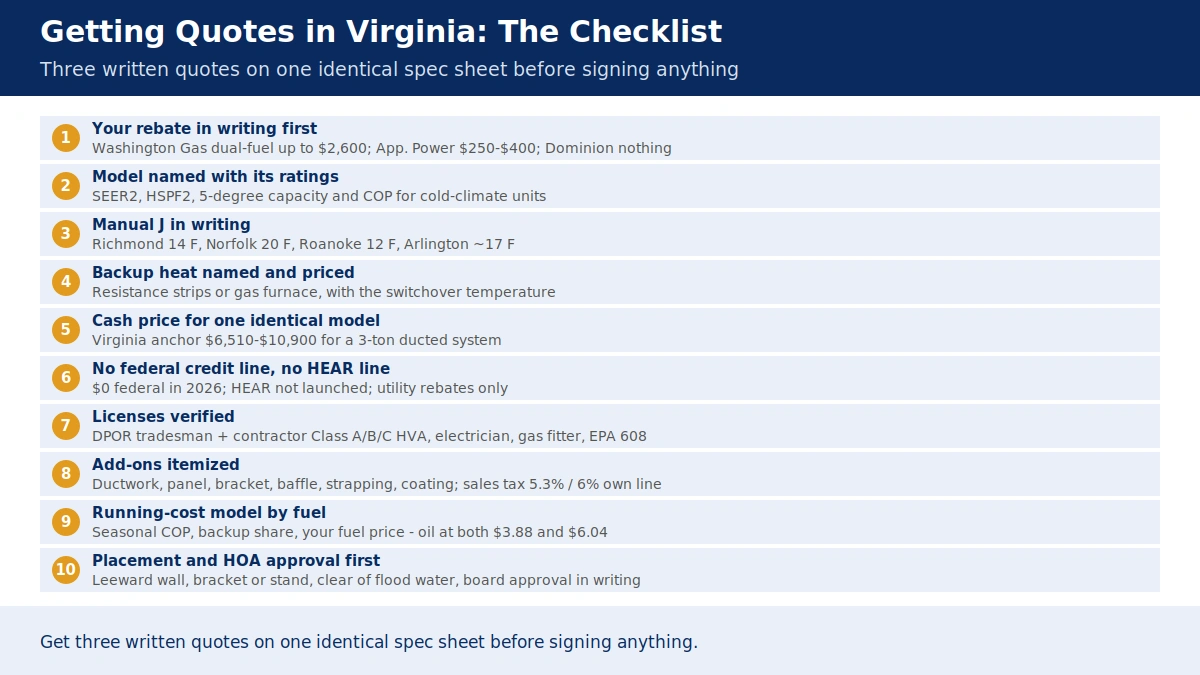
The ten-item quote checklist:
- Your rebate, in writing, first — Washington Gas dual-fuel up to $2,600 on the sell sheet ($2,000 on the most recent contractor figures) in Northern Virginia, Appalachian Power $250-$400 in the southwest, nothing from Dominion in most of the state. The territory decides the rebate before anything else — and a quote that subtracts a rebate your utility does not pay is a quote that needs rewriting.
- Model named, with its ratings — the model number, its SEER2 and HSPF2, its 5-degree capacity and COP if it is a cold-climate unit, and whether it is a standard or cold-climate machine for your region. A quote that names no model has priced a machine that may not exist, and a quote naming a standard unit for a mountain home has priced the wrong machine.
- Manual J load calculation, in writing — room by room, at your city’s design temperature (Richmond 14 F, Norfolk 20 F, Roanoke 12 F, Arlington about 17 F). A contractor who sizes by square footage alone is guessing at the number that decides everything else — and in Virginia the governing load changes by region, cooling in the east, heating in the west.
- Backup heat specified in full — strips or furnace, with capacity and switchover temperature both stated on the quote. In the mountains the backup system carries half the winter’s work, and a quote that leaves it out has left out the part that keeps the pipes from freezing.
- Cash price on paper for one identical model — the same kit, the same house, from all three bidders. The Virginia anchor runs $6,510-$10,900 for a 3-ton ducted system; a quote well above it needs an explanation, and one well below it needs a closer look at what was left out.
- No federal credit line, no HEAR line — a 2026 owner purchase gets $0 federal, and Virginia’s HEAR and HOMES programs have not launched. The only money is your utility’s: Washington Gas up to $2,600, Appalachian Power up to $400, Dominion nothing for a central heat pump. Any quote that still deducts a federal credit is using a law that no longer exists.
- Licenses verified — the DPOR tradesman license (Residential HVAC Mechanic, Journeyman, or Master) for the crew, the DPOR contractor license Class A, B, or C with the HVA specialty for the firm, the electrician’s license for electrical work, the gas fitter license for gas connections, and EPA Section 608 for refrigerants. Look both up at dpor.virginia.gov before anyone touches the house.
- Add-ons itemized — ductwork, panel upgrade, bracket or stand, wind baffle, hurricane strapping, corrosion coating, and thermostat, each priced on its own line rather than folded into the per-ton figure. Sales tax gets its own line too — 5.3 percent statewide, 6 percent in Northern Virginia, Hampton Roads, and Central Virginia.
- Model the running cost by fuel, not by brochure — seasonal COP assumed, backup-heat share, and the rate applied, worked out against your own fuel: gas at $1.74 a therm, oil at both $3.88 and $6.04 a gallon, propane at $3.86, or your own electric rate. A quote that models savings at the supply-only rate rather than the all-in 17.64 cents is off by about $120 a year on the planning home — and a quote that models oil savings at $6.04 without the $3.88 case is not a model at all.
- Placement and HOA approval settled first, in writing — the outdoor unit on the leeward wall, lifted on a bracket or stand, clear of flood water and plow drifts, with HOA or condo board approval before the unit is ordered. A unit sited for the installer’s convenience, facing into the wind, costs more to run and calls the technician out more often.
Buy, dual-fuel, or geothermal? Buying a standard ducted system wins for homeowners with electric heat, oil heat, or propane heat — and for anyone whose furnace and air conditioner are both dying anyway. Dual-fuel suits gas-heated homes in Northern Virginia, where the furnace owns January, the heat pump owns the shoulder seasons and the summer, and Washington Gas pays up to $2,600 toward the pair. Geothermal fits long-term owners on big lots who will stay 20 years and want the steadiest winter COP in Virginia — at $20,170-$31,790, with no federal credit to soften it in 2026. A cold-climate unit wins in the mountains and loses on the coast, where the premium buys capacity the winter never asks for — and a lease wins for almost no one either, because no provider was verified selling one here.
Sources & methodology
Cost anchors:
- NumeralQ Heat Pump Cost in Virginia 2026 (updated Oct 7, 2026; city pages Oct 9-Nov 2, 2026) — planning estimates, not contractor bids: statewide 3-ton ducted $6,510-$10,900; cold-climate ducted $8,560-$14,970; single-zone $3,120-$4,870; multi-zone 3-head $6,180-$11,100; dual-fuel $9,170-$15,050; geothermal $20,170-$31,790; Richmond $6,490-$10,870; Virginia Beach $6,500-$10,890; Norfolk $6,500-$10,890; Chesapeake $6,500-$10,890; HVAC replacement (AC + gas furnace) 3-ton $8,300-$14,050
- SwiftPro Heat Pump Installation and Replacement in Northern Virginia (prices checked Oct 2026): heat pump system $8,499-$21,650; ductless single-zone $7,000-$10,000; dual-fuel switchover ~38 F on Dominion, ~16 F on NOVEC; marginal winter costs Dominion 16.1 cents/kWh, NOVEC 12.6 cents/kWh, Washington Gas $1.41/therm; Washington Gas dual-fuel rebate $2,000 new 95% furnace / $1,400 existing 90%+ furnace
- BetterHouse Heat Pump Installation Cost by State 2026 (modeled): Virginia ducted $3,920-$13,730, typical $10,370; national ducted $4,000-$14,000 typical $10,575 (This Old House Aug 2026); single-zone $2,000-$12,000 typical $3,250; geothermal $12,000-$40,000+ typical $15,206 (Angi)
- AVS Heating and Air (Fairfax, VA contractor) 2026: average new heat pump install $5,613, most homeowners $4,068-$7,160; heat pump + ducts $12,000-$25,000; geothermal $6,000-$20,000 (complex/pond $30,000+)
- WeatherMakers Geothermal Heat Pump Cost in Chesapeake, VA (Sep 2026): national planning range $15,000-$40,000+ (Carrier / EnergySage); loop types (horizontal 4-6 ft trenches; vertical 150-250 ft/ton; pond half-acre, 10-12 ft deep, within 200 ft; open loop well water)
Rates:
- EIA Electric Power Monthly Table 5.6.A, Oct 28, 2026 release: VA residential 17.64 cents/kWh Aug 2026; US 18.16 cents; Jan-Aug 2026 VA avg 17.03 cents, +13.2% vs same months 2025; 12-month to Aug 2026 16.6 cents; Aug 2021 12.71 cents (+38.8% in 5 years)
- Dominion Energy Virginia: typical 1,000 kWh bill $149.92 (July 2025) to $180.79 (July 1, 2026) per Dominion Aug 2026 presentation; SCC base-rate increase $11.24/month in 2026, $2.36 in 2027 (Nov 2025 approval); Schedule 1 tariff filed June 16, 2026, effective July 1, 2026; $7.58/month fixed charge; all-in ~18.40 cents at 900 kWh
- EIA Natural Gas Prices, VA residential $17.99/Mcf, 12-month avg to July 2026 (~$1.74/therm); Virginia Natural Gas Schedule 1 Nov 2026 billing rate $1.88126/Ccf, customer charge $14.18/month; EIA VA citygate 2026 Jan $8.80/Mcf to Aug $6.15/Mcf
- EIA weekly heating oil/propane: VA week Nov 2, 2026 oil $6.04/gal (year earlier $3.63), propane $3.86/gal (year earlier $3.41); 2025-26 winter-season oil avg $3.88/gal; US oil avg $6.14/gal week Nov 2, 2026
- EIA Winter Fuels Outlook 2026-27 (Oct 6, 2026): Northeast gas $879/season, electric heat $1,637/season (context only)
Climate and performance:
- ASHRAE 90.1-2013 Table D-1 (99.6% design temp / HDD65 / CDD50): Richmond 14 F / 3,963 / 4,223; Norfolk 20 F / 3,495 / 4,478; Roanoke 12 F / 4,360 / 3,715; Lynchburg 12 F / 4,340 / 3,728; Charlottesville 4,224 HDD / 3,902 CDD; Danville 3,944 / 4,236; Fredericksburg 4,554 / 3,754; Washington DC 17 F (ICC Appendix D, used as Arlington planning estimate)
- WeatherSpark Virginia climate: Richmond July ~20 muggy days, August ~17; Richmond January avg high ~47 F / low ~30 F; July avg high ~88 F; Roanoke ~15 inches snow/yr, ~77 freezing nights/yr (secondary)
- ENERGY STAR CAC/ASHP V6.2 (revised Mar 2025) cold-climate bar — COP at least 1.75 at 5 F, capacity at 5 F at least 70% of the 47 F rating, HSPF2 8.1+ ducted / 8.5+ ductless, SEER2 15.2+ — alongside NEEP ccASHP Spec v4.0 (effective Jan 1, 2023)
- DOE Cold Climate Heat Pump Challenge field data: 5 F capacity 70-80%, COP 2.2-2.8; -5 F capacity 60-70%, COP 1.8-2.4; standard unit at 5 F 40-60% capacity, COP 1.0-1.5
Rebates and incentives:
- Washington Gas Home Energy Savings Program, Virginia: dual-fuel heat pump with furnace replacement $2,600 (ASHP 15.2 SEER2 / 7.5 HSPF, furnace 95% AFUE), existing furnace $2,000 (sell sheet RESI-VA-0725) vs $2,000 / $1,400 (SwiftPro Oct 2026) — conflict flagged; terms doc RESI-VA-0925 says amounts through Dec 31, 2025; must replace existing central AC; participating contractor; paperwork within 30 days
- Appalachian Power TakeCharge VA incentive guide (Jan 2026): ductless mini-split $300 standard / $400 HP Plus; air-source heat pump $250 (ENERGY STAR, 15.2 SEER2 / 7.8 HSPF2); heat pump water heater $1,200; ERV $1,500 / $650; HVAC tune-up $35; fuel switching not permitted; Home Energy Assessment required; HP Plus = 61-99% of VA state median income
- Dominion Energy Virginia: no central heat pump rebate currently listed (1Stop, Nov 2026); heat pump water heater rebates $250-$400; ENERGY STAR DIME lists Dominion VA heat pump rebate $156-$312, 01/01/2024-12/31/2029 — older listing, current status unverified, flagged
- Columbia Gas of Virginia: up to $500 for a 90%+ AFUE gas furnace, 2026 installs, apply within 120 days or by Jan 31, 2027 (furnace-side only)
- VA HEAR/HOMES: not launched; Virginia Energy FAQ updated Oct 13, 2026 — launch contingent on DOE review of updated application (submitted Sept 2026), no launch date; proposed budgets ~$75.2M HEAR + ~$75.6M HOMES (VA Energy) vs DOE Jan 2025 dataset $93,987,430 HEAR + $94,347,205 HOMES — conflict flagged; heatpumppricing verified Nov 4, 2026: not launched, no launch date
- DOE Program Notice 26-2 (May 29, 2026): HEAR electric-to-electric only, no fuel-switching; HEAR cap $8,000, HOMES up to $8,000
- OBBBA P.L. 119-21 and IRS FS-2025-05: §25C and §25D $0 for post-Dec-31-2025 installs, completion date counts; IRS Notice 2025-42 (§48E, in service by Dec 31, 2027, construction begun by Jul 4, 2026)
- HB 2 (2026, pending): low-income oil/propane heat pump conversions via Dominion/Appalachian Power, 30% of eligible Dominion customers + 2,000 AppCo households in 5 years; passed House subcommittee Jan 2026; similar bill vetoed 2025; not law
- CFPB Aug 2024 market spotlight: dealer $0-down financing fees 10-30% of cash price, sometimes over 50% (national figure)
Heating fuel mix:
- ACS 2022 (Census, via Statista / Brilliant Maps): VA electricity 56.5%, utility gas 32.8%, bottled/LP gas 4.2%, fuel oil 3.7%, wood 1.8%, coal 0.04%, solar 0.1%
Licensing:
- Virginia DPOR Board for Contractors (18VAC50-30 tradesmen; 18VAC50-22 contractor firms): Residential HVAC Mechanic (new Apr 1, 2025, residential-only); Journeyman HVAC (4 yrs experience + 240 hrs training or equivalents; PSI exam 85 items / 210 min); Master HVAC (1 yr as journeyman, or 3 yrs as Residential HVAC tradesman, or 9 yrs in trade); contractor license Class A/B/C with HVA specialty, required over $1,000 (Va. Code 54.1-1100); Class C $1,000-$30,000, Class B to $150,000, Class A $150,000+ or $1M+/12 months; Master HVAC qualified individual required; unlicensed work Class 1 misdemeanor (Va. Code 54.1-111); EPA Section 608 required for refrigerants; verify at dpor.virginia.gov
- Sales tax: 5.3% base statewide (4.3% state + 1% local); 6.0% in Northern Virginia, Hampton Roads, Central Virginia; 6.3% in eight localities; 7% Historic Triangle; Tax Foundation statewide avg 5.77% (July 1, 2026)
Labor:
- BLS OEWS May 2025, SOC 49-9021: VA HVAC mechanics median $28.72/hr (mean $29.42); national median $29.33 (mean $31.14); Richmond metro median $28.43; Washington-Arlington-Alexandria metro median $34.58 (mean $35.45, employment 8,730); Virginia Beach-Norfolk metro median $28.59; Blacksburg median $24.05
Running-cost and payback arithmetic:
- Planning home ~35 MMBtu delivered heat/yr (NestPriced planning assumption, scaled from the series’ 50 MMBtu Boston home at 5,634 HDD: 50 x 3,963/5,634 = 35.2) = 10,258 kWh of heat; gas 95% AFUE at $1.74/therm = 368 therms = ~$641/yr; heat pump COP 2.5 = 4,103 kWh (17.64 cents) = ~$724/yr; COP 2.0 = 5,129 kWh = ~$905/yr; COP 3.0 = 3,419 kWh = ~$603/yr; resistance = 10,258 kWh = ~$1,809/yr; oil 85% (138,500 BTU/gal) = 297 gal/yr ($6.04 = ~$1,796/yr; $3.88 = ~$1,154/yr); propane 95% (91,452 BTU/gal) at $3.86 = 403 gal = ~$1,555/yr; break-even COP vs 95% gas = 2.82, vs oil at $6.04 = 1.01, vs oil at $3.88 = 1.57, vs propane = 1.16; backup-resistance illustration (10% of heat at 17.64 cents) ~$181/yr; dual-fuel controls $500-$1,500 is a national planning figure, labeled as such
- Ducted 3-ton at ~$8,700 (midpoint of $6,510-$10,900): vs resistance saves ~$1,085/yr -> ~8.0 yrs; vs oil at $6.04 saves ~$1,072/yr -> ~8.1 yrs; vs oil at $3.88 saves ~$429/yr -> ~20.3 yrs; vs propane saves ~$831/yr -> ~10.5 yrs; vs gas 95% loses ~$83/yr -> never on fuel; at COP 3.0 vs gas saves ~$38/yr; Washington Gas dual-fuel rebate $2,000 (SwiftPro Oct 2026) takes a NoVA dual-fuel job to ~$6,700 net
EXCLUDED:
- Any “after 30% credit” or “after $2,000 credit” prices: §25C/§25D are $0 for 2026 installs
- Any HEAR rebate in a 2026 Virginia quote: not launched, no launch date, and no fuel-switching even after launch
- Washington Gas $2,600 figure as current: conflict with SwiftPro Oct 2026 ($2,000), flagged; WG terms say through Dec 31, 2025
- Dominion $156-$312 heat pump rebate as current: older DIME listing, unverified, flagged
- Dominion Home Retrofit Program central HP rebate amount: not verified
- Arlington/Alexandria and Roanoke city install prices: planning estimates only, flagged in the draft
- Cold-climate prices by size other than 3-ton: planning estimates scaled from the 3-ton anchor, flagged in the draft
- Dual-fuel bundled installed price: NumeralQ modeled band only, flagged
- VA-specific permit fee schedule and panel-upgrade price: not verified, flagged
- Heat-pump seasonal COP 2.5-3.0: planning range, not field-measured for a specific VA installation
- Any VA lease/PPA offer: no provider verified, authorization unverified
- HB 2 as a program: pending legislation, not law, flagged
- 2027 utility rebate levels: none published, not projected
- Snowfall figures: secondary only, hedged or omitted
- Billed hourly labor rates: not published, omitted (BLS wages only)
*Disclaimer: The prices here are 2026 Virginia planning figures. What you end up paying moves with the city, the house, the utility territory, and the contractor. Get written quotes from three DPOR-licensed Virginia installers before settling on a budget. Nothing here is tax advice for your own return — these are general notes only. A Virginia tax professional can confirm how these notes apply to your return — ask before you file. Program rules change — Washington Gas and Appalachian Power rebate amounts, and the HEAR/HOMES launch status — so confirm current terms with your utility before signing. This guide dates its heating oil prices to their sources — $6.04 a gallon from the week of November 2, 2026, and $3.88 as the 2025-26 winter-season average. An oil-heated home’s payback flips with the oil price, so check the current EIA weekly survey before you decide.*
What does a heat pump cost in Virginia in 2026?
A typical 3-ton ducted heat pump costs $6,510-$10,900 installed in Virginia in 2026 (NumeralQ planning estimates, October 2026), with a Northern Virginia contractor price list running $8,499-$21,650 for a full system. A single-zone ductless mini-split runs $3,120-$4,870, a cold-climate ducted system $8,560-$14,970, a dual-fuel system $9,170-$15,050, and geothermal with a ground loop $20,170-$31,790. The largest rebate in the state is Washington Gas’s dual-fuel payment of up to $2,600 in Northern Virginia, while Dominion Energy lists no central heat pump rebate at all — and the federal tax credit is $0 for a 2026 install.
Do heat pumps work in Virginia winters?
Yes — and Virginia is one of the easiest states in this series for a heat pump. Richmond is designed for 14 degrees, Norfolk for 20, and Roanoke for 12, so a standard ducted unit handles most of the state without the cold-climate premium; only the mountains need a cold-climate machine with backup heat. A standard unit keeps 40 to 60 percent of its capacity at 5 degrees, while a cold-climate unit keeps at least 70 percent with a COP of at least 1.75. This guide plans on a seasonal COP of 2.5 to 3.0 for Virginia, because most of the season sits in the 30s and 40s. Even the best air-source unit needs backup heat for the coldest nights in the mountains, and a standard unit is the wrong buy west of the Blue Ridge.
Is a heat pump cheaper to run than a gas furnace in Virginia?
Almost — it is the closest race in this series. Virginia power averages about 17.64 cents a kilowatt-hour, and tying a 95 percent gas furnace at $1.74 a therm takes a seasonal COP of about 2.82, while a realistic Virginia seasonal COP is 2.5 to 3.0. At COP 2.5 a heat pump costs about $724 a year to heat the planning home against about $641 for gas; at COP 3.0 it costs about $603, saving about $38. The machine you buy decides the race, not the fuel. Against electric resistance heat, the heat pump wins everywhere in the state, saving about $1,085 a year — and more than half of Virginia homes heat with electricity.
Does a heat pump save money against heating oil in Virginia?
Yes, at both oil prices this guide prints. Take oil at $6.04 a gallon, the November 2026 Virginia average. Against an 85 percent oil furnace on the planning home, a heat pump at a seasonal COP of 2.5 saves roughly $1,072 a year. At $3.88 a gallon, the 2025-26 winter-season average, it still saves about $429 a year, because the break-even COP against oil is only about 1.57 even at that price. Oil moved 67 percent in a single year, so check the current EIA weekly survey before you decide — but in Virginia the oil case wins at the low price too, which is not true in the northern states.
What rebates can I get for a heat pump in Virginia in 2026?
It depends entirely on your utility. Washington Gas pays up to $2,600 for a dual-fuel heat pump with a new 95 percent furnace in Northern Virginia ($2,000 with an existing 90 percent furnace), though a contractor’s October 2026 figures put those at $2,000 and $1,400 — confirm the current amount before you count it. Appalachian Power pays $250 for a standard air-source unit and $300-$400 for a ductless mini-split in southwest Virginia, and fuel switching is not permitted. Dominion Energy lists no rebate for a central heat pump at all. Low-income households can access free upgrades through the Weatherization Assistance Program and Dominion’s EnergyShare. For a 2026 install, the federal tax credit is $0 — nothing at all.
Can I get the $8,000 HEAR rebate for a heat pump in Virginia?
Not in 2026. Virginia’s HEAR and HOMES programs have not launched — Virginia Energy submitted updated application documents to the Department of Energy in September 2026 and says it cannot provide an estimated launch date. Roughly $150-$188 million is allocated to Virginia, and none of it buys a rebate you can claim today. After launch, Program Notice 26-2 from the Energy Department still bars HEAR money for fuel-switching. That shuts out a gas- or oil-heated home trying to switch to a heat pump; only electric-to-electric upgrades and new construction qualify — which in Virginia covers the 56.5 percent of homes that already heat with electricity.
What license or permit do I need to install a heat pump in Virginia?
You need a mechanical permit and an electrical permit from your county or city, and your contractor needs two state credentials: a DPOR tradesman license for the crew (Residential HVAC Mechanic, Journeyman, or Master HVAC) and a DPOR contractor license in Class A, B, or C with the HVA specialty for the firm, required once a job passes $1,000. Virginia does license HVAC — the idea that it does not is wrong, and it is the buyer’s best protection. The electrician’s license, the gas fitter license for dual-fuel work, and federal EPA Section 608 certification for refrigerants are separate checks. Look both DPOR licenses up at dpor.virginia.gov before anyone touches the house.
When does a Virginia heat pump pay for itself?
Against electric resistance heat, about 8 years, because it saves about $1,085 a year — and that is the payback most Virginia buyers actually get, since more than half the state heats with electricity. Against heating oil at $6.04 a gallon, about 8 years, saving about $1,072 a year; at last winter’s $3.88 a gallon, about 20 years, saving about $429 a year. Against propane, about 10 years, at about $831 a year saved. Versus a 95 percent gas furnace, fuel savings never arrive at a seasonal COP of 2.5 — the heat pump runs about $83 a year dearer. But compare the heat pump against the furnace-plus-air-conditioner you would buy anyway, and there is no premium to pay back at all: the heat pump is typically cheaper than the pair it replaces.