

Table of Contents
An Arkansas heat pump buyer faces a strange combination. The running-cost case is about as good as it gets anywhere in the country. Power is the ninth cheapest in America. Gas is cheap too, but not cheap enough — the heat pump still wins the fuel maths at every efficiency tier, which is true in only a handful of states. And the rebate case is about as bad as it gets. There is no state programme, no state tax credit, no federal credit, and no launched HEAR rebate. The utility money that does exist stops at territory lines, and the biggest utility in the state pays nothing at all for the machine itself. So the Arkansas decision turns on two questions that have nothing to do with each other: how cheaply can the house be heated and cooled, and whose name is on the electric bill?
The utility question comes first, because it decides the rebate before any equipment is priced. Entergy Arkansas serves Little Rock, Pine Bluff, Hot Springs, and much of central and southern Arkansas — about 615,191 residential customers — and it pays $0 for a residential heat pump. SWEPCO serves the northwest corner, including the Fayetteville area, and pays $250–$500 a ton, or $600 a ton for a conversion off electric resistance heat. OG&E serves the Fort Smith area and pays up to $500 a ton. Seventeen electric cooperatives cover the rural counties, each with its own terms, and Jonesboro’s City Water and Light is a municipal utility with its own rules. Two neighbours on the same street in different territories can collect rebates thousands of dollars apart for the same machine. Check the name on the bill first. Everything else follows from it.
The climate question is simpler than in most states, and it cuts the other way from what a buyer from the north expects. Arkansas winters are mild — Little Rock designs to 20F, Fort Smith to 17F, Texarkana to 23F — and a standard heat pump carries the house through nearly the whole heating season. Arkansas summers are the hard part. Fort Smith designs to 98F, Little Rock to 96F, and the air stays muggy for months. A heat pump in Arkansas is an air conditioner that also heats, not a heater that also cools. Buy it for the five months of cooling and dehumidification, and the heating comes almost free.
One more Arkansas fact belongs up front, because it changes how every price in this guide should be read. Arkansas charges sales tax. The state rate is 6.5%, and with local tax the combined rate runs about 9.5% in most cities. The equipment portion of a heat pump job is taxable tangible property. A $9,000 Arkansas quote may therefore carry several hundred dollars of tax, depending on how the contractor structures the invoice, while the same job quoted in a no-tax state costs exactly what it says. Ask every bidder whether the quote includes sales tax on the equipment. The answer is worth hundreds of dollars, and it is the easiest money in this whole guide to save.
The US-wide baseline behind every Arkansas figure below is our national heat pump cost guide.
How Much Does a Heat Pump Cost in Arkansas in 2026?
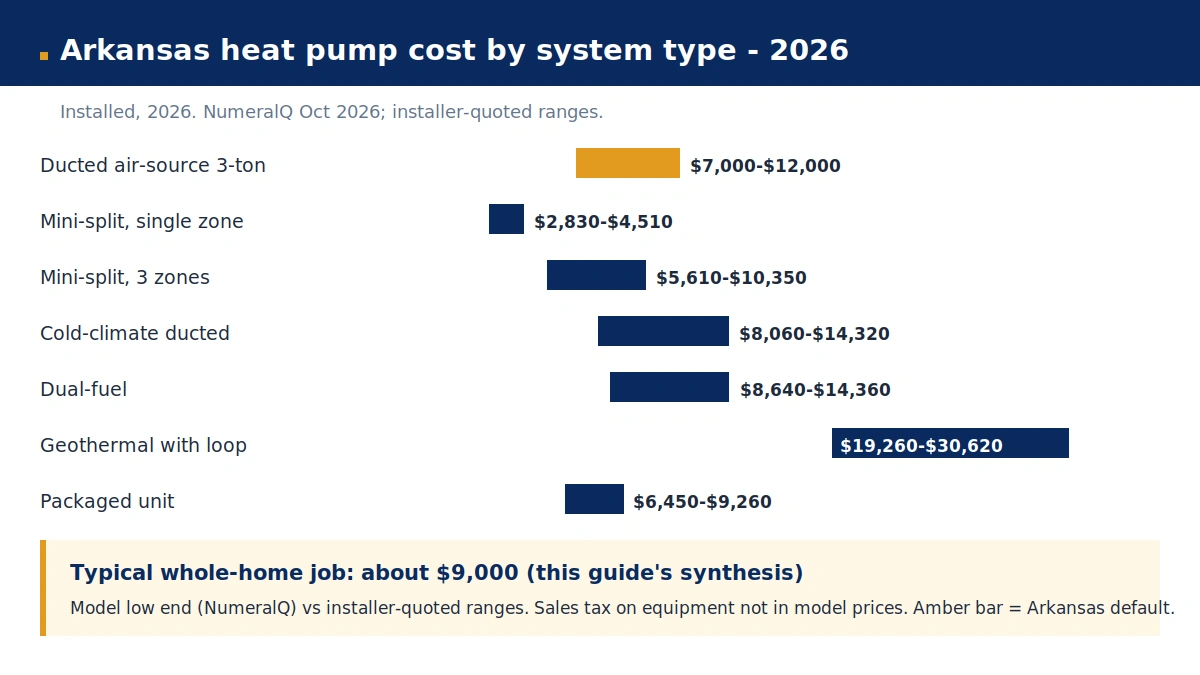
For an Arkansas home of 1,500–2,500 square feet, the machine that usually fits is a 3-ton whole-home ducted air-source heat pump. A 2026 fit for that 3-ton job runs $7,000–$12,000, and most settle near $9,000. Plan on that band. That covers the outdoor condenser, the indoor air handler, the refrigerant lines, a dedicated circuit, the permit, and the start-up visit — a system that runs, not a crate left on the driveway. Whether it also covers the sales tax on the equipment depends on the contractor, so ask, and get the answer in writing before you compare bids.
The band comes from two anchors that pull in different directions, and the spread between them is itself useful information. NumeralQ’s Arkansas estimator — October 26, 2026 pricing, built from Fixr, This Old House, Home Depot prices, and BLS May 2025 wages — puts the 3-ton ducted job at $6,080–$10,350. A model like that adds up parts and local pay and leaves out nearly everything else — the sales visit, the warranty reserve, whatever is hiding inside a real Arkansas house — so it lands below what installers actually charge. Bert Black, a Central Arkansas installer, puts the Arkansas heat pump range at about $4,000–$12,000, varying with system size, efficiency, ductwork, electrical needs, brand, and installation difficulty. The headline lands where those views meet: $7,000–$12,000 for the standard whole-home job, with the top end kept for variable-speed equipment, new ductwork, and panel work, and the bottom end for straightforward replacements in Little Rock. The near-$9,000 typical figure is this guide’s own synthesis. No published Arkansas statewide installer average was found, and this guide would rather say that than invent one.
A whole-home quote near $4,000 should raise an eyebrow, not excitement. When one bid comes in thousands below the others, something is usually missing from it — the indoor unit, the wiring, the permit fee, the duct changes, the start-up visit — or a line that shows up later as an extra. Hunt for the missing pieces before you sign, not after the crew is already on site.
Against the rest of the country, Arkansas sits below the national average. The national guide’s US-wide band for a ducted heat pump is $7,500–$15,000 in 2026, and NumeralQ puts Arkansas at about 6% below the national figure. Arkansas labour is the main reason: HVAC mechanics and installers in Arkansas earn a median $23.13 an hour against $29.33 nationally (BLS, May 2025) — about 21% below the national median — and contractors bill $46–$60 per worker-hour, against $61–$79 in a higher-wage state like Oregon. Cheap labour cuts both ways, though. It keeps the quote down, and it means the cheapest bidder in a low-wage market can be very cheap indeed. The price of a mistake is lower here than in the cold states — an undersized unit in Arkansas leans on strip heat for a few nights, not for a season — but the price of a bad install is the same everywhere: a system that short-cycles through a muggy July and leaves the house cool and clammy.
| System | Typical Arkansas installed cost (2026) |
|---|---|
| Ducted air-source heat pump, 3-ton (typical home) | $7,000–$12,000 (typical ~$9,000) |
| Ductless mini-split, single zone | $2,830–$4,510 |
| Ductless mini-split, 3 zones | $5,610–$10,350 |
| Cold-climate ducted heat pump, 3-ton | $8,060–$14,320 |
| Dual-fuel (heat pump + gas furnace) | $8,640–$14,360 |
| Geothermal (ground-source) with loop | $19,260–$30,620 |
| Packaged unit | $6,450–$9,260 |
Sources: NumeralQ Arkansas heat pump estimator (Oct 26, 2026); NumeralQ Arkansas HVAC replacement page (dual-fuel and packaged models); Bert Black Central Arkansas 2026 guide; Franklin NWA mini-split page (2026); nestpriced national guide (art. 1).
Heat Pump Cost in Arkansas by System Type
Start from the house, not the catalogue. One wall head costs roughly a third of a full ducted job, and a ground loop costs roughly triple — but neither number means anything until the house itself is understood. Ducts or no ducts, gas or no gas, a furnace with years left or one on its last legs, Little Rock mild or Ozark cold: those facts set the system before any price does.
Ducted air-source heat pumps are what most Arkansas homes get. A single unit pushes heated and cooled air through the ducts the house already has, retiring the furnace and the air conditioner in one move. NumeralQ’s model puts the 3-ton job at $6,080–$10,350; installer-published reality in Central Arkansas runs $4,000–$12,000, with the gap mostly margin, warranty, and job conditions. When the ducts are sound and the furnace and the AC are wearing out together, get this option priced first. Our ductless vs ducted comparison works through that whole trade-off in detail.
Ductless mini-splits fit the homes that never had ducts — a finished bonus room in Fayetteville, an addition in Conway, a garage conversion in Little Rock, older homes where ducts were never run, and cabins in the Ozarks. NumeralQ puts one 12,000 BTU head at about $2,830–$4,510 fitted, and three zones at $5,610–$10,350. Franklin, a Northwest Arkansas installer, puts a mini-split in NWA at $2,000–$10,000 or more depending on rooms, with installs starting from the $2,000s all-in. Five heads or more for a whole house climbs higher still on the national figures, and by then a ducted system is usually the cheaper answer, where ducts exist or can be added. Each mini-split is a heat pump in its own right: one box cools the bonus room through a humid July and warms it through January. You will find per-zone pricing in our mini-split installation cost guide.
Cold-climate heat pumps are a solution looking for a problem in most of Arkansas. A cold-climate ducted system costs $8,060–$14,320 (NumeralQ), about $2,000 more than a standard system, for inverter-driven capacity that keeps delivering heat down toward 5F and below. Little Rock designs to 20F, Fort Smith to 17F, and Texarkana to 23F — none of them asks a standard unit to prove itself for long. A contractor selling a cold-climate unit in Little Rock or Fort Smith is selling capacity the climate does not ask for. The one exception is the Ozark high country around Fayetteville, where the design case runs colder and the elevation is higher, and even there the premium is a judgement call rather than a default. When that premium pays and when it does not is covered in our cold-climate mini-split guide.
Dual-fuel systems pair a heat pump with a gas furnace, and in Arkansas they are the honest answer for a gas-heated home that is not ready to give up gas. Mild winters let the heat pump carry the long shoulder seasons; the furnace only steps in on the coldest nights, when the heat pump’s efficiency drops and the strips would otherwise take over. A complete dual-fuel system costs $8,640–$14,360 on NumeralQ’s model. The cheapest way into dual-fuel is a heat pump in the place of a dying air conditioner, with a gas furnace younger than about ten years kept in service. A young furnace paired with a dying AC makes dual-fuel the first option to get priced. The full breakdown is in the dual-fuel cost guide.
Geothermal sits apart: $19,260–$30,620 including the ground loop (NumeralQ), and higher on the national guide for larger or more complex loop fields. Nothing you can buy is more efficient or longer-lived — the loop itself runs 25–50+ years on national figures — yet in Arkansas the payback sums are stubborn. Electricity is already among the cheapest in the country, which shrinks the yearly savings that are meant to repay a premium of $10,000 or more over air-source. Geothermal adds up on new builds with room for a horizontal loop, or for an owner planning to stay twenty years or more. Nearly everyone else gets more value from a higher-efficiency air-source unit and sealed ducts. For the full geothermal figures, see our geothermal heat pump cost guide.
Packaged units — a single outdoor box holding the whole system — cost $6,450–$9,260 on NumeralQ’s Arkansas model. They suit homes with no indoor space for an air handler, and some manufactured homes, but they are a niche choice in Arkansas compared with the split ducted system above.
Heat Pump Cost by Home Size
Roughly 500–600 square feet per ton is a handy rule of thumb and a poor way to buy a machine. Insulation, glass, ceiling height, shade, duct leakage, and — in Arkansas more than most states — how much of the load is humidity rather than temperature all push the right size up or down, and only a Manual J load calculation settles it. That calculation runs $200–$500 on national figures, usually credited back against the install, and no Arkansas-specific price for it was found. Sizing off floor area alone, or off the nameplate on the old unit, is gambling with your own money.
| Home size | Typical system | Ducted air-source installed cost |
|---|---|---|
| 1,000–1,200 sq ft | 1.5–2 ton | $4,000–$7,820 |
| 1,200–1,500 sq ft | 2–2.5 ton | $4,700–$9,080 |
| 1,500–2,000 sq ft | 2.5–3 ton | $5,390–$10,350 |
| 2,000–2,500 sq ft | 3–3.5 ton | $6,080–$11,610 |
| 2,500–3,000 sq ft | 3.5–4 ton | $6,770–$12,880 |
| 3,000+ sq ft | 4–5 ton | $7,460–$15,410 |
Figures: NumeralQ’s Arkansas size estimator, October 26, 2026, ducted air-source. Those bands are model outputs — real installer quotes for the same sizes sit toward the top of each band. Treat the table as a rough guide, not a budget.
Oversizing is the expensive mistake in Arkansas, and it is a humidity mistake, not a temperature one. A unit too big for the house blasts cold air for a few minutes, shuts down before it has pulled any moisture out, and leaves the rooms cool and clammy — the worst outcome in a state where July air sits muggy three days out of four in Fayetteville and the cooling season runs from May into September. Too small, and the unit never rests. It runs around the clock on a 98F Fort Smith afternoon, still calling for strip heat on January nights. Over a decade in an Arkansas home, either sizing blunder costs far more than a Manual J ever could — so have the calculation on paper before a single piece of equipment is ordered.
Two-storey homes need their own warning. One system serving two floors leaves one of them unhappy — bedrooms roasting upstairs in July, a chilly ground floor in January. The fixes that work are two separate systems, one ducted system with zoning dampers, or a ducted unit downstairs with a mini-split head or two upstairs — all of them pricier than a single-system bid. Zoning for two zones runs $1,870–$2,910 in Arkansas (NumeralQ). A bid that prices a two-storey house with one system and never mentions zoning should prompt one question: how will the upstairs feel on a 98F afternoon? Get that answer in writing before you sign anything.
Heat Pump Cost by City: Little Rock, Fayetteville, Fort Smith & Jonesboro
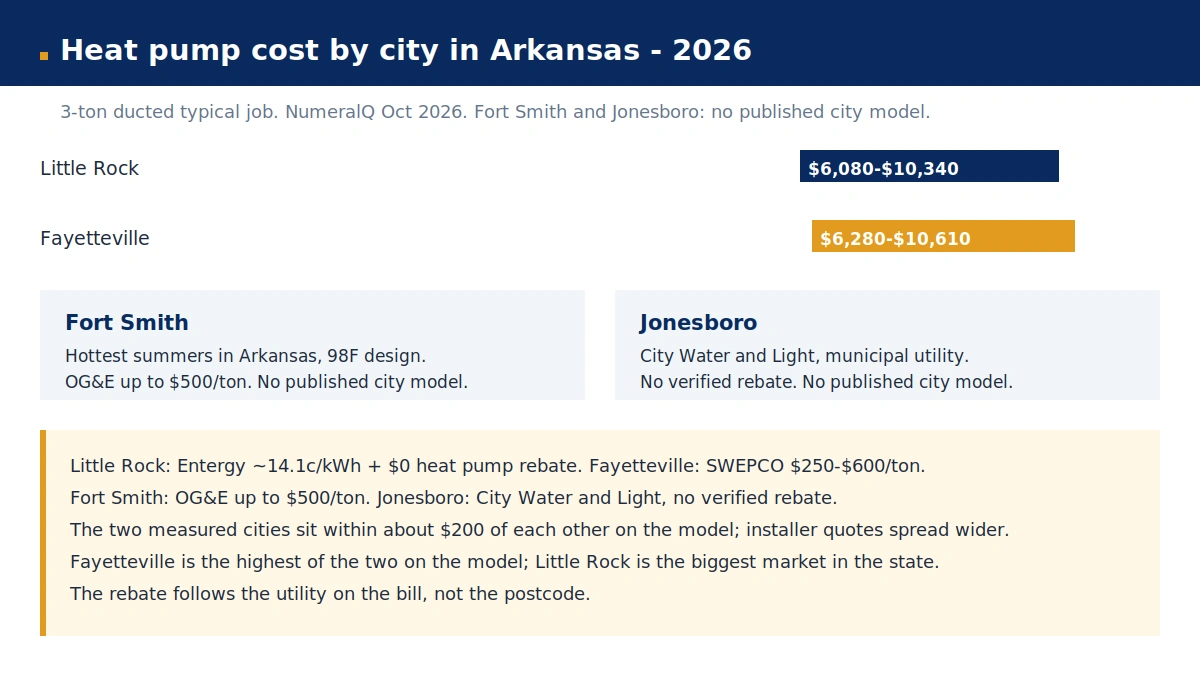
The model prices Arkansas’s two measured cities almost identically for the same 3-ton system — separated by about two hundred dollars — yet each city reaches that price for different reasons, and the rebate map splits them far more than the price does.
| City | 3-ton ducted job, model range | What drives the price |
|---|---|---|
| Little Rock | $6,080–$10,340 | Largest metro; Entergy power at ~14.1c/kWh; $0 heat pump rebate |
| Fayetteville | $6,280–$10,610 | Ozark elevation, colder design case; SWEPCO $250–$600/ton |
| Fort Smith | No published city model | OG&E territory, up to $500/ton; hottest summer design, 98F |
| Jonesboro | No published city model | Municipal utility (City Water & Light); Delta flatlands, no verified rebate |
Figures: NumeralQ Arkansas city pages, October 2026, 3-ton ducted system. No NumeralQ city model exists for Fort Smith or Jonesboro. This guide invents no price band for them — a sense of direction is all it offers, not dollars.
Little Rock is the biggest heat pump market in Arkansas, and the one with the thinnest rebate. The metro sits in Entergy Arkansas territory, which matters twice over: Entergy’s residential rate, about 14.1 cents per kilowatt-hour on the 12-month average to August 2026, sits a touch above the 13.6-cent statewide average, and Entergy pays $0 for a residential heat pump. A Little Rock buyer therefore prices the machine on fuel savings and cooling value alone, with no utility money to soften the front cost. The housing stock is the other complication: older homes in the Heights and Hillcrest with no ductwork and 100-amp panels, postwar ranches with ducts in hot attics, and new builds in west Little Rock that price like a different market. A Little Rock quote also carries the sales tax question more visibly than most Arkansas quotes, because the combined rate in the metro runs near 9.5%. Little Rock designs to 20F in winter and 96F in summer, with about 3,219 heating degree days — a mild winter and a long, hot, humid cooling season. Cooling capacity on a Little Rock quote is not a line to trim.
Fayetteville prices a hair above Little Rock on the model — $6,280–$10,610 against Little Rock’s $6,080–$10,340 — and the difference is mostly the Ozark climate and elevation rather than labour. Fayetteville sits at about 1,250 feet in the Boston Mountains, with a winter design temperature of 20F on ASHRAE design data (99% at 12F, 99.6% at 7F) and a summer design of 95F. January averages a 47F high and a 25F low; July averages 89F and 69F, with muggy conditions on about 75% of July days. What a Fayetteville buyer should check first is the utility name on the bill, because the rebate follows the utility, not the postcode. Fayetteville is in SWEPCO territory, so the $250–$500-a-ton installation rebate — or $600 a ton for a conversion off electric resistance heat — is available to a Fayetteville buyer in a way it never is to a Little Rock buyer. That rebate alone can be worth $750–$1,800 on a 3-ton job. Fayetteville is also the Arkansas city where the cold-climate question is a genuine judgement call rather than an easy no: the design case runs colder than the rest of the state, and a Manual J showing the design temperature it was sized to is worth more there than anywhere else in Arkansas.
Fort Smith has no published city price model, and this guide invents none. The honest answer is direction, not dollars. Fort Smith sits in the Arkansas River Valley on the Oklahoma border, in OG&E territory, and it is the hottest summer market in the state: a winter design temperature of 17F and a summer design of 98F, with about 3,292 heating degree days. OG&E’s Arkansas HVAC replacement programme pays up to $500 a ton, capped at $1,500 a unit and $3,000 a year — the best per-ton rebate in the state for a standard install — but only for retrofit homes built before 2016 with electric air conditioning, installed by a licensed Arkansas HVAC professional, with the paperwork in within 30 days of completion. Fort Smith’s gas comes from Arkansas Oklahoma Gas, a Summit Utilities company. Expect quotes softer than Little Rock on labour and heavier on cooling capacity — direction only, no band.
Jonesboro has no published city price model either, and this guide invents none. Jonesboro sits in the Delta flatlands of northeast Arkansas, in Craighead County, where the combined sales tax rate runs 8.5% (6.5% state, 1% county, 1% city). Its electric utility is City Water and Light, a municipal utility, and no verified 2026 residential heat pump rebate amount was found for it — check with the utility and do not budget on a figure. Jonesboro’s climate is humid subtropical with hot, humid summers and mild winters, and no IPC design temperature was found for the city, so none is given here. The rural counties around Jonesboro are served by electric cooperatives, each with its own terms. Expect Jonesboro quotes to track the statewide bands for the same house, with the rebate question answered by the municipal utility rather than by any statewide programme — direction only, no band.
Smaller Arkansas cities — Conway, Rogers, Springdale, Bentonville, Hot Springs, Pine Bluff, Texarkana, Benton, Bryant, Cabot, Searcy, El Dorado, Russellville — generally price near the statewide bands. Rogers and Bentonville sit in the northwest, where SWEPCO or a cooperative serves the home and the rebate follows the utility on the bill. Hot Springs and Pine Bluff are Entergy territory, so $0 for the heat pump itself. Texarkana straddles the state line, and the rebate follows the utility and the state side of the line — a Texarkana buyer should confirm which side of the border the meter sits on before counting any rebate money.
Arkansas’s Climate: Hot Humid Summers, Mild Winters
Arkansas is split under the International Energy Conservation Code, and the split runs the other way from the cold states: most of the state is Zone 3A, warm humid, and the Ozark counties in the northwest are Zone 4A (IECC Table 301.1 lists the Zone 4 counties as Baxter, Benton, Boone, Carroll, Fulton, Izard, Madison, Marion, and their neighbours; the 2021 IECC county table, PNNL-33270, carries the same split). There is no Arkansas county in Zone 5 or colder. That correction matters, because a Zone 5 label would imply a colder design case than Arkansas actually has — and because a contractor who gets the zone wrong may get the equipment wrong too.
The design temperatures a contractor actually sizes to are the numbers that tell the story. Little Rock: winter design 20F, summer 96F, about 3,219 heating degree days (IPC Appendix D). Fort Smith: winter design 17F, summer 98F, about 3,292 heating degree days. Texarkana: winter design 23F, summer 96F, about 2,533 heating degree days. Fayetteville: winter design 20F on ASHRAE design data (99% at 12F, 99.6% at 7F), summer design 95F, at about 1,250 feet of elevation. Jonesboro has no IPC design temperature on record, so none is given here. Compare those winters with a northern state — Wisconsin designs to the single digits and below — and the Arkansas story is plain: the heating season is short, the design case is mild, and a standard heat pump carries the house through nearly the whole winter with strip heat stepping in only on the coldest nights.
The summer is where Arkansas earns its reputation. Fort Smith’s 98F summer design temperature is the hottest in this series so far, and Little Rock’s 96F is barely behind it. The cooling season runs from May into September, and the air stays wet: in Fayetteville the muggy period runs May 19 to September 25, with muggy conditions on about 75% of July days. A heat pump in Arkansas does two jobs all summer — it cools the air and it wrings the water out of it — and the second job is the one that decides comfort. A single-stage unit sized only to temperature will short-cycle: it cools the room in a few minutes, shuts down before it has pulled any moisture out, and leaves the house at 72F and clammy. A variable-speed unit runs long, gentle cycles that keep pulling moisture out after the temperature is met. That is why the efficiency tier matters in Arkansas for a reason that has nothing to do with the SEER2 number in the brochure. Buy the variable-speed unit for the humidity, not for the rating.
Through most Arkansas winters a standard unit needs no help. When an Arkansas cold snap bites, the heat pump’s heating output falls away in step with the temperature outside. Near 30–35F, most units start leaning on the electric strips to keep up. In Little Rock, Fort Smith, and Jonesboro, that means a modest number of nights. Not weeks at a time. Strip heat is the dearest heat in the house, yet in Arkansas it runs on so few nights that the yearly bill barely notices. The Ozarks are the exception: a Fayetteville home sized to Little Rock assumptions will be undersized for a 12F night, and the strip heat will carry the house for days rather than hours. That is why the Fayetteville quote should name the design temperature it was sized to, and why a Manual J showing 20F — or colder — belongs on the quote rather than a hopeful note. Insist the installer writes the Manual J design temperature into the quote itself. If the number on it looks like Texarkana’s 23F and the house stands in Fayetteville, the sizing is wrong.
Arctic outbreaks are the wild card. Every few years a polar air mass drops over the state and pushes Arkansas well below its design temperatures for days — the February 2021 freeze is the recent example, when pipes burst across the state and the grid strained. A system sized only to a mild-winter assumption will lean on strip heat through such an event, and the bill will show it. That is not a reason to buy a cold-climate unit in Little Rock. It is a reason to size honestly, to keep the strips as backup rather than as the plan, and to ask what the system does at 10F, not only at 30F.
Arkansas weather touches a heat pump in ways no brochure mentions. Spring severe weather — hail and high wind — is a real siting consideration: anchor the outdoor unit, keep it clear of the roof drip line, and confirm with the homeowner’s insurer that hail damage to the outdoor unit is covered before signing, stated here as installer advice rather than a sourced Arkansas figure. Summer thunderstorms can knock power out for hours, and a heat pump that restarts cleanly after an outage is worth more than one that needs a service call. And the long cooling season means the outdoor coil works harder and longer than in a northern state — budget for a coil cleaning each spring, and keep vegetation cut back from the unit so air can move.
Arkansas is a high-adoption state on the quiet. About 19% of Arkansas homes already use a heat pump as their main heat (EIA RECS), against about 54% heating with electricity in some form and 37% with piped gas. That 19% share is higher than Oregon’s 13%, and it is the reason Arkansas installers know the equipment well: the heat pump is not an exotic import here. It is the default electric-heating choice, and has been for years.
Heat Pump vs Gas Furnace in Arkansas: The Running-Cost Math
Both Arkansas fuels sit well below the national average, and that is what makes this comparison interesting rather than lopsided. Arkansas residential electricity averages 13.6 cents per kilowatt-hour on the 12-month average to August 2026 (EIA) — 9th lowest in the US, against 18.0 cents nationally. August 2026 alone was 14.37 cents. The average Arkansas home’s electric bill runs about $143 a month. Residential natural gas runs about $1.86 a therm on the 2025 annual average ($19.25 per thousand cubic feet, EIA; 10.37 therms per thousand cubic feet). Other trailing-average sources agree on the roughly $1.24–$2.21 per therm zone, so this guide uses about $1.85 a therm as the heating-season planning figure and cites the range. Summer monthly gas figures spike — August 2026 at $33.08 per thousand cubic feet, about $3.19 a therm — because fixed charges spread over tiny summer volumes. Never use a summer month as the heating price.
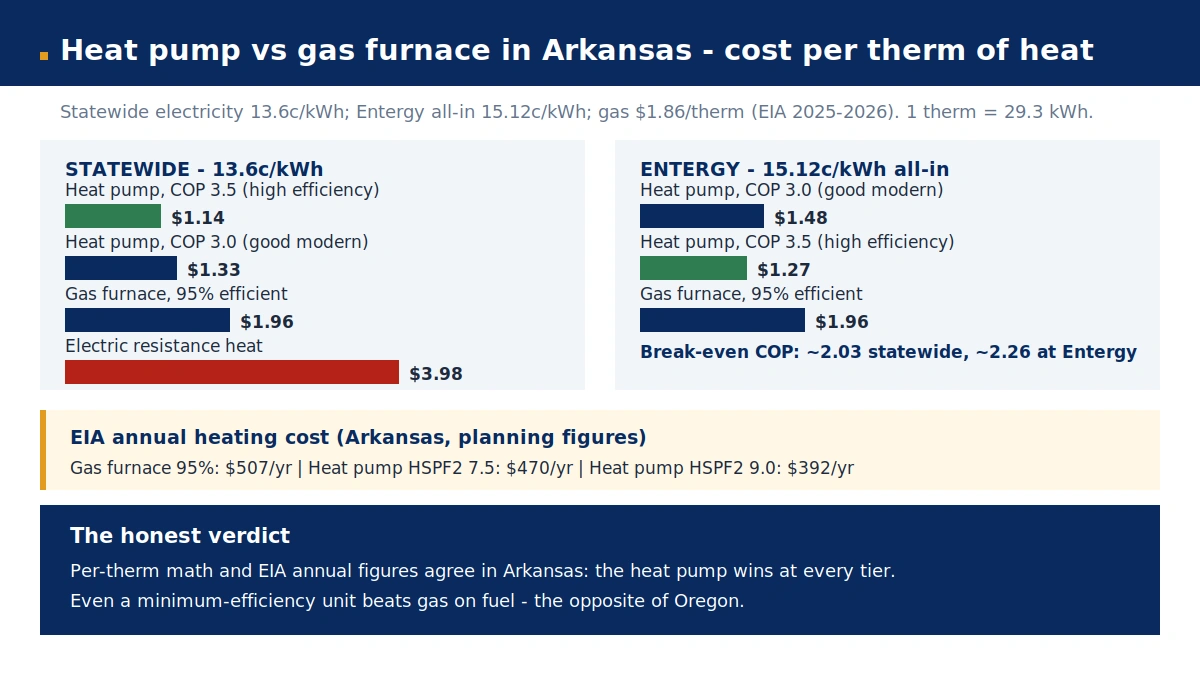
Do the sums per therm of heat, where one therm equals 29.3 kilowatt-hours. At the state-average electricity price of 13.6 cents, a good modern heat pump at a seasonal COP of 3.0 delivers that therm for 29.3 x $0.136 / 3.0, or about $1.33. At COP 3.5, a high-efficiency unit delivers it for about $1.14. For a 95%-efficient gas furnace, that therm costs $1.86 / 0.95 — about $1.96. Electric resistance heat, the fuel many Arkansas heat pump buyers are actually replacing, delivers it for 29.3 x $0.136, or about $3.98. At COP 3.0 the heat pump beats gas by about 63 cents a therm at the state-average price. The break-even COP against gas is only about 2.03 — even a minimum-efficiency heat pump wins on fuel in Arkansas. On this arithmetic the good heat pump wins, and it is not close.
EIA household heating estimates tell the same story, and that agreement is itself worth noting — in Oregon the two views conflict, while in Arkansas they agree. A 95% gas furnace heats the average Arkansas home for about $507 a year; a minimum-efficiency heat pump (HSPF2 7.5, the federal minimum) for about $470 a year; a high-efficiency heat pump (HSPF2 9.0) for about $392 a year. On annual figures, the heat pump wins at every tier — by $37 a year at minimum efficiency and by $115 a year at high efficiency. An independent model — Blue Ridge Heating and Air, October 13, 2026, using 2024 EIA prices and 2024 heating degree days — also puts the Arkansas heat pump ($420 a year) ahead of gas ($440 a year) for a standardised home, and calls the heat pump the cheapest heating method in Arkansas, one of only six states where that is true. Same direction, different absolute numbers, because the modelled home differs — so use it as corroboration of the direction only.
Now run the same sums at the rate most Little Rock buyers actually pay, because the statewide average hides a small gap. Entergy Arkansas, serving about 615,191 residential customers, averaged 14.1 cents per kilowatt-hour residential over the 12 months to August 2026 (EIA) — a touch above the state average — with a $149 average monthly bill. Entergy’s standard tariff adds an $8.40-a-month customer charge plus 5.29 cents per kilowatt-hour in riders, for an all-in 15.12 cents at 900 kilowatt-hours. At 15.12 cents, a heat pump at COP 3.0 delivers a therm for 29.3 x $0.1512 / 3.0, or about $1.48 — still comfortably below gas at $1.96. The break-even COP at Entergy’s all-in rate is about 2.26. An Entergy customer needs no high-efficiency tier for the fuel maths to work: even a standard unit wins by nearly 50 cents a therm. No current SWEPCO or OG&E Arkansas residential rate was verified from a primary source, so no figure is quoted for them — but both serve territories where the statewide average is the best available planning figure, and the heat pump wins there too.
Two more Arkansas situations tilt the sums further toward the heat pump. First is a home still heated by resistance — baseboard panels, wall units, or an ageing electric furnace. A heat pump gives the same warmth there for roughly a third of the electricity — about $1.33 a therm against $3.98 at the state-average price — and that is the case where the payback is fastest and the rebate is largest. The other is propane, whose fuel costs far more than Arkansas power or gas. Judge the heat pump’s $7,000–$12,000 against a furnace and an air conditioner bought together, not against a furnace alone. And remember the other half of the year. A gas furnace sits idle all summer, while a heat pump cools and dehumidifies for five months — and in Arkansas the cooling is the main event, not the bonus. Judge the machine across twelve months, not on one January bill. Our heat pump vs furnace comparison makes the full argument, our furnace replacement guide prices the gas side, and month-by-month sums live in our running-cost guide.
| Heating system | Cost per therm of heat delivered | EIA estimated annual heating cost (AR) |
|---|---|---|
| Gas furnace, 95% efficient | ~$1.96 | ~$507/yr |
| Heat pump, COP 3.0, statewide 13.6c/kWh | ~$1.33 | — |
| Heat pump, COP 3.5, statewide 13.6c/kWh | ~$1.14 | — |
| Heat pump, COP 3.0, Entergy all-in 15.12c/kWh | ~$1.48 | — |
| Heat pump, COP 3.5, Entergy all-in 15.12c/kWh | ~$1.27 | — |
| Heat pump, HSPF2 7.5 (federal minimum) | — | ~$470/yr |
| Heat pump, HSPF2 9.0 (high efficiency) | — | ~$392/yr |
| Electric resistance heat, statewide 13.6c/kWh | ~$3.98 | — |
How the table was built: electricity at 13.6 cents per kilowatt-hour statewide and 15.12 cents all-in for Entergy Arkansas, gas at $1.86 a therm (EIA 2025–2026 figures); 1 therm = 29.3 kilowatt-hours. Treat the COP in this guide as a whole-season planning number for an Arkansas winter, not a lab-bench rating. The yearly EIA figures are planning estimates, not predictions of your bill. They are built from household heating use and today’s state prices. In Arkansas the two views agree — the per-therm sums and the EIA annual figures both favour the heat pump — which is the opposite of Oregon, where they conflict.
SWEPCO, OG&E & the Other Rebates You Can Collect in 2026
Forget the federal money for a moment. In Arkansas in 2026, the live rebate money has two names, and which one pays you depends entirely on which utility sends your electric bill: SWEPCO in the northwest, OG&E around Fort Smith. Entergy Arkansas, the biggest utility in the state, pays nothing for a heat pump. Arkansas offers no statewide rebate and no state tax credit for heat pumps at all. In Arkansas the utility is the whole programme — and the amounts are modest, so budget with that in mind.
| Programme | What it pays (heat pump) | Key condition |
|---|---|---|
| SWEPCO, heat pump installation | $250–$500/ton by SEER2 tier | 15.2 SEER2 / 7.25 HSPF2 minimum; no fuel switching |
| SWEPCO, heat pump conversion | $600/ton | Electric resistance to heat pump, full replacement |
| SWEPCO, CoolSaver tune-up | $175–$250 | System over 1 year old; CoolSaver contractor |
| SWEPCO, heat pump water heater | $1,150 | ENERGY STAR, replaces electric water heater |
| OG&E Arkansas, HVAC replacement | Up to $500/ton, max $1,500/unit, $3,000/yr | Retrofit home built before 2016, electric AC |
| Entergy Arkansas, Home Energy Solutions | $0 for the heat pump | No-cost weatherization + tune-up only |
| Entergy Arkansas, Summer Advantage | $25–$80 first year | Demand response, AC/heat pump cycling |
| Electric cooperatives / Jonesboro CWL | No verified 2026 amount | Check with your own utility |
Sources: SWEPCO 2026 Residential Energy Improvement Program incentive table (swepcosavings.com); OG&E Arkansas HVAC Replacement Rules and Guidelines (oge.com) with amounts via HomeEnergyBasics Jun 11, 2026 summary; Entergy Arkansas Home Energy Solutions Program Guidebook v5.0 (Jan 1, 2026) and Summer Advantage page.
SWEPCO is the programme most northwest Arkansas buyers will actually collect from, and its central rule is the one this guide keeps repeating: it does not pay for fuel switching. The 2026 Residential Energy Improvement Program table pays for a heat pump installation by efficiency tier: $250 a ton at 15.2–17.09 SEER2, $400 a ton at 17.1–19.94 SEER2, and $500 a ton at 19.95 SEER2 or better, with a minimum of 15.2 SEER2, 7.25 HSPF2, and 3.6 COP. On a 3-ton job that is $750 at the bottom tier, $1,200 in the middle, and $1,500 at the top. The bigger payment is the conversion tier: $600 a ton for a full system replacement from electric resistance heat to a heat pump, mini-split, or geothermal system — $1,800 on a 3-ton job, $3,000 on a 5-ton job. The table states plainly that fuel switching cannot be incentivised, so a gas-to-heat-pump conversion collects $0 from SWEPCO. The programme is administered by CLEAResult. Around the heat pump itself, SWEPCO pays $175 for a CoolSaver tune-up on a 1.5–2.5 ton system or $250 on a 3.0–5.0 ton system over a year old, $1,150 for an ENERGY STAR heat pump water heater replacing an electric water heater, $1.25 per CFM reduction for duct sealing, and $75 for an ENERGY STAR thermostat.
OG&E is the Fort Smith programme, and its rules are stricter than SWEPCO’s. The Arkansas HVAC Replacement Program pays up to $500 a ton, capped at $1,500 a unit, two units a year, $3,000 a year maximum — the amounts come via HomeEnergyBasics’ June 11, 2026 summary of the OG&E programme, so verify them at oge.com before budgeting. The rules, from OG&E’s own document, are: only OG&E Arkansas residential customers; retrofit existing homes built before 2016 with electric air conditioning; equipment installed by a licensed Arkansas HVAC professional; the invoice dated January 1 to November 1 of the programme year; and the application, invoice, photo of the new condensing unit data plate, and AHRI certificate submitted within 30 days of completion. Rebates are issued as checks, not bill credits, and funding is limited to availability. Multi-family homes and new construction do not qualify. One warning from across the state line: OG&E temporarily closed Oklahoma applications in June 2026, while Arkansas applications remained open at that time. Check oge.com before purchasing, because a closed programme pays nothing.
Entergy Arkansas is the hole in the middle of the map. The utility serving Little Rock, Pine Bluff, and Hot Springs — about 615,000 homes — has no central residential heat pump rebate. What it does offer is worth knowing about, because it is free: the Home Energy Solutions programme (Guidebook v5.0, January 1, 2026) provides no-cost weatherization measures — ceiling insulation, duct sealing, air sealing, and an air conditioner or heat pump tune-up — to qualifying single-family homes where electricity is the primary heating or cooling source, first-come first-served while funds last. A tune-up and duct sealing on a house about to get a new heat pump is real value, even if it is not a rebate cheque. Entergy’s Summer Advantage programme pays $25–$80 in the first year for letting Entergy cycle the air conditioner or heat pump on peak summer afternoons — $25 to install the device plus up to $25 a year at the 50% cycling level, or $40 plus up to $40 a year at 75%. That is demand-response money, not equipment money, and it should never be counted against the install price. Entergy’s commercial POPS programme pays $175–$400 for packaged terminal heat pumps replacing PTACs — commercial only, not residential, and mentioned here only to prevent confusion.
Electric cooperatives and municipal utilities set their own terms, and no statewide co-op rebate amount was verified for this guide. Arkansas has seventeen electric cooperatives, and at least one co-op rebate form found for 2026 caps the rebate at 20% of equipment cost and runs through December 11, 2026 — but it is not attributable to a named Arkansas co-op, so it is not quoted as an Arkansas figure. Check with your own co-op and do not budget on a figure. Jonesboro’s City Water and Light is a municipal utility outside the state net-metering-style rules that bind the big investor-owned utilities, and no verified 2026 residential heat pump rebate amount was found for it — ask about it, and do not budget on a figure.
Stack the numbers honestly: a $1,200 SWEPCO rebate off a $9,000 job is a 13% discount, real money and not a decision-maker. It is not the five-figure stack some other states’ homeowners collect, and it is not the $8,000 federal rebate that has not launched in Arkansas. Treat the utility rebate as a windfall, never as the foundation of the budget. In 2026, it is. And remember the fuel rule that governs the whole stack: the best-subsidised Arkansas heat pump customer heats with electricity today. A gas-furnace home gets far less — no SWEPCO money for a fuel switch, no OG&E money without electric air conditioning, and, when it launches, no HEAR money for a gas-to-heat-pump switch under Program Notice 26-2.
Federal Help in 2026: $0 Tax Credit & HEAR Not Launched
Federal help in Arkansas in 2026 is nearly non-existent, so this section is short — and the part that does exist has not arrived at all.
The tax credit is $0. Once the calendar turned past December 31, 2025, the One Big Beautiful Bill Act (Public Law 119-21, signed July 4, 2025) had wiped out both federal credits. Both credits are gone: §25C, the Energy Efficient Home Improvement Credit at 30% and up to $2,000 a year for heat pumps, and §25D, the Residential Clean Energy Credit. The IRS confirmed it in FS-2025-05. A heat pump fitted in an Arkansas home in 2026 earns no federal tax credit at all. A 2026 Arkansas quote that still knocks $2,000 off for a federal credit is either stale paperwork — or a contractor betting you will not spot it. Tell them to strike it. The statute and the IRS notice are spelled out in our federal energy tax credits guide.
Arkansas has no state tax credit either. No Arkansas state tax credit for heat pumps exists in 2026, and no Arkansas state rebate programme was found. The only live money is the utility rebates in the previous section. Do not confuse the sales tax on the equipment — which Arkansas does charge — with a tax credit, which Arkansas does not offer.
Arkansas’s HEAR rebate has not launched — and has no launch date. The federal scheme in question is HEAR, the Home Electrification and Appliance Rebates programme under IRA §50122. In the federal design, income-qualified households could collect up to $8,000 toward a heat pump, with the biggest rebates under 80% of area median income and eligibility to 150%, paid as a discount at the point of sale. Arkansas’s allocation for HEAR and HOMES combined runs to $105 million — the exact split between the two programmes was not verified from a primary source, so this guide states no split. The National Housing Trust’s tracker, dated April 30, 2026, records Arkansas’s HEAR and HER applications as conditionally approved with no expected launch date. The Arkansas Energy Office’s own programme page states it plainly: “At this time, the Home Energy Rebates Program is not available in Arkansas.” That status was verified against the state page on November 4, 2026. Homeowner rebate applications have no launch date and will open only after US Department of Energy approval. No retroactive rebates will be paid — work completed before launch will not qualify, a warning that holds for every state in this series.
Arkansas was a late starter even by the slow standards of this programme. In August 2024, Arkansas was one of six states that had not applied for DOE administrative funds to set up its rebate programmes at all. It has since applied and received a conditional approval, but no launch date has followed. Two years after the money was allocated, an Arkansas homeowner still cannot apply for any of it.
The rules changed while Arkansas waited. DOE Program Notice 26-2, issued May 29, 2026, removed the fuel-switching allowance from HEAR: from September 1, 2026, once Arkansas’s programme opens, rebates cover electric-to-electric replacements only, and a gas-to-heat-pump conversion will not qualify. The sharpest consequence lands on the most common Arkansas scenario after electric heat: a gas-furnace home considering a heat pump. That gas-furnace household would still see not a dollar of HEAR money, launch or no launch. When HEAR eventually opens in Arkansas, the money will flow to homes that already heat with electricity — baseboard resistance heat, worn-out electric furnaces, and ageing heat pumps. Mind the timing trap: a job finished today, before launch, can never collect the rebate, whenever the programme eventually opens.
Leasing is the one federal-money route still open in principle. The One Big Beautiful Bill Act left the §48E clean-electricity investment credit open for systems placed in service by December 31, 2027, and heat-pump leasing and subscription products are marketed nationally. But no primary source was found confirming that any specific Arkansas lease product passes a §48E credit through to the homeowner, or the exact §48E mechanics for residential heat-pump leases. This guide says leasing exists nationally and is the one federal-money route still open in principle, and it does not promise a specific dollar saving from §48E, and it names no leasing product in Arkansas. Ask the leasing company in writing what federal credit value — if any — reaches you, and treat a vague answer as no answer at all.
Never build an Arkansas budget around HEAR or a federal tax credit. Before signing, check the Arkansas Energy Office’s home energy rebates page, and treat any future launch as upside rather than plan.
Permits & Licensing: Arkansas’s HVACR License
Arkansas licenses HVAC contractors statewide, and the difference works in the homeowner’s favour. Arkansas does have statewide HVACR licensing through the HVACR Licensing Board, administered by the Arkansas Department of Labor and Licensing — and the statute is blunt. Ark. Code §17-33-301(a) says it is unlawful for any person to engage in HVACR work without the appropriate license or registration. That hands you a real state licence number to ask for, a real state exam behind it, and a real state office to complain to.
Earning that licence is not easy, which is exactly the point. The classes run from Class A, which covers HVACR work without limitation on BTUH or horsepower, down through Class B — air conditioning up to 25 tons of cooling per unit or 1,000,000 BTUH of heating input, and refrigeration up to 15 horsepower per unit — to Classes C, D, and E with narrower limits. An applicant must be at least 18, show at least two years of on-the-job experience as an HVACR technician or graduation from a board-approved programme, and pass a board-approved exam through Prov Exams with a score of at least 70% (the exam fee is $55). EPA Section 608 certification is a federal requirement for anyone who handles refrigerant — no exceptions. General liability insurance of at least $250,000 is required, and workers’ compensation cover if the firm hires employees. Annual license fees run $200 for Class A, $150 for Class B, and $100 for Class C. Licenses expire one year after issuance, and renewal needs four hours of continuing education and proof of current insurance. Arkansas has no reciprocity with any other state, though the Board reviews out-of-state experience individually. Technicians who are not yet licensed must register with the state for $25 and work under a licensed contractor. Verify any contractor through the Department of Labor and Licensing’s licensing database before signing. A named example from this guide’s sources shows what a checkable number looks like: Franklin, a Northwest Arkansas installer, lists AR HVAC #0003484.
One more license sits above the HVACR one for big jobs. For projects over $50,000, state law also requires a separate contractor’s license from the Arkansas Contractors Licensing Board, plus a minimum $10,000 surety or cash bond. A $9,000 heat pump job does not trip that threshold, but a whole-house job with new ductwork, a panel upgrade, and a geothermal loop can — ask which license covers the job if the total climbs past $50,000. And a person licensed under the HVACR chapter is not required to obtain a license from any city or county to perform HVACR work — the state license is the one that counts, and a city cannot add its own.
Wherever a town or county runs a building department, swapping out a system means pulling a mechanical permit. Across the 35 cities NumeralQ checked, permit fees usually land between $70 and $166. No Little Rock-specific permit fee was verified for this guide, so none is quoted — ask the installer what the permit costs in your city and get the number in writing. Get the permit number in writing, with the installer pulling the permit — a contractor who asks you to pull it is passing you the liability. Under DOE rules the federal minimum efficiency for a split-system heat pump is 14.3 SEER2 and 7.5 HSPF2, in force since January 1, 2023.
Refrigerant rules and sale-time rules finish the section. New home systems today run on R-454B or R-32. R-410A was phased out of new home systems from 2025 under the EPA Technology Transitions rule, which caps global warming potential below 700. Read the refrigerant line on each Arkansas quote, and walk away from a new R-410A system sold at a 2026 price — that is last year’s kit dressed up at this year’s money. Arkansas works under the Arkansas Mechanical Code, based on the International Mechanical Code, enforced by the local Authority Having Jurisdiction — the city or county building department, not the state. That matters at sale time too, in a quieter way: a permitted, licensed install with the paperwork in order is the one a buyer’s inspector will not flag.
What Pushes Your Arkansas Quote Up or Down
Two quotes for one house can differ by $3,000, and the hardware is almost never why. Everything around the equipment is. The line items below move an Arkansas quote, in the order they usually show up.
No other line moves an Arkansas quote as far as the ductwork does. Fitting new or extended ductwork costs $3,570–$6,300 per job in Arkansas (NumeralQ), and whole-house new ductwork runs $4,550–$7,700 on the HVAC replacement page. Arkansas duct runs often sit in vented crawlspaces and hot attics. Duct leaks there can waste a fifth or more of the conditioned air before it reaches a room — Franklin, the Northwest Arkansas installer, puts average duct leakage at 20–30% of conditioned air. A heat pump price with no duct inspection in it is only half a job priced. Duct repairs and sealing run $1,330–$2,000 in Arkansas, and SWEPCO pays $1.25 per CFM reduction for duct sealing in its territory. Duct sealing pays for itself, yet it is the item a cut-price bid most often leaves out. Undersized, collapsed, or disconnected ducts in the crawlspace will end up blamed on the new heat pump — so get the ducts inspected and priced as a separate line.
The electrical panel is the next swing, and in Arkansas it swings less than in most states. A heat pump needs a dedicated 240V circuit, and a panel that is full, still 100-amp, or short of spare breaker space means a 200-amp upgrade at $1,850–$3,000 installed in Arkansas (NumeralQ) — below the national $2,180–$3,430 band, and well below the $3,080–$4,600 seen in Oregon. Older Little Rock homes in the inner neighbourhoods and postwar ranches on 100-amp panels hit this regularly. Electricians in Arkansas earn a median $23.59 an hour (BLS, May 2025), billed at $47–$61 an hour once insurance, payroll taxes, overhead, and profit are counted. List the panel on its own line in the quote, so the $2,500 reads as panel rather than profit. The panel numbers themselves are worked out in our electrical panel upgrade guide.
Sales tax is an Arkansas line item other states do not carry in the same form. The equipment portion of the job is taxable at 6.5% state plus local tax — about 9.5% combined in most cities. On a $9,000 job, the tax treatment can move the total by several hundred dollars depending on how the contractor structures the invoice. Some contractors fold the tax into the equipment price; others add it as a line. Neither is wrong, but a bid that never mentions tax cannot be compared honestly with one that does. Ask each bidder, in writing, whether the quoted total includes sales tax on the equipment. Jonesboro’s combined rate runs 8.5%; Little Rock’s runs near 9.5%. The rate follows the delivery address, not the contractor’s office.
In an Arkansas summer, getting the size right is what separates a system that genuinely cools and dehumidifies from one that merely hums along — and only a load calculation settles the size. National figures put a Manual J at $200–$500, and Arkansas installers typically knock that amount off the install price if you go ahead with them. Nothing else sizes a system honestly for a state with a mild winter, a 98F summer design temperature, and humidity that lasts five months — too big and the house stays clammy, too small and it runs around the clock. Nameplate figures and floor area alone are guesswork, not a sizing calculation.
Refrigerant matters in 2026. A new Arkansas system in 2026 should run on R-454B or R-32. Under the EPA’s phase-down, R-410A stopped going into new home systems in 2025. Check the refrigerant on each quote, and say no to a new R-410A system at a 2026 price.
Efficiency tiers are a genuine choice, not a rung on a sales ladder. A variable-speed system holds its output on the coldest nights, dehumidifies properly on the stickiest afternoons, and — for a SWEPCO customer — is the difference between a $250-a-ton rebate and a $500-a-ton rebate, because SWEPCO’s tiers pay by SEER2. Variable-speed costs real money, and in Arkansas it earns that back through dehumidification, shoulder-season efficiency, and the higher rebate tier, not through the SEER2 number in the brochure. Judge the tiers after the rebate comes off, and price the premium over a decade of Arkansas summers and winters rather than a single brochure rating.
Ozark siting is an Arkansas line item the rest of the state does not carry. A Fayetteville home at 1,250 feet faces colder design nights, more freeze-thaw, and steeper lots than a Little Rock home. A raised pad, defrost clearance, and sensible siting against snow and the roof drip line cost a few hundred dollars and protect a $9,000 machine. In the Delta flatlands around Jonesboro, the siting question is drainage: an outdoor unit sitting in standing water after a summer storm corrodes from the bottom up. Spring severe weather brings hail and high wind statewide, so anchor the outdoor unit and confirm hail cover with the insurer — stated as installer advice, not as a sourced Arkansas figure. If siting protection is missing from the quote, get a price for adding it on.
Labour and timing round out the list. Arkansas HVAC mechanics and installers earn a median $23.13 an hour (BLS, May 2025), across a state where Little Rock tech pay runs 21% below the national median and Fayetteville 12% below. Contractors bill $46–$60 per worker-hour once insurance, payroll taxes, overhead, and profit are counted. That is among the lowest billed rates in this series, and it is the main reason Arkansas quotes run below the national average. Spring and autumn installs run cheaper and faster than peak summer — and a busy installer is a reassuring sign, not a problem. One rate to watch: Entergy Arkansas filed a general rate case in February 2026 (APSC Docket No. 26-001-U) proposing a residential customer charge of $12.92, up from $8.40, and sharply higher energy charges. It is a request, not an approval, and the proposed rates must not be treated as current prices — but an Entergy customer signing a 10-year payback calculation should know the rate they pay today may not be the rate they pay in two years.
Payback: When Does an Arkansas Heat Pump Pay for Itself?
What the heat pump replaces decides the payback in Arkansas, because cheap electricity and cheap gas make the fuel sums small in dollars even though the heat pump wins them. There is no one payback number in Arkansas. The answer breaks into three cases, and the cases barely resemble each other. Every figure in this section is this guide’s own worked arithmetic from the prices in the running-cost section, labelled as such — not a published payback study. No Arkansas-specific payback study was found.
Swapping out electric resistance heat: roughly 7–10 years to payback. No other case in the state pays back faster, and it shows up everywhere: all-electric homes, older apartments, and houses with baseboard heat. A heat pump delivers the same heat for about a third of the electricity — about $1.33 a therm against $3.98 at the state-average price — so on a $9,000 system with a $1,800 SWEPCO conversion rebate, the yearly savings against resistance heat run to roughly $600–$700 on the EIA’s average-home heating load, and the system pays for itself in roughly 7–10 years. If your Arkansas home still runs on baseboards or an ageing electric furnace, forget the payback arithmetic for now — ring three installers and get real quotes in hand. This is also where the rebate stack is biggest, the fuel saving is biggest, and the HEAR design — whenever it launches — is aimed. Everything lines up for this household.
Old heat pump or furnace-plus-AC pair replaced: roughly 8–12 years to pay back. The work is done by efficiency — a modern variable-speed system replacing a 15-year-old single-stage one — plus the gain from retiring two ageing machines at once. The utility rebate helps a little. Remember the air conditioner that would otherwise have needed buying: a central AC alone costs $4,560–$7,300 in Arkansas, so the heat pump’s true incremental cost over the AC you were going to buy anyway is only $2,000–$4,000, not $9,000. Count that avoided purchase and the payback shortens fast. For a SWEPCO customer, buy the higher-efficiency tier here: it lifts the rebate from $250 a ton to $500 a ton and dehumidifies properly through July.
Working gas furnace out: fuel alone never pays it back. No sales pitch will tell you that. At $1.86 a therm against 13.6-cent electricity, a high-efficiency heat pump saves about $115 a year on fuel on the EIA’s annual figures — $392 a year against a 95% gas furnace at $507 — and about $20 a year on Blue Ridge’s standardised-home model. Against a $9,000 system with, at most, a $1,500 SWEPCO or OG&E rebate, fuel savings alone would take decades to repay the machine. The switch needs another reason: a dying air conditioner, a furnace at end of life, a wish for one system instead of two, or the cooling and dehumidification that a furnace never provides — cooling that, in a state designing to 96–98F with five muggy months, is the main event. Many Arkansas homes with gas service and a furnace under ten years old will find dual-fuel is the answer. Gas furnace on the coldest nights, heat pump through the shoulder seasons, and the SWEPCO or OG&E rebate only if the home already has electric air conditioning and the programme’s conditions are met.
Two more payback facts. First, the utility rebate only shortens every payback above by a year or two — $750–$1,800 off the front is real money on a $9,000 job, but a fraction of what some other states’ homeowners collect, and $0 for an Entergy customer or a gas-heated home on a fuel switch. Then there is servicing: neither free nor optional. A yearly professional service runs $150–$300 on national figures, and filters need changing every 1–3 months. No Arkansas-specific maintenance price was found, so that figure is flagged as national. Skip the yearly service and an Arkansas heat pump sheds efficiency far quicker than the glossy brochure ever lets on. Looked after properly, a system runs 12–15 years on NumeralQ’s planning figure, with 15–20 years as the well-maintained case in general guides. Let the servicing slide and the payback sums quietly fall apart. For running costs across the years, see our heat pump maintenance guide and heat pump repair guide, and for month-by-month sums our running-cost guide.
Getting Quotes in Arkansas: The Checklist
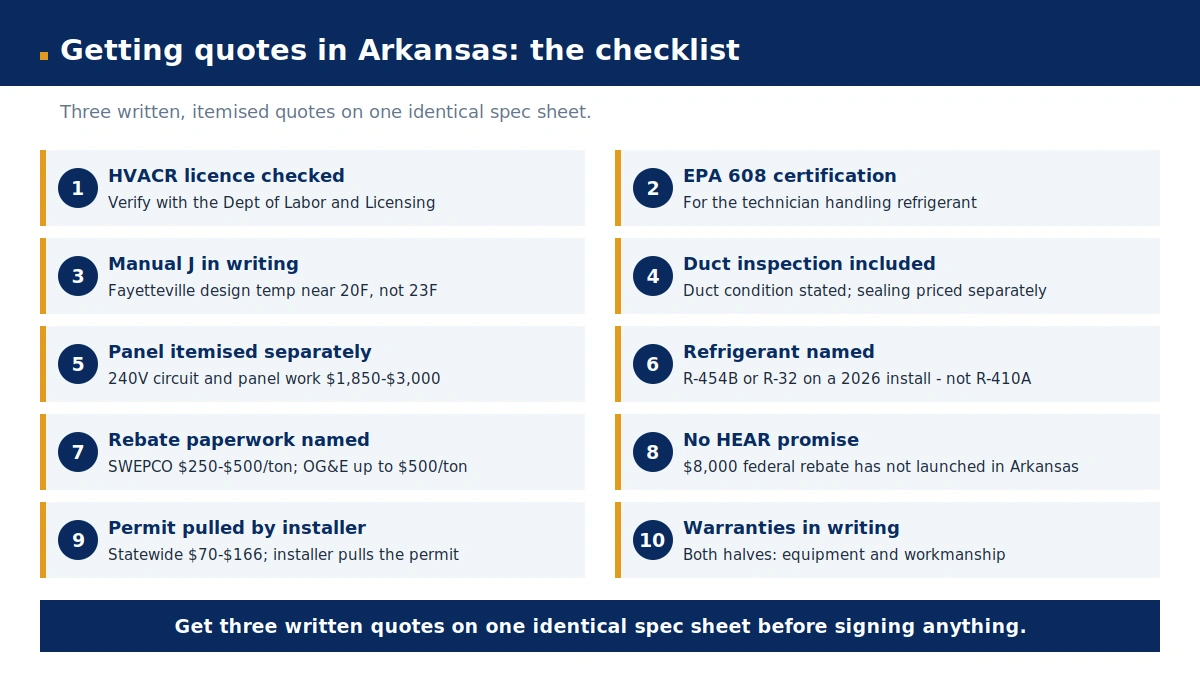
Collect three written, itemised quotes, each built to one identical specification: same tonnage, same efficiency ratings, same duct work, same electrical work, same permit — hold everything fixed except the price. Unless bids line up side by side, line for line, there is no honest comparison — and the cheapest bid usually leaves the most lines out. In Arkansas, add two more constants to the specification: the utility name and the fuel being replaced, because both change the rebate and the running-cost answer.
- HVACR licence checked. Arkansas licenses HVACR contractors statewide through the HVACR Licensing Board — ask for the licence number and check it with the Arkansas Department of Labor and Licensing. No licence is a walk-away. For jobs over $50,000, ask about the separate Contractors Licensing Board licence too.
- EPA 608 certification held by the person who handles the refrigerant on the job. Federal law allows no exceptions.
- Manual J on paper before anyone orders equipment. Sizing from square footage is a guess. In Fayetteville, the Manual J should show a design temperature near 20F, not a Texarkana 23F.
- Ducts inspected and priced. Put the duct condition in the bid, and list sealing or replacement as its own line. A bid that says nothing about ducts has left part of the job without a price.
- Panel on its own line. Put the 240V circuit and any panel work on separate lines, never folded into the headline total. In Arkansas that line often runs $1,850–$3,000.
- Refrigerant named. On a 2026 install, the quote should name R-454B or R-32 as the refrigerant. R-410A is last year’s equipment.
- Rebate paperwork spelled out. SWEPCO ($250–$500 a ton, or $600 a ton for a conversion off electric resistance heat) or OG&E (up to $500 a ton around Fort Smith) — with the efficiency threshold, the territory, and the fuel condition checked. Any federal credit line on the bid should read $0 for a 2026 install, and any HEAR line should read $0 too.
- No HEAR promise. A contractor who promises the $8,000 federal HEAR rebate on an Arkansas job in 2026 is promising money that has not launched — and work finished before launch can never collect it. Say no to the HEAR promise itself, not automatically to the contractor who made it — but file away the name of whoever tried it on.
- Permit taken out in the installer’s name, and ask for its number in writing before work starts. Never pull it yourself. The statewide band runs $70–$166.
- Both warranties in writing. On parts, the equipment warranty typically stretches to 10 years, and the premium brands stretch compressor cover longer still. Contractor workmanship cover, usually 1–10 years, matters more than the parts cover. Get both before signing.
Arkansas-specific red flags: a “federal tax credit” line on a 2026 bid; a HEAR rebate promised before the Arkansas Energy Office opens the programme; a SWEPCO rebate quoted for a gas-to-heat-pump fuel switch, which SWEPCO’s table bars; an OG&E rebate quoted for a home built after 2015 or without electric air conditioning; a rebate quoted for an Entergy Arkansas home at all; a whole-home quote near $4,000 with no duct or electrical lines; a cold-climate unit quoted for a Little Rock or Fort Smith home without a reason; sales tax never mentioned on the quote; and any contractor sizing the system from the old unit’s nameplate without a load calculation. The strongest Arkansas installers run two to three weeks out in peak season; a crew able to start tomorrow deserves scepticism, not a signature. For the neighbouring-state comparison, see our Missouri heat pump cost guide and our Tennessee heat pump cost guide — Missouri is the closest market to Arkansas’s, and the contrast in rebates and rates is instructive.
Sources & methodology
Cost anchors: NumeralQ’s “Heat Pump Cost in Arkansas (2026)” estimator, priced October 26, 2026 from Fixr, This Old House, Home Depot prices, and BLS May 2025 wages, is the primary Arkansas anchor — 3-ton ducted $6,080–$10,350; size table (1.5t $4,000–$6,550 through 5t $8,850–$15,410); type table (cold-climate ducted $8,060–$14,320; single-zone mini-split $2,830–$4,510; 3-head $5,610–$10,350; geothermal $19,260–$30,620); city table (Little Rock $6,080–$10,340; Fayetteville $6,280–$10,610); ductwork $3,570–$6,300; panel $1,850–$3,000; permits $70–$166; HVAC median pay $23.13 an hour, billed $46–$60 an hour; electricians $23.59 an hour, billed $47–$61 an hour; EIA heating-cost table (gas furnace $507 a year; heat pump HSPF2 7.5 $470 a year; HSPF2 9.0 $392 a year); about 19% of Arkansas homes heat mainly with heat pumps. NumeralQ’s “HVAC Replacement Cost in Arkansas (2026)” gives dual-fuel at $8,640–$14,360 and packaged units at $6,450–$9,260, with city full-system figures (Fayetteville $8,060–$13,740; Little Rock $7,840–$13,460), duct repairs and sealing at $1,330–$2,000, whole-house new ductwork at $4,550–$7,700, zoning at $1,870–$2,910, and smart thermostats at $241–$463. Bert Black, a Central Arkansas installer, published September 15, 2026 and updated October 16, 2026, puts the Arkansas heat pump range at about $4,000–$12,000. Franklin, a Northwest Arkansas installer (AR HVAC #0003484), puts a mini-split in NWA at $2,000–$10,000 or more, with installs starting from the $2,000s all-in, and notes ductwork leaks 20–30% of conditioned air on average. The US baseline from Article 1 (Nestpriced) is $7,500–$15,000. The headline $7,000–$12,000 band and the near-$9,000 typical job are this guide’s synthesis of the NumeralQ model band and the Bert Black installer range; no published Arkansas statewide installer average was found.
Rates: EIA Electric Power Monthly Table 5.6.A/B (August 2026, released October 2026), via Kadoa (updated November 7, 2026) — Arkansas residential electricity 13.6 cents per kilowatt-hour on the 12-month average to August 2026 (August 2026 alone 14.37 cents), 9th lowest in the US against 18.0 cents nationally; average bill about $143 a month; January–August 2026 average 13.76 cents, up 7.6% on the same months of 2025. Entergy Arkansas averaged 14.1 cents per kilowatt-hour residential over the 12 months to August 2026 (EIA Form 861 via Kadoa), serving about 615,191 residential customers at an average bill of about $149 a month; Entergy’s standard tariff adds an $8.40-a-month customer charge plus 5.29 cents per kilowatt-hour in riders, for an all-in 15.12 cents at 900 kilowatt-hours (Price of Electricity, EIA August 2026). No current SWEPCO or OG&E Arkansas residential rate was verified from a primary source. EIA Natural Gas Monthly Table 20 (October 27, 2026 release) — Arkansas residential gas about $1.86 a therm on the 2025 annual average ($19.25 per thousand cubic feet; 10.37 therms per thousand cubic feet); 2026 year-to-date through August $22.27 per thousand cubic feet. Trailing-average sources range $1.24–$2.21 a therm (ElectricChoice November 2026: $1.24; BallparkLab through April 2026: $2.21). We worked the per-therm arithmetic ourselves from those EIA prices at 29.3 kilowatt-hours per therm. It gives $1.33 for a heat pump at COP 3.0 and $1.96 for a gas furnace at 95% at the state-average price, and $1.48 for a heat pump at COP 3.0 at Entergy’s all-in rate, with a break-even COP of about 2.03 statewide and about 2.26 at Entergy’s rate. Blue Ridge Heating and Air (October 13, 2026) corroborates the direction only ($420 a year heat pump vs $440 a year gas, different home model). Entergy Arkansas’s rate case (APSC Docket No. 26-001-U, filed February 27, 2026) proposes a residential customer charge of $12.92 and higher energy charges — a request, not an approval. Summit Utilities’ January 2024 rate case was approved in November 2024 at +23.4%, about $15.43 a month on a typical bill.
Climate: IECC 2006 Table 301.1 and IECC 2021 zones (PNNL-33270) — most of Arkansas Zone 3A (warm humid), Ozark counties in the northwest Zone 4A, with no Arkansas county in Zone 5 or colder. IPC Appendix D Table D101 design temperatures (Fort Smith 17F/98F, HDD 3,292; Little Rock 20F/96F, HDD 3,219; Texarkana 23F/96F, HDD 2,533). Fayetteville design temperatures (20F heating at 97.5%, 12F at 99%, 7F at 99.6%; 95F cooling at 0.4%) via ASHRAE design data in an engineering weather-data summary, with NOAA 1991–2020 normals (Fayetteville Drake Field) and WeatherSpark Fayetteville climate (January average high 47F / low 29F; July average high 89F / low 69F; muggy 75% of July days; muggy period May 19–September 25). Jonesboro has no IPC design temperature on record, so none is given. Heating fuel mix: Census ACS 2020–2024 via NumeralQ (electricity about 54%, piped gas about 37%) and ACS 2024 1-year via StartBusinessByState (54.1% electric, 36.6% gas); EIA RECS (about 19% main-heat heat pumps).
Rebates: SWEPCO 2026 Residential Energy Improvement Program incentive table (swepcosavings.com, 2026) — installation $250/$400/$500 a ton by SEER2 tier, conversion $600 a ton, CoolSaver tune-up $175/$250, heat pump water heater $1,150, duct sealing $1.25 per CFM reduction, thermostats $75; fuel switching barred; programme administered by CLEAResult. OG&E Arkansas HVAC Replacement Rules and Guidelines (oge.com) — retrofit homes built before 2016 with electric air conditioning, licensed Arkansas HVAC professional, invoice January 1–November 1, paperwork within 30 days; amounts (up to $500 a ton, max $1,500 a unit, $3,000 a year) via HomeEnergyBasics June 11, 2026 summary — second-hand, verify at oge.com. Entergy Arkansas Home Energy Solutions Program Guidebook v5.0 (January 1, 2026) and Summer Advantage programme page — no central heat pump rebate; no-cost weatherization and tune-up only; demand-response $25–$80 first year. No verified 2026 rebate amounts found for Arkansas electric cooperatives or for Jonesboro City Water and Light. HomeEnergyBasics Arkansas rebate pages (June 11, 2026; September 11, 2026).
State programmes: no Arkansas state tax credit and no Arkansas state rebate programme for heat pumps was found. Arkansas sales tax: 6.5% state rate plus local tax, combined 8.5–11.25%, most commonly 9.5% (Tax Foundation midyear 2026, population-weighted average combined rate 9.48%); Jonesboro combined rate 8.5% (Craighead County transparency page); equipment is taxable tangible personal property (Arkansas Economic Development Commission; Zamp 2026).
Federal: Under Public Law 119-21, confirmed by IRS notice FS-2025-05, §25C and §25D both closed for installs after December 31, 2025. HEAR/HOMES Arkansas status via the National Housing Trust DOE Rebates State Funding Tracker (April 30, 2026) — $105 million allocation, applications conditionally approved, no expected launch date; the Arkansas Energy Office programme page states the programme “is not available in Arkansas at this time” (quoted via ReferenceSource, verified September 30, 2026; HeatPumpPricing HEAR status verified November 4, 2026); NASEO IRA Home Energy Rebate status (September 30, 2026). Under DOE Program Notice 26-2, dated May 29, 2026, fuel-switching drops out of HEAR from September 1, 2026, so only electric-to-electric swaps stay eligible. §48E lease route — no primary source confirms any Arkansas lease product passes a §48E credit through to a residential lessee. Under DOE rules, the federal minimum sits at 14.3 SEER2 / 7.5 HSPF2.
Licensing & permits: Arkansas HVACR Licensing Board, Arkansas Department of Labor and Licensing (Ark. Code §17-33-101 et seq.; §17-33-301(a); §17-33-303) — Class A unlimited, Class B up to 25 tons cooling / 1,000,000 BTUH heating, Classes C–E narrower; two years’ experience or board-approved programme; Prov exam at 70%; EPA 608 federal; general liability minimum $250,000; annual fees Class A $200, Class B $150, Class C $100; renewal with 4 hours continuing education; no reciprocity; technician registration $25. Jobs over $50,000 also need an Arkansas Contractors Licensing Board licence plus a $10,000 bond. In NumeralQ’s October 2026 check of 35 cities, permit fees came in at $70–$166. Arkansas Mechanical Code (based on the International Mechanical Code), enforced by the local Authority Having Jurisdiction. Gas utilities regulated by the Arkansas Public Service Commission: Summit Utilities Arkansas (acquired CenterPoint Energy Arkansas assets January 2022), Arkansas Oklahoma Gas Corporation, Black Hills Energy Arkansas, Logan Township Gas.
Method note: where a model estimate and an installer quote parted ways, this guide prints both and leans on the installer’s number. Where no Arkansas-specific figure was verified (for example maintenance $150–$300 a year; lifespan 12–15 years planning figure; Manual J $200–$500), the figure is the national guide’s and is labeled as such. Fort Smith and Jonesboro have no published city price model, so this guide invents no band for them. The payback figures in the payback section are this guide’s own worked arithmetic, labelled as such. Every price here is a 2026 planning figure, not a quote. Do not set the budget until three written local quotes are in hand.
Disclaimer: these 2026 Arkansas planning figures vary by city, home, and contractor. Plan your spending only once three written local quotes are in hand. Tax and rebate information here is general guidance, not professional tax advice. Any incentive should be checked with a tax professional, the Arkansas Energy Office, or your utility first.
What does a heat pump cost in Arkansas in 2026?
For a 3-ton whole-home ducted air-source system, expect $7,000–$12,000 installed, with the typical job near $9,000. A single ductless mini-split zone is $2,830–$4,510, three zones are $5,610–$10,350, a cold-climate ducted unit is $8,060–$14,320, a dual-fuel system is $8,640–$14,360, and geothermal is $19,260–$30,620. Little Rock and Fayetteville come out nearly the same in the model, within about $200 of each other. Fort Smith and Jonesboro have no published city price model, so this guide gives direction only for them. Arkansas charges sales tax on the equipment portion — about 9.5% combined in most cities — so ask whether the quote includes it.
What rebates can I get for a heat pump in Arkansas in 2026?
It depends on your utility. SWEPCO, in northwest Arkansas, pays $250–$500 a ton by efficiency tier for an installation, or $600 a ton for a full conversion from electric resistance heat — $1,800 on a 3-ton conversion — but it does not pay for a gas-to-heat-pump fuel switch. OG&E, around Fort Smith, pays up to $500 a ton, capped at $1,500 a unit and $3,000 a year, for retrofit homes built before 2016 with electric air conditioning. Entergy Arkansas, serving Little Rock and about 615,000 homes, pays $0 for a heat pump, though its Home Energy Solutions programme offers no-cost weatherization and tune-ups. Arkansas has no state tax credit and no state rebate programme, and the federal tax credit is $0 for 2026 installs.
Has Arkansas’s HEAR rebate launched yet?
No, and it has no launch date. Arkansas was allocated $105 million for HEAR and HOMES combined, and its applications are conditionally approved, but the National Housing Trust tracker dated April 30, 2026 records no expected launch date, and the Arkansas Energy Office’s own page states the programme “is not available in Arkansas at this time” — verified November 4, 2026. Watch two things: rebates are not retroactive, so work finished before launch never collects; and DOE Program Notice 26-2, effective September 1, 2026, limits HEAR to electric-to-electric swaps, so a gas-to-heat-pump conversion collects nothing once the programme opens. Leave it out of the budget entirely.
Does any federal tax credit apply to an Arkansas heat pump in 2026?
No — $0. IRS notice FS-2025-05 confirms it: §25C, worth 30% and up to $2,000 a year on a heat pump, and §25D both ended for property placed in service after December 31, 2025 under the One Big Beautiful Bill Act. Arkansas has no state tax credit either. See a $2,000 federal credit subtracted from a 2026 Arkansas install? The quote is out of date — tell the contractor to take it off. What is live is utility money: $250–$600 a ton from SWEPCO in the northwest, up to $500 a ton from OG&E around Fort Smith, and $0 from Entergy Arkansas.
Does a heat pump cost more to run than gas in Arkansas, or less?
Less, at every efficiency tier — Arkansas is one of the few states where the heat pump wins outright. At the statewide electricity price of 13.6 cents per kilowatt-hour, a good heat pump at COP 3.0 heats for about $1.33 a therm, against about $1.96 for a 95% gas furnace. At Entergy Arkansas’s all-in rate of 15.12 cents, the same heat pump heats for about $1.48 a therm and still wins by nearly 50 cents. The break-even COP is only about 2.03 statewide, so even a minimum-efficiency unit beats gas on fuel. The EIA’s annual planning figures agree: $392 a year for a high-efficiency heat pump against $507 for a gas furnace, and $470 for a minimum-efficiency unit. Against electric resistance heat, at about $3.98 a therm, the heat pump wins by a wide margin everywhere in Arkansas.
Do I need a cold-climate heat pump in Arkansas?
Almost certainly not. Little Rock designs to 20F in winter, Fort Smith to 17F, and Texarkana to 23F, and a standard unit carries the house through nearly the whole heating season, with strip heat stepping in only on the coldest nights. A cold-climate ducted system at $8,060–$14,320 is about $2,000 more than a standard system, and in Little Rock or Fort Smith that money buys capacity the climate does not ask for. The one judgement call is the Ozark high country around Fayetteville, where the design case runs colder and the elevation is higher. Arkansas has no county in IECC Zone 5 or colder — most of the state is Zone 3A, with the Ozark counties in Zone 4A.
Why is my Arkansas heat pump quote higher than the model price?
Three reasons, in order. Ductwork: new or extended ductwork costs $3,570–$6,300 in Arkansas, and a quote with no duct line has left part of the job unpriced. The electrical panel: a 200-amp upgrade runs $1,850–$3,000. And sales tax: Arkansas charges 6.5% state plus local tax, about 9.5% combined in most cities, on the equipment portion — several hundred dollars that a model estimate never shows. Add those three to the NumeralQ model’s $6,080–$10,350 and you arrive at the $7,000–$12,000 headline band. Get each line itemised separately, and ask whether the total includes sales tax.
What permit and licence do I need for an Arkansas heat pump?
Arkansas licenses HVACR contractors statewide through the HVACR Licensing Board, under the Department of Labor and Licensing, and Ark. Code §17-33-301(a) makes it unlawful to do HVACR work without the appropriate licence or registration. Ask for the licence number and verify it with the Department of Labor and Licensing — Class A is unlimited, Class B covers up to 25 tons of cooling per unit. Only an EPA Section 608 certified technician may do the refrigerant work. Wherever an Arkansas building department operates, a mechanical permit is part of the job, and the fee typically runs $70–$166 statewide. Ask for the permit number in writing, with the installer pulling the permit. For jobs over $50,000, a separate Arkansas Contractors Licensing Board licence and a $10,000 bond also apply.