

Table of Contents
A Utah heat pump buyer faces a question that buyers in flatter states never meet: which Utah does the house stand in? The Wasatch Front is a high-desert valley at 4,300 feet where January mornings drop into the single digits and July afternoons push past 100F, sometimes in the same week. Park City and the high country sit thousands of feet higher, colder, snowier, and harder on equipment. St. George, five hours south, is a different state of weather altogether — a red-rock desert where the average July high is 102F and the state heat record of 117F was set. One machine cannot be sized, priced, or rebated the same way in all three places, and any guide that quotes a single Utah number without naming the place is guessing.
The second question is the fuel on the bill. Most Wasatch Front homes heat with piped gas, and Utah gas is among the cheapest in the country at about $1.10 a therm. Utah electricity is cheap too — 13.3 cents a kilowatt-hour, the fifth lowest in the nation — yet cheap gas beats cheap power on the running-cost sums unless the heat pump is a high-efficiency one. That single fact shapes everything that follows: the system Utah installers recommend first, the rebate stack that actually pays, and the payback that a buyer should expect. In Utah, the heat pump’s case is built on cooling, on shoulder-season savings, and on replacing resistance heat — not on a big heating-fuel saving, because there is barely one to be had.
The third question is the utility name on the bill, and it decides the rebate before any equipment is chosen. Rocky Mountain Power serves most of the Wasatch Front, and its Wattsmart programme is the biggest rebate money in the state. But Provo, Murray, Bountiful, Lehi, Logan, and St. George run their own municipal electric utilities, and Wattsmart does not reach them. A Provo buyer and a Salt Lake City buyer ten miles apart collect different rebates for the same machine, and a St. George buyer collects neither Wattsmart nor ThermWise in the same form. Get the utility right first, and the rest of the decision — system type, size, rebate stack, payback — falls into place.
One more Utah fact changes the value calculation in a way no price table captures. Winter inversions trap cold air and fine particulate pollution in the Wasatch Front valleys for days at a time, and the Salt Lake Valley spends weeks each winter sealed under a grey lid. A heat pump lets a home heat and cool with its windows shut and its air filtered, and during inversion season that is not a comfort extra — it is the difference between breathing valley air and breathing filtered air. Add the dry air, the altitude, and the hundred-degree swing between a January morning and an August afternoon, and Utah asks more of a heating system than almost any other state in this series. This guide prices the machine that can answer it.
The US-wide baseline behind every Utah figure below is our national heat pump cost guide.
How Much Does a Heat Pump Cost in Utah in 2026?
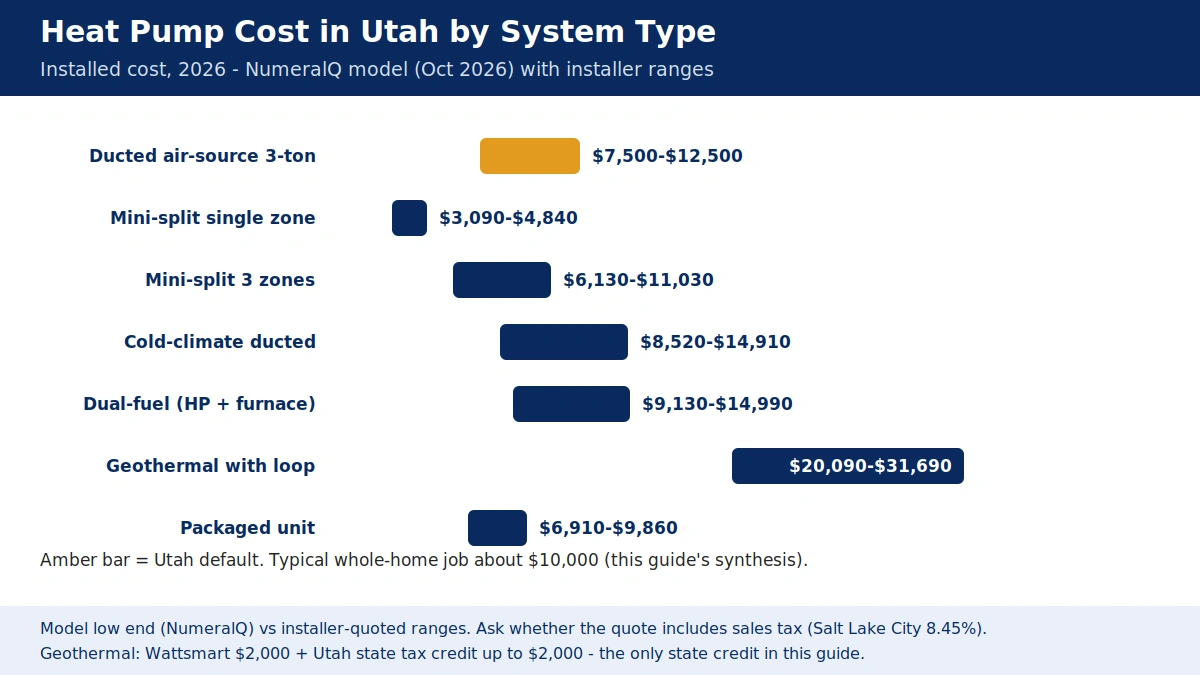
For a Utah home of 1,500–2,500 square feet, the machine that usually fits is a 3-ton whole-home ducted air-source heat pump. A 2026 fit for that 3-ton job runs $7,500–$12,500, and most settle near $10,000. Plan on that band. That figure buys the outdoor condenser, the indoor air handler, the refrigerant lines, a dedicated circuit, the permit, and the start-up visit — a running system, not equipment left on a pallet. And unlike the guides from no-sales-tax states, a Utah quote needs one extra question: does it include sales tax on the equipment? Utah’s combined sales tax runs from a 6.10% floor to 8.45% in Salt Lake City, and a $10,000 equipment line in Salt Lake City carries roughly $845 of tax if it is charged separately. Ask before signing, not after.
The band comes from three anchors that pull in different directions, and the spread between them is itself useful information. NumeralQ’s Utah estimator — October 26, 2026 pricing, built from Fixr, This Old House, Home Depot prices, and BLS May 2025 wages — puts the 3-ton ducted job at $6,470–$10,860. A model like that adds up parts and local pay and little else — no selling time, no warranty pot, no hidden surprises inside an actual house — so it lands low next to what installers charge. Air Pros Utah, a Salt Lake Valley installer, pulls the other way: a heat pump plus air handler runs $8,200–$21,000, with most Utah homeowners investing around $12,500 for a complete system including professional installation, and a standard 16 SEER single-stage 3-ton system at about $6,700 total, split $4,815 for equipment, parts, and supplies plus $1,885 for labour. Between them sits Salmon HVAC, another Salt Lake City installer, putting a full furnace-plus-AC replacement at $7,500–$12,500 and an air-source heat pump generally at $6,000–$25,000. The headline lands where those views meet: $7,500–$12,500 for the standard whole-home job, with the top end kept for variable-speed equipment, cold-climate tiers, and Salt Lake City addresses. The near-$10,000 typical job is this guide’s own blended estimate. No published Utah statewide installer average was found, and this guide would rather say that than invent one.
A whole-home bid near $5,000 should set off alarm bells, not excitement. A bid thousands below its rivals usually signals a missing piece — the indoor unit, the wiring, the permit fee, the duct alterations, the start-up visit, or the sales tax — or a separate line that appears later. A bid far under the others should send you hunting for the missing pieces before signing, not after the crew arrives.
Against the rest of the country, Utah sits just below the national average. The national guide’s US-wide band for a ducted heat pump is $7,500–$15,000 in 2026, and NumeralQ puts Utah at about 1% below the national figure. Utah labour runs about 4% below the national median — HVAC mechanics and installers in Utah earn a median $28.24 an hour against $29.33 nationally (BLS, May 2025) — and both fuels are cheap, yet the altitude and the climate push the other way. The price of a mistake is higher here too: a wrong size gets punished on a 102F St. George afternoon as surely as on a 5F Wasatch Front morning, and a standard unit fitted in Park City instead of a cold-climate one will lean on strip heat all winter.
| System | Typical Utah installed cost (2026) |
|---|---|
| Ducted air-source heat pump, 3-ton (typical home) | $7,500–$12,500 (typical ~$10,000) |
| Ductless mini-split, single zone | $3,090–$4,840 |
| Ductless mini-split, 3 zones | $6,130–$11,030 |
| Cold-climate ducted heat pump, 3-ton | $8,520–$14,910 |
| Dual-fuel (heat pump + gas furnace) | $9,130–$14,990 |
| Geothermal (ground-source) with loop | $20,090–$31,690 |
| Packaged unit | $6,910–$9,860 |
Sources: NumeralQ Utah heat pump estimator (Oct 26, 2026); NumeralQ Utah HVAC replacement page (dual-fuel and packaged models); Air Pros Utah 2026 guide; Salmon HVAC Salt Lake City 2026 guide; nestpriced national guide (art. 1).
Heat Pump Cost in Utah by System Type
Start from the house, not the catalogue. One wall head costs roughly a third of a full ducted job, and a ground loop costs roughly triple — yet both numbers mean little until the house itself is sized up. Ducts or no ducts, gas or no gas, a furnace with years left or one on its last legs, Wasatch Front cold or St. George heat: those facts set the system before any price does.
Ducted air-source heat pumps are what most Utah homes get. One unit pushes heated and cooled air through the ducts already in the house to every room, sending both the furnace and the air conditioner into retirement. NumeralQ’s model puts the 3-ton job at $6,470–$10,860; installer-quoted reality in the Salt Lake Valley runs $8,200–$21,000 for a heat pump plus air handler, with the gap mostly margin, warranty, air handler, backup strips, and job conditions. When the ducts hold up and the furnace and AC are wearing out together, get this route priced first. That trade-off is laid out in full in our ductless vs ducted comparison.
Ductless mini-splits fit the homes that never had ducts — a finished basement in Sandy, an addition in Layton, a bonus room over the garage in Orem, older bungalows in Ogden where ducts were never run, and cabins and vacation homes in the mountains and the red-rock country. NumeralQ puts one 12,000 BTU head at about $3,090–$4,840 fitted, and three zones for an addition or finished basement at $6,130–$11,030. Five or more heads to cover a whole home climb higher still on national figures, and by then a ducted system usually comes out cheaper, where ducts exist or can be put in. Each mini-split works as a heat pump on its own: a single box cools the bonus room through a July heat wave and warms it through January. The per-zone pricing lives in our mini-split installation cost guide.
Cold-climate heat pumps earn their keep in exactly two parts of Utah: the high country and the coldest Wasatch Front nights. A cold-climate ducted system costs $8,520–$14,910 (NumeralQ), about $2,000 more than a standard system, for inverter-driven capacity that keeps delivering heat down toward 5F and below — modern cold-climate models hold full rated heating capacity at 5F and keep running to minus 13F. Salt Lake City’s valley floor, with a Manual J winter design temperature of 14F, sits on the edge: a standard unit copes most winters, a cold-climate unit copes with the coldest stretches without leaning on strip heat. Park City and the mountain valleys are different — there the premium is the default, not an upgrade. St. George never needs it. When that premium pays, and when it does not, is set out in our cold-climate mini-split guide.
Dual-fuel systems pair a heat pump with a gas furnace, and on the Wasatch Front they may be the smartest premium spend in the state — every 2026 Utah installer guide leads with them, calling dual-fuel the safe pick and the gold standard for northern Utah. Mild weather lets the heat pump carry the long shoulder seasons; the furnace only steps in on the coldest mornings, when the heat pump’s efficiency drops and the strips would otherwise take over. A complete dual-fuel system costs $9,130–$14,990 on NumeralQ’s model. The cheapest way in is to put a heat pump where a dying air conditioner stood, and keep a gas furnace younger than about 10 years. A young furnace paired with a dying AC makes that route the one to price first. The full breakdown is in our dual-fuel cost guide.
Geothermal sits apart: $20,090–$31,690 including the ground loop (NumeralQ), and higher on installer figures, with Air Pros Utah putting geothermal at $15,000–$40,000+. Nothing you can buy is more efficient or longer-lived — the loop itself runs 25–50+ years on national figures — and Utah gives geothermal one thing it gives no other heat pump: a state tax credit worth 25% of the system cost up to $2,000, plus a $2,000 Wattsmart ground-source rebate, for up to $4,000 combined. Even so, the payback sums are stubborn, because both Utah fuels are cheap, which shrinks the yearly savings that are meant to repay a premium of $10,000 or more over air-source. Geothermal adds up for new builds with land for a horizontal loop, or for an owner staying 20 years or more. Nearly everyone else comes out ahead with a higher-efficiency air-source unit plus duct sealing. Our geothermal heat pump cost guide carries the geothermal numbers in full.
Packaged units — a single outdoor box holding the whole system — cost $6,910–$9,860 on NumeralQ’s Utah model. They suit homes with no indoor space for an air handler, and some manufactured homes, but they are a niche choice in Utah compared with the split ducted system above.
Heat Pump Cost by Home Size
Five hundred to six hundred square feet per ton is a handy rule of thumb and a poor way to buy a machine. Insulation, glass, ceiling height, shade, duct leakage, and — in Utah more than most states — elevation and which of the three Utahs the house stands in all push the right size up or down, and only a Manual J load calculation settles it. That calculation runs $200–$500 on national figures, usually credited back against the install, and no Utah-specific price for it was found. Floor area on its own, or the nameplate on the old unit, is a guess made with your money. At 4,300 feet the air is thinner, and a furnace sized by a sea-level rule of thumb comes up short — the same care applies to the heat pump, which must be sized for the actual elevation, the actual glass, and the actual design temperature of the place it will serve.
| Home size | Usual system | Ducted air-source installed cost |
|---|---|---|
| 1,000–1,200 sq ft | 1.5–2 ton | $4,340–$8,270 |
| 1,200–1,500 sq ft | 2–2.5 ton | $5,050–$9,570 |
| 1,500–2,000 sq ft | 2.5–3 ton | $5,760–$10,860 |
| 2,000–2,500 sq ft | 3–3.5 ton | $6,470–$12,150 |
| 2,500–3,000 sq ft | 3.5–4 ton | $7,180–$13,440 |
| 3,000+ sq ft | 4–5 ton | $7,890–$16,020 |
Figures: NumeralQ’s Utah size estimator, October 26, 2026, ducted air-source. Those bands are model outputs — real installer quotes for the same sizes sit toward the top of each band, and Salt Lake City quotes higher still. Treat the table as a ballpark figure, not a budget.
Oversizing is the expensive mistake in the south and the suburbs alike. A unit too big for the house blasts cold air for a few minutes, shuts down before it has pulled any moisture out, and leaves the rooms cool and clammy — the worst outcome in a St. George summer that now includes 102F average July highs, and a poor one in a Wasatch Front July that regularly tops 100F. Too small, and the unit never rests. It runs around the clock, still calling for strip heat on January mornings — the priciest heat a Utah home can buy. Either mistake costs more over ten years than a Manual J ever will — so get the calculation in writing before any equipment is ordered.
In the high country the sizing mistake runs the other way. A Park City home sized to Salt Lake Valley assumptions will be undersized for a mountain January, and the strip heat will carry the house for weeks rather than hours. That is why the mountain quote should name the design temperature it was sized to, and why a cold-climate unit with extended capacity at 5F belongs on the quote rather than a standard unit with a hopeful note. Ask the installer to put the Manual J design temperature in writing. If the number on it looks like Salt Lake City’s 14F and the house stands at 7,000 feet, the sizing is wrong.
Two-storey homes need their own warning. One system across two floors leaves one floor unhappy — hot bedrooms upstairs in July and a chilly ground floor in January. The workable fixes are two separate systems, one ducted system with zoning dampers, or a ducted unit downstairs plus a mini-split head or two upstairs — each dearer than a one-system bid. A bid that prices a two-storey house with one system and never mentions zoning should prompt one question: how will the upstairs feel on a 100F afternoon? Get a written answer to that question before you sign anything.
Heat Pump Cost by City: Salt Lake City, Provo & Ogden
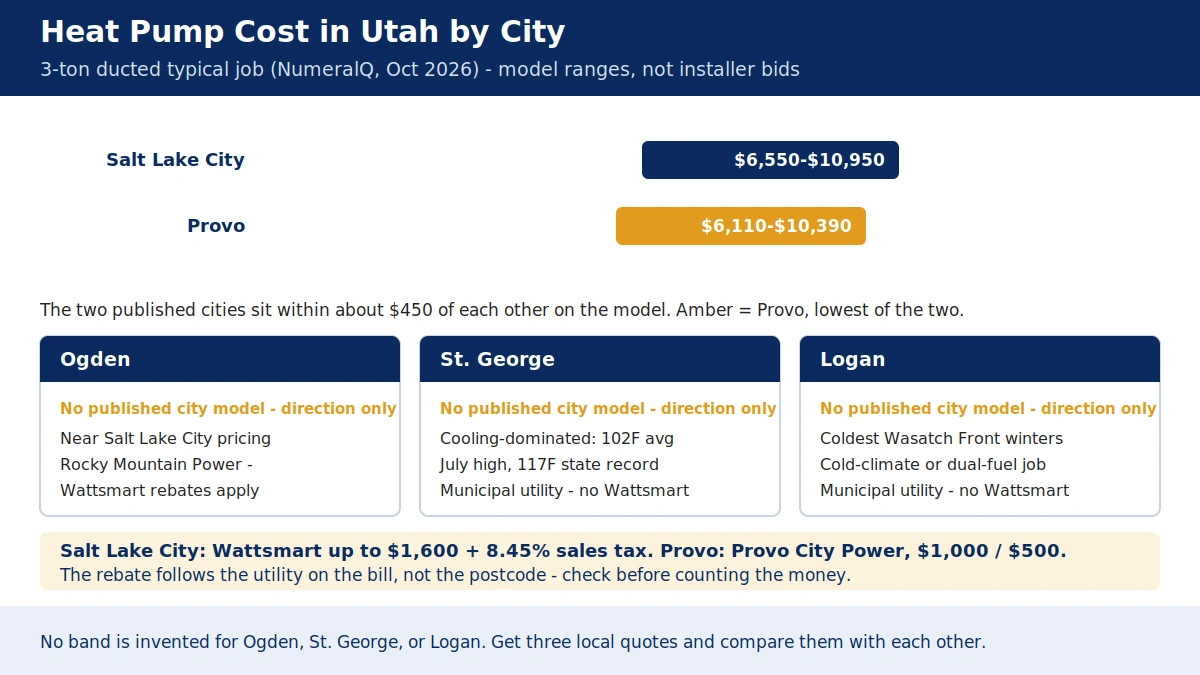
The model prices Utah’s two published cities a few hundred dollars apart for the same 3-ton system — yet each city reaches that price for different reasons, and installer-quoted reality spreads wider than the model suggests.
| City | 3-ton ducted job, model range | Why it prices that way |
|---|---|---|
| Salt Lake City | $6,550–$10,950 | Largest metro; 8.45% combined sales tax; older homes, benchland altitude |
| Provo | $6,110–$10,390 | Lowest of the two on the model; Provo City Power, not Wattsmart |
| Ogden | No published city model | Direction only: near Salt Lake City, Weber County, Rocky Mountain Power |
Figures: NumeralQ Utah city pages, October 2026, 3-ton ducted system. No NumeralQ city model exists for Ogden, St. George, or Logan. No band is made up here for them — direction only.
Salt Lake City is the biggest and most complicated heat pump market in Utah. The metro sits in Rocky Mountain Power territory, which matters twice over: RMP customers can collect the Wattsmart rebates, up to $1,600 ducted or $1,700 ductless on an electric-resistance conversion, and the city’s combined sales tax of 8.45% is the highest in the state, so the tax question on a quote matters more here than anywhere else in Utah. The housing stock is the other complication: older homes in the Avenues and Sugar House with no ductwork and 100-amp panels, postwar ramblers in the suburbs with ducts in unconditioned attics, and new builds on the east bench at 4,800 feet that price like a different altitude. A Salt Lake Valley installer guide puts a full heat pump plus air handler job at $8,200–$21,000, with most homeowners around $12,500, and a standard 16 SEER 3-ton system at about $6,700. Salt Lake City also requires a city business licence for trades working inside the city, which is one more credential to ask about. And the inversion is a Salt Lake City memory, not an abstraction: weeks each winter sealed under grey air, with PM2.5 trapped in the valley. Cooling and filtration capacity on a Salt Lake City quote is not a line to trim.
Provo prices a few hundred dollars below Salt Lake City on the model — $6,110–$10,390 against Salt Lake City’s $6,550–$10,950 — and the difference is mostly labour and housing age rather than climate. Provo shares the Wasatch Front’s cold winters and hot summers, and NumeralQ’s own FAQ notes that HVAC pay runs about 20% below the national median in Provo against about the same in Salt Lake City. What a Provo buyer should check first is the utility name on the bill, because Provo runs its own municipal electric utility, Provo City Power, and Wattsmart does not reach it. Provo buyers collect Provo’s own RenewChoice Conserve rebates instead — $1,000 for a ducted dual-fuel conversion and $500 for ductless — and the amounts and rules are Provo’s, not Rocky Mountain Power’s. Verify the current figures on Provo City Power’s site before counting the money. Provo’s permit schedule is set by the city, and the statewide permit band of $70–$166 covers the usual Provo job.
Ogden has no published city price model, and this guide invents none. What can be said with confidence is direction, not dollar figures. Ogden sits on the northern Wasatch Front in Weber County, in Rocky Mountain Power territory, at a similar elevation and climate to Salt Lake City, with an older housing stock — bungalows and postwar homes, many with ageing furnaces and 100-amp panels. Expect an Ogden quote to run near the Salt Lake City bands for the same house, with the same Wattsmart rebates available, because the utility, the climate, and the labour market are the same. Get three local quotes and compare them against each other, not against a Provo number.
St. George and the red-rock south have no published city price model either, and this guide invents none. What can be said is that St. George is the cooling outlier of Utah, with a 102F average July high, a 117F state record set there on July 5, 1985, and mild winters where the average January low is 32F. Cooling capacity matters most there, winters ask little of a heat pump, and a standard unit does the work a cold-climate unit would do in the north. St. George runs its own municipal electric utility, so Wattsmart does not apply — check with the city utility for any local programme, and do not budget on a Wattsmart figure. Expect quotes softer than Salt Lake City on labour and heavier on cooling capacity — direction only, no band.
Logan and Cache Valley have no published city price model either. Logan sits at the cold end of the Wasatch Front’s northern reach, with colder winters than Salt Lake City and a valley that traps cold air — a job for cold-climate equipment or dual-fuel, not for a bargain standard unit. Logan runs its own municipal electric utility, Logan City Light and Power, so Wattsmart does not apply there either. Expect a Logan quote to run above the Provo bands for the same house, because the equipment is dearer and the winters are colder — but no published Logan band exists to print, so get three local quotes and compare them against each other, not against a Salt Lake City number.
Smaller Utah cities — Orem, Sandy, West Jordan, Layton, Lehi, Murray, Bountiful, Cedar City, Park City, Tooele — generally price near the Wasatch Front bands, or, in the mountains, near the cold-climate direction. Park City, at roughly 7,000 feet, is a cold-climate job by default, with snow-aware siting and a raised pad as part of the base price rather than extras. Murray, Bountiful, and most of Lehi run their own municipal electric utilities, so Wattsmart does not reach them — check with the city utility before counting any rebate. Cedar City sits between the two Utahs: colder than St. George, warmer than the Wasatch Front, and worth a Manual J done for its own elevation rather than borrowed from either neighbour.
Utah’s Three Climates: Wasatch Front, High Country & Red-Rock South
Utah is split by elevation and latitude into three heating markets, and the split decides the equipment before any price does. Most of the Wasatch Front — Salt Lake City, Ogden, Provo, and the I-15 corridor between them — falls in IECC Zone 5B, cold-dry. Southern Utah around St. George, in Washington County, falls in Zone 3B, warm-dry. The high mountain communities such as Park City are treated as Zone 6B in practice. That zone reading is the standard one in Utah climate guides; no PNNL county table was pulled for this guide, so the zones are presented as the standard Utah reading rather than a county-by-county claim.
The design temperatures a contractor actually sizes to are where the story shows up in numbers. Salt Lake City International Airport, on Manual J Table 1A, designs to a 99% winter temperature of 14F and a 1% summer temperature of 95F, with a high daily temperature range — the big swing between a hot afternoon and a cool night that defines the high desert. One Salt Lake installer cites a colder NOAA 99th-percentile figure of 4F for the same airport, and valley-floor lows do bottom out around 5–10F in the coldest stretches; the two figures come from different percentile bases, and this guide uses the Manual J 14F/95F pair while noting the colder nights. Salt Lake City logs about 6,052 heating degree days. St. George, by contrast, averages a 54F high and a 32F low in January and a 102F high and a 76F low in July. The state records frame the range: 117F at St. George on July 5, 1985, the hottest day ever recorded in Utah, against minus 69F at Peter’s Sink on February 1, 1985, the coldest.
Through most Wasatch Front winters a standard unit needs help on the coldest mornings. As the thermometer drops, the unit’s output drops with it. Near 30–35F, most units begin drawing on the electric strips or handing over to the gas furnace to stay even. In Salt Lake City, Ogden, and Provo, that means a real number of mornings — December through February lows regularly sit in the teens — which is why dual-fuel is the configuration Utah installers recommend first, and why a cold-climate unit earns its premium on the valley floor sooner than it would in a milder state. Strip heat is the dearest heat in the house, and in a Utah winter it runs on enough mornings that the yearly bill notices. In Park City and the high country the picture is starker still: a standard unit there lives on backup heat for half the winter, which is why the cold-climate premium is the default in the mountains and merely sensible — a good buy for the coldest valley nights — everywhere else on the Front.
Newcomers underestimate the summer, not the winter — and in Utah the summer is a hundred-degree affair, not a mild one. Salt Lake City’s 1% summer design temperature is 95F, July afternoons regularly top 100F, and St. George averages 102F in July with a 117F record. A heat pump’s cooling is a genuine safety feature in a Utah July, not a luxury, and it is the half of the year a gas furnace never serves. Variable-speed equipment earns its keep on the hottest afternoon rather than the coldest night, holding its output and running long, gentle cycles where a single-stage unit’s short bursts leave rooms uneven. In St. George, cooling capacity should be sized without trimming: the winter there asks little, and the summer asks everything.
Utah weather touches a heat pump in ways no brochure mentions. The winter inversion traps cold air and PM2.5 in the Wasatch Front valleys, and one installer guide puts the efficiency loss from dust-coated coils at up to 30% — so filters clog fast, coils need cleaning, and a MERV 11–13 pleated filter is worth budgeting for. During inversion season, Utah installers recommend changing filters every two weeks rather than every one to three months. Snow on the Wasatch Front — about 59 inches a year in Salt Lake City, far more in the mountains — means a raised pad, defrost clearance, and an outdoor unit kept out of the roof drip line and drifting snow. The dry air matters too: heating cold, dry outdoor air can drop indoor humidity below 15%, drier than a desert, so a humidifier is a comfort add-on worth discussing, though it is not a heat pump cost line. And the altitude changes the physics: at 4,200–4,800 feet the air is roughly 15–18% less dense than at sea level, a gas furnace loses about 2–4% of its rated output per 1,000 feet of elevation, and a furnace rated at 100,000 BTU at sea level delivers roughly 82,000 BTU in the Salt Lake Valley. A heat pump is not combustion-limited the same way, but thin air still moves less heat per cubic foot — which is one more reason the Manual J must be done for the actual elevation.
Utah is a gas-heated state along the Wasatch Front, and heat pumps are a newer proposition here than in the Pacific Northwest. No verified Utah adoption percentage was found for this guide, and none is invented. What the 2026 installer guides agree on is the configuration: dual-fuel first for a gas-connected home, cold-climate all-electric for the household that wants off gas or has no gas line, and a standard unit only where the winters are mild — which in Utah means the red-rock south. The gap between Utah and the heat-pump states is not enthusiasm. It is the fuel price.
Heat Pump vs Gas Furnace in Utah: The Running-Cost Math
Both Utah fuels sit well below the national average, and that is what makes this comparison a genuine argument rather than a foregone conclusion. Utah residential electricity averages 13.3 cents per kilowatt-hour on the 12-month average to August 2026 (EIA) — 5th lowest in the US, against 18.0 cents nationally. August 2026 alone was 13.3 cents. The average Utah home’s electric bill runs about $104 a month — $101.29 in August alone, on 761 kilowatt-hours. Residential natural gas runs about $1.10 a therm as the heating-season planning figure, on a 12-month average of about $1.07 a therm to July 2026 ($11.07 per thousand cubic feet, EIA), with trailing-average sources ranging $1.06–$1.26 a therm. Summer monthly gas figures spike, because fixed charges spread over tiny summer volumes. Never take a summer month as the heating price.
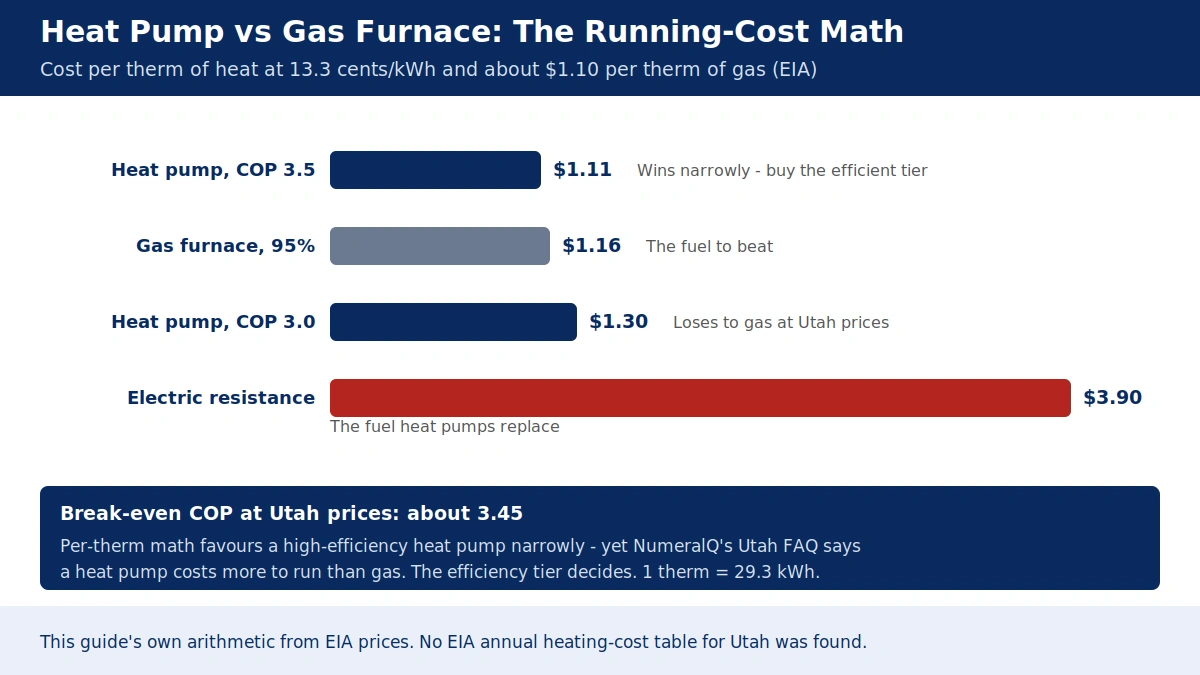
Work it out per therm of heat delivered, where one therm equals 29.3 kilowatt-hours. At the state-average electricity price of 13.3 cents, a good modern heat pump at a seasonal COP of 3.0 delivers that therm for 29.3 x $0.133 / 3.0, or about $1.30. At COP 3.5, a high-efficiency unit delivers it for about $1.11. For a 95%-efficient gas furnace, that therm costs $1.10 / 0.95 — about $1.16. Electric resistance heat, the fuel some Utah heat pump buyers are actually replacing, delivers it for 29.3 x $0.133, or about $3.90. At COP 3.0 the heat pump loses to gas by about 14 cents a therm at the state-average price. At COP 3.5 it wins by about 5 cents. The break-even COP at Utah prices is about 3.45 — a Utah buyer needs a high-efficiency system for the fuel maths to work at all. On this arithmetic the efficient heat pump wins narrowly, and the ordinary one loses.
NumeralQ’s own Utah page says the same thing in plain language: at those prices, a heat pump costs more to run than gas. That verdict and the per-therm sums above are not in conflict — they are the same fact stated two ways, because a real Utah winter’s seasonal COP, once cold mornings and strip-heat hours are counted, runs below 3.0 for a standard unit. The tier you choose tips the balance. A minimum-efficiency unit loses. A high-efficiency unit wins by a whisker. Printing only one side of that disagreement would be a sales pitch rather than a guide.
Two Utah situations tilt the sums decisively toward the heat pump. First comes a home still on resistance heat — baseboard panels, wall units, or an ageing electric furnace. A heat pump gives the same warmth there for roughly a third of the electricity — about $1.30 a therm against $3.90 at the state-average price — and that is the case where the payback is fastest and the rebate is largest. The other is propane or heating oil, whose fuel costs far more than Utah power or gas. Judge the heat pump’s $7,500–$12,500 against a furnace and an air conditioner bought together, not against a furnace alone. And remember the other half of the year. A gas furnace sits idle all July, while a heat pump cools for months — and in a Utah July, with 100F afternoons on the Wasatch Front and 102F averages in St. George, cooling is not a comfort extra. Judge the machine over twelve months rather than over one January bill. Our heat pump vs furnace comparison carries the full argument, the gas side is priced in our furnace replacement guide, and the month-by-month sums live in our running-cost guide.
| Heating system | Cost per therm of heat delivered |
|---|---|
| Gas furnace, 95% efficient | ~$1.16 |
| Heat pump, COP 3.0, statewide 13.3c/kWh | ~$1.30 |
| Heat pump, COP 3.5, statewide 13.3c/kWh | ~$1.11 |
| Electric resistance heat, statewide 13.3c/kWh | ~$3.90 |
How the table was built: electricity at 13.3 cents per kilowatt-hour statewide, gas at $1.10 a therm (EIA 2025–2026 figures); 1 therm = 29.3 kilowatt-hours. COP here is a planning figure for the whole season, not a laboratory rating. No EIA annual heating-cost table for Utah was found, so none is printed here — the per-therm sums above are this guide’s own arithmetic from EIA prices, and NumeralQ’s Utah FAQ verdict (a heat pump costs more to run than gas at Utah prices) is reported alongside them. Gas prices also moved in the background: the 2024 annual average was $1.255 a therm, above the 12-month average of $1.07 used here, which is why the planning figure is stated as a range, $1.06–$1.26, rather than a single certain number.
Rocky Mountain Power Wattsmart & the Other Rebates You Can Collect in 2026
Forget the federal money for a moment. In Utah in 2026, the live rebate money has two big names, and which programme pays you depends entirely on which utility sends the electric bill and which sends the gas bill: Rocky Mountain Power’s Wattsmart Homes for electricity, and Enbridge Gas Utah’s ThermWise for gas. Utah offers no state rebate for air-source heat pumps at all — the one state credit that exists pays only for geothermal, and it is covered in the federal section below. The utility is the programme — and in Utah, unusually, the two utilities stack.
| Programme | What it pays (heat pump) | Main condition |
|---|---|---|
| Wattsmart, ducted air-source, electric-resistance conversion | $1,200 / $1,400 / $1,600 by tier | Replaces electric resistance heat; existing home; programme-eligible contractor |
| Wattsmart, ducted air-source upgrade | $450 | Upgrades an existing heat pump to a cold-climate unit |
| Wattsmart, ductless mini-split | $1,300–$1,700 | Multi-head $1,700; single-head conversion $1,300; supplemental $600 |
| Wattsmart, dual-fuel (AHRI-rated) | $1,450 | Heat pump + gas furnace; 8.5 HSPF2 / 15.2 SEER2; 80+ AFUE furnace |
| Wattsmart, ground-source conversion | $2,000 | Electric-resistance conversion or air-source upgrade |
| ThermWise, dual-fuel Tier 1 | $1,000 new furnace / $700 existing | Heat pump + gas furnace; 95% AFUE furnace; changeover 40F or lower |
| ThermWise, dual-fuel Tier 2 | $1,200 new furnace / $850 existing | Heat pump + 97.5% AFUE furnace; higher efficiency thresholds |
| Provo City Power (Provo only) | $1,000 ducted / $500 ductless | Verify on Provo City Power’s site (second-hand figures) |
| UAMPS Cool Cash (member cities) | $200–$400 ducted; $400–$1,300 ductless | Varies by efficiency tier; verify with the city utility |
| Utah RESTC (geothermal only) | 25% up to $2,000 state tax credit | Geothermal heat pump; placed in service before Jan 1, 2028 |
Sources: Rocky Mountain Power Wattsmart rebate chart Rev. 3-2026 (Schedule 111; Utah PSC Docket 26-035-T02); Enbridge Gas ThermWise 2026 appliance rebate application; HeatPumpPricing Utah page (verified Nov 4, 2026); Lucas Heating (Aug 17, 2026); Salmon HVAC (2026); HomeEnergyBasics (June 2026).
Rocky Mountain Power’s Wattsmart Homes is the programme most Utah buyers will actually collect from, and its central rule is the one this guide keeps repeating: the big conversion tiers pay only when the new heat pump replaces electric resistance heat. A ducted air-source conversion pays $1,200 at Tier 1 (7.5 HSPF2 / 14.3 SEER2), $1,400 at Tier 2 (8.1 HSPF2 / 15.2 SEER2), or $1,600 at Tier 3 cold-climate (8.5 HSPF2 / 16 SEER2). Upgrading an existing electric heat pump to a cold-climate unit pays $450. A ductless mini-split pays $1,700 for a multi-head system, $1,300 for a single-head electric-resistance conversion, $1,700 for a ducted mini-split conversion, $600 for a supplemental ductless unit, and $1,000 for a single-head unit supplementing a gas hydronic radiant floor — a new tier added February 27, 2026. A window heat pump pays $125. Conditions: the home must be existing, not new construction; the customer must be a residential Rocky Mountain Power customer; the installation must use a programme-eligible contractor; and the application goes in within 90 days of completion on two 2026 installer guides — though one rebate tracker says 180 days, so check the Wattsmart portal rather than assuming the longer window. A qualifying smart thermostat adds up to $100 on one installer’s figures, $75 on another’s — the two sources conflict, so verify the current figure on the Wattsmart page.
The exception to the electric-heat-only rule is the dual-fuel tier: $1,450 for an AHRI-rated heat pump (8.5 HSPF2 / 15.2 SEER2) paired with a gas furnace of 80 AFUE or better, with a $50 trade-ally rebate on top. A non-AHRI qualifying dual-fuel system with an 80 AFUE furnace pays $700. Natural gas and propane are both eligible fuel sources for the dual-fuel rebate. That tier is the one route by which a gas-heated home collects Rocky Mountain Power money for a heat pump, and it is also the tier that fits the Wasatch Front anyway. A ground-source conversion pays $2,000.
Enbridge Gas Utah’s ThermWise is the gas side of the stack, and it pays only for systems that keep gas backup — which makes it the natural complement to the Wattsmart dual-fuel rebate. ThermWise’s dual-fuel Tier 1 pays $1,000 with a newly installed furnace or $700 for the heat pump alone with an existing qualifying furnace, for a heat pump at HSPF2 7.5 / SEER2 13.3 with a furnace at 95% AFUE or better. Tier 2 pays $1,200 with a new furnace or $850 with an existing one, for a heat pump at HSPF2 8.5 / SEER2 17.1 / EER2 10.9 with a furnace at 97.5% AFUE or better. Both tiers require a changeover setpoint of 40F or lower, and the rebate request must be postmarked within six months of installation. The 2026 promotion runs January 1 to December 31, 2026, for existing homes of one to three units. A hydronic heating coil as gas backup now qualifies for the same dual-fuel rebate as a furnace. Stack the two utilities honestly: Wattsmart dual-fuel $1,450 plus ThermWise Tier 2 $1,200 is $2,650 combined — the biggest realistic Utah rebate stack, and the only route by which a gas-heated home collects serious money.
Provo City Power is Provo’s programme, and Provo customers use it, not Wattsmart. The figures are $1,000 for a ducted dual-fuel heat pump conversion and $500 for ductless, via a June 2026 summary rather than Provo City Power’s own pages — verify the current amounts on the city’s site before counting the money. UAMPS member cities such as Kaysville and Price offer Cool Cash and Smart Energy rebates of $200–$400 for ducted heat pumps and $400–$1,300 for ductless, varying by efficiency tier — again second-hand figures, verify with the city utility.
Check with the local utility rather than inventing one. Murray City Power, Bountiful City Light and Power, and most of Lehi run their own municipal electric utilities, and no verified 2026 heat pump rebate amounts were found for them. Logan City Light and Power and St. George’s city energy services are municipal too, and no verified amounts were found for them either. A municipal-utility buyer who budgets on a Wattsmart figure is budgeting on money that does not exist for their address.
Stack the numbers honestly: a $1,600 Wattsmart rebate off a $10,000 job is a 16% discount, real money and not a decision-maker. A $2,650 dual-fuel stack off a $12,000 job is a 22% discount — the best stack in the state, and still not the five-figure stack some other states’ homeowners collect, and not the $8,000 federal rebate that has not launched in Utah. Count the utility rebates as a windfall, never as the foundation of the budget. In 2026, they are. And remember the fuel rule that governs the whole stack: the best-subsidised Utah heat pump customer heats with electricity today, or heats with gas and goes dual-fuel. A gas-furnace home that buys all-electric gets $0 from Wattsmart for a standard ducted swap and $0 from ThermWise — the worst of both programmes at once.
Federal Help in 2026: $0 Tax Credit, HEAR On Hold & the Geothermal Exception
Federal help in Utah in 2026 is nearly non-existent, so this section is short — and the part that does exist has not arrived, or applies to one system type only.
The tax credit is $0. The One Big Beautiful Bill Act (Public Law 119-21, signed July 4, 2025) ended both federal credits once December 31, 2025 passed. Both credits are gone: §25C, the Energy Efficient Home Improvement Credit at 30% up to $2,000 a year for heat pumps, and §25D, the Residential Clean Energy Credit at 30% for geothermal. The IRS confirmed it in FS-2025-05. A heat pump fitted in a Utah home in 2026 earns no federal tax credit at all. If a 2026 quote still subtracts a $2,000 federal credit, it is out of date — or the contractor hopes you will not notice. Tell them to strike it. Our federal energy tax credits guide covers the statute and the IRS notice.
Utah’s HEAR rebate remains unlaunched — and on hold. The federal scheme at the centre of that hold-up is HEAR — the Home Electrification and Appliance Rebates programme created under IRA §50122. Under the federal design, income-qualified households could collect up to $8,000 toward a heat pump, with the biggest rebates under 80% of area median income and eligibility to 150%, paid as a point-of-sale discount. Utah applied in December 2024 for approximately $101 million in combined HEAR and HOMES funding, and the Utah Office of Energy Development lists the programme as on hold until further notice: the US Department of Energy has not approved Utah’s application, and no launch date is set. That status was verified on November 4, 2026. Neither programme is accepting applications. The exact split between HEAR and HOMES was not verified from a primary source, so this guide states no split. No retroactive rebates will be paid — work finished before launch will not qualify — the same warning given for every other state in this series. Income-qualified households should watch energy.utah.gov, and nobody should budget on the money.
The rules changed while Utah waited. DOE Program Notice 26-2, issued May 29, 2026, removed the fuel-switching allowance from HEAR: from September 1, 2026, once Utah’s programme opens, rebates cover electric-to-electric replacements only, and a gas-to-heat-pump conversion will not qualify. The sharpest consequence lands on the most common Utah scenario after resistance heat: a gas-furnace home considering a heat pump. Even after launch, that household will collect no HEAR money. Once HEAR opens, its help goes to homes already heating with electricity — resistance heat, old electric furnaces, and ageing heat pumps. Keep the timing trap in mind: work done today, ahead of launch, can never collect the rebate, whenever the programme eventually opens.
Leasing is the single federal-money avenue that remains open, at least on paper. The One Big Beautiful Bill Act left the §48E clean-electricity investment credit open for systems placed in service by December 31, 2027. But no Utah-specific heat-pump lease product with a verified §48E pass-through to the homeowner was found for this guide. This guide says the route exists in principle, and it does not promise a specific dollar saving from §48E or name a Utah lease product. Ask the leasing company in writing what federal credit value — if any — is passed through to you, and treat a vague answer as no answer at all.
Utah’s own geothermal exception is real money, and it is the only state credit in this guide. The Utah Renewable Energy Systems Tax Credit pays 25% of the eligible system cost, up to $2,000, for a residential geothermal heat pump — a non-refundable state income tax credit, claimed on Form TC-40E after a $15 application to the Office of Energy Development. Under 2025 HB 264, the non-solar residential credit expires for systems completed and placed in service before January 1, 2028, so a 2026 geothermal install still qualifies and a 2028 one does not. Stack it with Wattsmart’s $2,000 ground-source rebate and the geothermal case collects up to $4,000. Two cautions: residential solar PV has not been eligible for this credit since January 1, 2024, so do not confuse the two, and the federal §25D credit that once paid 30% on geothermal is $0 for 2026 installs — the state credit is what remains, and it is capped at $2,000.
Never build a Utah budget around HEAR or a federal tax credit. Before signing, check the Office of Energy Development’s home energy rebate page, and treat any future launch as upside rather than plan.
Permits & Licensing: Utah’s DOPL Licence (S350 to H100)
Utah licenses contractors statewide, and the licence itself changed in 2026 — which is exactly why a buyer should ask for the number and check it, rather than trusting a familiar-looking code. Utah does have statewide contractor licensing through the Division of Occupational and Professional Licensing, DOPL, under the Utah Construction Trades Licensing Act (Utah Code Title 58, Chapter 55). Any alteration, repair, remodelling, or improvement valued at $7,000 or more, labour and materials combined, requires a licensed contractor. A heat pump job at $7,500–$12,500 is always over that line — a licence is legally required, not a nice-to-have. Work from $3,000 to under $7,000 requires a filed handyman affirmation with DOPL, with liability and workers’ compensation insurance. Unlicensed contracting is a Class A misdemeanour under Utah Code § 58-55-501. Utah has no reciprocity with other states.
The classification to look for changed this year. The old S350 HVAC Contractor specialty is being replaced by the new H100 HVAC Contractor classification, under a rule amendment effective March 30, 2026. New applicants on or after April 20, 2026 must use H100. Existing S350 licensees in good standing as of January 1, 2026 are deemed to hold H100 through the licensing period ending November 30, 2027 — so an S350 number on a 2026 quote is still valid through that grandfather window, and is not by itself a red flag. What changed for new applicants is real: the qualifier must now hold an RMGA or equivalent certification, pass the Utah Business and Law Exam and the HVAC (H100) Exam through Prov, and document two years of HVAC-specific experience verified by W-2 forms. Insurance minimums rose to $1 million per occurrence and $3 million aggregate. The fee is $175 for the primary classification plus a $1 e-library surcharge, renewal is $128 every two years, and licences expire on November 30 of odd-numbered years. Processing runs roughly two to six months. Older guides still describe the S350 with no exam — that is now outdated for new applicants. Verify any contractor at dopl.utah.gov, through the Licensee Lookup, before signing. The details above come from secondary licence guides summarising the 2026 rule change, so treat the DOPL lookup as the authority, not this paragraph.
Two further requirements sit underneath the contractor licence. The HVAC contractor may not do electrical work itself — it must hire or subcontract an E200 General Electrical or E201 Residential Electrical contractor, whose qualifier holds a Utah Master or Residential Master Electrician licence. The same applies to plumbing and gas work, which needs the appropriately licensed contractor. And EPA Section 608 certification is required federally for anyone handling refrigerant — no exceptions.
Wherever a Utah town or city runs a building department, swapping in a replacement system means pulling a mechanical permit first. Typical permit fees run $70–$166 on NumeralQ’s 35-city check. Salt Lake City also requires a city business licence for trades working inside the city. Get the permit number in writing, with the installer pulling the permit — a contractor who asks you to pull it is handing you the liability. The federal minimum efficiency under DOE rules is 14.3 SEER2 and 7.5 HSPF2 for a split-system heat pump, in force since January 1, 2023, and Utah sits in the federal Northern region, where the split-system air conditioner minimum is 13.4 SEER2.
Refrigerant and altitude round out the section. New home systems now run on R-454B or R-32. R-410A left new home systems from 2025 under the EPA Technology Transitions rule, which caps global warming potential below 700. Check the refrigerant on every quote, and turn down a new R-410A system at a 2026 price: yesterday’s equipment at today’s price. And remember the elevation: a Manual J done for the actual altitude is the only honest sizing in a state where the valley floor sits at 4,300 feet and the benches higher still. A sizing done from a sea-level rule of thumb is a guess with your money.
What Pushes Your Utah Quote Up or Down
Two quotes for one house can sit $3,000 apart, and the hardware is almost never the reason. Everything around the equipment is. The line items below move a Utah quote, in the order they usually show up.
No other line moves a Utah quote as far as the ductwork does. Fitting new or extended ductwork costs $4,060–$6,930 per job in Utah (NumeralQ), and one Salt Lake Valley installer puts duct modifications at $1,000–$3,000. Utah duct runs often sit in vented crawlspaces, basements, or hot attics. Leaks in those ducts can waste a fifth or more of the conditioned air before it reaches a room. A heat pump price with no duct inspection attached prices only half the job. Duct sealing repays its cost, yet it is the item a cut-price bid leaves out most often. Undersized, collapsed, or disconnected ducts in the crawlspace will be blamed on the new heat pump — so get the ducts inspected and priced separately.
The electrical panel is the next swing, though in Utah it swings less far than in most states. A heat pump needs a dedicated 240V circuit, and a panel that is full, still 100-amp, or short of spare breaker space means a 200-amp upgrade at $2,150–$3,400 installed in Utah (NumeralQ) — at the low end of the national band, not the top. Older Salt Lake City homes in the Avenues and postwar Ogden ramblers on 100-amp panels hit this regularly. Electricians in Utah earn a median $29.81 an hour (BLS, May 2025), billed at $60–$78 an hour once insurance, payroll taxes, overhead, and profit are counted. List the panel on its own line in the quote, so the $3,000 reads as panel rather than profit. Our electrical panel upgrade guide prices that panel work.
Sales tax is a Utah line item other states in this series do not carry in the same form. Utah’s combined sales tax runs from a 6.10% floor to 8.45% in Salt Lake City. Whether a quote includes tax on the equipment depends on how the contractor structures the job, because services are generally not taxable in Utah while installation labour tied to a taxable sale of tangible property is. A $10,000 equipment line in Salt Lake City carries roughly $845 of tax if charged separately. Ask every bidder the same question — is sales tax included, and on what? — and compare the answers before comparing the totals.
Sizing decides whether the system truly works or merely runs, and only a load calculation gets it right. A load calculation runs $200–$500 on national figures, usually credited back against the install. Nothing else sizes a system honestly for a state with a 14F Wasatch Front design night, a 95F summer design day, a 117F record in the south, and 4,300 feet of altitude — too big and the house stays clammy, too small and it leans on strip heat. Nameplate figures and floor area on their own are guesses, not sizing.
Refrigerant matters in 2026. A new Utah system in 2026 should run on R-454B or R-32. EPA rules ended R-410A for new home systems in 2025. Confirm the refrigerant on each quote, and turn down a new R-410A system at a 2026 price.
Efficiency tiers are a genuine choice, not a step on a sales ladder. A variable-speed system holds its output on the coldest mornings, dehumidifies properly on the hottest afternoons, and — for a Utah buyer — is the difference between a heat pump that beats gas and one that loses to it, because the break-even COP at Utah prices is about 3.45. A cold-climate tier adds roughly $2,000 over a standard ducted system on NumeralQ’s model, and it is the tier that also unlocks the top Wattsmart rebates: $1,600 for a Tier 3 cold-climate conversion against $1,200 at Tier 1. Compare the tiers with rebates applied, and weigh the premium over ten years of summers and winters, not on one rating.
Mountain and inversion siting is a Utah line item other states do not carry in the same form. In Utah, a few hundred dollars covers lifting the outdoor unit onto a raised pad, leaving it room to defrost, and placing it where drifting snow and water off the roofline cannot reach it. That is cheap protection for a $10,000 machine in a state where Salt Lake City averages about 59 inches of snow a year and the mountains see far more. During inversion season, budget for a good filter — MERV 11–13 pleated — and change it every two weeks while the valley is sealed, because a clogged filter and a dust-coated coil can cost up to 30% of the system’s efficiency on installer figures. If the quote leaves siting protection and filtration out, ask what they cost as add-ons.
Labour and timing round out the list. Utah HVAC mechanics and installers earn a median $28.24 an hour (BLS, May 2025), with contractors billing $56–$73 per worker-hour once insurance, payroll taxes, overhead, and profit are counted. Pay runs from about 20% below the national median in Provo to about the same in Salt Lake City. One Salt Lake installer’s worked example splits a $6,700 standard 3-ton job into $4,815 of equipment, parts, and supplies plus $1,885 of labour — labour is roughly 28% of that job. Spring and fall installs run cheaper and faster than peak summer — and a busy installer is a reassuring sign rather than a problem. During inversion and wildfire smoke season, budget for a good filter and check it after the season ends; a heat pump lets the home stay sealed and filtered, though no quantified Utah figure for that benefit was found.
Payback: When Does a Utah Heat Pump Pay for Itself?
What the heat pump replaces decides the payback in Utah, because cheap electricity and cheaper gas make the fuel sums a near-tie rather than a rout — and because the utility on the bill changes the answer. There is no one payback number in Utah. The answer splits into three cases, and the cases barely resemble one another. Every figure in this section is this guide’s own illustrative arithmetic built from the prices in the running-cost section, labelled as such, not a published payback study. No Utah-specific payback study was found.
Trading baseboard or other electric resistance heat for a heat pump: the money comes back in about 3–5 years. It pays back faster than any other case in Utah, and it turns up everywhere: all-electric homes, older apartments, and houses with baseboard heat. A heat pump delivers the same heat for about a third of the electricity — about $1.30 a therm against $3.90 at the state-average price — so on a $10,000 system with a $1,600 Wattsmart Tier 3 rebate, the yearly savings against resistance heat run into four figures, and the system pays for itself faster than in almost any other state. A home heated by baseboards or an old electric furnace can skip the payback tables and go straight to getting quotes. This is also the case where the rebate stack is biggest, the fuel saving is biggest, and the HEAR design — when it eventually launches — is aimed. Everything lines up for this household.
Replacing an ageing heat pump, or a furnace and air conditioner together: expect roughly 7–12 years before the savings repay the job. Efficiency does the work — a modern variable-speed system against a 15-year-old single-stage one — plus the gain from retiring two ageing machines together. The utility rebate helps a little. Remember the air conditioner that would otherwise have had to be bought. Set the heat pump against furnace-plus-AC, and the gap narrows fast. For a gas-connected home, buy dual-fuel here: the $2,650 combined Wattsmart-plus-ThermWise stack shortens the payback by years, and the furnace side covers the coldest mornings at the cheaper fuel.
Pulling out a gas furnace that still has life in it: around 8–12 years to break even, and longer still if fuel savings alone have to do the repaying. No sales pitch will say that. At $1.10 a therm against 13.3-cent electricity, a standard-efficiency heat pump saves nothing on fuel at all — it loses about 14 cents a therm — and even a high-efficiency unit at COP 3.5 saves only about 5 cents a therm. The switch needs another reason: a dying air conditioner, a furnace at end of life, a wish for one system instead of two, or the cooling that a furnace never provides — cooling that, in a Utah July, is a health feature on the Wasatch Front and in St. George alike. Many Utah homes with gas service and a furnace under ten years old will find dual-fuel is the answer. Gas furnace on the coldest mornings, heat pump through the shoulder seasons, and the $2,650 combined utility stack if the system meets the dual-fuel tiers.
Two more payback facts. First, the utility rebate only shortens every payback above by a few months — $1,200–$1,700 off the front is real money on a $10,000 job, and $2,650 on a dual-fuel job is better still, but a fraction of what some other states’ homeowners collect, and $0 for a gas-heated home on a standard all-electric swap. Servicing, too, is neither free nor optional. Yearly professional service runs $150–$300 on national figures, and filters need changing every 1–3 months — every two weeks during inversion season on Utah installer advice. No Utah-specific maintenance price was found, so that figure is flagged as national. A neglected heat pump loses efficiency faster than any brochure admits. Looked after properly, a system runs 12–15 years on NumeralQ’s listing as the planning figure, with 15–20 years as the well-maintained case on general guides. Neglect the servicing and the payback sums collapse before anyone notices. Our heat pump maintenance guide and heat pump repair guide cover running costs across the years; month-by-month sums are in our running-cost guide.
Getting Quotes in Utah: The Checklist
Collect three written, itemised quotes, each built to one identical specification: same tonnage, same efficiency ratings, same duct work, same electrical work, same permit, same sales-tax treatment — hold everything fixed except the price. Unless bids line up side by side and line for line, there is no honest comparison — and the cheapest bid usually leaves out the most lines. In Utah, add two more constants to the specification: the utility name and the fuel being replaced, because both change the rebate and the running-cost answer.
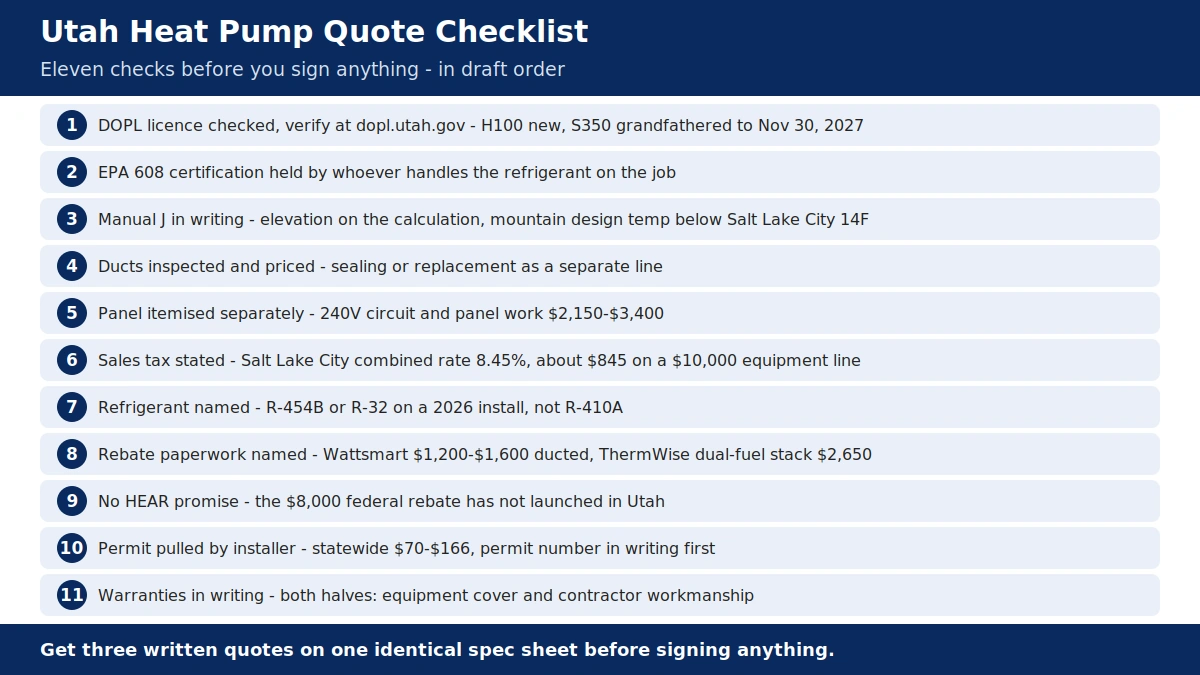
- DOPL licence checked. Utah licenses contractors statewide through the Division of Occupational and Professional Licensing — ask for the licence number and check it at dopl.utah.gov. Look for the H100 HVAC classification on new licences, and accept an S350 number only inside the grandfather window through November 30, 2027. No DOPL licence is a walk-away.
- EPA 608 held by whoever handles the refrigerant on the job. Federal law allows no exceptions.
- Before any equipment is ordered for the job, make the installer show you the Manual J load calculation in writing and talk you through its numbers. Sizing from square footage alone is a guess. In Park City or Logan, the Manual J should show a design temperature well below Salt Lake City’s 14F, and the elevation must be on the calculation.
- Ducts inspected and priced. Put the duct condition in the bid, and list sealing or replacement as a separate line. A bid that says nothing about ducts leaves part of the job unpriced.
- Panel shown separately. Put the 240V circuit and any panel work on separate lines of their own, never folded into the headline total. In Utah that line often runs $2,150–$3,400.
- Sales tax stated. Ask whether the quote includes sales tax on the equipment, and at what rate. In Salt Lake City the combined rate is 8.45% — roughly $845 on a $10,000 equipment line if charged separately.
- Refrigerant stated. A 2026 install should name R-454B or R-32 in the quote. R-410A is last year’s equipment.
- Rebate paperwork spelled out. Wattsmart ($1,200–$1,600 ducted or up to $1,700 ductless, electric-resistance replacement only) plus ThermWise for dual-fuel ($1,000–$1,200 with a new furnace) — with the efficiency threshold, the territory, and the fuel condition checked. Any federal credit line on the bid should read $0 for a 2026 install, and any HEAR line should read $0 too, because the programme has not launched.
- No HEAR promise. A contractor who promises the $8,000 federal HEAR rebate on a Utah job in 2026 is promising money that has not launched — and work finished before launch can never collect it. Turn down the promise, not necessarily the contractor — and remember who made it.
- Permit in the installer’s name, with its number given to you in writing before work starts. Never pull it yourself. The statewide band runs $70–$166.
- Both warranties in writing. Equipment cover usually runs 10 years on parts, with longer compressor cover on the premium brands. Contractor workmanship cover, usually 1–10 years, matters more still than the parts cover. Get both before signing.
Utah-specific red flags: a “federal tax credit” line on a 2026 bid; a HEAR rebate promised before the Office of Energy Development opens the programme; a Wattsmart standard rebate quoted for a gas-furnace home on a standard all-electric swap; a Wattsmart rebate quoted for a Provo, Murray, Bountiful, Lehi, Logan, or St. George address, where the municipal utility runs its own programme; a whole-home quote near $5,000 with no duct, electrical, or sales-tax lines; a standard unit quoted for a Park City or Logan home without the cold-climate premium; a dual-fuel quote with no changeover setpoint in writing — ThermWise requires 40F or lower; and any contractor sizing the system from the old unit’s nameplate without a load calculation. The strongest Utah installers run two to three weeks out in peak season; a crew able to start tomorrow deserves scepticism, not a signature. For the neighbouring-state comparison, see our Oregon heat pump cost guide — Oregon is the closest market to Utah’s in structure, and the contrast in rebates and rates is instructive.
Sources & methodology
Cost anchors: NumeralQ’s “Heat Pump Cost in Utah (2026)” estimator, priced October 26, 2026 from Fixr, This Old House, Home Depot prices, and BLS May 2025 wages, is the primary Utah anchor — 3-ton ducted $6,470–$10,860; size table (1.5t $4,340–$6,980 through 5t $9,320–$16,020); type table (cold-climate ducted $8,520–$14,910; single-zone mini-split $3,090–$4,840; 3-head $6,130–$11,030; geothermal $20,090–$31,690); city table (Salt Lake City $6,550–$10,950; Provo $6,110–$10,390); ductwork $4,060–$6,930; panel $2,150–$3,400; permits $70–$166; HVAC median pay $28.24 an hour, billed $56–$73 an hour; electricians $29.81 an hour, billed $60–$78 an hour. NumeralQ’s “HVAC Replacement Cost in Utah (2026)” gives dual-fuel at $9,130–$14,990 and packaged units at $6,910–$9,860, with city full-system figures (Salt Lake City $8,340–$14,100; Provo $7,880–$13,510). Air Pros Utah, a Salt Lake Valley installer, puts a heat pump plus air handler at $8,200–$21,000, most homeowners around $12,500, with a standard 16 SEER 3-ton system at about $6,700 ($4,815 equipment, parts, and supplies plus $1,885 labour), ducted air-source $8,000–$20,000, ductless $4,000–$15,000+, and geothermal $15,000–$40,000+. Salmon HVAC, a Salt Lake City installer, puts a full furnace-plus-AC replacement at $7,500–$12,500 and an air-source heat pump generally at $6,000–$25,000. Article 1 (Nestpriced) puts the US-wide baseline at $7,500–$15,000. The headline $7,500–$12,500 band and the near-$10,000 typical job are this guide’s synthesis of the NumeralQ model band and installer ranges; no published Utah statewide installer average was found.
Rates: EIA Electric Power Monthly Table 5.6.A (August 2026, released October 2026), as reported by Where’d My Money Go? (updated October 29, 2026) — Utah residential electricity 13.3 cents per kilowatt-hour on the 12-month average to August 2026 (August 2026 alone 13.3 cents), 5th lowest in the US against 18.0 cents nationally; average bill about $104 a month ($101.29 in August, 761 kilowatt-hours); 2024 full-year average 12.22 cents (EIA Electric Power Annual Table 2.10); July 2026 was 13.12 cents. EIA Natural Gas Monthly / SEDS — Utah residential gas about $1.07 a therm on the 12-month average to July 2026 ($11.07 per thousand cubic feet); 2024 annual average $1.255 a therm; BallparkLab trailing average through April 2026: $1.06 a therm. The per-therm arithmetic above was worked out from those EIA prices at 29.3 kilowatt-hours per therm. It gives $1.30 for a heat pump at COP 3.0 and $1.16 for a gas furnace at 95% at the state-average price, with a break-even COP of about 3.45. CONFLICT FLAGGED: the per-therm arithmetic favours a high-efficiency heat pump narrowly, while NumeralQ’s Utah FAQ states flatly that a heat pump costs more to run than gas at Utah prices — the draft reports both and explains the gap (seasonal COP below 3.0 for a standard unit). No EIA annual heating-cost table for Utah was found, so none is printed.
Climate: IECC zones as the standard Utah reading — Wasatch Front Zone 5B, southern Utah Zone 3B, high country Zone 6B in practice (Utah climate guides; no PNNL county table pulled). Manual J Table 1A design conditions via utahenergycode.com (Salt Lake City International Airport: 99% winter 14F, 1% summer 95F, high daily range); Salmon HVAC cold-winter guide (March 26, 2026) cites a NOAA 99th-percentile design temperature of 4F for the same airport and valley-floor lows of 5–10F in the coldest stretches — different percentile bases, flagged. Salt Lake City 6,052 heating degree days (Engineering Toolbox). St. George monthly averages via WeatherSpark (January 54F/32F; July 102F/76F). State records via city-data.com (117F at St. George, July 5, 1985; minus 69F at Peter’s Sink, February 1, 1985). Elevation and derating, inversion and filtration advice via SOS Air Utah Wasatch Front climate guides (2026) and Expert Services Utah (2026). Snow: Salt Lake City about 59 inches a year (1971–2000 normals). No verified Utah heating fuel-mix percentages or adoption percentage were found — none are stated.
Rebates: Rocky Mountain Power Wattsmart Homes rebate chart Rev. 3-2026 (Schedule 111; Utah PSC Docket 26-035-T02; programme changes effective February 27, 2026) — ducted conversion $1,200/$1,400/$1,600 by tier, upgrade $450, ductless $1,300–$1,700, dual-fuel AHRI $1,450, non-AHRI $700, ground-source $2,000, window heat pump $125, smart thermostat up to $100 (Salmon) vs $75 (Lucas) — conflict flagged; application deadline 90 days (Lucas, Salmon) vs 180 days (HeatPumpPricing) — conflict flagged. Enbridge Gas ThermWise 2026 Appliance Rebates application (January 1–December 31, 2026) — dual-fuel Tier 1 $1,000/$700, Tier 2 $1,200/$850, changeover 40F or lower, postmark within six months; 2026 budget application Docket 25-057-22 (hydronic coil backup qualifies). Provo City Power ($1,000 ducted / $500 ductless) and UAMPS Cool Cash ($200–$400 ducted, $400–$1,300 ductless) via HomeEnergyBasics (June 2026) — second-hand, verify with the utility. No verified 2026 rebate amounts found for Murray, Bountiful, Lehi, Logan, or St. George municipal programmes.
State programmes: Utah Renewable Energy Systems Tax Credit, Utah Code § 59-10-1014 (amended Chapter 233, 2025 General Session; HB 264) — 25% up to $2,000 for a residential geothermal heat pump, non-refundable, Form TC-40E, $15 application, expires for systems placed in service before January 1, 2028; residential solar PV not eligible since January 1, 2024. Utah has no state rebate for air-source heat pumps.
Federal: Public Law 119-21 and IRS notice FS-2025-05 ended §25C and §25D for property placed in service after December 31, 2025. HEAR/HOMES Utah status via HeatPumpPricing HEAR status map (verified November 4, 2026) and HomeEnergyBasics Utah page (June 2026) — approximately $101 million combined, applied December 2024, on hold until further notice, DOE approval pending, no launch date, split not verified. DOE Program Notice 26-2, dated May 29, 2026, took fuel-switching out from September 1, 2026, leaving HEAR to cover electric-to-electric swaps only. §48E lease route — no Utah-specific lease product with verified pass-through was found. The federal minimum under DOE rules is 14.3 SEER2 / 7.5 HSPF2, with Utah in the Northern region (13.4 SEER2 for split-system AC).
Licensing & permits: Utah Division of Occupational and Professional Licensing (DOPL), Utah Construction Trades Licensing Act (Utah Code Title 58, Chapter 55) — $7,000 threshold for a licensed contractor (HB 483, 2024, effective May 7, 2025); unlicensed contracting a Class A misdemeanour (§ 58-55-501); no reciprocity. H100/S350 transition via R156-55a rule amendment (Utah State Bulletin Vol. 2026 No. 4, February 15, 2026, Filing No. 57745; effective March 30, 2026; new applicants from April 20, 2026; S350 grandfathered through November 30, 2027) — RMGA qualifier, Prov exams, two years of experience, $1M/$3M insurance, $175 fee, $128 renewal every two years; details via secondary licence guides (ContractorLicenseCheck, VerticalOS verified October 14, 2026, ServiceTitan, SOS Air Utah) — verify at dopl.utah.gov. EPA 608 federal. NumeralQ’s 35-city check (October 2026) puts typical permit fees at $70–$166.
Sales tax: Utah combined rates 6.10% floor to 8.45% in Salt Lake City (Commenda, June 11, 2026; SalesTaxHandbook, March 2026); state rate 4.85% plus 1.25% local option tax; services generally not taxable, installation labour tied to a taxable sale of tangible property taxable.
Method note: where a model estimate and an installer quote disagreed, both figures appear here, with the installer figure given the prominence. Where no Utah-specific figure was verified (for example maintenance $150–$300 a year; lifespan 12–15 years planning figure; Manual J $200–$500), the figure is the national guide’s and is labeled as such. Ogden, St. George, and Logan have no published city price model, so this guide invents no band for them. The payback figures in the payback section are this guide’s own illustrative arithmetic, labelled as such throughout. All prices here are 2026 planning figures rather than quotes. Set the budget only once three written local quotes are in hand.
Disclaimer: these 2026 Utah planning figures vary by city, home, and contractor. Hold off spending until three written local quotes are in hand. Tax and rebate information here is general guidance rather than tax advice. Any incentive should be checked with a tax professional, the Utah Office of Energy Development, or your utility first.
What does a heat pump cost in Utah in 2026?
For a 3-ton whole-home ducted air-source system, expect $7,500–$12,500 installed, with the typical job near $10,000. A single ductless mini-split zone is $3,090–$4,840, three zones are $6,130–$11,030, a cold-climate ducted unit is $8,520–$14,910, a dual-fuel system is $9,130–$14,990, and geothermal is $20,090–$31,690. Salt Lake City runs $6,550–$10,950 on the model and Provo $6,110–$10,390. Ogden, St. George, and Logan have no published city price model, so this guide gives direction only for them. Ask whether the quote includes sales tax: Salt Lake City’s combined rate is 8.45%, roughly $845 on a $10,000 equipment line if charged separately.
What rebates does Rocky Mountain Power pay for a heat pump in 2026?
Wattsmart pays $1,200, $1,400, or $1,600 for a ducted air-source heat pump that replaces electric resistance heat, depending on the efficiency tier, with the top tier reserved for cold-climate units. Upgrading an existing heat pump to a cold-climate unit pays $450. Ductless mini-splits pay $1,300 for a single-head conversion or $1,700 for a multi-head system, and a dual-fuel system with an AHRI-rated heat pump and a gas furnace pays $1,450. A ground-source conversion pays $2,000. The central condition is fuel: the big conversion tiers pay only when the new heat pump replaces electric resistance heat. A gas-furnace home gets $0 for a standard ducted swap — the dual-fuel tier is the exception. Apply within 90 days of completion and use a programme-eligible contractor, and check the Wattsmart portal for the current deadline.
Can I stack Wattsmart with the gas utility rebate?
Yes, on a dual-fuel system — and it is the biggest rebate stack in Utah. Enbridge Gas Utah’s ThermWise programme pays $1,000 at Tier 1 or $1,200 at Tier 2 with a newly installed furnace, or $700 and $850 respectively for the heat pump alone with an existing qualifying furnace, for a heat pump paired with a high-efficiency gas furnace and a changeover setpoint of 40F or lower. Wattsmart’s dual-fuel rebate of $1,450 plus ThermWise Tier 2 of $1,200 comes to $2,650 combined. ThermWise pays only for systems that keep gas backup, and Wattsmart pays the dual-fuel tier only for an AHRI-rated heat pump with a gas furnace, so the two programmes fit together by design. Provo, Murray, Bountiful, Lehi, Logan, and St. George run municipal electric utilities, so Wattsmart does not reach them — check with the city utility instead.
Has Utah’s HEAR rebate launched yet?
No. Utah applied in December 2024 for approximately $101 million in combined HEAR and HOMES funding, and the Utah Office of Energy Development lists the programme as on hold until further notice: the US Department of Energy has not approved Utah’s application, and no launch date is set. That status was verified on November 4, 2026. Neither programme is accepting applications. Two things to watch: rebates are not retroactive, so work finished before launch never collects; and DOE Program Notice 26-2, effective September 1, 2026, limits HEAR to electric-to-electric swaps, so a gas-to-heat-pump conversion collects nothing even after launch. Leave it out of the budget entirely.
Does any federal tax credit apply to a Utah heat pump in 2026?
No — $0. IRS notice FS-2025-05 confirms it: §25C, worth 30% up to $2,000 a year on a heat pump, and §25D, worth 30% on geothermal, both ended for property placed in service after December 31, 2025 under the One Big Beautiful Bill Act. Utah has one state credit that survives, and it is geothermal only: the Renewable Energy Systems Tax Credit pays 25% of the system cost up to $2,000 for a residential geothermal heat pump, claimed on Form TC-40E, for systems placed in service before January 1, 2028. See a $2,000 federal credit subtracted from a 2026 Utah air-source install? That quote is out of date — tell the contractor to take the credit off. What is live is utility money: up to $1,600 ducted or $1,700 ductless from Wattsmart when electric resistance heat is being replaced, or the $2,650 dual-fuel stack for a gas home.
Does a heat pump cost more to run than gas in Utah, or less?
It depends on the efficiency tier, and this guide prints both sides of the argument. At Utah’s electricity price of 13.3 cents per kilowatt-hour and gas at about $1.10 a therm, a heat pump at COP 3.0 heats for about $1.30 a therm, against about $1.16 for a 95% gas furnace — the pump loses. At COP 3.5 the same heat pump heats for about $1.11 a therm and wins by about 5 cents. The break-even COP at Utah prices is about 3.45, so a Utah buyer needs a high-efficiency system for the fuel maths to work. NumeralQ’s Utah FAQ says flatly that a heat pump costs more to run than gas at Utah prices, which matches the standard-tier sums. Against electric resistance heat, at about $3.90 a therm, the heat pump wins by a wide margin everywhere in Utah.
Do I need a cold-climate heat pump in Utah?
In St. George, no. In Park City and the high country, yes. On the Wasatch Front, it is a good buy rather than a necessity. St. George sits in Zone 3B with mild winters and a 102F average July high, so a standard unit does the work. Park City and the mountain valleys are treated as Zone 6B, and a cold-climate ducted system at $8,520–$14,910 is the default there. Salt Lake City designs to a 14F winter temperature on Manual J, with valley-floor lows bottoming out around 5–10F in the coldest stretches, so a cold-climate unit copes with the coldest mornings without leaning on strip heat — and it also unlocks the top Wattsmart tier of $1,600. For a gas-connected Wasatch Front home, dual-fuel is the configuration Utah installers recommend first, with the furnace covering the coldest mornings.
What permit and licence do I need for a Utah heat pump?
Utah licenses contractors statewide through the Division of Occupational and Professional Licensing, DOPL, under the Utah Construction Trades Licensing Act. Ask for the licence number and verify it at dopl.utah.gov — look for the H100 HVAC classification on new licences, and accept an S350 number only inside the grandfather window through November 30, 2027. Any job worth $7,000 or more requires a licensed contractor, and unlicensed contracting is a Class A misdemeanour. Refrigerant work calls for an EPA Section 608 certified technician, and electrical work must be done by a licensed electrical contractor. Where a building department operates, a mechanical permit goes with the job, with typical fees of $70–$166 statewide. Get the permit number in writing, with the installer pulling the permit.