


Table of Contents
Maryland hands a heat pump buyer a split decision that no other state in this series has produced in quite this form. The rebate cheque is the biggest on the map. The electric bill is one of the highest. Both facts are true at the same time, and the buyer who looks at only one of them will make the wrong call. A Baltimore rowhouse heated by an old oil boiler and a Rockville split-level heated by a nearly new gas furnace are not buying the same machine, even if the quote on the kitchen table shows the same tonnage and the same brand. One of them gets up to $15,000 back and saves money every month from the day the system starts. The other gets a smaller rebate, pays more per month to heat the house than before, and buys the heat pump for the air conditioning and the carbon cut instead. This guide keeps those two buyers separate all the way through, because the state does.
Three facts decide which buyer you are. The first is the fuel your house burns today: 44% of Maryland homes heat with electricity, 43% with piped gas, and 10% with propane or oil, per Census figures, and the rebate stack and the running-cost answer both turn on that split. The second is the name on the electric bill. Five utilities divide the state — Baltimore Gas & Electric around the bay, Pepco in the Washington suburbs, Potomac Edison in the west, Delmarva Power on the Eastern Shore, and the SMECO cooperative in Southern Maryland — and their all-in residential rates run from 16.6 cents a kilowatt-hour at Potomac Edison to 23.4 cents at Pepco, a gap wide enough to flip the fuel maths on its own. The third is the calendar. The EmPOWER programme that pays the large rebates runs to the end of 2026, and the commission that decides whether it continues has not ruled yet. A quote that is right in November can be wrong in January if the reservation was never filed.
The climate, for once, is the easy part. Most of Maryland sits in zone 4A, mixed-humid, with a Baltimore winter design temperature near 15 degrees and a summer design near 91. A standard heat pump carries that winter without backup heat in a typical house. Only the mountain counties in the west — Garrett and Allegany, where the design temperature drops far below Baltimore’s — genuinely need cold-climate equipment. The hard part of a Maryland heat pump decision is not whether the machine can heat the house. It is whether the electricity price, the rebate, and the fuel being replaced add up to a purchase that pays. The sections below run that addition in full, utility by utility and fuel by fuel, so the answer is yours rather than the salesman’s.
Before you read on, start with the country-wide baseline in our national heat pump cost guide.
How Much Does a Heat Pump Cost in Maryland in 2026?
Three anchors describe the Maryland market in 2026, and they measure different things, so the first job is to say which anchor measures what. NumeralQ’s Maryland model, priced as of October 26, 2026, puts a 3-ton ducted air-source system at $6,890–$11,390 installed, with materials, waste, and contractor markup included. That is a planning model built from material prices and local labour rates, not a stack of contractor quotes, and it is the figure this guide headlines because it is the only Maryland-specific, system-by-system model published in 2026 with its method stated. Its midpoint, about $9,140, is the typical whole-home job this guide uses as its synthesis figure — a labelled midpoint, not a quoted price.
The second anchor is the DMV Energy Guide, updated July 2026, which prices a ducted heat pump on existing ductwork in the Maryland–DC–Virginia region at $5,000–$13,500, a ductless multi-zone system at $8,000–$18,000 or more, and a whole-home electrification job at $12,000–$25,000 or more. Its range is wider because it covers the whole DMV rather than Maryland alone, and it carries a warning the NumeralQ model does not: close-in Washington suburbs and Baltimore City run 10–15% above those averages on labour. The two anchors overlap across nearly the whole NumeralQ band, which is reassuring — the DMV range contains the Maryland model range with room on both sides.
The third anchor sits higher, and it should. ElectrifyAtlas, working from 2026 installer proposals, prices a 3-ton ducted replacement at $11,000–$17,000 for a variable-speed system, with equipment accounting for roughly 40–50% of the total. That is not a contradiction of the NumeralQ band; it is the premium end of it, priced for variable-speed equipment with new electrical work and permits folded in. A like-for-like changeout on good ducts with an existing 240-volt circuit re-used lands near the NumeralQ band. A premium variable-speed system with a panel upgrade and duct repairs lands near the ElectrifyAtlas band. The quote in your hand belongs somewhere on that spectrum, and the first question to ask about it is which end it was priced from.
Two more national cross-checks help place Maryland. The National Residential Efficiency Measures Database (REMDB), published by the National Laboratory of the Rockies in April 2025, prices a 3-ton ducted 15-SEER system at $7,450 at the low end, $13,350 in the middle, and $19,250 at the high end — but those are modelled estimates in 2023 dollars, so treat the top of that range as stale rather than as a Maryland price. Angi’s Baltimore page, updated August 4, 2026, reports a $5,705 average for Baltimore homes, with most jobs falling between $4,155 and $7,255, and notes the average Baltimore home needs a 2.5-ton unit. Angi’s figure is a project-reported average across system types and efficiency tiers, which is why it sits below the NumeralQ band — it includes plenty of single-zone and changeout jobs. Use it as a floor for simple jobs, not as the price of a whole-home ducted system.
What the headline band buys is the whole installed job: the outdoor condenser, the indoor air handler or coil, the line set, the thermostat, the labour, the permit, and the start-up. It does not buy new ductwork, a panel upgrade, or a new circuit — those are priced separately in the table below, and they are the three add-ons that most often turn a $9,000 quote into a $14,000 invoice. It also does not buy the rebate: every figure in this guide is the gross price before incentives, because the EmPOWER rebate depends on your utility, your current fuel, and whether the reservation was filed before the work started, and no single net price exists for the whole state.
| Source | System | Installed cost | What it measures |
|---|---|---|---|
| NumeralQ Maryland (Oct 26, 2026) | 3-ton ducted air-source | $6,890–$11,390 | Planning model; materials + local labour |
| DMV Energy Guide (Jul 2026) | Ducted, existing ducts | $5,000–$13,500 | DMV-wide guide; Baltimore City + DC suburbs 10–15% above average |
| Angi Baltimore (Aug 4, 2026) | Heat pump, Baltimore | $5,705 avg; $4,155–$7,255 | Project-reported average, all system types |
| ElectrifyAtlas (2026) | 3-ton ducted, variable-speed | $11,000–$17,000 | Installer-quoted premium variable-speed jobs |
| REMDB (Apr 2025, 2023 dollars) | 3-ton ducted 15 SEER | $7,450 / $13,350 / $19,250 low/mid/high | National modelled estimates, not quotes |
| NumeralQ Maryland | Cold-climate ducted | $9,000–$15,550 | 3-ton system |
| NumeralQ Maryland | Ductless single zone | $3,360–$5,200 | One indoor head |
| NumeralQ Maryland | Ductless multi-zone, 3 heads | $6,690–$11,760 | Three indoor heads |
| NumeralQ Maryland | Geothermal with loop | $20,970–$32,830 | Ground loop included |
One caution before the tables: the cheapest quote in Maryland is rarely the cheapest system over fifteen years. Labour is 25–40% of a Baltimore install, per Angi, and the crew that sizes by square footage instead of a Manual J load calculation will sell you a ton too much equipment and a decade of short-cycling. Maryland HVAC mechanics earn a median of $33.67 an hour and electricians $35.33, per BLS May 2025 figures, and billed rates run $67–$88 an hour for HVAC work and $71–$92 for electrical — a crew that charges far below those rates is cutting something, and it is usually the load calculation, the duct sealing, or the commissioning. Get three written quotes on one identical spec sheet, and make the Manual J a line item on every one of them.
Heat Pump Cost in Maryland by System Type
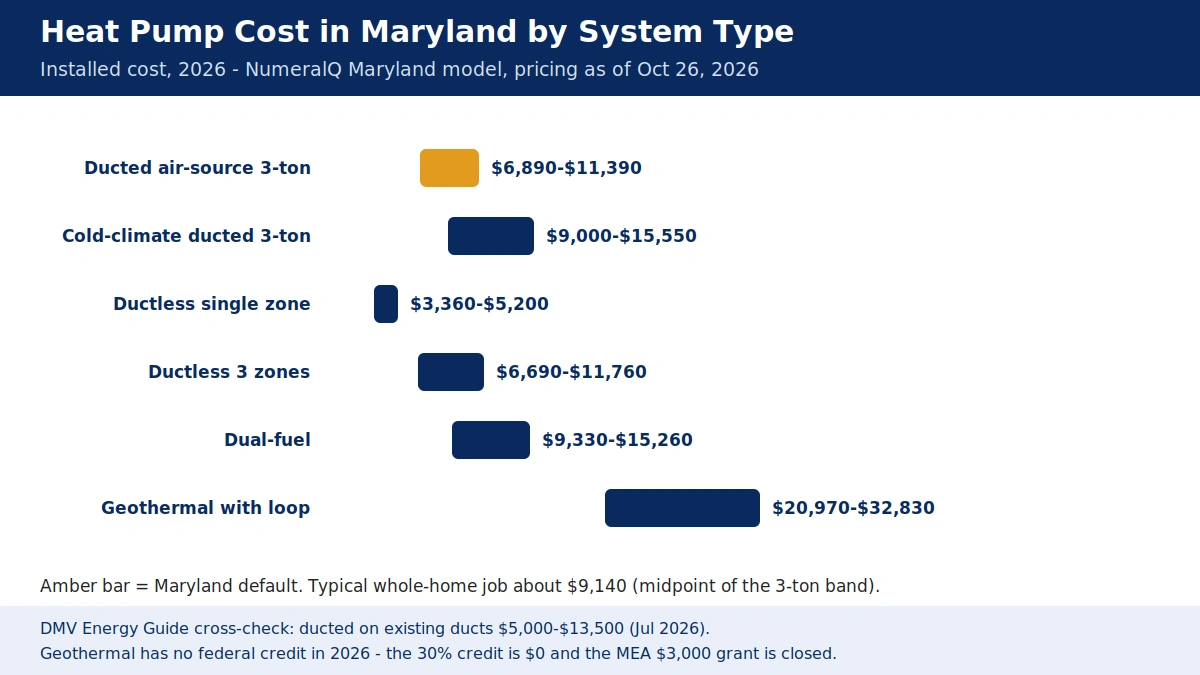
System type is the first decision, and in Maryland it is mostly a decision about what the house already has. A home with sound ducts buys a ducted system. A Baltimore rowhouse with no ducts, or a house where only two rooms need conditioning, buys ductless. A mountain home in Garrett County buys cold-climate equipment. A home with a good gas furnace that still has life in it buys dual-fuel. The table below prices each path on the same NumeralQ Maryland anchors, so the comparison is apples to apples.
| System type | Installed cost (Maryland, 2026) | Best for in Maryland |
|---|---|---|
| Ducted air-source, 3-ton | $6,890–$11,390 | The default whole-home replacement on existing ducts |
| Cold-climate ducted, 3-ton | $9,000–$15,550 | Western Maryland, exposed sites, homes that want no backup heat |
| Ductless mini-split, single zone | $3,360–$5,200 | One room, a rowhouse addition, a home office over a garage |
| Ductless mini-split, 3 zones | $6,690–$11,760 | Ductless whole-home or three problem rooms; DMV Guide $8,000–$18,000+ |
| Dual-fuel (heat pump + gas furnace) | $9,330–$15,260 | A good gas furnace with years left; gas does the coldest hours |
| Geothermal with ground loop | $20,970–$32,830 | Large lots, new builds, owners staying 20+ years |
| Packaged unit | Not modelled for Maryland | Rooftop or slab-mounted all-in-one; ask for a local quote |
Ducted air-source is the Maryland default. It uses the ducts the house already has, heats and cools the whole home from one system, and at $6,890–$11,390 for a 3-ton it is the cheapest whole-home path. The risk is the ducts themselves: Maryland’s housing stock is old — much of Baltimore’s rowhouse stock predates the Second World War — and leaky, undersized, or bare ducts in a hot attic can lose a fourth of the heated and cooled air into the attic before it gets to a room. A ducted quote that does not include a duct inspection is a quote that has not priced the job. New or extended ductwork runs $4,570–$7,600 a job in Maryland, per NumeralQ, and duct replacement in Baltimore runs $458–$1,699, per Angi — the difference is scope, and the quote should say which scope it covers.
Cold-climate ducted costs about $2,000–$4,000 more than a standard ducted system for the same tonnage, and in most of Maryland that premium buys capacity the house will rarely use. A cold-climate unit holds its heating output as the outdoor temperature falls toward single digits, where a standard unit’s output fades and the backup heat strips take over. In Baltimore, where the design temperature is 15 degrees and the average January low is around 27, the standard unit covers the season and the cold-climate premium is insurance against a handful of cold snaps. In Garrett County, where the design temperature runs far colder and the heating season is longer, that extra money is what stands between a heat pump that keeps the house warm and one that falls back on pricey strip heat for months. Buy cold-climate equipment for the mountains, not for the bay.
Ductless mini-splits are Maryland’s rowhouse answer. A single zone at $3,360–$5,200 conditions one room without touching the rest of the house, and a three-head system at $6,690–$11,760 can carry a small rowhouse or a whole floor. Baltimore’s narrow rowhouses, with their shared walls and limited duct chases, are exactly the housing stock ductless was designed for, and a ductless system also solves the historic-district problem: no ductwork to thread through plaster walls, and a condenser that can sit on a rear pad out of sight. The cost driver is the head count, not the tonnage — each indoor head adds equipment, refrigerant piping, and a wall penetration — so a four-head quote that looks expensive next to a ducted quote is usually pricing four rooms, not one system. The full ductless-versus-ducted comparison sits in our ductless vs ducted guide, and the mini-split pricing detail sits in our mini-split installation guide.
Dual-fuel is the compromise for a gas-heated home that is not ready to leave gas. At $9,330–$15,260 in Baltimore, per NumeralQ, it pairs a heat pump with the existing gas furnace: the heat pump carries the mild weather, the furnace takes over below a set outdoor temperature, and the house keeps the cheapest fuel for the coldest hours. In Maryland that compromise has a real economic logic, because gas at $1.71 a therm beats a heat pump on running cost at the statewide electricity price — the furnace is not a sentimental attachment, it is the cheaper heater for the coldest week of the year. Dual-fuel also preserves the gas furnace as backup if the heat pump fails in January, which matters in a state where a winter outage can leave a house cold for a day. The dual-fuel detail, including the switchover-temperature decision, sits in our dual-fuel guide.
Geothermal is the long game, and in Maryland it is a harder sell than in the Midwest. At $20,970–$32,830 with the ground loop, per NumeralQ, it costs roughly three times a ducted air-source system, and it needs land for the loop — vertical bores where the lot is small, horizontal trenches where it is not. Its advantages are real: steady ground temperatures mean it never loses capacity in a cold snap, and its seasonal efficiency beats any air-source unit. But the two supports that used to hold its price up have both gone in 2026. The 30% federal geothermal credit (§25D) is $0 for systems finished after December 31, 2025. Maryland’s own $3,000 geothermal rebate — the MEA Geothermal Rebate Program — spent its entire $150,000 FY26 budget, closed its portal to new applications, and will not run again; FY26 was its final year. A Maryland geothermal buyer in 2026 pays full price and waits a very long time for the energy savings to repay the loop. The national geothermal numbers sit in our geothermal cost guide.
Heat Pump Cost by Home Size
Size is the second decision, and the only correct way to make it is a Manual J load calculation — a room-by-room accounting of insulation, windows, air leakage, and orientation that the Air Conditioning Contractors of America publishes as its standard. Square footage is a sanity check, not a sizing method: two 2,000-square-foot houses in Maryland can need different tonnages if one is a brick rowhouse with shared walls and the other is a detached colonial with a sun-baked west face. The table below is priced from the NumeralQ Maryland model, with square-footage bands shown only as a rough guide, and every row carries the same warning — size from the load calculation, then check the quote against it.
| Size | Installed cost (ducted, NumeralQ) | Rough home size | Notes |
|---|---|---|---|
| 1.5 tons | $4,690–$7,440 | ~900–1,200 sq ft | Small homes, condos, single-floor zones |
| 2 tons | $5,420–$8,760 | ~1,200–1,500 sq ft | Small rowhouses, townhouses |
| 2.5 tons | $6,150–$10,080 | ~1,500–1,800 sq ft | The average Baltimore home, per Angi |
| 3 tons | $6,890–$11,390 | ~1,800–2,200 sq ft | The Maryland typical whole-home job |
| 3.5 tons | $7,620–$12,710 | ~2,200–2,600 sq ft | Larger colonials, split-levels |
| 4 tons | $8,350–$14,030 | ~2,600–3,000 sq ft | Large detached homes |
| 5 tons | $9,820–$16,660 | ~3,000+ sq ft | Very large homes; two systems often beat one |
Each additional ton adds roughly $700–$1,500 to the installed price in the NumeralQ model, and the ElectrifyAtlas variable-speed cross-check runs higher — $9,000–$13,000 for 2 tons, $11,000–$17,000 for 3 tons, $13,000–$20,000 for 4 tons, and $15,000–$24,000 for 5 tons — because it prices premium equipment with the electrical work folded in. The gap between the two models is a reminder that tonnage alone does not price a job: efficiency tier, brand, duct condition, and electrical scope move the total by as much as the tonnage does.
Oversizing is the expensive mistake in Maryland, and it is more expensive here than in a dry climate because of the humidity. An oversized heat pump satisfies the thermostat quickly and shuts off, which sounds efficient and is not: short cycles leave the air damp, because the coil never runs long enough to wring moisture out of Chesapeake Bay summer air, and the house feels clammy at 72 degrees. An oversized unit also costs more to buy, cycles more often, and wears its compressor faster. An undersized unit is the opposite failure — it runs constantly on the coldest nights and leans on resistance backup heat, which at 21.4 cents a kilowatt-hour is the most expensive heat in the state. The Manual J exists to land between those two failures, and a contractor who sizes by square footage alone has skipped the one calculation that protects you from both. Ask for the Manual J in writing, with the design temperatures shown — Baltimore’s heating design near 15 degrees, cooling near 91 — and walk away from any bidder who will not produce it.
Heat Pump Cost by City: Baltimore, Rockville & the DC Suburbs
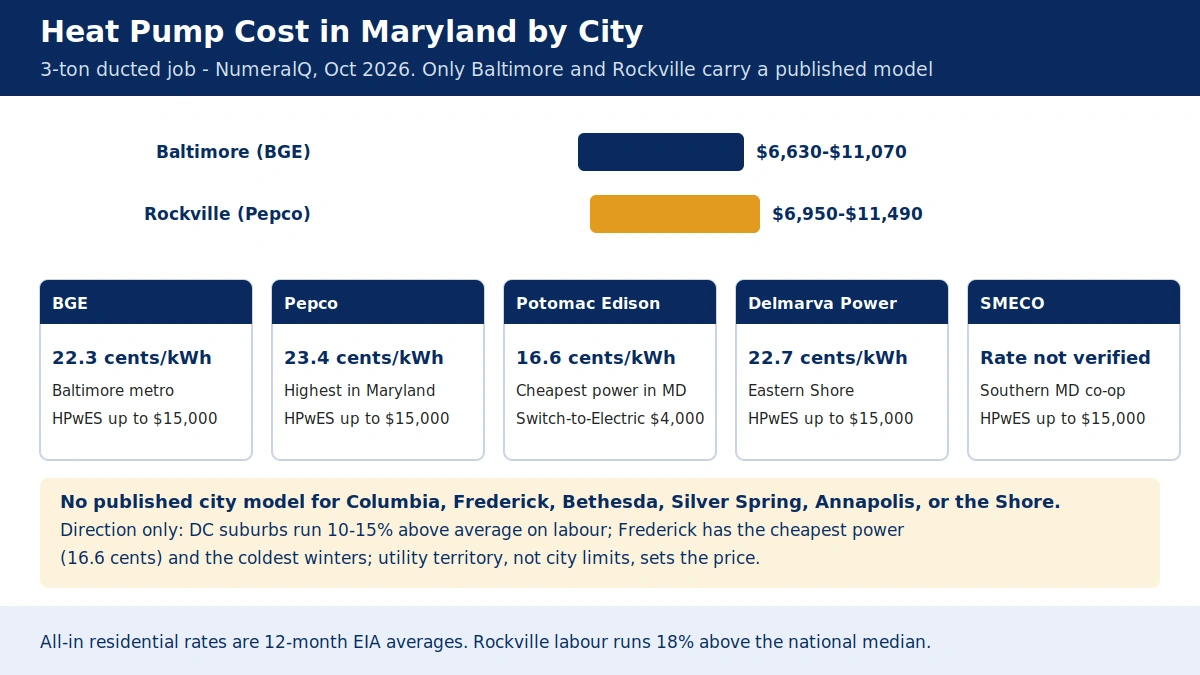
Only two Maryland cities carry a published 2026 price model, and the honest thing to do is to say so and build the section around them plus the utility territories, rather than inventing bands for cities nobody modelled. NumeralQ’s October 2026 model covers Baltimore and Rockville, and those two cities happen to sit in different utility territories with different electricity prices and different labour markets, which makes the comparison more useful than a longer list of invented numbers would be.
| City | 3-ton ducted (NumeralQ, Oct 2026) | Utility | All-in residential rate (12-mo avg) |
|---|---|---|---|
| Baltimore | $6,630–$11,070 | BGE | 22.3 cents/kWh |
| Rockville | $6,950–$11,490 | Pepco | 23.4 cents/kWh |
Baltimore is the cheaper of the two on the install and the cheaper on the power, and the gap is a labour story. HVAC technician pay runs 4% above the national median in Baltimore and 18% above it in Rockville, per BLS May 2025 figures, and Rockville sits inside the close-in Washington suburbs that the DMV Energy Guide puts 10–15% above the regional average on labour. A Rockville 3-ton job at $6,950–$11,490 costs roughly $300–$400 more than the same job in Baltimore, and the Rockville homeowner then pays 23.4 cents a kilowatt-hour to run it against Baltimore’s 22.3. Angi’s Baltimore average of $5,705, with most jobs between $4,155 and $7,255, sits below the NumeralQ Baltimore band for the same reason it sits below the statewide band — it averages changeouts and single-zone jobs in with whole-home ducted systems.
For the cities without a published model, direction is all the data supports, and the direction runs through the utility, not the city line. Columbia and the rest of Howard County sit in BGE territory, so expect Baltimore-like install prices and BGE’s 22.3-cent power. Bethesda, Silver Spring, Gaithersburg, and Germantown sit in Pepco territory with Montgomery County labour rates, so expect Rockville-like install prices — at the top of the state range — and Pepco’s 23.4-cent power, the highest in Maryland. Frederick sits in Potomac Edison territory, where the power is the cheapest in the state at 16.6 cents and the winters run colder than Baltimore’s, so a Frederick buyer should budget for a cold-climate unit more often and will see the best running-cost maths in the state. The Eastern Shore — Salisbury, Easton, Ocean City — is Delmarva Power territory at 22.7 cents, with a separate EmPOWER pathway and a housing stock that leans toward ductless in older shore cottages. Southern Maryland — Waldorf, Leonardtown, La Plata — is SMECO cooperative territory, where the utility is customer-owned and the EmPOWER whole-home cap still applies, though no SMECO-specific rate figure was verified for this guide.
| Utility territory | Serves | All-in rate (12-mo avg) | Heat-pump rebate pathway |
|---|---|---|---|
| BGE | Baltimore metro, central Maryland, ~1.23M customers | 22.3 cents/kWh | EmPOWER HPwES up to $15,000; electrification tiers up to $4,000/unit |
| Pepco | Montgomery + Prince George’s counties, ~562,000 customers | 23.4 cents/kWh | EmPOWER HPwES up to $15,000; electrification tiers up to $4,000/unit |
| Potomac Edison | Western Maryland, ~260,000 customers | 16.6 cents/kWh | EmPOWER HPwES up to $10,000; Switch-to-Electric up to $4,000/unit |
| Delmarva Power | Eastern Shore, ~189,000 customers | 22.7 cents/kWh | EmPOWER HPwES up to $15,000; electrification tiers up to $4,000/unit |
| SMECO | Southern Maryland (co-op) | Not verified | EmPOWER HPwES up to $15,000 |
One more city-level note: Annapolis, the state capital, has no published city model either, but its housing stock tells the story — historic homes, narrow lots, and a Chesapeake Bay waterfront that keeps summer humidity high. A ductless system or a compact ducted unit with a variable-speed compressor fits that stock better than a large single-stage system, and the historic-district rules in the downtown core can restrict where a condenser sits. That is a local-permit question, not a price question, and it belongs on the checklist before the order is placed.
Maryland’s Climate: Zone 4A Comfort, Zone 5 Winters in the West
Maryland is two climates wearing one state name, and the line between them runs along the mountains. Most of the state — Baltimore, the Washington suburbs, Annapolis, the Eastern Shore, Southern Maryland — sits in climate zone 4A, mixed-humid, where a standard heat pump is the right machine. The western counties — Garrett and Allegany, the high ground around Oakland and Frostburg — sit in zone 5, where winters are longer, colder, and snowier, and a standard unit sized for Baltimore will spend the season calling for backup heat. The map matters because the equipment decision follows it, not the other way around.
The bay-side numbers. Baltimore’s heating design temperature is 15 degrees at the airport and 17 degrees in the city, with a cooling design of 91 degrees at the airport and 89 in the city, per the ACCA Manual J design tables; the ASHRAE 2021 Handbook puts the Baltimore-Washington 99.6% heating figure at 13.5 degrees and the 99% figure at 17.5 degrees, with a 1% cooling figure of 91.3 degrees. Frederick, inland and a little higher, designs at 12 degrees heating and 91 cooling. Heating degree days run about 4,475–4,654 in Baltimore and 5,087 in Frederick. January averages 34.3 degrees in Baltimore, with an average low of 25 and an average high of 43; July averages 78. The DMV Energy Guide puts it plainly: Baltimore’s average January low is around 27 degrees, so a standard heat pump performs efficiently year-round with no backup needed in a typical winter. That is the sentence that should settle the equipment question for most Maryland buyers — a standard unit, properly sized, carries the house.
The western numbers are different in kind, not degree. Garrett County sits at elevation, catches lake-effect moisture off the Great Lakes, and holds snow on the ground for weeks at a time. Its design temperatures run well below Baltimore’s 15 degrees, its heating season starts earlier and ends later, and a standard heat pump there will do what standard units do when they are undersized for the cold: run constantly, lean on resistance strips, and produce electric bills that erase the savings the rebate promised. No exact Garrett County design temperature was verified for this guide, so none is stated — but the direction is certain, and the prescription follows from it: cold-climate equipment, a Manual J run at the local design temperature rather than Baltimore’s, and a defrost and snow-clearance plan for the outdoor unit. A contractor who quotes a Garrett County job at Baltimore design temperatures has sized the wrong house.
Humidity is Maryland’s second climate fact, and it decides the cooling side of the purchase. Chesapeake Bay air arrives damp, and a Baltimore summer at 91 degrees design with high humidity asks the heat pump to dehumidify as much as to cool. That is why the efficiency tier matters on the cooling side too: a variable-speed compressor that runs long and low wrings moisture out of the air, while a single-stage unit that blasts cold air for ten minutes and shuts off leaves the house cool and clammy. The federal minimum for Maryland’s region is 14.3 SEER2 for cooling and 7.5 HSPF2 for heating, under DOE rules in effect since January 2023 — but a minimum-efficiency unit in a humid Maryland summer is a false economy, and the running-cost section below shows why the higher tier pays in this state.
Snow, ice, and the outdoor unit. Maryland winters are mild by New England standards, but ice storms do reach the state, and a heat pump’s outdoor unit needs clear air around it to defrost. The unit should sit on a raised pad or wall bracket above the typical snow line, with clearance on all sides and no roof drip line pouring meltwater onto the fan. In the west, where snow accumulates, a snow stand and a wind baffle are worth specifying on the quote rather than discovering their absence in January. None of this is exotic equipment — it is placement and clearance, and it costs little when it is planned and a great deal when it is retrofitted.
The cooling bonus is real here. Roughly one Maryland home in five already uses a heat pump as its main heat, per EIA survey data, but plenty of older gas-heated homes still cool with window units or not at all. A heat pump gives those homes their first whole-home cooling, and in a state where summer design hits 91 degrees and the humidity rarely lets up, that cooling is not a luxury feature. It is the other half of the machine, and it belongs in the payback maths alongside the heating savings — a point the payback section returns to.
Heat Pump vs Gas Furnace in Maryland: The Running-Cost Math
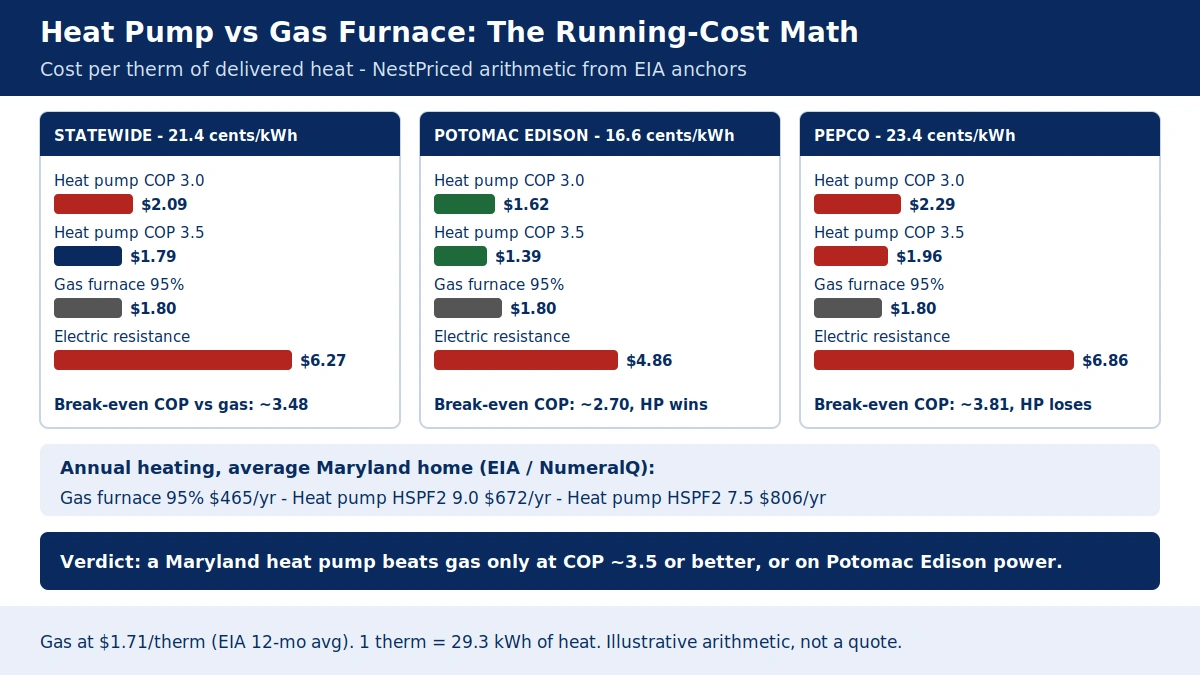
This is where the purchase gets decided, and the numbers are not kind to the heat pump. Maryland’s electricity is expensive and its gas is not, and the arithmetic says so in plain numbers. One therm of delivered heat equals 29.3 kilowatt-hours of heat. A heat pump’s cost per therm is the electric rate times 29.3 divided by its seasonal COP. A gas furnace’s cost per therm is the gas price divided by its efficiency. At Maryland’s prices, the two lines cross at a seasonal COP of about 3.48 — and most mid-efficiency heat pumps do not get there.
| Heat source | Price | Efficiency | Cost per therm of delivered heat |
|---|---|---|---|
| Heat pump, COP 3.0, statewide 21.4 cents | 21.40 cents/kWh | COP 3.0 | $2.09 |
| Heat pump, COP 3.5, statewide 21.4 cents | 21.40 cents/kWh | COP 3.5 | $1.79 |
| Heat pump, COP 2.5, statewide 21.4 cents | 21.40 cents/kWh | COP 2.5 | $2.51 |
| Gas furnace, 95%, at $1.71/therm | $1.71/therm | 95% | $1.80 |
| Electric resistance heat, 21.4 cents | 21.40 cents/kWh | COP 1.0 | $6.27 |
| Heat pump, COP 3.0, Potomac Edison 16.6 cents | 16.60 cents/kWh | COP 3.0 | $1.62 |
| Heat pump, COP 3.5, Potomac Edison 16.6 cents | 16.60 cents/kWh | COP 3.5 | $1.39 |
| Heat pump, COP 3.5, Pepco 23.4 cents | 23.40 cents/kWh | COP 3.5 | $1.96 |
| Heat pump, COP 3.5, BGE 22.3 cents | 22.30 cents/kWh | COP 3.5 | $1.87 |
Read the table from the gas line outward. A 95% gas furnace at Maryland’s 12-month average gas price of $1.71 a therm delivers heat at about $1.80 a therm. A heat pump at seasonal COP 3.0 — a fair figure for a mid-efficiency unit in a Maryland winter — delivers the same therm for $2.09 at the statewide electricity price. It loses by 29 cents a therm, or about 16%. At COP 3.5, the figure for a good high-efficiency unit, the heat pump delivers at $1.79 — effectively tied with gas, a penny ahead. At COP 2.5, the figure for a minimum-efficiency unit on the coldest nights, it delivers at $2.51 and loses by 40%. The break-even COP against gas is about 3.48 statewide. That is the whole running-cost story in one number: in Maryland, a heat pump only beats gas if it is efficient enough, and “efficient enough” means a seasonal COP near 3.5, which in practice means a high-HSPF2 variable-speed unit, not the cheapest box on the quote sheet.
The utility changes the answer completely. In Potomac Edison territory, where the all-in rate is 16.6 cents, a COP 3.0 heat pump delivers at $1.62 a therm — cheaper than gas by 18 cents — and a COP 3.5 unit at $1.39 beats gas by 23%. In Pepco territory, where the rate is 23.4 cents, even a COP 3.5 unit delivers at $1.96 and loses to gas by 16 cents a therm; the break-even COP there is about 3.81, beyond what most residential units sustain across a whole season. In BGE territory at 22.3 cents, a COP 3.5 unit delivers at $1.87 and loses to gas by 7 cents, with a break-even COP near 3.63. The same machine, the same house, the same winter — and the fuel verdict flips twice across the state line by utility alone. A heat pump buyer who does not know their utility’s all-in rate is buying blind, and a quote that promises savings without naming that rate is a promise without a price behind it.
The yearly totals point the same way, seen from the other side. EIA household energy data, as modelled by NumeralQ for the average Maryland home, puts annual heating at $465 a year for a 95% gas furnace, $672 a year for a heat pump at HSPF2 9.0, and $806 a year for a heat pump at HSPF2 7.5, the federal minimum. A Maryland heat pump replacing a gas furnace costs $207 a year more to run at high efficiency and $341 a year more at minimum efficiency. Those are planning figures, not a bill forecast — your home’s insulation, size, and thermostat habits move them — but the direction is robust, because it follows from the per-therm table above. Any quote that shows a Maryland heat pump saving money against gas on fuel alone has either used a cheaper electricity price than the one on your bill or a higher gas price than the one on your bill, and the per-therm table above is the check to run on it.
Against any other fuel, the story reverses and the heat pump wins by a wide margin. Electric resistance heat — baseboards, wall heaters, an old electric furnace — delivers a therm for $6.27 at the statewide rate, so a heat pump at COP 3.5 replaces it at $1.79 and saves more than two-thirds of the heating bill. The same arithmetic, worked from the gas figure above, puts the average Maryland home’s heat load at roughly 7,570 kilowatt-hours of delivered heat a year: resistance heat costs about $1,620 a year to deliver it, a HSPF2 9.0 heat pump about $672, a saving near $948 a year. Oil and propane sit between gas and resistance on price, and NumeralQ’s note is the honest one — propane and oil homes, about 10% of the state, are where a heat pump usually saves the most. No Maryland heating-oil or propane price was verified for this guide, so no worked number is given for those fuels; the direction is certain, the figure is not, and the draft does not invent it.
Three cautions belong on the running-cost math. First, the gas price used here — $1.71 a therm — is a 12-month EIA average that spreads fixed charges across the year’s gas use; BGE’s own October 2026 figures put the volumetric charges at about $1.33 a therm before the $16.15-a-month customer charge, which lands in the same place once the fixed charge is spread across a heating home’s winter use. Summer gas prices look higher per therm because the same fixed charges spread over very little gas — do not annualise a July gas bill. Second, the electricity rate used here is the all-in rate, not the supply-only rate. Maryland’s deregulated market lets households shop the supply portion — BGE variable supply was 11.29 cents a kilowatt-hour in November 2026, Potomac Edison’s 9.59 cents — but delivery, distribution, and surcharges sit on top, and the all-in bill is what the heat pump actually costs to run. A quote that prices savings at a supply-only rate understates the running cost by nearly half. Third, rates are moving. BGE filed in July 2026 to lift its electric distribution rate from 4.9 to 5.8 cents a kilowatt-hour, Pepco’s rate case 9820 is pending with a 23% overall increase requested, and Maryland’s average rate has already risen 66% in five years. Rising electricity prices hurt the heat pump’s case against gas; rising gas distribution charges — BGE’s gas distribution rate has more than tripled since 2012, from 30 cents to 97 cents a therm — help it. Both trends are live, both are dated in this guide, and neither is a reason to build a 15-year decision on a single month’s tariff.
The full national running-cost method, including the COP-to-HSPF2 conversion, sits in our heat pump running cost guide, and the head-to-head comparison with a furnace sits in our heat pump vs furnace guide.
EmPOWER Maryland, Potomac Edison & the Other Maryland Rebates for 2026
No other state in this series offers as much rebate money as Maryland, and none of it comes with a tighter clock. The money is real, it is large, and it runs through two different pathways that must not be confused with each other — plus a western-Maryland pathway, a county pilot, and a state geothermal grant that has already closed. The section below separates them, because the most expensive mistake a Maryland buyer can make is to count the same dollar twice, or to count a dollar that stopped existing in January.
The whole-home pathway: Home Performance with ENERGY STAR. EmPOWER Maryland’s Home Performance with ENERGY STAR programme — HPwES — is the flagship. It starts with a home energy audit that costs $100, against a normal price near $400, and that audit unlocks whole-home rebates of up to $15,000 for electrification — replacing a fossil-fuel heating system with a heat pump — capped at 75% of the project cost. Oil and propane systems qualify alongside gas. Envelope-only work, such as insulation and air sealing without a fuel switch, caps at $10,000 on the same framework. The programme runs at BGE, Pepco, Delmarva Power, and SMECO; Potomac Edison runs its own pathway with a $10,000 cap, described below. Some projects also carry a 0%-interest 24-month financing option. Two conditions govern everything: the work must go through an approved contractor, and the project needs an approved reservation — pre-approval — before the work begins. A heat pump installed first and submitted afterwards does not qualify, and no amount of paperwork after the fact fixes that order.
The per-equipment pathway: electrification tiers and instant rebates. Alongside the whole-home route, BGE, Pepco, and Delmarva have offered per-equipment electrification rebates since April 1, 2025: $4,000 for a Tier 1 ducted mini-split and $4,000 for a ductless multi-zone system, with electrification rebates reaching up to $8,000 overall. To qualify, the electric system must serve as the primary heating source, and the fossil-fuel system being replaced must be removed or set as backup with its thermostat not above 40 degrees. Separately, instant midstream rebates of roughly $800–$1,700 per unit are applied through participating contractors at purchase, with the amount varying by utility and equipment tier. No Maryland utility publishes its own midstream amounts, so the range is the figure — a quote that promises a precise midstream rebate without naming the utility’s current schedule is promising a number it has not verified. The per-equipment route and the whole-home route are different doors into the same building: a household takes one of them, not both, and the caps do not stack. A quote that adds the $4,000 tier to the $15,000 whole-home cap and shows $19,000 of rebates has invented $4,000.
Potomac Edison runs its own programme, and it is the best deal in the state for a fuel-switching home. Potomac Edison’s Switch-to-Electric programme pays up to $4,000 for a cold-climate heat pump and up to $3,500 for a standard air-source heat pump when the home currently heats with oil, propane, or natural gas, and those amounts stack on top of the standard HVAC discounts — a cold-climate unit replacing an oil furnace can draw $1,700 from the standard programme plus up to $4,000 from Switch-to-Electric, plus up to $3,000 if the electrical panel needs upgrading, with geothermal discounts reaching $7,100. Potomac Edison’s HPwES whole-home cap is $10,000 rather than $15,000, but the Switch-to-Electric stacking more than makes up for it on a per-unit basis, and Potomac Edison’s power is the cheapest in the state at 16.6 cents — the one territory where the running-cost maths favours the heat pump against gas at every efficiency tier. The programme runs through December 31, 2026, first-come first-served while funding lasts, through participating contractors only.
Montgomery County adds its own money. Electrify MC, the county’s pilot programme, adds up to $2,500 for electrification work, administered through Elysian Energy. It is a pilot, its funding is limited, and it sits on top of the Pepco EmPOWER money for county residents — a Bethesda or Rockville buyer should ask the contractor whether the county money has been applied for, because it will not find the household on its own.
Heat-pump water heaters carry a separate rebate with a hard deadline. Pepco and BGE pay up to $1,600 for an ENERGY STAR certified heat-pump water heater, but the 2026 dates are strict: Pepco requires the purchase completed by November 30, 2026 with the application and receipts in by December 7, 2026, and BGE requires purchases and applications by December 31, 2026. That rebate is for water heating, not space heating — it does not reduce the price of the heat pump in this guide — but a household replacing a water heater in the same project should claim it before the dates pass.
The geothermal grant is closed, and the draft says so rather than listing it as live. The Maryland Energy Administration’s Geothermal Rebate Program paid a flat $3,000 for a new residential geothermal system, but its FY26 budget of $150,000 was fully requested, its application portal closed, and FY26 was announced as the programme’s final year. A geothermal buyer in November 2026 cannot apply for it. The programme is recorded here so that a quote or a web search that still lists the $3,000 can be recognised for what it is — a closed programme, not a live rebate. The MEA’s Clean Energy Advantage loan pilot still exists for low-interest financing, but no loan rate was verified for this guide, so it is mentioned only as a financing route to ask MEA about.
The deadline is the section’s most important sentence. The current EmPOWER cycle ends December 31, 2026. Delmarva Power’s programme page states plainly that projects without an approved reservation submitted after that date will sit pending, awaiting the Maryland Public Service Commission’s decision on whether the efficiency programmes continue. Pepco and BGE are in the same position, waiting on the same commission. A household that wants the 2026 rebates must get the $100 audit done, choose an approved contractor, and hold an approved reservation before the year ends. A household that starts in January is betting on a commission decision that has not been made, and this guide does not price that bet.
| Programme | Value | Who runs it | Deadline / status |
|---|---|---|---|
| EmPOWER HPwES electrification (BGE, Pepco, Delmarva, SMECO) | Up to $15,000, 75% of cost | Utility, via approved contractor | Cycle ends Dec 31, 2026; pre-approval required |
| EmPOWER HPwES electrification (Potomac Edison) | Up to $10,000 | Potomac Edison | Cycle ends Dec 31, 2026 |
| EmPOWER HPwES envelope-only | Up to $10,000 | Utility | Cycle ends Dec 31, 2026 |
| Electrification tiers (BGE, Pepco, Delmarva) | $4,000 Tier 1 ducted mini-split; $4,000 ductless multi-zone; up to $8,000 overall | Utility, from Apr 1, 2025 | Do not stack with HPwES cap |
| Midstream instant rebates | ~$800–$1,700 per unit | Utility, via contractor | Varies by utility and tier; no per-utility figure published |
| Potomac Edison Switch-to-Electric | Cold-climate up to $4,000; air-source up to $3,500; panel up to $3,000 | Potomac Edison | Through Dec 31, 2026; stacks with standard HVAC discounts |
| Montgomery County Electrify MC | Up to $2,500 | County, via Elysian Energy | Pilot; limited funding |
| Heat-pump water heater rebate | Up to $1,600 | Pepco / BGE | Pepco purchase by Nov 30, 2026, apply by Dec 7, 2026; BGE by Dec 31, 2026 |
| MEA Geothermal Rebate | $3,000 flat | Maryland Energy Administration | CLOSED — FY26 budget exhausted, portal closed, final year |
| MEA Clean Energy Advantage loan pilot | Low-interest loans, rate not verified | Maryland Energy Administration | Ask MEA for current terms |
Federal Help in 2026: No Tax Credit, and HEAR Still Not Launched
The federal picture in Maryland fits in a short section, and its shortness is the point: in 2026 the federal government contributes nothing to a Maryland homeowner who buys a heat pump, and the one federal rebate that could contribute has not launched. Any quote that says otherwise is priced under a law that no longer exists, or a programme that has not opened.
Buy a heat pump yourself in 2026 and Washington gives you nothing back on the tax return. The §25C home-improvement credit once paid as much as $2,000 a year toward an air-source heat pump, but it stopped for property finished after December 31, 2025, when the One Big Beautiful Bill Act (P.L. 119-21, signed July 4, 2025) took it away, and IRS fact sheet FS-2025-05 confirms that the completion date is what counts: a deposit paid in 2025 buys nothing if the crew finished the job in January 2026. That same law also killed the 30% Residential Clean Energy Credit on the same date, which matters for geothermal — the federal geothermal credit that had been scheduled to run through 2032 is $0 for residential geothermal spending after December 31, 2025. A 2026 quote that still takes $2,000 off an air-source system, or 30% off a geothermal one, is priced under a dead law. Have the installer take it off and quote again. Note that Maryland’s own Department of the Environment heat-pump page still describes the §25C credit and an $8,000 HEAR rebate as available — that page is stale, it is not cited anywhere in this guide, and a contractor who quotes from it is quoting from an outdated page.
HEAR — the $8,000 federal heat pump rebate — has not launched in Maryland, and when it does it will not pay for a gas-to-heat-pump switch. That programme — federal money from the Inflation Reduction Act, handed out state by state — would pay as much as $8,000 toward a heat pump for a household that qualifies on income. Maryland’s Energy Administration resubmitted its HEAR and HOMES applications to the US Department of Energy on September 30, 2026, under the department’s updated guidance, and the launch date now depends on DOE approval. Applications are not open, no amounts have been set, and no launch date exists — verified as of November 4, 2026. Maryland’s combined federal allocation is about $136.7 million ($68,212,540 for HEAR and $68,472,604 for HOMES, per the DOE January 2025 dataset). And there is a second catch that matters more than the delay: since DOE Notice 26-2 of September 1, 2026, HEAR covers electric-to-electric upgrades only — no fuel-switching. A Maryland household that replaces an electric furnace or baseboard heat with a heat pump may qualify when the programme launches. A household that replaces a gas furnace will not. Do not let a quote tuck a HEAR rebate into the price of a gas-to-heat-pump conversion; the programme does not work that way, and in Maryland it does not work at all yet.
The HOMES efficiency rebates have not launched either. The same September 30, 2026 resubmission covers the HOMES (Home Efficiency Rebates) programme, which would pay for whole-home efficiency work. It is in the same position as HEAR: resubmitted, awaiting DOE approval, no launch date, no applications. The full 2026 federal picture sits in our federal tax credits guide.
One federal route does survive, but it does not apply to a homeowner-owned heat pump. The commercial clean-electricity credit (§48E, 30%) still lives for systems a company owns, for systems in service by December 31, 2027 — but that is a solar and commercial provision, not a residential heat-pump route, and no Maryland heat-pump lease programme was verified for this guide. A homeowner who buys a heat pump in Maryland in 2026 should budget on the EmPOWER money alone, and treat anything labelled federal as $0 until a state launch is announced.
Permits & Licensing: Maryland’s HVACR Board and MHIC License
Maryland does not have one licence called “licensed HVAC contractor.” It has two, held by different parties, plus a federal certification, and a buyer who checks only one of them has checked half the job. The distinction is the most useful thing in this section, because it is the check that catches the unlicensed operator who looks legitimate on a business card.
Licence one: the HVACR trade licence, held by the individual. The Maryland Board of HVACR Contractors, part of the Maryland Department of Labor, licenses the individuals who provide heating, ventilation, air conditioning, and refrigeration services, under Business Regulation Article 9A and COMAR 09.15. The Board’s licensing notice is direct: all individuals providing HVACR services in Maryland must be licensed. There are six levels. An apprentice must be licensed and supervised by a licensed master or journeyman who is present on the jobsite, and may not work alone or contract. A journeyman is licensed after at least four years as an apprentice with at least 6,000 hours of training under a licensed contractor, plus an exam. A master requires at least three years as a licensed journeyman across all areas of HVACR work, 1,875 hours in the prior year, plus an exam. Every exam requires a score of 70%. Ask for the licence level of the person who will actually be on your roof and at your air handler, not just the company name on the van — and verify it on the Department of Labor’s licence lookup before the work starts.
Licence two: the MHIC licence, held by the business. The Maryland Home Improvement Commission licenses and regulates home-improvement contractors and salespersons, and only MHIC-licensed contractors may contract with homeowners for home-improvement work — which includes replacing a home’s heating and cooling system — on jobs of $500 or more per contract. To hold it, a contractor needs two years of experience or equivalent education, a passing score of 70% on the PSI-administered MHIC exam, proof of financial solvency, a payment into the Home Improvement Guaranty Fund, and, since June 1, 2024, at least $500,000 in general liability insurance. The subcontractor licence category was eliminated in July 2016, so a subcontractor may work without an MHIC licence only when working for an MHIC-licensed contractor. The Guaranty Fund matters: it is the fund a homeowner claims against if a licensed contractor fails to complete the work, and it is only available when the contractor was licensed. There is no statewide general-contractor licence in Maryland — commercial general contracting is licensed at county and municipal level — so a contractor who shows a county business licence and calls it a state licence has shown the wrong document.
The two licences do not substitute for each other. The Department of Labor’s own green-technology licensing page says it plainly: a home-improvement licence does not authorise the licensee to perform electric, HVACR, or plumbing work. A company can hold an MHIC licence and still have no licensed HVACR individual on staff, and a licensed HVACR master can still be unable to sign a home-improvement contract without the MHIC licence. Check both, and check that the names match the contract. For geothermal, the licensing splits further: the system must be installed by a licensed HVACR contractor, the well must be dug by a state-licensed well driller, and the pipe must be laid by a licensed plumber or HVACR contractor.
Licence three, federal: EPA Section 608. Any technician who handles refrigerant must hold EPA Section 608 certification under the Clean Air Act. It is a federal requirement, not a Maryland one, and it is the credential that separates a technician who may legally recover and charge refrigerant from one who may not. Ask for it by name on the quote, alongside the two state licences.
Permits are county business, and the fees are small. A heat-pump install in Maryland needs a mechanical permit from the county or city, pulled by the licensed contractor, and an electrical permit where the panel or circuit changes. Permit fees typically land between $70 and $166 — NumeralQ checked 35 cities for that range — while a Baltimore County mechanical permit runs $34–$85, per Angi. No statewide permit fee schedule was verified for this guide, so no single statewide figure is stated — the county sets it, and the contractor should list it as its own line on the quote rather than burying it in the equipment price. The permit is also the inspection: the county inspector checks the electrical work, the refrigerant lines, and the condensate drain, and the inspection is the only independent check on the install that the homeowner does not have to pay a second contractor to perform. A contractor who offers to skip the permit is offering to skip the inspection, and the saving is a few dozen dollars against a $9,000 machine.
Refrigerant and efficiency paperwork belong on the quote too. A 2026 install should use R-32 or R-454B refrigerant, under the EPA’s AIM Act Technology Transitions rule, which requires new residential split systems to use refrigerants with a global warming potential under 700, phased in from January 1, 2025. The EPA removed the January 1, 2026 installation deadline for R-410A equipment made before 2025 in May 2026, so older-refrigerant stock can still be installed until it runs out — ask which refrigerant the quote names, and treat an R-410A quote as clearance stock rather than current equipment. The quote should also name the AHRI certificate for the matched system, which is the document that proves the SEER2 and HSPF2 ratings being claimed, and the efficiency minimums for Maryland’s region are 14.3 SEER2 for cooling and 7.5 HSPF2 for heating under DOE rules in effect since January 2023.
What Pushes Your Maryland Quote Up or Down
The headline band is where pricing starts, not a quote. Eight things move a Maryland quote by thousands of dollars, and four of them belong to this state’s housing stock, power market, and rebate rules.
Duct condition is the biggest swing in the state. Maryland’s housing stock is old, and old ducts leak. A ducted quote on ducts that have never been sealed can waste a quarter of the conditioned air into an attic or crawlspace, and the fix — sealing, insulating, or replacing runs — costs $4,570–$7,600 for new or extended ductwork in Maryland, per NumeralQ. A quote that assumes good ducts without inspecting them is a quote that has not priced the job, and the duct work that appears as a change order halfway through the install costs more than the same work priced upfront. Get the duct inspection in writing before you sign, with photographs if the ducts are in an attic or crawlspace you cannot reach yourself.
The panel is the next big swing. Plenty of Maryland homes still run on 100-amp service — especially the brick rowhouses and split-levels built from the 1950s to the 1980s — and a heat pump needs a dedicated 240-volt circuit that a full panel cannot provide. A panel upgrade to 200 amps runs $2,420–$3,750 in Maryland, per NumeralQ, and a new circuit alone runs about $1,400, per the REMDB. Potomac Edison’s Switch-to-Electric programme will pay up to $3,000 toward the panel upgrade for a fuel-switching home, which is the one place the panel cost comes back. Settle whether the quote covers the panel before you sign, not once the electrician is already in your driveway. The national panel numbers sit in our electrical panel upgrade guide.
Efficiency tier is the third swing, and in Maryland it is a running-cost decision, not a luxury choice. A minimum-efficiency unit at HSPF2 7.5 costs about $806 a year to heat the average Maryland home; a high-efficiency unit at HSPF2 9.0 costs about $672 — a $134-a-year gap that compounds over fifteen years, and a gap that decides whether the heat pump beats gas at all, since the break-even COP against gas is about 3.48 at the statewide electricity price. Premium variable-speed equipment costs more upfront — the ElectrifyAtlas 3-ton band of $11,000–$17,000 is largely a variable-speed band — but it is also the equipment that holds its COP on cold nights and dehumidifies properly in a Chesapeake summer. A quote that prices the cheapest single-stage unit against a gas furnace on running cost is comparing the wrong machine.
Brand tier is the fourth swing. Value brands run several thousand dollars less than premium brands for the same tonnage, and in a mild Maryland winter the value tier heats the house just as well. The premium buys quieter operation, better low-temperature capacity, longer warranties, and a dealer network that stocks parts — which matters more in western Maryland, where a failed board in January is a cold house, than it does in Baltimore. Buy the tier that matches the winter the house actually faces, not the tier the showroom prefers.
Refrigerant and the 2026 changeover is the fifth. Units charged with R-32 or R-454B are the current generation; R-410A stock is clearance. A quote that does not name the refrigerant is a quote that has not said which generation it is selling, and the price difference between the two is not the point — the point is that the refrigerant determines which technicians can service the unit and which parts will be available in ten years.
The house itself is the sixth. A Baltimore rowhouse with a flat roof and no yard for a condenser pad needs a wall-mounted unit or a roof curb, and a historic-district home needs the condenser placed where the district rules allow it. A detached colonial with a wide side yard takes a standard pad. A home on a slab with no basement needs the line set run differently from a home with a full basement. None of these are expensive on their own, but each one is a line item that a site visit catches and a phone quote misses — which is why a quote priced without a site visit is a guess, not a price.
Financing terms are the seventh. Cash buys the best long-term return. A $0-down loan carries dealer fees that hide inside the amount financed — nationally, the Consumer Financial Protection Bureau’s August 2024 market spotlight puts those fees at 10–30% of the cash price, sometimes over 50% — and Maryland quotes are priced the same way. The EmPOWER 0%-interest 24-month financing option on some HPwES projects is the exception: genuine zero-interest money, where it applies, beats any dealer-financed loan. Compare cash price per ton, not the monthly payment, and read the escalator on any financed quote before signing.
Maintenance and lifespan are the eighth. A heat pump lasts 15–20 years with annual maintenance, and the maintenance is not optional in Maryland’s climate: a dirty coil in a humid summer costs efficiency every day it runs, and a neglected defrost sensor in a western Maryland winter costs a compressor. Budget for an annual service visit, keep the outdoor unit clear of leaves and snow, and treat the warranty as two documents — the equipment warranty from the manufacturer and the workmanship warranty from the installer — because the first does not cover the second’s mistakes. The maintenance detail sits in our heat pump maintenance guide and the repair numbers in our heat pump repair guide.
Payback: When Does a Maryland Heat Pump Pay for Itself?
Payback in Maryland is a tale of two fuels, and the honest answer starts by naming which fuel the house burns today. Against a gas furnace, a Maryland heat pump does not pay for itself on energy savings at all. Against electric resistance heat, it pays in about five years. Both statements are true, both follow from the same numbers, and a guide that gives only one of them has misled half its readers.
Against gas: there is no energy payback, and the rebate is the whole case. The average Maryland home’s heating bill is $465 a year on a 95% gas furnace, $672 a year on a high-efficiency heat pump at HSPF2 9.0, and $806 a year on a minimum-efficiency heat pump at HSPF2 7.5, per EIA household data as modelled by NumeralQ. The heat pump costs $207–$341 a year MORE to run than the gas furnace it replaces. Over fifteen years that is $3,000–$5,000 of extra running cost, before the heat pump’s own maintenance. No payback period exists for a purchase that costs more every year than the thing it replaced. What makes the switch work for a gas-heated home is not the fuel bill — it is the rebate and the avoided second machine. The EmPOWER electrification rebate pays up to $4,000 per unit on the per-equipment pathway, or up to $15,000 at 75% of project cost on the whole-home pathway, and the heat pump is also the home’s air conditioner. A gas-heated home that needs a new furnace and a new air conditioner in the same decade is comparing one machine against two, and the heat pump’s case is a replacement-timing case, not a fuel-savings case. The furnace and air-conditioner prices for that comparison sit in our furnace replacement guide and our central AC guide — this guide does not invent a combined price for them.
Against electric resistance heat: the payback is about five years, and it is the best payback in the state. Worked from the same EIA anchors: the average Maryland home needs roughly 7,570 kilowatt-hours of delivered heat a year — the figure implied by the $465 gas bill at $1.71 a therm and 95% efficiency. Resistance heat at 21.4 cents delivers that heat for about $1,620 a year. A HSPF2 9.0 heat pump delivers it for $672. The saving is about $948 a year. A 3-ton ducted install at the NumeralQ midpoint of $9,140, less a $4,000 electrification rebate, nets about $5,140 — and $5,140 divided by $948 a year is about 5.4 years. On the whole-home pathway, where the rebate can reach $15,000 at 75% of cost, the net install falls further and the payback shortens with it — but only for homes that qualify for that pathway with pre-approval in hand. That is the payback to quote for the 44% of Maryland homes that heat with electricity, and it is a genuinely good one: five years, then a decade of savings.
Against oil and propane: a saving, but no worked number. Oil and propane heat costs more per therm than gas in Maryland, and a heat pump beats both on running cost at any efficiency tier a buyer would sensibly install. No Maryland oil or propane price was verified for this guide, so the payback against those fuels is stated as a direction, not a number — a saving, in the same order as the resistance-heat case, and the largest available to a fuel-switching home. A quote that shows a precise oil payback without citing a Maryland oil price has invented its own input.
Three things move the payback most. The rebate is first, by a wide margin: $4,000–$15,000 of EmPOWER money is the difference between a five-year payback and no payback at all, and it is also the money with a December 31, 2026 deadline attached. The efficiency tier is second: the $134-a-year gap between an HSPF2 7.5 unit and an HSPF2 9.0 unit is $2,000 over fifteen years, and it is the gap that decides whether the heat pump beats gas at all. The utility is third: the same heat pump in Potomac Edison territory beats gas on running cost and pays back years sooner than the same machine in Pepco territory, where it never catches gas on fuel alone. And one thing shortens the payback that no table captures: the cooling. A gas-heated home that buys a heat pump buys its air conditioning in the same machine, and the household that would otherwise have bought a separate AC system has already recovered part of the heat pump’s price before the first heating bill arrives.
| Replacement case | Annual heating cost | Saving vs heat pump (HSPF2 9.0, $672/yr) | Illustrative payback on $5,140 net install |
|---|---|---|---|
| Gas furnace, 95% | $465/yr | -$207/yr (heat pump costs MORE) | No energy payback |
| Electric resistance heat | ~$1,620/yr | ~$948/yr | ~5.4 years |
| Heat pump, HSPF2 7.5 (minimum) | $806/yr | -$134/yr vs HSPF2 9.0 | Upgrade pays in efficiency, not in years |
| Oil / propane | Not verified | Saving, direction only | Not calculated — no MD fuel price verified |
All worked examples are NestPriced arithmetic from the EIA/NumeralQ anchors above, labelled illustrative, not quotes. Rates are dated to their sources, and the December 31, 2026 rebate deadline governs every net-cost figure in this section.
Getting Quotes in Maryland: The Checklist
Maryland is a good state to buy a heat pump in — strong rebates, a mild climate, and a deep installer field — but only for a homeowner who checks the rebate paperwork and the running-cost maths before the sales pitch. Use this checklist on every bidder, and do not sign until every line has an answer in writing.
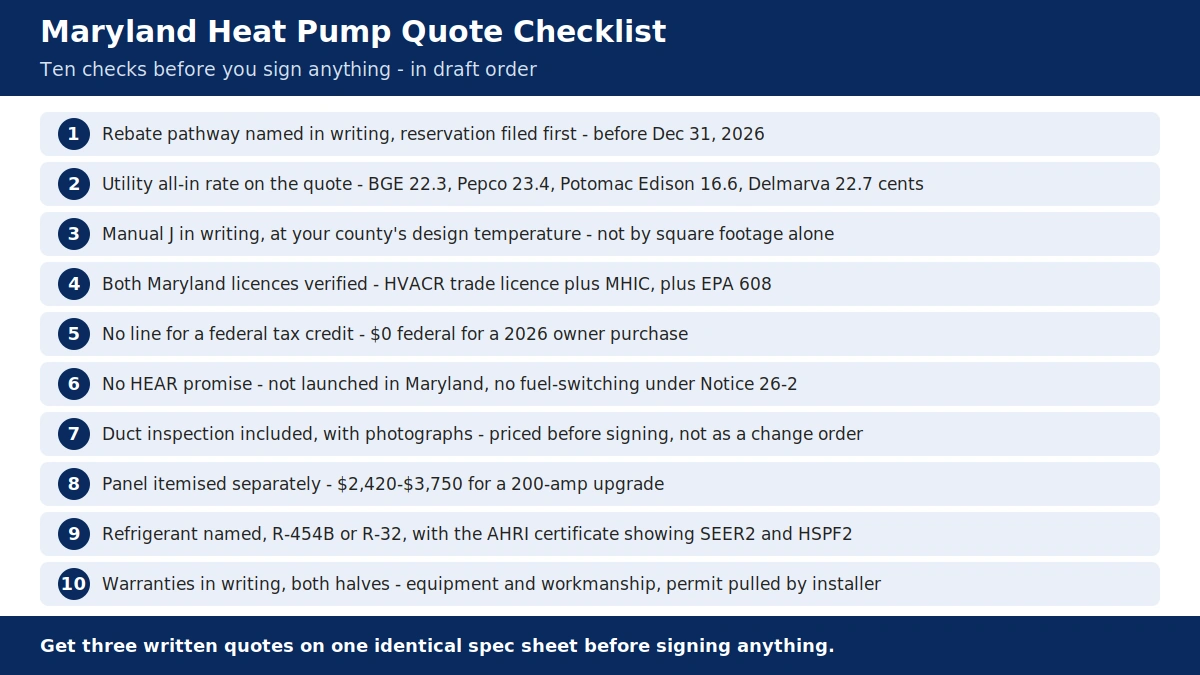
The ten-item quote checklist:
- Your rebate pathway named in writing, with the reservation filed first — HPwES whole-home up to $15,000 or the per-equipment electrification tier up to $4,000, never both added together, with the $100 audit done and the approved reservation in hand before work starts, and before December 31, 2026.
- Your utility’s all-in rate on the quote — BGE 22.3 cents, Pepco 23.4, Potomac Edison 16.6, Delmarva 22.7 — and the per-therm running-cost sum worked at that rate, not at a supply-only rate and not at a national average.
- Manual J load calculation in writing — room by room, at your county’s design temperature, not Baltimore’s if you live in Garrett County, and not by square footage alone.
- Both Maryland licences verified — the installer’s HVACR trade licence (journeyman or master, 70% exam) and the business’s MHIC licence ($500,000 liability since June 2024), names matched to the contract, plus the federal EPA 608 ticket for whoever handles refrigerant.
- No line for a federal tax credit — a 2026 owner purchase gets $0 federal, and HEAR has not launched in Maryland. Any quote still deducting $2,000 or 30% is priced under a dead law.
- No HEAR promise — up to $8,000, not launched, no launch date, and no fuel-switching when it does launch under DOE Notice 26-2. A quote that counts HEAR against a gas-to-heat-pump conversion is counting money that will not come.
- Duct inspection included, with photographs — leaky or undersized ducts priced before signing, not as a change order, with new or extended ductwork at $4,570–$7,600 shown as its own line.
- Panel itemised separately — 240-volt circuit and panel work at $2,420–$3,750 for a 200-amp upgrade, with Potomac Edison’s up-to-$3,000 panel help claimed where it applies.
- Refrigerant named, R-454B or R-32 on a 2026 install, not R-410A — with the AHRI certificate for the matched system showing the SEER2 and HSPF2 ratings being claimed.
- Warranties in writing, both halves — equipment warranty from the manufacturer and workmanship warranty from the installer, with the permit pulled by the installer and the county inspection scheduled.
Buy, dual-fuel, or wait? Buying a full heat pump wins for homes on electric resistance, oil, or propane heat, where the fuel saving and the rebate stack together into a five-year payback. Dual-fuel wins for a gas-heated home with a good furnace left in it, because gas is the cheaper fuel for the coldest hours and the furnace is the backup if the heat pump fails. Waiting wins for a gas-heated home with a young furnace and a working air conditioner — the rebate deadline argues for acting before December 31, 2026, but a heat pump that costs $207 a year more to run than the furnace it replaces is a purchase to make for the cooling and the carbon cut, not for the fuel bill, and it should be bought with that understood. Whatever you choose, get three written quotes on one identical spec sheet before signing anything.
Sources & methodology
Cost anchors (installed, 2026):
- NumeralQ Maryland heat-pump page, pricing as of Oct 26, 2026: 3-ton ducted $6,890–$11,390; 1.5-ton $4,690–$7,440; 2-ton $5,420–$8,760; 2.5-ton $6,150–$10,080; 3.5-ton $7,620–$12,710; 4-ton $8,350–$14,030; 5-ton $9,820–$16,660; cold-climate ducted $9,000–$15,550; single-zone mini-split $3,360–$5,200; multi-zone 3-head $6,690–$11,760; geothermal with loop $20,970–$32,830; ductwork $4,570–$7,600; panel upgrade 200 A $2,420–$3,750; HVAC median pay $33.67/hr, billed $67–$88/hr; electricians $35.33/hr, billed $71–$92/hr; permits $70–$166 typical; Baltimore 3-ton $6,630–$11,070; Rockville $6,950–$11,490; Baltimore tech pay +4% vs national median, Rockville +18%; planning model, not contractor bids
- NumeralQ Baltimore HVAC replacement page, Oct 26, 2026: dual-fuel $9,330–$15,260
- DMV Energy Guide, updated July 2026: ducted existing ducts $5,000–$13,500; ductless multi-zone $8,000–$18,000+; whole-home electrification $12,000–$25,000+; close-in DC suburbs and Baltimore City 10–15% above averages; zone 4A; Baltimore average January low ~27F; 2026 units on R-32 / R-454B
- Angi Baltimore heat-pump page, updated Aug 4, 2026: $5,705 average, $4,155–$7,255 range; 2.5-ton typical Baltimore home; minimum 15 SEER; mechanical permit $34–$85 Baltimore County; labour 25–40% of total; duct replacement $458–$1,699 Baltimore
- ElectrifyAtlas 2026 installer-cost guide: 3-ton ducted variable-speed $11,000–$17,000; 2-ton $9,000–$13,000; 4-ton $13,000–$20,000; 5-ton $15,000–$24,000; equipment 40–50% of total
- REMDB, National Laboratory of the Rockies, version 4.0.0, April 2025 (2023 dollars): 3-ton ducted 15 SEER (~14.3 SEER2) $7,450 / $13,350 / $19,250 low/mid/high; 2-ton $6,500 / $11,750 / $17,000; 4-ton $8,400 / $14,950 / $21,500; 5-ton $9,400 / $16,550 / $23,700; single-zone mini-split 12,000 BTU 20 SEER $4,500–$10,500; multi-zone 2–4 ton 18 SEER $7,000–$29,550; new circuit ~$1,400
- Angi national heat-pump page, updated Oct 28, 2026: national average $6,087; 2-ton $3,500–$5,500; 3-ton $3,900–$6,200; 5-ton $4,500–$8,800 — project-reported, national, cross-check only
Rates:
- EIA Electric Power Monthly Table 5.6.A, Oct 2026 release: MD 21.40 cents/kWh Aug 2026; US 18.16 cents; 15th-highest of 51; 17.8% above US average; +7.6% YoY; +30.6% over 3 yrs; +66.0% over 5 yrs; Aug avg bill $233.47 at 1,091 kWh; via priceofelectricity.com and Energy Factbook, updated Oct 27–Nov 5, 2026
- EIA via wheredmymoney.com, updated Oct 29, 2026: MD 12-mo avg 21.2 cents/kWh; avg bill $202/mo; gas $1.71/therm ($17.69/Mcf, 12-mo avg to Jul 2026)
- EIA via kadoa.com, updated Nov 7, 2026 (12-mo averages): BGE 22.3 cents, ~1,230,019 customers; Pepco 23.4 cents, ~561,604 customers; Potomac Edison 16.6 cents, ~260,040 customers; Delmarva 22.7 cents, ~188,659 customers
- MD Office of People’s Counsel: BGE supply + transmission 15.284 cents/kWh Oct 2026; BGE electric distribution 4.9 cents/kWh Jan 2026, filing Jul 6, 2026 for 5.8 cents (+17%, +$156.1M); BGE gas distribution 94 cents/therm Jan 2026, 97 cents Feb 1, 2026; BGE gas volumetric ~$1.33/therm Oct 2026 (distribution $0.9733 + supply $0.2880 + EmPOWER $0.0712) plus $16.15/mo customer charge; Washington Gas distribution 46 cents/therm; Pepco distribution 7.6 cents/kWh 2026 vs 3.3 cents 2015 (+132%), rate case 9820 pending seeking +23%; Delmarva distribution 7.1 cents/kWh 2025 vs 4.3 cents 2015 (+65%)
- EnergySage MD electricity page, WattBuy data Nov 1, 2026: MD 22 cents/kWh
- Xoom Energy variable-rate sheet, Nov 1, 2026: BGE supply 11.29 cents/kWh, Potomac Edison supply 9.59 cents/kWh — supply only, not all-in
Running-cost arithmetic:
- The per-therm and annual figures in the running-cost and payback sections are NestPriced arithmetic from the EIA anchors above: 1 therm = 29.3 kWh of heat; heat-pump cost per therm = rate x 29.3 / COP; gas cost per therm = $1.71 / 0.95 = $1.80; break-even COP statewide ~3.48, Potomac Edison ~2.70, Pepco ~3.81, BGE ~3.63
- EIA RECS 2020 household use x current state prices, as modelled by NumeralQ (state page, Oct 2026): gas furnace 95% $465/yr; heat pump HSPF2 7.5 $806/yr; heat pump HSPF2 9.0 $672/yr; planning figures, not bill forecasts
- Average Maryland heat load ~7,570 kWh of delivered heat per year and resistance-heat cost ~$1,620/yr are NestPriced arithmetic from the gas figure above ($465/yr at $1.71/therm, 95% efficiency implies ~258 therms delivered); payback ~5.4 years on a $5,140 net install saving ~$948/yr is the same arithmetic, labelled illustrative
Climate:
- DOE / PNNL county climate-zone guide: most of Maryland zone 4A mixed-humid; Garrett and Allegany counties zone 5
- ACCA Manual J design tables: Baltimore AP heating 15F, cooling 91F; Baltimore city 17F / 89F; Frederick 12F / 91F; HDD65 Baltimore 4,654, Frederick 5,087
- ASHRAE 2021 Handbook, Baltimore-Washington: 99.6% heating 13.5F, 99% heating 17.5F, 1% cooling 91.3F; HDD65 4,475
- Baltimore monthly averages 1991–2020: January average 34.3F (low 25F, high 43F), July average 78F; coldest record -7.5F (Feb 1934, Jan 1963)
- DOE regional standards, 10 CFR 430.32: federal minimum 14.3 SEER2 / 7.5 HSPF2 in Maryland’s region, in effect since Jan 1, 2023 (via NumeralQ)
Heating mix:
- Census Bureau ACS 2020–2024 5-year estimates, tables B25034 and B25040, via NumeralQ: 44% electric heat, 43% piped gas, 10% propane or oil
- EIA RECS 2020, via NumeralQ: ~19% of Maryland homes use a heat pump as main heat
Incentives:
- EmPOWER HPwES whole-home: $100 audit (~$400 value) unlocks up to $15,000 at 75% of cost for electrification at BGE/Pepco/Delmarva/SMECO, $10,000 at Potomac Edison; envelope-only up to $10,000; approved contractor + pre-approval required; 0%-interest 24-month financing on some projects — DMV Energy Guide July 2026; Home Energy Basics tracker Sep 17, 2026; ProFusion Maryland programmes page
- Electrification tiers from Apr 1, 2025: Tier 1 ducted mini-split $4,000; ductless multi-zone $4,000; electrification rebates up to $8,000 overall; fossil system removed or backup thermostat not above 40F — Fresh Air Concepts (Baltimore contractor), updated Sep 29, 2026
- Midstream instant rebates ~$800–$1,700 per unit, varying by utility and tier; no utility publishes its own amounts — DMV Energy Guide; Home Energy Basics Sep 17, 2026
- Potomac Edison Switch-to-Electric: cold-climate heat pump up to $4,000; air-source up to $3,500; panel upgrade up to $3,000; geothermal up to $7,100 standard discounts; stacks with standard HVAC discounts; through Dec 31, 2026 — Potomac Edison HVAC programme via legalclarity.org
- Montgomery County Electrify MC: up to $2,500 via Elysian Energy — DMV Energy Guide July 2026
- Heat-pump water heater rebates up to $1,600: Pepco purchase by Nov 30, 2026, application by Dec 7, 2026; BGE purchases and applications by Dec 31, 2026 — Karma Construction Group, checked early Nov 2026
- EmPOWER cycle end and PSC pending: current cycle through Dec 31, 2026; Delmarva Power HPwES page — projects without an approved reservation after Dec 31, 2026 sit pending awaiting PSC approval on continuance
- MEA Geothermal Rebate Program: $3,000 flat; FY26 final year; $150,000 budget; portal closed (Jan 6, 2026 update); deadline was Feb 27, 2026; single-family detached homes and townhomes only — Maryland Energy Administration geothermal page
- MEA Clean Energy Advantage loan pilot: mentioned qualitatively, no rate verified — MDE heat-pump page
- MD Residential Clean Energy Grant: $1,000 flat for residential solar, not a heat-pump programme — ProFusion
Federal:
- OBBBA P.L. 119-21 and IRS FS-2025-05: §25C and §25D $0 for property placed in service after Dec 31, 2025; completion date counts
- OBBBA Title VII §70511: §25D geothermal 30% terminated for residential spending after Dec 31, 2025 — geothermalfinder.com 2026 guide
- HEAR/HOMES not launched in Maryland: MEA resubmitted both applications to DOE Sep 30, 2026; no launch date; applications not open — heatpumppricing.com 50-state census, verified Nov 4, 2026; GridShift, updated Oct 21, 2026; allocations HEEHR $68,212,540 + HOMES $68,472,604 (DOE Jan 2025 dataset)
- DOE Notice 26-2, May 29, 2026, effective Sep 1, 2026: HEAR electric-to-electric upgrades only, no fuel-switching
- §48E commercial credit survives for third-party-owned systems in service by Dec 31, 2027 — solar/commercial provision, no Maryland heat-pump lease programme verified
- CFPB Solar Financing Market Issue Spotlight, Aug 2024: dealer fees 10–30%, sometimes over 50% (national figure, cited as national)
Licensing and permits:
- Maryland Board of HVACR Contractors, MD Department of Labor (Business Regulation Article 9A; COMAR 09.15): six levels; journeyman 4 years apprentice + 6,000 hours + exam; master 3 years journeyman + 1,875 hours prior year + exam; exams 70%; apprentices supervised on-site, may not work alone or contract — DMV Heat Pumps contractor-licensing guide (2026)
- Maryland Home Improvement Commission: home-improvement contracts $500+; 2 years experience; 70% PSI exam; financial solvency; Home Improvement Guaranty Fund; $500,000 general liability since June 1, 2024; subcontractor category eliminated Jul 1, 2016 — DMV Heat Pumps licensing guide; Housecall Pro MD guide (2026); Harbor Compliance
- No statewide general-contractor licence in Maryland; commercial GC licensing at county/municipal level
- EPA Section 608 certification required for refrigerant handling (Clean Air Act)
- Geothermal licensing: licensed HVACR installer; state-licensed well driller; licensed plumber or HVACR for pipe — MD Dept. of Labor green-technology licensing page
- MHIC licence does not authorise electrical, HVACR, or plumbing work — MD Dept. of Labor green-technology page
- Permits: NumeralQ typical $70–$166 (35 cities checked); Baltimore County mechanical permit $34–$85 (Angi)
- Refrigerant: EPA AIM Act Technology Transitions rule (40 CFR 84 subpart B) — new residential split systems GWP under 700 from Jan 1, 2025 (R-32 / R-454B); EPA May 2026 removed the Jan 1, 2026 installation deadline for pre-2025 R-410A stock — DMV Heat Pumps 2026 review guide; NumeralQ Maryland page
Labor:
- BLS Occupational Employment and Wage Statistics, May 2025, via NumeralQ: HVAC mechanics and installers, Maryland, median $33.67/hr, billed $67–$88/hr; electricians, Maryland, median $35.33/hr, billed $71–$92/hr; Baltimore tech pay +4% vs national median, Rockville +18%
EXCLUDED:
- Any “after federal tax credit” price for a 2026 install; any §25C or §25D credit for property placed in service after Dec 31, 2025
- Any HEAR rebate amount for Maryland (not launched; no amounts set; no fuel-switching under Notice 26-2)
- City-level heat-pump price bands for Columbia, Frederick, Annapolis, Germantown, Silver Spring, Bethesda, Gaithersburg, or Bowie — no published city model found; direction only
- Per-utility midstream rebate amounts (only the ~$800–$1,700 range is published)
- SMECO-specific electricity rate and rebate figures — not verified
- Maryland heating-oil and propane prices — not verified; savings described qualitatively only
- Maryland sales-tax treatment of heat-pump equipment — no exemption verified; not stated
- A combined furnace-plus-air-conditioner replacement price — not verified; arts. 7 and 14 linked instead
- Garrett County exact design temperature — described qualitatively as zone 5, well below Baltimore’s 15F
- The MDE heat-pump page’s claims that the §25C credit (up to $2,000) and HEAR rebates (up to $8,000) are available — stale, excluded
- The MEA $3,000 geothermal rebate presented as open — closed, FY26 final year, portal closed
*Disclaimer: The prices here are 2026 Maryland planning figures. They change by city, house, utility territory, and contractor. Before you lock in a budget, get three written quotes from local installers. Treat the tax notes here as general information, not advice for your return. Talk to a Maryland tax professional before you file. Program rules change — EmPOWER Maryland terms, Potomac Edison Switch-to-Electric, and the Public Service Commission’s decision on 2027 programmes — so confirm current terms with BGE, Pepco, Potomac Edison, Delmarva Power, or SMECO before signing. The EmPOWER cycle ends December 31, 2026, and 2027 terms are pending a commission decision. Rate figures in this guide are dated to their sources.*
How much does a heat pump cost in Maryland in 2026?
A typical 3-ton ducted air-source heat pump costs $6,890–$11,390 installed in Maryland in 2026 (NumeralQ Maryland model, pricing as of October 26, 2026), with a typical whole-home job landing near $9,140. A single-zone ductless mini-split runs $3,360–$5,200, a three-head multi-zone system $6,690–$11,760, a cold-climate ducted system $9,000–$15,550, a dual-fuel system $9,330–$15,260 in Baltimore, and geothermal with a ground loop $20,970–$32,830. Baltimore runs $6,630–$11,070 for a 3-ton system and Rockville $6,950–$11,490. For a homeowner-owned system installed in 2026, the federal tax credit is $0, so every figure here is the gross price before Maryland’s own rebates.
Does a heat pump save money over a gas furnace in Maryland?
Usually not on fuel alone. At Maryland’s statewide electricity price of 21.40 cents a kilowatt-hour, a heat pump at seasonal COP 3.0 delivers heat at about $2.09 a therm, against about $1.80 for a 95% gas furnace at $1.71 a therm — so it costs more to run. At COP 3.5 it ties gas at about $1.79 a therm, and the break-even COP is about 3.48. The annual figures agree: a gas furnace costs about $465 a year to heat the average Maryland home, a high-efficiency heat pump $672, and a minimum-efficiency heat pump $806. The exceptions are Potomac Edison territory, where power costs 16.6 cents and a COP 3.0 heat pump beats gas, and homes now on electric resistance, oil, or propane heat, where the heat pump saves by a wide margin.
Which heat pump rebates are open to Maryland homeowners in 2026?
EmPOWER Maryland is the main money. Its Home Performance with ENERGY STAR pathway pays up to $15,000 (75% of project cost) for replacing a fossil-fuel system with a heat pump at BGE, Pepco, Delmarva Power, and SMECO, and up to $10,000 at Potomac Edison, starting from a $100 energy audit. Per-equipment electrification rebates pay $4,000 for a Tier 1 ducted mini-split or a ductless multi-zone system, with up to $8,000 overall, and instant midstream rebates run roughly $800–$1,700 per unit. Potomac Edison’s Switch-to-Electric programme adds up to $4,000 for a cold-climate heat pump or $3,500 for a standard one, plus up to $3,000 for a panel upgrade. Montgomery County’s Electrify MC pilot adds up to $2,500. Do not add the whole-home cap and the per-equipment rebates together — they are different pathways, and the current cycle ends December 31, 2026.
Is there still a federal tax credit for heat pumps in Maryland in 2026?
No. The §25C home-improvement credit once paid as much as $2,000 a year toward an air-source heat pump, but it stopped for property finished after December 31, 2025, when the One Big Beautiful Bill Act (P.L. 119-21) took it away, and the IRS confirmed that the completion date is what counts. The 30% geothermal credit (§25D) ended on the same date. Any quote that still subtracts a federal credit is priced under a law that no longer exists. The $8,000 federal HEAR rebate for heat pumps has also not launched in Maryland — the state resubmitted its applications on September 30, 2026, and no launch date has been set — and under the Energy Department’s Notice 26-2 it will not pay to replace a gas furnace when it does launch.
Will a heat pump keep up in a Maryland winter?
Yes, for most of the state. Maryland sits in climate zone 4A, and Baltimore’s heating design temperature is about 15 degrees, with an average January low near 27 degrees — a standard heat pump carries a typical home through that winter without backup heat. The exception is western Maryland: Garrett and Allegany counties sit in zone 5, with design temperatures well below Baltimore’s, longer heating seasons, and real snow, so cold-climate equipment, a Manual J run at the local design temperature, and a snow-clearance plan for the outdoor unit are the right call there. A standard unit sized for Baltimore will lean on expensive resistance backup heat in the mountains.
How much does a heat pump cost in Baltimore vs Rockville?
Baltimore runs $6,630–$11,070 for a 3-ton ducted system (NumeralQ, October 2026), and Rockville $6,950–$11,490 — about $300–$400 more in Rockville, mostly a labour story, since HVAC technician pay runs 18% above the national median in Rockville against 4% above it in Baltimore. The running cost differs more than the install price: Baltimore sits in BGE territory at 22.3 cents a kilowatt-hour, while Rockville sits in Pepco territory at 23.4 cents, the highest in the state. Angi’s Baltimore average of $5,705 sits below both bands because it averages changeouts and single-zone jobs in with whole-home ducted systems.
What licences should a Maryland heat pump installer hold?
Two state licences plus a federal certification. The individual doing the work needs a licence from the Maryland Board of HVACR Contractors — journeyman or master, earned by years of apprenticeship and an exam passed at 70%. The business signing the contract needs a Maryland Home Improvement Commission (MHIC) licence, which requires two years of experience, a 70% exam pass, and at least $500,000 in general liability insurance since June 2024. Neither licence substitutes for the other: an MHIC licence does not authorise HVACR work, and an HVACR licence does not authorise signing a home-improvement contract. Any technician handling refrigerant also needs EPA Section 608 certification. Verify both state licences on the Department of Labor’s lookup before work starts.
When does the Maryland heat pump rebate money run out?
The current EmPOWER cycle ends December 31, 2026, and 2027 terms are waiting on a Maryland Public Service Commission decision that has not been made. Delmarva Power’s programme page says projects without an approved reservation submitted after that date will sit pending until the commission rules. Pepco’s heat-pump water heater rebate requires purchase by November 30, 2026 and application by December 7, 2026, and BGE’s by December 31, 2026. If you want the 2026 rebates, get the $100 audit done, choose an approved contractor, and hold an approved reservation before the year ends — work installed first and submitted afterwards does not qualify.