

Table of Contents
Missouri is a border state in every sense that matters to a heating decision. It sits on the line between the humid South and the cold Midwest, between cheap electricity and mid-priced gas, between cities that license every mechanical contractor and rural counties that license nobody at all. A heat pump bought in St. Louis faces a different winter from one bought in Kirksville, a different utility from one bought across the river in Kansas City, and a different rebate from one bought twenty miles down the road in Columbia. The state does not have one heat pump market. It has four or five, sharing a name.
That is why this guide prices Missouri the way a local estimator would: by system type, by home size, and by city — St. Louis, Kansas City, Springfield, and Columbia — with the rebate each utility actually pays in 2026, the licensing rules that change at every county line, and the running-cost math done at Missouri’s own electricity and gas prices, not national averages. The headline number is $7,000–$13,000 for the standard whole-home job. Everything after it is the detail that decides whether your job lands at the bottom of that band or the top.
Before the Missouri numbers, the US-wide picture is worth ten minutes: our national heat pump cost guide sets the baseline every state figure below is measured against.
How Much Does a Heat Pump Cost in Missouri in 2026?
A typical Missouri home of 1,500–2,500 square feet needs a 3-ton whole-home ducted air-source heat pump. In 2026 that job costs $7,000–$13,000 installed in Missouri. The typical job lands near $9,500. That range is the number to budget on. That figure is for everything: the outdoor unit, the indoor air handler, the refrigerant lines, a dedicated circuit, the permit, and the commissioning visit — a finished system in a working house, not a box on a pallet.
Two published anchors sit underneath that range, and they pull in opposite directions in a way worth understanding. NumeralQ’s Missouri estimator (pricing as of October 26, 2026, built from Fixr, This Old House, Home Depot prices, and Bureau of Labor Statistics wages) puts a 3-ton ducted system at $6,510–$10,910. That is a planning model — parts plus local wages, with nothing in it for the installer’s sales time, warranty reserve, or the surprises a real house always holds — so it lands below what installers actually charge. At the other end, Swiss Air, a St. Louis installer publishing 2026 market prices, puts typical installed heat pump systems in the St. Louis market at $6,000–$14,000, with dual-fuel systems at $10,000–$18,000. The honest headline sits where those two views overlap: $7,000–$13,000 for the standard whole-home job, with the top of the band reserved for high-efficiency variable-speed equipment, difficult installs, and St. Louis addresses. The $9,500 typical figure is this guide’s synthesis of the two — no single published Missouri statewide installer average was found, and the guide says so rather than inventing one.
One warning before you use any number in this guide: a quote near $5,000 for a whole-home system is almost never a complete quote. Angi’s St. Louis average of $5,376 and its Kansas City average of $5,174 circulate widely online, and both are equipment-weighted figures that understate the installed job. A real bid thousands below the other two is usually equipment plus a thin slice of labor, with the air handler, electrical work, permit, duct modifications, or commissioning left out — or priced as separate line items that appear later. When a bid lands far below the rest, ask which pieces are missing before you sign, not after the crew is on site.
Missouri sits just below the national middle on price. Across the US as a whole, the national guide puts a ducted heat pump at $7,500–$15,000 in 2026. Missouri labor is cheaper than the coasts, power is cheaper than most states, and the climate in most of the state lets standard equipment do the job — no cold-climate premium required south of the northern tier of counties. Compare that with New Jersey, where the statewide average is about $13,600, or Pennsylvania, where the same system runs higher on labor alone. Missouri is simply a cheaper state to buy a heat pump in. The catch is that the price of getting it wrong is higher here too, because the winters are colder than the Deep South and the summers are hotter than the Upper Midwest — a wrongly sized system gets punished in both seasons.
| System | Typical Missouri installed cost (2026) |
|---|---|
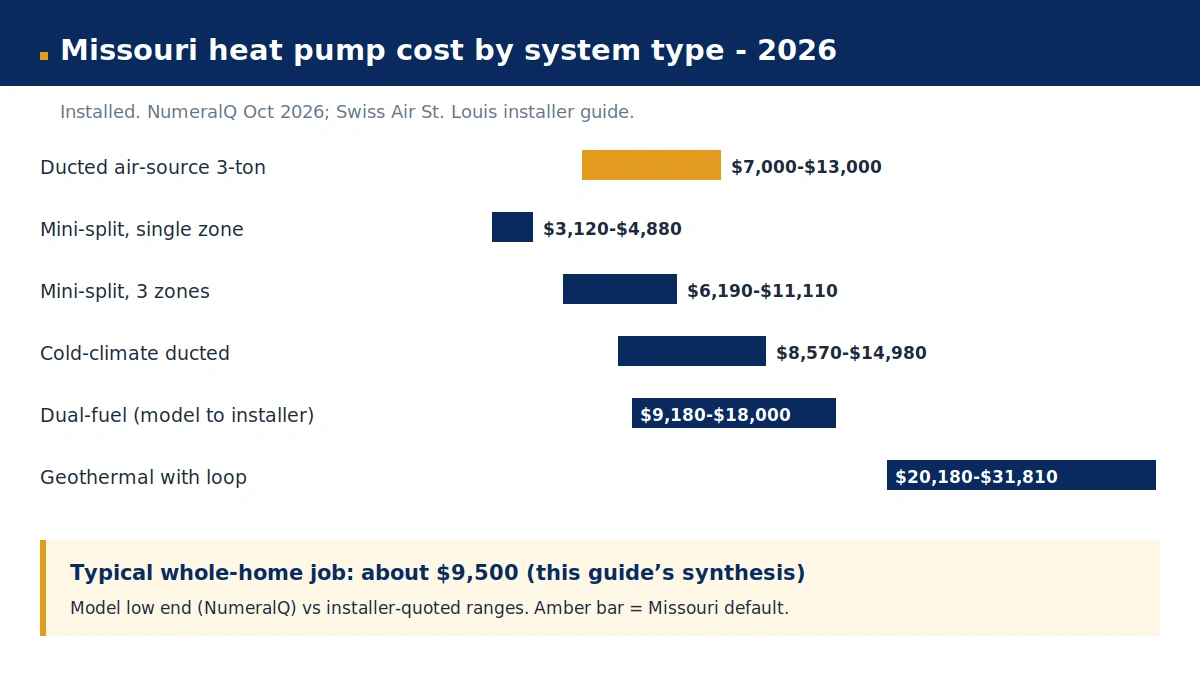
| Ducted air-source heat pump, 3-ton (typical home) | $7,000–$13,000 (typical ~$9,500) |
| Ductless mini-split, single zone | $3,120–$4,880 |
| Ductless mini-split, 3 zones | $6,190–$11,110 |
| Cold-climate ducted heat pump, 3-ton | $8,570–$14,980 |
| Dual-fuel (heat pump + gas furnace) | $9,180–$15,070 (model); $10,000–$18,000 (St. Louis installer) |
| Geothermal (ground-source) with loop | $20,180–$31,810 |
| Add heat pump to existing gas furnace (replacing AC) | $5,500–$10,000 |
Sources: NumeralQ Missouri estimator (Oct 26, 2026); NumeralQ HVAC replacement page (dual-fuel model); Swiss Air St. Louis installer guide (Jul 20, 2026); nestpriced national guide (art. 1). The add-heat-pump figure is the national guide’s band, carried over because no Missouri-specific figure was published.
Heat Pump Cost in Missouri by System Type
No other choice moves the invoice as far as the system type does: one mini-split head costs roughly a third of a whole-home ducted job, while geothermal costs roughly three times as much. Price alone is the wrong way to compare them, though. What matters is the price measured against the house you already own — whether it has ducts, whether gas reaches it, and whether the furnace in the basement has years left or is on its last legs.
Ducted air-source heat pumps are the Missouri default. They use the home’s existing ductwork, heat and cool the whole house from one system, and replace both the furnace and the air conditioner in one job. A 3-ton system runs $6,510–$10,910 on NumeralQ’s model and $7,000–$13,000 on the installer-quoted synthesis — the difference is mostly margin, warranty, and job conditions. If your ducts are in good shape and your furnace and AC are both aging out together, this is the system to price first. Our ductless vs ducted comparison lays out the trade-offs in full.
Ductless mini-splits are the answer for homes without ducts — a finished basement in Kirkwood, an addition in Lee’s Summit, a bonus room over the garage in Springfield, older brick homes in St. Louis where ducts were never run, and lake houses at the Lake of the Ozarks. A single 12,000 BTU head runs about $3,120–$4,880 installed (NumeralQ), and three zones for an addition or a finished basement run $6,190–$11,110. A whole-home multi-zone setup with five or more heads can reach $15,000–$24,000 on national figures — at which point a ducted system is usually cheaper if ducts exist or can be added. Every mini-split is a heat pump, so the same box that cools the bonus room in July warms it in January. See our mini-split installation cost guide for per-zone pricing.
Cold-climate heat pumps cost more and matter in Missouri exactly where the map says they should: the north. A cold-climate ducted system runs $8,570–$14,980 (NumeralQ), roughly $2,000 above a standard system. The premium buys inverter-driven capacity that holds output down to -13F or lower. In St. Louis, where winter nights rarely test a standard unit for long, that money is mostly wasted. In Kirksville, Maryville, and St. Joseph, where design temperatures run down to 2F and cold snaps last for days, it is worth pricing. For most of the state — St. Louis, Kansas City, Springfield, Columbia — a standard variable-speed system with electric backup strips covers the handful of genuinely cold nights each year. Our cold-climate mini-split guide explains where the premium pays and where it does not.
Dual-fuel systems — a heat pump paired with a gas furnace — are the Missouri compromise, and in St. Louis they may be the most sensible premium choice in the state. The heat pump does the work through the long shoulder seasons, when Missouri weather is mild and electricity is cheap. The gas furnace takes over only on the coldest nights, when the heat pump’s efficiency falls and the strips would otherwise take over. A full dual-fuel system runs $9,180–$15,070 on NumeralQ’s model and $10,000–$18,000 on St. Louis installer pricing. The cheapest dual-fuel route is adding a heat pump in place of a dying air conditioner while keeping a gas furnace under about 10 years old: $5,500–$10,000 on national figures. If your furnace is young and your AC is dying, price this first. Our dual-fuel cost guide has the full breakdown.
Geothermal is the outlier: $20,180–$31,810 with the ground loop (NumeralQ), and the national guide puts it at $25,000–$40,000+ for larger or more complex loop fields. It is the most efficient system you can buy and the longest-lived, but in Missouri the payback math is hard — cheap electricity shrinks the annual savings that are supposed to repay a $10,000+ premium over air-source. It makes sense on new construction with land for a horizontal loop, or for a homeowner planning to stay 20+ years. For almost everyone else, the air-source money is better spent on a higher-efficiency air-source unit plus duct sealing. See our geothermal heat pump cost guide.
Heat Pump Cost by Home Size
Heat pumps are sized in tons, and one ton covers roughly 500–600 square feet of Missouri home — but only roughly. The right tonnage shifts with the house itself — how well it is insulated, how much glass it has, how high the ceilings run, how much shade falls on it, and how much air the ducts lose. Only a Manual J load calculation, $200–$500 and usually credited back against the install, pins the size down properly. Anybody who picks a size from floor area alone, or who simply matches the nameplate on the unit coming out, is spending your money on a guess.
| Home size | Typical system | Installed cost (ducted air-source) |
|---|---|---|
| 1,000–1,200 sq ft | 1.5–2 ton | $4,370–$8,330 |
| 1,200–1,500 sq ft | 2–2.5 ton | $5,090–$9,620 |
| 1,500–2,000 sq ft | 2.5–3 ton | $5,800–$10,910 |
| 2,000–2,500 sq ft | 3–3.5 ton | $6,510–$12,210 |
| 2,500–3,000 sq ft | 3.5–4 ton | $7,230–$13,500 |
| 3,000+ sq ft | 4–5 ton | $7,940–$16,090 |
Source: NumeralQ Missouri estimator by size (Oct 26, 2026), ducted air-source. These are model-derived bands — installer quotes for the same sizes run toward the top of each band, and St. Louis quotes run higher still. Use the table to find your ballpark, not to set your budget.
The sizing mistake that costs Missouri homeowners the most is oversizing. An oversized heat pump short-cycles in summer: it blasts cold air for a few minutes, shuts off before it has dehumidified anything, and leaves the house cool and clammy — a bad outcome in a state where July humidity sits on the house for weeks. Go too small and the unit never rests — it runs around the clock and still calls on the strip heaters on January nights, the dearest heat a Missouri home can buy. Either error costs more across a decade than the load calculation ever will. Insist on the calculation on paper, and insist on it before anybody orders equipment.
Two-story Missouri homes deserve a special note. One system trying to serve two storeys will leave one of them unhappy in practice — the bedrooms bake in July while the ground floor shivers in January. The workable answers are two separate systems, one ducted system with zoning dampers, or a ducted unit downstairs with a mini-split head or two upstairs. Every one of those costs more than a one-system bid. When a bid covers a two-storey house with a single system and says nothing about zoning, ask how the upstairs will feel in July — and get the answer before you sign.
Heat Pump Cost by City: St. Louis, Kansas City, Springfield & Columbia
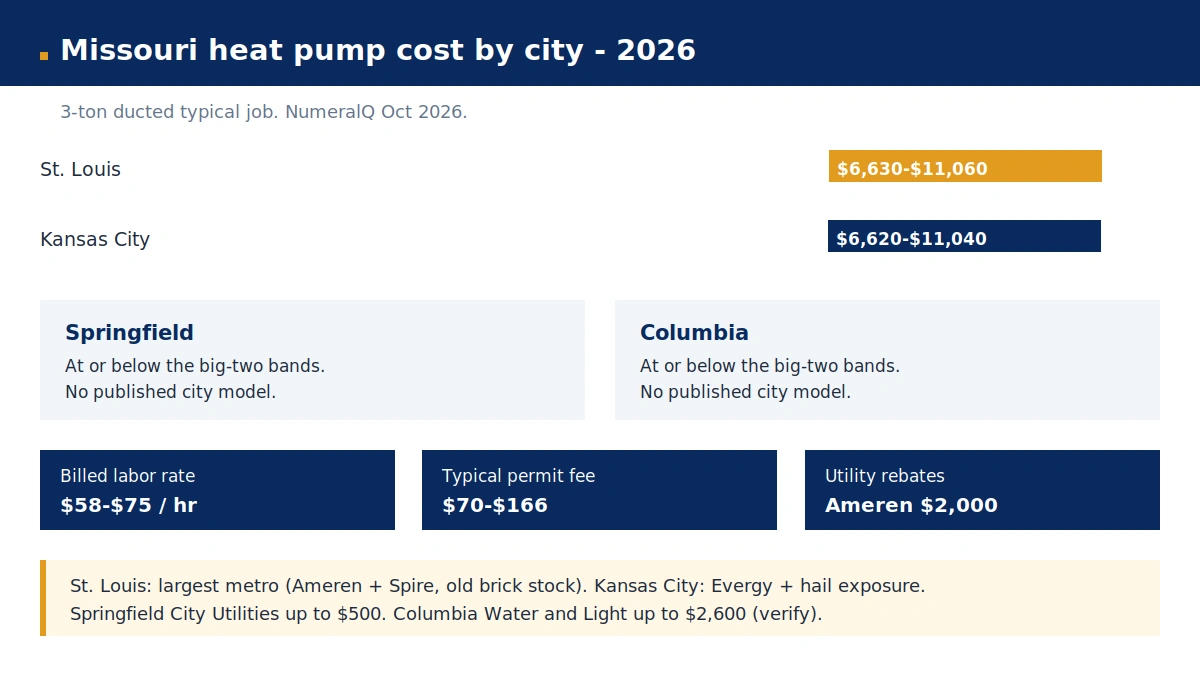
Missouri’s two big metros price the same 3-ton system almost identically on the model — about ten dollars separates them — but the reasons behind the prices are different in each city, and the installer-quoted reality spreads wider than the model suggests.
| City | Typical 3-ton ducted job (model) | What drives the price |
|---|---|---|
| St. Louis | $6,630–$11,060 | Largest metro; Ameren power + Spire gas; older brick housing stock |
| Kansas City | $6,620–$11,040 | Evergy power; newer housing on the Kansas side; hail and tornado exposure |
| Springfield | At or below the big-two bands | City Utilities power; softer labor market; no published city model |
| Columbia | At or below the big-two bands | Columbia Water & Light; college-town rental stock; no published city model |
Source: NumeralQ Missouri city pages (Oct 26, 2026), 3-ton ducted system. Springfield and Columbia have no published NumeralQ city model — this guide gives no invented price band for them, only the direction of travel.
St. Louis is the state’s biggest heat pump market and its most complicated. The metro straddles two states, two permitting systems, and two utility territories: Ameren Missouri delivers the power on the Missouri side, Spire delivers the gas, and St. Louis City — an independent city, not part of St. Louis County — runs its own building division with its own mechanical contractor license, separate from the county’s. The housing stock is the local complication: century-old brick homes in the city with no ductwork and 100-amp panels, postwar ranches in the county with ducts in unconditioned attics, and new builds in St. Charles County that price like a different state. A St. Louis installer guide puts typical installed systems at $6,000–$14,000, and the top of that band is where the old-brick jobs land. A single-zone mini-split in the St. Louis area typically runs inside the statewide $3,120–$4,880 band. The city’s permit runs $25 plus $10 per $1,000 of project cost — about $85 on a typical job.
Kansas City prices a hair below St. Louis on the model, and the difference is mostly housing age. The Missouri side of the metro has more postwar and newer stock, more homes with usable ducts, and Evergy as the electric utility — which matters because Evergy’s rebate is the one Kansas City homeowners actually collect. Kansas City requires its own local mechanical contractor license, issued by the Development Services Department, and the metro’s hail and tornado exposure is the local wrinkle: a Kansas City outdoor unit lives under the same sky that produces some of the country’s worst hail, so placement, a raised pad, and a surge protector are worth discussing at quote time rather than after the first storm. The city permit runs about $75 on a typical job.
Springfield is the Ozarks market: smaller, cheaper on labor, and served by City Utilities of Springfield, a municipal utility that runs its own rebate program — up to $500 for a qualifying heat pump, according to a local installer (verify with City Utilities before counting on it). Springfield winters run a touch colder than St. Louis on design temperature, and the housing stock mixes older homes near downtown with newer builds on the edges. No published city price model exists for Springfield, so this guide does not invent one: expect quotes at or below the St. Louis and Kansas City bands, with the spread decided by the house, not the city.
Columbia is the college town: Columbia Water & Light serves the power, and the rental-heavy housing stock near the University of Missouri means a lot of small systems, a lot of mini-splits, and a lot of landlords pricing the cheapest compliant option. Columbia Water & Light is reported to pay up to $2,600 for heat pumps — the largest municipal rebate figure found in Missouri — but that figure comes second-hand and must be verified with the utility before anyone budgets on it. Like Springfield, Columbia has no published city price model, and this guide does not invent one.
Smaller Missouri cities — Independence, Lee’s Summit, O’Fallon, St. Charles, St. Joseph, Joplin, Jefferson City — generally price at or below the big-two bands on softer labor markets. St. Joseph and the northern tier run colder, so the cold-climate question matters more there; Joplin and the southwest sit closer to the Ozarks pattern, with Springfield pricing as the nearest anchor.
Missouri’s Two-Sided Climate: Why a Standard Heat Pump Mostly Works Here
Missouri’s climate is the reason a standard heat pump is a sensible purchase across most of the state — and the reason it is not a sensible purchase everywhere in it. The state spans three IECC climate zones: Zone 4A across 87 counties, Zone 5A across the northernmost 26, and Zone 3A in two southern counties. Kansas City sits in Zone 4A. The northern tier — Kirksville, Maryville, St. Joseph — sits in Zone 5A, and the heating load there is a different animal.
The numbers make the split concrete. Kansas City International records about 4,977 heating degree days and 1,409 cooling degree days a year (ASHRAE 2021). St. Louis runs about 4,900 heating degree days and 1,475–1,640 cooling degree days. Columbia runs 5,046 heating degree days. Springfield runs 4,900. St. Joseph runs 5,484 — the coldest of the five. Design temperatures tell the same story in a form a contractor actually uses: St. Louis is designed to 6F in winter and 94F in summer, Kansas City to 6F and 96F, Columbia to 4F and 94F, Springfield to 9F and 93F, St. Joseph to 2F. A heat pump sized to those numbers, with a Manual J behind it, is sized for real Missouri weather, not for an average.
A standard heat pump covers most Missouri winters without help. As the thermometer falls, a heat pump’s output falls with it, and somewhere near 30–35F most units begin borrowing heat from the electric strips to stay even. In St. Louis and Kansas City that happens on a modest number of nights, not for weeks at a time. The strip heat is expensive — it is the most expensive heat in the house — but it runs rarely enough that it barely moves the annual bill. Up north the picture reverses: a standard unit there lives on backup heat for half the winter, which is what makes the cold-climate premium compulsory in those states. In most of Missouri the cold-climate premium is optional, and sensible mainly in the Zone 5A north.
The summer side of the climate is the part newcomers underestimate. Missouri summers are hot and humid for months — 100F days are routine, heat index values approach 115F in heat waves, and the humidity rarely lets up. A heat pump that cools without dehumidifying leaves a house at 72F and clammy. Where variable-speed kit earns its extra money in Missouri is not the coldest night of the year but the stickiest afternoon — its long, gentle cycles wring moisture out of the air where a single-stage unit’s short bursts leave it behind. Choosing between single-stage and variable-speed, judge the upgrade on how it handles humidity, not on the SEER2 figure printed in the brochure.
Then there is the weather Missouri is famous for, and it touches a heat pump in ways no brochure mentions. The state averages about 45 tornadoes a year — 8th nationally — with 50 or more days a year of severe weather, and large hail is routine: the April 2001 St. Louis hailstorm dropped hail up to 4.5 inches across the metro and caused over $2 billion in damage. Hail dents outdoor coils and fan blades, straight-line winds throw debris at the unit, and lightning is a genuine risk to the control board. None of this is a reason not to buy a heat pump. It is a reason to site the outdoor unit thoughtfully — on a raised pad, clear of flood-prone spots and drifting snow, away from the drip line where ice falls off the roof — and to price a surge protector into the job. Winter ice storms are the other seasonal hazard: freezing rain can coat an outdoor unit, and a unit that cannot defrost properly will struggle. A good installer sites for all of this. A cheap one does not mention it.
Missouri homes also carry a structural quirk that shapes heat pump jobs: basements and crawlspaces. A large share of the state’s housing stock sits over basements or vented crawlspaces, and ductwork running through a damp crawlspace sweats in summer, loses conditioned air through leaks, and in the worst cases grows mold on saturated insulation. On a crawlspace house, a heat pump install is frequently a double job: the machine itself, and then the ductwork underneath it. Of all the companion work in this guide, sealing the ducts — and sealing and conditioning the crawlspace too, if the budget stretches — returns the most per dollar. It is also the work a suspiciously cheap quote is most likely to have left out.
None of this is theory. About 10% of Missouri homes already use a heat pump as their main heat, according to the EIA’s home energy survey, and about 39% heat with electricity in some form against 49% with piped gas. The technology is proven here. The question is never whether a heat pump works in Missouri. It is whether the quote in front of you is complete, the size is right, and the running-cost math was done at Missouri prices.
Heat Pump vs Gas Furnace in Missouri: The Running-Cost Math
This is the section most Missouri heat pump guides get wrong, because they import national math into a state where the two fuels are priced very differently from the national picture. Here is the math at Missouri’s own prices.
Missouri residential electricity averages 14.0 cents per kilowatt-hour (12-month average to August 2026, EIA) — the 12th lowest in the country, against 18.0 cents nationally. August 2026 alone was 16.0 cents. The average Missouri home pays about $145 a month for electricity. Missouri residential natural gas averages $1.64 a therm (12-month average to July 2026, EIA) — dearer than the $1.57 national figure once fixed charges are counted, and far dearer than Tennessee’s $1.29. Ameren Missouri delivers the power across much of the state; Spire delivers the gas in St. Louis and western Missouri; Evergy and Liberty serve the Kansas City and southwest territories. Electricity is cheap here. Gas is not.
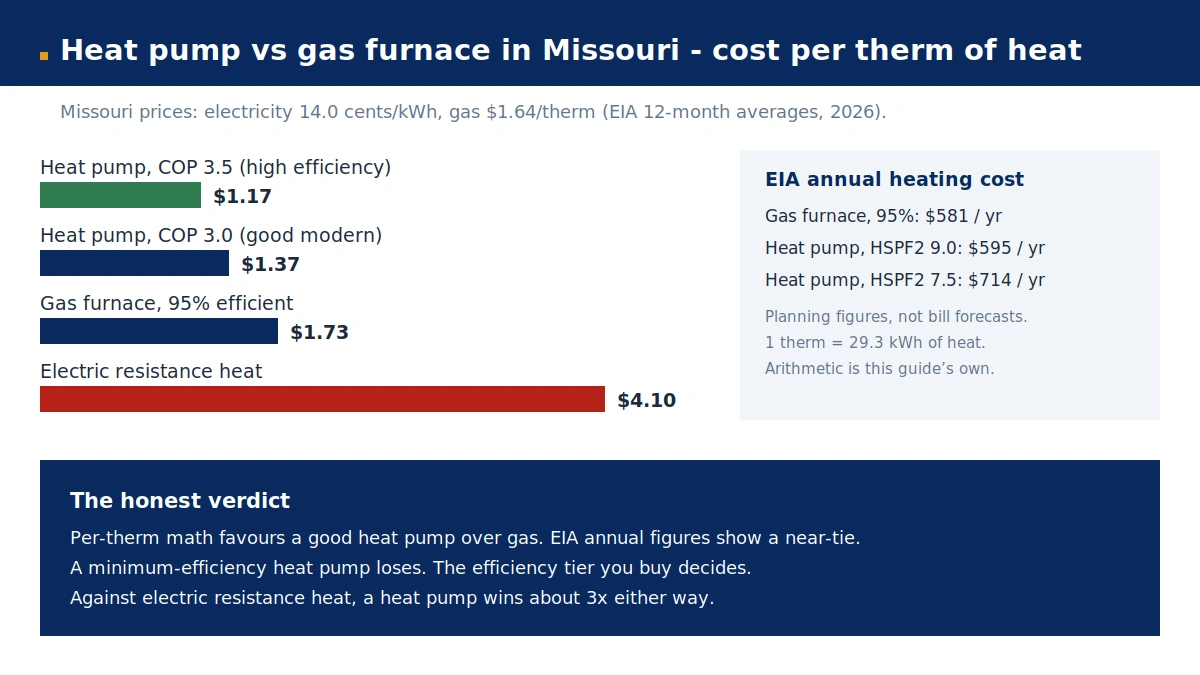
Run the heat math. A therm of heat is 29.3 kWh of heat, which is the conversion the sums below run on. A heat pump with a seasonal COP of 3.0 — a fair figure for a good modern system in Missouri’s climate — delivers that therm for 29.3 x $0.14 / 3.0 = about $1.37. A 95%-efficient gas furnace delivers it for $1.64 / 0.95 = about $1.73. A high-efficiency heat pump at COP 3.5 delivers it for about $1.17 and wins clearly. A bare-minimum heat pump at HSPF2 7.5 comes out behind. The EIA’s own household heating estimates tell a more cautious story from the other direction: a 95% gas furnace costs about $581 a year to heat the average Missouri home; a minimum-efficiency heat pump (HSPF2 7.5) costs about $714 a year; a high-efficiency heat pump (HSPF2 9.0) costs about $595 a year. Those are planning figures, not bill forecasts — but the tension between the two views is real and worth stating plainly. The per-therm arithmetic at COP 3.0 favours the heat pump, while the EIA annual figures show a near-tie ($595 against $581), because a real Missouri winter’s seasonal COP, once cold snaps and strip-heat hours are counted, runs below 3.0. The honest verdict: a good heat pump wins modestly against gas on fuel, a minimum-efficiency one loses, and the efficiency tier you buy decides which side of the line you land on.
That verdict is the opposite of Tennessee’s, where cheap gas makes the fuel comparison a tie, and it is the single most important difference between the two states’ guides. In Missouri the heat pump does not need the cooling argument to justify itself on fuel — though the cooling argument is still strong. A gas furnace does nothing in July. A heat pump cools and dehumidifies for four to five months a year, and in a state with 100F summers and humidity that rarely lets up, that is half the value of the machine. Size the decision up over twelve months, not over one January bill.
The heat pump wins decisively in two more Missouri situations. First, in any home still heated by resistance — baseboards, wall heaters, an ageing electric furnace — where a heat pump delivers the same warmth on roughly a third of the electricity. Second, against propane or heating oil, where the fuel is far more expensive than either Missouri power or Missouri gas. Weigh the heat pump’s $7,000–$13,000 against a furnace and an air conditioner bought together, not against a furnace on its own — our heat pump vs furnace comparison argues that case in full, and our furnace replacement guide puts a number on the gas side.
| Heating system | Cost per therm of heat delivered | EIA estimated annual heating cost (MO) |
|---|---|---|
| Gas furnace, 95% efficient | ~$1.73 | ~$581/yr |
| Heat pump, COP 3.0 (good modern system) | ~$1.37 | — |
| Heat pump, COP 3.5 (high efficiency) | ~$1.17 | — |
| Heat pump, HSPF2 7.5 (federal minimum) | — | ~$714/yr |
| Heat pump, HSPF2 9.0 (high efficiency) | — | ~$595/yr |
| Electric resistance heat | ~$4.10 | — |
Assumptions: electricity 14.0 cents/kWh, gas $1.64/therm (EIA 12-month averages, 2026). 1 therm = 29.3 kWh. The COP figures are seasonal planning values, not laboratory ratings. The EIA annual figures are planning numbers built from household heating use and today’s state prices.
Ameren, Evergy & the Other Missouri Rebates You Can Collect in 2026
Forget the federal money for a moment. In Missouri in 2026, the live rebate money has two names, and which one pays you depends entirely on which utility sends your electric bill: Ameren Missouri in St. Louis and much of central and eastern Missouri, and Evergy in Kansas City and the west. A third layer — municipal utilities in Springfield and Columbia — pays smaller amounts in its own territories. There is no statewide rebate and no state tax credit for heat pumps in Missouri. The utility is the program.
| Program | What it pays (heat pump) | Key condition |
|---|---|---|
| Ameren Missouri PAYS (2026) | $2,000 ducted ASHP 15.2+ SEER2; $500/ton mini-split 19+ SEER2; $5,000 geothermal | PAYS tier 4; existing AC 10+ yrs old, 14 SEER or less, or dead |
| Evergy FastTrack PAYS (Missouri) | $1,300 ASHP replacing electric resistance; $1,000 dual-fuel; $500 mini-split; $1,900 geothermal | FastTrack PAYS participation |
| City Utilities of Springfield | Up to $500 qualifying heat pump | Verify with City Utilities (installer-reported) |
| Columbia Water & Light | Up to $2,600 heat pumps | Verify with Columbia W&L (second-hand figure) |
| Liberty Utilities (Missouri) | No verified residential ASHP rebate found | Do not count one |
| Spire (gas) | Furnace/thermostat/water heater rebates only | Does not pay for heat pumps |
Sources: Ameren Missouri 2026 PAYS rebate charts via St. Louis installer summaries (Tom Hoffmann, Swiss Air); Evergy FastTrack PAYS via Summit Heating (Sep 2025); Springfield via SS&B (Oct 2026); Columbia W&L via HomeEnergyBasics (Jun 2026).
Ameren Missouri is the biggest rebate in the state, and it changed shape in 2026. Ameren’s traditional standalone HVAC rebates ended in 2025. The money now runs through Pay As You Save (PAYS), and the 2026 program year pays $2,000 per system for a qualifying air-source heat pump rated 15.2+ SEER2 — whether it replaces an existing heat pump, replaces electric resistance heat, runs as a dual-fuel system with a gas furnace, or goes into a home with no existing central system. Mini-split air conditioners and heat pumps rated 19+ SEER2 pay $500 per ton. A ground-source heat pump rated 23+ EER pays $5,000 per system. A smart thermostat pays $250. The rebates are valid January 1 through December 31, 2026. Three conditions decide whether you collect: you must participate in tier 4 of the PAYS program, you must have lived in the home for the past 12 months, and your existing AC must be at least 10 years old, rated 14 SEER or less, or no longer working. One installer page also quotes “up to $2,500 per system” for Ameren heat pumps — that higher figure does not appear in the itemised PAYS chart this guide used, so the guide sticks to $2,000 and flags the discrepancy rather than repeating the bigger number.
Evergy runs its own version of the same idea for Missouri customers: FastTrack HVAC PAYS, launched in August 2025. It pays $1,300 for an air-source heat pump replacing electric resistance heat, $1,000 for an air-source heat pump in a dual-fuel system, $500 for a mini-split, $1,900 for a ground-source heat pump, and $1,000 for a high-efficiency central AC. Evergy charges a 3% service fee on amounts financed through PAYS. An older Evergy program under the Kansas Energy Efficiency Investment Act (KEEIA) is quoted elsewhere at $650–$1,200 for air-source heat pumps — the FastTrack figures above are the newer program and the ones this guide uses. Either way, verify the current amount with Evergy before you sign: these figures come via installer summaries, not from Evergy’s own rebate page, and program years turn over.
City Utilities of Springfield pays up to $500 for a qualifying residential heat pump, according to a Springfield installer writing in October 2026. Columbia Water & Light is reported to pay up to $2,600 — the largest municipal figure found in the state. Both figures are second-hand, and this guide flags them as such: confirm the amount, the efficiency threshold, and the qualifying-model list with the utility itself before you count the money in a budget.
Liberty Utilities deserves a sentence of its own, because a careless search will tell you it pays for heat pumps. It does not — not in Missouri, not for a space-heating air-source heat pump, not in any figure this guide could verify. The ENERGY STAR rebate database lists Liberty heat pump rebates, but those listings mix territories, and the Missouri-specific Liberty rebate found for 2026 covers Rinnai water heaters, including a $100 heat pump water heater — not a space-heating heat pump. Do not count a Liberty heat pump rebate. And Spire, the gas utility, rebates high-efficiency gas furnaces, thermostats, and water heaters — not heat pumps. Its program year runs October 1 through September 30.
Stack the numbers honestly: an Ameren $2,000 rebate off a $9,500 job is meaningful — roughly a fifth — but it is not the five-figure stack New Jersey homeowners collect, and it is not the $8,000 federal rebate that does not exist yet in Missouri. Budget as if the utility rebate is the only rebate. In 2026, it is.
Federal Help in 2026: $0 Tax Credit and Rebates That Have Not Launched
This section is short because the federal help in Missouri in 2026 is short: there is almost none, and the part that exists has not arrived.
The tax credit is $0. The One Big Beautiful Bill Act (P.L. 119-21, signed July 4, 2025) ended the Energy Efficient Home Improvement Credit (§25C, 30% up to $2,000 a year for heat pumps) and the Residential Clean Energy Credit (§25D) for property placed in service after December 31, 2025. The IRS confirmed it in FS-2025-05. A heat pump installed in a Missouri home in 2026 gets no federal tax credit whatsoever. If a quote subtracts a $2,000 federal credit from a 2026 install, the quote is outdated or the contractor is hoping you will not check. Ask them to remove it. Our federal energy tax credits guide has the full legal picture.
The HEAR rebate has not launched in Missouri. The Home Electrification and Appliance Rebates program (HEAR, IRA §50122) would pay up to $8,000 for a heat pump, income-qualified (up to 150% of area median income, with larger rebates under 80%), as a point-of-sale discount. Missouri’s allocation is about $151 million ($75.37 million HEAR + $75.65 million HOMES). The Missouri Department of Natural Resources, Division of Energy, which administers the program, issued a request for proposals in June 2026 and selected BDO Government Services in August 2026 as the implementer. And then nothing opened. The department is still awaiting federal approval and receipt of funds, and its own page states rebates may not be available until 2027 at the earliest, potentially as late as 2028. As of November 2026, there is no public launch date and no application to file. A September 2026 census of state program pages lists Missouri as still in development, paused, or giving no date at all.
The HOMES rebate has not launched either. The Home Efficiency Rebates program (IRA §50121) pays on modeled energy savings rather than fixed equipment amounts. Same status: awarded, not open, no date.
And the rules changed while Missouri waited. DOE Program Notice 26-2, issued May 29, 2026, removed the fuel-switching allowance from HEAR: from September 1, 2026, when Missouri’s program does open, rebates will cover electric-to-electric replacements only. A gas furnace to heat pump conversion will not qualify. HEAR also does not cover solar panels, batteries, EV chargers, or windows. The practical consequence is sharp for the most common Missouri scenario — a gas-furnace home considering a heat pump — because even after launch, that household will not collect the $8,000. The households HEAR will help are the ones already heating with electricity: resistance heat, old electric furnaces, and aging heat pumps.
Compare Missouri with its neighbors and the gap is stark. North Carolina is the contrast case: its federal rebate program genuinely opened, and our North Carolina heat pump cost guide covers a state where the $8,000 can actually be collected. Missouri has not opened at all. Do not build a Missouri budget around HEAR. Check the Department of Natural Resources page before you sign, and treat any future launch as upside, not as plan.
Permits & Licensing: Missouri Has No Statewide HVAC License
Missouri licenses HVAC contractors differently from most states in this series, and the difference matters because it creates a gap most homeowners never notice. Missouri has no statewide HVAC contractor license, no statewide general contractor license, and no statewide residential building code. Licensing is entirely local. There is no state board to look a contractor up on, no state license number to demand, and no state inspector who will catch a bad job. The protection that exists in Missouri is local — and where no local rule exists, it does not exist at all.
The local licenses that do apply vary by city. Kansas City requires a local mechanical contractor license, issued by the Development Services Department. St. Louis City — an independent city, not part of St. Louis County — requires a local mechanical contractor license through its Building Division, and St. Louis County runs an entirely separate permitting and registration system. Springfield, Columbia, St. Charles County, and Jefferson City each maintain their own contractor or trade registrations. A contractor licensed in Kansas City is not automatically licensed in St. Louis, and a contractor licensed in St. Louis City is not automatically licensed in St. Louis County. Ask for the license that covers your address, and verify it with that city or county — not with the state, because the state has nothing to verify.
The one statewide trade license is the optional Statewide Electrical Contractor license, issued by the Office of Statewide Electrical Contractors (OSEC) inside the Division of Professional Registration (RSMo §§324.900–324.945). It lets an electrical contractor work across Missouri without a separate local license in each locality — but it does not displace local licensing or permits, and plumbing and HVAC have no statewide equivalent at all. A statewide mechanical license has been proposed in Missouri but had not been enacted as of 2026.
Two more requirements sit underneath the local licenses. Anyone handling refrigerant needs EPA Section 608 certification — universal, by federal law, no exceptions. And a mechanical permit is required for a system replacement wherever a building department exists — but many rural Missouri counties have no building code and require no permit or inspection at all. Where permits do exist, typical fees run $70–$166 (NumeralQ 35-city check, October 2026): about $85 in St. Louis City ($25 application plus $10 per $1,000 of project cost) and about $75 in Kansas City.
What to verify before you sign: the contractor’s local mechanical license for your city or county, EPA 608 certification for the technician handling refrigerant, general liability insurance, and workers’ compensation coverage. Get the permit number in writing and confirm the installer pulls it — a contractor who asks you to pull the permit yourself is shifting liability onto you. If the job needs electrical panel work, our electrical panel upgrade guide prices that piece separately. And because there is no state license board in Missouri, the Missouri Attorney General’s consumer-protection office — which enforces the Merchandising Practices Act — is the complaint route if a job goes wrong, not a licensing board.
What Pushes Your Missouri Quote Up or Down
Two bids for the same house can sit $3,000 apart, and the equipment is almost never the reason. It is everything around the equipment. These are the line items that move a Missouri quote, in the order they usually appear.
Ductwork is the biggest swing. New or extended ductwork runs $4,110–$7,000 per job (NumeralQ). Many Missouri homes have ducts in vented crawlspaces, basements, or hot attics, and leaky ducts can waste a fifth or more of the conditioned air before it reaches a room. A contractor who quotes the heat pump without inspecting the ducts is quoting half the job. Duct sealing is the companion work worth paying for — and the work most likely to be missing from the cheapest bid. If the ducts are undersized, collapsed, or disconnected in the crawlspace, the new heat pump will be blamed for a duct problem.
The electrical panel is the second swing. A heat pump needs a dedicated 240V circuit. If the panel is full, still 100-amp, or has no spare breaker space, a 200-amp upgrade runs $2,230–$3,500 (NumeralQ; the national guide puts it at $1,500–$4,000). Older St. Louis brick homes and postwar Kansas City ranches with 100-amp panels hit this regularly. Get the panel itemized separately in the quote, so you can see whether the $3,000 is panel or profit.
Sizing and the load calculation decide whether the system works or merely runs. A Manual J calculation costs $200–$500 and is often credited toward the install. It is the only honest way to size a system in a climate with both a real winter and a humid summer, where oversizing leaves the house clammy and undersizing leans on strip heat. A contractor who sizes from the old unit’s nameplate, or from square footage alone, is guessing.
The refrigerant matters in 2026. New home systems now use R-454B or R-32; R-410A was phased out in new home systems starting in 2025 under EPA rules. Ask which refrigerant each quote uses, and do not accept a new R-410A system at a 2026 price — it is last year’s equipment at this year’s money.
The efficiency tier is a real choice, not a sales ladder. A 15.2 SEER2 system collects the $2,000 Ameren rebate; a 19+ SEER2 mini-split collects $500 a ton; a variable-speed system holds its output on the coldest nights and dehumidifies properly on the most humid afternoons. The premium for variable-speed equipment is real money — typically $1,500–$3,000 over a single-stage system — and in Missouri it pays back through dehumidification and shoulder-season efficiency, not through surviving deep cold. Price the tiers side by side with the rebates applied, and judge the premium against ten years of summer humidity, not against the brochure’s SEER2 number.
Severe-weather protection is a Missouri line item other states do not have. A raised pad, a surge protector, and sensible siting against hail, wind-blown debris, and flood-prone spots cost a few hundred dollars and protect a $10,000 machine in a state that averages 45 tornadoes a year. Ask whether the quote includes them. If it does not, ask what they cost as an add-on.
Labor and timing round out the list. HVAC technician median pay in Missouri is $28.82 an hour (BLS, May 2025), and contractors bill $58–$75 per worker-hour once insurance, payroll taxes, overhead, and profit are included — a touch above the national median, which is why Missouri technician pay runs about 3% above the national median in both St. Louis and Kansas City. Spring and fall shoulder-season installs are cheaper and faster than peak summer. A reputable installer will be booked out. That is a good sign, not a problem.
Payback: When Does a Missouri Heat Pump Pay for Itself?
Payback in Missouri depends entirely on what the heat pump replaces, because Missouri’s cheap electricity and mid-priced gas make the fuel math a modest win rather than a rout. There is no single payback number. The answer splits three ways, and the three answers barely resemble each other.
Replacing electric resistance heat: payback in roughly 3–5 years. This is the best case in the state and the most common one in all-electric homes, older apartments, and houses with baseboard heat. A heat pump delivers the same heat for about a third of the electricity. On a $9,500 system with a $2,000 Ameren rebate or a $1,300 Evergy rebate, the annual savings against resistance heat run into four figures, and the system pays for itself faster than in almost any other state. If your home heats with baseboards or an old electric furnace, stop reading payback tables and get quotes.
Replacing an old heat pump or a furnace-plus-AC pair: payback in roughly 7–12 years. The savings here come from efficiency — a modern variable-speed system against a 15-year-old single-stage one — and from replacing two aging machines with one. The utility rebate helps. The avoided cost of the air conditioner you would otherwise have bought is the quiet part of the math: price the heat pump against furnace-plus-AC, and the gap narrows fast.
Replacing a working gas furnace with a heat pump: payback in 8–12 years, possibly longer on fuel alone. This is the honest answer the sales pitch skips. At $1.64 a therm against 14.0-cent electricity, a high-efficiency heat pump saves a little on fuel each year and a minimum-efficiency one saves nothing — the EIA’s own annual figures put a high-efficiency heat pump at $595 a year against a 95% gas furnace at $581, which is a tie, not a saving. The case for switching has to rest on something else: the air conditioner is dying anyway, the furnace is at end of life, you want one system instead of two, or you value the cooling and dehumidification. Dual-fuel is the compromise that keeps the gas furnace for the coldest nights and lets the heat pump do the shoulder seasons — and it is the right answer for a large share of Missouri homes with gas service and a furnace under ten years old.
Two more payback facts. First, the utility rebate shortens every payback above by roughly a year — $1,300–$2,000 off the front is real money on a $9,500 job. Second, maintenance is not free and it is not optional: annual professional service runs $150–$300, filters need monthly attention in summer, and a neglected Missouri heat pump in a humid climate loses efficiency faster than the brochure admits. Looked after properly, a system runs 15–20 years. Skip the servicing and the payback sums fall apart without anyone noticing. The ownership years are priced in our heat pump maintenance guide and heat pump repair guide, and the month-by-month sums are in our running-cost guide.
Getting Quotes in Missouri: The Checklist
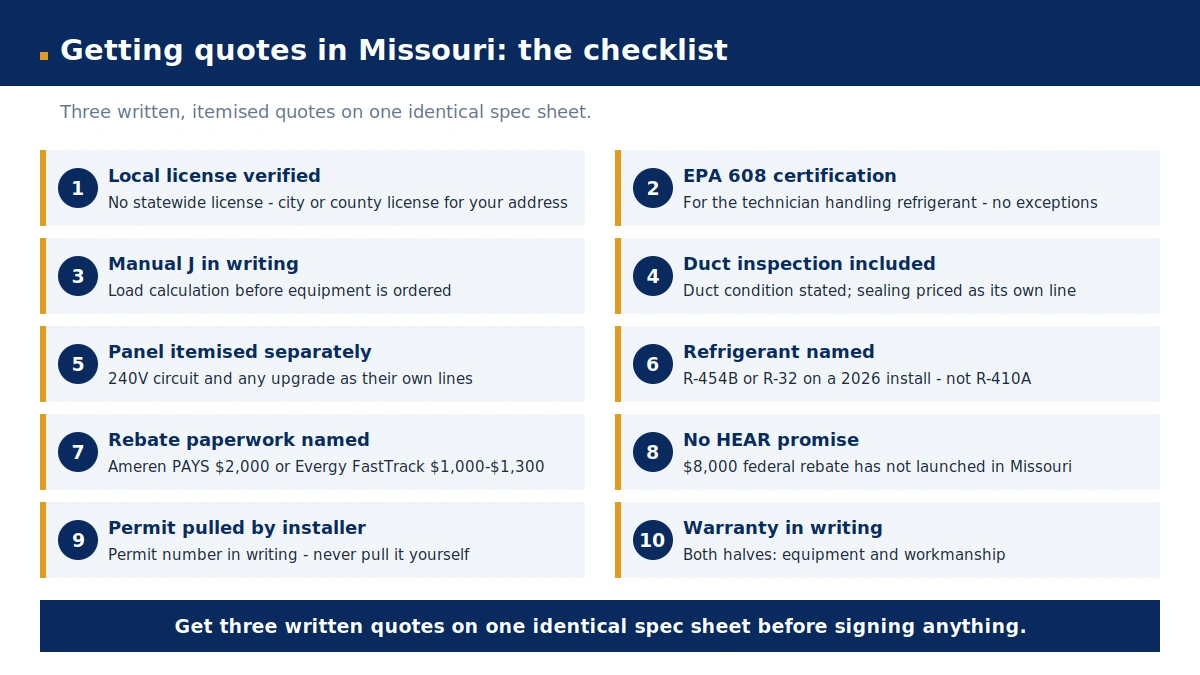
Collect three written, itemised quotes, all built to one identical specification. Identical tonnage, identical SEER2 and HSPF2, identical duct scope, identical electrical scope, identical permit — everything held constant except the price. Bids that cannot be laid side by side, line for line, cannot be compared at all, and the cheapest of them is usually the one with the most lines missing.
- Local license verified. No statewide HVAC license exists in Missouri — ask for the local mechanical license that covers your address (Kansas City, St. Louis City, St. Louis County, Springfield, Columbia, or your county) and verify it with that city or county. No license for your address is a walk-away.
- EPA 608 certification for the technician handling refrigerant. No exceptions, by federal law.
- Manual J load calculation in writing before equipment is ordered. Square-footage sizing is a guess.
- Duct inspection included. The quote states the duct condition and prices any sealing or replacement as its own line. A bid that says nothing about the ducts has not priced the whole job.
- Panel itemized separately. The 240V circuit and any panel upgrade appear as their own lines, not buried in the total.
- Refrigerant named. R-454B or R-32 on a 2026 install. R-410A is last year’s equipment.
- Rebate paperwork named. Ameren PAYS ($2,000) or Evergy FastTrack PAYS ($1,000–$1,300) tier, PAYS participation confirmed, existing-AC condition checked. No federal credit anywhere on the bid — that figure is $0 for a 2026 install.
- No HEAR promise. Any contractor promising the $8,000 federal HEAR rebate for a Missouri job in 2026 is promising money that has not launched and may not arrive until 2027 or 2028. Drop the promise, not necessarily the contractor — but remember that it was made.
- Permit pulled by the installer, with the permit number in writing. Never pull it yourself. In a rural county with no building department, get that in writing too.
- Warranty in writing, both halves. Manufacturer warranty on equipment (typically 10 years on parts, longer on compressors for premium brands) and workmanship warranty from the contractor (1–10 years — the second one matters more). Get both before signing.
Red flags specific to Missouri: a “federal tax credit” line on a 2026 bid; a HEAR rebate promised before the Department of Natural Resources opens the program; an Ameren rebate quoted for a home that does not meet the PAYS conditions (new AC, under 10 years old, not in tier 4); a Liberty heat pump rebate quoted for a Missouri home (no verified program exists); a whole-home quote near $5,000 with no duct or electrical lines; and any contractor who sizes the system from the old unit’s nameplate without a load calculation. The best Missouri installers are booked two to three weeks out in peak season. A crew free to start tomorrow deserves a sceptical look, not a signature.
Sources & methodology
Cost anchors: NumeralQ — “Heat Pump Cost in Missouri (2026)” (estimator, pricing as of Oct 26, 2026; model built from Fixr, This Old House, Home Depot prices, BLS May 2025 wages) — primary MO anchor: 3-ton ducted $6,510–$10,910; size table; type table (cold-climate $8,570–$14,980; single-zone mini-split $3,120–$4,880; 3-head $6,190–$11,110; geothermal $20,180–$31,810); city table (Kansas City $6,620–$11,040; St. Louis $6,630–$11,060); ductwork $4,110–$7,000; panel $2,230–$3,500; permits $70–$166; HVAC median pay $28.82/hr, billed $58–$75/hr; EIA heating-cost table (gas furnace $581/yr; HP HSPF2 7.5 $714/yr; HSPF2 9.0 $595/yr); ~10% of MO homes heat mainly with heat pumps. NumeralQ — “HVAC Replacement Cost in Missouri (2026)” (dual-fuel $9,180–$15,070). Swiss Air Heating & Cooling — “Is a Heat Pump Right in Missouri?” (Jul 20, 2026 — St. Louis installed systems $6,000–$14,000; dual-fuel $10,000–$18,000; Ameren rebates). Angi — St. Louis heat pump cost (Aug 4, 2026; average $5,376) and Kansas City heat pump cost (Aug 4, 2026; average $5,174; KC permit ~$75; KC sales tax 8.99%; STL permit ~$85). BuildX — Kansas City energy-efficient heat pump ($4,928–$11,826, 2026). Nestpriced art. 1 — national heat pump cost $7,500–$15,000 (baseline); add-heat-pump band $5,500–$10,000 and whole-home multi-zone $15,000–$24,000 are national-guide figures. The headline $7,000–$13,000 band and the ~$9,500 typical job are this guide’s synthesis of the NumeralQ model band and the St. Louis installer range; no published Missouri statewide installer average was found.
Rates: EIA Electric Power Monthly (Oct 23, 2026 release) via Where’d My Money Go? (updated Oct 29, 2026) — MO residential electricity 14.0 cents/kWh (12-mo avg to Aug 2026; Aug 2026 alone 16.0 cents), 12th lowest US vs 18.0 cents national; avg bill ~$145/mo. EIA Natural Gas Monthly Table 20 — MO residential gas $1.64/therm (12-mo avg to Jul 2026; $17.00/Mcf); 2025 annual $14.94/Mcf (~$1.46/therm). The per-therm running-cost arithmetic ($1.37 heat pump at COP 3.0 vs $1.73 gas furnace at 95%) is our own calculation from those EIA prices at 29.3 kWh per therm. Summer monthly gas prices spike above $3/therm on tiny volumes and are not used.
Climate: IECC 2021 zones (PNNL-33270 via hvacbase.org) — Missouri 4A (87 counties), 5A (26), 3A (2); ASHRAE 2021 Handbook Kansas City Intl (HDD65 4,977 / CDD65 1,409); IPC Appendix D Table D101 design temperatures (St. Louis 6F/94F; Kansas City 6F/96F; Columbia 4F/94F; Springfield 9F/93F; St. Joseph 2F) and degree days (Columbia 5,046; Kansas City 4,711; St. Louis 4,900; Springfield 4,900; St. Joseph 5,484). Tornadoes ~45/yr, 8th nationally, 50+ severe-weather days/yr, Apr 2001 St. Louis hail up to 4.5 in / $2B+ damage (NOAA summaries via ChaseDay, DisasterPrepCalc 2026, Farmers Almanac).
Rebates: Ameren Missouri 2026 PAYS rebate charts ($2,000 ASHP 15.2+ SEER2; $500/ton mini-split 19+ SEER2; $5,000 GSHP 23+ EER; $250 smart thermostat; valid Jan 1–Dec 31, 2026; tier 4; 12-month residency; existing AC 10+ yrs / 14 SEER or less / dead) via Tom Hoffmann PAYS sheet (Aug 2026) and Swiss Air rebates page (2026). Evergy FastTrack HVAC PAYS ($1,300 ASHP replacing electric resistance; $1,000 dual-fuel; $500 mini-split; $1,900 GSHP) via Summit Heating (Sep 3, 2025); KEEIA $650–$1,200 range via HomeEnergyBasics (Jun 2026). City Utilities of Springfield up to $500 via SS&B (Oct 2, 2026). Columbia Water & Light up to $2,600 via HomeEnergyBasics (Jun 10, 2026). Liberty: no verified Missouri residential ASHP rebate (ENERGY STAR DIME listings mix territories; Missouri Rinnai 2026 rebate covers water heaters only). Spire gas rebates cover furnaces, not heat pumps.
Federal: OBBBA P.L. 119-21 + IRS FS-2025-05 (§25C/§25D ended Dec 31, 2025). HEAR/HOMES MO status via Missouri DNR Division of Energy / HYRE state rebate census (Sep 6, 2026 — MO “still in development, paused, or no date given”; rebates may not arrive until 2027, potentially 2028; $151,173,700 allocation), BetterHouse (Sep 2026 — contractor selected Aug 2026, rebates not expected before 2027), HeatPumpPricing (verified Nov 4, 2026 — BDO Government Services selected Aug 2026, awaiting federal approval). DOE Program Notice 26-2 (May 29, 2026; fuel-switching removal effective Sep 1, 2026) — HEAR electric-to-electric only. DOE northern-region minimum efficiency 14.3 SEER2 / 7.5 HSPF2 (10 CFR 430.32).
Licensing & permits: Missouri has no statewide HVAC, general contractor, or residential building code — licensing entirely local (FieldTics 2026; ContractorLicenseCheck Apr 2026; Housecall Pro 2026; Build-Your-House May 2026). Kansas City local mechanical license (Development Services); St. Louis City and St. Louis County separate systems. Optional statewide electrical contractor license via OSEC (RSMo §§324.900–324.945). EPA 608 federal. Permit fees $70–$166 via NumeralQ 35-city check (Oct 2026); St. Louis City $25 + $10/$1,000 and Kansas City ~$75 via Angi (Aug 2026).
Method note: where a model estimate and installer quotes disagreed, this guide reports both and headlines the installer range. Where no Missouri-specific figure was verified (e.g. maintenance $150–$300/yr; lifespan 15–20 years; add-heat-pump band), the figure is the national guide’s and is labeled as such. Springfield and Columbia have no published city price model — this guide gives no invented band for them. Prices are 2026 planning figures, not quotes — get three written local quotes before budgeting.
Disclaimer: Prices are 2026 Missouri planning figures and change by city, home, and contractor. Always get three written local quotes before budgeting. Tax and rebate information is general, not tax advice — confirm with a tax professional and with the Department of Natural Resources / your utility before counting on any incentive.
How much does a heat pump cost in Missouri in 2026?
A typical whole-home ducted air-source heat pump (3-ton) costs $7,000–$13,000 installed in Missouri in 2026, with a typical job near $9,500. A single ductless mini-split zone runs $3,120–$4,880, a 3-zone system $6,190–$11,110, a cold-climate ducted system $8,570–$14,980, and geothermal $20,180–$31,810. St. Louis and Kansas City price almost identically on the model; Springfield and Columbia generally run at or below the big-two bands. The federal tax credit is $0, but Ameren pays $2,000 and Evergy pays $1,000–$1,300 through their PAYS programs.
Is a heat pump worth it in Missouri when so many homes heat with gas?
Yes, more so than in most gas-heavy states. Missouri electricity averages 14.0 cents a kilowatt-hour, the 12th cheapest in the country, while gas averages $1.64 a therm once fixed charges are counted. A good heat pump at COP 3.0 delivers a therm of heat for about $1.37, against about $1.73 for a 95% gas furnace — a modest win on fuel that a minimum-efficiency heat pump does not get. The EIA’s annual planning figures are more cautious, putting a high-efficiency heat pump at $595 a year against a gas furnace at $581, essentially a tie. Either way, the heat pump also cools and dehumidifies for four to five months a year, which a furnace never does. For a gas-heated home, the sensible middle path is dual-fuel: a heat pump carrying the mild months and the gas furnace covering the coldest nights.
What rebates can I get for a heat pump in Missouri in 2026?
Ameren Missouri pays $2,000 for a qualifying ducted heat pump (15.2+ SEER2) through Pay As You Save, plus $500 a ton for 19+ SEER2 mini-splits and $5,000 for geothermal. Evergy pays $1,300 for a heat pump replacing electric resistance heat, $1,000 for a dual-fuel system, and $500 for a mini-split through FastTrack PAYS. City Utilities of Springfield pays up to $500 and Columbia Water and Light is reported to pay up to $2,600 — verify both with the utility before counting on them. There is no statewide rebate, no verified Liberty heat pump rebate in Missouri, and Spire rebates furnaces, not heat pumps.
Will Missouri’s HEAR rebate of up to $8,000 ever open?
Nobody can promise a date. Missouri was allocated about $151 million in federal HEAR and HOMES money, and the Department of Natural Resources selected BDO Government Services as implementer in August 2026 — but the department is still awaiting federal approval and receipt of funds, and its own page says rebates may not be available until 2027 at the earliest, potentially as late as 2028. As of November 2026 the program is not launched, with no public launch date. And even once it does open, DOE Program Notice 26-2 (September 1, 2026) restricts HEAR to electric-to-electric swaps, so a gas furnace to heat pump conversion will not collect it. Leave it out of the budget entirely.
Do heat pumps work in Missouri winters?
Yes — across most of the state. Missouri spans IECC Zones 4A, 5A, and 3A, with design temperatures of 6F in St. Louis and Kansas City and 4F in Columbia. A standard unit carries the house through most of the winter, with the electric strips stepping in only on the coldest nights. Cold-climate models are worth pricing mainly in the northern Zone 5A counties — Kirksville, Maryville, St. Joseph — where design temperatures run down to 2F and cold snaps last for days. The bigger Missouri challenge is summer humidity, which is why variable-speed equipment that dehumidifies properly matters more here than raw cold-weather output. Hail and ice storms are the other local risks: site the outdoor unit on a raised pad and price a surge protector into the job.
Do I need a permit or a licensed contractor for a heat pump in Missouri?
Yes to a permit where one exists, and yes to a local license — but there is no statewide HVAC license in Missouri to ask for. Licensing is entirely local: Kansas City issues its own mechanical contractor license, St. Louis City and St. Louis County run separate systems, and Springfield, Columbia, and other cities have their own registrations. Many rural counties have no building code and require no permit at all. Where permits exist, typical fees run $70–$166. The technician who touches the refrigerant must hold EPA Section 608 certification. Verify the local license with the city or county that issued it, and make sure the installer pulls the permit.
Ducted or ductless mini-split — which fits a Missouri home?
With sound ductwork already in place, a ducted system is generally the smarter spend — a single $7,000–$13,000 system heating and cooling the whole house. If the home has no ducts — a bonus room over the garage, an addition, a finished basement, or an older brick home where ducts were never run — a ductless mini-split is the answer: $3,120–$4,880 for a single zone, $6,190–$11,110 for three zones. A whole-home multi-zone ductless setup can reach $15,000–$24,000 on national figures, at which point a ducted system is usually cheaper if ducts exist or can be added. A two-storey house usually needs two systems, or zoning, no matter which route you choose.
Is there a federal tax credit for a heat pump in Missouri in 2026?
No — $0. Under the One Big Beautiful Bill Act, the §25C credit — 30%, up to $2,000 a year on a heat pump — ended for property placed in service after December 31, 2025, as the IRS confirmed in FS-2025-05. If a quote subtracts a $2,000 federal credit from a 2026 Missouri install, the quote is outdated — ask the contractor to remove it. The only live money is utility money: Ameren $2,000 and Evergy $1,000–$1,300 through PAYS, and the federal HEAR rebate of up to $8,000 has not launched in Missouri.