

Table of Contents
Tennessee is a strange state to price a heat pump in, because almost everything about it pulls in two directions at once. The electricity is cheap — 13.6 cents a kilowatt-hour, the 8th lowest in the country — which is exactly what a heat pump wants. But the natural gas is cheap too, about $1.29 a therm, which is exactly what a gas furnace wants. The winters are mild enough that a standard heat pump covers nearly all of them, yet the summers are long, hot, and humid enough that the same machine earns its keep cooling and dehumidifying for five months a year. About 35% of Tennessee homes already heat mainly with a heat pump, one of the highest shares in the country, and the other 65% mostly heat with gas or electric resistance — which means the market here is not about convincing anyone the technology works. It is about which house, which system, and which rebate stack.
This guide prices Tennessee the way a local estimator would: by system type, by home size, and by city — Nashville, Memphis, Knoxville, and Chattanooga — with the TVA rebate tiers, the licensing rules that actually apply to a job under $25,000, and the running-cost math done at Tennessee’s own electricity and gas prices, not national averages.
For the country-wide baseline, start with our national heat pump cost guide.
How Much Does a Heat Pump Cost in Tennessee in 2026?
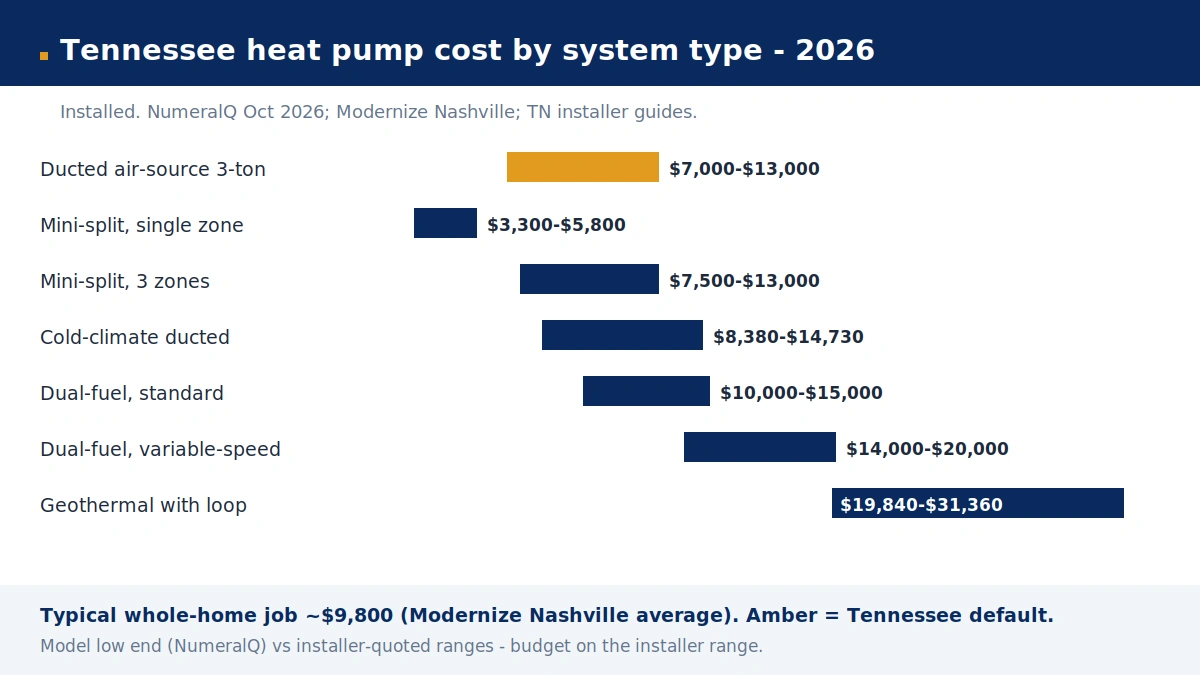
A typical Tennessee home of 1,500–2,500 square feet needs a 3-ton whole-home ducted air-source heat pump. In 2026 that job costs $7,000–$13,000 installed in Tennessee. The typical job lands near $9,800 — the average Modernize reports for air-source heat pump installation in Nashville. That range is the number to budget on. It covers the outdoor unit, the indoor air handler, refrigerant lines, a dedicated electrical circuit, the permit, and commissioning — the complete installed system, not the equipment alone.
Two published anchors sit underneath that range, and they disagree in a way worth understanding. NumeralQ’s Tennessee estimator (pricing as of October 26, 2026, built from Fixr, This Old House, Home Depot prices, and Bureau of Labor Statistics wages) puts a 3-ton ducted system at $6,350–$10,700. That is a model estimate — materials plus local labor, no installer margin for sales, warranty overhead, or job-specific surprises — and it reads low against real installer quotes. At the other end, Tennessee installer guides price a heat pump with electric backup strips at $7,000–$13,000 and a full dual-fuel system at $10,000–$15,000 (standard efficiency) to $14,000–$20,000 (variable-speed). The honest headline sits where those two views overlap: $7,000–$13,000 for the standard whole-home job, with the top of the band reserved for high-efficiency variable-speed equipment, difficult installs, and Nashville addresses.
One warning before you use any number in this guide: a quote near $6,000 for a whole-home system is almost never a complete quote. It is usually equipment plus a thin slice of labor, with the air handler, electrical work, permit, duct modifications, or commissioning left out — or priced as separate line items that appear later. When a bid lands thousands below the other two, ask which pieces are missing before you sign, not after the crew is on site.
Tennessee sits at or just below the national middle on price. The national guide puts a ducted heat pump at $7,500–$15,000 across the US in 2026. Tennessee labor is cheaper than the coasts, power is cheaper than most states, and the mild climate means standard equipment does the job in most of the state — no cold-climate premium required. Compare that with Pennsylvania, where the same system runs higher on labor alone, or New Jersey, where the statewide average is about $13,600. Tennessee is simply a cheaper state to buy a heat pump in. The catch is that it is also a cheaper state to buy the alternatives in.
| System | Typical Tennessee installed cost (2026) |
|---|---|
| Ducted air-source heat pump, 3-ton (typical home) | $7,000–$13,000 (typical ~$9,800) |
| Ductless mini-split, single zone | $3,300–$5,800 |
| Ductless mini-split, 3 zones | $7,500–$13,000 |
| Ductless mini-split, whole-home multi-zone | $15,000–$24,000 |
| Cold-climate ducted heat pump, 3-ton | $8,380–$14,730 |
| Dual-fuel (heat pump + gas furnace), standard | $10,000–$15,000 |
| Dual-fuel, variable-speed | $14,000–$20,000 |
| Geothermal (ground-source) with loop | $19,840–$31,360 |
| Add heat pump to existing gas furnace (replacing AC) | $5,500–$10,000 |
Sources: NumeralQ Tennessee estimator (Oct 26, 2026); Modernize Nashville (2026, avg $9,840); Tennessee dual-fuel and mini-split installer guides (Oct–Nov 2026); nestpriced national guide (art. 1).
Heat Pump Cost in Tennessee by System Type
The system type is the biggest single decision on the invoice — a single-zone mini-split costs a third of a whole-home ducted system, and geothermal costs three times as much. But the right comparison is not price alone. It is price against what the house already has: ducts or no ducts, gas service or none, a furnace worth keeping or one ready for the scrapyard.
Ducted air-source heat pumps are the Tennessee default. They use the home’s existing ductwork, heat and cool the whole house from one system, and replace both the furnace and the air conditioner in one job. A 3-ton system runs $6,350–$10,700 on NumeralQ’s model and $7,000–$13,000 on installer-quoted ranges — the difference is mostly margin, warranty, and job conditions. If your ducts are in good shape and your furnace and AC are both aging out together, this is the system to price first. Our ductless vs ducted comparison lays out the trade-offs in full.
Ductless mini-splits are the answer for homes without ducts — bonus rooms over the garage, additions, finished basements, older homes in East Nashville or Germantown where ducts were never run, and cabins in the Smokies. A single 12,000 BTU head in a Franklin bonus room runs about $4,200 installed, permitted, and running the same afternoon, inside a statewide single-zone band of $3,300–$5,800 (NumeralQ’s model says $3,010–$4,740, which again reads low against installer quotes). Two or three zones for an addition or a finished basement run $7,500–$13,000. A whole-home multi-zone setup with five or more heads can reach $15,000–$24,000 — at which point a ducted system is usually cheaper if ducts exist or can be added. Every mini-split is a heat pump, so the same box that cools the bonus room in July warms it in January. See our mini-split installation cost guide for per-zone pricing.
Cold-climate heat pumps cost more and matter less in Tennessee than in most states. A cold-climate ducted system runs $8,380–$14,730 (NumeralQ), roughly $2,000 above a standard system, and a cold-climate mini-split adds $300–$800 per zone. The premium buys inverter-driven capacity that holds output down to -13F or lower. In Memphis, where winter nights rarely test a standard unit, that money is wasted. On the Cumberland Plateau and in the mountains near the Smokies, where design temperatures run lower and cold snaps last longer, it is worth pricing. For most of Middle Tennessee, a standard variable-speed system with electric backup strips covers the handful of genuinely cold nights each year. Our cold-climate mini-split guide explains where the premium pays and where it does not.
Dual-fuel systems — a heat pump paired with a gas furnace — are the Tennessee compromise, and in Middle Tennessee they are the most common premium choice. The heat pump does the work through the long shoulder seasons, when Tennessee weather is mild and electricity is cheap. The gas furnace takes over only on the coldest nights, when the heat pump’s efficiency falls and the strips would otherwise take over. A full dual-fuel system runs $10,000–$15,000 standard and $14,000–$20,000 variable-speed. The cheapest dual-fuel route is adding a heat pump in place of a dying air conditioner while keeping a gas furnace under about 10 years old: $5,500–$10,000. If your furnace is young and your AC is dying, price this first. Our dual-fuel cost guide has the full breakdown.
Geothermal is the outlier: $19,840–$31,360 with the ground loop (NumeralQ), and the national guide puts it at $25,000–$40,000+ for larger or more complex loop fields. It is the most efficient system you can buy and the longest-lived, but in Tennessee the payback math is brutal — cheap electricity and cheap gas both shrink the annual savings that are supposed to repay a $10,000+ premium over air-source. It makes sense on new construction with land for a horizontal loop, or for a homeowner planning to stay 20+ years. For almost everyone else, the air-source money is better spent on a higher-efficiency air-source unit plus duct sealing. See our geothermal heat pump cost guide.
Heat Pump Cost by Home Size
Heat pumps are sized in tons, and one ton covers roughly 500–600 square feet of Tennessee home — but only roughly. Insulation, window area, ceiling height, shade, and how leaky the ducts are all move the right size up or down. A Manual J load calculation ($200–$500, often credited toward the install) is what gets the size right. A contractor who sizes by square footage alone, or who proposes the same size as the unit being replaced without checking, is guessing with your money.
| Home size | Typical system | Installed cost (ducted air-source) |
|---|---|---|
| 1,000–1,200 sq ft | 1.5–2 ton | $4,230–$8,140 |
| 1,200–1,500 sq ft | 2–2.5 ton | $4,940–$9,420 |
| 1,500–2,000 sq ft | 2.5–3 ton | $5,650–$10,700 |
| 2,000–2,500 sq ft | 3–3.5 ton | $6,350–$11,980 |
| 2,500–3,000 sq ft | 3.5–4 ton | $7,060–$13,270 |
| 3,000+ sq ft | 4–5 ton | $7,760–$15,830 |
Source: NumeralQ Tennessee estimator by size (Oct 26, 2026), ducted air-source. These are model-derived bands — installer quotes for the same sizes run toward the top of each band, and Nashville quotes run higher still. Treat the table as a sizing map, not a bid.
The sizing mistake that costs Tennessee homeowners the most is oversizing. An oversized heat pump short-cycles in summer: it blasts cold air for a few minutes, shuts off before it has dehumidified anything, and leaves the house cool and clammy — the worst outcome in a humid subtropical climate, where the latent load (humidity) matters as much as the temperature. An undersized unit has the opposite problem: it runs constantly and still leans on electric strip heat on cold January nights, which is the most expensive heat in the house. Both mistakes cost more over ten years than the Manual J ever would. Get the load calculation in writing, and get it before the equipment is ordered.
Two-story Tennessee homes deserve a special note. A single system serving two floors almost always leaves one floor uncomfortable — usually the upstairs in July and the downstairs in January. The honest options are two systems, a zoned ducted system with dampers, or a ducted system downstairs plus a mini-split head or two upstairs. All three cost more than a single-system quote. If a bid prices a two-story home with one system and no zoning discussion, ask what happens in July before you sign.
Heat Pump Cost by City: Nashville, Memphis, Knoxville & Chattanooga
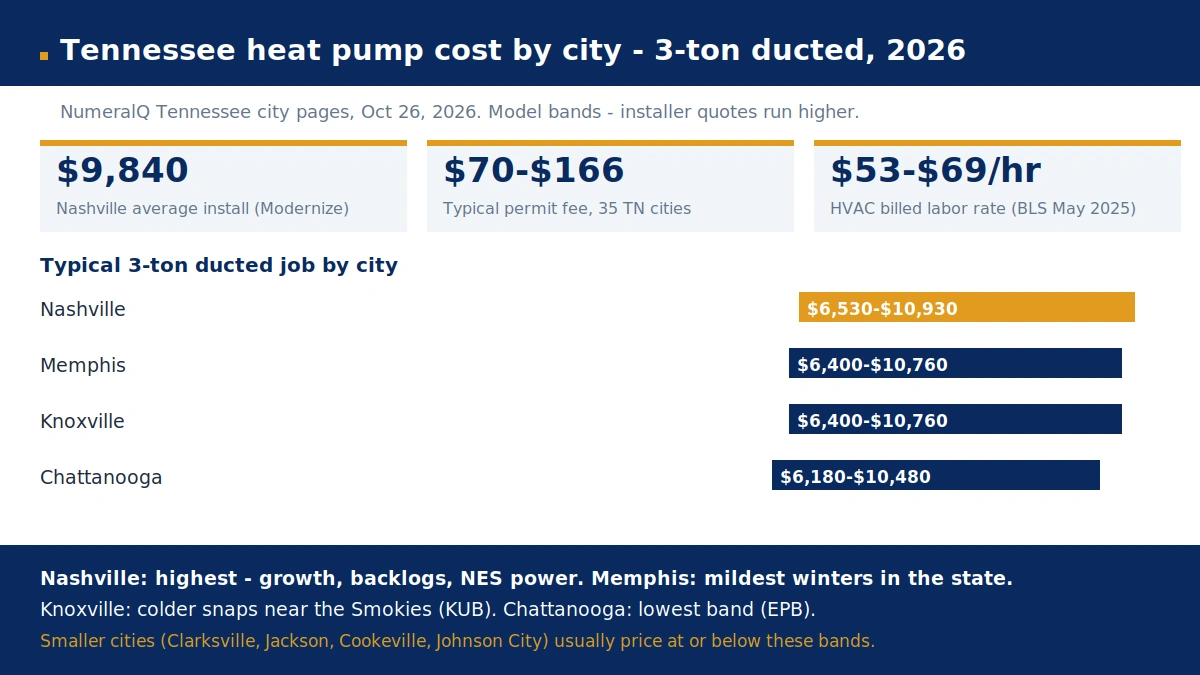
Tennessee’s four big metros price the same 3-ton system inside a fairly narrow band — about $300 separates the cheapest from the most expensive on the model — but the reasons behind the prices are different in each city, and the installer-quoted reality spreads wider than the model suggests.
| City | Typical 3-ton ducted job (model) | What drives the price |
|---|---|---|
| Nashville | $6,530–$10,930 | Highest in the state — growth, backlogs, NES power |
| Memphis | $6,400–$10,760 | Mildest winters; MLGW electric + gas on one bill |
| Knoxville | $6,400–$10,760 | KUB power + gas; colder snaps near the Smokies |
| Chattanooga | $6,180–$10,480 | Lowest model band; EPB power; valley humidity |
Source: NumeralQ Tennessee city pages (Oct 26, 2026), 3-ton ducted system.
Nashville is the most expensive heat pump market in Tennessee. The metro’s rapid growth has stretched installer capacity, spring and summer scheduling can run two to three weeks out, and labor tracks a hotter market than the rest of the state — HVAC technician pay runs about 1% below the national median in Nashville, against 17% below in Chattanooga (BLS May 2025, via NumeralQ). The Modernize average of $9,840 for Nashville is the most useful single number in this guide for a Middle Tennessee budget. Nashville homes also carry two local complications: older homes in East Nashville and Germantown with undersized systems and no ductwork, and the city’s clay soil, which shifts with seasonal moisture and cracks crawlspace ductwork. Nashville Electric Service (NES) delivers the power; Piedmont Natural Gas serves much of the gas load. A single-zone mini-split in the Nashville area typically runs $3,600–$5,000.
Memphis is the mildest winter market in the state. A home in Memphis or Jackson may drop below the heat pump’s balance point — the temperature where backup heat has to help — on only a small number of nights each year. That makes a standard heat pump with electric backup strips a genuinely good fit, with no cold-climate premium and no dual-fuel complication. Memphis Light, Gas and Water (MLGW) is unusual in delivering electricity, gas, and water on one bill, which makes the running-cost comparison unusually easy to see: the same utility sells you both fuels. Memphis summers are the longest and stickiest in the state, so the cooling and dehumidification side of the heat pump matters at least as much as the heating side.
Knoxville sits between the two: a little colder than Nashville on winter nights, a little closer to the mountains, and served by Knoxville Utilities Board (KUB) for both power and gas. Knoxville homeowners should take the cold-climate question more seriously than Memphis homeowners — not because Knoxville is cold, but because the cold snaps that do arrive are sharper, and a home on the east side toward the Smokies sees more of them. Dual-fuel is a live option here for homes with gas service.
Chattanooga posts the lowest model band in the state, $6,180–$10,480 for a 3-ton system, and EPB — the city’s power distributor, better known for its fiber network — delivers the electricity. Chattanooga’s valley humidity is the local wrinkle: a system that cannot dehumidify properly will leave a Chattanooga home clammy all summer, so sizing and variable-speed equipment matter more here than raw tonnage.
Smaller cities — Clarksville, Murfreesboro, Franklin, Jackson, Cookeville, Johnson City — generally price at or below the big-four bands on softer labor markets. Franklin is the exception that proves the rule: its bonus-room mini-split jobs price like Nashville’s, because Franklin is Nashville’s most expensive suburb and its installers know it.
Why Tennessee Is One of the Best Heat Pump States in America
Tennessee sits in IECC Climate Zone 4A, Mixed-Humid — humid subtropical, in plain language. Nashville averages about 50 days above 90F in summer and about 68 days at or below freezing in winter. January, the coldest month, averages highs near 49F and lows near 31F. The ASHRAE design conditions for Nashville International Airport are 18F on the cold side and 92F on the hot side, with about 3,600 heating degree days and 1,650 cooling degree days a year, and about 50 inches of rain. That is a climate that asks a heating system to work moderately for three months and a cooling system to work hard for five — and a heat pump is the only single machine that does both.
A standard heat pump covers most Tennessee winters without help. Capacity falls as the outdoor temperature drops, and somewhere around 30–35F most systems start leaning on supplemental electric resistance heat to keep pace. In Tennessee that happens on a handful of nights, not for weeks at a time. The strip heat is expensive — it is the most expensive heat in the house — but it runs so rarely that it barely moves the annual bill. This is the opposite of the northern states, where a standard heat pump spends half the winter on backup heat and the cold-climate premium is mandatory. In Tennessee the cold-climate premium is optional for most homes and sensible only on the Cumberland Plateau and in the mountains.
The humidity is the part newcomers underestimate. A Tennessee summer is not just hot; it is sticky for months, and a heat pump that cools without dehumidifying leaves a house at 72F and clammy. Variable-speed equipment earns its premium here not on the coldest night but on the most humid afternoon: it runs long, slow cycles that pull moisture out of the air instead of short blasts that leave the humidity behind. If you are choosing between a single-stage system and a variable-speed one, the dehumidification difference is the reason to pay up — not the SEER2 number on the brochure.
Tennessee homes also carry a structural quirk that shapes heat pump jobs: crawlspaces. A large share of the state’s housing stock sits over vented crawlspaces, and ductwork running through a damp crawlspace sweats in summer, loses conditioned air through leaks, and in the worst cases grows mold on saturated insulation. A heat pump job in a crawlspace home is often two jobs — the equipment, and the ducts. Sealing the ducts and, where the budget allows, sealing and conditioning the crawlspace, is the highest-return companion work in this guide. It is also the work most likely to be missing from the cheapest quote.
None of this is theory. About 35% of Tennessee homes already use a heat pump as their main heat, according to the EIA’s home energy survey — one of the highest shares in the country. The technology is proven here. The question is never whether a heat pump works in Tennessee. It is whether the quote in front of you is complete, the size is right, and the running-cost math was done at Tennessee prices.
Heat Pump vs Gas Furnace in Tennessee: The Honest Running-Cost Math
This is the section most Tennessee heat pump guides get wrong, because they import national math into a state where both fuels are cheap. Here is the math at Tennessee’s own prices.
Tennessee residential electricity averages 13.6 cents per kilowatt-hour (12-month average to August 2026, EIA) — the 8th lowest in the country, against 18.0 cents nationally. August 2026 alone was 13.4 cents. The average Tennessee home pays about $158–$161 a month for electricity and uses about 1,180 kWh. Tennessee residential natural gas averages $1.29 a therm (12-month average to July 2026, EIA) — also well below the $1.57 national figure. TVA generates the power and local distributors like NES, MLGW, KUB, and EPB deliver it; Piedmont, Atmos, MLGW, and KUB deliver the gas. Both fuels are cheap. That is the whole story.
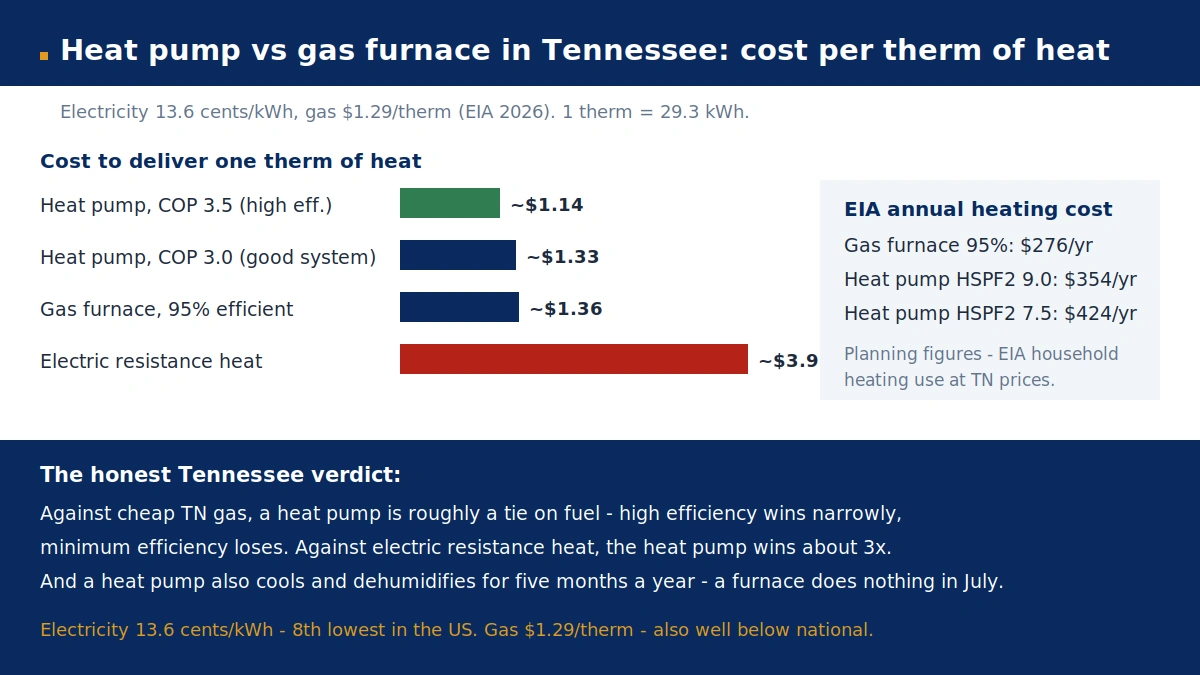
Run the heat math. One therm of heat equals 29.3 kWh of heat. A heat pump with a seasonal COP of 3.0 — a fair figure for a good modern system in Tennessee’s climate — delivers that therm for 29.3 x $0.136 / 3.0 = about $1.33. A 95%-efficient gas furnace delivers it for $1.29 / 0.95 = about $1.36. A high-efficiency heat pump at COP 3.5 delivers it for about $1.14 and wins clearly. A minimum-efficiency heat pump at HSPF2 7.5 loses. The EIA’s own household heating estimates tell the same story from the other direction: a 95% gas furnace costs about $276 a year to heat the average Tennessee home; a minimum-efficiency heat pump (HSPF2 7.5) costs about $424 a year; a high-efficiency heat pump (HSPF2 9.0) costs about $354 a year. Those are planning figures, not bill forecasts — but the direction is unmistakable. Against cheap Tennessee gas, a heat pump is not a fuel-saving machine. It is roughly a tie, decided by the efficiency tier you buy.
That does not make the heat pump a bad buy. It makes the sales pitch honest. A heat pump wins decisively in three Tennessee situations. First, against electric resistance heat — baseboards, wall heaters, or an old electric furnace — where it delivers the same heat for about a third of the electricity. Second, against propane or heating oil, where the fuel is far more expensive than either TVA power or Tennessee gas. Third, against any home that needs air conditioning anyway: a heat pump replaces the furnace and the AC in one box, while the gas route means buying a furnace plus a separate AC system. Compare the heat pump’s $7,000–$13,000 against furnace-plus-AC, not against the furnace alone — our heat pump vs furnace comparison makes that case in full, and our furnace replacement guide prices the gas side.
The other honest point: the heat pump’s real Tennessee advantage is cooling. A gas furnace does nothing in July. A heat pump cools and dehumidifies for five months a year, and in a state with 50 days above 90F and humidity that rarely lets up, that is half the value of the machine. Judge the purchase on the full year, not on the January fuel bill alone.
| Heating system | Cost per therm of heat delivered | EIA estimated annual heating cost (TN) |
|---|---|---|
| Gas furnace, 95% efficient | ~$1.36 | ~$276/yr |
| Heat pump, COP 3.0 (good modern system) | ~$1.33 | — |
| Heat pump, COP 3.5 (high efficiency) | ~$1.14 | — |
| Heat pump, HSPF2 7.5 (federal minimum) | — | ~$424/yr |
| Heat pump, HSPF2 9.0 (high efficiency) | — | ~$354/yr |
| Electric resistance heat | ~$3.98 | — |
Assumptions: electricity 13.6 cents/kWh, gas $1.29/therm (EIA 2026). 1 therm = 29.3 kWh. COP figures are seasonal planning values. EIA annual costs are planning figures from household heating use and current state prices.
TVA EnergyRight Rebates: The Money You Can Actually Collect
Forget the federal money for a moment. In Tennessee in 2026, the live rebate money has one name: TVA EnergyRight. TVA is the federal power producer for the whole Valley, and EnergyRight is its efficiency program, delivered through the local power companies — NES in Nashville, MLGW in Memphis, KUB in Knoxville, EPB in Chattanooga, Duck River EMC around Spring Hill, and more than 150 local distributors across the region. The rebates are real, the amounts are published, and the conditions are specific.
| Measure | TVA EnergyRight rebate (2026) |
|---|---|
| Heat pump, 17+ SEER2 | $800 |
| Heat pump, 15–16.99 SEER2 | $500 |
| Heat pump, TVA Preferred (variable-speed, full heating output at 17F) | $1,500 |
| Geothermal heat pump | $1,500 |
| Heat pump water heater | $900 |
| Insulation (per measure) | $300 |
Sources: TVA EnergyRight via FixFirstHome (verified Oct 2, 2026), UpgradeRebates Tennessee guide (2026), BetterHouse (Sep 2026), Hisense Nashville guide (verified Jul 2026).
Three conditions decide whether you collect. First, the work must be done by a member of TVA’s Quality Contractor Network (QCN) — a contractor outside the network cannot file the rebate, no matter how good the equipment is. Second, the rebate requires replacing an existing electric heating source. A gas furnace to heat pump conversion does not qualify. That rule surprises a lot of Nashville homeowners who assumed the rebate would pay them to leave gas. It will not. Third, the efficiency tier decides the amount: 15–16.99 SEER2 pays $500, 17+ SEER2 pays $800, and the TVA Preferred tier — variable-speed equipment holding full heating output at 17F without backup heat — pays $1,500. Notice what the top tier is really specifying: inverter-driven cold-climate equipment. TVA is paying the most for exactly the machine that performs best on the coldest Tennessee nights.
Two more things to know. The rebate amounts are not identical at every local power company — which distributors take part in each EnergyRight measure is not published in one list, and MLGW’s and KUB’s pages do not carry the same offers — so verify the current amount with your own distributor before you sign, not with a statewide article. And the heat pump water heater rebate is the program’s quiet success story: TVA moved more than 10,000 heat pump water heaters in the last quarter of 2025 under a midstream discount model, then cut the rebate from $1,300 to $900 on February 15, 2026 to stretch funding. If you are replacing a water heater too, that $900 is the easiest money in this guide — see our heat pump water heater cost guide.
TVA also runs eScore, its home-energy evaluation program — an audit that scores the house and points to the measures that pay. It is the sensible starting step if you are unsure whether the heat pump, the ducts, or the insulation should come first. It carries no rebate of its own in the figures verified for this guide, but it is the route into the EnergyRight measures, and the audit itself is the cheapest way to find out whether your ducts are the real problem.
Stack the numbers honestly: a TVA Preferred system at $1,500 off a $10,000–$13,000 job is meaningful — roughly 12–15% — but it is not the five-figure stack New Jersey homeowners collect, and it is not the $8,000 federal rebate that does not exist yet in Tennessee. Budget as if EnergyRight is the only rebate. In 2026, it is.
Federal Help in 2026: $0 Tax Credit and Rebates That Have Not Launched
This section is short because the federal help in Tennessee in 2026 is short: there is almost none, and the part that exists has not arrived.
The tax credit is $0. The One Big Beautiful Bill Act (P.L. 119-21, signed July 4, 2025) ended the Energy Efficient Home Improvement Credit (§25C, 30% up to $2,000 a year for heat pumps) and the Residential Clean Energy Credit (§25D) for property placed in service after December 31, 2025. The IRS confirmed it in FS-2025-05. A heat pump installed in a Tennessee home in 2026 gets no federal tax credit whatsoever. If a quote subtracts a $2,000 federal credit from a 2026 install, the quote is outdated or the contractor is hoping you will not check. Ask them to remove it. Our federal energy tax credits guide — published under the solar category but covering both credits — has the full legal picture.
The HEAR rebate has not launched in Tennessee. The Home Electrification and Appliance Rebates program (HEAR, IRA §50122) would pay up to $8,000 for a heat pump, income-qualified (up to 150% of area median income, with larger rebates under 80%), as a point-of-sale discount. Tennessee’s allocation is about $167 million ($83.39 million HEAR + $83.71 million HOMES). The Department of Energy issued Tennessee a conditional award in January 2025. And then nothing opened. The Tennessee Department of Environment and Conservation (TDEC), which administers the program, states it still needs full DOE approval and an executed agreement, then contracting with TVA as implementer, before any rebate can be paid. TDEC once expected rebates by the third quarter of 2026. That date passed with no launch. A September 2026 census of state program pages lists Tennessee as “approved, explicitly not accepting applications,” and TDEC’s own page carries a Consumer Protection Notice warning that funding is not yet available and that any current offers claiming otherwise are not affiliated with Tennessee’s IRA rebate programs. As of November 2026, there is no public launch date.
The HOMES rebate has not launched either. The Home Efficiency Rebates program (IRA §50121) pays on modeled energy savings rather than fixed equipment amounts, and Tennessee has proposed raising its cap to $16,000 for households at or below 80% of area median income on projects achieving at least 20% savings. Same status: conditionally approved, not open, no date.
And the rules changed while Tennessee waited. DOE Program Notice 26-2, issued September 1, 2026, removed the fuel-switching allowance from HEAR: when Tennessee’s program does open, rebates will cover electric-to-electric replacements only. A gas furnace to heat pump conversion will not qualify. HEAR also does not cover solar panels, batteries, EV chargers, or windows. The practical consequence is sharp for the most common Tennessee scenario — a gas-furnace home considering a heat pump — because even after launch, that household will not collect the $8,000. The households HEAR will help are the ones already heating with electricity: resistance heat, old electric furnaces, and aging heat pumps.
Compare Tennessee with its neighbors and the gap is stark. North Carolina’s federal rebate program actually opened — our North Carolina heat pump cost guide covers a state where the $8,000 is real money. Georgia launched and then paused. Tennessee has not opened at all. Do not build a Tennessee budget around HEAR. Check TDEC’s page before you sign, and treat any future launch as upside, not as plan.
Permits & Licensing: What Tennessee Requires Before Anyone Touches Your System
Tennessee licenses contractors differently from most states in this series, and the difference matters because it creates a gap most homeowners never notice. Tennessee is a threshold state: the state Contractor license only kicks in at $25,000. Most single heat-pump jobs cost less than that. So the state license that protects a Virginia or New Jersey homeowner does not automatically protect a Tennessee one — and the license that does apply is one most homeowners have never heard of.
The $25,000 threshold. The Tennessee Board for Licensing Contractors (BLC), inside the Department of Commerce & Insurance, requires a state Contractor license before anyone bids, negotiates, or offers a price on a project of $25,000 or more, materials and labor combined (T.C.A. §62-6-102). That covers prime contractors and subcontractors doing electrical, mechanical, plumbing, HVAC, or roofing work at that threshold. HVAC classifications are CMC (Full Mechanical Contractor — HVAC plus plumbing, Board pre-approval required before the trade exam) and CMC-C (Mechanical — HVAC/Refrigeration and Gas Piping, no pre-approval). Both require the PSI Business & Law exam plus a trade exam at 73% to pass, a CPA-prepared financial statement that sets the monetary limit (roughly ten times the lesser of working capital or net worth), and a $250 application fee with $200 renewal every two years. A geothermal job with a loop field can cross $25,000 and trigger all of it. A standard $9,800 heat pump does not.
The license that covers most Tennessee heat pump jobs is the Home Improvement license. It covers residential improvement work from $3,000 to $24,999 — which is exactly where nearly every Tennessee heat pump job lands — in nine designated counties: Bradley, Davidson, Hamilton, Haywood, Knox, Marion, Robertson, Rutherford, and Shelby. Read that list again: it includes Nashville (Davidson), Memphis (Shelby), Knoxville (Knox), and Chattanooga (Hamilton). The four big metros are all covered. The license requires a $10,000 surety bond or irrevocable letter of credit, general liability insurance, and workers’ compensation coverage or an exemption. Ask for the Home Improvement license number on any job under $25,000 in those counties, and verify it through the BLC’s CORE license lookup before signing.
Two more requirements sit underneath the contractor license. Anyone handling refrigerant needs EPA Section 608 certification — universal, by federal law, no exceptions. And a mechanical permit is required for a system replacement in Tennessee cities; across 35 cities checked, typical permit fees run $70–$166 (NumeralQ, October 2026). Electrical work on the job needs a limited licensed electrician where applicable. Acting as a contractor without the required license is a Class A misdemeanor under T.C.A. §62-6-120.
What to verify before you sign: the contractor’s license (Contractor license above $25,000, Home Improvement license from $3,000–$24,999 in the nine counties), EPA 608 certification for the technician handling refrigerant, general liability insurance, and workers’ compensation coverage. Get the permit number in writing and confirm the installer pulls it — a contractor who asks you to pull the permit yourself is shifting liability onto you. If the job needs electrical panel work, our electrical panel upgrade guide prices that piece separately.
What Pushes Your Tennessee Quote Up or Down
Two quotes for the same house can differ by $3,000 or more, and the difference is rarely the equipment. It is everything around the equipment. These are the line items that move a Tennessee quote, in the order they usually appear.
Ductwork is the biggest swing. New or extended ductwork runs $3,910–$6,740 per job (NumeralQ). Many Tennessee homes have ducts in vented crawlspaces or hot attics, and leaky ducts can waste a fifth or more of the conditioned air before it reaches a room. A contractor who quotes the heat pump without inspecting the ducts is quoting half the job. Duct sealing is the companion work worth paying for — and the work most likely to be missing from the cheapest bid. If the ducts are undersized, collapsed, or disconnected in the crawlspace, the new heat pump will be blamed for a duct problem.
The electrical panel is the second swing. A heat pump needs a dedicated 240V circuit. If the panel is full, still 100-amp, or has no spare breaker space, a 200-amp upgrade runs $2,130–$3,370 (NumeralQ; the national guide puts it at $1,500–$4,000). Older Nashville and Memphis homes with 100-amp panels hit this regularly. Get the panel itemized separately in the quote, so you can see whether the $3,000 is panel or profit.
Sizing and the load calculation decide whether the system works or merely runs. A Manual J calculation costs $200–$500 and is often credited toward the install. It is the only honest way to size a system in a humid climate, where oversizing leaves the house clammy and undersizing leans on strip heat. A contractor who sizes from the old unit’s nameplate, or from square footage alone, is guessing.
The refrigerant matters in 2026. New home systems now use R-454B or R-32; R-410A was phased out in new home systems starting in 2025 under EPA rules. Ask which refrigerant each quote uses, and do not accept a new R-410A system at a 2026 price — it is last year’s equipment at this year’s money.
The efficiency tier is a real choice, not a sales ladder. A 15 SEER2 system collects the $500 TVA rebate; a 17+ SEER2 system collects $800; a TVA Preferred variable-speed system collects $1,500 and holds full heating output at 17F. The premium for variable-speed equipment is real money — typically $1,500–$3,000 over a single-stage system — and in Tennessee it pays back through dehumidification and shoulder-season efficiency, not through surviving deep cold. Price the tiers side by side with the rebates applied, and judge the premium against ten years of summer humidity, not against the brochure’s SEER2 number.
Labor and timing round out the list. HVAC technician median pay in Tennessee is $26.68 an hour (BLS, May 2025), and contractors bill $53–$69 per worker-hour once insurance, payroll taxes, overhead, and profit are included. Nashville books two to three weeks out in peak season; spring and fall shoulder-season installs are cheaper and faster. A reputable installer will be booked out. That is a good sign, not a problem.
Payback: When Does a Tennessee Heat Pump Pay for Itself?
Payback in Tennessee depends entirely on what the heat pump replaces, because Tennessee’s cheap gas makes the fuel math a tie and cheap electricity makes the electric math a rout. There is no single payback number. There are three cases, and they are very different.
Replacing electric resistance heat: payback in roughly 3–5 years. This is the best case in the state and the most common one in all-electric homes, older apartments, and houses with baseboard heat. A heat pump delivers the same heat for about a third of the electricity. On a $9,800 system with a $500–$800 TVA rebate, the annual savings against resistance heat run into four figures, and the system pays for itself faster than in almost any other state. If your home heats with baseboards or an old electric furnace, stop reading payback tables and get quotes.
Replacing an old heat pump or a furnace-plus-AC pair: payback in roughly 7–12 years. The savings here come from efficiency — a modern variable-speed system against a 15-year-old single-stage one — and from replacing two aging machines with one. The TVA rebate helps. The avoided cost of the air conditioner you would otherwise have bought is the quiet part of the math: price the heat pump against furnace-plus-AC, and the gap narrows fast.
Replacing a working gas furnace with a heat pump: payback in 12 years or more, possibly never on fuel alone. This is the honest answer the sales pitch skips. At $1.29 a therm against 13.6-cent electricity, a high-efficiency heat pump saves a little on fuel each year and a minimum-efficiency one saves nothing. The case for switching has to rest on something else: the air conditioner is dying anyway, the furnace is at end of life, you want one system instead of two, or you value the cooling and dehumidification. Dual-fuel is the compromise that keeps the gas furnace for the coldest nights and lets the heat pump do the shoulder seasons — and it is the right answer for a large share of Middle Tennessee homes with gas service and a furnace under ten years old.
Two more payback facts. First, the TVA rebate shortens every payback above by roughly a year — $500–$1,500 off the front is real money on a $9,800 job. Second, maintenance is not free and it is not optional: annual professional service runs $150–$300, filters need monthly attention in summer, and a neglected Tennessee heat pump in a humid climate loses efficiency faster than the brochure admits. A well-maintained system lasts 15–20 years. Budget the service, or the payback math quietly falls apart. Our heat pump maintenance guide and heat pump repair guide price the ownership years, and our running-cost guide does the monthly math.
Getting Quotes in Tennessee: The Checklist
Get three written, itemized quotes on one identical spec sheet. Same tonnage, same SEER2/HSPF2, same duct scope, same electrical scope, same permit. Quotes that cannot be compared line by line cannot be compared at all, and the cheapest one is usually the one that left the most lines out.
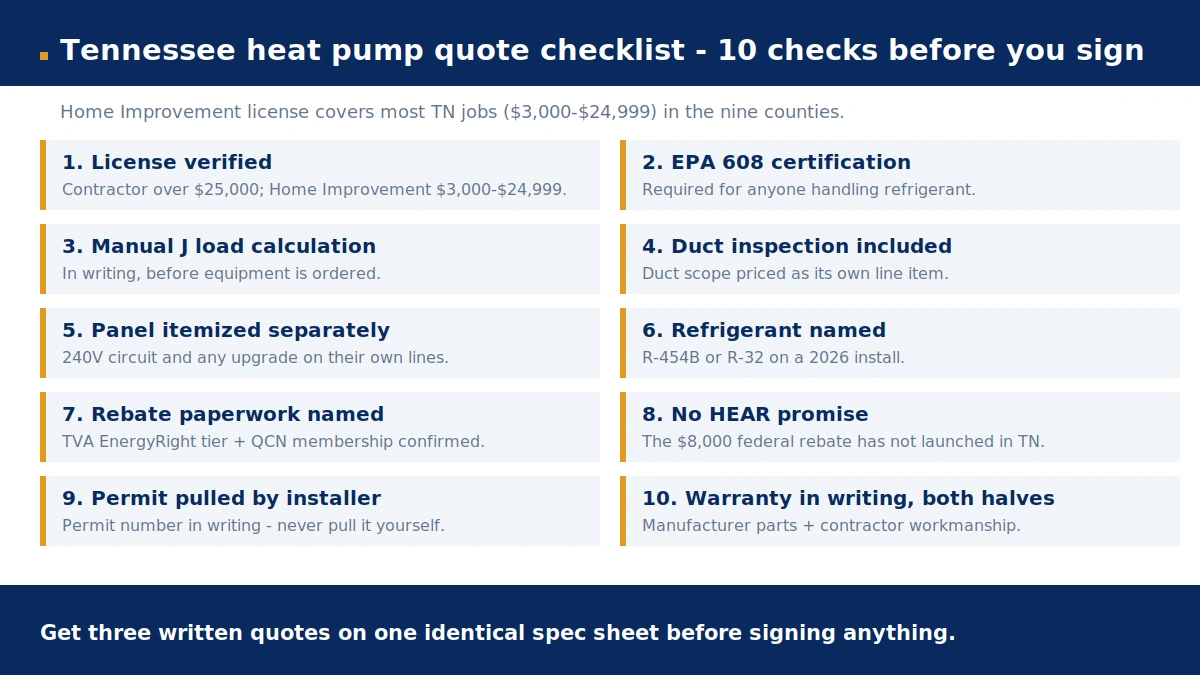
- License verified. Contractor license above $25,000; Home Improvement license from $3,000–$24,999 in Davidson, Shelby, Knox, Hamilton, and the other five designated counties. Look it up in the BLC CORE system. No number on the proposal is a walk-away.
- EPA 608 certification for the technician handling refrigerant. No exceptions, by federal law.
- Manual J load calculation in writing before equipment is ordered. Square-footage sizing is a guess.
- Duct inspection included. The quote states the duct condition and prices any sealing or replacement as its own line. A quote that never mentions the ducts is incomplete.
- Panel itemized separately. The 240V circuit and any panel upgrade appear as their own lines, not buried in the total.
- Refrigerant named. R-454B or R-32 on a 2026 install. R-410A is last year’s equipment.
- Rebate paperwork named. TVA EnergyRight tier ($500 / $800 / $1,500), QCN membership confirmed, electric-heat replacement condition checked. No federal credit on the quote — it is $0 in 2026.
- No HEAR promise. Any contractor promising the $8,000 federal HEAR rebate for a Tennessee job in 2026 is promising money that has not launched. Walk away from the promise, not necessarily from the contractor — but note it.
- Permit pulled by the installer, with the permit number in writing. Never pull it yourself.
- Warranty in writing, both halves. Manufacturer warranty on equipment (typically 10 years on parts, longer on compressors for premium brands) and workmanship warranty from the contractor (1–10 years — the second one matters more). Get both before signing.
Red flags specific to Tennessee: a “federal tax credit” line on a 2026 bid; a HEAR rebate promised before TDEC opens the program; a gas-to-heat-pump conversion quoted with a TVA rebate attached (it does not qualify); a whole-home quote near $6,000 with no duct or electrical lines; and any contractor who sizes the system from the old unit’s nameplate without a load calculation. The best Tennessee installers are booked two to three weeks out in peak season. Treat a crew that can start tomorrow with the suspicion it deserves.
Sources & methodology
Cost anchors: NumeralQ — “Heat Pump Cost in Tennessee (2026)” (estimator, pricing as of Oct 26, 2026; model built from Fixr, This Old House, Home Depot prices, BLS May 2025 wages) — primary TN anchor: 3-ton ducted $6,350–$10,700; size table; type table; city table (Nashville $6,530–$10,930; Memphis $6,400–$10,760; Knoxville $6,400–$10,760; Chattanooga $6,180–$10,480); ductwork $3,910–$6,740; panel $2,130–$3,370; permits $70–$166; HVAC billed rate $53–$69/hr; EIA heating-cost table (gas furnace $276/yr; HP HSPF2 7.5 $424/yr; HSPF2 9.0 $354/yr); 35% of TN homes heat mainly with heat pumps. Modernize — Nashville heat pump installation pages (2026; air-source average $9,840; Nashville ~50 days above 90F, ~68 days at/below freezing). Tennessee installer guides (tennesseebusinessesnearme.com): dual-fuel guide (Nov 2, 2026 — HP-only $7,000–$13,000; add-HP $5,500–$10,000; dual-fuel $10,000–$15,000 standard, $14,000–$20,000 variable-speed) and mini-split guide (Oct 22, 2026 — single zone $3,300–$5,800, midpoint ~$4,200 Franklin; 2–3 zones $7,500–$13,000; whole-home $15,000–$24,000; cold-climate +$300–$800/zone). Nestpriced art. 1 — national heat pump cost $7,500–$15,000 (baseline). The headline $7,000–$13,000 band and the ~$9,800 typical job are this guide’s synthesis of the installer ranges anchored on the Modernize Nashville average; NumeralQ’s model band is reported alongside it as the low end.
Rates: EIA Electric Power Monthly (Oct 23, 2026 release, Tables 5.6.A/B) via Where’d My Money Go? / ElectricityPlans / Kadoa — TN residential electricity 13.6 cents/kWh (12-mo avg to Aug 2026; Aug 2026 alone 13.4 cents; Jan–Aug 2026 avg 13.80 cents), 8th lowest US vs 18.0 cents national; avg bill ~$158–$161/mo at ~1,180 kWh/mo. EIA natural gas — TN residential $1.29/therm (12-mo avg to Jul 2026; $13.37/MCF) vs $1.57 national. TVA-area electricity ~12.4 cents/kWh (Hisense Nashville guide, Jul 2026). The per-therm running-cost arithmetic ($1.33 heat pump at COP 3.0 vs $1.36 gas furnace at 95%) is our own calculation from those EIA prices at 29.3 kWh per therm.
Climate: IECC Zone 4A Mixed-Humid; ASHRAE design conditions Nashville International (18F cold / 92F heat) via Hisense Nashville market page (verified Jul 2026); NOAA Climate Normals (~3,600 HDD / ~1,650 CDD; ~50 in annual rain); Modernize Nashville (50 days above 90F; 68 days at/below freezing; Jan highs ~49F, lows ~31F).
Rebates: TVA EnergyRight tiers ($500 at 15–16.99 SEER2; $800 at 17+ SEER2; $1,500 TVA Preferred; $1,500 geothermal; $900 heat pump water heater; $300 insulation) via FixFirstHome (verified Oct 2, 2026), UpgradeRebates Tennessee guide (2026), BetterHouse heat-pump rebates by state (Sep 2026), Hisense Nashville guide (verified Jul 2026), Duck River EMC / Spring Hill HVAC (2026). HPWH $1,300 to $900 cut Feb 15, 2026 and 10,000+ units Q4 2025 via CleanTechnica. QCN requirement and electric-heat-replacement condition via Hisense Nashville guide and BetterHouse.
Federal: OBBBA P.L. 119-21 + IRS FS-2025-05 (§25C/§25D ended Dec 31, 2025). HEAR/HOMES TN status via TDEC / National Housing Trust DOE Rebates State Funding Tracker (Apr 30, 2026; conditional approval Jan 2025; $167M allocation; Q3 2026 expectation passed) and HYRE state rebate census (Sep 6, 2026 — TN “approved, explicitly not accepting applications”; TDEC Consumer Protection Notice). DOE Program Notice 26-2 (Sep 1, 2026) — HEAR fuel-switching removed (electric-to-electric only).
Licensing & permits: Tennessee Board for Licensing Contractors, T.C.A. Title 62 Ch. 6, via SimplyWise TN contractor license guide (Jun 2026, sourced to BLC + statute), ServiceTitan TN HVAC license guide, GetJobber TN HVAC license guide, ContractorLicenseCheck TN page (Apr 2026) — $25,000 Contractor threshold; CMC / CMC-C classifications; PSI exams 73% pass; Home Improvement license $3,000–$24,999 in nine counties (Bradley, Davidson, Hamilton, Haywood, Knox, Marion, Robertson, Rutherford, Shelby); $10,000 bond; EPA 608. Permit fees $70–$166 via NumeralQ 35-city check (Oct 2026).
Method note: where a model estimate and installer quotes disagreed, this guide reports both and headlines the installer range. Where no Tennessee-specific figure was verified (e.g. maintenance $150–$300/yr; lifespan 15–20 years), the figure is the national guide’s and is labeled as such. Prices are 2026 planning figures, not quotes — get three written local quotes before budgeting.
*Disclaimer: Prices are 2026 Tennessee planning figures and change by city, home, and contractor. Always get three written local quotes before budgeting. Tax and rebate information is general, not tax advice — confirm with a tax professional and with TDEC / your local power company before counting on any incentive.*
How much does a heat pump cost in Tennessee in 2026?
A typical whole-home ducted air-source heat pump (3-ton) costs $7,000–$13,000 installed in Tennessee in 2026, with a typical job near $9,800 (Modernize Nashville average). A single ductless mini-split zone runs $3,300–$5,800, a 3-zone system $7,500–$13,000, a cold-climate ducted system $8,380–$14,730, and geothermal $19,840–$31,360. Nashville is the priciest metro; Chattanooga posts the lowest model band. The federal tax credit is $0, but TVA EnergyRight pays $500–$1,500 through your local power company.
Is a heat pump worth it in Tennessee when natural gas is so cheap?
It depends on what you are replacing. Against electric resistance heat, a heat pump wins by about 3x and pays back in roughly 3–5 years. Against propane or oil, it wins by a wide margin. Against Tennessee gas at $1.29 a therm, it is roughly a tie on fuel: a good heat pump at COP 3.0 delivers a therm of heat for about $1.33, a 95% gas furnace for about $1.36 — a high-efficiency heat pump wins narrowly, a minimum-efficiency one loses. The heat pump’s real Tennessee advantage is that it also cools and dehumidifies for five months a year, and it replaces the furnace and the air conditioner in one box. Dual-fuel — heat pump plus gas furnace — is the honest compromise for gas homes.
What rebates can I get for a heat pump in Tennessee in 2026?
TVA EnergyRight is the only live rebate money: $500 for a 15–16.99 SEER2 heat pump, $800 at 17+ SEER2, and $1,500 for a TVA Preferred variable-speed system that holds full heating output at 17F, plus $1,500 for geothermal. The work must be done by a Quality Contractor Network member, and the rebate requires replacing an existing electric heating source — a gas-to-heat-pump conversion does not qualify. Verify the current amount with your local power company (NES, MLGW, KUB, EPB, or your local distributor) before signing, because participation varies by distributor.
Will Tennessee’s HEAR rebate of up to $8,000 ever open?
Nobody can promise a date. Tennessee received a conditional DOE award in January 2025 for about $167 million in federal HEAR and HOMES money, but TDEC states it still needs full DOE approval and an executed agreement, then contracting with TVA, before any rebate can be paid. TDEC once expected rebates by the third quarter of 2026; that date passed with no launch, and as of November 2026 the program is listed as approved but explicitly not accepting applications, with no public launch date. Even after it opens, DOE Program Notice 26-2 (September 1, 2026) limits HEAR to electric-to-electric replacements — a gas furnace to heat pump switch will not qualify. Do not budget around it.
Do heat pumps work in Tennessee winters?
Yes — Tennessee is one of the best heat pump climates in the country. The state sits in Climate Zone 4A (Mixed-Humid) with a Nashville design temperature of 18F, January highs near 49F and lows near 31F, and only a handful of nights each winter cold enough to need backup heat. A standard heat pump covers most of the winter; backup electric strips handle the coldest nights. Cold-climate models are worth pricing mainly on the Cumberland Plateau and in the Smokies, where design temperatures run lower. The bigger Tennessee challenge is summer humidity, which is why variable-speed equipment that dehumidifies properly matters more here than raw cold-weather output.
Do I need a permit or a licensed contractor for a heat pump in Tennessee?
Yes to both. A mechanical permit is required for a system replacement in Tennessee cities, with typical fees of $70–$166. On licensing, Tennessee is a threshold state: a state Contractor license is required only on projects of $25,000 or more, so most single heat pump jobs fall under it. The license that covers most Tennessee heat pump jobs is the Home Improvement license ($3,000–$24,999) in nine counties including Davidson (Nashville), Shelby (Memphis), Knox (Knoxville), and Hamilton (Chattanooga). Whoever handles refrigerant needs EPA Section 608 certification. Verify the license in the Board for Licensing Contractors’ CORE lookup before signing, and make sure the installer pulls the permit.
Ducted or ductless mini-split — which fits a Tennessee home?
If your home has ductwork in good shape, a ducted system is usually the better buy: one system heats and cools the whole house for $7,000–$13,000. If the home has no ducts — a bonus room over the garage, an addition, a finished basement, or an older home where ducts were never run — a ductless mini-split is the answer: $3,300–$5,800 for a single zone, $7,500–$13,000 for two or three zones. A whole-home multi-zone ductless setup can reach $15,000–$24,000, at which point a ducted system is usually cheaper if ducts exist or can be added. Two-story homes often need two systems or zoning, whichever route you take.
Is there a federal tax credit for a heat pump in Tennessee in 2026?
No — $0. The One Big Beautiful Bill Act ended the §25C credit (30%, up to $2,000 a year for heat pumps) for property placed in service after December 31, 2025, and the IRS confirmed it in FS-2025-05. If a quote subtracts a $2,000 federal credit from a 2026 Tennessee install, the quote is outdated — ask the contractor to remove it. The only live money is TVA EnergyRight ($500–$1,500), and the federal HEAR rebate of up to $8,000 has not launched in Tennessee.