

Table of Contents
Ohio is not one heating market. It is three. Cleveland and Toledo sit in the Lake Erie Snowbelt, where the heating season runs long, the snow piles 56 inches deep, and the January design temperature is 1 to 5 degrees. Columbus and Dayton sit in the middle, with real winters but less lake effect. Cincinnati sits on the Ohio River in the warmest corner of the state, with about a third fewer heating degree-days than Cleveland. One heat pump price cannot cover all three, and this guide does not pretend it does. Every figure below is 2026 Ohio data, with the federal credit correctly shown as $0 and the state’s rebate map drawn honestly — including the parts of the map that are blank.
Compare with the national heat pump cost guide for the US baseline, our North Carolina heat pump cost guide for the sharpest contrast — a state where the rebates are real — and our cold-climate mini-split guide for the inverter models that matter north of Columbus.
How much does a heat pump cost in Ohio in 2026?
The number this guide stands behind for 2026 Ohio: $8,500–$15,000 installed for a typical whole-home ducted air-source heat pump (3-ton). That range is built from Ohio installer quotes, not national averages. Modernize’s Cleveland page (2026) puts the Ohio average at $11,150 installed, with a standard air-source system at $8,960 and a high-efficiency system at $13,440. Logan Services — a Dayton, Columbus, and Cincinnati installer in business since 1969 — quotes heat pump replacement at $8,500–$15,000+ and puts air-source systems generally at $7,000–$14,000+. Its running-cost page, updated October 13, 2026, carries the same bands. The two sources agree closely enough to trust the range: the middle of the Ohio market is an $11,000 job.
The installer quotes behind the range tell the same story from different corners of the state. Logan puts replacing both a furnace and an air conditioner with a heat pump at $9,500–$20,000+ in Southwest and Central Ohio — the band that covers dual-fuel and premium variable-speed work. A Reynoldsburg installer near Columbus quotes a cold-climate heat pump that replaces both furnace and AC at $8,000–$15,000 (March 2025). In the Greater Cincinnati area, AnyWeather HVAC quotes a standard residential replacement at $5,000–$12,000 (February 9, 2026) — the low end of the state, for basic single-stage equipment. In Toronto, a small town on the Ohio River, HonestFix prices a full matched heat pump and air handler replacement at $11,880–$24,225 under its 2026–2027 guide, with the outdoor unit alone at $7,030–$13,270 and the air handler at $4,850–$10,955. HomeServiceCost’s Ohio page puts heat pump installation at $5,022–$12,053 and notes Ohio labor runs about 1% above the national average.
Two numbers you will see elsewhere need handling with care. Angi’s Columbus page (updated August 4, 2026) reports an average heat pump cost of $6,027 (range $4,497–$7,558). That figure conflicts sharply with every Ohio installer quote we found — $8,500–$15,000+ for a complete installed system. Angi’s numbers appear to reflect equipment-only or partial-scope pricing: its own Columbus page lists air-source equipment at $3,742–$8,000 and an HVAC pro at $115 an hour, with a $250 Columbus mechanical permit. Do not budget on $6,027. When a quote lands near that figure, ask which pieces are missing — the air handler, the ductwork, the panel, the permit, or the install labor itself. The same pattern showed up in our Georgia and North Carolina guides, where Angi’s city averages were also far below every installer quote. Manta’s Ohio county calculators tell a similar low story — Bedford averages $6,816, Marietta $5,918, Newbury $6,625, Wapakoneta $5,998 — but Manta states plainly that its figures exclude permits and general-contractor fees of $710–$1,022. Treat those as the floor for a basic job, not the typical installed price.
The pricing rule that defines 2026: the quoted price is the real price, minus almost nothing. The §25C credit paid 30% of the cost, capped at $2,000 a year for a heat pump, until it stopped applying to systems placed in service after December 31, 2025. In most states, a rebate softens that blow. In Ohio, it barely does: the biggest live rebate is $750, and most Ohioans cannot claim even that. Every price in this guide is the price you actually pay, less only the small Ohio rebates listed in the incentives section.
Heat pump cost by system type in Ohio
| System type | Ohio installed range | Best for |
|---|---|---|
| Ducted air-source heat pump (whole home) | $8,500–$15,000 (typical 3-ton; Modernize standard $8,960, high-efficiency $13,440) | Most Ohio homes with existing ducts |
| Ductless mini-split, single zone | $6,160 (Modernize Ohio) | One room, addition, garage |
| Ductless mini-split, multi-zone (3 zones) | $13,440 (Modernize Ohio) | Whole home without ducts |
| Dual-fuel (heat pump + gas furnace) | $9,500–$20,000+ (Logan, furnace + AC replacement band) | Most Ohio homes that already have gas |
| Cold-climate ducted heat pump | $8,000–$15,000 (Reynoldsburg installer, Mar 2025) | Snowbelt, Cleveland, Toledo, unheated-space rooms |
| Geothermal (ground-source) | $15,000–$45,000+ (Logan); Modernize Ohio $31,360 | Maximum efficiency; propane-heated rural homes; 20+ year stays |
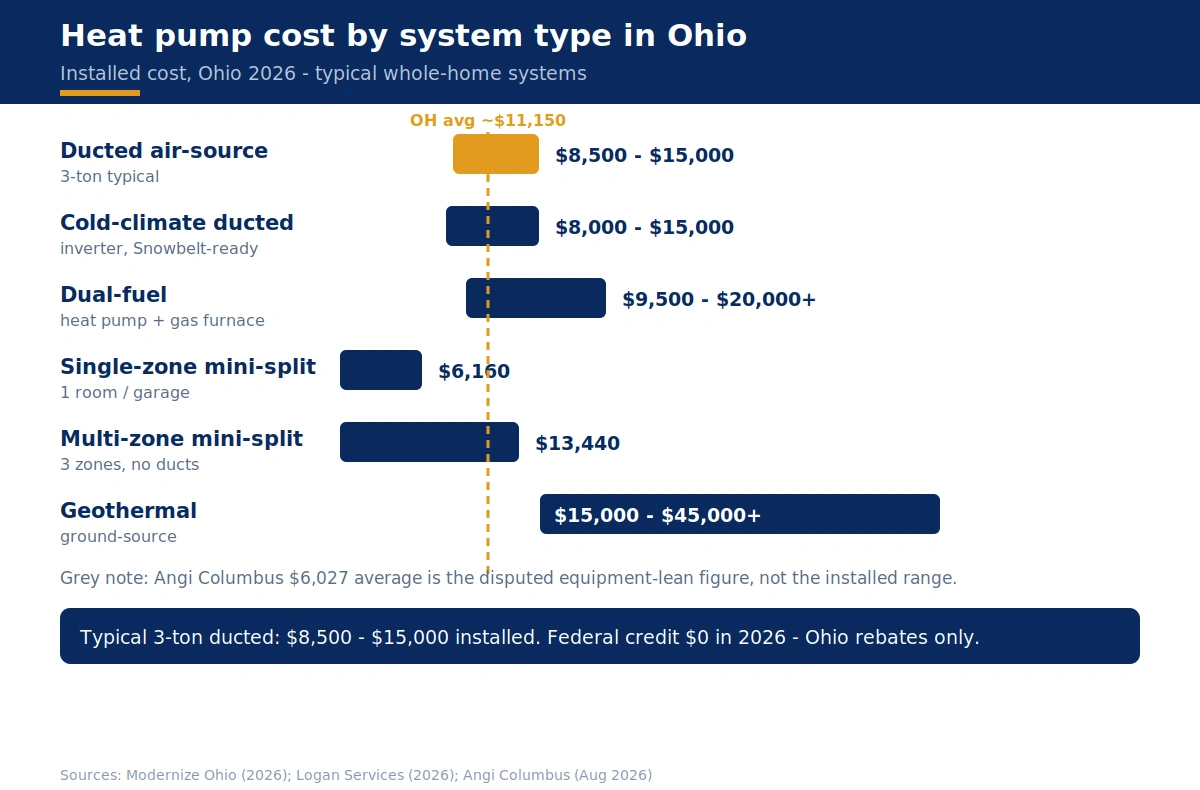
Ducted air-source is the default Ohio system. When your existing ducts are in good shape, get the quote for this system first. Modernize’s Ohio figures split the tier clearly: a standard air-source system at $8,960 against a high-efficiency system at $13,440. The high-efficiency tier means a variable-speed (inverter) system, and in Ohio that upgrade earns its keep differently than it does in the South: it is not about humidity, it is about cold. A variable-speed compressor keeps delivering heat as the outdoor temperature falls, instead of giving up and handing the job to backup strips at 30 degrees.
Mini-splits are the answer for homes without ducts. One zone at about $6,160 handles a single room, an addition, or a converted garage. A whole-home 3-zone setup runs about $13,440, and once you are spending that much, a ducted system usually wins on value wherever ducts already exist or go in cheaply. Our mini-split installation cost guide breaks down per-zone pricing in detail, and our cold-climate mini-split guide covers the inverter models that matter in Cleveland and the Snowbelt.
Dual-fuel is the Ohio answer more often than a heat-pump-only system. A heat pump paired with the gas furnace you already own costs $9,500–$20,000+ when it replaces both the furnace and the AC, and it is the only setup where the heating-cost math and the comfort math both work in a Zone 5A winter. The heat pump runs the mild hours; the furnace takes the deep cold. More on this in the dual-fuel section below.
Geothermal is the finest system money buys — and the hardest to justify on payback in Ohio. At $15,000–$45,000+ installed (Logan), with a seasonal efficiency that never drops with the air temperature, it is superb engineering. But the 30% federal geothermal credit is gone too — a $31,360 system that would have cost about $21,950 after the credit in 2025 costs the full $31,360 in 2026. With Ohio’s gas as cheap as it is, the efficiency premium over a good air-source system pays back very slowly. The real exceptions are rural homes heating with expensive propane and homeowners planning to stay put for 20 years or more.
Cost by metro area (built from the Ohio installer sources above — no single source publishes a metro table for Ohio, so treat these as guided bands, not a survey):
| Metro / Area | Ducted air-source | Mini-split, single zone | Mini-split, multi-zone (3 zones) |
|---|---|---|---|
| Cleveland / Northeast Ohio | $9,000–$15,500 | $6,000–$7,500 | $13,000–$16,000 |
| Columbus / Central Ohio | $8,500–$15,000 | $5,500–$7,000 | $12,500–$15,500 |
| Cincinnati / Southwest Ohio | $8,000–$14,000 | $5,000–$6,500 | $12,000–$15,000 |
| Dayton | $8,500–$14,500 | $5,500–$7,000 | $12,500–$15,500 |
| Toledo / Northwest Ohio | $8,500–$15,000 | $5,500–$7,000 | $12,500–$15,500 |
| Rural / small-town Ohio | $8,000–$14,000 | $5,000–$6,500 | $12,000–$15,000 |
Cleveland runs dearest because the heating load is biggest, the installs are harder in lake-effect conditions, and labor runs $84–$178 an hour statewide (Modernize, 2026). Cincinnati runs cheapest because the heating season is shortest and the design temperature is mildest. Rural Ohio can run cheaper on labor but dearer on travel and on propane-tank logistics — get the quote in writing either way.
Cost by size: the tonnage table
Square footage alone never sizes a system. The “one ton per 500–600 square feet” shortcut is a starting guess at best, never a sizing method. Right-sizing takes a Manual J load calculation — expect $200–$500 for the calculation, a fee most Ohio installers apply to the job when you hire them — which weighs insulation, windows, ceiling height, and — the part that matters most here — the winter design temperature of your corner of Ohio. An oversized system is not a safety margin. In Ohio it is the sizing mistake installers see most: it short-cycles, leaves rooms cold, and runs up the bill. An undersized system is worse in a different way: it leans on backup heat all winter, and backup heat in Ohio is expensive electric resistance at 19.38 cents a kilowatt-hour.
| Home size | Typical tonnage | Ohio installed range (ducted air-source) |
|---|---|---|
| 1,000–1,400 sq ft | 2-ton | $7,000–$11,000 |
| 1,400–1,800 sq ft | 2.5-ton | $7,500–$12,500 |
| 1,800–2,200 sq ft | 3-ton | $8,500–$15,000 |
| 2,200–2,800 sq ft | 3.5–4-ton | $10,000–$18,000 |
| 2,800–3,500 sq ft | 4–5-ton | $12,000–$22,000 |
The 3-ton row is the Ohio middle: Angi says the average Columbus home needs a 3-ton heat pump, and the $8,500–$15,000 headline range in this guide is the 3-ton band. A Cleveland home of the same square footage often needs the next size up, because its design temperature is 5 degrees against Cincinnati’s 6 and its heating degree-days run 6,351 against Cincinnati’s 4,410. Same house, different city, different tonnage — another reason a square-footage quote over the phone is worth nothing.
What the tonnage table does not include: ductwork, panel work, permits, and the furnace in a dual-fuel setup. Those are the line items that turn a $9,000 equipment quote into a $13,000 job, and they are covered in the next section.
What drives your price up or down in Ohio
Ductwork. Have good ducts? A ducted swap is straightforward. Need new ducts? Add $5,000–$10,000 (national planning range, art. 1). Ohio’s older housing stock — Cleveland bungalows, Columbus foursquares, Cincinnati Victorians — often has ducts that were sized for a furnace, not for a heat pump’s lower-temperature air. Ask for duct sealing as its own line item, and ask whether the quote assumes your existing ducts pass a leakage test.
Electrical panel. A heat pump runs on its own dedicated 240V circuit. A full panel, or one still rated at 100 amps, means budgeting $1,500–$4,000 for a 200-amp replacement. The electrical panel upgrade cost guide covers the options and the price bands in detail. One Ohio-specific note: unlike North Carolina, Ohio has no live HEAR program to pay up to $4,000 toward a panel — the panel is on you in 2026.
Efficiency tier. The national legal floor for a split-system heat pump is 14.3 SEER2 / 7.5 HSPF2. A mid-tier 15–17 SEER2 / 8.5+ HSPF2 system is the sweet spot for most Ohio homes. An 18+ SEER2 variable-speed system costs more, and in Ohio its payback concentrates in the heating season, not the cooling season — the opposite of the Southern case. Cold-climate (inverter-driven) models cost 15–30% more than standard — worth pricing everywhere north of Columbus, and near-necessary in the Snowbelt.
The furnace question. If you already have a gas furnace in working order, a dual-fuel setup reuses it as backup and saves the cost of a new furnace. If the furnace is dead too, Logan’s $9,500–$20,000+ band for replacing both systems is your range. Either way, ask the quote to show the furnace line separately from the heat pump line, so you can see what the backup heat is actually costing you.
Labor market. Ohio HVAC labor runs $84–$178 an hour (Modernize, 2026), and Angi’s Columbus page puts a pro at $115 an hour. The same equipment costs noticeably more in Cleveland and Columbus than in smaller markets, and quotes for identical systems can swing widely between contractors — which is why three quotes are non-negotiable.
Permits and tax. A Columbus mechanical permit costs $250, including two inspections (Angi, August 2026). Other Ohio cities vary — ask for the permit as a line item, and check that the contractor pulls it. Check whether quotes include sales tax: Ohio’s state base is 5.75% plus local rates, and rates vary by county. No Ohio-city-specific applied rate for heat pumps was verified, so do not assume the quote includes it.
Snowbelt and lake effect. Cleveland, Toledo, and the Snowbelt carry a cold-climate premium — harder installs, bigger equipment, longer heating seasons. The outdoor unit needs a snow stand or wall bracket so drifts do not bury it, and the defrost cycle has to actually work when the lake wind is driving snow sideways. In the Ohio River valley, none of that applies, and the install is simpler and cheaper.
Refrigerant transition. Every 2026 system ships with R-454B or R-32 inside; R-410A left new equipment on January 1, 2025. New systems carry a modest cost increase over old R-410A equipment. A 2026 quote for a “new” R-410A unit is selling you last-generation stock — ask what refrigerant is actually in the box.
Home age and insulation. Ohio’s housing stock is old, and an old house with thin walls and leaky ducts needs a bigger system than a new build of the same size. Money spent on air sealing and insulation before the install shrinks the system you need — and in Ohio, where the heating season is long, that saving compounds every winter for the life of the equipment.
Ohio’s climate: real winters, lake-effect snow, and the cold-climate question
The key insight: Ohio’s load is heating-dominated, and the north of the state is a different climate from the south. Cleveland accumulates 6,351 heating degree-days (base 65F) against Columbus’s 5,660 and Cincinnati’s 4,410. Toledo, at 6,494, carries the heaviest heating load of any Ohio metro in this guide. For comparison, Charlotte — the mildest city in our North Carolina guide — sits at 3,181. Cleveland’s winter is roughly twice Charlotte’s, and that gap is the whole story of Ohio heat pump sizing.
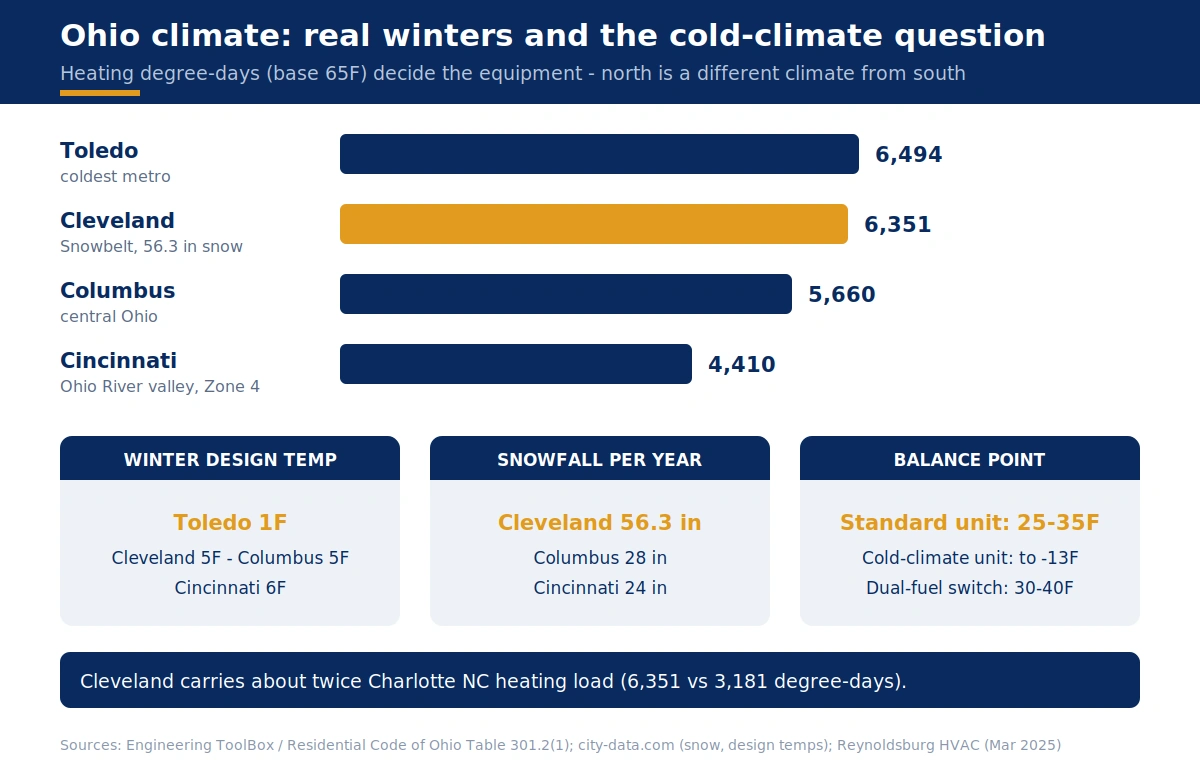
Regional variation inside the state matters more than the state average. In the Snowbelt (Cleveland, Toledo, Youngstown, Akron-Canton), January means run near freezing, design temperatures sit at 1–6 degrees, and Cleveland averages 127 days a year at or below 32 degrees with 56.3 inches of snow. Standard heat pumps still work here, but backup heat runs often, and cold-climate/inverter models and dual-fuel are worth pricing on every job. In Central Ohio (Columbus, Dayton), January means are a few degrees milder, design temperatures are 4–5 degrees, and Columbus averages 124 days at or below freezing with 28 inches of snow — a cold-climate heat pump handles most heating hours without backup, but the backup still matters. In the Ohio River valley (Cincinnati), winters are the mildest in the state: 4,410 heating degree-days, 99 days at or below freezing, 24 inches of snow, and a Zone 4 climate instead of Zone 5A. Standard equipment is the right default there, and dual-fuel is a choice, not a necessity.
The balance point is the number to understand before you buy. A standard heat pump’s balance point — the outdoor temperature below which it can no longer heat the house efficiently without help — sits around 25–35 degrees. Columbus averages 27 days a year below 32 degrees and sees lows in the single digits during polar-vortex events, with roughly 20–30 days a year below 20 degrees and 40–60 days a year below 40 degrees (Reynoldsburg HVAC, March 2025; Fire & Ice, Columbus). That means a standard system in Central Ohio spends a meaningful slice of every winter on backup heat. Cold-climate heat pumps change the equation: modern inverter units from Mitsubishi, Bosch, and others hold meaningful heating capacity down to -13 degrees or below, with strong efficiency down to 0 degrees. For Ohio’s climate specifically, a cold-climate unit can now handle the vast majority of heating hours without backup heat (Reynoldsburg HVAC, March 2025).
Snow is an equipment problem, not just a weather problem. A ground-level outdoor unit in Cleveland can end up buried in a drift, and a buried unit cannot move air. Ask for a wall bracket or a snow stand, and make sure the defrost cycle is set up for lake-effect conditions rather than a mild-climate default. Cleveland is also the windiest of Ohio’s big cities, averaging 11 mph, which drives snow into places a sheltered unit would never see it.
The efficiency ratings that matter in Ohio. Under the DOE’s 2023 standards, a split-system heat pump sold in the North must hit at least 14.3 SEER2 for cooling and 7.5 HSPF2 for heating. SEER2 has been the rating standard since 2023, so a SEER2 number and an old SEER number do not compare directly. ENERGY STAR split-system minimums are 15.2 SEER2 / 7.8 HSPF2. To convert HSPF2 to a seasonal COP, divide by 3.412: the 7.5 HSPF2 minimum is a seasonal COP of about 2.2, and a good cold-climate Ohio unit at 8.5 HSPF2 runs a seasonal COP near 2.5. In Ohio, HSPF2 is the rating that decides your winter bill — SEER2 decides your summer bill, and Ohio summers are short. Spend the upgrade money on heating performance first.
Heat pumps are still uncommon in Central Ohio — and that tells you something. Fire & Ice, a Columbus installer, reports heat pumps are only 15–20% of its sales against air conditioners. Most Central Ohio homes heat with gas, and most homeowners replacing a system default to what they already have. That is not proof heat pumps fail in Ohio. It is proof the gas default is strong, the rebate map is empty, and no one has made the dual-fuel case to most homeowners yet. This guide is that case.
The federal tax credit is $0 in 2026 — what that means
The §25C credit is dead for 2026. It used to pay 30% of a heat pump’s cost, up to $2,000 a year, but the One Big Beautiful Bill Act (P.L. 119-21, signed July 4, 2025) ended it for any system placed in service after December 31, 2025, and IRS FS-2025-05 (August 21, 2025) confirms the termination. A heat pump installed in 2026 gets $0 federal credit, regardless of when the equipment was ordered or the contract was signed. A 2025 install can still be claimed on the 2025 return, filed in early 2026 — but that window is closed for anyone buying now.
Geothermal’s 30% §25D credit ended on the same date. A $31,360 geothermal system that would have cost about $21,950 after the credit in 2025 costs the full $31,360 in 2026. There is no lease workaround for heat pumps either: the §48E pass-through reaches leased solar panels, never a heat pump.
Plenty of high-ranking pages still show heat pump prices with a tax credit already subtracted. Treat those as outdated. The Cincinnati AnyWeather guide (February 9, 2026) still tells readers “the federal government currently offers tax credits of up to $2,000 for qualifying heat pump installations.” The Sears Heating & Cooling Ohio page (published November 14, 2025) still claims 2026 credits are “fully stackable” and that a $12,000 heat pump nets roughly $8,000 after all incentives. Both are wrong for 2026 installs. Every price in this guide is the price you actually pay, less only the small Ohio rebates in the next section. Our federal energy tax credits guide carries the full 2026 picture.
What $0 means for the quote in your hand: there is no line on a 2026 quote that should subtract a federal credit. If one does, the contractor is using dead law, and the quote needs correcting before you sign anything. The same check applies to any article or calculator that shows you a price “after the tax credit” — in Ohio in 2026, there is no after.
Ohio rebates in 2026: the thinnest map in the Midwest
Here is the honest Ohio rebate map, and it is short. If you live in North Carolina, Duke Energy pays $500–$1,000 and the state HEAR program pays up to $8,000. If you live in Ohio, the big utilities pay nothing, the state program has not opened, and the biggest check in the state is $750 — available only to a small slice of homeowners.
The big investor-owned utilities: $0. Ohio House Bill 6, passed in 2020, ended the energy-efficiency programs of the big investor-owned utilities. AEP Ohio, Duke Energy Ohio, and AES Ohio no longer offer heat pump rebates (Watkins Heating, 2026). Duke Energy’s Smart $aver program — the one that pays $500–$1,000 in North Carolina and Indiana — does not operate in Ohio. Do not import Duke’s North Carolina or Indiana figures into an Ohio quote. CenterPoint Energy, which served Dayton and northern Cincinnati, discontinued its rebate program on November 1, 2024. Since October 1, 2026, AEP Ohio has gone by the name Ohio Power Company — the rename came with no rate change and no new rebate.
The $249 million that never arrived. Ohio was awarded about $249 million in federal HEAR and HOMES rebate money under the Inflation Reduction Act. As of November 4, 2026, Ohio’s Home Energy Savings page still says the program is awaiting DOE approval — the application was submitted November 12, 2024, and nothing has opened since. HEAR was expected to offer up to $8,000 for a heat pump when it opens. It has not opened. Do not sign a contract that depends on it. For scale: as of October 27, 2026, only 12 states plus DC had launched these programs at all, and only 7 of those listed open heat pump rebates. Ohio is one of the 38 jurisdictions where HEAR has never launched for homeowners. Cincinnati’s Green Bank noted in October 2025 that Ohio’s program had received conditional approval and hoped for a launch in late 2025 or early 2026. A year later, it still had not launched. One more wrinkle, moot for Ohio today but worth knowing: since September 1, 2026, DOE Program Notice 26-2 means HEAR no longer pays to replace gas, propane, or oil heat anywhere — electric-to-electric upgrades only.
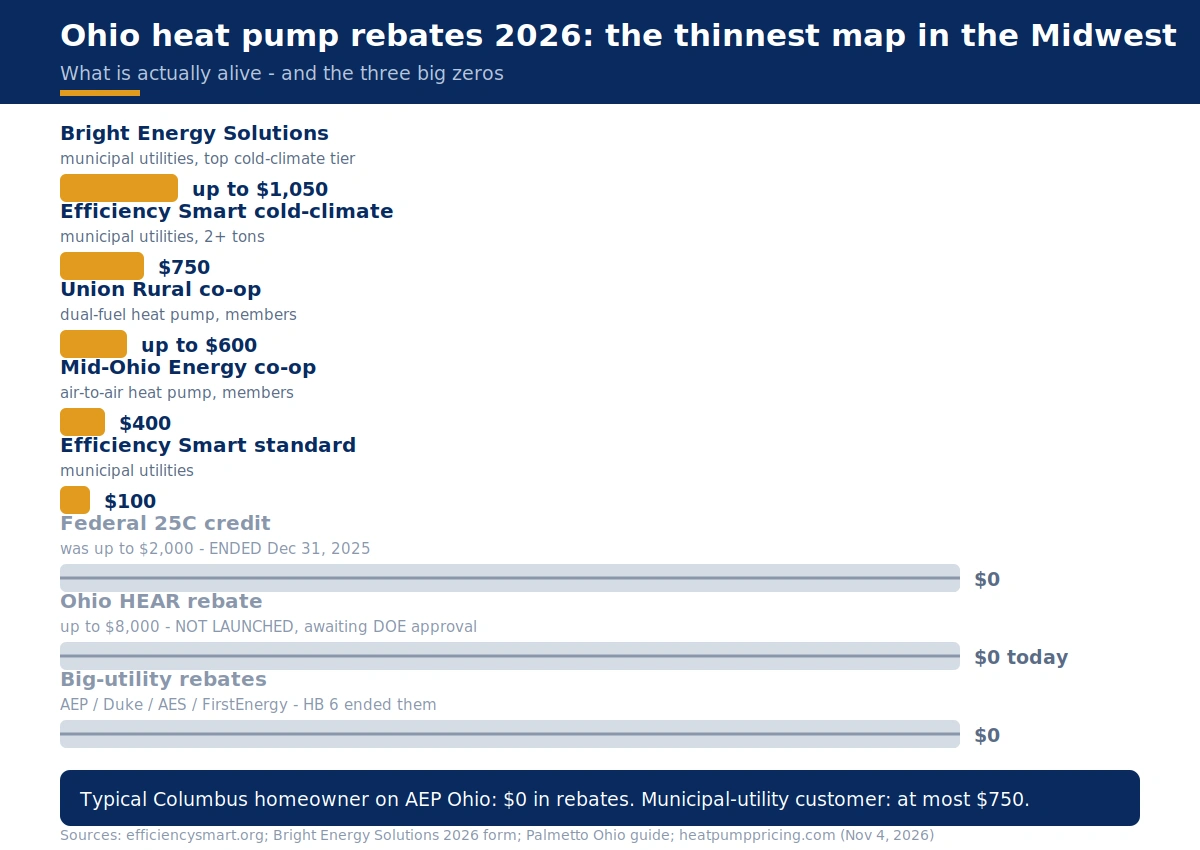
What is actually alive in Ohio in 2026:
| Program | Who qualifies | Value |
|---|---|---|
| Efficiency Smart (cold-climate air-source heat pump) | Customers of participating municipal electric utilities only | $350 (<2 tons) or $750 (2+ tons) |
| Efficiency Smart (standard air-source heat pump) | Participating municipal utility customers | $100 |
| Efficiency Smart (heat pump water heater) | Participating municipal utility customers | $300 |
| Bright Energy Solutions (2026 form, municipal utilities) | Customers of participating utilities | Air-source $150/unit; cold-climate premier $350/unit; cold-climate mini-split $400/outdoor unit; highest cold-climate tier up to $1,050/unit |
| Union Rural Electric Cooperative | Co-op members | Dual-fuel heat pump up to $600; heat pump water heater $400 |
| Mid-Ohio Energy Cooperative | Co-op members | Air-to-air heat pump $400; geothermal $800 |
| Midwest Electric | Co-op members | Bill credits (amounts not published) |
| North Western Electric Cooperative | Co-op members | Rebates, amounts vary (not published) |
| AEP Ohio HELP program | Income-qualified AEP customers after a home energy assessment; heat pump replaces an existing heat pump or electric heat only — NOT a working gas system | Equipment provided via the program, not a cash rebate |
| ECO-Link (Ohio Treasurer) | Ohio homeowners with a qualifying bank loan, primary residence | Up to 3% interest-rate reduction on loans up to $50,000 (5 years, or 7 years above $25,000) — cheaper financing, not a rebate |
Efficiency Smart’s rebates are real money — $750 for a cold-climate unit of two tons or more, with a limit of two per year and applications due within three months of purchase — but they reach only customers of participating municipal electric systems. If your power comes from AEP, Duke, AES, or FirstEnergy, they do not reach you. The co-op rebates reach co-op members in rural Ohio. The AEP HELP program is a direct-install measure for assessed, income-qualified homes, and it will not replace a working gas furnace with a heat pump. ECO-Link is the one statewide tool that reaches almost everyone: a 3% rate cut on a home-improvement loan up to $50,000, through a participating bank, for an Ohio primary residence. It is financing help, not a rebate — but on an $11,000 job financed over five years, a 3% cut is worth real money.
Worked reality: a typical Columbus homeowner on AEP Ohio gets $0 in heat pump rebates in 2026. A homeowner on a participating municipal utility gets at most $750. A co-op member gets $400–$600. That is the whole map. Palmetto’s Ohio guide (2026) states it plainly: Ohio’s confirmed 2026 options are utility-specific co-op and participating municipal-utility rebates, and no statewide HEAR or HOMES rebate was confirmed active. Budget on the quoted price, full stop — and treat any rebate as a bonus you verify on the program’s own page before counting it.
One warning about a bad source. The Sears Heating & Cooling page on Ohio HVAC tax credits claims AEP Ohio pays “$500 base for heat pumps” and Columbia Gas pays “$750 for 97% modulating furnaces,” plus an extra $800 for low-income households. It also claims the §25C credit is alive in 2026. Every one of those claims conflicts with the HB 6 record, the DOE/IRS record, and every 2026 tracker we checked. Do not use any figure from that page.
Ohio electricity and gas rates: what a heat pump costs to run
Two numbers decide whether a heat pump saves you money in Ohio, and they point in opposite directions. Electricity is dear. Gas is cheap. That tension is the whole running-cost story.
Electricity. The EIA’s all-in Ohio residential average is 19.38 cents per kilowatt-hour (Electric Power Monthly, Table 5.6.A, August 2026), against a US average of 18.16 cents. That all-in figure is what lands on the bill — supply plus delivery, transmission, riders, and the kilowatt-hour tax. The “Price to Compare” figures the utilities publish are supply only: AEP Ohio (now Ohio Power Company) 10.19 cents (October 1–December 31, 2026), Duke Energy Ohio 10.49 cents (October 2026), AES Ohio 10.86 cents (June 2026–May 2027), and the three FirstEnergy utilities — Ohio Edison, The Illuminating Company, Toledo Edison — around 10.9–11.2 cents (PUCO Energy Choice Ohio, November 2026). Do not mix the two numbers. A quote or article that prices heat pump running costs at 10 cents a kilowatt-hour is using the supply-only figure and understating the bill by roughly half. This guide uses the all-in 19.38 cents for every running-cost calculation below.
Gas. Residential gas in Ohio runs about $1.24–$1.35 a therm, all-in (town-level rate pages, 2026). The supply-only side is cheaper still: NOPEC’s seasonal rate for Columbia Gas of Ohio is $0.635 per Ccf from June to December 2026, and $0.485 a therm for Enbridge Gas Ohio (formerly Dominion Energy Ohio). This guide uses about $1.30 a therm, all-in, as a planning figure and says so plainly — the town-level source is a low-authority aggregator, so treat the figure as approximate. Ohio’s gas utilities are Columbia Gas of Ohio (central and southern Ohio), Enbridge Gas Ohio (northeast, including Cleveland), Duke Energy Ohio (Cincinnati gas and electric), and the Dayton-area gas territory formerly served by CenterPoint.
The per-therm arithmetic — check it yourself. One therm of heat equals 29.3 kilowatt-hours of heat energy. At a seasonal COP of 2.5 — a good cold-climate unit at about 8.5 HSPF2 — a heat pump needs 11.7 kilowatt-hours per therm of heat, which at 19.38 cents costs $2.27 per therm of delivered heat. A new 95% gas furnace delivers a therm of heat for $1.30 divided by 0.95, or $1.37. An old 80% furnace delivers it for $1.63. Electric strip heat, at a COP of 1.0, delivers it for $5.68. The conclusion is unavoidable: at 2026 Ohio rates, heat-pump heat costs more than gas-furnace heat. It costs less than half as much as strip heat. The sensitivity holds even if gas were $1.50 a therm — the furnace would deliver heat for $1.58, still well under the heat pump’s $2.27. Only a much cheaper electric rate or much dearer gas flips the comparison, and neither is on Ohio’s 2026 horizon.
What that means per year. For a typical 2,000-square-foot Ohio home with an annual delivered heating load of 55 MMBtu (550 therms of heat) — a planning figure, not a metered average — the modeled annual heating costs are: heat pump at COP 2.5, about $1,249 a year; new 95% gas furnace, about $753; old 80% gas furnace, about $894; electric strip or baseboard heat, about $3,123. A Reynoldsburg installer’s estimate of $900–$1,400 a year to heat with a cold-climate heat pump (March 2025) lands in the same band as this model’s $1,249, which is a useful cross-check. Cooling is a wash: a heat pump cools at the same efficiency as an air conditioner of the same SEER2, so the summer bill is no different from a new AC. Our heat pump running cost guide covers the national picture in more depth.
Heat pump vs gas furnace in Ohio: the honest comparison
Most Ohio heat pump articles dodge this comparison, or they answer it with national averages. Here is the Ohio answer, with the numbers shown.
Against a new 95% gas furnace, the heat pump loses on heating cost. The model in the last section puts the heat pump at about $1,249 a year against the new furnace’s $753 — roughly $496 a year more expensive to heat with. Upfront, the heat pump at $8,500–$15,000 is also dearer than a furnace alone at $2,500–$6,000 (Ohio HVAC Pros, 2026). But that is the wrong comparison, because a furnace does not cool. The fair upfront comparison is the heat pump against a furnace plus a separate air conditioner: $2,500–$6,000 for the furnace plus $3,500–$7,500 for the AC, or $6,000–$13,500 combined — roughly a wash against the heat pump’s $8,500–$15,000, with one system to maintain instead of two. The heat pump’s case against a new furnace is comfort, single-system simplicity, and cooling — not heating savings. Say it plainly to any contractor who claims otherwise.
Against an old 80% furnace, the heat pump still loses on heating cost alone — by about $355 a year. The case here is the same as above, plus the avoided cost of replacing a dying furnace and a dying AC separately. If both are near the end of their lives, one heat pump replaces two systems in one job, with one install, one warranty, and one maintenance visit a year.
Against electric strip heat or baseboards, the heat pump wins by a landslide. About $1,249 a year against about $3,123 — roughly $1,874 a year in heating savings. This is the one Ohio scenario where a heat pump is a slam-dunk financial decision on heating alone. Older all-electric homes, especially in the Snowbelt where strip heat is common, should treat a heat pump as the first upgrade to price. The AEP HELP program is aimed squarely at these homes, too — it replaces existing electric heat, not working gas systems.
Against propane, the heat pump wins as well. Propane in rural Ohio runs far dearer per unit of heat than pipeline gas, and the gap against a heat pump at COP 2.5 is wide. No Ohio-specific propane price was verified for this guide, so no dollar figure is claimed here — but the direction is not in doubt, and it is the reason geothermal’s best Ohio case is a propane-heated rural home.
The comfort comparison matters too, and it cuts both ways. A heat pump delivers cooler supply air than a furnace — typically 90–110 degrees against a furnace’s 120–140. In a Zone 5A January, that can feel drafty in a leaky older home, especially if the system is undersized and the backup strips are cycling. A variable-speed system fixes most of this: it runs long, slow cycles that hold the temperature steady instead of blasting hot air and then shutting off. If comfort in deep cold is your worry, price the variable-speed tier and the dual-fuel setup before you price the basic single-stage box.
The bottom line for the comparison: in Ohio, buy a heat pump for the cooling, the single system, and the strip-heat savings — or buy it as half of a dual-fuel pair. Do not buy it expecting your heating bill to fall against a gas furnace. It will not, at 2026 Ohio rates. Our heat pump vs furnace cost guide covers the national version of this comparison.
Dual-fuel and geothermal: when they make sense in Ohio
Dual-fuel is the setup this guide recommends for most Ohio homes that already have gas. A heat pump paired with a gas furnace switches to gas below the programmed point — typically 30–40 degrees — and the heat pump handles the mild hours. In Ohio’s climate the heat pump typically covers 70–75% of heating hours while the gas furnace covers the coldest 25–30% (Reynoldsburg HVAC, March 2025; Ohio HVAC Pros, 2026). That split is what makes the math work: the heat pump runs when its COP is 3.0 or better, and gas takes over exactly when the heat pump’s efficiency falls and its cost per therm of heat rises above gas. Logan’s band for replacing both furnace and AC with a heat pump — $9,500–$20,000+ — covers dual-fuel territory, and a homeowner whose furnace still has life in it pays less, since the furnace stays. Our dual-fuel heat pump cost guide breaks down the configuration in detail.
Three questions decide whether dual-fuel is right for your house. First, is your furnace in decent shape? A furnace with five or more good years left is a free backup system — keep it. Second, is your gas cheap and your electricity dear? In Ohio, yes on both counts, which is exactly the dual-fuel profile. Third, do you want one system or two? Dual-fuel is two systems to maintain, but each one runs in the conditions where it is cheapest. For a Cincinnati home, dual-fuel is a choice. For a Cleveland home, it is close to the default.
Geothermal is the finest system money buys — and the hardest to justify on payback in Ohio. Modernize puts an Ohio geothermal install at $31,360; Logan’s band is $15,000–$45,000+. A closed-loop system needs no state permit in Ohio, but a city or county permit is required (Apex Pros, Central Ohio). Labor can run up to 70% of the job, because the ground loop is the job. The 30% §25D credit is gone, so the full price lands on the homeowner in 2026. With Ohio gas at about $1.30 a therm, the efficiency premium over a good air-source system pays back very slowly. The genuine exceptions are rural homes heating with expensive propane, where the savings are large enough to matter, and homeowners planning to stay 20 years or more, who will live long enough to collect the savings. No Ohio-specific loop-installation cost for clay soils was verified, so this guide claims no soil premium either way. Our geothermal heat pump cost guide covers the national numbers.
Payback math: when an Ohio heat pump pays for itself
The model below uses the $11,150 average installed job (Modernize Ohio), the running-cost figures from the rates section, and a 12–15 year heat pump lifespan. Rebates are $0 for the typical AEP, Duke, AES, or FirstEnergy customer and $750 at most for a municipal-utility customer. All figures are labeled as a model — the per-therm comparison is arithmetic, the annual dollars scale with the assumed 55 MMBtu heating load.
| Scenario | Net cost | Annual heating saving | Simple payback |
|---|---|---|---|
| Strip-heat home to heat pump ($0 rebate) | $11,150 | ~$1,874/yr | ~6 years |
| Strip-heat home to heat pump (Efficiency Smart, $750 rebate) | $10,400 | ~$1,874/yr | ~5.5 years |
| Old 80% gas furnace to heat pump (heating only) | $11,150 | -$355/yr (costs more) | Never on heating alone |
| New 95% gas furnace to heat pump (heating only) | $11,150 | -$496/yr (costs more) | Never on heating alone |
| Dual-fuel (heat pump + existing gas furnace kept) | ~$9,500–$15,000 | Blended — heat pump hours save, gas hours cost the same | Payback via the avoided AC replacement, not heating savings |
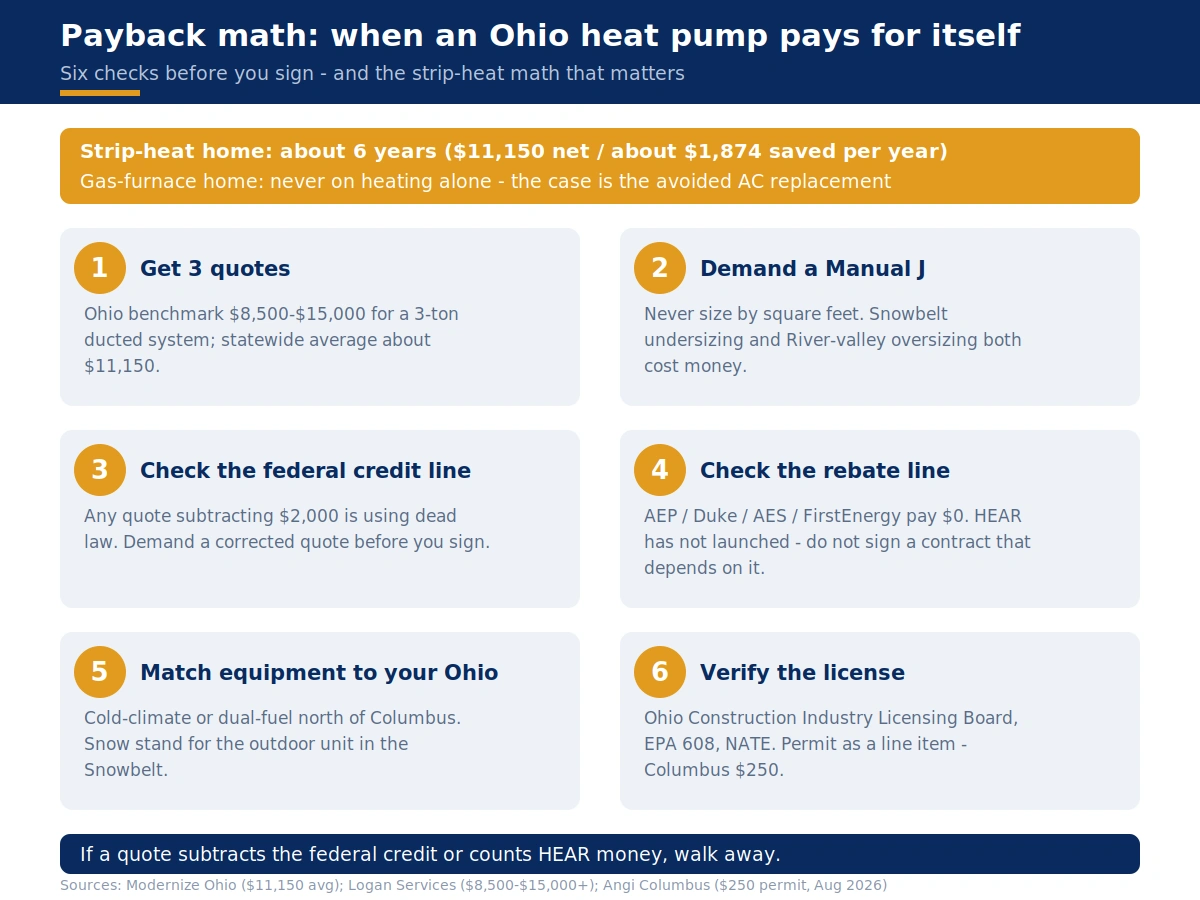
The honest headline: in Ohio, a heat pump pays for itself fast only when it replaces electric resistance heat. Against gas heat it is a comfort, cooling, and single-system decision, not a heating-savings decision. That sentence is the most useful one in this guide, and it is the one most Ohio heat pump pages will not print.
Two more payback notes. First, the cooling side counts: a heat pump that replaces a dying air conditioner as well as a dying furnace avoids a $3,500–$7,500 AC purchase, and that avoided purchase is real payback even though it never shows up on the heating bill. Second, financing changes the shape of the payback even when it cannot change the total: ECO-Link’s 3% rate cut on a loan up to $50,000 lowers the monthly cost of an $11,000 job, and Logan and other Ohio installers offer financing of their own. Cheaper financing does not make a bad heating case good — but it does make a good strip-heat case easier to say yes to.
How to get quotes in Ohio + red flags
Get three quotes. That advice is generic; the Ohio version of it is specific, because the Ohio market has specific traps.
- Get three quotes, and make them comparable. The Ohio benchmark is $8,500–$15,000 for a 3-ton ducted system, with the statewide average near $11,150. A quote far below that band should prompt the same question as a quote far above it: what is different about the scope?
- Demand a Manual J load calculation. Never size by square footage. In Ohio, the sizing mistake that costs the most is undersizing for the Snowbelt or oversizing for the River valley — either way, the system short-cycles or leans on backup strips all winter. Expect a $200–$500 fee for the calculation, usually applied to the install price when you hire that contractor.
- Check the federal credit line. Any quote subtracting $2,000, or 30%, for a 2026 install is using dead law. Demand a corrected quote before you sign.
- Check the rebate line against the real map. AEP Ohio, Duke Energy Ohio, AES Ohio, and FirstEnergy pay $0 for heat pumps in 2026 — HB 6 ended those programs. The only live rebates are Efficiency Smart ($100–$750, municipal customers), the co-ops ($400–$600), and Bright Energy Solutions ($150–$1,050, municipal customers). If a quote claims a $500 AEP rebate or a $750 Columbia Gas rebate, it is wrong.
- Do not sign a contract that depends on the $8,000 HEAR rebate. Ohio’s HEAR/HOMES program has not launched. It was awarded about $249 million and has been awaiting DOE approval since November 2024. It may open one day. It is not open now.
- Match the equipment to your corner of Ohio. A Cleveland or Toledo home needs a cold-climate or dual-fuel conversation; a Cincinnati home usually does not. Ask the contractor what the balance point is for the system they are quoting, and what happens on a 5-degree night.
- Ask about the snow plan. In the Snowbelt, the outdoor unit needs a snow stand or wall bracket, and the defrost cycle needs to be set for lake-effect conditions. If the contractor has no snow plan for a Cleveland install, find one who does.
- Verify the license. Ohio requires HVAC contractors to be licensed by the state through the Ohio Construction Industry Licensing Board. Check the license, check that the installer is EPA 608-certified for refrigerant work, and ask for NATE certification. The permit must be a line item — Columbus charges $250 including two inspections — and the contractor pulls it.
- Ask which refrigerant the quote uses. New 2026 systems run R-454B or R-32. A “new” R-410A system in 2026 is old stock and should be priced accordingly.
- Ask whether the quote includes sales tax. Ohio’s state base is 5.75% plus local rates, and whether a quote includes it varies. A quote that looks $600 cheaper than the others may simply be the one that left the tax out.
If a quote still subtracts the federal credit, counts HEAR money for a 2026 Ohio install, or claims a big-utility rebate that HB 6 ended, walk away. The contractor is either working from outdated information or hoping you are. Either way, that is not the contractor to trust with an $11,000 install in a Zone 5A winter.
Sources & methodology
Every price in this guide is an installed price unless labeled otherwise, and every price is the price the homeowner actually pays in 2026 — the federal credit is $0, and Ohio rebates are $0 for most homeowners. Sources were checked in November 2026. Installer quotes come from Ohio contractors: Logan Services (Dayton, Columbus, Cincinnati; heat pump replacement $8,500–$15,000+, updated October 13, 2026), Reynoldsburg HVAC (Columbus area; cold-climate $8,000–$15,000, March 2025), AnyWeather HVAC (Cincinnati; $5,000–$12,000, February 9, 2026), HonestFix (Toronto, Ohio; $11,880–$24,225 matched system, 2026–2027 guide), and Fire & Ice (Columbus; heat pumps 15–20% of sales). Aggregator figures come from Modernize (Ohio average $11,150; standard $8,960; high-efficiency $13,440; single-zone mini-split $6,160; multi-zone $13,440; geothermal $31,360; labor $84–$178/hr; 2026), Angi (Columbus average $6,027, updated August 4, 2026 — flagged in the article as equipment-lean and not used as the anchor), Manta (county averages $5,918–$6,816, excluding permits and contractor fees), and HomeServiceCost (Ohio heat pump installation $5,022–$12,053, 2026).
Electricity rates come from the EIA Electric Power Monthly, Table 5.6.A (Ohio residential all-in 19.38 cents/kWh, August 2026) and the Public Utilities Commission of Ohio’s Energy Choice Ohio Price to Compare listings (AEP Ohio 10.19 cents, Duke Energy Ohio 10.49 cents, AES Ohio 10.86 cents; November 2026). Gas rates come from NOPEC residential pricing (Columbia Gas $0.635/Ccf supply, Enbridge $4.85/Mcf supply; June–December 2026) and town-level all-in figures of $1.24–$1.35 a therm; the $1.30 all-in planning figure is an approximate synthesis and is labeled as such. Climate data comes from the Engineering ToolBox heating degree-day table and the Residential Code of Ohio Table 301.2(1) (Cleveland 6,351; Toledo 6,494; Columbus 5,660; Dayton 5,622; Cincinnati 4,410), with design temperatures and snowfall from city-data.com and the International Plumbing Code appendix.
Rebate status comes from the Ohio Department of Development’s Home Energy Savings page (HEAR/HOMES not launched, awaiting DOE approval since the November 12, 2024 application), verified against heatpumppricing.com (November 4, 2026) and startbusinessbystate.com (October 6, 2026); from Efficiency Smart’s published rebate pages (cold-climate $350/$750, standard $100, water heater $300); from the Bright Energy Solutions 2026 residential HVAC form (V5.0); from Palmetto’s Ohio guide (co-op rebates, 2026); from Watkins Heating on HB 6 and the §25C termination; and from the AEP Ohio HELP program materials (May/June 2026) and the Ohio Treasurer’s ECO-Link program (3% rate reduction, loans to $50,000).
Federal framing comes from the One Big Beautiful Bill Act (P.L. 119-21, signed July 4, 2025) and IRS FS-2025-05 (August 21, 2025). The running-cost and payback figures are our own model, with assumptions stated in the article: a 2,000-square-foot home, 55 MMBtu of annual delivered heat, a seasonal heat-pump COP of 2.5, electricity at 19.38 cents/kWh all-in, and gas at about $1.30 a therm all-in. The per-therm comparison ($2.27 heat pump vs $1.37 new furnace vs $1.63 old furnace vs $5.68 strip heat) is arithmetic from those rates and that COP; the annual dollar figures scale with the assumed heating load. Where a figure could not be verified — the gas all-in rate, CenterPoint rebates, Ohio clay-soil loop costs, the applied sales-tax rate, and the Sears page’s claims — the research file flags it in the less-than-certain section, and the article either labels it approximate or leaves it out. The national heat pump cost guide is the baseline this state guide builds on.
How much does a heat pump cost in Ohio in 2026?
$8,500–$15,000 installed for a typical whole-home ducted system (3-ton), with the statewide average job at about $11,150 (Modernize, 2026). Single-zone mini-splits run about $6,160, multi-zone systems about $13,440, and geothermal $15,000–$45,000+. The federal credit is $0 for 2026 installs.
Is there a federal tax credit for heat pumps in Ohio in 2026?
No — $0. The §25C credit paid 30%, capped at $2,000 a year for a heat pump, until it ended for property placed in service after December 31, 2025 (OBBBA, P.L. 119-21; IRS FS-2025-05). Geothermal’s §25D credit ended on the same date. You can still claim a 2025 install on the 2025 return — a 2026 install earns nothing. No lease workaround exists for heat pumps: the §48E pass-through reaches leased solar only.
What rebates are available for heat pumps in Ohio in 2026?
Almost none for most homeowners. AEP Ohio, Duke Energy Ohio, AES Ohio, and FirstEnergy pay $0 — House Bill 6 ended their efficiency programs. Efficiency Smart pays up to $750 for a cold-climate heat pump, but only to customers of participating municipal utilities. Electric co-ops pay $400–$600 to members. Ohio’s $249 million in federal HEAR/HOMES money has not launched — the program is still awaiting DOE approval. ECO-Link offers cheaper financing, not a rebate: up to a 3% rate cut on home-improvement loans up to $50,000.
Is Ohio’s $8,000 HEAR heat pump rebate available yet?
No. Ohio was awarded about $249 million in federal HEAR and HOMES money, but the state’s Home Energy Savings page still says it is awaiting DOE approval (application submitted November 12, 2024; verified November 4, 2026). When it opens, HEAR is expected to offer up to $8,000 for a heat pump. Do not sign a contract that depends on it — and note that since September 1, 2026, HEAR no longer pays to replace gas, propane, or oil heat anywhere in the country.
Do heat pumps work in Ohio winters?
Yes, with the right equipment. A standard heat pump’s balance point sits around 25–35 degrees, and Columbus sees 27 days a year below freezing with single-digit lows in polar-vortex events — so a standard system leans on backup heat often. Cold-climate inverter units hold meaningful heating capacity down to -13 degrees, and dual-fuel setups let a gas furnace take the deep cold while the heat pump runs the mild hours. In the Snowbelt, ask for a snow stand or wall bracket so drifts do not bury the outdoor unit.
Heat pump vs gas furnace in Ohio — which is cheaper to run?
The gas furnace, on heating alone. At 2026 Ohio rates — 19.38 cents a kilowatt-hour all-in for electricity against about $1.30 a therm for gas — a heat pump at a seasonal COP of 2.5 delivers a therm of heat for $2.27, while a new 95% furnace delivers it for $1.37 and an old 80% furnace for $1.63. The heat pump wins big only against electric strip heat ($5.68 a therm), saving about $1,874 a year. The honest case for a heat pump in a gas-heated Ohio home is the air conditioning it replaces and the single system, not heating savings.
What size heat pump do I need in Ohio?
The average Columbus home needs about a 3-ton system, but never size from square footage alone. A Manual J load calculation ($200–$500, often credited toward the install) weighs insulation, windows, ceiling height, and your city’s winter design temperature — 1 degree in Toledo, 5 in Cleveland and Columbus, 6 in Cincinnati. A Cleveland home of the same size as a Cincinnati home often needs the next size up. Undersizing means expensive backup heat all winter; oversizing means short-cycling and cold rooms.
When does a heat pump pay for itself in Ohio?
About 6 years when it replaces electric strip heat — an $11,150 average job saving about $1,874 a year in heating, or about 5.5 years for a municipal-utility customer who claims the $750 Efficiency Smart rebate. Against a gas furnace it never pays back on heating alone, because heat-pump heat costs more than gas heat at 2026 Ohio rates. In a gas home the payback comes from the air conditioner the heat pump replaces ($3,500–$7,500) and from running one system instead of two.