


Table of Contents
Arizona is the easiest state in America to make the case for a heat pump — and the hardest state to price one honestly. The case is easy because Phoenix barely has a winter: about 1,765 heating degree days a year, against 111 days at or above 100°F. A heat pump’s heating job in the Valley is a few dozen chilly mornings. Its cooling job is five months of survival. The pricing is hard because the numbers online disagree by thousands of dollars, several top-ranking pages still subtract a federal credit that ended on December 31, 2025, and your rebate depends entirely on which side of the APS/SRP boundary your house sits on.
This guide gives you the 2026 Arizona numbers with sources and dates, the rebate rules as they actually stand in November 2026, and the desert-specific buying advice — which efficiency rating matters, which system type fits your house, and when the math works.
Compare with the national heat pump cost guide for the US baseline, and with our Arizona solar cost guide if you are weighing a heat pump against solar panels — the two share the same APS/SRP rate structures.
How much does a heat pump cost in Arizona in 2026?
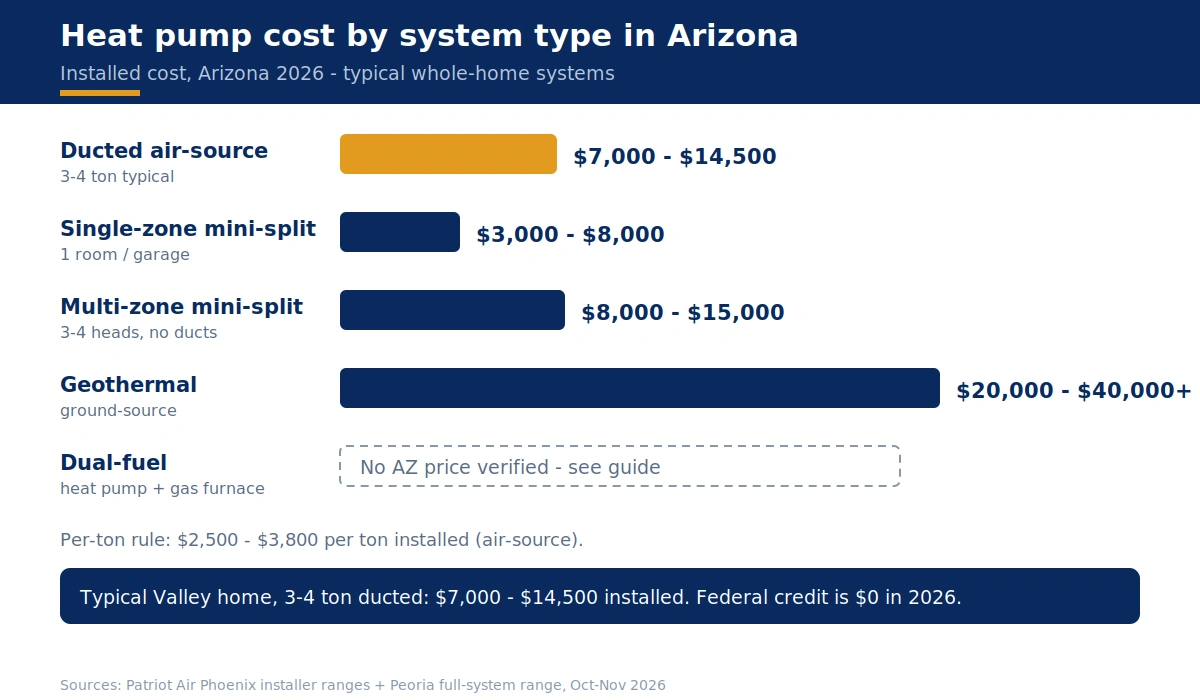
The defensible 2026 Arizona answer: $7,000–$14,500 installed for a typical whole-home ducted air-source heat pump (3–4 ton). That range is anchored on Phoenix installer market ranges published in November 2026 — 3 to 3.5 ton systems at $7,000–$11,500, 4 ton at $8,000–$13,000, 5 ton at $10,000–$15,000 (Patriot Air, Phoenix) — and a Peoria full-system range of $7,800–$15,000 (full HVAC replacement $7,800–$15,500, average around $10,800) (October 2026).
Two labor-adjusted state models agree with the low end: TryDun puts Arizona at $6,300–$11,650 (August 2026, modeled from Bureau of Labor Statistics wage data plus typical equipment pricing), and NumeralQ at $6,490–$10,890 (November 2026, about 1% below the national figure). Angi’s Phoenix page gives a lower average — $6,088, range $4,801–$7,376 (August 2026) — but those figures read equipment-lean against every installer quote in the Valley, so treat them as a cross-check, not the headline. Angi’s own HVAC replacement page for Phoenix is more consistent with installer pricing: an average of $7,748, with most homeowners spending $5,165–$12,913 (April 2026).
Budget single-stage jobs land at $6,000–$9,000. Variable-speed premium systems reach $13,000–$18,500 — HVAC Visit’s Phoenix guide lists heat pumps at $7,150–$18,500 installed this quarter, before rebates (November 2026). The spread is the story: identical equipment can be quoted thousands apart depending on staging, brand tier, ductwork, and the contractor. Three written quotes are not optional.
The number-one rule of 2026 Arizona pricing: there is no federal credit to subtract. The §25C credit (up to $2,000 a year for air-source heat pumps) ended for property placed in service after December 31, 2025, under the One Big Beautiful Bill Act (P.L. 119-21). The same law ended the 30% §25D credit for geothermal. Every figure in this guide is the price you actually pay, minus only the rebates in the next sections that you actually qualify for.
Heat pump cost by system type in Arizona
The system type decides your price more than anything else. A ducted system uses your existing ductwork. A mini-split skips ducts entirely. Geothermal drills into the ground. Dual-fuel keeps your furnace.
| System type | Installed cost (Arizona 2026) | Best for |
|---|---|---|
| Ducted air-source heat pump (whole home) | $7,000–$14,500 (3–4 ton typical) | Most Valley homes with existing ducts |
| Ductless mini-split, single zone | $3,000–$8,000 | One room, garage, or addition |
| Ductless mini-split, multi-zone (3–4 heads) | $8,000–$15,000 | Whole home without ducts |
| Dual-fuel (heat pump + existing gas furnace) | No AZ-specific figure verified — see below | High-country homes; keeping gas heat |
| Geothermal (ground-source) | $20,000–$40,000+ | Long-term owners; new builds with land |
| Packaged rooftop unit | No AZ-specific figure verified | Homes with zero yard space |
Ducted air-source is the default Valley choice: one outdoor unit, one indoor air handler or coil, your existing ducts. It replaces both your air conditioner and your furnace in a single install — the economic point this whole guide turns on (see the payback section).
Mini-splits suit homes without ducts, additions, and rooms that never cool evenly. Each additional zone adds roughly $1,500–$3,500. Our mini-split installation cost guide has the per-zone breakdown, and our ductless vs ducted comparison helps decide between the two.
Dual-fuel pairs a heat pump with your existing gas furnace: the heat pump handles mild weather, the furnace takes over on the coldest nights. In the Valley the furnace would sit idle most of the year, so dual-fuel is mainly a Flagstaff/Prescott play — or a way to keep gas heat while adding efficient cooling. No Arizona-specific dual-fuel installed price was verified in our research, so none is given here; our dual-fuel heat pump cost guide covers national pricing depth.
Geothermal is the most efficient system you can buy and the most expensive to install in Arizona — rocky desert soil makes the ground loop costly. It gets its own section below. Our geothermal heat pump cost guide has the national detail.
Cost by size: the tonnage table
Heat pumps are sized in tons. One ton equals 12,000 BTU per hour of cooling. A 3-ton system cools roughly 1,700–2,100 square feet — but square footage is only a rough guide. Insulation, window area, ceiling height, and shade move the real number, which is why a proper Manual J load calculation matters.
| System size | Home size (approx.) | Installed cost |
|---|---|---|
| 1.5 ton | 600–1,000 sq ft | $4,410–$7,080 |
| 2 ton | 1,000–1,400 sq ft | $7,500–$11,000 |
| 2.5 ton | 1,400–1,700 sq ft | $8,500–$13,000 |
| 3 ton | 1,700–2,100 sq ft | $6,550–$15,000 |
| 4 ton | 2,100–2,700 sq ft | $11,000–$17,000 |
| 5 ton | 2,700–3,500 sq ft | $13,000–$18,000 |
Sources: NumeralQ (November 2026) for the 1.5-ton and low-end 3-ton figures; NearbyHunt (2026) for the 2, 2.5, 4, and 5-ton bands. The 3-ton row shows the widest spread in the table — $6,550 to $15,000 — because sources mix budget single-stage equipment with premium variable-speed systems. That spread is real, not an error: staging and brand tier move a 3-ton quote by thousands.
The per-ton rule: expect $2,500–$3,800 per ton installed for an air-source heat pump (Costimated, November 2026; national average $9,400 for a 3-ton system, range $6,000–$14,800). The per-ton rate falls as tonnage rises — a 5-ton system costs more in total but less per ton than a 2-ton system.
Do not size by this table alone. A Manual J load calculation costs $200–$500 and is often credited toward the install. Oversizing wastes money upfront and short-cycles — the system blasts cold air in short bursts, never runs long enough to dehumidify during monsoon season, and wears out faster. Undersizing leaves the house hot on a 115°F afternoon. A contractor who sizes by square footage alone, without a load calculation, is a contractor to skip. Phoenix’s summer design temperature is 107°F — the system must hold your setpoint at that outdoor temperature, not at 95°F.
What drives your price per ton in Arizona
Staging (single-stage vs two-stage vs variable-speed). This is the biggest single price lever after size. A single-stage compressor is either on or off. A two-stage unit has two gears. A variable-speed (inverter) unit ramps continuously, down to about 30% capacity, holding a steady temperature all day instead of cycling. Variable-speed costs the most upfront, earns the top SRP rebate tier ($225/ton vs $75/ton for single-stage), and is the right buy for a house that runs its system May through October. In Phoenix, that is every house.
Ductwork. Have good ducts? A ducted swap is straightforward. Need new ducts? Add $5,000–$10,000. Leaky ducts that need repair or sealing add $1,000–$4,000 (Patriot Air, Phoenix, November 2026). Ducts in a superheated Phoenix attic leak more and lose more than ducts in milder climates — a duct test before you sign is money well spent.
Electrical panel. A heat pump needs a dedicated 240V circuit. If your panel is full or still 100-amp, budget $1,500–$4,000 for an upgrade; a sub-panel alone, if that is all you need, runs $1,500–$3,500 (Patriot Air, November 2026). Get it itemized — it is the most common surprise add-on. Our electrical panel upgrade cost guide covers the panel side in detail.
Refrigerant and matched equipment. New systems use R-454B or R-32 refrigerant and require a matched indoor coil. Replacing only the outdoor unit costs $5,000–$9,500 in Peoria (October 2026) — but only when the indoor unit is newer and compatible. If your indoor coil is old, a condenser-only swap is usually not possible, and a quote that promises one deserves a second opinion.
Sales tax. Phoenix sales tax runs about 9.1% (Angi, August 2026) — and quotes may or may not include it. On an $11,000 system that is roughly $1,000. Ask every bidder the same question: is tax included?
Permits and inspections. Expect $100–$500 depending on municipality. Legitimate installers pull permits. One who offers to skip the permit is offering to skip the inspection that protects you.
Equipment share. On a typical Phoenix full replacement, equipment (outdoor unit plus matched indoor coil or air handler) is about 45–60% of the installed price (Patriot Air, November 2026). The rest is labor, materials, permits, overhead, and margin — which is why identical equipment quotes vary 30% or more between contractors.
Lifespan. A ducted heat pump typically lasts 12–15 years (NumeralQ, November 2026). One Arizona contractor puts it at 10–14 years, against 15–20 for an AC-only unit and 20–30 for a furnace — because the heat pump runs year-round, cooling and heating, while an AC rests all winter. Budget for a shorter life than a furnace, and for annual maintenance (our heat pump maintenance cost guide has the yearly numbers).
The $0 federal credit: 2026’s hard tax reality
The §25C Energy Efficient Home Improvement Credit paid up to $2,000 a year for a qualifying air-source heat pump. The §25D Residential Clean Energy Credit paid 30% for geothermal. Both ended for property placed in service after December 31, 2025, under the One Big Beautiful Bill Act (OBBBA, P.L. 119-21, signed July 4, 2025), confirmed by the IRS in FS-2025-05 (August 21, 2025).
For a heat pump installed in Arizona in 2026 — air-source or geothermal, cash or loan — the federal credit is $0. Gross quoted price is the real out-of-pocket price, minus only the rebates in the next section.
Watch for stale math. It is everywhere in 2026. Some national guides still show prices “after the $2,000 IRA credit” — one GreenSaveHome guide, updated in mid-2026, lists air-source heat pumps at $4,000–$12,000 and then “$2,000–$10,000 after the $2,000 credit.” That second column is dead law. At least one guide claims the 30% geothermal credit “continues through 2032.” It does not — §25D ended on the same December 31, 2025 date as §25C. If a quote subtracts either credit from a 2026 install, ask the contractor to remove it and re-issue the quote. Our federal energy tax credits guide explains the post-OBBBA rules in full.
One nuance worth knowing: an unused §25C credit from a 2025 install can still be claimed on a 2025 return (IRS Form 5695). That is a credit for a 2025 install claimed on a 2025 return — not a credit for 2026 work. And Arizona has no state tax credit for heat pumps: the $1,000 Arizona solar credit (A.R.S. §43-1083) is solar-only, so do not let anyone apply it to a heat pump quote.
Rebates that still work: SRP Cool Cash, HEAR, and the APS gap
Two money sources survive in Arizona in 2026. One depends on your utility. The other depends on your income. Neither is automatic — both have deadlines and paperwork.
SRP Cool Cash: the only utility equipment rebate left
| Compressor type | Minimum efficiency | Rebate per ton |
|---|---|---|
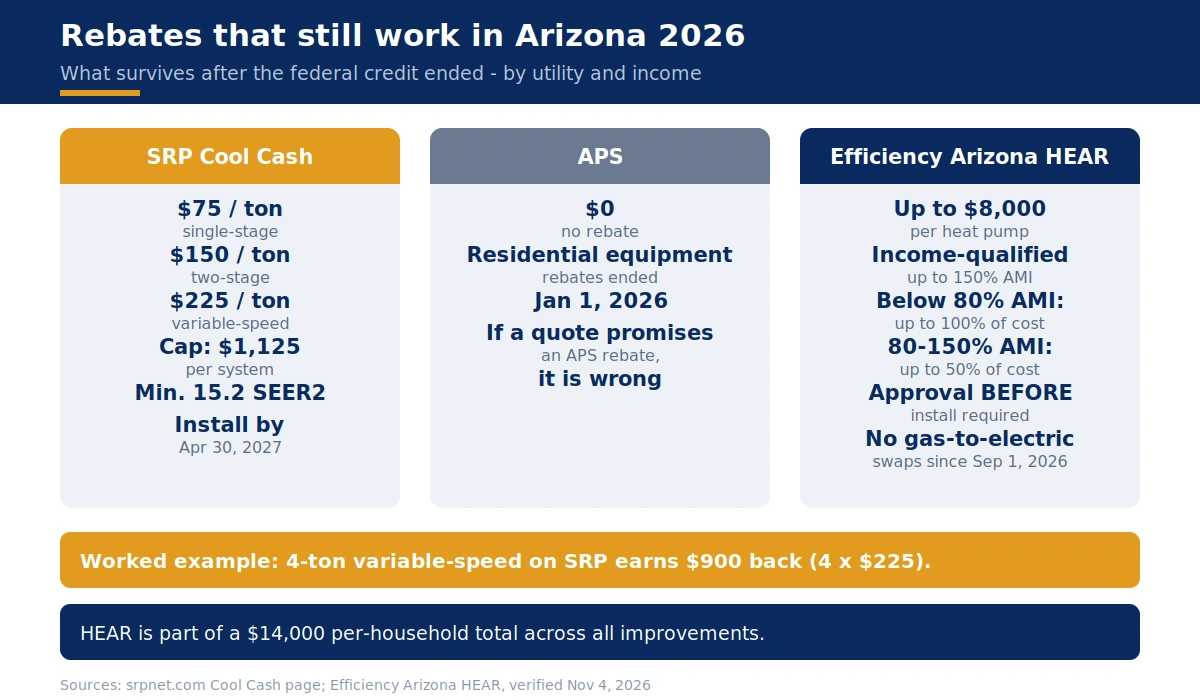
| Single-stage | 15.2 SEER2 or higher | $75 |
| Two-stage (multi-stage) | 15.2 SEER2 or higher | $150 |
| Variable-capacity | 15.2 SEER2 or higher | $225 |
| Inverter-driven mini-split | 15.2 SEER2 or higher | $225 |
Cap: $1,125 per system. Install must be completed before April 30, 2027, and the application submitted within 6 months of installation. On a split system, both the outdoor unit and the indoor coil or air handler must be replaced. The system must be installed by an Arizona-licensed contractor, and new construction, garages, and other non-habitable spaces do not qualify. (Source: SRP AC rebates page, accessed November 2026.)
Cool Cash is fuel-neutral: it pays the same amount whether the new outdoor unit is an air conditioner or a heat pump. It does not tilt the heat-pump-vs-AC decision — it rewards efficiency, not fuel choice.
Worked examples. A 4-ton variable-speed heat pump on SRP earns 4 × $225 = $900 back. A 5-ton variable-speed system earns 5 × $225 = $1,125 — exactly at the cap. A 3-ton single-stage system earns 3 × $75 = $225. The staging choice alone is worth $600 on a 4-ton system ($900 variable-speed vs $300 single-stage at $75/ton, with two-stage at $600 in between). If you are already buying variable-speed for comfort, the rebate is a bonus. If you are choosing between single-stage and variable-speed, the rebate narrows the gap by hundreds of dollars.
APS: nothing
APS residential equipment rebates ended on January 1, 2026. APS customers have no equipment rebate to weigh in 2026. That is unanimous across Arizona sources (George Brazil, September 2026; Varsity Zone and Patriot Air, November 2026; Peoria guide, October 2026). If a quote promises an APS rebate on a 2026 install, it is wrong.
One APS item to watch: APS has a rate request pending before the Arizona Corporation Commission that would raise the average residential bill by roughly 16%, about $20 a month. Hearings concluded in July 2026, the administrative law judge’s recommendation was expected by late November, and the Commission’s deadline to vote is December 31, 2026, with new rates effective early 2027. That is a proposal, not an approved rate — but an APS customer comparing running costs should run the math twice, once at today’s rate and once with the requested increase applied.
Efficiency Arizona HEAR: up to $8,000 for income-qualified households
HEAR (Home Electrification and Appliance Rebates) is federally funded and state-administered. Arizona’s program, run as Efficiency Arizona, is open statewide with limits as of November 4, 2026. It pays up to $8,000 toward an ENERGY STAR heat pump for space heating and cooling:
- Households below 80% of Area Median Income (AMI) can receive up to 100% of eligible costs, subject to the cap.
- Households at 80–150% of AMI can receive up to 50% of cost, subject to the cap.
- The $8,000 heat pump rebate sits inside a $14,000 per-household HEAR total across all improvements.
- The project must be approved before installation and completed through an Efficiency Arizona Qualified Contractor.
The September 2026 rule change — read this before you plan. Federal guidance issued May 29, 2026 (DOE Program Notice 26-2) bars HEAR funds from replacing gas, oil, or propane heating with electric equipment. Arizona applies the rule to reservations made on or after September 1, 2026: the heat pump must replace electric equipment or be added alongside an existing system. A gas-furnace-to-heat-pump swap no longer qualifies.
Revised guidelines announced September 9, 2026 expanded access in two ways that matter for Arizona. First, homeowners with an existing heat pump can now qualify to replace it with a more efficient model — under the earlier rules, existing heat pump systems were excluded. Second, a homeowner who wants to keep the gas furnace can participate: the rebate covers replacing the AC portion of the system with a qualifying heat pump while the furnace stays. The program does not pay to remove or replace the gas heating source. That matters in the Valley, where an estimated 65–70% of Phoenix-area homes already have heat pumps or all-electric HVAC — the revised rules opened the program to most of them.
Worked HEAR example. An income-qualified household below 80% AMI replacing an old electric heat pump with an $11,000 system could receive up to the $8,000 cap — a net cost around $3,000 before Cool Cash. At 80–150% AMI, the same system could receive up to 50% of cost, or $5,500. One Arizona HVAC guide puts the program horizon at September 30, 2031 — that date rests on a single source, so verify current status at Efficiency Arizona before counting on it. And remember: approval comes before installation. Installing first and applying later does not work.
TEP customers should also ask about the TEP Efficient Home Program, which offers rebates for certified AC and heat-pump equipment plus duct sealing and tune-ups. The rebate amounts were not verifiable in our research, so no dollar figure is given here — ask TEP directly. Southwest Gas and the City of Mesa gas utility offer nothing for furnaces in 2026.
Arizona’s extreme heat: why EER2 matters more than SEER2
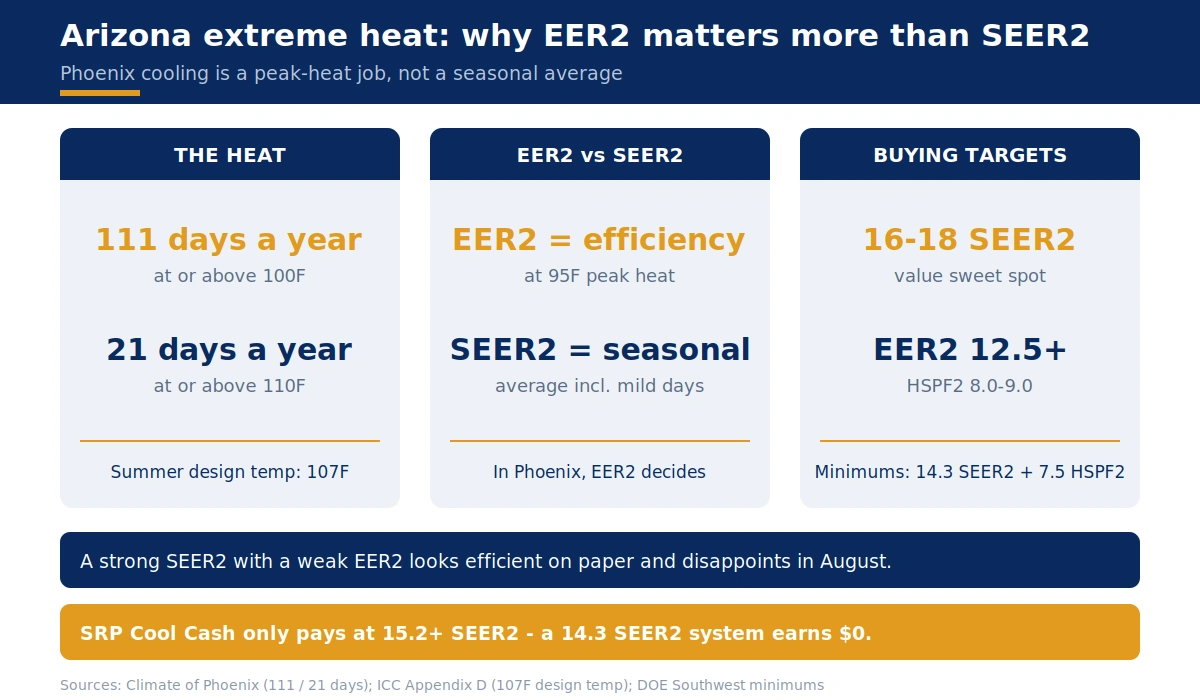
Phoenix averages 111 days a year at or above 100°F, including 21 days at or above 110°F. Summer nights stay at or above 80°F for 74 days a year. The all-time record is 122°F. Your heat pump will spend months running at full capacity in air hotter than its test conditions. Buying it on the wrong efficiency number is the most expensive mistake in this guide.
SEER2 (Seasonal Energy Efficiency Ratio 2) measures cooling efficiency across a whole season — mild May afternoons included. EER2 (Energy Efficiency Ratio 2) measures efficiency at exactly 95°F — peak-heat performance. HSPF2 measures heating efficiency over the winter.
In most of the country, SEER2 is the number to shop. In Arizona, EER2 is the more important number, because Phoenix equipment spends months operating at or above 95°F and the mild days SEER2 averages in barely exist in a Valley cooling season. A unit with a strong SEER2 and a weak EER2 will look efficient on paper and disappoint in August.
The minimums (federal law, since January 1, 2023). Arizona sits in the DOE’s Southwest region, which carries among the strictest minimums in the country. New split-system AC under 45,000 BTU must be at least 14.3 SEER2; larger split systems at least 13.8 SEER2; heat pumps must meet 14.3 SEER2 plus 7.5 HSPF2. Equipment below those levels cannot legally be installed in Arizona, regardless of when it was manufactured.
The buying targets. Arizona contractor guidance converges on 16–18 SEER2 as the value sweet spot — one Phoenix source puts the best return at 17–19 SEER2, and notes that above 20 SEER2 the equipment gets much more expensive while the monthly savings shrink. For EER2, look for 12.5 or higher to keep August bills under control. For HSPF2, aim for 8.0–9.0 (the minimum is 7.5) — but do not overpay for winter capacity the Valley barely uses. Phoenix winters run 66–71°F by day and 44–48°F by night; the heating load is 1,765 heating degree days against Flagstaff’s 7,152.
The SRP threshold is a buying reason to step up. Cool Cash only pays at 15.2 SEER2 or higher. A 14.3 SEER2 system — legal, but minimum — earns zero rebate. The step from 14.3 to 15.2 SEER2 often pays for itself in rebate alone on a 4-ton system.
Variable-speed is the desert pick. A variable-speed system runs continuously at low speed, holding a steady 74°F all day instead of cycling on and off. It dehumidifies better during monsoon season, when humidity jumps and single-stage systems short-cycle. It also earns the top $225/ton Cool Cash tier. Two-stage is the mid-tier compromise. Single-stage is cheapest upfront and earns only $75/ton — and in a house that runs its system five months straight, the comfort gap is real.
One caution on a commonly quoted claim: upgrading from an older 10 SEER2 unit to a modern 18 SEER2 system “frequently reduces cooling-related energy consumption by 30 to 50%,” according to one Phoenix contractor. That is a contractor estimate, not a measured benchmark — use it as a planning range, not a promise.
Cooling-dominated Arizona: what a heat pump costs to run
A heat pump’s running cost in Arizona is decided by three things: your utility’s rate structure, the time of day you cool, and how old the system you are replacing is.
The rates. Arizona’s residential average is 15.05¢/kWh (EIA, August 2026), about 17% below the national 18.16¢/kWh. But the average hides the structure. On APS’s R-TOU-E time-of-use plan, off-peak power is 15.0¢/kWh and the summer peak is 37.1¢/kWh from 4–7 PM on weekdays, with a $13.94 monthly service charge. On SRP, standard plans run about 11–14¢/kWh plus a demand charge — billed on your highest 30-minute demand during on-peak hours, commonly cited around $9/kW on-peak (tiered in SRP’s rate book), with the on-peak window typically 2–8 PM weekdays. TEP runs about 12–16¢/kWh. Our Arizona solar cost guide breaks down all three utilities in full — the rate structures are the same ones that decide solar payback, and they decide heat pump running costs the same way.
The seasonal bill. The average Arizona monthly electric bill is $157.15 on an annual-average basis — but $269.26 in August, when the average home uses 1,789 kWh (EIA, August 2026). August bills run about 70% above the annual average because of air conditioning. A heat pump’s cooling efficiency decides the August bill more than its heating rating does. That is why the EER2 section above matters more than any heating number in this guide.
Heating cost. In Phoenix, a high-efficiency heat pump costs roughly $700 a year to heat a typical Valley home, against roughly $900 a year for a comparable gas furnace — about 22% less, saving roughly $200 every winter (Discount ACR installer estimate, Phoenix, 2026). SRP states a heat pump “can save up to 30% on heating costs when compared to a gas furnace.” Both are installer and utility claims, not measured benchmarks — treat them as planning figures, not promises. The physics behind them is solid: an air-source heat pump delivers 1.5–3 times more heat energy than the electrical energy it consumes (U.S. Department of Energy), while a gas furnace converts 80–98.5% of its fuel to heat and never more than 100%. And Phoenix heating happens at 40–70°F outdoor temperatures, where heat pumps run at their efficient best.
The Tucson break-even rule. A heat pump rated 8.5 HSPF2 delivers about 8,500 BTU per kWh. An 80% AFUE furnace delivers about 80,000 BTU per therm. Heating the same space takes 1 therm or about 9.4 kWh. Divide your all-in price per therm by 9.4: if your all-in electric price per kWh is below that number, the heat pump is cheaper to run. If it is above, the furnace is cheaper. Use the full bill amounts, including adjustments and taxes — gas and electric prices move, so run the rule on your own bills, not on a national average.
One honest warning: your electric bill will rise in winter. When a heat pump replaces a gas furnace, the heating load moves onto the electric account while the gas bill falls by about the same amount. The household total is what matters, not one bill in isolation. If you keep a gas water heater or range, you will still get a Southwest Gas bill with its fixed charges.
For the full monthly math, see our heat pump running cost guide. And if you are weighing a heat pump against rooftop solar, our heat pump vs solar comparison runs both options on the same Arizona rates.
Heat pump vs furnace vs AC in Arizona
The wrong way to compare is heat pump vs furnace. The right way is heat pump vs (air conditioner + furnace) — because in Phoenix, a heat pump replaces both.
Upfront. Installing a furnace and a separate air conditioner costs more than installing one heat pump, and the gap grows if you need a new gas line ($400–$1,300). A heat pump is one install, one outdoor unit, one maintenance visit, one system to replace in 12–15 years instead of two systems on two different schedules.
Running costs. The heat pump cools as efficiently as an air conditioner and heats cheaper than a gas furnace — about 30% cheaper on heating in Phoenix by the installer estimates above. One Phoenix installer puts 15-year ownership at roughly $28,500–$32,500 for a heat pump against $38,000–$42,000 for a furnace plus AC. That is a single installer’s estimate with unitemized assumptions, not a benchmark — but the direction is right, and it follows from the one-system-vs-two-systems structure.
When a furnace still wins. In Flagstaff and Prescott, winters are real: Flagstaff logs 7,152 heating degree days, and freezing temperatures and snow are normal. There, a standard heat pump leans on expensive electric resistance heat on the coldest nights, and the heating rating (HSPF2) and cold-weather performance matter as much as SEER2. That is where dual-fuel earns its keep — a heat pump for mild weather, a gas furnace for the coldest nights — and where cold-climate hyper-heat models, which cost 15–30% more nationally, are worth the premium. Our cold-climate mini-split guide covers high-elevation buying. In the Valley, a cold-climate model is overkill: Phoenix’s winter design temperature is 34°F, and the heating load is a few dozen mornings a year.
What about keeping gas? Under HEAR’s September 2026 rules, adding a heat pump alongside an existing furnace is an eligible project — you keep gas heat and add efficient cooling. Removing the furnace is not funded. For a Valley homeowner who likes gas heat, that is the practical middle path: the heat pump does the cooling and the mild-weather heating, the furnace stays for the handful of cold mornings.
Compare the full head-to-head in our heat pump vs furnace cost comparison, and the Texas state guide (heat pump cost in Texas 2026) for a hot-climate parallel with different rebate rules.
Geothermal in Arizona: why the desert makes it expensive
Geothermal is the most efficient system on this page and the worst fit for most Arizona lots. It exchanges heat with the ground instead of the air, but the ground loop dominates the price, so it is the most expensive option to install.
The Arizona numbers. Plan on $20,000–$40,000+ for a Phoenix geothermal install. Angi’s Phoenix page (September 2026) puts horizontal loops at $15,500–$35,200 per system and vertical loops at $20,700–$39,300 per system. National sources agree with the range: a typical 3-ton geothermal system lands around $20,000–$27,000 installed all-in, and hard drilling can push a project to $50,000–$60,000 or more (AirProHQ, October 2026). Angi’s own Phoenix average of $15,206 (range $4,541–$26,537) conflicts with its own loop figures and with national data, so it is not used as the headline here.
Why Arizona ground is hard ground. The hard, dry, rocky desert soil makes loop installation labor-intensive. A horizontal loop needs a large yard — most Valley lots do not have one — and a vertical loop needs a heavy drilling rig boring 200–500 feet down. Rocky land can make drilling prohibitively expensive. Get professional soil testing (about $1,300 on average nationally) before anyone recommends geothermal for your lot.
The cooling-dominated warning. Geothermal’s weakness in Arizona is the same as its strength anywhere: the ground. One Southern Arizona homeowner reported a 5-ton horizontal loop buried 8–9 feet down performing well early in the summer but running nearly 24 hours a day once the harsh heat set in, with loop temperatures reportedly climbing above 100°F. That is one homeowner’s report, not a performance benchmark — but it illustrates the design risk: a shallow horizontal loop in hot, dry soil can heat-soak across a Phoenix summer. A proper loop design, sized for the cooling load rather than the heating load, is non-negotiable here.
The credit that vanished. Geothermal’s 30% federal §25D credit ended December 31, 2025. A $30,000 system that would have cost $21,000 after the credit in 2025 costs the full $30,000 in 2026. That single change did more to geothermal math than any equipment price move. Geothermal payback was already long — often a decade or more even with incentives — and it is longer now. It remains a decision for long-term owners and new builds, not for a retrofit on a small Valley lot. Our geothermal heat pump cost guide has the full national breakdown.
Payback math: when a heat pump pays for itself in Arizona
The honest frame first: a heat pump in Arizona rarely “pays back” against doing nothing. It pays back against replacing two systems and against running old, inefficient equipment. The model below is ours, with stated assumptions — not a published benchmark.
Worked model: 3.5-ton variable-speed ducted heat pump, SRP territory, replacing a 15-year-old AC + gas furnace.
| Line | Math | Result |
|---|---|---|
| Installed cost (mid Patriot Air range) | 3.5-ton variable-speed | $11,000 |
| Less SRP Cool Cash (variable-speed) | 3.5 ton × $225 | −$788 |
| Net cost | ~$10,200 | |
| Heating saving vs gas furnace | ~$200/yr (installer estimate: $700 vs $900) | $200/yr |
| Cooling saving vs old 10 SEER2 AC | 30–50% cooling-energy cut claimed for a 10 to 18 SEER2 upgrade; modeled at ~$400/yr | ~$400/yr (modeled) |
| Total modeled saving | ~$600/yr | |
| Simple payback (net cost) | $10,200 ÷ $600 | ~17 years |
| Upfront comparison vs replacing both systems | AC ($5,500–$12,500) + furnace ($4,500–$10,000) = $10,000–$22,500 combined | Heat pump at $11,000 gross is at or below the two-system replacement cost before any rebate |
Assumptions, stated plainly. The $600 a year saving is modeled: heating at $200 a year from one installer’s Phoenix estimate, cooling at about $400 a year from the 30–50% efficiency-gain claim applied to a Valley summer cooling bill. Neither is a measured benchmark. No electricity-price escalation is modeled. The equipment life is 12–15 years — which means the simple energy payback can exceed the unit’s life on energy savings alone.
That sounds discouraging until you read the last row of the table. The real economic case is the avoided second system: one install instead of two, at or below the combined replacement cost, before any rebate. The energy savings are the bonus, not the case.
And HEAR transforms the math for eligible households. With an $8,000 HEAR rebate, the same $11,000 system nets to about $2,200 after Cool Cash — and the modeled payback falls to roughly 4 years. The rebate, not the energy saving, is what makes the math compelling for qualifying households. SRP Cool Cash alone ($788 on this system) moves payback by about a year. On APS territory, with no equipment rebate, the case rests on the one-system-vs-two-systems comparison and the efficiency gain — check HEAR eligibility first, because for an income-qualified APS household it is the whole ballgame.
How to get quotes in Arizona + red flags
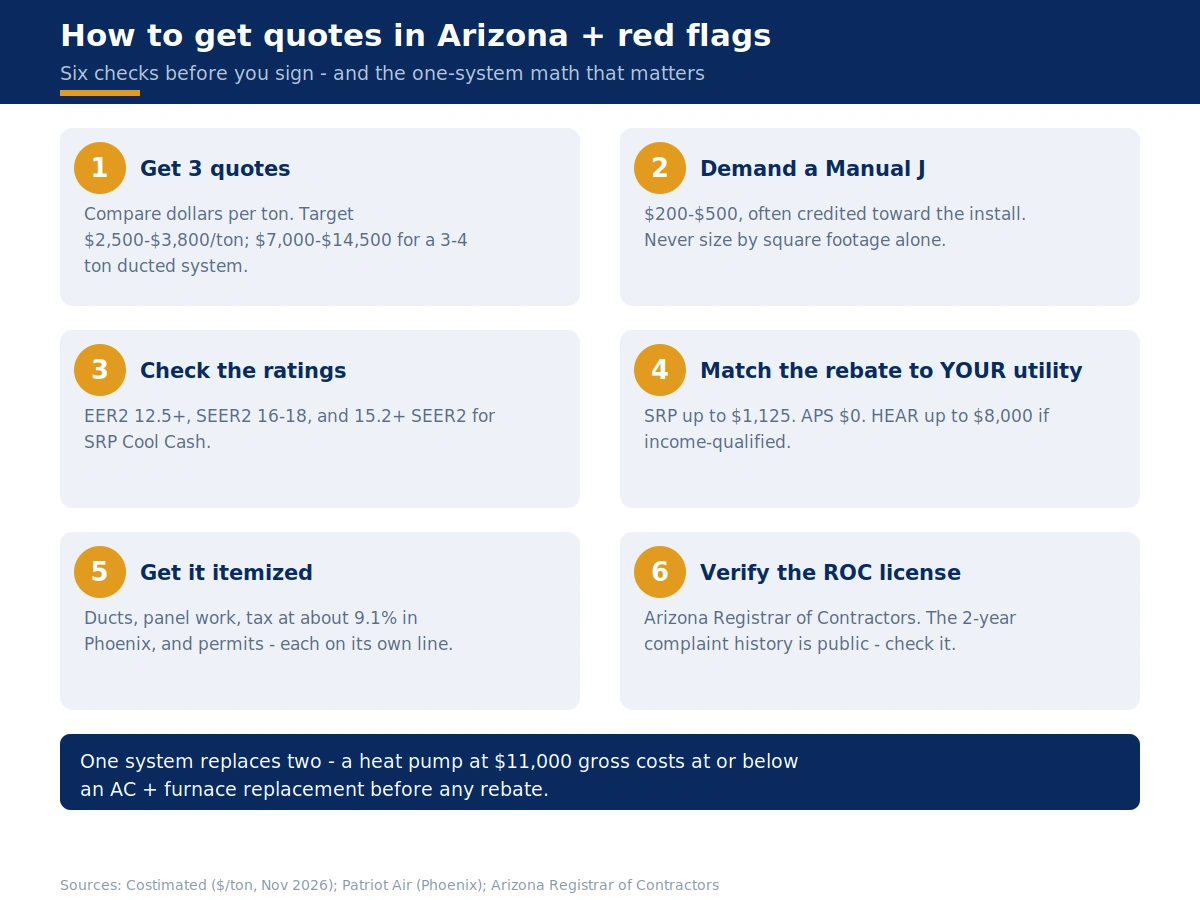
Get at least three written quotes, and ask every installer the same questions so the bids compare:
- What is my $/ton — before any incentives? The Arizona benchmark is $2,500–$3,800 per ton installed, $7,000–$14,500 for a typical 3–4 ton ducted system. Anything above $18,500 for a standard ducted job needs a justification (complex ducts, premium equipment, difficult access).
- Did you do a Manual J load calculation? If the size came from square footage alone, the quote is a guess. The calculation costs $200–$500 and is often credited toward the install.
- What are the SEER2, EER2, and HSPF2 ratings? In Arizona, EER2 (12.5 or higher) matters as much as SEER2. And 15.2 SEER2 is the SRP Cool Cash threshold — a 14.3 SEER2 system earns zero rebate.
- Does the quote subtract a federal tax credit? If yes, it is using dead law. The §25C credit ended December 31, 2025. Ask them to remove it.
- Does the rebate on the quote match MY utility? SRP customers get Cool Cash; APS customers get nothing. A quote promising an APS equipment rebate in 2026 is wrong.
- Is the quote itemized — ducts, panel, tax, permits? The most common surprise add-ons are ductwork ($5,000–$10,000 new), panel work ($1,500–$4,000), and sales tax (Phoenix ~9.1%). Get each as its own line.
- Is the installer licensed with the Arizona Registrar of Contractors, and what is the 2-year complaint history? Arizona requires a licensed contractor for HVAC jobs of this size. Verify the license and complaint history on the Registrar’s site before you sign — the 2-year history is public.
Timing. Spring and fall are the shoulder seasons — installers discount when they are not booked solid with emergency summer replacements. A failed system in July in Phoenix is an emergency purchase at emergency pricing. If your system is 12-plus years old, get quotes in March, not in August.
Red flags. A quote that subtracts the dead federal credit. A quote that promises an APS rebate. A quote sized by square footage with no load calculation. A contractor who offers to skip the permit. A price far below the $7,000–$14,500 range with no explanation — the cheapest bid in Phoenix is often the one that skips the duct test, the matched coil, or the permit. And any “free heat pump” or “government program” pitch: there is no program that gives away heat pumps. HEAR is real, income-qualified, and capped at $8,000 — it is not free equipment for everyone.
Sources & methodology
Cost anchors: TryDun heat pump cost by state (August 2026: Arizona $6,300–$11,650, BLS labor-adjusted model); NumeralQ heat pump cost (November 2026: Arizona $6,490–$10,890, −1% vs national; 1.5-ton $4,410–$7,080; 3-ton $6,550–$10,960; single-zone mini-split $3,150–$4,910); Angi Phoenix heat pump cost page (updated August 4, 2026: average $6,088, range $4,801–$7,376; Phoenix sales tax 9.1%); Angi Phoenix HVAC replacement (updated April 21, 2026: average $7,748, most $5,165–$12,913; air-source heat pump $6,500–$14,000); Patriot Air Phoenix installer blogs (November 2026: split-system installed 2–2.5 ton $6,000–$9,000, 3–3.5 ton $7,000–$11,500, 4 ton $8,000–$13,000, 5 ton $10,000–$15,000; existing-ductwork conversion 3.5–4 ton $8,000–$14,500; equipment 45–60% of installed price; duct repair $1,000–$4,000; panel $1,500–$3,500); HVAC Service Cost Peoria guide (updated October 17, 2026: full system $7,800–$15,500, average ~$10,800; heat pump split $7,800–$15,000; outdoor unit + coil $5,000–$9,500); HVAC Visit city price guides (November 2026: Phoenix heat pump $7,150–$18,500); Costimated HVAC replacement cost (November 2026: $2,500–$3,800/ton heat pump, 3-ton average $9,400, range $6,000–$14,800); NearbyHunt heat pump cost (2026: tonnage table 2–5 ton; mini-split single $3,000–$8,000, tri-zone $7,500–$14,000, quad $10,000–$17,000, +$1,500–$3,500/zone; equipment 55–60% of installed cost).
Efficiency ratings: DOE Southwest regional minimums (since January 1, 2023): 14.3 SEER2 under 45,000 BTU, 13.8 SEER2 larger systems, heat pumps 14.3 SEER2 + 7.5 HSPF2 — via Nichols Prescott SEER guide (2026), Zona Tucson SEER2 guide (September 2026), A1 Solar Store SEER guide (2026); EER2-at-95°F definition and Arizona buying targets (16–18 SEER2 sweet spot, EER2 12.5+, HSPF2 8.0–9.0, 30–50% cooling-energy claim for a 10 to 18 SEER2 upgrade) via PlumbSmart Phoenix guides (April 2026); variable-speed behavior (down to ~30% capacity) via PlumbSmart (April 2026).
Climate: ICC Appendix D degree-day/design-temperature table (Phoenix HDD 1,765, summer design 107°F, winter design 34°F; Tucson 1,800; Yuma 974; Flagstaff 7,152); Climate of Phoenix (111 days ≥100°F, 21 days ≥110°F, 74 nights ≥80°F, record 122°F June 26, 1990, ~3,872 sunshine hours); Phoenix winter highs 66–71°F, lows 44–48°F (annual-weather summary, 2026).
Rates: EIA Electric Power Monthly Table 5.6.A (August 2026, released October 28, 2026: Arizona residential 15.05¢/kWh, US 18.16¢/kWh, AZ average bill $157.15 annual average / $269.26 August, 1,789 kWh); APS R-TOU-E plan (off-peak 15.0¢, summer peak 37.1¢/kWh 4–7 PM weekdays, $13.94/month service charge; tariffs checked November 4, 2026) and SRP/TEP rate structures per art. 60 research (EIA Form 861 2025: APS ~1.29M customers, 17.0¢/kWh average; SRP ~1.07M customers, 14.0¢/kWh average; SRP demand charge ~$9/kW on-peak, tiered; on-peak 2–8 PM weekdays).
Rebates: SRP Cool Cash / AC rebates page (tier table $75/$150/$225 per ton at 15.2+ SEER2, $1,125 cap, install before April 30, 2027, apply within 6 months, both units replaced, licensed AZ contractor); APS residential rebates ended January 1, 2026 (George Brazil, September 2026; Varsity Zone, November 2026; Patriot Air, November 2026; Peoria guide, October 2026); APS rate case pending (~16%, ~$20/month; hearings concluded July 2026; ALJ recommendation expected late November; Commission vote deadline December 31, 2026; effective early 2027) via Varsity Zone (November 2026); HEAR status via HeatPumpPricing HEAR status map (verified November 4, 2026: Arizona open with limits, up to $8,000; no gas-to-electric swaps since September 1, 2026), StartBusinessByState (checked October 6, 2026), BetterHouse (September 2026), Rosie on the House (September 2026: September 9 revised guidelines, existing-heat-pump eligibility, keep-the-furnace option, 65–70% of Phoenix-area homes all-electric or heat pump, <80% AMI up to 100% of cost, 80–150% AMI up to 50%), ElectricalContractorsAndWiring (October 27, 2026); DOE Program Notice 26-2 / May 29, 2026 fuel-switching guidance via HeatPumpPricing and StartBusinessByState; HEAR horizon through September 30, 2031 via Allstate Air & Heating guide (single source); TEP Efficient Home Program existence via Tucson AC Repair blog (October 2026; amounts not verified); Southwest Gas / City of Mesa gas rebates (nothing for furnaces, 2026) via Varsity Zone (November 2026).
Federal framing: OBBBA P.L. 119-21 (signed July 4, 2025); IRS FS-2025-05 (August 21, 2025); §25C and §25D both ended for property placed in service after December 31, 2025 — confirmed by NumeralQ (November 2026) and Costimated (November 2026). Stale-claim examples: GreenSaveHome heat pump installation cost guide (2026, “after $2,000 IRA credit” column); NearbyHunt (2026, geothermal “30% credit continues through 2032” claim). Arizona solar credit A.R.S. §43-1083 is solar-only (art. 60 research).
Running costs / comparisons: Discount ACR Phoenix heat pump vs furnace guide (2026: heating ~$700/yr heat pump vs ~$900/yr furnace; 15-year ownership ~$28,500–$32,500 vs ~$38,000–$42,000 furnace + AC); Patrick Riley Phoenix guide (updated September 16, 2026: SRP “up to 30% on heating costs” quote; DOE 1.5–3× heat delivery; heat pump life 10–14 years vs AC 15–20, furnace 20–30; gas line $400–$1,300); Tucson AC Repair blog (October 2026: 8.5 HSPF2 is about 8,500 BTU/kWh; 80% AFUE is about 80,000 BTU/therm; 9.4 kWh = 1 therm break-even rule; electric bill rises in winter while gas bill falls).
Geothermal: Angi Phoenix geothermal page (updated September 18, 2026: average $15,206, range $4,541–$26,537 — flagged as inconsistent; horizontal loop $15,500–$35,200; vertical loop $20,700–$39,300; hard rocky desert soil); HomeGuide Phoenix AC cost (October 2026: geothermal $11,000–$35,000 in Phoenix); AirProHQ heat pump cost guide (updated October 31, 2026: typical 3-ton geothermal $20,000–$27,000; hard drilling $50,000–$60,000+); The Cooldown (October 2026: Southern Arizona 5-ton horizontal-loop homeowner anecdote, loop temperatures above 100°F); soil testing ~$1,300 average (HomeAdvisor via Angi, July 2026); vertical boreholes 200–500 ft (MyHomePros geothermal guide, 2026).
Payback model: our arithmetic with stated assumptions (3.5-ton variable-speed $11,000; SRP Cool Cash 3.5 × $225 = $787.50; heating saving ~$200/yr from Discount ACR estimates; cooling saving ~$400/yr modeled from the 30–50% efficiency-gain claim; AC $5,500–$12,500 from Costimated; furnace $4,500–$10,000 from art. 1). Not a published benchmark.
EXCLUDED: Angi’s $15,206 Phoenix geothermal average as a headline (conflicts with its own loop figures); any single hard-coded dual-fuel Arizona price (unverified); TEP Efficient Home rebate amounts (unverified); the APS ~16% rate increase as fact (pending proposal only); extension of solar HOA statutes (§33-439/§33-1816) to heat pumps (solar-specific, unverified for heat pumps); any Arizona-specific summer emergency-replacement premium % (unverified); GreenSaveHome’s “after $2,000 credit” prices and NearbyHunt’s geothermal “30% through 2032” claim (stale law).
*Disclaimer: Prices are 2026 Arizona planning figures and change by utility territory, home, and installer. Always get 3 written local quotes before budgeting. Tax information is general, not tax advice — confirm with a tax professional. Rebate deadlines matter: SRP Cool Cash requires installation before April 30, 2027; HEAR requires approval before installation — verify current terms with SRP and Efficiency Arizona before signing.*
—
How much does a heat pump cost in Arizona in 2026?
A typical whole-home ducted air-source heat pump costs $7,000–$14,500 installed for a 3–4 ton system in Arizona in 2026 (Phoenix installer ranges, November 2026). A single-zone mini-split runs $3,000–$8,000, a multi-zone system $8,000–$15,000, and geothermal $20,000–$40,000+. The federal credit is $0, so the quoted price is the price before only the rebates you qualify for.
Is there a federal tax credit for a heat pump in Arizona in 2026?
No. The §25C credit (up to $2,000 a year for air-source heat pumps) and the 30% §25D credit for geothermal both ended for property placed in service after December 31, 2025, under the One Big Beautiful Bill Act (P.L. 119-21), confirmed by IRS FS-2025-05. A 2026 install gets $0 federal credit. If a quote subtracts either credit, ask for it to be removed.
Does SRP offer a heat pump rebate in 2026?
Yes — SRP Cool Cash pays $75 per ton for single-stage, $150 per ton for two-stage, and $225 per ton for variable-speed equipment at 15.2 SEER2 or higher, capped at $1,125 per system. Installation must be completed before April 30, 2027, and the application submitted within 6 months. It pays the same for an air conditioner or a heat pump. A 4-ton variable-speed system earns $900 back.
Does APS offer a heat pump rebate in 2026?
No. APS ended its residential equipment rebates on January 1, 2026, so APS customers get $0 in utility equipment rebates. APS customers should check HEAR eligibility instead — Efficiency Arizona’s income-qualified program pays up to $8,000 and is open statewide with limits.
Can I get the $8,000 HEAR rebate for a heat pump in Arizona?
Yes, if your household income is at or below 150% of Area Median Income and the project replaces electric equipment or is added alongside an existing system. Since September 1, 2026, HEAR no longer funds gas-to-electric swaps. Households below 80% of AMI can receive up to 100% of eligible costs; households at 80–150% of AMI up to 50%, capped at $8,000 per heat pump. The project must be approved before installation and done by an Efficiency Arizona Qualified Contractor.
Do heat pumps work in Phoenix’s 110-degree heat?
Yes — cooling is what heat pumps do best, and Phoenix’s heating load is tiny (1,765 heating degree days vs 7,152 in Flagstaff). Buy on EER2, the peak-heat efficiency rating at 95°F: look for 12.5 or higher, with 16–18 SEER2 overall. Variable-speed systems handle the long hot season best, holding a steady temperature instead of cycling on and off.
Heat pump or furnace in Arizona?
A heat pump for most Valley homes. One heat pump replaces both the air conditioner and the furnace, costs less upfront than replacing both separately, and heats for roughly $700 a year against about $900 for a gas furnace (installer estimates). A furnace or dual-fuel system mainly makes sense in Flagstaff and Prescott, where winters are real, or for homeowners who want to keep gas heat — under HEAR’s September 2026 rules, adding a heat pump alongside an existing furnace is eligible.
How long do heat pumps last in Arizona?
Typically 12–15 years for a ducted system. That is shorter than an AC-only unit (15–20 years) or a furnace (20–30 years) because the heat pump runs year-round, cooling and heating, while an AC rests all winter. Annual maintenance — filter changes plus a yearly professional service — is what gets you to the top of that range.