

Table of Contents
A whole house surge protector is the cheapest electrical upgrade that protects the most expensive things in your house. The HVAC control board, the refrigerator, the well pump controller, the home office — a single bad surge can kill any of them, and one replacement usually costs more than the entire SPD installation.
The pricing picture is thinner than for roofs or HVAC, but the sources that do track it converge tightly. This guide stacks every 2026 number: unit cost by type and brand tier, the labor math, what your panel does to the quote, the meter-lease alternative, and the warranty fine print nobody reads until something burns out.
The $300 average and the $200–$800 reality
Two publisher benchmarks anchor the national picture:
- Angi (Oct 13, 2026): $70–$700 installed, $300 average.
- HomeAdvisor (Jun 19, 2026): $70–$700 installed, $300 average.
Independent 2026 sources run slightly higher — the range shifts up when the device tier rises:
- costtorenovate (Apr 4, 2026): $200–$500 typical, $350 average, high end $800.
- thepricer (Oct 24, 2026): $200–$800 installed; straightforward jobs $250–$450; labor $140–$300.
- betterhomehelp24 (early 2026 contractor survey): equipment $120–$450, total $280–$750.
- askaprepper (2026): device $50–$300, install $150–$500, total $300–$700.
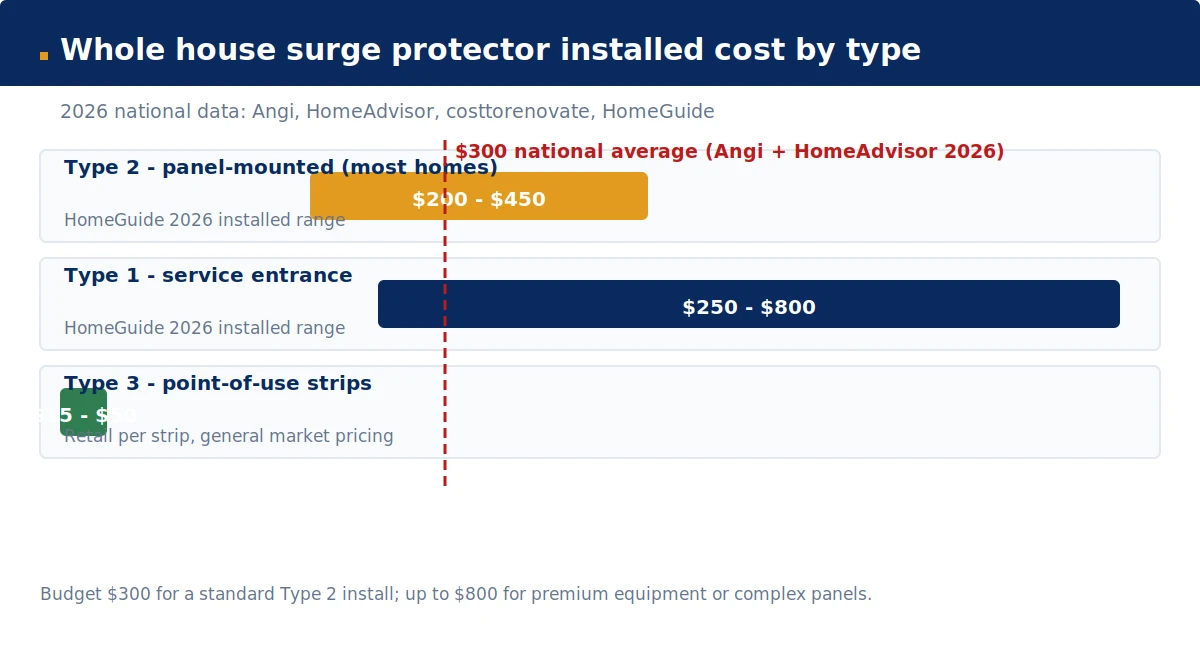
The honest planning range: budget $300 for a standard install, and up to $800 if you want premium equipment or your panel fights back. The $70 low end is real — a cheap Type 2 device in an easy panel with a short service call — but it’s not the job most people get.
What the average excludes: panel upgrades, permits, and grounding work. Your panel is the variable, and it owns the next section.
Type 1 vs Type 2 vs Type 3: what you pay for by type
SPDs are classified by where they sit in your electrical system — and the location determines the price.
Type 2 — the workhorse for most homes. Installed on the load side, inside or next to the main breaker panel, usually on its own dedicated two-pole breaker. It handles utility-side events and the surges your own appliances generate (motors, compressors, AC units cycling). Device: $60–$300. Installed: $200–$450 (HomeGuide). This is what the $300 average is mostly built from.
Type 1 — the service-entrance bouncer. Installed between the utility transformer and the main breaker, on the line side — at or near the meter, ahead of everything. It takes the highest-energy external events (lightning transients, grid switching) before they enter the house. More complex installation. Device: $100–$500+. Installed: $250–$800 (HomeGuide).
Type 3 — point-of-use. Plug-in strips and surge receptacles for the gear you can’t afford to lose: TVs, computers, medical equipment. These don’t replace a Type 1 or 2 — they’re the second layer IEEE and UL recommend. Retail: $15–$50 each. Nobody’s “whole house” job is Type 3 alone, but no whole house job is complete without a few of them either.
Combined Type 1+2. A single module handling both stages — the premium tier. Device: $150–$300; installed: $575 benchmark (costtorenovate). Worth it on exposed overhead service or in lightning country (Florida, Texas, the Gulf and Plains).
One code note that moves real money: the 2023 NEC (§230.67) requires a Type 1 or Type 2 SPD on every new or replaced residential service. If you’re getting a panel upgrade anyway, the protector becomes a required line item — added on one permit, one inspection. Ask for it itemized in the panel quote.
Brand tiers: Eaton vs Siemens vs Square D vs Leviton
Four brands own US residential panels, and their flagship SPDs sit at three clear price tiers. Specs from a 2026 contractor comparison (betterhomehelp24):
| Brand | Flagship model | Surge current | Clamping (VPR) | Warranty + connected equipment |
|---|---|---|---|---|
| Square D (Schneider) | HEPD80 | 80 kA | 800V | 5 yrs + $50,000 |
| Siemens | FS140 | 140 kA | 800V | 25 yrs + $25,000 |
| Eaton | CHSPT2ULTRA | 108 kA | 700V | Lifetime + $75,000 |
| Leviton | R2120-B | 36 kA/phase | — | — |
Value tier — Square D HEPD80 (~$100–$150 device). The budget standard. Solid 80 kA rating, but the 5-year warranty is the shortest here. The smaller HEPD50 (50 kA) costs less still — fine as a supplement, thin as your only device.
Balanced tier — Siemens FS140 (~$150–$220 device). The highest surge current rating (140 kA) at a middle price, 25-year warranty. Siemens also sells plug-in models (BoltShield) for its own panels at lower ratings.
Premium tier — Eaton CHSPT2ULTRA (~$180–$260 device). Lowest clamping voltage in class (700V VPR) — it clamps surges at a lower voltage, which is what protects sensitive electronics. Also the only one here with an audible failure alarm; SPDs otherwise die silently. Premium pricing runs ~25–40% above the Square D equivalent.
Budget tier — Leviton and entry models. The Leviton R2120-B (36 kA per phase) and entry Eaton CHSPT2SURGE (36 kA) cover moderate-storm areas fine. Eaton’s snap-in BRNSURGE (18 kA) is a panel-specific add-on, not standalone protection.
Warranty honesty: connected-equipment warranties ($25,000–$75,000) require product registration, and the fine print varies — read before you count it as insurance. See the warranty section below.
kA rating and clamping voltage: what the numbers mean for cost
Two specs drive the price spread between a $100 device and a $260 one.
kA (kiloamp) rating is how much surge current the device can divert in one event. The working floor for whole-house protection: ≥30 kA (per industry testing guidance). Residential Type 2 units typically run 20–40 kA per phase; flagships push 80–140 kA. More kA doesn’t mean better protection from small surges — it means surviving *bigger* events without dying.
VPR (voltage protection rating) is the clamping voltage — how much voltage is allowed through to your electronics. Lower is better. The Eaton’s 700V VPR vs the typical 800V is the difference between protecting a smart TV and merely protecting the panel. This is why the premium tier costs more: you’re paying for tighter clamping, not just bigger numbers.
The decision ladder:
- Moderate storm area, standard electronics: 36–50 kA is plenty. Don’t overpay.
- Frequent thunderstorms, expensive electronics, home office: 80–108 kA with low VPR (the Eaton class).
- High-lightning region (Florida, Gulf Coast): 140 kA (Siemens FS140) or a Type 1+2 combo.
Higher kA also buys longevity — a 108 kA device shrugging off a 40 kA event has more life left than a 36 kA device that absorbed it at its limit.
Labor: the 1–2 hour job
SPD installation is one of the cheapest licensed-electrician jobs on the price sheet:
- Labor: $100–$300 for the install (Angi $100–$200 for ~2 hrs; BLUETTI/thepricer $140–$300).
- Time: 45–90 minutes for a clean Type 2 in a compatible panel; up to ~2 hours with a dedicated breaker.
- Service call fee: $75–$200 — many electricians fold the first hour into it, so the total bill often equals the service call plus the device.
The math checks against our electrician-rate data: Angi’s 2026 electrician rate of $50–$130/hr × 1–2 hours plus a service call lands exactly in the reported $100–$300 labor band. If a quote shows labor over $350 for a standard Type 2 install, ask what’s bundled — you’re paying for extra work, not the SPD. See our [electrician cost per hour guide](https://nestpriced.com/plumbing-electrical/electrician-cost-per-hour-2026/) for the full rate ladder.
Permit fees are jurisdiction-dependent and usually small ($50–$150 where required) — but ask the electrician whether the quote includes them.
Your panel decides the price: compatibility guide
The device is $100–$250. The panel is where quotes go from $300 to $800. The ladder:
Best case — modern compatible panel (Eaton BR/CH, Siemens QP, Square D QO/Homeline): $280–$580 installed. The SPD drops into a breaker slot or wires to a dedicated two-pole breaker. 45–90 minutes. Done.
Middle case — external enclosure with conduit: $400–$840. Panel has no free space or can’t take the breaker; the device mounts in a weatherproof box next to the panel. More parts, more labor, sometimes a permit.
The panel problem cases:
- No free breaker spaces: may need a tandem/quad breaker shuffle, a sub-panel, or the Type 1 route at the meter.
- Legacy panels (Federal Pacific Stab-Lok, Zinsco, Pushmatic): $580+ and it often forces a full panel replacement. These panels have known safety issues; an electrician won’t wire a new device into a hazard-prone box. See our [electrical panel upgrade cost guide](https://nestpriced.com/plumbing-electrical/electrical-panel-upgrade-cost-2026/) — upgrades run $1,500–$4,000.
- Undersized service or weak grounding: surges need a clean path to ground; substandard grounding has to be fixed first. See our [house rewiring cost guide](https://nestpriced.com/plumbing-electrical/house-rewiring-cost-2026/) if your wiring is older than your appliances.
The bundling play: installing the SPD during a panel upgrade adds one device, one permit, one inspection — typically $150–$300 extra on the panel job instead of a standalone $300+ visit later. If your panel is 20+ years old or you’re adding an EV charger or heat pump, ask about the bundle.
Meter-base utility programs: $6–$12/month vs owning
Many utilities lease meter-base surge protection — a device installed behind the meter, maintained by the utility:
| Utility program | Monthly fee | Warranty |
|---|---|---|
| FPL SurgeShield (FL) | $11.95 + tax | $5,000 per appliance, per occurrence |
| DEMCO | $7.95 + tax | Up to $50,000 |
| OPPD Surge Guard | $6.99 (+$20 install) | $50,000 ($5,000/item) |
| Craighead Electric | $6.00 | Up to $50,000 |
| Edisto Electric | $5–$6 (36-mo min) | 15-yr product; $25,000 secondary |
| Duke Energy | ~$7.99–$9.99 | Caps ~$2,500/incident |
The math: $8.99/mo (Duke midpoint) = ~$1,080 over 10 years. A homeowner-owned Type 2 install costs $300–$700 once. Owning wins on cost after about 3–5 years of any lease.
The catch (and the utilities admit it): meter-base devices only stop surges entering through the service line. Your own appliances generate internal surges, and nearby strikes can bypass the meter entirely. Every utility program page says the same thing: you still need Type 3 strips inside the house. The lease is a supplement, not a substitute — and you own nothing at the end.
Lease makes sense when: you’re a renter (with landlord approval), you sell within a few years, or you want the included warranty without thinking about it. Owning makes sense otherwise.
Warranties, connected equipment, and insurance
Manufacturer warranties vary dramatically: Eaton offers lifetime + $75,000 connected-equipment coverage; Square D gives 5 years + $50,000; Siemens gives 25 years + $25,000; utility secondary devices (Meter-Treater) offer lifetime product + $25,000. All require product registration, and all have exclusions — read the connected-equipment fine print (proof of the surge, proper installation, sometimes a professional-installation requirement).
Homeowners insurance: surge damage is generally covered under standard policies, but deductibles ($1,000–$2,500) often exceed the SPD cost. In lightning-prone states (Florida, Texas, Oklahoma), some carriers offer small discounts for whole-house surge protection — ask your agent; no national dataset quantifies this.
The honest limitation: no residential SPD protects against a direct lightning strike. That’s a lightning-rod system’s job. What SPDs stop are the far more common events: grid switching, utility faults, transformer events, nearby-strike induction, and your own appliances’ surges.
When does a surge protector need replacement?
SPDs are sacrificial — they die absorbing energy so your electronics don’t. What 2026 data tells us:
- No published consensus lifespan exists — flagging that honestly. Warranties run 5–25 years, but warranty length isn’t lifespan.
- Replacement triggers: the status LED goes dark or red, the Eaton’s audible alarm sounds, the breaker trips after a major event, or visible damage. SPDs fail silently otherwise — check the indicator annually.
- Replacement cost: same as the original job — typically $200–$450 installed, sometimes less since the breaker/wiring is already in place.
- After a major event (nearby strike, grid fault that killed other equipment), assume the SPD took the hit and have it inspected. A dead SPD with a lit indicator is protecting nothing.
The indicator LED is the whole maintenance program. If you can’t see it, the device is a talisman, not protection.
How to get a fair quote: 3 red flags
1. A quote that doesn’t name the device. “Whole house surge protector installed: $450” tells you nothing. The quote should list the type (Type 1/2), the model (e.g., Eaton CHSPT2ULTRA vs Square D HEPD80), and the kA rating. The device spread alone is $100–$500+.
2. Labor at $400+ with no explanation. This is a 45–90 minute job in a compatible panel. Labor over $350 means bundled panel work, an external enclosure, or grounding repairs — any of which should be line-itemed, not buried.
3. A quote into a legacy panel without mentioning it. If your panel is a Federal Pacific Stab-Lok or Zinsco, the correct answer is a panel upgrade first — not a new device wired into a hazard-prone box. See our [panel upgrade guide](https://nestpriced.com/plumbing-electrical/electrical-panel-upgrade-cost-2026/) for what that costs ($1,500–$4,000) and why bundling the SPD saves a permit.
The fair-quote playbook: one electrician, one written quote with device model + type + kA, labor broken out from hardware, permit included or named, and a price for “installed during your panel upgrade” as the comparison bid. Three quotes, identical device tier.
Sources & methodology
National benchmarks: Angi, “How Much Does a Whole House Surge Protector Cost?” (updated Oct 13, 2026: $70–$700, avg $300; device $10–$250 by type; labor $100–$200 ~2 hrs); HomeAdvisor (updated Jun 19, 2026: $70–$700, avg $300; confirmed via MDL Electric NJ page Oct 2026). Tier/regional detail: costtorenovate (Apr 4, 2026: avg $350, $200–$500, tiers $150/$345/$575, service call $75–$150); thepricer (Oct 24, 2026: $200–$800; Type 2 $200–$450, Type 1 $250–$800; labor $140–$300); HomeGuide 2026 ranges (via MDL/thepricer). Consumer data: BLUETTI 2026 project data (~Aug 2026: avg ~$300, range $70–$700; Type 1 $100–$500, Type 2 $60–$300; electrician $50–$130/hr). Retail snapshot: MDL Electric NJ (Oct 14, 2026: 4 devices $142–$260.96 at Home Depot Montville NJ); Angi Boston page (Jul 21, 2026: avg $325). Brand specs: betterhomehelp24 2026 comparison (Eaton CHSPT2ULTRA 108kA/700V/lifetime+$75k; Siemens FS140 140kA/800V/25yr+$25k; Square D HEPD80 80kA/800V/5yr+$50k; config table $280–$580 / $420–$800 / $400–$840 / legacy $580+; 45–90 min installs; NEC 230.67). Product comparison: sweetandsimplekitchen (Oct 2026); strongmocha (Leviton R2120-B 36kA/phase); gagthesurge (≥30kA floor). Electrician-side: saiyanelectric (2026 cost drivers; panel bundle logic); askaprepper (2026: $300–$700 total, 20–40kA/phase typical). Utility programs: FPL SurgeShield ($11.95/mo, $5k/appliance); DEMCO ($7.95/mo, $50k); Craighead ($6/mo, $50k); OPPD ($6.99/mo + $20 install, $50k); Edisto ($5–$6/mo); engineerfix Duke analysis (~$7.99–$9.99/mo, 10-yr ~$1,080). Labor cross-check: article 40 electrician research (Angi 2026 $50–$130/hr; first hour ~$150). Internal links: art. 9 panel upgrade ($1,500–$4,000), art. 40 electrician rates. Code: 2023 NEC §230.67 (Type 1/2 SPD required on new/replaced residential service). Tax-credit status: standing project rule per IRS FS-2025-05 (OBBBA, P.L. 119-21) — $0 federal credit for surge protectors in 2026 (never §25C/§25D property). Flagged honestly: no 2026 publisher gives a consensus SPD lifespan; no national homeowners-insurance discount dataset; Type 3 retail $15–$50 is general market knowledge, not a 2026 citation.
—
How much does a whole house surge protector cost in 2026?
$300 on average installed, per both Angi (October 2026) and HomeAdvisor (June 2026), with a typical range of $70–$700. Straightforward Type 2 installs run $250–$450; premium Type 1 setups reach $800.
How much does a Type 1 vs Type 2 surge protector cost?
A Type 2 (panel-mounted, the standard choice) costs $200–$450 installed; a Type 1 (service-entrance, line side) costs $250–$800 installed (HomeGuide 2026). The devices alone run $60–$300 for Type 2 and $100–$500+ for Type 1.
How much does an electrician charge to install a whole house surge protector?
$100–$300 in labor for a 45–90 minute job, plus the device ($60–$300). A $75–$200 service call often covers the first hour. At 2026 electrician rates ($50–$130/hr), this is one of the cheapest licensed jobs on the price sheet.
Which brand is best: Eaton, Siemens, Square D, or Leviton?
It depends on your budget and storm exposure. Eaton’s CHSPT2ULTRA (108 kA, 700V clamping, lifetime warranty) protects sensitive electronics best but costs ~25–40% more. Siemens FS140 offers the highest rating (140 kA) at a mid price. Square D HEPD80 is the value pick (80 kA) but carries only a 5-year warranty.
What kA rating do I need for a whole house surge protector?
At least 30 kA — that’s the working floor for whole-house protection. In moderate-storm areas, 36–50 kA is enough. With expensive electronics or frequent thunderstorms, go 80–108 kA; in high-lightning regions (Florida, the Gulf Coast), 140 kA or a combined Type 1+2.
Is a utility meter-base surge program worth it?
Rarely, long-term: $6–$12/month totals $720–$1,440 over 10 years, vs $300–$700 once for an owned Type 2 install. The lease also only covers surges through the meter — you still need point-of-use strips inside. It makes sense for renters or short stays, not for long-term owners.
Do whole house surge protectors need replacement?
Yes — they’re sacrificial and absorb damage for you. Check the indicator LED annually: dark or red means it died silently (except Eaton models with audible alarms). Replacement runs $200–$450 installed. There’s no 2026 consensus lifespan figure, so treat the indicator as the maintenance program.
Is there a federal tax credit for a surge protector in 2026?
No. Surge protectors were never §25C/§25D energy property, and OBBBA (P.L. 119-21) ended those credits for 2026 homeowner installs anyway. Budget the full $300–$700 with no rebate.