


A Massachusetts heat pump buyer faces a contradiction no other state in this series presents. The state has the most generous utility rebate program in the country and the third-most-expensive electricity in the country, in the same bill, in the same winter. Mass Save will hand back $2,650 a ton, up to $8,500, for a whole-home heat pump, and will lend the rest at 0% interest. The power that heat pump runs on costs about 30.5 cents a kilowatt-hour on average, 68% above the national average, because the delivery charges piled on top of a 17.3-cent supply price are among the heaviest in America. The rebate makes the purchase cheap. The electricity makes the running expensive. Any guide that quotes only one of those two numbers is selling something, not informing someone.
The second contradiction is the fuel sitting in the basement. About one Massachusetts home in four still heats with oil — roughly 572,000 homes — a share no other large state in this series comes close to. Oil was $3.92 a gallon on average last winter. It is $6.18 a gallon this November, up 73% in a year after a March price shock that never unwound, and the governor has declared a State of Energy Emergency through April 2027. At last winter’s price a heat pump barely breaks even against an oil furnace. At today’s price it saves about $839 a year on the planning home in this guide. The payback for an oil home therefore depends on which oil price you believe will still be true next winter, and this guide prints both and lets the reader decide — because a purchase justified only by a price spike is a purchase that needs to be understood as one.
The third fact shapes the equipment choice. Massachusetts winters are cold but not extreme: Boston is designed for 9 degrees, Worcester for 4, Springfield for 2, Pittsfield for minus 3. That is cold enough that a standard heat pump gives up in January, and mild enough that a cold-climate unit runs at a seasonal efficiency no Dakota system can match. A Massachusetts cold-climate heat pump can realistically hold a seasonal COP of 2.0 to 2.5, against the 2.0 this series used for North Dakota — and even at 2.5 it needs a COP of about 3.4 to tie a gas furnace at Massachusetts prices. The equipment is right for the climate. The electricity price is what stands between it and a gas furnace, and nothing in the rebate program changes that arithmetic.
Check our national heat pump cost guide for the national numbers first, then weigh Massachusetts’ figures against them.
Table of Contents
How Much Does a Heat Pump Cost in Massachusetts in 2026?
Two Massachusetts sources anchor the 2026 market, and they do not agree — which is itself useful information, because the gap between them is the gap between a value-tier quote and a premium-brand quote in the Boston metro. MassHVAC, verified against Mass Save and IRS primary sources on September 19, 2026, puts a ducted central heat pump with existing ductwork at $12,000-$20,000 and a whole-home ductless system of four or five zones at $18,000-$26,000. Modernize, updated August 27, 2026, puts a typical whole-home cold-climate system at $8,500-$16,000, with Boston ducted cold-climate at $11,000-$18,000. CleanTap lands between them on the size this guide headlines: a common 3-ton system at $10,000-$17,000. This guide headlines the MassHVAC band, $12,000-$20,000 for a 3-ton cold-climate ducted system, because it is the most recent verification against the program documents and because Boston labor — Massachusetts HVAC mechanics earn a median $37.16 an hour, against $29.33 nationally — supports the higher end. A quote inside the Modernize band is not automatically wrong. It is a value-tier system, or a smaller home, or a contractor outside the Boston metro. Know which one before you compare.
A third dataset sits above both of them and needs a warning label of its own. WattFax reports a median of $23,500 from 76 crowdsourced Massachusetts homeowner quotes, with a range of $11,000-$36,000. That median is real homeowner-reported spending, and it is also a blend of single-zone jobs and five-zone whole-home conversions, of Boston brownstones and Cape cottages, with no control for system size. Use it as a ceiling check — if your quote is above $23,500 for a 3-ton ducted job, ask why — not as the price of a 3-ton system, because it is not one.
What the sticker buys is the complete installation: outdoor unit, indoor coil or air handler, refrigerant lineset, pad or wall bracket, electrical disconnect and wiring, thermostat, labor, permits, and startup. What it does not buy is the rest of the job — a gas furnace for a dual-fuel setup, a panel upgrade, ductwork repairs or replacement, snow and wind protection for an exposed outdoor unit. Those arrive as separate lines, and this guide prices each one where a price could be verified, and flags the ones where it could not.
One number does sit inside the arithmetic, and in Massachusetts it is large enough to change the decision. A whole-home 3-ton system earns a Mass Save rebate of $2,650 a ton, or $7,950, capped at $8,500 — which takes a $16,000 midpoint install down to $8,050 before financing. A partial-home system earns $1,125 a ton, or $3,375 on 3 tons, plus up to $1,000 in sizing and weatherization bonuses. An income-qualified household can collect up to $16,000, and the Turnkey pathway can take a qualifying home to no cost at all. The rebate is the reason a Massachusetts heat pump costs less out of pocket than the same system in most states — and it is also the reason the gross price matters less here than the net price. Judge every quote on the net figure, after the rebate your home actually qualifies for, not the gross figure on the first page.
One caution before the tables: the cheapest Massachusetts quote is rarely the cheapest system in the end, and the most expensive is not automatically the best. Massachusetts has the densest installer market in New England, and the spread between bidders on identical equipment can run several thousand dollars — Boston metro labor, permitting, and parking alone push some quotes up by 10% over Worcester or Springfield. Lining bidders up means lining up the same job: one cold-climate model, one house, one backup-heat arrangement, all in writing, with the Mass Save rebate your home actually qualifies for already taken off. Three quotes from installers in the Mass Save Heat Pump Installer Network is the minimum, and any bidder who will not name the model number, its 5-degree capacity and COP, and its place on the Mass Save Qualified Products List is a bidder to walk away from.
| Source | 3-ton ducted cold-climate | Single-zone mini-split | Multi-zone (3 heads) | Geothermal |
|---|---|---|---|---|
| MassHVAC (Sep 2026) | $12,000-$20,000 | $5,000-$11,000 | $13,000-$18,000 | $30,000-$60,000 |
| Modernize (Aug 2026) | $8,500-$16,000 (whole-home) | $4,000-$7,500 | $18,000-$22,000+ (large) | $25,000-$45,000+ |
| CleanTap (2026) | $10,000-$17,000 (3-ton) | $3,500-$7,000 | $8,000-$18,000 (2-4 zones) | Not published |
| WattFax (Mar 2026) | $23,500 median, all jobs | $11,000-$36,000 range | Crowdsourced, 76 quotes | Not published |
Two rows in that table need a note attached before they are read as prices. The MassHVAC and CleanTap single-zone figures disagree by thousands — $5,000-$11,000 against $3,500-$7,000 — because MassHVAC prices a premium-brand cold-climate head installed in the Boston metro and CleanTap prices a value-tier head statewide; the overlap, roughly $5,000-$7,000, is where a competitive single-zone quote should land. And the WattFax median is not a 3-ton price at all: it blends every system size and type its 76 reporters bought, so it reads high against the 3-ton bands and should be used as a ceiling check only. No Massachusetts-specific dual-fuel bundled price was published by the two primary anchors, so the dual-fuel row is built from components in the system-type section below — CleanTap’s $14,000-$25,000 dual-fuel band is a secondary figure and is flagged as such.
Heat Pump Cost in Massachusetts by System Type
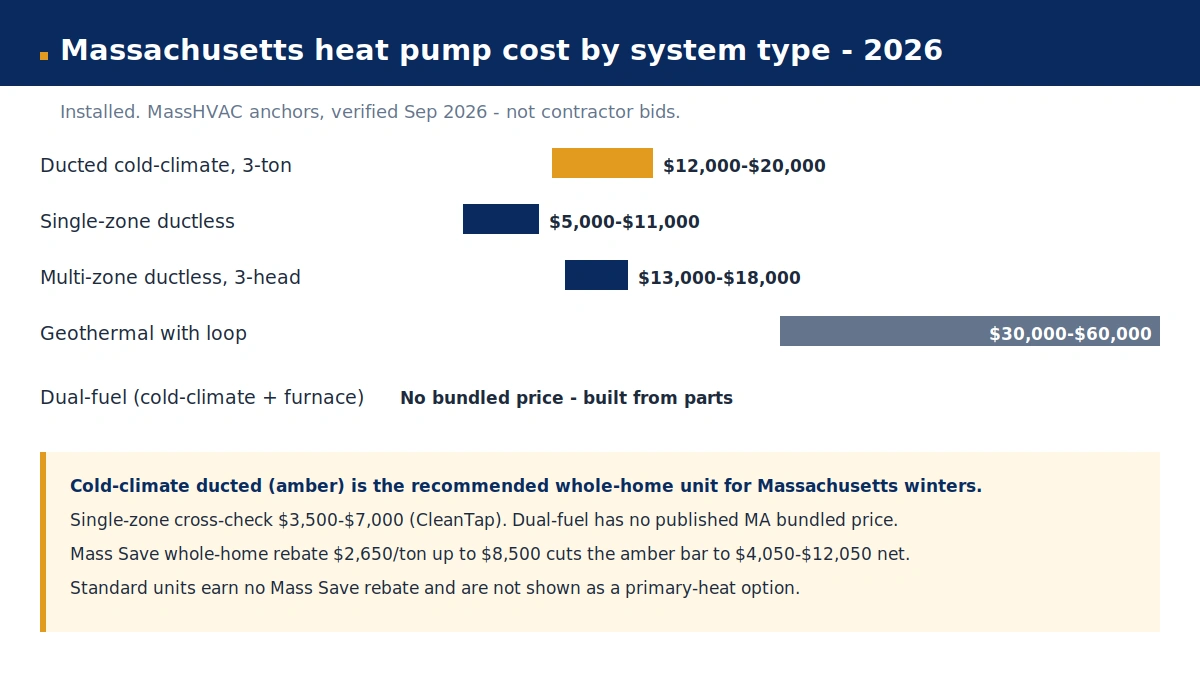
In Massachusetts the words “heat pump” can mean five machines at very different prices — more than five to one from the cheapest to the dearest. Which one fits depends on the house, and here the house usually decides: a Boston triple-decker with no ducts, a Cape Cod cottage on a boiler and baseboards, a Worcester colonial with forced air, a Berkshire farmhouse on oil with a stone foundation. The table prices each machine from the MassHVAC anchors, with cross-checks where the state figure needs one.
| System type | Installed cost (MA) | Best for in Massachusetts |
|---|---|---|
| Ducted cold-climate (3-ton) | $12,000-$20,000 | Whole-home primary heat with ducts; the default MA buy |
| Ductless mini-split, single zone | $5,000-$11,000 | One room, addition, or a house with no ducts |
| Ductless multi-zone (3 heads) | $13,000-$18,000 | Whole-home without ducts; zone-by-zone control |
| Dual-fuel (cold-climate + gas furnace) | Built from parts — see text | Gas-heated home that wants a heat pump for shoulder seasons + AC |
| Geothermal, ground-source with loop | $30,000-$60,000 | Long-term owner, big lot, coldest sites; steadiest winter COP |
Ducted cold-climate is the default Massachusetts buy. The rebate rules make it so: Mass Save pays only for cold-climate equipment on its Qualified Products List, so the ducted cold-climate unit is the one that both heats the house and collects $2,650 a ton. It reuses the existing ductwork, heats and cools from a single system, and a model that meets the ENERGY STAR cold-climate criteria or sits on the NEEP list keeps at least 70 percent of rated capacity at 5 degrees with a COP of at least 1.75. At $12,000-$20,000 for a 3-ton job, the spread is brand and efficiency tier, and the state of the ducts: leaky, uninsulated ductwork in an unconditioned attic pushes a job to the top of the band once sealing and insulation join the quote, and the money is well spent, because heat-pump air leaves the register at 90 to 110 degrees and exposes duct losses a 140-degree furnace stream used to hide. The ducted-versus-ductless choice is covered in full in our ductless vs ducted guide.
A standard ducted unit is the wrong buy as primary heat in Massachusetts. The rebate is the proof: it is not cold-climate certified, it is not on the Qualified Products List, and it earns $0 from Mass Save. Its January performance is the other proof. At 5 degrees it keeps 40 to 60 percent of rated capacity while its COP falls toward 1.0, so resistance strips carry weeks of the season — and resistance heat at about 30.5 cents a kilowatt-hour runs near $89 a million BTU, more than triple a gas furnace. On a mild October afternoon the two machines look identical; the difference is a January electric bill. The saving on the install is spent twice over — once in winter electricity, once in a rebate never collected. A standard unit belongs in Massachusetts only as a cooling-first machine behind a gas furnace that stays the primary heat, which is a dual-fuel purchase under another name and should be priced that way.
Massachusetts’ older housing stock is exactly what ductless mini-splits were built to retrofit. Mini-splits are how Massachusetts retrofits houses that never had ducts — and that is a large share of the state’s homes, from Boston and Worcester triple-deckers to Capes and colonials on boiler heat, plus the additions and finished attics no duct ever reached. One zone runs $5,000-$11,000 and heats and cools a single room or open-plan area: outdoor unit on a wall bracket, indoor head on the wall, one small hole for the lineset. Three heads at $13,000-$18,000 cover a whole small home, each zone on its own thermostat, so bedrooms can sit at 62 degrees overnight while the living room holds 70 — real money across a Massachusetts winter. The limit is coverage: a head warms only the room it serves, so a four-bedroom colonial with a single living-room head still needs heat in the bedrooms. The models that dominate from the North Shore to the Berkshires are cold-climate mini-splits — Mitsubishi Hyper-Heat, Fujitsu, Daikin Aurora — which hold full rated capacity to 5 degrees and about 70 percent or more at minus 13. For sizing and pricing zone by zone, our mini-split installation guide is the place to look.
Dual-fuel is the honest answer for the 52 percent of Massachusetts homes that heat with piped gas. Dual-fuel fits the gas-heated majority: the cold-climate heat pump and a gas furnace share the house, and a control hands the load to the furnace below a switchover temperature the installer sets — usually somewhere between 30 and 40 degrees here, fixed by the gas and electric prices. Mild weather belongs to the heat pump, because it beats gas then; deep cold belongs to the furnace, because the heat pump’s COP has dropped past the point where it wins. No primary anchor in this pass published a bundled dual-fuel installed price for Massachusetts, so none is invented here: add the cold-climate ducted system ($12,000-$20,000) to a 95 percent gas furnace — the furnace half is priced in our furnace replacement guide — and about $500-$1,500 for dual-fuel controls, wiring, and commissioning, a national planning figure. CleanTap’s secondary band of $14,000-$25,000 lines up with that build. The running-cost section works out the switchover point at Massachusetts prices, because that number — not the sticker — decides whether dual-fuel saves money here. The configuration itself is covered in our dual-fuel heat pump guide.
Geothermal is the only system in this state whose winter efficiency barely notices the weather — and the only one whose rebate needs its own conversation. A ground-source unit pulls heat from earth that stays near 50 degrees all year a few feet under a Worcester lawn, holding a COP of 3.0 to 5.0 through a 4-degree night while an air-source unit works at 1.75. MassHVAC puts the Massachusetts installed range at $30,000-$60,000 with the loop, Modernize at $25,000-$45,000 and more — the loop is the swing, horizontal trenching where the lot allows, vertical bores where it does not, and ledge rock under a Massachusetts yard can make a borefield the dearest line on the quote. Mass Save handles geothermal rebates apart from air-source, with a higher cap: up to $13,500 standard, up to $25,000 income-qualified, on secondary sources that disagree and are flagged in the sources section. The buyer who fits geothermal is a long-term owner on a big lot staying 20 years; the buyer who does not is anyone likely to move in five, because the loop stays in the ground and the payback needs a decade of winters. The 30 percent federal credit that once softened the price is $0 for a 2026 homeowner-owned install under the same OBBBA change that ended the air-source credit, so the 2026 geothermal case stands on operating savings alone. Loop types, tight-lot bores, and the 20-year math without a credit are in our geothermal heat pump guide.
One more configuration worth a paragraph: a cold-climate mini-split added to a home that keeps its boiler or furnace. One or two heads go into the rooms people live in — living room, home office, main bedroom — and take the shoulder seasons plus the mild winter days, while the old system handles deep cold and the house gains air conditioning in July. The first zone at $5,000-$11,000 is the cheapest entry to a heat pump in Massachusetts, and the partial-home rebate — $1,125 a ton plus up to $1,000 in bonuses — was written for exactly this job. Sold as a whole-home solution it disappoints, because one head cannot heat a house; a quote that suggests otherwise is pricing a smaller system than the house needs.
Heat Pump Cost by Home Size
After system type comes size, and Massachusetts gets it wrong in both directions more often than most states. Too small in Worcester, and the machine leans on resistance heat for a month every winter at 30.5 cents a kilowatt-hour. Too big, and it short-cycles, never settles into steady efficiency, and costs thousands extra for capacity the house never calls on. The right size comes from one document only: a Manual J load calculation, room by room, at the design temperature — 9 degrees in Boston, 4 in Worcester, 2 in Springfield, minus 3 in Pittsfield. Square footage alone, or the size of the furnace coming out, is a guess at the number everything else hangs on. Insist on the Manual J in writing before signing — Mass Save wants it too, for the partial-home sizing bonus, so the calculation doubles as rebate paperwork.
The table below prices ducted cold-climate systems by tonnage from the $12,000-$20,000 3-ton anchor. Heat pump capacity is rated in tons, 12,000 BTU an hour to the ton, and the heating load sets the tonnage: a 2,000-square-foot Boston house commonly needs a 3-ton or 3.5-ton system, where the same house in a mild climate would take 2.5 tons, because the design temperature sits some 60 degrees below room temperature.
| System size | Home size (approx.) | Ducted cold-climate (MA) |
|---|---|---|
| 1.5 ton | 600-1,000 sq ft | $7,500-$13,000 (planning est.) |
| 2 ton | 1,000-1,400 sq ft | $9,000-$15,000 (planning est.) |
| 2.5 ton | 1,400-1,700 sq ft | $10,500-$17,500 (planning est.) |
| 3 ton | 1,700-2,100 sq ft | $12,000-$20,000 |
| 3.5 ton | 2,100-2,400 sq ft | $13,500-$22,500 (planning est.) |
| 4 ton | 2,100-2,700 sq ft | $15,000-$25,000 (planning est.) |
| 5 ton | 2,700-3,500 sq ft | $18,000-$30,000 (planning est.) |
Every row except the 3-ton row carries a warning label. No Massachusetts source in this pass published cold-climate prices by size; the other rows are planning estimates scaled from the 3-ton anchor, and they are labeled as such. Do not quote them as measured Massachusetts prices, because they are not. What they show honestly is the shape of the decision: at every size, the step from one tonnage to the next costs roughly $1,500-$3,000, and the 3-ton row is the only one with a measured anchor behind it.
Three cautions sit behind that table. To begin with, the home-size column is a rough guide, and rougher in Massachusetts than most places: a tight, well-insulated 2,000-square-foot house built in 2020 can need a full ton less than a drafty 2,000-square-foot triple-decker from 1910 with single-pane windows and bare walls. Age, insulation, glazing, air leakage, and ceiling height move the answer more than floor area does — and Massachusetts holds the third-oldest housing stock in the country, so the drafty end of the range is the usual case. Next, heating load sets the size, not cooling load. In Massachusetts the heating load runs three to four times the cooling load, so a system chosen for the summer will be far too small for January. Sizing from the old air conditioner’s tonnage is sizing for the wrong season. Finally, backup heat is sized at the same time as the heat pump, not afterwards. Resistance strips or a furnace have to cover the full design load on the coldest night, when the heat pump contributes least. A quote that prices the heat pump and leaves backup heat to be decided later has left out the part that keeps pipes from freezing — and in a Massachusetts triple-decker, frozen pipes are a building-wide event, not one unit’s problem.
The 3-ton row deserves the closest look, because it is the only row with a measured anchor behind it and the size most Massachusetts homes settle on. Within that $12,000-$20,000 band, brand and efficiency tier set where a quote lands. The bottom of the band is a value-tier cold-climate unit, around HSPF2 8.5. The top is a premium variable-speed unit, above HSPF2 10. Across a Worcester winter at 6,969 heating degree days, the premium tier pays for itself — a higher HSPF2 means a higher seasonal COP, and each tenth of a COP point is worth real money. Short on cash, the value-tier cold-climate unit still beats a standard unit by a wide margin; the error is buying a standard unit at all — and giving up the Mass Save rebate with it.
Heat Pump Cost by City: Boston, Worcester, Springfield & Cambridge
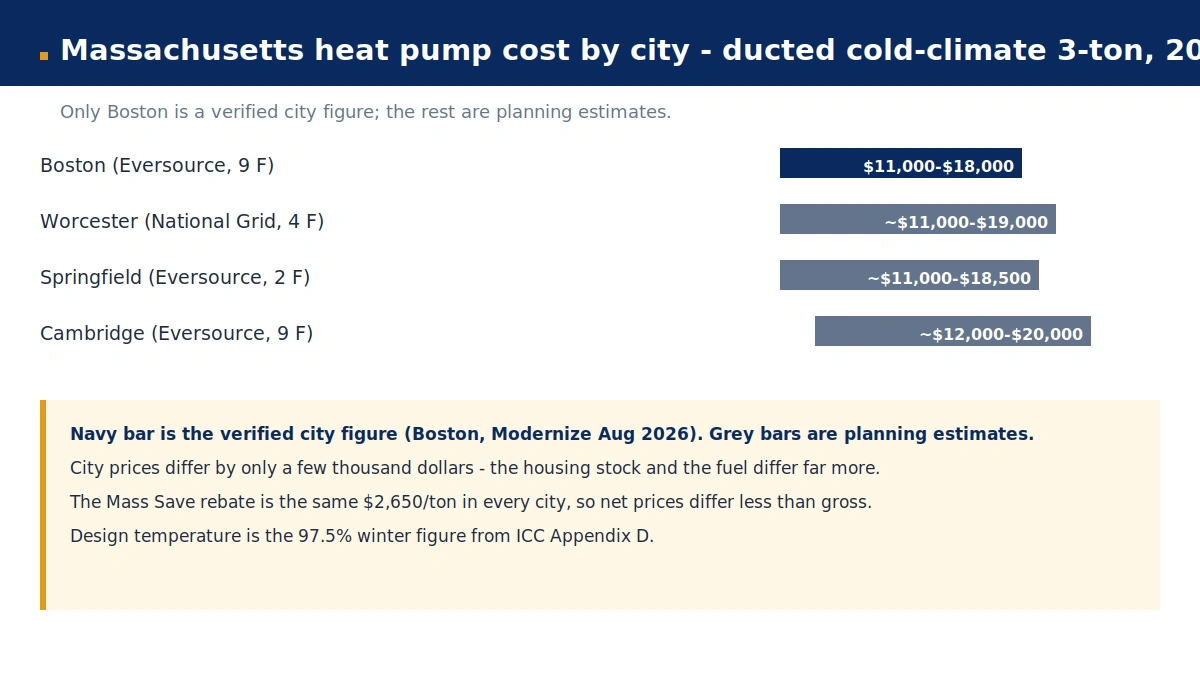
Massachusetts is a small state with one very expensive HVAC market — Boston — and several cheaper ones a short drive away, and the verified figures run from $11,000 to $20,000 for the same 3-ton ducted job. What sets the cities apart is labor and permitting more than equipment: the rebate is identical statewide, the electricity price is nearly identical statewide, and the design temperature differs by only a few degrees. Modernize’s Boston figures are the only verified city band in this pass; the other three cities carry a warning label rather than a verified price.
| City | 3-ton ducted cold-climate | Utility | Design temp |
|---|---|---|---|
| Boston | $11,000-$18,000 (Modernize) | Eversource | 9 F |
| Worcester | ~$11,000-$19,000 (planning est.) | National Grid | 4 F |
| Springfield | ~$11,000-$18,500 (planning est.) | Eversource | 2 F |
| Cambridge | ~$12,000-$20,000 (planning est.) | Eversource | 9 F |
Boston is the biggest market in the state and the most expensive of the verified cities, at $11,000-$18,000 for a 3-ton ducted cold-climate system. Boston is also where the installer bench is deepest — the Boston-Cambridge-Newton metro employs about 6,050 HVAC technicians, the most of any Massachusetts metro, at a median $37.75 an hour (BLS, May 2025) — and where the housing stock fights the installer hardest: triple-deckers with no ducts, brownstones with plaster walls that cannot be opened cheaply, condos where the exterior wall is common area and the board’s approval is the whole decision. A Boston buyer pays the most for the install and runs the system on Eversource power at a 17.3-cent supply price inside a 30.5-cent all-in average. That is not a reason to skip the heat pump in Boston — it is a reason to buy it for the right reason: replacing oil heat, adding air conditioning to a house that never had it, or pairing it with a gas furnace in a dual-fuel setup where the furnace carries January.
Worcester is the coldest of the four cities, designed for 4 degrees with 6,969 heating degree days, and its planning estimate of $11,000-$19,000 sits just below Boston’s top end. Worcester runs on National Grid power, and its triple-decker stock is the same retrofit challenge as Boston’s at a lower labor rate. Springfield, designed for 2 degrees on Eversource power in the Pioneer Valley, carries a planning estimate of $11,000-$18,500 — the valley’s lower labor costs pull it down, and its older mill-town housing pulls the ductwork and panel work back up. Cambridge, across the river from Boston on the same Eversource territory and the same 9-degree design temperature, carries the highest planning estimate at $12,000-$20,000: dense streets, tight parking, strict permitting, and some of the oldest housing in the state.
Lowell and the Berkshires are worth a line each, without a price attached. Lowell, on National Grid in the Merrimack Valley, shares Worcester’s mill-town housing and mid-range labor, and its stock of older two- and three-family homes is the classic Massachusetts mini-split market. The Berkshires — Pittsfield, designed for minus 3 degrees, the coldest design temperature in the state — are where the cold-climate rating and the backup heat matter most, where lots run big enough for geothermal, and where the nearest qualified installer may be an hour away. The Worcester, Springfield, and Cambridge install figures are indicative only; do not quote them as Modernize figures, because they are not.
Compare cities on price per ton, never on the total, and look at the rebate before the price. Boston’s $18,000 top end next to Springfield’s $11,000 bottom end looks like a large gap, but most of it is the range itself — the same 3-ton job can land anywhere inside either city’s band with brand and ductwork. Mass Save pays the same $2,650 a ton in every city, so the net-price gap between Boston and Springfield is smaller than the gross gap, and the payback gap smaller still. The payback section below runs the fuel-by-fuel numbers.
Massachusetts’ Cold-Climate Reality: Design Temps, HDD & What 9°F Does to a Heat Pump
Massachusetts winters are cold enough to punish the wrong equipment and mild enough to reward the right equipment — and the difference between those two outcomes is the whole guide. The state sits in IECC climate zone 5 for most of its area, zone 6 in the Berkshire hills, which puts it a full zone warmer than North Dakota and a full zone colder than Maryland. That middle position is what makes the cold-climate heat pump the right machine here, and the standard machine the wrong one.
The design temperatures. Sizing starts from the 97.5 percent winter design temperature: the outdoor temperature the weather stays above for 97.5 percent of a typical winter’s hours, and the figure every Manual J is built on. Boston’s is 9 degrees, Worcester’s 4 degrees, Springfield’s 2 degrees, Pittsfield’s minus 3 degrees. These are routine winter conditions, not records — Boston still logs 5,634 heating degree days a year, Worcester 6,969, Springfield 5,429, Pittsfield 7,578. For scale, the North Dakota guide in this series designs around minus 18 and Maryland around 13; Massachusetts sits between them, nearer Maryland. The record lows go further: minus 18 in Boston, minus 24 in Worcester. A Boston January averages a high near 37 and a low near 22, so the heat pump spends most of its season in the 20s and 30s — exactly where a cold-climate unit does its best work.
What the cold does to a heat pump. An air-source machine pulls heat out of outdoor air, and colder air holds less heat to pull. Capacity and efficiency fall together. Picture a standard unit rated 36,000 BTU an hour at 47 degrees. At 5 degrees that same machine may manage only 14,000 to 22,000 BTU an hour — 40 to 60 percent of what it is rated for — as its COP falls toward 1.0. Department of Energy field tests show what the vapor-injection hardware buys. At 5 degrees a cold-climate unit still delivers 70 to 80 percent of its rated capacity, with a COP between 2.2 and 2.8. At minus 5 it holds 60 to 70 percent, with a COP between 1.8 and 2.4. One brand line illustrates it: Mitsubishi Hyper-Heat holds its full rated output down to 5 degrees, and roughly three-quarters of it — about 76 percent — at minus 13. In Massachusetts, with a 9-degree design temperature in Boston and most of the season above 20, a cold-climate unit seldom reaches its worst-case numbers — which is why this guide plans on a seasonal COP of 2.0 to 2.5 for Massachusetts, a planning range, rather than the harsher figure a Dakota winter would force. Even the best air-source unit fades below zero, and on the coldest nights of a Worcester January it cannot carry the house alone. Backup heat is not a footnote in Massachusetts either. It is half the system.
The defrost cycle is a Massachusetts line item, and the damp air makes it heavier than in the Dakotas. Once the outdoor coil falls below freezing, moisture from the air freezes onto it, and the unit has to reverse itself every so often to melt the frost off — pushing cold air indoors for a few minutes while it does. Coastal air off the Atlantic keeps Massachusetts winters humid, so a Boston heat pump defrosts more often than a Fargo unit in dry prairie air. The meltwater needs somewhere to go, and an outdoor unit sitting at grade in a Boston yard will grow an ice mound underneath itself until the coil is blocked. A wall bracket or raised stand lifts the unit clear, and a pad that drains away from the house finishes the job — a few hundred dollars on the quote, and the difference between a unit that defrosts cleanly and one that ices itself into a February service call.
Snow, wind, and the nor’easter. A nor’easter can leave a foot of snow on Boston overnight and drive it sideways into drifts, and an outdoor unit on the windward wall, below a roof valley that sheds snow, or beside a driveway the plow buries will spend the storm starved for air. Put the unit on the leeward wall, under an eave that throws snow clear of it, with open space on every side for airflow and for a technician to reach it in a storm. On exposed coastal and hilltop sites, a wind baffle — a plain shield on the intake side — keeps driven snow out of the coil. The catalog never mentions any of it. The February service bill does.
Start with the house, not the machine. The machine matters less than the house it heats. Heat-pump air leaves the register at 90 to 110 degrees, while a gas furnace delivers 120 to 140. A well-sealed, well-insulated house feels no difference at all. A drafty triple-decker with single-pane windows, bare walls, and a 1910 attic notices it every evening: the rooms feel as if the heat pump is always a step behind. The cheapest capacity a Massachusetts homeowner can buy is air sealing and insulation — each BTU kept inside is a BTU the heat pump need not make at 9 degrees, and a BTU the backup heat need not make either. Massachusetts makes the first step easy in a way most states do not: Mass Save offers a no-cost Home Energy Assessment, weatherization is a required step for the whole-home rebate, and a $500 bonus rides on the partial-home rebate. Get the assessment and an insulation quote before the heat pump quote; if the house needs both, fix the envelope first and size the heat pump after, because the right size may drop a full ton. A smaller heat pump costs less to buy and less to run, and it is the one place in this purchase where paying first means paying less twice.
Cooling is the quiet half of the value. July is the quiet half of the value. Boston summers reach the 90s with humidity to match, and a heat pump wrings moisture out of the air as it cools — something a window unit does poorly and a fan cannot do at all. For a Massachusetts home that has never had cooling, a large share of the older stock, that July comfort is worth more than the heating sums alone suggest. Size the system for January anyway: a machine chosen for a Boston July will be far too small for a Boston January, and the heating load is the one that governs.
Heat Pump vs Gas Furnace in Massachusetts: The Running-Cost Math
Every number in this guide comes back to this section, and it is also where most Massachusetts heat pump advertising slips — because the honest answer is that a heat pump usually loses to a gas furnace on fuel here, and the exceptions can be named one by one. Every figure below is NestPriced arithmetic built on published prices. Each assumption is stated outright, so the sums can be repeated with any utility’s rate and any house.
The planning home. Start with a 2,000-square-foot Boston-area home needing about 50 million BTU of delivered heat a year — a planning assumption built from Boston’s 5,634 heating degree days, not a measured bill. Fifty million BTU equals 14,650 kilowatt-hours of heat. The rest of this section divides that heat by the efficiency of each machine and multiplies by the price of its fuel.
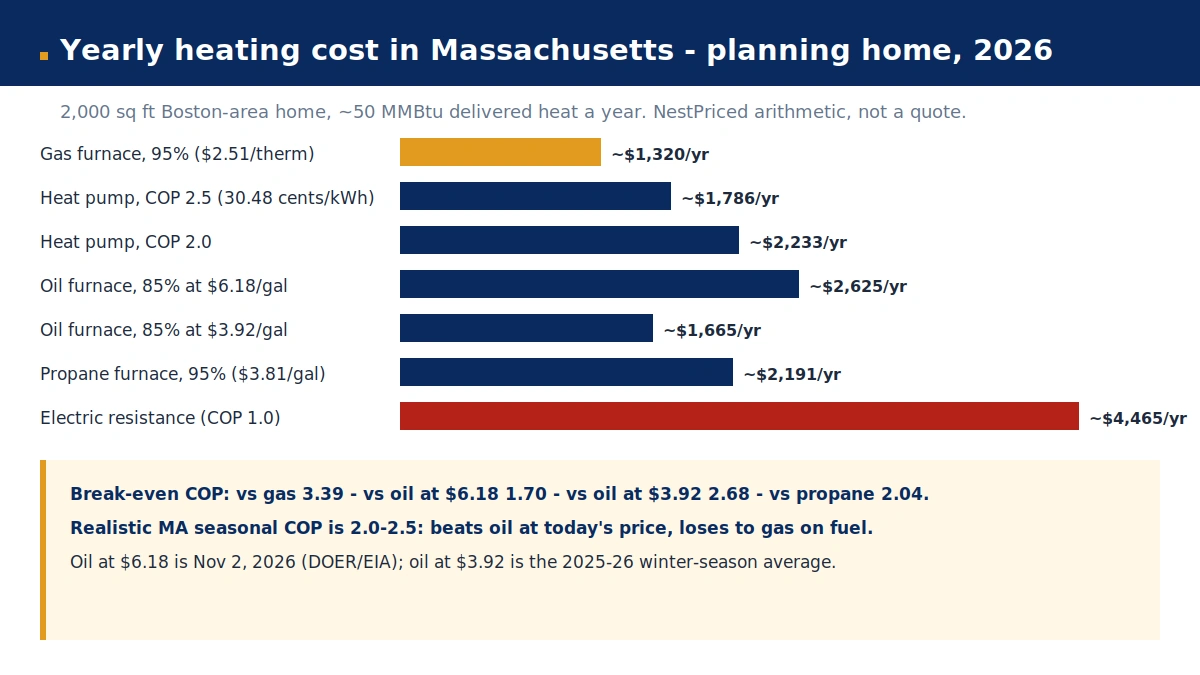
The gas furnace. Take the furnace first: at 95 percent AFUE, 50 million BTU of heat out of the registers needs about 52.6 million BTU of gas in, which is 526 therms. At Massachusetts’ 2025 residential gas price of about $2.51 a therm (EIA, $25.06 per thousand cubic feet), the fuel bill lands near $1,320 a year. That gas price is the second shock in this guide after the electricity price: Massachusetts homes paid $25.06 per thousand cubic feet in 2025, against $15.34 nationally, because the state’s gas utilities paid $8.14 per thousand cubic feet at the citygate against $4.85 nationally. A second modeled source puts a standardized Massachusetts home’s gas heating lower, and the EIA’s own Winter Fuels Outlook puts a Northeast gas-heated home at $879 a season — both describe smaller homes or smaller loads than the planning home here, and the shape of the answer does not turn on which one is used. Gas is expensive in Massachusetts. Electricity is more expensive still.
The heat pump. A cold-climate heat pump at a seasonal COP of 2.5 — a realistic Massachusetts seasonal figure, between the 2.2 to 2.8 it manages at 5 degrees and the lower numbers it falls to on the coldest nights — draws 5,860 kilowatt-hours to deliver the same 50 million BTU. At the state-average all-in price of about 30.5 cents a kilowatt-hour (EIA, August 2026), that runs about $1,786 a year. At a seasonal COP of 2.0 it runs about $2,233 a year; at 3.0, about $1,488. Set those against the gas furnace’s $1,320: at COP 2.5 the heat pump runs about $466 a year dearer than gas; at COP 3.0 it still runs about $168 dearer; only past a seasonal COP near 3.4 does it draw level with gas at all.
The break-even COP. Ask the question backwards and it sharpens: what efficiency would a heat pump need to match the gas furnace? The break-even COP is a division: the electricity price per million BTU over the gas price per million BTU at 95 percent efficiency. At 30.5 cents a kilowatt-hour — $89.33 a million BTU — against gas at $25.10 a million BTU, $26.38 once the furnace’s 5 percent loss is counted, the answer is a break-even COP of 3.39. No heat pump on the market holds a seasonal COP of 3.39 through a Massachusetts winter. That is the blunt fact, and any quote claiming a Massachusetts heat pump beats a 95 percent gas furnace on fuel at the average electric rate is pricing a different state’s power. One qualification counts: the all-in average folds in delivery charges that do not all grow with usage, and the residential heat-pump electric rates that began November 1, 2025 cut distribution and transmission charges from November through April for eligible customers — which lowers the effective winter rate by an amount this guide could not verify, so the break-even COP above is the cautious figure, not the best case. Ask your utility which heat-pump rate you qualify for before modeling anything.
The backup-heat adder. The numbers above credit the heat pump with all 50 million BTU at its seasonal COP. In a real winter, the backup system covers part of the season’s heat, and that share is the expensive part. Say 10 percent of the season’s heat comes from electric resistance strips — a fair share for a cold-climate unit on the coldest nights. That slice is 1,465 kilowatt-hours, about $447 extra a year at 30.5 cents — an illustration, not a bill. Dual-fuel earns its keep exactly here, in gas territory: below the switchover temperature the gas furnace supplies that 10 percent at gas prices instead of resistance prices, and the heat pump never has to run near a COP of 1.0 at all.
The switchover temperature. A dual-fuel control changes over at one outdoor temperature: the point where the heat pump’s COP has sunk to the break-even COP. In Massachusetts, with a break-even COP near 3.4, that handover sits above the temperatures where a heat pump does most of its work — so the furnace carries most of deep winter while the heat pump earns its keep in the shoulder seasons, roughly October through November and March through April, plus the cooling season. A typical Massachusetts dual-fuel switchover lands somewhere between 30 and 40 degrees, and the installer fixes it during commissioning; ask which temperature was chosen and why, and get it in writing, because a switchover set 10 degrees too high hands the furnace months of work the heat pump could have done cheaper, and one set 10 degrees too low hands the resistance strips a January they cannot afford.
What the heat pump beats, clearly. Electric resistance heat is the matchup the heat pump wins outright — baseboard panels, electric furnaces, space heaters, everywhere in the state, by a wide margin. The resistance bill for the same 50 million BTU runs about $4,465 a year at the state-average price — $2,679 a year more than the heat pump’s $1,786, every year. Some 17 percent of Massachusetts homes heat with electricity, and no purchase in this guide pays those homes back faster than a heat pump. Against propane it wins by less: a 95 percent propane furnace at $3.81 a gallon runs about $2,191 a year for the planning home, against the heat pump’s $1,786, a saving near $405 a year. Against a 95 percent gas furnace at the average electric rate, it loses — and the right reason to buy it there is the air conditioning, the comfort, the zoning, or the plan to replace a furnace that is already at the end of its life, not the fuel bill.
Cooling, counted honestly. A heat pump is also the air conditioner, and a Boston July reaches the 90s with humidity to match. A new central air conditioner alone runs several thousand dollars nationally — the national picture is in our central AC replacement guide — so part of the heat pump’s price is money the buyer would have spent on cooling anyway. Count the premium over the furnace-plus-AC combination it replaces, not the full sticker, and the sums look considerably better than the fuel comparison alone suggests. Our heat pump running cost guide has the full running-cost picture.
The Oil Question: What a Heat Pump Saves an Oil-Heated Home
If the gas comparison is the section where Massachusetts heat pump advertising goes wrong, the oil comparison is the section where it goes right — with one condition attached, and the condition is the price of oil on the day you sign. About one Massachusetts home in four heats with oil, roughly 572,000 homes, and no other large state in this series has a fuel-switching story this big. Mass Save’s own three-year plan set out to switch about 50,000 of those homes, almost 10 percent of the state’s total, and has managed about 37,000 in five years — roughly half the planned pace. The reason the pace lags is not that the math is bad. It is that the math depends on an oil price that moved 73 percent in a single year.
Two oil prices, two answers. The Massachusetts Department of Energy Resources surveys dealers every week through the heating season. For the week of November 2, 2026, the statewide average was $6.18 a gallon (EIA’s weighted figure $6.19), against $3.63 the same week a year earlier. The 2025-26 winter-season average was $3.92 a gallon retail, $3.64 on the EIA’s weighted measure. The jump came in March 2026, when the price rose more than a dollar in a single week to $5.44, and it never came back down. This guide prints both prices and runs the math on both, because a payback built on $6.18 oil is a different purchase from a payback built on $3.92 oil, and a buyer who plans on one and gets the other has been misled either way.
The arithmetic. An 85 percent efficient oil furnace burns about 425 gallons to deliver the planning home’s 50 million BTU a year. At $6.18 a gallon that is about $2,625 a year. At $3.92 it is about $1,665 a year. The heat pump at a seasonal COP of 2.5 costs about $1,786 a year. So at today’s oil price the heat pump saves about $839 a year against oil. At last winter’s oil price it costs about $121 a year more than oil. The break-even COP tells the same story from the other side: against oil at $6.18 a gallon, a heat pump ties the oil furnace at a COP of about 1.70 — any cold-climate unit clears that easily. Against oil at $3.92, the break-even COP is about 2.68 — above the realistic Massachusetts seasonal range, which means the heat pump loses on fuel at that price. The honest summary is that a heat pump beats oil decisively when oil is expensive, roughly ties it when oil is at its recent average, and loses when oil is cheap. Oil has been all three of those things in the last eighteen months.
Why the oil case is still the strongest fuel-switching case in Massachusetts. Three facts steady it. First, the Mass Save whole-home rebate pays the most where the displacement is greatest: a whole-home system displacing oil earns $2,650 a ton, $7,950 on a 3-ton job, which is the largest rebate in the program and the one that most directly cuts the payback. Second, an oil home that switches removes a tank, a delivery schedule, a burner service contract, and the price risk that just moved 73 percent in a year — the heat pump’s fuel is electricity, whose Massachusetts price moved less than 1 percent over the same twelve months. Third, the oil furnace itself is usually the oldest equipment in the house: when a 25-year-old boiler is due for replacement anyway, the premium for a heat pump over a new boiler is small enough that the cooling, the zoning, and the rebate carry it even at last winter’s oil price. The households that should think hardest about switching are the ones with an aging boiler, a tank that needs replacing, or a delivery contract that just repriced — and the ones that should wait are the ones with a new boiler and a fixed-price oil contract, who can let the next winter’s price decide.
The partial-home oil play. A growing number of Massachusetts oil homes do not switch at all — they add one or two mini-split heads and keep the boiler. The heads take the shoulder seasons and the mild winter days, the boiler keeps the deep cold, and the house gains air conditioning in July for the first time. The partial-home rebate pays $1,125 a ton plus up to $1,000 in bonuses, and the oil burn drops by the share of the season the heads carry — which, in a Boston winter spent mostly above 20 degrees, can be most of it. It is the lowest-risk way into a heat pump in this state, and the configuration the rebate program was built to encourage. What it is not is a whole-home solution: the boiler stays, the tank stays, and the oil bill falls by a fraction rather than disappearing. Get the fraction modeled in writing, with the switchover behavior of the integrated controls named, before you sign.
Mass Save Rebates & What You Can Actually Collect in 2026
Mass Save is the reason a Massachusetts heat pump costs less out of pocket than the same system in almost any other state — and the reason the paperwork matters more here than anywhere else in this series. The program is a collaboration of the state’s electric and gas utilities — Eversource, National Grid, Cape Light Compact, Unitil, Berkshire Gas, and Liberty — and its 2026 heat pump rebates are the largest in the country. They are also tiered, conditional, and deadline-bound in ways that punish a buyer who assumes the headline number applies to every home.
Whole-home pays the most. A whole-home air-source heat pump — the heat pump becomes the home’s sole source of heating and cooling — earns $2,650 a ton, up to $8,500 in 2026. On a 3-ton system that is $7,950. The 2025 rate was $3,000 a ton capped at $10,000, so the 2026 rebate is smaller than the one your neighbor collected last year, and any quote still showing the 2025 numbers is out of date. The conditions matter: the equipment must be ENERGY STAR Cold Climate certified and on Mass Save’s Qualified Products List, the contractor must be in the Mass Save Heat Pump Installer Network, the install must fall between January 1 and December 31, 2026, and the application with supporting documents must be received by February 28, 2027. A no-cost Home Energy Assessment is required before the rebate applies, and weatherization and verification steps follow. The rebate cannot exceed the installation cost, and the tiers cannot be combined for the same equipment.
Partial-home pays less per ton, with bonuses attached. A partial-home system — the heat pump supplements an existing boiler or furnace that stays in place — earns $1,125 a ton, up to $8,500. On a 3-ton system that is $3,375. Two $500 bonuses attach to partial-home jobs only: a right-sized equipment bonus, for equipment sized to meet 90 to 120 percent of the total heating load on a Manual J, and a weatherization bonus, for completing the recommended air sealing and insulation. Together they can add $1,000, taking a 3-ton partial-home rebate to $4,375. Whole-home jobs get no bonuses, which narrows the gap between the tiers on a 3-ton system to about $3,575 — worth knowing before you decide whether to keep the old boiler as backup or remove it entirely.
Basic pays the least, for the jobs that displace nothing. The basic tier, new for 2026, pays $250 a ton, up to $2,500 — for a replacement heat pump, or for conditioning a space that had no heat before. A single-zone mini-split in a new addition earns $375 at 1.5 tons. It is a small rebate, and it is also the tier most often misquoted, because a contractor who prices a partial-home job as a basic job leaves $875 a ton on the table. Ask which tier your quote assumes, and ask for the program form that says so.
Income-qualified households collect far more. Enhanced incentives reach up to $16,000 for an air-source heat pump, and the Turnkey pathway can take a qualifying household to up to no cost at all — the program manages the whole job, from assessment to install, for households that meet the income and building screens. These are alternatives to the standard rebate, not amounts to add to it: a household collects either the standard $8,500 or the enhanced $16,000, never both. For ground-source systems, the enhanced ceiling reaches up to $25,000 according to one secondary source, against a standard ground-source cap of up to $13,500 reported by another — the two figures disagree, and this guide flags the conflict rather than resolving it, because the program documents are the only source that counts and they were not directly readable in this pass. If your household income is anywhere near the program’s thresholds, ask the Mass Save income-eligible team before you price anything else: the difference between the standard and enhanced pathways is the difference between a rebate and a free system.
The HEAT Loan covers the rest at 0%. The Mass Save HEAT Loan offers 0% interest financing up to $25,000 for qualifying energy-efficiency upgrades, including heat pumps — but the $25,000 is a lifetime cap across all of a customer’s Mass Save-financed projects, not a fresh $25,000 for each job. The term depends on income: up to 7 years (84 months) below 135 percent of state median income, 5 years (60 months) from 135 to 300 percent, and 3 years (36 months) above 300 percent, through participating Massachusetts lenders subject to credit underwriting. A Home Energy Assessment is mandatory before financing a whole-home heat pump. At 0% over 7 years, a $8,050 net balance after the whole-home rebate costs about $96 a month — an illustration, not a loan offer. One exclusion to know: residents of municipal light plant territories cannot use the HEAT Loan, because their utility is not a Mass Save sponsor; the Commonwealth offers a separate MLP Zero-Interest Energy Efficiency Loan, also 0% up to $25,000, for those households.
What else is on the table. Mass Save’s 2026 program also removed new split systems using refrigerants with a global warming potential above 700 — including R-410A — from the Qualified Products List as of January 1, 2026. A system installed from April 1, 2026 onward needs R-32 or R-454B refrigerant to qualify, after a grace period for installs through March 31. A quote naming an R-410A system in November 2026 is a quote for a system that earns no rebate, whatever the price. And one warning about next year: a secondary source reports the whole-home rebate dropping to $2,350 a ton, capped at $7,500, for installs on or after January 1, 2027 — which means a 2026 install that slips into January loses $600 on a 3-ton job. The deadline is real, and the February 28, 2027 application deadline is the one that decides whether the money arrives at all.
| Source | Amount | Who can collect it |
|---|---|---|
| Mass Save whole-home ASHP | $2,650/ton, up to $8,500 | HPIN contractor, HPQPL cold-climate equipment, sole heat/cool |
| Mass Save partial-home ASHP | $1,125/ton, up to $8,500 + up to $1,000 bonuses | HPIN contractor, HPQPL equipment, existing heat stays |
| Mass Save basic ASHP | $250/ton, up to $2,500 | Replacement heat pump or new conditioned space |
| Mass Save income-based enhanced ASHP | Up to $16,000 / Turnkey up to no cost | Income-qualified households, program screens |
| Mass Save ground-source | Up to $13,500 standard; up to $25,000 income-qualified (secondary sources, flagged) | GSHP, loop in ground |
| Mass Save HEAT Loan | 0%, up to $25,000 lifetime cap | Mass Save sponsor territory, lender approval |
| MLP Zero-Interest Loan | 0%, up to $25,000 | Municipal light plant territories |
| Federal tax credit (§25C) | $0 for 2026 installs | — |
| HEAR / HOMES | Not launched | — |
What Washington Pays a Massachusetts Buyer in 2026: Nothing Direct, Rebates Not Yet Open & the Lease Route Unproven
The federal picture for 2026 is short enough for one paragraph — which is exactly why so much heat pump advertising still gets it wrong. In Massachusetts the paragraph has a second half that other states do not get, because the federal rebates that would matter most here have not launched at all, and even after they launch they will not pay for the fuel switch Massachusetts most needs.
The federal picture for 2026 is short, and it is short because the money is gone. Congress ended the Energy Efficient Home Improvement Credit in the One Big Beautiful Bill Act, Public Law 119-21, signed July 4, 2025: §25C, up to $2,000 a year for air-source heat pumps, no longer applies to equipment placed in service after December 31, 2025. IRS fact sheet FS-2025-05 turns on the finish date, not the payment date. A deposit paid in 2025 buys nothing if the crew finished the job in January 2026. The Residential Clean Energy Credit, §25D at 30 percent, closed on the same date, taking the geothermal credit with it. A 2026 quote that still subtracts a federal credit is pricing a law that no longer exists — have the installer take it off and quote again. What ended on July 4, 2025, and why the completion date is the date that counts, is laid out in our federal tax credits guide. Buy the heat pump yourself, install it in 2026, and the federal tax credit on it is $0.
Massachusetts’ HEAR and HOMES rebates have not launched, and nobody will give a launch date. The federal dataset allocates the state about $145.9 million — $72,809,130 for HEAR and $73,086,125 for HOMES — but the Department of Energy Resources is folding HEAR into Mass Save’s income-eligible channel instead of opening a separate portal, and the $8,000 federal adder cannot be claimed separately yet. That status was checked against state program pages on November 4, 2026, and again in a September 6, 2026 census of administrator pages. Do not count on this money when you buy. Do not let a quote count it. Do not let a salesperson promise it is coming soon — the state itself will not name a date.
When it does arrive, HEAR will not pay an oil-heated home to switch — the most important federal fact in this guide. The program pays up to $8,000 for a heat pump, but the Energy Department’s Program Notice 26-2, dated May 29, 2026, restricts the money to electric-to-electric upgrades — swapping electric equipment for more efficient electric equipment — plus new construction. Replacing a gas or oil furnace with a heat pump is fuel-switching, and fuel-switching no longer qualifies. That bites harder in Massachusetts than in most states, where about 24 percent of homes heat with oil and 52 percent with gas — the very homes barred from using HEAR to switch. The households that could use it, once it launches, are the 17 percent already on electric heat: a baseboard-heated house moving to a cold-climate heat pump is an electric-to-electric upgrade, the configuration HEAR was written for. HOMES, the whole-home efficiency program, pays on measured or modeled energy savings — up to $8,000 — rather than on the equipment list, and Massachusetts has not launched it either.
The lease route is unverified in Massachusetts. A heat pump that a company owns rather than the Massachusetts homeowner can still earn the federal clean-electricity credit — 30 percent under §48E. The catch is timing: the system must enter service by December 31, 2027, with construction begun by July 4, 2026 — the cutoff IRS Notice 2025-42 sets out. In states where a homeowner may legally buy power from a third party’s system, the company claims that credit and passes part of it through as a lower monthly lease or power purchase payment. Massachusetts is not a state where that route was verified in this pass: no lease or PPA provider was found selling one to Massachusetts homes, and third-party PPA authorization was not confirmed. Read any lease offer with a lawyer before signing — a monthly payment that looks cheap can hide a lien, a buyout clause, or a term that outlives the equipment. The honest summary is this: in 2026 the federal government pays nothing toward a Massachusetts homeowner’s own heat pump purchase, and it cannot be relied on to pay indirectly through a lease either, because no clear legal route and no verified provider exist for one. On a cash quote, the price is the price — less Mass Save, the only money on the table.
Permits & Licensing: No State HVAC License, City Rules & the HIC Registration
Massachusetts’ licensing picture is unusual in one respect that helps a buyer who knows where to look — and hurts one who does not: the state issues no HVAC license at all, which means the credential that matters is the trade license for the work actually being done, and a company can be perfectly legal to sell you a heat pump while being unlicensed to do half the job.
Massachusetts licenses the pieces of a heat pump job, not the job itself — which helps a buyer who knows which piece to ask about, and hurts one who does not. There is no statewide HVAC license. A refrigeration license applies only above 10 tons, which covers commercial work and very large homes, not a typical 3-ton residential install. Ductwork falls under the Sheet Metal Worker license, journeyperson or master, from the Board of Sheet Metal Workers. Gas piping and gas appliance connections fall under the Gas Fitter license from the Board of State Examiners of Plumbers and Gas Fitters. Oil work needs an Oil Burner Technician certificate. The electrical connections need a licensed electrician under the Board of Electricians. And anyone handling refrigerant needs federal EPA Section 608 certification — ask for the card by name. The question is never “are you licensed for HVAC,” because no such license exists. The question is which of these licenses the crew holds, and who holds the ones it does not.
The business credentials are the check that does exist. Massachusetts has no single general-contractor license, but most contractors need two credentials to work legally on a home: a Construction Supervisor License, the competency license for pulling building permits on structural work, and a Home Improvement Contractor registration, the consumer-protection registration for contracting with homeowners — handled since January 2026 through the MA Contractor Hub. A heat pump installer without an electrician’s license must bring in a licensed electrician for the electrical work, and the electrical permit should carry the electrician’s name, not the HVAC company’s. The rebate adds a credential of its own: the contractor has to belong to the Mass Save Heat Pump Installer Network, or the rebate does not apply, whatever licenses the company holds.
Permits and inspection take time, and the city sets the pace. Permits come from the city or town building department — a mechanical permit and an electrical permit — and the outdoor unit’s placement, the refrigerant lines, and the electrical disconnect are all inspected. No Massachusetts-wide permit fee schedule was verified for this guide; fees differ by municipality and usually track the job cost, so do not borrow another state’s schedule — the number belongs to the city that issues the permit. The calendar, not the price tag, is what slows a Massachusetts install: the best crews book weeks out in the shoulder seasons, and a next-day install promised in October means a crew that is either very lucky or very quiet. Permission to operate inside two weeks is the building department’s promise to make, not the installer’s.
Condos and HOAs are where the placement fight happens, and no Massachusetts law was found giving heat pump owners the solar-style protection some states grant. An outdoor unit is visible in a way a furnace is not, so an association can restrict where it sits, how it looks, and whether the street can see it — and in a Boston condo the exterior wall is usually common area, so the board’s approval is the whole decision. Sort the placement out in writing before the unit is ordered, and bring the installer into the conversation early: a unit placed for the HOA’s convenience and against the wind will cost more to run and more to service. Triple-decker owners have the same conversation with the other units in the building, because the outdoor unit, the lineset, and the electrical work all touch shared space.
What Pushes Your Massachusetts Quote Up or Down
The per-ton anchor gives a budget its bearings; it does not price the job. Seven factors can move a Massachusetts quote by thousands of dollars, and three of them come from this state’s housing stock and power market.
Labor is expensive in Massachusetts — and that is itself the point. Labor is the largest soft cost on any install, and Massachusetts labor is dear: HVAC mechanics earn a median $37.16 an hour ($77,300 a year, BLS May 2025), against $29.33 nationally, and the Boston metro median runs higher still at $37.75 an hour — with 6,050 technicians, the largest metro pool in New England. Electricians earn a median $38.18 an hour statewide. What swings a Massachusetts quote is not cheap labor but a difficult house: a triple-decker with no ducts, a brownstone with plaster walls, a Cape with a stone foundation and a 100-amp panel. Ask how many cold-climate installs the crew has done in your city and your housing type, not just how long the company has been in business.
The ductwork, and whether it survives. A heat pump moves a bigger volume of cooler air than a furnace does. Ducts that once carried a 140-degree furnace stream can fail a 100-degree heat pump stream — undersized, leaky, or poorly insulated. In Massachusetts the gap is priced in the open: a ducted system with existing ductwork runs $12,000-$20,000, one needing new ductwork $20,000-$32,000 (MassHVAC) — an $8,000 to $12,000 step, the largest single swing in any Massachusetts quote. Pricing the heat pump while taking the ducts on trust leaves the dearest part of the job out of the quote. Insist on a duct inspection and a static-pressure reading in writing — together with the cost of fixing whatever they turn up.
The electrical panel. Many Massachusetts homes still run on 100-amp service — triple-deckers, Capes, and post-war ranches above all — and a heat pump with electric backup strips can force the question. No Massachusetts-specific panel-upgrade price was verified in this pass, so this guide prints none: get the upgrade as its own line on the quote, before signing, not when the electrician is already in the driveway. One Massachusetts wrinkle: a panel upgrade is electrification work, the kind HEAR is designed to pay for — once Massachusetts’ HEAR program launches, which it has not, and only for electric-to-electric upgrades in any case. The national picture lives in our electrical panel upgrade guide.
Equipment tier. Premium cold-climate units cost 10-20 percent more than value-tier units. In Massachusetts the premium buys two things that count: stronger low-temperature performance on the coldest nights, and a higher HSPF2 that pays back across 5,634 heating degree days in Boston and 6,969 in Worcester. A cheaper cold-climate unit still leaves a standard unit far behind, and that holds even on a tight budget. For a house the buyer will keep for 20 years, the premium tier’s higher seasonal COP returns real money each winter. Premium units also hold their capacity ratings longer as they age — which counts more where the heating season runs seven months, because every point of capacity lost is a point the backup heat has to cover. And only the cold-climate tier collects the Mass Save rebate at all, which makes the tier choice a rebate choice too.
The bracket, the baffle, and the lineset. A Boston outdoor unit sitting at grade ends up under a nor’easter drift, and a unit that cannot breathe cannot defrost. A wall bracket or raised stand, a wind baffle on an exposed coastal or hilltop site, and a lineset routed clear of the roof valley that sheds snow cost a few hundred dollars each on the quote — and they are the difference between a unit that runs clean all winter and one that ices itself into a February service call. Ask for them by name. A quote that leaves them out was priced for a southern winter, not a northern one.
Financing terms. Cash is the cheapest way to pay over the system’s life — except, in Massachusetts, the 0% HEAT Loan, which costs nothing to take: $25,000 at 0% over up to 7 years, with no interest at all, is the one loan in this series that beats cash on its own terms. The loan to avoid is dealer $0-down financing, which folds dealer fees of 10-30 percent of the cash price — sometimes over 50 percent — into the amount financed. That figure is national, from the Consumer Financial Protection Bureau’s August 2024 market spotlight — and it lands on Massachusetts quotes in exactly the same way. A lease or PPA is the third path, and it is thin here: no provider was found actually selling one to Massachusetts homes, and the legal status is unverified, so a lease quote belongs in front of a lawyer before it is compared on its monthly payment at all. Beyond the HEAT Loan and the MLP loan, Massachusetts offers no state energy loan for heat pumps.
Maintenance and lifespan. A Massachusetts heat pump works harder than one in a mild climate — seven months of heating, a defrost cycle every damp cold snap, and an outdoor unit living in snow, wind, and road salt. Service once a year: clean the coils, check the refrigerant, verify the defrost cycle, and test that the backup heat actually engages when it should. Filters get changed monthly through the heating season, and snow gets cleared off the outdoor unit after every storm. Both are the homeowner’s job, not the technician’s. Lifespan, degradation, and maintenance figures are national only — no Massachusetts-specific versions exist — so each number in this paragraph carries a national flag. With good maintenance, equipment typically lasts 15-20 years; the compressor is the part that decides it, and a unit that short-cycles because it was oversized will die years before one that was sized right. Our heat pump maintenance guide and our heat pump repair guide break down what it costs to keep the system running.
Payback: When Does a Massachusetts Heat Pump Pay for Itself?
Payback is where a Massachusetts heat pump either earns its keep or does not, and the answer turns on what it replaces and what oil costs the winter you buy it — more sharply than in any other state in this series. The worked examples below use the MassHVAC anchors and the running-cost arithmetic above, with every input open to checking, and every soft spot flagged where it sits.
A worked example. Take a typical cold-climate ducted 3-ton system at the middle of the Massachusetts range, about $16,000 installed, heating the planning home — 2,000 square feet in the Boston area, about 50 million BTU of delivered heat a year. The federal credit is $0. The state pays nothing beyond Mass Save. The rebate depends on the pathway: whole-home pays $7,950 on a 3-ton system, partial-home pays $3,375 plus up to $1,000 in bonuses, and an income-qualified household can collect up to $16,000. The fuel saving depends on what the heat pump replaces, and the table below runs the five cases that actually occur in Massachusetts, on the net price after the whole-home rebate.
| What it replaces | Annual fuel saving | Payback on $16,000 gross | Payback on $8,050 net |
|---|---|---|---|
| Electric resistance heat | ~$2,679/yr | ~6.0 yrs | ~3.0 yrs |
| Heating oil at $6.18/gal | ~$839/yr | ~19.1 yrs | ~9.6 yrs |
| Heating oil at $3.92/gal | Negative — costs ~$121/yr MORE | Never on fuel | Never on fuel |
| Propane furnace | ~$405/yr | ~39.5 yrs | ~19.9 yrs |
| 95% gas furnace | Negative — costs ~$466/yr MORE | Never on fuel | Never on fuel |
Study that table the way you studied the running-cost table, because it holds the whole verdict. Against electric resistance heat, a heat pump saves about $2,679 a year and pays back in about 6 years gross, about 3 years net — the best payback in the state, and it belongs to the 17 percent of Massachusetts homes that already heat with electricity. Against oil at today’s $6.18 a gallon it saves about $839 a year, a payback of about 19 years gross and about 10 years net. Against oil at last winter’s $3.92 it loses about $121 a year, so there is no fuel payback at all at that price — the two oil rows are the same purchase at two different oil prices, and the buyer has to decide which price to believe. Against propane it saves about $405 a year, a payback measured in decades even net of the rebate. Against a 95 percent gas furnace it costs about $466 a year more to run than the furnace, so there is no fuel payback at all, ever, at the average electric rate.
Price the premium, not the whole machine. That table charges the full heat pump against the full fuel bill, which misleads any home that needs a new furnace and a new air conditioner anyway. One machine does the work of both. If the furnace-plus-AC combination would have cost $11,000 and the cold-climate heat pump costs $16,000, the premium is $5,000, not $16,000 — and against electric resistance heat that premium pays back in about 2 years, against oil at today’s price in about 6 years, against propane in about 12, and against gas it still never pays back on fuel, because the fuel saving is negative. Under the premium framing, the payback works for electric-heat, oil, and propane homes — and still does not work for gas homes. That boundary is where this guide stops defending the purchase.
What moves the payback most. Five levers move the payback, and they are not close in size. No lever comes close to the fuel being replaced: resistance heat first, oil at today’s price second, propane third, gas last — and gas never. The oil price is the second lever: the same heat pump against the same oil furnace saves $839 a year at $6.18 a gallon and loses $121 a year at $3.92, a swing of $960 a year on identical equipment in an identical house. The rebate is the third lever, and only the whole-home rebate is large enough to matter: $7,950 takes about nine years off the oil payback and three years off the resistance-heat payback. Fourth comes the switchover temperature in a dual-fuel home: a well-chosen setting lets the heat pump own the shoulder seasons at its best efficiency, while a setting 10 degrees too high hands the furnace months of work the heat pump could have done for less. Fifth comes the envelope: air sealing and insulation cut the heating load, which cuts the heat pump, which cuts the backup heat — the only lever that improves every row of the table at once, and the only one Mass Save pays a bonus for.
Who still comes out ahead. Four kinds of Massachusetts household clear it. The electric-heat home, where the published saving is about $2,679 a year and the payback is about 3 years net of the rebate. The oil-heated home at today’s oil price, where the saving is about $839 a year and the payback is about 10 years net — and shorter still if the boiler is dying anyway and the premium framing applies. The income-qualified household, where the enhanced rebate of up to $16,000 or the Turnkey pathway can take the net cost to near zero and the payback with it. And the household whose furnace is already dying: when replacement is unavoidable anyway, the premium for a heat pump over a furnace-plus-AC is small enough that the cooling, the zoning, and the shoulder-season savings carry it. Walk away when your home heats with a 95 percent gas furnace and you are counting on a fuel saving to justify the purchase — the saving is not there, and no rebate in Massachusetts is big enough to invent it.
Getting Quotes in Massachusetts: The Checklist
Massachusetts is the most paperwork-heavy state in this series to buy a heat pump in — the biggest rebate, the most conditions on it, the most expensive electricity, and the oldest housing stock — but only for a homeowner who checks the rebate tier and the equipment ratings before the sales pitch. Take this list to every bidder, and do not sign until each line has an answer in writing.
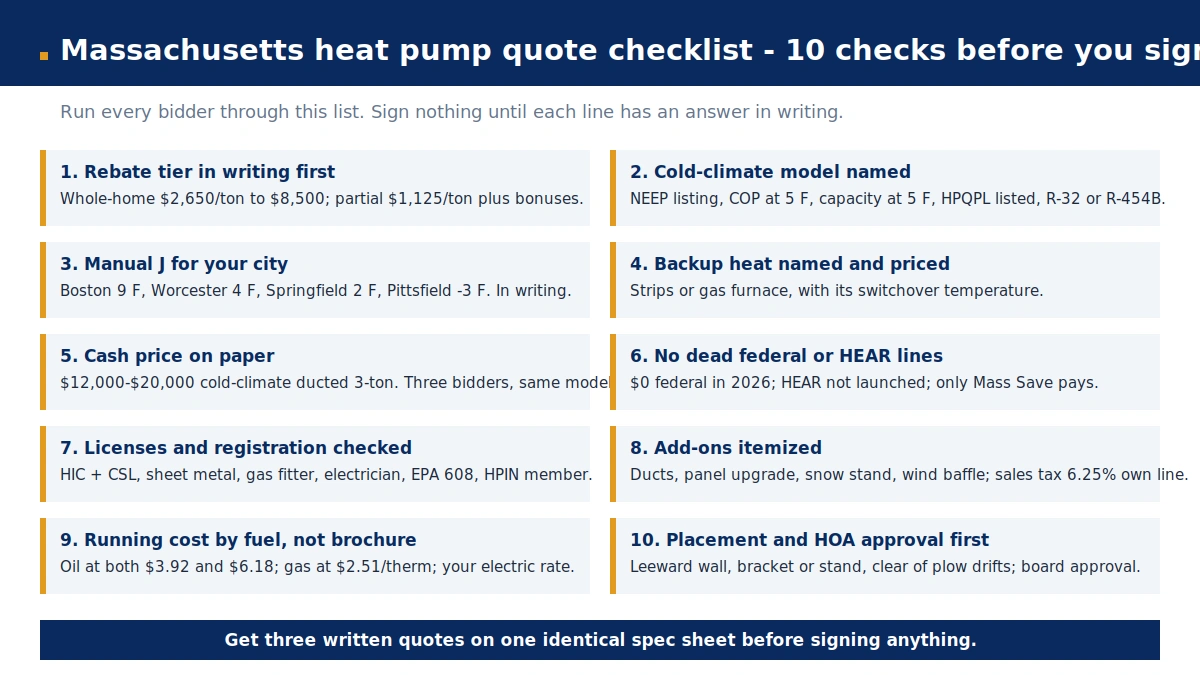
The ten-item quote checklist:
- Your rebate tier, in writing, first — whole-home $2,650 a ton up to $8,500, partial-home $1,125 a ton plus up to $1,000 in bonuses, basic $250 a ton, or income-based enhanced up to $16,000. The tier decides the net price before anything else — and the whole-home tier is worth about $4,575 more than the partial-home tier on a 3-ton job.
- Cold-climate model named, with its 5-degree numbers — the model number, its NEEP listing or ENERGY STAR cold-climate status, its place on the Mass Save Qualified Products List, its COP at 5 degrees (at least 1.75), and its capacity at 5 degrees (at least 70 percent of rated). A quote that names no model has priced a machine that may not exist, and a quote naming an R-410A system earns no rebate at all.
- Manual J load calculation, in writing — room by room, at your city’s design temperature (Boston 9 F, Worcester 4 F, Springfield 2 F, Pittsfield minus 3 F). A contractor who sizes by square footage alone is guessing at the number that decides everything else — and the Manual J is required for the partial-home sizing bonus.
- Backup heat named and priced — resistance strips or a gas furnace, with its capacity and its switchover setting. In Massachusetts the backup system does half the winter’s work, and a quote that omits it has omitted the part that keeps the pipes from freezing.
- Cash price, in writing, for one identical cold-climate model — the same kit, the same house, from all three bidders. The Massachusetts anchor runs $12,000-$20,000 for a 3-ton cold-climate ducted system; a quote well above it needs an explanation, and one well below it needs a closer look at what was left out.
- No line for a federal tax credit, no line for a HEAR rebate — a 2026 owner purchase gets $0 federal, and Massachusetts’ HEAR and HOMES programs have not launched. The only money is Mass Save: whole-home up to $8,500, partial-home up to $8,500 plus bonuses, income-based up to $16,000. Any quote still subtracting a federal credit is pricing a law that no longer exists.
- Licenses and registrations verified — the Home Improvement Contractor registration and Construction Supervisor License for the business, the Sheet Metal Worker license for ductwork, the Gas Fitter license for gas connections, the electrician’s license for electrical work, EPA Section 608 for refrigerants, and membership in the Mass Save Heat Pump Installer Network. Massachusetts issues no single HVAC license, so check the trade licenses for the work actually being done.
- Add-ons itemized — ductwork, panel upgrade, bracket or stand, wind baffle, and thermostat, each priced on its own line rather than folded into the per-ton figure. Sales tax gets its own line too — 6.25 percent flat statewide, with no local add-ons.
- Running-cost model by fuel, not by brochure — the seasonal COP assumed, the backup-heat share, and the rate applied, shown against your own fuel: gas at $2.51 a therm, oil at both $3.92 and $6.18 a gallon, or your own electric rate. A quote that models savings at the supply-only rate of 17.3 cents instead of the all-in 30.5 cents is wrong by about $780 a year on the planning home — and a quote that models oil savings at $6.18 without showing the $3.92 case is not a model at all.
- Placement and HOA approval, in writing, first — the outdoor unit sited on the leeward wall, lifted on a bracket or stand, clear of roof valleys and plow drifts, with HOA or condo board approval for the placement before the unit is ordered. A unit placed for convenience, against the wind, runs dearer and needs more servicing.
Buy, dual-fuel, or geothermal? Buying a cold-climate ducted system wins for homeowners with electric heat, oil heat at today’s price, or propane heat — and for anyone whose furnace or boiler is dying anyway. Dual-fuel suits gas-heated homes, where the furnace owns January and the heat pump owns the shoulder seasons and the summer. Geothermal suits long-term owners on big lots who will stay 20 years and want the steadiest winter COP in the state — at $30,000-$60,000, with no federal credit softening it in 2026. A standard non-cold-climate unit wins for almost no one in Massachusetts as primary heat, because it earns no Mass Save rebate and leans on resistance heat all winter — and a lease wins for almost no one either, because no provider was verified selling one here.
Sources & methodology
Cost anchors:
- MassHVAC Heat Pump Cost in Massachusetts 2026, verified 2026-09-19 against Mass Save and IRS primary sources: single-zone ductless $5,000-$11,000; 3-zone multi-split $13,000-$18,000; 4-5-zone whole-home ductless $18,000-$26,000; ducted existing ductwork $12,000-$20,000; ducted new ductwork $20,000-$32,000; geothermal $30,000-$60,000; Boston metro 4-zone whole-home $20,000-$28,000; GSHP rebate up to $13,500 (secondary, flagged)
- Modernize Heat Pump Cost in Massachusetts 2026 (updated 2026-08-27): whole-home cold-climate $8,500-$16,000; single-room ductless $4,000-$7,500; large multi-zone/ducted with upgrades $18,000-$22,000+; geothermal $25,000-$45,000+; Boston-Cambridge-Newton ducted cold-climate $11,000-$18,000, ductless 1-2 zone $5,000-$9,000
- CleanTap Heat Pump Installation Cost in MA 2026: single-zone $3,500-$7,000; multi-zone 2-4 zones $8,000-$18,000; whole-home ducted $12,000-$22,000; dual-fuel $14,000-$25,000; common 3-ton $10,000-$17,000
- WattFax Heat Pump Cost in Boston 2026 (updated Mar 2026): median $23,500 from 76 crowdsourced MA homeowner quotes, range $11,000-$36,000 — flagged crowdsourced, all system types blended
- nearbyhunt Heat Pump Cost 2026 (May 2026, national): cold-climate premium $2,000-$4,000; Mitsubishi Hyper-Heat $14,000-$18,000; Bosch IDS 2.0 $13,000-$17,000; Daikin Fit $11,500-$15,000; Carrier Greenspeed $14,500-$18,500
Rates:
- EIA Electric Power Monthly Table 5.6.A, Oct 2026 release: MA residential 30.48 cents/kWh Aug 2026; US 18.16 cents; 3rd-highest of 51; 67.8% above US average; Aug bill $235.80 at 774 kWh; 2025 annual avg 30.41 cents; Jan-Aug 2026 avg 30.19 cents vs 30.21 a year earlier
- Eversource / National Grid Basic Service (supply only), Aug 1, 2026-Jan 31, 2027: Eversource 17.323 cents/kWh, National Grid 17.185 cents/kWh (DPU via Energy Switch, read Oct 31, 2026); competitive suppliers as low as ~15.1 cents supply-only
- RMI brief Aug 26, 2026: residential heat-pump electric rates from Eversource, Unitil and National Grid available Nov 1, 2025, lower distribution/transmission Nov 1-Apr 30 — discount amount not verified
- EIA Natural Gas Prices, MA annual 2025: residential $25.06/Mcf (~$2.51/therm), citygate $8.14/Mcf; US residential $15.34/Mcf
- DOER weekly heating oil survey + EIA weekly series: MA week Nov 2, 2026 $6.176/gal (DOER $6.17, EIA weighted $6.19); same week 2025 $3.63; 2025/26 winter-season avg retail $3.92, EIA weighted $3.64; Mar 9, 2026 $5.437; Feb 23, 2026 $4.207; Gov. Healey Executive Order No. 659 (Oct 5, 2026) State of Energy Emergency through Apr 30, 2027
- EIA weekly propane: MA week Nov 2, 2026 $3.812/gal (year earlier $3.389); Oct 19, 2026 $3.659/gal
- EIA Winter Fuels Outlook 2026-27 (Oct 6, 2026): Northeast gas $879/season, electric heat $1,637/season; oil-heated homes national avg $2,115 (402 gal at $5.26/gal)
Climate and performance:
- ICC Appendix D design temps/HDD: Boston 9 F / 5,634 HDD; Worcester 4 F / 6,969 HDD; Springfield 2 F / 5,429 HDD; Pittsfield -3 F / 7,578 HDD; NOAA 1991-2020 normals Worcester 6,623 HDD, 502 CDD; Boston record low -18 F, Worcester -24 F
- ENERGY STAR CAC/ASHP V6.2 (revised Mar 2025) sets the cold-climate bar — COP at least 1.75 at 5 F, capacity at 5 F at least 70% of the 47 F rating, HSPF2 8.1+ ducted / 8.5+ ductless, SEER2 15.2+ — alongside NEEP ccASHP Spec v4.0 (effective Jan 1, 2023)
- DOE Cold Climate Heat Pump Challenge field data: 5 F capacity 70-80%, COP 2.2-2.8; -5 F capacity 60-70%, COP 1.8-2.4; standard unit at 5 F 40-60% capacity, COP 1.0-1.5; Mitsubishi Hyper-Heat full capacity to 5 F, ~76% at -13 F
Rebates and incentives:
- Mass Save 2026 ASHP rebates (verified Sep 19, 2026 MassHVAC; Sep 28, 2026 aductless; Aug 18, 2026 heat-pumps.guide): whole-home $2,650/ton cap $8,500 (2025: $3,000/ton cap $10,000); partial-home $1,125/ton cap $8,500 + $500 sizing + $500 weatherization bonuses (partial only); basic $250/ton cap $2,500; income-based enhanced up to $16,000 ASHP, Turnkey up to no cost; GSHP standard up to $13,500 (MassHVAC) vs enhanced GSHP up to $25,000 (NuWatt) — secondary-source conflict, flagged; install Jan 1-Dec 31, 2026, application received by Feb 28, 2027; HPQPL + ENERGY STAR Cold Climate required; R-410A (GWP above 700) removed from HPQPL Jan 1, 2026, R-32/R-454B required from Apr 1, 2026; HPIN contractor required; Home Energy Assessment required for whole-home
- 2027 preview (alharbihomes, read Oct 27, 2026): whole-home $2,350/ton cap $7,500 for installs on/after Jan 1, 2027 — secondary, flagged
- Mass Save HEAT Loan: 0% APR, up to $25,000 lifetime cap, terms by income (below 135% SMI 84 mo; 135-300% SMI 60 mo; above 300% SMI 36 mo), participating lenders, credit underwriting; MLP Zero-Interest Energy Efficiency Loan 0% up to $25,000 for municipal light plant territories
- Mass Save sponsors: Eversource, National Grid, Cape Light Compact, Unitil, Berkshire Gas, Liberty; standard rebates for new gas/oil furnaces generally ended (2021 Climate Act) except income-eligible households
- MA HEAR/HOMES: not launched; DOER folding HEAR into Mass Save income-eligible channel, no separate portal (heatpumppricing, verified Nov 4, 2026; HYRE Sep 6, 2026); allocation HEAR $72,809,130 + HOMES $73,086,125 = ~$145.9M (DOE Jan 2025 dataset via ECW Oct 27, 2026)
- DOE Program Notice 26-2 (May 29, 2026): HEAR electric-to-electric only, no fuel-switching; HEAR cap $8,000, HOMES up to $8,000
- OBBBA P.L. 119-21 and IRS FS-2025-05: §25C and §25D $0 for post-Dec-31-2025 installs, completion date counts; IRS Notice 2025-42 (§48E, in service by Dec 31, 2027, construction begun by Jul 4, 2026)
- Mass Save 2025-2027 plan: ~50,000 oil homes targeted; 37,000 switched in 5 years per WCVB (Oct 2026); plan capped at $4.5 billion
- Tax: MA sales tax 6.25% flat statewide, no local add-ons (Mass.gov DOR via Zamp, Nov 2026); residential utilities and heating fuel exempt
Heating fuel mix:
- ACS 2022 (Census): MA utility gas 52.01%, fuel oil/kerosene 23.80%, electricity 17.24%, propane 4.17%, wood 1.11%; ~572,000 oil-heated homes (massdailynews, Oct 2026)
Licensing:
- No statewide HVAC license in MA (ServiceTitan, Housecall Pro); refrigeration license required only above 10 tons (Bureau of Pipefitters, Refrigeration Technicians and Sprinkler Fitters; Technician 6,000 hrs as apprentice + EPA 608); Sheet Metal Worker license (Board of Sheet Metal Workers, DPL); Gas Fitter license (Board of State Examiners of Plumbers and Gas Fitters); Oil Burner Technician certificate; electrician license (Board of Electricians); EPA Section 608 required for refrigerants
- CSL (BBRS/OPSI) + HIC registration (OCABR, MA Contractor Hub since Jan 2026); no single general-contractor license; Mass Save Heat Pump Installer Network membership required for rebate
Labor:
- BLS OEWS May 2025, SOC 49-9021: MA HVAC mechanics mean $37.38/hr, median $37.16/hr; Boston-Cambridge-Newton metro mean $38.41, median $37.75, employment 6,050; national median $29.33; electricians MA median $38.18/hr, Boston metro median $38.42
Running-cost and payback arithmetic:
- Planning home ~50 MMBtu delivered heat/yr (NestPriced planning assumption from Boston 5,634 HDD) = 14,650 kWh of heat; gas 95% AFUE at $2.51/therm = 526 therms = ~$1,320/yr; heat pump COP 2.5 = 5,860 kWh (30.48 cents) = ~$1,786/yr; COP 2.0 = 7,325 kWh = ~$2,233/yr; COP 3.0 = 4,883 kWh = ~$1,488/yr; resistance = 14,650 kWh = ~$4,465/yr; oil 85% (138,500 BTU/gal) = 425 gal/yr ($3.92 = ~$1,665/yr; $6.18 = ~$2,625/yr); propane 95% (91,500 BTU/gal) at $3.81 = 575 gal = ~$2,191/yr; break-even COP vs 95% gas = 3.39, vs oil at $6.18 = 1.70, vs oil at $3.92 = 2.68, vs propane = 2.04; backup-resistance illustration (10% of heat at 30.48 cents) ~$447/yr; dual-fuel controls $500-$1,500 is a national planning figure, labeled as such
- Cold-climate 3-ton at ~$16,000 (midpoint of $12,000-$20,000), whole-home rebate $7,950, net $8,050: vs resistance saves ~$2,679/yr -> ~6.0 yrs gross, ~3.0 yrs net; vs oil at $6.18 saves ~$839/yr -> ~19.1 yrs gross, ~9.6 yrs net; vs oil at $3.92 loses ~$121/yr -> never; vs propane saves ~$405/yr -> ~39.5 yrs gross, ~19.9 yrs net; vs gas 95% loses ~$466/yr -> never; HEAT Loan illustration ($8,050 over 84 mo at 0%) ~$96/mo
EXCLUDED:
- Any “after 30% credit” or “after $2,000 credit” prices: §25C/§25D are $0 for 2026 installs
- Any HEAR rebate in a 2026 Massachusetts quote: not launched, no launch date, and no fuel-switching even after launch
- 2027 Mass Save rates ($2,350/ton, cap $7,500): 2027 figures, not 2026
- Any MA lease/PPA offer: no provider verified, authorization unverified
- Worcester / Springfield / Cambridge city install prices: planning estimates only, flagged in the draft
- Cold-climate prices by size other than 3-ton: planning estimates scaled from the 3-ton anchor, flagged in the draft
- Dual-fuel bundled installed price: none published by primary anchors; built from components, CleanTap $14,000-$25,000 secondary, flagged
- MA-specific permit fee schedule and panel-upgrade price: not verified, flagged
- Heat-pump electric rate discount amount: not verified, qualitative only
- Snowfall figures: not verified in this pass, omitted
- Billed hourly labor rates: not published, omitted
- GSHP Mass Save caps: secondary-source conflict ($13,500 standard vs $25,000 enhanced), flagged
- HOA protection statute for heat pumps in MA: none verified
- Monthly COP or field-measured seasonal COP for a specific MA installation: none found; COP 2.0-2.5 seasonal is a planning range, labeled as such
*Disclaimer: The prices here are 2026 Massachusetts planning figures. City, house, utility territory, and contractor all move what you end up paying. Get written quotes from three Massachusetts installers in the Mass Save Heat Pump Installer Network before settling on a budget. These tax notes are general information, not personal advice about your own return. Talk to a Massachusetts tax professional before you file. Program rules change — Mass Save rebate tiers, HEAT Loan terms, and the HEAR/HOMES launch status — so confirm current terms with Mass Save before signing. Heating oil prices in this guide are dated to their sources: $6.18 a gallon is the week of November 2, 2026, and $3.92 is the 2025-26 winter-season average; the payback for an oil-heated home flips with the oil price, so check the current DOER weekly survey before you decide.*
What does a heat pump cost in Massachusetts in 2026?
A typical whole-home cold-climate ducted 3-ton heat pump costs $12,000-$20,000 installed in Massachusetts in 2026 (MassHVAC, verified September 19, 2026), with cross-checks at $10,000-$17,000 for a 3-ton system and $8,500-$16,000 for a typical whole-home system. A single-zone ductless mini-split runs $5,000-$11,000, a three-head multi-zone system $13,000-$18,000, and geothermal with a ground loop $30,000-$60,000. Mass Save pays $2,650 a ton, up to $8,500, for a whole-home system — $7,950 on a 3-ton job — and the federal tax credit is $0 for a 2026 install.
Do heat pumps work in Massachusetts winters?
Yes — provided it is a cold-climate model paired with backup heat. Massachusetts designs for 9 degrees in Boston, 4 in Worcester, 2 in Springfield, and minus 3 in Pittsfield, and a standard heat pump keeps only 40 to 60 percent of its capacity at 5 degrees. A cold-climate unit pairs a variable-speed inverter compressor with enhanced vapor injection, and it sits on the NEEP list or meets ENERGY STAR cold-climate criteria. It keeps at least 70 percent of capacity at 5 degrees, with a COP of at least 1.75. Department of Energy field tests put it at 70 to 80 percent capacity and a COP of 2.2 to 2.8 at 5 degrees. Even the best air-source unit needs backup heat — resistance strips or a gas furnace in a dual-fuel setup — for the coldest nights, and a standard unit earns no Mass Save rebate at all.
Is a heat pump cheaper to run than a gas furnace in Massachusetts?
Usually not. Massachusetts power averages about 30.5 cents a kilowatt-hour. At that price, tying a 95 percent gas furnace would take a seasonal COP of about 3.4 — while a realistic Massachusetts seasonal COP is 2.0 to 2.5. At COP 2.5 a heat pump costs about $1,786 a year to heat the planning home against about $1,320 for gas. The new residential heat-pump electric rates that took effect November 1, 2025 cut distribution and transmission charges from November through April, which improves the math by an amount this guide could not verify — ask your utility what rate you qualify for. Against electric resistance heat, the heat pump wins everywhere in the state, saving about $2,679 a year.
Does a heat pump save money against heating oil in Massachusetts?
It depends on the oil price, and this guide prints both. At $6.18 a gallon, the November 2026 statewide average, a heat pump at a seasonal COP of 2.5 saves about $839 a year against an 85 percent oil furnace on the planning home. At $3.92 a gallon, the 2025-26 winter-season average, it costs about $121 a year more than oil. Oil moved 73 percent in a single year, so the payback for an oil-heated home flips with the price — check the current DOER weekly survey before you decide, and remember the Mass Save whole-home rebate of up to $8,500 is the same either way.
What rebates can I get for a heat pump in Massachusetts in 2026?
Mass Save pays $2,650 a ton, up to $8,500, for a whole-home system; $1,125 a ton, up to $8,500, for a partial-home system, plus up to $1,000 in sizing and weatherization bonuses; and $250 a ton, up to $2,500, on the basic tier. Income-qualified households can collect up to $16,000, or up to no cost through the Turnkey pathway. The equipment must be ENERGY STAR Cold Climate certified and on the Qualified Products List, the contractor must be in the Heat Pump Installer Network, the install must fall in 2026, and the application must be received by February 28, 2027. The HEAT Loan adds 0% financing up to $25,000. A 2026 install earns no federal tax credit at all — $0.
Can I get the $8,000 HEAR rebate for a heat pump in Massachusetts?
Not in 2026. Massachusetts’ HEAR and HOMES programs have not launched — the Department of Energy Resources is folding HEAR into Mass Save’s income-eligible channel rather than opening a separate portal, and the $8,000 federal adder is not separately claimable yet. The state has about $145.9 million allocated to it, and that allocation buys no rebate you can claim. Even once it launches, the Energy Department’s Program Notice 26-2 bars HEAR money for fuel-switching. That shuts out an oil- or gas-heated home trying to switch to a heat pump; only electric-to-electric upgrades and new construction qualify.
Do I need a license or permit to install a heat pump in Massachusetts?
You need a mechanical permit and an electrical permit from your city or town, and your contractor needs a Home Improvement Contractor registration and a Construction Supervisor License for the business, plus the trade licenses for the work actually done: Sheet Metal Worker for ductwork, Gas Fitter for gas connections, a licensed electrician for electrical work, and EPA Section 608 certification for refrigerants. Massachusetts issues no single statewide HVAC license, and a refrigeration license is required only above 10 tons. The contractor must also be in the Mass Save Heat Pump Installer Network, or the rebate does not apply.
When does a Massachusetts heat pump pay for itself?
Against electric resistance heat, about 3 years net of the whole-home rebate, because it saves about $2,679 a year. Against heating oil at $6.18 a gallon, about 10 years net, saving about $839 a year — but at last winter’s $3.92 a gallon, never on fuel. Against propane, about 20 years net on the modeled figures, at about $405 a year saved. Versus a 95 percent gas furnace, fuel savings never arrive — the heat pump runs about $466 a year dearer. That is the buy for the air conditioning, the zoning, or a furnace that is dying anyway. Compare the heat pump against the furnace-plus-AC you would buy anyway, and judge only the premium — not the full sticker. That comparison is what makes the purchase work for most Massachusetts homes.