

A Michigan heat pump buyer is really buying an answer to two questions that have nothing to do with the equipment catalog. The first is what heats the house today. Three out of four Michigan homes heat with piped gas, and for those homes a heat pump is a fuel switch into the most expensive electricity in the Great Lakes region. About one in eight homes heats with electricity, and for those homes a heat pump is the single best purchase in this guide. The second question is which utility sends the bill. DTE Electric serves the southeast, Consumers Energy serves the west and center, and the two companies’ rates, rebates, and time-of-use plans are different enough that the same house in Detroit and the same house in Grand Rapids get different answers on the same equipment.
Then there is the snow. Michigan is two peninsulas wrapped around four Great Lakes, and the lakes do not just moderate the weather — they manufacture it. Cold air crossing open water picks up moisture and drops it as snow on the downwind shore, which is why Grand Rapids averages about 78 inches a year, Traverse City about 101, and Marquette about 120, while Detroit, sheltered on the far side of the state, sees about 45. A heat pump outdoor unit in Michigan does not sit on a concrete pad and get forgotten. It lives under a snow load, in wind, in defrost cycles, for five months a year. The unit that survives that is a cold-climate unit on a snow stand, on the leeward wall, with backup heat behind it — and that is the unit this guide prices. Begin with the national picture in our national heat pump cost guide, then measure Michigan’s numbers against it.
Table of Contents
How Much Does a Heat Pump Cost in Michigan in 2026?
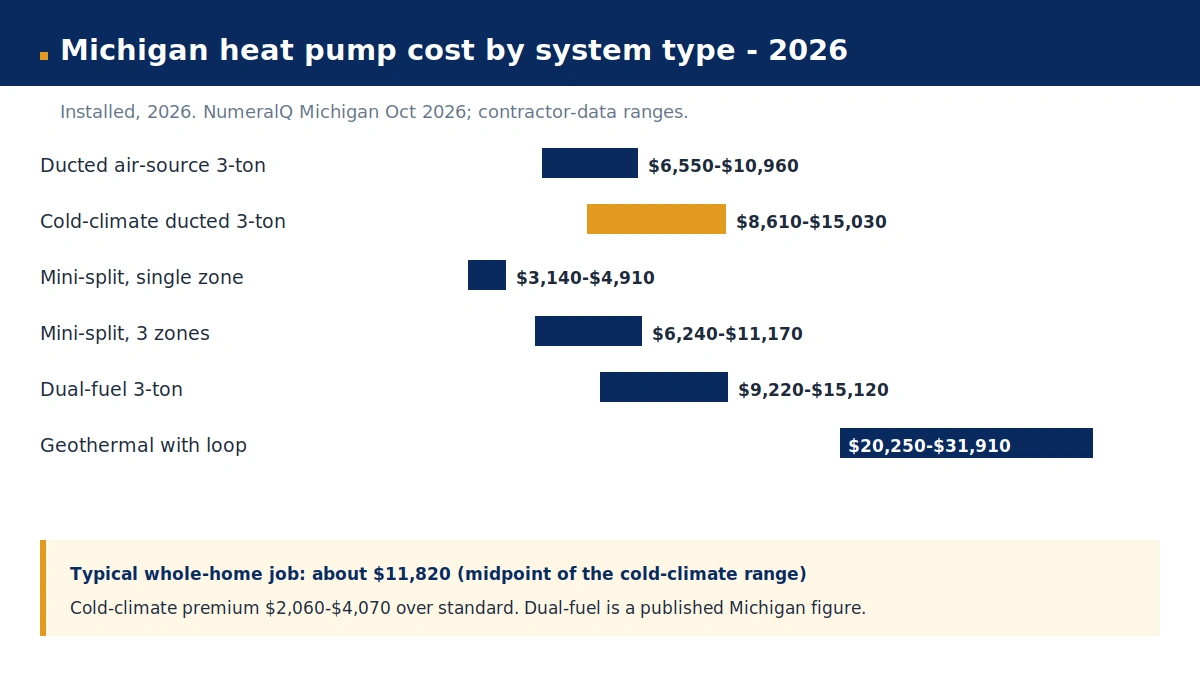
Michigan pricing in 2026 rests on two anchors, and the cold-climate premium is the distance between them. Priced as of October 26, 2026, NumeralQ’s Michigan estimator puts a standard ducted 3-ton air-source system at $6,550-$10,960 installed — the planning range for a whole-home ducted replacement in a typical Michigan house. For the cold-climate ducted version of that same 3-ton job, the range is $8,610-$15,030. That $2,060 to $4,070 step up is the inverter compressor, the enhanced vapor injection, the larger coil, and the low-temperature controls that let the unit keep heating at 5 degrees and below — and in a state where 55 percent of counties sit in IECC climate zone 6 or colder, it is the price of the system that actually works here, not an upgrade to consider later.
National figures point the same way for a Michigan buyer. A May 2026 national pricing survey lists a standard 3-ton at $9,500-$15,000 and prices cold-climate 3-ton models by brand — Mitsubishi Hyper-Heat at $14,000-$18,000, Bosch IDS 2.0 at $13,000-$17,000, Daikin Fit at $11,500-$15,000, and Carrier Greenspeed at $14,500-$18,500. Michigan’s NumeralQ ranges sit below those national figures, which is consistent with the state’s labor market: Michigan HVAC mechanics earn a median $29.26 an hour (BLS, May 2025), almost exactly the national median, and electricians earn a median $36.67 an hour. A second national source puts central ducted systems at $4,500-$20,000 with an average near $8,350, and cold-climate air-source systems at $15,000-$22,000 installed — the top of the Michigan cold-climate range touches the bottom of that national band, which is where a competitive Michigan quote should land.
That per-ton figure has to pay for the entire installed job: outdoor unit, indoor coil or air handler, refrigerant lineset, pad or wall bracket, electrical disconnect and wiring, thermostat, labor, permits, and startup. A dual-fuel gas furnace, a panel upgrade, ductwork repairs, and a snow stand for the outdoor unit all sit outside those ranges. In Michigan, the snow stand is no cosmetic extra: a unit at grade level through a Grand Rapids winter disappears under a lake-effect drift, and a unit that cannot breathe cannot defrost. Each of those add-ons shows up as its own line on the quote, and this guide puts a number on every one of them as it comes up.
One rebate sits inside those numbers, and it is small enough that a buyer can easily overstate it. DTE Energy’s top cold-climate rebate is $1,200 — but only for DTE electric customers replacing existing electric heat, only with a participating contractor, and only for AHRI-certified matched systems. Consumers Energy pays $300 for a ducted air-source system, and only when it replaces an existing heat pump. Michigan offers no state tax credit, and the federal credit is $0 for a 2026 install. Michigan’s sales tax is a flat 6 percent statewide with no local add-ons, so on a $12,000 system the tax alone is about $720 — get it shown as its own line on the quote, because a quote that folds it into the per-ton price is hiding $720 of real money.
Before the tables, one warning: Michigan’s lowest quote does not always end up the cheapest system. Pricing a standard unit where a cold-climate unit belongs is no bargain. Resistance heat is what such a system calls for on the first single-digit night, and it stays on it. Line bidders up side by side and a single figure compares cleanly across bids: what the same cold-climate model costs installed, on the same house, with the same backup heat, in writing. That number should come from at least three installers — and any bidder who will not name the model number and its 5-degree capacity and COP is one to walk away from.
| Source | Ducted, 3-ton | Cold-climate, 3-ton | Single-zone mini-split | Geothermal |
|---|---|---|---|---|
| NumeralQ MI (Oct 2026) | $6,550-$10,960 | $8,610-$15,030 | $3,140-$4,910 | $20,250-$31,910 |
| May 2026 national survey | $9,500-$15,000 | $14,000-$18,500 (brand models) | $2,000-$7,000 | $20,000-$50,000+ |
| 2026 national average | ~$8,350 | $15,000-$22,000 | ~$4,000 | ~$30,000 |
That table has two entries that call for a footnote, not a headline. In the national survey, the cold-climate column lists brand-model prices above Michigan’s NumeralQ range. Those are premium-brand installed prices from larger metro markets, included here as a ceiling rather than the Michigan price. And one small conflict in the sources themselves: NumeralQ’s national heat-pump page lists the cold-climate 3-ton top end at $15,040, while its Michigan state page lists $15,030. This guide uses the state-page figure, $8,610-$15,030, and flags the $10 difference rather than quietly picking one. Ground-loop drilling costs swing enormously with soil, rock, and lot size, which is why the geothermal column’s national range runs to $50,000 and beyond; NumeralQ’s $20,250-$31,910 is the Michigan planning range for a typical residential loop, and a tight in-town lot or a vertical borefield can push past it. The dual-fuel row is not in this table because it has its own published Michigan figure — $9,220-$15,120 — and it is priced in the system-type section below.
Heat Pump Cost in Michigan by System Type
In Michigan, “heat pump” names five different machines, with more than a six-to-one spread from the cheapest to the most expensive. The house decides which one fits: its ducts, its current heat, and how much of the winter the heat pump is expected to carry alone. The NumeralQ Michigan anchors price each type below, with national cross-checks wherever the state figure needs one.
| System type | Installed cost (MI) | Best for in Michigan |
|---|---|---|
| Ducted air-source, standard (3-ton) | $6,550-$10,960 | Shoulder-season heat + cooling only — never the main heat in a Michigan winter |
| Ducted cold-climate (3-ton) | $8,610-$15,030 | Whole-home heat with ducts; the Michigan default |
| Ductless mini-split, single zone | $3,140-$4,910 | One room, an addition, a cottage, or a ductless house |
| Ductless multi-zone (3 heads) | $6,240-$11,170 | Whole home, no ducts; room-by-room control |
| Dual-fuel (cold-climate + gas furnace) | $9,220-$15,120 | Gas-heated home that wants a heat pump for shoulder seasons + AC |
| Geothermal, ground-source with loop | $20,250-$31,910 | Long-term owner, big lot, coldest corners; the steadiest winter COP |
Ducted cold-climate is the default Michigan buy. It runs on the house’s existing ductwork and heats and cools the whole home from a single system. Qualify on the NEEP cold-climate list, or meet the ENERGY STAR cold-climate criteria, and it still holds at least 70 percent of its rated capacity at 5 degrees with a COP of at least 1.75. That $8,610-$15,030 range is for a 3-ton job; what moves a quote inside it is brand, efficiency tier, and how much of the existing ductwork survives inspection. Leaky, uninsulated ducts in an unconditioned attic push a house to the top of the range once sealing and insulation are added. That work earns its keep: a heat pump pushes more air at lower temperatures than a furnace, so duct losses a 140-degree furnace airstream could hide turn into cold rooms once the heat pump is in. Our ductless vs ducted guide covers that choice in full.
A standard ducted unit is the wrong buy as primary heat in Michigan. Set against the cold-climate unit, the $6,550-$10,960 standard range looks like $2,000 or more saved. The two machines look alike on a mild October day. The difference arrives in January. At 5 degrees a standard unit keeps only 40 to 60 percent of its capacity, and its COP slides toward 1.0. Resistance strips then take over for weeks at a time — and resistance heat at Michigan’s average 21.3 cents a kilowatt-hour runs about $62 a million BTU, more than five times the gas furnace it replaced. Only one Michigan role fits a standard unit: a cooling-first machine in a home where a gas furnace stays the primary heat. That is really a dual-fuel purchase, with the furnace doing the work, and it should be priced as one.
For Michigan’s older housing stock, ductless mini-splits are the retrofit answer. At $3,140-$4,910, a single-zone system heats and cools one room or one open-plan area with no ducts at all — the outdoor unit on a wall bracket or a snow stand, the indoor head on the wall, one small hole for the lineset. That makes it the right machine for a house with no ductwork at all, which describes a large share of Michigan’s pre-war homes in Detroit and Grand Rapids, the bungalows and Cape Cods that heat with a boiler or a stove, and the additions, finished basements, and lake cottages that never got a duct run. A three-head multi-zone system at $6,240-$11,170 heats a whole small home, with its own thermostat in each zone. Zoning pays in a Michigan winter: bedrooms can sit at 62 degrees overnight while the living room holds 70. A mini-split only heats the rooms it serves — put one head in the living room of a four-bedroom house and the bedrooms still need heat from somewhere. Cold-climate mini-split models — Mitsubishi Hyper-Heat, Fujitsu, Daikin Aurora — hold full rated capacity to 5 degrees and keep 70 percent or more at minus 13, which is why they dominate the mini-split market along the lake-effect belt.
Dual-fuel is the honest answer for the 75 percent of Michigan homes that heat with piped gas — and Michigan is one of the few states where it carries a published price. NumeralQ’s Michigan HVAC replacement pages put a dual-fuel package at $9,220-$15,120 for a 3-ton job ($9,330-$15,260 in Detroit, $9,190-$15,080 in Grand Rapids). Dual-fuel pairs a cold-climate heat pump with a gas furnace. A control switches between them at a switchover temperature the installer sets — often somewhere between 25 and 35 degrees in Michigan, depending on gas and electric prices. The heat pump carries the load above the switchover temperature, where it undercuts gas; under it, the furnace takes over, because the heat pump’s COP has fallen below the level at which it beats gas. Where that switchover point sits on each Michigan utility, the running-cost section below works out exactly — because that number, not the sticker, decides whether dual-fuel saves money here. One eligibility trap to know before pricing it: Ann Arbor’s A2ZERO rebate does not pay for dual-fuel systems at all, and DTE’s heat pump rebates do not pay for a heat pump that replaces gas heat. That configuration gets its full treatment in our dual-fuel heat pump guide.
No other system in this guide shrugs off a Michigan January the way geothermal does — its winter efficiency barely moves with the weather. A ground-source heat pump draws heat from earth that sits near 45 to 50 degrees year-round, a few feet below a Michigan lawn, so its COP holds at 3.0 to 5.0 through a single-digit night when an air-source unit is working at 1.75. Against a national range of $20,000-$50,000 or more, NumeralQ’s Michigan range is $20,250-$31,910 with the loop — and the spread is the loop itself: horizontal trenching where the lot allows it, vertical bores where it does not, and the drilling conditions under a Michigan yard. A Michigan custom-home source puts the typical range at $20,000-$45,000, roughly $8,500 a ton, with a 3-ton system commonly around $25,000-$26,000. Geothermal fits an owner on a big lot who expects to stay put for 20 years. For anyone who might move in five it is the wrong buy: the loop stays in the ground, it does not move with you, and payback needs a decade or more of winters to arrive. Geothermal used to get a 30 percent federal credit; for a homeowner-owned system installed in 2026 that credit is $0, killed by the same OBBBA change that ended the air-source credit, so the 2026 geothermal case rests on operating savings alone. Geothermal’s full Michigan case gets its own walk-through in our geothermal heat pump guide.
Heat Pump Cost by Home Size
After system type comes size, and in Michigan that decision is also the one most often got wrong — in both directions. In Grand Rapids, an undersized heat pump is not a minor inconvenience: it is a machine running on resistance heat for a month every winter. Oversize it and the unit short-cycles, never reaches steady efficiency, and charges thousands for capacity the house never calls on. The only correct size comes from a Manual J load calculation — a room-by-room accounting of the house’s heat loss at the design temperature, 6 degrees in Detroit, 5 in Grand Rapids, 1 in Lansing, minus 8 in Marquette. A contractor who sizes from square footage alone, or from the size of the furnace being replaced, is guessing at the number everything else depends on. Get the Manual J in writing before you sign — and in Ann Arbor, the A2ZERO rebate requires one anyway.
Below, ducted air-source systems are priced by tonnage from the NumeralQ Michigan anchors. The cold-climate premium appears alongside, making the step up visible at every size. One ton means 12,000 BTU an hour of capacity. A typical Michigan home needs more heating capacity per square foot than a home in almost any other state in this series except the far north, because the design temperature is 30 to 40 degrees colder than the mild-climate states — which is why a 2,000-square-foot Detroit house commonly takes a 3-ton or 3.5-ton system where the same house in a mild climate would take 2.5 tons.
| System size | Home size (approx.) | Standard ducted (MI) | Cold-climate ducted (MI) |
|---|---|---|---|
| 1.5 ton | 600-1,000 sq ft | $4,400-$7,070 | $6,460-$11,140 (planning est.) |
| 2 ton | 1,000-1,400 sq ft | $5,120-$8,370 | $7,180-$12,440 (planning est.) |
| 2.5 ton | 1,400-1,700 sq ft | $5,830-$9,660 | $7,890-$13,730 (planning est.) |
| 3 ton | 1,700-2,100 sq ft | $6,550-$10,960 | $8,610-$15,030 |
| 3.5 ton | 2,100-2,400 sq ft | $7,260-$12,250 | $9,320-$16,320 (planning est.) |
| 4 ton | 2,100-2,700 sq ft | $7,980-$13,550 | $10,040-$17,620 (planning est.) |
| 5 ton | 2,700-3,500 sq ft | $9,410-$16,140 | $11,470-$20,210 (planning est.) |
Every row but the 3-ton one carries a warning label in the cold-climate column. Only the 3-ton job has a published NumeralQ cold-climate figure ($8,610-$15,030); the other rows are planning estimates built by applying the Michigan cold-climate premium of $2,060-$4,070 to the standard range at each size, and they are labeled as such. Treat them as estimates, not measured Michigan prices, because that is what they are. The honest shape of the decision is visible at every size: the cold-climate unit runs roughly $2,000-$4,000 above the standard unit, and that premium is what a system that still heats at 5 degrees costs.
This table holds three points worth a closer look. First, the home-size column is approximate in a way that matters more in Michigan than elsewhere: a tight, well-insulated 2,000-square-foot house built in 2020 needs far less heat than a drafty 2,000-square-foot Detroit bungalow from 1940 with single-pane windows and no wall insulation, and the two houses can be a full ton apart. Second, heating load — not cooling load — sets the tonnage a heat pump needs. Michigan’s heating load runs three to four times its cooling load, so a system sized for summer will be far too small for January. Third, the backup heat is sized at the same time as the system, not afterwards: on the coldest night the resistance strips or the furnace must carry the whole design load, because that is when the heat pump contributes least.
Heat Pump Cost by City: Detroit, Grand Rapids, Ann Arbor, Lansing & Traverse City
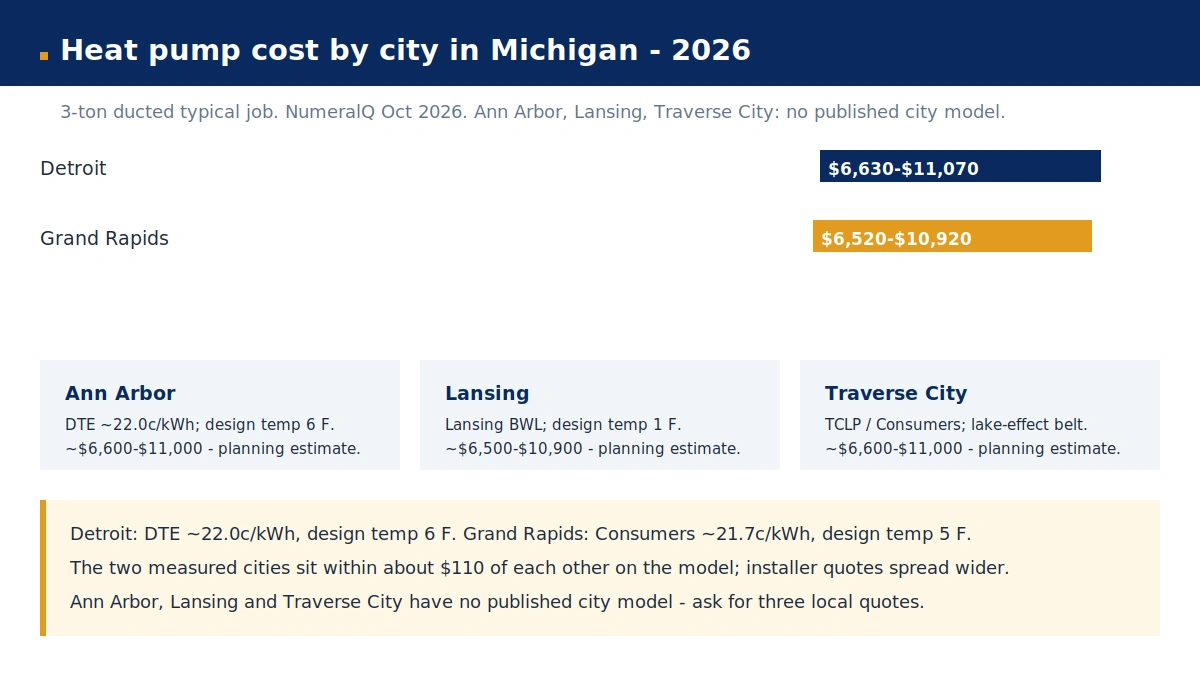
Michigan is a two-peninsula state with two real HVAC markets — Detroit in the southeast, Grand Rapids in the west — and smaller ones scattered from Ann Arbor to Traverse City to Marquette, and the verified figures run from $6,520 to $11,070 for the same 3-ton ducted job. What sets the cities apart is not just the install price but the utility behind the meter — and in Michigan that gap matters twice over, because the utility decides both whether the heat pump beats gas at all and which rebate, if any, the buyer can collect. Two cities have verified figures on NumeralQ’s October 2026 city pages; the other three carry a warning label rather than a verified price.
| City | 3-ton ducted (verified) | Utility | Avg. kWh price |
|---|---|---|---|
| Detroit | $6,630-$11,070 | DTE Electric | ~22.0 cents |
| Grand Rapids | $6,520-$10,920 | Consumers Energy | ~21.7 cents |
| Ann Arbor | ~$6,600-$11,000 (planning est.) | DTE Electric | ~22.0 cents |
| Lansing | ~$6,500-$10,900 (planning est.) | Lansing BWL | Not verified |
| Traverse City | ~$6,600-$11,000 (planning est.) | Traverse City Light & Power / Consumers | Not verified |
Detroit, the state’s biggest market, is also the most expensive of the verified cities: $6,630-$11,070 for a 3-ton ducted system. Detroit is also where the installer bench is deepest and where the running-cost answer is the worst: DTE Electric averages about 22.0 cents a kilowatt-hour over the 12 months to August 2026, with an all-in tariff near 23.99 cents at 900 kilowatt-hours once the $9.75 monthly service charge, riders, and taxes are counted, so a Detroit heat pump at a seasonal COP of 2.0 costs about $1,838 a year to heat the planning home in the running-cost section, against about $632 for a 95 percent gas furnace. Detroit pays the most twice over: the highest install price and the highest running cost. That is not a reason to skip the heat pump in Detroit — it is a reason to buy it for the right reason: replacing electric resistance heat, adding air conditioning, pairing it with a gas furnace in a dual-fuel setup where the furnace carries January, or collecting the MiHER rebate if the household is income-qualified and the district pause does not cover the address.
Grand Rapids is the cheapest verified city, at $6,520-$10,920, and its running-cost math is only marginally better than Detroit’s. Consumers Energy averages about 21.7 cents a kilowatt-hour over the same 12 months, so a Grand Rapids heat pump at COP 2.0 costs about $1,813 a year against the same $632 for gas. The difference between the two cities is about $25 a year on the fuel bill — real, but not the reason to choose one city over the other. What does differ in Grand Rapids is the snow: about 78 inches a year against Detroit’s 45, which means the snow stand, the wind baffle, and the leeward-wall siting matter more here, and the defrost cycle works harder. Grand Rapids is also where the MiHER pause bites a second time — new income-qualified applications are suspended in the EGLE Grand Rapids District as well.
Ann Arbor, Lansing, and Traverse City carry a warning label rather than a verified price. All three figures in the table are planning estimates built from the state range and the nearest verified city, not measured market prices. Ann Arbor sits in DTE territory like Detroit, so its running-cost math matches Detroit’s — but Ann Arbor is the one Michigan city with its own rebate on top: A2ZERO pays $4,000 at market rate and $5,500 for income-qualified households for a cold-climate heat pump, up to 90 percent of project cost, though its 2025-26 program year closed June 30, 2026 and the new schedule had not been posted as of July 2026. Lansing sits on its own municipal utility, the Lansing Board of Water & Light, whose electrification program lists $4,000-$5,000 for a heat pump replacing a gas furnace — a figure that conflicts with the $200-$600 tiered rebate in the same utility’s Hometown Energy Savers program, and the rebate section below untangles the two. Traverse City sits on Traverse City Light & Power, whose heat pump rebate of up to $3,000 also belongs to a program year that ended June 30, 2026. Treat the Ann Arbor, Lansing, and Traverse City install figures as indicative only, and do not quote them as NumeralQ figures, because they are not.
Two more places get a line each, even with no price attached. Marquette, in the Upper Peninsula, is the coldest and snowiest of Michigan’s cities — designed for minus 8 degrees, 8,393 heating degree days, about 120 inches of snow a year — and no published install price was found for it in this pass. The Upper Peninsula is a different market in every way that matters: fewer installers, longer travel, Upper Peninsula Power Company on the electric bill and SEMCO Energy on the gas bill, and lake-effect snow that does not stop in March. A Marquette buyer should budget above the Lower Peninsula range. Flint, on Consumers Energy in the east, shares Grand Rapids’ running-cost math and Detroit’s housing stock — pre-war homes, boilers, and additions that never got ducts — which makes it a mini-split town more often than a ducted town.
Use price per ton to compare cities, not the headline total, and check the utility column first. Next to Grand Rapids’ $6,520 bottom end, Detroit’s $11,070 top end looks alarming — but most of that gap is the range itself, since the same 3-ton job can land anywhere inside either city’s band depending on brand and ductwork. And a Grand Rapids system that costs slightly less to install and slightly less to run is not a close call against a Detroit system on the same equipment. The payback section below runs those numbers for each utility.
Michigan’s Lake-Effect Climate: Design Temps, HDD & What Snow Does to a Heat Pump
This guide exists in its current form because of Michigan’s climate, and that climate is worth understanding in numbers before any equipment is chosen. The state is two peninsulas wrapped around four Great Lakes, and the lakes set the terms: they delay the autumn freeze, they feed the winter snow, and they split the state into a milder southeast and a much colder, much snowier north and west.
The design temperatures. Sizing starts from the 97.5 percent winter design temperature — the outdoor temperature the weather stays above for 97.5 percent of the hours in a typical winter. The Manual J load calculation is built on that number. In Detroit that number is 6 degrees. In Grand Rapids it is 5. In Lansing and Flint it is 1. In Alpena it is minus 6. In Escanaba it is minus 7. In Marquette it is minus 8. Those are design conditions, not records — the temperatures the system must handle as a matter of routine. Detroit logs 6,232 heating degree days a year, Grand Rapids 6,894, Lansing 6,909, Alpena 8,506, Marquette 8,393, and Sault Ste. Marie 9,048. The coldest nights go far lower: Detroit’s record low is minus 21 degrees, set in January 1984, Grand Rapids’ is minus 22, and Marquette’s is minus 33. Traverse City’s design temperature is not published in the ICC Appendix D table this guide draws from, so no precise figure is stated for it here — it sits between Grand Rapids at 5 degrees and Alpena at minus 6, and the installer sizes it from the nearest station.
What the cold does to a heat pump. An air-source heat pump pulls heat from outdoor air into the house, and the colder that air gets, the less heat there is in it to move. Capacity and efficiency fall together. A standard unit rated 36,000 BTU an hour at 47 degrees is a different machine at 5 degrees: 14,000 to 22,000 BTU an hour, 40 to 60 percent of its rating, its COP sliding from above 3.0 toward 1.0. Department of Energy field testing puts a cold-climate unit with enhanced vapor injection at 70 to 80 percent of capacity at 5 degrees, COP 2.2 to 2.8, and 60 to 70 percent at minus 5, COP 1.8 to 2.4. Even the best air-source unit loses ground below minus 10. At minus 8 — Marquette’s design temperature — every air-source heat pump on the market is running at reduced capacity, its COP barely above 1.75. So in Michigan, backup heat sits at the center of the system design — it is half the system, not a footnote.
The lake-effect snow is a Michigan line item. When cold air crosses the relatively warm water of Lake Michigan or Lake Superior, it picks up moisture and drops it as snow on the downwind shore — the west side of the Lower Peninsula and the whole Upper Peninsula. The bands are narrow and violent: it can be sunny in Escanaba and a whiteout a few miles away in Munising, and a single band can drop a foot of snow on one neighborhood while the next town over gets flurries. The annual totals tell the story: Detroit about 45 inches, Grand Rapids about 78, Traverse City about 101, Marquette about 120 — and the Marquette figure itself depends on the station, with the city’s long-term records running as high as about 149 inches. Lake Superior rarely freezes over completely, so the Upper Peninsula’s lake effect does not stop in February; it runs until the lake finally ices or the air warms. For a heat pump, that means the outdoor unit spends five months in snow that arrives sideways, in wind, at temperatures where the defrost cycle is working hardest.
The defrost cycle and the snow stand. Below freezing, moisture in the air frosts onto the outdoor coil. The unit then periodically reverses itself to melt that frost — blowing cold air indoors for a few minutes while it does. In Michigan’s damp lake-effect air, that happens more often than in a dry continental winter, which is one more reason the seasonal COP here sits at 2.0 to 2.5 rather than the 3.0 a mild-climate brochure promises. Meltwater has to go somewhere. At grade level in a Grand Rapids yard, an outdoor unit will build an ice mound under itself that eventually blocks the coil. The fix is a snow stand or wall bracket that lifts the unit 18 to 24 inches off the ground — higher in the Upper Peninsula, where the drifts run deeper — and a pad that drains away from the house.
Snow and wind load on the outdoor unit. Windward siting, a roof valley that dumps snow, a driveway the plow buries — any of those leaves the outdoor unit spending the winter fighting for air. The leeward wall, under an eave that sheds snow away from it, is where it belongs, with room all around for airflow and for a technician to get at it in a storm. A wind baffle — a simple shield on the intake side — keeps blowing snow out of the coil on exposed sites along the Lake Michigan shore and in the open country of the Upper Peninsula. A catalog price shows none of that. All of it shows up in a February service bill, and the homeowner’s job does not end at the install: the outdoor unit needs its snow cleared after every storm.
In Michigan, the house itself matters as much as the machine. Heat pump air comes out at 90 to 110 degrees, against 120 to 140 from a gas furnace. Inside a tight, well-insulated house, that difference goes unnoticed. Take a drafty Detroit bungalow — single-pane windows, uninsulated walls, a 1940s attic. There, it is the difference between a house that feels warm and one that feels like the heat pump is always behind. The cheapest capacity a Michigan homeowner can buy is air sealing and insulation. Every BTU that stops leaking out of the house is a BTU the heat pump does not have to produce at 5 degrees, and a BTU the backup heat does not have to produce either. A blower-door test and an insulation quote come before the heat pump quote. Where the house needs both, seal and insulate first, then size the heat pump — the right size may drop a full ton. It also happens to be the kind of work MiHER’s HOMES program pays for, for households that qualify.
Cooling is the quiet half of the value. Detroit summers reach the 90s, and a heat pump is an air conditioner in July. For a Michigan home that has never had cooling — a large share of the state’s older stock — that is worth more than the heating math alone suggests. The cooling load must not set the size, for the same reason: a system sized for a Detroit July is far too small for a Detroit January, and the heating load governs.
Heat Pump vs Gas Furnace in Michigan: The Running-Cost Math
The whole guide turns on this section, and it is also where most Michigan heat pump advertising goes wrong: the honest answer is that a heat pump loses to a gas furnace on fuel in this state, by a lot, with exceptions specific enough to name. Every number below comes from NestPriced arithmetic on published prices. All assumptions are on the table, so a reader can redo the sums with their own utility’s rate and their own house.
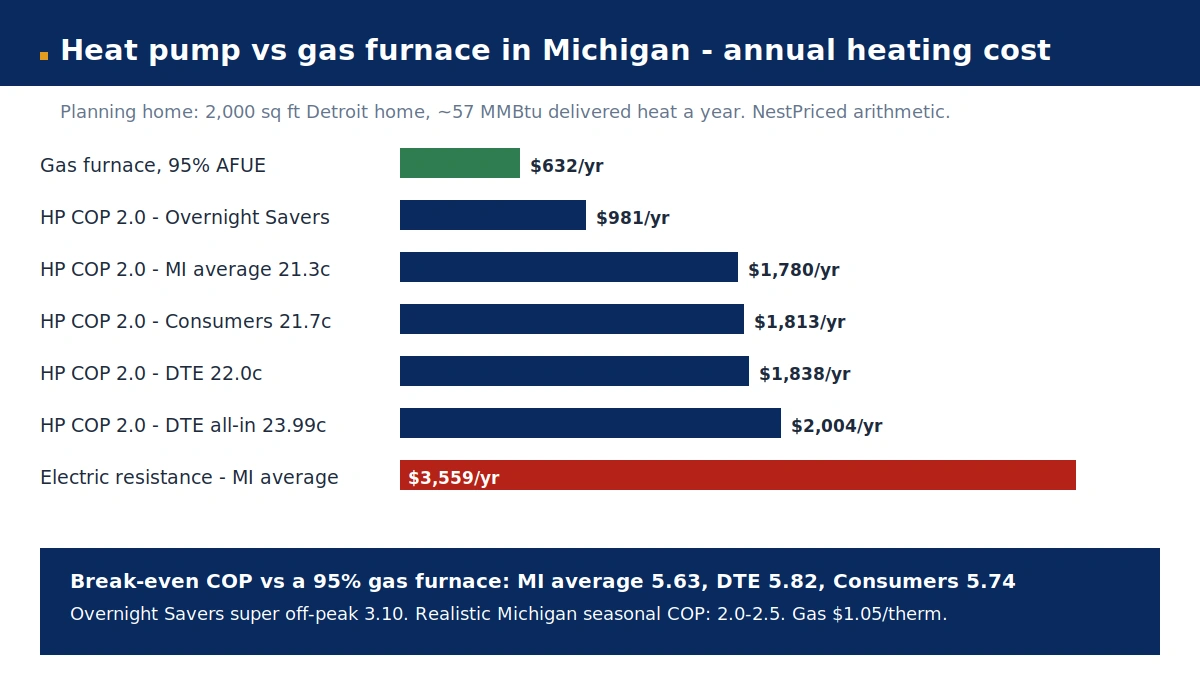
The planning home. Take a 2,000-square-foot Detroit home that needs about 57 million BTU of delivered heat a year — a planning assumption built from Detroit’s 6,232 heating degree days and cross-checked against NumeralQ’s own annual figures, not a measured bill. Fifty-seven million BTU is 16,710 kilowatt-hours of heat. Every step below takes that heat, divides it by the efficiency of the machine delivering it, and multiplies by the price of the fuel.
The gas furnace. A furnace at 95 percent AFUE needs about 60 million BTU of gas input — 602 therms — to deliver 57 million BTU of heat. At Michigan’s 2025 residential gas price of about $1.05 a therm (EIA, $10.92 per thousand cubic feet), that is about $632 a year in fuel — the same figure NumeralQ publishes for the average Michigan home, which is the cross-check that the planning home is the right size. On top sits the gas basic charge. It is charged whether the furnace runs or not, so the comparison does not change.
The heat pump. At a seasonal COP of 2.0 — a realistic Michigan seasonal figure, between the 2.2 to 2.8 it manages at 5 degrees and the 1.5 it falls to on the coldest nights — a cold-climate heat pump needs 8,355 kilowatt-hours of electricity to deliver the same 57 million BTU. The answer depends entirely on the utility:
| Utility | Rate per kWh | Heat pump, COP 2.0 | Heat pump, COP 2.5 | Resistance heat |
|---|---|---|---|---|
| DTE Electric (Detroit, Ann Arbor) | ~22.0 cents | ~$1,838/yr | ~$1,470/yr | ~$3,676/yr |
| Consumers Energy (Grand Rapids, Lansing) | ~21.7 cents | ~$1,813/yr | ~$1,450/yr | ~$3,626/yr |
| MI average | ~21.3 cents | ~$1,780/yr | ~$1,424/yr | ~$3,559/yr |
| DTE all-in tariff (900 kWh) | ~23.99 cents | ~$2,004/yr | ~$1,603/yr | ~$4,009/yr |
| DTE Overnight Savers super off-peak (1-7 a.m.) | ~11.74 cents | ~$981/yr | ~$785/yr | ~$1,962/yr |
Read that table twice over — the whole guide sits inside it. On DTE power, the heat pump costs about $1,838 a year — nearly triple the gas furnace’s $632 — and even at a generous seasonal COP of 2.5 it costs $1,470, still more than double gas. On Consumers Energy it costs $1,813, still nearly triple gas. On the state average it costs $1,780, still nearly triple gas. On DTE’s all-in tariff, with the service charge and riders counted, it costs about $2,004. Only the last row changes the picture at all: on DTE’s Overnight Savers super off-peak rate of 11.74 cents, the heat pump costs about $981 a year — still more than gas at $632, but no longer triple. And that row comes with a catch the next section explains in full: the super off-peak window runs from 1 a.m. to 7 a.m., and a heat pump cannot move its daytime heating into the middle of the night.
The break-even COP. Run the arithmetic the other way round: what efficiency would a heat pump need to tie the gas furnace? Take the electricity price per million BTU and divide it by the gas price per million BTU at 95 percent efficiency. State-average electricity at 21.3 cents a kilowatt-hour is $62.42 a million BTU; gas at $10.53 a million BTU becomes $11.08 after the furnace’s 5 percent loss — and the break-even COP comes out at 5.63. By utility: DTE 5.82, Consumers Energy 5.74, DTE Overnight Savers super off-peak 3.10. With an older 80 percent furnace, the break-even COP at the state average is about 4.74. A cold-climate heat pump’s realistic Michigan seasonal COP is 2.0 to 2.5 — below break-even on every Michigan rate in this guide except a rate no heat pump can actually run on all day. No heat pump sold today holds a seasonal COP of 5.63 through a Michigan winter. That is the blunt fact, and any quote that claims a Michigan heat pump beats a 95 percent gas furnace on fuel at DTE or Consumers Energy rates is modeling a different state’s prices.
The backup-heat adder. That whole comparison assumes the heat pump delivers all 57 million BTU at its seasonal COP. In practice the backup system carries part of the season’s heat, and that part costs more. If 15 percent of the season’s heat comes from electric resistance strips — a plausible share for a standard unit, or for a cold-climate unit on the coldest nights — that slice costs the resistance price: 15 percent of 16,710 kilowatt-hours is 2,507 kilowatt-hours, which at the state-average 21.3 cents is about $534 extra a year, an illustration, not a bill. On DTE’s all-in tariff the same slice costs about $601. Dual-fuel earns its keep in Michigan on the backup share: below the switchover temperature the gas furnace delivers that 15 percent at gas prices instead of resistance prices, and the heat pump never has to run at a COP near 1.0 at all.
The switchover temperature. Dual-fuel controls hand the load to the furnace once the outdoor temperature drops to the point where the heat pump’s COP hits the break-even COP. On DTE or Consumers Energy power, with a break-even COP near 5.8, that point sits above the temperatures where a heat pump does most of its work. The furnace therefore carries most of the deep winter, and the heat pump earns its keep in the shoulder seasons — roughly October through November and March through April — plus the cooling season. The installer sets the switchover point during commissioning; ask what temperature was chosen and why, and ask for it in writing.
What the heat pump beats, clearly. Electric resistance heat is the one comparison the heat pump wins everywhere in Michigan, and by a wide margin — baseboard panels, electric furnaces, space heaters, all of them. At the state-average price, resistance heat delivers that same 57 million BTU for about $3,559 a year, against the heat pump’s $1,780 — a saving of about $1,780 a year, every year. About 12 percent of Michigan homes heat with electricity. For those homes, no purchase in this guide beats the heat pump. Against propane, the heat pump wins too — propane is a delivered fuel with volatile pricing, and the 10 percent of Michigan homes on propane or oil are the second-best case in this guide — but no Michigan-specific modeled annual propane cost was verified in this pass, so no propane payback number is printed here. Against a 95 percent gas furnace on DTE or Consumers Energy power, it loses — and the right reason to buy it there is the air conditioning, the comfort, the zoning, or the plan to replace a furnace that is already at the end of its life, not the fuel bill.
Cooling, counted honestly. It is also the air conditioner — and a Detroit July reaches the 90s. A new central air conditioner alone runs several thousand dollars nationally. Part of the heat pump’s price is therefore money the buyer would have spent on cooling anyway. Measure the heat pump by its premium over the furnace-plus-AC combination it replaces, not by its full sticker. Running costs get their full treatment in our heat pump running cost guide.
DTE vs Consumers Energy: Rate Plans That Change the Math
Michigan’s two big utilities do not just charge different rates — they sell different rate plans, and the plan a household sits on can move the heat pump’s running cost by hundreds of dollars a year. This section is about DTE, because DTE publishes its time-of-use schedules in full and Consumers Energy’s equivalent schedules were not priced in this pass. A Consumers Energy customer should ask for the current time-of-use schedule in writing before comparing it with anything here.
DTE’s standard rate is the expensive one. DTE’s standard residential tariff adds a $9.75 monthly service charge, riders of 10.95 cents a kilowatt-hour, and 4.0 percent in taxes on top of the energy charge, for an all-in price of about 23.99 cents a kilowatt-hour at 900 kilowatt-hours of usage. That is the rate the running-cost table’s all-in row uses, and it is the rate a Detroit household pays if it never asks for anything else. The 12-month average of 22.0 cents is lower because it spreads the fixed charges across higher-usage months, but the all-in figure is the honest one for a household sizing a heat pump: every extra kilowatt-hour the heat pump consumes is billed at the marginal rate, and the marginal rate on the standard tariff is the high one.
Time of Day 3 p.m. to 7 p.m. is DTE’s standard base rate. Under this plan, the peak window runs Monday to Friday, 3 p.m. to 7 p.m. The off-peak price is 18.44 cents a kilowatt-hour; the peak price is 24.13 cents in summer (June through September) and 20.05 cents from October through May. A heat pump does not care much about the 3-to-7 window in winter — it runs all day and all night, and the evening peak is exactly when the house is coldest and the family is home. The off-peak price of 18.44 cents still needs a break-even COP of about 4.9 against a 95 percent gas furnace, so the Time of Day plan narrows the gap without closing it.
Overnight Savers is the plan that actually moves the number. DTE’s Overnight Savers rate (D1.13) has three tiers on weekdays and two on weekends. The super off-peak tier, from 1 a.m. to 7 a.m., is 11.74 cents a kilowatt-hour — the cheapest electricity DTE sells to a home, and the only DTE price in this guide that brings the heat pump’s break-even COP down to 3.10. The off-peak tier, 7 a.m. to 3 p.m. and 7 p.m. to 1 a.m., is 15.55 cents from October through May. The peak tier, 3 p.m. to 7 p.m. on weekdays, is 19.06 cents from October through May and 35.56 cents in summer. A heat pump running overnight in January does use the super off-peak window — the house loses heat all night, and the pump runs to replace it — but it also runs through the morning, the afternoon, and the evening, at 15.55 or 19.06 cents. The blended rate across a winter day lands somewhere near 14 to 16 cents, not 11.74. At a blended 15 cents, the heat pump at COP 2.0 costs about $1,253 a year — still about double gas, but a real improvement on $1,838. The conditions: a smart meter, a 12-month commitment to the rate, and a household that can live with a 35.56-cent peak in summer. A heat pump buyer on DTE should price the quote on the blended rate, not on the super off-peak headline, and should ask DTE for the rate in writing before signing.
The geothermal time-of-day rate is closed. DTE’s Geothermal Time of Day rate (D1.7), which once gave ground-source systems their own cheap overnight window, is no longer accepting new enrollments. A geothermal buyer cannot count on it — the operating savings have to come from the ground loop’s steady COP, not from a special rate.
What to ask for. Before signing, ask the utility for three things in writing: the current tariff sheet for the rate plan the household is on, the current schedule for any time-of-use plan being considered, and whether the heat pump’s extra winter usage pushes the household into a different tier or block. DTE’s stated base rates exclude the Power Supply Cost Recovery surcharge, so the bill will run a little above the rate card. Consumers Energy customers should ask the same three questions of their own utility — the answers are different, and a quote that models savings at the other utility’s rate is wrong by hundreds of dollars a year on the planning home.
Michigan Utility Rebates in 2026: What Is Actually Collectible
The federal credit is gone. Most states still keep something in reserve, though: a state credit, a rebate, an exemption. Michigan keeps utility rebates — and only for some utilities, only for some equipment, only for some households, and only in the amounts below. The incentives picture in Michigan is no bigger than that, and it is more complicated than in any other state in this series, because the two biggest utilities exclude the very households most likely to buy a heat pump. Saying it plainly matters, because most heat pump advertising in Michigan skips it.
DTE Energy pays up to $1,200 — and only when the heat pump replaces electric heat. DTE’s 2026 incentive chart, valid for installs on or after January 1, 2026, pays by equipment type and efficiency tier: a cold-climate air-source heat pump earns $900, $1,000, or $1,200, with the top tier requiring 16 or better SEER2, 9.1 or better HSPF2, and an EER2 of 10.0 or better; a standard air-source heat pump earns $150 or $500; a ground-source heat pump earns $600 or $800; a ductless mini-split earns $700 or $1,000. Every one of those rebates carries the same footnote, and it is the footnote that decides who can collect: the heat pump must replace existing electric heating. A gas-heated home in Detroit cannot collect a dollar of it. The other conditions: a DTE participating contractor must do the work, the equipment must be an AHRI-certified matched system, the home must be single-family, new construction is excluded, and funds are first-come, first-served — check availability before committing. One claim to disregard: a third-party page says DTE pays $2,500 for a whole-home cold-climate install. No other source supports $2,500, and the official 2026 chart tops out at $1,200.
Consumers Energy pays $300-$350 — under still narrower rules. Consumers Energy’s 2026 qualifying sheet pays $300 for a ducted air-source heat pump at SEER2 15.2 or better, but only as a replacement for an existing heat pump; $350 for a ductless mini-split at SEER2 17 or better and HSPF2 8 to 12.5, which may replace any primary electric heat system; and $200 or $300 for a ground-source heat pump depending on efficiency, again only as a replacement for an existing heat pump. The program covers installs from January 1 to December 31, 2026, first-come, first-served while funds last, and a participating Trade Ally must install the equipment and submit the application. Consumers Energy does not differentiate between cold-climate and standard air-source systems — the same $300 applies either way. A gas-heated home in Grand Rapids, like a gas-heated home in Detroit, collects nothing from its utility for switching to a heat pump.
Lansing’s BWL pays two different amounts, and the difference is the program. The Lansing Board of Water & Light runs two rebate programs that pay very different money for the same equipment. The Hometown Energy Savers program pays $200-$600 for a central air-source heat pump tiered by SEER2, $300 for a mini or multi-split ($500 if it replaces electric resistance heat), and $500 for a heat pump water heater, for the January-to-December 2026 program year. The separate Electrification Programs page on BWL’s own site pays far more: $4,000 for a central air-source heat pump replacing a gas furnace and a central air conditioner, $5,000 for one replacing a gas furnace only, and $1,000 for a heat pump water heater — but only for installations replacing existing natural gas or propane fueled equipment, only with a pre-inspection or a Home Energy Visit within the past three years, and only one rebate per residential account. The two programs point in opposite directions — one pays for replacing electric heat, the other pays for replacing gas heat — and both are real. Confirm which one applies to the house, and confirm it is still funded, on lbwl.com before counting on either figure.
Ann Arbor and Traverse City have city-level money — between program years. Ann Arbor’s A2ZERO program, funded by the voter-approved Community Climate Action Millage at about $2 million a year, pays $4,000 at market rate and $5,500 for income-qualified households (at or below 120 percent of area median income) for a cold-climate central or mini-split heat pump, up to 90 percent of project cost, with NEEP listing, SEER2 15.2 or better, HSPF2 8.0 or better, a Manual J, and an AHRI certificate all required — and dual-fuel systems are explicitly not eligible. The catch is the calendar: the 2025-26 program year closed June 30, 2026, and a 2026-27 schedule had not been posted as of July 2026, although the city’s live rebates page still lists up to $5,500 and other trackers call it a confirmed 2026 option. Check osi.a2gov.org/rebates for the current program year before counting on it. Traverse City Light & Power’s rebate of up to $3,000 belongs to the same story: its 2025-26 program year ended June 30, 2026, and the new schedule was pending as of July 2026. Confirm before planning around it.
There is no state money beyond MiHER, and MiHER is not for most buyers. Michigan has no state tax credit for heat pumps and no sales-tax exemption for the equipment — the flat 6 percent sales tax applies, with no local add-ons anywhere in the state. The state’s own rebate program is MiHER, which is federal money administered by the state, and it reaches only income-qualified households — the next section covers it in full.
| Source | Amount | Who can collect it |
|---|---|---|
| DTE Energy, cold-climate ASHP | $900-$1,200 by tier | DTE electric customers replacing electric heat, participating contractor |
| DTE Energy, standard ASHP | $150-$500 | DTE electric customers replacing electric heat |
| DTE Energy, ductless mini-split | $700-$1,000 | DTE electric customers replacing electric heat |
| DTE Energy, ground-source | $600-$800 | DTE electric customers replacing electric heat |
| Consumers Energy, ASHP | $300 | Consumers customers replacing an existing heat pump |
| Consumers Energy, mini-split | $350 | Consumers customers replacing any primary electric heat |
| Consumers Energy, ground-source | $200-$300 | Consumers customers replacing an existing heat pump |
| Lansing BWL, Hometown Energy Savers | $200-$600 (ASHP) | BWL customers, 2026 program year |
| Lansing BWL, Electrification Program | $4,000-$5,000 | BWL customers replacing a gas/propane furnace — confirm first |
| Ann Arbor A2ZERO | $4,000 / $5,500 income-qualified | Ann Arbor residents, cold-climate only, dual-fuel excluded — confirm program year |
| Traverse City Light & Power | Up to $3,000 | TCLP customers — 2025-26 year ended, new schedule pending |
| State of Michigan | $0 — no credit, no exemption | — |
| Federal §25C credit | $0 for 2026 installs | No 2026 claims |
| MiHER (HEAR / HOMES) | Up to $8,000 heat pump | Income-qualified only (≤150% AMI), 5 districts paused |
Federal Help in 2026: $0 Tax Credit, MiHER’s Pauses & the Lease Question
One paragraph holds the entire 2026 federal story, and that brevity is exactly why so much heat pump advertising still gets it wrong. In Michigan the paragraph has a second half that other states do not get, because the federal rebates that would matter most here are open but limited, paused in the very districts where most Michiganders live, and closed to the gas-heated homes that make up three quarters of the state.
Buy the heat pump yourself, install it in 2026, and it earns no federal tax credit at all. For Michigan buyers the cutoff lands hard: Public Law 119-21 — the One Big Beautiful Bill Act, signed July 4, 2025 — ended the Energy Efficient Home Improvement Credit (§25C, worth up to $2,000 a year on air-source heat pumps) for any equipment placed in service after December 31, 2025. The finish date is decisive, per IRS fact sheet FS-2025-05: money put down in 2025 counts for nothing if the crew completed the job in January 2026. That same date also closed the Residential Clean Energy Credit — §25D, 30 percent — taking with it the 30 percent credit that used to apply to geothermal. A federal credit on a 2026 quote means the quote was priced under a law that no longer exists. Tell the installer to strip it out and quote again. Our federal tax credits guide sets out the 2026 federal picture in full: what ended on July 4, 2025, and why the completion date decides it.
Michigan’s MiHER program is open, income-limited, and paused where most people live. The Michigan Home Energy Rebates program (MiHER), administered by the Department of Environment, Great Lakes, and Energy (EGLE) through CLEAResult, launched statewide on April 14, 2025 after a November 2024 pilot in Marquette County and Holland, with about $211 million in federal funding — $105,291,160 for HEAR and $105,696,321 for HOMES. The HEAR side pays up to $8,000 for a heat pump at point of sale, inside a $14,000 household cap, covering 100 percent of costs for households at or below 80 percent of area median income. But applications are open to low- to moderate-income households only — households above 150 percent of area median income cannot currently apply — and new income-qualified applications are paused in the EGLE Detroit, Warren, Grand Rapids, Lansing, and Kalamazoo districts while the program reviews current applications and funding capacity. Applications already submitted in the paused districts continue to be processed, and applications continue elsewhere in the state. A Detroit buyer who is income-qualified and lives in the paused district cannot apply today; a buyer in Marquette or Traverse City can. Check the district map at Michigan.gov/HomeEnergyRebates before counting on a dollar of it.
Even where it is open, HEAR will not pay a gas-heated home to switch. Up to $8,000 for a heat pump is what the Home Electrification and Appliance Rebates program pays — but the Energy Department’s Program Notice 26-2, dated May 29, 2026, limits that money to electric-to-electric upgrades, replacing electric equipment with more efficient electric equipment, plus new construction. A gas furnace replaced by a heat pump is fuel-switching, and fuel-switching no longer qualifies for reservations made after August 31, 2026. It matters more in Michigan than in most states: about 75 percent of the state’s homes heat with piped gas, exactly the homes that cannot use HEAR to switch. The homes that can use it are the 12 percent already heating with electricity: a baseboard-heated house switching to a cold-climate heat pump is an electric-to-electric upgrade, the configuration HEAR was designed for. HOMES, the whole-home efficiency program, pays up to $8,000 on measured or modeled energy savings rather than on the equipment list, and it remains fuel-neutral. MiHER requires an approved home energy assessment and a program-participating contractor, and the heat pump rebate is paid at point of sale rather than claimed on a tax return.
The lease route is unverified in Michigan. The commercial clean-electricity credit (§48E, 30 percent) is still open to a company-owned heat pump, provided the system enters service by December 31, 2027 and construction started by July 4, 2026, the cutoff IRS Notice 2025-42 sets out. Where residential third-party ownership is clearly legal — Michigan is one such state — that credit reaches homeowners through a lease or a power purchase agreement, with the company passing part of the value on as a lower monthly payment. Michigan is not verified as such a state in this pass — no Michigan lease or PPA provider was found selling one to Michigan homes, and the state’s third-party PPA authorization was not verified. Do not trust a lease offer until its terms are in writing, and have a lawyer read it before signing — a lease that looks cheap month to month can carry a lien, a buyout clause, or a term that outlasts the equipment. Put honestly: in 2026 a Michigan homeowner who buys a heat pump outright gets nothing from the federal government, and a lease cannot be counted on to contribute indirectly either. On a cash quote, the price is the price — unless the household is income-qualified, lives outside a paused district, and is replacing electric heat, in which case MiHER is the one federal door still open.
Permits & Licensing: LARA Mechanical Contractor License & City Rules
Michigan’s licensing picture is unusually clear for a buyer who knows where to look — the state licenses the contractor, not the technician, and the credential that matters is the same from Detroit to Marquette. That clarity helps, but only if the buyer actually checks the license before the crew arrives.
Michigan licenses mechanical contractors statewide, through LARA. The Department of Licensing and Regulatory Affairs (LARA), Bureau of Construction Codes, Mechanical Division, issues the Mechanical Contractor license that a business needs to legally install, alter, or service heating, air conditioning, and refrigeration equipment in Michigan. The state issues no separate journeyman, master, or technician license — technicians work under a licensed contractor of record. To earn the license, the applicant needs three years or 6,000 hours of verifiable experience under a licensed mechanical contractor in each work classification sought (a two-year HVAC program from a recognized trade school, community college, or university can credit up to one year or 2,000 hours), must pass a PSI licensing exam for each classification — the HVAC Equipment exam is 150 questions over three hours, most others are 55 questions over one hour, with a passing score of 70 percent — and pays a $300 license fee. The license runs on a three-year cycle ending August 31, and no continuing education is currently required for renewal. There are 14 classifications, including HVAC equipment, ductwork, refrigeration, hydronic heating and cooling, and limited and unlimited heating service. Ask which classifications the contractor holds and verify them with LARA — a company licensed for ductwork alone cannot legally install the heat pump, and a company whose license has lapsed is working without one. Working without a license is reported to carry fines of up to $5,000 or up to one year in jail.
Electrical work needs a separate license. The heat pump’s electrical work — the disconnect, the circuit, the panel work — is licensed separately, through LARA’s electrical division, and the name on the electrical permit should be the electrician’s, not the HVAC company’s. Anyone who handles refrigerants also needs EPA Section 608 certification — ask for it by name.
The building department sets the pace on permits and inspection, and that pace is slow. A heat pump install in Michigan needs a mechanical permit and an electrical permit from the city or county building department, and the outdoor unit’s placement, the refrigerant lines, and the electrical disconnect are all inspected. No permit fee schedule specific to Michigan was verified for this guide; a national estimator puts typical permit costs at $70-$166 in the cities it checked, and the town or county building department sets the actual figure. What slows a Michigan install down is the calendar, not the price tag: the best installers book weeks out in the shoulder seasons, and in the Upper Peninsula, where the installer bench is thinnest, the wait runs longer still.
No Michigan statute gives a heat pump owner solid ground against an HOA. Michigan law, as verified for this guide, gives heat pump owners no protection of the kind some states give solar owners — and unlike a furnace, an outdoor unit is visible. A homeowners association can restrict the outdoor unit’s siting, its looks, and whether it can be seen from the street. In a Detroit or Grand Rapids subdivision, that can mean the leeward wall the unit needs versus the front wall the HOA prefers. Approval for the placement, in writing, comes before the unit is ordered — with the installer brought into that conversation early. Condo owners get the hurdle twice: the exterior wall is usually common area, so the board’s approval process is the whole decision.
What Pushes Your Michigan Quote Up or Down
Treat the per-ton anchor as a budgeting compass, not a price: it orients the budget but never prices the job. Seven factors can move a Michigan quote by thousands of dollars. Three of them come from this state’s climate and power market.
Labor is close to the national average in Michigan — and that is itself the point. Michigan HVAC mechanics earn a median $29.26 an hour (BLS May 2025), almost exactly the national median, with billed rates running an estimated $59-$76 an hour once insurance, payroll taxes, overhead, and profit are loaded in. Electricians earn a median $36.67 an hour, with billed rates of $73-$95 an hour. What moves a Michigan quote is not cheap labor but thin competition outside the two big metros: with only a handful of installers serving much of the Upper Peninsula and the northern Lower Peninsula, the crew’s cold-climate experience matters more than the headline rate. Ask how many cold-climate installs the crew has done on DTE or Consumers Energy territory, not just how many years the company has been around.
The ductwork, and whether it survives. Because a heat pump moves more air at lower temperatures than a furnace, ducts that served a 140-degree furnace airstream fine can be too small, too leaky, or too poorly insulated for a 100-degree heat pump airstream. In Michigan, new or extended ductwork runs $4,160-$7,060 a job (NumeralQ), and sealing and insulating existing ducts can add thousands more. Pricing the heat pump on the assumption that the ducts are fine wishes away the most expensive part of the job. Have the ducts inspected and a static-pressure reading taken, in writing, along with the price of fixing whatever turns up.
The electrical panel. Many Michigan homes still run on 100-amp service — especially Detroit bungalows and post-war ranches — and a heat pump with electric backup strips can force the question. In Michigan a 200-amp panel upgrade runs $2,490-$3,840 installed (NumeralQ). It is the most common surprise add-on in Michigan quotes. Before signing, settle whether the quote covers it — not once the electrician is already standing in your driveway. National panel pricing is covered separately in our electrical panel upgrade guide.
Equipment tier. Going top-tier over value-tier adds 10-20 percent to the price. In Michigan that premium buys two things that matter: better low-temperature performance on the coldest nights, and a higher HSPF2 that pays back across 6,232 heating degree days in Detroit and 6,894 in Grand Rapids. Money tight? Even a value-tier cold-climate unit beats a standard unit by a wide margin. Keeping the house 20 years? The premium tier’s higher seasonal COP is worth real money every winter.
Snow stand, wind baffle, lineset — three small lines, one Michigan winter. An outdoor unit at grade level in Grand Rapids ends up buried in a lake-effect drift, and a unit that cannot breathe cannot defrost. Each of a snow stand or wall bracket, a wind baffle on an exposed lakeside site, and a lineset routed away from the roof valley that dumps snow adds a few hundred dollars on the quote. Together they are the difference between a unit that runs clean all winter and one that ices itself into a February service call. Ask for them by name. Leave them off the quote and you have priced a southern installation in a northern state.
Financing terms. Counted over the system’s life, nothing beats paying cash. $0 down sounds free, but the loan folds dealer fees of 10-30 percent of the cash price — sometimes over 50 percent — into the amount financed. The Consumer Financial Protection Bureau’s August 2024 market spotlight is the source — a national figure, and one Michigan quotes carry exactly the same way. A lease or PPA is the third path, and it is thin here: no provider was found actually selling one to Michigan homes, and the legal status is unverified, so a lease quote should be read by a lawyer before it is compared on its monthly payment at all.
Maintenance and lifespan. Six months of heating, a defrost cycle every cold snap, and an outdoor unit that lives in snow and wind: a Michigan heat pump works harder than one in a mild climate. One service visit a year is the plan: coil cleaning, a refrigerant check, defrost-cycle verification, and a check that the backup heat actually engages when it should. Monthly filter changes through the heating season, plus clearing the outdoor unit’s snow after every storm, keep it running. That falls to the homeowner, not the technician. No Michigan-specific lifespan, degradation, or maintenance figures exist. Every figure in this paragraph is therefore national, flagged as such: equipment typically lasts 15-20 years with good maintenance, the compressor is the part that decides it, and a unit that short-cycles because it was oversized will die years before one that was sized right. For the running-cost picture, our heat pump maintenance guide and heat pump repair guide have the full detail.
Payback: When Does a Michigan Heat Pump Pay for Itself?
Payback is where a Michigan heat pump either earns its keep or does not, and the answer turns on what it replaces and which utility sends the bill — more sharply than in any other state in this series except the ones where electricity is cheap. Each worked example below uses the NumeralQ anchors and the running-cost arithmetic above, so every input can be checked — and this guide flags each place where the two part ways.
A worked example. Start with a typical cold-climate ducted 3-ton system at the middle of the Michigan range, about $11,820 installed, heating the planning home — 2,000 square feet in Detroit, about 57 million BTU of delivered heat a year. The federal credit is $0. The state pays nothing. The rebate depends on the utility and the house: DTE pays up to $1,200 but only for electric-heat replacements, Consumers Energy pays $300-$350 under narrower rules still, BWL’s electrification program pays $4,000-$5,000 for a gas-furnace replacement in Lansing, and MiHER pays up to $8,000 for income-qualified households replacing electric heat outside the paused districts. The table below runs the cases that actually occur in Michigan.
| Fuel replaced | Utility | Yearly fuel saving | Payback on $11,820 |
|---|---|---|---|
| Electric resistance heat | State average (21.3 cents) | ~$1,780/yr | ~6.6 yrs (~6.0 yrs with DTE rebate) |
| Electric resistance heat | State average + MiHER $8,000 | ~$1,780/yr | ~2.1 yrs |
| Electric resistance heat | DTE Overnight Savers blended ~15 cents | ~$1,253/yr | ~9.4 yrs |
| 95% gas furnace | DTE (22.0 cents) | Negative — costs ~$1,206/yr MORE | Never on fuel |
| 95% gas furnace | Consumers (21.7 cents) | Negative — costs ~$1,181/yr MORE | Never on fuel |
Study the payback table the way you studied the running-cost numbers above — a Detroit or Grand Rapids buyer will find the entire buy-or-skip answer sitting in it. Against electric resistance heat on average-priced power, a heat pump saves about $1,780 a year and pays back in about 6.6 years — about 6 years once DTE’s $1,200 rebate is applied, and about 2.1 years once MiHER’s $8,000 is applied for a household that qualifies. The state’s best payback belongs to the 12 percent of Michigan homes that already heat with electricity. Against a 95 percent gas furnace on DTE power, the heat pump costs about $1,206 a year MORE to run than the furnace, so there is no fuel payback at all, ever; on Consumers Energy power the figure is about $1,181 a year more. No rebate in this state is large enough to create a fuel saving where none exists — not DTE’s $1,200, not Consumers Energy’s $300, not even BWL’s $5,000, because the $5,000 is a one-time payment against a deficit that recurs every year.
Frame it as an incremental cost and the answer changes. Pricing the whole heat pump against the whole fuel bill — as the table above does — is the wrong comparison for a home that needs a new furnace and a new air conditioner anyway. One heat pump replaces both machines. If the furnace-plus-AC combination would have cost $8,340-$14,110 — NumeralQ’s Michigan HVAC replacement range — and the cold-climate heat pump costs $11,820, the premium is small, and in many cases negative: the heat pump can cost less than the furnace-plus-AC it replaces. Against electric resistance heat that premium pays back in about 2 years, and against gas on DTE power the fuel saving is still negative, so the purchase still has to be justified by the cooling, the zoning, and the shoulder-season savings rather than by the fuel bill.
What moves the payback most. By far the biggest lever is the fuel being replaced — resistance heat first, propane second, gas last, and gas on DTE or Consumers Energy power never. The rebate is the second lever, and only two are large enough to matter: MiHER’s $8,000 for income-qualified electric-heat homes, which takes the payback from 6.6 years to 2.1, and BWL’s $4,000-$5,000 electrification rebate in Lansing, which takes roughly two to three years off any payback it applies to. The rate plan is the third lever, and it cuts both ways: on DTE’s Overnight Savers at a blended 15 cents, the heat pump costs about $1,253 a year against resistance heat at $2,507 on the same plan, so the saving shrinks to about $1,253 a year and the payback stretches to about 9.4 years — the cheaper rate helps the heat pump, but it helps the resistance heat it replaces just as much. For dual-fuel homes the fourth lever is the switchover temperature: set it right and the heat pump carries the shoulder seasons at its best COP; set it 10 degrees too high and the furnace takes months of work the heat pump could have done cheaper. The fifth lever is the envelope: every dollar on air sealing and insulation shrinks the heating load, shrinks the heat pump, and shrinks the backup heat — the only lever that helps every case in the table at once.
Who still comes out ahead. Four kinds of Michigan household clear the bar. The electric-heat home: published saving about $1,780 a year, payback about 6.6 years — 2.1 with a MiHER rebate. A propane-heated rural home gains three things: a fuel saving, air conditioning it never had, and no more propane tank or delivery schedule. The Lansing BWL customer replacing a gas furnace, where the $4,000-$5,000 electrification rebate — if it is still funded and the house qualifies — takes years off the payback even though the fuel saving is negative. Finally, the household with a dying furnace: replacement is due anyway, so the premium for a heat pump over a furnace-plus-AC is small enough that the cooling, the zoning, and the shoulder-season savings carry it. Walk away when your home heats with a 95 percent gas furnace on DTE or Consumers Energy power and you are counting on a fuel saving to justify the purchase — the saving does not exist.
Getting Quotes in Michigan: The Checklist
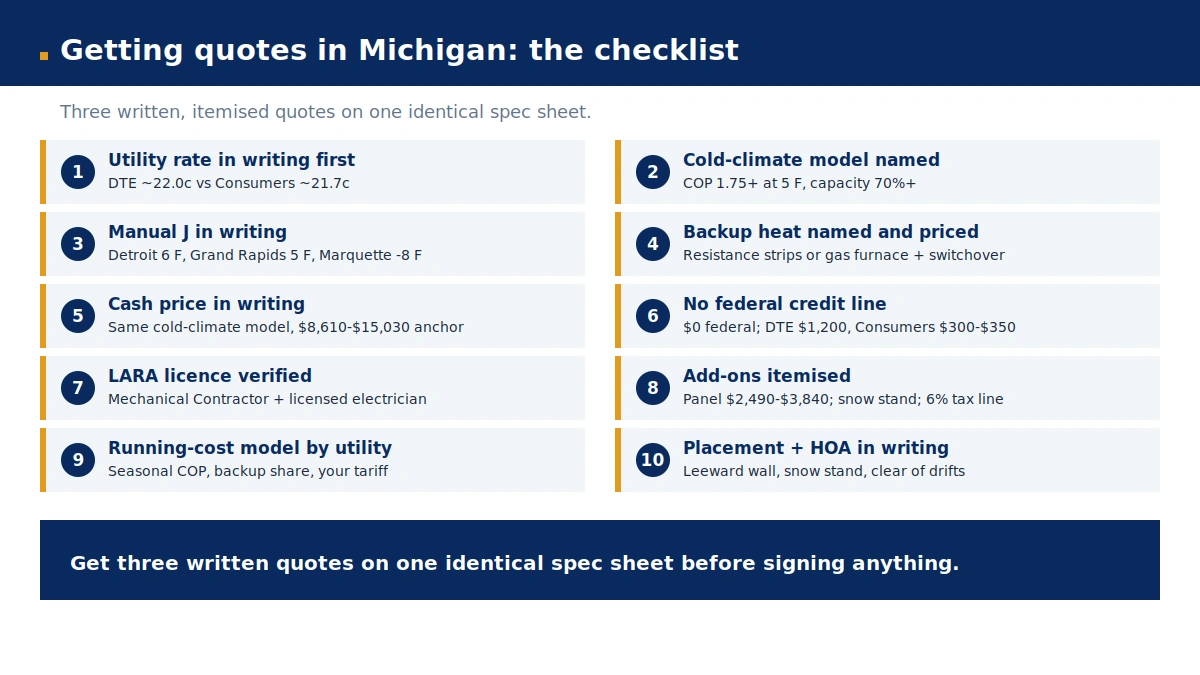
Michigan is one of the hardest states in this series to buy a heat pump in — expensive electricity, lake-effect snow, two utilities with opposite rebate rules, and a federal rebate program paused in the five districts where most Michiganders live — but only for a homeowner who checks the utility terms and the equipment ratings before the sales pitch. Carry this checklist to every bidder meeting; sign nothing until each line has its answer in writing.
The ten-item quote checklist:
- Your utility’s rate, in writing, first — DTE’s ~22.0 cents, Consumers Energy’s ~21.7 cents, BWL’s or TCLP’s own rate sheet, and whether the household is on a time-of-use plan. The rate decides whether the heat pump beats gas before anything else — and DTE’s Overnight Savers blended rate is worth about $585 a year against its standard rate on the same system.
- Cold-climate model named, 5-degree numbers attached — model number, NEEP listing or ENERGY STAR cold-climate status, COP at 5 degrees (1.75 minimum), capacity at 5 degrees (70 percent of rated minimum). With no model named, a quote has priced a machine that may not exist.
- Manual J load calculation, in writing — room by room, at your city’s design temperature (Detroit 6, Grand Rapids 5, Lansing 1, Marquette minus 8). Size by square footage alone and the contractor is guessing at the number that decides everything else.
- Backup heat specified, with its price — resistance strips or a gas furnace, capacity and switchover temperature included. Backup heat makes up half the system in Michigan. Leave it off a quote and the part that keeps the pipes from freezing is missing.
- Written cash price for the same cold-climate model — same kit, same house, from all three bidders. $8,610-$15,030 is the Michigan anchor for a 3-ton cold-climate ducted system; a quote far above it calls for an explanation, and a quote far below it calls for a closer look at what was left out.
- No line for a federal tax credit, no line for a state rebate — for a 2026 owner purchase the federal figure is $0, and Michigan offers neither a state rebate nor a state tax credit. The only money is the utility rebate and, for income-qualified households outside the paused districts, MiHER: DTE up to $1,200 (electric-heat replacements only), Consumers Energy $300-$350, BWL $200-$600 or $4,000-$5,000 depending on the program, A2ZERO $4,000-$5,500 with the program year to confirm. If a federal credit still sits in a quote, that quote was priced under a dead law.
- Both licenses verified — the LARA Mechanical Contractor license with the right classifications, verified with the state, and the electrical work done by or under a licensed electrician, with names matched to the contract. The installer needs EPA Section 608 certification to handle refrigerants.
- Add-ons itemized, each as its own line, not folded into the per-ton price — ductwork, panel upgrade ($2,490-$3,840), snow stand, wind baffle, and thermostat. Sales tax shown as its own line too — a flat 6 percent statewide, about $720 on a $12,000 system.
- A running-cost model built from your utility’s tariff — seasonal COP, backup-heat share, and rate, all shown against the tariff your own household pays, not a brochure figure. Model savings at the state-average rate for a DTE home and the quote is wrong by about $58 a year on the planning home; model savings against a gas furnace without naming the switchover temperature and it is not a model at all.
- Placement and HOA approval in writing before anything is ordered — the outdoor unit on the leeward wall, lifted on a snow stand, clear of roof valleys and plow drifts, HOA approval for the placement in hand. Convenience siting, against the wind, means higher running costs and higher service costs.
Buy, dual-fuel, or geothermal? A cold-climate ducted system is the winning buy for homeowners with electric heat or propane heat — and for anyone whose furnace is dying anyway. For gas-heated homes on DTE or Consumers Energy power, dual-fuel wins: the furnace carries January, the heat pump carries the shoulder seasons and the summer. Long-term owners on big lots who plan to stay 20 years and want the steadiest winter COP in the state should buy geothermal — at $20,250-$31,910, with no federal credit to soften it in 2026. As primary heat, a standard non-cold-climate unit wins for almost no one in Michigan. A lease wins for almost no one either, because no provider was verified selling one here.
Sources & methodology
Cost anchors:
- NumeralQ Michigan heat pump cost page, estimator pricing as of 2026-10-26: ducted 3-ton $6,550-$10,960; cold-climate ducted $8,610-$15,030; single-zone mini-split $3,140-$4,910; multi-zone 3-head $6,240-$11,170; geothermal $20,250-$31,910; by size 1.5t $4,400-$7,070 to 5t $9,410-$16,140; ductwork $4,160-$7,060; panel upgrade $2,490-$3,840; Detroit $6,630-$11,070; Grand Rapids $6,520-$10,920; permits typically $70-$166; BLS May 2025 HVAC median $29.26/hr, electricians $36.67/hr; heating cost/yr gas 95% $632, heat pump HSPF2 7.5 $1,637, HSPF2 9 $1,364; “55% of counties are zone 6 or colder”; heating fuel mix 12% electric, 75% piped gas, 10% propane or oil
- NumeralQ Michigan HVAC replacement pages (estimator 2026-10-26): dual-fuel $9,220-$15,120 (Detroit $9,330-$15,260; Grand Rapids $9,190-$15,080); central AC + gas furnace split system $8,340-$14,110
- nearbyhunt Heat Pump Cost 2026 (May 2026): standard 3-ton $9,500-$15,000; cold-climate 3-ton by brand — Mitsubishi Hyper-Heat $14,000-$18,000, Bosch IDS 2.0 $13,000-$17,000, Daikin Fit $11,500-$15,000, Carrier Greenspeed $14,500-$18,500; cold-climate premium $2,000-$4,000
- jouleio Heat Pump Cost 2026: mini-split single zone $2,000-$7,000; central ducted $4,500-$20,000, avg ~$8,350; geothermal $20,000-$50,000+, avg ~$30,000
- intelligentliving Geothermal vs Air Source 2026 — national price bands used as a cross-check: air-source cold-climate $15,000-$22,000; geothermal $45,000-$70,000
- Michigan custom-home geothermal source (oaks-of-tyrone.huzi.site, published 2026-10-30): $20,000-$45,000, ~$8,500/ton, 3-ton ~$25,000-$26,000
- CONFLICT: NumeralQ national page lists cold-climate 3-ton top end $15,040; Michigan state page lists $15,030. Draft uses the state-page figure.
Rates:
- EIA Electric Power Monthly Table 5.6.A, Oct 2026 release: MI residential 22.99 cents/kWh Aug 2026; US 18.16 cents; 13th-highest of 51; 12-mo avg to Aug 2026 21.3 cents vs US 18.0 cents (kadoa, updated 2026-11-07); average bill $134/mo
- kadoa/EIA-861 utility figures, 12 mo to Aug 2026: DTE Electric 22.0 cents, 2,085,559 customers, ~$137; Consumers Energy 21.7 cents, 1,666,844 customers, ~$139; Aug 2026 snapshot DTE 23.25 cents, Consumers 24.38 cents (energyfactbook)
- DTE standard tariff: $9.75/mo service charge, riders 10.95 cents/kWh, 4.0% taxes, all-in ~23.99 cents/kWh at 900 kWh (priceofelectricity.com)
- DTE Residential Electric Pricing Options rate card (March 2026, dteenergy.com): Time of Day 3-7 p.m. off-peak 18.44 cents, peak 24.13 cents (Jun-Sep) / 20.05 cents (Oct-May); Time of Day 11 a.m.-7 p.m. off-peak ~15.18 cents (Jun-Oct) / ~14.97 cents (Nov-May), peak 25.93 cents / 23.41 cents; Overnight Savers (D1.13) super off-peak 11.74 cents (1-7 a.m.), off-peak 15.55 cents (Oct-May), peak 19.06 cents (Oct-May) / 35.56 cents (Jun-Sep); 12-month commitment, smart meter required; Geothermal Time of Day rate (D1.7) no longer accepting new enrollments; stated base rates exclude PSCR surcharges
- EIA MI residential gas: 2025 annual average $10.92/Mcf (~$1.05/therm, NestPriced conversion); 2024 $10.76/Mcf; monthly 2025 $9.29-$19.57/Mcf; Aug 2026 $20.75/Mcf
- Consumers Energy $139M natural gas rate increase, effective Nov 1, 2026, ~$3.92/mo typical bill (wisevoter, Oct 29, 2026, secondary)
Climate and performance:
- ICC Appendix D design temps/HDD (97.5% winter): Detroit 6 F, 6,232 HDD; Grand Rapids 5 F, 6,894 HDD; Lansing 1 F, 6,909 HDD; Flint 1 F, 7,377 HDD; Muskegon 6 F, 6,696 HDD; Alpena -6 F, 8,506 HDD; Escanaba -7 F, 8,481 HDD; Marquette -8 F, 8,393 HDD; Sault Ste. Marie 9,048 HDD
- Snowfall 1991-2020 normals (currentresults.com, NCEI): Detroit 45.0 in; Grand Rapids 77.6 in; Traverse City 101.0 in; Houghton Lake 74.7 in; Marquette 102.0 in; Detroit NWS 2000-2020 avg 43.4 in (fox2detroit); Marquette ~119-120 in (usclimatedata, myperfectweather)
- CONFLICT: Marquette annual snowfall reported ~102 in (currentresults 1991-2020) vs ~149.1 in (NWS city records). Draft uses ~120 in with the station caveat.
- Record lows: Detroit -21 F (Jan 21, 1984, NWS Detroit Metro Airport records via coolweather.net); Grand Rapids -22 F; Marquette -33 F (extremeweatherwatch, NOAA-based). CONFLICT: extremeweatherwatch lists Detroit record low -24 F; draft uses -21 F and flags the variant.
- PNNL DOE climate zone guide via NumeralQ: 55% of MI counties zone 6 or colder
- ENERGY STAR CAC/ASHP V6.2 (revised March 2025) and NEEP ccASHP Spec v4.0 (effective Jan 1, 2023): COP 1.75 or better at 5 F; 70% or more of 47 F capacity at 5 F; HSPF2 8.1+ ducted / 8.5+ ductless; SEER2 15.2+
- DOE Cold Climate Heat Pump Challenge field data (cold-climate units): 5 F capacity 70-80%, COP 2.2-2.8; -5 F capacity 60-70%, COP 1.8-2.4
- DOE Cold Climate Heat Pump Challenge field data (standard units and Mitsubishi Hyper-Heat): standard unit at 5 F 40-60% capacity, COP 1.0-1.5; Hyper-Heat full capacity to 5 F, ~76% at -13 F
Rebates and incentives:
- DTE Energy 2026 incentive chart (michiganrebates.com, official DTE chart, valid for installs on/after Jan 1, 2026): cold-climate ASHP $900/$1,000/$1,200 (top tier 16+ SEER2, 9.1+ HSPF2, EER2 >= 10.0); standard ASHP $150/$500; ground-source $600/$800; ductless mini-split $700/$1,000; all heat pump rebates limited to electric customers replacing existing electric heating; participating contractor; single-family; not valid for new construction; funds first-come, first-served
- DTE $2,500 whole-home claim (profusion.solutions) — unsupported by the official 2026 chart ($1,200 max); flagged in draft
- Consumers Energy 2026 Qualifying sheet (March 2026, consumersenergy.com): ASHP $300 (SEER2 15.2+, replacement for existing heat pump only); ductless mini-split $350 (SEER2 17+, HSPF2 8-12.5, replacement for any primary electric heat system); ground-source $200 (17-18.99 EER) / $300 (19+ EER), existing-heat-pump replacement only; installs Jan 1-Dec 31, 2026; participating Trade Ally submits
- Lansing BWL Hometown Energy Savers (tracked Aug 2026): central ASHP $200-$600 tiered by SEER2; mini/multi-split $300 ($500 if replacing electric resistance); HPWH $500; Jan-Dec 2026; administered by Michigan Energy Options
- Lansing BWL Electrification Programs (lbwl.com, live page): central ASHP replacing gas furnace + central AC $4,000; replacing gas furnace only $5,000; HPWH $1,000; SEER2 >= 15.2, HSPF2 >= 7.8; pre-inspection / Home Energy Visit within past 3 years; replacement of existing natural gas or propane equipment only; one rebate per account
- Ann Arbor A2ZERO (a2gov.org): cold-climate heat pump $4,000 market rate / $5,500 income-qualified (<=120% AMI), up to 90% of project cost; NEEP-listed, SEER2 15.2+, HSPF2 8.0+; Manual J + AHRI required; dual-fuel NOT eligible; up to two mini-split systems per address; funded by Community Climate Action Millage (~$2M/yr); 2025-26 program year closed June 30, 2026, new schedule pending as of July 2026 (homeenergybasics) — live city page still lists up to $5,500
- Traverse City Light & Power: up to $3,000, 2025-26 program year ended June 30, 2026, new schedule pending as of July 2026 (homeenergybasics)
- MiHER (EGLE via CLEAResult): launched statewide April 14, 2025 (pilot Nov 2024, Marquette County + Holland); ~$211M total — HEAR $105,291,160 + HOMES $105,696,321 (DOE dataset via ECW, Oct 27, 2026); HEAR up to $8,000 heat pump, $14,000 household cap, 100% of costs <=80% AMI; open to <=150% AMI only; new income-qualified applications paused in EGLE Detroit, Warren, Grand Rapids, Lansing, Kalamazoo districts (verified Aug-Oct 2026: homeenergybasics Aug 22, betterhouse Sept, heatpumppricing Nov 4); up to 15,000 households expected to benefit
- DOE Program Notice 26-2 (May 29, 2026): HEAR electric-to-electric only, no fuel-switching; reservations after Aug 31, 2026 (NASEO FAQ, Aug 2026); HOMES fuel-neutral, up to $8,000 at 20%+ savings
- OBBBA (P.L. 119-21) with IRS FS-2025-05: §25C and §25D pay $0 for installs completed after Dec 31, 2025 — the completion date decides; IRS Notice 2025-42 on §48E (in service by Dec 31, 2027, construction begun by Jul 4, 2026)
- Michigan sales tax: flat 6% statewide, no local add-ons (Tax Foundation, rates as of July 1, 2026; Michigan Dept. of Treasury); no state tax credit for heat pumps; no sales-tax exemption for the equipment
Heating fuel and running-cost models:
- Census ACS 2020-2024 5-yr via NumeralQ: MI homes heated with electricity 12%, utility gas 75%, propane or oil 10%
- CFPB Solar Financing Market Issue Spotlight, Aug 2024: dealer fees 10-30%, sometimes over 50% — a national figure that Michigan $0-down quotes carry too
Licensing:
- LARA Bureau of Construction Codes, Mechanical Division: Mechanical Contractor license required for HVAC work; 3 years / 6,000 hours experience per classification (2-year HVAC program credits up to 1 year / 2,000 hours); PSI exam per classification (HVAC Equipment 150 questions / 3 hours; most others 55 questions / 1 hour; pass 70%); $300 license fee; 3-year cycle ending Aug 31; no continuing education currently required; no separate technician/journeyman/master license; unlicensed work fines up to $5,000 or up to 1 year in jail (reported, secondary — budgetheating.com); 2017 Skilled Trades Regulation Act (MCL 339.5807)
- Electrical work: licensed separately through LARA’s electrical division; EPA Section 608 required for refrigerants
Running-cost and payback arithmetic:
- Planning home ~57 MMBtu delivered heat/yr (NestPriced planning assumption from Detroit 6,232 HDD, cross-checked against NumeralQ’s $632/yr gas figure) = 16,710 kWh of heat; gas 95% AFUE at $1.05/therm = 602 therms = ~$632/yr; heat pump COP 2.0 = 8,355 kWh/yr (MI avg $1,780, DTE $1,838, Consumers $1,813, DTE all-in $2,004, Overnight Savers super off-peak $981); COP 2.5 = 6,684 kWh (MI avg $1,424, DTE $1,470, Consumers $1,450); resistance = 16,710 kWh (MI avg $3,559, DTE $3,676, Consumers $3,626); break-even COP vs 95% gas = 5.63 MI avg (DTE 5.82, Consumers 5.74, Overnight Savers super off-peak 3.10), vs 80% furnace ~4.74 MI avg; backup-resistance illustration (15% of heat at MI avg rates) ~$534/yr; Overnight Savers blended ~15 cents is a planning illustration, not a measured bill
- Cold-climate 3-ton at ~$11,820 (midpoint of $8,610-$15,030): vs resistance saves ~$1,780/yr MI avg -> ~6.6 yrs, ~6.0 yrs with $1,200 DTE rebate, ~2.1 yrs with $8,000 MiHER rebate; vs gas on DTE costs ~$1,206/yr more -> never; vs gas on Consumers costs ~$1,181/yr more -> never; dual-fuel midpoint $12,170 (range $9,220-$15,120)
EXCLUDED:
- Prices quoted “after 30% credit” or “after $2,000 credit”: §25C/§25D pay $0 on 2026 installs
- Any HEAR rebate in a 2026 Michigan quote for a gas-heated home: electric-to-electric only under Notice 26-2, and paused in five districts
- DTE $2,500 whole-home claim: unsupported, flagged
- BWL $200-$600 vs $4,000/$5,000: two different programs, both presented with program names
- A2ZERO 2026-27 amounts and TCLP new schedule: between program years as of July 2026, flagged
- Traverse City / Sault Ste. Marie design temperatures: not published/captured, not stated
- Ann Arbor / Lansing / Traverse City install prices: planning estimates only, flagged
- Upper Peninsula install prices: none published, none stated
- Cold-climate prices by size other than 3-ton: planning estimates from the MI premium ($2,060-$4,070), flagged
- Permit fee schedule specific to MI: not verified (NumeralQ $70-$166 typical only)
- MI lease/PPA provider and third-party PPA authorization: none found / not verified
- Propane retail price / modeled annual propane cost in MI: not verified, no propane payback number printed
- Heat-pump HOA protection statute in MI: none verified
- Consumers Energy time-of-use schedules: not priced in this pass
- Installer names / counts in MI beyond BLS medians: not verified; none named
- Field-measured seasonal COP, or monthly COP, for a specific MI installation: none found; the 2.0-2.5 seasonal COP is a planning range, labeled as such
*Disclaimer: The prices here are 2026 Michigan planning figures. Your final price turns on city, house, utility territory, and contractor. Before settling on a budget, get written quotes from three Michigan installers. Take the tax notes here as general information only; they are not advice for your own return. Before filing, check with a Michigan tax professional who knows the 2026 rules. Program rules change — DTE, Consumers Energy, BWL, TCLP, A2ZERO, and MiHER terms — so confirm current terms with your own utility or the program before signing. DTE’s stated base rates exclude PSCR surcharges; MiHER applications are paused in the Detroit, Warren, Grand Rapids, Lansing, and Kalamazoo districts as of the sources checked in August-October 2026.*
What does a heat pump cost in Michigan in 2026?
A typical whole-home ducted 3-ton air-source heat pump costs $6,550-$10,960 installed in Michigan in 2026, and the cold-climate ducted system Michigan winters demand runs $8,610-$15,030 (NumeralQ, October 2026). A single-zone ductless mini-split runs $3,140-$4,910, a three-head multi-zone system $6,240-$11,170, a dual-fuel package $9,220-$15,120, and geothermal with a ground loop $20,250-$31,910. Detroit runs $6,630-$11,070 for a 3-ton ducted system and Grand Rapids $6,520-$10,920. For a homeowner-owned system installed in 2026, the federal tax credit is $0, and Michigan has no state rebate or tax credit — only utility rebates and, for income-qualified households, MiHER.
Do heat pumps work in Michigan winters?
They do — provided the unit is a cold-climate model and backup heat stands behind it through a Michigan January. Michigan designs for 6 degrees in Detroit, 5 in Grand Rapids, 1 in Lansing, and minus 8 in Marquette, and a standard heat pump keeps only 40 to 60 percent of its capacity at 5 degrees. Cold-climate status means a variable-speed inverter compressor, enhanced vapor injection, and a place on the NEEP list — or meeting ENERGY STAR’s cold-climate criteria. At 5 degrees such a unit still delivers at least 70 percent of its capacity, at a COP of at least 1.75. In Department of Energy field testing, capacity ran 70 to 80 percent at 5 degrees, with a COP of 2.2 to 2.8. Backup heat is needed even by the best air-source unit on the coldest nights: resistance strips, or a gas furnace in a dual-fuel setup. The outdoor unit also needs a snow stand so it can defrost under lake-effect snow.
Is a heat pump cheaper to run than a gas furnace in Michigan?
No — not on fuel, on any Michigan utility. At about 21.3 cents a kilowatt-hour, the state-average electricity price, a heat pump would need a seasonal COP of about 5.63 to tie a 95 percent gas furnace. A realistic Michigan seasonal COP is 2.0 to 2.5. On DTE Energy at about 22.0 cents, heating the planning home with a heat pump costs about $1,838 a year, against about $632 for gas. Even DTE’s cheapest overnight rate, 11.74 cents from 1 a.m. to 7 a.m., still needs a COP of 3.10 to tie gas. Everywhere in the state, the heat pump beats electric resistance heat — saving about $1,780 a year at the average rate.
Which heat pump rebates are actually collectible in Michigan in 2026?
DTE Energy pays up to $1,200 for a cold-climate system, but only when the heat pump replaces existing electric heat, and only through a participating contractor. Consumers Energy pays $300 for a ducted system replacing an existing heat pump, or $350 for a mini-split replacing any primary electric heat system. Lansing BWL runs two programs: Hometown Energy Savers pays $200-$600, while its Electrification Program lists $4,000-$5,000 for a heat pump replacing a gas furnace — confirm which one applies before counting on either. Ann Arbor’s A2ZERO pays $4,000, or $5,500 for income-qualified households, but its 2025-26 program year ended June 30, 2026, so check the current schedule. No state tax credit exists, and the federal tax credit is $0 for 2026 installs.
Can I get the $8,000 MiHER rebate for a heat pump in Michigan?
Only if the household is income-qualified, lives outside a paused district, and is replacing electric heat. Michigan’s MiHER program (HEAR) pays up to $8,000 for a heat pump, but applications are open to households at or below 150 percent of area median income only, and new income-qualified applications are paused in the EGLE Detroit, Warren, Grand Rapids, Lansing, and Kalamazoo districts. Even where it is open, HEAR money is barred from fuel-switching by the Energy Department’s Program Notice 26-2. A gas-heated home cannot use it to switch to a heat pump; only electric-to-electric upgrades and new construction qualify. The HOMES side of MiHER remains fuel-neutral and pays on whole-home energy savings instead.
What permits and licenses does a Michigan heat pump install require?
You need a mechanical permit and an electrical permit from your city or county, and your contractor needs a Mechanical Contractor license from LARA, the Department of Licensing and Regulatory Affairs, with the right work classifications for the job — three years or 6,000 hours of experience and a PSI exam behind it, on a three-year cycle. Michigan issues no separate license for individual HVAC technicians; they work under a licensed contractor. The electrical work needs a separate licensed electrician, and the installer needs EPA Section 608 certification to handle refrigerants. Typical permit costs run $70-$166.
Should I get a dual-fuel heat pump in Michigan?
For a gas-heated home on DTE or Consumers Energy power, yes — dual-fuel is the honest answer. In that setup the heat pump handles Michigan’s spring and fall heating plus summer cooling. Once outdoor temperatures drop past the switchover point your installer dials in — typically 25 to 35 degrees in Michigan — the gas furnace carries the load, because by then the heat pump’s COP has slipped below the level at which it still undercuts gas. Michigan is one of the few states with a published dual-fuel price: $9,220-$15,120 for a 3-ton package. On DTE or Consumers Energy power the break-even COP is near 5.8, so the furnace carries most of the deep winter. Note that Ann Arbor’s A2ZERO rebate does not pay for dual-fuel systems, and DTE’s rebates do not pay for a heat pump replacing gas heat.
When does a Michigan heat pump pay for itself?
Against electric resistance heat, about 6.6 years at the state-average rate — about 6 years with DTE’s $1,200 rebate, and about 2.1 years with MiHER’s $8,000 for a household that qualifies — because it saves about $1,780 a year. Against a 95 percent gas furnace on DTE or Consumers Energy power, never on fuel, because the heat pump costs about $1,181-$1,206 a year more to run; buy it there for the air conditioning, the zoning, or because the furnace is dying anyway. Judge the premium over the furnace-plus-AC you would buy anyway, not the full sticker — Michigan’s furnace-plus-AC replacement range is $8,340-$14,110, so the heat pump’s premium over that combination is small, and in many cases negative.