


Table of Contents
Delaware is the second-smallest state in the country, and a heat pump buyer here can drive from the Pennsylvania line to the Maryland line in under two hours — yet the price of running the machine changes more across that drive than the price of buying it. The install quote barely moves. A 3-ton ducted system costs roughly the same in Wilmington as it does in Dover, because the same small pool of contractors works the whole state and the labour market is one market. The electric bill is where the state splits. Delmarva Power, which bills most of New Castle County and the towns along the bay, charges about 19 cents a kilowatt-hour. The Delaware Electric Cooperative, which bills the farms and subdivisions of Kent and Sussex counties, charges about 14.3 cents. That 4.7-cent gap is worth roughly $200 a year on the average home’s heating bill, and it is the difference between a heat pump that ties gas and a heat pump that beats it.
The climate does the buyer a favour that the electric bill partly takes away. Delaware winters are mild by Northeast standards. Wilmington’s design temperature is 14 degrees, January nights average in the mid-20s, and the heating season runs about 4,930 degree days — short enough that a standard heat pump, not a cold-climate specialist, carries a typical house through the winter without leaning on resistance backup heat. Summers are the other half of the bargain. They are hot and wet, with humidity in the high 60s and a cooling load that runs more than 1,200 degree days, so the same machine that heats in January also dehumidifies and cools in July. A heat pump in Delaware is never a heating-only purchase. It is a two-season machine, and the cooling season is the part the buyer feels every day.
Three facts decide whether the purchase pays. The first is the fuel the house burns today: 42% of Delaware homes heat with piped gas, 38% with electricity, and about 18% with propane or oil — and the rebate stack and the running-cost answer both turn on that split. The second is the name on the electric bill — Delmarva, the co-op, or one of the nine municipal utilities — because the rebate and the rate both follow the utility. The third is the calendar: the Home Performance bonus that lifts incentives by 25% started July 1, 2026 and is described as limited-time with no published end date, while the federal HEAR rebate has been “expected to launch” since a state web page last updated in October 2024. A quote that is right in November can be wrong in January if the assessment was never booked.
For the country-wide baseline first, see our national heat pump cost guide before weighing Delaware’s figures against it.
How Much Does a Heat Pump Cost in Delaware in 2026?
The Delaware market in 2026 is best described by three anchors, each measuring something different — so the first step is sorting out what each one actually captures. NumeralQ’s Delaware model (priced October 26, 2026) puts an installed 3-ton ducted air-source system at $6,600–$11,030, materials, waste, and contractor markup included. It is a planning model assembled from material prices and Delaware labour rates rather than a pile of contractor quotes, and this guide headlines it because no other Delaware-specific model published in 2026 lays out its method system by system. The midpoint, about $8,815, stands in this guide as the typical whole-home job — a labelled midpoint, not a price anyone quoted.
The second anchor is Dun’s state model, updated August 2026, which prices a ducted air-source heat pump in Delaware at $6,550–$12,100 installed, built from federal wage data for HVAC trades plus typical equipment pricing. Its band is a little wider at the top than NumeralQ’s, which is what you would expect from a model that scales a national equipment price by state wages rather than pricing Delaware jobs directly. The two anchors overlap across nearly the whole NumeralQ band, which is reassuring — two different methods land on the same price for the same machine.
The third anchor sits in the middle of both and comes from contractor-reported jobs. Modernize’s Delaware page puts the average heat pump installation in the state at $10,550, with a standard air-source system at $8,480 and a high-efficiency air-source system at $12,720. That average sits above the NumeralQ midpoint because it mixes premium variable-speed systems and multi-zone jobs in with standard changeouts. BetterHouse, working from a national baseline scaled by Delaware’s HVAC wage index of 1.02, prices the state at $4,030–$14,100 with a typical job of $10,650 — the widest band of the four, because it carries the full national spread. Taken together, the four anchors agree on the shape of the market: a standard whole-home ducted job lands near $8,800–$10,600, a budget changeout can come in under $7,000, and a premium variable-speed job with new electrical work can push past $12,000.
That headline band covers the complete installed job — outdoor condenser, indoor air handler or coil, line set, thermostat, labour, permit, and start-up. New ductwork, a panel upgrade, and a new circuit are not in that band — the table below prices each separately, and those three extras are what most often stretch a $9,000 Delaware quote toward $14,000. It also does not buy the rebate: every figure in this guide is the gross price before incentives, because the Energize Delaware rebate depends on the efficiency tier you pick and whether the energy assessment was done first, and no single net price exists for the whole state.
| Source | 3-ton ducted | What it measures | Date |
|---|---|---|---|
| NumeralQ Delaware model | $6,600–$11,030 | Planning model, materials + local labour | Oct 26, 2026 |
| Dun Delaware model | $6,550–$12,100 | BLS-wage model, equipment + labour | Aug 2026 |
| Modernize Delaware average | $10,550 average; standard $8,480 | Contractor-reported jobs | 2026 |
| BetterHouse Delaware | $4,030–$14,100; typical $10,650 | National baseline scaled by wage index 1.02 | 2026 |
| National cross-check (This Old House) | $10,575 average ducted | National contractor survey | Aug 2026 |
| National cross-check (Angi) | $4,500–$8,000 | Project-reported, national | Aug 2026 |
One more number belongs in this section because it changes how every quote should be read: Delaware has no state sales tax. There is no 6% line to add to the equipment, and there is no sales-tax saving to claim either. A quote that shows a sales-tax line for a Delaware job is either templated from another state or padding the total — ask which one. The absence of a sales tax also means the $0 federal credit has nowhere to hide. In a state with a sales tax, a careless quote can bury the dead credit in a tax line. In Delaware the arithmetic is bare, and any quote that still subtracts 30% for a federal credit is priced under a law that no longer exists.
Heat Pump Cost in Delaware by System Type
The system type is the biggest single choice in the quote, bigger than the brand and bigger than the efficiency tier. A single-zone mini-split and a geothermal loop are not two prices for the same job. They are two different machines for two different houses, and the table below prices them all on the same NumeralQ Delaware model so the comparison is honest.
| System type | Installed (3-ton unless noted) | Best for |
|---|---|---|
| Air-source heat pump, ducted | $6,600–$11,030 | Whole-home replacement on good ducts |
| Cold-climate heat pump, ducted | $8,670–$15,110 | Homes that want full capacity on the coldest nights |
| Ductless mini-split, single zone | $3,180–$4,950 | One room, addition, or a house with no ducts |
| Ductless multi-zone (3 heads) | $6,310–$11,260 | Small homes or one floor without ducts |
| Dual-fuel (heat pump + gas furnace) | $9,290–$15,210 | Gas-heated homes keeping the furnace as backup |
| Packaged unit (all-in-one) | $7,070–$10,060 | Homes with no indoor space for an air handler |
| Geothermal with ground loop | $20,370–$32,050 | Large lots, long ownership, lowest running cost |
Ducted air-source is Delaware’s default purchase. At $6,600–$11,030 for a 3-ton system it replaces the furnace and the air conditioner in one machine, reuses the ducts the house already has, and needs no new holes in the walls. Most Delaware homes have ducts — the state’s housing stock is dominated by post-war suburbs and newer subdivisions built around forced-air systems — so most buyers never need to look past this row. The price spread inside the band is mostly efficiency and controls: a single-stage 14.3 SEER2 unit on existing ducts lands near the bottom, a two-stage or variable-speed unit with a communicating thermostat lands near the top, and the difference shows up in the running-cost section below.
Cold-climate ducted is the upgrade that Delaware rarely needs but some buyers still want. At $8,670–$15,110 it costs roughly $2,000–$4,000 more than a standard ducted system of the same size, and it buys full heating capacity down to about 5 degrees and useful heat well below zero. Wilmington’s design temperature is 14 degrees, so a standard unit already covers the design day in most of the state. The cold-climate premium makes sense in two Delaware cases: a house on the edge of the Piedmont in northern New Castle County, where winter nights run a few degrees colder than the coast, and a buyer who wants to retire the backup heat strips entirely and never see resistance heat on a January bill. For a typical Wilmington or Dover home it is insurance, not necessity, and the guide says so rather than selling it as standard.
Ductless mini-splits are Delaware’s answer for the houses the ducted market forgot. One zone at $3,180–$4,950 heats and cools a single room while the rest of the house stays untouched, and a three-head system at $6,310–$11,260 can carry a small house or a full floor. The housing stock that needs them is easy to find: the brick rowhouses and twins of Wilmington’s older neighbourhoods, the beach cottages and condos of Rehoboth and Bethany that were built for summer use and now get lived in year-round, and the additions and converted garages that never got ductwork. With mini-splits the price follows the number of indoor heads rather than the tonnage, because every head adds its own equipment, refrigerant piping, and wall penetration — so a four-head quote that looks dear beside a ducted price is usually pricing four rooms, not one machine. Our ductless vs ducted guide carries the full side-by-side comparison, and the mini-split installation guide carries the detailed mini-split pricing.
Dual-fuel suits the gas-heated home that wants to keep its furnace for the coldest nights. At $9,290–$15,210, the dual-fuel setup keeps the existing gas furnace alongside the heat pump: the pump handles the mild stretches, the furnace steps in once the outdoor temperature drops past a set point, and the home burns its cheapest fuel through the coldest hours. In Delaware that compromise has a real economic logic, because gas at $1.78 a therm beats a standard heat pump on running cost at Delmarva’s electricity price — the furnace is not a sentimental attachment, it is the cheaper heater for the coldest week of the year. Dual-fuel also keeps the gas furnace standing by if the heat pump fails in January, which counts in a state where a winter outage can leave a house cold until the crew arrives. The switchover-temperature decision and the rest of the dual-fuel detail live in our dual-fuel guide.
Packaged units solve a space problem. At $7,070–$10,060 the whole system sits in one outdoor cabinet, usually on a slab beside the house or on the roof, with ducts running straight into the home. They suit the slab-on-grade ranches and small-lot homes of Delaware’s older suburbs, where there is no basement or attic for an air handler. The trade-off is efficiency and noise: packaged units rarely match a good split system’s SEER2, and the compressor sits closer to the living space.
Geothermal plays the long game, and in Delaware the pitch is tougher than in the Midwest. With the ground loop included, $20,370–$32,050 runs roughly three times a ducted air-source system, and the loop needs land — vertical bores on a small lot, horizontal trenches where there is room. The advantages are genuine: ground temperatures stay steady, so the machine never sheds capacity in a cold snap, and its seasonal efficiency tops any air-source unit. But both of the props that once held its price up are gone in 2026. Systems finished after December 31, 2025 get $0 from the 30% federal geothermal credit (§25D). Delaware’s own geothermal help now runs through two narrow doors: the co-op’s geothermal grant for DEC members (up to $7,500 for a new system) and the DNREC Green Energy Program for municipal-utility customers, whose amounts have not been verified as current. A Delaware buyer choosing geothermal in 2026 pays nearly the full price out of pocket, then waits many years for energy savings to repay the loop. Our geothermal cost guide covers the national geothermal picture.
Heat Pump Cost by Home Size
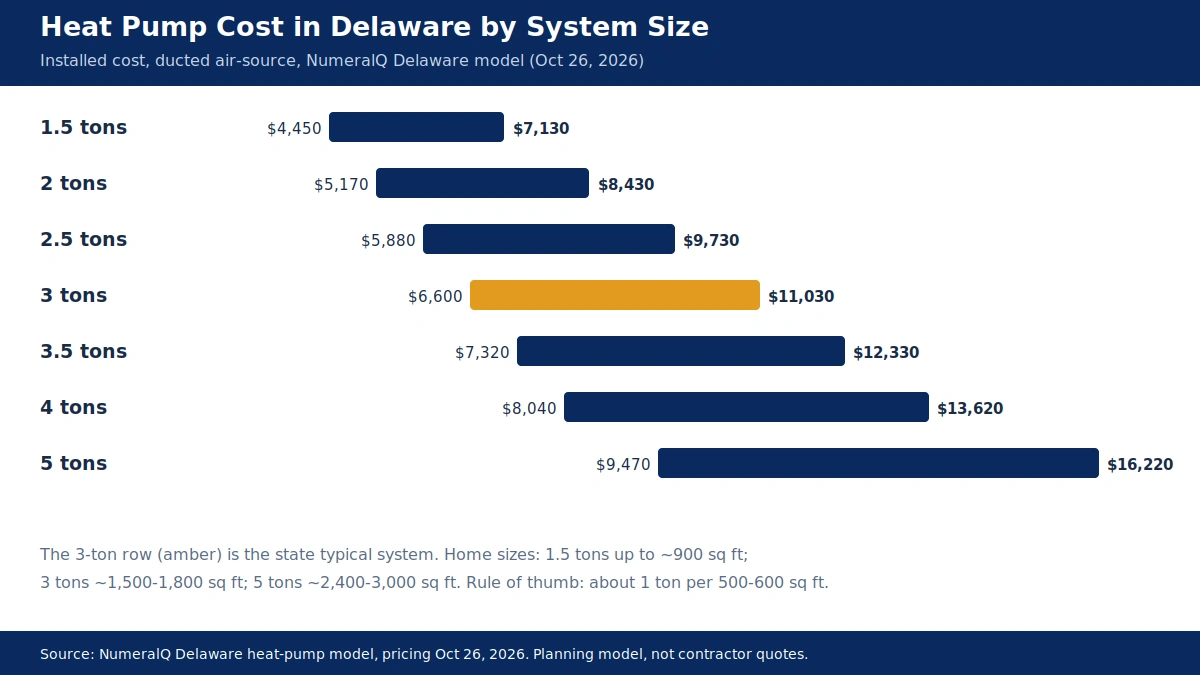
Tonnage follows the house, and the house follows the tonnage — a system that is too small runs all day and never catches up, and a system that is too big short-cycles, leaves the humidity in the air, and dies early. The rule of thumb in Delaware is about one ton for every 500 to 600 square feet of conditioned space, refined by insulation, windows, and how much sun the roof takes. That rule is a starting point only. The right size comes from a Manual J load calculation run at Wilmington’s 14-degree design temperature, and any contractor who sizes from square footage alone, without the calculation, is guessing with your money.
| System size | Installed (ducted air-source) | Typical home |
|---|---|---|
| 1.5 tons | $4,450–$7,130 | Small condo or apartment, up to ~900 sq ft |
| 2 tons | $5,170–$8,430 | Small home or townhouse, ~1,000–1,200 sq ft |
| 2.5 tons | $5,880–$9,730 | Townhouse or small single-family, ~1,200–1,500 sq ft |
| 3 tons | $6,600–$11,030 | Typical Delaware single-family, ~1,500–1,800 sq ft |
| 3.5 tons | $7,320–$12,330 | Larger single-family, ~1,800–2,100 sq ft |
| 4 tons | $8,040–$13,620 | Large single-family, ~2,100–2,400 sq ft |
| 5 tons | $9,470–$16,220 | Large or older home, ~2,400–3,000 sq ft |
The table prices the NumeralQ Delaware model by size, and the pattern in it is worth reading carefully: the jump from 3 tons to 5 tons is about $2,900–$5,200, which is a lot of money for two tons of capacity. That is why oversizing is expensive twice over — once on the invoice and again on the electric bill, because an oversized unit spends its life starting and stopping instead of running steadily. In Delaware’s humid climate the penalty for oversizing is worse than in a dry state: a short-cycling heat pump never runs long enough to pull moisture out of the air, so the house feels clammy at 72 degrees and the thermostat gets pushed down to compensate, which costs more power for less comfort.
Delaware’s housing stock pushes buyers toward the middle of the table. The state’s median home is a 3-bedroom single-family house of roughly 1,600–1,900 square feet, built between the 1960s and the 2000s, and that house takes a 3-ton system in most cases. The exceptions cluster at the edges. The small brick twins and rowhouses of Wilmington’s older streets often need only 1.5–2 tons, and a 2-ton ducted system or a two-head mini-split can be the right answer there. The big new subdivisions of Middletown, Smyrna, and the Sussex beach towns — 2,500 square feet and up, with vaulted ceilings and a wall of west-facing glass — often need 4–5 tons, and the load calculation matters most exactly there, because vaulted ceilings and glass break the square-footage rule completely.
Two size mistakes show up in Delaware quotes more than any others. The first is sizing for the coldest night instead of the design temperature: a contractor who sizes for 0 degrees in a state whose design temperature is 14 is selling a ton of capacity the house will use for a few hours a decade. The second is ignoring the ducts. A 3-ton unit on ducts built for a 2-ton furnace starves for air, runs loud, and freezes the coil in summer. The quote should name the ductwork it includes — new, extended, or reused as-is — and the load calculation should be attached to it, not promised verbally. If the calculation is not in the paperwork, the size is a guess.
Heat Pump Cost by City: Wilmington, Newark, Dover & the Beaches
Delaware is small enough that one labour market covers the whole state, and the install price reflects that. The honest city story is that the price barely moves between cities, while the running cost and the rebate do. Wilmington is the only Delaware city with a published city-level price model in 2026, so it anchors this section, and the other cities are described by their utility territory and housing stock rather than by invented city prices.
| City | 3-ton ducted (where published) | What changes the answer |
|---|---|---|
| Wilmington | $6,690–$11,130 (NumeralQ, Oct 2026) | Delmarva Power 19.0 cents; oldest housing stock; rowhouses suit mini-splits |
| Newark | Statewide band applies; no city model published | Delmarva Power; university rentals; many 100-amp panels |
| Dover | Statewide band applies; no city model published | City of Dover municipal electric; state-capital housing mix |
| Middletown / Smyrna | Statewide band applies; no city model published | Fastest-growing suburbs; large new homes, 4–5 ton systems |
| Rehoboth / Bethany Beach | Statewide band applies; no city model published | DEC 14.3 cents; salt air; electric-heated beach homes |
Wilmington runs $6,690–$11,130 for a 3-ton ducted system, about $90–$100 above the statewide band on both ends — a small premium that tracks the city’s labour market, where HVAC technician pay runs 6% above the national median. Wilmington is also where the state’s oldest housing stock concentrates: brick rowhouses and twins from the early 1900s with no ducts, narrow lots, and plaster walls that make ductwork expensive. For those houses the mini-split row of the system table is often the real quote, not the ducted row. Wilmington sits entirely in Delmarva Power territory, so its buyers pay the state’s highest electricity price and qualify for the Energize Delaware rebates but not the co-op grants.
Newark has no published city price model, so the statewide band is the honest figure. What changes in Newark is the housing mix: a university town with a large stock of rentals, student housing, and 1960s–70s split-levels, many still on 100-amp electrical service. The panel upgrade — $2,190–$3,450 statewide — shows up in Newark quotes more often than anywhere else in the state, and landlords comparing a heat pump against a cheap furnace replacement should read the payback section with their own numbers, because a rental’s running cost falls on the tenant while the install cost falls on the owner.
Dover is the state capital and the largest of the municipal-utility cities. Dover’s electric customers are served by the City of Dover, a DEMEC member, not by Delmarva Power — which means Dover buyers should check the city’s own rebate terms rather than assuming Delmarva’s apply. Dover’s housing is a mix of older homes near the historic district and newer subdivisions to the west, and its buyers sit in the middle of the state on both price and climate: a touch warmer in summer and a touch colder in winter than the coast, with the same 14-degree design temperature governing the sizing.
Middletown and Smyrna are the growth story. They are the fastest-growing towns in Delaware, full of subdivisions built in the last twenty years, and their houses are the biggest in the state on average — 2,400 square feet and up, which pushes them into the 4–5 ton rows of the size table. A Middletown quote that looks high next to a Wilmington quote is usually pricing a bigger house, not a more expensive market. These towns sit in Delmarva Power territory for electricity, so the running-cost math is the Delmarva math.
Rehoboth Beach, Bethany Beach, and the Sussex coast are Delaware’s best heat pump market on running cost and its hardest on equipment. They sit in Delaware Electric Cooperative territory at 14.3 cents a kilowatt-hour, the cheapest power in the state, which makes the fuel math work at almost any efficiency tier. They also have the state’s highest share of electric-heated homes — about 90% in Bethany Beach — because the beach housing stock was built for summer use with electric baseboard or wall heaters, and a heat pump replacing baseboard heat saves money from the first month. The hard part is the salt air: an outdoor unit a few hundred yards from the ocean corrodes faster than the same unit in Wilmington, so coastal quotes should name a coated coil or a coastal-rated cabinet, and the warranty should be read for salt-air exclusions. Beach homes also sit empty for weeks in winter, so a Wi-Fi thermostat and a freeze-protection setting are worth more there than anywhere else in the state.
Delaware’s Climate: Mild Winters, Humid Summers, and What That Means for Sizing
Delaware sits in climate zone 4A — mixed-humid — and the whole state shares that designation, from the Pennsylvania line to the Atlantic. The numbers behind it are gentle by Northeast standards. Wilmington records about 4,930 heating degree days a year, with a 97.5% winter design temperature of 14 degrees and a summer design of 89 degrees dry bulb with a 76-degree wet bulb. January nights average in the mid-20s and July afternoons in the mid-80s, the annual mean sits near 55–57 degrees, and average relative humidity runs about 67–70%. The cooling season runs more than 1,200 degree days, and the city sees roughly 22 days a year with highs at or above 90 degrees.
The winter side of that climate is the good news for a heat pump buyer. A standard air-source unit holds its capacity well down to the mid-teens, and Delaware’s design temperature is 14 degrees — which means the machine is asked to do its hardest work on a night that the weather record says happens only a few hours a year. On a typical January day in the 30s and low 40s, a standard unit runs at a seasonal efficiency that makes the running-cost section a genuine contest with gas rather than a foregone conclusion. Backup resistance heat, the expensive strip heaters that rescue an undersized system in a cold snap, should be a rare event in a Delaware winter, not a nightly one. If a quote leans on backup heat as a normal part of the design, the system is undersized or the house is leaking heat through the envelope, and the air sealing rebate in the Home Performance program is the cheaper fix.
The summer side is where Delaware differs from its neighbours to the north. Humidity is the load that does not show up on the thermostat. A house at 72 degrees and 65% humidity feels worse than a house at 75 degrees and 45% humidity, and the machine that fixes the first house is not a bigger compressor — it is a longer run time at a lower speed. That is the case for variable-speed equipment in Delaware: a two-stage or variable-speed unit that runs long and slow pulls moisture out of the air while it cools, where a single-stage unit blasts cold air for ten minutes, shuts off, and leaves the humidity behind. The efficiency tiers in the rebate table follow the same logic. The Tier 2 threshold of 17 SEER2 and 8.2 HSPF2 is not just a rebate hoop; it is roughly the point where the equipment gets the variable-speed compressor that makes a Delaware summer comfortable.
The coast adds two wrinkles that inland buyers never see. The first is salt. An outdoor condenser near the beach lives in a salt fog, and the coil fins and cabinet corrode faster than the same unit ten miles inland. Coastal installers stock coated coils and stainless hardware for this reason, and the quote should say so. The second is wind and driving rain. The beach towns take the edge of coastal storms, and an outdoor unit needs a solid pad, a level mount, and clearance from drifting sand and dune grass. Neither wrinkle is a reason not to buy a heat pump at the beach. Both are reasons to buy the right one and to ask the installer what coastal jobs they have done.
Snow is the last climate fact, and it is a small one. Wilmington averages about 6 inches in January and a little over a foot a year, most of it melting within days. The outdoor unit needs clearance above the snow line and a working defrost cycle, and the owner needs to keep it clear after a storm. There is no deep-snow design problem here, and no reason to pay a cold-climate premium for snow that melts by the weekend.
Heat Pump vs Gas Furnace in Delaware: The Running-Cost Math
This is the section that decides the purchase, and it is the section where Delaware refuses to give a single answer. The same heat pump, at the same efficiency, beats gas in one part of the state and loses to it in another — because the electricity price changes and the gas price does not. The arithmetic below is NestPriced arithmetic from the published rates, and every input is named so the reader can redo it with their own bill.
The method is simple. One therm of heat is 29.3 kilowatt-hours of heat energy. A heat pump delivers that heat by moving it, not making it, so the electricity it uses is 29.3 divided by its seasonal COP — and COP is the HSPF2 rating divided by 3.412. A 95% gas furnace delivers a therm of heat by burning a therm of gas and wasting 5% up the flue, so its cost per therm of heat is the gas price divided by 0.95.
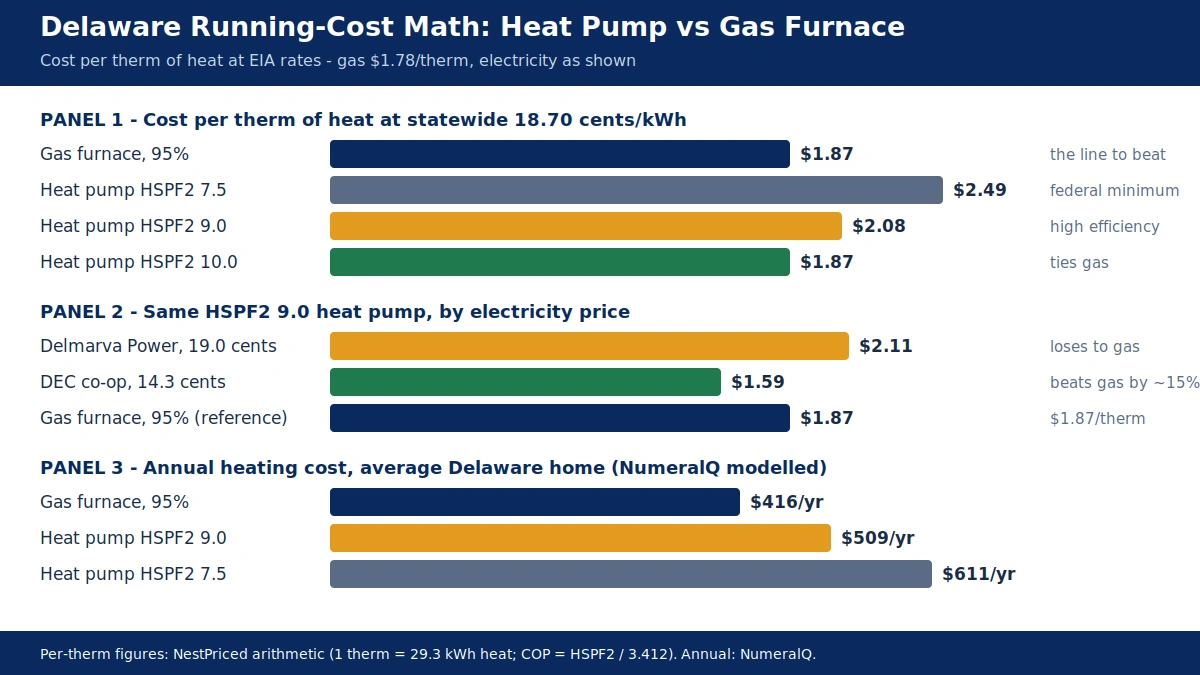
The inputs: Delaware’s statewide residential electricity price is 18.70 cents a kilowatt-hour (EIA, August 2026), Delmarva Power’s is 19.0 cents (12-month average to August 2026), and the Delaware Electric Cooperative’s is 14.3 cents. The statewide residential gas price is $1.78 a therm (EIA, 12-month average to July 2026). At $1.78 a therm, a 95% gas furnace delivers heat at $1.87 a therm.
| Heat pump efficiency | Cost per therm of heat at 18.70 cents (statewide) | At 19.0 cents (Delmarva) | At 14.3 cents (DEC) |
|---|---|---|---|
| HSPF2 7.5, COP 2.20 (federal minimum) | $2.49 | $2.53 | $1.91 |
| HSPF2 9.0, COP 2.64 (high efficiency) | $2.08 | $2.11 | $1.59 |
| HSPF2 10.0, COP 2.93 (premium) | $1.87 | $1.90 | $1.43 |
| Gas furnace 95% at $1.78/therm | $1.87 | $1.87 | $1.87 |
Read the table from the buyer’s side. On Delmarva Power’s 19-cent electricity, a high-efficiency heat pump at HSPF2 9.0 delivers heat at $2.11 a therm against gas at $1.87 — about 13% more expensive. Only a premium unit at HSPF2 10 or better ties gas, and only a unit above that beats it. On the co-op’s 14.3-cent power, the same HSPF2 9.0 unit delivers heat at $1.59 a therm — about 15% cheaper than gas — and even a minimum-efficiency unit roughly ties it. The break-even point tells the same story in one number: at the statewide 18.70-cent price, a heat pump needs a seasonal COP of about 2.93 — an HSPF2 near 10 — to match gas. At the co-op’s 14.3 cents, the break-even COP is about 2.24, an HSPF2 near 7.6, which any modern unit clears.
The annual figures agree, with a different gas price behind them. NumeralQ’s modelled annual heating cost for the average Delaware home — EIA household heating use times current state prices — puts a 95% gas furnace at $416 a year, a minimum-efficiency heat pump at HSPF2 7.5 at $611 a year, and a high-efficiency heat pump at HSPF2 9.0 at $509 a year. The gap between the two methods is the gas price vintage: NumeralQ’s annual figures use the 2025 annual average gas price, which was lower than the 2026 price used in the per-therm table. Both methods point the same way. On Delmarva power, a gas-heated home pays more to heat with a standard heat pump than it does today. On co-op power, it pays less.
Against oil and propane there is no contest at all. Heating oil in Delaware costs $6.413 a gallon in the week of November 2, 2026 — up $2.43 from a year earlier — which works out to $53.22 per million Btu of delivered heat in an 87% furnace. Propane costs $3.938 a gallon, or $45.33 per million Btu at 95% efficiency. A heat pump at HSPF2 9.0 on statewide electricity delivers the same million Btu for about $20.80. That is less than half the cost of propane and not much more than a third of the cost of oil. GreenCalculus, modelling a ducted heat pump at HSPF2 9.2 against an 80% furnace, puts the annual result the same way: replacing gas costs about $3 a year more, replacing propane saves about $506 a year, and replacing heating oil saves about $814 a year. The fuel being replaced is the whole decision. A gas-heated home buys a heat pump for the air conditioning, the rebate, and the carbon cut. An oil- or propane-heated home buys one and saves money from the first winter.
Two more wrinkles belong in the math. The first is Delmarva’s gas tariff itself: delivery of $0.78735 per CCF plus a gas cost rate of $0.63922 per CCF, on top of a $17 monthly charge, works out to about $1.43 per CCF of variable cost, or roughly $1.38 a therm before the fixed charge. A Delmarva customer who heats with gas is buying the cheapest gas in the state, which makes the heat pump’s case harder still in Wilmington and Newark. The second wrinkle is the cooling season, which the heating-only math ignores: a heat pump replaces the air conditioner as well as the furnace, and in Delaware’s humid summers that cooling is worth real money. Our heat pump running cost guide explains the national running-cost method, including the COP-to-HSPF2 conversion, and the heat pump vs furnace guide carries the head-to-head furnace comparison.
Energize Delaware, Delmarva Power & the Delaware Electric Cooperative: The 2026 Rebates
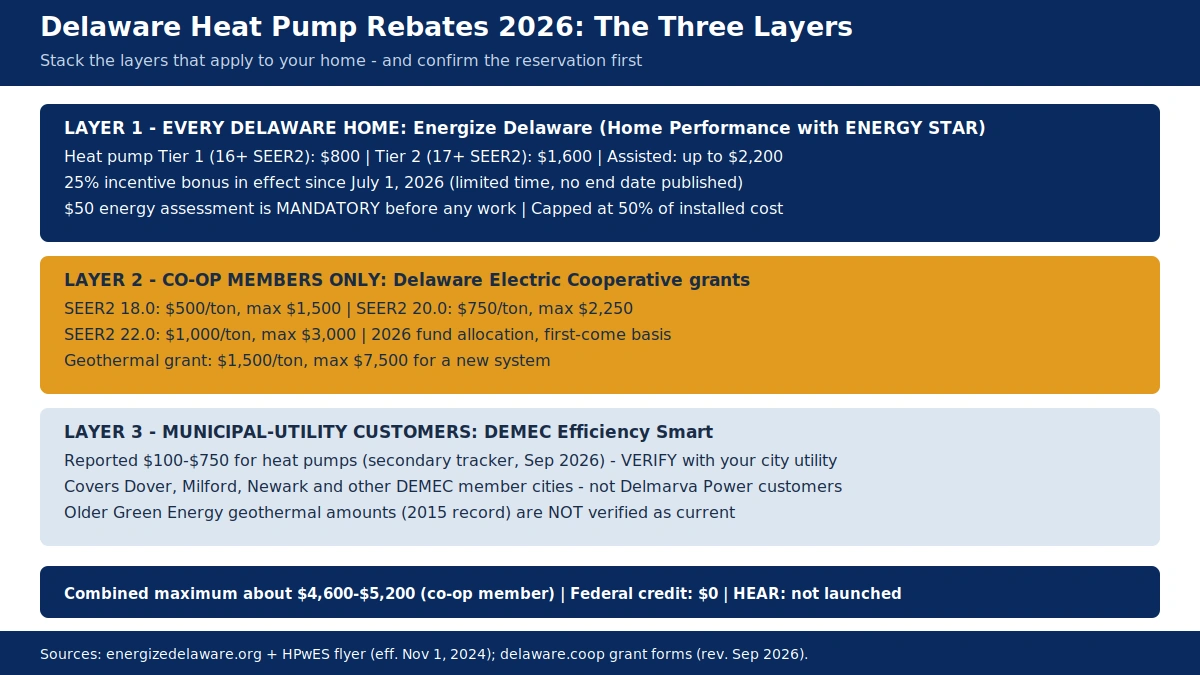
Delaware’s rebate money comes in three layers, and the layers do not all apply to the same house. The first layer is Energize Delaware’s Home Performance with ENERGY STAR program, which covers every Delaware home regardless of utility. The second layer is the Delaware Electric Cooperative’s grant program, which covers only co-op members. The third layer is the municipal utilities’ Green Energy Program, which covers only customers of the nine DEMEC member cities — and whose current amounts are not verified, so this guide flags them rather than quoting them as 2026 fact. Delmarva Power’s own residential heat pump rebates run through Energize Delaware; Delmarva’s separate HVAC flyer with per-ton instant discounts is a commercial program for Maryland customers only, and importing its numbers into Delaware would be wrong.
Energize Delaware — Home Performance with ENERGY STAR
The Home Performance program is a whole-house program, and its first rule is the one buyers most often miss: the energy assessment comes before any work. The assessment costs $50 as a co-pay ($100 for homes over 3,000 square feet, $25 for income-qualified customers), and during the visit the advisor installs up to $250 worth of energy-saving products — LED bulbs, faucet aerators, pipe insulation — at no extra charge. Work installed before the assessment, or installed by the homeowner, does not qualify for incentives. The assessment incentive itself is capped at $400, and the program confirms a rebate reservation before the work starts — incentives are not guaranteed until that reservation is confirmed.
The heat pump incentives from the program’s flyer (effective November 1, 2024, confirmed on the program’s site through 2026) are tiered by efficiency, and the tiers are the same thresholds that decide comfort in a humid summer:
| Measure | Standard incentive | Assisted incentive |
|---|---|---|
| Heat pump Tier 1 (16+ SEER2, 11.5+ EER2, 7.8+ HSPF2, multi-stage) | $800 | $1,200 |
| Heat pump Tier 2 (17+ SEER2, 12.0+ EER2, 8.2+ HSPF2, multi-stage) | $1,600 | $2,200 |
| Heat pump 4/5-ton Tier 1 (16 SEER2, 7.5 HSPF2, 11.5 EER2) | $800 | $1,200 |
| Heat pump 4/5-ton Tier 2 (17 SEER2, 7.8 HSPF2, 11.7 EER2) | $1,600 | $2,200 |
| Mini-split, first unit Tier 1 / Tier 2 | $550 / $1,100 | Higher (assisted rates) |
| Mini-split, each additional indoor unit Tier 1 / Tier 2 | $350 / $600 | Higher (assisted rates) |
| Hybrid heat pump + furnace Tier 1 / Tier 2 | $1,450 / $2,250 | $2,300 / $3,300 |
| Heat pump water heater | $1,100 | $1,350 |
| Air sealing, 20% improvement | $900 | $1,100 |
| Air sealing + heat pump bundling bonus | $300 | $350 |
Three caps govern the total. HVAC and water-heating incentives are capped at the listed amount or 50% of the total installed cost, whichever is lower — 75% for Assisted customers. Air sealing and duct sealing are capped at 75% of cost. Mini-split rebates are capped at $4,000 per Home Performance customer, or $5,500 for an Assisted customer. The bundling bonus pays when air sealing is done within three months of the equipment installation and achieves a 20% reduction in airflow. And since July 1, 2026, the program’s incentive bonus has been lifted from 20% to 25% for a limited time — the program’s own page gives no end date for that lift, so treat it as live today and confirm it before signing.
The Assisted Home Performance track deserves a line of its own. Since July 1, 2023, military members and active-duty first responders — firefighters, police, and EMTs — can join the Assisted program, paying $25 for the assessment and receiving the higher incentive column above. It is the most generous door in the Delaware rebate stack, and it is also the least advertised.
Delaware Electric Cooperative grants — the stackable layer
Co-op members get a second layer on top of Energize Delaware, and it is the layer that makes high-efficiency equipment pay. The co-op’s High Efficiency Air Source Heat Pump Grant (application revised September 2026) pays by the ton, by efficiency tier, for Class A members — homes whose average monthly peak demand is under 50 kW, which is nearly every house:
| Efficiency | Grant per ton | Maximum per dwelling |
|---|---|---|
| SEER2 18.0 or higher | $500 | $1,500 |
| SEER2 20.0 or higher | $750 | $2,250 |
| SEER2 22.0 or higher | $1,000 | $3,000 |
Class B members — larger accounts at 50 kW or more — receive $500 a ton up to $5,000 for systems at IEER2 16.0 or higher. The grants are paid from a 2026 fund allocation on a first-come basis, and the program states plainly that funding is limited and amounts may change year to year. A co-op member who buys a 3-ton unit at SEER2 22 can therefore stack up to $3,000 from the co-op on top of $1,600–$2,200 from Energize Delaware — $4,600–$5,200 in total, which is the largest combined rebate available anywhere in the state. The co-op also runs a geothermal grant: $1,500 a ton up to $7,500 for a new geothermal system at EER 18.0 and COP 3.6, or $500 a ton up to $1,500 for a replacement, with a five-year warranty required and a DNREC-approved contractor mandatory. The co-op’s Beat the Peak program adds small bill credits on top — $25 to enrol a Wi-Fi thermostat plus $5 a month from June through September — and a time-of-use Beat the Peak rate that can cut a flexible household’s bill by up to 8%.
The municipal layer — verify before counting it
Customers of the nine DEMEC municipal utilities — Dover, Milford, Newark, New Castle, Smyrna, Seaford, Lewes, Clayton, and Middletown — have a third layer in the form of Efficiency Smart rebates, reported at $100–$750 for heat pumps by a secondary tracker checked in September 2026. That figure has not been verified against a DEMEC primary page, so this guide reports it as reported and tells Dover, Newark, and Milford buyers to confirm it with their city utility before counting it. The older DEMEC Green Energy Program record, which lists geothermal rebates of $500–$600 a ton up to $2,500–$3,000 for residential systems, dates to a 2015 database entry and is not verified as current — it is flagged here, not quoted as a 2026 fact. The practical point for municipal-utility buyers is narrower than the numbers: your rebate path runs through your city, not through Delmarva Power, so the first call is to the city utility office, not to the state program.
What the stack adds up to
For a Delmarva Power customer in Wilmington buying a Tier 2 ducted system, the realistic total is $1,600 from Energize Delaware, plus the 25% bonus while it lasts — about $2,000 in round terms, before the 50%-of-cost cap bites. For a co-op member in Sussex County buying the same system at SEER2 20 or higher, the total is $1,600–$2,200 from Energize Delaware plus $2,250 from the co-op — roughly $3,850–$4,450. For an Assisted customer the numbers rise further. None of these totals includes a federal credit, because there is none to include. And none of them should be added to a quote until the assessment is booked and the reservation is confirmed — the assessment-first rule is the difference between a rebate and a disappointment.
Federal Help in 2026: No Tax Credit, and HEAR Still Not Launched
The federal picture for a Delaware heat pump buyer in 2026 is short, and it is all zeros. The Energy Efficient Home Improvement Credit — §25C — once paid up to $2,000 a year toward a qualifying air-source heat pump. It stopped for property placed in service after December 31, 2025, when the One Big Beautiful Bill Act (P.L. 119-21) took it away, and the IRS confirmed in FS-2025-05 that the completion date is what counts. The 30% geothermal credit — §25D — ended on the same date. Any quote that still subtracts a federal credit is priced under a law that no longer exists, and any contractor who tells a buyer the credit is “probably coming back” is selling hope, not a rebate.
The $8,000 federal HEAR rebate for heat pumps — the Home Electrification and Appliance Rebate, renamed the High-Efficiency Electric Home Rebate in a May 2026 Energy Department notice — has also not launched in Delaware. The money is allocated: $32,837,400 for the electrification rebates and $32,964,663 for the HOMES efficiency rebates, about $66 million in total, administered by the Delaware Division of Energy and Climate. The state’s own program page, last updated in October 2024, says the program is expected to launch once funding is received. A National Housing Trust tracker updated April 30, 2026 records both Delaware applications as conditionally approved and says the state plans to launch both programs “this year.” But Delaware appears on no launched list: it is not among the 13 jurisdictions on the Energy Department’s February 2026 map, not on the June 2026 Building Performance Association map, and an independent check on October 27, 2026 records its status as “funds awarded: not launched.” A separate verification on November 4, 2026 places Delaware among the 38 states where HEAR has never launched for homeowners.
Two warnings attach to that unlaunched money. The first is the May 29, 2026 federal notice — Program Notice 26-2 — which removed the fuel-switching allowance from the HEAR program. When and if Delaware launches, the rebate will not pay to replace a gas or oil furnace with electric equipment; it will pay for electric-to-electric replacements only. A gas-heated home waiting for HEAR to fund its switch is waiting for money that the current rules say it cannot have. The second warning is the calendar. The state has been saying “this year” since a page last updated in October 2024, and two years of “this year” is not a launch date. Do not let a contractor hold a deposit against a HEAR rebate that does not exist yet.
The one federal door that is still open is the narrowest one. The commercial credit — §48E, 30% — survives for third-party-owned systems placed in service by December 31, 2027, which is the legal basis for a lease or power purchase agreement in which a company owns the equipment on the buyer’s roof. No provider has been verified selling a residential heat pump lease or PPA to Delaware homeowners, and Delaware’s rules for third-party residential energy agreements are not settled in the sources checked for this guide. Treat any lease offer as unverified, have a lawyer read it before signing, and never let a lease promise stand in for a rebate that is actually available. For the whole 2026 federal picture, see our federal tax credits guide.
Permits & Licensing: What Delaware Requires
Delaware is one of the easiest states in the country to get into the contracting business — and one of the more careful states about who actually touches the refrigerant. The two facts together define what a buyer should check, and the check is quick.
There is no statewide general contractor licence in Delaware, and there is no state exam for general contractors. What the state requires instead is registration. Every contractor needs a business licence from the Division of Revenue — $75 a year, which also enrols the business in the gross receipts tax — and a registration with the Department of Labor’s Office of Contractor Registration before any work begins, under the Delaware Contractor Registration Act. The registration costs $200 a year for private work, $300 for public work, or $500 for both. A contractor who cannot show both numbers is not a licensed contractor in the usual sense; the state simply does not issue that credential. The honest wording on a Delaware business card is “Delaware Business Licence” with the number, not “licensed general contractor,” and a buyer should be wary of any card that claims the second.
The work itself is licensed differently. Heating, ventilation, air conditioning, and refrigeration work in Delaware requires a Master HVACR licence — or work under the direct supervision of someone who holds one — issued through the Division of Professional Regulation by the Board of Plumbing, Heating, Ventilation, Air Conditioning and Refrigeration Examiners. Below the master level there is a Master HVACR Restricted licence for a single specialty, a Journeyman certificate earned through a four-year apprenticeship with at least 144 hours of education a year plus two years working under a Master, and apprentice registration with the Department of Labor. Any technician handling refrigerant also needs EPA Section 608 certification — that is federal, and there is no Delaware substitute. Licensed HVACR holders must display “Licensed HVACR” and their licence number on their vehicles in letters at least three inches high, so the side of the van is itself a check.
Permits are a county and city matter. New Castle, Kent, and Sussex counties each run their own permit process, and Wilmington and the other cities add their own requirements on top. NumeralQ’s survey of 35 cities puts typical permit fees for this kind of job at $70–$166, shown separately from the install price. No Delaware-specific permit fee schedule was verified for this guide, so treat that range as typical rather than exact, and ask the contractor to name the permit fee on the quote rather than burying it in a lump sum. The permit matters for the rebate as well as for the law: the Home Performance program requires the work to be done by a program-approved contractor after the assessment, and unpermitted work can void both the rebate and the manufacturer’s warranty.
Two practical checks close the section. First, verify the Master HVACR licence on the Division of Professional Regulation’s lookup before work starts, and match the name on the licence to the name on the contract — a licence held by a different company does not cover the job. Second, confirm that the refrigerant in the quote is R-454B or R-32. EPA rules phased R-410A out of new residential split systems starting in 2025, so a 2026 quote naming R-410A is either old stock or an old template, and either way it deserves a question. The federal minimum efficiency for a new system is 7.5 HSPF2 and 14.3 SEER2, in effect since January 1, 2023 — anything below that is not a 2026 system at all.
What Pushes Your Delaware Quote Up or Down
Eight factors move a Delaware quote, and they move it by thousands. Knowing them before the contractor arrives is the difference between comparing quotes and being compared by them.
The ducts are the first. New or extended ductwork runs $4,220–$7,150 in Delaware, and it is the single biggest add-on in the state. A house with clean, sealed, right-sized ducts needs none of it. A house with ducts sized for a 2-ton furnace, or ducts running through an unconditioned attic with torn insulation, needs a lot of it. The Home Performance program will pay for air sealing and duct sealing — up to 75% of the cost — which is the cheapest way to shrink this line. Get the duct inspection in writing before the quote is final, not after the crew is in the attic.
The electrical panel is the second. A panel upgrade to 200 amps runs $2,190–$3,450 in Delaware, and a new circuit alone runs about $1,400 on the national modelled figures. Many Delaware homes still run on 100-amp service — above all the brick rowhouses and split-levels from the 1950s to the 1980s — and a heat pump needs its own dedicated 240-volt circuit, which a full panel has no room for. The co-op’s grants do not cover the panel, and neither does Energize Delaware’s heat pump tier, so the panel is usually the buyer’s own money. Find out whether the quote covers the panel before signing, not after the electrician is already parked in the driveway. National panel-upgrade figures are in our electrical panel upgrade guide.
Efficiency tier is the third. The jump from a Tier 1 unit at 16 SEER2 to a Tier 2 unit at 17 SEER2 is worth $800 in rebate money — $800 versus $1,600 from Energize Delaware — and it usually buys the variable-speed compressor that makes a humid Delaware summer comfortable. The jump to SEER2 20 or 22 is worth more again on co-op territory, where the grant pays $750–$1,000 a ton. The tier decision is therefore a rebate decision as well as a comfort decision, and the quote should show the AHRI certificate number for the exact equipment combination, because the rebate is paid on the rated combination, not on the brand name.
The refrigerant and the coil are the fourth. A 2026 system runs on R-454B or R-32, and the coil should be matched to the outdoor unit by the AHRI rating. A mismatched coil costs efficiency every day the system runs, and it can cost the rebate too, since the program verifies efficiency by AHRI certificate. At the beach, the coil question is also a corrosion question — ask for a coated coil or a coastal-rated cabinet, and read the warranty for salt-air exclusions.
The house itself is the fifth. Age, insulation, windows, and air leakage decide the load, and the load decides the tonnage. A leaky 1960s ranch needs a bigger system than a tight 2015 subdivision house of the same size, and the bigger system costs more to buy and more to run. The $50 Home Performance assessment is the cheapest way to find out which house you own — it measures the leakage, names the fixes, and unlocks the rebates in the same visit.
The season is the sixth. HVAC contractors in Delaware are busiest in late spring, when air conditioners fail, and in early autumn, when furnaces get their annual check. A quote taken in February or March, when crews have open calendars, is often sharper than the same quote taken in a July heatwave. The rebate reservation does not care about the season, but the install calendar does.
The contractor’s labour rate is the seventh. HVAC mechanics in Delaware earn a median of $29.96 an hour, and contractors bill $60–$78 an hour per worker once insurance, payroll taxes, overhead, and profit are folded in. Electricians run $30.63 an hour median, billed at $61–$80. Wilmington’s technicians earn about 6% above the national median, which is most of the reason Wilmington’s install band sits slightly above the state’s. A quote that is far below those labour rates is not a bargain; it is a crew that is cutting corners somewhere the buyer cannot see.
Maintenance and lifespan are the eighth. With an annual service a heat pump lasts 15–20 years, and in Delaware’s climate that service is not optional: a dirty coil bleeds efficiency all summer in the humidity, and a neglected defrost sensor on the coast can cost a compressor in winter. Plan on a yearly service visit, keep the outdoor unit free of leaves, sand, and snow, and read the warranty as two separate documents — equipment cover from the manufacturer, workmanship cover from the installer — since the first never pays for the second’s mistakes. Our heat pump maintenance guide covers the maintenance detail, and the heat pump repair guide covers the repair numbers.
Payback: When Does a Delaware Heat Pump Pay for Itself?
Payback is the question every buyer asks, and in Delaware it has four different answers — one for each fuel being replaced, and each answer changes again with the utility. The honest way to present it is to work each case separately and name the inputs, rather than to publish a single number that is wrong for three-quarters of the state.
Against propane: about 6–8 years, and the case is strong. A propane-heated home saves roughly $506 a year by switching to a heat pump at HSPF2 9.2, per GreenCalculus modelling. Against a typical 3-ton installed cost of $8,815, less the Energize Delaware Tier 2 rebate of $1,600 and the 25% bonus, the net cost lands near $6,800–$7,000. At $506 a year of fuel saving, simple payback runs about 13–14 years on fuel alone — but that understates the case, because the heat pump also replaces the air conditioner, and a propane-heated home usually has no central cooling at all. Count the avoided air conditioner — a few thousand dollars of equipment the buyer does not have to purchase separately — and the payback shortens to roughly 6–8 years. Propane-heated homes in Sussex County, where propane is common and the co-op’s cheap power and grants both apply, are the best payback story in the state.
Against heating oil: about 5–7 years, and the case is strongest of all. Oil saves roughly $814 a year in the same GreenCalculus model, and the oil price has jumped — $6.413 a gallon in November 2026, up $2.43 from a year earlier — which makes the saving larger every year the price stays high. Against a net cost near $6,800 after the Tier 2 rebate, $814 a year pays back in about 8 years on fuel alone, and again the avoided air conditioner shortens it to roughly 5–7 years. Oil-heated homes are concentrated in the older housing of New Castle County, where the furnace is often past its expected life anyway — and a furnace that needs replacing in the same decade as the air conditioner is the buyer for whom the heat pump’s case is a replacement-timing case, not a fuel-savings case.
Against electric resistance heat: about 3–5 years, and the case is obvious. A home heated with baseboard or wall heaters — common in the beach towns, where about 90% of Bethany Beach homes heat with electricity — pays roughly three times as much for heat as a heat pump delivers it for, because resistance heat has a COP of 1.0 and a heat pump at HSPF2 9.0 runs at a COP near 2.6. The annual saving runs into four figures, and on co-op power with a stacked rebate the payback is measured in a few years. These are the homes the rebate programs were designed for, and they are also the homes where the co-op’s grant tiers pay the most.
Against gas: there is no fuel payback, and the rebate plus the air conditioner is the whole case. The average Delaware home’s heating bill is $416 a year on a 95% gas furnace, $509 a year on a high-efficiency heat pump at HSPF2 9.0, and $611 a year on a minimum-efficiency heat pump at HSPF2 7.5, per NumeralQ’s modelled annual figures. Running the heat pump costs $93–$195 a year MORE than running the gas furnace it replaces. Across fifteen years that adds $1,400–$2,900 of extra running cost, before counting the heat pump’s own maintenance. A purchase that costs more every year than the machine it replaced has no payback period at all. For a gas-heated home, what makes the switch work is not the fuel bill — it is the rebate plus the second machine that never has to be bought. The Energize Delaware rebate pays $800–$2,200, the co-op adds up to $3,000 for its members, and the heat pump is also the home’s air conditioner. When a gas-heated home needs a new furnace and a new air conditioner within the same decade, it is weighing one machine against two — and the heat pump’s argument is about replacement timing, not fuel savings. That comparison’s furnace and air-conditioner prices are in our furnace replacement guide and our central AC guide — no combined price is invented here.
One caution applies to every payback figure above: they are planning figures, not bill forecasts. The gas price, the electricity price, the winter’s cold, and the house’s insulation all move the answer, and the electricity price has moved fast — Delmarva’s supply rate more than doubled between 2021 and 2026. A buyer who wants a personal payback number should take the last twelve months of electric and gas bills, the HSPF2 and SEER2 on the quote, and the rebate reservation, and work the per-therm table in the running-cost section with their own numbers. That takes twenty minutes and it is worth more than any statewide average.
Getting Quotes in Delaware: The Checklist
Ten checks, in the order that saves the most money. Do them in this order, because the first three decide whether the rest are worth doing.
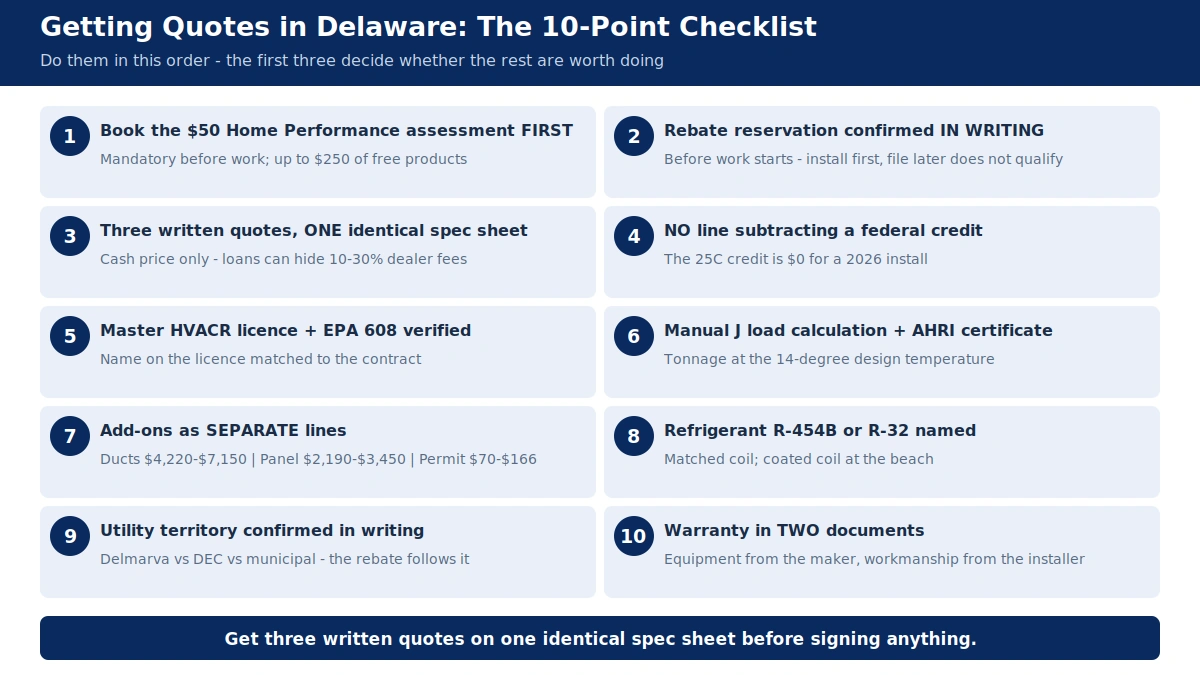
- Book the $50 Home Performance assessment first. It is mandatory before any work qualifies for Energize Delaware incentives, it installs up to $250 of free products, and it measures the air leakage that decides whether the house needs sealing before it needs a bigger heat pump. Work done before the assessment does not qualify. Income-qualified customers pay $25, and military and active-duty first responders join the Assisted track.
- Get the rebate reservation confirmed in writing before the work starts. Incentives are not guaranteed until the program confirms the reservation. A contractor who says “we will file it after the install” is describing a rebate you may never receive.
- Collect three written quotes on one identical spec sheet. Same tonnage, same SEER2 and HSPF2, same ductwork scope, same panel scope. Cash price is the only comparable figure — loan quotes can bury dealer fees of 10–30% of the cash price inside the amount financed.
- Check for a line subtracting a federal credit — and reject any quote that has one. The §25C credit is $0 for a 2026 install. A quote that still subtracts 30% is priced under a dead law, and the “saving” will vanish when the tax return is filed.
- Verify the Master HVACR licence and the EPA 608 certification. Look the licence up on the Division of Professional Regulation’s site, match the name to the contract, and ask for the technician’s 608 card. Delaware has no general contractor licence to fall back on — the HVACR licence is the credential that matters.
- Ask for the Manual J load calculation and the AHRI certificate number. The calculation justifies the tonnage at Wilmington’s 14-degree design temperature. The certificate proves the rated SEER2 and HSPF2 of the exact equipment combination, which is what the rebate is paid on.
- Price the add-ons as separate lines. Ductwork ($4,220–$7,150), panel upgrade ($2,190–$3,450), new circuit (~$1,400), permit ($70–$166). A quote that hides them in a lump sum cannot be compared with one that shows them.
- Name the refrigerant and the coil. R-454B or R-32 for a 2026 system, matched coil by AHRI rating, coated coil or coastal-rated cabinet within a few hundred yards of the ocean. Ask about salt-air warranty exclusions at the beach.
- Confirm the utility territory in writing. Delmarva Power, Delaware Electric Cooperative, or a municipal utility — the rebate stack, the grant, and the running-cost math all follow that answer. A co-op member who is quoted Delmarva’s terms, or a Dover customer quoted Energize Delaware’s alone, is being quoted the wrong program.
- Get the warranty in two documents. Equipment warranty from the manufacturer, workmanship warranty from the installer, both in writing, with the labour term stated in years. Ask who services the system in year three, and what the annual maintenance visit costs.
Sources & methodology
Cost anchors (installed, 2026):
- NumeralQ Delaware heat-pump page, pricing as of Oct 26, 2026: 3-ton ducted $6,600–$11,030; 1.5-ton $4,450–$7,130; 2-ton $5,170–$8,430; 2.5-ton $5,880–$9,730; 3.5-ton $7,320–$12,330; 4-ton $8,040–$13,620; 5-ton $9,470–$16,220; cold-climate ducted $8,670–$15,110; single-zone mini-split $3,180–$4,950; multi-zone 3-head $6,310–$11,260; geothermal with loop $20,370–$32,050; ductwork $4,220–$7,150; panel upgrade 200 A $2,190–$3,450; HVAC median pay $29.96/hr, billed $60–$78/hr; electricians $30.63/hr, billed $61–$80/hr; permits $70–$166 typical; Wilmington 3-ton $6,690–$11,130; Wilmington tech pay +6% vs national median; planning model, not contractor bids
- NumeralQ Delaware HVAC-replacement page, Oct 26, 2026: dual-fuel $9,290–$15,210; packaged unit $7,070–$10,060
- Dun heat-pump cost page, updated Aug 2026: Delaware ducted $6,550–$12,100; BLS-wage model
- Modernize Newark DE page, 2026: Delaware average install $10,550; standard air-source $8,480; high-efficiency $12,720; single-zone mini-split $5,830; multi-zone $12,720; geothermal $29,680
- BetterHouse heat-pump cost by state, 2026: Delaware ducted $4,030–$14,100, typical $10,650, wage index 1.02
- National cross-checks: This Old House Aug 2026 ducted average $10,575; Angi Aug 2026 $4,500–$8,000; ConsumerAffairs Jul 2026 $4,000–$14,000
Rates:
- EIA Electric Power Monthly Table 5.6.A/B, Aug 2026: Delaware residential 18.70 cents/kWh, 19th-highest of 51; US average 18.16 cents; 12-month average 18.0 cents
- EIA-861 via kadoa.com, updated Nov 7, 2026: Delmarva Power 19.0 cents/kWh, +6.3% YoY, $171 average bill, 281,296 homes; Delaware Electric Cooperative 14.3 cents, +2.6%, $148 average bill, 110,275 customers
- Delmarva Power Standard Offer Service supply rates: summer 11.1063 cents/kWh Jun 1–Sep 30, 2026; winter 11.4049 cents Oct 1, 2026–May 31, 2027; all-in ~20.87 cents at 900 kWh incl. $13.50/mo customer charge (priceofelectricity.com, EIA Aug 2026 data, refreshed Oct 28, 2026)
- Delaware Division of the Public Advocate, Historical Review of Delmarva Power Electric Residential Rates, Apr 6, 2026: supply rates more than doubled since 2021 (summer $0.052148 to $0.111063, +114.1%)
- EIA Natural Gas Monthly Table 20, Oct 2026: Delaware residential 2026 YTD $18.29/Mcf; 12-month average to Jul 2026 $18.40/Mcf, about $1.78/therm (wheredmymoney.com, Oct 29, 2026)
- Delmarva Power gas tariff P.S.C. Del. No. 5 – Gas, revised Aug 28, 2026, effective Nov 1, 2026: space-heating delivery $0.78735/CCF + gas cost rate $0.63922/CCF + $17.00/mo customer charge
- Chesapeake Utilities PSC Docket 26-0883, filed Aug 31, 2026, Order 11093 Sep 23, 2026: residential gas sales rate $1.20655/therm from Nov 1, 2026, down from $1.29752
- EIA heating oil and propane weekly survey via nailthemath.com, week of Nov 2, 2026: heating oil $6.413/gal (+$2.43 YoY), $53.22 per MMBtu at 87%; propane $3.938/gal (+$0.47), $45.33 per MMBtu at 95%
Running cost:
- NumeralQ Delaware page, Oct 2026: annual heating cost — gas furnace 95% $416; heat pump HSPF2 7.5 $611; heat pump HSPF2 9.0 $509; EIA heating use per household times current state prices, planning figure
- GreenCalculus heat-pump calculator, Oct 2026: Delaware electricity Jan–Jul 2026 average 17.86 cents; replacing gas costs $3/yr more, replacing propane saves $506/yr, replacing oil saves $814/yr (HSPF2 9.2 vs 80% furnace)
- Per-therm table: NestPriced arithmetic — 1 therm = 29.3 kWh of heat; COP = HSPF2 / 3.412; gas $1.78/therm at 95% = $1.87/therm of heat
- Census Bureau ACS 2020–2024 5-year, tables B25034/B25040 (via NumeralQ): piped gas 42%, electricity 38%, propane or oil about 18%; EIA RECS 2020: about 20% of Delaware homes already heat with a heat pump
Rebates:
- Energize Delaware Home Performance with ENERGY STAR page (energizedelaware.org, checked Nov 2026): assessment mandatory before work, $50 co-pay ($100 over 3,000 sq ft, $25 income-qualified), up to $250 free products, audit incentive capped $400, 25% incentive bonus from Jul 1, 2026 (limited time, no end date published); Assisted track open to military and active-duty first responders since Jul 1, 2023
- Energize Delaware HPwES incentives flyer 048-1167-10-072025, effective Nov 1, 2024: Tier 1 $800/$1,200, Tier 2 $1,600/$2,200; 4/5-ton same; mini-split first unit $550/$1,100, additional units $350/$600, cap $4,000 ($5,500 assisted); hybrid Tier 1 $1,450/$2,300, Tier 2 $2,250/$3,300; heat pump water heater $1,100/$1,350; air sealing $900/$1,100; bundling bonus $300/$350; HVAC capped at 50% of installed cost (75% assisted); geothermal excluded
- Delaware Electric Cooperative High Efficiency Air Source Heat Pump Grant + Geothermal Grant applications, revised Sep 2026 (delaware.coop): ASHP Class A 18.0 SEER2 $500/ton max $1,500, 20.0 SEER2 $750/ton max $2,250, 22.0 SEER2 $1,000/ton max $3,000; Class B IEER2 16.0 $500/ton max $5,000; geothermal new $1,500/ton max $7,500 (EER 18.0, COP 3.6), replacement $500/ton max $1,500; 2026 fund allocation, first-come
- DEC Beat the Peak: thermostat $25 enrolment + $5/mo Jun–Sep; EV $100 + $5/mo summer; time-of-use rate saving up to 8%; more than $36 million saved since 2008
- Home Energy Basics heat-pump tracker, checked Sep 25–26, 2026 (secondary): DEMEC Efficiency Smart $100–$750 stackable — not verified from a DEMEC primary page
- DEMEC Green Energy Program via DSIRE/OpenEI, last modified Feb 12, 2015 (old record, currency unverified): geothermal $500–$600/ton up to $2,500–$3,000 residential
Federal:
- OBBBA P.L. 119-21; IRS FS-2025-05: §25C and §25D end for property placed in service after Dec 31, 2025
- DOE Program Notice 26-2, May 29, 2026: HEAR renamed High-Efficiency Electric Home Rebates; fuel-switching allowance removed
- Delaware HEAR/HOMES: allocations HEEHR $32,837,400, HOMES $32,964,663; DNREC page last updated Oct 2024 (“expected to launch once funding is received”); National Housing Trust DOE Rebates State Funding Tracker, Apr 30, 2026 (applications conditionally approved, “plans to launch both state programs this year”); not on DOE Feb 6, 2026 launched map or BPA Jun 2026 map; ECW check Oct 27, 2026 (“funds awarded: not launched”); HeatPumpPricing verification Nov 4, 2026 (Delaware among 38 not launched)
Climate:
- ICC Appendix D: Wilmington 4,930 heating degree days; 97.5% winter design 14°F; summer design 89°F dry bulb, 76°F wet bulb
- NWS Mount Holly Wilmington climate report, 2021 (1991–2020 normals): mean 55.5°F, average RH 67%, 1,228 cooling degree days, 4,647 heating degree days, 22.4 days max at or above 90°F
- DOE/PNNL Guide to Determining Climate Zone by County (PNNL-33270): Delaware zone 4A mixed-humid
Licensing:
- Delaware Division of Revenue business licence $75/yr (30 Del. C. §2502(a)); Department of Labor Office of Contractor Registration before work (19 Del. C. Ch. 36; $200 private / $300 public / $500 both); no statewide general contractor licence or exam
- Master HVACR licence via Division of Professional Regulation, Board of Plumbing, Heating, Ventilation, Air Conditioning and Refrigeration Examiners (24 Del. C. Ch. 18); journeyman certificate, 4-year apprenticeship + 144 hrs/yr; vehicle lettering 24 Del. C. §1806(a)(12)
- EPA AIM Act Technology Transitions rule: R-410A phased out of new residential split systems from Jan 1, 2025; DOE minimums 7.5 HSPF2 / 14.3 SEER2 (10 CFR 430.32, since Jan 1, 2023)
- BLS OEWS May 2025: HVAC mechanics median $29.96/hr; electricians $30.63/hr (via NumeralQ)
*Disclaimer: The prices here are 2026 Delaware planning figures. Expect these figures to shift with the city, the utility territory, and the contractor. Before fixing a budget, get written quotes from three Delaware installers. The tax notes in this guide are background information, not personal tax advice. Talk to a Delaware tax professional before you file. Program rules change — Energize Delaware HPwES terms, DEC grant availability, DEMEC municipal terms — so confirm current terms with Energize Delaware, Delaware Electric Cooperative, or your own utility before signing. The HPwES 25% bonus is described as limited-time with no published end date, and Delaware’s HEAR/HOMES programs have not launched — rebate figures in this guide are dated to their sources.*
How much does a heat pump cost in Delaware in 2026?
A typical 3-ton ducted air-source heat pump costs $6,600–$11,030 installed in Delaware in 2026 (NumeralQ Delaware model, pricing as of October 26, 2026), with a typical whole-home job landing near $8,815. A single-zone ductless mini-split runs $3,180–$4,950, a three-head multi-zone system $6,310–$11,260, a cold-climate ducted system $8,670–$15,110, a dual-fuel system $9,290–$15,210, and geothermal with a ground loop $20,370–$32,050. Wilmington runs $6,690–$11,130 for a 3-ton system. For a homeowner-owned system installed in 2026, the federal tax credit is $0, so every figure here is the gross price before Delaware’s own rebates.
Does a heat pump save money over a gas furnace in Delaware?
On Delmarva Power it usually does not on fuel alone. At Delmarva’s 19.0 cents a kilowatt-hour, a heat pump at HSPF2 9.0 delivers heat at about $2.11 a therm against about $1.87 for a 95% gas furnace at $1.78 a therm — so it costs more to run, and only a premium unit near HSPF2 10 ties gas. On the Delaware Electric Cooperative’s 14.3-cent power, the same unit delivers heat at about $1.59 a therm and beats gas by about 15%. The annual figures agree: a gas furnace costs about $416 a year to heat the average Delaware home, a high-efficiency heat pump $509, and a minimum-efficiency heat pump $611. The exceptions are homes now on electric resistance, oil, or propane heat, where the heat pump saves by a wide margin.
Which heat pump rebates are open to Delaware homeowners in 2026?
Energize Delaware’s Home Performance with ENERGY STAR program is the main money, and it covers every Delaware home. It pays $800–$2,200 for an air-source heat pump depending on efficiency tier — $800 for Tier 1, $1,600 for Tier 2, higher on the Assisted track — plus $1,450–$3,300 for a hybrid heat pump and furnace, and a 25% incentive bonus has applied since July 1, 2026. The energy assessment ($50) is mandatory before any work, and incentives are capped at 50% of installed cost. Delaware Electric Cooperative members can stack grants of up to $3,000 on top for high-efficiency units. Do not add the whole stack together without checking the caps and the assessment-first rule.
Is there still a federal tax credit for heat pumps in Delaware in 2026?
No. The §25C home-improvement credit once paid as much as $2,000 a year toward an air-source heat pump, but it stopped for property finished after December 31, 2025, when the One Big Beautiful Bill Act (P.L. 119-21) took it away, and the IRS confirmed that the completion date is what counts. The 30% geothermal credit (§25D) ended on the same date. Any quote that still subtracts a federal credit is priced under a law that no longer exists. The $8,000 federal HEAR rebate for heat pumps has also not launched in Delaware — the state was allocated about $66 million, its applications are conditionally approved, and its own page has said it expects to launch “once funding is received” since October 2024 — and under the Energy Department’s Notice 26-2 it will not pay to replace a gas furnace when it does launch.
Will a heat pump keep up in a Delaware winter?
Yes, for most of the state. Delaware sits in climate zone 4A, and Wilmington’s heating design temperature is 14 degrees, with January nights averaging in the mid-20s — a standard heat pump carries a typical home through that winter without backup heat. The exception is the northern edge of New Castle County, where winter nights run a few degrees colder than the coast, and the beach towns, where wind and salt matter more than cold. A standard unit sized for Wilmington will lean on expensive resistance backup heat only if it is undersized or the house leaks badly — which is what the $50 Home Performance assessment is for.
How much does a heat pump cost in Wilmington vs Dover?
Wilmington runs $6,690–$11,130 for a 3-ton ducted system (NumeralQ, October 2026), about $90–$100 above the statewide band on both ends, mostly a labour story since HVAC technician pay runs 6% above the national median there. Dover has no published city price model, so the statewide band of $6,600–$11,030 is the honest figure — but Dover buyers sit on a different utility, the City of Dover municipal electric, so their rebate path runs through the city rather than Delmarva Power. The install price barely moves between Delaware cities; the running cost and the rebate move far more.
What licences should a Delaware heat pump installer hold?
A Master HVACR licence, plus EPA Section 608 certification for anyone handling refrigerant. Delaware has no statewide general contractor licence, so the HVACR licence is the credential that matters — it is issued through the Division of Professional Regulation by the Board of Plumbing, Heating, Ventilation, Air Conditioning and Refrigeration Examiners, and it must be held by the individual doing the work or their direct supervisor. The business also needs a Division of Revenue business licence ($75 a year) and a Department of Labor contractor registration before work begins. Verify the Master HVACR licence on the Division of Professional Regulation’s lookup and match the name to the contract before work starts.
When does the Delaware heat pump rebate money run out?
The Energize Delaware 25% incentive bonus started July 1, 2026 and is described as limited-time with no published end date, so confirm it before signing rather than assuming it will still be there in January. The co-op’s grants are paid from a 2026 fund allocation on a first-come basis, and the program states plainly that once the allocation is awarded, no further grants will be made for 2026. The federal HEAR rebate has no launch date at all. If you want the 2026 money, get the $50 assessment done, choose a program-approved contractor, and hold a confirmed reservation before the year ends — work installed first and submitted afterwards does not qualify.